
Getting a planning application over the line in Cheltenham often turns on details that look simple on a drawing but become contentious once highways officers review them. A proposed access may appear workable until visibility is checked properly. A modest redevelopment may feel low impact until trip generation, parking stress or servicing movements are tested against local conditions. That’s where a traffic engineer in Cheltenham becomes central to the planning process rather than a late-stage add-on.
We work with architects, planners, developers, solicitors, surveyors and local authorities who need transport evidence that is clear, proportionate and robust. In practice, that means translating a scheme into highway terms the decision-maker can assess: how people arrive, where they park, whether refuse vehicles can turn, what happens at nearby junctions, and whether the residual impacts are acceptable under local and national policy.
In Cheltenham, transport matters sit within a very specific context. Applications are shaped by Cheltenham Borough Council policy, Gloucestershire County Council as local highway authority, national guidance such as the DfT’s Transport Assessment guidance, and wider principles in the National Planning Policy Framework. The strongest submissions don’t just provide data. They anticipate objections, explain impacts in plain language and show workable mitigation.
This guide sets out what a traffic engineer does, when a Transport Assessment or Transport Statement is needed, the technical documents commonly required, and what to look for when appointing support for a Cheltenham project in 2026.
Key Takeaways
- A traffic engineer in Cheltenham is crucial for ensuring planning applications meet local highway safety, efficiency, and policy requirements through clear and proportionate transport evidence.
- Transport Assessments or Statements must be tailored to the project’s scale and local context, with early consultation advised to avoid delays in approval.
- Local planning policies and Cheltenham-specific conditions shape transport evidence, focusing on practical impacts like access, parking, servicing, and sustainable travel opportunities.
- Residential, commercial, education, and mixed-use developments often require detailed transport input to address operational behaviours and local network impacts effectively.
- Technical documents including transport assessments, travel plans, junction reviews, and targeted technical notes must be coherent and focused on planning questions to facilitate smooth application processing.
- Engaging a traffic engineer with local Cheltenham knowledge and strong communication skills improves evidence quality, negotiation, and successful planning outcomes.
What A Traffic Engineer Does In Cheltenham Planning Projects
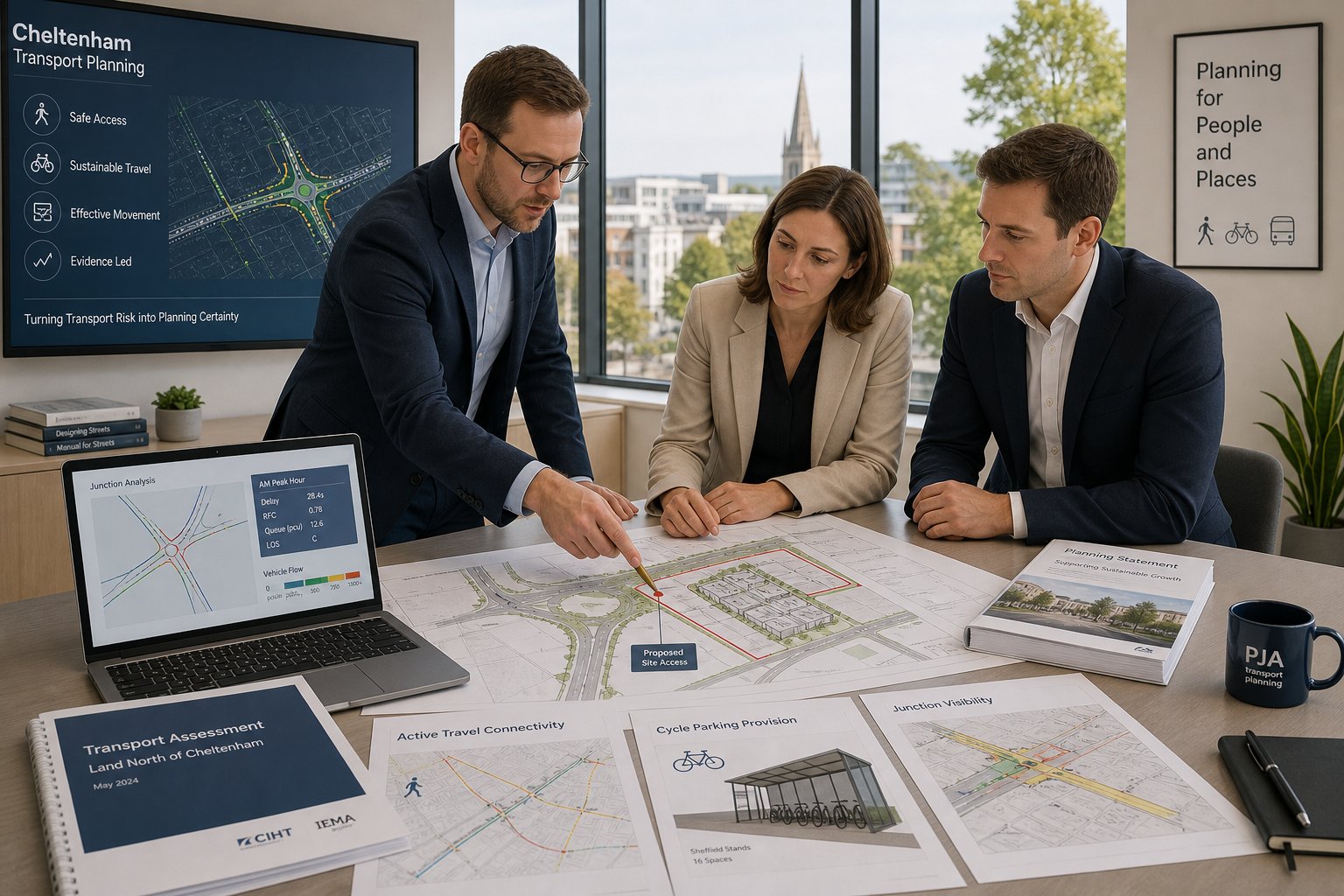
A traffic engineer in Cheltenham provides the transport and highway evidence that helps a planning application stand up to scrutiny. At the simplest level, we assess how a proposal connects to the road network and whether that connection is safe, efficient and policy-compliant. But the role usually goes much further than measuring visibility splays or counting vehicle trips.
We test likely development impact on local junctions, surrounding roads and active travel routes. That may include forecasting trips, reviewing peak-hour conditions, checking pedestrian access to nearby facilities and identifying whether mitigation is needed to keep impacts within acceptable limits. For many schemes, we also advise on access geometry, internal circulation, refuse collection, delivery activity, cycle parking, car parking and emergency access.
The work is often iterative. Early in the process, we review constraints before layouts are fixed, which saves time later. A slightly altered access position, a better servicing arrangement or a more credible parking strategy can remove objections before they arise. That is one reason many applicants bring in support well before submission rather than after highways comments land.
Our role also includes negotiation. We respond to consultee feedback, prepare technical notes, refine assumptions and, where necessary, justify why a proportionate level of evidence is enough. On broader schemes, principles used by Traffic Engineering Consultants: are applied locally, but always with Cheltenham-specific policy, network sensitivity and officer expectations in mind.
In short, we help convert a transport risk into a defensible planning case.
When You Need A Transport Assessment Or Transport Statement

Not every planning application in Cheltenham needs the same level of transport reporting. The key question is proportionality. Larger or more traffic-intensive proposals generally require a Transport Assessment, while smaller schemes with a material but more limited effect may only need a Transport Statement. The distinction matters because submitting too little can trigger delays, but overproducing technical material can waste time and budget.
A Transport Assessment is usually expected where trip generation could materially affect the network, where a site sits in a sensitive location, or where junction performance, safety, servicing or sustainable travel issues are likely to be debated in detail. A Transport Statement is more concise and normally suitable where impacts are more limited and can be explained clearly without extensive modelling.
In Cheltenham, thresholds are not just about unit numbers or floorspace. We need to look at context: nearby schools, constrained streets, parking pressure, protected frontages, walking and cycling links, and existing congestion patterns. Pre-application discussion is often the smartest route, especially for edge-case schemes. Gloucestershire County Council may agree the scope early, which can prevent a submission from being validated with avoidable information requests.
Comparable principles are visible in places beyond Gloucestershire, whether in Traffic Engineer In Bristol: work or on denser urban sites elsewhere, but local highway sensitivity still drives the final evidence package.
The practical rule is straightforward: if transport could become a reason for refusal, it deserves structured assessment before the application is lodged.
How Local Planning Requirements Shape Transport Evidence In Cheltenham
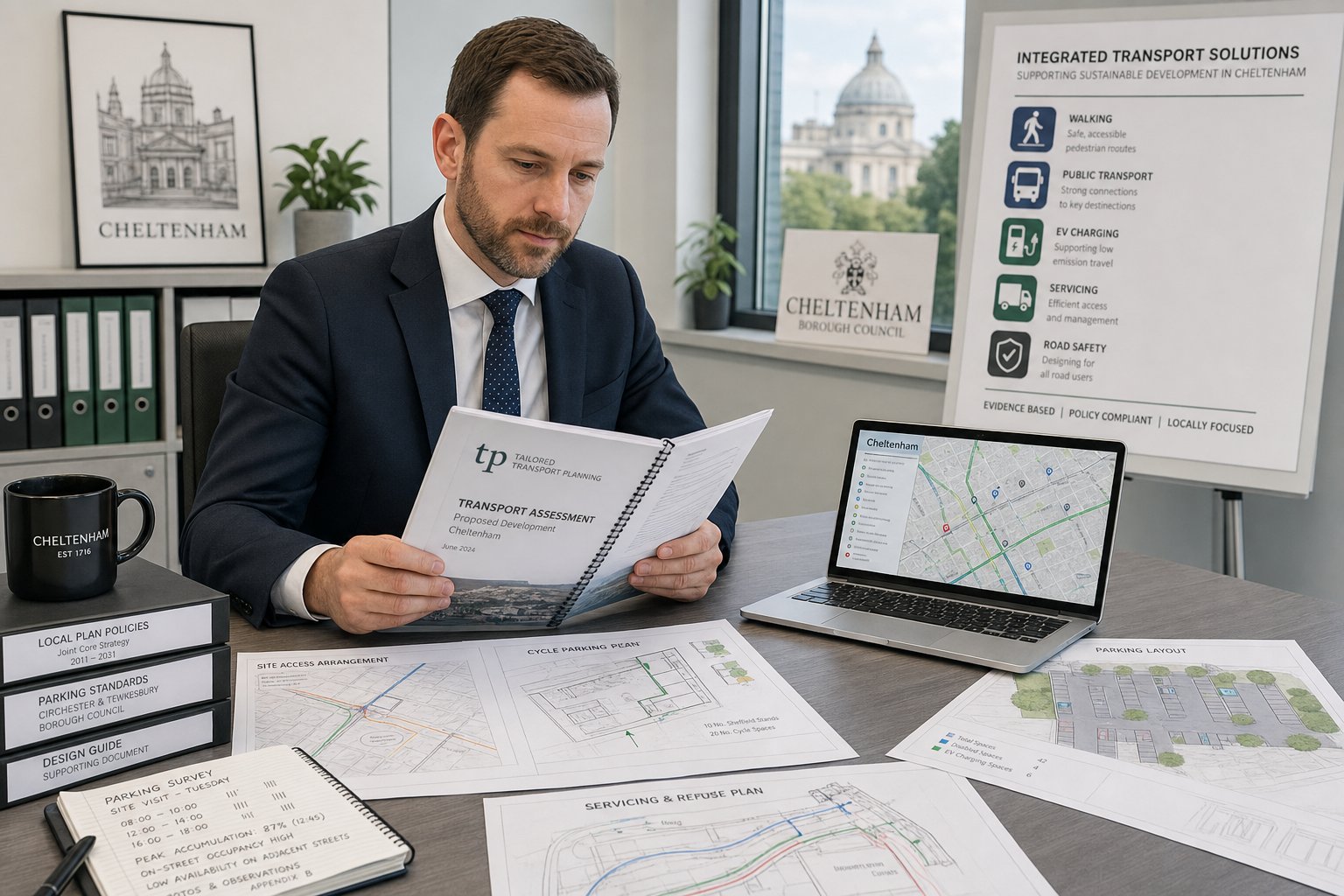
Transport evidence in Cheltenham is shaped by more than generic national guidance. Local policy and decision-making culture influence what needs to be addressed, how much detail is required and which issues are likely to attract scrutiny. That means a good report is not just technically correct: it is tailored to the local planning framework.
The starting point is usually the Cheltenham Local Plan alongside county-level transport policy, parking expectations and adopted or emerging design guidance. Those documents shape questions around parking provision, cycle storage, access standards, servicing arrangements, electric vehicle infrastructure and support for sustainable travel. National policy also matters, particularly the NPPF test around whether residual cumulative transport impacts would be severe.
That local context affects report scope. In a central location with stronger walking and bus accessibility, the justification for lower car parking may be easier to make, provided the evidence is credible. In a constrained suburban street, the same proposal might need parking surveys, manoeuvring checks and a more careful access review. Cheltenham’s urban form varies street by street, and transport evidence has to respond to that reality.
This is where local authority familiarity helps. We know that officer concerns are often less about abstract modelling and more about practical effects on neighbouring roads, vulnerable users and day-to-day operation. Wider experience from Highway And Traffic work is useful, but the report still has to speak directly to Gloucestershire and Cheltenham requirements.
Well-pitched transport evidence does two things at once: it satisfies policy tests and answers the actual concerns decision-makers are likely to raise.
Typical Developments That Require Traffic Engineering Input
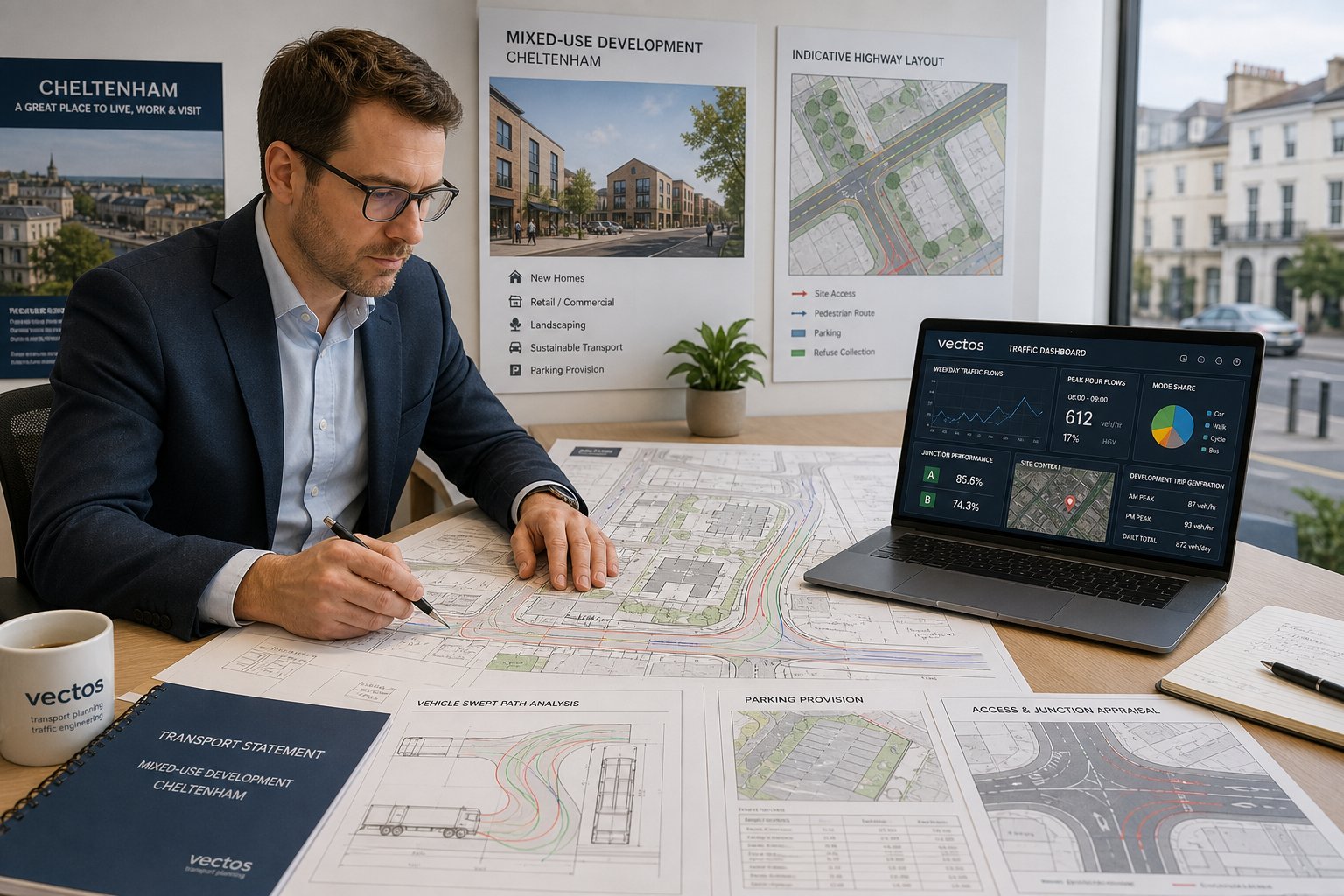
Traffic engineering input is needed on a surprisingly wide range of schemes in Cheltenham. It is not limited to major housing sites or strategic employment land. In practice, relatively modest proposals can trigger transport questions where access is awkward, parking is constrained, or neighbouring streets already operate under pressure.
The common thread is that development changes how people and vehicles interact with a site and its surroundings. Once that happens, planning officers and the highway authority need evidence. Sometimes the issue is network impact. Sometimes it is simply whether a refuse vehicle can enter and leave safely without reversing into the public highway.
Below are the broad categories where transport support is most often needed.
Residential Schemes
Residential proposals form a large share of transport planning work in Cheltenham. That includes infill plots, backland developments, apartment conversions, estate redevelopments, extra-care accommodation and larger multi-plot schemes. Even where traffic generation is fairly modest, access, parking and turning are often decisive.
For smaller residential sites, the focus is usually on practical design. Can vehicles enter and leave in forward gear? Is there adequate visibility from the proposed access? Will on-site parking reduce pressure on the street, or could it create awkward manoeuvres and poor pedestrian conditions? Parking beat surveys can be especially important where existing kerbside demand is already high and objections from neighbours are likely.
For larger housing schemes, the analysis expands. We may calculate trip generation from robust databases, distribute those trips across the local network and assess the effect on nearby junctions. We also review walking and cycling links to schools, shops, bus stops and local services because sustainable accessibility can influence both policy compliance and parking justification.
Cheltenham’s residential streets vary enormously. A compact urban infill site near amenities is very different from an edge-of-settlement proposal where car dependency is higher. Our job is to explain those differences clearly and match the evidence to the scale and sensitivity of the scheme, not to apply a one-size-fits-all template.
Commercial, Education, And Mixed-Use Sites
Commercial, education and mixed-use developments often need a more layered transport response because their travel patterns are less predictable than straightforward housing. Office schemes may concentrate arrivals in the morning peak. Retail and leisure uses can generate shorter but more frequent trips through the day. Schools and colleges can create intense, site-specific congestion in narrow time windows. Mixed-use sites combine several of these patterns at once.
In these cases, we often need to examine not just trip numbers but operational behaviour. How will servicing work? Can delivery vehicles be accommodated on site? Will pick-up and drop-off activity block access roads? Are pedestrian movements segregated from vehicle routes in a way that feels safe in daily use rather than only on paper?
Education and healthcare sites deserve special care because vulnerable users, crossing demand and parent parking behaviour can quickly become planning flashpoints. Commercial schemes meanwhile are often judged on whether parking levels are realistic and whether access points interact safely with existing junctions.
Experience across urban authorities, including Traffic Engineer In Manchester: and Traffic Engineer In London: style project types, reinforces the same lesson: the strongest reports deal with actual operational patterns, not just theoretical capacity figures.
For Cheltenham mixed-use schemes in particular, transport evidence needs to show the development will function calmly on an ordinary Tuesday, not only under ideal assumptions.
Core Transport Planning Reports And Technical Documents
Most planning projects do not rely on a single transport report. They rely on a package of documents, each addressing a different issue at the right level of detail. That package may be fairly light for a small application, or extensive for a complex site with multiple highway concerns.
The important point is coherence. The access drawing, parking strategy, trip generation, swept path checks and supporting note all need to tell the same story. If one document assumes constrained car ownership and another quietly depends on generous parking overspill, officers will spot the contradiction quickly.
Below are the core document types we prepare most often for Cheltenham projects.
Transport Assessments, Statements, And Travel Plans
Transport Assessments and Transport Statements are the backbone of most planning-stage transport submissions. They set out existing site conditions, local highway context, accessibility by non-car modes, forecast trip generation, traffic distribution, likely impact and, where needed, mitigation. The difference is mainly depth and scale rather than purpose.
A Travel Plan often sits alongside those reports. For residential schemes, it may promote walking, cycling, public transport information and welcome packs for new residents. For workplaces, it can include measures such as cycle facilities, car-sharing, shower provision, travel information boards and monitoring arrangements. Done well, a Travel Plan is not a box-ticking exercise: it helps justify a development’s transport strategy and supports policy compliance on sustainable travel.
The best reports are proportionate. A concise statement for a smaller site can be more persuasive than an overlong assessment loaded with irrelevant charts. Equally, a larger application with junction pressure or safety concerns needs enough detail to be credible. Broadly similar principles appear in Traffic Engineer In Leeds: assignments and other planning-led transport work, but local assumptions in Cheltenham should always be evidence-based and site-specific.
At ML Traffic, speed matters too. Architects and planners usually need concise reports that are technically sound, validation-ready and easy for officers to follow.
Technical Notes, Junction Reviews, And Supporting Evidence
Many applications are decided not on the headline report, but on the supporting documents that answer a specific concern. A technical note might justify reduced parking in a sustainable location, explain why a Transport Statement is proportionate, or respond to highway comments after submission. These shorter documents can be decisive because they address the exact issue holding up progress.
Junction reviews are another common requirement. Depending on the layout, we may assess priority junctions, roundabouts or signal-controlled nodes using recognised tools such as PICADY, ARCADY or LINSIG. The aim is to understand capacity, delay and queueing under existing and future-year conditions, then explain whether the development causes a material problem.
Supporting evidence can include automatic traffic counts, classified turning counts, speed surveys, parking beat surveys, swept path analysis, personal injury collision review and sometimes Road Safety Audit input. None of these should be produced for the sake of bulk. Each one should answer a planning question.
That focused approach is what separates persuasive evidence from paperwork. Schemes handled in the style of Traffic Engineer In Birmingham: or Traffic Engineer In Liverpool: often demonstrate the same principle: targeted technical work tends to move applications forward faster than generic reporting.
If a report can’t explain why it exists, it probably isn’t helping the application.
Key Traffic And Highway Issues Reviewed At Planning Stage
At planning stage, highway review usually centres on a predictable set of issues, though the importance of each varies by site. Access is often first. Officers want to know whether the proposed entry and exit arrangement is safe, visible and compatible with the surrounding road hierarchy. Gradients, gate set-back, interaction with nearby junctions and space for vehicles to pass can all become relevant.
Traffic impact comes next. We consider how many trips the site is likely to generate, when they occur and where they go. Then we test whether nearby junctions and links can accommodate that demand without unacceptable congestion or safety problems. The legal and policy threshold is not zero impact: it is whether impacts are acceptable and, if necessary, capable of mitigation.
Sustainable travel is increasingly important. Applications are expected to show realistic opportunities for walking, cycling and public transport, especially in accessible parts of Cheltenham. But realism matters. A report loses credibility if it oversells poor bus provision or ignores uncomfortable walking routes.
Finally, planning officers and highway consultees look hard at day-to-day operation. Can deliveries happen without conflict? Will informal parking block visibility? Are pedestrians, cyclists and disabled users properly considered? Those questions sound ordinary. They are also where many applications succeed or struggle.
Strong transport evidence addresses all of them in plain terms, with enough technical depth to be defensible if challenged.
Access, Parking, Servicing, And Road Safety Considerations
Access, parking, servicing and road safety are often the most immediate transport concerns on a Cheltenham application because they relate directly to whether a scheme will function safely once built. They are also the issues local residents tend to understand instinctively, which means objections can gather pace quickly if the design looks awkward.
Access design starts with geometry and visibility, but it does not end there. We also look at gradients, drainage implications, pedestrian crossing desire lines and whether the access arrangement suits the street type. A technically compliant access that feels hostile to pedestrians may still attract challenge.
Parking requires a balance between local standards, practical demand and placemaking. Too little parking can push vehicles onto already stressed streets. Too much can undermine design quality, active frontage and sustainable travel goals. In Cheltenham, parking justification often needs to engage with context rather than simply quote standards. Disabled bays, visitor spaces, cycle parking and EV charging all need to be integrated coherently.
Servicing is another classic stumbling block. Refuse vehicles, deliveries and emergency access must be able to operate without unsafe reversing or obstruction. Swept path analysis is frequently the clearest way to demonstrate this.
Road safety pulls everything together. We review collision history, likely conflict points and conditions for vulnerable users, particularly pedestrians and cyclists. Good design reduces risk before mitigation is ever debated. And that, quietly, is usually what highways officers want to see most.
Choosing The Right Traffic Engineer For A Cheltenham Project
Choosing the right consultant is not just about finding someone who can produce a Transport Statement quickly. It is about appointing a team that understands how transport evidence will be read by planners, highway officers, neighbours and, in some cases, appeal inspectors. The report needs to be technically sound, yes, but also clear, proportionate and strategically aware.
For Cheltenham projects, local knowledge is a real advantage. Familiarity with Gloucestershire County Council expectations, Cheltenham Borough Council planning context, local thresholds and recurring design issues can shorten the route to an acceptable submission. We would always recommend asking whether the consultant has worked on comparable schemes locally and whether they can show experience responding to highway comments rather than only drafting first submissions.
Professional credentials matter too. Chartered or professionally recognised practitioners, including CEng, MICE, MCIHT or MTPS-level backgrounds, generally signal technical rigour and accountability. But credentials alone are not enough. Ask whether the team can handle the full process: pre-app input, scoping advice, survey coordination, modelling, technical notes, negotiation and condition discharge.
There is also a communication point that gets overlooked. The best traffic engineer can explain a junction issue to an architect, a solicitor and a planning officer without changing the substance each time. That clarity saves projects.
In our experience, the strongest results come from early involvement, local understanding and concise reports that answer the right questions first time.
Conclusion
A well-prepared planning application in 2026 rarely treats transport as an afterthought. In Cheltenham, highway and traffic issues can influence layout, viability, determination times and eventually whether consent is granted at all. That is why using an experienced traffic engineer in Cheltenham is less about paperwork and more about risk management.
We help schemes show that access is safe, parking and servicing are workable, sustainable travel has been considered properly, and any transport effects are supported by evidence rather than assumption. For architects, planners, developers, surveyors and legal teams, the value is practical: fewer surprises, clearer negotiations and a stronger planning case.
When transport evidence is proportionate, locally informed and technically robust, it gives decision-makers confidence. And in a planning system where avoidable uncertainty can be expensive, that confidence is often what moves a project from debate to approval.
FAQs About Traffic Engineering in Cheltenham
What does a traffic engineer in Cheltenham do during planning projects?
A traffic engineer in Cheltenham assesses how developments connect to the road network, ensures safe and efficient access, forecasts trip generation, reviews parking, servicing, and pedestrian routes, and recommends mitigation in line with local policies to support planning applications.
When is a Transport Assessment or Transport Statement required in Cheltenham?
Transport Assessments are needed for larger or traffic-intensive schemes impacting the local network, while smaller but significant developments require a Transport Statement. The decision depends on trip generation, site sensitivity, and Gloucestershire County Council thresholds agreed pre-application.
How do local policies affect transport evidence for planning in Cheltenham?
Cheltenham’s Local Plan and Gloucestershire transport guidance dictate requirements for parking, access, EV charging, and sustainable travel measures. Transport evidence must be tailored to local conditions and address whether residual impacts are severe, complying with national and local policy.
What are key highway issues a traffic engineer reviews for Cheltenham planning?
Traffic engineers focus on safe access geometry and visibility, parking quantity and layout, servicing arrangements for refuse and deliveries, and road safety for pedestrians and cyclists, ensuring developments meet Gloucestershire’s standards and do not create unacceptable impacts.
What types of developments commonly require traffic engineering input in Cheltenham?
Residential infill and multi-plot sites, commercial offices, retail, education, healthcare, and mixed-use developments all often need traffic engineering support to address access design, trip impacts, parking strategies, and operational considerations within Cheltenham’s context.
How do I choose the right traffic engineer for a project in Cheltenham?
Select a traffic engineer with local Cheltenham experience, professional accreditation like CEng or MICE, a strong record of planning approvals, and capability in providing technical reports, junction modelling, and negotiating with local highway authorities for efficient project delivery.