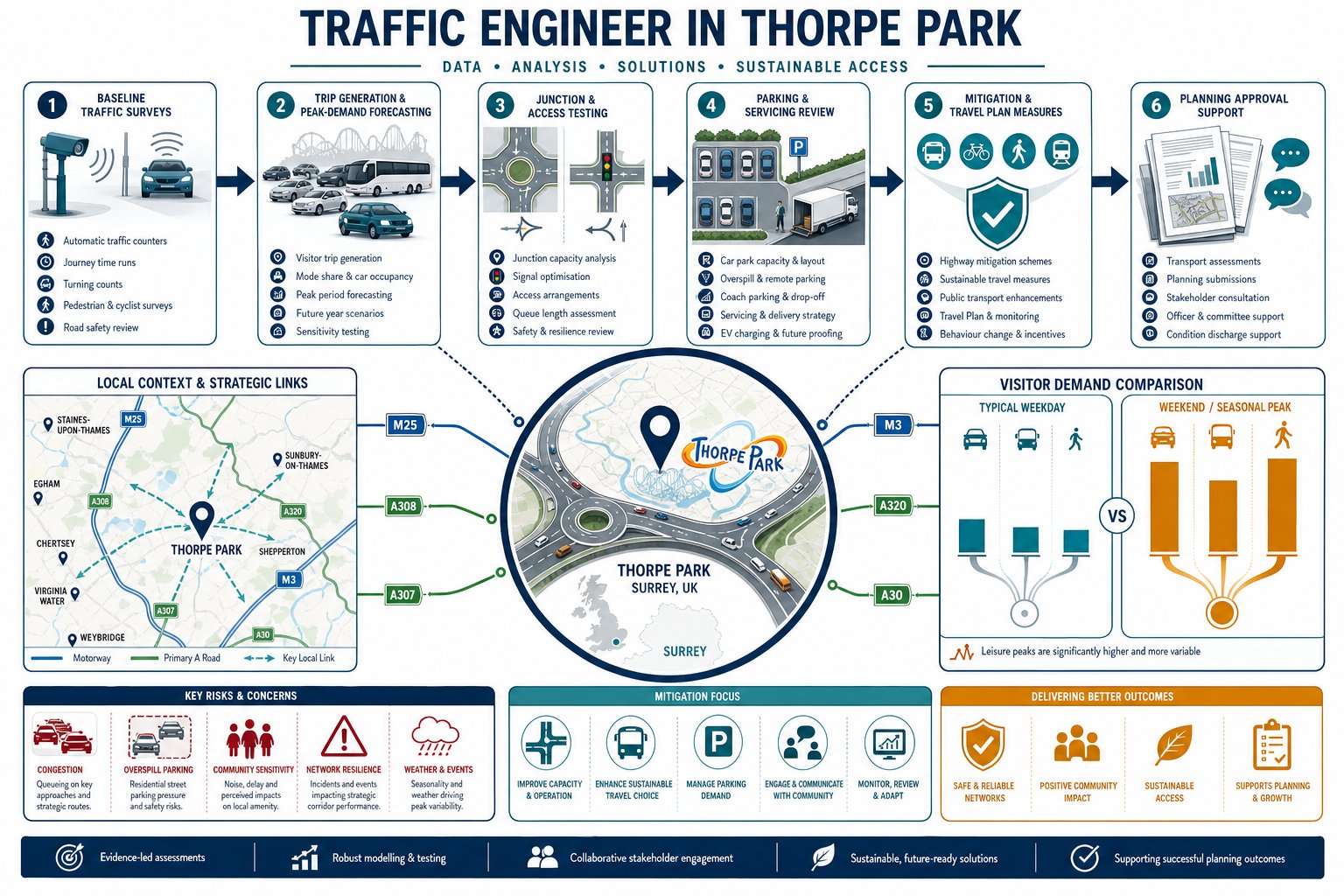
Getting a development approved in and around Thorpe Park isn’t just about good design, commercial viability, or a polished planning statement. In practice, transport is often where schemes are tested hardest. Can the local road network cope? Will access work safely for cars, coaches, servicing, and emergency vehicles? And will the proposal satisfy Surrey highways officers, National Highways, and local communities already sensitive to congestion?
That is exactly where a traffic engineer in Thorpe Park becomes critical. We help turn a transport concern into a structured, evidence-led planning case. For developers, architects, planners, lawyers, and local authorities, the challenge is rarely limited to one document. It usually involves a joined-up package: baseline traffic data, realistic trip generation, junction analysis, access design, parking strategy, travel planning, and responses to technical comments as a project evolves.
Thorpe Park and its surrounding area bring their own complications. Leisure-driven peaks don’t always look like standard weekday commuter patterns. Seasonal demand can skew assumptions. Nearby villages, strategic routes, and visitor expectations all shape what is and isn’t acceptable. In 2026, that means transport work has to be accurate, locally informed, and prepared early enough to support planning rather than scramble behind it.
In this text, we set out where traffic engineering fits, what reports may be needed, the common risks to avoid, and what to look for when appointing the right consultant for a Thorpe Park project.
Key Takeaways
- A traffic engineer in Thorpe Park plays a critical role in demonstrating with clear evidence that developments can be safely and efficiently accommodated, addressing peak visitor patterns and local congestion.
- Transport assessments, including Transport Assessments, Statements, and Travel Plans, must be tailored to the scale and impact of the project, considering seasonal and event-driven traffic variations unique to Thorpe Park.
- Early engagement and agreed scoping with local authorities and National Highways prevent delays by ensuring surveys, trip generation, and mitigation strategies meet strict local requirements.
- Effective traffic engineering integrates access design, parking strategy, junction appraisal, and sustainable travel to form a coherent transport package that supports planning approval.
- Choosing a traffic engineer with specific experience in leisure destinations like Thorpe Park and familiarity with Surrey’s planning context increases the likelihood of a smooth, successful planning process.
- Proactive transport planning that addresses potential objections related to congestion, safety, and parking overspill early on reduces planning risks and accelerates decision-making.
Why A Traffic Engineer Matters For Developments In Thorpe Park
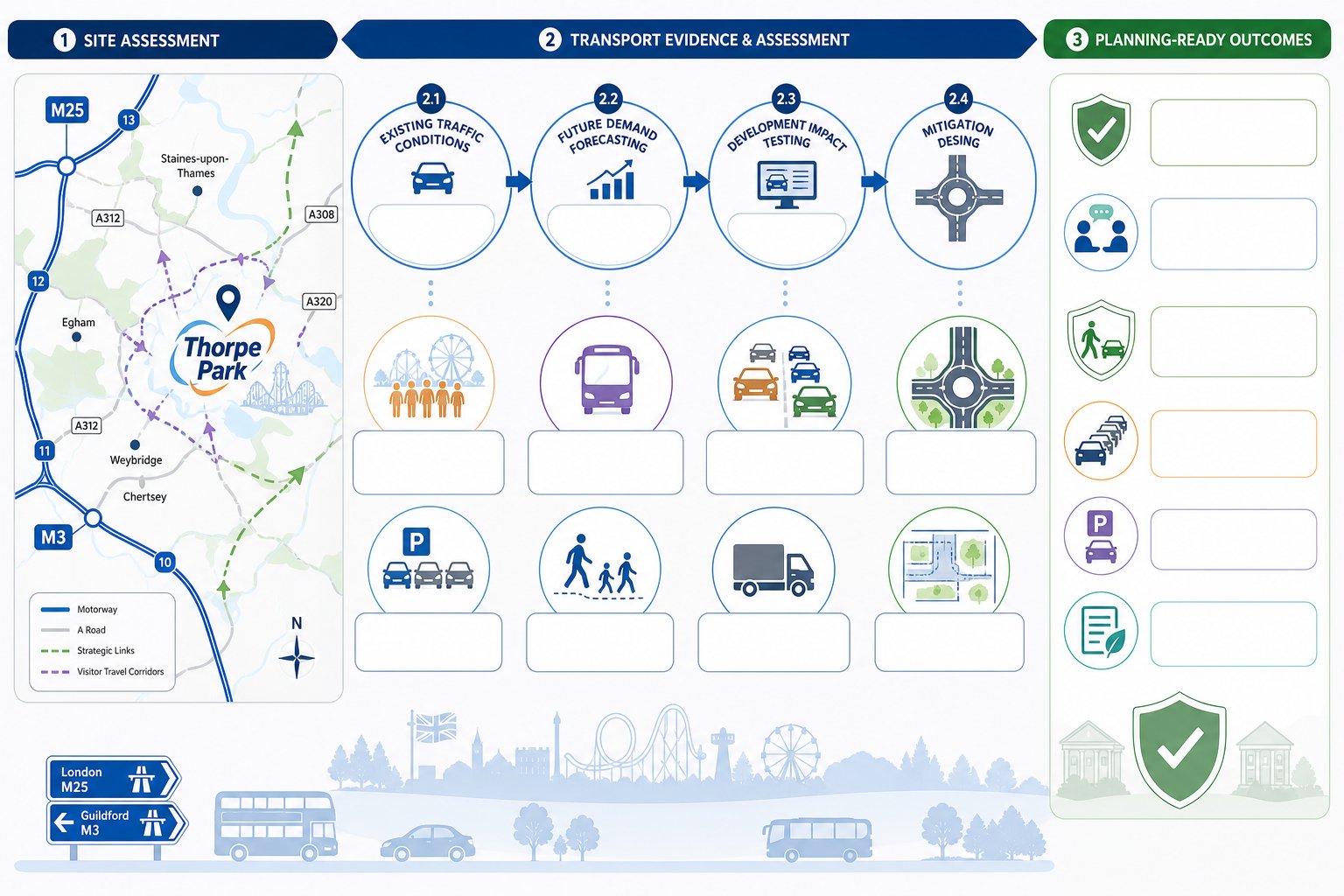
Transport evidence often decides whether a scheme moves smoothly through planning or gets stuck in rounds of queries, objections, and redesign. Around Thorpe Park, that pressure is even sharper because proposals can affect not only local roads but also wider movements connected to the M25, M3, nearby settlements, and visitor traffic patterns.
A traffic engineer’s role is to show, with evidence, that a development can be accommodated safely and efficiently. That usually means we establish existing conditions, forecast future demand, test the effect of development traffic, and identify mitigation where required. For a leisure-led destination, that may include visitor peaks, coach arrivals, parking turnover, pedestrian movement between car parks and entrances, and servicing patterns that don’t neatly fit a standard office or housing model.
We also help shape the scheme itself. Sometimes the right answer is not simply a longer report: it is a better access arrangement, a revised parking layout, clearer servicing strategy, or stronger Travel Plan measures. That early design input can prevent a proposal from drifting into avoidable transport problems.
For planning teams, the value is straightforward: fewer assumptions left exposed, fewer surprises late in the process, and a stronger basis for discussion with highways officers. Our approach reflects the same planning-led thinking we apply across wider Traffic Engineering Consultants: support, where transport work is built around decision-making, not paperwork for its own sake.
Just as importantly, a good traffic engineer helps reduce the likelihood of objection. If resident amenity, queueing, rat-running, parking overspill, or safety concerns are likely to arise, those issues need to be addressed before submission, not after.
Key Planning And Transport Challenges In The Thorpe Park Area
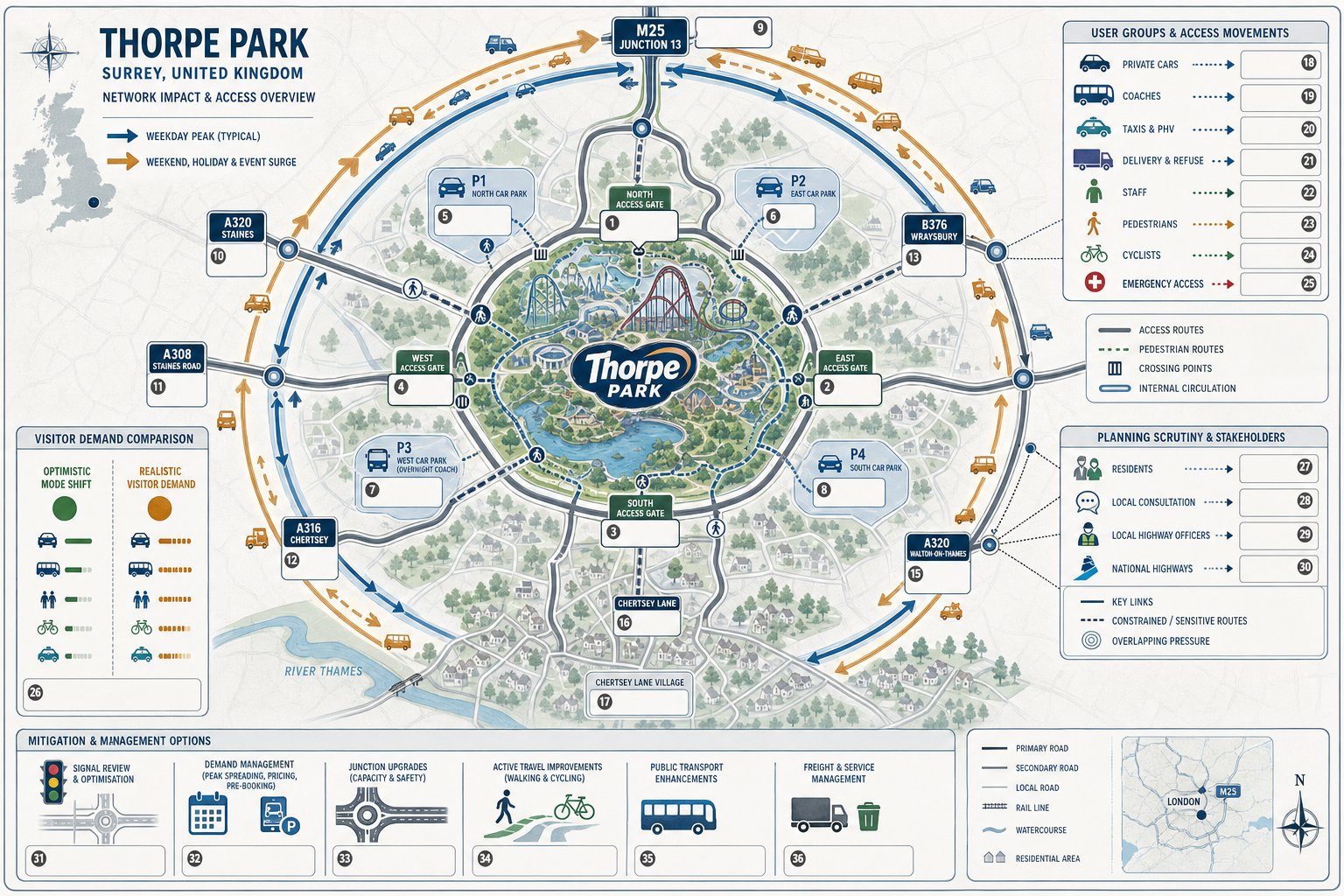
Thorpe Park sits in a transport environment that is more sensitive than it may first appear on a location plan. On paper, there is strategic accessibility nearby. In reality, development proposals can run into a mix of local congestion, seasonal pressure, constrained routes, and heightened scrutiny from multiple stakeholders.
Peak-hour conditions matter, but so do event and visitor peaks. That distinction is important. A scheme may look modest against a weekday baseline yet create very different pressure on access points, car parks, nearby junctions, and local roads at weekends, in school holidays, or during special events. Standard assumptions can miss that.
There is also the issue of surrounding communities. Villages and residential streets near major visitor attractions are often sensitive to informal routeing, overspill parking, coach movements, and noise associated with traffic growth. Even where technical modelling shows operation within capacity, perceived impact on amenity can still shape consultation responses and committee discussion.
And then there is the strategic layer. Where development has implications for key links or junctions connected to the wider network, National Highways may take an interest alongside local highway officers. That means the evidence base has to be coherent, transparent, and properly scoped.
For comparable leisure and business-led sites, Commercial Traffic Engineering work often succeeds or fails on whether those local and strategic pressures are dealt with together rather than in isolation.
How Thorpe Park Location, Access, And Network Conditions Affect Development Proposals
Location drives transport impact. A new hotel, ride, event space, ancillary retail unit, or operational building may generate different traffic profiles, but each still interacts with the same underlying access constraints.
First, access has to work for all users, not just private cars. Coaches, taxis, delivery vehicles, refuse vehicles, staff arrivals, and emergency access all need safe movement and adequate geometry. Swept paths, gate arrangements, queue storage, crossing points, and internal circulation can become decisive.
Second, the surrounding network may limit scale unless mitigation is provided. If key junctions are already under pressure, even relatively contained growth can trigger requests for additional modelling, signal review, operational changes, or demand management measures.
Third, mode choice is relevant but not limitless. Public transport and active travel opportunities may exist, yet they do not always absorb visitor demand at the same rate as urban centres with stronger rail and bus networks. That has to be reflected honestly in any assessment. Optimistic mode shift assumptions rarely survive technical review.
In short, location is not background context. It directly shapes what level of development is feasible and what evidence is needed to support it.
When A Transport Assessment, Transport Statement, Or Travel Plan May Be Required
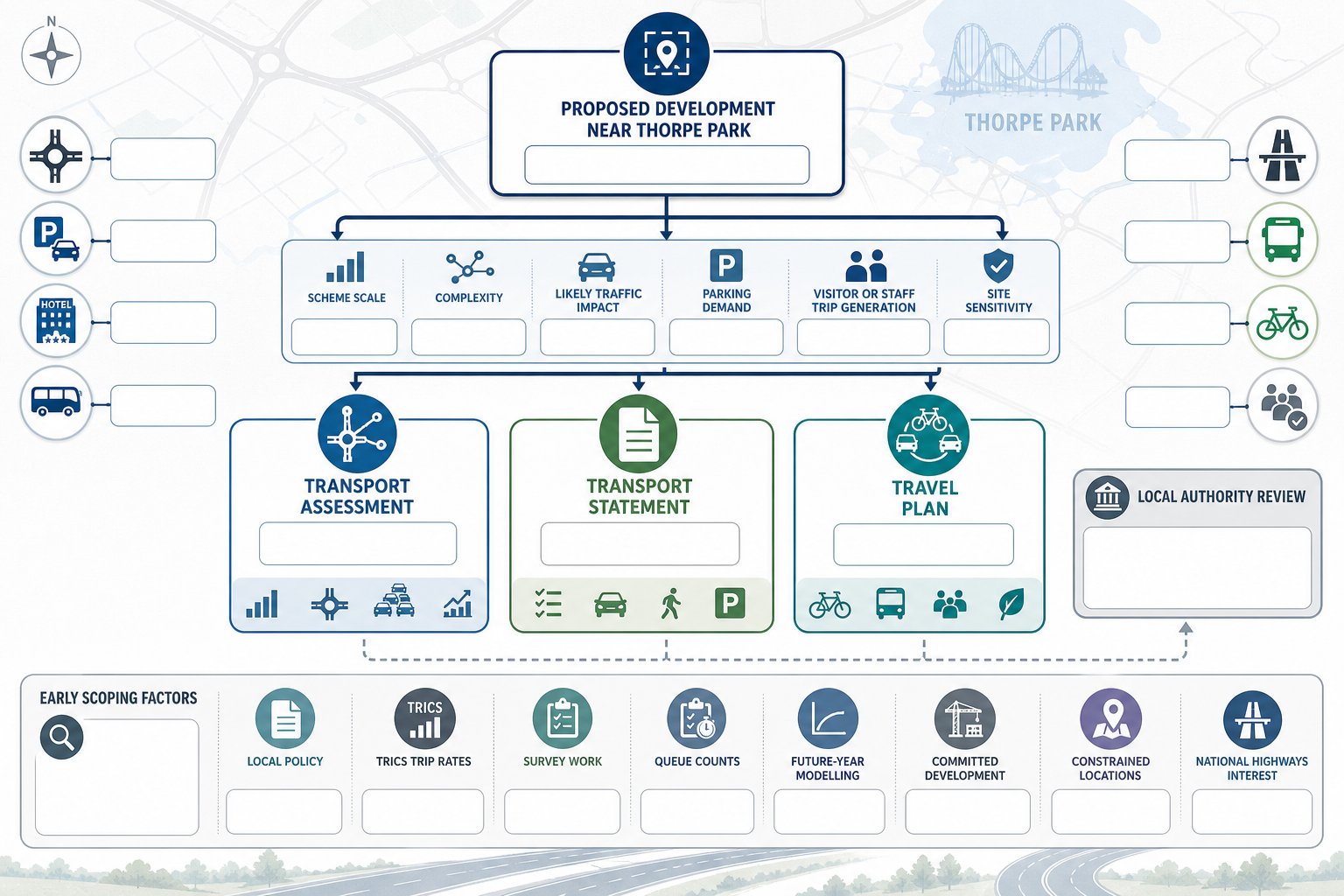
Not every scheme near Thorpe Park needs the same level of reporting. The right submission depends on scale, likely impact, local policy, and the sensitivity of the site context. But choosing too light a route too early can slow everything down later.
A Transport Assessment (TA) is usually required where a proposal is larger, more complex, or likely to affect the operation of surrounding junctions and routes. That could include a new hotel, a notable increase in visitor capacity, a mixed-use expansion, or a scheme with implications for strategic roads, internal access, or parking demand.
A Transport Statement (TS) is typically more proportionate for smaller schemes where transport effects are expected to be limited. Even then, it still needs proper baseline evidence and a reasoned explanation of why impacts remain modest.
A Travel Plan (TP) may be requested where staff or visitor travel generation is material and there is scope to encourage more sustainable travel choices. For leisure and hospitality uses, that can include staff travel measures, cycle provision, car sharing, coach management, public transport information, and parking management.
This is where early advice matters. We often find the best route is agreed through pre-application discussion, with the scope tailored to the actual issues rather than guessed from generic thresholds alone. Broader principles around Traffic Engineering: Your Complete support apply here too: the report type is only useful if it matches the planning risk.
Understanding Local Authority Expectations And Planning Thresholds
Thresholds are rarely just a numbers exercise. Local authorities will usually consider land use, trip generation, network sensitivity, safety history, nearby committed developments, and whether the scheme sits in an already constrained location.
In Surrey, as elsewhere, planning and highways officers typically expect assessment work to align with the National Planning Policy Framework, local transport policies, and standard industry methods. Trip rates are often drawn from TRICS or similarly defensible evidence. Assessment years, committed development assumptions, and study area extents should be agreed as early as possible.
That early scoping step saves time. If the authority expects queue surveys at certain junctions, future-year modelling, or a Travel Plan framework, it is better to pin that down before surveys are commissioned and reports drafted. The same goes where National Highways may have an interest in the strategic network effects.
We also advise clients not to rely on threshold tables alone. A modest proposal in a highly sensitive location may need more analysis than a larger scheme elsewhere. Equally, a well-scoped statement can be entirely adequate where impacts are demonstrably low.
The key is proportionality backed by evidence. Local authorities are usually receptive to concise, accurate reporting. What they do not like, and fairly enough, is optimistic under-scoping followed by reactive addenda after submission.
Core Traffic Engineering Services For Thorpe Park Projects
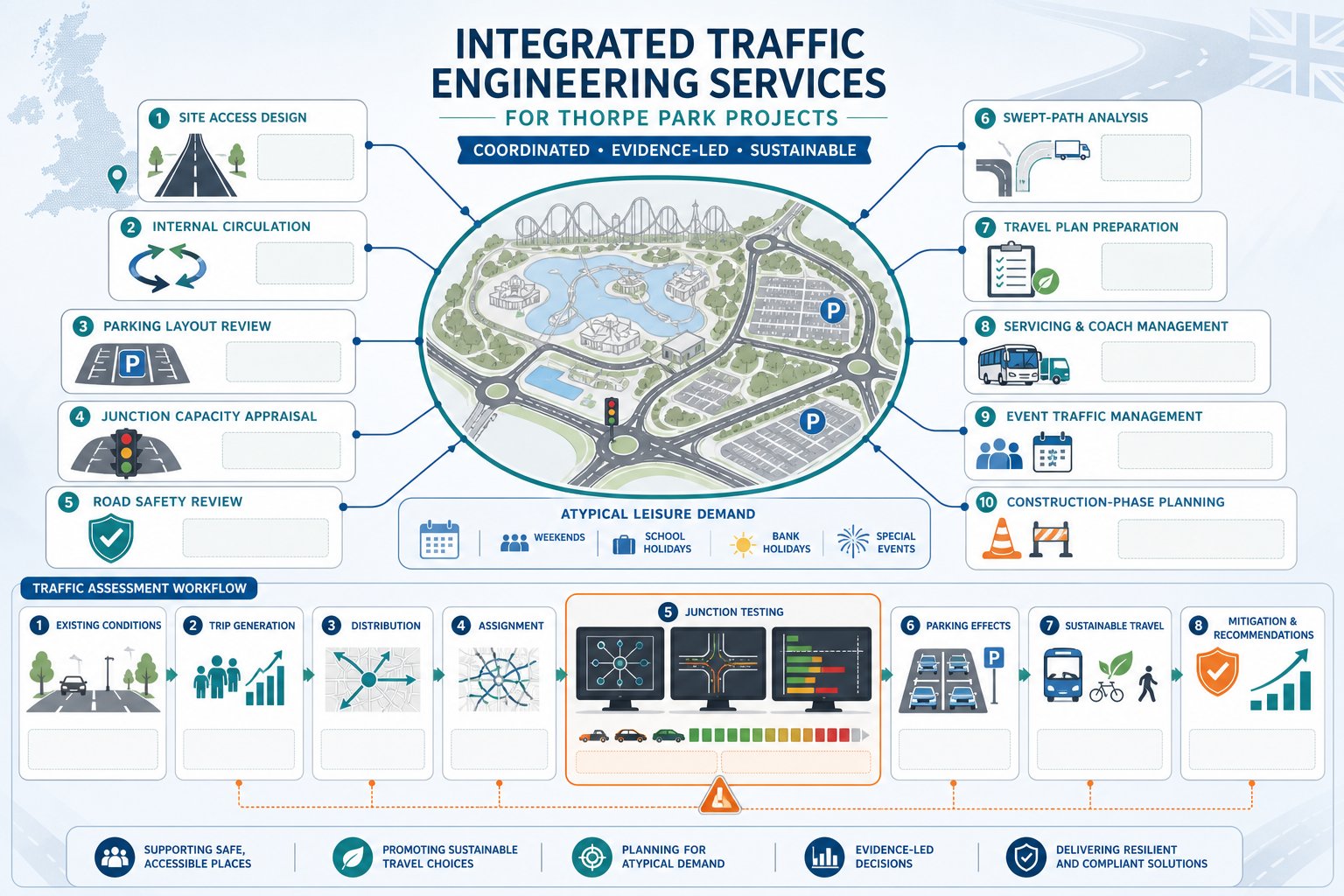
Traffic engineering support for Thorpe Park projects often extends well beyond a single planning report. Most schemes need a combination of analytical, design, and advisory input, especially where access arrangements and operational demands are part of the planning discussion.
Typical services include site access design, internal circulation planning, parking layout review, junction appraisal, road safety review, swept-path analysis, and Travel Plan preparation. On more complex sites, we may also support servicing strategies, coach management, event traffic arrangements, and construction-phase planning.
Parking is a good example of where transport and planning overlap. It is not only about counting spaces. We need to understand demand profiles, turnover, disabled provision, staff versus visitor allocation, overflow arrangements, and the knock-on effect on nearby roads if parking is misjudged. A sound parking strategy traffic approach can resolve issues before they become objections.
For clients, the benefit of integrated support is consistency. The assumptions used in access design should match those used in the TA or TS. The parking strategy should reflect likely mode share and operating peaks. The mitigation package should align with what can actually be delivered on site. That sounds obvious, but plenty of applications stumble because separate pieces of work do not quite join up.
Transport Assessments, Technical Notes, And Junction Capacity Appraisals
A strong TA or TS usually covers existing conditions, trip generation, trip distribution, assignment, junction operation, parking effects, sustainable travel opportunities, and any mitigation needed to keep impacts within acceptable bounds. In Thorpe Park, that analysis may also need to reflect atypical demand patterns, including school holiday and weekend profiles.
Junction capacity appraisal is often central. Depending on the layout, we may use tools such as PICADY, ARCADY, LINSIG, or other recognised software to test operation with and without the development. The point is not to bury decision-makers in model outputs: it is to show clearly how key junctions perform, where stress points arise, and what mitigation would be effective.
Technical notes have a different job. They are targeted responses to specific comments from the highway authority, National Highways, or planning case officer. Sometimes a concise note dealing with trip rate sensitivity, queue reassessment, or revised parking data can unlock progress faster than producing a large rewritten report.
We also support broader planning teams with the same practical mindset reflected in location-specific work such as Traffic Engineer In London: tailoring evidence to local authority expectations rather than relying on one-size-fits-all templates.
Supporting Different Project Types Across Commercial, Residential, And Mixed-Use Sites
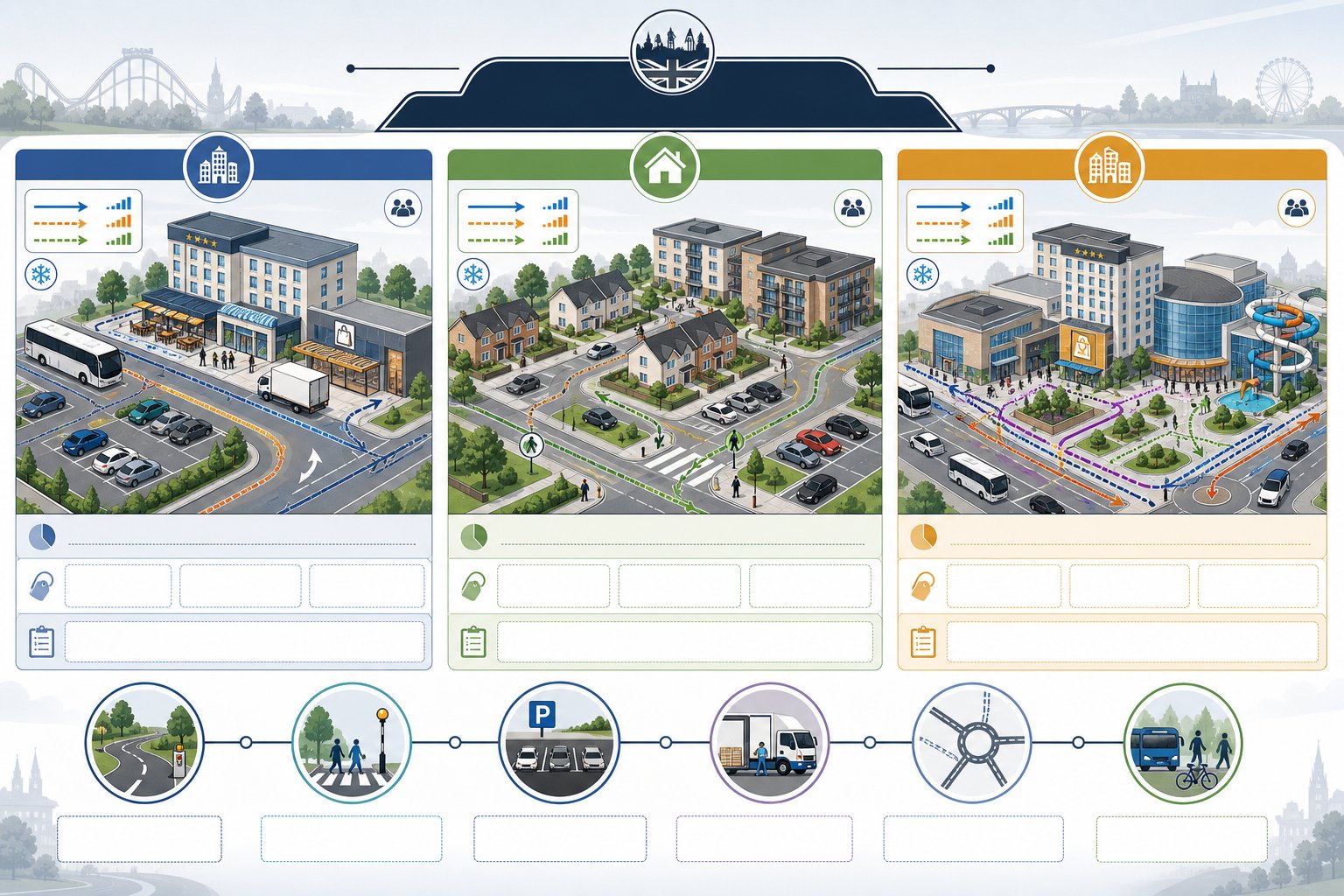
Thorpe Park-related transport work is not limited to one project type. The issues differ depending on whether the proposal is commercial, residential, or mixed-use, and a good assessment needs to reflect those differences rather than force everything into a standard format.
For commercial schemes, common examples include hotels, food and beverage units, retail elements, operational buildings, and other leisure-related facilities. These projects often bring varied arrival patterns across the day, stronger weekend demand, servicing needs, coach activity, and more complicated parking behaviour than a conventional employment site.
For residential development, the key question is sometimes not only what the housing generates, but how the wider Thorpe Park traffic environment influences access, amenity, road safety, and parking stress. Staff accommodation, nearby housing, and edge-of-settlement schemes may all need careful consideration of background visitor traffic and seasonal variation.
For mixed-use proposals, complexity increases. A hotel combined with conference space, leisure floorspace, and ancillary retail may produce overlapping peaks, or, in some cases, demand smoothing that can be beneficial if evidenced properly. The transport strategy has to explain that interaction clearly.
Across all three categories, we look at the same fundamentals: access, safety, parking, servicing, network impact, and sustainable travel. But the evidence base, survey strategy, and mitigation package must suit the use. That’s one reason planners and developers often value consultants with cross-sector experience, whether on local leisure schemes or work comparable in structure to Traffic Engineer In Manchester: and other city-based, planning-led transport commissions.
The practical lesson is simple: land use matters. The better the transport evidence reflects actual operational reality, the more credible the planning case becomes.
The Data, Surveys, And Modelling Used To Build A Robust Planning Case
Good transport reporting starts with good evidence. If the baseline data is weak, outdated, or unrepresentative, every conclusion built on it becomes easier to challenge.
For Thorpe Park projects, that usually means assembling a data set that reflects both normal operating conditions and any relevant seasonal or peak visitor patterns. Depending on the scheme, this may include classified turning counts at key junctions, automatic traffic counts, queue length surveys, journey time information, parking occupancy surveys, and pedestrian movement observations.
Car park data is often more important than teams expect. Arrival and departure profiles, occupancy by time of day, overflow use, and peak accumulation can reveal whether the real pressure point is the external highway network, internal circulation, or both. Visitor origin-destination information can also help explain routeing and strategic impacts, especially where wider network concerns are raised.
Trip generation must be based on defensible evidence. That may involve TRICS, local survey data, comparable sites, or a blend of sources, depending on the use. Then comes distribution, assignment, and scenario testing for opening year and future year conditions, often including sensitivity tests.
The modelling itself should answer planning questions, not just produce diagrams and ratios. What happens in the AM peak, PM peak, weekend peak, or event condition? Which junctions are critical? What difference does mitigation make? Clear reporting is essential.
Our wider experience on regional planning work, including Traffic Engineer In Bristol: and other authority-facing studies, reinforces the same principle: robust inputs make for faster, more defensible outputs.
And one final point, survey timing matters. Data gathered on the wrong day, in the wrong season, or without agreed scope can create weeks of avoidable delay.
Common Risks That Delay Planning Applications And How To Avoid Them
Most transport delays are predictable. They are rarely caused by one dramatic failure: more often, they come from small weaknesses that accumulate until the planning authority asks for more information.
The first common risk is poor scoping. If the study area, survey requirements, or report type are not agreed early, applicants can end up revisiting core assumptions after submission. That is expensive and frustrating, and usually avoidable.
The second is underestimating trip generation. Around Thorpe Park, this often shows up where weekday assumptions are applied to uses that have stronger holiday, weekend, or event demand. If local officers think the traffic forecast is too low, confidence in the whole report drops quickly.
A third problem is vague mitigation. Saying that parking will be managed, active travel encouraged, or access improved is not enough. Authorities typically want specifics: layout changes, signage, operational measures, Travel Plan actions, monitoring triggers, or junction works that can actually be secured.
Then there is technical quality. Drawings that do not match the text, swept paths prepared for the wrong vehicle, modelling files in the wrong format, or unsupported assumptions in appendices can all trigger delay.
We advise clients to treat transport work as part of the planning strategy from day one. That means early scoping, realistic survey design, honest assumptions, and draft review before submission. The principles are consistent with planning-focused support across sectors, including Traffic Engineer In Leeds: style commissions where timing and clarity often matter as much as technical depth.
Done properly, traffic engineering does not just respond to risk. It removes it before it reaches committee papers or objection letters.
What To Look For When Choosing A Traffic Engineer In Thorpe Park
Not every consultant is the right fit for a Thorpe Park project. The technical basics matter, of course, but so does relevant experience, judgement, and the ability to work comfortably within a planning-led process.
First, look for proven experience with theme parks, leisure destinations, or major visitor attractions. These sites do not behave like standard office parks or suburban housing estates. Peak patterns, parking demand, coach operations, event management, and seasonal pressures all need sector-specific understanding.
Second, choose a team familiar with Surrey requirements and National Highways processes. Local expectations on scoping, thresholds, modelling, and report presentation can make a real difference to programme and outcome.
Third, ask whether the consultant can do more than produce a report. Can they advise on access design, parking strategy, swept-paths, road safety, and technical responses during determination? Planning applications rarely move in a straight line, so flexibility matters.
Fourth, pay attention to reporting style. Decision-makers need concise, accurate, readable documents. Long reports are not automatically persuasive. In our experience, clients value clear evidence, direct recommendations, and prompt answers to officer queries, especially where a programme is tight.
Finally, look at track record. Successful planning support usually reflects a mix of technical capability and stakeholder handling. If a consultant can gather robust data, model properly, explain issues plainly, and negotiate sensibly, the project is in safer hands.
That is the standard we aim for through our work at ML Traffic: over 30 years of experience, concise reporting, and advice tailored to local authority thresholds and planning context.
Conclusion
For schemes at or near Thorpe Park, transport is rarely a side issue. It can determine the scale of development that is realistic, the mitigation that is necessary, and whether a planning application progresses smoothly or stalls under technical challenge.
A capable traffic engineer in Thorpe Park helps bring structure to that process. We define the right scope early, build the evidence base properly, test impacts honestly, and shape mitigation that stands up to scrutiny. That applies whether the project is a hotel, leisure expansion, staff accommodation, mixed-use proposal, or a nearby site affected by resort traffic conditions.
The strongest applications tend to have one thing in common: transport is considered early, not bolted on at the end. When access, parking, junction performance, servicing, and sustainable travel are addressed in a joined-up way, planning risk drops and decision-making becomes much clearer.
In 2026, that kind of planning-led, locally aware transport support is not a luxury. For Thorpe Park projects, it is often what unlocks permission.
Frequently Asked Questions about Traffic Engineering in Thorpe Park
Why is a traffic engineer important for developments in Thorpe Park?
A traffic engineer provides essential transport evidence to prove that a development can be safely accommodated, helping to address capacity, safety, and amenity concerns from Surrey authorities, National Highways, and local communities, which supports successful planning approvals.
What transport assessments might be required for Thorpe Park projects?
Larger schemes like new hotels or major expansions typically require a Transport Assessment, smaller developments may only need a Transport Statement, while Travel Plans are often required to promote sustainable travel and manage parking for significant visitor or staff travel.
How do location and access influence development proposals near Thorpe Park?
Thorpe Park’s transport environment involves seasonal peaks, coach movements, and limited public transport options. Access designs must accommodate cars, coaches, deliveries, and emergency vehicles safely, and network constraints may limit development scale without effective mitigation.
What are the common risks that delay planning applications in Thorpe Park, and how can they be avoided?
Delays often stem from poor early scoping, underestimating trip generation—especially seasonal or event peaks—vague mitigation plans, or technical errors. Early agreement on scope, realistic data, specific mitigation, and high-quality reports help avoid such issues.
What core traffic engineering services are provided for Thorpe Park developments?
Services include access and parking layout design, junction capacity modelling using tools like PICADY and LINSIG, road safety audits, swept-path analysis for large vehicles, and preparation of Travel Plans and construction traffic management strategies.
How do traffic patterns at Thorpe Park differ from standard developments?
Thorpe Park experiences leisure-driven visitor peaks, with higher weekend, holiday, and event traffic unlike typical weekday commuter flows. This requires tailored trip generation and modelling to capture seasonal variability and complex visitor movement patterns accurately.