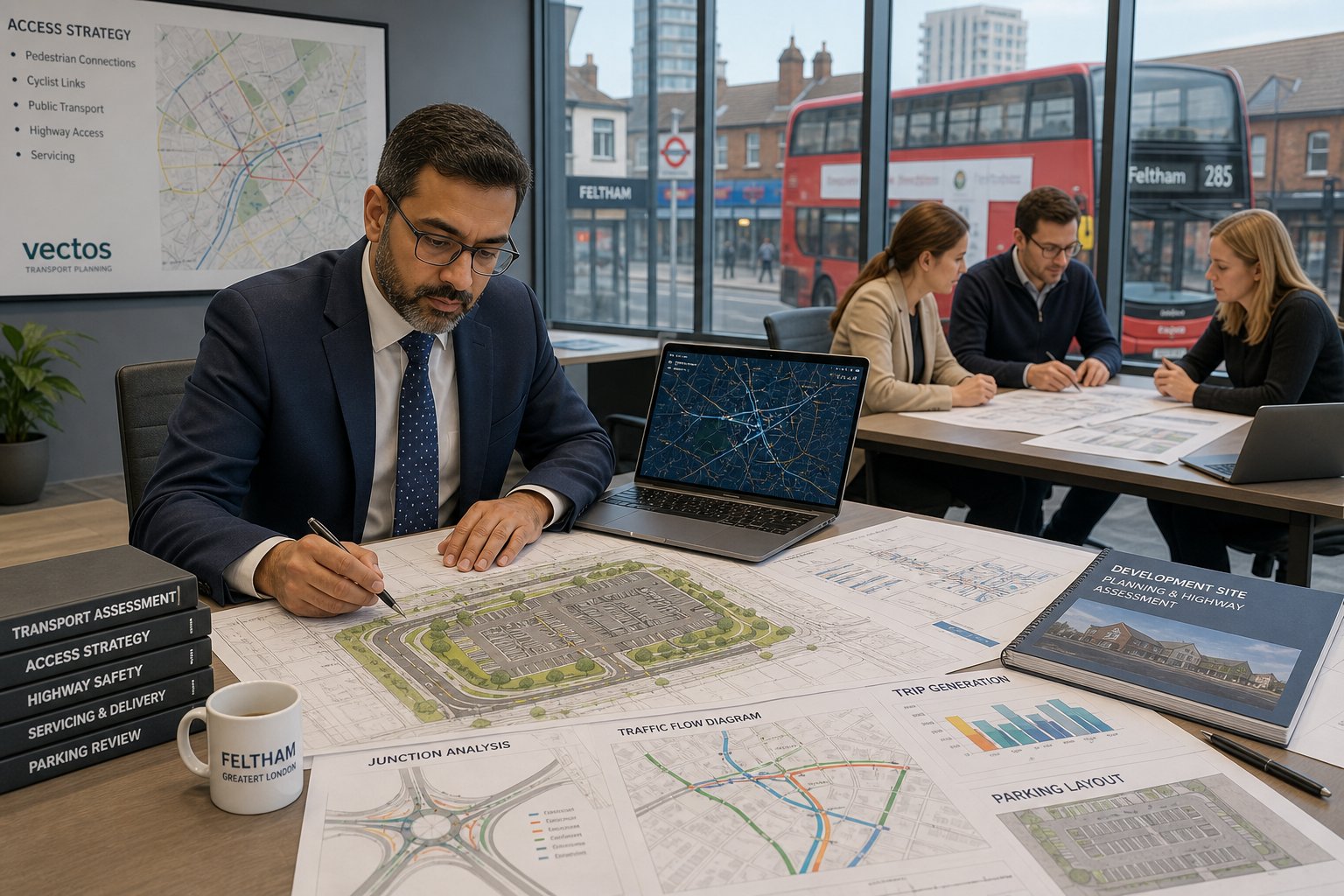
Planning applications rarely fail on transport alone, but transport is often where weak schemes start to unravel. A promising site layout can suddenly look far less convincing once trip rates, access geometry, servicing movements, parking demand, or junction stress are tested properly. In Feltham, that matters more than many applicants first assume. The area combines busy corridors, local centres, residential streets, public transport links, school-run pressure, and the very real expectations of planning officers and highway consultees.
That is where a traffic engineer in Feltham becomes commercially useful, not just technically necessary. We help project teams show how a development will actually function in the real network around it, rather than in a neat red-line drawing detached from day-to-day conditions. For architects, planners, lawyers, developers, surveyors, and councils, the value is straightforward: clearer evidence, fewer assumptions, and a better chance of addressing transport issues before they become objections.
In practice, our role usually centres on Transport Statements, Transport Assessments, Travel Plans, access reviews, servicing analysis, junction capacity work, and parking evidence tailored to the scale of the proposal. But the most effective input often starts earlier than the formal report. We use transport evidence to influence design, strategy, and planning positioning from the start, so the final submission is more robust, more defensible, and usually far easier for decision-makers to assess.
Key Takeaways
- A traffic engineer in Feltham plays a crucial role in ensuring development proposals align with local transport conditions, making planning submissions more robust and defensible.
- Early involvement of a traffic engineer can influence site layout, access, parking, and servicing strategies to avoid common objections and support smoother planning approval processes.
- Transport Statements, Transport Assessments, and Travel Plans are vital reports tailored to the scale and sensitivity of Feltham developments, addressing trip generation, junction capacity, and sustainable travel.
- Local transport evidence specific to Feltham’s busy corridors, public transport links, and residential pressures is essential for credible assessments that satisfy planning officers and highway consultees.
- Collaboration between traffic engineers, architects, planners, and developers ensures transport issues are integrated early, reducing redesign and improving the overall planning outcome.
- Choosing a traffic engineer with relevant local experience, strong analytical skills, and clear communication significantly enhances the transport evidence quality and planning success in Feltham.
What A Traffic Engineer In Feltham Does For Planning And Development Projects
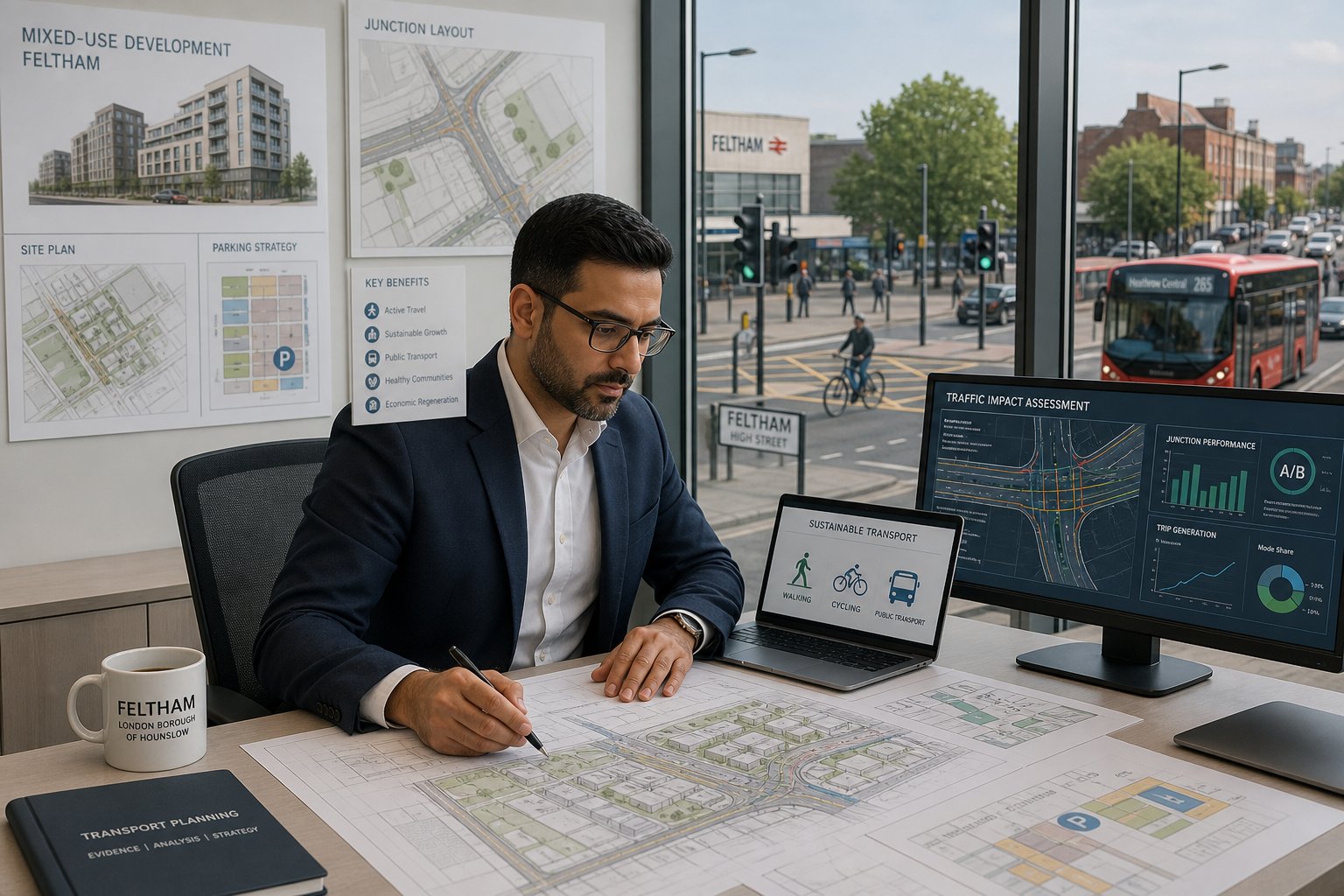
A traffic engineer in Feltham supports the planning process by testing whether a development can be accessed safely, accommodated on the surrounding highway network, and aligned with sustainable transport expectations. That sounds simple. It rarely is.
Our work normally begins with the proposal itself: what land use is proposed, how many units or how much floor area is involved, what access points are being considered, and which users will rely on the site. From there, we assess likely trip generation, distribution, parking demand, servicing needs, walking and cycling connectivity, and the effect on nearby junctions or streets. On smaller schemes, this may lead to a concise evidence base. On larger or more sensitive sites, it becomes a detailed modelling and strategy exercise.
We also translate technical transport issues into planning-ready evidence. That matters because planning officers, committees, and consultants need clear reasoning, not just data tables. Good reporting explains what is happening, why it matters, and whether mitigation is needed.
For teams comparing broader regional approaches, work in Feltham often sits within the same discipline described in Traffic Engineering: Your, but local context still drives the final advice. Equally, the practical role outlined in Traffic Engineering Consultants: is highly relevant here: we are there to identify transport risk early, shape the scheme, and support a more credible planning submission.
Why Local Transport Evidence Matters In Feltham
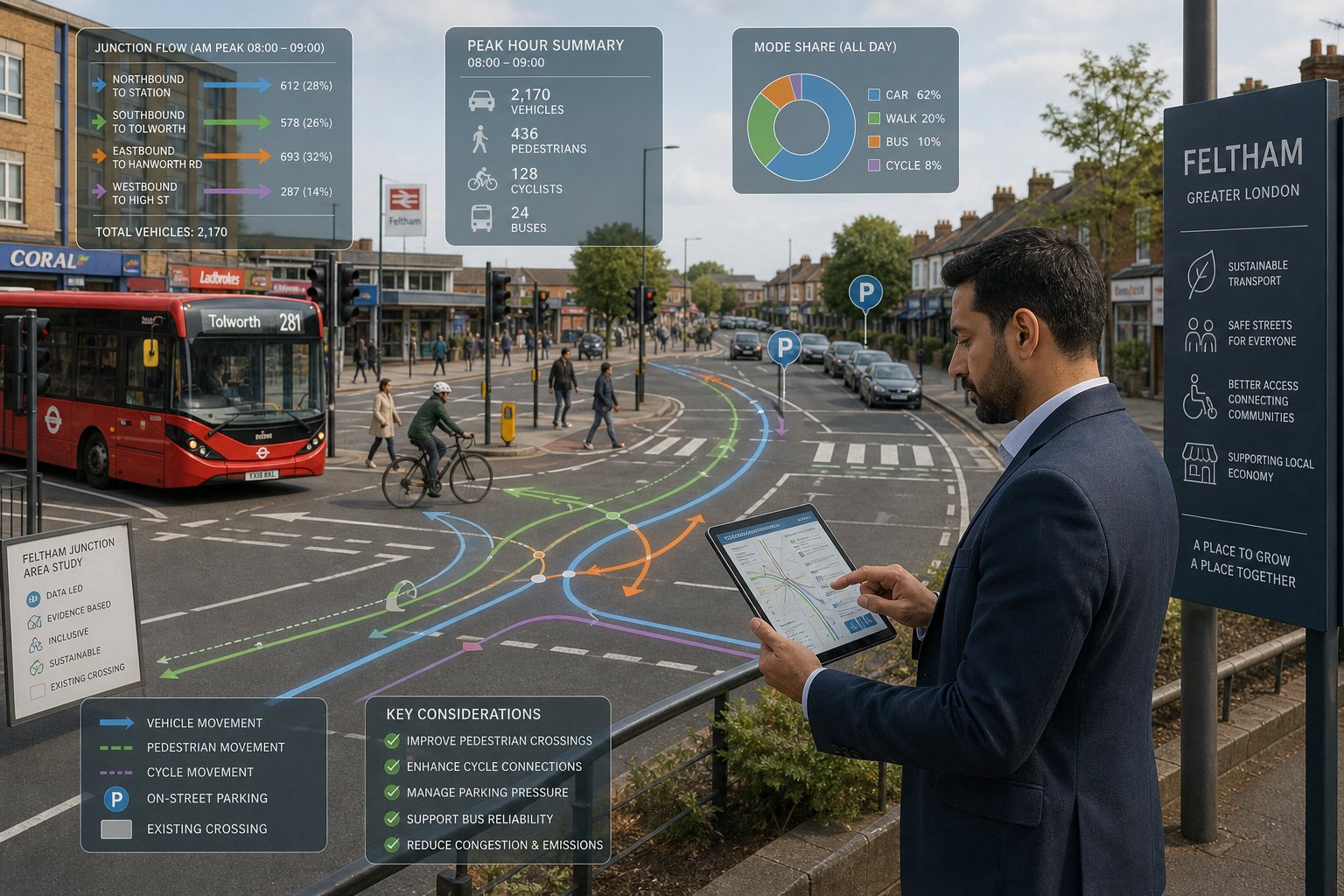
Transport evidence only becomes persuasive when it reflects the place the scheme will sit in. In Feltham, local conditions can shift the planning position considerably. A site close to rail and bus links may support a stronger sustainability case than one dependent on private car travel. A frontage on a strategic route creates different access and safety issues from a quiet side street. And a proposal near schools, retail activity, or constrained residential parking will often attract closer scrutiny.
That is why local surveys, site observations, and network understanding matter. We look at peak-hour conditions, turning patterns, nearby junction operation, pedestrian movement, on-street parking stress, and the character of the surrounding road hierarchy. Generic assumptions borrowed from another borough or another site type can undermine an otherwise strong application.
Feltham also sits within a wider London planning and transport context, so local authority expectations tend to be evidence-led and fairly pragmatic. The benchmark is not whether a report looks substantial: it is whether it answers the real transport questions raised by the site.
That local emphasis mirrors what teams often encounter across the capital, as discussed in Traffic Engineer In London:, but Feltham has its own development patterns, congestion points, and access constraints. In other words, local transport evidence is not a formality. It is the difference between a report that sounds competent and one that actually helps unlock consent.
Planning Applications That Often Require Traffic Engineering Input
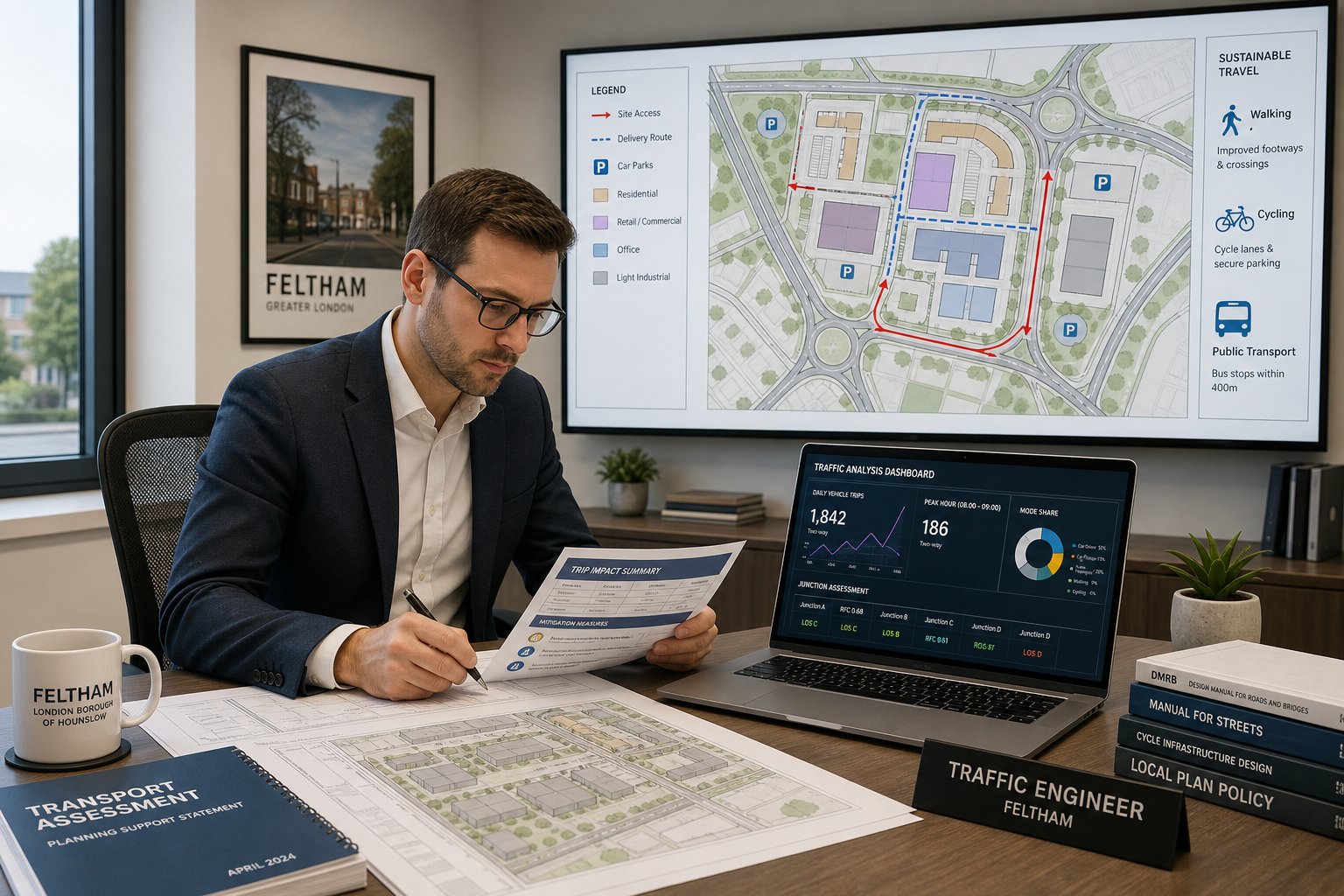
Not every planning application needs the same level of transport evidence, but many development types trigger the need for traffic engineering input much earlier than expected. Residential schemes, mixed-use developments, retail units, offices, industrial premises, schools, healthcare uses, and changes of use can all raise transport questions. Sometimes the issue is total trip impact. Sometimes it is parking overspill, delivery activity, refuse access, or unsafe vehicle manoeuvring.
In practice, the planning authority usually wants evidence proportionate to the likely effect of the proposal. A modest infill scheme may only need a focused statement. A larger redevelopment or site with operational sensitivity may require full assessment, modelling, and a structured package of mitigation. The three report types below form the backbone of that process.
Transport Statement
A Transport Statement is generally used for smaller or lower-impact proposals. Its purpose is to explain the transport characteristics of the site and development in a concise, proportionate way. We would typically cover the existing transport context, access arrangements, sustainable travel opportunities, trip generation at an appropriate level, parking provision, and whether any obvious highway safety or operational concerns arise.
A good Transport Statement is short because the scheme allows it, not because the analysis is superficial. The report still needs to show that the proposal has been examined properly and that any likely effects are understood.
Transport Assessment
A Transport Assessment goes further. It is usually prepared for larger schemes or for proposals where the transport implications are more complex, more sensitive, or more likely to be contested. Here, we analyse baseline conditions in more detail, estimate development trips more rigorously, assign those trips onto the network, and test junction capacity where required. We may also review accident patterns, servicing, active travel links, public transport accessibility, and mitigation options.
For developers working on employment and trading locations, the same principles often overlap with Commercial Traffic Engineering, where operational patterns and delivery activity can be just as important as peak-hour commuting trips.
Travel Plan
A Travel Plan is the behavioural side of the transport package. It sets out practical measures to reduce reliance on single-occupancy car use and encourage walking, cycling, public transport, car sharing, and other sustainable choices. Depending on the scheme, that might include cycle parking, welcome packs, public transport information, monitoring, incentives, coordinator roles, or targeted measures for staff, residents, or visitors.
The strongest Travel Plans are realistic. They reflect who will use the site, what alternatives are genuinely available, and what commitments can actually be delivered after occupation. Planning officers usually spot boilerplate text immediately, so a site-specific Travel Plan tends to carry far more weight.
The Core Traffic Engineering Reports Used To Support Applications

Most planning submissions in this space revolve around a recognisable suite of transport documents. The exact mix depends on scheme scale, use, local thresholds, and pre-application feedback, but several report types appear again and again.
Transport Statements and Transport Assessments are the main planning reports. They are often accompanied by a Travel Plan where sustainable travel management is expected. Depending on the site, we may also prepare junction capacity assessments, swept path analysis, parking surveys, delivery and servicing notes, construction transport material, or standalone traffic impact work.
What matters is not producing more documents than necessary. It is producing the right evidence, in the right depth, at the right point in the planning programme. A concise but targeted package can be far stronger than a bulky submission full of generic appendices.
This is one reason early scoping helps. If the likely transport concerns are known upfront, we can agree a proportionate evidence base with the wider team and avoid late surprises. On comparable urban projects, approaches seen in Traffic Engineer In Birmingham: or Traffic Engineer In Leeds: often show the same pattern: the better the scope is defined, the more efficient the planning process becomes.
In Feltham, the core reports should always answer practical questions. Can vehicles get in and out safely? Will the local network cope? Is parking realistic? Are sustainable travel options credible? If the documents answer those clearly, they are doing their job.
How Trip Generation, Junction Capacity, And Parking Assessments Are Evaluated

These three topics often carry the most scrutiny because they go to the heart of operational impact.
Trip generation is assessed by estimating how many movements a development is likely to create and when those trips occur. We usually derive this from recognised databases, comparable sites, census-based context, public transport accessibility, and the nature of the proposed land use. But raw benchmark data is never enough on its own. In Feltham, local mode share, nearby rail and bus provision, parking restraint, and surrounding land uses can all justify careful adjustment. Decision-makers want to know not just the number of trips, but why that number is reasonable.
Junction capacity assessment then examines whether nearby junctions can accommodate forecast traffic within acceptable operational limits. Depending on the layout, this may involve priority junction models, roundabout modelling, signal assessment, or network-level review. The quality of this work depends as much on assumptions as on software. If future flows, distribution patterns, or baseline traffic conditions are unrealistic, the model may look precise while proving very little.
Parking assessment is similarly context-sensitive. We compare likely demand with local standards, development characteristics, accessibility, existing on-street conditions, and the balance between resident, visitor, staff, and service vehicle needs. An undersupplied car park is not always unacceptable, but it must be justified. Equally, oversupplying parking can weaken the sustainability case.
We often remind clients that these strands are interconnected: lower car trip rates may be credible only if parking restraint and sustainable travel measures are credible too. That is where sound methodology makes the difference between a report that survives challenge and one that does not.
Key Feltham Site Factors That Can Influence Transport Strategy
Feltham is not a one-condition market. Transport strategy can change sharply from one site to the next, even within a short distance. Several local factors tend to shape the advice.
First, proximity to rail and bus services can materially affect trip generation, mode split assumptions, and Travel Plan ambitions. Sites within comfortable reach of strong public transport are often better placed to support reduced parking or stronger sustainable travel arguments. Second, the surrounding road hierarchy matters. Access onto a heavily trafficked route may raise capacity and safety issues that do not arise on lower-order roads, while quieter residential streets may create sensitivity around rat-running, overspill parking, or refuse activity.
Third, peak-period congestion is a genuine issue in many suburban London locations, and Feltham is no exception. A scheme that appears manageable in daily traffic terms may still face objection if it intensifies pressure at already stressed junctions during school-run or commuter peaks. Fourth, pedestrian and cycle routes can either strengthen or weaken a planning case. A site may be geographically close to local services but still function poorly if crossings, footways, or cycle links are weak.
Nearby schools, centres, stations, and constrained service yards also influence strategy. Some sites need parking restraint: others need more attention on servicing windows, refuse collection, or delivery management. The lesson is simple: the best transport strategy starts with the actual site, not a template. A traffic engineer in Feltham should be able to spot those constraints early and use them to shape the development approach before the design hardens.
Access, Servicing, And Highway Safety Considerations
Access and safety issues are often where planning discussions become most detailed. A site may have acceptable trip generation overall but still struggle because vehicles cannot enter, turn, load, unload, or exit safely.
We usually begin by reviewing the proposed access geometry, visibility splays, interaction with pedestrians and cyclists, likely vehicle speeds on the frontage, and whether the access sits in a sensible relationship to nearby junctions or crossings. For many schemes, especially tighter urban plots, the question is less “can an access be drawn?” and more “will it work repeatedly in real operation without creating conflict?”
Servicing needs similar scrutiny. Delivery vans, refuse vehicles, maintenance traffic, and in some cases larger goods vehicles must be able to approach, stop, manoeuvre, and depart in a way that is practical for the operator and acceptable to the highway authority. If servicing relies on awkward reversing, prolonged kerbside obstruction, or unrealistic time windows, officers will usually notice.
Highway safety review can include collision history, user conflict points, visibility standards, swept path analysis, footway continuity, and the relationship between parking and manoeuvring. Sometimes modest design changes solve the problem: a widened access, adjusted gate line, revised bin store position, or altered servicing arrangement.
Comparable lessons appear on projects discussed in Traffic Engineer In Manchester:, where constrained urban access points often shape the whole planning narrative. In Feltham too, practical access and safety design can determine whether a transport submission feels convincing or fragile.
Working With Architects, Planning Consultants, And Developers
Traffic engineering works best when it is integrated into the project team rather than bolted on near submission. We regularly work alongside architects, planning consultants, developers, surveyors, and legal advisers to make sure transport evidence aligns with design, policy, viability, and programme.
That collaboration matters because transport issues rarely sit in isolation. An architect may adjust building placement to improve servicing or visibility. A planner may need transport wording that supports a planning balance case. A developer may need to understand whether reducing parking helps policy compliance or simply creates a refusal risk. Lawyers may need clear, defensible commitments where conditions or obligations are likely.
Our role is often part technical adviser, part translator. We explain what the authority is likely to focus on, what evidence is proportionate, and where the scheme can be improved before formal submission. This is especially valuable on mixed teams where design decisions are moving quickly and one small layout change can alter access performance, cycle provision, refuse movement, or vehicle tracking.
When this coordination happens early, the final package tends to read as one coherent planning case rather than a collection of disconnected documents. That saves time, reduces redesign, and usually improves credibility with consultees. In truth, some of the best transport work is invisible to the end reader because the layout has already been shaped to avoid predictable objections.
When To Appoint A Traffic Engineer During The Planning Process
Earlier than most teams think.
The ideal time to appoint a traffic engineer is before the site layout is fixed and before assumptions about access, parking, or servicing become embedded in the scheme. At that point, transport advice can influence the fundamentals: where the access should go, whether the amount of development is operationally realistic, how much parking is defensible, and what evidence will be needed for planning.
If we are brought in only after the design is effectively complete, the scope narrows. We can still test the proposal and prepare reports, but options for improving the scheme may be limited. That is when teams discover that a bin collection route does not work, a visibility line is compromised, junction modelling is required unexpectedly, or parking numbers are difficult to justify.
Early appointment also helps with pre-application strategy. We can support proportionate scoping, identify likely authority concerns, advise on surveys, and coordinate transport inputs with the wider planning narrative. That usually means fewer late changes and a more efficient path to submission.
Across UK planning work, whether in Feltham or in places referenced through Traffic Engineer In Bristol:, the pattern is consistent: early transport input is cheaper than late transport correction. It also tends to produce better schemes, not just better reports.
What To Look For In A Traffic Engineer In Feltham
If you are appointing a traffic engineer in Feltham, technical competence is the starting point, not the full answer. You need someone who understands UK planning evidence, knows how local highway and planning concerns are typically framed, and can produce reports that are concise, accurate, and genuinely useful to the decision-making process.
We would look for five things.
First, relevant project experience. Residential, commercial, education, mixed-use, and urban infill schemes all raise different transport issues, so comparable case history matters. Second, strong analytical ability. Trip generation, capacity testing, parking assessment, and servicing review need judgement as well as software. Third, practical communication. A good engineer should be able to explain risk clearly to non-technical project teams and produce reports that planning officers can follow without decoding jargon.
Fourth, local sensitivity. Feltham-specific conditions, London policy context, and authority expectations should inform the advice from the outset. And fifth, responsiveness. Planning programmes move fast: transport inputs often affect layout, statements, committee preparation, and condition discharge, so delays can ripple across the whole team.
From our perspective, the best appointment is not just the consultant who can write a Transport Assessment. It is the one who can help shape the scheme so the report has a stronger story to tell. With more than 30 years of experience and a focus on concise, planning-ready evidence, that is exactly how we approach transport support for applications in and around Feltham.
Frequently Asked Questions about Traffic Engineer Services in Feltham
What does a traffic engineer in Feltham do to support planning applications?
A traffic engineer in Feltham assesses access, trip generation, parking, servicing, and highway safety to prepare evidence like Transport Statements and Transport Assessments that show how a development will function safely within the local transport network.
Why is local transport evidence particularly important for developments in Feltham?
Feltham’s busy corridors, nearby schools, and public transport links mean local site surveys and network understanding are crucial to accurately evaluate junction capacity, trip patterns, and parking demand, ensuring transport reports reflect real operational conditions.
Which types of planning applications in Feltham usually require traffic engineering input?
Residential, mixed-use, retail, office, industrial, schools, and healthcare developments often trigger the need for traffic engineering, especially when they impact vehicle trips, parking demand, servicing arrangements, or local highway safety.
What is the difference between a Transport Statement and a Transport Assessment?
A Transport Statement is a concise report for smaller or low-impact proposals covering basic transport impacts, while a Transport Assessment is a detailed analysis including junction modelling, trip distribution, and mitigation options, used for larger or more complex schemes.
When should a developer appoint a traffic engineer during the planning process in Feltham?
Early appointment is best, ideally before fixing site layout or access details, so transport constraints can shape design decisions and planning evidence can be developed efficiently, reducing late changes and improving submission quality.
How do traffic engineers evaluate trip generation and parking assessments for Feltham developments?
They estimate trips using recognised data adjusted for local factors like public transport access, then compare parking demand against local standards and on-street conditions to balance operational needs and sustainability aims in the planning evidence.