
A planning application can look perfectly sensible on paper and still come unstuck once transport issues are tested. In Ruislip, that happens more often than many project teams expect. A scheme may fit the site, meet broad policy aims, and even respond well to design feedback, but if access is awkward, parking pressure is already high, or nearby junctions are stretched at school-run times, transport becomes the detail that decides everything.
That is why a traffic engineer in Ruislip plays such a practical role in the planning process. We do far more than produce a report to tick a box. We help show that development can function safely, that trips can be accommodated, that servicing is realistic, and that the proposal aligns with the expectations of the London Borough of Hillingdon, the London Plan, and, where relevant, Transport for London.
For architects, planners, solicitors, surveyors, developers, and local authorities, the value is simple: stronger evidence, fewer surprises, and a better chance of moving from concept to consent without avoidable delays. In this guide, we set out where traffic engineering input matters most in Ruislip, what supporting documents are typically required, and how to prepare a project so the transport case is proportionate, robust, and planning-ready.
Key Takeaways
- A traffic engineer in Ruislip plays a crucial role in ensuring development projects have safe, efficient, and policy-compliant transport solutions before planning consent.
- Early engagement with a traffic engineer can prevent delays by addressing local transport issues such as parking pressure, access geometry, and junction capacity tests.
- Transport assessments or statements in Ruislip must be proportionate to the project’s scale and local sensitivities, especially in areas affected by school peak traffic or station catchments.
- Tailored Travel Plans are essential for larger developments to promote sustainable travel and reduce car dependency while meeting London Borough of Hillingdon and London Plan requirements.
- Vehicle tracking and servicing strategies must demonstrate that manoeuvres can be repeated safely without conflicting with pedestrians or obstructing the highway.
- Coordinated collaboration with design teams and local councils ensures transport considerations are integrated early, resulting in clearer applications and higher chances of planning approval.
Why A Traffic Engineer Matters For Development Projects In Ruislip
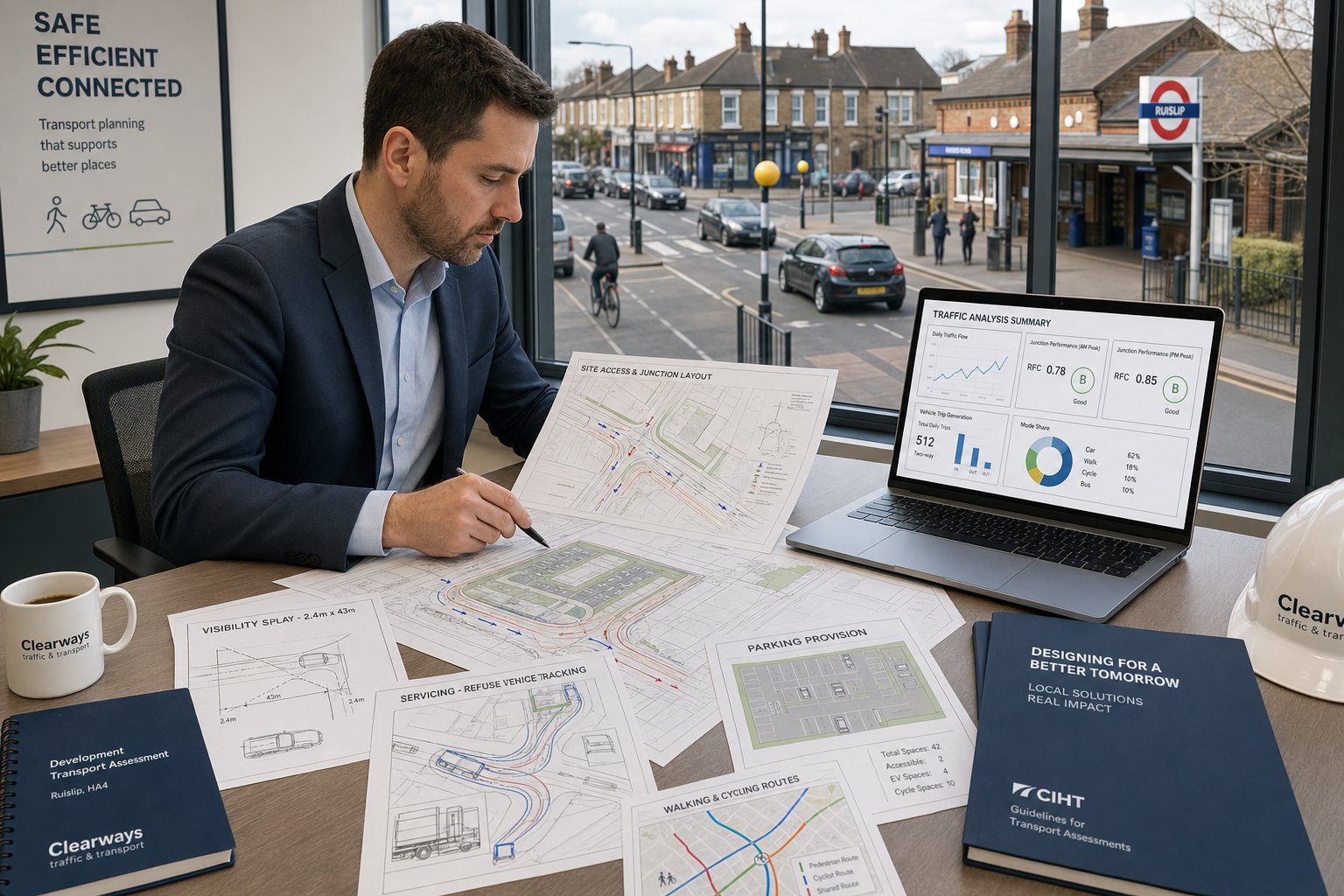
Transport is often one of the first technical disciplines to influence whether a proposal feels deliverable. A well-prepared transport case can answer concerns before they harden into objections: will vehicles enter and leave safely, will refuse collection work, is there enough parking, will local roads cope, and does the design encourage realistic non-car travel?
In Ruislip, those questions are rarely abstract. Streets can be constrained, station catchments can create competing parking demand, and school peaks can sharply affect local operation over short time windows. A traffic engineer in Ruislip helps turn those issues into measurable evidence rather than assumption. That usually means reviewing access geometry, visibility, traffic generation, parking effects, servicing, walking and cycling links, and the likely performance of surrounding junctions.
Done early, this input can save redesign costs and reduce risk. We regularly find that a modest layout amendment, a different bin collection arrangement, or a more realistic delivery strategy resolves the very issue that might otherwise delay validation or trigger objections. Broader strategic thinking matters too, which is why many teams also draw on wider guidance around Traffic Engineering Consultants: and Highway And Traffic support when deciding how much evidence a scheme needs.
In short, our role is to de-risk planning by showing a scheme is safe, efficient, policy-aware, and capable of operating in the real world, not just on a drawing.
Understanding Ruislip’s Transport And Planning Context
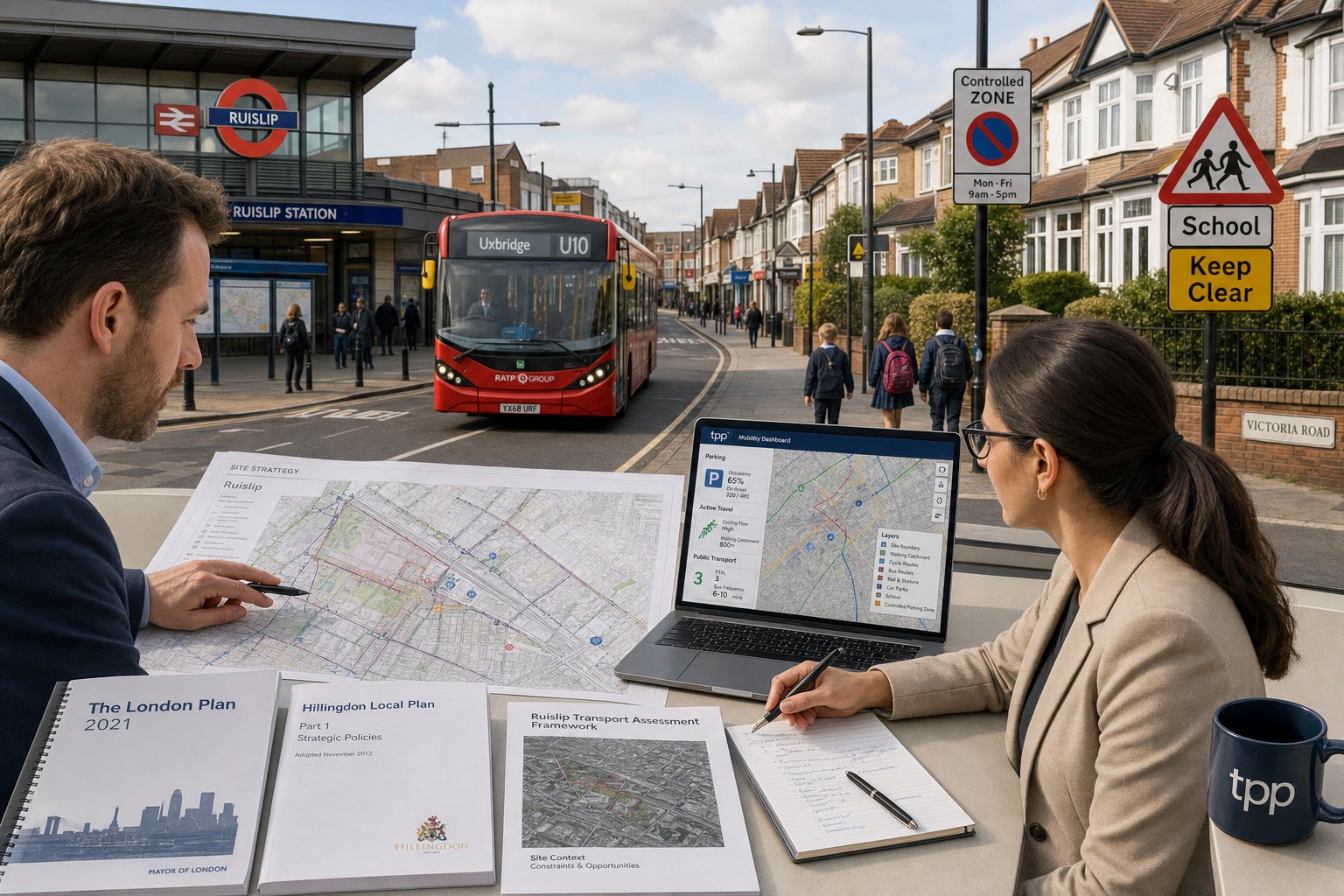
Ruislip sits within the London Borough of Hillingdon, so transport submissions are shaped by a layered policy context rather than a single checklist. The National Planning Policy Framework sets the broad test around safe and suitable access. The London Plan then adds sharper expectations on mode shift, active travel, healthy streets, public transport accessibility, and parking restraint in appropriate locations. Hillingdon’s own planning and highway considerations sit on top of that, along with any site-specific pre-application advice.
That matters because Ruislip is not uniform. Areas around stations can have stronger public transport connections and tighter parking expectations, while quieter residential streets may be far more sensitive to overspill parking, turning conflicts, and visibility constraints. In some locations, controlled parking zones, narrow carriageways, bus movement, school travel patterns, and existing congestion are central to the planning story.
We hence approach each site with local conditions first, policy second. The order is important. Policy tells us what authorities want to achieve: site evidence shows whether this scheme can credibly support it. A proposal near established public transport may justify a different parking and travel plan approach from one on a constrained suburban frontage.
For project teams working across regions, the local nuances often matter as much as the report type itself. That is one reason clients who use our broader Traffic Engineer In London: support tend to value authority-specific thresholds and expectations, especially where TfL considerations may overlap with borough review.
Common Schemes That Need Traffic Engineering Input

Not every proposal needs a full Transport Assessment, but plenty of schemes benefit from early traffic engineering input long before that threshold is tested. The common thread is change: a new access, intensified use, altered servicing, higher trip generation, or a layout that could affect highway safety.
Typical projects in Ruislip include infill residential schemes, redevelopment of commercial plots, school extensions, health facilities, mixed-use town centre proposals, changes of use with different peak-hour profiles, and sites where existing access arrangements are simply not fit for the proposed operation. Even relatively modest developments can trigger transport concerns if they sit on constrained roads or in locations with known parking stress.
We are often instructed where the issue is not just traffic volume, but practical operation. Can a refuse vehicle turn on site? Will delivery vans stop on the highway? Does a widened access remove too much kerbside parking? Is the likely trip distribution going to load a sensitive junction already under pressure?
That is why proportionate advice matters. Some projects need only a concise statement and tracking plan: others require surveys, junction modelling, travel planning, and mitigation design. The aim is never to over-engineer the response. It is to match the evidence to the planning risk, using the same practical discipline that underpins effective Traffic Engineering and work on development sites more broadly.
Residential Developments
Residential proposals are among the most common instructions for a traffic engineer in Ruislip, and they often look deceptively straightforward. A small block of flats, a backland scheme, or a conversion with additional units may seem modest in planning terms, yet access and parking issues can become the main technical hurdle.
For residential schemes, we usually test five things early: safe access geometry, visibility splays, vehicle tracking, parking provision, and likely trip impact. Refuse and emergency access are especially important. A layout that works for a private car but fails for a fire appliance or refuse vehicle is unlikely to survive detailed scrutiny.
Parking and cycle storage also need to reflect London and local standards while remaining realistic for the site’s context. That means understanding PTAL, nearby station access, on-street pressure, and whether displaced demand could affect neighbouring roads. Where local residents already perceive parking to be at capacity, survey evidence becomes crucial.
Trip generation for residential development is rarely dramatic in isolation, but cumulative impact can matter, particularly where several sites are coming forward in the same area. We hence assess not just how many trips are likely, but when they occur and which junctions or streets are most affected.
Commercial, Education, And Mixed-Use Projects
Commercial, education, and mixed-use schemes tend to generate more complex travel patterns than standard housing. Staff arrivals, visitor peaks, servicing windows, delivery activity, and school drop-off behaviour can overlap in ways that create very localised stress. In Ruislip, that can be the difference between an acceptable scheme and one that draws detailed objection from highways officers or neighbours.
For commercial proposals, we look closely at trip profiles by land use, parking accumulation, servicing demand, and whether loading can happen without blocking the network. Office, retail, health, and leisure uses each behave differently. A convenience retail unit may have short-stay churn: a medical use may create more evenly spread arrivals but higher accessibility needs.
Education projects require particular care. School peaks are intense, compressed, and emotionally charged in planning terms because local experience of congestion is so immediate. A robust school travel plan, sensible pickup arrangements, and honest parking analysis carry real weight here.
Mixed-use schemes add another layer because shared access, staggered demand, and combined servicing can either help or hinder. Sometimes a balanced mix smooths peak demand. Sometimes it creates conflict. This is where Commercial Traffic Engineering thinking becomes useful: understanding how each use actually operates, not just how it is labelled in the application.
Transport Assessments And Transport Statements For Planning Applications
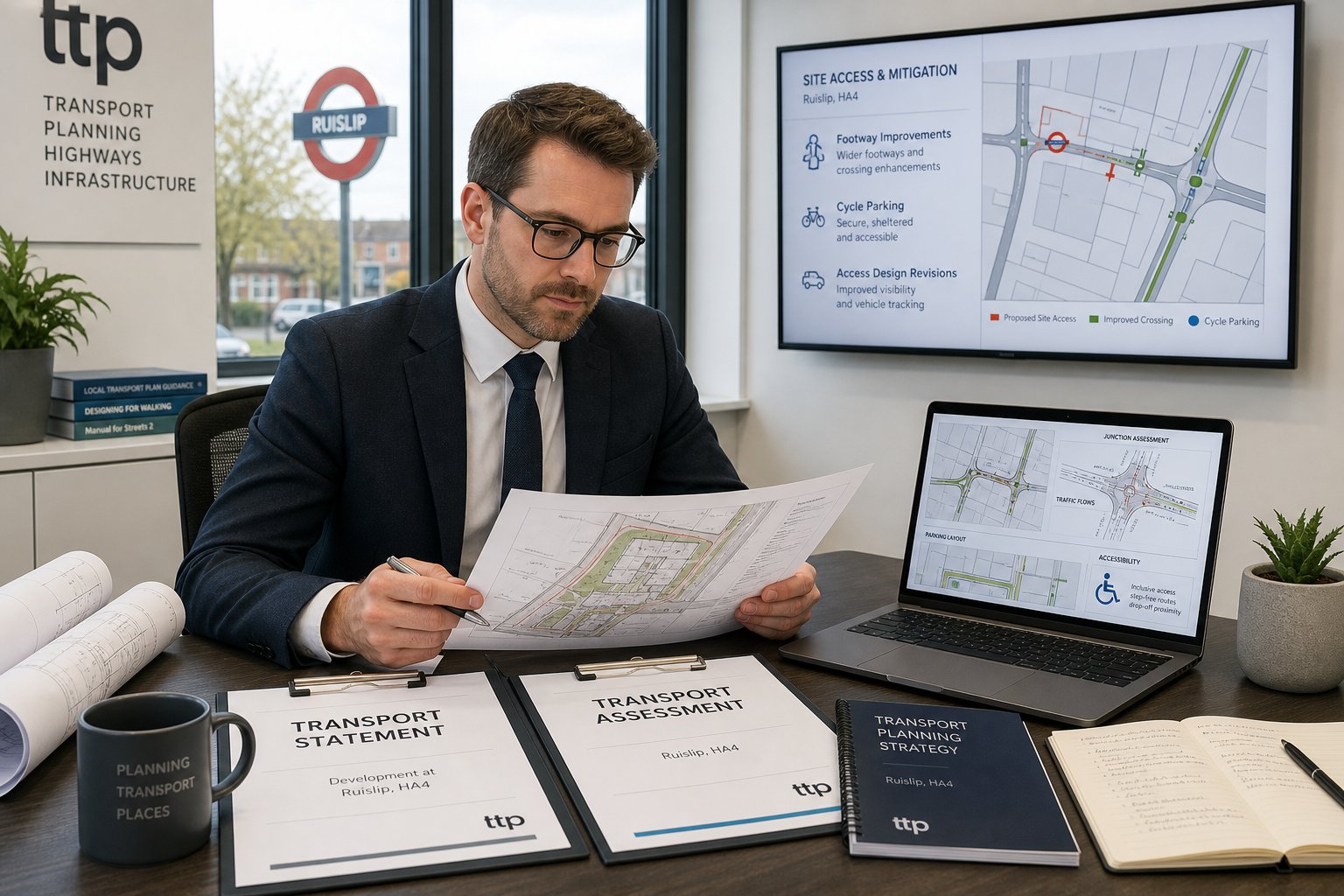
One of the most common early questions is whether a scheme needs a Transport Assessment or a Transport Statement. The short answer: it depends on scale, impact, and local sensitivity.
A Transport Assessment is the fuller document. It typically covers existing conditions, site accessibility, policy context, traffic surveys where needed, trip generation, trip distribution and assignment, junction impact, parking implications, road safety considerations, servicing, and mitigation. We prepare TAs where a proposal is large enough, intensive enough, or sensitive enough to warrant detailed evidence.
A Transport Statement is lighter and more proportionate. It is generally suited to smaller developments with more limited transport effects, though “small” does not automatically mean “simple”. In constrained Ruislip locations, even relatively modest schemes may still need careful assessment of access, parking stress, and local highway operation.
The key is proportionality backed by judgement. A weak TS submitted for a scheme that clearly needs a TA often causes delay: an oversized TA for a genuinely low-impact proposal can waste time and budget without adding planning value. We focus on the threshold question early, then scope the report to fit the risk.
Good reports are not just descriptive. They explain why a development is acceptable, acknowledge constraints honestly, and identify mitigation where needed. In practice, that might include revised access design, footway improvements, servicing controls, cycle parking upgrades, or targeted junction works. The best transport documents do not merely record impact: they help shape a scheme the authority can support.
When A Travel Plan Is Required And What It Should Include

Travel Plans are commonly required for larger schemes and for uses with concentrated staff, student, or visitor demand. In Ruislip, schools, offices, healthcare schemes, and major residential development are the obvious examples, but the exact trigger often comes from local authority judgement, pre-application feedback, or planning conditions.
A useful Travel Plan is not a generic list of aspirations. It should be tailored to the site, the likely users, and the realistic alternatives to private car travel. That starts with baseline conditions: walking links, cycling routes, public transport availability, car parking controls, and any barriers that make sustainable travel harder than policy might assume.
From there, the document should set out clear objectives, target mode shares where appropriate, practical measures, and who is responsible for implementation. Typical measures include cycle parking and showers for staff, personalised travel information, public transport incentives, car-share systems, school travel campaigns, delivery management, and monitoring arrangements.
The management structure matters more than many applicants expect. If no one is named to carry out and review the plan, officers may treat it as wishful thinking. We hence make sure Travel Plans identify responsibility, timescales, monitoring periods, review triggers, and fallback actions if mode share targets are missed.
Used properly, a Travel Plan is not just a policy attachment. It can be part of the mitigation strategy that makes a scheme acceptable, especially where parking is constrained or where the authority expects clear support for mode shift and Vision Zero objectives.
Vehicle Tracking, Access Design, And Servicing Strategy
This is often where planning drawings meet operational reality. A site may look neat on a layout, yet fail once actual vehicle movement is tested. Vehicle tracking, access design, and servicing strategy are hence core parts of many planning submissions in Ruislip.
Using swept-path analysis, we test whether vehicles can safely enter, manoeuvre, and exit the site. That usually includes private cars, refuse vehicles, emergency appliances, and delivery vehicles relevant to the proposed use. The purpose is not simply to prove something can just about happen on paper: it is to show it can happen repeatedly, safely, and without unreasonable conflict with pedestrians, cyclists, parked vehicles, or boundary features.
Access design must also respond to visibility, carriageway width, footway continuity, gradients, gates, and the relationship with nearby junctions or crossings. On constrained suburban plots, a few centimetres in the wrong place can affect whether a design is workable.
Servicing strategy is just as important. If deliveries are likely to occur from the carriageway, block a bus route, or reverse across a footway, the planning risk climbs quickly. We look at vehicle size, frequency, dwell time, delivery management, and whether on-site servicing is realistically achievable.
For many teams, this is the point where broader Traffic Engineering: Your principles become very tangible: making sure the proposal works day after day, not only under ideal conditions shown on a CAD drawing.
Parking Surveys, Capacity Reviews, And Local Highway Considerations
Parking can dominate planning discussions in Ruislip because it is both technical and highly visible to neighbours. A transport authority may be interested in standards and capacity: residents are often focused on what happens at 7pm on their street. Both viewpoints matter.
Where a proposal could displace parking onto surrounding roads or relies on spare on-street capacity, surveys are usually essential. Depending on the site and use, that may involve overnight beat surveys, weekday daytime observations, Saturday checks, or more targeted review of school peak conditions. The goal is to establish occupancy, turnover, and realistic residual capacity rather than relying on anecdote.
But parking is only part of the local highway picture. We also review collision history, speed environment, visibility, crossing desire lines, existing restrictions, bus stop locations, and any evidence of informal behaviour such as verge parking or turning conflicts. A new access that technically meets standards can still be problematic if it sits next to a heavily used crossing route or within a pattern of poor driver behaviour.
Capacity reviews should hence be rounded, not narrow. We ask whether the site can function without creating knock-on effects, and whether local constraints suggest mitigation is needed. Sometimes that means revised parking provision or a stronger Travel Plan. Sometimes it means accepting that a lower-car approach is supportable, but only if backed by credible local evidence and careful condition wording.
Junction Capacity Assessments And Traffic Impact Analysis
Where development is likely to add material traffic to the network, junction capacity assessment becomes a key part of the planning evidence. The purpose is straightforward: quantify whether surrounding junctions can accommodate forecast demand, and if not, identify mitigation.
In practice, that can involve priority junction modelling, roundabout assessment, signal analysis, or corridor review depending on the road layout and authority concerns. We establish baseline conditions, forecast development traffic, and test future-year scenarios with and without the scheme. The outputs usually focus on queueing, delay, reserve capacity, and operational performance during relevant peaks.
For Ruislip sites, the right peak period is not always obvious. AM and PM commuter peaks may matter, but school-run conditions or Saturday retail periods can be more critical for some proposals. Using the wrong scenario can make an assessment look tidy while missing the issue everyone local actually cares about.
Traffic impact analysis should also be interpreted sensibly. A small numerical increase at a highly sensitive junction may warrant mitigation: a larger increase on a resilient route may not. We combine model outputs with engineering judgement, observed conditions, and policy context.
Where mitigation is needed, it should be proportionate and deliverable: lining changes, localised widening, signal optimisation, crossing upgrades, or management measures tied to phasing. Teams working across multiple authorities often recognise the same discipline in places beyond west London too, whether through a Traffic Engineer In Manchester: brief or Traffic Engineer In Birmingham: support for urban schemes under different local standards.
Working With Local Councils, Design Teams, And Planning Consultants
Transport planning works best when it is integrated early rather than added at the end. By the time a layout is fixed, options can be limited. That is why we prefer to work alongside architects, planning consultants, solicitors, drainage engineers, landscape teams, and project managers from the outset.
With local councils, the value of early engagement is obvious. Hillingdon officers may flag concerns about parking stress, access width, school traffic, or report scope long before a formal determination. Where a strategic road or TfL interest is involved, understanding who needs to be consulted, and when, can prevent avoidable delay.
Internally, coordination is just as important. Drainage features can affect vehicle tracking. Bin stores can compromise turning space. Landscaping can obstruct visibility. Cycle parking can improve a Travel Plan but reduce room for servicing. None of these are dramatic problems individually, yet they are exactly the sort of issues that unravel submissions late in the programme.
We find the best results come from iterative review: test the concept, identify transport risks, refine the layout, and then write the supporting case around a scheme that already works. With over 30 years of experience reflected in the approach behind mltraffic.co.uk, speed matters, but accuracy and local judgement matter more. A concise report is useful only when it has been built on sound assumptions and coordinated design input.
What To Prepare Before Instructing A Traffic Engineer In Ruislip
A good brief makes transport advice faster, sharper, and more cost-effective. Too many projects lose time because key information arrives in fragments after the transport scope has already been agreed.
Before instructing a traffic engineer in Ruislip, it helps to assemble the red-line boundary, draft site layout, site address, existing and proposed land uses, floorspace or unit numbers, expected staffing, parking proposals, cycle parking numbers, and any phasing assumptions. If there are unusual operational features, delivery restrictions, school pickup management, blue-light access needs, or shared servicing, those should be flagged early.
Pre-application feedback is especially valuable. Comments from Hillingdon, TfL, or the design team can shape the report scope immediately and avoid unnecessary work. We also ask about known local sensitivities: existing parking pressure, neighbour complaints, collision concerns, school peaks, bus route issues, and nearby developments that may affect cumulative impact.
Topographical survey information, site photographs, and any previous planning history can also help. And if a layout is still fluid, that is not a problem, provided we know which elements are fixed and which are open to change.
In practical terms, the more clearly the project team explains the scheme’s operation, the easier it is for us to judge whether the site needs a TS, a TA, a Travel Plan, tracking, parking surveys, junction modelling, or a combination of these. Good upfront information usually means fewer late revisions and a stronger planning submission.
Conclusion
A traffic engineer in Ruislip is not there simply to produce a transport document for the planning portal. Our role is to help prove that a development can work safely, efficiently, and in line with local and London-wide policy expectations.
That means understanding how Ruislip actually functions: its residential streets, station influences, school peaks, parking constraints, and authority priorities. It means matching the level of assessment to the real planning risk, whether that involves a concise Transport Statement, a full Transport Assessment, a Travel Plan, vehicle tracking, parking surveys, or junction analysis. And it means coordinating transport evidence with design decisions early enough to solve problems before they become objections.
For architects, developers, planners, lawyers, surveyors, and councils, the benefit is straightforward. Stronger transport input usually leads to clearer applications, fewer surprises during determination, and better prospects of securing consent on a scheme that is genuinely deliverable.
Frequently Asked Questions About Traffic Engineering in Ruislip
What role does a traffic engineer play in Ruislip’s planning applications?
A traffic engineer in Ruislip ensures developments are safe and efficient by assessing access, parking, traffic impact, and servicing arrangements, aligning proposals with London Borough of Hillingdon and London Plan policies to support planning approval.
How do traffic engineers in Ruislip address parking pressures around stations and residential areas?
They conduct on-street parking surveys and capacity reviews to measure demand and available space, advising designs that minimise overspill and meet PTAL-based and local parking standards, crucial in areas with controlled parking zones and high local sensitivity.
When is a Transport Assessment required instead of a Transport Statement for developments in Ruislip?
Larger or more intensive projects needing detailed analysis of traffic flows, junction capacity, and mitigation require a Transport Assessment, while smaller or lower-impact schemes typically submit a proportionate Transport Statement based on national and local thresholds.
What should be included in a Travel Plan for a large residential or commercial development in Ruislip?
A Travel Plan must set clear objectives and mode-share targets, include practical measures such as cycle parking, car sharing, and public transport incentives, and define management, monitoring, and review structures to encourage sustainable travel and comply with local policies.
How does vehicle tracking and access design affect planning approval in Ruislip?
Using swept-path analysis, traffic engineers verify that all vehicles—including emergency and refuse—can safely manoeuvre on site without obstructing roads or pedestrian routes, ensuring layouts are practical and compliant with local highway safety and operational requirements.
Why is early involvement of a traffic engineer recommended for Ruislip development projects?
Engaging a traffic engineer early helps identify transport-related risks and solutions, promoting efficient design iterations that avoid delays, objections, and costly revisions, while facilitating coordinated input with architects, planners, and local authorities including Hillingdon and TfL.