
Guildford planning work rarely succeeds on design merit alone. But good the architecture, the transport case still has to stand up to scrutiny: access, junction impact, parking pressure, servicing, pedestrian safety, cycle movement, and whether the local highway network can realistically absorb change. That is where a traffic engineer in Guildford becomes central to the planning process.
We work with architects, planners, developers, solicitors, surveyors, and design teams who need transport evidence that is clear, proportionate, and aligned with how planning decisions are actually made. In practice, that often means translating a promising scheme into something a case officer, highway authority, committee member, or appeal inspector can test with confidence.
Guildford has its own pressures. Historic streets, constrained junctions, school-run peaks, commuter movement, town-centre activity, and varied village contexts across the wider borough all shape what is likely to be acceptable. A generic report drafted without local awareness can miss the point entirely.
In this guide, we explain what a traffic engineer in Guildford does, which projects typically need input, how transport assessments and travel plans fit into the planning process, and what to look for when appointing support. The aim is simple: help you build a stronger application, reduce avoidable objections, and move faster with evidence that answers the questions decision-makers are actually asking.
Key Takeaways
- A Traffic Engineer in Guildford plays a crucial role in supporting planning applications by providing transport evidence tailored to local conditions and decision-maker expectations.
- Transport assessments, statements, and travel plans each serve distinct purposes and must be correctly matched to the site’s scale, land use, and local authority thresholds to ensure effective planning support.
- Local knowledge is essential in Guildford due to unique constraints like historic streets, narrow junctions, and varying local traffic patterns that influence the acceptability of developments.
- Early collaboration between traffic engineers, architects, planners, and councils leads to better design choices, fewer objections, and faster planning approvals.
- A well-prepared traffic engineering report focuses on practical issues such as access design, junction capacity, parking management, and highway safety to strengthen planning applications and appeals.
- When choosing a Traffic Engineer in Guildford, prioritise those with planning-led experience, local understanding, clear communication skills, and a collaborative approach to effectively navigate the borough’s specific challenges.
What A Traffic Engineer In Guildford Does For Planning And Development

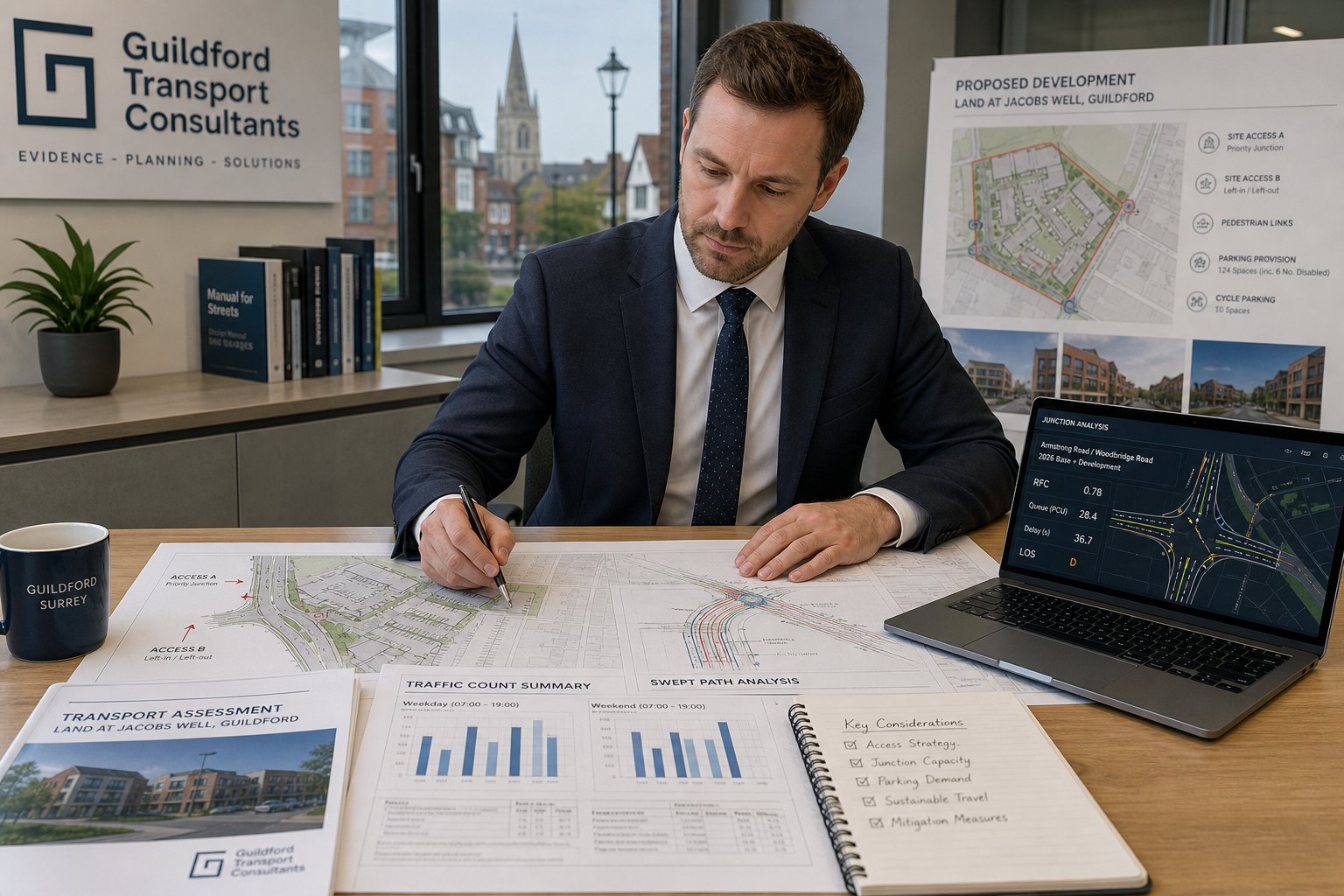
A traffic engineer in Guildford supports planning and development by assessing how a proposal will function in transport terms before problems become planning objections. That sounds straightforward. It rarely is.
Our role usually starts with understanding the site, proposed land use, likely trip generation, surrounding highway conditions, and the planning strategy. From there, we assess whether the development can be accessed safely, whether nearby junctions can accommodate additional traffic, whether parking and servicing arrangements work, and whether mitigation is needed.
That can involve traffic counts, junction reviews, swept path analysis, visibility checks, accident data review, baseline parking surveys, and transport policy appraisal. We also prepare the documents that planning teams rely on, including transport statements, transport assessments, travel plans, technical notes, and responses to highways queries. Broader Highway And Traffic Engineering support often sits alongside this work when a scheme needs both planning evidence and practical design input.
Just as important, we help teams decide what level of reporting is actually proportionate. Not every site needs a large modelling exercise. Not every application can get by with a few paragraphs on access either. Good advice means identifying the right technical scope early, then producing evidence that is robust enough for the decision in front of it.
That combination of analysis, judgement, and planning awareness is what turns transport work from a box-ticking exercise into something genuinely useful.
Why Guildford Requires A Local Transport And Highways Perspective
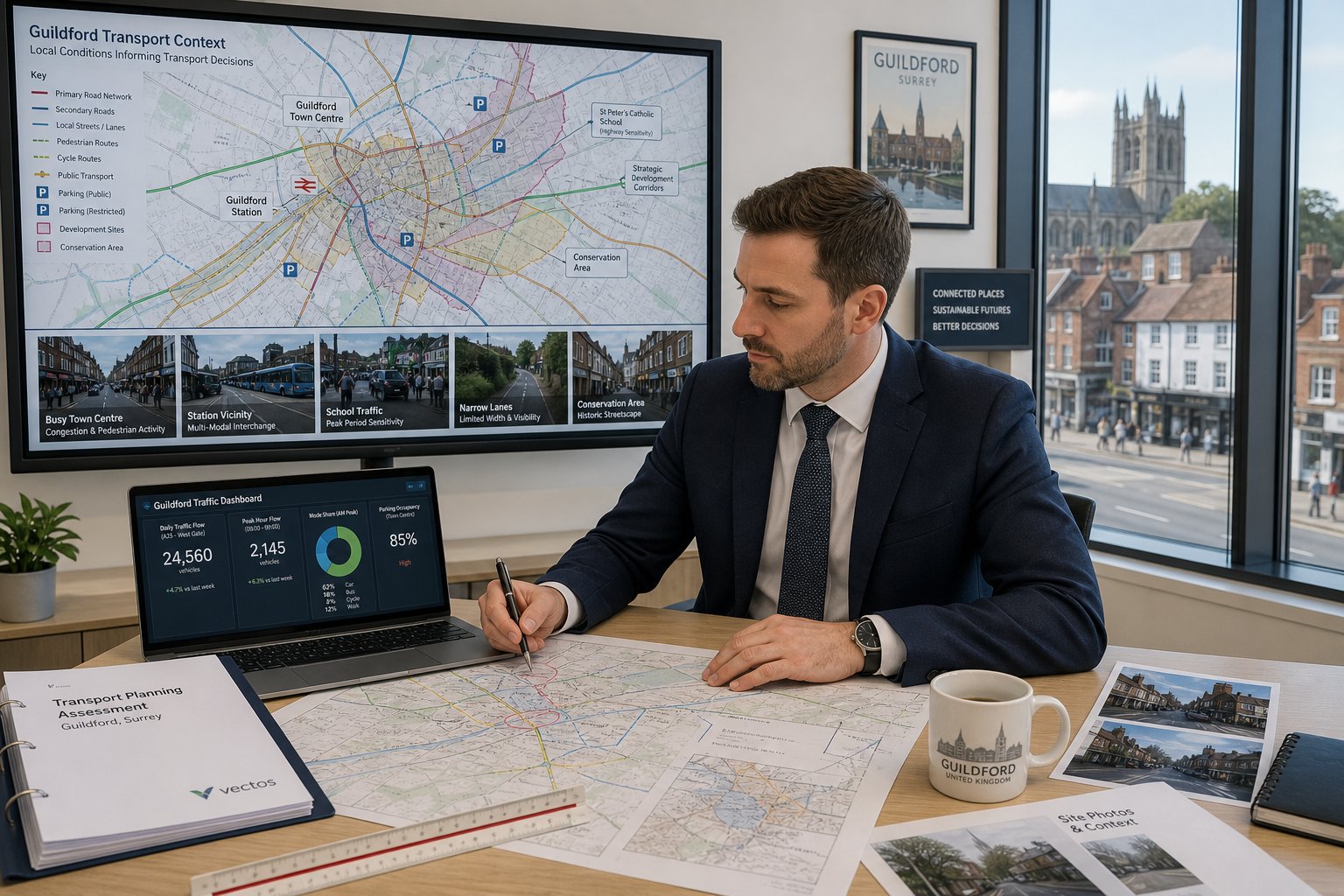
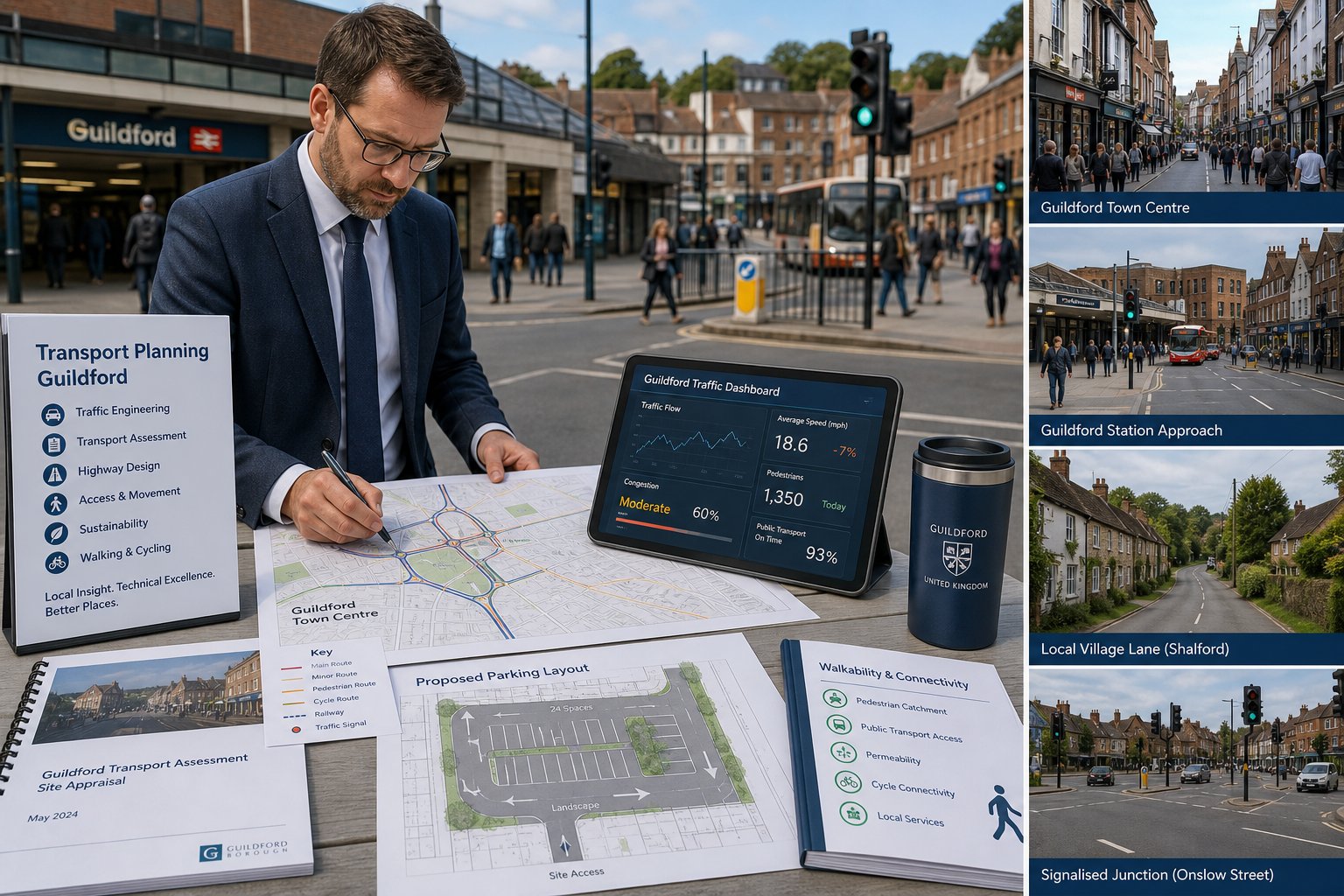
Guildford is not a place where standardised transport commentary goes very far. Local context matters because the acceptability of development often turns on conditions that only become obvious once you understand the network around the site.
The borough combines busy strategic movement with highly local constraints: narrow frontages, town-centre pedestrian activity, station-related demand, school traffic, village lanes, conservation sensitivities, and junctions that may operate adequately on paper but feel fragile in reality. A proposal near one corridor may be judged very differently from an apparently similar proposal elsewhere because local traffic patterns, parking stress, and walkability are different.
There is also the practical side of dealing with authority expectations. Thresholds, survey scope, mitigation preferences, and report presentation all benefit from local familiarity. We find that teams save time when transport evidence is framed in a way that reflects how officers and highway reviewers in the area are likely to interrogate it.
That does not mean transport planning becomes subjective. It means local evidence is interpreted through local conditions. A capable Traffic Engineer in Guildford knows that the same technical guidance can lead to different planning outcomes depending on access geometry, nearby receptors, peak periods, and cumulative development pressure.
And that local perspective often makes the difference between a report that merely exists and one that actually resolves concerns.
Common Projects That Need Traffic Engineering Input
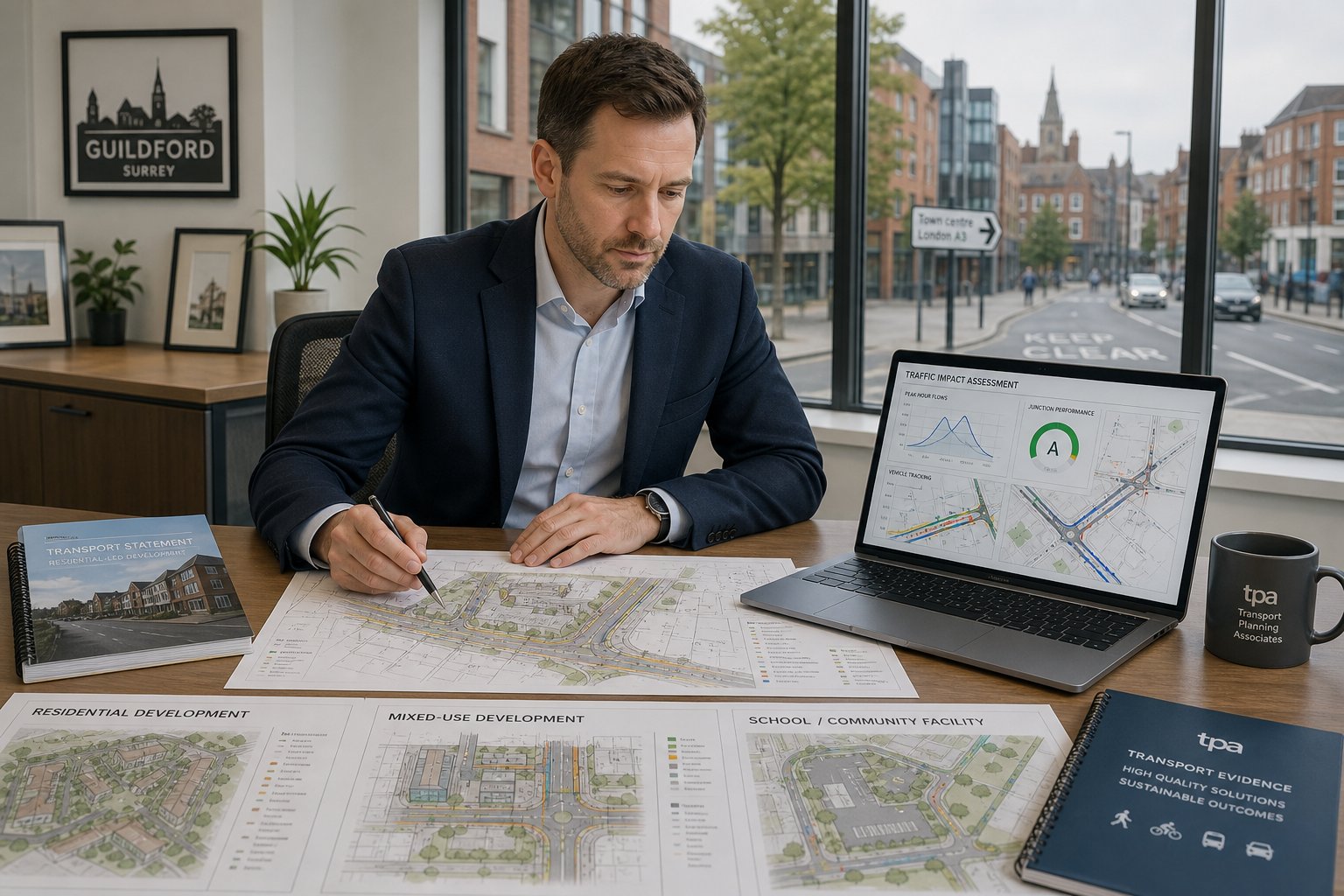

Not every scheme needs the same level of transport input, but a surprisingly wide range of projects benefit from it. The common thread is simple: if a development changes how people, vehicles, or service activity interact with the highway, transport evidence usually helps.
Residential Developments
Residential schemes often trigger questions that seem modest at first and become critical later. How many trips will the development generate? Is the access wide enough and visible enough? Will refuse vehicles turn safely? Is parking likely to overspill onto surrounding streets? Will the internal layout work for emergency access, deliveries, and daily manoeuvring?
Even relatively small housing proposals can face resistance where local roads are narrow, on-street parking is heavy, or visibility is constrained. For larger schemes, the scope expands into junction capacity, pedestrian links, cycle provision, travel planning, and the cumulative impact of nearby development allocations.
Residential work also tends to be politically sensitive. Neighbours understand peak-time congestion on their street far better than abstract planning policy, so evidence needs to be both technical and readable. That is why structured Traffic Engineering: Your Complete input can be so valuable at concept stage, before an application is locked into a weak layout.
Commercial, Education, And Mixed-Use Schemes
Commercial, education, and mixed-use proposals usually create more complex movement patterns. Staff arrival peaks, customer turnover, delivery activity, school drop-off, shared access points, and multiple user groups all have to be understood together.
A warehouse, nursery, roadside unit, town-centre commercial scheme, or mixed-use redevelopment may each require different evidence, but the pressure points are familiar: servicing strategy, peak-hour impact, pedestrian conflict, cycle movement, taxi activity, and whether the site can operate efficiently without creating highway safety issues.
For business and institutional schemes, timing matters. A school can be acceptable in daily traffic terms and still fail on drop-off management. A commercial site can have modest trip generation and still struggle because one rigid vehicle cannot turn without overrunning. Work in Commercial Traffic Engineering tends to focus on these operational realities, not just headline numbers.
That practical detail is often what gives planning officers confidence that a scheme will function once occupied, not just once approved.
Transport Assessments, Statements, And Travel Plans Explained
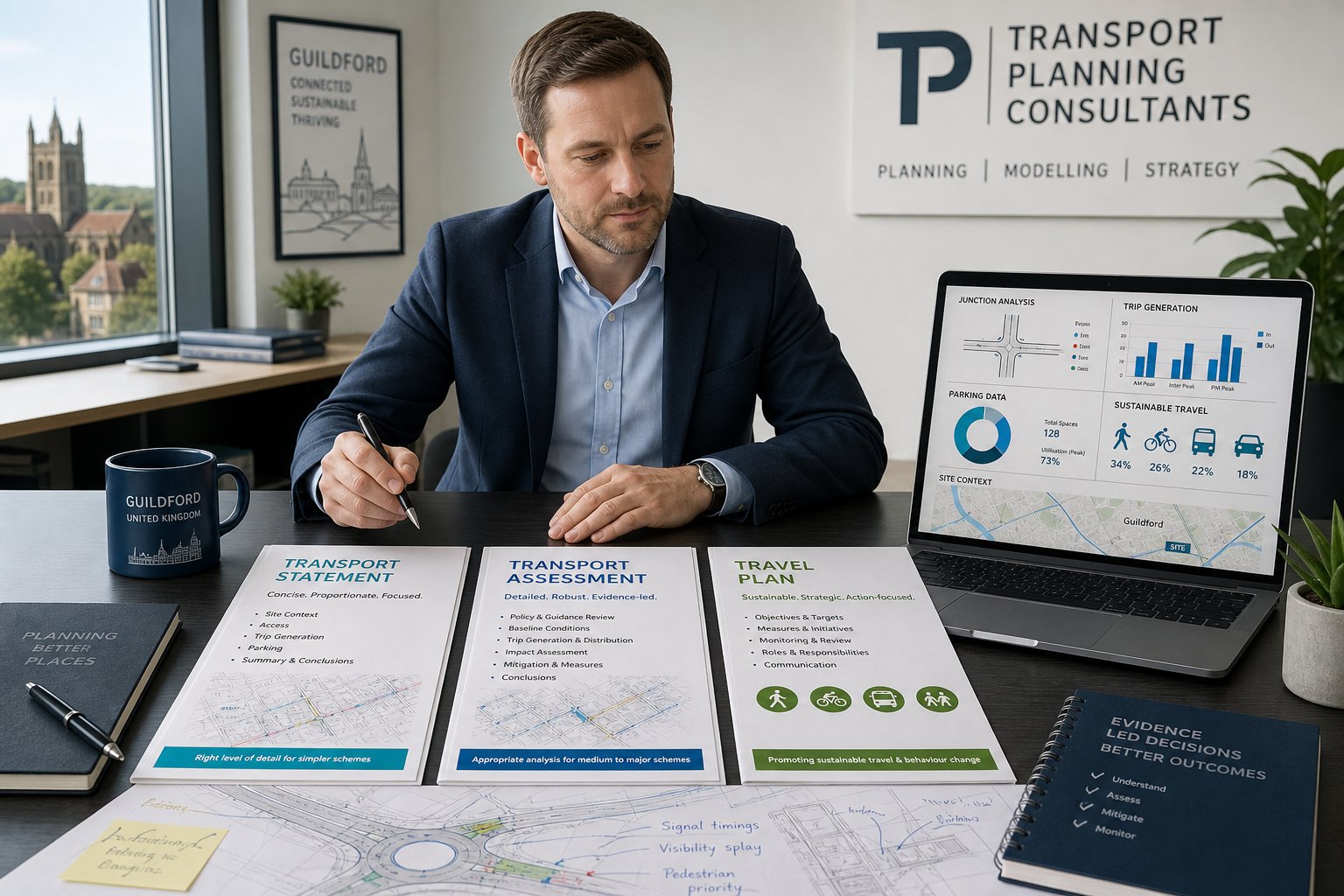
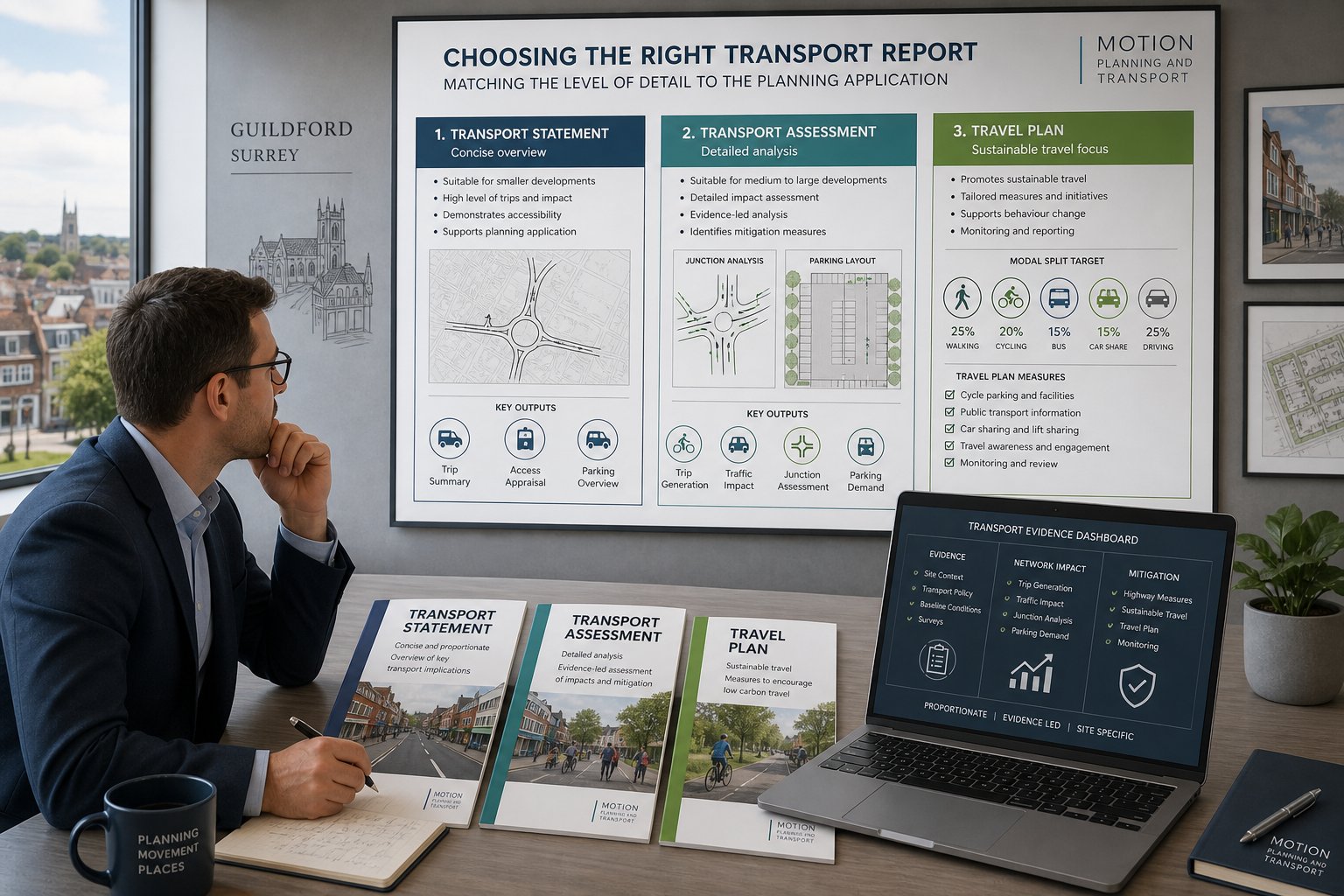
These documents are often mentioned together, but they serve different purposes.
A Transport Statement is typically used for developments with limited transport impact. It summarises existing conditions, anticipated trip generation, access arrangements, parking, sustainable travel opportunities, and any modest mitigation required. Its job is to show that the proposal is acceptable without unnecessary technical weight.
A Transport Assessment goes further. It provides a fuller evidence base on existing travel conditions, development demand, network impact, junction performance, mode share, policy context, accessibility, and mitigation. Where a proposal could materially affect the surrounding network, this is usually the core planning document.
A Travel Plan focuses on behaviour and mode choice. It sets out measures to encourage walking, cycling, public transport, car sharing, and other sustainable options, often supported by targets, monitoring, and management arrangements.
The mistake we see most often is treating these as interchangeable templates. They are not. The right document depends on local thresholds, scale, land use, and sensitivity of the site. A well-judged scope can avoid both under-reporting and overcomplication.
In practical terms, we align the reporting package with the application strategy. If access is straightforward but local concern is parking stress, the evidence needs to deal with parking properly. If the issue is cumulative junction pressure, analysis has to focus there. That broader role is similar to what many Traffic Engineering Consultants: What provide across planning-led schemes: the right report, at the right depth, for the right decision.
Junction Capacity, Access Design, And Highway Safety Considerations
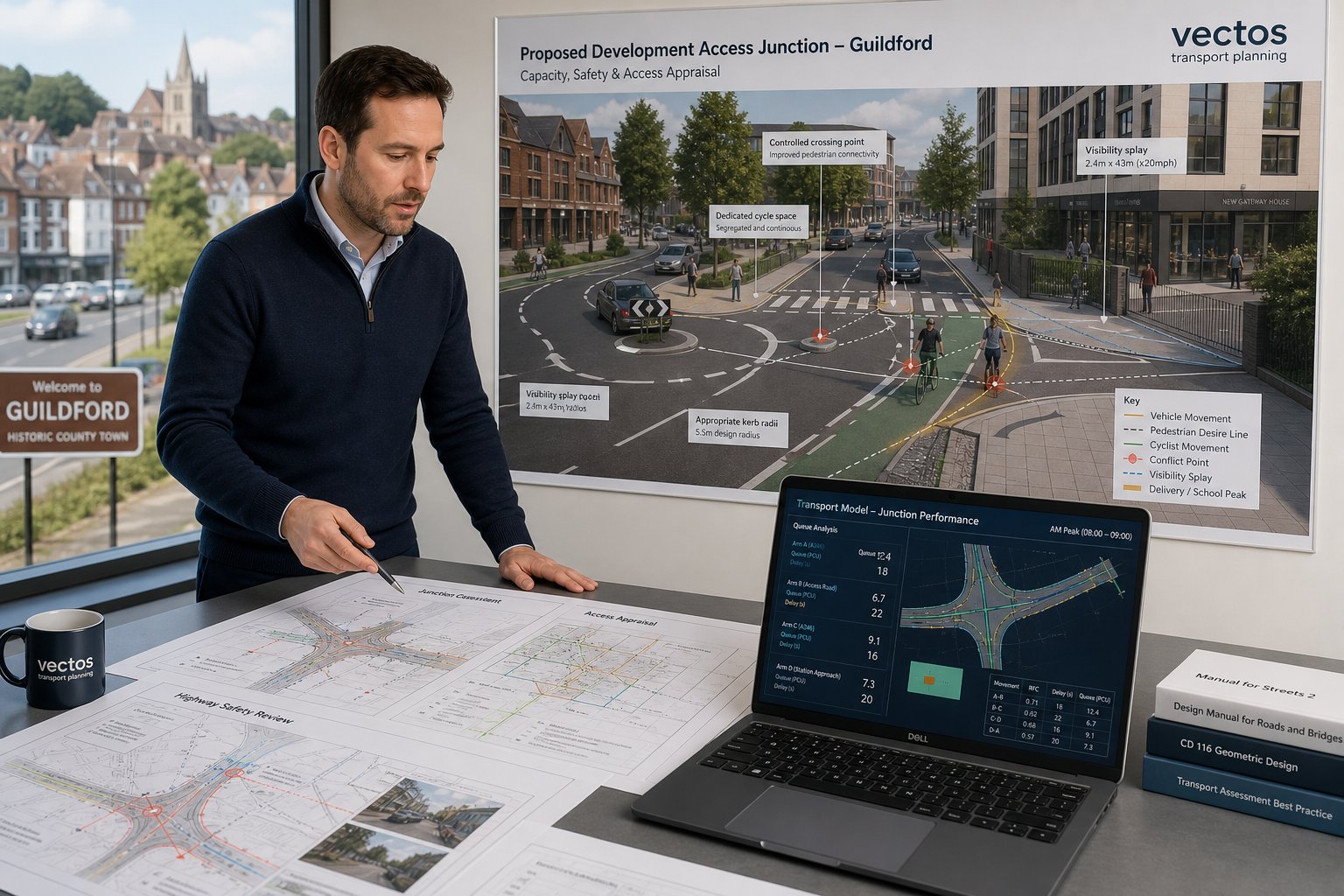
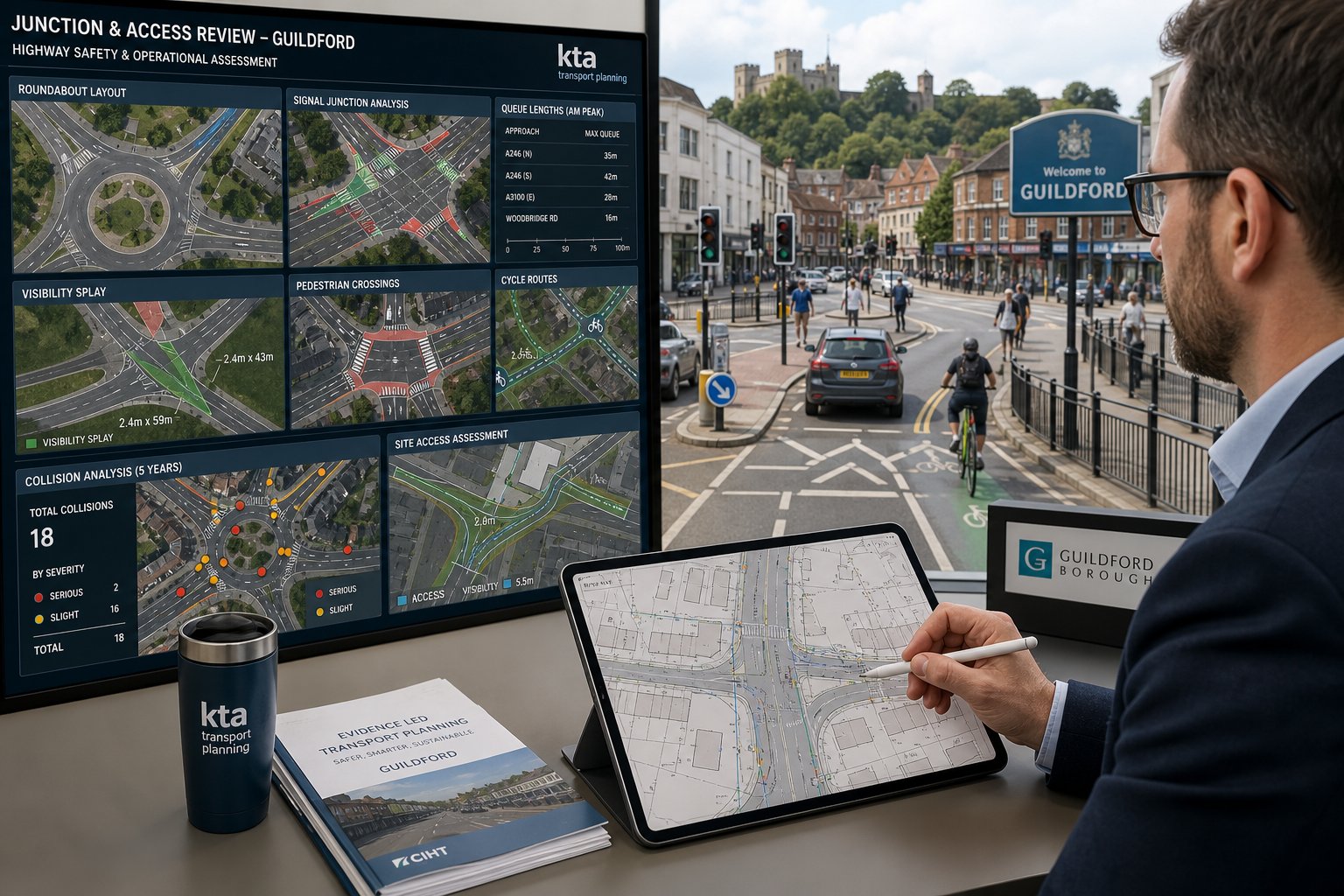
This is where a lot of planning applications either become persuasive or start to wobble.
Junction capacity asks whether surrounding junctions can continue to operate acceptably with development traffic added. Depending on the site, that may involve priority junction review, signal junction modelling, roundabout assessment, or queue and delay analysis. The point is not to prove there will never be congestion. It is to show whether the impact is severe, manageable, or capable of mitigation in policy terms.
Access design focuses on how vehicles, cyclists, and pedestrians enter and leave the site. Width, radii, gradients, visibility splays, gate positions, crossing points, and internal geometry all matter. One awkward access can undermine an otherwise sensible scheme. Detailed access design highway work is often where transport engineering and site design need to speak to each other properly.
Highway safety pulls the wider picture together. We review collision records, likely conflict points, pedestrian desire lines, cycle interaction, and operational features such as school peaks or delivery overlap. Safety concerns are rarely solved by assertion: they need evidence and, where required, design change.
Guildford schemes frequently sit in constrained settings, so the answer is not always a large intervention. Sometimes a revised access position, clearer pedestrian priority, or a better-served loading arrangement is enough. Sometimes it is not. The value lies in knowing the difference early, before a weak point hardens into a reason for refusal.
Parking, Servicing, And Vehicle Tracking Requirements
Parking can look like a numbers exercise. In planning terms, it is usually much more than that.
Local authorities want to know whether the quantity and layout of parking are suitable for the use proposed, whether disabled and cycle parking are properly integrated, and whether overspill is likely to harm neighbouring streets. In Guildford, that can be especially sensitive around stations, schools, local centres, and established residential roads where kerb space is already doing too much work.
Servicing is equally important. A site may technically have enough parking and still fail because delivery vehicles cannot enter, unload, turn, and exit safely. Bin collection, supermarket deliveries, school catering vehicles, and occasional larger service movements all need thought at design stage rather than after submission.
That is where vehicle tracking comes in. Swept path analysis demonstrates whether the relevant design vehicles can manoeuvre through accesses, around corners, into loading areas, and back out without conflict. It is not glamorous, but it is often decisive.
We also advise on management where geometry alone does not solve the issue: timed deliveries, booking systems, marshal arrangements, or revised servicing points. Comparable urban work by a Traffic Engineer In one authority area may look similar on paper, yet local parking stress and servicing patterns can change the planning balance significantly.
Well-presented parking and servicing evidence reassures reviewers that the site will work on an ordinary Tuesday, not just in an idealised drawing.
How Traffic Evidence Supports Planning Applications And Appeals
Good transport evidence does two jobs at once. First, it identifies likely impacts in a form that planners and highway officers can test. Second, it gives the wider consultant team a framework for refining the scheme before concerns become entrenched.
For planning applications, that may mean demonstrating that trip generation is proportionate, local junctions remain within acceptable limits, access is safe, parking is workable, and sustainable transport measures are credible. It can also mean narrowing the debate. Instead of a generalised objection about traffic, the discussion becomes a specific conversation about peak-hour movements, servicing frequency, visibility, or mitigation.
At appeal stage, robust evidence becomes even more valuable. Inspectors are rarely persuaded by broad claims from either side. They respond to structured analysis, transparent assumptions, and a clear explanation of why impacts are or are not material. When transport work has been prepared carefully from the outset, the appeal case is usually stronger because the technical foundation already exists.
We also find that concise reporting matters. Decision-makers do not need fifty pages of throat-clearing. They need evidence they can follow. That is one reason our approach aligns with the wider ethos behind ML Traffic: concise, accurate reporting tailored to authority thresholds and planning context. Similar lessons can be seen in work by a Traffic Engineer In Bristol: local teams that succeed tend to frame technical issues in a way planning officers can use, not just engineers can admire.
Working With Local Councils, Design Teams, And Planning Consultants
Transport engineering is collaborative by nature. The best outcomes usually come from early coordination rather than late-stage technical patching.
With local councils and highway authorities, the aim is clarity. We need to understand likely concerns, thresholds for assessment, relevant local standards, and whether a proposal may need changes before determination. Pre-application dialogue can be especially useful on sensitive or larger sites, though it only works well when the transport input is focused and realistic.
With architects and design teams, our role is often to pressure-test layouts before they solidify. Can the access be shifted a few metres? Does the internal aisle width work? Is the pedestrian route legible? Will a tracking issue undermine the frontage strategy? Small design changes early can prevent major planning problems later.
Planning consultants rely on transport advice to integrate policy, evidence, and strategy. Lawyers may need technical support where obligations, conditions, or appeal matters turn on transport effects. Surveyors and developers often need quick answers on risk before land positions are finalised.
That joined-up approach is common across regional planning work, whether the discussion is with a Traffic Engineer In Manchester: scheme team on city-centre servicing or a Surrey project dealing with suburban access constraints. The principle is the same: transport evidence should inform decisions, not arrive too late to influence them.
When teams collaborate early, applications are typically stronger, faster, and less exposed to avoidable highways objection.
What To Look For When Choosing A Traffic Engineer In Guildford
Not all transport support is equal, and appointment decisions have a direct effect on programme risk.
First, look for planning-led experience. A consultant may be technically competent but still struggle to produce reports that answer planning questions in a proportionate way. You want someone who understands the difference between engineering detail and decision-useful evidence.
Second, test local awareness. That does not just mean knowing where Guildford is on a map. It means understanding how constrained streets, local parking conditions, school movements, commuter demand, and borough-level expectations shape assessment and mitigation.
Third, ask about report quality and turnaround. Clear technical writing matters. So does speed, provided it does not come at the expense of accuracy. For many projects, the real value lies in getting reliable advice early enough to influence layout, red-line strategy, and planning narrative.
Fourth, look for collaborative working style. Transport engineers need to coordinate with architects, planning consultants, highways officers, and sometimes legal teams. If they cannot explain a junction result without disappearing into jargon, problems tend to multiply.
Finally, ask for relevant examples: residential access, mixed-use servicing, parking stress analysis, travel plans, or appeal support. Broader benchmarking from a Traffic Engineer In planning context can help, but what really matters is whether the consultant can apply sound judgement to your specific site.
In short, choose someone who is technically solid, locally aware, commercially responsive, and able to make the planning case clearer rather than heavier.
Conclusion
A strong planning application needs more than a compliant drawing set. It needs transport evidence that reflects how the site will actually operate and how local decision-makers will assess that operation. That is the real value a traffic engineer in Guildford brings.
When the work is done well, it reduces uncertainty early. Access issues are identified before layouts are fixed. Junction and parking concerns are tested before objections harden. Reports are scoped proportionately, written clearly, and aligned with the planning route the wider team is trying to follow.
For architects, planners, developers, councils, and legal teams, the goal is not paperwork for its own sake. It is a faster, stronger application with fewer avoidable transport risks. In Guildford, where local conditions and highway sensitivities matter, informed transport planning is rarely optional. It is often one of the reasons a scheme progresses at all.
Frequently Asked Questions About Traffic Engineering in Guildford
What role does a traffic engineer in Guildford play in the planning process?
A traffic engineer in Guildford assesses transport impacts of proposed developments, including access, junction capacity, parking, and safety, to provide clear, proportionate evidence supporting planning applications that local authorities can confidently evaluate.
Why is local knowledge essential for traffic engineering in Guildford?
Guildford’s unique conditions—historic streets, narrow junctions, school traffic peaks, and varied local contexts—mean transport assessments must consider local road pressures and authority expectations to produce relevant, effective planning evidence.
What types of developments typically require input from a traffic engineer in Guildford?
Projects like residential developments, commercial, education, and mixed-use schemes often need traffic engineering support to address issues such as trip generation, access design, parking management, servicing arrangements, and pedestrian and cycle safety.
How do transport assessments, statements, and travel plans differ in planning applications?
Transport Statements address limited impacts with concise summaries; Transport Assessments provide detailed analysis for significant impacts including junction performance; Travel Plans focus on encouraging sustainable travel behaviours with targets and monitoring.
What should I look for when choosing a traffic engineer in Guildford?
Seek a planning-led expert with local Guildford experience who produces clear, timely reports, understands local highway standards, collaborates well with planning teams, and has proven expertise in residential and commercial transport assessments.
How does vehicle tracking and swept path analysis influence development design in Guildford?
Vehicle tracking ensures service and delivery vehicles can safely manoeuvre on-site, preventing operational issues. It informs access and servicing layout design, helping avoid planning objections related to safety and functionality.