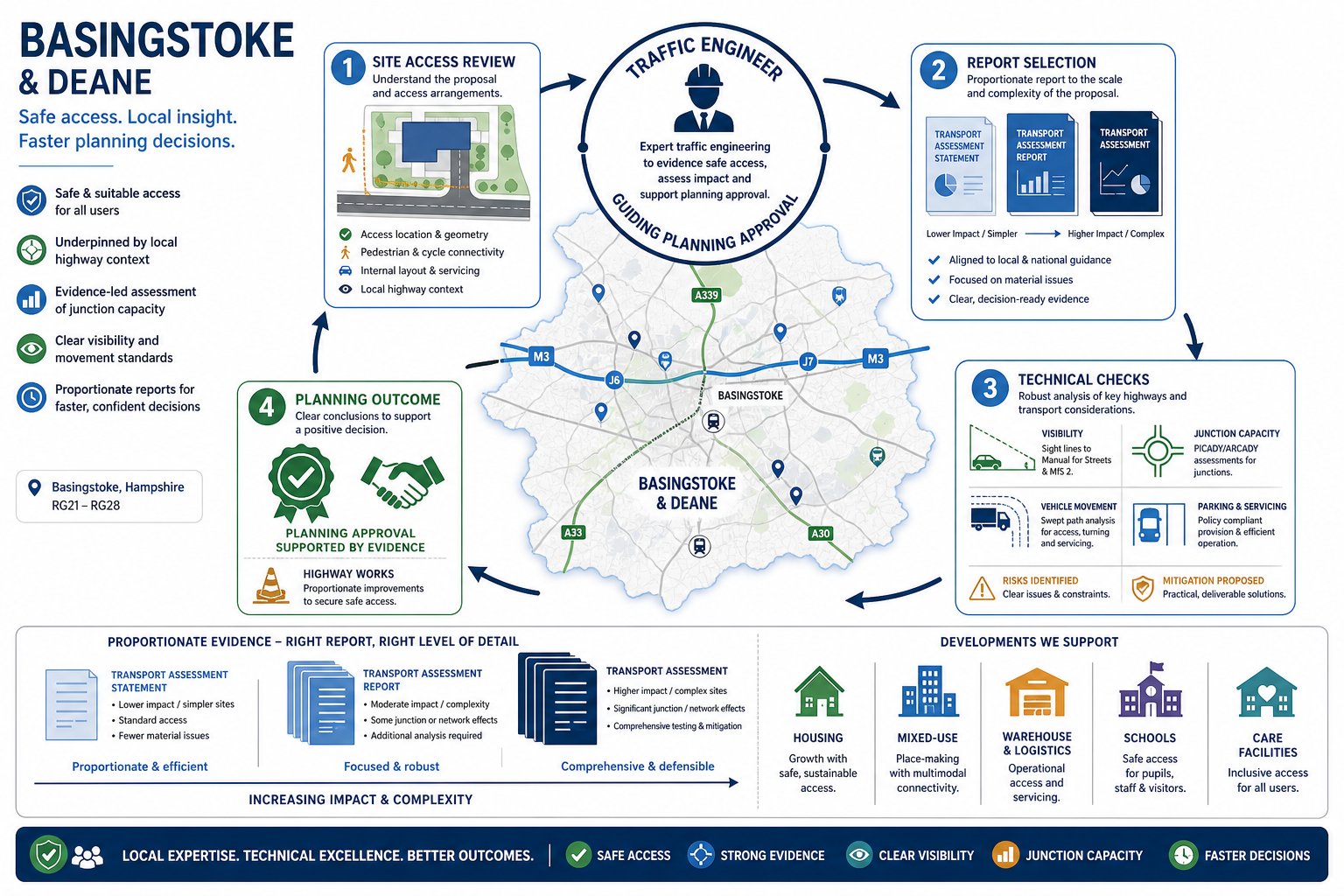
Getting a planning application over the line in Basingstoke often comes down to a deceptively simple question: can the site be accessed safely, and can the surrounding network cope? For architects, planners, surveyors, developers and local authorities, that question rarely has a one-line answer. It usually needs measured evidence, policy awareness, and someone who understands how Hampshire highways officers are likely to read the detail.
That is where a traffic engineer in Basingstoke becomes valuable. We’re not just talking about trip rates and visibility splays on a drawing. In practice, traffic engineering sits right in the middle of planning strategy, access design, local policy compliance and technical negotiation. A well-scoped report can remove uncertainty early, while a weak one can trigger avoidable objections, redesign work and delay.
In Basingstoke and Deane, the local context matters. The relationship between development sites and the M3, A339, A33, A30, key roundabouts, bus links, rail access and established residential streets can change the right transport response quite dramatically. Some schemes need a full Transport Assessment, some only a concise Transport Statement, and others are best served by a targeted technical note that answers one highway point properly rather than ten points poorly.
In this guide, we set out what a traffic engineer does, when different transport reports are needed, the checks that matter most, and how to choose the right support for faster, stronger planning submissions in 2026.
Key Takeaways
- A traffic engineer in Basingstoke plays a critical role in ensuring safe access and managing transport impact, tailoring advice to local Hampshire highways policies and conditions.
- Selecting the appropriate transport report—Transport Assessment, Transport Statement, or Technical Note—is vital to provide proportional, effective evidence and avoid delays.
- Traffic engineering in Basingstoke shapes site layout, access design, parking, and transport mitigation, reducing planning risks and addressing local objections early.
- Developments of all sizes and types, from residential and mixed-use to commercial and care facilities, require transport input that reflects actual usage and local context.
- Core technical checks such as access design, visibility splays, junction capacity, and vehicle manoeuvrability are essential to defend planning applications successfully.
- Choosing a traffic engineer with local experience and the ability to scale services ensures clear communication, tailored advice, and smoother planning approvals in Basingstoke.
What A Traffic Engineer Does In Basingstoke Planning Projects
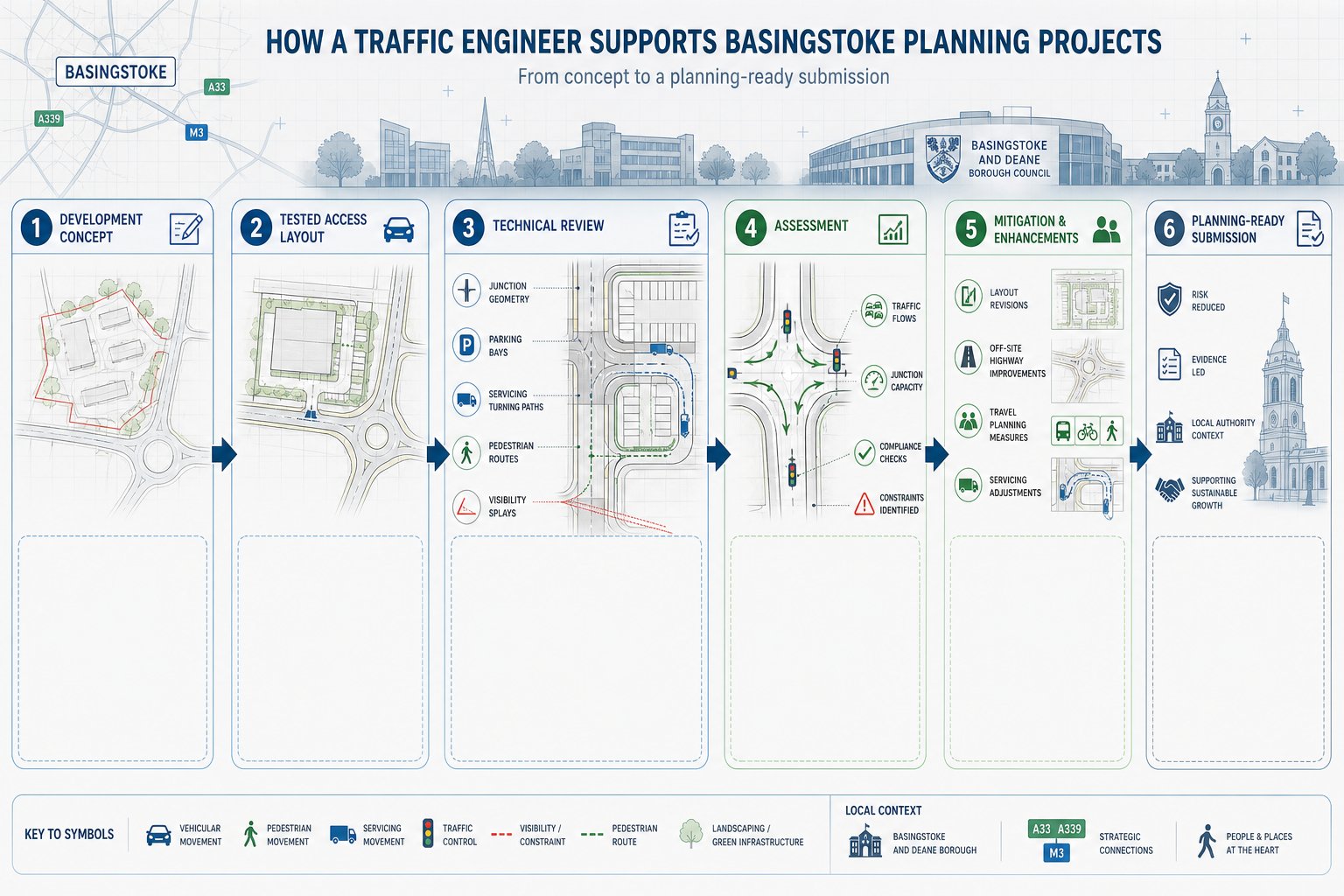
A traffic engineer in Basingstoke provides the technical bridge between a development concept and a planning submission that can stand up to scrutiny. At the early stage, we typically review the proposed access, internal layout, parking, servicing, pedestrian routes and likely traffic effects on nearby roads and junctions. That sounds straightforward, but it rarely is. A site that looks workable on a sketch plan can quickly become problematic once gradients, refuse movements, visibility or right-turn demand are tested properly.
In practical terms, our role includes assessing whether the site can achieve safe and suitable access in line with the National Planning Policy Framework, and whether the residual cumulative transport impact would be severe. We also consider whether mitigation is needed, whether through layout changes, off-site highway works, travel planning measures or refined servicing arrangements.
For planning teams, the real value is often in risk reduction. We help identify likely highway objections before the application is submitted, not after. That might mean adjusting an access point away from a bend, checking whether parking provision aligns with local expectations, or demonstrating that a nearby priority junction still operates within capacity.
This work often overlaps with wider traffic engineering consultants support, especially where planning strategy and technical evidence need to move together. And because local interpretation matters, a traffic engineer who understands Hampshire County Council and Basingstoke and Deane Borough Council can usually frame the evidence far more effectively than a generic report writer.
When A Transport Assessment, Statement Or Technical Note Is Needed
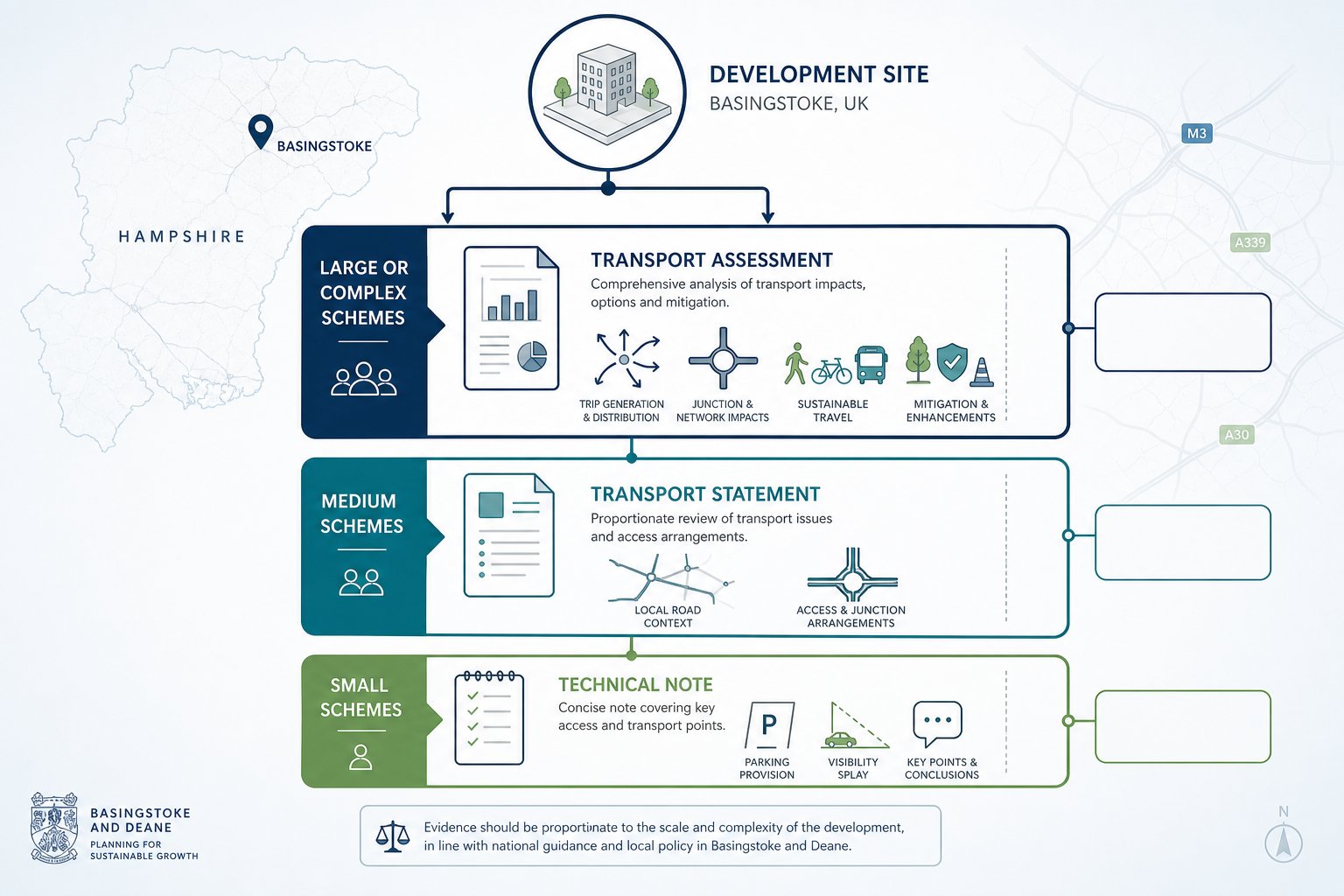
Not every development in Basingstoke needs the same level of transport evidence. The right report depends on the likely scale of impact, the sensitivity of the local network, and what Hampshire County Council is likely to expect at pre-application or application stage.
A Transport Assessment (TA) is normally required for larger or more complex schemes where the transport effects are material and need detailed analysis. That often includes major residential development, strategic mixed-use sites, or proposals that may affect busy junctions, schools, town centre routes or the strategic road network. A TA will usually cover existing conditions, trip generation, trip distribution, junction capacity, sustainable travel opportunities and any proposed mitigation.
A Transport Statement (TS) is more proportionate for medium-scale development where impacts are real but relatively contained. It still needs to be robust, but it tends to be shorter and more focused than a full TA.
A Technical Note is often the right tool for smaller schemes or discrete issues. If the only live concern is parking stress, access visibility, or a response to a consultee comment, a concise note can be far more effective than an oversized report.
The key point is proportionality. We generally advise agreeing scope early, because the wrong reporting level wastes time either way: too little evidence invites objection: too much can delay submission for no planning benefit. This is a recurring theme across wider highway and traffic planning support, and it matters just as much in Basingstoke as it does on more complex urban schemes.
How Traffic Engineering Supports Planning Applications In Basingstoke And Deane
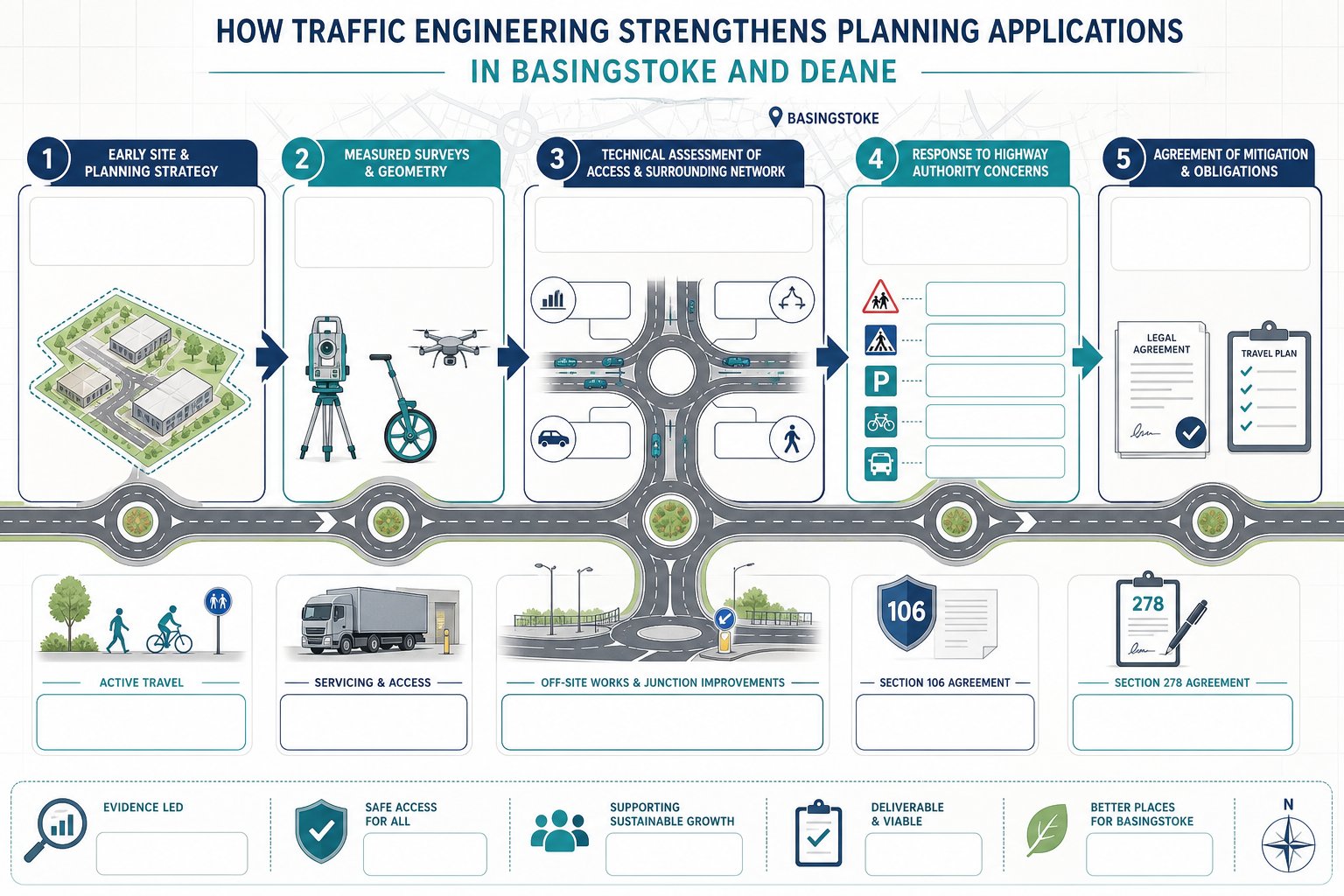
Good traffic engineering does more than produce a report to sit in the application bundle. It helps shape the planning case itself. In Basingstoke and Deane, highway matters often influence site layout, density, servicing arrangements, active travel connections, and even whether a proposal is considered deliverable in the first place.
At application stage, our role is to provide evidence that the development can achieve safe access and acceptable operation on the surrounding network. That means grounding design choices in measured geometry, survey data and recognised modelling methods rather than broad assumptions. If objections arise, the technical work also gives the team something solid to respond with.
This is especially important where comments from the local highway authority focus on cumulative impact, parking pressure, school-run conflict, pedestrian safety or the operation of nearby roundabouts. A clear technical response can narrow the debate quickly. Without one, relatively minor issues can become a holding objection for weeks.
Traffic engineering also supports negotiation around planning conditions and legal agreements. Where off-site works are needed under Section 278, or transport measures need securing through Section 106, we can help define what is proportionate and technically justified. Travel Plans also sit within this space, giving councils confidence that the development is not relying solely on private car use.
For multidisciplinary teams, this means transport input is most useful when it starts early and stays involved. The best outcomes usually come when access design, planning strategy and transport evidence are developed together rather than in isolation.
Typical Development Types That Need Traffic Engineering Input
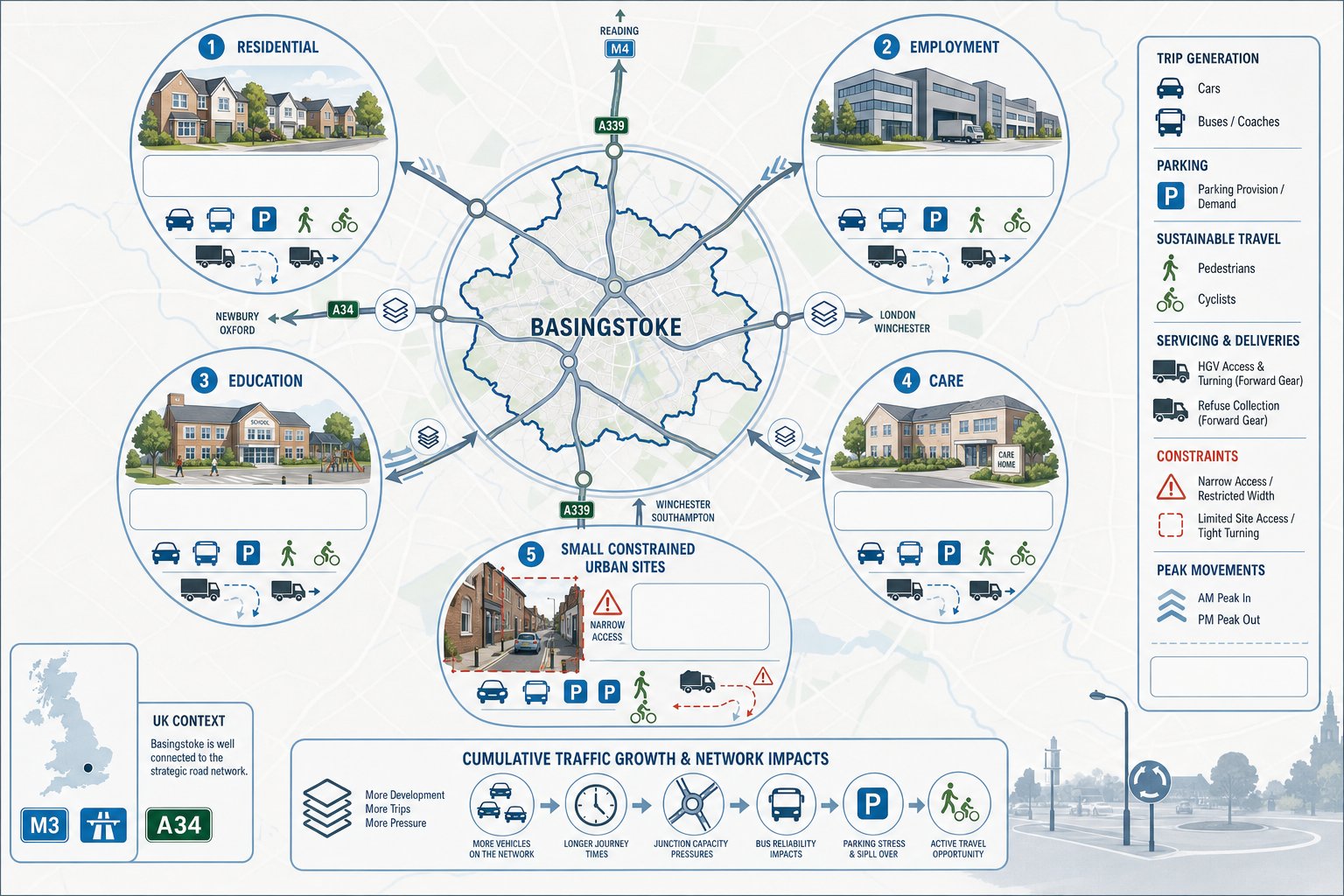
Traffic engineering input is relevant across a much wider spread of schemes than many applicants first assume. In Basingstoke, the requirement is not limited to major allocations or large commercial parks. Smaller sites can also trigger transport concerns where access is constrained, surrounding streets are sensitive, or local highway comments are likely.
The common thread is simple: if a proposal changes how people, vehicles, deliveries or service movements interact with the highway network, there is usually a transport question to answer. Sometimes that question is strategic, such as cumulative traffic growth. Sometimes it is very local, such as whether a refuse vehicle can enter and leave in forward gear.
The right level of input varies with the use class, scale and context. Residential-led development often focuses on trip generation, parking, sustainable travel and safe access. Employment schemes may bring more emphasis on HGV routing, staff travel and servicing. Education and care uses can create highly concentrated peak activity, which means even modest floor areas can need careful assessment.
That is why we rarely treat traffic engineering as a box-ticking exercise. Different land uses create different patterns of demand, and the report needs to reflect that reality if it is going to be persuasive.
Residential Schemes And Mixed-Use Sites
Residential schemes are among the most common developments requiring a traffic engineer in Basingstoke, from small infill plots to strategic urban extensions. Even where the number of homes is modest, access width, visibility, turning, parking layout and effects on nearby priority junctions can all become planning issues.
Mixed-use sites add another layer. Residential, retail, workspace and community uses can have very different peak periods and internal movement patterns. That can be a benefit if trips are genuinely linked and spread across the day, but councils will usually expect that claim to be evidenced rather than assumed. We hence test whether the mix changes trip generation, parking demand and servicing needs in a meaningful way.
On larger sites, phasing also matters. An access arrangement that works for the first parcel may not be the final solution for the full allocation, so the transport strategy has to be coherent from the outset. This is where experience from comparable work, including projects shaped by a Traffic Engineer In London: planning context or other high-pressure authorities, can be surprisingly useful: the principles of phasing, evidence and mitigation travel well, even when local standards differ.
In Basingstoke specifically, residential and mixed-use proposals also need to show realistic links to bus routes, schools, local centres and active travel corridors. If those connections are weak, the application needs to explain how dependency on the car has been addressed as far as reasonably possible.
Commercial, Education And Care Developments
Commercial development can produce very different traffic effects depending on whether the use is office, industrial, warehousing, retail or leisure. A light industrial scheme may have limited employee parking demand but more regular van activity. A retail proposal might produce short-stay turnover, weekend pressure and sensitivity around nearby roundabouts. Warehousing introduces servicing, articulated vehicle manoeuvring and routeing considerations that often dominate the technical case.
Education uses are another category where transport evidence needs care. Schools, nurseries and colleges can generate intense but short-lived peaks, often interacting with existing congestion and on-street parking stress. The issue is not just total trips: it is timing, parent behaviour, crossing demand and road safety around the gate line. Those details matter to both councils and local residents.
Care developments, including care homes, extra-care and medical facilities, may appear low impact at first glance, yet operational patterns can still raise questions around staff shifts, visitor peaks, ambulance access, servicing and accessible parking. Here, a proportionate technical note is sometimes enough, but only if it addresses the real operational profile clearly.
Across all these sectors, transport evidence works best when it reflects the actual use rather than relying on generic templates. We have seen many schemes move faster once the traffic report begins speaking the same language as the proposed operation.
Key Local Considerations For Highway And Transport Reports In Basingstoke
Basingstoke has a transport context of its own, and good reporting needs to respond to it directly. Hampshire County Council, as local highway authority, will usually expect proposals to align with its standards on visibility, parking, cycle parking, servicing and manoeuvring. Basingstoke and Deane Borough Council policy also shapes how transport issues are viewed, particularly where accessibility, place-making and sustainable travel are concerned.
Location is a major factor. Sites with direct or indirect influence on the M3, A339, A33 or A30 often require more careful consideration of distribution and junction impact than sites serving quieter local roads. Equally, some town-centre or edge-of-centre schemes are judged as much on sustainable accessibility as on pure vehicle capacity, especially where bus services and rail access via Basingstoke station are strong.
Local character matters too. Established residential streets can be sensitive to turning movements, school-run parking and informal pedestrian activity. Industrial areas may be more tolerant of HGV movement but stricter on operational access design. A report that ignores these nuances tends to look generic, and generic reports do not persuade officers for long.
That is one reason we favour locally grounded advice rather than a one-size-fits-all template. The same disciplined approach used by a Traffic Engineer In Birmingham: planning team or a Traffic Engineer In Leeds: assignment still needs to be adapted to Hampshire policy, thresholds and decision-making culture if it is going to work in Basingstoke.
Access Design, Visibility And Junction Capacity: The Core Technical Checks
Most transport reports stand or fall on a small number of technical checks. In Basingstoke, the core ones are usually access design, visibility, junction capacity and vehicle manoeuvrability. If any of those are weak, the wider planning argument becomes much harder to defend.
Access design starts with the basics: can vehicles enter and leave safely, can pedestrians move clearly around the frontage, are gradients acceptable, and does the geometry suit the expected vehicle types? Those questions apply whether the proposal is a single commercial access or a new residential street.
Visibility is often the first point raised by highway officers. Splays need to reflect speed environment, local standards and site constraints. Overly optimistic assumptions here are a classic cause of delay.
Junction capacity analysis then looks at whether nearby priority junctions, roundabouts or signalised nodes can absorb forecast development traffic. Depending on the junction type, tools such as PICADY, ARCADY or SIDRA may be used. The modelling itself matters, but so do the inputs: survey quality, growth assumptions, committed development and realistic distribution all need to be right.
Finally, swept path analysis checks whether refuse vehicles, fire appliances and delivery vehicles can manoeuvre without conflict. For some schemes, especially tight urban or backland sites, this becomes the critical issue.
When needed, broader insight from a Traffic Engineer In Manchester: style evidence base or Traffic Engineer In Bristol: level threshold review can help benchmark assumptions, but the final judgement still has to be tailored to Basingstoke’s local highway context.
Scope Of Services A Traffic Engineer May Provide
The scope of services a traffic engineer may provide can be broader than many project teams expect. It often starts with feasibility, but it does not end there. In many planning projects, we move from initial access review through to application support, responses to objections, condition discharge and detailed highway design input.
At feasibility stage, we may review site constraints, likely trip impact, access options and whether a Transport Statement or Assessment is likely to be needed. During pre-application work, we can help frame discussions with Hampshire County Council so the eventual evidence base is proportionate and defensible.
As the design develops, the service scope may include parking and servicing strategy, cycle provision, electric vehicle considerations, refuse tracking, visibility checks, junction modelling and Travel Plans. Construction traffic is another common issue. On constrained sites, a Construction Traffic Management Plan can become essential to reassure the authority that temporary effects are manageable.
Where schemes require off-site mitigation, a traffic engineer may also support the concept design of Section 278 works, traffic regulation changes or pedestrian crossing improvements. The best value usually comes when those strands are joined up, because transport reporting, design and negotiation influence one another throughout the planning process.
Transport Statements, Assessments And Travel Plans
Transport Statements, Transport Assessments and Travel Plans are the documents most planning teams will recognise first, but they are only useful when they are tightly matched to the scheme.
A good TS or TA should explain the existing transport context, estimate likely trip generation using sensible evidence, set out assignment assumptions, assess impacts and identify mitigation where needed. The difference is usually depth rather than principle. Statements are more concise: Assessments go further into modelling, scenario testing and strategic impact.
Travel Plans support that evidence by showing how a development will encourage lower-car modes in a realistic way. In Basingstoke, that may include improved pedestrian links, cycle parking, wayfinding to nearby services, public transport information, welcome packs, car club measures or monitoring commitments. Empty promises are easy to spot, so the measures need to suit the location and user group.
For us, the strongest reports are the ones planners can actually use in conversation with officers. They are not bloated, and they do not bury key conclusions under pages of standard text. They explain the issue, the method and the outcome clearly enough that a reviewer can follow the logic without feeling they are being pushed toward it.
Junction Modelling, Swept Path Analysis And Access Appraisals
These are often the specialist tasks that make or break an application once the broad transport strategy is agreed.
Junction modelling tests whether development traffic can be accommodated at nearby nodes with acceptable delay and queueing. In Basingstoke, this is especially relevant where sites connect to busy roundabouts, main distributor roads or corridors influenced by the strategic network. The output needs interpretation, not just numbers. A model can technically pass but still raise operational concerns if queues block other movements or interact badly with pedestrian activity.
Swept path analysis is equally important for servicing and emergency access. If a refuse vehicle cannot turn properly, or a delivery vehicle over-runs footways, the issue is obvious on plan and hard to argue away. We hence use tracking early, not as a last-minute patch.
Access appraisals bring these checks together by testing whether a proposed access works in geometric, operational and safety terms. That may involve visibility, radii, gradients, frontage constraints and relationship to nearby junctions or crossings. For constrained plots, small adjustments can make a big difference.
In our experience, the strongest planning submissions are rarely the ones with the most modelling. They are the ones where the technical work answers the real highway questions before the authority has to ask them.
How To Choose The Right Traffic Engineer In Basingstoke
Choosing the right traffic engineer in Basingstoke is partly about qualifications and partly about judgement. Technical competence is essential, of course, but planning support also requires proportionality, local awareness and the ability to communicate clearly with design teams and highway officers.
We would start with relevant UK experience. Look for a consultant with a track record in transport planning and traffic engineering, ideally backed by professional engagement with bodies such as CIHT, TPS or ICE. Then test local fit. Have they worked in Hampshire or with similar authorities? Do they understand how local thresholds, parking expectations and access standards are typically interpreted?
Range of service matters too. A consultant may be perfectly capable of producing a brief technical note but not set up for junction modelling, swept path analysis or Travel Plans. If your project could evolve, it is safer to appoint a team that can scale with it.
It is also worth asking how they approach scope. Good consultants do not automatically push every project toward a full TA. They explain what is likely to be required, what can be scoped out, and where early risk sits. That practical approach is central to how we work at ML Traffic, where concise reporting and local-authority-aware advice often help clients move more quickly without cutting corners.
Finally, ask to see examples of similar schemes. Not glossy marketing slides, actual evidence of clear thinking, proportionate reporting and planning-aware technical support.
Conclusion
In Basingstoke and Deane, transport evidence can either smooth the path to approval or become the reason a scheme stalls. The difference is usually not volume of paperwork. It is whether the right issues were identified early, tested properly and explained in a way that fits local policy and highway expectations.
A capable traffic engineer in Basingstoke helps with exactly that: shaping access, checking visibility and capacity, selecting the right level of reporting, and supporting planning teams through comments, conditions and negotiation. For residential, mixed-use, commercial, education or care development, early input usually saves far more time than it costs.
In 2026, with authorities continuing to expect proportionate but robust transport evidence, the strongest applications will be the ones built on clear technical judgement rather than generic templates. If the goal is faster decisions and fewer avoidable highway objections, traffic engineering needs to be part of the conversation from the start.
FAQs About Traffic Engineers in Basingstoke
What role does a traffic engineer play in planning applications in Basingstoke?
A traffic engineer in Basingstoke reviews site access, parking, servicing, and traffic impacts to ensure safe access and compliance with local policies, helping to reduce risks and address potential highway objections early in the planning process.
When is a Transport Assessment required for developments in Basingstoke?
A Transport Assessment is typically needed for larger or more complex schemes, such as major residential or mixed-use developments, where detailed junction modelling and mitigation are essential to assess transport effects comprehensively.
How does a traffic engineer ensure a development’s access meets Hampshire County Council standards?
They assess access design, visibility splays, junction capacity, and vehicle manoeuvrability against Hampshire County Council requirements, using detailed surveys and modelling to confirm safe, suitable access for all users and vehicle types.
What types of developments commonly require traffic engineering input in Basingstoke?
Traffic engineering is needed for residential, mixed-use, commercial, education, and care developments, particularly when changes affect vehicle movements, parking, servicing, or pedestrian safety on nearby roads.
How can a travel plan support sustainable transport in Basingstoke developments?
Travel Plans encourage low-car travel by improving pedestrian and cycle links, providing public transport information, supporting car clubs, and offering monitoring, thereby aligning with local sustainable travel policies.
What should I consider when choosing a traffic engineer in Basingstoke?
Choose one with relevant UK experience and local knowledge of Hampshire policies, capable of providing a full range of services including assessments, modelling, and design, and with proven success negotiating with local authorities.