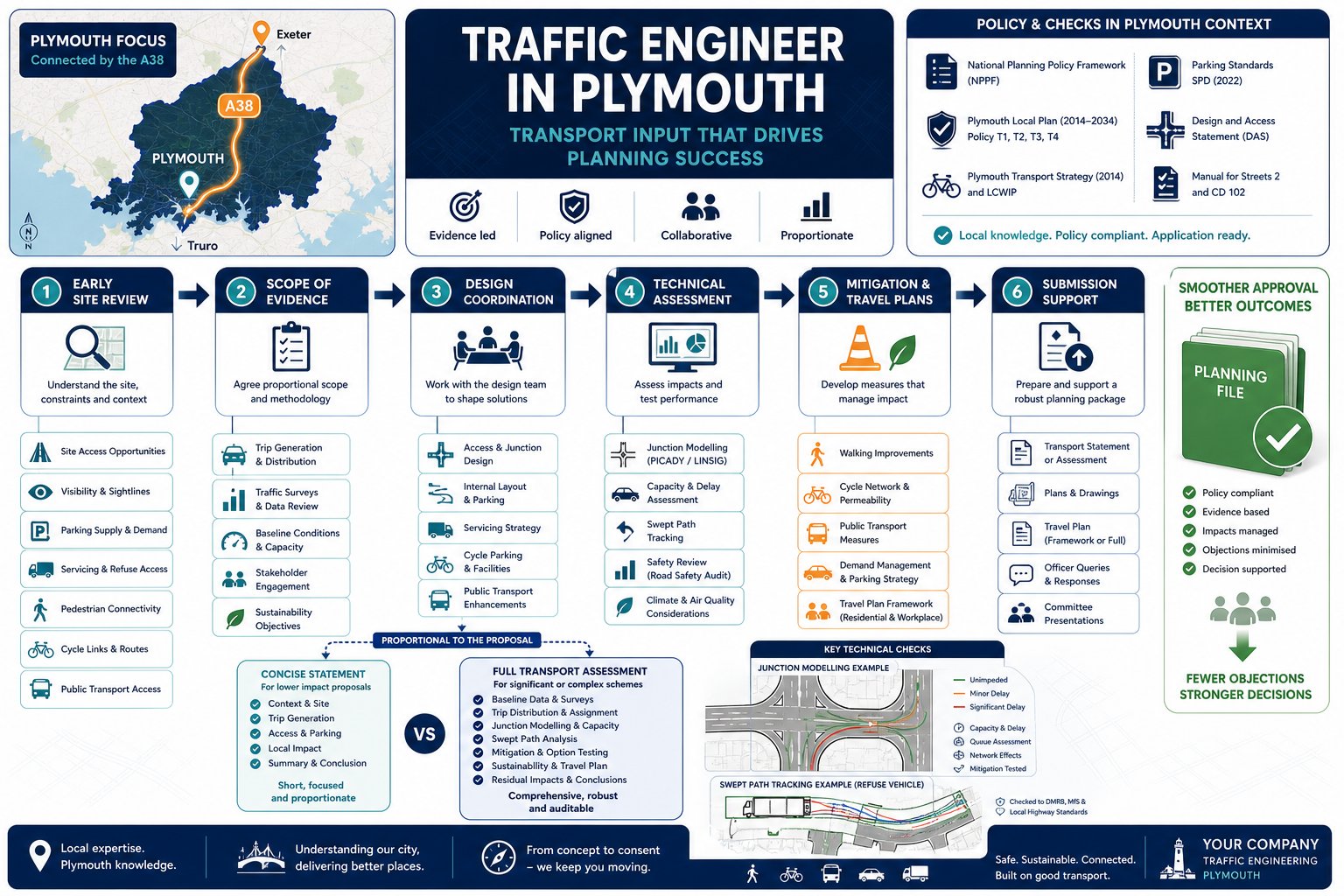
Planning applications rarely fail on ambition alone. More often, they stall because transport questions turn up late, the evidence is too thin, or the local highway authority simply isn’t convinced the scheme will work on the ground. In Plymouth, that matters more than many teams expect. The city has a complex road network, busy corridors feeding the A38, sensitive residential streets, and a planning policy backdrop that places real weight on safe access, sustainable travel, parking, and network impact.
That’s where a Traffic Engineer in Plymouth becomes central to the planning process rather than an afterthought. We work with architects, planners, developers, surveyors and legal teams to test whether a scheme is likely to create transport concerns, define the right scope of assessment, and produce reports that stand up to scrutiny. Sometimes that means a concise Transport Statement. Sometimes it means a full Transport Assessment, Travel Plan, junction modelling package, access review, or swept path work.
The practical goal is simple: reduce uncertainty and help a planning submission move forward with fewer avoidable objections. In 2026, with local validation expectations, policy compliance, and evidence quality under even sharper focus, transport input needs to be proportionate, technically sound, and aligned with Plymouth City Council’s requirements from the outset. The sections below explain what that looks like in practice, when reports are usually required, and how to choose support that genuinely improves the odds of a smoother planning decision.
Key Takeaways
- A Traffic Engineer in Plymouth plays a crucial role early in the planning process to address transport concerns and align schemes with local policies for safe access and sustainable travel.
- Transport Assessments or Statements are required based on site-specific transport impacts, not just development size, focusing on trip generation, junction capacity and sustainable travel arrangements.
- Tailoring transport reports to Plymouth’s local planning context and highway requirements ensures compliance and reduces objections during the planning approval process.
- Common developments needing traffic engineering input include residential schemes, commercial, community and mixed-use projects, where access, parking, servicing and trip profiles vary significantly.
- Proactive engagement, proportionate transport evidence, credible sustainable travel measures, and clear presentation help avoid delays and further information requests.
- Choosing the right traffic engineer involves local expertise, relevant experience, professional credentials, and ongoing availability for pre-application to post-submission support.
What A Traffic Engineer In Plymouth Does For Planning Applications
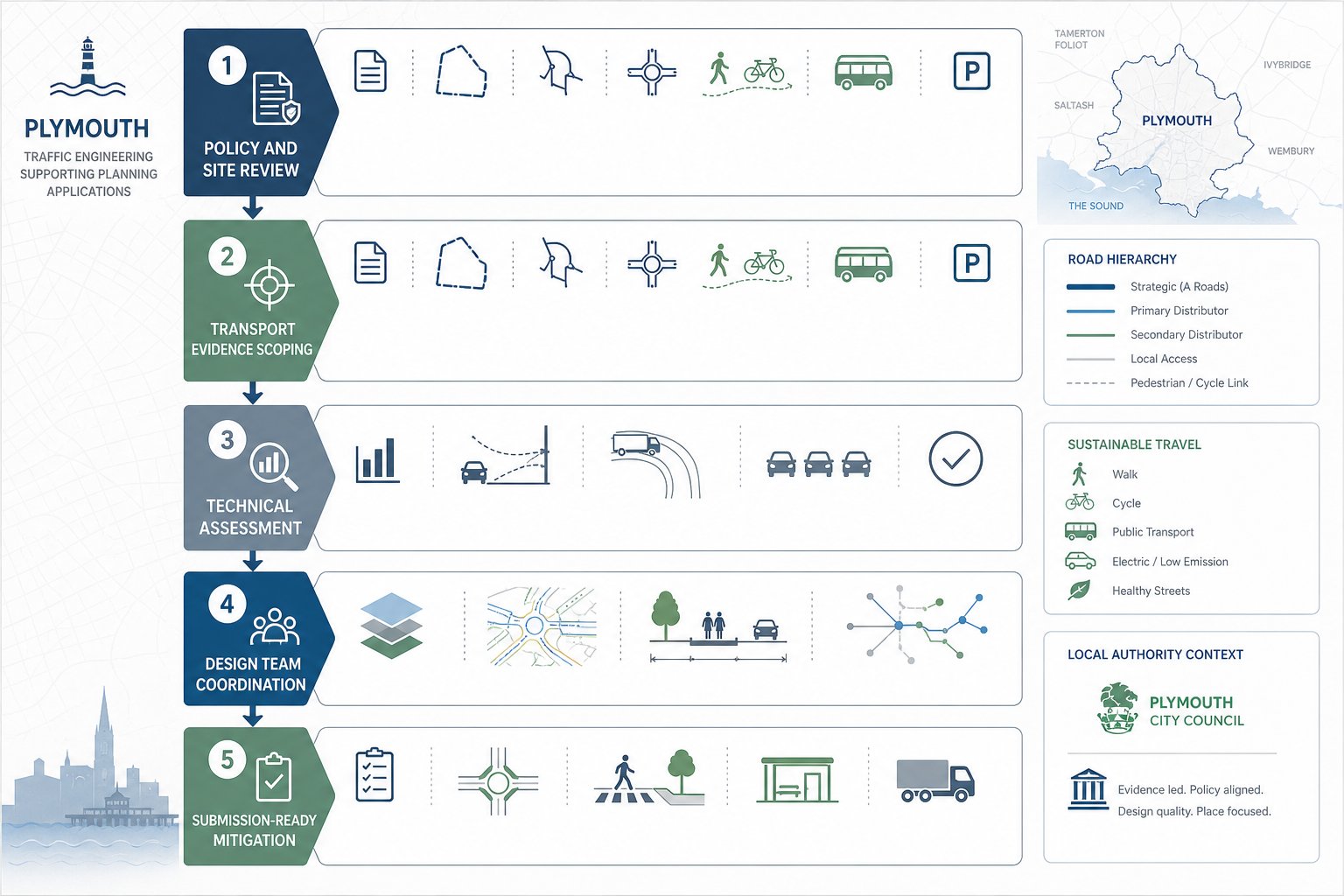
A traffic engineer’s role is broader than many project teams first assume. We’re not just producing a report to satisfy a validation checklist. We’re usually helping shape the scheme itself so that access, parking, servicing, circulation, and sustainable travel all make sense before the application lands on a case officer’s desk.
In Plymouth, that starts with reviewing the proposal against the local planning context, including the Plymouth and South West Devon Joint Local Plan, relevant supplementary guidance, parking expectations, and national documents such as Manual for Streets and the Department for Transport’s transport assessment guidance. We look at the red-line boundary, surrounding road hierarchy, nearby junctions, walking and cycling links, bus accessibility, recorded safety issues, and whether the site sits close to a constrained corridor or strategic route.
From there, we advise on what level of transport evidence is proportionate. For some schemes, a short note can answer the key questions. For others, a full package is needed, covering trip generation, traffic distribution, junction capacity, visibility, swept paths, and mitigation. That early judgement matters because over-scoping wastes time and money, while under-scoping almost always leads to objections or requests for further information.
We also work closely with the rest of the design team. Access widths may affect landscape plans. Vehicle tracking can alter a building line. Parking layout can influence drainage and bin collection strategy. This coordination is a big reason experienced Traffic Engineering Consultants: What tend to add value well before submission, not just at the reporting stage.
When A Transport Assessment Or Transport Statement Is Needed In Plymouth
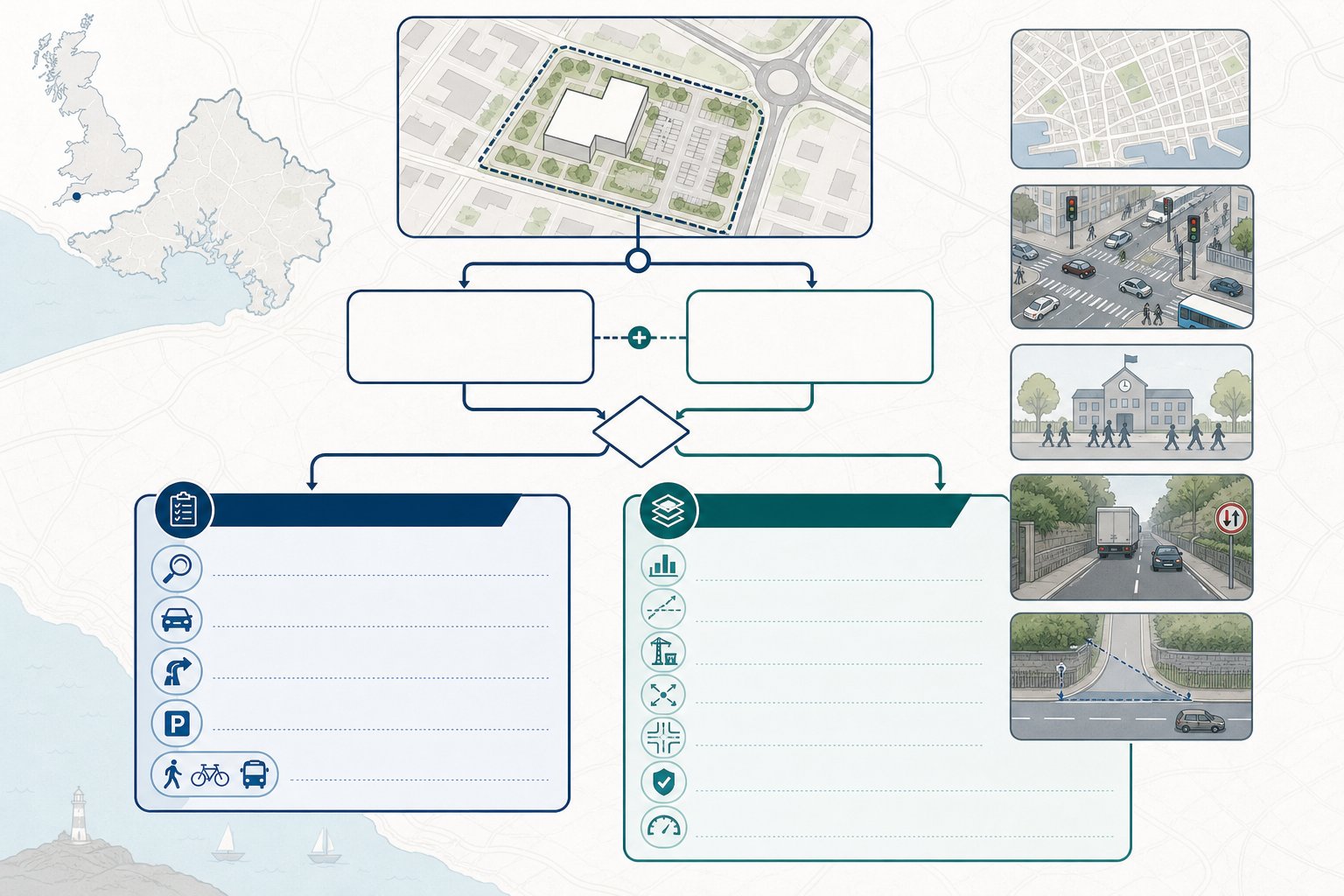
The short answer is this: a Transport Assessment or Transport Statement is needed when the development is likely to create transport effects that the planning authority cannot reasonably ignore. The harder part is deciding where that threshold sits for a particular site.
National guidance still points teams toward assessing proposals that may generate significant transport impacts. In practice, larger residential, retail, employment, education, healthcare, and leisure schemes are the obvious candidates. But in Plymouth, smaller schemes can also trigger transport work where the location is sensitive. A modest development beside a heavily trafficked junction, near a school, on a constrained urban street, or with poor visibility may still need formal evidence.
A Transport Statement is generally suitable where impacts are expected to be limited and the task is mainly to describe existing conditions, estimate likely trips, and show that access, parking, and sustainable travel arrangements are acceptable. A Transport Assessment is more detailed. It usually covers baseline conditions, future year forecasts, committed development, trip generation and distribution, junction modelling, mitigation, and a clearer explanation of residual impacts.
The right answer often emerges through scoping. We prefer to review likely trip rates, surrounding constraints, and consultee sensitivities before deciding what to submit. That avoids the common mistake of treating every site the same. Comparable planning contexts in cities discussed by Traffic Engineer In Bristol: and Traffic Engineer In Birmingham: show the same pattern: thresholds matter, but site-specific judgment matters more.
How Local Planning And Highway Requirements Shape Transport Reports
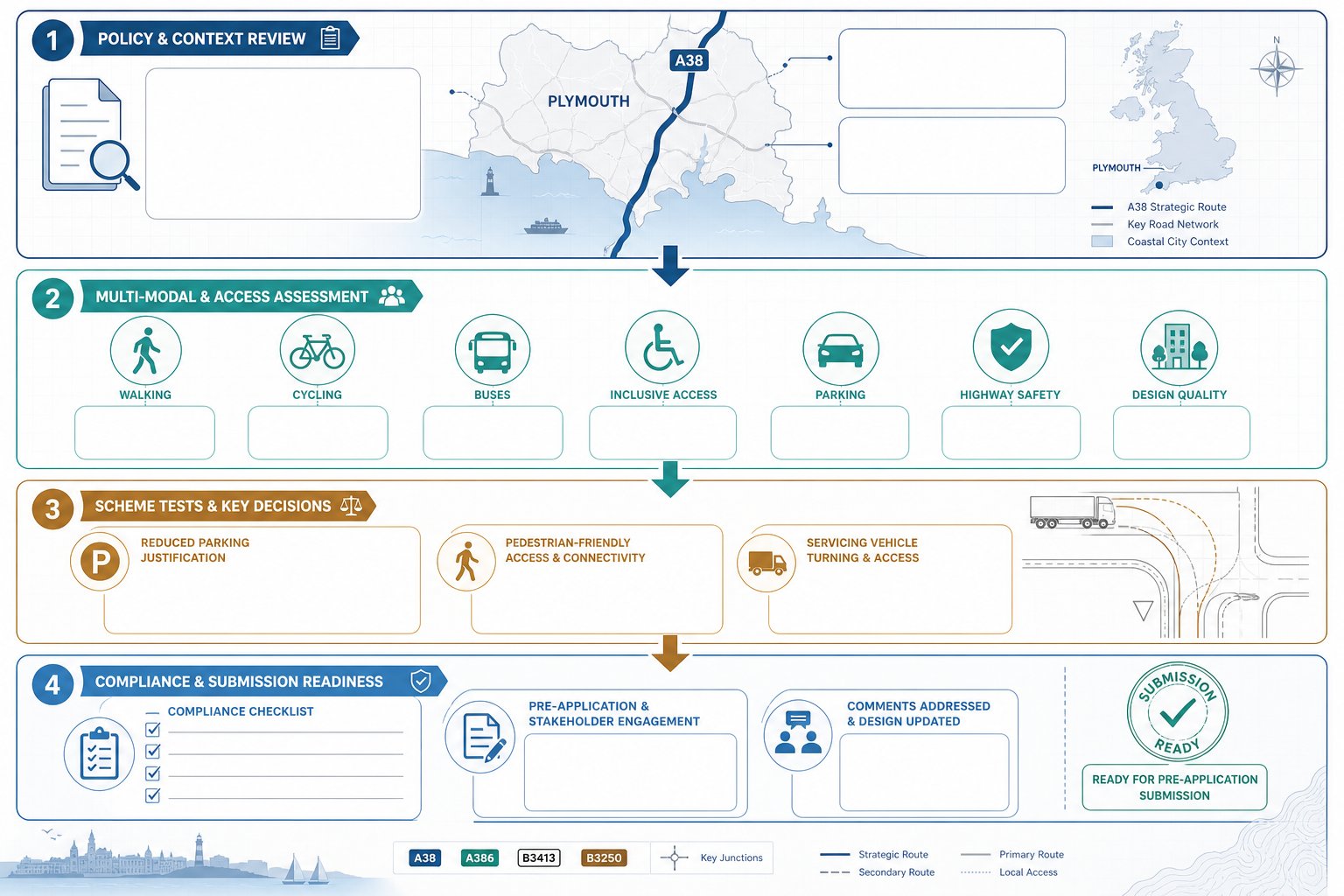
A good transport report for Plymouth is never just a generic national template with local place names dropped in. It has to respond to the actual policy and highway context that decision-makers are working within.
At local level, that means understanding how sustainable transport, accessibility, parking provision, highway safety, and design quality are addressed within the development plan and validation requirements. Plymouth City Council will want confidence that a scheme is not simply workable for cars, but appropriately connected for walking, cycling, buses, and inclusive access. If the proposal sits near the strategic highway network, National Highways may also have a role, particularly where cumulative effects on the A38 corridor are a concern.
That policy context shapes report structure. For example, if a scheme relies on reduced parking, the transport case needs to explain why the location can support that approach and what travel plan measures will make it credible. If an access is technically achievable but awkward for pedestrians, the design may need refining before submission. If servicing vehicles can enter but not turn, a swept path assessment becomes essential rather than optional.
We also pay close attention to the Local Validation List and any pre-application advice. Those two items often tell you exactly what the authority will expect, yet they’re surprisingly easy to underuse. Work prepared with the same practical discipline used by Highway And Traffic specialists tends to perform better because it is built around the authority’s real concerns, not just textbook compliance.
Common Development Types That Need Traffic Engineering Input
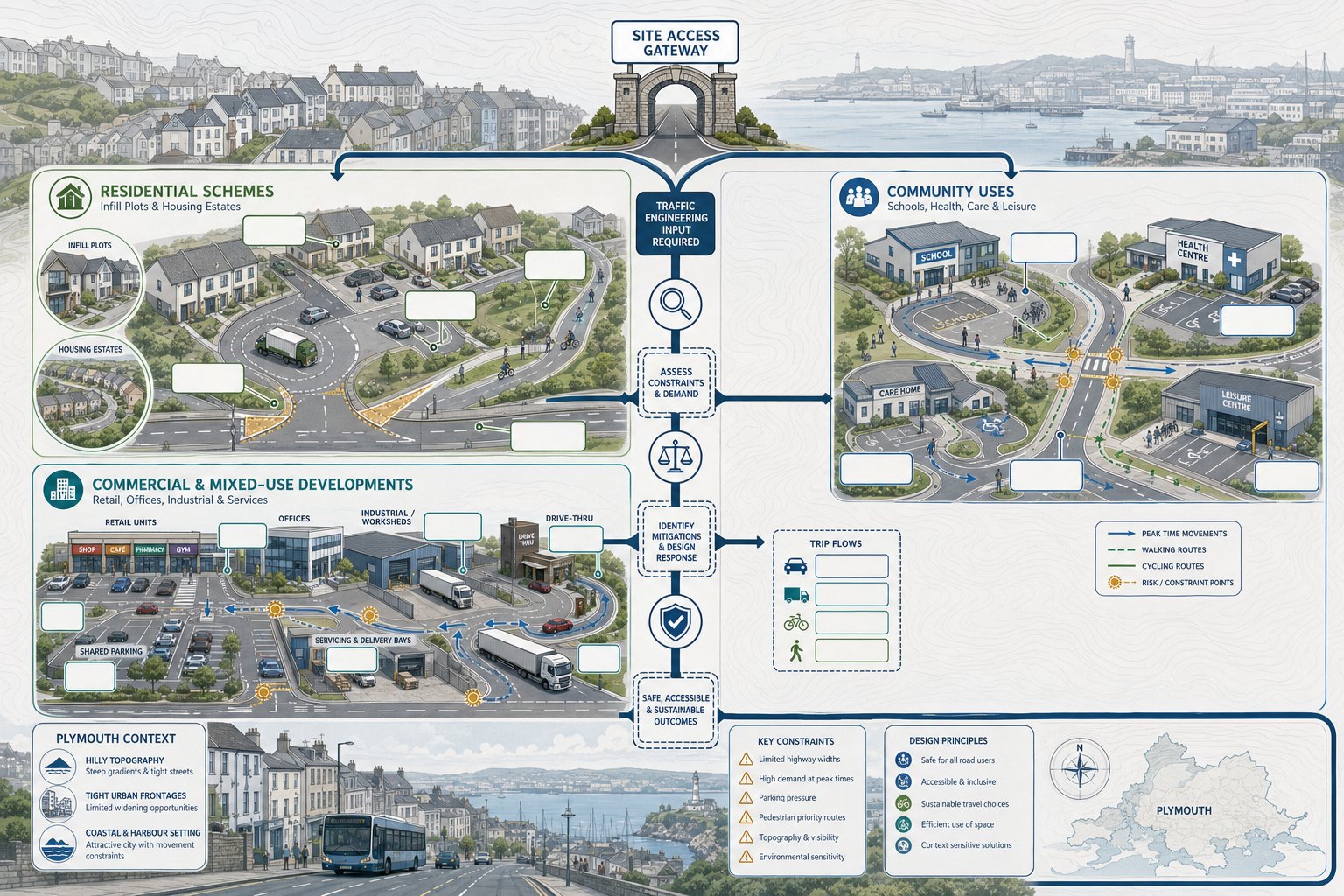
Not every proposal needs a lengthy transport package, but a wide range of developments in Plymouth benefit from traffic engineering input far earlier than teams often expect. The common thread is simple: if a scheme changes how people, goods, refuse vehicles, emergency services, or delivery traffic move to and around a site, transport questions will surface.
The degree of input depends on scale, use, and context. A small urban infill site can be transport-sensitive because of tight geometry or parking pressure. A much larger greenfield edge-of-settlement scheme may have room for access design but still require robust junction testing and travel planning. And some uses, such as drive-thrus or schools, can create sharp peaks that need careful assessment even where daily traffic totals don’t look dramatic on paper.
That is why we usually advise clients not to think in terms of “big scheme equals report, small scheme equals no issue”. The more accurate question is whether the development introduces material planning and highway risks that need evidence, drawings, or mitigation.
Residential Schemes
Residential development is one of the most frequent triggers for transport support in Plymouth. This covers everything from single plots with awkward access arrangements to estate extensions and major housing allocations.
For smaller residential schemes, the issues are often deceptively practical: can vehicles enter and leave in a safe manner, is visibility acceptable, where do refuse vehicles stop or turn, will parking overspill affect neighbours, and is there a reasonable walking route to local services? On compact sites, a quick access review or swept path check can avoid a costly redesign later.
For larger housing developments, the emphasis shifts. We’re usually looking at trip generation, peak-hour impact on nearby junctions, pedestrian and cycle connectivity, bus accessibility, internal street hierarchy, emergency access, and whether phased mitigation is required. Travel Plans also become more meaningful on these schemes, especially where active travel infrastructure or bus service enhancements form part of the planning balance.
Plymouth’s topography and street patterns can complicate residential design more than a plan drawing first suggests. Steep gradients, constrained frontages, and established parking stress all matter. Similar urban pressures appear in places covered by Traffic Engineer In London: where location-specific judgement is often just as important as raw trip numbers.
Commercial, Mixed-Use, And Community Developments
Commercial and community schemes tend to require a broader transport lens because they involve more varied trip profiles, servicing demands, and operating patterns. Retail units, foodstores, drive-thrus, offices, industrial premises, schools, health facilities, leisure uses, care homes, and mixed-use town centre projects all raise different questions.
A drive-thru may hinge on queueing and internal stacking. An industrial scheme may stand or fall on HGV access, turning, and interaction with nearby junctions. A school can generate acute arrival and departure peaks, safety concerns outside the gate, and strong pressure for active travel planning. Community uses often need careful thought about drop-off, accessibility for disabled users, and compatibility with neighbouring streets.
Mixed-use sites are especially interesting because the answer is rarely found in a single spreadsheet. We need to understand whether uses share trips internally, whether parking can be managed across the day, how servicing avoids conflict, and whether the transport narrative is coherent enough for planning officers, councillors, and local residents to follow. That combination of technical evidence and plain-English explanation is often what turns a dense report into a useful planning document.
Core Traffic Engineering Services For Plymouth Projects
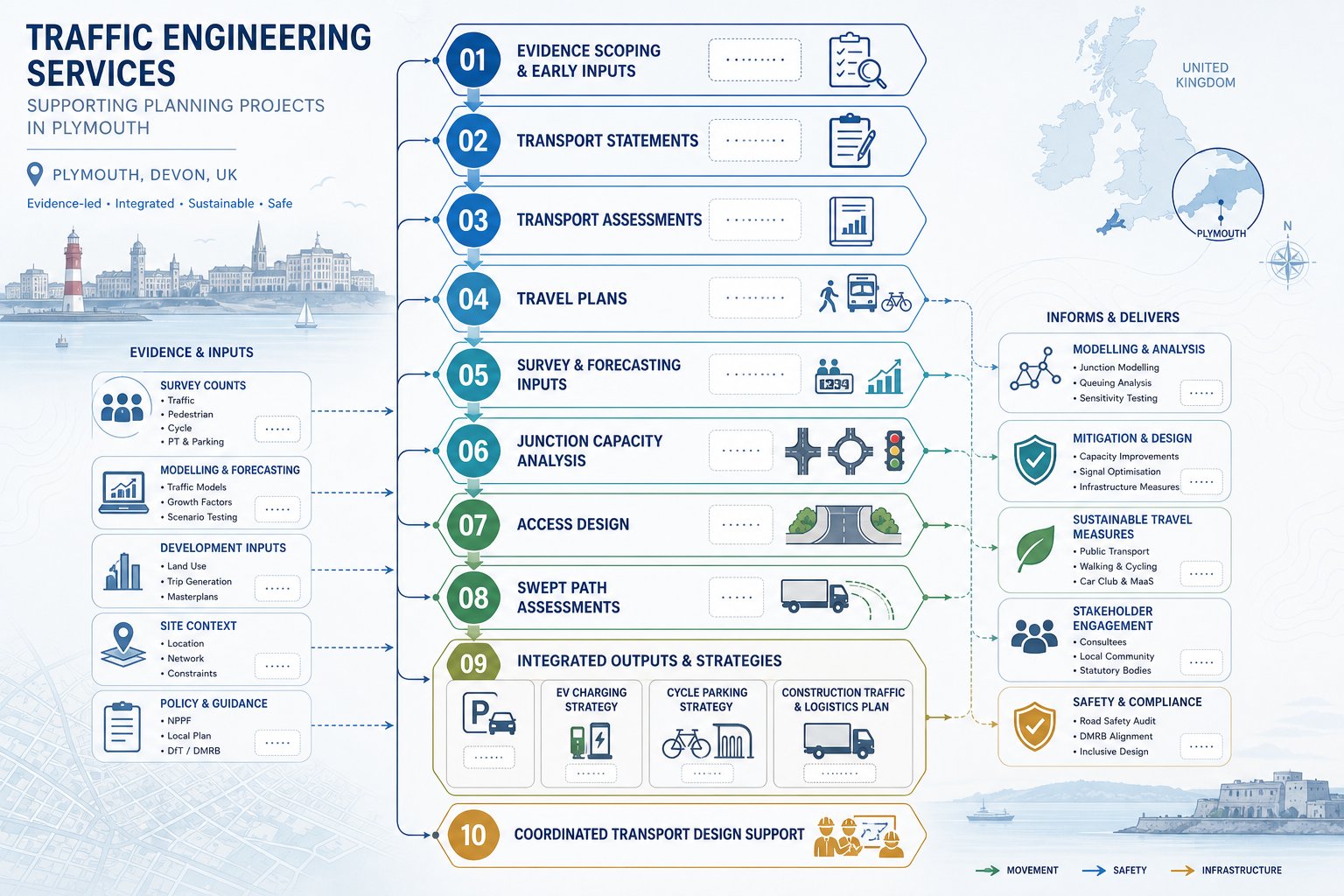
Most Plymouth planning schemes don’t need every transport service available, but they do need the right combination delivered at the right time. The best outcomes usually come from proportionate scope, clear assumptions, and enough technical depth to answer the authority’s likely questions before they are formally asked.
Our work typically starts with identifying what evidence is essential for validation and determination, then supporting the design team so that transport inputs feed into the wider planning case. That can mean anything from a concise statement for a small redevelopment site to a package of surveys, modelling, access design advice, and follow-up responses after submission.
Transport Assessments, Transport Statements, And Travel Plans
These are the backbone documents for many planning applications. A Transport Statement is often the right fit where a proposal has limited impact but still needs a reasoned explanation of access, parking, servicing, and likely trip generation. A Transport Assessment goes further, providing a detailed appraisal of baseline conditions, development trips, assignment, future year scenarios, cumulative impacts, mitigation, and residual effects.
Travel Plans sit alongside that technical evidence. Done well, they’re not generic promises about encouraging cycling. They set realistic targets, identify measures, define monitoring, and explain how the development will support more sustainable travel choices. In Plymouth, that often means paying attention to walking routes, gradients, cycle parking quality, bus availability, and the practical travel behaviour of future users.
Underpinning these reports are survey data and forecasting tools. We may use TRICS for trip generation, junction counts for calibration, parking surveys where stress is a concern, and multi-modal accessibility reviews where car restraint or reduced parking provision needs support. The same planning-led mindset discussed in Traffic Engineer In Leeds: is relevant here too: the report has to help win consent, not just exist.
Junction Capacity Analysis, Access Design, And Swept Path Assessments
When a development may affect operation on the surrounding highway network, junction modelling becomes central. Depending on the site, that could involve priority junction analysis, roundabout modelling, or signal assessment using established tools such as PICADY, ARCADY, or LINSIG. The objective is not merely to produce numbers: it is to understand whether queues, delays, and reserve capacity remain acceptable with development traffic in place, and whether mitigation is needed.
Access design is equally important. We review visibility splays, bellmouth geometry, gradients, pedestrian crossing points, internal circulation, and compatibility with Manual for Streets or other relevant standards. A technically poor access can undermine an otherwise strong planning case.
Swept path assessments are the detail that many teams leave too late. Yet refuse vehicles, fire appliances, delivery vans, and larger service vehicles all need to move safely without unrealistic manoeuvres. A tracking exercise can expose problems with bin collection, servicing courts, or basement ramps long before they become planning objections.
On more complex developments, these services also overlap with parking strategy, EV charging provision, cycle parking quality, and construction traffic planning. In other words, transport evidence is rarely a single standalone task: it’s a linked package that supports safe, workable development.
The Process From Initial Enquiry To Planning Submission
A well-run transport workstream usually follows a clear sequence, and when that sequence is skipped, projects tend to feel the consequences later.
First comes the initial enquiry. At this stage, we review the red-line boundary, site location, development quantum and mix, any concept drawings, and any pre-application feedback already received. That early review lets us identify obvious transport risks, likely report requirements, and whether traffic, speed, parking, or junction surveys are needed. It also allows us to provide a sensible fee and programme rather than guessing.
Next is scoping and data collection. We prefer to agree the assessment scope with the relevant highway authority wherever possible. That can cover study area junctions, survey days, assessment years, committed development, and whether a TS or TA is expected. Good scoping is one of the easiest ways to avoid later dispute.
Then comes design support. We work with architects and planners on access location, internal layout, parking strategy, servicing, active travel links, and any initial mitigation options. This is often the point where swept paths or capacity tests change the design for the better.
After that, we move into assessment and reporting: baseline review, trip generation, assignment, impact testing, mitigation, and drafting. Once the team has reviewed the documents, we finalise them for submission and remain involved post-submission to answer consultee comments. That ongoing role matters. Teams dealing with schemes in cities such as Traffic Engineer In Manchester: run into the same reality: determination often depends as much on how comments are handled as on the first draft report.
What Helps Avoid Delays, Objections, And Requests For Further Information
Most planning delays linked to transport are avoidable. Not all, of course. Some sites are genuinely constrained and some highway concerns are entirely justified. But a surprising number of objections stem from timing, scope, presentation, or coordination failures rather than from the development principle itself.
The first safeguard is early engagement. If highway officers are likely to care about a specific junction, school gate issue, parking stress problem, or strategic route effect, it is better to know that before surveys are commissioned and models are built. Pre-application discussions can save weeks.
The second is proportionate but robust evidence. Up-to-date traffic counts, speed data, parking stress surveys, and accurate drawings make a huge difference. Old counts, unsuitable neutral months, or diagrams that don’t match the architect’s plans are classic triggers for further information requests.
Third, sustainable travel measures need to be credible. It’s not enough to state that residents can walk or cycle if the route is indirect, steep, poorly lit, or disconnected. The report should explain what infrastructure exists, what improvements are proposed, and how a Travel Plan will support realistic behaviour change.
Clarity also matters more than many technical teams admit. Officers, committee members, and objectors need to understand the story. A concise summary, well-annotated figures, and straightforward explanation of effects and mitigation can prevent misunderstanding from turning into objection. Finally, transport advice should align with drainage, urban design, ecology, and noise work. A great access proposal that clashes with tree protection or visibility requirements is not a great proposal at all.
Choosing The Right Traffic Engineer For A Plymouth Development
Choosing the right consultant is partly about technical competence and partly about judgment. You need both.
At a minimum, the team should understand Plymouth’s planning and highway environment, the expectations of Plymouth City Council, and where National Highways may become relevant because of A38 interactions. That local awareness affects scoping, assumptions, design advice, and how reports are framed. Generic transport writing rarely performs as well as work grounded in the realities of the local network and authority concerns.
Track record matters too. We’d always recommend looking for experience on comparable schemes by scale and type, not just a long project list. A consultant who regularly supports residential infill may not be the best fit for a logistics or school project, and vice versa.
Professional credentials are another obvious checkpoint: Chartered status, relevant institution membership such as MICE or MCIHT, appropriate professional indemnity cover, and competence with recognised modelling and design tools. But softer skills matter just as much. Can the engineer explain technical issues clearly to planners, lawyers, ward members, and residents? Can they hold their line when assumptions need defending, while still being pragmatic enough to refine a scheme when evidence points that way?
We’d also look at availability. Planning applications move quickly, and transport questions rarely arrive once. A consultant who can support pre-app, submission, consultee responses, committee preparation, and appeal if necessary is often worth more than one who simply issues a report and disappears. That’s the difference between document production and real planning support.
Conclusion
For many Plymouth developments, transport is the part of the planning case that quietly decides whether the whole submission feels credible. A safe access, realistic parking strategy, sound junction evidence, and a convincing approach to sustainable travel can turn a scheme from questionable to well-founded. The reverse is true as well: weak or late transport input can create avoidable friction even where the wider proposal is strong.
That is why a Traffic Engineer in Plymouth should be brought in early, scoped properly, and integrated with the design team rather than treated as a final reporting exercise. In 2026, smoother approvals are far more likely when transport evidence is local, proportionate, technically robust, and clearly explained. For architects, planners, developers, lawyers, and councils alike, the goal is not simply to satisfy a requirement. It is to demonstrate, with confidence, that the development will work in the real world as well as it does on the drawing board.
Frequently Asked Questions About Traffic Engineering in Plymouth
What role does a traffic engineer play in Plymouth planning applications?
A traffic engineer in Plymouth assesses how developments impact local roads, junctions, parking, safety, and sustainable travel. They prepare Transport Assessments, Transport Statements, and Travel Plans aligned with Plymouth City Council policies to ensure schemes work in practice and meet local planning requirements.
When is a Transport Assessment or Transport Statement required in Plymouth?
Transport evidence like a Transport Assessment is needed for developments with significant transport impacts, such as large housing or commercial projects. Smaller but sensitive sites, for example near busy junctions or schools, may require a Transport Statement to address local concerns effectively.
How do local Plymouth policies affect transport reports?
Transport reports must comply with Plymouth City Council’s planning policies on sustainable transport, parking, and road safety. They also follow the Local Validation List and design standards like Manual for Streets, ensuring evidence meets local authority expectations and reflects the city’s transport context.
What types of developments typically need traffic engineering input in Plymouth?
Traffic engineering support is critical for residential schemes ranging from infill plots to major housing sites, as well as commercial, mixed-use, and community developments like schools, retail parks, offices, and care homes, because these affect access, parking, safety, and transport networks.
How can early engagement with a traffic engineer help avoid planning delays in Plymouth?
Early involvement allows scope agreement with Plymouth highway officers, timely data collection, and integration of transport design with planning. This reduces risks of objections and requests for further information, streamlining approval by ensuring transport evidence is proportionate, robust, and locally relevant.
What should I look for when choosing a traffic engineer for a Plymouth development?
Select a consultant with local Plymouth experience, a strong track record on similar schemes, professional qualifications (Chartered status, MICE/MCIHT), proficiency in modelling tools, clear communication skills, and capacity to support pre-application to post-submission stages for smooth planning navigation.