
Planning applications rarely fail on design alone. More often, they stall because the transport case is weak, late, or too generic for the site. In Doncaster, that matters more than many teams expect. The borough includes strategic motorway connections, busy logistics corridors, town-centre constraints, edge-of-settlement growth areas, and places where walking, cycling and bus access can become just as important as junction capacity.
That is where a traffic engineer in Doncaster adds real value. We help project teams turn a transport issue into a clear, evidence-based planning submission: one that addresses likely highways concerns before they harden into objections. For architects, planners, lawyers, surveyors, developers and local authorities, the benefit is practical rather than theoretical, better scoping, sharper reports, fewer rounds of avoidable comments, and a stronger route to consent.
In this guide, we set out what a traffic engineer in Doncaster actually does, when a Transport Assessment or Transport Statement is likely to be needed, how local planning and highway context shapes the work, and why early technical input often saves weeks later. We also cover the reports commonly prepared, the local issues that can influence outcomes, what to have ready before instruction, and the most frequent reasons transport submissions are delayed. If you are programming a 2026 application, this is the groundwork worth getting right first.
Key Takeaways
- A traffic engineer in Doncaster provides essential, site-specific transport evidence to support planning applications, addressing local highway authority concerns early in the process.
- Transport Assessments or Statements are needed when developments have a material transport effect, with local context in Doncaster influencing the scope beyond national thresholds.
- Local transport conditions in Doncaster, including strategic routes, public transport availability, and safety issues, must shape transport reports for credible and effective planning submissions.
- Common developments requiring traffic engineering input in Doncaster include residential schemes, commercial and logistics sites, and education or healthcare facilities, each with distinct transport considerations.
- Coordinated reports combining trip generation, junction capacity, parking assessments, and access design reduce delays and objections in Doncaster planning approvals.
- Choosing a traffic engineer familiar with Doncaster’s local policies, capable of comprehensive analysis, and able to deliver timely, planning-focused advice improves the likelihood of successful transport submissions.
What A Traffic Engineer In Doncaster Does For Planning Applications
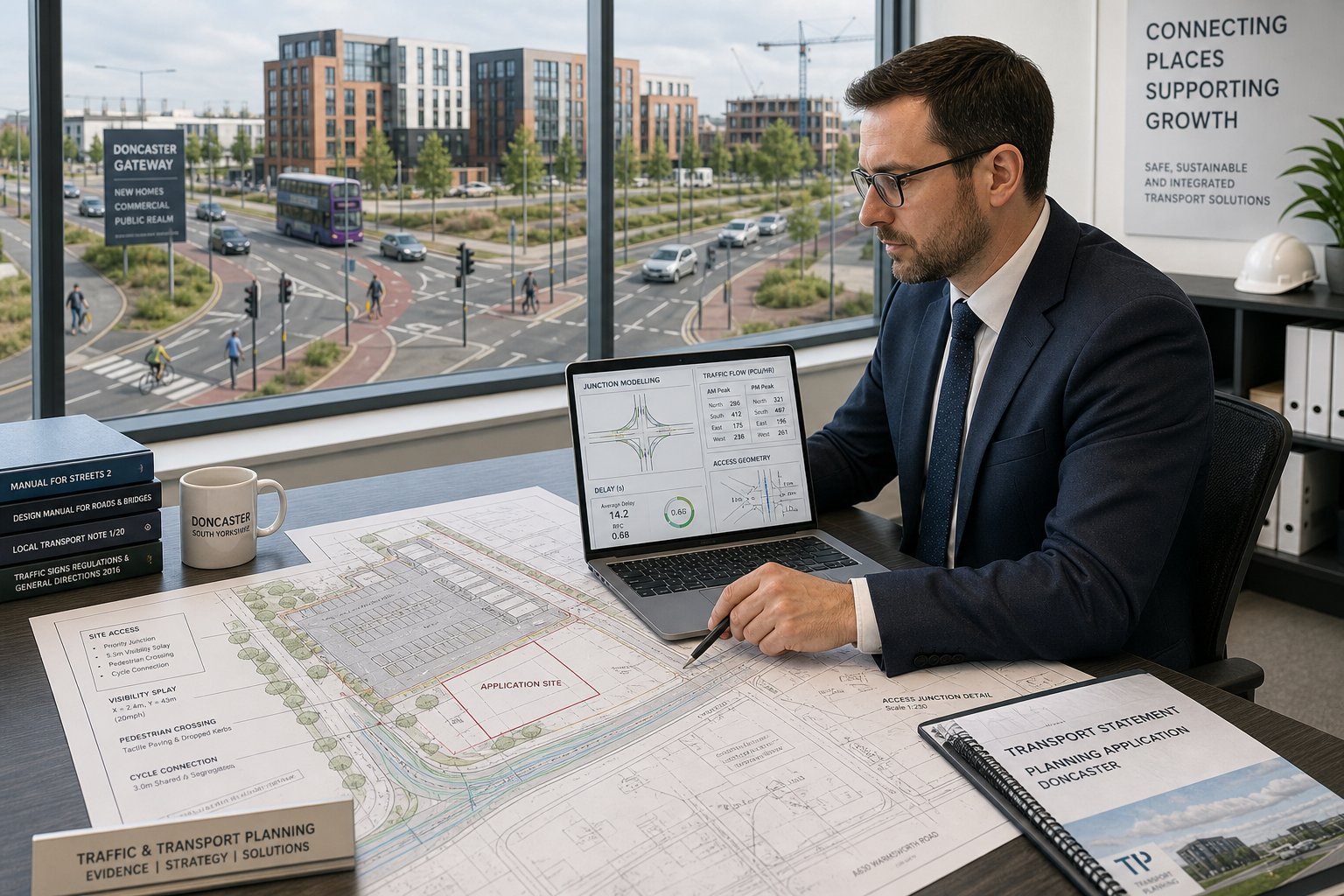
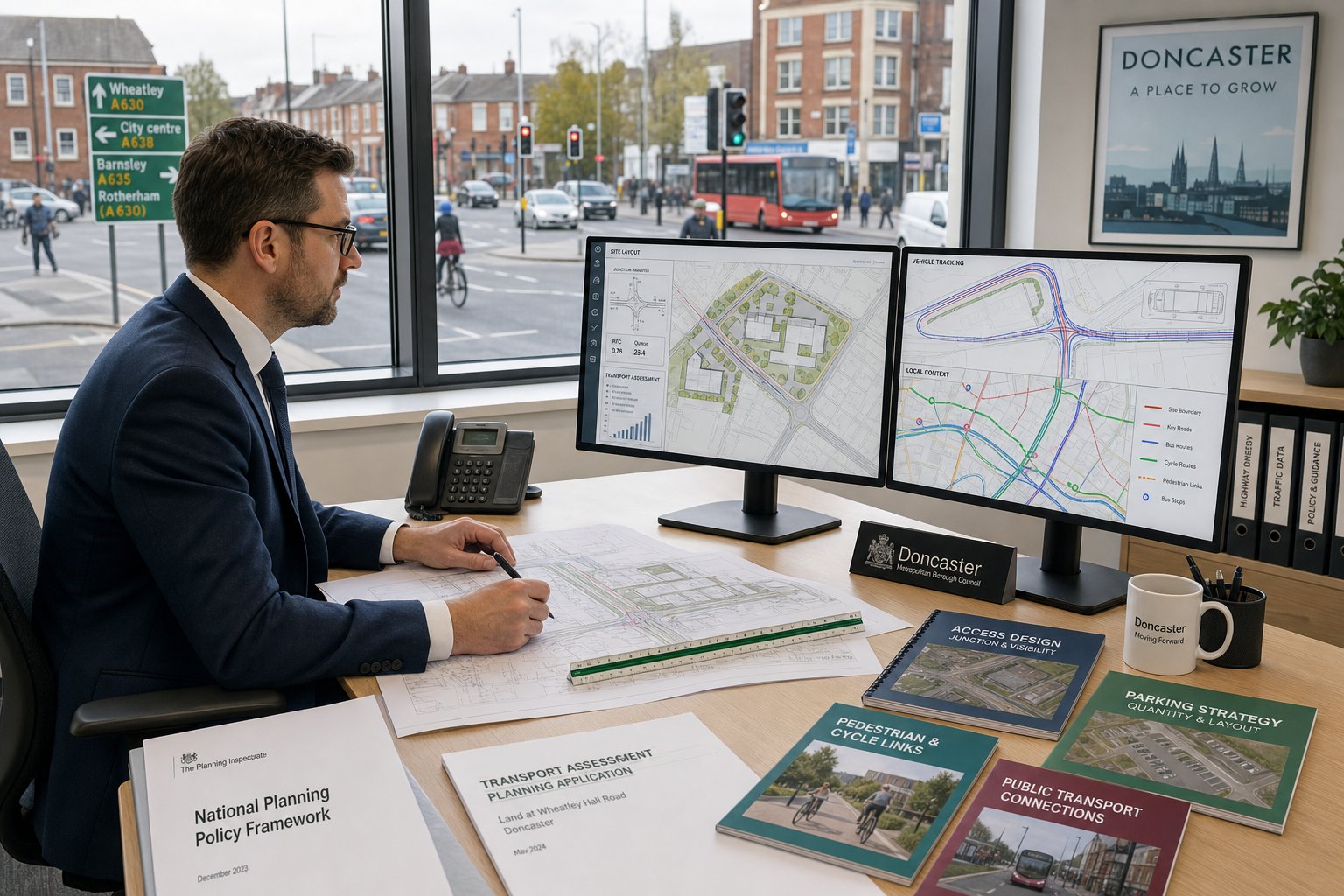
A traffic engineer in Doncaster supports the planning process by showing, with evidence, how a proposal will interact with the surrounding highway and transport network. That sounds simple. In practice, it covers far more than counting vehicles.
We typically advise on whether a scheme needs a Transport Assessment, Transport Statement, Travel Plan, technical note, access review, junction appraisal or parking strategy. We assess likely trip generation, access geometry, visibility splays, internal layout, refuse and delivery tracking, servicing arrangements, pedestrian links, cycle access, and public transport connections. On more sensitive sites, we also review personal injury collision history, frontage conditions, school pick-up pressures, or HGV routing.
For planning teams, our role is partly analytical and partly strategic. We identify the issues the local highway authority is likely to focus on, then scope the work to answer those points directly. That may include traffic surveys, TRICS-based forecasts, junction modelling, swept path analysis, or design input tied to national guidance such as Manual for Streets and relevant DMRB principles.
The best results usually come when transport advice is integrated early with design and planning. A workable access, realistic parking provision and defensible traffic assumptions can prevent redesign later. Broader practice standards are covered in Traffic Engineering Consultants: What and our wider overview of Traffic Engineering: Your Complete, but in Doncaster the local planning context always shapes the final approach.
When A Transport Assessment Or Transport Statement Is Needed
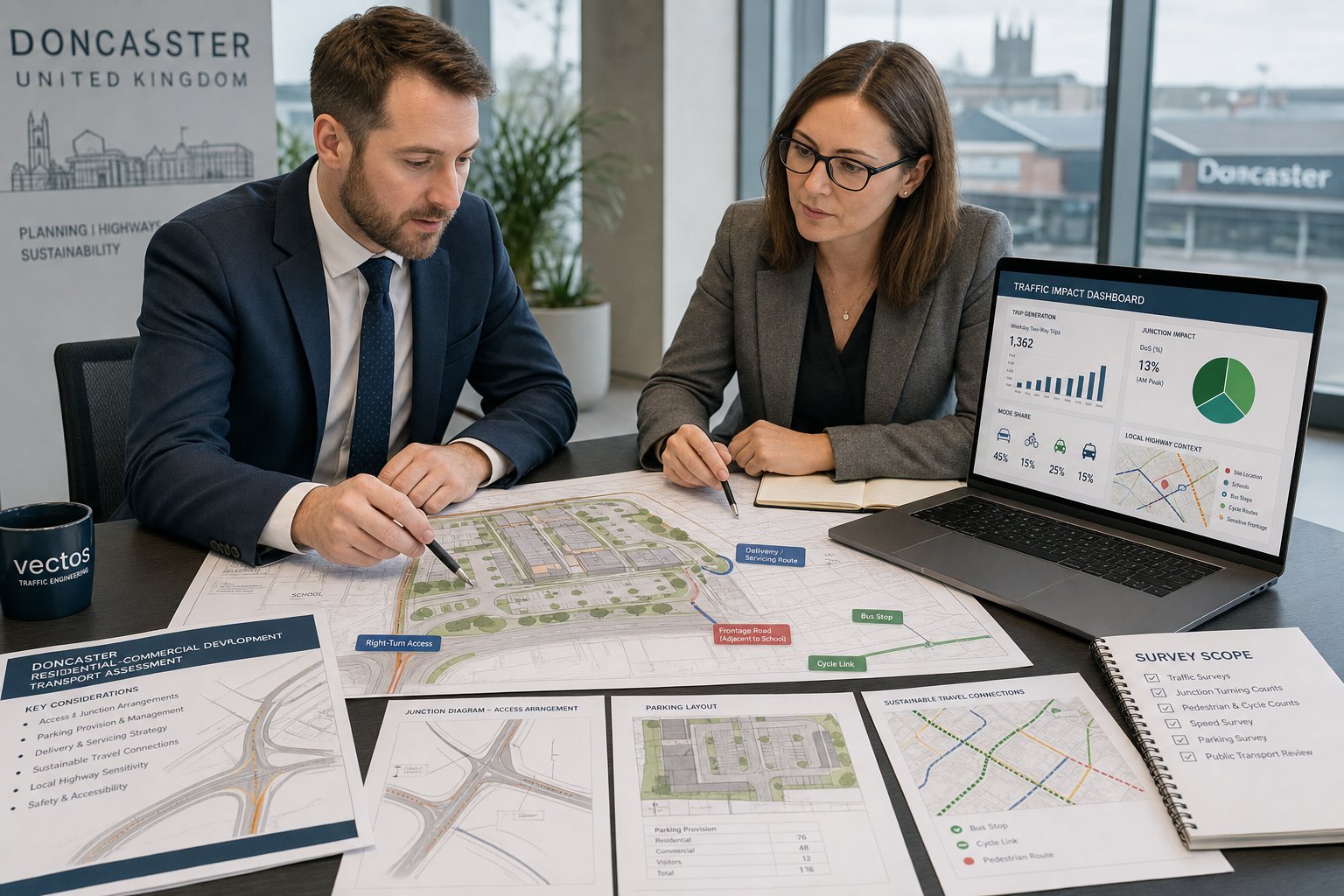
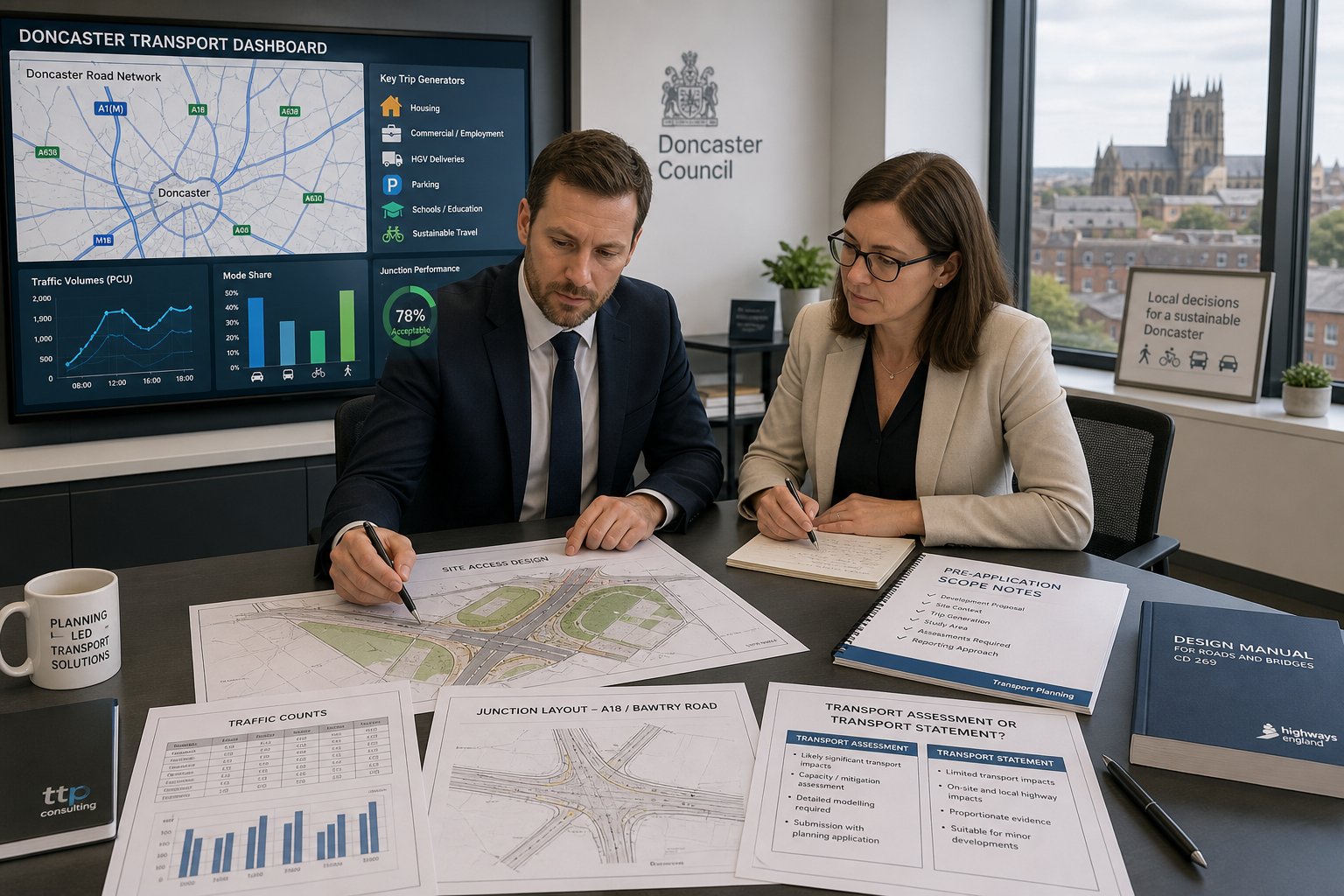
The short answer is: when the development is likely to have a material transport effect. The harder part is defining “material” for the specific site, use and location.
In broad terms, larger residential, commercial, industrial and mixed-use schemes are more likely to require a full Transport Assessment. Smaller proposals may only need a Transport Statement or concise transport note. But national guidance thresholds are not a substitute for judgement. Doncaster Council’s highways team will consider local road conditions, existing congestion, sustainable travel options, road safety context, servicing intensity and whether a new or altered access is proposed.
A residential scheme with a modest number of dwellings may still require robust assessment if it sits on a constrained frontage road, near a school, or relies on a difficult right-turn movement. Likewise, a relatively small commercial unit can trigger detailed review if HGV activity, delivery timing or parking stress is likely to be contentious.
That is why pre-application discussion matters. We generally recommend agreeing scope early where possible: what surveys are needed, which junctions should be assessed, whether a Travel Plan is expected, and if parking or servicing needs standalone justification. Comparable approaches in other cities can be useful context, our work as Traffic Engineer In Leeds: and Traffic Engineer In Manchester: shows how threshold decisions often turn on local network sensitivity rather than scheme size alone.
Doncaster Planning And Highway Context That Shapes Transport Reports
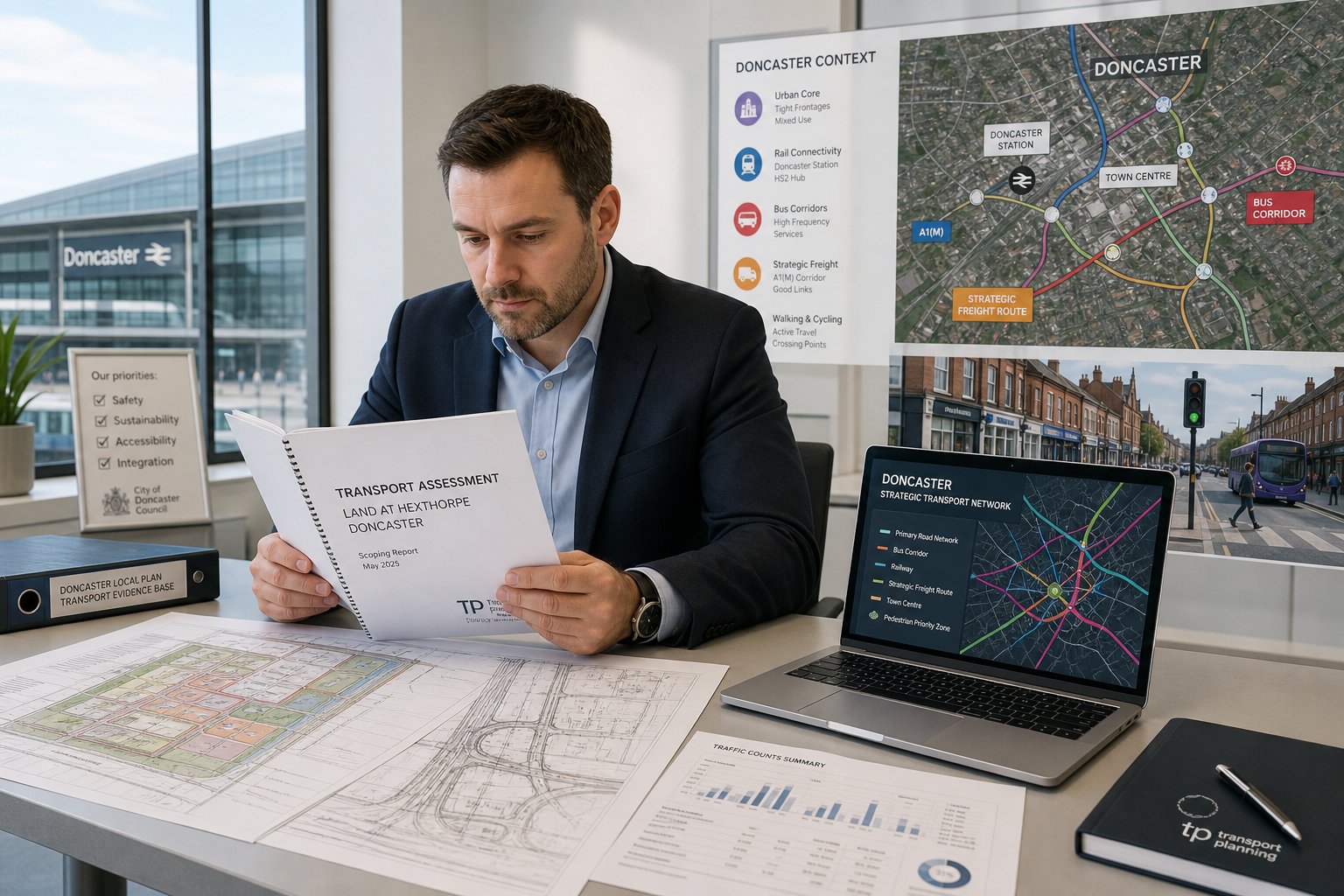
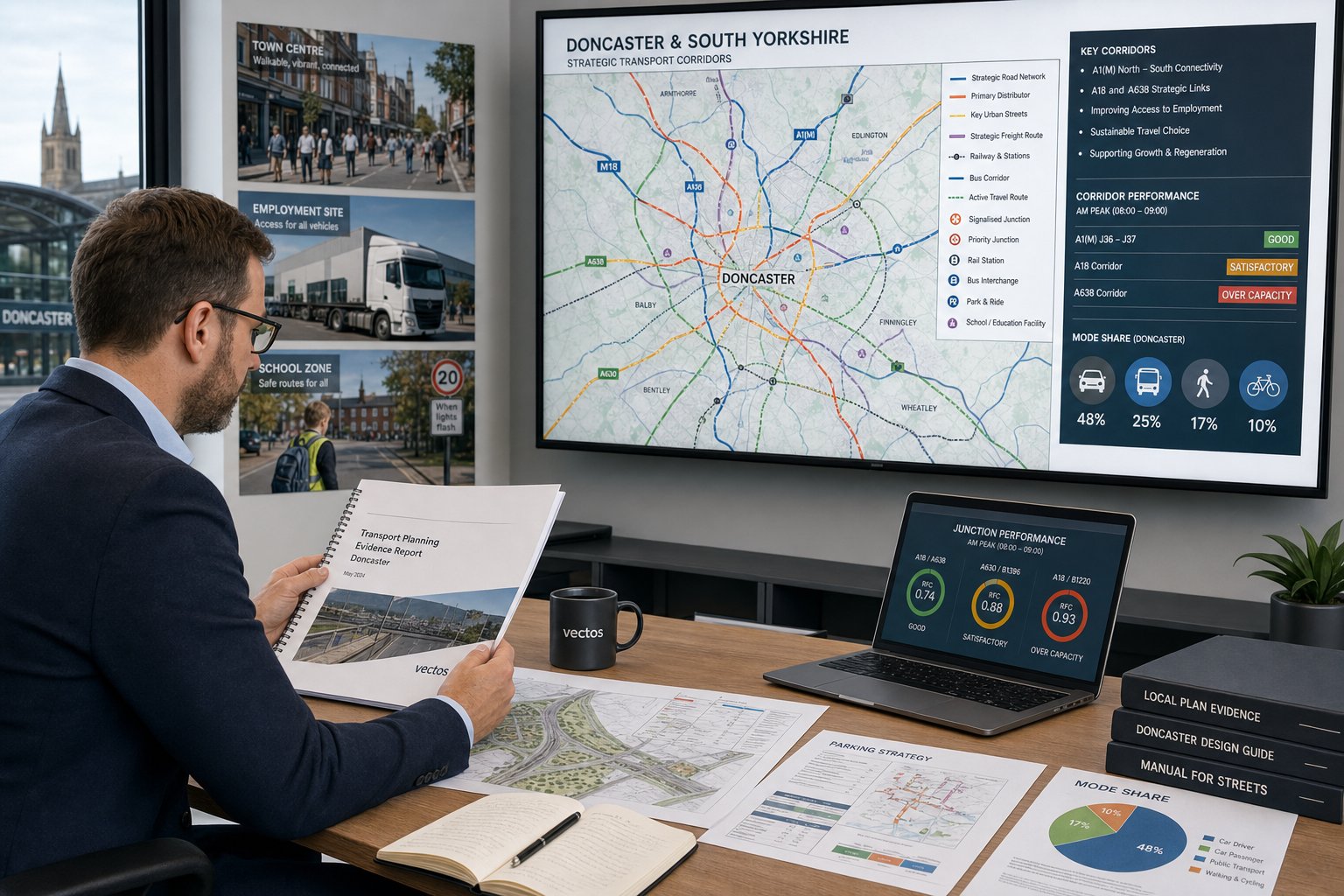
Transport reports in Doncaster do not sit in a vacuum. They need to respond to national planning policy, local plan policy, South Yorkshire transport objectives, and the practical concerns of the highway authority reviewing the application.
At national level, the familiar themes remain: safe and suitable access, sustainable travel, and impacts on the residual cumulative operation of the road network. Locally, that broad framework becomes more specific. Doncaster contains urban roads with tight frontages, strategic routes serving employment areas, settlements with more limited public transport choice, and town-centre locations where walkability can materially improve the planning balance.
That means report scoping should reflect place. A site near a rail station or strong bus corridor may justify different assumptions on mode share and parking demand from a peripheral site where car dependency is harder to avoid. An employment site close to strategic freight routes may need far more detail on HGV arrivals, routing, gate operation and junction resilience. A school or care use may need sharper focus on vulnerable road users and crossing points than pure traffic volume suggests.
We also find that local credibility matters. Generic text copied between authorities is easy to spot and rarely persuasive. Our role is to tie the evidence to Doncaster-specific conditions, network constraints, observed travel patterns, local standards, and highway concerns likely to arise in consultation. That local tailoring is often the difference between a report that is merely submitted and one that is actually useful.
Typical Development Types That Need Traffic Engineering Input
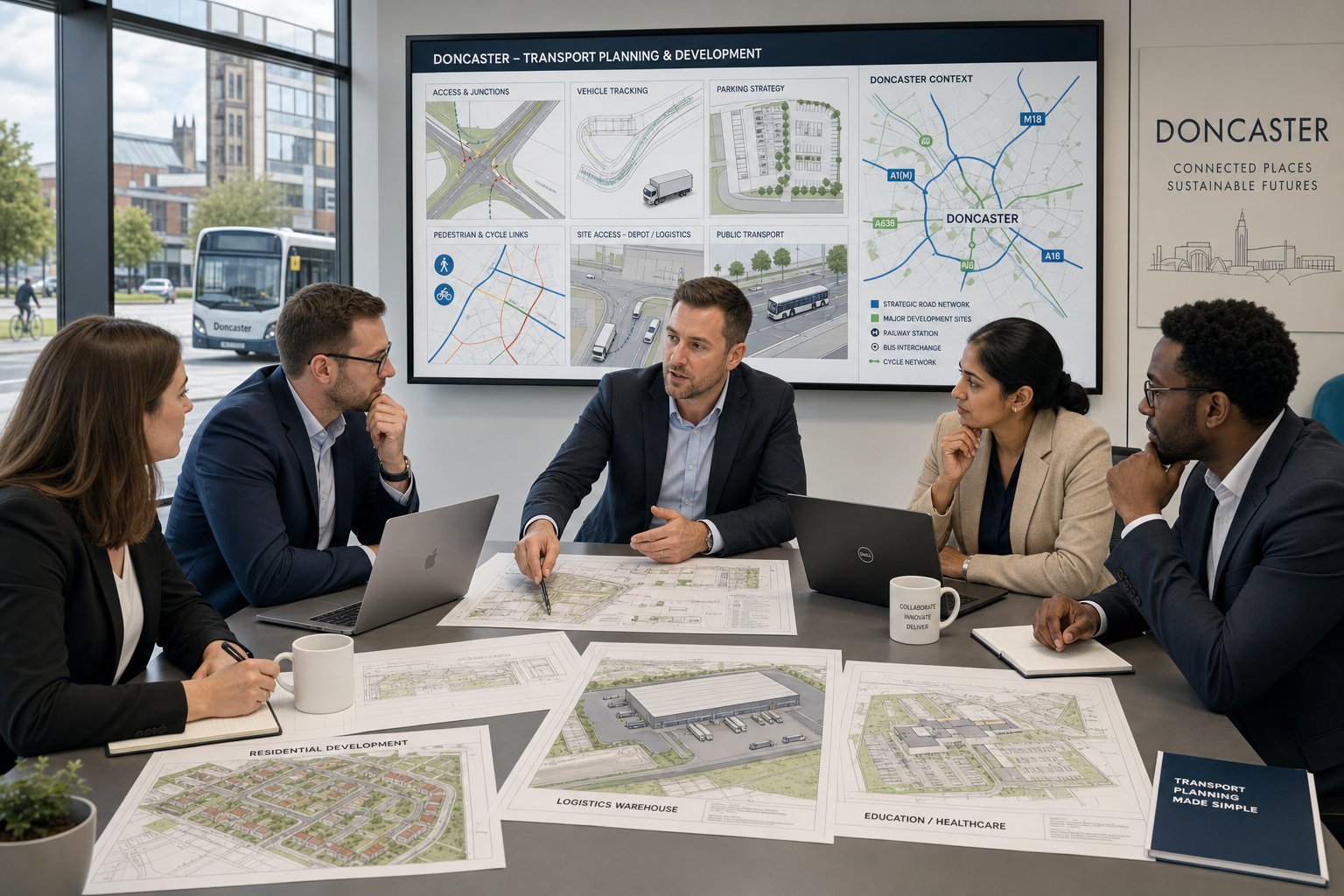

Not every planning application needs a detailed transport package, but many do. The trigger is usually a mix of scale, access change, operational complexity and local sensitivity rather than one blunt threshold.
Residential Schemes
Residential development is one of the most common reasons teams appoint us. Even relatively modest schemes can raise transport issues if they introduce a new access, intensify use of a constrained frontage, or sit near a busy junction. For larger housing sites, the usual topics include trip generation, distribution, site access design, visibility, internal road hierarchy, parking, refuse tracking and sustainable travel opportunities.
In Doncaster, residential proposals also need to reflect context. A site within or near the urban area may have a stronger case on bus accessibility and walkable services. Edge-of-settlement sites often face closer scrutiny on car dependency, school travel patterns and the realism of cycling links. And where previous refusals exist, transport evidence needs to answer those points directly rather than simply restate standard assumptions.
Commercial, Industrial, And Logistics Sites
Commercial and employment schemes often require more technical transport input because their movements are more varied. A retail proposal may have sharp peak-hour parking demand and interaction with adjoining junctions. An industrial or B8 logistics site may generate fewer total person trips than housing, but more HGV activity, more servicing complexity and greater sensitivity around routing, noise and turning movements.
In Doncaster, that is particularly relevant given the borough’s strategic location and established logistics role. Warehouse, depot and trade-counter schemes often need robust evidence on staff travel, delivery profiles, yard operation, gate capacity, swept path analysis and interaction with nearby strategic roads. Similar principles apply in other major urban markets, whether acting as Traffic Engineer In Birmingham: or Traffic Engineer In Liverpool:: the detail changes, but servicing and access realism is always central.
Education, Healthcare, And Mixed-Use Developments
These uses can be deceptively complex. Schools, colleges, surgeries, clinics, care homes and mixed-use town-centre sites often generate transport concerns out of proportion to their headline floorspace. Why? Because timing, user profile and operational overlap matter.
Education schemes can create short but intense peak pressures, often concentrated around drop-off and pick-up periods. Healthcare uses may generate steady flows through the day but involve vulnerable users, ambulance access, blue-badge demand and short-stay parking turnover. Mixed-use developments need a careful view on linked trips, internal capture, servicing overlap and whether shared parking assumptions are credible.
For these projects, the transport case usually needs to do more than prove “capacity”. It has to show that the site works safely and predictably for real users, parents, older people, pedestrians, cyclists, delivery drivers and bus passengers, not just modelled vehicles.
Core Reports And Technical Documents Prepared By Traffic Engineers
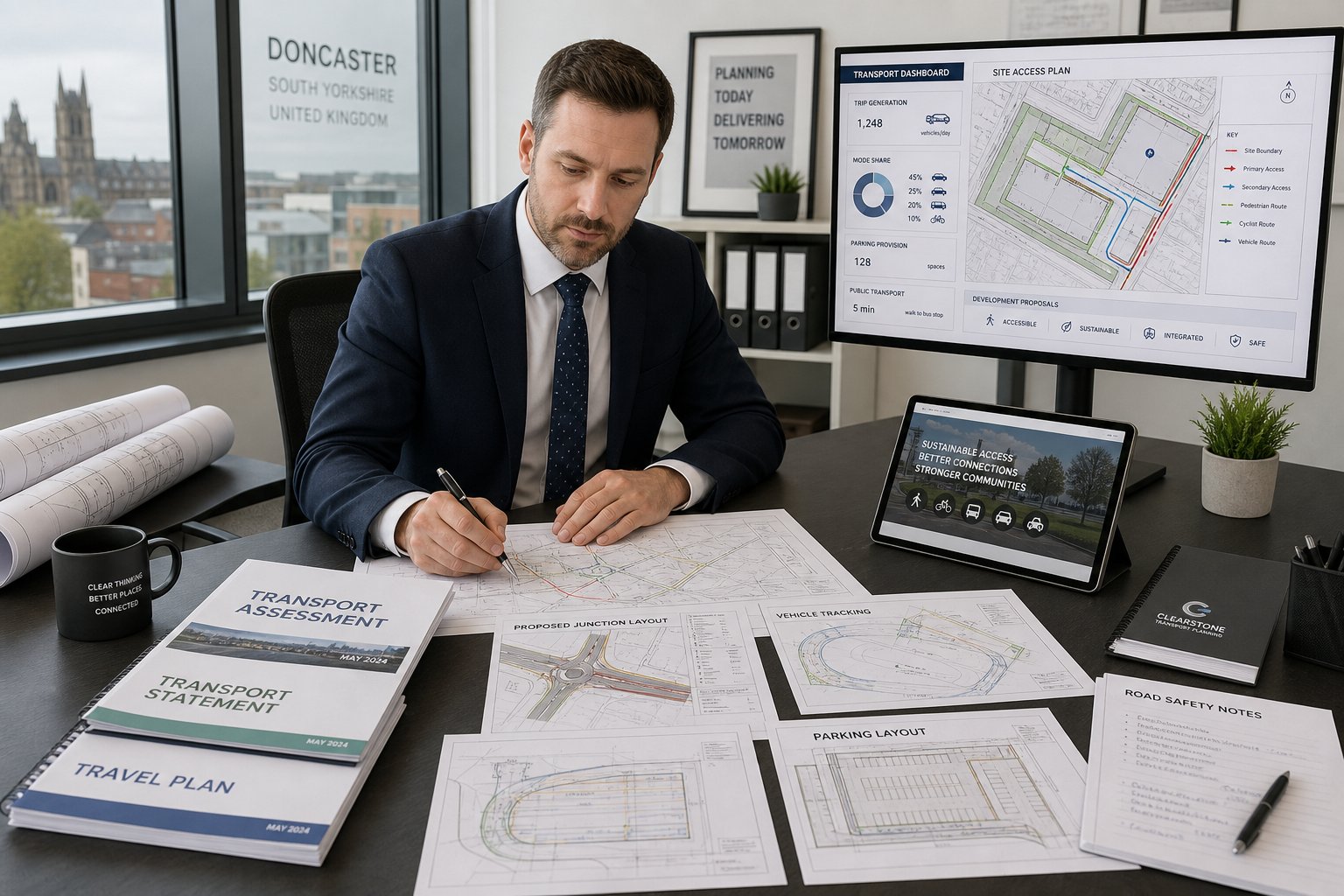

The exact submission package depends on the scheme, but most planning projects in Doncaster draw from a recognisable set of transport documents.
The main report is usually a Transport Assessment or Transport Statement. A TA is the fuller document, used where effects are more significant or more heavily scrutinised. A TS is typically shorter and more proportionate for lower-impact proposals. Both should explain the site context, baseline transport conditions, proposed access, trip generation, distribution, impact appraisal and any mitigation.
A Travel Plan may also be needed, either full or framework form. This sets out how sustainable travel will be encouraged through measures such as public transport information, cycle facilities, appointment of a coordinator, incentives, monitoring and review.
Depending on the site, we may also prepare or coordinate:
- access feasibility drawings
- junction improvement drawings
- visibility assessments
- vehicle tracking plans
- parking layouts and parking management strategies
- servicing and delivery plans
- road safety reviews or audit coordination
- construction traffic management plans
- technical notes responding to consultee comments
The key point is that these documents should work together. A polished TA can still fall apart if the access drawing is underdeveloped or the parking strategy contradicts the layout. Our experience across schemes in places such as Traffic Engineer In London: and Traffic Engineer In Bristol: reinforces the same lesson: clear, coordinated transport evidence usually gets better traction with consultees than bulky documents assembled in silos.
How Trip Generation, Junction Capacity, And Parking Are Assessed
This is often the section clients worry about most, because it looks highly technical from the outside. It is technical, but it is also structured and testable.
Trip generation starts with understanding the land use properly: number of dwellings, GIA, beds, pupils, shift patterns, delivery profiles, and whether there are pass-by, linked or diverted trips. We commonly use TRICS as the starting database, then apply professional judgement to select comparable sites and adjust for local context. A suburban warehouse in Doncaster should not simply inherit rates from an unrelated town-centre site elsewhere.
Junction capacity is then tested where needed using recognised software, often including Junctions, LINSIG, SYNCHRO or, on more complex schemes, microsimulation tools. The aim is to understand queueing, delay, reserve capacity and operational resilience, not just to produce a spreadsheet full of decimals. Input assumptions matter enormously: survey quality, growth factors, committed development, and realistic distribution patterns can all change the answer.
Parking assessment combines standards, local expectations and real-world demand. We review parking accumulation, likely overspill risk, disabled provision, cycle parking, servicing space and the practical relationship between layout and operation. Under-providing parking without a credible sustainable travel case is risky. Over-providing it can undermine design quality and policy compliance.
Good transport advice joins these strands together. If trip rates, modelling and parking logic are developed independently, inconsistencies creep in fast, and highways officers usually spot them.
Key Local Issues In Doncaster That Can Affect Highways Advice
Doncaster is not one uniform transport market, and that is exactly why local highways advice needs to be tailored.
First, strategic connectivity matters. The borough’s relationship with the wider motorway and freight network means some proposals, especially industrial and logistics uses, will be judged not only on local access but on how traffic reaches and leaves strategic corridors. HGV routing, stacking risk and interaction with key junctions can become central very quickly.
Second, road safety history can shape scope. Sites near schools, local centres or known collision locations may attract closer attention to visibility, crossing provision, turning movements and speed environment. Sometimes the transport debate is not about total traffic numbers at all: it is about whether the proposal worsens an already fragile situation.
Third, public transport and active travel quality varies widely across the borough. In some locations, a strong case can be made for non-car mode share because shops, schools, bus stops and rail links are genuinely close and usable. In more peripheral settlements, those claims need to be realistic. Aspirational wording without walkable infrastructure behind it tends not to survive scrutiny.
And finally, existing local pressure points, parking stress, school gate congestion, rat-running, delivery conflict, can influence officer and community responses more than broad policy wording. We always prefer to address those issues openly. A transport report that acknowledges local experience usually reads as more credible than one pretending every site starts from a blank sheet.
How To Choose The Right Traffic Engineer For A Doncaster Project
Not all transport consultants are interchangeable. For a Doncaster planning application, we would look for four things.
First, local authority familiarity. A consultant does not need to be based in Doncaster to do good work there, but they do need to understand how local highways concerns are typically framed, what level of evidence is proportionate, and when pre-app engagement is worth pursuing.
Second, technical range. Some projects need only a concise TS and access note. Others need detailed TRICS analysis, modelling, swept path work, Travel Plans, road safety input and responses through determination. If one firm can only do part of that chain, coordination risk rises.
Third, planning judgement. This is easy to underestimate. The best consultant is not the one who produces the longest report: it is the one who knows what the decision-maker actually needs to be comfortable. That means proportionate scoping, clear assumptions, direct responses to likely objections and enough design awareness to avoid transport advice colliding with architecture or viability.
Fourth, track record and communication. Ask for examples of similar schemes, not just generic capability statements. Ask how quickly drafts can be turned around, how comments are managed, and who will actually do the work. In practice, timely and concise reports often outperform grand promises. That is the approach we follow at ML Traffic: planning-led transport advice, shaped to local thresholds, without unnecessary bulk.
What To Prepare Before Instructing A Traffic Engineer
A little preparation at instruction stage can save a surprising amount of time later. The more clearly the scheme is defined, the faster we can scope the right transport work and avoid redoing assumptions after design moves on.
At minimum, it helps to provide:
- a site location plan and red line boundary
- details of existing and proposed access points
- an indicative layout or concept sketch
- a schedule of accommodation, such as dwellings, GIA, beds, classrooms, pupil numbers or staffing levels
- any known operating details, including delivery hours, shift patterns or servicing needs
- pre-application advice, if already obtained
- planning history, including refusals or appeal issues
- target submission date and wider programme constraints
If available, local concerns are valuable too. Residents often focus on parking, school traffic, speed or rat-running long before a formal objection is written. Knowing that early helps shape surveys and report emphasis.
We also encourage teams to be honest about uncertainty. If the unit mix may change, or a commercial operator is not yet fixed, say so. Transport evidence can usually accommodate staged assumptions if they are set out clearly. What causes problems is pretending a fluid brief is final, then trying to retrofit the analysis once numbers shift. That almost always leads to revisions, and revisions cost time.
Common Reasons Planning Transport Submissions Are Delayed
Most delays are avoidable. They usually come from scope, coordination or evidence gaps rather than from the existence of transport issues themselves.
One frequent problem is poor early scoping. If surveys are commissioned before the authority’s likely concerns are understood, teams can end up with missing junction counts, the wrong peak periods, or no agreed assessment extent. Then extra work is requested mid-determination.
Another is weak or inconsistent assumptions. We still see submissions where trip rates, mode share, parking numbers and servicing claims do not align. A report might argue for low car use while the layout quietly assumes heavy overspill tolerance. That kind of mismatch invites challenge.
Underdeveloped access design is another classic delay point. A TA can be technically sound, but if visibility is unclear, tracking is absent, gradients are unresolved or refuse vehicles cannot operate cleanly, the highways response will often be “more information required”.
There is also the practical issue of late responses to queries. Highways officers and statutory consultees rarely object for fun: they object when the information is not there, not coordinated, or not convincing. Once comments arrive, quick and focused replies matter.
In our experience, the fastest approvals do not come from rushing the report. They come from getting the scope right, tying analysis to local Doncaster conditions, and submitting a transport package that answers the obvious questions before anyone has to ask them.
Frequently Asked Questions about Traffic Engineers in Doncaster
What services does a traffic engineer in Doncaster provide for planning applications?
A traffic engineer in Doncaster prepares Transport Assessments, Transport Statements, and Travel Plans; assesses access, parking, servicing, visibility, and safety; and designs or reviews junctions and site accesses to support planning submissions tailored to local conditions.
When is a Transport Assessment or Transport Statement needed in Doncaster?
A Transport Assessment is required for developments with a material transport impact, typically larger schemes, while smaller proposals may need a Transport Statement or transport note, with final requirements based on Doncaster Council’s highways advice and pre-application discussions.
How do local Doncaster conditions influence transport reports?
Doncaster’s transport reports must consider local plan policies, South Yorkshire objectives, road safety histories, public transport quality, and network constraints to create credible, site-specific assessments addressing the borough’s varied urban and strategic contexts.
What types of developments usually require traffic engineering input in Doncaster?
Residential schemes, commercial, industrial and logistics sites, and education or healthcare developments often need traffic engineering support in Doncaster due to specific concerns like access, parking, trip generation, and peak-hour or vulnerable user impacts.
How is trip generation and junction capacity assessed by traffic engineers?
Trip generation is forecast using databases like TRICS, adjusted for local context, while junction capacity is analysed using software such as LINSIG or SYNCHRO to evaluate flows, delays, and operational resilience, ensuring transport assumptions are consistent and realistic.
What should I prepare before instructing a traffic engineer for a Doncaster project?
You should provide a site location plan, existing and proposed access details, concept layouts, accommodation schedules, any pre-application advice, planning history, local concerns, and set a target submission date to help scope the transport work accurately and efficiently.