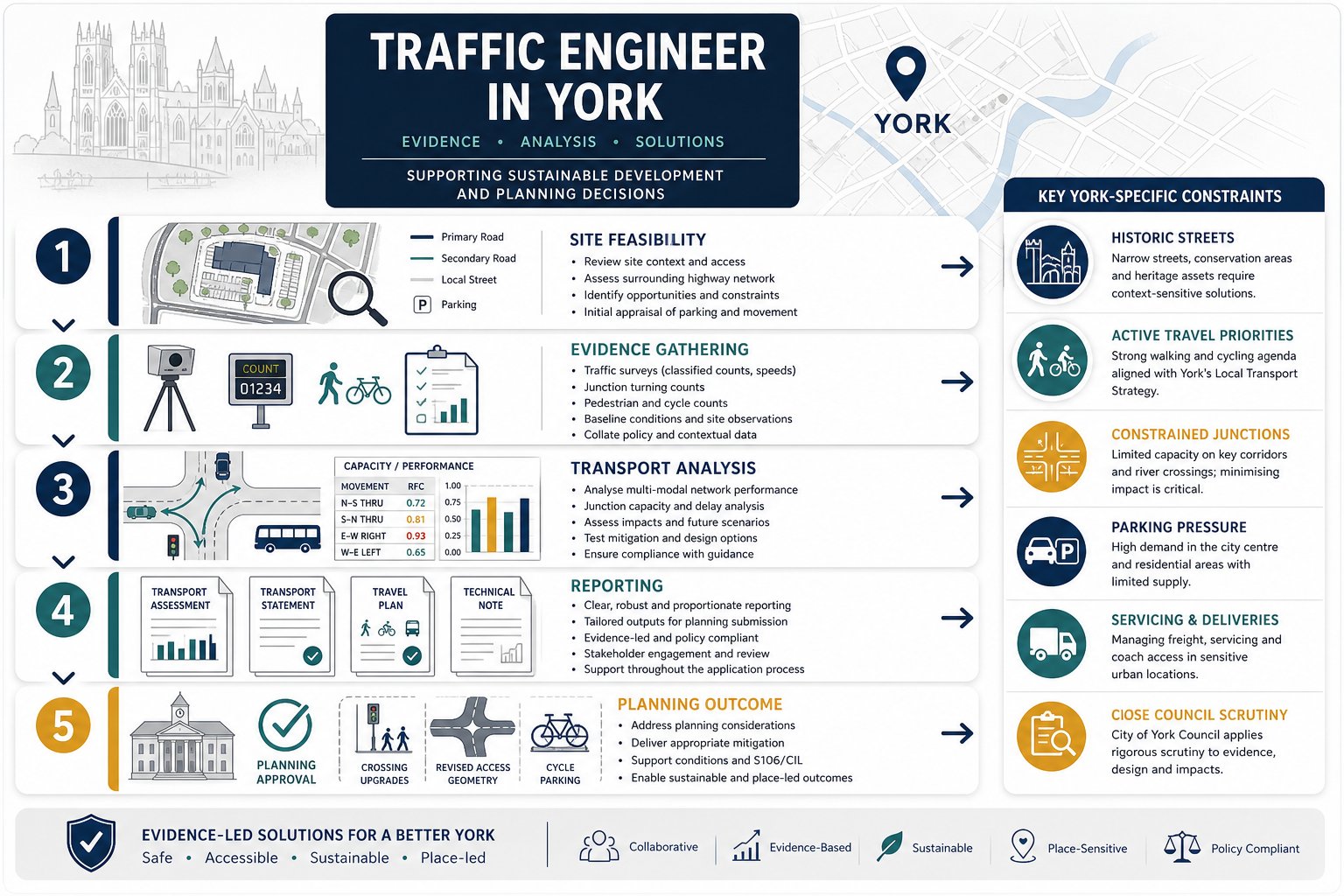
Planning applications in York rarely succeed on land use arguments alone. If a scheme changes traffic flow, creates new turning movements, affects pedestrian routes, or raises questions about parking and servicing, transport evidence quickly becomes central to the decision. That is where a traffic engineer in York adds real value.
We work at the point where development ambition meets highway reality. For architects, planners, developers, surveyors, lawyers, and local authorities, that usually means translating a proposal into robust evidence: how many trips it is likely to generate, whether nearby junctions can cope, whether access is safe, and what mitigation is reasonable. In a city like York, with constrained streets, sensitive historic areas, active travel priorities, and close planning scrutiny, that translation needs to be precise.
In practice, good transport input is not just about producing a report at the end. It starts earlier, often with a quick feasibility view on access, parking, or likely planning thresholds, and continues through surveys, modelling, negotiations, and condition discharge. The benefit is simple: fewer surprises, stronger applications, and a much better chance of avoiding costly redesign late in the process.
Below, we set out what a traffic engineer in York does, when a Transport Assessment or Statement is likely to be needed, how City of York Council requirements shape the work, and what to look for when appointing support for a live project.
Key Takeaways
- A traffic engineer in York plays a critical role in aligning development plans with local highway and active travel policies to ensure planning applications succeed.
- Transport Assessments or Statements are essential documents that provide detailed evidence on a scheme’s impact on traffic, parking, access, and sustainable transport in York.
- Early involvement of a traffic engineer helps highlight and address transport-related issues before plans are finalised, reducing delays and costly redesigns.
- Local City of York Council policies and network sensitivities significantly shape the scope and conclusions of transport reports, demanding tailored and credible evidence.
- Effective traffic engineering support includes collaboration with architects, planners, and developers to integrate practical transport solutions into project design.
- Selecting a traffic engineer with proven local experience and clear communication skills maximises the chances of a smooth planning process aligned with York’s unique context.
What A Traffic Engineer In York Does For Planning And Development
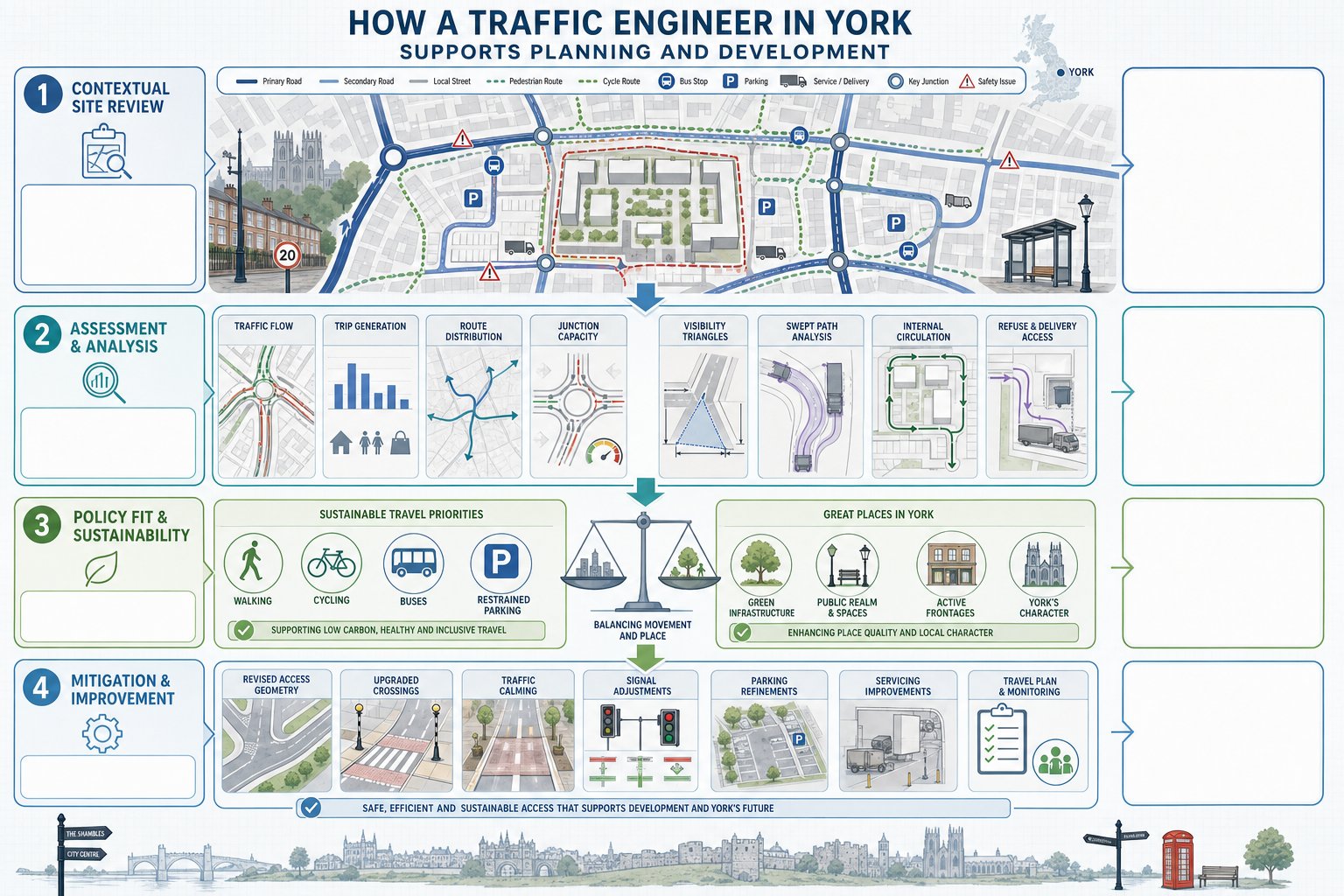
A traffic engineer in York supports planning and development by assessing how a scheme interacts with the highway network and by presenting that evidence in a form decision-makers can rely on. That sounds tidy on paper. In reality, it covers a broad range of work.
At the start of a project, we typically review the site in context: surrounding road hierarchy, nearby junctions, walking and cycling links, public transport accessibility, parking conditions, servicing constraints, and any obvious safety issues. For many sites, this early step tells the design team whether the proposal is broadly workable or whether access, layout, or scale needs rethinking before a planning application is prepared.
We then test likely transport effects. That can include baseline traffic conditions, projected trip generation, distribution and assignment, junction capacity, visibility, swept path requirements, internal circulation, refuse and delivery access, and the relationship between the site and sustainable modes. On urban sites in particular, the question is rarely just “can cars get in and out?” It is also whether the development fits local policy on walking, cycling, buses, parking restraint, and placemaking.
Where issues arise, we recommend mitigation. That might mean revised access geometry, crossing improvements, parking or servicing changes, traffic calming, updated signal staging, or targeted Travel Plan measures. Broader Traffic Engineering Consultants: support often sits alongside this work, especially where a scheme needs coordinated planning, highway, and technical input. The point is not to overcomplicate matters. It is to produce evidence that is proportionate, credible, and aligned with how York planning decisions are actually made.
When A Transport Assessment Or Statement Is Needed In York
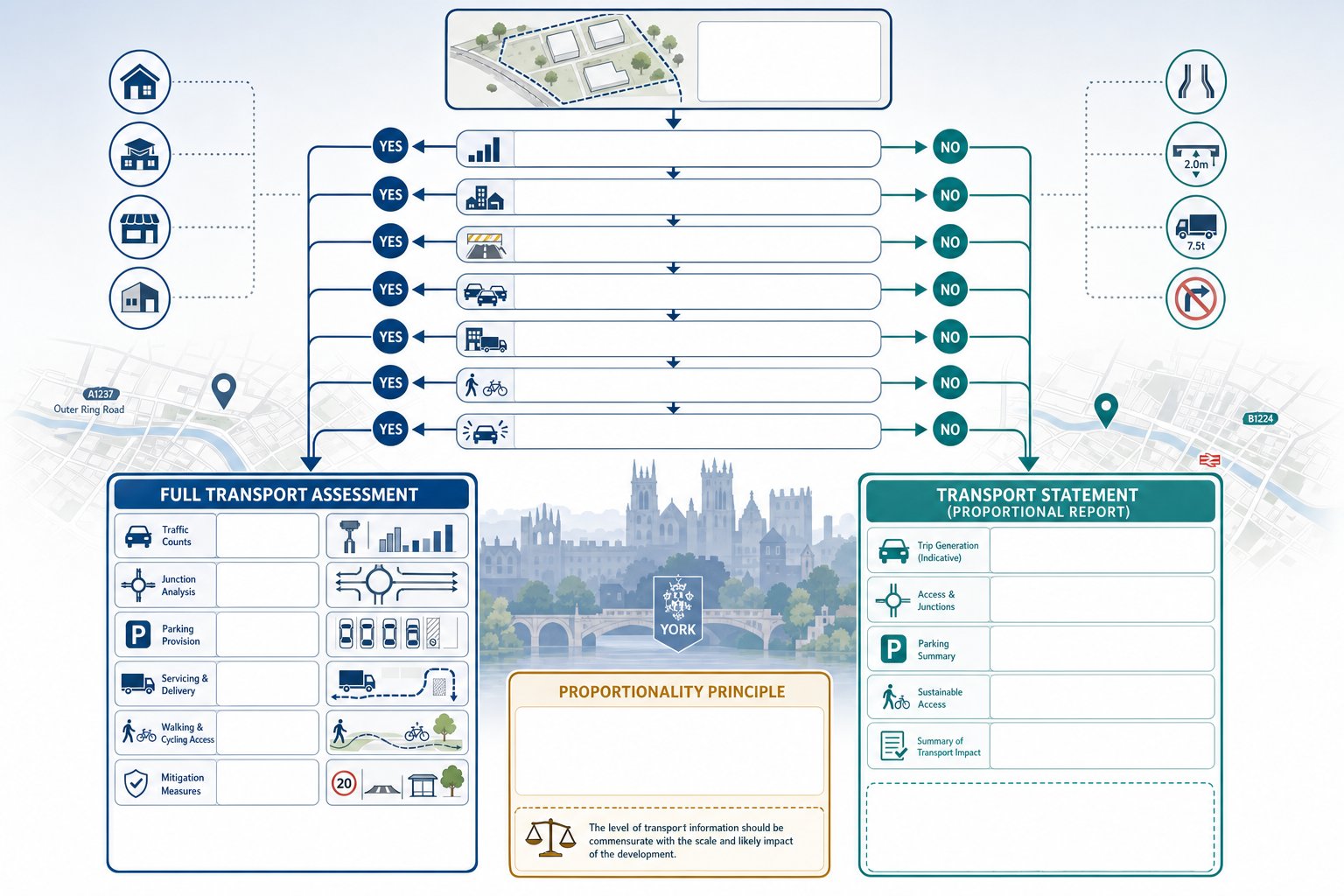
The choice between a Transport Assessment (TA) and a Transport Statement (TS) usually turns on scale, use, and likely impact. Larger or more traffic-intensive schemes generally need a TA. Smaller proposals with limited transport effects are more likely to justify a TS. But there is no universal one-size-fits-all trigger that removes the need for judgement.
In York, we advise clients to treat local validation requirements and pre-application feedback as the practical starting point. A residential scheme on a constrained access, a school extension near peak-time congestion, or a town-centre change of use with servicing implications may require more evidence than the floor area alone suggests. Equally, a modest proposal in a sustainable location may only need a concise statement if its impacts are genuinely limited.
A TA usually explores baseline conditions, trip generation, modal split, junction effects, parking, servicing, accessibility, and mitigation in some depth. A TS is lighter-touch and proportionate, but it still needs to answer the right questions clearly. Thin reports do not help anyone if officers or highway consultees simply come back asking for more.
This is where experience matters. We often review a proposal early and identify the likely level of reporting before design work has gone too far. Comparable work in places with similar planning pressures, such as Traffic Engineer In Leeds: assignments, is useful because the same principle applies: align the evidence with the authority’s likely concerns from the outset, not after an objection lands.
How Local Planning And Highway Requirements Shape Transport Reports
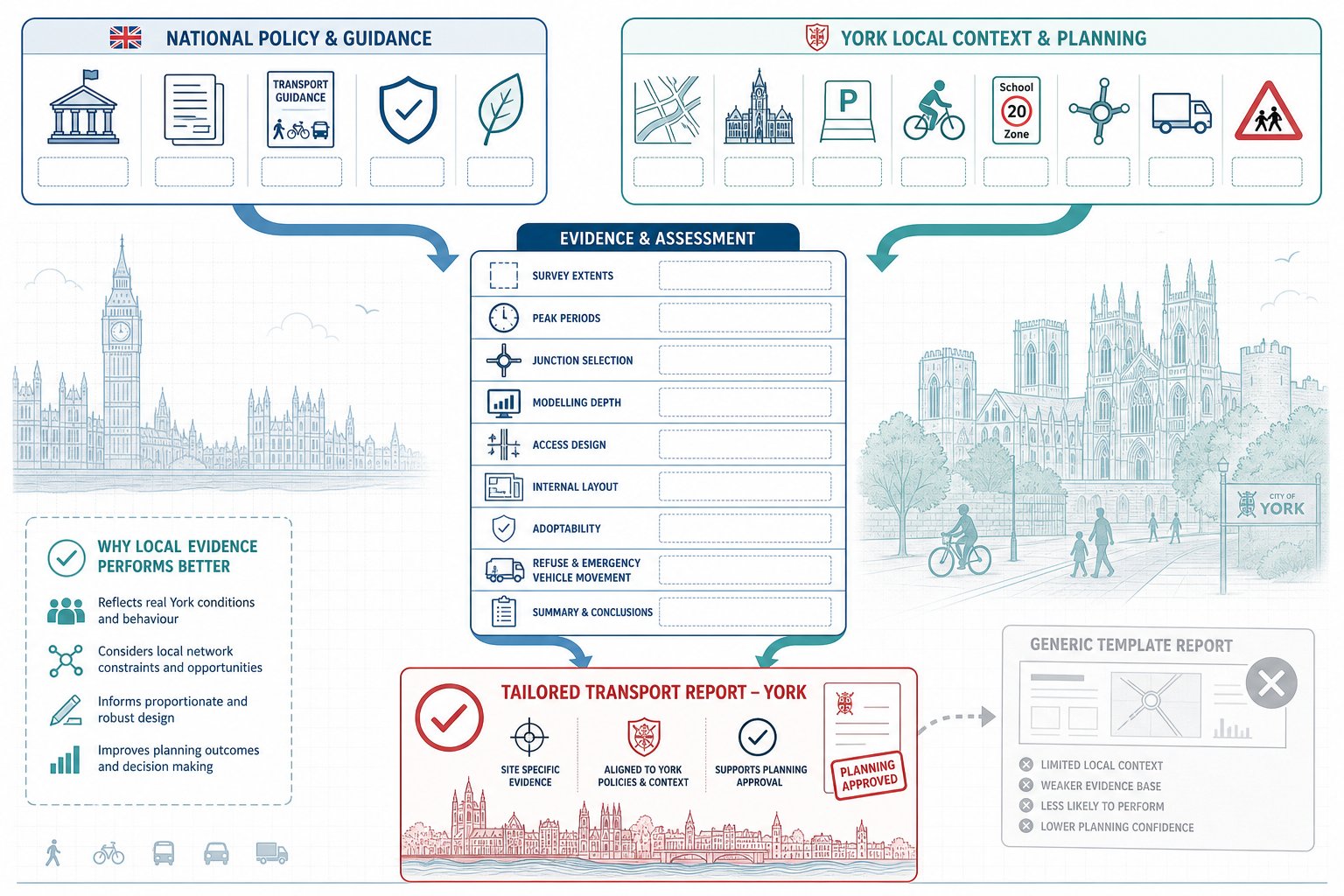
Transport reports are only persuasive if they are written for the policy and decision-making context they will be judged against. In York, that means combining national guidance with local planning and highway expectations.
At national level, the framework is familiar: the National Planning Policy Framework, Planning Practice Guidance, and Department for Transport guidance on Transport Assessments and Statements. Those documents establish the need for safe and suitable access, proportionate evidence, and support for sustainable travel. They also shape how cumulative impact, severe residual impact, and mitigation are argued.
Locally, City of York Council requirements matter just as much. Parking standards, cycle provision expectations, sustainable transport priorities, road safety concerns, servicing arrangements, and site-specific network sensitivities all influence scope and conclusions. A report that might pass comfortably elsewhere can stall in York if it underplays a local junction issue, ignores nearby school travel patterns, or assumes parking tolerance that officers do not share.
That local lens affects methodology too. Survey extents, peak periods, junction selection, and the level of modelling detail should reflect actual network conditions and the authority’s likely review process. The same applies to access design and internal layout comments, which need to sit comfortably with adoptability, refuse movement, emergency access, and day-to-day operation.
We find the best reports are not generic templates with a York postcode added at the end. They are tailored pieces of planning evidence. The broader principles discussed in Traffic Engineering: Your Complete still apply, but local policy fluency is what turns technical analysis into a report that supports consent rather than invites rounds of queries.
Key Documents A Traffic Engineer Can Prepare
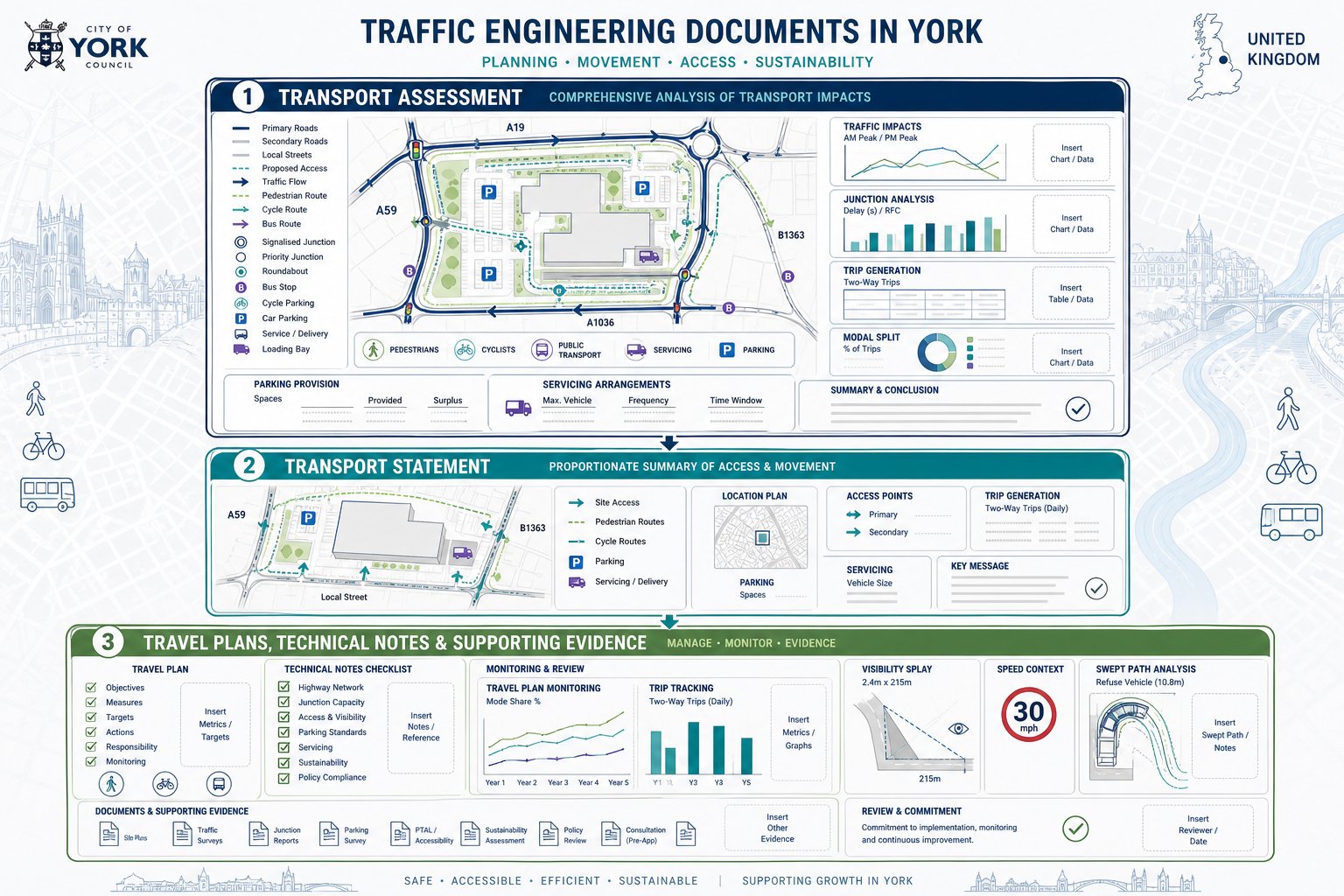
The exact package varies by project, but most planning-led traffic engineering work in York centres on a core set of documents. Each serves a slightly different purpose, and the distinction matters because the wrong report type can create delay before the planning merits are even considered.
Transport Assessments
A Transport Assessment is the fuller, more detailed document used for schemes with material transport implications. It usually sets out the site context, local highway and sustainable transport conditions, survey data, forecast trip generation, trip distribution and assignment, and technical assessment of impacts on access and junction performance. It should also cover parking, servicing, refuse collection, cycle provision, public transport accessibility, and any proposed mitigation.
For major residential, commercial, education, roadside, or mixed-use proposals, the TA is often the transport backbone of the application. It gives the planning authority and highway officers a defensible basis for judging whether the scheme is acceptable, what conditions may be needed, and whether off-site works or obligations should be secured.
Transport Statements
A Transport Statement is shorter and more proportionate, but it is not a watered-down placeholder. A good TS still needs to explain the proposal, the surrounding network, existing accessibility, likely trip effects, parking and servicing arrangements, and why the development can be accommodated without significant transport harm.
For small residential schemes, minor extensions, modest change-of-use proposals, or lower-impact urban projects, a TS can be the right level of evidence. The key is proportionality with substance. If local constraints are obvious, the statement still needs to address them properly.
Travel Plans, Technical Notes, And Supporting Evidence
Travel Plans are often required where authorities want a structured commitment to reducing single-occupancy car travel and encouraging walking, cycling, buses, rail, car sharing, or flexible working patterns. A useful Travel Plan includes targets, measures, management arrangements, and monitoring rather than broad promises nobody will revisit.
Technical notes and addendum evidence are equally important in live planning cases. We regularly prepare responses to highway comments, parking and servicing reviews, speed survey summaries, visibility assessments, swept path notes, and focused junction updates. On some projects, these shorter documents make the difference between a stalled application and a practical path to determination.
That flexible support is often what clients value most. Whether the requirement is a full TA or a concise note, the report has to answer the authority’s actual questions clearly and quickly.
Common York Development Projects That Need Traffic Engineering Input
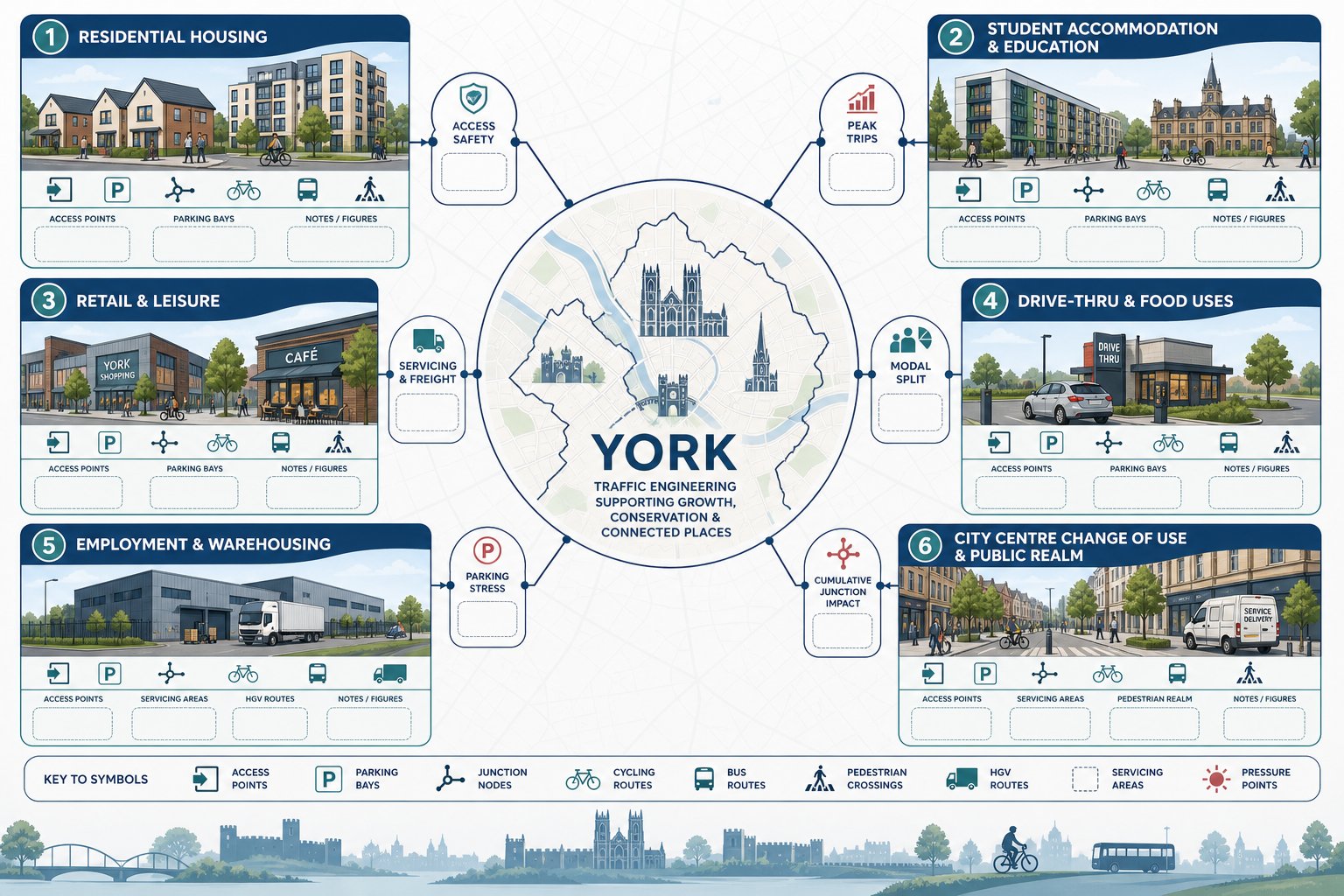
York presents a varied development picture, and traffic input is needed across far more than large housing sites. Residential schemes are the obvious example, ranging from small infill plots and apartment blocks to strategic housing allocations. Questions usually focus on access safety, parking levels, servicing, and cumulative effects on nearby junctions.
Student accommodation, HMOs, schools, and colleges also generate regular transport work. These schemes are often sensitive because peak movements overlap with already busy periods, and because modal assumptions need to be realistic. A student scheme in a central location may support lower car ownership. A school expansion on a constrained street is a different story entirely.
Retail, food and drink, drive-thru, health, and leisure uses can be especially scrutiny-heavy because their peaks, turnover, and servicing patterns differ from standard employment or residential assumptions. Even where floor area appears modest, the operational impact can be significant.
Employment sites, industrial units, warehousing, and business parks typically bring attention to HGV routing, staff travel, shift patterns, yard circulation, and parking stress. In the city centre, change-of-use proposals and public realm schemes can raise a more complex mix of servicing, accessibility, pedestrian priority, and network management issues.
We also see cross-city similarities. A city balancing heritage, active travel, and growth often faces the same transport tensions found in Traffic Engineer In London: or Traffic Engineer In Manchester: work, even if the network scale differs. What changes is the local detail. What does not change is the need for evidence that is specific to the site and credible under planning scrutiny.
How Traffic Surveys, Trip Data, And Junction Analysis Support Applications
Planning arguments are stronger when they rest on evidence rather than assumptions. That is why surveys, trip data, and junction modelling sit at the centre of many transport submissions.
Traffic surveys establish the baseline. Depending on the site, that may include automatic traffic counts, turning counts at junctions, queue length surveys, pedestrian and cycle counts, parking beat surveys, or spot speed surveys. The objective is to capture how the network actually performs, not how it is assumed to perform. Timing matters here. Survey days need to be representative, school holidays may distort conditions, and unusual roadworks can make data unusable.
Trip generation then estimates what the proposed development is likely to add or remove. In UK planning work, that commonly involves TRICS-informed analysis, adjusted where necessary for local context, mode share, pass-by effects, linked trips, or committed development. This stage often attracts the most debate because small assumptions can shift the apparent scale of impact.
Junction analysis takes those trips and tests network performance. Depending on junction type, we may use ARCADY, PICADY, LINSIG, or SIDRA to assess capacity, delay, queueing, and reserve capacity. The model itself is not the conclusion: it is evidence to support professional judgement. If a junction is stressed, we then consider whether mitigation is possible, proportionate, and likely to be supported.
Comparable approaches appear in Traffic Engineer In Birmingham: and Traffic Engineer In Bristol: assignments, but York often demands especially careful interpretation because constrained streets and historic patterns can make averages misleading. Good analysis explains not just what the software says, but why it matters for the planning decision.
Working With Architects, Planners, Developers, And Local Councils
Traffic engineering works best when it is integrated into the design team, not bolted on after the site layout is fixed. In practice, we work closely with architects, planning consultants, developers, surveyors, and sometimes legal teams from the earliest feasibility stages through to determination.
For architects, the transport role often centres on access geometry, tracking, bin collection strategy, cycle parking, disabled parking, turning space, and how the layout functions day to day. A drawing can look efficient until a refuse vehicle cannot manoeuvre or visibility splays conflict with boundary treatments. Sorting those issues early saves everybody time.
For planners and lawyers, the focus is usually evidence and risk. Does the proposed package answer validation requirements? Is the methodology defensible? Are there likely highways objections, and if so, can they be addressed through revised design, mitigation, planning conditions, or obligations? Those are not abstract questions when an appeal timetable or acquisition deadline is involved.
Developers tend to want clarity on programme and cost exposure. Local councils, meanwhile, need concise, policy-aware reports that engage with genuine impacts rather than advocacy disguised as analysis. We often support pre-application meetings, written responses to highways comments, and project-team discussions to keep everyone aligned.
That collaborative style matters. A transport report rarely succeeds in isolation: it succeeds because the site layout, planning narrative, and technical evidence reinforce one another. And yes, when that happens, the application process becomes noticeably less painful.
What To Look For When Choosing A Traffic Engineer In York
Not all transport support is equal, and procurement based purely on fee often turns out to be expensive later. When choosing a traffic engineer in York, we suggest starting with relevant planning experience rather than generic highway design credentials alone.
First, look for proven UK development-planning work: Transport Assessments, Statements, Travel Plans, junction modelling, access appraisals, and responses to local authority comments. Professional grounding matters too, whether through chartership, a suitable transport or civil engineering background, or long practical experience on planning-led projects.
Second, check local familiarity. York has its own policy context, network sensitivities, and review culture. A consultant who understands City of York Council expectations, local parking debates, and the practicalities of constrained urban sites will usually scope work more efficiently and write reports with fewer avoidable gaps.
Third, ask how they communicate. Can they explain what level of report is likely to be needed before the design is frozen? Will they flag risks early rather than simply documenting them later? Are reports clear enough for non-technical readers on planning committees as well as highway officers?
Finally, responsiveness matters more than many clients expect. Planning submissions are rarely linear: comments arrive, assumptions change, and transport notes may be needed quickly. With more than 30 years of experience reflected in the approach behind mltraffic.co.uk, we know clients usually value concise, accurate advice delivered when it is still useful, not a week after the deadline has passed.
Typical Project Stages, Timescales, And Early Input Benefits
Most planning-led traffic commissions in York follow a broadly familiar sequence, although the detail varies by scale and sensitivity.
Stage one is feasibility. We review the proposed use, likely access approach, surrounding network, parking and servicing demands, and whether the concept appears deliverable in transport terms. At this point, a few hours of clear advice can prevent months of work on an arrangement that was never likely to satisfy highways officers.
Stage two is scoping. We identify whether a TA, TS, Travel Plan, or targeted technical note is likely to be required and agree the survey strategy. On some schemes, that includes pre-application engagement with the authority so that survey extents, peak periods, and methodology are settled early.
Stage three is data collection and analysis. Survey lead-in times, school term effects, weather, and network conditions all influence programme. Once data is in place, trip forecasts, capacity testing, access review, and drafting follow. Smaller TS projects may move quickly: larger TA work with multiple junctions and design iterations naturally takes longer.
Stage four is submission support and determination. That can include updates following design changes, responses to consultation comments, and assistance with conditions or section 106-related travel planning obligations.
The biggest advantage of early involvement is simple: problems are cheaper to fix before a layout is committed. Over-parking, under-parking, weak access design, poor servicing logic, or unrealistic trip assumptions are all manageable early on. Late in the process, they become refusal reasons, redesign costs, or awkward negotiation points. That is why early transport input so often pays for itself.
Conclusion
A traffic engineer in York plays a practical, often decisive role in planning success. We assess how development proposals affect roads, junctions, access, parking, servicing, walking, cycling, and public transport, then turn that analysis into clear planning evidence that local decision-makers can use.
For some schemes, that means a concise Transport Statement. For others, it means a detailed Transport Assessment, Travel Plan, junction modelling, and ongoing responses during determination. In every case, the value lies in matching the level of work to the real planning risk, while keeping the advice grounded in City of York Council expectations and current national guidance.
Done properly, traffic engineering is not a box-ticking exercise. It shapes layouts, reduces avoidable objections, supports negotiations, and helps development teams move forward with confidence. And in York, where transport impacts are often closely examined, that early, planning-savvy input can make all the difference.
Frequently Asked Questions About Traffic Engineering in York
What services does a traffic engineer in York provide for planning and development?
A traffic engineer in York analyses traffic conditions, assesses access, parking, and servicing, recommends mitigation measures, and advises on sustainable transport, ensuring development proposals meet City of York Council and national requirements.
When is a Transport Assessment or Transport Statement required in York planning applications?
Larger, traffic-intensive developments typically need a detailed Transport Assessment, while smaller proposals with limited impact may require a Transport Statement. The City of York Council’s local validation and pre-application advice guide the appropriate choice.
How do local York planning policies influence transport reports prepared by traffic engineers?
Reports must comply with the National Planning Policy Framework and City of York Local Plan policies, reflecting local parking standards, sustainable transport priorities, road safety, and network sensitivities unique to York to support planning decisions effectively.
What documents can a traffic engineer in York prepare to support a planning application?
Key documents include Transport Assessments with detailed impact analysis, proportionate Transport Statements, Travel Plans promoting sustainable travel, and technical notes addressing highways comments, parking, visibility, and junction modelling.
What types of development projects in York most commonly require traffic engineering input?
Projects such as residential schemes, student accommodation, schools, retail and leisure uses, employment sites, and city-centre change-of-use developments often need traffic engineering to assess access, parking, servicing, and local highway impacts.
Why is early involvement of a traffic engineer important in York development projects?
Early input helps identify access issues, parking needs, and transport impacts before design finalisation, reducing costly redesign, avoiding refusals on highway grounds, and increasing the chances of a smoother planning approval process.