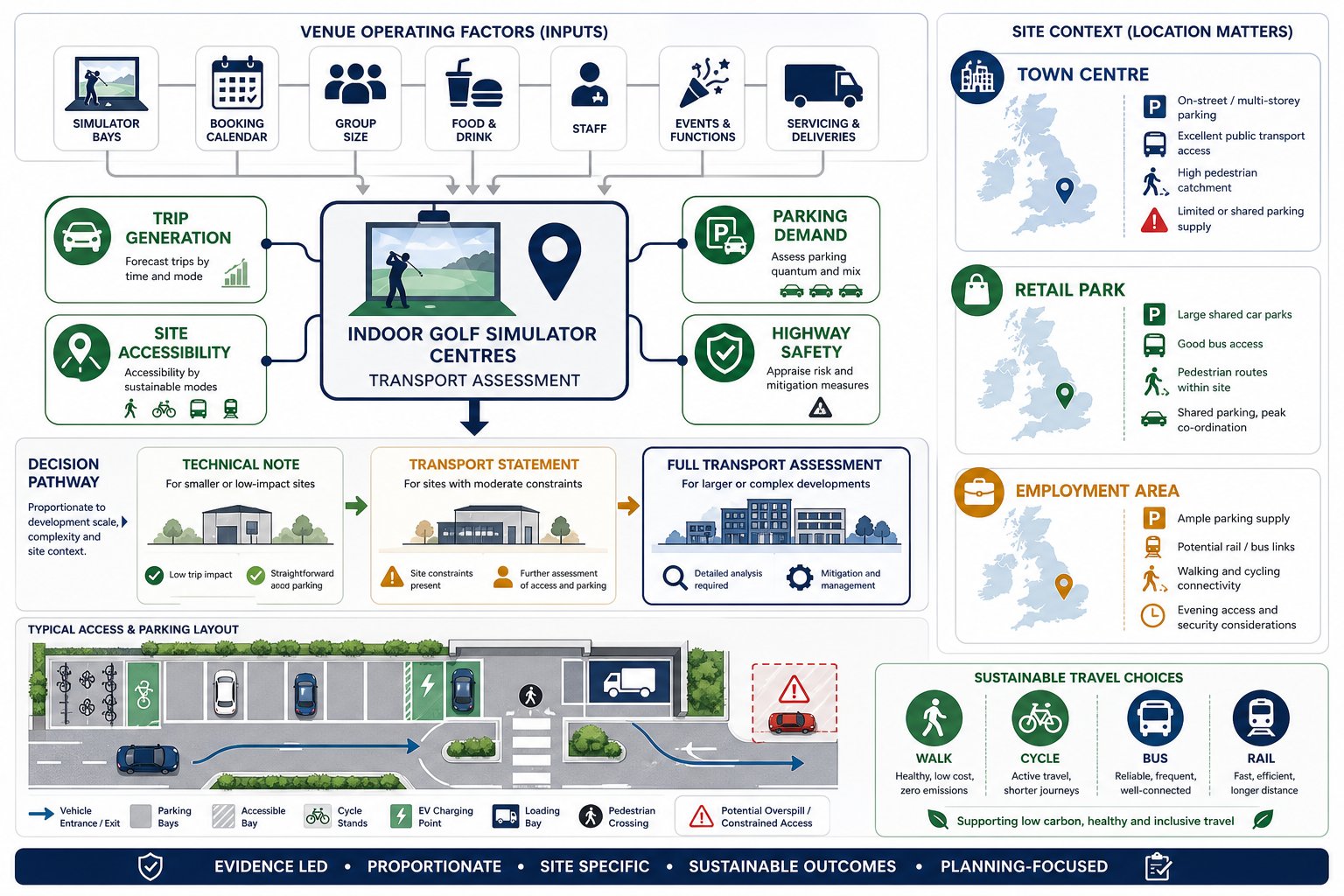
Indoor golf simulator centres sit in an interesting planning space. They’re leisure uses, yes, but they rarely behave like a typical gym, bar, cinema or five-a-side venue. Capacity is usually fixed by the number of bays. Bookings are often pre-arranged. Dwell times can be long enough to smooth arrivals, yet event nights, coaching sessions or an ancillary bar can shift the whole traffic picture surprisingly quickly.
That’s exactly why an Indoor Golf Simulator Centres Transport Assessment needs to be proportionate, evidence-led and specific to how the venue will actually operate. For architects, planning consultants, developers, surveyors and local authorities, the challenge is rarely whether the use generates any traffic at all. The real question is whether the likely trips, parking demand, servicing activity and sustainable travel opportunities have been understood properly for that site.
In 2026, with local planning authorities applying transport policy more carefully and highway teams expecting clearer justification, generic leisure assumptions usually aren’t enough. We need to explain the development in operational terms: number of bays, booking structure, likely group sizes, food and drink offer, staff levels, event management and how all of that interacts with the surrounding network.
Below, we set out how we approach this niche use, when a technical note may be enough, when a full assessment is justified, and what a robust submission should contain to give planning applications the best chance of progressing smoothly.
Key Takeaways
- Indoor golf simulator centres require a proportionate, evidence-based transport assessment that accurately reflects their unique operational patterns and traffic generation.
- Transport assessments should focus on trip generation, parking demand, site accessibility, and highway safety, considering ancillary uses like bars or event spaces for a comprehensive evaluation.
- Assessment reports must be tailored to the venue’s scale and location, ranging from a technical note for small, accessible sites to full assessments for larger venues with complex impacts.
- Parking strategy is critical and should be derived from actual operating capacity, including demand during special events, with clear management measures to prevent overspill and ensure safety.
- Sustainable travel opportunities, such as walking, cycling, and public transport access, must be evaluated realistically, supported by proportionate travel plans and accessible infrastructure.
- Effective transport assessments align with local policies and provide transparent, site-specific evidence to ensure planning applications progress smoothly and local authority concerns are addressed.
Why Transport Assessment Matters For Indoor Golf Simulator Centres
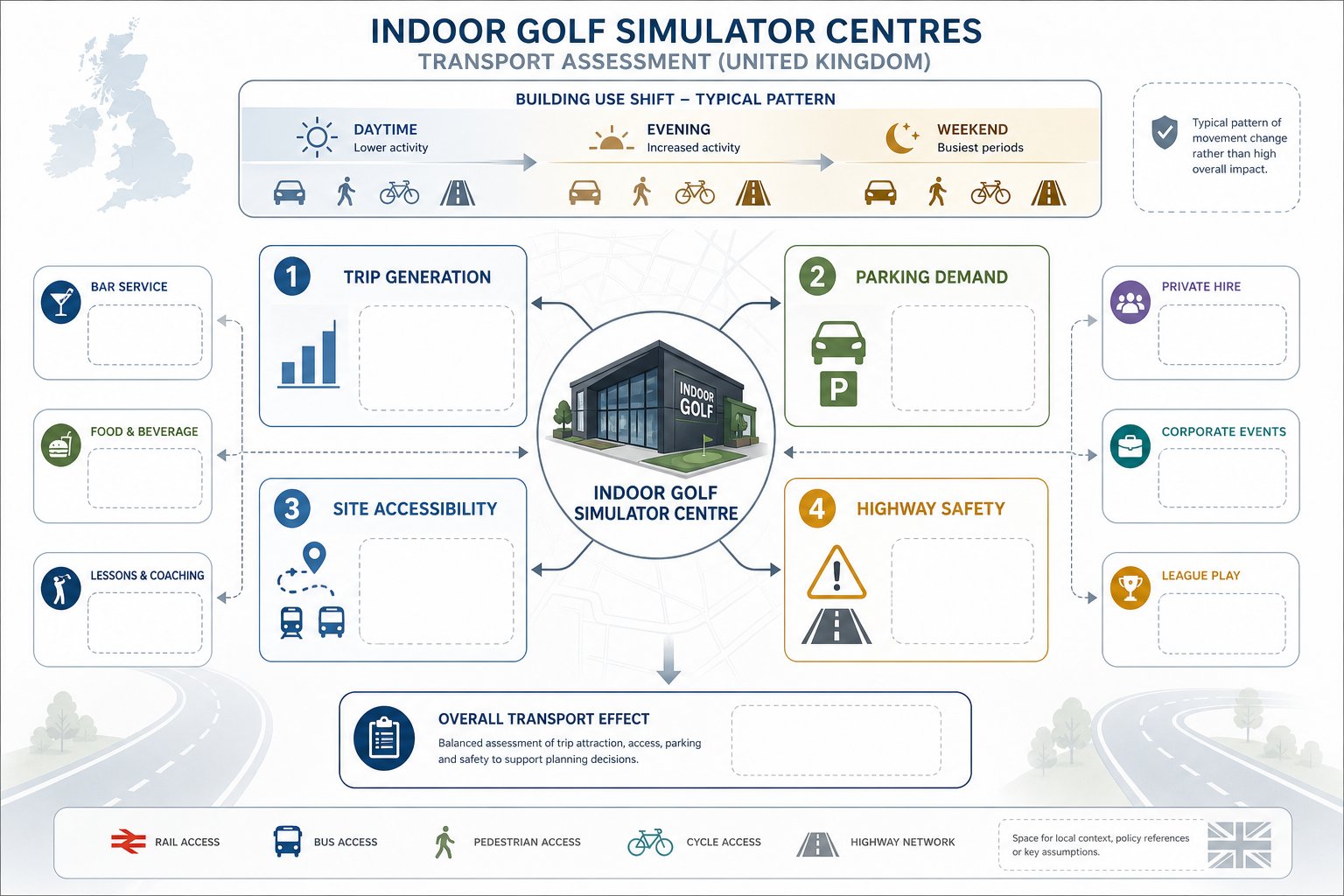
Indoor golf simulator centres often appear low impact at first glance. Compared with many mainstream leisure uses, that can be true. But planning and highway officers still need confidence that the proposed use won’t create unacceptable effects on road safety, parking conditions or the efficient operation of the local highway network.
The reason transport evidence matters is simple: these venues can change the timing and character of activity in a building quite significantly. A former retail, warehouse or employment unit may have been busiest in the daytime. An indoor golf venue can flip that pattern toward weekday evenings and weekend periods. That shift matters even where total daily traffic remains modest.
A proportionate report also helps avoid bad assumptions. If officers treat the use like a bar, parking demand may be overstated. If they treat it like a quiet office, evening impacts may be understated. A properly scoped assessment closes that gap.
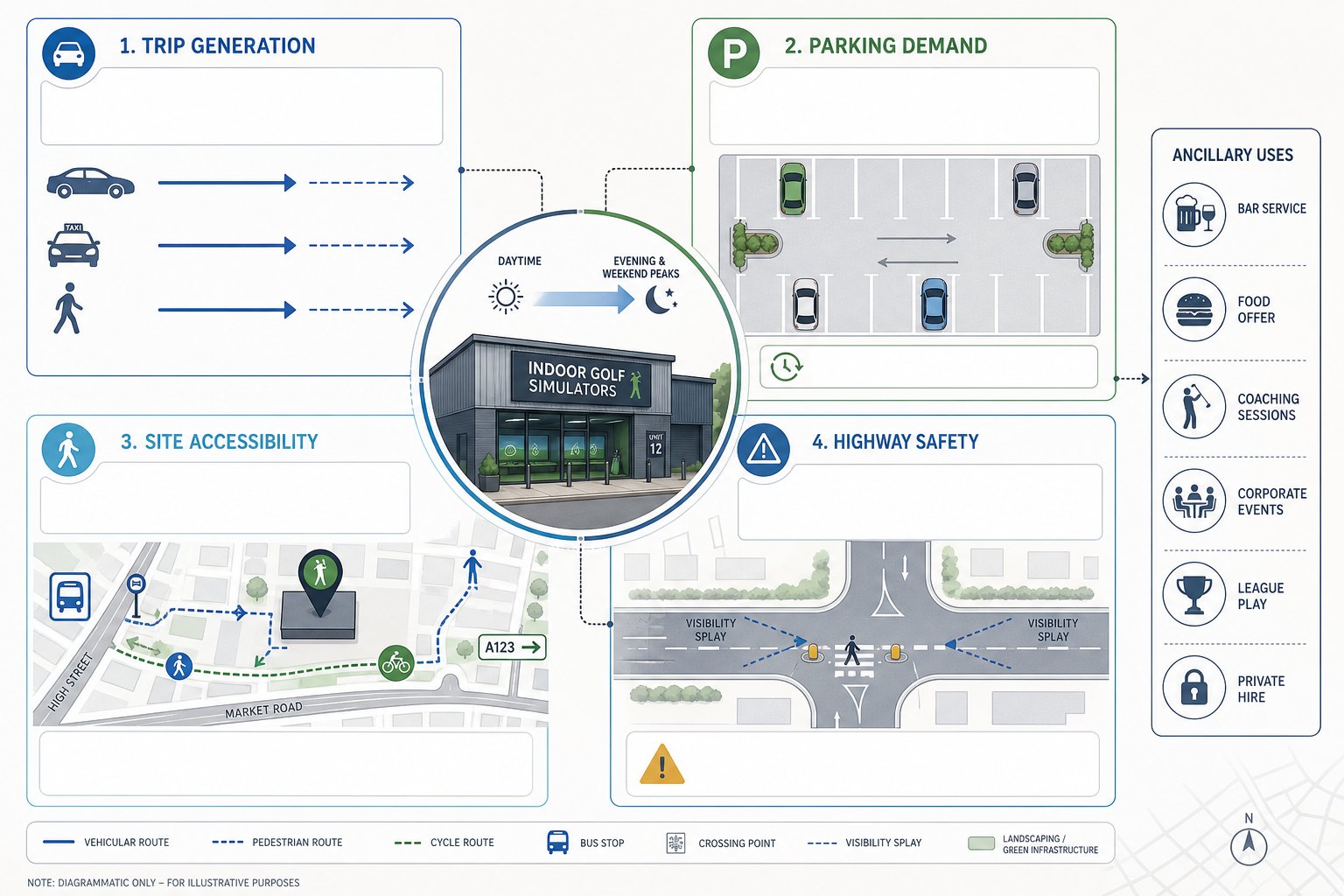
In practice, we normally focus on four things: trip generation, parking demand, site accessibility and highway safety. We also test whether ancillary elements, licensed bar sales, food service, private hire, lessons, corporate events or league play, materially alter the transport profile. If they do, they need to be assessed openly rather than left to implication.
For planning teams preparing wider development submissions, the discipline is the same as any other transport assessment for scheme: explain the use clearly, scale the evidence sensibly, and align the conclusions with local thresholds, policy and observed conditions.
How Indoor Golf Simulator Centres Differ From Other Leisure Uses
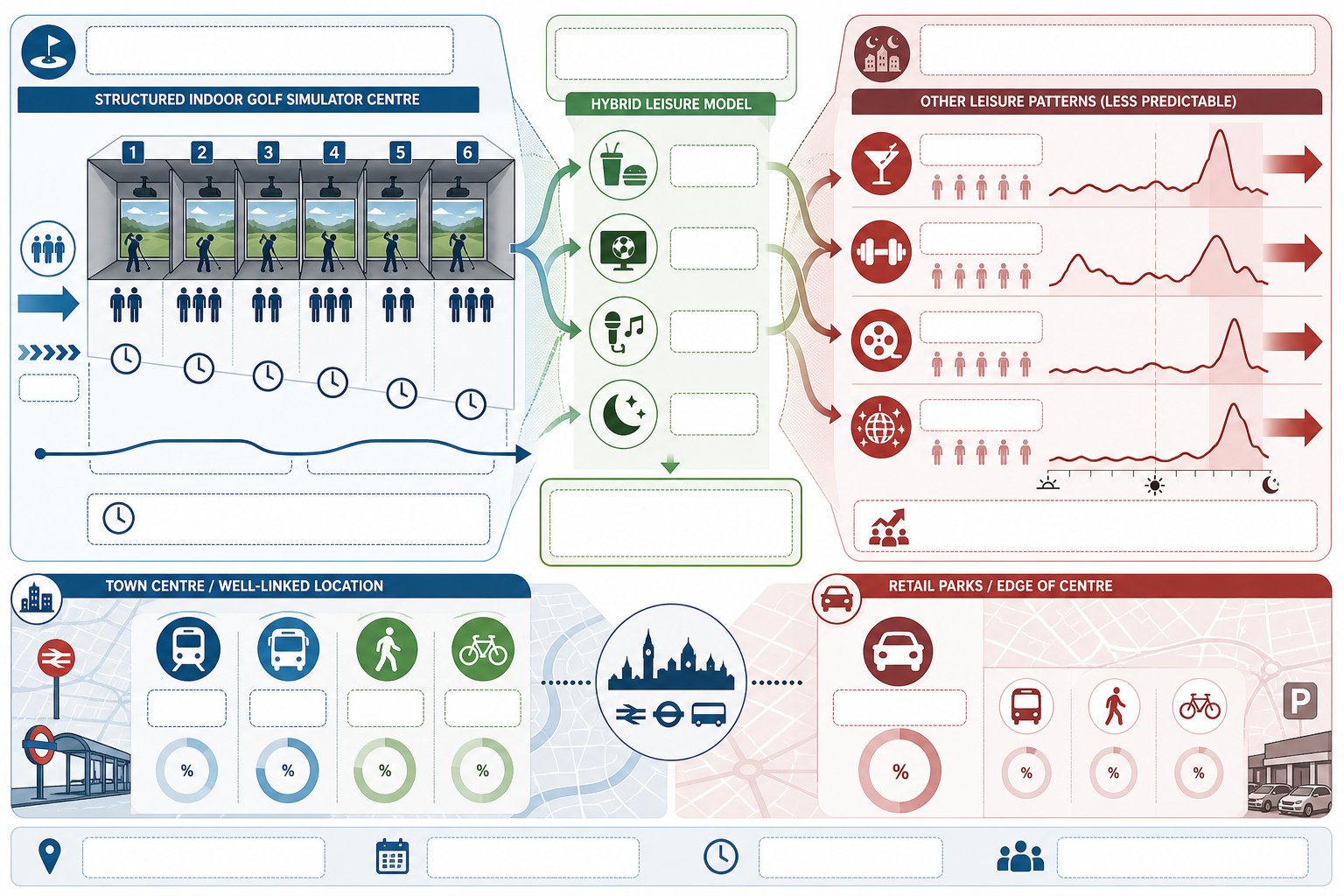
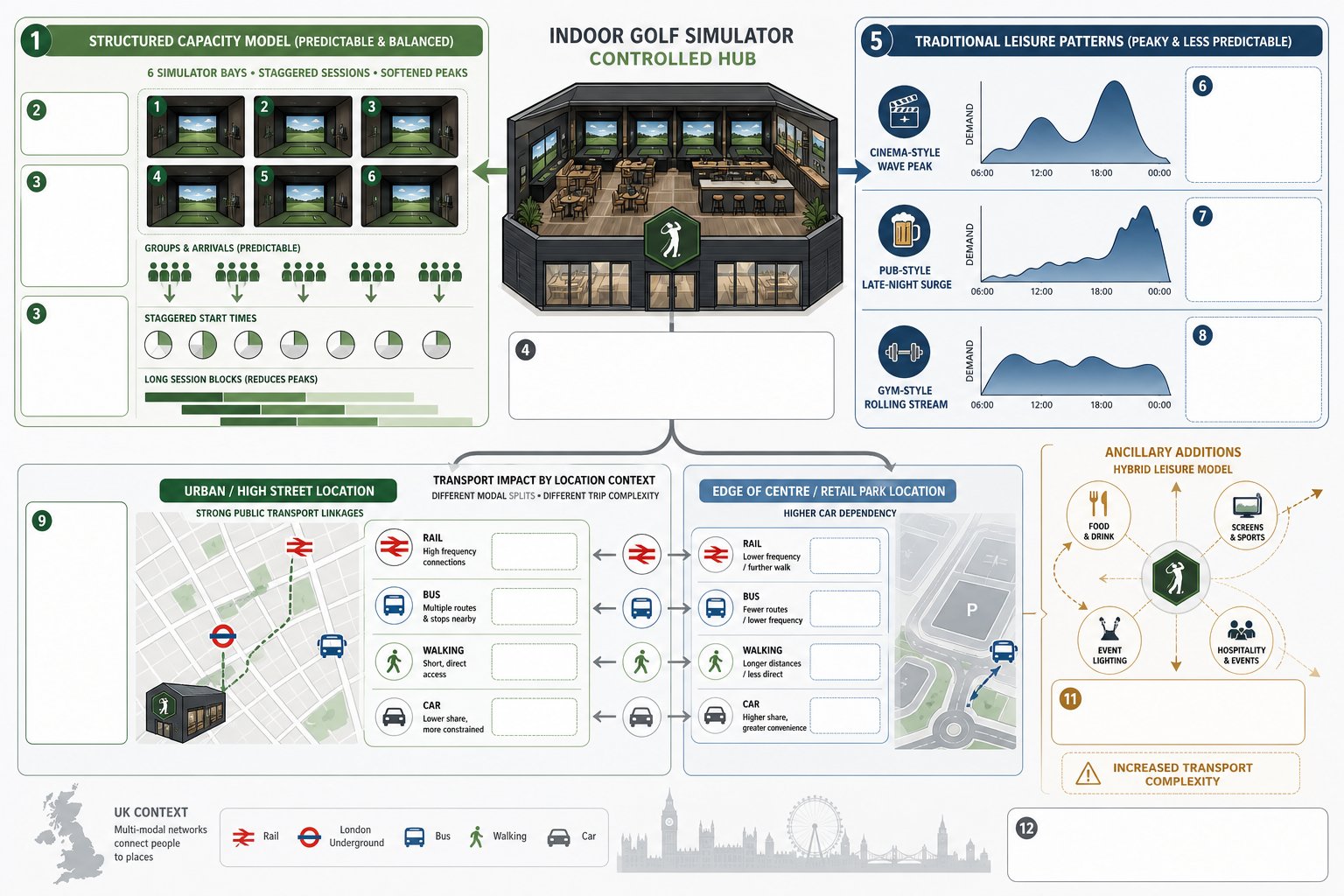
This use is niche, and that matters. Indoor golf simulator centres are usually appointment-based, capacity-led and relatively controllable. A venue with six bays does not suddenly behave like an open-floor bar or a budget gym with rolling attendance through the day.
The number of playable bays, maximum players per bay, booking intervals and average dwell time all create a more predictable operating pattern. Most sessions last one to three hours. Many sites stagger starts across the hour, which softens sharp inbound spikes. That’s a very different transport profile from cinema screening turnarounds or pub closing peaks.
The catchment can also be broader than for convenience leisure. Some customers are committed golfers travelling with purpose: others are social groups, families, work teams or coaching clients. In town centres, that may translate into linked trips by rail, bus or on foot. In retail parks and edge-of-centre locations, car mode share is usually much higher.
The complication comes from ancillary uses. Add a substantial food and drink offer, televised sport, late licensing or event programming, and the centre can start to resemble a hybrid leisure venue. That doesn’t make it unsuitable, but it does mean the transport work needs to distinguish between normal booked play and expanded hospitality-led activity.
So while there’s no off-the-shelf category that fits perfectly, the key point is this: indoor golf simulator centres are not transport-neutral, but neither should they be assessed lazily by analogy with unrelated leisure classes.
When A Transport Assessment, Transport Statement, Or Technical Note May Be Needed
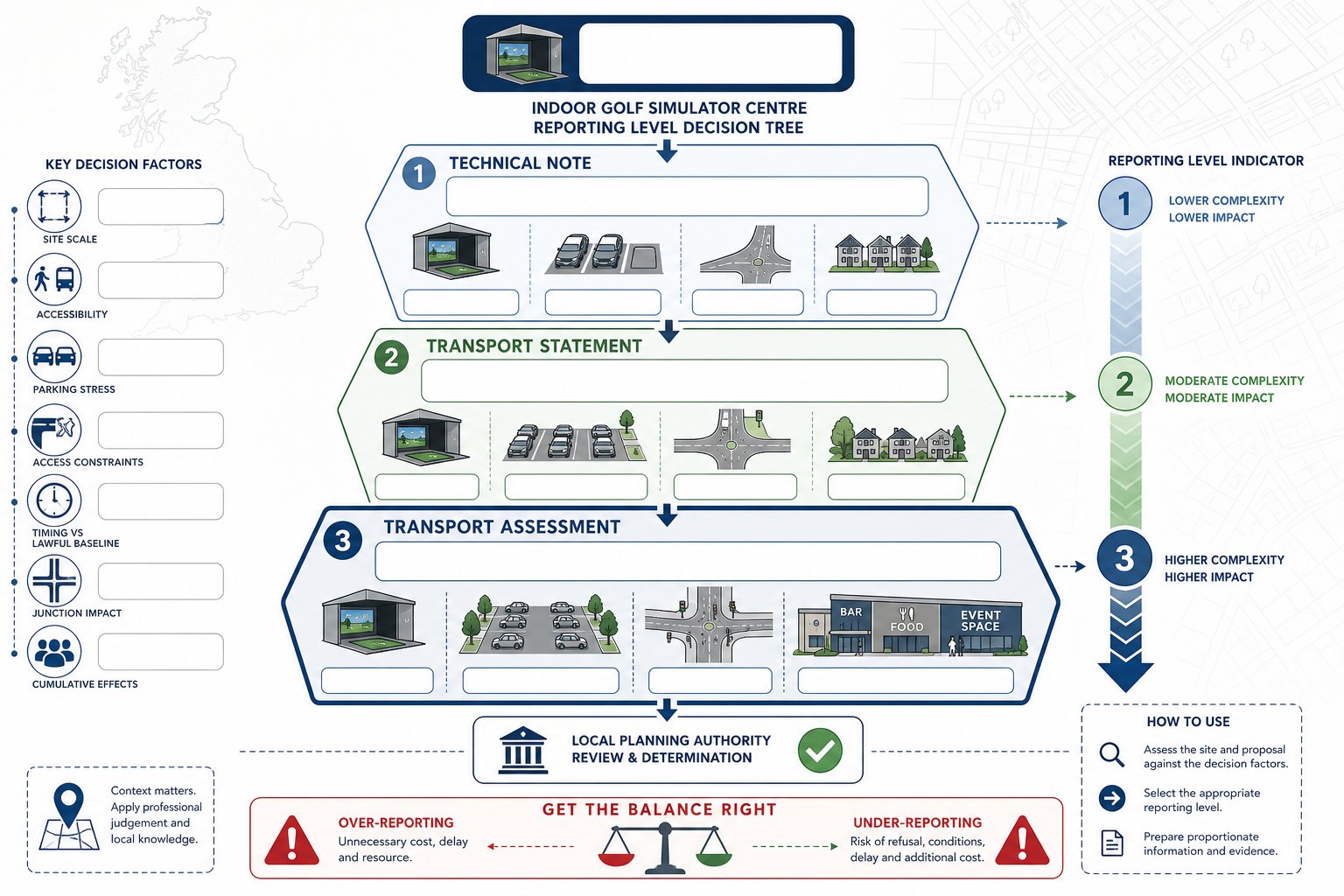
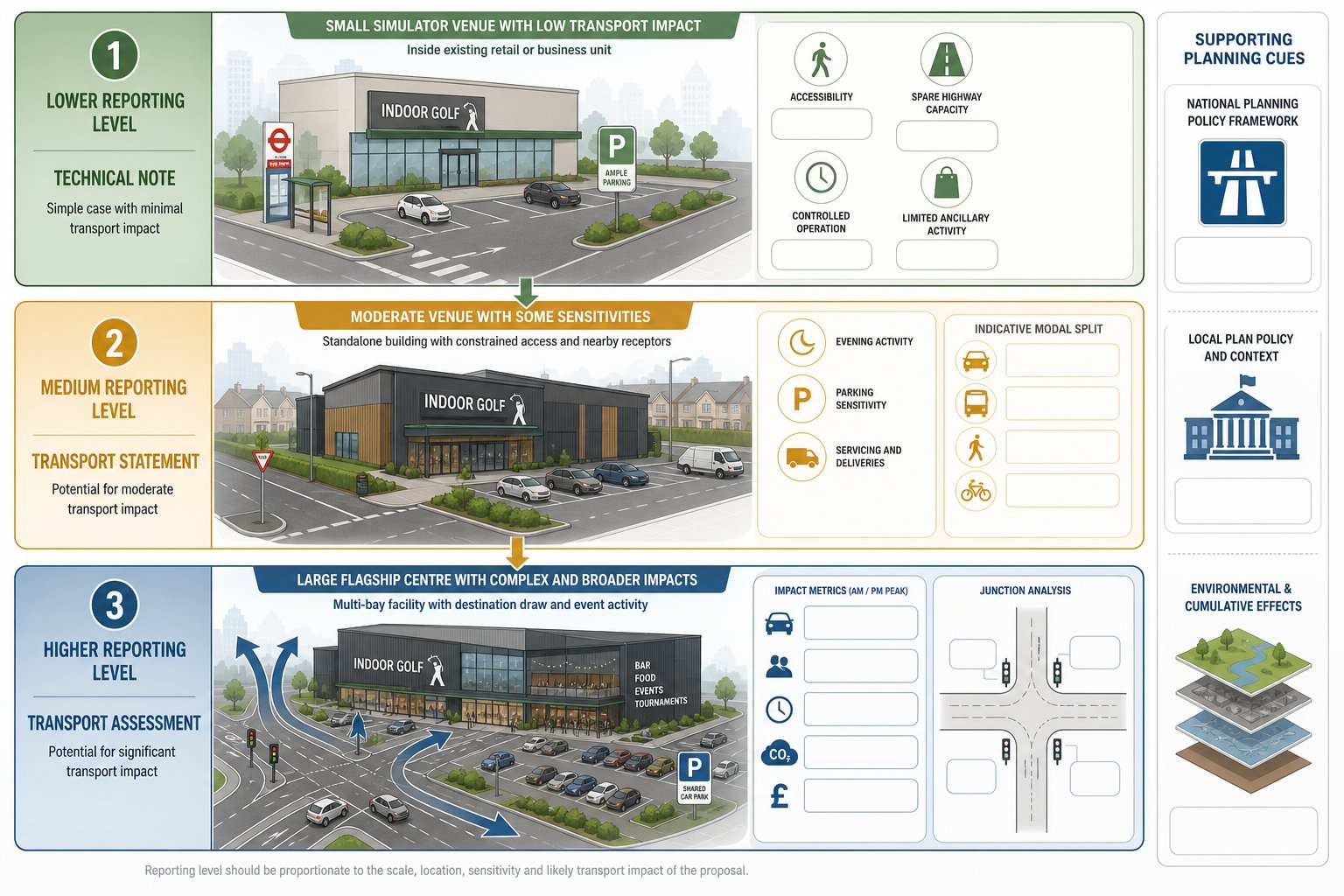
Not every proposal needs a full Transport Assessment. In our experience, the right level of reporting depends on scale, location sensitivity, existing parking stress, access constraints and whether the proposed operation changes traffic at materially different times from the lawful baseline.
A Technical Note may be enough for a small change of use in an accessible location where parking supply is ample, the highway network has clear spare capacity and the operation is tightly controlled. A modest number of simulator bays in a retail or business unit, especially with limited ancillary activity, often falls into this bracket.
A Transport Statement is commonly appropriate where the site is modest but not entirely straightforward. Perhaps there is some local parking sensitivity, a suboptimal access arrangement, evening activity near housing, or a need to explain mode share and servicing in more detail. This is often the sweet spot for standalone simulator venues.
A full Transport Assessment becomes more likely where the development is larger, newly built, access is constrained, or there is a realistic prospect of noticeable impact at nearby junctions or within a shared car park. Multi-bay flagship venues with bars, food, event space or tournament-style activity can justify that level of work.
And sometimes wider planning requirements pull transport further into the spotlight. On more complex sites, transport may need to interface with topics covered in an environmental impact assessment, especially where cumulative traffic effects or broader environmental considerations are being tested.
The practical message is to agree scope early with the local authority where possible. Over-reporting wastes time. Under-reporting causes avoidable objections.
Key Planning And Highway Issues Local Authorities Usually Review
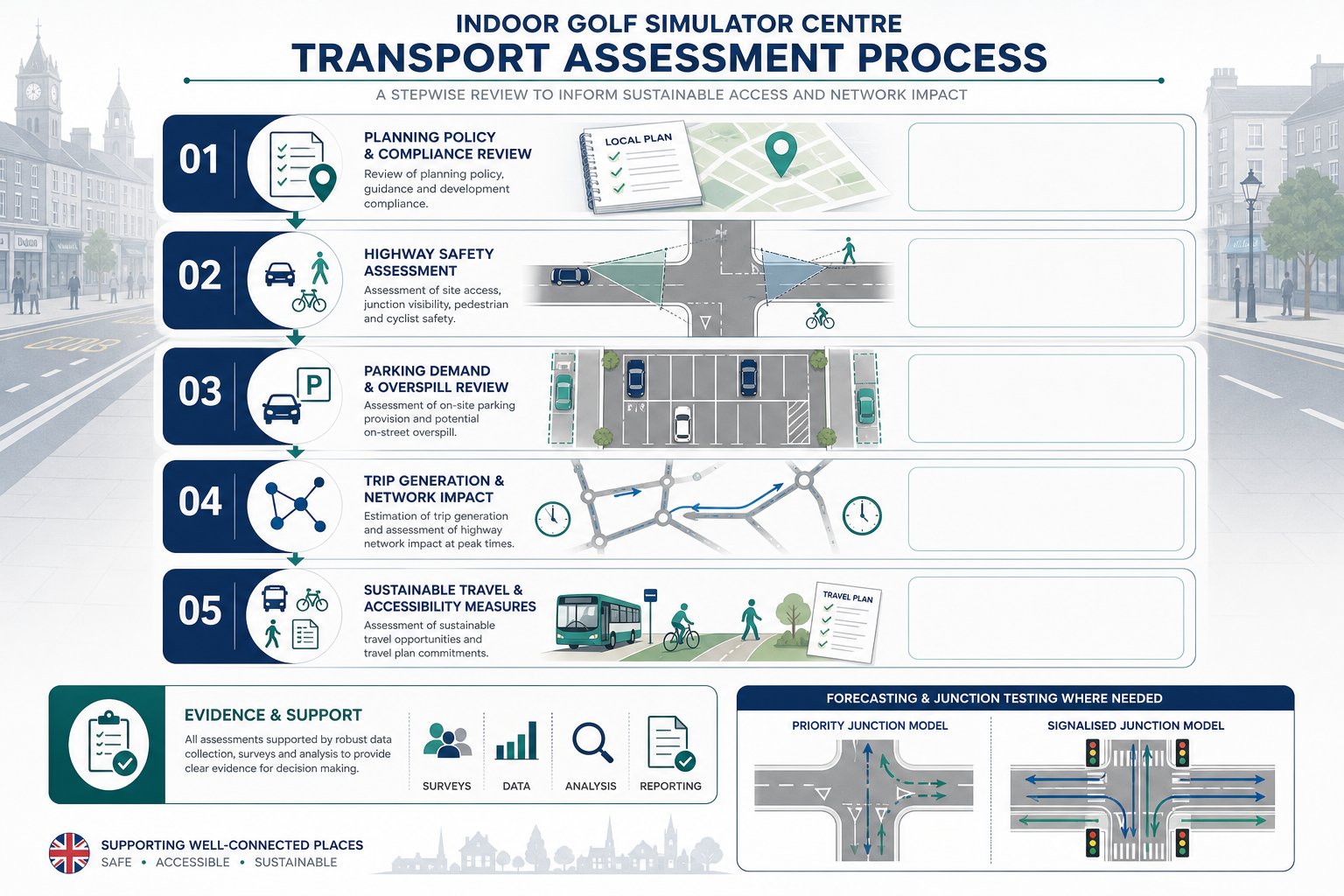
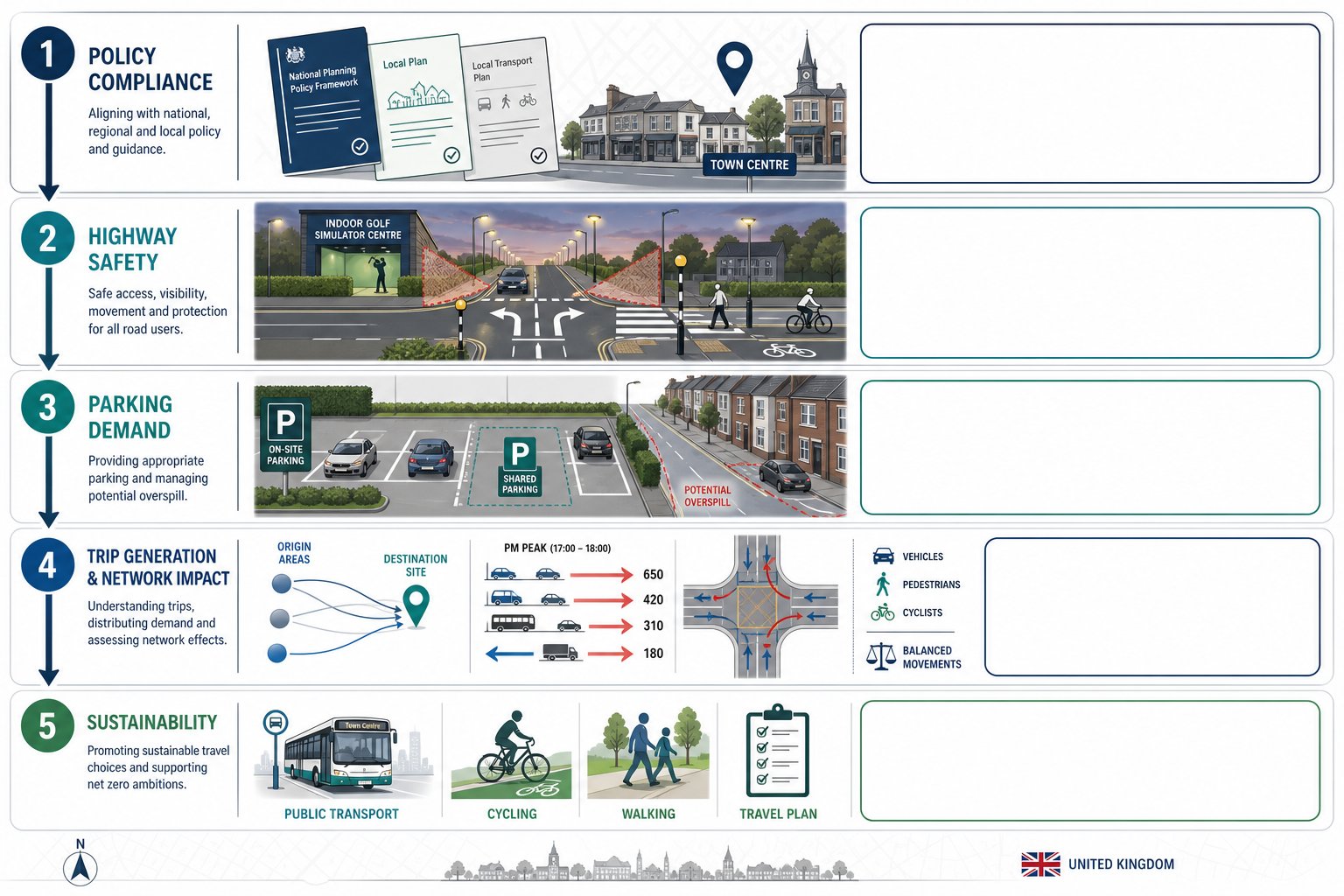
Local authorities usually review indoor golf simulator proposals through a familiar set of transport lenses, even if the use itself is unusual.
First, there is policy compliance. Officers will want to know whether the proposal aligns with the National Planning Policy Framework, local plan transport policies, parking standards and any town centre or sustainable travel expectations. If the site is in a centre, they may tolerate lower car parking provision, provided accessibility is genuinely good.
Second comes highway safety. That includes the suitability of the access, visibility splays, turning arrangements, internal circulation and conflict points with pedestrians and cyclists. Evening operation can sharpen concern around lighting, overlooked routes and the quality of walking links.
Third is parking demand and overspill. This is often the biggest practical issue. Authorities will ask whether customers, staff and occasional spectators can be accommodated on site or within accepted shared arrangements, and whether nearby residential streets or adjoining commercial spaces could be affected.
Fourth is trip generation and network impact. Officers tend to focus on weekday PM peak conditions and Saturday trading periods, even if the venue’s own peak sits slightly later. The assessment hence needs to explain both the venue’s operational peak and its interaction with surveyed network peaks.
Finally, authorities increasingly expect a proportionate sustainability response: accessibility analysis, cycle parking, public transport opportunities and, where justified, a travel plan. For more technical forecasting or junction testing, tools such as Junctions 11 Software may support the evidence base where a nearby priority or signalised junction genuinely requires modelling.
Site Location, Accessibility, And Catchment Considerations
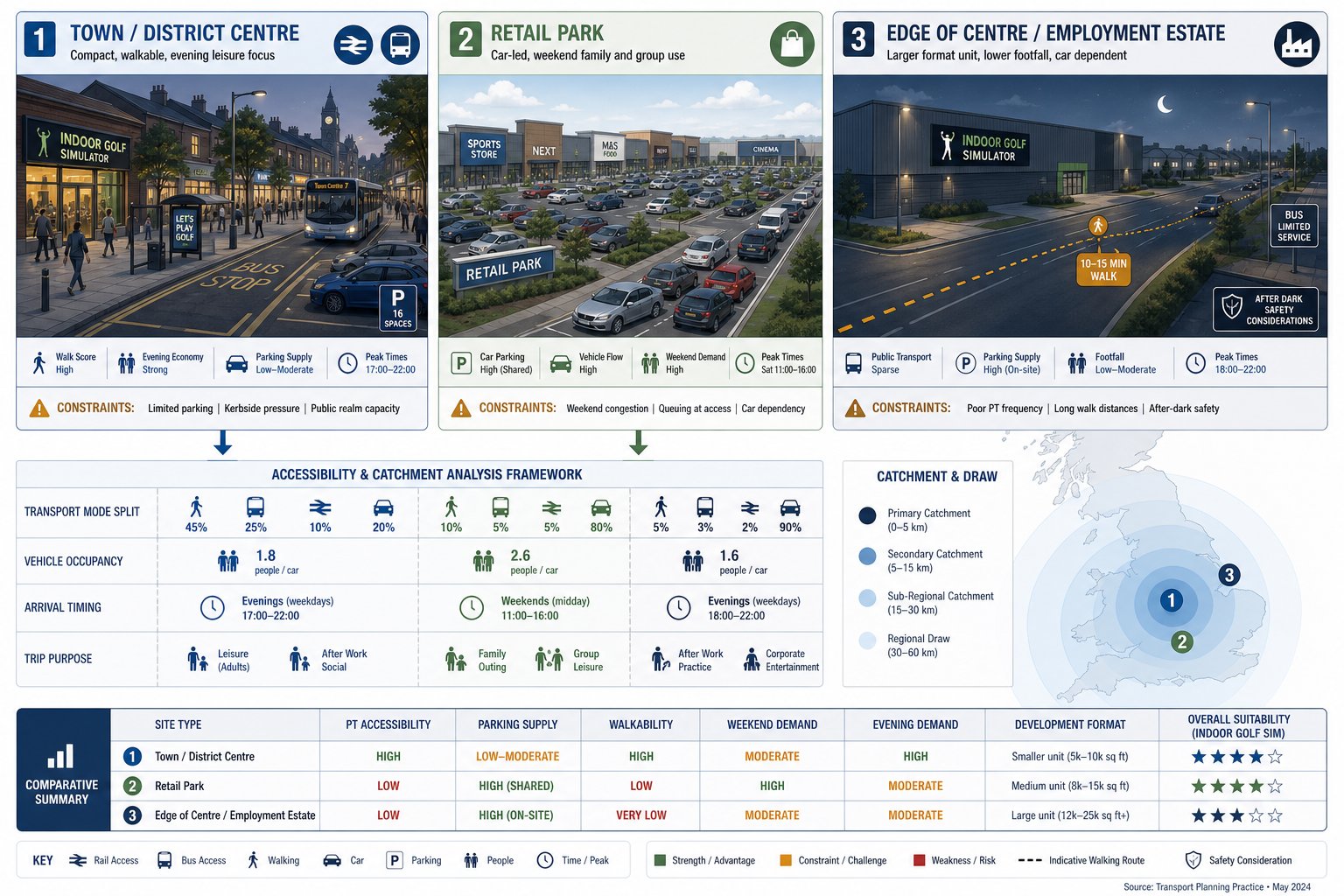
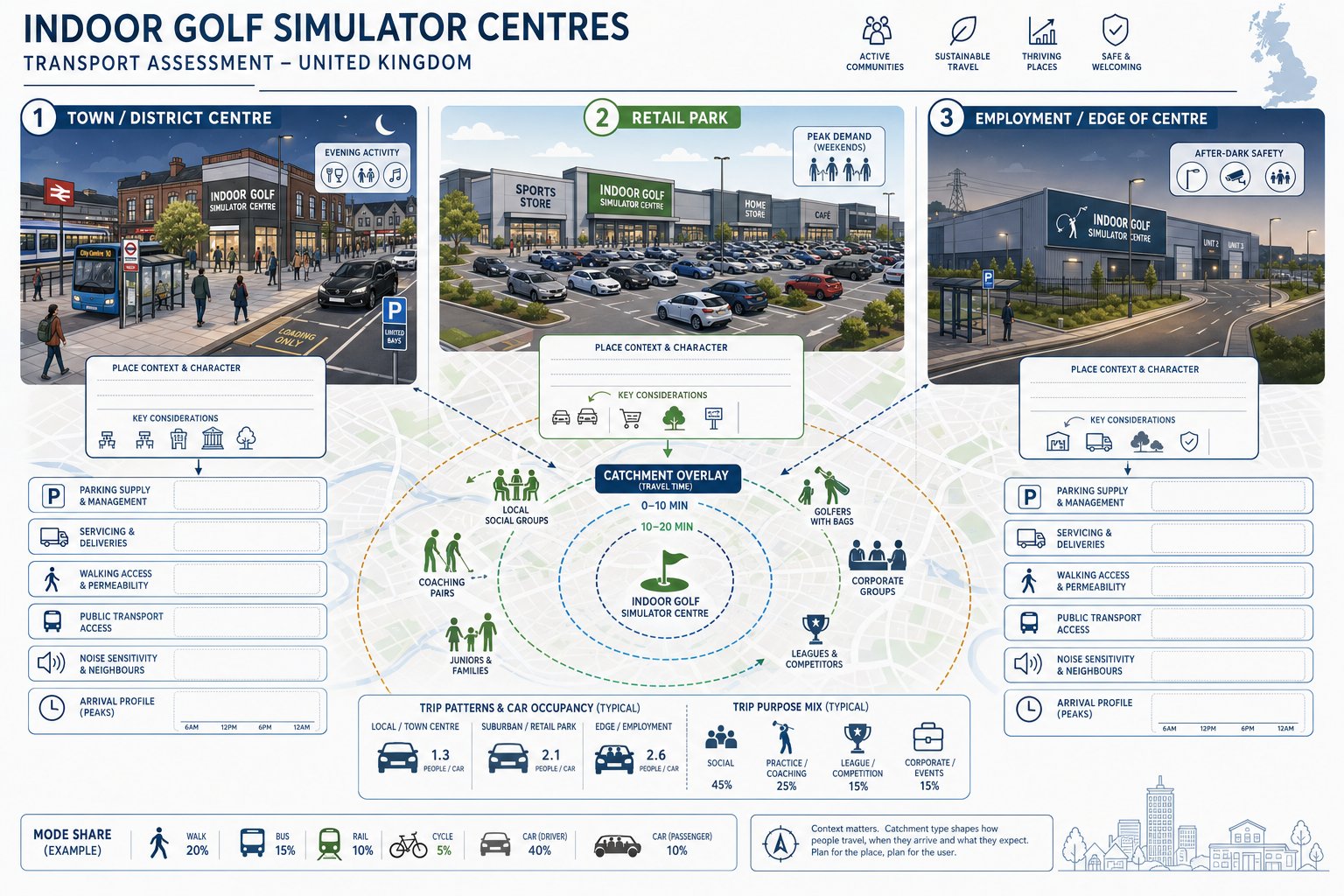
Location changes everything. The same six-bay venue can have a very different transport profile in a town centre than it would on a retail park or in an employment estate.
In town and district centres, public transport accessibility and walk-in demand are often strongest. Customers may combine a simulator booking with food, shopping or evening social activity. That can reduce car dependency, but these sites usually come with tighter parking supply, constrained servicing and greater sensitivity to late-night noise or kerbside activity.
In retail parks, car mode share is usually higher. Parking may look generous on paper, yet shared demand can become intense at weekends or during seasonal peaks. We need to understand not just total spaces, but who else is using them, when, and whether the proposed venue’s busiest periods overlap.
In employment areas or edge-of-centre locations, units may be larger and cheaper, making them commercially attractive. The trade-off is weaker off-peak bus provision, poorer walking routes and after-dark safety concerns. A site that functions adequately for daytime office staff may feel quite different for leisure customers arriving at 8pm.
Catchment also matters. Some venues draw a local social crowd: others attract serious golfers, coaching clients and corporate groups from a wider sub-regional area. That mix affects mode split, average vehicle occupancy and arrival behaviour. We hence assess accessibility in practical terms, not just by drawing a neat set of isochrones and declaring victory.
Car Parking Demand, Layout, And Overspill Risk
Parking is usually the most scrutinised issue for this use, and rightly so. A simplistic ratio borrowed from another leisure class rarely tells the full story. We prefer to derive demand from the venue’s actual operating capacity.
The starting point is straightforward: number of bays, likely players per bay, expected car occupancy, staff presence and any non-playing guests. Then we stress-test the result for coaching sessions, league nights, private events or a stronger food-and-drink offer. A centre with staggered two-hour bookings behaves differently from a venue hosting simultaneous arrivals for a corporate evening.
Layout matters as much as quantity. Authorities will want safe pedestrian paths from parking spaces to the entrance, logical disabled bay provision, cycle parking, room for EV charging where required by policy or design standards, and clear segregation from loading activity. If parking is remote, shared or decked, wayfinding and after-dark security can become material planning points.
Overspill risk needs honest treatment. If demand could exceed supply on peak evenings, where will vehicles actually go? Nearby public streets, neighbouring units and informal verge parking all have planning consequences. Sometimes management measures, booking caps, event controls, time-limited validation systems or staff parking restraint, are enough. Sometimes the issue points to a different site altogether.
Where the lawful fallback use has a different parking profile, comparative analysis can be especially useful. It’s not always just about gross demand: it’s about whether the proposal creates a more harmful pattern at the wrong times.
Peak Trading Periods And Their Impact On Arrival And Departure Patterns
The biggest mistake in assessing an indoor golf simulator centre is to assume it peaks like a standard daytime land use. Most don’t.
Demand often builds in the weekday evening and through weekend daytime and evening periods. But even then, movements may be smoother than expected because bookings are commonly staggered. If players are assigned start times at 15- or 30-minute intervals, there may be no single dramatic pulse of arrivals.
That operational detail is worth evidencing. Booking structures can show that one party leaves as another arrives, limiting simultaneous parking accumulation and reducing stress at the site access. In effect, the software behind the business can become part of the transport mitigation strategy.
Still, we should not romanticise it. Leagues, special events, televised sport nights or hospitality packages can compress arrivals in a way ordinary bookings do not. Those scenarios deserve sensitivity testing, particularly where parking is tight or nearby junctions already operate close to capacity.
For that reason, we normally compare the venue’s own expected peaks with surveyed background traffic peaks rather than relying on one in isolation. A centre may peak at 7pm, while the local highway network peaks earlier. Or the reverse. Understanding that overlap is what turns a plausible narrative into a robust assessment.
Servicing, Deliveries, And Operational Vehicle Movements
Servicing is rarely the headline issue for an indoor golf simulator venue, but it can become surprisingly important on constrained sites. Drinks deliveries, food supplies, cleaning contracts, refuse collection and occasional simulator maintenance all generate operational vehicle movements that need to be accommodated sensibly.
The first question is frequency and vehicle type. Many centres will receive light goods vehicles rather than large HGVs, but that assumption should be checked against the operator’s intended supply chain. A venue with a stronger hospitality offer may need more regular deliveries and waste collection than a basic simulator-only format.
The second question is where servicing happens. If delivery vehicles stop in customer parking aisles, block disabled bays or reverse across pedestrian desire lines, the arrangement may be unacceptable even if the overall trip numbers are low. On town centre sites, kerbside loading restrictions or narrow service yards can be the make-or-break constraint.
A sound assessment should hence identify the loading location, likely vehicle sizes, turning requirements and timing assumptions. Swept path analysis may be needed where geometry is tight. Refuse storage and collection points should also be practical rather than purely diagrammatic.
Done properly, servicing strategy reassures highway officers that day-to-day operation won’t undermine the access or parking conclusions set out elsewhere in the report.
Walking, Cycling, Public Transport, And Sustainable Travel Opportunities
Even where car use is likely to dominate, a planning submission should still examine sustainable travel opportunities properly. For indoor golf simulator centres, that means moving beyond a generic list of nearby bus stops and actually considering whether people will use them.
Walking analysis should cover footway continuity, crossing opportunities, dropped kerbs, lighting, surveillance and personal security, especially on evening routes. A bus stop 300 metres away sounds excellent until you realise the path to it runs behind shuttered warehouses with poor lighting and no active frontage.
Cycling can play a bigger role than some applicants expect, particularly for staff and local customers. Secure, convenient cycle parking is a low-cost improvement with planning value. On some sites, staff showers or changing space may also support active travel, though that should be proportionate to the scale and setting of the scheme.
Public transport assessment should identify realistic bus and rail choices, service frequencies during opening hours and whether the site supports linked trips from nearby centres. If the proposal includes events, staff travel management and late-evening departure patterns become more relevant.
A proportionate travel plan can tie these strands together: customer information, staff incentives, lift-sharing, booking confirmations that include travel choices, and event management protocols. The aim is not to pretend every golfer will arrive by bike: it is to show that non-car options have been understood, supported and made credible.
Trip Generation And Assessment Methodology For A Niche Leisure Use
Trip generation is where this use most often needs bespoke thinking. Conventional trip databases are useful, but they rarely contain a neat, reliable category for indoor golf simulator centres. If we force the development into the wrong proxy class, the result can look precise while being fundamentally unconvincing.
A better method usually combines three strands: capacity-based forecasting, comparable site evidence and locally informed mode split assumptions. Capacity-based work starts with the number of bays, maximum players, booking intervals, opening hours, staff and ancillary activity. That gives us a transparent ceiling and a realistic operating profile.
Comparable evidence then helps calibrate that profile. Similar venues can reveal actual vehicle arrivals, average car occupancy, parking accumulation and the effect of bars, coaching or event nights. Local accessibility informs mode split adjustments: a town-centre venue near rail will not perform like an out-of-town warehouse site.
The resulting forecast should be presented clearly, with explicit assumptions and sensitivity tests. Authorities tend to respond better when they can see the logic rather than being asked to trust a black box.
Where a proposal sits within a broader mixed-use scheme, methodological discipline matters even more. Lessons from sectors such as Residential Development Transport can be helpful in structuring baseline analysis and cumulative thinking, even though the trip characteristics are obviously very different.
Using Comparable Sites And Survey Evidence To Support Robust Forecasts
Comparable surveys are often the difference between a merely plausible assessment and one that withstands scrutiny. But the comparables need to be genuinely comparable.
We look for venues with similar bay numbers, pricing model, urban context, parking arrangements and ancillary offer. A city-centre boutique venue with a cocktail bar is a weak comparator for a basic edge-of-centre simulator unit beside trade counters. The label may be the same: the transport behaviour is not.
Survey evidence can capture vehicle arrivals and departures by time period, parking accumulation, average persons per car, staff travel patterns and any seasonal variation. It can also reveal subtle operational realities, such as customers arriving early to socialise or staying on after play for food and drink.
That said, survey data is not magic. We still need to sense-check it against the proposed site’s accessibility, local highway conditions and business model. One busy comparator should not be used as a proxy for every scheme. Equally, a quiet initial survey should not be treated as a permanent ceiling if the operator intends to expand events.
The most persuasive forecasts usually combine comparator evidence with transparent capacity-based logic and sensitivity scenarios. That way, if officers challenge one assumption, the overall assessment still stands up.
Common Constraints In Town Centre, Retail Park, And Employment Area Locations
Every location type brings its own transport risks, and indoor golf simulator centres tend to expose them quickly.
In town centres, the usual constraints are limited on-site parking, restricted servicing windows, busy pedestrian environments and proximity to residential uses. Late-evening activity may be acceptable in principle, but authorities will still want comfort that drop-off behaviour, taxi activity and customer dispersal will not create nuisance or safety concerns.
In retail parks, the headline issue is often shared parking stress. A unit can appear policy-compliant in isolation yet still trigger practical problems if weekend demand overlaps with food stores, gyms, restaurants and family leisure uses. Internal circulation, queueing at access points and pedestrian movement through parking aisles are also common concerns.
In employment areas, public transport can be thinner in the evening, walking routes may be less attractive after dark, and heavy goods vehicle activity can conflict with customer movements. These sites can work well, but they often need more thought around lighting, wayfinding, staff travel and separation from industrial operations.
Across all three settings, the right mitigation is usually management-led before it becomes infrastructure-led: booking controls, event protocols, delivery timing, staff parking rules and clear customer information. If those measures are built into the planning narrative early, objections tend to be easier to resolve.
What A Strong Indoor Golf Simulator Centres Transport Assessment Should Include
A strong submission starts with a precise description of the development. We need the number of simulator bays, opening hours, staffing, expected customer profile, booking system, ancillary bar or food offer, coaching provision, event use and any membership model. Without that, the rest of the assessment floats.
It should then cover the essential technical components clearly: policy review, site context, accessibility, baseline traffic conditions, collision history where relevant, parking conditions, trip generation, trip distribution, servicing and highway safety. If junction effects could be material, those should be tested proportionately and transparently.
Parking strategy should be explicit rather than implied. Show supply, layout, disabled provision, cycle parking, servicing interaction, EV charging where relevant, and how peak demand will be managed. If there is shared parking, explain the legal and operational basis for relying on it.
Sustainable travel opportunities should be assessed honestly, with a proportionate travel plan where justified. And if mitigation is needed, it should be specific: signage, event booking controls, minor access works, loading restrictions, staff travel measures or parking management.
At ML Traffic, our role is usually to turn a niche, easily misunderstood use into a concise evidence base that officers can follow. In practice, a good report does not try to make the scheme sound impact-free. It shows that the operation has been understood, tested and, where necessary, managed sensibly.
Indoor Golf Simulator Centres Transport Assessment – Frequently Asked Questions
What makes indoor golf simulator centres different from other leisure venues in terms of transport assessment?
Indoor golf simulator centres are appointment-based with fixed capacity and usually have staggered bookings lasting 1–3 hours. This creates predictable traffic patterns unlike gyms or bars, requiring a transport assessment specific to their operating profile rather than generic leisure assumptions.
When is a full Transport Assessment required for an indoor golf simulator centre?
A full Transport Assessment is necessary for large multi-bay venues, new builds, or sites with constrained access, parking stress, or potential congestion. Smaller or less sensitive sites might only need a Transport Statement or Technical Note, depending on scale and local conditions.
How is parking demand calculated for indoor golf simulator centres?
Parking demand is based on the number of bays multiplied by players per bay, adjusted for car occupancy, staff, spectators, and special events like leagues or coaching. Layout must also provide safe pedestrian routes, disabled bays, EV charging, and avoid servicing conflicts to minimise overspill risk.
What sustainable travel opportunities should be considered in the transport assessment?
Assessments should evaluate walking routes for safety and accessibility, convenient cycle parking and facilities for staff, realistic public transport options based on service frequency and timing, and include a proportionate travel plan supporting non-car modes, staff incentives and event management protocols.
Why is understanding peak trading periods important in transport assessments for these centres?
Indoor golf centres often peak during weekday evenings and weekends rather than traditional commuter times. Staggered bookings help smooth arrivals, but special events can cause arrival surges. Assessing these peaks relative to local traffic conditions ensures accurate evaluation of network impact and parking stress.
How do indoor golf simulator centres impact local highway safety and what issues do authorities commonly review?
Authorities review site access, visibility, servicing arrangements, pedestrian and cyclist interaction, and parking overspill risks. Evening operations heighten concerns about lighting and pedestrian safety. A well-prepared assessment addresses these issues aligning with policies and demonstrating safe, efficient use.