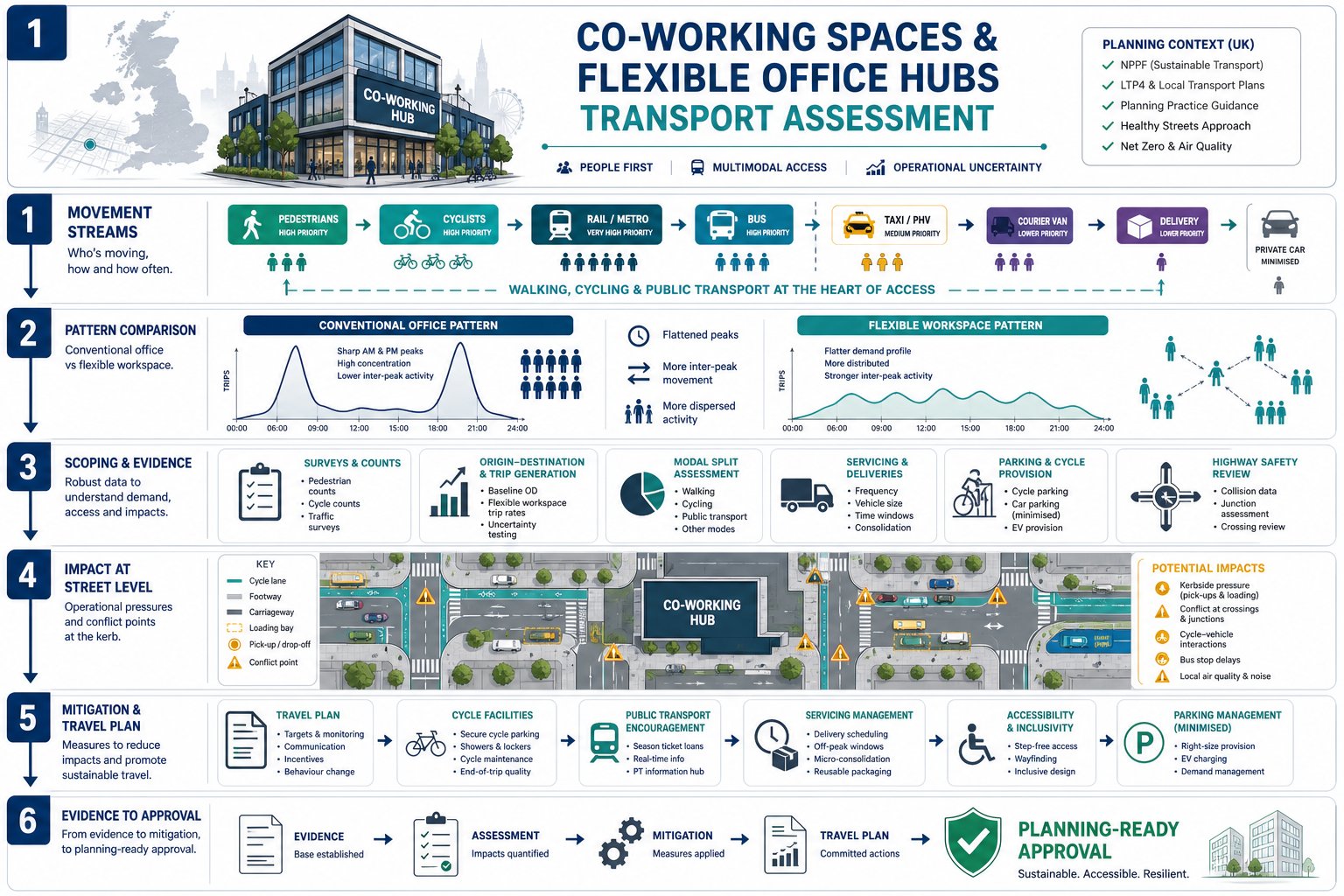
The transport case for a co-working scheme looks simple at first glance. Put flexible desks in a town centre, lean on good public transport, keep parking low, and surely the planning position should follow. In practice, it rarely works out that neatly.
A co-working spaces and flexible office hubs transport assessment has to deal with something standard office assessments often do not: uncertainty built into the operating model. Memberships flex. Occupancy changes by day and season. Meeting rooms, events, courier activity, visitor arrivals and ride-hail pick-ups can all shift the pattern of movement well beyond a conventional 9-to-5 office profile.
That matters because local authorities are increasingly alert to person-trip intensity, kerbside pressure, highway safety, cycle provision and the realism of modal split assumptions, especially in dense urban locations. A weak assessment can stall an otherwise sensible application. A well-scoped one can do the opposite: frame the scheme clearly, answer likely objections early, and show how sustainable travel will actually work in operation.
In this text, we set out what planning applicants need to get right in 2026, from scope and surveys to trip generation, servicing, parking and mitigation. The focus is practical. We are writing for architects, planners, surveyors, lawyers, developers, builders and councils who need a robust, policy-ready submission rather than a generic report template.
Key Takeaways
- A co-working spaces and flexible office hubs transport assessment must address the inherent operational uncertainty due to variable occupancy and diverse trip patterns, unlike conventional office assessments.
- Local authorities focus on person-trip intensity, kerbside pressure, highway safety, and realistic modal split assumptions, especially in dense urban settings where co-working spaces commonly locate.
- Trip forecasting should rely on comparable flexible workspace evidence and operational models rather than generic office assumptions, reflecting flatter peak profiles and varied travel modes.
- Early and precise scoping—defining use class, operational characteristics, study area, and survey scope—is crucial to produce a robust, policy-aligned transport assessment that avoids delays.
- Servicing, deliveries, and app-based pick-up activity significantly impact kerbside management and must be quantified and mitigated through measures like Delivery and Servicing Plans to prevent street congestion.
- Car and cycle parking strategies need to be justified against local policies with clear allocation rationales and high-quality end-of-trip facilities, supporting sustainable travel and gaining authority approval.
Why Co-Working And Flexible Office Uses Need A Transport Assessment
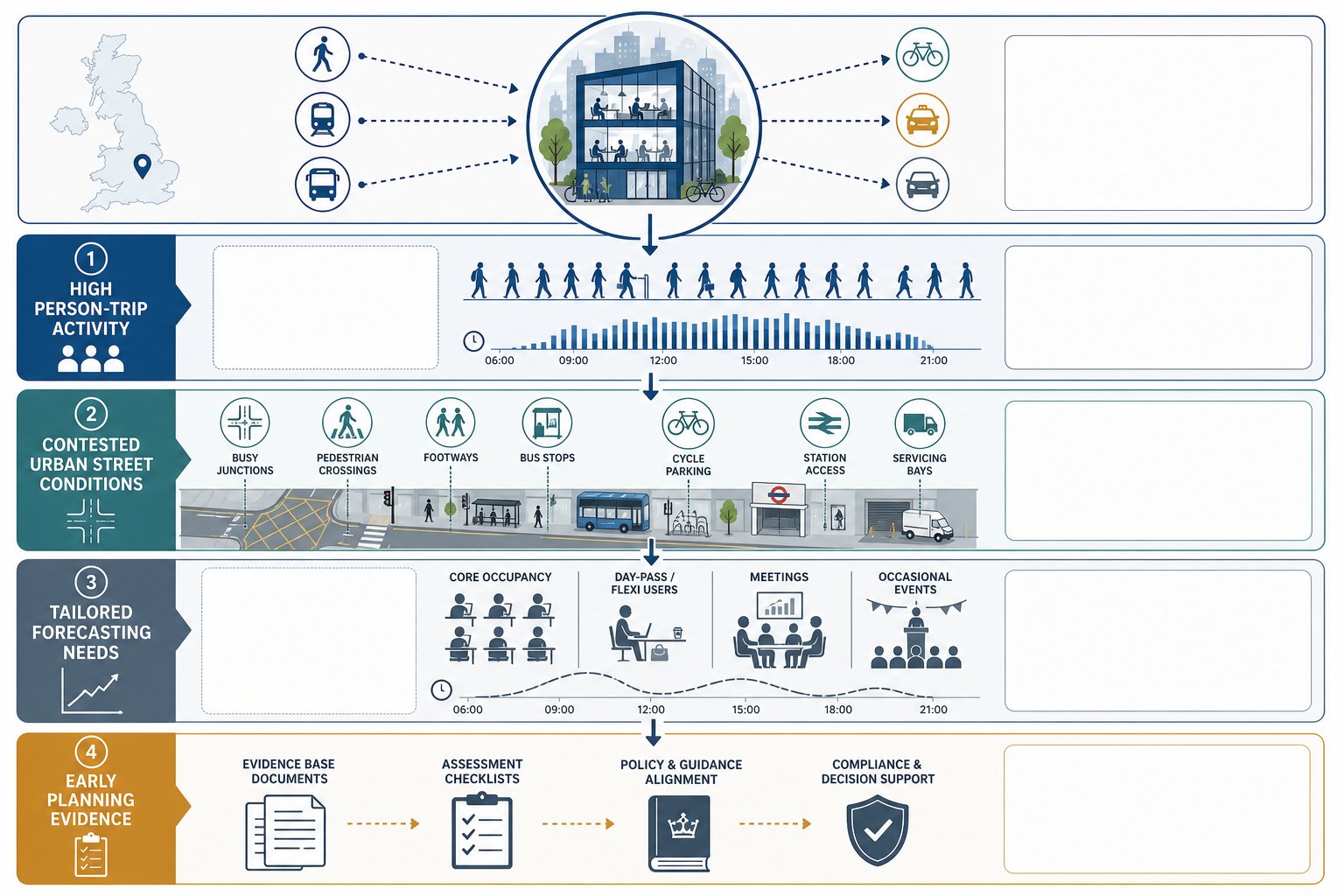
Co-working and flexible office schemes often sit in places where transport impacts matter most: busy centres, edge-of-centre corridors, regeneration sites and public-transport-rich locations with already contested street space. Low parking provision does not remove the need for assessment. If anything, it sharpens the focus on how people will actually arrive, how servicing will happen, and whether nearby streets and junctions can absorb changing patterns of demand.
The key issue is person trips rather than just vehicle trips. A flexible workspace can produce high levels of walking, rail, bus, cycle and taxi activity even where private car use is modest. That means a planning authority may want evidence not only on access and junctions, but also on crossing points, footway capacity, cycle facilities, bus stop quality, station proximity and inclusive access.
There is also a forecasting problem. Traditional office assumptions can be too blunt for a scheme with hot-desking, short-term memberships, day passes, client meetings and occasional events. Authorities hence expect a more tailored evidence base, aligned with National Planning Policy Framework tests and local plan policies.
In many cases, the co-working assessment should be treated as part of the broader discipline of transport assessment for developments: it is just one with a more fluid operational profile than most. That fluidity is exactly why early clarity matters.
How Flexible Occupancy Changes Trip Generation And Travel Demand
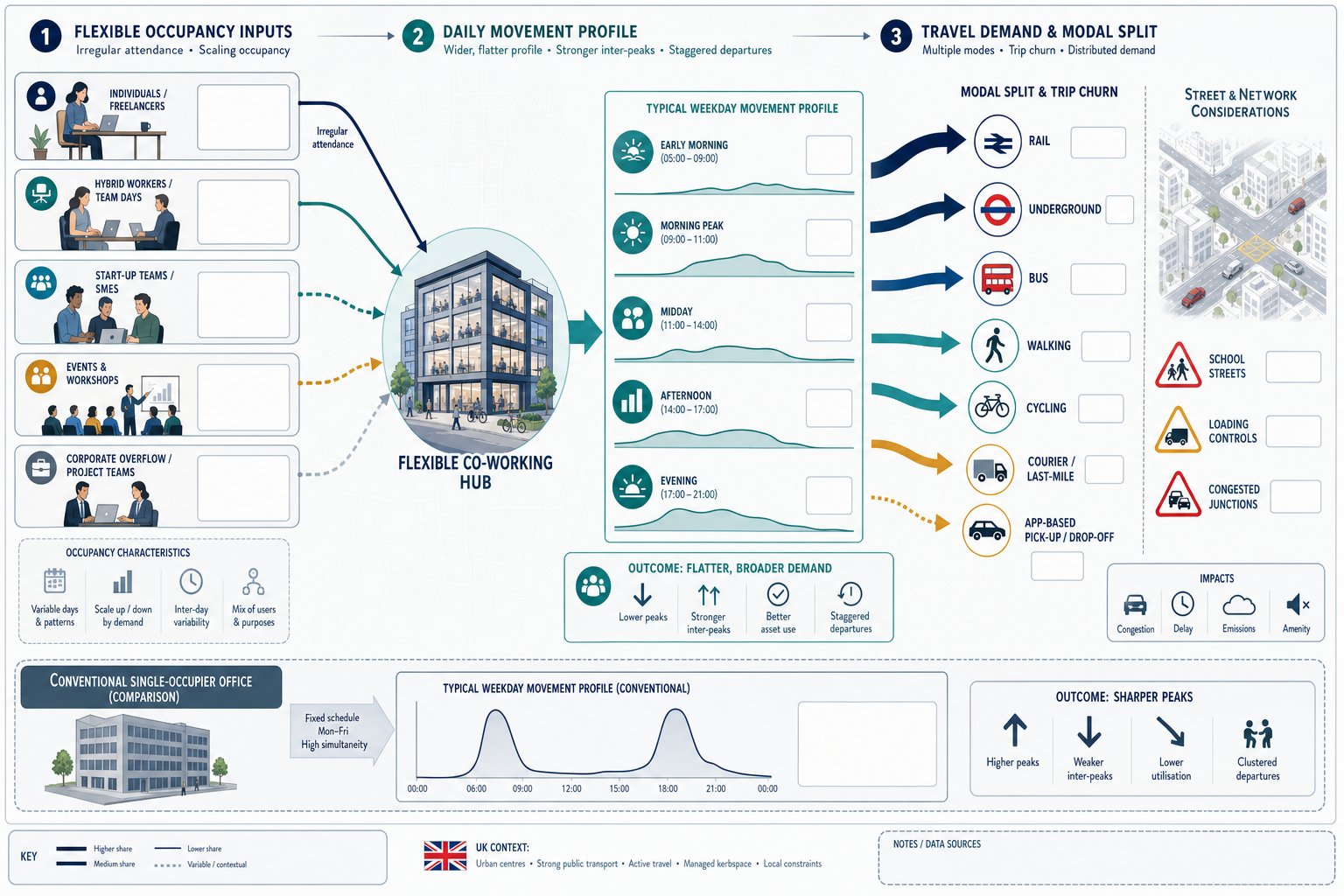
Flexible occupancy changes nearly everything about trip forecasting. In a conventional single-occupier office, we can usually infer fairly stable arrival and departure patterns from job numbers, floor area and standard commute peaks. In a co-working hub, the picture is messier. Some users attend three days a week. Others come only for meetings. Start-ups may scale up quickly. Event space can pull in off-peak or evening movements. And a corporate overflow hub can behave differently again.
That variability affects both volume and timing. We often see flatter peak profiles, stronger inter-peak activity, and more dispersed evening departures than a standard office benchmark would suggest. Modal split may also differ, particularly in central locations where members choose the site precisely because it is close to rail, Underground, bus routes or high-quality walking and cycling links.
But flexible working does not automatically mean low impact. It can generate more visitor trips, more churn at the entrance, more courier calls, and more app-based pick-up activity than a single-tenant office of equivalent size. If those movements coincide with school streets, loading restrictions or congested junctions, local concern rises fast.
This is why we prefer demand assumptions grounded in comparable flex-space evidence, not a generic office rate pasted into a report. The operational model should drive the trip model, not the other way round.
Key Planning Triggers And Local Authority Expectations
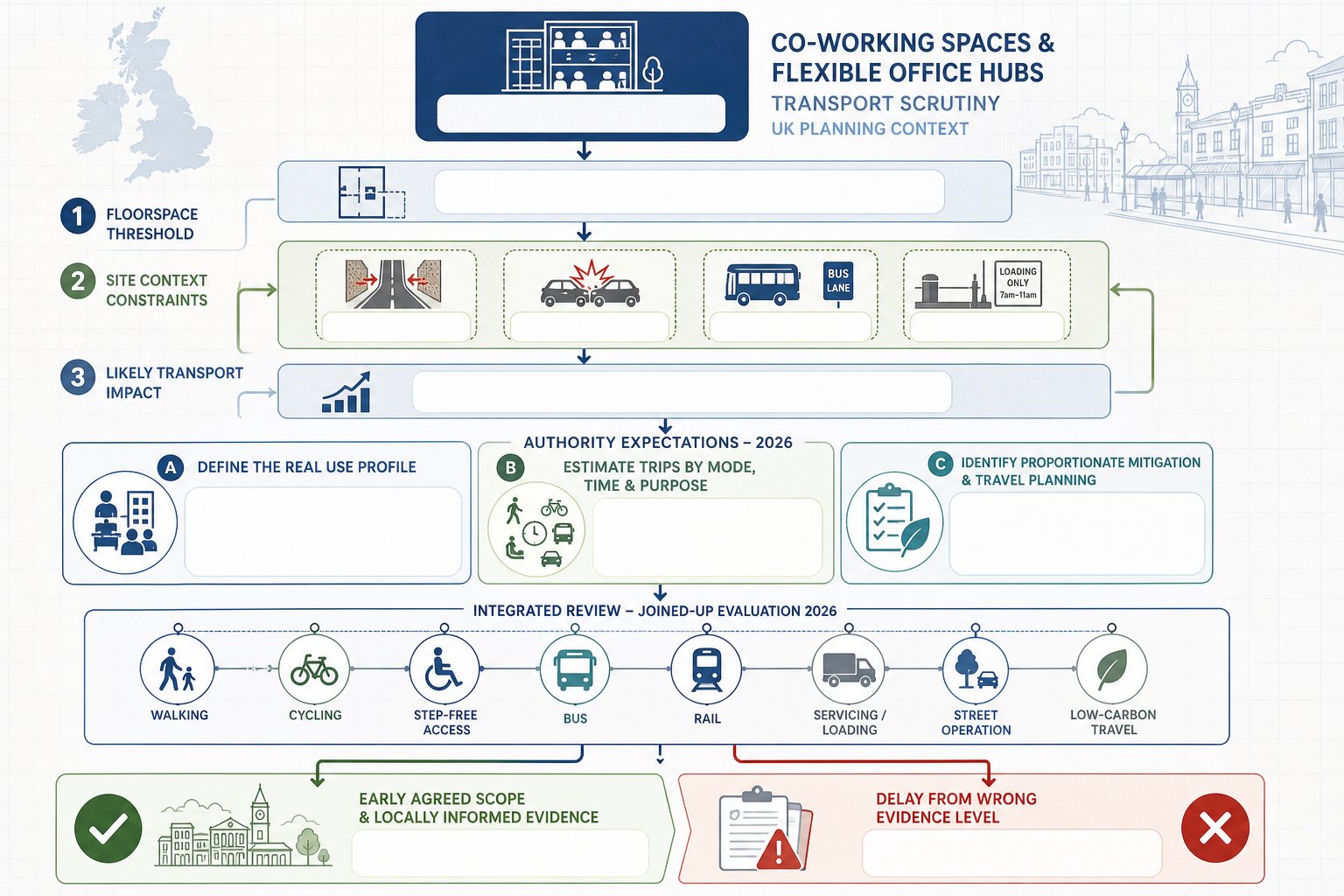
Whether a formal Transport Assessment is required depends on local thresholds, site context and the scale of likely impact. Floorspace is still a common trigger, usually tied to office-type Class E development, but it is rarely the whole story. A modest scheme on a constrained access, near a collision cluster, beside a saturated bus corridor or within a tightly managed town-centre kerbside environment may attract detailed scrutiny even below headline thresholds.
Authorities generally want three things. First, a defensible account of what the use actually is: office-led, event-heavy, mixed-use, or something edging towards sui generis in practice. Second, an evidence-led estimate of trips by mode, time period and purpose. Third, a proportionate package of mitigation and travel planning that reflects local policy rather than generic promises.
In 2026, expectations are also more integrated. Highway officers and planning officers are not just reviewing vehicle flows. They are looking at active travel policy, accessible design, public transport dependency, loading strategy, carbon-conscious travel planning and how the development will function on the street.
For applicants, that means getting the scope agreed early and using advisers who understand local authority habits as much as national guidance. A lot of delay comes not from major impact, but from submitting the wrong level of evidence first time. That is where experienced Transport Assessment Consultants: tend to make the biggest difference.
What A Robust Assessment Should Scope At The Outset
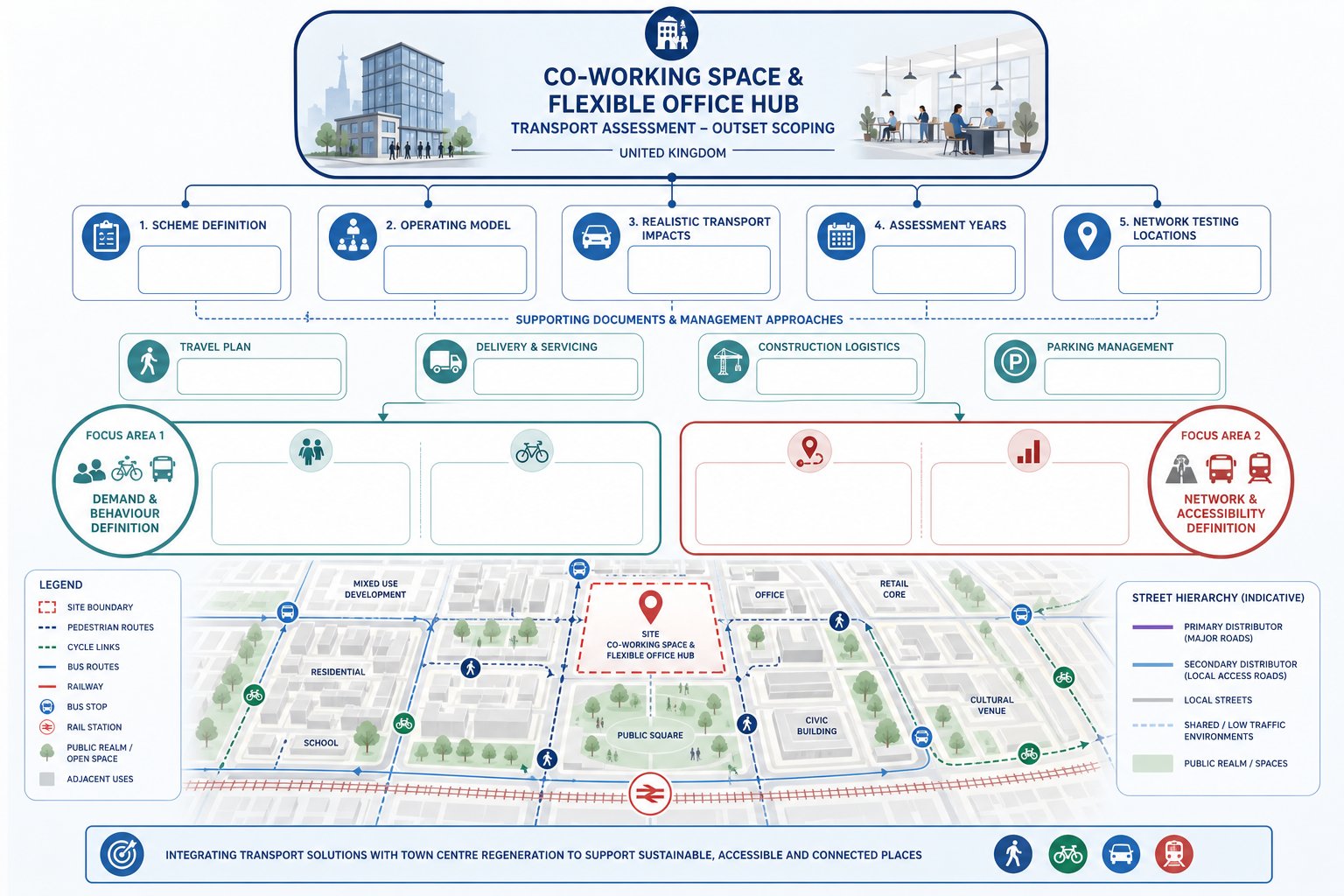
Scoping is where strong flexible office applications separate themselves from weak ones. If the initial brief is vague, every later chapter becomes harder: use class disputes linger, trip rates are challenged, surveys miss key activity, and mitigation feels reactive rather than planned.
A robust scope should set out what the scheme is, how it will operate, what impacts could realistically arise, and which assessment years and network locations need to be tested. It should also confirm whether supporting documents will be needed alongside the Transport Assessment, such as a Travel Plan, Delivery and Servicing Plan, Construction Logistics Plan or parking management strategy.
For town-centre and mixed commercial schemes, this often overlaps with wider movement planning. In denser regeneration settings, the relationship with adjacent uses, public realm and street hierarchy can be just as important as the site itself, which is why principles from mixed use masterplan work often become relevant even for a single building.
At the outset, two areas need particularly careful definition.
Defining The Use Class, Floorspace, And Operational Model
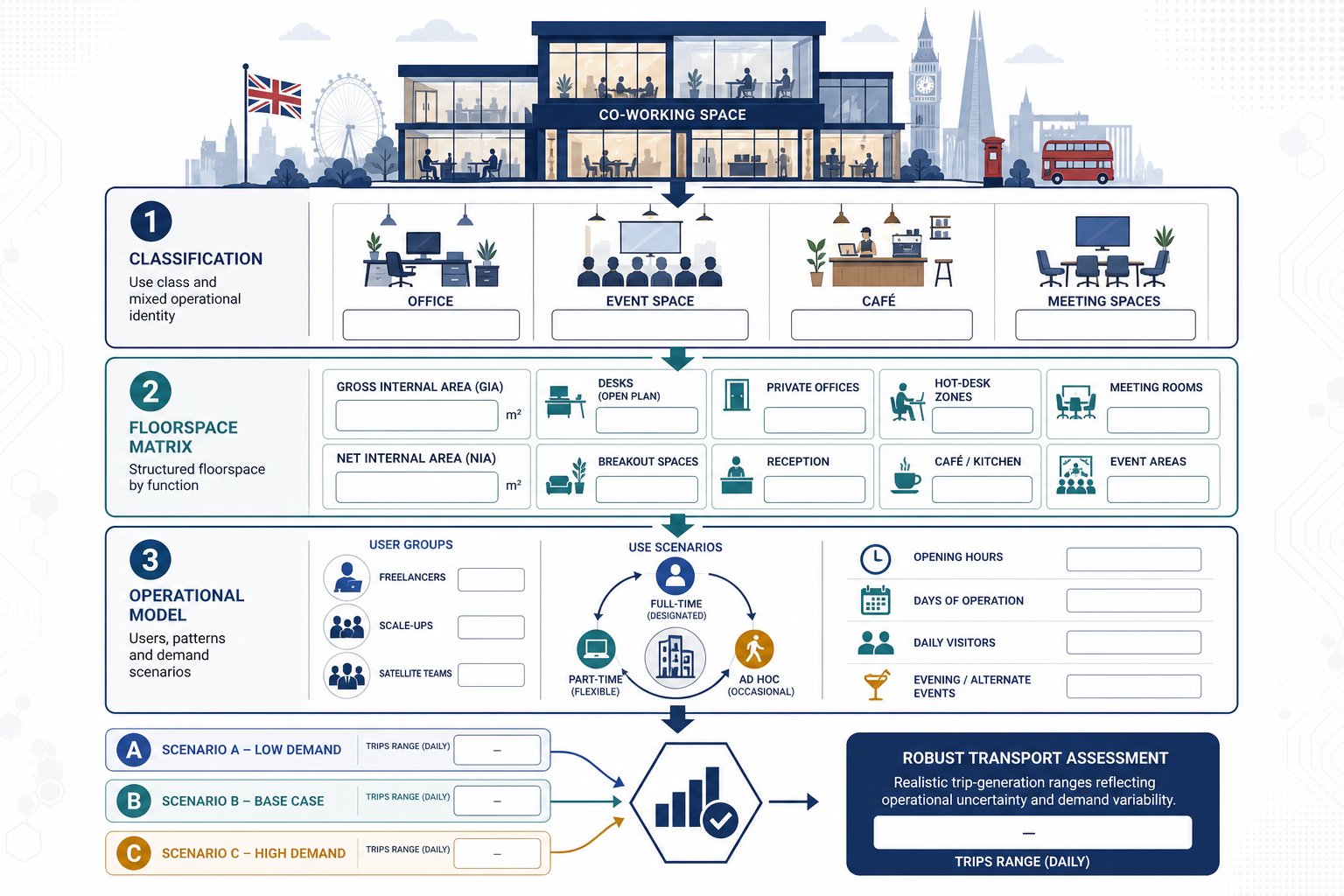
The first is the planning and operational identity of the scheme. Most co-working proposals fall within Class E, commonly E(g)(i), where the use is predominantly office-based. But that should not be assumed blindly. If the scheme includes substantial public-facing event space, large meeting suites, a café with independent attraction, or frequent evening functions, the operational reality may be more mixed than the headline description suggests.
We need clear schedules for gross internal area, net internal area, desk numbers, private office capacity, hot-desk zones, meeting rooms, breakout areas, reception, ancillary café space and any event areas. Without that breakdown, trip generation becomes guesswork.
The operational model matters just as much. Is the occupier targeting freelancers, scale-ups, satellite teams, or a blend? Are memberships full-time, part-time or ad hoc? What are the opening hours? Will there be evening networking events? How many visitors are expected daily? A 2,000 square metre scheme can behave in very different ways depending on those answers.
Good assessments spell this out plainly. They do not hide uncertainty: they bracket it with realistic scenarios and explain why the chosen case is robust.
Agreeing Study Area, Survey Scope, And Assessment Scenarios
The second scoping task is to agree what part of the network matters and how it should be measured. For most flexible workspace schemes, the study area should cover the site access, nearby priority junctions or signals, principal walking routes, controlled crossings, cycle desire lines, bus stops, rail or Underground access points, and any streets likely to absorb loading or pick-up activity.
Survey scope should follow operational risk. If the site relies on kerbside loading, then kerbside beat surveys are often essential. If cycling is a policy priority, link and junction counts for cycles and pedestrians may be needed. If evening events are part of the model, weekday inter-peak and evening surveys may matter more than a narrow AM peak snapshot.
Assessment scenarios should normally include the existing baseline, future baseline with background growth and committed development, and with-development cases, sometimes both with and without mitigation. On larger or more sensitive sites, public transport crowding or cumulative development effects may also need review.
Where transport interacts with wider environmental topics, the scoping logic should align with any environmental impact assessment approach so that assumptions stay consistent across the application set.
Survey Data And Evidence Typically Required For Flexible Workspace Schemes
Evidence quality usually determines whether review comments are minor or painful. For flexible workspace, that evidence must extend beyond standard turning counts. We normally need a picture of both movement and operation.
Baseline traffic counts at key junctions remain important, typically in weekday AM and PM peaks. But for co-working schemes, person-count data can be just as valuable: pedestrian flows on approach routes, cycle volumes on relevant links, and where justified, inter-peak or evening counts reflecting meetings or events. Around stations and major bus corridors, local authorities may also ask for a public transport accessibility and capacity narrative, supported by timetables, frequencies and known loading conditions.
Comparable-site evidence is especially useful. Travel surveys from similar co-working spaces, preferably local or regionally comparable, can help justify trip rates, modal split and temporal spread. Where operator data exists, it should be used.
On-street conditions need proper documentation too. Parking beat surveys, loading observations, taxi and private hire activity, and refuse arrangements can all become critical in constrained centres. And a five-year collision review from STATS19 data is standard practice where access or highway safety is in issue.
In short, the assessment should reflect how the building will really function, not merely how the floor plans look.
Trip Generation, Modal Split, And Peak Period Analysis
Trip generation for flexible office hubs should be built from the most relevant unit of occupation. Depending on the scheme, that may be per 100 square metres NIA, per workstation, per occupied desk, or a hybrid method that tests both floorspace and capacity assumptions. What matters is that the method reflects actual operation.
Standard office databases can still help, but they often need adjustment. Co-working users tend to show higher public transport and active travel shares in well-connected urban areas, and their peaks can be broader. If we simply apply a conventional suburban office arrival rate, the result may misstate both impact and mitigation need.
Modal split should be calibrated against local conditions: Census journey-to-work patterns where still useful, local mode share evidence, PTAL-style accessibility considerations where relevant, nearby cycle infrastructure, and comparable flex-space survey data. The result should be expressed clearly as person trips by mode before converting relevant demand into vehicle trips for highway modelling and parking analysis.
Time periods deserve care. AM and PM peaks remain standard, but some schemes also need inter-peak, evening or even weekend analysis. If client meetings, community events or start-up programmes continue beyond office peaks, those movements cannot be brushed aside.
For junction testing, robust modelling inputs matter as much as trip rates, and tools such as Junctions 11 Software are only as credible as the assumptions fed into them.
Servicing, Deliveries, Pick-Up Activity, And Kerbside Pressure
This is one of the most commonly underestimated aspects of a flexible office application. A co-working building may have relatively few resident parking spaces, yet still create a surprising amount of street activity. Parcels arrive for multiple small businesses. Consumables are delivered frequently. Waste and recycling collections need regular access. Visitors come and go. Taxis and private hire vehicles often cluster around the entrance, especially after meetings or evening functions.
In tight urban streets, that activity can become the real transport issue, not junction capacity. We hence need to quantify likely servicing trips by vehicle type and time of day, identify where loading will take place, and show that movements can occur safely and lawfully without blocking traffic lanes, cycle tracks, bus stops or crossings.
Swept path analysis may be required for service vehicles and refuse collection, particularly where rear service yards are absent and access is constrained. If on-street loading is proposed, the assessment should review nearby controls, competing demands and dwell times. Blue-badge demand, short-stay bays and school-run conditions can all complicate what looks, on a plan, like a simple frontage.
A practical Delivery and Servicing Plan often reassures authorities here, especially where parcel consolidation, timed deliveries, concierge management or operator booking systems can reduce kerbside friction.
Car Parking, Cycle Parking, And End-Of-Trip Facilities
Parking strategy for co-working schemes is usually policy-sensitive. Many are intentionally low-car or car-free, especially in central locations with strong public transport access and controlled parking zones. That can be entirely acceptable, but only if the evidence supports it and the residual operational needs are handled properly.
Car parking provision should be justified against local standards, including any maximum thresholds, restraint policies or accessibility-led exceptions. If spaces are provided, the rationale for allocation matters: disabled users, essential operational needs, car club use, EV charging or shared-use arrangements. A bare parking schedule without explanation tends to invite challenge.
Cycle provision has become equally important. For flexible offices, we normally need secure long-stay cycle parking for members and staff, short-stay stands for visitors, and end-of-trip facilities that make cycling realistic rather than symbolic. Showers, lockers, changing space and drying areas can materially affect uptake.
The detail needs to match local standards on numbers, dimensions, accessibility and convenience. Poorly located basement stores or stacked systems with weak usability are often criticised. The best strategy is one that treats cycle parking as core infrastructure, not leftover space.
The logic is familiar across sectors, although the balance differs from a Residential Development Transport case because workplace arrival patterns and visitor needs are operationally distinct.
Junction Capacity, Site Access, And Highway Safety Considerations
Not every co-working scheme needs detailed junction modelling, but every scheme needs a credible statement on access and safety. The first question is whether development traffic will materially affect any site access or nearby junction. In highly sustainable locations, vehicle trip increases may be limited. Even then, servicing manoeuvres, pick-up activity and crossing movements can still raise local concerns.
Where vehicle effects are material, agreed junctions should be tested using appropriate tools and growth assumptions. Capacity results need to be read sensibly. A tiny increase at a junction already under pressure may still matter, while a larger percentage increase on paper may be immaterial in practice if absolute flows stay low.
Access design should also be reviewed from the perspective of pedestrians and cyclists. Visibility splays, dropped kerbs, footway continuity, priority arrangements, crossing desire lines and interaction with cycle infrastructure all deserve attention. Local authorities are increasingly interested in whether an access feels safe and legible for vulnerable users, not simply whether cars can enter and leave.
Collision analysis should cover the most recent five-year record and identify patterns, particularly involving pedestrians, cyclists or powered two-wheelers. If risk factors exist, mitigation should be specific: geometry changes, lining, signing, loading controls, crossing upgrades or management measures.
Travel Plans, Mitigation Measures, And Planning Support Documents
A strong co-working transport assessment does not stop at forecasting impact. It should show how the development will operate successfully once occupied. That is where Travel Plans and linked management documents come in.
A Framework Travel Plan should set realistic mode-share objectives, baseline assumptions, monitoring arrangements and practical measures tailored to the user base. For flexible workspace, that might include cycle incentives, shower and locker management, public transport season-ticket support, personalised travel information, visitor travel guidance, discounted local mobility offers, or membership communications that actively shape travel behaviour. Generic boilerplate targets are easy to spot and rarely persuasive.
Mitigation can also be physical or operational. Improved crossings, wayfinding, cycle stands, loading controls, pick-up management and access adjustments may all be relevant. Where parking is provided, a management plan should explain allocation, disabled use, EV operation and any anti-overspill measures. Delivery activity may need a formal DSP, and construction-stage effects usually require a CLP.
The important point is alignment. The TA, Travel Plan and supporting plans should tell the same story with the same assumptions, thresholds and operating model. When that consistency is missing, review comments multiply quickly, even where the underlying scheme is sound.
Common Issues That Delay Approval For Flexible Office Transport Assessments
Most delays come from avoidable weaknesses rather than exotic technical disputes. The first is an unclear description of the use. If the application says “office” but the drawings and management statement suggest events, high visitor turnover or public-facing ancillary uses, authorities will question the trip model straight away.
The second is weak evidence. Standard office trip rates with no flex-space adjustment, outdated surveys, missing pedestrian or cycle counts, and little or no kerbside analysis are common reasons for further information requests. So is underplaying servicing and private hire activity.
The third is inconsistency across documents. A TA may assume one occupancy level, while the Design and Access Statement or planning statement implies another. Parking schedules, cycle numbers and operating hours then stop matching. That undermines confidence surprisingly quickly.
Finally, mitigation is often too generic. Promising “encouragement of sustainable travel” without specific facilities, controls, targets or monitoring does not satisfy experienced reviewers. Nor does highway modelling that ignores the junctions the authority already flagged at scoping.
The practical lesson is simple: define the scheme properly, survey it proportionately, model it honestly, and show how it will be managed day to day. Do that, and approval usually becomes a much more straightforward conversation.
Co-working Spaces and Flexible Office Transport Assessment FAQs
Why is a transport assessment necessary for co-working and flexible office spaces?
Co-working spaces generate highly variable person trips, servicing demands, and kerbside activity in busy urban centres, requiring a transport assessment to demonstrate acceptable impacts on highways, public transport, walking, cycling, and to ensure sustainable travel compliance.
How does flexible occupancy in co-working spaces affect trip generation and travel demand?
Flexible occupancy causes variable daily and seasonal trip patterns, with less concentrated 9–5 peaks and higher active and public transport mode shares, plus additional visitor, courier, and ride-hail trips, making demand forecasting more complex than for standard offices.
What key elements should be included when scoping a transport assessment for a flexible office hub?
Scoping must define the use class, floorspace details including workstations and event areas, operational model with occupancy and membership types, study area including key junctions and active travel routes, plus survey scope covering traffic, pedestrian, cycle and kerbside activity.
How should servicing and pick-up activities be addressed in flexible office transport assessments?
Servicing effects include frequent parcel deliveries, waste collections, and high taxi or private hire vehicle activity. Assessments must quantify vehicle trips, demonstrate safe loading or servicing access, manage kerbside competition, and may require swept path analysis and a Delivery and Servicing Plan.
What role do Travel Plans and mitigation measures play in the approval of co-working transport assessments?
Travel Plans set realistic mode-share targets and deliver practical measures like cycle incentives and public transport support, while mitigation covers physical improvements, loading controls, and parking management; aligned and consistent documentation speeds approval and reduces objections.
Can low parking provision in flexible offices eliminate the need for a transport assessment?
No, low or no parking does not remove the need for a transport assessment because co-working spaces still generate significant person trips, servicing demands, and kerbside pressures that must be evaluated against local transport and active travel policies.