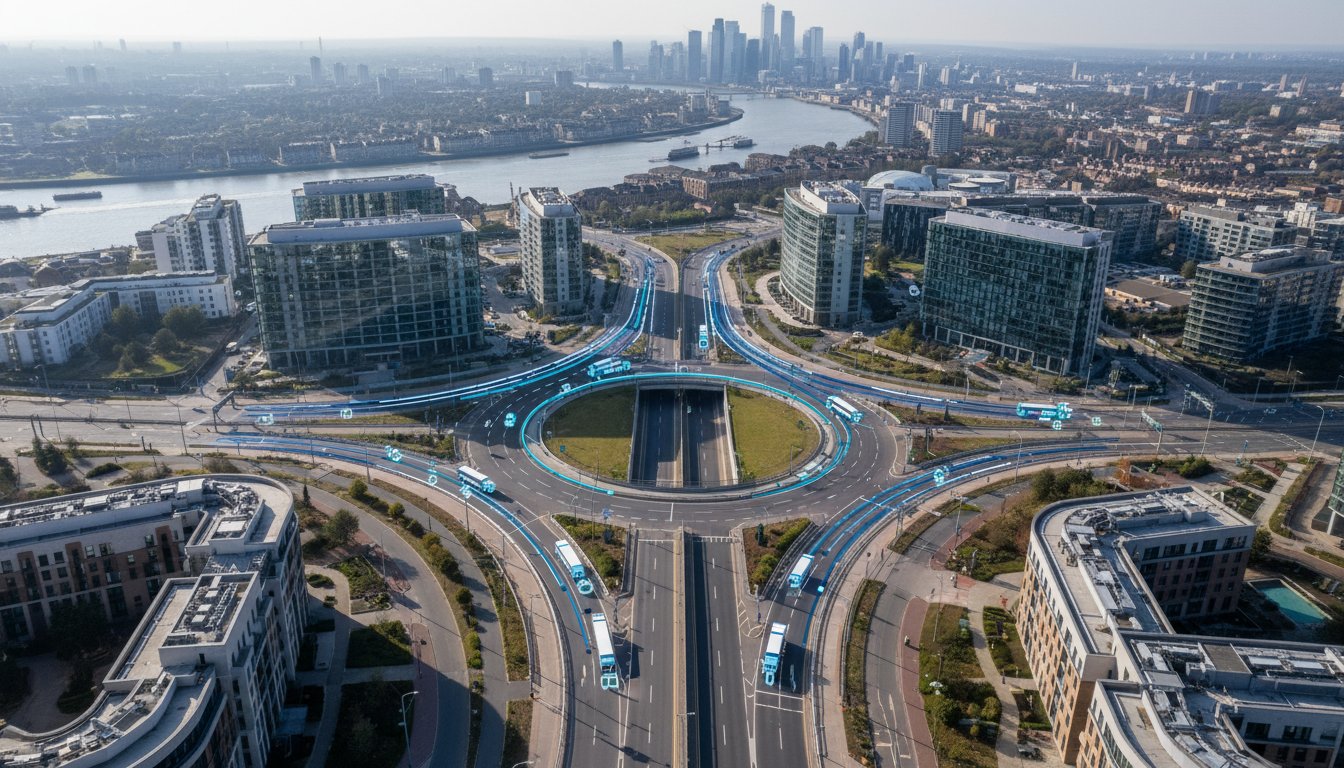
A single overlooked parking survey or a flawed swept path analysis can stall a multi-million pound development for months. You already understand that the Royal Borough of Greenwich enforces some of London’s strictest car-free policies, especially near the high-pressure zones of the O2 and Greenwich Peninsula. Partnering with expert Transport Planning Consultants Greenwich is the only way to ensure your technical reports meet the rigorous safety standards required by local highways officers. We know the pressure of a looming planning committee date and the fear of a refusal based on traffic impact.
This 2026 guide provides a clear checklist for securing approvals, focusing on cost-effective SPA surveys and robust transport assessments that satisfy TfL requirements. We’ve compiled the essential steps to help you manage regulatory burdens while maintaining project momentum. You’ll find a logical roadmap for everything from initial CAD designs to final implementation, ensuring your submission addresses every highways safety concern with precision and technical authority. Let’s look at the specific data sets and compliance standards that will get your project over the finish line.
Key Takeaways
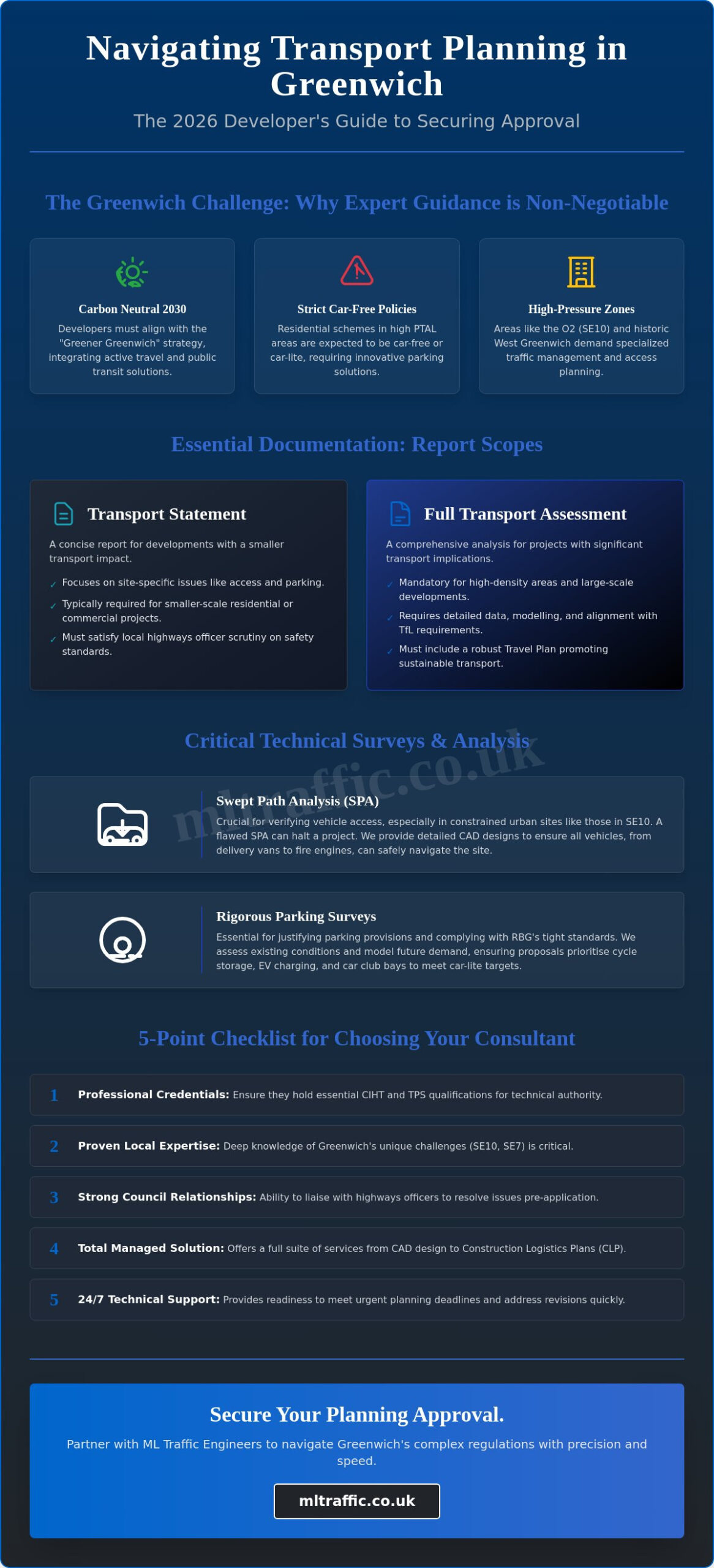
- Understand the 2026 Royal Borough of Greenwich (RBG) transport policy landscape to align your development with local planning expectations from the outset.
- Identify whether your project requires a Transport Statement or a full Assessment to satisfy mandatory requirements for Travel Plans in high-density areas.
- Learn why Swept Path Analysis (SPA) and rigorous parking surveys are critical for overcoming access challenges in narrow SE10 development sites.
- Utilize our 5-point checklist to ensure your chosen Transport Planning Consultants Greenwich possess the essential CIHT and TPS professional credentials.
- Discover how 24/7 technical support and expert pre-app consultation can alleviate regulatory burdens and help you meet urgent planning deadlines.
Navigating Transport Planning in the Royal Borough of Greenwich
Securing planning permission in the Royal Borough of Greenwich (RBG) in 2026 requires more than a basic site plan. As the borough accelerates toward its Carbon Neutral 2030 target, the role of Transport Planning Consultants Greenwich has shifted from simple layout design to complex carbon-reduction strategy. Developers must now demonstrate how every new build integrates into a wider network of active travel and public transit. This process relies on a deep understanding of transportation planning principles to ensure that development proposals don’t just meet minimum standards but actively improve local infrastructure.
Our team manages the technical requirements of these applications, providing the precision needed to satisfy both local highways officers and Transport for London (TfL) requirements. We focus on delivering bespoke solutions that align with the “Greener Greenwich” strategy. This ensures your project remains viable under increasingly strict environmental regulations. We operate with a sense of urgency, recognizing that regulatory delays can impact your project’s bottom line.
Greenwich Local Plan and Transport Standards
By 2026, RBG parking standards have tightened significantly. Residential schemes in high PTAL (Public Transport Accessibility Level) areas, such as Greenwich Peninsula, are now expected to be car-free or car-lite. Commercial developments must prioritize cycle storage and electric vehicle (EV) charging infrastructure as a baseline requirement. We help you navigate these comprehensive transport assessments, ensuring your submission accounts for TfL’s Vision Zero safety standards. This technical authority is vital when your project faces scrutiny from multiple regulatory bodies.
Why Local Expertise Matters in SE10 and SE7
Greenwich presents unique geographic challenges that demand local knowledge. The SE10 postcode, dominated by the Greenwich Peninsula and the O2 Arena, requires specialized management of high-volume traffic corridors and event-day logistics. Conversely, West Greenwich and Blackheath feature historic, narrow street layouts where access for construction and delivery vehicles is physically restricted. Transport Planning Consultants Greenwich must account for these constraints early in the design phase to avoid costly revisions later.
Our consultants build rapport with Royal Greenwich highways officers to resolve potential bottlenecks before they become formal objections. We provide a total, managed solution that includes:
- Detailed CAD design for site access and swept path analysis.
- Robust Construction Logistics Plans (CLP) that minimize disruption to SE7 residential areas.
- 24/7 readiness to address emergency road works or planning revisions.
- Bespoke travel plans that promote walking and cycling routes.
Success in Greenwich depends on this level of organized, safety-conscious planning. We act as your safe pair of hands, managing the intricate complexities of London’s road regulations so your development stays on schedule. Our approach prioritizes clarity and speed, ensuring busy project managers grasp the scope of our offerings without navigating through unnecessary filler.
Essential Documentation for Greenwich Planning Applications
Securing planning permission in the Royal Borough of Greenwich (RBG) requires a meticulous approach to highways and transport data. The council’s planning department operates with high expectations for technical accuracy. If your documentation lacks precision, you’ll face delays or outright refusal. Expert Transport Planning Consultants Greenwich bridge the gap between architectural vision and the strict safety standards required for the public highway.
Transport Statements vs. Assessments: The Greenwich Thresholds
The scale of your development determines the level of scrutiny. In Greenwich, smaller projects typically require a Transport Statement. This usually applies to residential schemes under 80 units or commercial spaces below 2,500sqm. A Statement focuses on local access and immediate road safety. Larger developments trigger a full Transport Assessment. This is a comprehensive document that models junction capacity and multi-modal impact across a wider area. All reports must demonstrate alignment with the Royal Borough of Greenwich Transport Strategy, which prioritizes the reduction of car dependency. You can compare Transport Statements and Assessments to see which technical path fits your site’s specific metrics.
Travel Plans: Encouraging Sustainable Movement
Travel Plans are mandatory for most new Greenwich developments to ensure long-term sustainability. For residential blocks with 20 to 79 units, you’ll likely need a Framework Travel Plan. Once a project exceeds 80 units, RBG requires a Full Travel Plan with clear, measurable targets. These documents aren’t just paperwork; they’re legal commitments often tied to Section 106 obligations. They include 5-year monitoring cycles where developers must prove they’re meeting targets for cycling and public transport use. Failure to reach these benchmarks can lead to financial penalties. Our guide to London Travel Plans explains how to draft these to satisfy local authority auditors.
Technical data is vital when justifying car-free or car-capped schemes. In areas with a PTAL (Public Transport Accessibility Level) score of 4 or higher, Greenwich expects developers to minimize parking. We use TRICS database analysis and 2021 Census travel-to-work patterns to prove your site won’t cause overspill parking on surrounding streets. This evidence-based approach mitigates the risk of highways objections. It gives planners the confidence that your project supports the borough’s environmental goals without compromising road safety. If you’re unsure about your site’s constraints, contact our team for a preliminary consultation to assess your project’s viability.
Technical Data: SPA and Parking Surveys in the Greenwich Context
RBG planning officers prioritise safety and highway capacity above all else. Developers must provide granular, site-specific data to prove a project won’t cause gridlock in the high-density corridors of SE10. This requires technical precision that only experienced Transport Planning Consultants Greenwich can deliver. We focus on two main pillars: vehicle movement dynamics and parking capacity. Providing a total, managed solution means we handle the data collection and the complex modelling required for 2026 regulatory standards.
Swept Path Analysis for Tight Urban Sites
Greenwich features some of the most challenging access points in South East London. We use CAD-based simulations to model the movement of 11.4m refuse vehicles and 16.8m fire tenders. This process identifies potential pinch points before they become expensive construction errors. It’s vital for designing underground car park layouts where ramp gradients and pillar placements leave zero margin for error. Our Swept Path Analysis Services London provide the visual evidence RBG needs to approve tight urban sites. We ensure emergency vehicles can reach every corner of your development without mounting kerbs or damaging infrastructure. Our simulations reflect real-world conditions, accounting for street furniture and existing on-road parking.
Parking Surveys and the Lambeth Methodology
Securing planning for schemes in North Greenwich or the town centre requires a robust parking strategy. We conduct overnight parking beat surveys between 00:30 and 05:30 on two separate weekday nights. This follows the Lambeth Methodology, which remains the industry standard for measuring parking stress. Meeting the requirements set out in the Guidance on Transport Assessment is non-negotiable for major applications in the Royal Borough of Greenwich.
For sites with a high Public Transport Accessibility Level (PTAL) score of 4, 5, or 6, we often justify zero-parking developments. This is essential when dealing with Controlled Parking Zones (CPZ) where new residents are restricted from obtaining permits. Our data provides the evidence needed to satisfy the following criteria:
- Baseline Capacity: Accurate counts of available on-street spaces within a 200m radius.
- PTAL Justification: Using high connectivity to argue for reduced car dependency.
- Refuse Strategy: Mapping bin drag distances to ensure they don’t exceed the 10m limit for collectors.
- Emergency Access: Proving that 3.7m wide fire access routes are maintained at all times.
By partnering with Transport Planning Consultants Greenwich, you gain access to 24/7 survey capabilities and technical CAD design. We position ourselves as a safe pair of hands, managing the intricate complexities of UK road regulations so you don’t have to. Our reports don’t just identify problems; they offer bespoke solutions that align with the London Plan 2021 and local Greenwich policies.
Checklist: Choosing the Right Transportation Planning Consultants
Selecting the right Transport Planning Consultants Greenwich requires a focus on technical precision and local regulatory alignment. Developers must vet potential partners against a rigorous 5-point framework to ensure project viability for 2026. This process prevents costly delays during the Royal Borough of Greenwich (RBG) planning committee reviews.
- Professional Accreditation: Verify that lead consultants hold active memberships in the Chartered Institution of Highways and Transportation (CIHT) or the Transport Planning Society (TPS). These credentials guarantee adherence to the latest UK professional standards.
- Local Authority Track Record: Demand evidence of successful project approvals within Greenwich. A consultant who understands RBG’s specific stance on the Silvertown Tunnel impact or the Greenwich Peninsula transport strategy offers a distinct advantage.
- Software Currency: Confirm the firm uses 2026-ready versions of TRICS and AutoTRACK. Outdated modelling leads to rejected Transport Assessments.
- Negotiation History: Evaluate their success rate in reducing developer contributions through evidence-based Section 106 and Section 278 negotiations.
- Data Authenticity: Ensure the firm prioritizes bespoke, site-specific traffic counts over generic national averages that fail to capture London’s unique congestion patterns.
Technical Capability and Software Standards
Precision in trip generation and vehicle movement modelling is non-negotiable for modern developments. Competent Transport Planning Consultants Greenwich utilize the latest TRICS database, specifically version 7.11 or newer, to predict traffic impact with high confidence intervals. For 2026 approvals, generic industry data often falls short of RBG’s stringent requirements. We utilize CAD-based Swept Path Analysis models via AutoTRACK to simulate the movement of refuse vehicles and emergency services through tight urban footprints. This technical rigor identifies design flaws before they reach the planning stage. Bespoke data collection remains superior to generic averages because it accounts for specific local bottlenecks and current Public Transport Accessibility Level (PTAL) ratings.
Strategic Communication and Negotiation Skills
Technical data only succeeds if it’s presented persuasively to local stakeholders. Your consultant must bridge the gap between engineering requirements and planning policy. They need to negotiate Section 278 and Section 106 agreements that protect your project margins while satisfying RBG’s infrastructure demands. Experience in representing clients at RBG planning committee meetings is essential for high-stakes projects. A consultant who understands the specific concerns of Greenwich councilors can pivot strategies mid-meeting to secure a positive recommendation. For more information on budgeting for these services, see our guide on Understanding Consultant Costs and Quotes.
We provide the technical expertise and local knowledge required to secure your development’s future. Explore our comprehensive transport planning services to see how we manage your project from initial design to final implementation.
Securing Approval: The ML Traffic Approach to Greenwich
Securing a green light from the Royal Borough of Greenwich (RBG) requires more than just standard documentation. It demands a technical partner who treats safety as a non-negotiable foundation. ML Traffic Engineers bridge the gap between ambitious development goals and strict local authority requirements. We don’t just provide reports; we deliver engineered solutions that withstand the scrutiny of planning committees. Our role as Transport Planning Consultants Greenwich involves deep integration with your design team. We identify potential bottlenecks before they become planning refusals.
Our team operates with a sense of urgency because we know that planning windows are narrow. We provide 24/7 support to ensure that urgent technical queries or last-minute design changes don’t stall your application. Whether it is a Saturday night or a bank holiday, our engineers remain available to support your project’s critical path. This constant availability ensures that developers in the SE10 area can meet every regulatory deadline with confidence.
From Initial Design to Final Implementation
Success begins long before the formal application is submitted. We start with early-stage site feasibility and access reviews to determine if a site can physically accommodate the proposed trip generation. This proactive approach saves thousands in redesign fees later in the process. You can Explore our Greenwich Project Types to see how we tailor these reviews to specific residential and commercial needs.
- Feasibility Studies: We analyze existing road geometry and pedestrian flows to ensure safe access.
- CAD Design: Our engineers produce precise swept path analyses to prove that service vehicles can maneuver safely.
- Regulatory Liaison: We manage the technical dialogue with RBG highways and Transport for London (TfL) throughout the planning lifecycle.
In a 2024 redevelopment project near the Greenwich Peninsula, the developer faced significant pushback regarding construction vehicle impact. We deployed a comprehensive multi-way traffic management plan and CAD-simulated access routes. This data-driven evidence convinced RBG highways officers of the project’s viability, leading to a successful planning committee vote. We moved from initial consultation to final implementation support in less than six months, keeping the project on track.
Your Partner for Planning Success
We use a data-driven approach to reduce the risk of planning objections. By using accurate traffic counts and safety-conscious design, we provide the “safe pair of hands” that planning officers trust. Our bespoke solutions ensure that every multi-way system or temporary signal layout complies with Chapter 8 standards. We take the logistical burden off your shoulders so you can focus on construction. If you’re ready to start your next project, Contact ML Traffic Engineers for a Greenwich consultation to secure your transport approvals.
Our team remains dedicated to providing the precise technical data and safety-led designs required to protect your project and the public.
Secure Your 2026 Greenwich Development Approval
Navigating the Royal Borough of Greenwich planning framework requires technical precision and current data. Success hinges on accurate Parking Stress Surveys and robust Statement of Preparedness for Adoption documentation that meets 2026 standards. These technical assessments are the foundation of a successful application, ensuring your project aligns with local transport strategies and safety regulations from the outset. Precise data collection and adherence to RBG policy aren’t just checkboxes; they’re the drivers of project viability.
Partnering with experienced Transport Planning Consultants Greenwich provides the regulatory certainty required for complex London sites. ML Traffic Engineers delivers over 10 years of London planning experience and specific expertise in RBG local policy. We offer 24/7 technical support for urgent applications, managing projects from initial consultation through to final implementation. Our team understands the intricate complexities of UK road regulations, acting as a safe pair of hands for your development’s logistical needs. We focus on precision and compliance so you can focus on delivery.
Contact ML Traffic Engineers for a Transport Planning Quote today. We’re ready to help you navigate the approvals process with speed and professional integrity.
Frequently Asked Questions
Do I need a transport statement for a small development in Greenwich?
You generally need a Transport Statement for residential developments between 5 and 49 units or commercial projects under 2,500 square metres. The Royal Borough of Greenwich mandates these reports to ensure smaller schemes don’t compromise local road safety or pedestrian flow. Our Transport Planning Consultants Greenwich team produces these technical documents to prove your project aligns with the London Plan 2021. We focus on clear data to help you avoid unnecessary delays during the initial planning stages.
What is the current parking policy for new builds in the Royal Borough of Greenwich?
Greenwich enforces a car-free or car-lite policy for most new developments, particularly in areas with high public transport access. According to the 2021 London Plan, sites with a PTAL rating of 4 or higher must provide zero residential parking, excluding essential disabled bays. For sites in lower PTAL zones, the council permits limited parking spaces based on specific bedroom counts. We design parking management strategies that meet these strict environmental targets while ensuring your site remains functional for residents.
How much does a transport planning consultant cost in London?
Professional fees for transport consultants in the London market typically range from £450 to £950 per day based on the level of technical expertise required. A standard Transport Assessment for a medium-sized project often carries a fixed fee starting at approximately £2,500. These costs cover essential tasks like traffic modelling, CAD design, and site visits. Investing in expert advice early prevents the far higher costs associated with planning refusals or protracted Section 106 negotiations.
How long is a parking survey valid for a Greenwich planning application?
A parking survey is valid for 6 months from the date the data was recorded. Greenwich Council requires these surveys to follow the Lambeth Methodology, which involves collecting data during two separate weekday overnight periods between 00:30 and 05:30. If your data exceeds the 180-day threshold, highways officers will likely demand a fresh assessment. We ensure surveys take place during neutral months to provide the most accurate representation of local parking stress.
What happens if my development has a low PTAL rating?
Developments with a low PTAL rating of 0 to 2 must implement aggressive Travel Plans to reduce reliance on private vehicles. You’ll likely need to provide high-quality cycle parking, car club memberships, or improved pedestrian wayfinding as part of your application. Our Transport Planning Consultants Greenwich experts mitigate low scores by proposing infrastructure improvements that satisfy council requirements. We focus on delivering sustainable transport solutions that make even remote sites viable for approval.
Can a transport consultant help with Section 278 highway works?
Yes, we manage the entire Section 278 process to facilitate permanent alterations to the public highway. This includes creating detailed CAD drawings for new site entrances, puffin crossings, or junction realignments that meet Chapter 8 safety standards. We act as your technical liaison with the Royal Borough of Greenwich highways department to secure necessary approvals. Our team ensures all designs are compliant and cost-effective so your construction schedule stays on track.

Article by
Michael Lee
Transport planner with over 35 years’ experience.
Disclaimer
The content on mltraffic.co.uk, including all technical articles, guides, and resources, is provided for general informational and educational purposes only. It is not intended to constitute professional advice in traffic engineering, transportation planning, development approvals, or any other technical or legal field.
While ML Traffic Engineers makes every reasonable effort to ensure the accuracy, completeness, and timeliness of the information published, we do not provide any warranties or representations (express or implied) regarding its reliability, suitability, or availability for any particular purpose. Any reliance you place on the content is strictly at your own risk.
In no event shall ML Traffic Engineers, its directors, employees, authors, or affiliates be liable for any direct, indirect, incidental, special, consequential, or punitive damages (including, without limitation, loss of profits, data, or business opportunities) arising out of or in connection with the use of, or inability to use, any information provided on this website.
The articles and guides on this site are not a substitute for engaging a qualified, professional traffic engineer to assess your specific project requirements. For tailored advice, compliance assessments, or traffic engineering services, please contact a competent professional.
This disclaimer may be updated from time to time without notice. By accessing or using this website, you agree to be bound by the most current version of this disclaimer.