
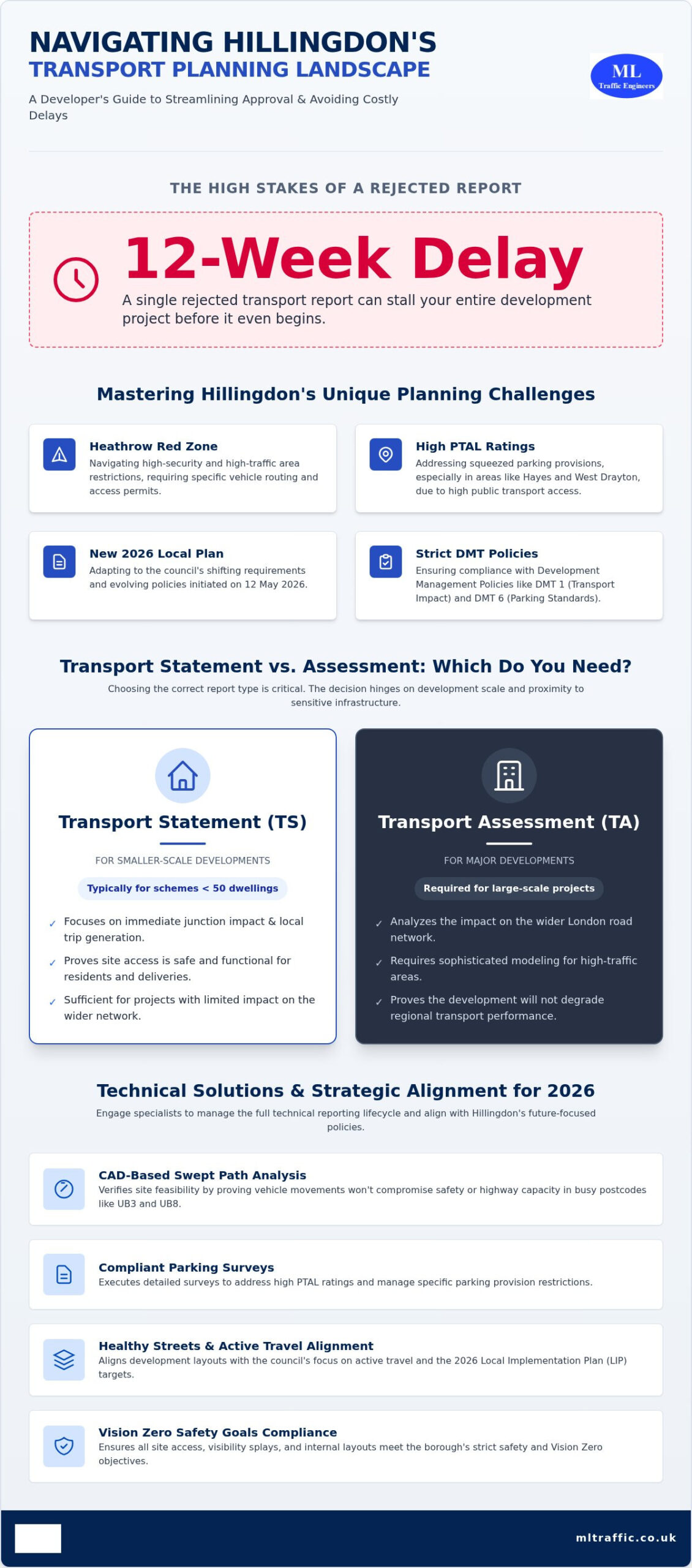
A single rejected transport report in Hillingdon can trigger a 12-week delay, effectively stalling a development before the first spade hits the ground. You understand that the borough’s planning landscape is exceptionally demanding, especially when navigating the intricate Red Zone restrictions around Heathrow or managing high PTAL ratings that squeeze parking provision. Securing a successful outcome requires more than just a basic assessment; it demands technical precision and an unwavering commitment to regulatory standards. By engaging a specialist hillingdon transport planning consultant, you can mitigate these risks and streamline your path to approval through expert data analysis and robust technical reporting.
We recognize the pressure of meeting the council’s shifting requirements as they transition toward the new Local Plan initiated on 12 May 2026. This article provides the clarity you need to master Hillingdon’s complex regulations, from DMT 1 transport impact management to DMT 6 parking standards. You’ll learn how to leverage CAD-based Swept Path Analysis and detailed Transport Statements to satisfy planning officers and avoid costly setbacks. We’ll preview the essential strategies for 2026, ensuring your project remains compliant, safe, and ready for execution.
Key Takeaways
- Distinguish between Transport Statements and full Assessments to ensure your submission aligns with Hillingdon’s 2020 Development Management Policies and the 2026 Local Plan updates.
- Utilize CAD-based Swept Path Analysis to verify site feasibility and prove that vehicle movements won’t compromise safety or highway capacity in busy postcodes like UB3 and UB8.
- Execute compliant Parking Surveys to address high PTAL ratings and manage the specific parking provision restrictions found in Hayes and West Drayton.
- Align your development layout with the “Healthy Streets” approach and the 2026 Local Implementation Plan targets to satisfy the council’s focus on active travel and Vision Zero safety goals.
- Engage a specialist hillingdon transport planning consultant to manage the full technical reporting lifecycle and eliminate the risk of 12-week delays caused by rejected planning documents.
The Role of a Hillingdon Transport Planning Consultant in 2026
In the postcodes of UB3, UB4, and UB8, the scope of a hillingdon transport planning consultant has transitioned into a highly technical advisory role. By 2026, standard traffic counts aren’t enough to satisfy planning officers. Instead, developers need to demonstrate a deep understanding of the transportation planning process to navigate the borough’s evolving infrastructure. Precision in these early stages is the only way to ensure your project moves forward without regulatory friction.
To understand the local context and resident concerns regarding transport and planning, watch this recent session from the Hillingdon London Council:
Achieving compliance involves a dual-lens approach that aligns development goals with the Mayor’s Transport Strategy and Hillingdon’s Local Implementation Plan. This ensures submissions don’t just meet technical benchmarks but also support borough-wide objectives like Vision Zero. Professional reporting from ML Traffic Engineers UK is a critical tool for mitigating the risk of Section 106 or 278 delays. Without precise data, developers often face unexpected costs and timeline extensions that could’ve been avoided at the inception stage.
Navigating Hillingdon’s Unique Infrastructure
Hillingdon’s geography presents specific challenges for site access, particularly along the A40 Western Avenue and the M4 corridor. High traffic volumes in Uxbridge and Hayes town centres require sophisticated modeling to prove that new developments won’t cause gridlock. Additionally, your consultant must balance site requirements with Hillingdon’s “Air Quality Focus Areas,” where emissions and congestion are under intense scrutiny. We use data-driven strategies to ensure your project remains viable even within these restricted zones.
When to Engage a Transport Consultant
Early engagement during the pre-application stage allows us to identify potential “showstoppers,” such as inadequate visibility splays or restricted access points, before they become permanent obstacles. If you’ve already submitted and received a Highways Authority objection, we provide the technical data needed to resolve disputes and secure approval. The Heathrow Red Zone is a designated high-security and high-traffic area where specific vehicle routing restrictions and access permits are mandatory to maintain operational safety around the airport. The team at ML Traffic Engineers UK is ready to manage these high-stakes requirements from day one.
Transport Statements vs. Assessments: Which Does Your Project Need?
Hillingdon Council applies specific criteria to decide if a site needs a Transport Statement or a full Assessment. Getting this choice wrong leads to 12-week delays and wasted application fees. A hillingdon transport planning consultant ensures your project starts with the correct technical foundation by identifying these requirements during the feasibility stage. This decision hinges on the development scale and its proximity to sensitive infrastructure identified in Hillingdon’s Local Implementation Plan (LIP). While smaller projects focus on local safety, larger developments must prove they won’t degrade the performance of the wider London road network.
The Transport Statement (TS) for UB3 Developments
For schemes under 50 dwellings in UB3 or surrounding areas, a Transport Statement is typically sufficient. This report focuses on immediate junction impact and local trip generation. It proves that the site access is safe and functional for residents and delivery vehicles alike. We analyze how your site interacts with local bus routes and pedestrian paths to ensure full compliance with Hillingdon’s 2020 Development Management Policies. You can find more detail in our Transport Statement London Guide. These reports are concise but must be technically accurate to avoid council pushback.
The Full Transport Assessment (TA) Framework
Major commercial hubs or large residential blocks near Uxbridge town centre or the M4 require a full Transport Assessment. These involve complex junction capacity modelling to assess the wider network impact. The council scrutinizes these reports to ensure no negative effect on highway safety or capacity. Data requirements for projects near Heathrow are particularly stringent, often requiring multi-modal analysis to account for airport-related traffic. Our Transport Assessment London Guide covers the data requirements for these high-impact zones. We use this framework to demonstrate that your project can thrive without causing gridlock.
Travel Plans act as a strategic companion to both documents. They outline specific measures to encourage walking, cycling, and public transport use among future occupants. In 2026, Hillingdon prioritizes developments that actively reduce private car dependency, making a robust Travel Plan a vital component of your planning submission. These plans help bridge the gap between technical traffic data and the borough’s long-term sustainability goals. If you need clarity on your project’s specific requirements, consult our technical specialists for an initial assessment of your site’s needs.
Technical Analysis for Hillingdon: Swept Path and Parking Survey Requirements
Technical precision is the backbone of any successful planning application in Hillingdon. Planning officers require data that stands up to rigorous scrutiny, especially when your site is influenced by the “Heathrow Factor.” This unique constraint involves managing height and timing restrictions for technical surveys to ensure that data reflects typical operational conditions around the airport. A hillingdon transport planning consultant must also utilize TRICS data to justify trip generation figures. We carefully adjust these models based on Public Transport Access Levels (PTAL) to ensure the proposed traffic impact is realistic for the specific UB postcode zone.
Swept Path Analysis for Fire Tenders and Refuse Vehicles
Proving site feasibility requires more than a standard drawing; it demands CAD-based simulation. We provide specialized Swept Path Analysis Services to demonstrate that large vehicles can navigate your site without compromising safety. Hillingdon Council utilizes specific refuse vehicle dimensions for UB-specific templates. Failure to use these exact measurements often leads to immediate report rejection. This technical analysis is essential for several reasons:
- Ensuring fire tenders can access narrow residential mews in Ruislip or Northwood.
- Verifying that refuse vehicles can enter, turn, and exit the site in a forward gear.
- Validating delivery bay functionality for commercial hubs near the M4.
Parking Surveys: The Lambeth Methodology in Hillingdon
Parking provision remains a point of contention in Hayes and West Drayton. While high PTAL ratings might suggest a need for lower parking ratios, the council remains wary of “overspill” into existing residential streets. We address these concerns by conducting overnight parking surveys using the recognized Lambeth Methodology. This process involves a detailed count of available on-street spaces within a 200-metre radius of the site during periods of peak residential demand.
This data-driven evidence is vital. It allows us to prove that the surrounding infrastructure can absorb any potential overflow, which can help justify a lower parking ratio for your development. In 2026, Hillingdon officers expect this level of transparency to protect local residents from increased parking stress. We ensure all surveys are conducted during neutral periods, avoiding school holidays or major local events to provide the most accurate snapshot of the area’s parking capacity. By delivering this level of detail, we reduce regulatory pressure and move your project closer to approval.
Strategic Compliance: Aligning with Hillingdon’s Local Implementation Plan (LIP)
Hillingdon’s Local Implementation Plan (LIP) serves as the technical roadmap for delivering the Mayor’s Transport Strategy at a borough level. For developers, alignment with LIP targets for 2026 is a prerequisite for planning success. These targets prioritize sustainable travel and safety across all new infrastructure. A hillingdon transport planning consultant integrates these strategic goals into your site design from the outset. This proactive approach reduces the risk of friction with Transport for London (TfL) or council auditors. We ensure your submission doesn’t just meet local rules but supports the wider London network goals.
Modern car park design must also incorporate Electric Vehicle (EV) charging and high-quality cycle storage. Hillingdon’s 2026 standards require a specific percentage of active and passive EV charging points. We help you balance these requirements with the space constraints of your site, ensuring full compliance without sacrificing operational efficiency. Our technical reports provide the data needed to justify your provision levels to the Highways Authority.
Sustainable Transport and Travel Plans
Hillingdon requires robust Travel Plans for any significant new workplace or school development. These documents are essential for incentivizing non-car modes of transport, particularly in areas with PTAL ratings of 4 to 6 like Uxbridge and Hayes. A well-crafted plan outlines clear targets for reducing single-occupancy vehicle trips and provides a monitorable framework for success. You can learn more about this in our Travel Plan Consultants Guide. These plans act as a long-term commitment to sustainable growth.
Active Travel Infrastructure
Meeting Hillingdon’s cycle parking standards for 2026 requires more than just installing racks. You must provide secure, accessible, and well-lit storage that caters to various bicycle types, including cargo bikes. We conduct pedestrian comfort levels and accessibility audits to prove your site is inclusive for all users. Hillingdon’s 2026 LIP prioritises bus reliability near Hayes by implementing priority measures that your site access design must not impede. This ensures that new developments don’t negatively impact the efficiency of the public transport network.
To ensure your project aligns with these complex strategic requirements, contact our expert team for a comprehensive planning review.
Professional Traffic Engineering Solutions for Hillingdon Developers
ML Traffic Engineers UK acts as a strategic partner to simplify the complex Hillingdon planning process for developers and architects. As a dedicated hillingdon transport planning consultant, we provide the technical authority needed to navigate the borough’s unique logistical landscape. Our team understands the specific pressures of the Heathrow corridor and the M4 logistics network. Whether you are coordinating staff transport with EC Minibus or managing freight movements, we ensure that your development’s transport strategy is both realistic and compliant with the latest 2026 standards. We deliver precision-engineered reports that withstand scrutiny from both local planning officers and Transport for London.
Our “Total Managed Solution” covers every stage of the project lifecycle from inception to completion. We manage everything from the initial site survey and data collection to final Highways Authority approval. By providing a single point of contact for Transport Statements, Assessments, and Swept Path Analysis, we reduce the administrative burden on your team. This integrated approach ensures that all technical reporting is consistent and meets the high standards required for modern submissions. We prioritize speed without compromising on accuracy. This is essential for maintaining your project’s momentum and avoiding the 12-week delays often associated with rejected reports.
Expertise Across All Hillingdon Project Types
The team at ML Traffic Engineers UK supports a wide range of developments across the UB postcodes. Our experience includes residential blocks, commercial offices, and industrial warehouses in Hayes, Uxbridge, and West Drayton. Our specialists collaborate directly with TfL and Hillingdon Council on your behalf to resolve potential objections before they lead to formal refusals. We’ve a proven track record of securing approvals for complex urban sites where space is limited and traffic demands are high. By leveraging our local knowledge, we anticipate council requirements and address them proactively in our technical submissions. This proactive stance is what separates a successful application from one that gets stuck in the planning system.
Secure Your Hillingdon Planning Approval
Securing your planning approval starts with a robust technical foundation and a partner you can trust. You can request a quote for your Hillingdon Transport Statement or Assessment to see how our expertise aligns with your project goals. Our team maintains 24/7 readiness to support urgent planning deadlines. This ensures that your application stays on track even when timelines are tight. We take pride in our ability to deliver high-quality results under pressure while adhering to all industry benchmarks and legislative requirements. Contact ML Traffic Engineers UK today for a bespoke transport planning quote.
Secure Your Hillingdon Development Success in 2026
Navigating the intricate planning landscape of West London requires more than just meeting basic criteria; it demands a proactive approach to technical excellence. By integrating the specific technical analysis and strategic compliance measures discussed, you ensure your project remains resilient against regulatory shifts. Whether you are managing high-density residential schemes or logistics hubs near the Heathrow corridor, the precision of your data is what secures the council’s confidence. Engaging a specialized hillingdon transport planning consultant allows you to mitigate risks and streamline the path to final Highways Authority approval.
As London planning specialists since 2014, ML Traffic Engineers UK provides the unwavering reliability needed for high-stakes urban projects. We deliver a comprehensive service that covers every detail, from expert CAD-based technical analysis to a deep understanding of Hillingdon LIP 2026 targets. Our team is ready to help you navigate these requirements with speed and technical authority. Get a Professional Quote for Your Hillingdon Transport Report and take the first step toward a successful planning outcome today. Your project’s future depends on the precision of today’s technical reporting.
Frequently Asked Questions
Do I need a Transport Statement for a small development in Hillingdon?
Hillingdon Council requires a Transport Statement for developments that fall below the thresholds for a full Assessment but still impact the local highway. This usually includes residential schemes with fewer than 50 units or small commercial extensions. A hillingdon transport planning consultant can confirm the exact requirements during the pre-application stage to ensure your submission meets the 2020 Development Management Policies and avoids unnecessary delays.
How long does Hillingdon Council take to review a Transport Assessment?
Statutory consultation periods for major planning applications usually last between 13 and 16 weeks. However, the initial technical review by the Highways Authority often occurs within the first 21 days of the consultation period. Delays frequently occur if the technical data is incomplete or fails to meet the borough’s 2026 Local Implementation Plan targets. Providing a precise, compliant report from the outset is the most effective way to maintain your project timeline.
What is the cost of a Swept Path Analysis for a Hillingdon project?
The cost varies depending on the number of vehicle types and specific maneuvers required for your site layout. Factors such as the complexity of the access points and the need for multiple revisions also influence the total fee. We recommend checking with a qualified engineer who can provide a bespoke quote based on your architectural drawings and Hillingdon’s specific refuse vehicle templates. This ensures you receive a price tailored to your project’s unique technical demands.
Why is PTAL important for my Hillingdon planning application?
Public Transport Access Level (PTAL) is a standard London metric that determines the maximum allowable car parking provision for a site. Hillingdon uses PTAL scores to enforce the London Plan’s parking standards. Sites with high scores, such as those in Uxbridge or near Hayes & Harlington station, are restricted to lower parking ratios. Accurate PTAL assessment is vital for justifying your parking provision to planning officers and ensuring your site layout remains compliant.
Can a Travel Plan help reduce my parking requirements in Hillingdon?
A robust Travel Plan can support a case for reduced parking by demonstrating a commitment to sustainable transport modes. By outlining clear incentives for cycling, walking, and public transport use, you mitigate the perceived impact of lower on-site parking provision. Hillingdon Council prioritizes developments that align with the Mayor’s Transport Strategy, making a high-quality Travel Plan a persuasive tool during negotiations with the Highways Authority to secure officer support.
What happens if my Transport Statement is rejected by Hillingdon Highways?
A rejected report often triggers a formal objection, which can stall your planning application for 12 weeks or more. You’ll need to address the technical deficiencies identified by the council; this might involve conducting new traffic surveys or revising your site access design. Working with an experienced hillingdon transport planning consultant ensures that technical “showstoppers” are identified and resolved before the formal submission is made, protecting your development from costly administrative setbacks.
Does Hillingdon Council follow the Lambeth methodology for parking surveys?
Hillingdon Council generally accepts parking surveys conducted using the Lambeth methodology to assess on-street parking stress. This involves two overnight surveys between 00:30 and 05:30 on neutral weekday nights to capture peak residential demand. The data must prove that any potential overspill from your development won’t exceed 85% of the total available on-street capacity within a 200-metre walking distance of the site, ensuring local residents are not negatively impacted.
What are the specific refuse vehicle dimensions for Hillingdon SPA?
Hillingdon requires Swept Path Analysis to use a specific refuse vehicle template, typically a four-axle 11.22-metre Mercedes Econic or a similar approved model. The vehicle must be able to enter and leave the site in a forward gear while maintaining a 0.5-metre safety clearance from all boundaries. Using generic vehicle dimensions is a common reason for report rejection, so it’s essential to use the borough’s approved CAD templates for all vehicle movement simulations.

Disclaimer
The content on mltraffic.co.uk, including all technical articles, guides, and resources, is provided for general informational and educational purposes only. It is not intended to constitute professional advice in traffic engineering, transportation planning, development approvals, or any other technical or legal field.
While ML Traffic Engineers makes every reasonable effort to ensure the accuracy, completeness, and timeliness of the information published, we do not provide any warranties or representations (express or implied) regarding its reliability, suitability, or availability for any particular purpose. Any reliance you place on the content is strictly at your own risk.
In no event shall ML Traffic Engineers, its directors, employees, authors, or affiliates be liable for any direct, indirect, incidental, special, consequential, or punitive damages (including, without limitation, loss of profits, data, or business opportunities) arising out of or in connection with the use of, or inability to use, any information provided on this website.
The articles and guides on this site are not a substitute for engaging a qualified, professional traffic engineer to assess your specific project requirements. For tailored advice, compliance assessments, or traffic engineering services, please contact a competent professional.
This disclaimer may be updated from time to time without notice. By accessing or using this website, you agree to be bound by the most current version of this disclaimer.