
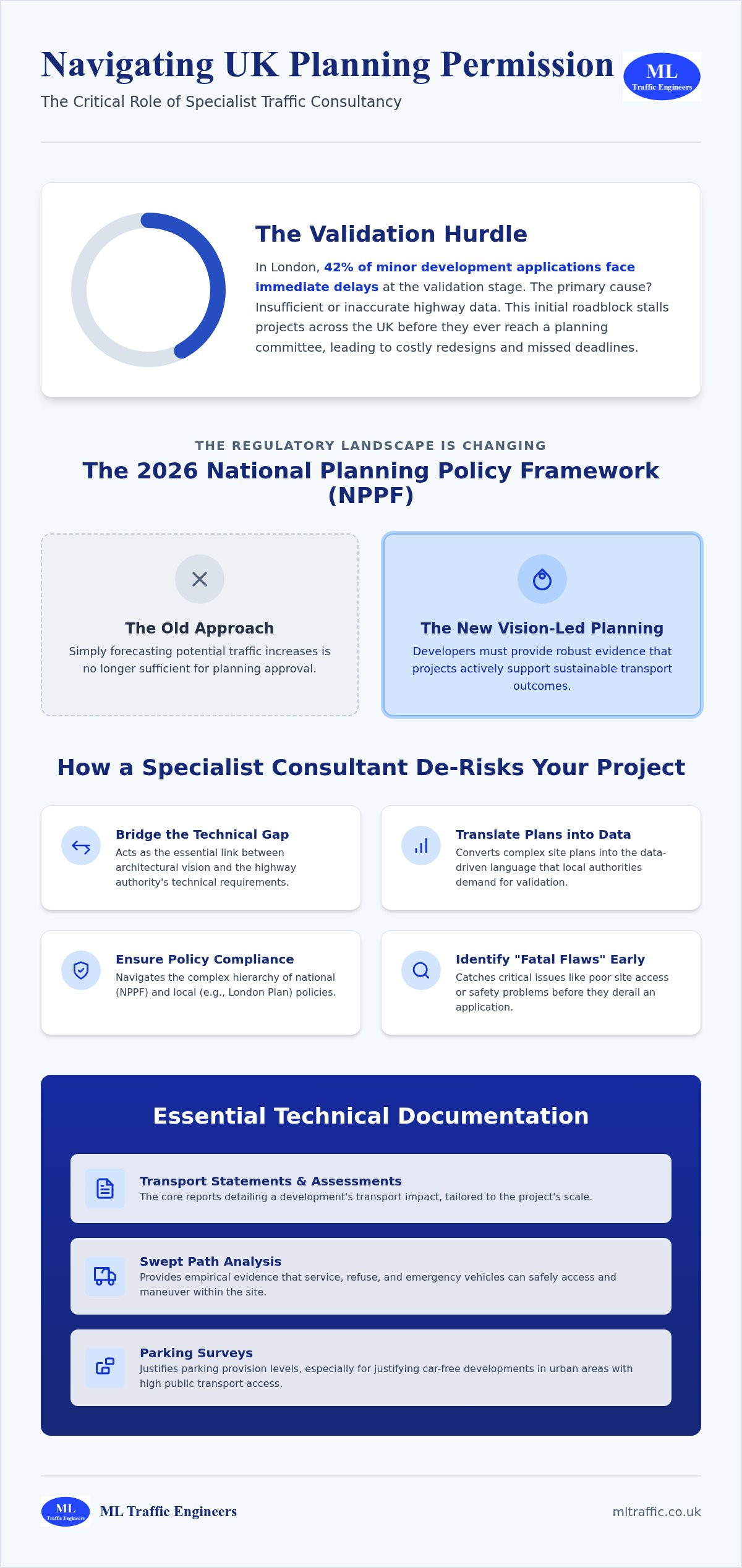
In London, 42% of minor development applications face immediate delays at the validation stage because of insufficient highway data. This statistic highlights a growing trend across the UK where projects stall before they even reach a planning committee. Engaging a specialist traffic consultant for planning applications isn’t an optional luxury; it’s a functional necessity for any developer aiming to bypass these initial regulatory hurdles. As the 2026 National Planning Policy Framework shifts toward vision-led transport planning, the margin for error in technical documentation has vanished.
You likely understand the frustration of receiving a late-stage objection from a highway authority that threatens your entire project timeline. It’s a high-stakes environment where technical jargon and shifting local requirements can lead to expensive, avoidable mitigation costs. This guide explains how professional traffic consultancy de-risks your project by providing the technical precision needed to secure approval. We’ll explore the critical role of transport assessments, the impact of Active Travel England’s statutory status, and how to navigate the specific constraints of the London Plan 2026. You’ll gain a clear roadmap for achieving a fast turnaround on technical reports and a successful planning decision.
Key Takeaways
- Understand how a specialist traffic consultant for planning applications acts as the primary bridge between your architectural vision and a successful local authority decision notice.
- Learn to navigate the 2026 National Planning Policy Framework’s shift toward vision-led transport planning to avoid costly project validation delays.
- Identify the specific technical requirements for your submission, including the critical differences between Transport Statements and comprehensive Transport Assessments.
- Discover how Swept Path Analysis and Parking Surveys provide the empirical evidence needed to justify car-free developments and tight urban site layouts.
- Gain insights into evaluating consultancy expertise to ensure rapid turnaround times and the successful mitigation of highway authority objections.
The Role of a Traffic Consultant in Securing Planning Permission
A specialist traffic consultant for planning applications serves as the essential bridge between your architectural vision and the highway authority’s technical requirements. While architects focus on the internal layout and aesthetic appeal of a site, the consultant manages the transportation planning process to ensure the development is functionally viable within the existing road network. This role is not merely advisory; it’s a technical necessity for translating complex site plans into the data-driven language that local authorities demand.
The National Planning Policy Framework (NPPF) makes transport a “make or break” issue for modern developments. With the 2026 updates shifting toward a vision-led approach, simply forecasting traffic is no longer sufficient. You must prove your project supports sustainable outcomes. Generic engineering firms often lack this specific policy expertise. A specialized consultant focuses entirely on the planning phase, ensuring that every technical report aligns with current legislative benchmarks. This precision prevents applications from being rejected due to technical non-compliance.
Early engagement is the most effective way to avoid the “re-draw” cycle. If a refuse vehicle cannot safely turn or a visibility splay is obstructed, you will face an immediate highway authority objection. Identifying these issues during the feasibility stage allows for minor design adjustments before you commit to a full submission. It’s much cheaper to move a site entrance on a screen than it is to redesign a project after a planning refusal.
Navigating Statutory Requirements and Local Policies
England’s planning landscape involves a complex hierarchy of national and local policies. While the NPPF sets the baseline, borough-specific standards often dictate the final outcome. In London, for instance, the London Plan 2026 mandates strict car-free requirements for areas with high public transport accessibility. Consultants interpret these nuanced standards to ensure your Transport Statement or Assessment meets local expectations. Securing pre-application advice from bodies like Transport for London (TfL) or local councils further streamlines the process by agreeing on the scope of work before formal submission.
De-Risking Your Development Strategy
A primary objective for any developer is to identify “fatal flaws” before significant capital is at risk. We analyze site access and safety data to catch problems that could stall an application for months. By providing robust evidence, a consultant can also help you justify higher density developments in urban areas where traditional parking standards might otherwise limit your yield. A specialist traffic consultant mitigates planning risk by providing evidence-based reporting that transforms subjective objections into objective technical discussions.
Essential Transport Documentation for UK Planning Submissions
Securing planning permission in 2026 requires more than just a site plan; it demands a suite of technical reports that satisfy the Local Highway Authority. A professional traffic consultant for planning applications ensures that these documents meet the precise standards set by the UK government guidance on transport evidence. While architectural designs evolve, these core documents remain the legal basis for assessing a development’s impact on the public highway. Inaccurate data at this stage is a primary cause for the 42% of applications that face immediate delays during validation.
Beyond the core reports, developers must account for emerging requirements like Construction Logistics Plans. Although these focus on the build phase, they must integrate seamlessly with your initial transport strategy to avoid conflicting planning conditions. Ensuring your documentation is technically precise from day one is the most reliable way to maintain project momentum. Reviewing our project experience can help you identify which documents apply to your specific development type.
Transport Statements and Assessments: Which Do You Need?
The scale of your project determines the level of detail required. Generally, residential developments between 10 and 49 units require a Transport Statement. This report focuses on site access, local safety, and parking provision. Larger schemes, typically those exceeding 80 residential units or 2,500 square meters of commercial space, trigger a full Transport Assessment. In 2026, these assessments have moved away from the old “predict and provide” model. They now utilize a vision-led approach that prioritizes sustainable outcomes over simple road capacity. For projects in the capital, our Transport Statement London guide provides specific borough-level thresholds that can be as low as 30 units in sensitive areas.
Travel Plans and Sustainable Transport Strategy
Travel Plans are no longer a secondary consideration; they’re essential for meeting Section 106 obligations and achieving net-zero targets. These documents outline how a development will actively encourage walking, cycling, and public transport use. In 2026, Active Travel England acts as a statutory consultee for major projects, making a robust sustainable strategy a non-negotiable requirement. A well-crafted plan can often justify reduced parking provisions, which is vital for car-free developments in high PTAL areas. Engaging traffic consultant for planning applications to coordinate with Travel Plan consultants early ensures your sustainability targets are realistic, technically sound, and fully compliant with the latest London Plan mandates.
How to Evaluate and Appoint a Traffic Consultancy
Assess their local knowledge next. Each UK borough maintains distinct highway standards that can stall an application if ignored. You should also review their technical toolkit. Industry-standard software like TRICS for trip generation and AutoTurn for maneuverability are non-negotiable for credibility. Finally, prioritize responsiveness. With a rejected statement potentially stalling a project for 12 to 16 weeks, you need a team that acts with urgency to meet tight planning deadlines. A fully-managed service that includes negotiation with authorities is the most effective way to reduce your logistical pressure.
The Value of Local Authority Experience
Consultants with a background in local government bring a unique advantage: they understand the “other side” of the desk. This experience allows them to anticipate the specific concerns of highway officers before they become formal objections. They can navigate the nuances of London-specific methodologies, such as the Lambeth Parking Survey, with greater precision. Established professional relationships often lead to more productive pre-application discussions, ensuring your submission aligns with the official government guidance from the outset. This insight is vital for justifying reduced parking or higher density layouts in sensitive urban areas.
Technical Proficiency and Software Standards
Credibility in transport planning is built on robust data and industry-standard tools. We utilize the latest version of AutoTurn 2026 to prove site accessibility for emergency and service vehicles. Using the most recent software versions ensures that your reports withstand the scrutiny of statutory consultees like Active Travel England. When a consultancy manages “in-house” data collection, such as traffic counts or parking surveys, it eliminates the delays associated with third-party contractors. This integrated approach ensures your reports are compliant with the latest 2026 planning circulars and ready for immediate validation. Explore our project types to see how this technical precision applies to your specific sector.
Leveraging Technical Analysis: Swept Path and Parking Surveys
Proving site viability relies on empirical evidence rather than architectural assumptions. A specialist traffic consultant for planning applications uses technical analysis to demonstrate that a development can function safely within its physical constraints. This process starts with robust Traffic Surveys to establish accurate baseline data. Without precise traffic counts and speed data, impact modeling remains speculative, leaving your application vulnerable to highway authority objections. Modern technical analysis provides the objective proof needed to justify your site layout and parking strategy from the moment of validation.
Swept Path Analysis: Visual Proof of Access
Swept Path Analysis (SPA) is the industry standard for proving that vehicles can navigate a site safely without overrunning curbs or striking buildings. Using advanced software like AutoTurn Swept Path Analysis, we simulate the movements of refuse vehicles, fire tenders, and heavy delivery vans. This digital tracking prevents design errors that frequently lead to planning refusals, such as inadequate turning circles or obstructed visibility splays. Digital vehicle tracking transforms architectural concepts into functionally verified site layouts that secure immediate highway officer confidence. By identifying these issues during the design phase, you avoid the high costs and delays of post-submission redesigns. Accurate SPA is now a mandatory requirement for almost all urban developments in 2026.
Parking Surveys and the Lambeth Methodology
In high-density urban areas, justifying reduced parking provision is a major hurdle for developers. We conduct overnight parking beat surveys to assess the existing capacity of local streets and determine if the area can absorb any overspill. In London, applying the Lambeth Methodology is essential for providing consistent, council-approved data that officers trust. This methodology accounts for the specific parking stress levels within a 200-meter radius of the site during peak residential demand hours.
When combined with high Public Transport Accessibility Level (PTAL) ratings, this data provides a powerful argument for car-free developments. Proving that your project won’t exacerbate local parking pressure is vital for overcoming neighbor objections and meeting strict borough standards. If you need to verify your site’s parking capacity or prove vehicle access, you can book a technical survey to secure the necessary data for your planning submission.
De-Risking Your Development with ML Traffic Engineers UK
ML Traffic Engineers UK understands that for developers, time is the most critical commodity. As your chosen traffic consultant for planning applications, we prioritize technical precision and rapid delivery to ensure your project maintains its momentum. Since our founding in 2014, we’ve built a reputation for reliability in high-stakes regulatory environments across England. Our “ready and urgent” approach matches the fast-moving nature of modern infrastructure, providing you with a dependable partner that understands intricate regional regulations so you don’t have to. We view our role not just as a service provider, but as a vital guardian of professional standards and public safety.
Our comprehensive service manages the full project lifecycle from inception to completion. This begins with initial feasibility assessments and continues through the preparation of specialized documentation, such as a Transport Assessment for London or regional Transport Statements. Our support extends beyond the planning decision notice, as we frequently assist clients with the technical requirements of Section 278 (S278) agreements. By providing a fully-managed service, we reduce the logistical and regulatory pressures on your team, allowing you to focus on the build phase with confidence.
A Fully Managed Approach to Transport Planning
We take immense pride in our ability to manage all technical reporting requirements with unwavering accuracy. One of our primary goals is to minimize the financial impact of transport mitigation packages through expert negotiation with highway authorities. By using evidence-based reporting, we often secure approvals that avoid the hidden costs of unnecessary Section 106 contributions. Our track record across England and all London Boroughs demonstrates our ability to navigate the 2026 NPPF vision-led requirements effectively. We transform potential highway objections into solved technical problems, ensuring your development strategy remains cost-effective and compliant with industry benchmarks.
Next Steps: Securing Your Planning Approval
Securing professional support for your next submission is a straightforward and efficient process. To request a tailored quote, we typically require your site location, a preliminary site layout, and details regarding the proposed unit count or commercial floorspace. This information allows us to determine the exact scope of work, whether you need a Transport Statement, a detailed Travel Plan, or technical surveys. We’re prepared to act immediately to meet your specific planning deadlines. Contact ML Traffic Engineers UK today for a project review to ensure your planning application is built on a foundation of technical excellence and professional integrity.
Securing Your Project’s Future with Technical Precision
Success in the 2026 planning landscape depends on your ability to bridge architectural vision with rigorous highway standards. Utilizing advanced Swept Path Analysis and vision-led Transport Assessments ensures your application withstands statutory scrutiny from the outset. These technical tools don’t just satisfy regulations; they provide the empirical evidence needed to justify site density and access strategies in a competitive market. Engaging a specialist traffic consultant for planning applications is the most effective way to eliminate the risk of validation delays while ensuring your project remains cost-effective.
Founded in 2014, ML Traffic Engineers UK brings specialized expertise in London planning requirements and high-stakes technical reporting to every development. Our team prioritizes precision and readiness to help you navigate the intricate regional regulations that often stall projects. We manage the full technical lifecycle so you can focus on the construction phase. Get a Professional Quote for Your Transport Planning Needs and ensure your submission is built on a foundation of technical excellence. With the right expert partner, your development can overcome highway objections and move toward a successful decision notice with confidence.
Frequently Asked Questions
What does a traffic consultant do for a planning application?
A traffic consultant for planning applications acts as a technical intermediary between developers and local highway authorities. They prepare essential documentation like Transport Statements and Assessments to prove a development’s viability. Their role includes analyzing site access, evaluating traffic impact, and negotiating mitigation packages to secure planning approval. By providing evidence-based reporting, they de-risk projects and help bypass potential highway authority objections during the validation process.
When is a Transport Statement required for planning?
A Transport Statement is typically required for smaller developments that don’t trigger a full assessment. In England, this usually applies to residential projects between 10 and 49 units. However, local authorities often lower these thresholds in sensitive urban areas. In London, some boroughs require a statement for as few as 30 units. It focuses on access, safety, and local parking capacity to justify the project’s impact on the highway.
How much does a traffic consultant cost in the UK?
Professional fees vary based on project scale and location. In London, a Transport Statement for a minor scheme generally ranges between £2,200 and £4,800. Full Transport Assessments for larger developments often start at £4,500 and can exceed £25,000 for complex sites. Regional prices outside London are typically lower, with assessments starting from approximately £2,500 plus VAT. These costs reflect the technical precision and data collection required for a robust submission.
Can a traffic consultant help if my planning application was refused on highway grounds?
Yes, consultants specialize in resolving highway objections through technical re-evaluation. They analyze the specific reasons for refusal, such as safety concerns or inadequate parking data, and provide the empirical evidence needed to overcome them. This often involves conducting new surveys or refining site access designs. Their expertise is vital for preparing strong grounds for appeal or a revised planning submission that directly addresses authority concerns with technical accuracy.
What is Swept Path Analysis and do I need it?
Swept Path Analysis is a digital simulation that proves vehicles can safely maneuver within a site. It’s almost always required for urban developments to demonstrate access for refuse trucks, fire tenders, and delivery vans. Using specialized software, a traffic consultant for planning applications maps the path of these vehicles to ensure they don’t strike buildings or overrun curbs. It provides the visual proof highway officers need to verify site safety and maneuverability.
How long does it take to complete a Transport Assessment?
A standard Transport Assessment usually takes four to six weeks to complete. This timeline accounts for site visits, data collection, and junction capacity modeling. Complex projects or those requiring multi-day traffic surveys may take longer. Early engagement is essential to ensure these technical reports are ready for the validation stage. Fast-moving projects benefit from consultants who manage data collection in-house to reduce turnaround times and meet tight deadlines.
What is the difference between a traffic survey and a parking survey?
A traffic survey measures the volume and speed of vehicles moving past a specific point on the road network. It establishes baseline data for impact modeling. In contrast, a parking survey assesses the existing demand and capacity for stationary vehicles on local streets. Developers often need parking surveys to justify “car-free” schemes by proving that local roads can absorb any residual parking stress without exceeding council-approved thresholds like the Lambeth Methodology.
Do I need a traffic consultant for a small residential conversion?
Small conversions often trigger requirements for parking surveys or access statements, especially in high-density urban areas. While a full assessment isn’t necessary for a single-unit conversion, local authorities often demand proof that the change in use won’t harm highway safety or increase parking stress. A consultant provides the technical data needed to satisfy these specific local requirements and ensure your application isn’t stalled at the validation stage due to missing highway information.

Disclaimer
The content on mltraffic.co.uk, including all technical articles, guides, and resources, is provided for general informational and educational purposes only. It is not intended to constitute professional advice in traffic engineering, transportation planning, development approvals, or any other technical or legal field.
While ML Traffic Engineers makes every reasonable effort to ensure the accuracy, completeness, and timeliness of the information published, we do not provide any warranties or representations (express or implied) regarding its reliability, suitability, or availability for any particular purpose. Any reliance you place on the content is strictly at your own risk.
In no event shall ML Traffic Engineers, its directors, employees, authors, or affiliates be liable for any direct, indirect, incidental, special, consequential, or punitive damages (including, without limitation, loss of profits, data, or business opportunities) arising out of or in connection with the use of, or inability to use, any information provided on this website.
The articles and guides on this site are not a substitute for engaging a qualified, professional traffic engineer to assess your specific project requirements. For tailored advice, compliance assessments, or traffic engineering services, please contact a competent professional.
This disclaimer may be updated from time to time without notice. By accessing or using this website, you agree to be bound by the most current version of this disclaimer.