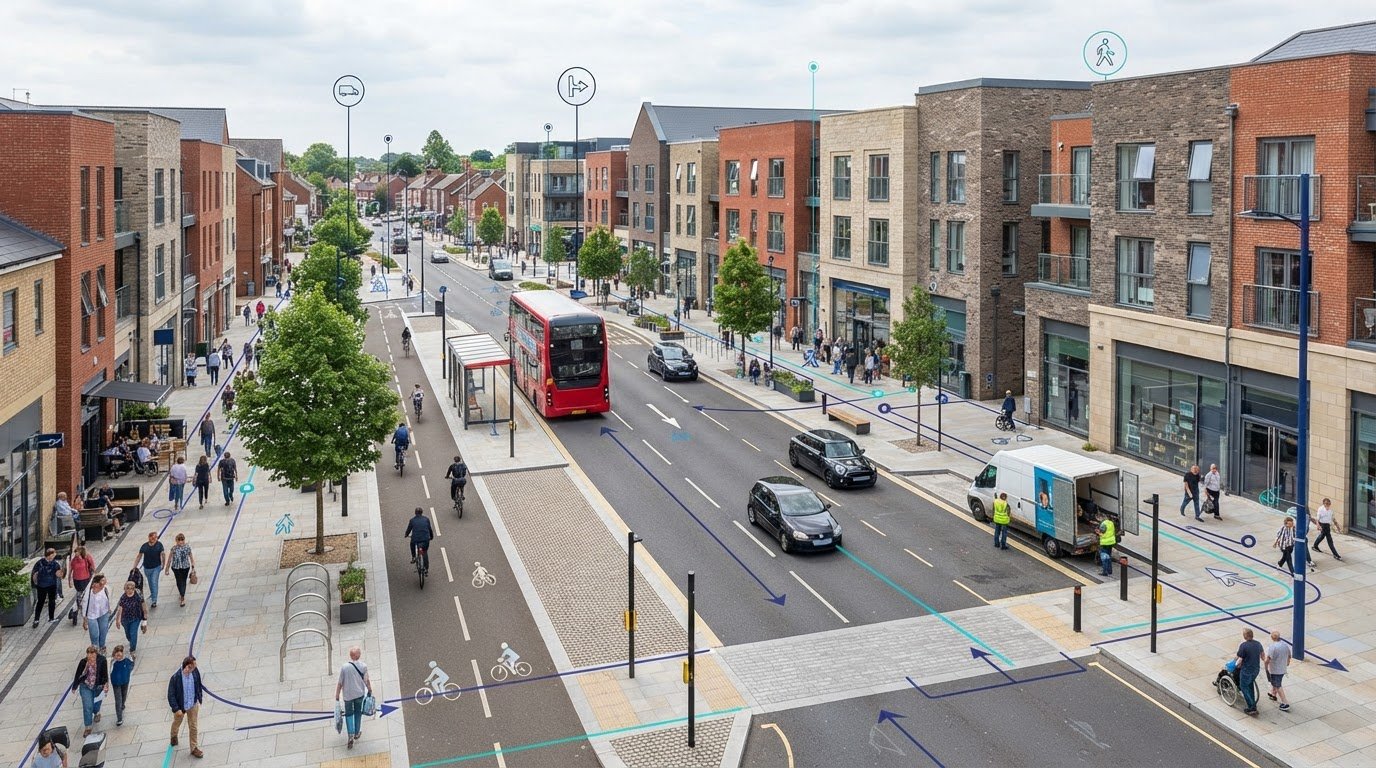
What if the success of town centre regeneration depended less on how many vehicle trips a scheme adds and more on how well people can move through the place? A transport assessment for town centre regeneration should connect transport evidence to the vision for the area, not simply count development trips. That means considering how people will walk, wheel, cycle and use public transport, alongside servicing, parking and traffic effects.
It’s understandable to be unsure which impacts need detailed assessment. Regeneration schemes often combine new uses, changing travel patterns and public-realm ambitions, while local planning and highway authority requirements can vary. Agreeing a proportionate scope early helps focus evidence on the issues that matter and reduces the risk of gaps holding up a planning application.
This guide explains what a regeneration-focused Transport Assessment should examine, how to choose suitable evidence and how to relate the analysis to the place-making vision. It also covers traffic and parking surveys, access and movement, servicing, and cumulative effects, so you can build a clearer transport case for your proposal.
Key Takeaways
- A transport assessment for town centre regeneration should show how movement supports the place-making vision, not just quantify vehicle trips.
- Scope the assessment around the proposal, local context and likely transport impacts. Distinguish observed conditions from assumptions and forecasts.
- Compare credible regeneration options by considering access, walking, wheeling, cycling, public transport, servicing and public space.
- Agree the study area, assessment questions, data requirements and future scenarios with the relevant authorities early in the planning process.
- Traffic surveys, parking surveys and technical analysis can help build a coherent evidence base for a planning submission where needed.
What a Transport Assessment means for town centre regeneration
A transport assessment for town centre regeneration explains how a proposal could affect movement and access, and what measures may be needed to manage those effects. It relates transport evidence to the intended future of the place, rather than treating the scheme as a standalone source of vehicle trips. This place-based perspective is consistent with regenerative urban development, where change is considered in relation to the wider urban environment.
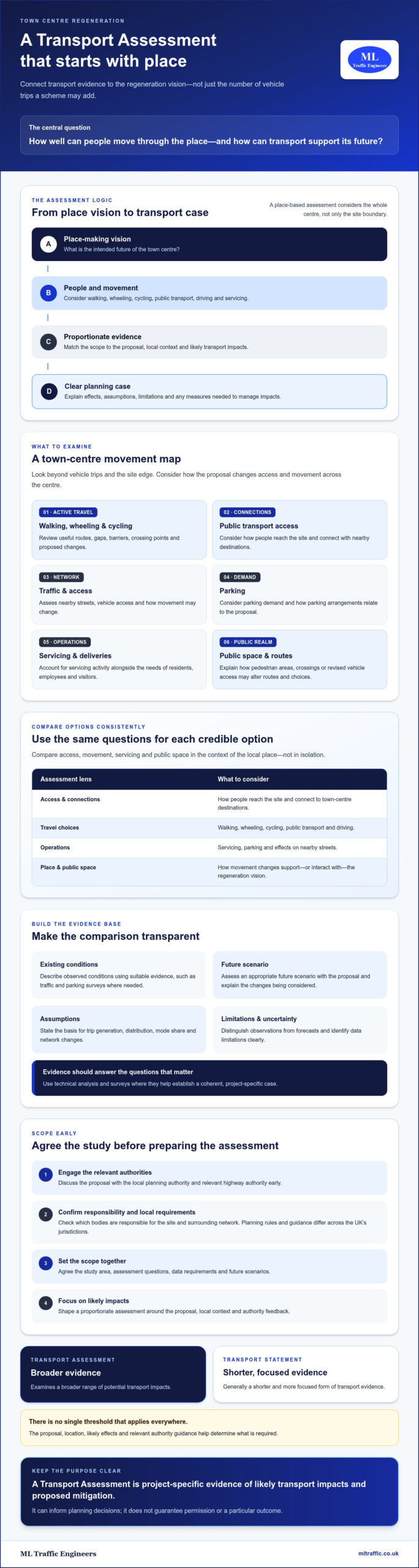
In brief: A Transport Assessment is project-specific evidence of likely transport impacts and proposed mitigation. It can inform planning decisions, but it does not guarantee permission or a particular outcome.
The appropriate document depends on the development and its context. A Transport Statement is generally a shorter, more focused form of transport evidence, while a Transport Assessment examines a broader range of potential impacts. There is no single threshold that applies everywhere. The proposal, location, likely effects and relevant authority guidance all help determine what is required.
To see how town centre regeneration can shape a place, watch Town Centre Regeneration from Owen Thompson MP for Midlothian:
How regeneration differs from a single-use development
A town centre scheme can combine homes, shops, workplaces and community uses. Their travel patterns may vary by time of day: residents travel for work or everyday needs, employees arrive for shifts, visitors come to shop or attend activities, and deliveries serve businesses. The assessment should consider these groups alongside people already using the centre, not only trips associated with new buildings.
Public-realm proposals also matter. A new pedestrian area, changed crossing point or revised vehicle access may alter routes and choices for people walking, wheeling, cycling, driving or using public transport. Explain how these changes interact with existing movement and the regeneration vision.
Who helps shape the assessment scope?
Engage the local planning authority and relevant highway authority early. The scope should reflect the proposal, its location, likely transport effects and feedback from those authorities. Confirm which bodies are responsible for the site and surrounding network before agreeing evidence requirements.
Planning policy and responsibilities differ across the UK, so check the rules and guidance for the project’s jurisdiction rather than assuming requirements are identical in England, Scotland, Wales and Northern Ireland. Early scoping can establish the study area, key questions and suitable evidence before the assessment is prepared.
What transport impacts should a regeneration assessment examine?
A regeneration assessment should examine how the proposal changes access and movement across the town centre, not just at the site boundary. Relevant effects may include walking and cycling connections, public transport access, traffic on nearby streets, parking demand, servicing activity and changes to public space. The official government guidance provides a starting point, but the scope should reflect the development and local authority requirements.
Build the analysis around a clear comparison: describe observed existing conditions, then assess an appropriate future scenario with the proposal. State the assumptions behind trip generation, distribution, mode share and network changes. Identify data limitations so decision-makers can see what the analysis establishes and where uncertainty remains.
Access, walking, cycling, and public transport
Review how people reach the site and connect with nearby streets, shops, services and other town centre destinations. For walking and cycling, map useful routes, gaps, barriers, crossing points and proposed changes. Consider whether public-realm proposals redirect movement or change access for existing users. Assess public transport access and, where relevant, capacity using current, project-specific evidence. Set study area boundaries to capture the routes and connections likely to be affected, and discuss them with the relevant authorities.
Traffic, parking, servicing, and inclusive access
Explain how trip-generation and distribution assumptions were selected, and use methods suited to the proposal. Consider how new trips interact with existing traffic and other committed or proposed development where cumulative effects may be relevant. Compare the future scenario with the baseline, distinguishing observed data from forecasts and assumptions.
Parking analysis should relate to the proposed uses and local context. Examine how servicing activity could affect access, street operation and public space. Check movement needs for different users, including people who walk, cycle, use public transport, drive, wheel or require step-free access. Local standards and authority expectations can vary, so confirm applicable requirements rather than assuming one approach fits every town centre.
In practice, link each identified impact to its evidence, the people or routes affected, and proportionate mitigation. This makes the assessment traceable: readers can understand what may change, why the conclusion is reasonable and how proposed measures respond. For a transport assessment for town centre regeneration, agree the study area, assessment questions and relevant development scenarios with the local planning and highway authorities early. Specialist Transport Assessment support, informed by traffic or parking surveys where needed, can help bring that evidence together.
How to assess regeneration options without overlooking local context
Comparing credible options shows how design choices may affect movement through a town centre. Start with a clearly described baseline, then distinguish it from assumptions, forecast scenarios and proposed interventions. For each option, explain what changes and why. A transport assessment for town centre regeneration should make these distinctions clear so readers can trace the evidence behind each conclusion.
| Assessment area | Option A: retain current access | Option B: revise access and public space |
|---|---|---|
| Access and movement | How existing routes connect the site to town centre destinations | Which routes or connections change, and for whom |
| Servicing | How existing delivery access operates | How revised arrangements affect servicing and nearby streets |
| Public space | How current vehicle and pedestrian space is used | What space is reallocated and how movement responds |
Adapt the comparison to the actual proposals. The table exposes trade-offs; it does not imply that an option is preferred before its effects are assessed. A place-based approach also reflects the case for long-term transport investment, connecting transport decisions with wider town centre objectives.
Building a reliable baseline and choosing evidence
Gather evidence that answers the agreed assessment questions. Depending on the location and proposal, this may include traffic and parking data, walking and cycling conditions, and public transport information. Use surveys when available records do not provide a suitable picture. Record survey dates, locations, coverage and limitations, and explain any adjustments made for analysis. This allows decision-makers to judge how well the evidence represents the conditions being assessed.
Comparing options and cumulative effects
Set out the baseline and future scenarios separately. Identify nearby committed proposals using information agreed with the relevant authorities, then explain which are included in the cumulative assessment and how their effects are represented. If development is phased, uses may change or information is incomplete, state what has been assumed and how this could affect forecasts.
Forecasts and model outputs are estimates, not certainty. Explain the method, key inputs and limitations, then interpret what the results mean for access, movement, servicing and public space. For London projects, the Transport Assessment London guide offers a location-specific companion; it is not a substitute for checking requirements elsewhere in the UK.
Where specialist evidence would help bring the options and supporting data together, review Transport Assessment support.
How to scope and prepare a town centre Transport Assessment
A clear scope gives the assessment a practical purpose: explain the proposal, identify likely transport effects and provide evidence for proportionate recommendations. For a transport assessment for town centre regeneration, agree the questions and study area before commissioning surveys or technical analysis. This keeps the work focused on the proposal and local context.
A practical sequence from proposal review to assessment
- Describe the proposal. Set out the uses, scale, phasing, access arrangements and regeneration objectives. Note what is fixed and what may change.
- Identify assessment questions. Consider which routes, users and transport operations could be affected, including walking, cycling, public transport, traffic, parking and servicing.
- Agree the scope with authorities. Consult the local planning authority and relevant highway authority on the study area, evidence requirements, baseline and future scenarios. Confirm which nearby proposals should be considered.
- Collect suitable evidence. Use existing information where it answers the agreed questions. Where it does not, identify whether traffic surveys, parking surveys or other relevant data are needed.
- Analyse and report. Explain methods, assumptions, survey dates and limitations. Present findings against the agreed scenarios, then connect identified effects to appropriate mitigation.
Let the scope determine the evidence, rather than collecting data first and deciding later how to use it. For example, a parking survey may help establish existing demand if parking effects are a key assessment question. Traffic data may be needed to understand how a proposed access interacts with nearby streets, while footfall analytics from providers such as Smart Urban Sensing Ltd can clarify pedestrian movement patterns. Choose methods to address identified information gaps, not as a default checklist.
Turning findings into proportionate mitigation
Recommendations should respond directly to evidenced impacts. Explain what measure is proposed, which effect it addresses and who would be responsible for taking it forward. Keep the assessment’s recommendations distinct from any separately commissioned design work or audit services. The assessment can identify a transport issue and intended response without implying that every related service forms part of the assessment commission.
A Travel Plan may complement the assessment where it suits the proposal, helping set out measures to support travel choices associated with the development. Its role should be consistent with the assessment’s assumptions and conclusions.
ML Traffic Engineers UK prepares Transport Assessments and related transport evidence for development proposals. Developers can review project types and planning support to consider relevant experience. To discuss assessment evidence for a regeneration proposal, contact ML Traffic Engineers UK.
How specialist Transport Assessment support can strengthen the planning submission
A well-structured assessment gives decision-makers a clear line of sight from the regeneration proposal to its likely transport effects and proposed mitigation. It brings together development details, local context, supporting evidence and analysis, while making assumptions and limitations visible. For a transport assessment for town centre regeneration, this joined-up account helps explain how transport considerations relate to the scheme’s objectives. It supports planning decisions, but cannot guarantee permission or a particular outcome.
Specialist input can help establish what evidence a project needs. Traffic surveys may inform analysis of network conditions, while parking surveys can help describe existing demand. Technical analysis then relates suitable evidence to the proposal and agreed assessment questions. Each method should have a clear purpose, rather than being included by default.
What to look for when appointing assessment support
Check whether the consultant has experience preparing transport documentation for planning proposals relevant to your development type. Ask how they will agree the assessment scope with you and the relevant authorities, identify data requirements, and document assumptions in the report. Confirm which services suit the brief, such as a Transport Assessment, traffic or parking surveys, or Swept Path Analysis where vehicle movement needs to be examined.
Clarity on responsibilities also matters. Establish what the assessment will cover, what evidence is required from other project contributors, and which recommendations may need separate design or delivery work. This keeps the report focused and makes its conclusions easier to follow.
Prepare for an initial project discussion
Gather information that will help define the scope and identify gaps. A useful starting pack includes:
- A site location plan and current proposal details, including uses and phasing where known.
- Available information on site access, parking, servicing and connections to nearby streets.
- Transport data already collected, with dates and coverage if known.
- Planning milestones, authority feedback and any known transport constraints.
- Unresolved questions, such as which scenarios or nearby proposals may need consideration.
This preparation helps focus early discussions on the project’s actual requirements. It also gives the assessment team a basis for identifying proportionate survey and analysis needs, rather than making assumptions before the proposal and local context are understood.
ML Traffic Engineers prepares Transport Assessments and related transport evidence for development proposals. Its transport services include traffic and parking surveys and Swept Path Analysis where appropriate to the project. Details of these services can help you identify support relevant to the brief.
Set your regeneration proposal up for a clear transport case
A strong transport assessment for town centre regeneration connects the development vision with the way people and goods move through the area. Its scope should reflect local conditions, the proposal’s likely effects and relevant authority feedback. Clear assumptions, proportionate evidence and mitigation linked to identified impacts make the planning submission easier to assess.
Start by agreeing the study area, assessment questions and relevant scenarios. Then use suitable evidence, including traffic or parking surveys where needed, to explain existing conditions and potential change. A coherent report supports informed planning decisions, but it cannot guarantee planning permission.
ML Traffic Engineers is a UK consultancy providing Transport Assessments for planning submissions, with traffic and parking survey capabilities to inform project evidence. Its local focus includes Greater London, Manchester, Birmingham, the West Midlands, Liverpool, Surrey, East Sussex, West Sussex, Hampshire, Berkshire and Buckinghamshire. If you’re preparing a regeneration proposal, discuss your town centre regeneration assessment to explore the scope and evidence it may require.
Frequently Asked Questions
What is a Transport Assessment for town centre regeneration?
A Transport Assessment is a project-specific report that examines how a development may affect transport and sets out potential mitigation. A transport assessment for town centre regeneration considers the scheme alongside existing town centre movement, planned changes and local conditions. It may draw on traffic or parking surveys and technical analysis where needed. The report supports planning decisions by presenting evidence, but it doesn’t guarantee permission.
When is a Transport Assessment required for a regeneration project?
The need for a Transport Assessment depends on the proposal, its location, likely transport effects and local authority requirements. There isn’t one threshold that applies to every regeneration project across the UK. Discuss the scope early with the local planning authority and relevant highway authority. They can help determine whether a Transport Assessment or a more focused Transport Statement is appropriate and what evidence the submission should include.
What should a town centre Transport Assessment include?
A town centre Transport Assessment should address the transport questions raised by the proposal. Depending on its scope, this can include site access, walking and cycling connections, public transport, traffic, parking, servicing and public-realm changes. It should describe existing conditions, assess suitable future scenarios, explain assumptions and limitations, and connect identified impacts to proportionate mitigation. Traffic surveys, parking surveys or other technical analysis may inform the report where the agreed scope requires them.
How do you assess transport impacts for a mixed-use regeneration scheme?
Assess each proposed use and consider how travel patterns may vary across the day. Homes, shops, workplaces and community uses can attract different residents, employees, visitors and deliveries. Compare the existing baseline with appropriate future scenarios, explaining assumptions about trips and how nearby development is treated. Consider access, movement choices, network operation, parking and servicing together so the analysis reflects how the mixed-use scheme may function as part of the town centre.
Should a Transport Assessment consider walking and cycling in a town centre?
Yes. The assessment should consider how the proposal connects with existing walking and cycling routes and whether access or movement may change. Examine route continuity, barriers, crossing points and links to town centre destinations. Where the scheme changes public space or street access, explain how those changes could affect people walking, cycling or wheeling. The scope should reflect local conditions and authority feedback, rather than assuming the same analysis applies to every site.
How early should a transport consultant be involved in town centre regeneration?
Involve a transport consultant while the proposal and access arrangements are still being developed. Early input can help identify likely transport questions, agree a study area with relevant authorities and establish whether traffic or parking surveys are needed. This applies whether the site is in Greater London, Manchester, Birmingham, the West Midlands, Liverpool, Surrey, East Sussex, West Sussex, Hampshire, Berkshire or Buckinghamshire, where project requirements must be checked locally.
Can a Transport Assessment help support planning permission?
A Transport Assessment can support a planning application by providing evidence about likely transport effects and proposed mitigation. A clear report helps decision-makers understand the proposal, local context, analysis and how identified impacts may be addressed. It doesn’t secure planning permission or guarantee a particular decision. The assessment should follow current, relevant planning policy and authority guidance for the project’s location, with its methods and limitations explained clearly.

Disclaimer
The content on mltraffic.co.uk, including all technical articles, guides, and resources, is provided for general informational and educational purposes only. It is not intended to constitute professional advice in traffic engineering, transportation planning, development approvals, or any other technical or legal field.
While ML Traffic Engineers makes every reasonable effort to ensure the accuracy, completeness, and timeliness of the information published, we do not provide any warranties or representations (express or implied) regarding its reliability, suitability, or availability for any particular purpose. Any reliance you place on the content is strictly at your own risk.
In no event shall ML Traffic Engineers, its directors, employees, authors, or affiliates be liable for any direct, indirect, incidental, special, consequential, or punitive damages (including, without limitation, loss of profits, data, or business opportunities) arising out of or in connection with the use of, or inability to use, any information provided on this website.
The articles and guides on this site are not a substitute for engaging a qualified, professional traffic engineer to assess your specific project requirements. For tailored advice, compliance assessments, or traffic engineering services, please contact a competent professional.
This disclaimer may be updated from time to time without notice. By accessing or using this website, you agree to be bound by the most current version of this disclaimer.