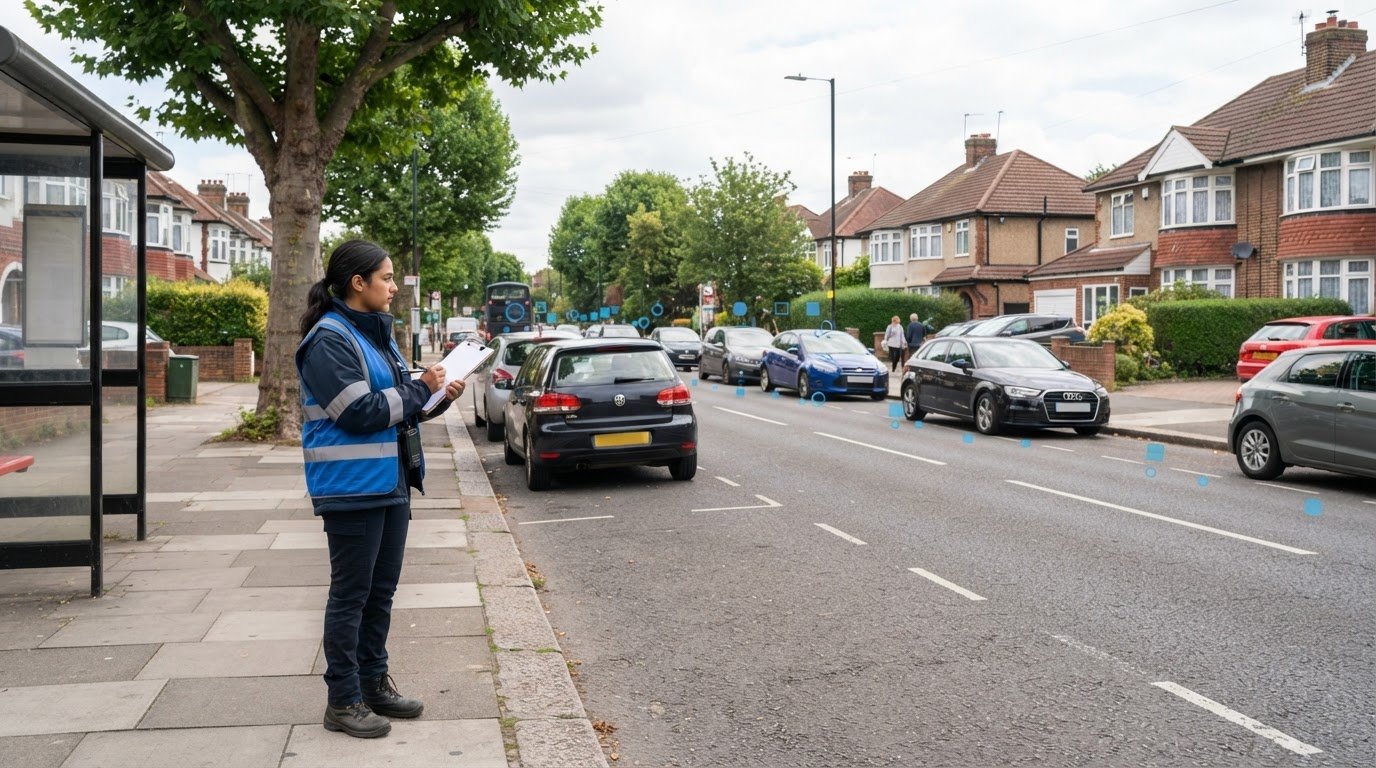
A busy street in Stanmore may not tell the whole story about local parking pressure. A single count shows how many vehicles are present at one moment, while a well-scoped parking survey stanmore records observations at relevant times and locations to build a clearer picture. The results can reveal recurring patterns during the survey period, but they may not establish whether residents, commuters, visitors or a proposed development caused the observed demand.
It’s reasonable to ask whether a survey reflects typical conditions or whether it serves the same purpose as a council parking review. These are different types of evidence. A development-planning survey can provide local observations relevant to a particular proposal; a council review may consider wider parking management. The right scope depends on the decision the data needs to inform.
This article explains what a Stanmore parking survey can measure, how timing and coverage affect its usefulness, and what findings can and can’t establish. It also covers when survey evidence may support a Transport Statement or Transport Assessment, and what information to provide when defining the site, study area, timing and purpose.
Key Takeaways
- A parking survey stanmore can help answer a specific planning or parking question. Its usefulness depends on matching the survey scope to that decision.
- Occupancy, parking duration and turnover describe different aspects of demand. Knowing which measures matter helps you request relevant evidence.
- Check survey dates, coverage and recording methods before deciding whether findings represent typical conditions or support wider conclusions.
- When briefing a survey, clarify the decision, site boundaries, study area, timing and required outputs. Provide plans, access points and known restrictions.
- If a development needs parking evidence considered in a transport-planning context, specialist support can help shape the survey brief and inform relevant project documentation.
What does a parking survey in Stanmore tell you?
A parking survey records parked vehicles and kerbside activity in a defined area over a specified period. Depending on the brief, it may record how many spaces are occupied, how long vehicles remain and how often spaces are used by different vehicles. The purpose is to describe observed parking conditions, not to assume why each person parked there.
This guide refers to Stanmore in the London Borough of Harrow, not other places with the same name. A development-planning survey is commissioned to help assess a particular proposal. Where relevant to the project brief, its findings may inform a Transport Statement or Transport Assessment. A council parking review may consider parking management across an area, while a community consultation gathers local views. These processes may inform one another, but they answer different questions.
Which Stanmore parking question are you trying to answer?
First distinguish a concern about existing resident parking from a question about the effect of a proposed development. The first may focus on local parking patterns or kerbside use. The second asks what demand the proposal could add and how that relates to existing conditions around the site.
That distinction helps determine where and when to observe, and which activity to record. For example, a survey near Stanmore Hill should be designed around the specific streets and issue under review. Observations from that area alone cannot be treated as representative of all Stanmore.
What a parking survey can, and cannot, establish
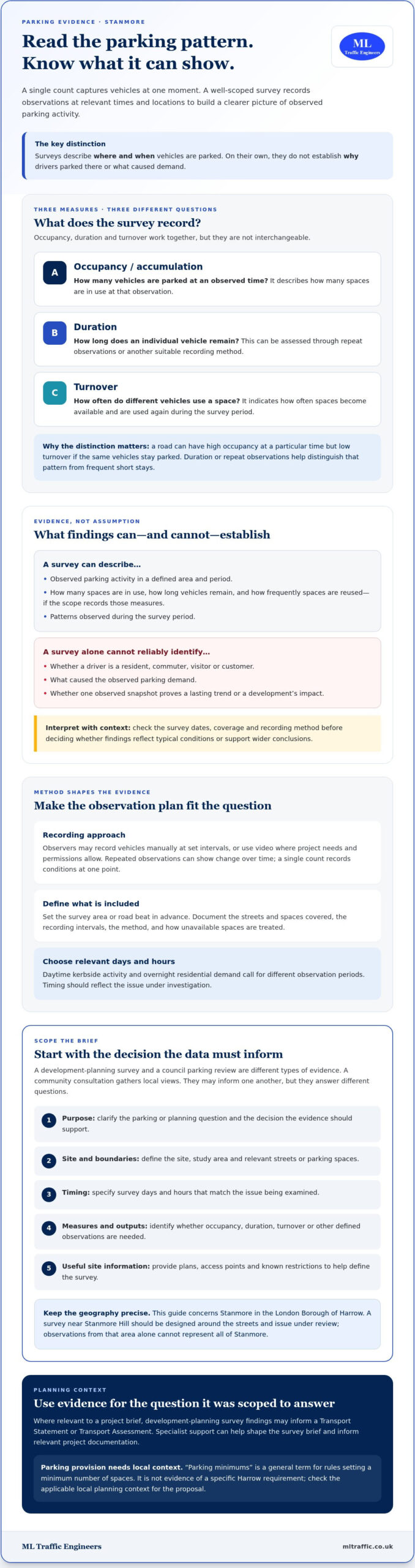
Occupancy describes how many parking spaces are in use at an observed time. Duration tracks how long vehicles stay, while turnover indicates how often spaces are used by different vehicles during the survey period. Together, these measures describe observed parking activity. They don’t reliably identify every driver’s purpose: a parked vehicle alone can’t confirm whether its driver is a resident, commuter, visitor or customer.
A parking survey records where and when vehicles are parked; it does not, by itself, establish why they are there or what caused the observed demand. Interpret findings in light of the survey dates, coverage and method. A snapshot may show conditions on the day observed, but it shouldn’t automatically be treated as proof of a lasting trend or a development’s impact.
For development teams, the planning question may include whether proposed parking provision is appropriate. The concept of parking minimums describes rules that set a minimum number of spaces. The link is general background, not evidence of a specific Harrow requirement. Check the applicable local planning context for the proposal before drawing conclusions from survey results.
How a Stanmore parking survey records occupancy, duration, and turnover
A survey plan should match the question being investigated. Observers may record parked vehicles manually at set intervals, or use video where the project needs and permissions allow. The method affects what can be captured: repeated observations can show changes over time, while a single count records conditions at one point. Document the approach, recording intervals and treatment of unavailable spaces so the results can be interpreted correctly.
These measures answer different questions:
- Occupancy or accumulation: the number of parked vehicles observed at a particular time. This shows how many spaces are in use at that observation.
- Duration: how long an individual vehicle remains parked, based on repeat observations or another suitable recording method.
- Turnover: how frequently different vehicles use a parking space during the survey period. It indicates how often spaces become available and are used again.
For example, a road could have high occupancy at a particular time but low turnover if the same vehicles remain parked. A separate duration or repeat-observation measure is needed to distinguish that pattern from frequent short stays. Occupancy, duration and turnover are related, but they aren’t interchangeable.
How survey timing and location affect the results
Survey days and hours should reflect the issue under investigation. A question about daytime kerbside activity calls for a different observation period from one about overnight residential demand. Define the survey area or road beat in advance, including the streets and parking spaces to be included. A limited observation period describes only the conditions recorded. Don’t label it representative of other times or locations without supporting evidence.
What parking stress and kerbside activity mean
Parking stress describes pressure on the spaces included in a survey. State exactly how it is measured. For example, an occupancy measure could compare the number of vehicles observed with the number of eligible spaces surveyed at the same time. The result depends on clear rules for defining eligible spaces and recording restrictions or spaces that are temporarily unavailable.
Kerbside activity can include more than vehicles left in parking spaces. Loading, stopping and restrictions may affect available space or how a location appears during an observation. The survey scope should say whether these activities are recorded and how they are treated, rather than blending them into a parking count without distinction.
Survey conclusions depend on the defined area, recording method and observation times; they should not be extended beyond the evidence collected. For development proposals, findings may contribute to transport-planning documents where relevant to the project brief. The UK government’s official planning practice guidance provides context on Transport Assessments and Statements. A clearly scoped parking survey and transport-planning service can help connect collected data with the question a project needs to address.
How to interpret Stanmore parking survey findings without overclaiming
Begin with the purpose of the evidence. A council-area parking review may examine how parking is managed across a neighbourhood. A resident consultation records views and reported experiences. A development-planning survey collects observations relevant to a particular proposal and its potential parking demand. These sources can inform the same discussion, but they aren’t interchangeable: each has a different scope and answers a different question.
For a parking survey stanmore, check the survey dates, days and times, the streets or spaces included, and how observations were recorded. A count covering only part of an area may miss pressure elsewhere. A short observation period may capture a particular set of conditions, not a normal pattern. Manual observations and video may capture different details, so understand the method before comparing results.
Snapshot survey or representative evidence?
Ask whether the observed days and time periods match the question. If the concern is overnight demand, daytime counts alone won’t answer it. Check for known context that could affect the results, such as an unusual local event or incomplete street coverage. If those details aren’t available, state that limitation rather than assuming the survey reflects typical conditions.
The Hampshire Chronicle has reported on a three-day parking snapshot in a different Stanmore context, in the Winchester area. That report is not evidence about Stanmore in the London Borough of Harrow. Its location and survey period matter; findings from another place or time shouldn’t be transferred to Harrow or treated as proof of local parking patterns.
Survey findings versus community consultation
A survey records observed conditions, such as how many vehicles were parked in a defined area at a particular time. A consultation records what participants say about parking, which can highlight concerns and experiences a count might not explain. Used together, they can give decision-makers different kinds of evidence. Keep them distinct in any summary: don’t present reported views as observed counts or counts as proof of driver identity or trip purpose.
A sound interpretation separates measured results from assumptions. Present the observations first, then explain what they may suggest and what remains uncertain. For a wider planning context, see this London Transport Assessment guide. It can help frame how transport evidence fits into development documentation, while the project-specific survey scope and local planning context still need to be considered.
How to scope a parking survey for a Stanmore site
A useful brief starts with the decision the evidence needs to inform. For a development proposal, that may mean understanding existing parking activity near the site and identifying information that could support a Transport Statement or Transport Assessment. Agree the scope for the specific project rather than assuming a standard survey area, timing or method will suit every Stanmore location.
What information to provide before data collection
Give the survey team enough context to define what should be observed and how the results will be used. A clear project brief can follow this sequence:
- Define the decision: State the planning or operational question and the evidence you need.
- Identify the site: Provide a site plan showing boundaries, proposed access points and relevant development details.
- Set the survey area: Mark nearby streets and parking areas to consider, and identify known restrictions or access arrangements.
- Agree the time period: Explain which days and times may relate to the question. Confirm the observation schedule for the project rather than assuming one.
- Specify the outputs: Clarify the measures, reporting format and limitations that should be documented.
Include known local concerns where they may help shape the brief. If the issue is suspected resident demand, say so. If the question concerns parking associated with a proposed development, describe the proposal and planning context. These are questions to investigate, not conclusions the survey should assume in advance.
How survey evidence can support a planning submission
Parking observations can contribute to a transport-related assessment by describing existing conditions relevant to a proposal. Their value depends on how well the survey area, dates, times and measures match the planning question. Agreeing these details early also helps distinguish what the data can show from what requires wider professional judgement or other project information.
ML Traffic Engineers UK provides Parking Surveys and prepares Transport Statements and Transport Assessments where relevant to the project brief. A survey may inform those documents, but it doesn’t guarantee a planning outcome or replace assessment of the proposal as a whole. Check requirements against the project’s circumstances and applicable local planning context.
For broader application context, review the Transport Assessment guide, then consider how a clearly scoped parking survey stanmore could address your project’s evidence needs.
When to involve a parking survey specialist in Stanmore
Specialist support may be useful when a development raises a specific parking question, when evidence needs to be coordinated with a planning submission, or when your project team has limited capacity to plan and analyse observations. A defined brief keeps the work focused by linking the survey method and coverage to the decision the project needs to inform.
Connecting parking data with transport planning
Parking observations may contribute to a Transport Statement or Transport Assessment by describing conditions relevant to a proposal. The appropriate document and supporting evidence depend on the development and its planning context. A survey can inform that assessment, but it doesn’t determine the planning outcome or replace professional judgement.
ML Traffic Engineers provides Parking Surveys and transport-planning analysis, and prepares Transport Statements and Transport Assessments where relevant to the project brief. Its work supports projects across Greater London, Manchester, Birmingham, the West Midlands, Liverpool, Surrey, East Sussex, West Sussex, Hampshire, Berkshire and Buckinghamshire. You can review its transport planning services to understand how these services relate to a project. For a parking survey stanmore, confirm project-specific evidence requirements with the relevant planning team rather than assuming a particular scope will apply.
What to ask a survey provider before starting
Before commissioning a survey, ask how the proposed scope addresses your project’s specific question. A clear discussion should cover what will be observed, why the selected area and timing are suitable, and how results will be presented. It should also explain the limits of the data, so findings aren’t mistaken for conclusions the observations cannot support.
- Which streets and parking areas are included, and how were the boundaries chosen?
- What observation periods and recording method are proposed, and how do they relate to the planning question?
- How will observed counts be distinguished from assumptions about driver identity or trip purpose?
- What assumptions, gaps in coverage and limitations will the report state?
- How could the results fit the project’s Transport Statement or Transport Assessment, if one is relevant?
These questions help establish a transparent scope before data collection begins. If your Stanmore project needs parking evidence analysed in a transport-planning context, contact ML Traffic Engineers to discuss your survey requirements and project context. Share the site information and planning question so the discussion can focus on the evidence your project may need.
Make your next parking decision evidence-led
A useful parking survey stanmore begins with a clear question and a scope designed around the site, relevant streets and observation period. Occupancy, duration and turnover reveal different aspects of parking activity, but results describe only the conditions recorded. They don’t, on their own, identify why drivers parked or prove what caused local demand.
For development work, well-scoped survey evidence may support a Transport Statement or Transport Assessment where relevant to the project brief. Clear reporting distinguishes observed data from assumptions and shows decision-makers how to interpret the findings.
ML Traffic Engineers provides Parking Surveys and prepares Transport Statements and Transport Assessments. If you’re assessing a Stanmore site, share the planning question, site information and evidence requirements to start a focused discussion. Discuss your parking survey requirements with ML Traffic Engineers and consider how the data could fit your wider project documentation.
With a clear question and transparent scope, you can make informed next steps with greater confidence.
Frequently Asked Questions
What does a parking survey in Stanmore measure?
A parking survey records vehicles parked in a defined area and may measure occupancy, duration, turnover and kerbside activity. Occupancy is the number of vehicles observed at a particular time; duration records how long vehicles stay, while turnover tracks how often spaces are used by different vehicles. The measures selected depend on the project question. A survey describes observed conditions during its study period, but doesn’t automatically explain why drivers parked there.
How long does a parking survey need to run?
There’s no single duration that suits every parking survey. The observation schedule should reflect the question, location and evidence needed, including relevant days and times. A survey intended to assess overnight parking may need a different schedule from one examining daytime activity. Agree the dates, observation periods and coverage for the specific project, and record any limitations. Don’t treat a brief snapshot as evidence of typical conditions unless its scope supports that conclusion.
Can a parking survey show whether commuters cause parking problems?
A parking survey can show patterns such as when spaces are occupied and how long vehicles remain, but observations alone can’t reliably identify every driver’s purpose. A vehicle parked during working hours might belong to a commuter, resident, visitor or someone making a local trip. The report should present observed data separately from assumptions about driver identity. If identifying trip purpose is central to the question, discuss what additional evidence may be suitable for the project.
What is the difference between a parking survey and a parking consultation?
A parking survey records observed conditions, such as the number of parked vehicles in a defined area at set times. A consultation gathers people’s views and reported experiences, which may reveal concerns that counts don’t explain. Both can inform a parking discussion, but they aren’t equivalent evidence. Keep measured results distinct from consultation responses, and consider each in light of its method, scope and purpose.
Is Stanmore Hill covered by the London Borough of Harrow parking review?
Harrow Council material identifies a parking review and consultation concerning the Stanmore Hill area. That reference doesn’t establish that every nearby road is included, or confirm the review’s current status or boundaries. Check the latest council information for the precise area and any published updates before relying on it. A council review also has a different purpose from a separately scoped development-planning survey for a particular site.
When might a development need a parking survey for planning?
A parking survey may be relevant when a development proposal raises questions about existing parking conditions or the effect of additional demand, including where on-site parking is limited. Whether evidence is requested depends on the proposal and planning context, so check current requirements with the relevant planning authority rather than assuming a survey is always necessary. A clearly scoped parking survey stanmore may inform a Transport Statement or Transport Assessment where relevant to the project brief.
How are parking survey results presented?
Results may be reported as tables or written analysis showing observed occupancy, duration, turnover and the area and periods covered. The format should make clear how observations were collected, what assumptions were applied and where coverage was limited. Depending on the project brief, findings may also be interpreted in transport-planning documentation. Ask the survey provider which outputs are proposed and how the report will distinguish recorded conditions from conclusions or assumptions.

Disclaimer
The content on mltraffic.co.uk, including all technical articles, guides, and resources, is provided for general informational and educational purposes only. It is not intended to constitute professional advice in traffic engineering, transportation planning, development approvals, or any other technical or legal field.
While ML Traffic Engineers makes every reasonable effort to ensure the accuracy, completeness, and timeliness of the information published, we do not provide any warranties or representations (express or implied) regarding its reliability, suitability, or availability for any particular purpose. Any reliance you place on the content is strictly at your own risk.
In no event shall ML Traffic Engineers, its directors, employees, authors, or affiliates be liable for any direct, indirect, incidental, special, consequential, or punitive damages (including, without limitation, loss of profits, data, or business opportunities) arising out of or in connection with the use of, or inability to use, any information provided on this website.
The articles and guides on this site are not a substitute for engaging a qualified, professional traffic engineer to assess your specific project requirements. For tailored advice, compliance assessments, or traffic engineering services, please contact a competent professional.
This disclaimer may be updated from time to time without notice. By accessing or using this website, you agree to be bound by the most current version of this disclaimer.