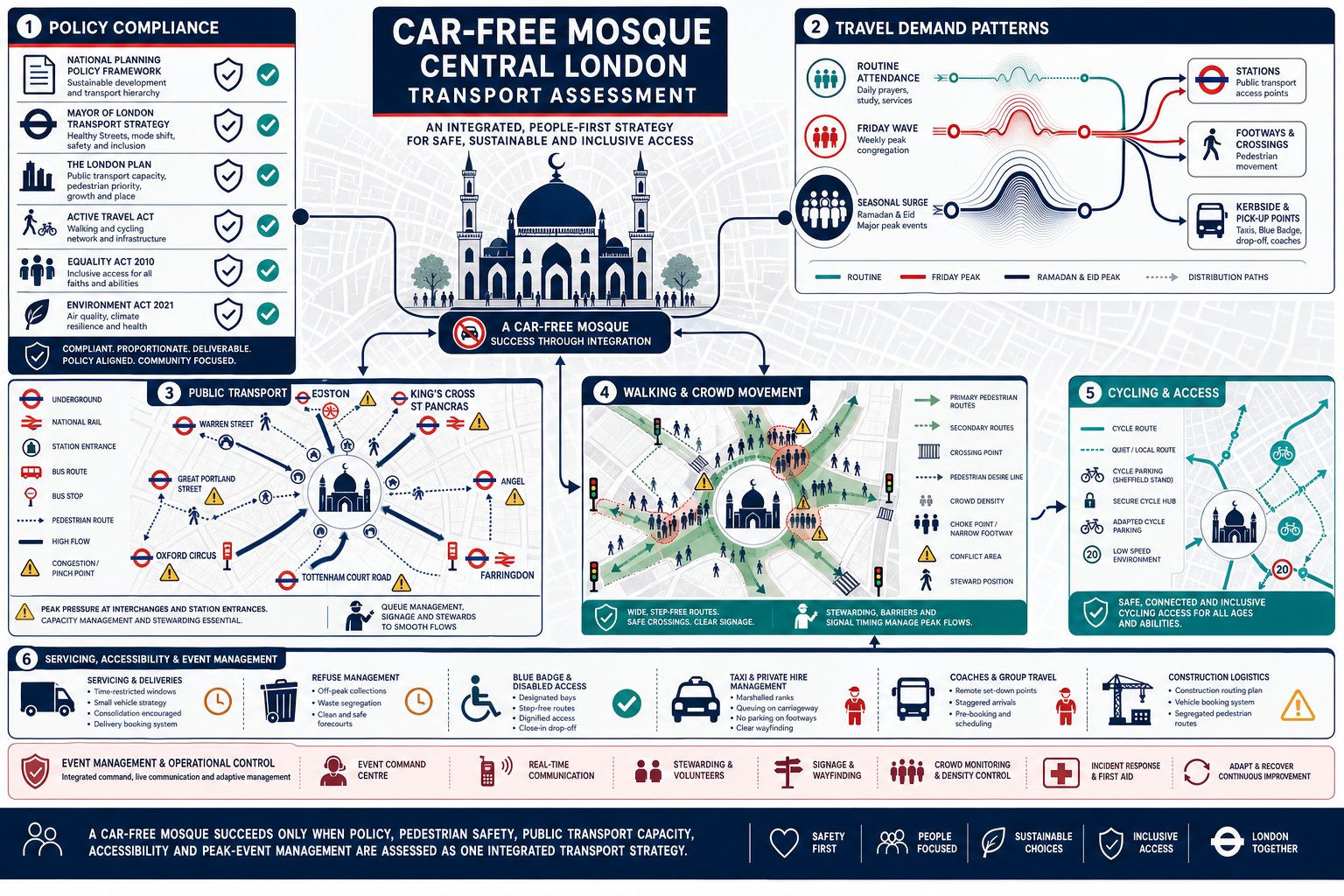
A car-free mosque in central London is never assessed like a routine place-of-worship scheme. On paper, the principle can look straightforward: no general parking, strong public transport accessibility, and a policy backdrop that plainly favours walking, cycling and public transport in highly accessible locations. In practice, though, planning officers will want much more than a statement that “most people won’t drive.” They will expect evidence.
For architects, planning consultants, developers, local authorities and legal teams, the real challenge is proving that worship-related travel demand can be absorbed safely and lawfully by the surrounding network without triggering severe impacts under the National Planning Policy Framework, conflicting with the London Plan, or undermining TfL’s Healthy Streets and Vision Zero objectives. That means understanding weekly peaks, seasonal surges, station pinch points, crowd movement on footways, accessible access arrangements, servicing logistics and construction impacts as one joined-up transport story.
In our experience, a robust Car-Free Mosque in Central London Transport Assessment succeeds when it is specific to the mosque’s pattern of use, honest about pressure points and practical about mitigation. Central London raises the bar. Existing congestion, constrained footways, busy stations and sensitive highway conditions leave little room for vague assumptions. What officers want in 2026 is a disciplined, policy-led assessment that shows the scheme can operate well on ordinary days, peak Fridays and exceptional religious periods alike.
Key Takeaways
- A successful car-free mosque transport assessment in central London must prove no general parking is provided while accommodating worship-related travel primarily through walking, cycling and public transport.
- The assessment should provide detailed evidence on travel patterns, including weekly peaks like Friday prayers and exceptional periods such as Ramadan and Eid, addressing crowd management and route capacity.
- Pedestrian safety and crowd movement analysis are crucial, considering footway capacity, crossing quality, and potential conflict points to ensure a safe and comfortable walking environment.
- Cycle access and parking must be compliant with London standards and designed to accommodate peak demand without encroaching on pedestrian areas.
- Servicing, deliveries and Blue Badge parking require practical, policy-compliant strategies that avoid obstructing the highway or compromising pedestrian and traffic safety.
- Event management plans and adaptive travel planning with monitoring and mitigation measures are essential to maintain operational resilience and compliance with Healthy Streets and Vision Zero principles.
What A Car-Free Mosque Transport Assessment Needs To Demonstrate
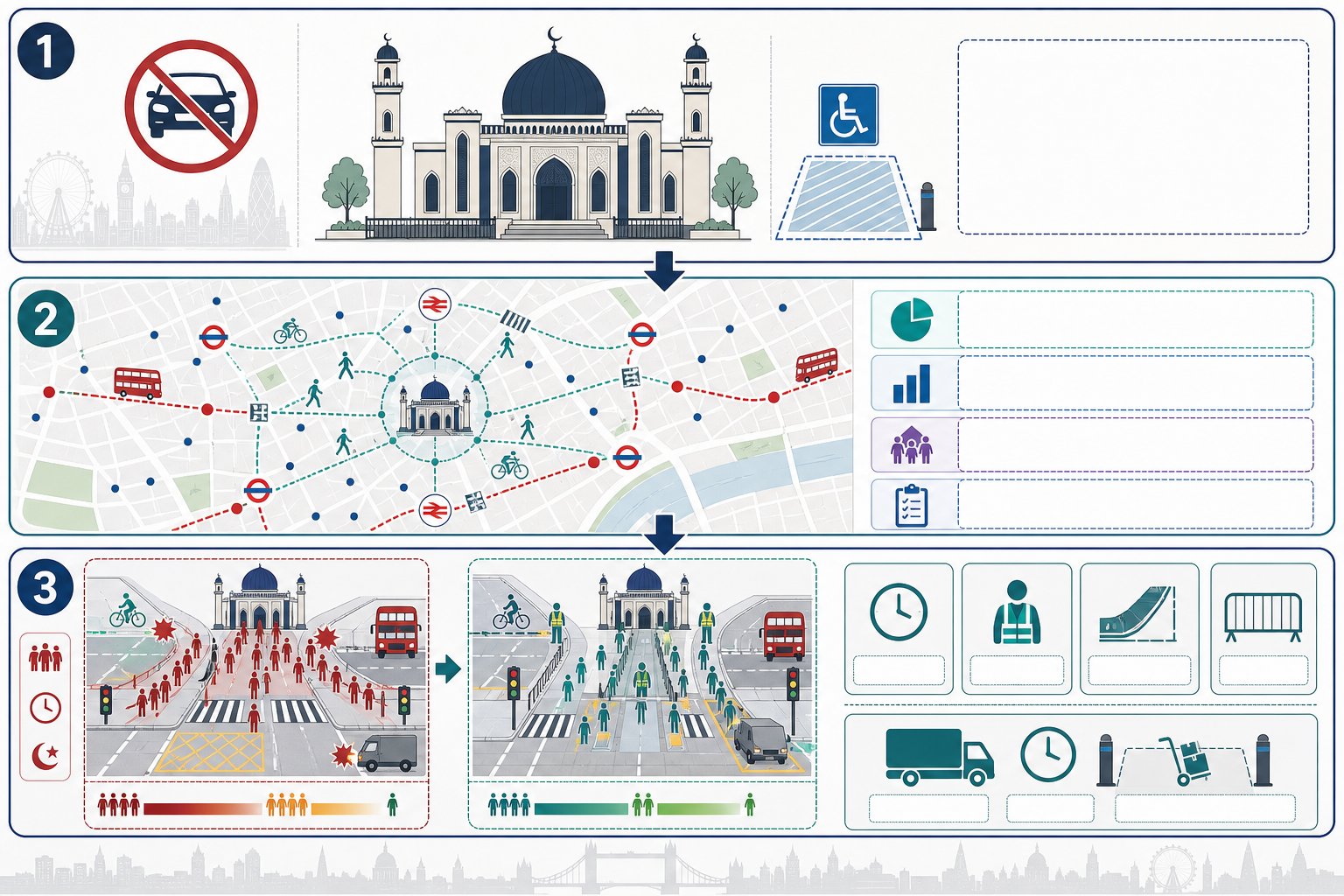
At its core, the assessment must do three things. First, it must show that the development can function without general car parking. Second, it must demonstrate that the resulting travel demand can be accommodated primarily by walking, cycling and public transport. Third, it must identify any residual effects and set out credible mitigation so that no severe impact arises.
That sounds simple. It isn’t.
For a central London mosque, officers will normally expect a clear statement of the proposed parking strategy, including confirmation that no general parking is provided and that any accessible provision is policy-compliant under London Plan requirements, particularly around Blue Badge parking. They will also expect realistic mode split assumptions, not optimistic guesses. Comparable survey evidence, local census data, PTAL context, nearby station access, local bus connectivity and the demographic profile of likely worshippers all matter.
A strong report also needs to move beyond trip numbers. It should explain how people arrive, when they arrive, where they queue, which crossings they use, whether footways can cope before and after prayers, and what happens during unusual peaks. This is where experienced transport assessment for work tends to separate robust applications from weak ones.
Finally, the document has to align with Healthy Streets and Vision Zero principles. If the site generates conflict with pedestrians, cyclists, buses or servicing activity, the answer cannot be hand-waving. Officers want management measures, design changes, timing restrictions, and where necessary contributions or operational controls that are proportionate and enforceable.
Why Central London Context Changes The Assessment Approach
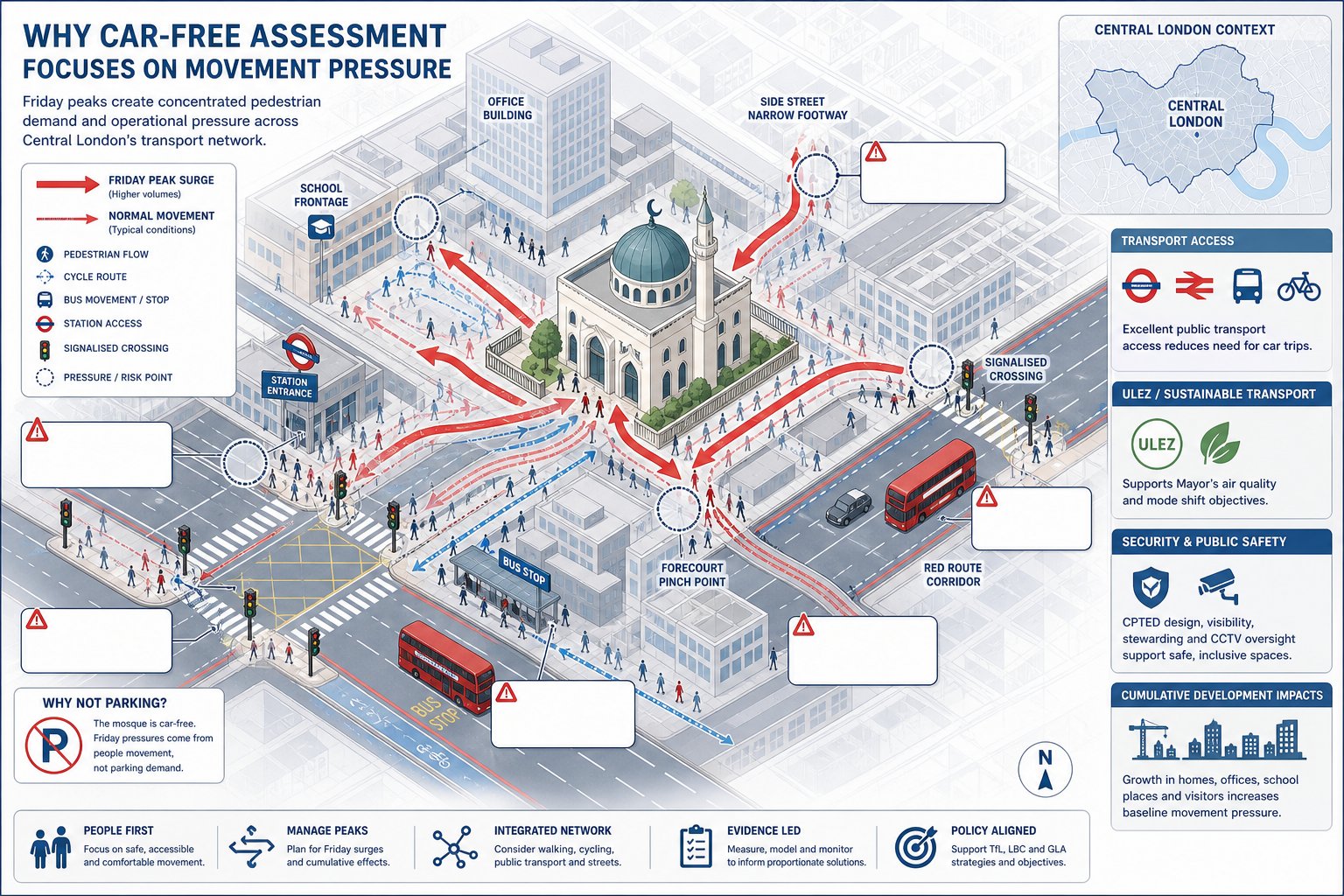
Central London changes almost every assumption. In outer boroughs, a place of worship assessment may spend more time on parking stress, junction turning movements and nearby residential streets. In central London, the issue is usually not whether people can drive there. It is whether the surrounding pedestrian and public transport network can safely absorb concentrated pulses of movement.
High PTAL scores do not remove the need for detailed analysis. In fact, they often increase scrutiny because stations, bus stops and footways may already operate under pressure. A mosque that is technically well located can still create localised problems if a Friday peak sends several hundred worshippers through a narrow station entrance or along a constrained footway outside a school, office cluster or busy signalised junction.
Officers will also read the proposal in the wider policy context: congestion management, ULEZ, strategic road function, bus reliability, cycle routes, security considerations and the cumulative impact of nearby developments. That is why a central London assessment benefits from a genuinely local lens rather than a generic template. Good London Development Transport Advice: is often about understanding those micro-conditions, how people actually move through one block, one station forecourt, one crossing cycle, one pinch point.
And there is another factor: perception. Councils and TfL know that mosque peaks can be highly visible in the public realm. If crowding spills into carriageways or informal drop-offs block a side street, complaints come quickly. So central London schemes are assessed not just for technical capacity, but for operational resilience.
Planning Policy And Car-Free Development Requirements
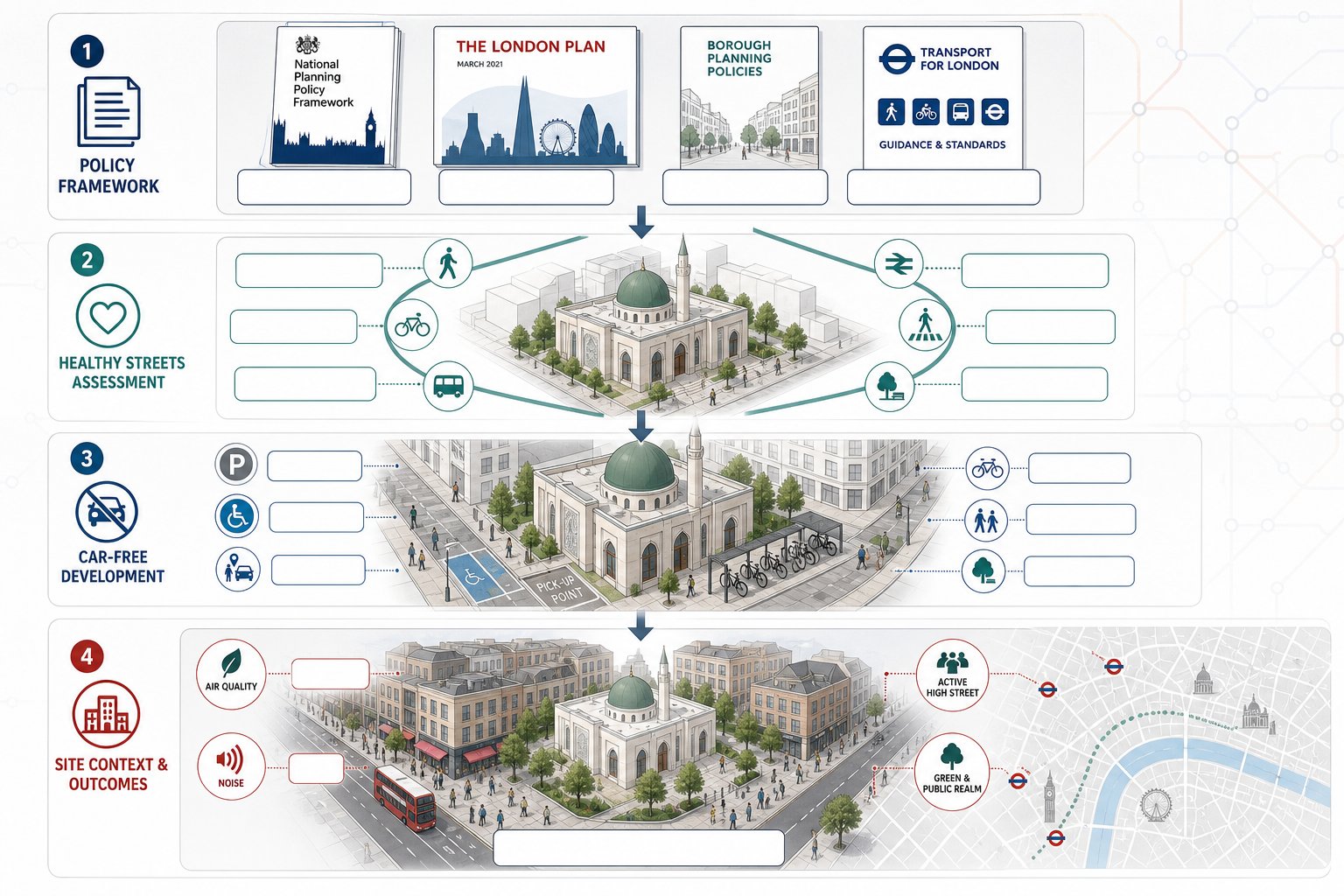
The planning framework in 2026 points firmly toward car-free or car-lite development in highly accessible parts of London, but policy compliance still has to be demonstrated line by line. For mosque proposals, that usually means drawing together the National Planning Policy Framework, the London Plan, borough-level transport policies and TfL’s transport assessment expectations into one coherent case.
The headline principles are familiar: prioritise active travel, reduce reliance on private car use, minimise parking, support safe streets and avoid severe residual impacts on the network. But officers will expect those principles to appear in the methodology as well as the conclusions. A report prepared in TfL’s preferred Healthy Streets style is generally stronger because it deals directly with safety, comfort, legibility, inclusivity and mode shift rather than treating transport as a narrow vehicle-count exercise.
Blue Badge parking needs especially careful handling. A car-free position does not mean ignoring accessibility. It means showing that any accessible parking or pick-up arrangements are justified, policy-compliant and workable in highway terms. Likewise, cycle parking should not be tokenistic: it must be designed to London standards and matched to the use.
Where the scheme forms part of a larger estate, mixed-use site or town-centre change, the relationship with adjoining uses should be addressed in the same disciplined way we would apply on a mixed use masterplan. If transport effects overlap with wider environmental topics, air quality, noise, cumulative townscape pressure, the analysis may also need to interface with environmental impact assessment work.
How The Proposed Use Generates Travel Demand
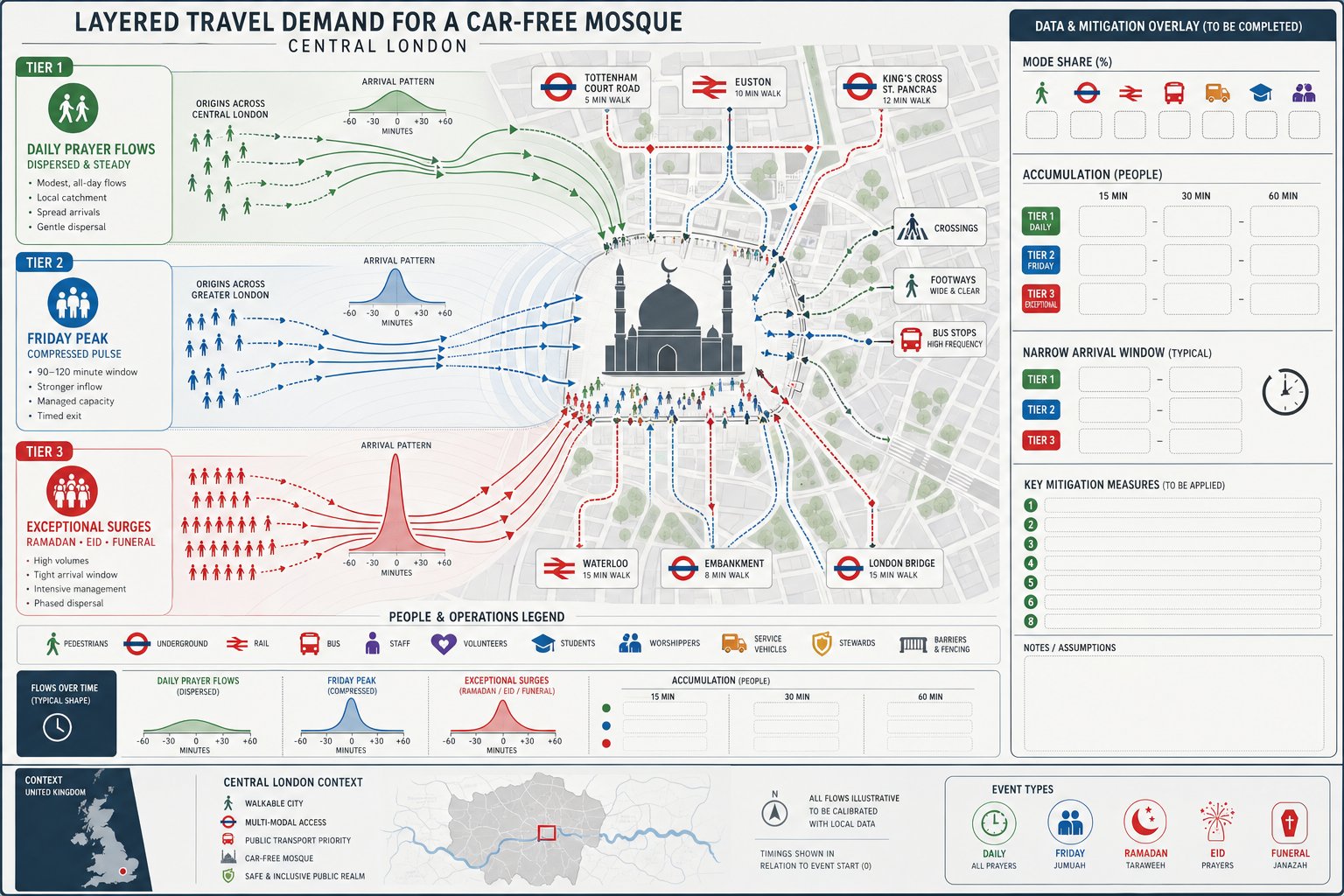
Mosques are unusual in transport terms because they do not produce one flat daily demand profile. They create a layered pattern of dispersed routine attendance, predictable weekly peaks and intense seasonal or event-led surges. A credible assessment hence has to model the use as it will actually operate, not as a simplified community facility with one opening and closing time.
Trip generation should normally distinguish regular worshippers, staff, volunteers, education-related visitors if relevant, funeral attendees, special event visitors and servicing trips. It should also test whether the congregation is likely to be heavily local, drawn from across central London, or connected to specific workplaces and institutions nearby. Those differences materially affect mode share and route assignment.
Comparable surveys can be useful, but officers will be wary of blind transfer. A mosque near major employment concentrations may see strong walk-in demand from workers at Friday lunchtime. Another may depend much more on rail and Underground access. The assessment should explain those behavioural drivers rather than just presenting a spreadsheet.
Daily Worship, Friday Prayers, And Peak Attendance Patterns
The five daily prayers usually generate relatively modest and dispersed flows. For many central London sites, those trips can be absorbed easily, especially where the catchment includes nearby residents, employees and students. But Friday prayers, especially Jumu‘ah, are the principal weekly test.
That peak is not only larger: it is compressed. Arrival and departure may occur within tight windows, which means the key issue is often accumulation, queueing and route choice rather than daily total trips. Officers will want to know how many people arrive in the 15, 30 and 60 minutes before prayer, whether worshippers wait outside, how quickly departures clear, and whether nearby crossings, footways, bus stops and station entrances can accommodate that pulse safely.
This is where survey evidence and timing assumptions need to be realistic. If two prayer sittings are proposed, the operational effect should be explained. If worshippers spill between the street and entrance lobby, that needs a crowd management response.
Ramadan, Eid, Funerals, And Other Exceptional Demand Periods
Exceptional periods are often where weak applications come unstuck. Ramadan introduces late-evening and night-time movements, Tarawih attendance, possible I’tikaf stays and the prospect of more intensive use across consecutive days. Eid can generate event-scale peaks in very short periods. Funerals bring their own demand profile, including mourners who may be less familiar with local transport restrictions.
Planning officers do not expect every exceptional circumstance to be eliminated: they do expect it to be managed. That means identifying realistic maximum scenarios, assessing likely travel modes, and setting out event management procedures. Temporary stewards, timed entry, liaison with nearby stations, pre-booked coach restrictions if relevant, communication to attendees, and overflow arrangements for public realm pressure may all form part of the mitigation package.
If the assessment simply labels these as “occasional” and moves on, it usually won’t satisfy central London scrutiny. Exceptional peaks are precisely what the authority will worry about.
Public Transport Accessibility And Station Capacity Review
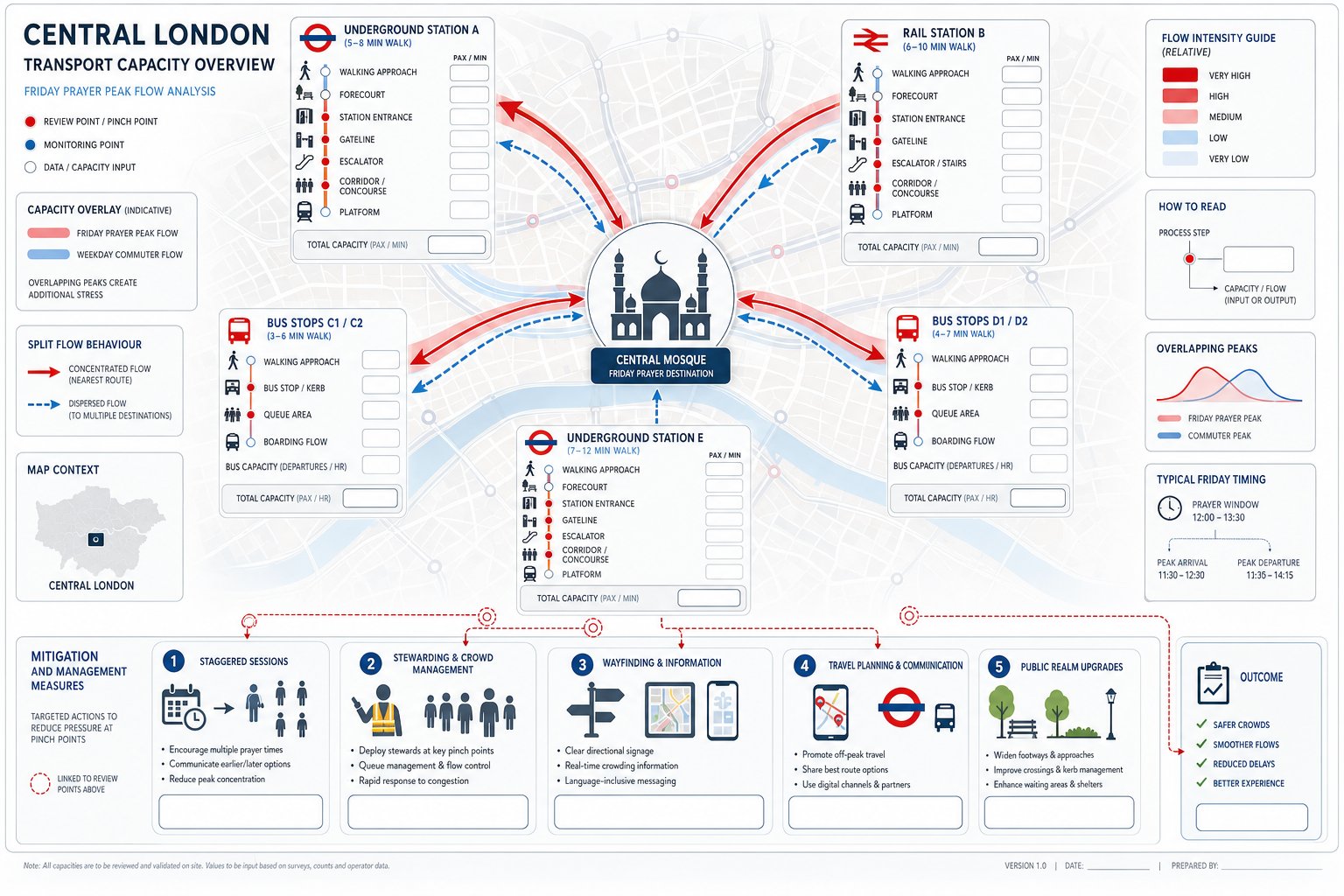
Public transport accessibility is usually one of the strongest arguments for a car-free mosque in central London, but it must be evidenced properly. PTAL is a starting point, not the whole assessment. Officers and TfL will want to understand the practical capacity of the nearest Underground, rail and bus connections at the times worshippers actually travel.
That means reviewing station entrances, gatelines, escalators, platforms and street-level approaches where relevant, especially if Friday peaks overlap with commuter flows or lunchtime crowding. A station that appears highly accessible on paper may still be constrained by narrow sub-surface corridors, one-way gate operation or a congested forecourt. The review should also consider whether attendees are likely to split across several stations or concentrate on the nearest, most legible route.
Bus access matters too. If routes are frequent but bus stops are already saturated, queuing and dwell time may become relevant. For some sites, bus-to-walk interchange is the dominant pattern. For others, rail and Tube demand will govern.
Mode share assumptions should be calibrated carefully and tested with sensitivity checks. In our work, the most persuasive reports are those that connect accessibility evidence with observed behaviour and local conditions, often drawing on the judgement of a Traffic Engineer In London: who understands how borough officers and TfL interpret capacity concerns in practice.
Where stress points are identified, mitigation may include staggered prayer sessions, stewarding, wayfinding, travel plan messaging or contributions linked to public realm and transport upgrades.
Walking Routes, Crowd Movement, And Pedestrian Safety
For a car-free mosque, walking is not just an assumed mode: it is often the dominant one. That makes pedestrian analysis central rather than supplementary. The assessment should identify the principal walking routes from stations, bus stops, nearby workplaces and residential areas, then test whether those routes remain safe, direct and comfortable at routine and peak times.
Footway width is the obvious starting point, but not the only one. We also need to understand guardrailing, street furniture, crossing delay, signal cycle length, servicing activity, pavement quality, lighting, personal security and existing pedestrian congestion. A route that works for everyday flows may become problematic when a Friday departure wave meets lunchtime workers, delivery riders and general footfall on the same frontage.
Healthy Streets indicators are particularly useful here because they force the assessment to address quality as well as raw capacity. Are routes easy to cross? Do they feel inclusive? Is there protection from traffic intimidation? Are there known collision records or KSI patterns nearby? Officers increasingly expect those questions to be answered, especially where crowding may spill into the carriageway.
Pedestrian management should be practical. That may include adjusted entrance design, internal waiting space, marshal positions, temporary barriers for major events, revised crossing points or dispersal messaging. Similar principles apply in other dense urban schemes, including Residential Development Transport, but mosque peaks are sharper and more visible, so the tolerance for weak pedestrian planning is lower.
Cycle Access, Parking Provision, And Supporting Facilities
Cycle provision can’t be an afterthought in a car-free strategy. If private car use is restricted, the alternative modes need to be genuinely usable, and for some worshippers, especially those living within a few kilometres, cycling will be realistic if the site supports it properly.
The assessment should hence cover both access and storage. Access means reviewing the local cycle network, junction conditions, permeability, one-way restrictions, links to existing TfL or borough cycle routes and any conflict points near the site entrance. Storage means providing long-stay and short-stay cycle parking to London Plan standards, in safe, convenient and overlooked locations, with designs aligned to current cycle parking guidance.
For mosques, there can be distinctive operational questions. Will peaks create short-term surges in demand before and after Friday prayer? Is there enough space to avoid cycle parking spilling informally onto footways? Are stands suitable for different cycle types, including adapted cycles used by disabled visitors? If the site includes ablution or ancillary facilities, are lockers or changing provision proportionate and feasible?
A good report also explains why the level of provision is appropriate rather than simply reproducing a standards table. In denser urban contexts, the balance between secure staff parking, visitor stands and future adaptability matters. And because central London sites are often tight, the design needs to work spatially as well as numerically. Officers notice when cycle parking is technically compliant but awkward, hidden or likely to be bypassed in practice.
Servicing, Deliveries, Refuse Collection, And Operational Access
Even a genuinely car-free mosque still needs to function day to day. Deliveries arrive, refuse is collected, cleaners and maintenance teams need access, and some sites may have catering, educational or community uses that increase operational demand. Planning officers will expect the transport assessment to deal with that plainly.
The usual approach is to define the likely servicing profile, identify vehicle types and frequencies, and show where loading, refuse presentation and collection will occur without obstructing the highway or compromising pedestrian safety. Off-street servicing is generally preferable where space allows, but many central London sites don’t have that luxury. If on-street activity is unavoidable, timing and management become critical.
The report should explain how deliveries are booked, whether large vehicles are prohibited, what happens during Friday prayer periods, and how refuse is stored and moved. Swept path analysis may be needed for any constrained access. So may kerbside observations, particularly where existing loading pressure is already high.
This is often one of the sections where local credibility matters most. Boroughs know their own streets intimately. A generic statement that “deliveries will be managed” rarely lands well. A more convincing approach is to tie servicing strategy to established central London operational constraints, the sort of issue routinely considered in Traffic Engineer In Manchester: and London city-centre work alike: narrow kerbs, timed restrictions, competing frontage uses and very little tolerance for obstruction.
Managing Drop-Offs, Blue Badge Access, And Taxi Activity
Car-free does not mean zero vehicle activity. The difficult part is making limited essential access work without allowing routine non-compliant drop-offs to take hold around the site.
Blue Badge access must be handled carefully and lawfully. The assessment should identify whether on-site provision is possible, whether nearby on-street bays can reasonably serve the mosque, and how the route from bay to entrance performs for disabled users. Distance, gradient, surfacing, crossing quality and shelter all matter. An inaccessible Blue Badge strategy is not a compliant one.
Taxi and private hire demand also needs honest treatment. In central London, some worshippers will arrive by licensed taxi or app-based vehicle, particularly older attendees, visitors unfamiliar with the network, and those attending funerals or late-evening Ramadan prayers. If that likelihood is ignored, informal stopping on red routes, side streets or cycle lanes can become the real transport problem.
So the report should set out where set-downs are expected, what restrictions apply, how waiting will be prevented, and what messaging or stewarding will control behaviour during peaks. For major events, temporary marshals and designated meeting points can make a large difference. The aim is not to pretend there will be no vehicle arrivals: it is to keep them limited, predictable and safe.
This is also where inclusive design intersects with enforcement reality. A scheme that is theoretically car-free but practically reliant on unmanaged kerbside stopping will attract planning and operational criticism very quickly.
Construction, Event Management, And Travel Planning Measures
A central London mosque may be acceptable in operation but still problematic in delivery if construction and event management are not planned properly. Officers will expect both.
During construction, the priority is protecting the surrounding street network from unnecessary obstruction and risk. A Construction Logistics Plan should cover vehicle routing, timing restrictions, contractor parking prohibition, loading arrangements, hoarding impacts, pedestrian diversions, cycle safety and coordination with neighbouring land uses. On constrained streets, even a short-term blocked footway can create disproportionate harm. That is why a disciplined methodology, like the one we apply in broader London Development Transport and transport assessment for developments: work, is so important.
Operationally, an event management plan should sit alongside the core assessment where exceptional peaks are anticipated. It should define triggers, stewarding levels, liaison procedures, communication methods, taxi management, queue controls and contingency actions if surrounding routes become crowded.
Then there is the Travel Plan. For this type of development, it should be more than a standard appendix. It needs clear mode-share objectives, mosque-specific measures, monitoring periods, survey commitments and review mechanisms. Messaging may include prayer-time travel guidance, walking and cycling promotion, public transport routing advice, accessibility information and reminders against informal parking or stopping.
If monitoring shows different behaviour than forecast, the plan should explain how measures will be tightened. That adaptive element matters. Officers know that real-world travel patterns evolve, especially after occupation.
Conclusion
In 2026, a successful Car-Free Mosque in Central London Transport Assessment is not built on policy slogans. It is built on evidence, local understanding and operational realism. Planning officers will expect a report that proves the scheme can work day to day, during Friday peaks and through exceptional periods such as Ramadan and Eid, without causing severe impacts or undermining safety.
For project teams, the message is straightforward: treat the mosque’s travel patterns as distinctive, not generic: test stations, footways and kerbside conditions properly: and address accessibility, servicing and event management with the same care as headline mode share. When that is done well, a car-free approach can be both policy-compliant and practical in central London.
Our view is that the strongest applications are the ones that confront pressure points early, explain them clearly and offer mitigation that officers can trust. That is what turns a difficult transport case into an approvable one.
Car-Free Mosque Transport Assessment FAQs in Central London
What are the key components a car-free mosque transport assessment must demonstrate in central London?
A car-free mosque transport assessment must prove no general car parking, support travel primarily via walking, cycling, and public transport, and identify residual effects with credible mitigation to prevent severe impacts under the National Planning Policy Framework and London Plan.
How does central London’s context affect the transport assessment approach for a car-free mosque?
Central London’s high PTAL, busy footways, constrained station capacity, and congestion charge zones demand a detailed, localised transport assessment focusing on pedestrian safety, crowd management, and public transport capacity rather than typical parking concerns.
Why is managing travel demand during Friday prayers critical for a car-free mosque in London?
Friday prayers cause compressed, high attendance peaks that can overwhelm footways, crossings, and station entrances. Transport assessments must analyse arrival and departure flows, queueing, and network effects to ensure safety and operational resilience during these times.
How should a transport assessment address exceptional periods like Ramadan and Eid for a car-free mosque?
Assessments need to forecast surges like late-night Ramadan prayers and Eid events, provide realistic travel mode assumptions, and set detailed event management strategies including stewarding, communication, and overflow arrangements to manage public realm pressure effectively.
What role does cycle access and parking play in a car-free mosque transport strategy?
Cycle provision must comply with London Plan standards and include secure, convenient parking for various users. Assessments should consider local cycle network access, operational surges before/after prayer times, and facilities like lockers or changing rooms to encourage cycling as a viable mode.
How are Blue Badge parking and taxi drop-offs managed in a car-free mosque transport assessment?
Blue Badge parking must be policy-compliant, accessible, and justified with detailed route analysis, while taxi and private hire demand requires managed set-down points, waiting controls, and stewarding during peak times to prevent informal stopping that reduces street safety and flow.