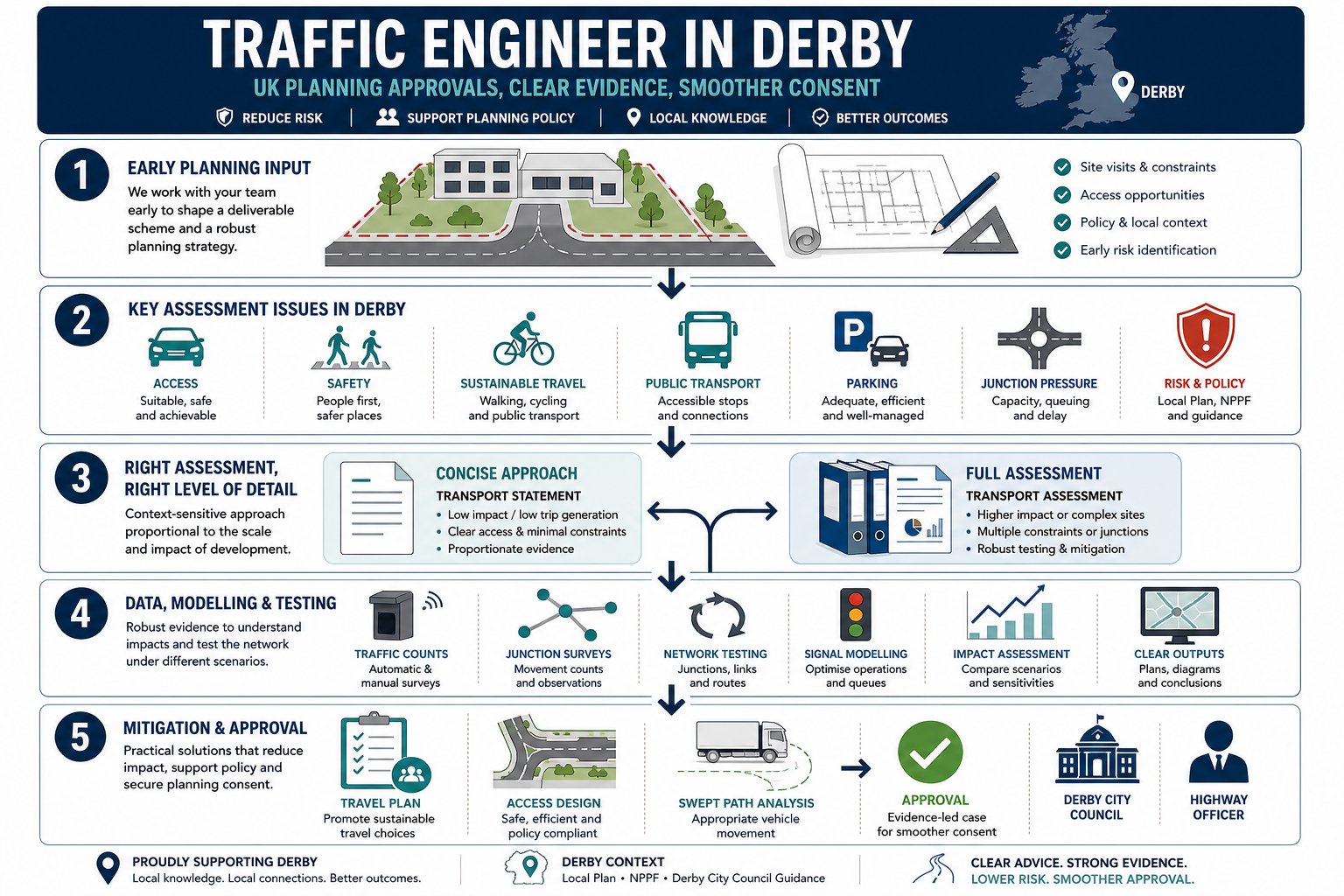
Planning consent in Derby rarely turns on architecture alone. A scheme can look commercially sound, fit its site neatly, and still stall because the transport case is weak, incomplete, or simply misjudged. That’s where a traffic engineer in Derby becomes central to the process.
For architects, planners, developers, surveyors and local authorities, the real question usually isn’t whether traffic will increase at all. It’s whether that increase can be shown to be acceptable in policy, workable in practice, and safe on the ground. In Derby, that means dealing with local validation requirements, highway authority expectations, sustainable transport policy, parking standards, access geometry, and the ever-important test of whether a proposal would create a severe residual impact.
We approach that problem from the planning side first. In other words, we don’t produce transport reports as box-ticking exercises. We build evidence that helps decision-makers understand how a development will operate, what mitigation is justified, and why an application should move forward with confidence. Sometimes that means a concise Transport Statement. Sometimes it means a full Transport Assessment, junction modelling, Travel Plan measures, speed data, swept path analysis, or technical responses to highways comments.
Done properly, transport input reduces planning risk early. And in a market where delays can cost far more than consultancy fees, that matters.
Key Takeaways
- A traffic engineer in Derby is crucial for developing a strong transport case that aligns with local planning policy and reduces planning risk early in the process.
- Transport assessments or statements must be carefully scoped based on site context, with evidence-led trip generation, access design, and sustainable travel considerations.
- Early engagement with architects, planners, and local authorities allows for proactive adjustments to access, parking, and servicing that prevent objections and delays.
- Accurate, timely traffic surveys and realistic modelling are essential to establish credible transport impacts and secure planning approval without costly revisions.
- Clear, concise, and locally tailored reporting is vital for satisfying Derby’s highway officers and ensuring transport evidence supports the planning application effectively.
- Prioritising coordinated transport strategy and mitigation from the initial project stages significantly improves the likelihood of smooth and timely approval for Derby developments.
Why A Traffic Engineer Matters For Development Projects In Derby
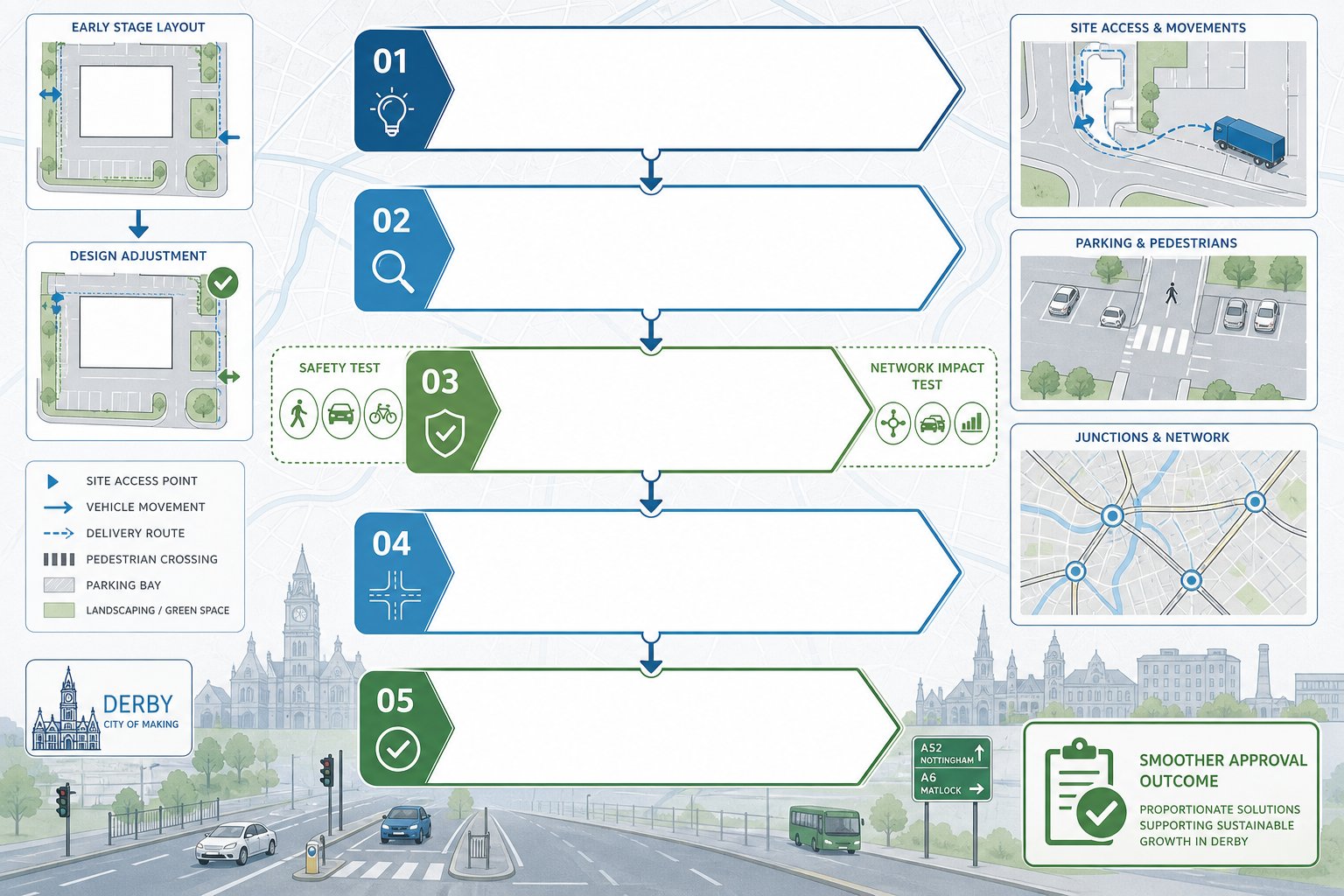
A traffic engineer in Derby helps translate a development proposal into highway terms that planning officers, highway officers and, where relevant, National Highways can properly assess. That sounds simple. It isn’t.
Most schemes generate concern in predictable areas: additional vehicle movements, access safety, parking pressure, servicing, pedestrian connectivity, and cumulative impact on nearby junctions. The role of the traffic engineer is to test those issues objectively and present them in a way that aligns with the National Planning Policy Framework, local transport policy and accepted technical guidance.
One of the key planning tests is whether a proposal would result in an unacceptable impact on highway safety, or a severe residual cumulative impact on the road network. That wording carries weight. It means assumptions need to be credible, evidence needs to be robust, and mitigation needs to be proportionate. If the transport case is weak, the application can unravel quickly.
We often find the biggest value comes early, before layouts are fixed. A minor repositioning of an access, a more realistic parking arrangement, or a better servicing path can remove objections before they appear. That early-stage input is often what separates a smooth approval from a long, expensive round of revisions.
For teams comparing local approaches, the issues are broadly similar to those discussed in Traffic Engineering Consultants: broader planning work, but Derby schemes still need place-specific judgement.
Local Planning And Highway Considerations That Shape Derby Schemes

Derby projects sit within a layered policy environment. National guidance matters, of course, but local interpretation matters just as much. Derby City Council and Derbyshire County Council will look at proposals through the lens of local plan policies, parking standards, walking and cycling priorities, road safety expectations, and practical network constraints around the site.
That means transport evidence has to do more than repeat generic standards. It should respond to the development’s context: proximity to bus corridors, rail access, schools, town or district centres, existing footway quality, cycle connections, collision history, and the character of the surrounding highway network. A suburban edge-of-settlement site in Derbyshire is not assessed in the same way as a constrained urban infill plot close to the city centre.
Parking is one recurring pressure point. Under-provision can trigger overspill concerns: over-provision can conflict with sustainable travel aims or undermine the layout. The right answer is usually evidence-led rather than ideological. The same goes for active travel links. If a site claims strong sustainable accessibility, officers may expect that claim to be backed by realistic walking distances, crossing opportunities and bus service quality.
We also need to consider whether Road Safety Audit input is likely to be required, whether access works may fall under Section 278, and whether legal obligations or phased mitigation could be necessary. Comparable planning-led transport issues arise in Traffic Engineer In Birmingham: city schemes too, but Derby’s own thresholds and officer expectations should always shape the final reporting strategy.
When A Transport Assessment Or Transport Statement Is Needed
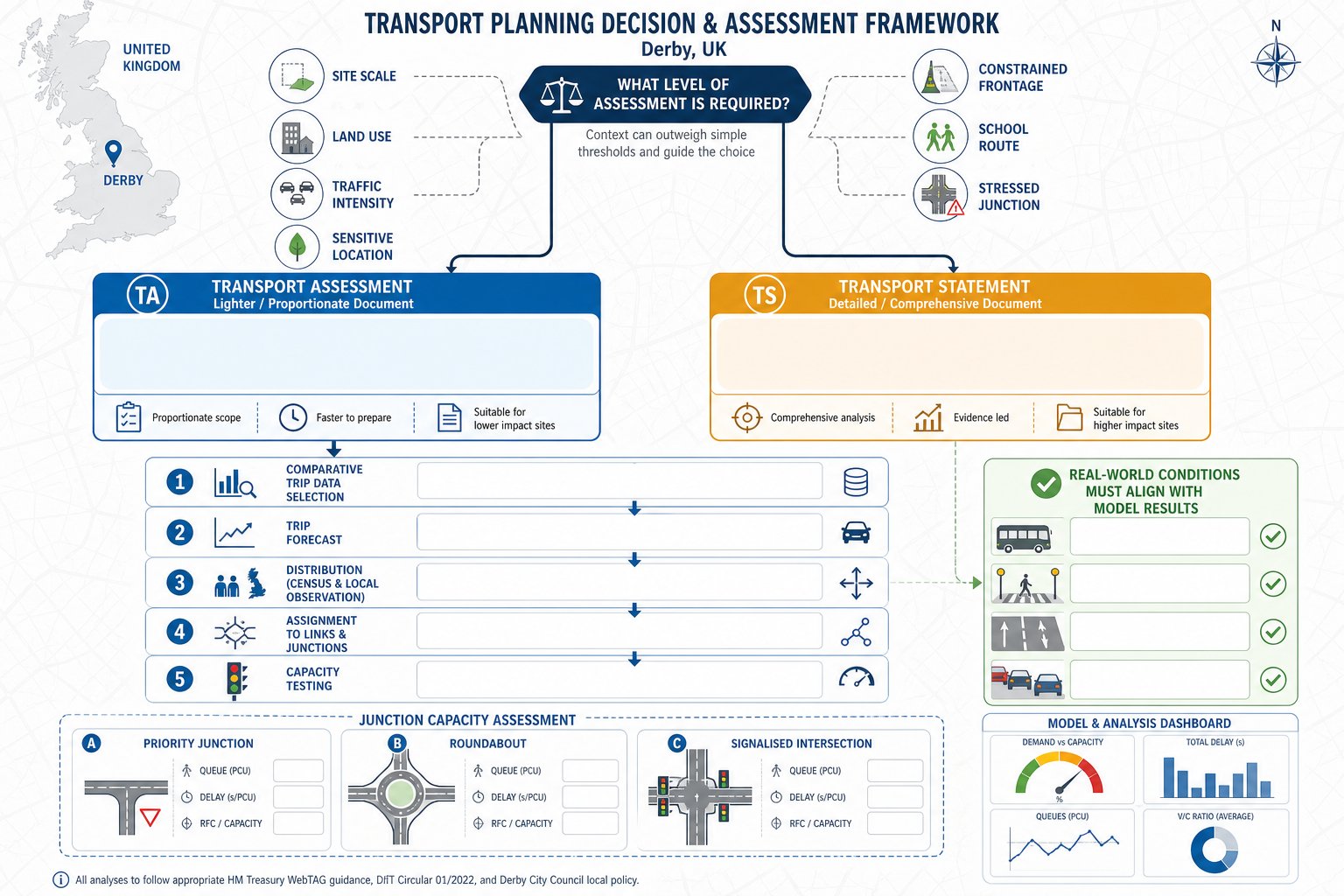
Whether a scheme needs a Transport Assessment (TA) or a Transport Statement (TS) depends on scale, intensity, land use, and sensitivity of location. In broad terms, a TS is usually suitable for smaller developments where traffic effects are likely to be limited. A TA is more detailed and is generally required for larger, more traffic-intensive, or more sensitive proposals.
The Department for Transport’s Guidance on Transport Assessment remains the starting point, but local validation requirements and officer expectations are decisive in practice. A modest proposal on paper can still justify substantial transport work if it sits on a constrained frontage, near a busy school route, or beside a junction already under pressure.
A well-scoped TS should explain existing conditions, forecast development trips, review accessibility, test access arrangements and show that impacts are not materially harmful. A TA goes further. It will often include committed development review, distribution and assignment, capacity assessment, mitigation proposals, and more formal consideration of travel planning.
The mistake we see most often is treating the TA/TS choice as a purely numerical threshold exercise. It isn’t. Context matters. Officer concerns matter. And programme risk matters. If there’s any doubt, scoping the transport submission early can save weeks later.
That planning-first judgement is common across urban authorities: the same pattern appears in Traffic Engineer In Leeds: work where site context can outweigh headline trip totals.
How Trip Generation And Junction Impact Are Assessed
Trip generation typically starts with TRICS or other suitable comparative evidence, selecting sites that genuinely resemble the proposed development in scale, location and travel characteristics. That selection stage matters more than people sometimes think. Weak comparables can undermine an otherwise solid report.
Once trips are forecast, we assess where they are likely to travel using census data, local observations, committed development information and network logic. Those flows are then assigned to the relevant junctions and links. The next question is straightforward: can the network cope?
For priority junctions and roundabouts, modelling might use Junctions software such as PICADY or ARCADY. For signalised junctions, LINSIG is common. We look at practical metrics including queue length, delay and ratio of flow to capacity. But modelling outputs are not the whole story. On-site conditions, lane discipline, nearby crossings, bus activity and blocking back can all affect how robust the conclusions are.
In Derby, officers will expect the narrative to match the maths. If a model says everything works perfectly but local conditions plainly suggest otherwise, credibility drops fast.
Typical Traffic Engineering Reports Required For Planning Applications

Planning applications in Derby can require anything from a short technical note to a suite of coordinated transport documents. The right package depends on the land use, site constraints, consultation history and likely highway concerns.
At the core, most submissions revolve around the same themes: how people will reach the site, how vehicles will enter and manoeuvre, whether the network can absorb the demand, and what measures will support sustainable travel and safety. The transport engineer’s task is to make those points clear, proportionate and policy-aligned.
For some schemes, a concise statement backed by a plan and a few targeted appendices is enough. For others, especially mixed-use or phased development, the application may need a TA, Travel Plan, access design material, swept path evidence, parking strategy and formal responses to pre-application comments. Technical notes are often just as important as headline reports, particularly when officer queries arise late in the process.
Our preference is to keep reporting concise where possible. Decision-makers do not benefit from 200 pages of repetition. They do benefit from a document set that answers the actual planning questions quickly and defensibly.
Transport Assessments, Transport Statements, And Travel Plans
Transport Assessments and Transport Statements are the main planning documents, but Travel Plans often carry equal practical importance. A Framework or Full Travel Plan sets out how the development will encourage travel by walking, cycling, bus, rail, car sharing and other sustainable modes where realistic.
The stronger Travel Plans are specific. They identify site constraints, likely user groups, delivery responsibilities, monitoring arrangements and sensible targets. Weak ones tend to drift into vague promises about cycle information boards and welcome packs. Officers have read plenty of those.
For residential schemes, the focus may be on location-specific travel information, cycle parking, pedestrian links and public transport awareness. For employment or education uses, there may be more emphasis on mode share targets, coordinators, monitoring and phased measures. The right level of detail depends on the proposal and whether the Travel Plan will be secured by condition or obligation.
Approaches used in Traffic Engineer In Manchester: planning work show a similar principle: concise reporting wins when it is backed by genuinely usable mitigation.
Speed Surveys, Swept Path Analysis, And Access Reviews
These supporting studies often decide whether a planning application feels technically complete. Speed surveys help establish visibility requirements and can influence whether an access arrangement is realistic without major off-site works. Depending on the road type and conditions, data may come from automatic traffic counters or approved spot speed methods.
Swept path analysis demonstrates whether vehicles can safely enter, turn and leave the site. That can involve refuse vehicles, fire appliances, articulated deliveries, coaches or construction traffic, depending on the use. The drawing itself is only part of the exercise: it has to reflect believable tracking assumptions and workable geometry.
Access reviews pull the main issues together: junction form, width, radii, visibility splays, gradients, pedestrian conflict points, boundary constraints and nearby collision history. Sometimes the conclusion is reassuring. Sometimes it shows the access needs redesign before submission. Better to discover that early than in a formal objection.
This kind of technical support sits alongside wider planning advice, much like the site-specific work described by a Birmingham Transport Consultant: when applications hinge on a single access point.
Traffic Surveys And Data Collection For Derby Planning Evidence

Transport reports are only as reliable as the evidence beneath them. In Derby, survey strategy often determines whether a submission is accepted smoothly or challenged in consultation.
Typical data collection may include turning counts at nearby junctions, automatic traffic counts, queue surveys, pedestrian and cycle counts, parking beat surveys, bus stop observations and, where appropriate, speed surveys. The selection should be led by the questions the planning application needs to answer, not by habit.
Survey timing matters as much as survey type. School holidays, roadworks, diversions, abnormal weather, rail disruption, nearby events and temporary closures can all distort results. If that context is not explained, officers may doubt the whole dataset. Likewise, if baseline counts are old, the report should justify why they remain representative or explain how they have been factored.
For many Derby sites, we also need a practical understanding of network behaviour that raw counts alone won’t show: informal parking patterns, delivery activity, parent drop-off peaks, pedestrian desire lines, or queues that relocate rather than disappear. Good transport evidence combines numerical data with observed reality.
That’s one reason concise specialist support tends to outperform generic templates. Whether the project is local or compared with work such as Traffic Engineer In Bristol: assignments, the principle is identical: collect the evidence that answers the authority’s likely objections before they are raised.
Highway Design, Site Access, And Safety Appraisal
A planning application can survive a moderate increase in traffic more easily than it can survive a flawed access design. If vehicles cannot enter safely, if pedestrians are squeezed into poor routes, or if servicing blocks circulation, the transport case weakens quickly.
Highway design at planning stage usually focuses on preliminary rather than detailed design, but it still needs to be credible. We review access width, corner radii, gradients, visibility splays, tracking, parking layout, turning heads, refuse collection arrangements, cycle provision and pedestrian links. The standards may draw on Manual for Streets, DMRB and local authority guidance, with the balance depending on road function and context.
Safety appraisal is not just a box to tick. A Road Safety Audit may be required for new or altered highway works, and even where it is not formally requested, the design should still be interrogated from a user perspective. Where are the conflict points? Can pedestrians cross desire lines safely? Will larger vehicles overrun footways? Does outbound visibility work in winter, not just in ideal summer conditions?
The best schemes usually show restraint. They don’t over-engineer a simple access, but they don’t rely on wishful thinking either. A clean, policy-aware design note backed by sensible drawings tends to give officers confidence that the proposal can move from planning into delivery without unpleasant surprises.
Working With Architects, Planners, Developers, And Local Councils
Transport engineering works best when it is integrated into the project team, not added at the end. We often start with a layout review alongside architects, because site design decisions made early can shape almost every transport outcome that follows.
Architects need to know how access geometry, parking courts, bin collection routes and visibility requirements affect the layout. Planners need a realistic view of policy risk, likely highways objections and whether pre-application engagement is worth the time. Developers need to understand what mitigation may be required and whether it affects viability or programme. Lawyers, meanwhile, often come into the picture when obligations, highway agreements or planning conditions need careful drafting.
Then there is the authority interface. Constructive engagement with highway officers can resolve a great deal before determination. That may include agreeing scope, confirming survey expectations, discussing junction modelling assumptions, or narrowing what mitigation is genuinely necessary. Where the strategic road network is involved, National Highways may also need to be consulted.
The process is rarely linear. A revised layout can trigger revised tracking: a junction comment can prompt a fresh sensitivity test: a planning officer query may require a short technical note within 48 hours. Teams that work collaboratively generally handle that pressure better. Similar coordination patterns appear in Traffic Engineer In London: project work, although Derby decisions often turn more sharply on local network practicality than on sheer report volume.
Common Issues That Delay Transport Approval And How To Avoid Them
Most transport delays are not caused by obscure technical problems. They come from predictable weaknesses that could have been avoided much earlier.
One common issue is inadequate survey data. Counts may be out of date, collected in abnormal conditions, or too limited to support the conclusions drawn. Another is underestimating trip generation in an effort to make impacts look smaller. That usually backfires. Officers and reviewers tend to challenge optimistic assumptions quickly, and once confidence is lost, every part of the report comes under heavier scrutiny.
Poor access design is another frequent problem. We still see schemes submitted with marginal visibility, awkward gradients, impossible servicing movements or parking that functions only if no one opens a car door. Add in weak policy references or a generic Travel Plan and the application starts to look undercooked.
Early engagement is the best remedy. If there is a likely dispute about scope, agree it. If local guidance points toward a Road Safety Audit, don’t leave it until after objection. If junctions are sensitive, test scenarios before locking the site layout. And if the authority has asked for a particular assessment method, address it directly rather than arguing around it.
In practice, smoother approvals usually come from ordinary discipline: sound data, realistic assumptions, concise explanation and timely responses to comments. Nothing glamorous, but it works.
Choosing A Traffic Engineer In Derby For Clear, Policy-Aligned Reporting
Not every transport consultant is the right fit for a Derby planning application. Technical competence is essential, but so is judgement: knowing how much analysis is enough, what local officers are likely to focus on, and how to present findings in a way that supports rather than burdens the planning case.
We’d suggest looking for three things. First, relevant qualifications and experience, ideally with chartered status, strong transport planning credentials and practical road safety or highway design knowledge. Second, a track record with Derby or comparable authorities, including familiarity with local validation expectations, policy wording and officer concerns. Third, report quality. Dense reports can still be weak if they do not answer the actual planning questions.
Clear writing matters more than many teams expect. A planning officer or committee member should be able to understand the transport position without fighting through jargon. That doesn’t mean oversimplifying. It means explaining assumptions, impacts and mitigation in a structured, defensible way.
At ML Traffic, our focus is concise, accurate reporting delivered quickly and tailored to local thresholds and planning context. That approach reflects what many project teams actually need: not a mountain of paperwork, but evidence that stands up when scrutinised.
There’s value in comparing methods across authorities too: work reflected in Traffic Engineer In Liverpool: schemes shows how local insight and concise reporting often matter more than report length.
Conclusion
For Derby development projects, transport evidence is rarely a side issue. It often determines whether an application feels credible, safe and policy-compliant from the outset. A capable traffic engineer in Derby helps turn transport from a planning risk into a structured case for approval.
That means more than producing a Transport Assessment or a few tracking drawings. It means understanding local policy, collecting the right evidence, testing realistic impacts, shaping workable access arrangements and responding clearly to highway concerns. When that work is done early and done well, approvals tend to move faster and with fewer surprises.
For architects, planners, developers, surveyors and councils alike, the practical takeaway is simple: align transport strategy with planning strategy from day one. The result is usually a cleaner application, a stronger technical case and a far better chance of smooth highway sign-off in 2026.
Frequently Asked Questions about Traffic Engineering in Derby
What role does a traffic engineer play in Derby development projects?
A traffic engineer in Derby evaluates how a development impacts local and strategic highways, ensuring proposals meet Derby City and Derbyshire County Council policies, including safety and traffic flow, to gain planning approval smoothly.
When is a Transport Assessment or Transport Statement required for a Derby planning application?
Smaller or less traffic-intensive developments usually need a Transport Statement, while larger or more sensitive sites require a detailed Transport Assessment, based on Department for Transport guidance and local Derby authorities’ validation standards.
How do traffic engineers assess junction impact for new developments in Derby?
They forecast trip generation using TRICS databases, assign trips to junctions, and model capacity with software like PICADY, ARCADY, or LINSIG, checking practical factors such as delays and queue lengths against local safety and performance criteria.
What common issues cause delays in obtaining transport approval in Derby, and how can they be avoided?
Delays often stem from inadequate survey data, underestimating trip generation, poor access design, or insufficient early engagement with highway officers. Appointing a qualified traffic engineer early and following agreed methodologies prevents these problems.
How does local policy influence traffic engineering for planning in Derby?
Local policies on parking standards, sustainable transport, walking and cycling priorities, and road safety shape transport evidence requirements, ensuring development proposals align with Derby and Derbyshire’s specific planning frameworks and practical network conditions.
What qualifications should I look for when choosing a traffic engineer in Derby?
Select a chartered engineer with PTOE or road safety expertise, proven experience in Derby or similar authorities, knowledge of local policies, and a reputation for clear, concise reports that facilitate highway authority approval and mitigate planning risks.