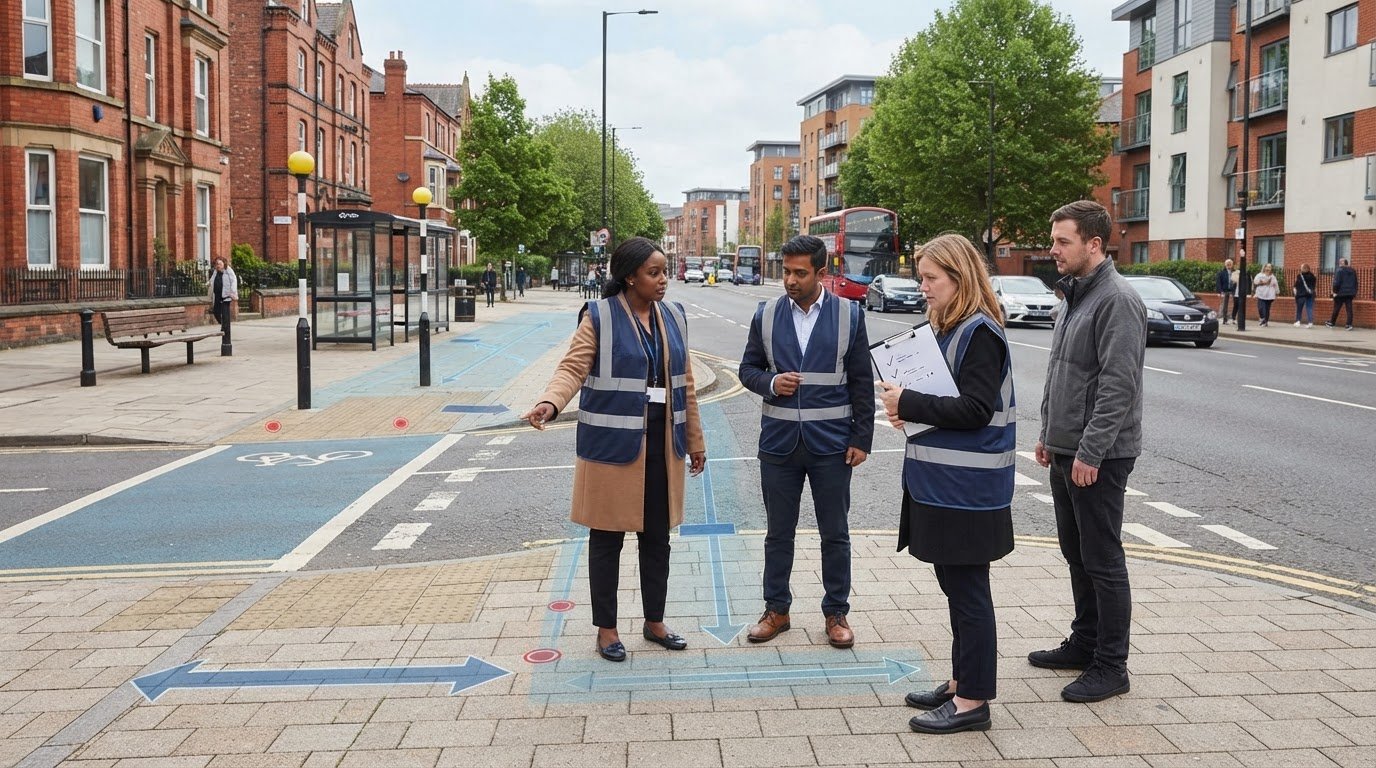
Can a street score capture what it’s actually like to walk there? If you’re asking what is a pedestrian environment review system (PERS), the answer starts with a distinction: PERS gives planners a structured way to assess pedestrian conditions, but its scores are not the whole story. A route may look adequate on a plan, while barriers, crossing conditions or the quality of the surroundings shape the experience on foot.
PERS reviews pedestrian facilities and records findings so strengths and issues can be compared and prioritised. This structure is useful when a development could affect how people reach local destinations. However, a score needs to be read alongside the site context and the needs of people using the route, not treated as a standalone verdict.
This article explains what PERS covers, how its findings are documented and how to interpret scores without losing sight of people’s experience. It also explains that PERS is an assessment tool whose place in a planning process depends on the project context. Finally, it looks at how pedestrian evidence can inform wider transport planning, including Transport Statements and Transport Assessments shaped around local planning considerations.
Key Takeaways
- Understand what is a pedestrian environment review system (PERS) and how it organises observations about walking conditions.
- Follow the audit process from defining the review area to recording findings, with attention to the methodology used.
- Interpret PERS scores as evidence about specific conditions, rather than a complete judgement of a place.
- See how pedestrian evidence can inform development decisions alongside a Transport Statement or Transport Assessment.
- Use a practical checklist to clarify the review’s purpose, scope and planning context before treating PERS as a project requirement.
What Is a Pedestrian Environment Review System (PERS)?
The Pedestrian Environment Review System (PERS) is a structured system for reviewing pedestrian environments and recording observations about walking conditions. It gives assessors a consistent framework for examining what people encounter on foot, rather than relying on general impressions. In practical terms, what is a pedestrian environment review system (PERS) designed to capture? The physical conditions and features of pedestrian spaces, assessed in a structured way.
That distinction matters. A pedestrian count records how many people pass a point during a set period; PERS focuses on the environment they use. It can help identify features that support or hinder walking, but it does not, by itself, explain how many people walk, why they choose a route or how they experience it in every circumstance.
For a visual introduction to a PERS walking review, watch this demonstration:
What does PERS stand for, and what is it designed to do?
PERS stands for Pedestrian Environment Review System. It aims to make reviews of pedestrian conditions more consistent by directing attention to features of the environment and recording observations for later consideration. Published accounts associate the system’s development with the Transport Research Laboratory (TRL) and the London Borough of Bromley. The Pedestrian Environment Review System (PERS) is also discussed as a walking-audit tool, providing context for readers new to the term.
A structured review makes observations easier to communicate and compare, but the findings still need interpretation. They describe conditions within the area and scope reviewed. They do not automatically establish what caused a problem or which improvement is appropriate. Those decisions depend on the location, the people using it and the planning context.
What is meant by the pedestrian environment?
The pedestrian environment includes walking routes and the public-realm conditions around them. A route may include a footway or shared path, junctions and crossing points, as well as places where people wait or change between modes of travel. PERS descriptions commonly refer to elements such as links and crossings; wider summaries also identify routes, public transport waiting areas, public spaces and interchange spaces. The elements considered depend on the audit scope and methodology.
For example, reviewing a link means considering the walking space along a stretch of route, while reviewing a crossing focuses on a place where pedestrians cross a road or another route. These are different parts of a journey, so a finding about one should not be treated as a complete account of the other. Together, recorded observations can give planners a clearer picture of the pedestrian environment around a site. They describe the reviewed environment, but do not replace an assessment of how a proposed development connects with its surroundings.
How Does a PERS Audit Work, from Site Review to Findings?
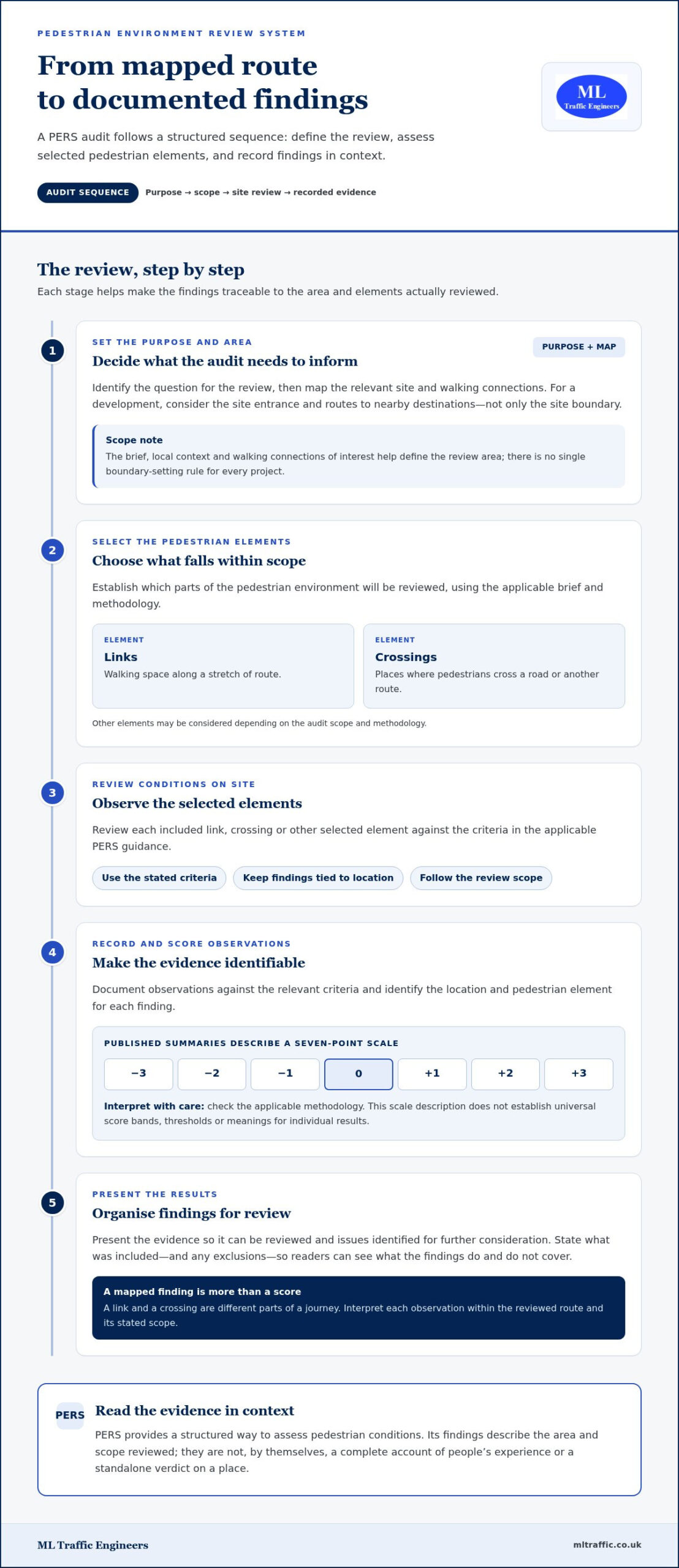
A PERS audit moves from defining what to review to recording observations in a consistent format. The exact scope and reporting format can vary with the project brief and methodology, so findings should be read alongside the guidance used for the assessment. In practice, the process follows a clear sequence:
- Set the review purpose and area. Identify the question the audit needs to inform and map the relevant site and walking connections.
- Select the pedestrian elements. Establish which parts of the environment fall within scope, such as links or crossings.
- Review conditions on site. Observe the selected elements using the criteria in the applicable PERS guidance.
- Record and score observations. Document findings against the relevant criteria, identifying each location and element.
- Present the results. Organise the evidence so it can be reviewed and used to identify issues for further consideration.
How are routes and review areas defined?
The review boundary should match the audit’s purpose. For a development, that may mean considering the site entrance and the walking connections to nearby destinations, rather than drawing a boundary around the site alone. There is no single boundary-setting rule for every project. The brief, local context and walking connections of interest all help define the area under review.
Mapping the area first makes the assessment easier to follow. It shows which links and crossing points are included, where one element ends and another begins, and whether a relevant connection falls outside the boundary. This gives context to individual observations: a finding about one stretch of footway can be understood as part of a mapped route, not an isolated note. The report should also state any exclusions so readers can see what the findings do and do not cover.
How do observations become PERS findings?
During a site review, the auditor records conditions against the relevant PERS criteria and links those observations to the pedestrian elements being assessed. Published summaries describe a PERS scoring approach that uses a seven-point scale from -3 to +3. Check the applicable methodology before interpreting the scale: this description does not establish score bands, thresholds or the meaning of any particular result across every version or project.
A PERS score represents an assessment of a specific pedestrian element against the criteria used for that review. It is not a score for every aspect of walking in the area, nor does it explain the cause of a condition on its own. A useful record connects the score to its location, the observed evidence and the method applied. Some PERS workflows also use GIS software to organise and analyse collected data, although the tools and outputs depend on the assessment setup.
Before relying on a finding, look for a clear audit boundary, a list of the elements reviewed, the methodology and a record linking observations to their locations. This helps keep conclusions proportionate to the evidence. If the results need to inform a development proposal, locally tailored transport planning can place pedestrian evidence in the wider project context.
What Does PERS Assess, and How Should You Interpret Its Scores?
PERS findings are most useful when you know what was reviewed, where it was reviewed and which observations support each score. A summary score can help organise evidence, but it cannot describe every feature of a place or represent every pedestrian’s experience. Read it as one part of the assessment, not a standalone verdict.
Which pedestrian elements can PERS review?
Links and crossings are identifiable PERS elements. A link is a stretch of pedestrian route; a crossing is a place where people move across a road or another route. These parts of a journey have different functions, so reviewing them separately helps show where a condition occurs.
| Element | What the review considers |
|---|---|
| Link | Conditions along a section of pedestrian route. |
| Crossing | Conditions at a place where pedestrians cross. |
Other elements may appear in PERS descriptions, but the categories in a particular audit should be checked against the applicable methodology and project scope. Do not assume every assessment covers the same set. A pedestrian review is also not a comprehensive cycling assessment: the modes, questions and assessment criteria are not interchangeable.
What can a PERS score tell you, and what can it not?
A PERS score summarises how a reviewed element was assessed against the criteria used in that audit. Across a mapped area, scores can make observations easier to organise, compare and communicate. They can help a project team identify where further investigation or design consideration may be useful.
A score is evidence about the conditions of a particular reviewed element, not a complete verdict on a place. On its own, it cannot explain why a condition exists, establish how every person experiences it or determine the right response. For example, a crossing score should be considered alongside the recorded observations and the crossing’s relationship to the wider route, rather than interpreted in isolation.
Context matters. A summary can conceal differences between locations or between the conditions that informed the assessment. Check the audit boundary, methodology, observations and any limitations before drawing conclusions. The method records and organises evidence; professional interpretation connects it with the site and the question being examined. Project teams then use the relevant wider evidence and planning context to make decisions.
PERS scores do not, by themselves, certify safety, demonstrate legal compliance or determine a planning decision. If you’re asking what is a pedestrian environment review system (PERS), this distinction is central: the system provides a structured way to review pedestrian conditions, while the meaning and use of its findings depend on scope, evidence and context.
When Can PERS Findings Help with Development and Planning?
PERS findings can add site-specific evidence to a development discussion by showing pedestrian conditions along routes people may use to reach a proposed site. They can help identify constraints, connections or design questions for further consideration. Their value depends on how clearly the review relates to the project, its location and the walking routes included.
How might PERS inform a development discussion?
Imagine a proposed development near a local high street. A review records a narrow section of footway or a crossing that may affect a route between the site and nearby shops. That finding raises practical questions: does the proposed access connect well with the existing route, and should the design team consider how people would move through this point?
The finding frames a discussion; it does not prescribe a solution or prove that a proposal is acceptable or unacceptable. A project team can consider it alongside site plans, access arrangements and other relevant evidence, then assess whether design changes or further investigation are appropriate. PERS findings do not secure planning permission and should not be presented as a substitute for a planning authority’s assessment.
Planning expectations can vary with the authority, proposal and site context. Do not assume every development needs a PERS audit or that one approach applies across the UK. Review the relevant authority’s project-specific expectations and guidance before treating a particular assessment as necessary.
How does PERS differ from transport planning reports?
PERS focuses on reviewing pedestrian-environment conditions within a defined scope. A Transport Statement or Transport Assessment addresses wider transport matters relevant to a proposal. Depending on the project, these reports may consider how a development relates to transport networks and access. PERS findings can provide useful pedestrian evidence, but they are not interchangeable with these planning reports and do not replace them.
The appropriate report depends on the proposal and its planning context. A Transport Assessment London guide explains the broader role of transport assessment in development planning. Pedestrian evidence may form one part of a wider assessment, considered alongside the project’s other transport issues and local authority expectations.
Understanding what is a pedestrian environment review system (PERS) helps keep its role clear: it can inform a development discussion with structured pedestrian evidence, but it is not itself a planning decision or a complete transport assessment. For support with wider transport planning requirements, discuss your development’s transport planning needs with ML Traffic Engineers UK.
What Should You Do Next if Your Project Raises PERS Questions?
A PERS report is most useful when its scope and purpose are clear. Before relying on its findings in a development discussion, check what was assessed, how the method was applied and how the results relate to the planning question. Review the relevant planning authority’s project-specific expectations before treating a PERS audit as a requirement. Expectations can vary by authority and proposal, so avoid assuming one approach applies everywhere.
Questions to clarify before relying on a PERS report
Use this checklist to understand what the report can and cannot tell you:
- Purpose: What project question was the review intended to inform?
- Area: Which routes, links, crossings or other pedestrian elements were included, and what fell outside the review boundary?
- Methodology: Which PERS methodology or version was applied? Check that the report identifies it clearly.
- Findings: Can you connect each score or conclusion to the relevant location and recorded observation?
- Limitations: Does the report explain any gaps in coverage or constraints on how the findings should be interpreted?
- Planning context: What does the relevant authority expect for this proposal, and how does the pedestrian evidence relate to that expectation?
If the report does not make these points clear, interpret its conclusions cautiously. A summary may help identify issues, but decisions should account for the evidence behind it and the wider development context. Use the relevant authority’s guidance or application discussions to understand project-specific planning expectations, rather than assuming PERS is automatically required.
How wider transport planning can support a development
Pedestrian-environment evidence may be relevant to a wider assessment of how a development connects with its surroundings. It does not replace a Transport Statement or Transport Assessment, which address broader transport considerations. The appropriate documentation depends on the proposal, its location and the planning context.
ML Traffic Engineers UK prepares Transport Statements, Transport Assessments and Green Travel Plans, with assessments tailored to local planning context and variations between authorities. Senior staff have over 35 years of traffic engineering experience. This wider transport planning perspective can place pedestrian questions alongside other relevant issues for a planning submission, without treating a PERS score as the sole basis for a project decision. The company works across Greater London, Manchester, Birmingham, the West Midlands, Liverpool, Surrey, East Sussex, West Sussex, Hampshire, Berkshire and Buckinghamshire.
Once you’ve clarified the review scope and planning expectations, consider how pedestrian evidence fits the development’s transport requirements. Discuss your project’s transport planning requirements with ML Traffic Engineers UK.
Put pedestrian evidence into your next project decision
Start by deciding what the pedestrian evidence needs to help you understand. Consider how it connects with the development’s access strategy, nearby destinations and the planning authority’s expectations. This keeps the discussion focused on practical project questions instead of treating a PERS result as an answer in itself.
If you began by asking what is a pedestrian environment review system (PERS), the key takeaway is that pedestrian findings can support planning decisions when considered in context. They sit alongside, rather than replace, wider transport planning. The right approach depends on the proposal and local planning context, so clarity at an early stage can help identify the relevant evidence and reporting needs.
ML Traffic Engineers UK prepares transport planning reports with local authority variations in mind, drawing on senior staff with over 35 years of traffic engineering experience. Discuss your project’s transport planning requirements and consider how pedestrian evidence may fit into the wider assessment. A clear, context-led next step can help move your project forward.
Frequently Asked Questions
Is a Pedestrian Environment Review System assessment required for planning permission?
A PERS assessment should not be assumed to be a requirement for every planning application. The relevant planning authority may set project-specific information expectations, depending on the proposal and its context. If you’re asking “what is a pedestrian environment review system (PERS), and do I need one?”, start with the authority’s guidance or application advice for your site. Expectations may differ, for example, between a town-centre scheme and a development on the edge of a settlement.
Who developed the Pedestrian Environment Review System?
PERS was developed by the Transport Research Laboratory (TRL) and the London Borough of Bromley, according to available accounts. The research information for this article dates its original development to 2001. That history gives the system a London connection, but does not mean the methodology is restricted to London. If citing its origins in a formal report, refer to the relevant original methodology so the attribution and date match the version being discussed.
Can PERS assess crossings separately from walking links?
Yes. Links and crossings can be treated as distinct pedestrian elements in a PERS review, so findings can relate to a particular part of a journey. For example, a report might record a condition on a footway link separately from one at a nearby crossing. When reviewing the results, check that each observation is associated with the correct element and location. This helps prevent a finding about one point from being applied to the whole route.
Can PERS be used to assess cycle routes?
PERS is a pedestrian-environment review, so it should not be treated as a comprehensive assessment of cycle-route provision. A shared path could be considered for its pedestrian environment when it falls within the audit scope, but that would not automatically assess the route from a cyclist’s perspective. If a proposal raises questions about both walking and cycling, treat them as separate assessment needs and identify which methods address each mode.
How long does a PERS audit take?
There is no single duration that applies to every PERS audit. The time required depends on the area included, the pedestrian elements selected, site-review arrangements and the work needed to record and present findings. A small, clearly bounded review differs from one covering a wider network. For project planning, establish the scope and reporting outputs first, then set a programme that reflects the assessment tasks.
Can PERS be used outside London?
PERS is not inherently limited to London. Although its development is associated with TRL and the London Borough of Bromley, the system can be considered for pedestrian reviews elsewhere in the UK. Its suitability for a particular proposal is a separate question: authorities may have different expectations, and the project team should establish whether the methodology fits the site and planning purpose. This is relevant for schemes in Manchester or Birmingham as well as London.
What information should a project team review in a PERS report?
Check that the report explains its purpose, boundary and methodology, and identifies the pedestrian elements covered. Look for observations tied to mapped locations, an explanation of how scores relate to those observations, and any stated limitations or exclusions. Note when the site review took place and whether the report explains relevant conditions at the time. These details help the team judge whether the findings address its project question or whether further evidence may be needed.

Disclaimer
The content on mltraffic.co.uk, including all technical articles, guides, and resources, is provided for general informational and educational purposes only. It is not intended to constitute professional advice in traffic engineering, transportation planning, development approvals, or any other technical or legal field.
While ML Traffic Engineers makes every reasonable effort to ensure the accuracy, completeness, and timeliness of the information published, we do not provide any warranties or representations (express or implied) regarding its reliability, suitability, or availability for any particular purpose. Any reliance you place on the content is strictly at your own risk.
In no event shall ML Traffic Engineers, its directors, employees, authors, or affiliates be liable for any direct, indirect, incidental, special, consequential, or punitive damages (including, without limitation, loss of profits, data, or business opportunities) arising out of or in connection with the use of, or inability to use, any information provided on this website.
The articles and guides on this site are not a substitute for engaging a qualified, professional traffic engineer to assess your specific project requirements. For tailored advice, compliance assessments, or traffic engineering services, please contact a competent professional.
This disclaimer may be updated from time to time without notice. By accessing or using this website, you agree to be bound by the most current version of this disclaimer.