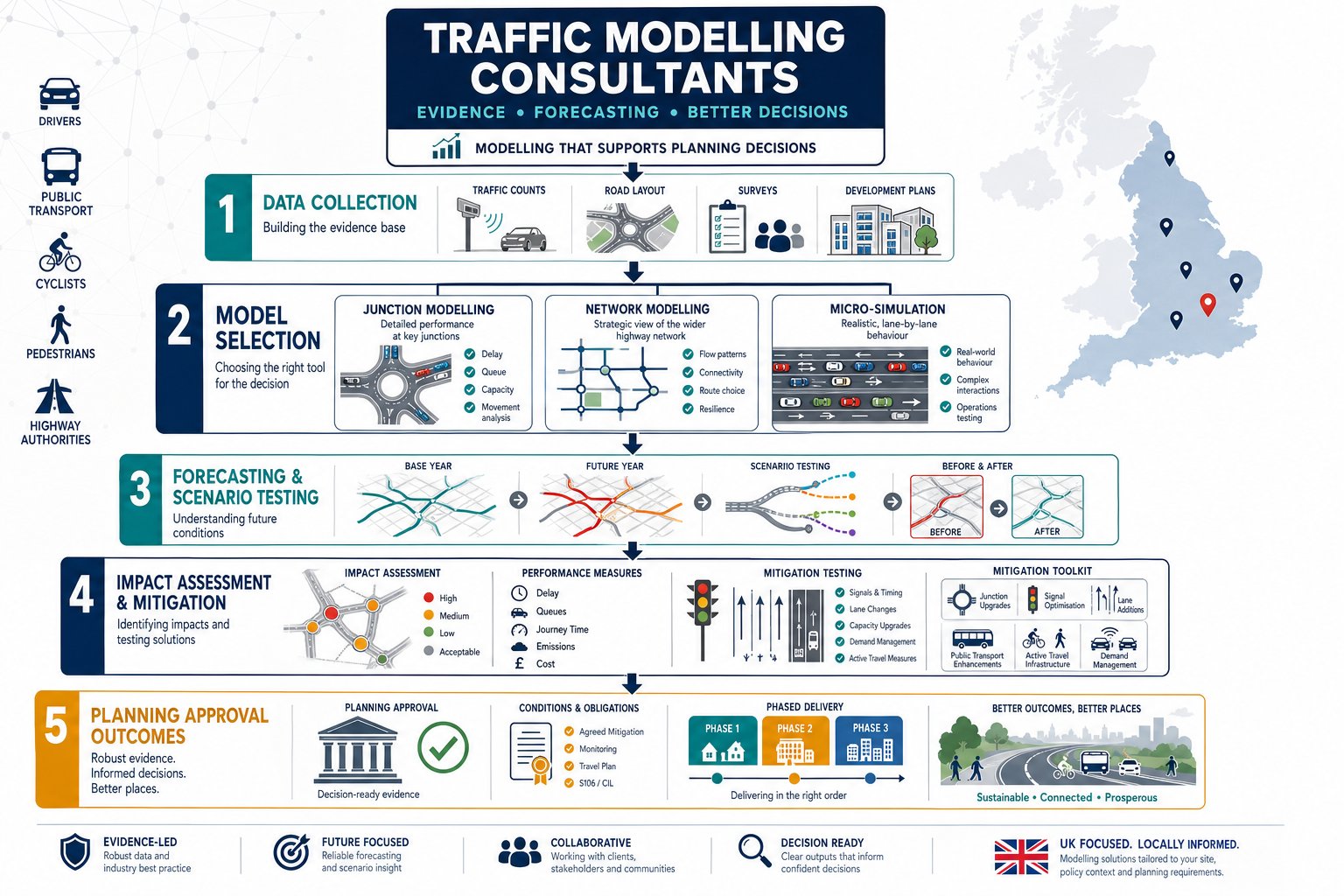
A planning application can look tidy on paper and still fall apart the moment a highway authority asks the awkward question: what actually happens on the network once this scheme is built? That’s where traffic modelling consultants earn their keep.
For architects, developers, planners, lawyers and local authorities, modelling is rarely just a technical add-on. It often becomes the evidence base that decides whether a proposal is accepted, revised, phased, or pushed back for more work. A well-judged model can show that an access works, a junction can cope, mitigation is proportionate, and future growth has been tested properly. A poor one does the opposite. It raises doubts, invites objections, and slows everything down.
In UK planning work, the best traffic modelling consultants do more than run software. We use modelling to answer practical planning questions: how many trips a site will generate, where they are likely to go, what pressure they place on nearby junctions, and whether changes to layout, signals, phasing or travel demand can resolve the problem. That evidence then feeds transport assessments, travel plans, design decisions and negotiation with authorities.
This guide explains what traffic modelling consultants do, when you need one, which modelling types matter in practice, what councils expect to see, and how to choose a consultant who helps keep planning on track rather than adding another layer of risk.
What Traffic Modelling Consultants Do And When You Need One
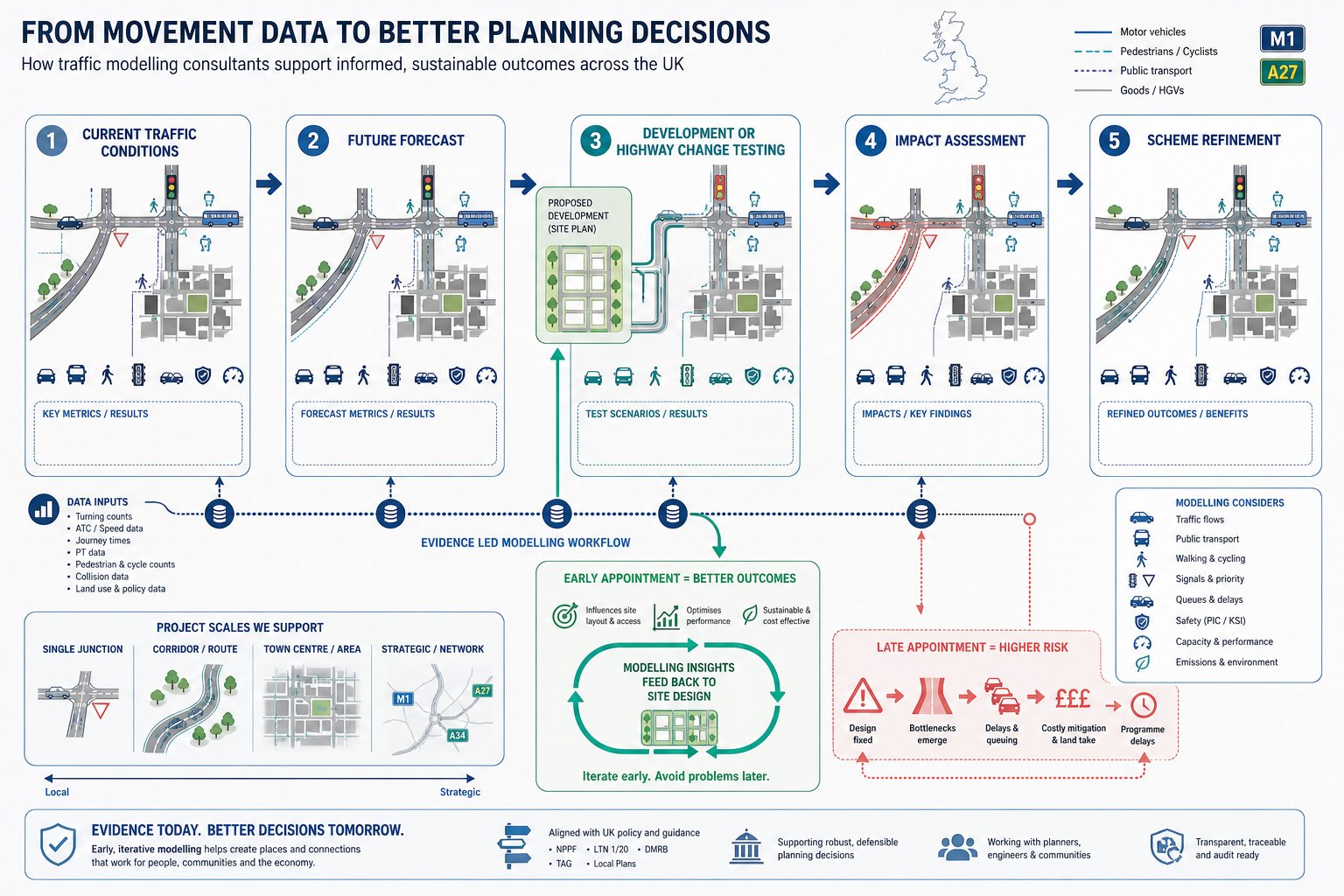
Traffic modelling consultants are specialist transport planners who turn movement data into decision-ready evidence. In straightforward terms, we estimate how people and vehicles move now, forecast how they may move in future, and test whether a proposed development or highway change creates material effects on capacity, delay, queues, safety or wider network performance.
That work can sit at several scales. Sometimes it is tightly focused on a single priority junction or signalised crossroads. Sometimes it covers an entire corridor, town centre, development allocation or strategic network. The common thread is the same: authorities need quantified evidence, not guesswork.
You usually need modelling when a scheme is large enough to trigger a formal transport assessment, when an access arrangement is contentious, when local congestion is already sensitive, or when the site interacts with strategic routes, committed developments or constrained urban streets. It is also common where a council or National Highways requests a specific modelling approach during pre-application engagement.
In practice, the decision to appoint early matters. The wider role often overlaps with Transport Planning Consultants: What, because modelling rarely stands alone: it supports planning strategy, site design and negotiation. On more operational schemes, the work also sits alongside broader advice from Traffic Engineering Consultants:, particularly where junction geometry, lane allocation or signal staging are still evolving.
The key point is timing. If modelling is treated as a late validation exercise, it often exposes issues after the layout has hardened. If it starts early, it can shape a better scheme from the outset.
How Traffic Modelling Supports Planning Applications And Development Decisions
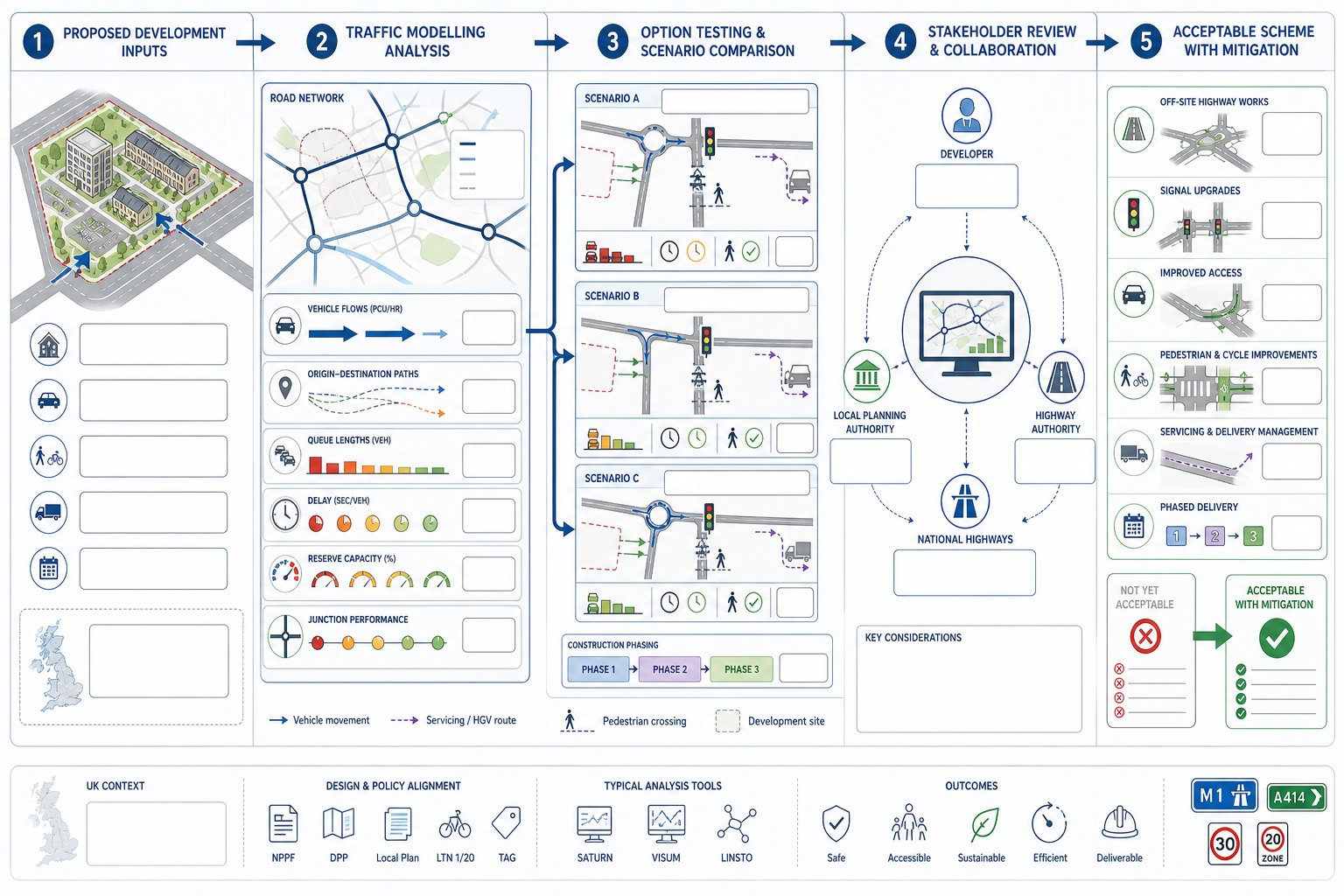
Planning decisions are rarely made on traffic counts alone. Authorities want to understand the change a development causes, whether that change is severe or manageable, and what mitigation is realistically needed. Modelling provides the backbone for those judgements.
A robust model helps quantify trip generation, distribution, assignment, queue lengths, delays, reserve capacity and sometimes wider journey time reliability. That evidence underpins access design, servicing strategy, internal layout, construction phasing and the case for off-site works. It also helps teams compare options. A proposed signal upgrade might solve one problem while shifting delay elsewhere. A revised access arrangement may reduce queueing but worsen pedestrian crossing conditions. Modelling lets us test those trade-offs before they become planning conditions or appeal arguments.
For development teams, this has a practical benefit: the model creates a common technical language between applicant, local planning authority, highway authority and, where relevant, National Highways. When assumptions are clearly stated and methodology is agreed, debates become more focused and productive.
That is one reason modelling often sits beside a wider traffic impact assessment. The assessment explains planning context and significance: the model shows the mechanics of movement. Used well, they strengthen each other.
And importantly, modelling is not only about saying yes or no. It is often what allows a scheme to move from “not yet acceptable” to “acceptable with targeted mitigation and sensible phasing”.
The Main Types Of Traffic Modelling Used In UK Planning Work
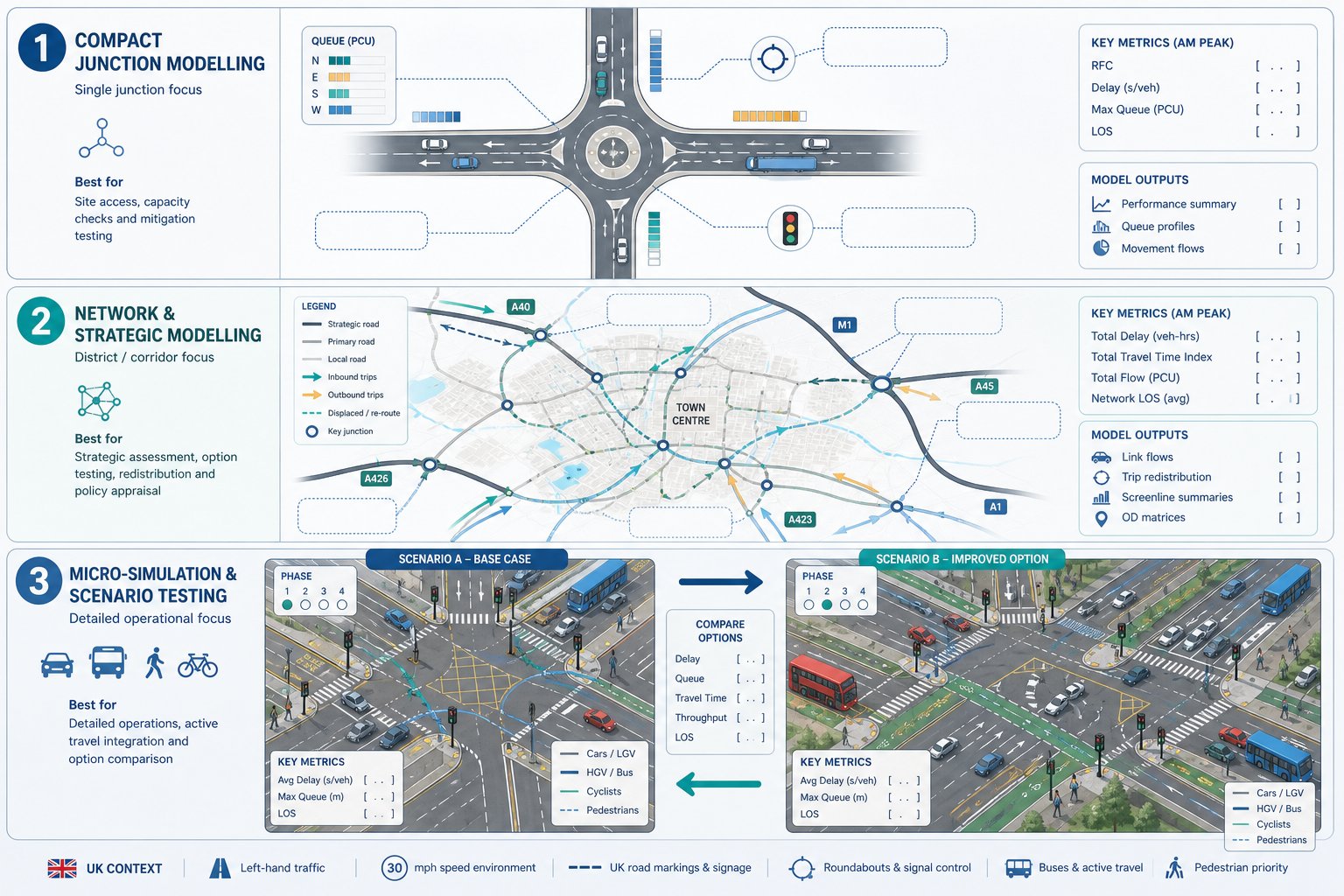
Not all traffic models do the same job, and one of the most common mistakes in planning work is using a tool that is either too simplistic or far more complex than the decision really requires. The right traffic modelling consultants match the method to the planning question.
Junction Modelling
Junction modelling is the workhorse of many planning applications. It examines how a specific junction performs under forecast demand, typically looking at capacity, queue lengths, delay and practical reserve. In UK work, this is often used for priority junctions, roundabouts, signalised layouts and simple linked junction arrangements.
It is especially useful where the main question is local: will the site access operate satisfactorily, and what happens at nearby junctions in the opening year and future assessment year? For many medium-sized schemes, this is enough. But it must still be grounded in sound survey data, realistic development trips and agreed background growth.
Network And Strategic Modelling
Once a scheme affects multiple junctions, route choice, town centre circulation or a wider highway area, network or strategic modelling becomes more appropriate. This type of model looks beyond one node and examines how traffic redistributes across corridors and competing routes.
That matters for larger mixed-use schemes, urban extensions, local plan allocations and interventions near strategic roads. A new development may not simply add cars to one junction: it may alter turning patterns across a district. Wider modelling can reveal displacement effects, rat-running concerns or pressure transferred to links that were not obvious at first glance.
In city contexts, local knowledge still counts. Work tied to dense urban authorities often benefits from experience similar to that reflected by a Traffic Engineer In London: or a Traffic Engineer In Manchester:, where route hierarchy, constrained streets and authority preferences can materially shape the modelling approach.
Micro-Simulation And Scenario Testing
Micro-simulation is the detailed end of the spectrum. It models vehicle movements lane by lane, often second by second, and is useful where interactions are too complex for conventional junction tools alone. Think closely spaced signals, major redevelopment areas, bus movements, weaving sections, complex roundabouts, or designs where pedestrian and cycle facilities interact strongly with traffic operation.
Its real value is scenario testing. We can compare different signal strategies, lane configurations, access positions, construction phases or demand assumptions in a visually and technically rich way. That can be persuasive in meetings because stakeholders can see how a network behaves, not just read summary tables.
But micro-simulation is not magic. It takes more data, more calibration and more care. If the planning issue can be answered by simpler, transparent modelling, that may be the better route. Good consultants know when detail helps and when it merely looks impressive.
Key Inputs, Data Sources, And Assumptions That Shape Model Accuracy
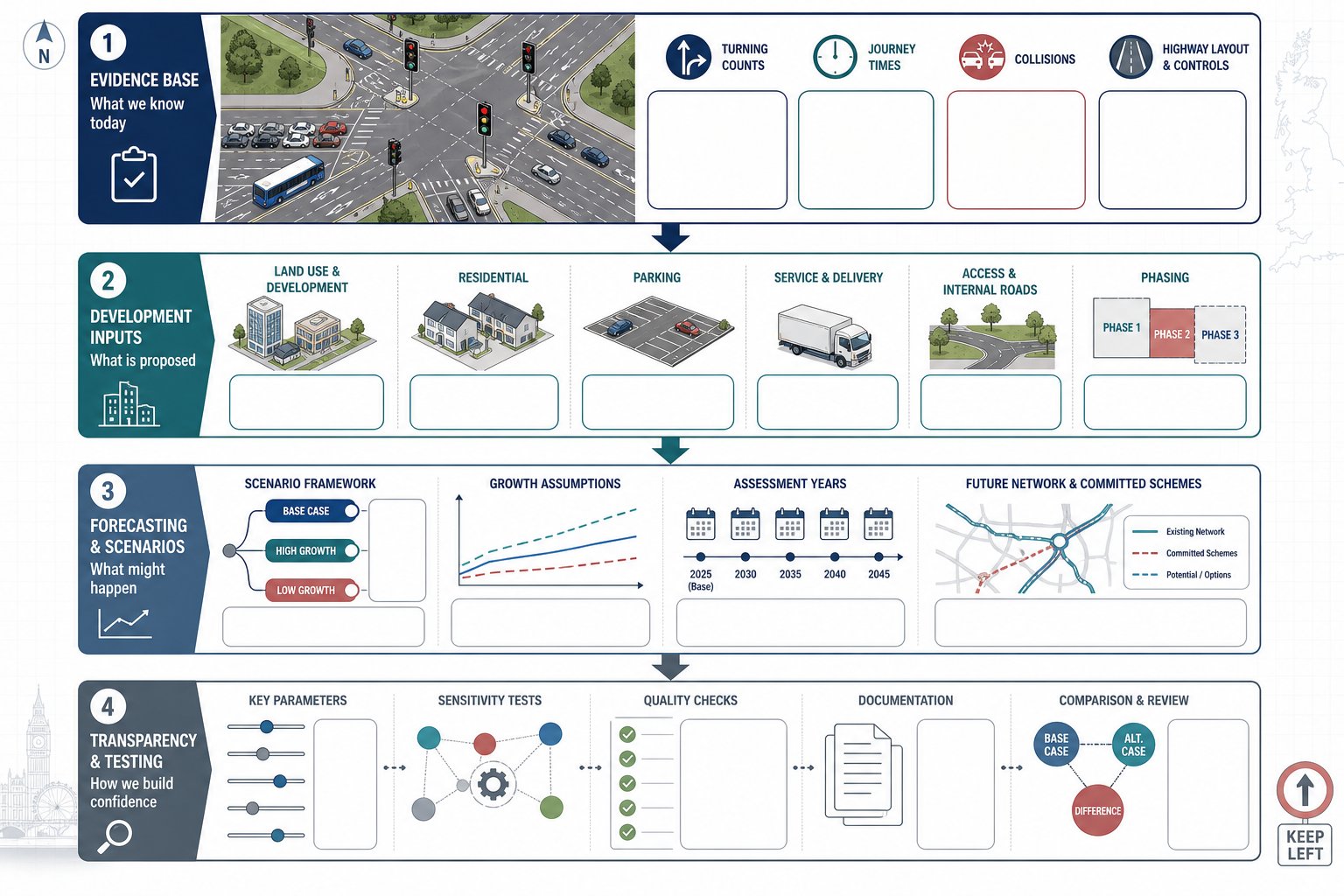
Traffic modelling is only as reliable as the evidence and assumptions beneath it. Software does not rescue weak inputs: it simply processes them neatly. That is why experienced consultants spend serious time on scope, surveys and assumption-setting before running forecasts.
The starting point is usually baseline data: classified turning counts, queue surveys, journey times, signal information, collision context where relevant, and an accurate understanding of highway layout and control. Survey timing matters. So does seasonality. A count collected during abnormal conditions can distort the whole exercise.
Next comes the development side: land use mix, gross floor area or unit numbers, access strategy, parking provision, expected mode share, servicing demands and phasing. Trip generation must be defensible, and distribution must reflect local reality rather than default assumptions that look tidy in a spreadsheet. For some schemes, committed developments and consented highway changes are just as important as the red-line proposal itself.
Forecasting then introduces growth factors, future assessment years and scenario assumptions. This is where consultants can either build confidence or lose it. If growth, modal shift or background traffic reduction is assumed too optimistically, the authority will usually spot it.
The best Traffic Flow Management advice tends to be disciplined about documenting these choices. We should be able to explain where every core assumption came from, why it is proportionate, and how sensitive the outcome is if one variable moves. That transparency matters more than glossy charts.
How Consultants Assess Development Impact And Forecast Future Traffic
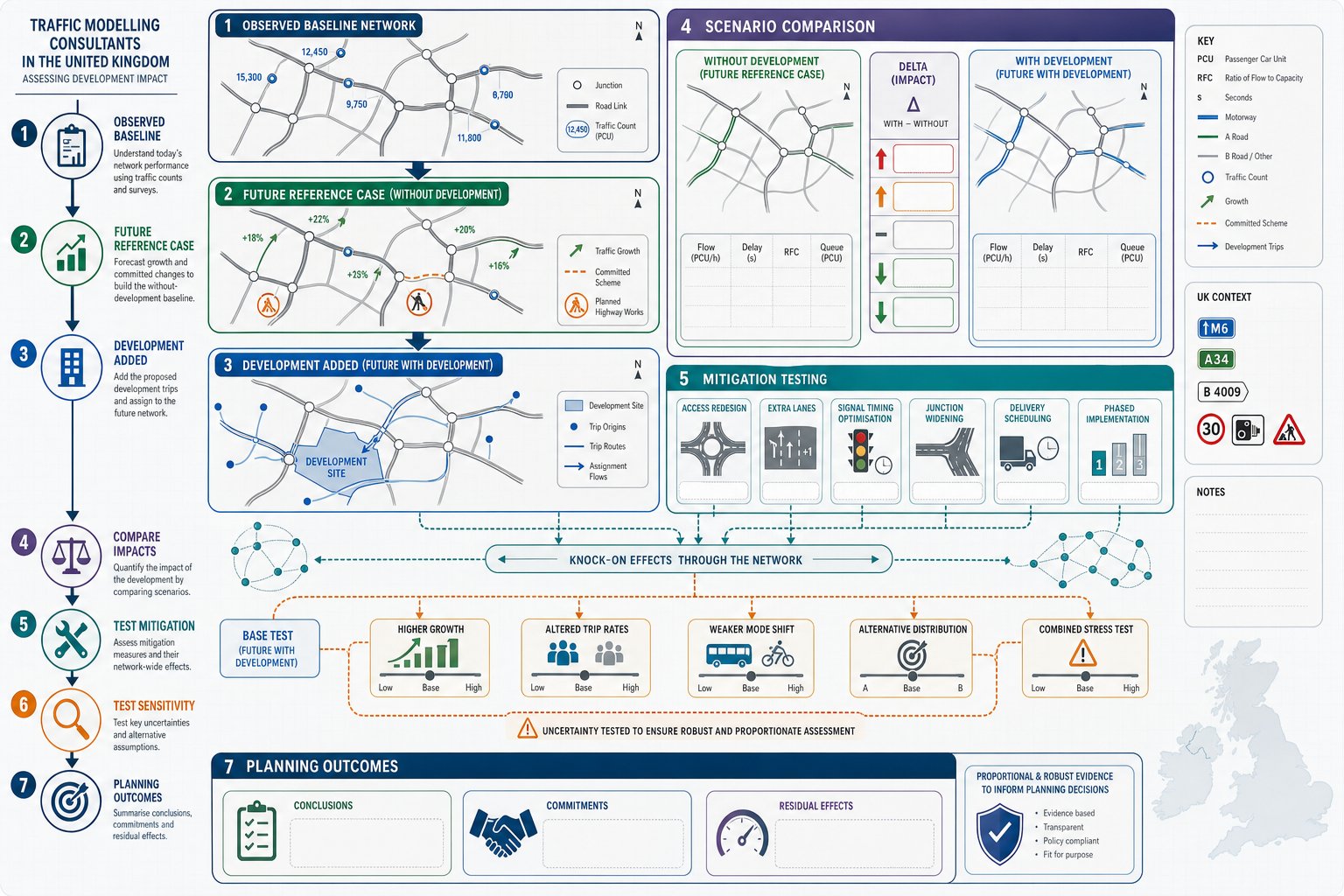
The central discipline in planning-related modelling is comparison. We normally test a future year without the development and then a future year with it. That sounds simple, but good assessment depends on careful construction of both scenarios.
First, we establish the baseline network and validate that the model broadly reflects observed conditions. Then we apply background growth, committed development traffic and any known scheme changes to create a future reference case. Only after that do we layer in the proposed development’s trips, routeing and assignment.
The difference between those cases shows the development impact. We can then test mitigation: revised access geometry, additional lanes, signal optimisation, junction widening, demand management, phasing, or operational changes such as delivery timing. Sometimes a modest geometric tweak unlocks a difficult site. Sometimes the outcome shows that mitigation works at one junction but creates fresh pressure elsewhere, which is exactly why network thinking matters.
Forecasting also has to acknowledge uncertainty. That is where sensitivity testing comes in. Authorities often expect alternative scenarios around higher growth, different trip rates, reduced mode shift or alternative distribution patterns. This is not an academic exercise: it shows whether the scheme is robust or fragile.
For applicants, that process links closely to broader traffic impact assessment developers: work, because modelling outputs need to be translated into planning effects, mitigation commitments and residual impact conclusions that a case officer or committee can actually use.
What Local Planning Authorities And Highway Authorities Expect To See
Most objections to modelling are not really about software. They are about confidence. Authorities want to know that the assessment question has been framed correctly, the data is current, the assumptions are reasonable, and the reporting allows third parties to follow the logic without guessing.
In practical terms, they generally expect an agreed methodology at an early stage, including survey scope, forecast years, committed development treatment, software choice and assessment scenarios. They also expect validation or calibration proportionate to the model type. A strategic model without proper validation, or a junction model based on stale counts, tends to unravel quickly in review.
Clear reporting is essential. That means not just headline capacity ratios, but flows, queues, delays, practical interpretation, and a plain explanation of what is driving any deterioration. Sensitivity tests and mitigation options should be set out transparently. If assumptions have been agreed through pre-application engagement, that should be documented.
Authorities also look for consistency between the model and the wider planning submission. A transport statement that says impacts are modest while the modelling shows recurring queue growth is an obvious problem. On smaller schemes, support from Transport Statement Consultants can help align the proportionality of the evidence. On larger or more policy-sensitive schemes, councils often expect the modelling to sit within a coherent transport planning narrative, not as a detached technical appendix.
That last point matters. Good modelling is not just correct: it is legible, auditable and planning-relevant.
How Traffic Modelling Fits With Transport Assessments And Travel Plans
Traffic modelling should not be treated as a separate technical silo. In a well-prepared application, it connects directly with the transport assessment, the travel plan and often the site design narrative.
The transport assessment sets out existing conditions, policy context, accessibility, trip generation, impact significance and mitigation strategy. Modelling supplies the numerical evidence for the highway performance parts of that story. If the assessment says a junction will remain within acceptable operational limits, the model is what proves it. If mitigation is proposed, the model should demonstrate why that measure is enough and whether it needs to be delivered before occupation, at a defined phase, or through a future trigger.
Travel plans matter here too. Mode shift assumptions are often built into forecasts, especially on urban or mixed-use sites. But those assumptions need backing. A travel plan that promises reduced car use without realistic measures, monitoring and delivery mechanisms will not carry much weight. Good consultants hence make sure the model and the travel plan speak the same language.
This integrated approach is a core part of what specialist teams such as Birmingham Transport Consultant: Planning-Led support on planning-led schemes: not simply producing model outputs, but tying them to the actual planning pathway, local thresholds and authority expectations.
When that alignment is missing, submissions often feel disjointed. When it is present, the whole package reads as one coherent case.
Common Problems That Delay Approval And How Good Consultants Avoid Them
Most planning delays linked to modelling are predictable. The first is poor or outdated data. If counts were undertaken in unusual conditions, or if committed schemes have been ignored, reviewers will question everything built on top of them.
The second is unagreed methodology. Trip rates, distribution patterns, growth factors and assessment years should not appear as a surprise in the submitted report. When scope is discussed early and confirmed with the authority, technical debate becomes far more manageable.
Third, consultants sometimes over-model or under-model. An elaborate micro-simulation can waste time if a simpler junction model would answer the planning issue clearly. But the reverse is just as risky: trying to justify a wide-area development with isolated junction assessments can look evasive.
Another recurring problem is weak calibration and poor explanation. Even where the technical work is basically sound, a report can fail because it does not explain assumptions, validation or residual effects in a way reviewers can follow. And then there is the classic coordination issue: the transport report says one thing, the planning statement another, and the drawings a third.
Good traffic modelling consultants avoid these traps through early engagement, clear scoping notes, current data, disciplined QA and realistic sensitivity testing. At firms with long planning experience, including teams such as ours at ML Traffic, speed only helps when accuracy and local authority fit come with it. Fast delivery without technical discipline is just fast trouble.
How To Choose A Traffic Modelling Consultant For Your Project
Choosing well is less about finding the biggest name and more about finding the right fit for the planning risk in front of you. We would start with five checks.
First, look for genuine UK transport planning and modelling experience, not generic engineering support. The consultant should understand local planning thresholds, transport assessment practice, appeal scrutiny and how highway authorities typically review evidence.
Second, ask about relevant scheme experience. A consultant who regularly models urban mixed-use redevelopment may not be the best fit for a logistics site on a strategic corridor, and vice versa. Similarity of context matters.
Third, test their approach to scope and assumptions. Do they talk early about survey strategy, committed developments, forecast years, validation, sensitivity testing and authority engagement? If not, that is a warning sign. Strong consultants are usually methodical before they are flashy.
Fourth, check software capability and interpretation. Technical proficiency matters, but so does judgement. The model is only useful if the consultant can explain what the outputs mean for design, mitigation, viability and planning strategy.
Fifth, consider communication and turnaround. Planning programmes are rarely generous. You need advisers who can coordinate with architects, lawyers, planners and project managers without disappearing into technical abstraction. That is often where specialist, planning-focused teams stand out: concise reporting, practical advice, and evidence tailored to the authority reviewing it.
In short, choose a consultant who can do three things at once: model accurately, write clearly, and think like a planning problem-solver.
Conclusion
Traffic modelling is not a box-ticking exercise. In 2026, it is one of the clearest ways to show whether a scheme works in the real world, not just on a drawing sheet. For developers, councils, planners and design teams, the right consultant helps translate movement into evidence that authorities can trust.
The strongest traffic modelling consultants combine sound data, proportionate methodology, careful forecasting and clear reporting. They also know that planning success depends on more than a model run: it depends on early scoping, local authority awareness, coordination with transport assessments and travel plans, and mitigation that is realistic to deliver.
When choosing a consultant, we should be asking a simple question: will this team merely produce outputs, or will they help us make better planning decisions? That difference is usually what separates a smooth application from months of avoidable delay.
Frequently Asked Questions About Traffic Modelling Consultants
What roles do traffic modelling consultants play in UK planning applications?
Traffic modelling consultants provide specialist transport planning services by estimating current and future traffic movements. They assess development impacts on junctions and networks, supporting planning decisions with evidence-based forecasts and testing mitigation options to help obtain planning approval.
When should I engage a traffic modelling consultant for my development project?
You need a traffic modelling consultant for medium to large developments, complex or constrained junctions, projects affecting strategic routes, or when a local or national highway authority requests modelling as part of a Transport Assessment during pre-application discussions.
How does traffic modelling support transport assessments and travel plans?
Modelling supplies quantitative evidence for transport assessments, demonstrating impacts on highway operations, trip generation, and network performance. It also informs travel plans by integrating mode shift assumptions and trip reductions, ensuring coherent mitigation strategies aligned with planning and design.
What types of traffic modelling are commonly used in UK planning?
The main types are junction modelling for individual junction performance; network or strategic modelling for wider route choice and traffic redistribution; and micro-simulation for detailed, lane-by-lane analysis and scenario testing of complex interactions or major redevelopments.
What are common pitfalls in traffic modelling that can delay planning approval?
Delays often arise from poor or outdated data, unagreed assumptions, ignoring committed developments, choosing inappropriate model complexity, weak calibration, and inconsistent reporting. Experienced consultants avoid these through early engagement, robust data collection, clear scope agreement, and transparent sensitivity testing.
How can I choose the right traffic modelling consultant for my project?
Select a consultant with proven UK transport planning expertise, relevant project experience, thorough approach to assumptions and validation, proficiency in recognised software, and excellent communication skills to integrate modelling with planning strategy and deliver clear, practical advice.