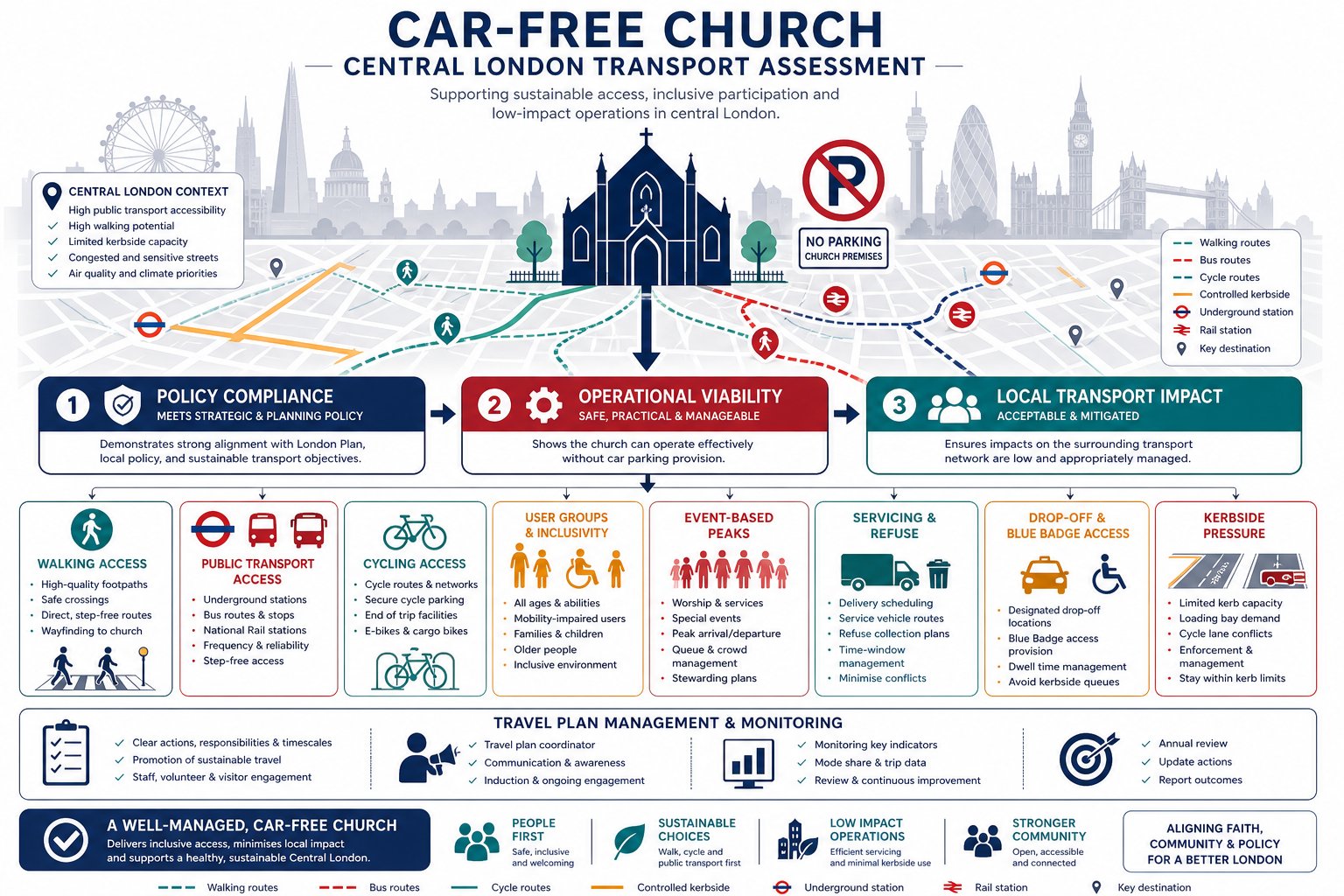
A church in Central London can be entirely viable without general car parking. In fact, in many boroughs, that starting point is no longer unusual: it is the policy expectation. The challenge is that “car-free” does not mean “transport-light”. Planning officers still expect a robust assessment showing how worshippers, staff, volunteers, visitors, delivery drivers and mobility-impaired users will reach the site safely, conveniently and without pushing problems onto already stressed streets.
That matters even more for churches than for many other uses. The travel profile is irregular. A modest weekday pattern can give way to sharp Sunday peaks, weddings, funerals, evening meetings, food-bank activity, choir rehearsals or major seasonal services. In dense Central London locations, those movements unfold on constrained footways, controlled parking zones, red routes, busy bus corridors and heavily used public transport interchanges.
In our experience, a strong Car-Free Church in Central London Transport Assessment succeeds when it moves beyond a generic template. It explains how the church will actually operate, who will come, when they will come, and how the proposal aligns with London Plan policy, Healthy Streets principles and local borough expectations. Below, we set out what officers typically want to see in 2026, and where applicants most often strengthen, or weaken, their planning case.
Key Takeaways
- A Car-Free Church in Central London must demonstrate policy compliance, operational viability, and minimal transport impact without relying on general car parking.
- Transport assessments should detail realistic access by walking, public transport, and cycling, addressing all user groups including those with mobility impairments.
- Church transport profiles are unique due to irregular peak events like services, weddings, and funerals, requiring nuanced planning beyond generic community building templates.
- Servicing, deliveries, blue badge access, and drop-off provisions must be explicitly planned to maintain car-free status while ensuring inclusivity and operational efficiency.
- A robust transport assessment includes site context, accessibility appraisal, trip generation by activity type, and management strategies for peak periods and kerbside pressure.
- Travel plans with clear measures, monitoring, and compliance commitments are essential to translate the car-free transport strategy into practical, enforceable action.
What A Car-Free Church Transport Assessment Needs To Demonstrate
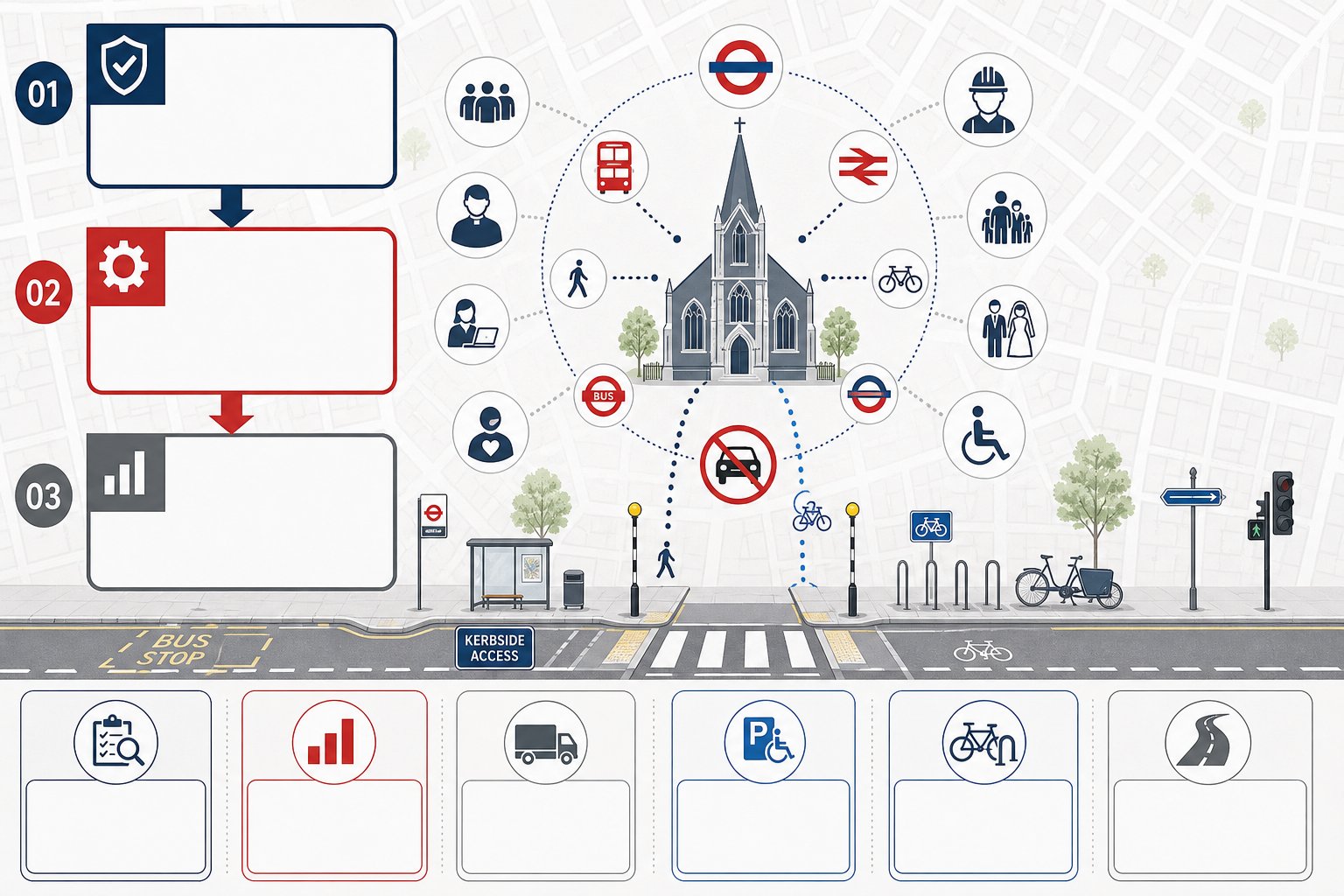
At its core, the assessment has to prove three things: the proposal is policy-compliant, it is operationally workable, and it does not create unacceptable transport impacts.
For Central London schemes, that usually means demonstrating a credible pattern of access by walking, public transport and cycling, with no reliance on general car parking for day-to-day church activity. Officers will expect the report to show how the site fits the London Plan’s sustainable transport direction and the Healthy Streets approach, not just mention those policies in passing. A weak report quotes policy. A good one translates policy into the street-level reality around the building.
The transport assessment should also identify all principal user groups: congregation members, clergy, staff, volunteers, contractors, community users, funeral and wedding attendees, and people with impaired mobility. Their journeys are not identical, so the evidence cannot be one-size-fits-all.
In practical terms, we would normally include an accessibility review, trip generation by land-use component, servicing strategy, blue badge and drop-off arrangements, cycle parking provision, and an appraisal of local highway effects. Depending on scale and borough requirements, this may sit within a broader transport assessment for planning package.
The key test is simple: can the church function smoothly, inclusively and safely without general on-site parking? If the answer is evidenced clearly, officers are far more likely to treat the car-free position as realistic rather than aspirational.
Why Central London Churches Raise Distinct Transport Planning Issues
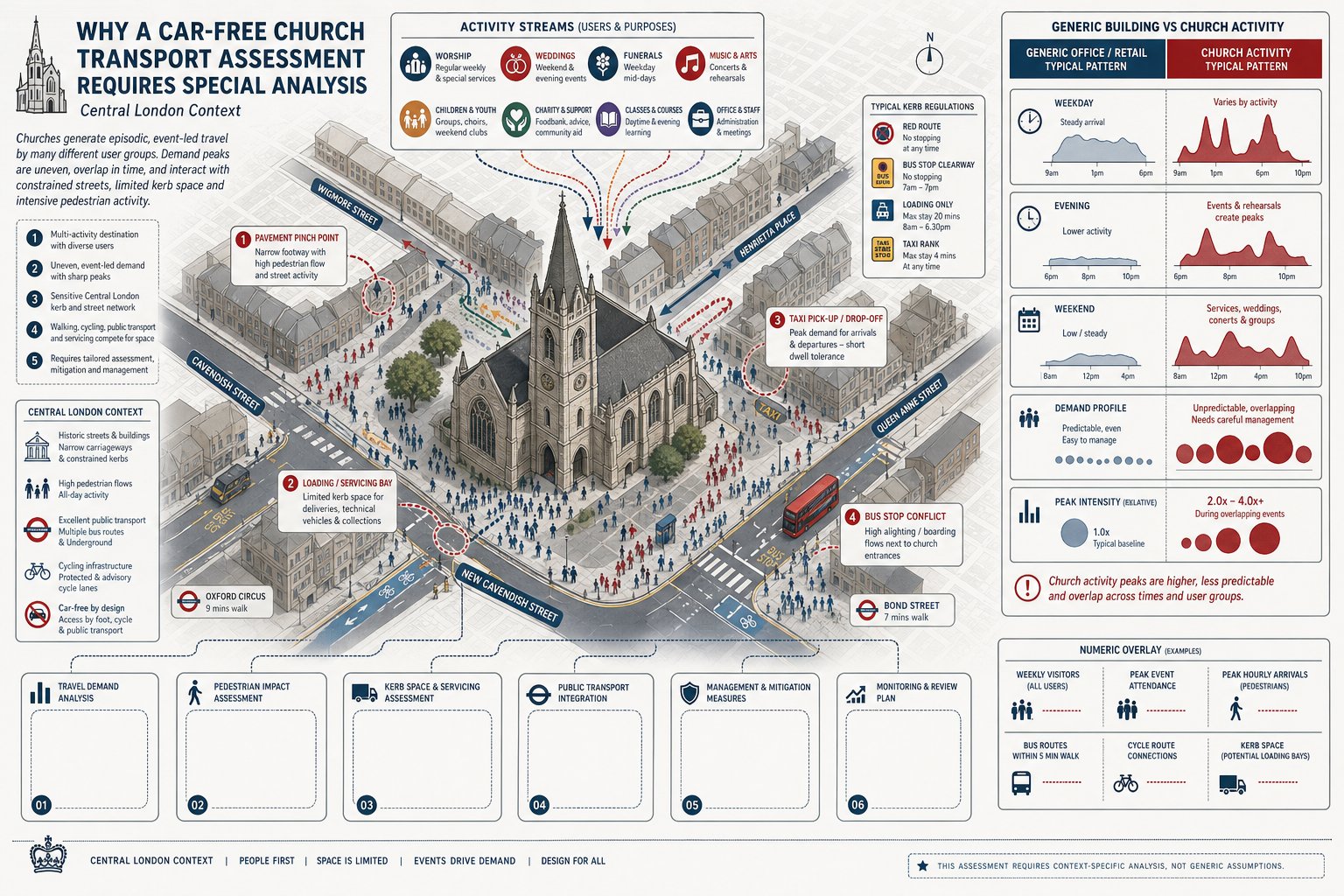
Churches are not standard Class E occupiers with flat, predictable daily demand. Their transport profile is more lumpy, more event-led, and often more sensitive to local street conditions.
In Central London, that creates a very particular planning problem. The surrounding network may be highly accessible overall, yet the immediate kerbside environment can be extremely constrained. Footways may already be crowded. Loading opportunities may be short and tightly regulated. Nearby residents may be sensitive to taxi activity, idling, noise or people gathering after services.
There is also the mixed-function nature of many churches. A single building may host worship, counselling, music practice, children’s groups, language classes, food distribution, charity meetings and office functions. Weddings and funerals bring different arrival patterns from a Sunday service: Christmas and Easter can generate a surge that bears little resemblance to a normal week.
That is why boroughs often expect a more nuanced assessment than they would for a straightforward office or small retail use. The report should explain not only average demand but exceptional demand, including what happens when activities overlap.
For applicants working through wider planning strategy, this sits comfortably within broader London Development Transport Advice: principles: understand the local context, identify stress points early, and provide operational detail rather than broad assurances.
Churches can absolutely operate successfully in car-free form in Central London. But they need a transport story that reflects how churches really function, not how generic community buildings are assumed to function.
How Car-Free Status Is Defined In Planning And Operational Terms
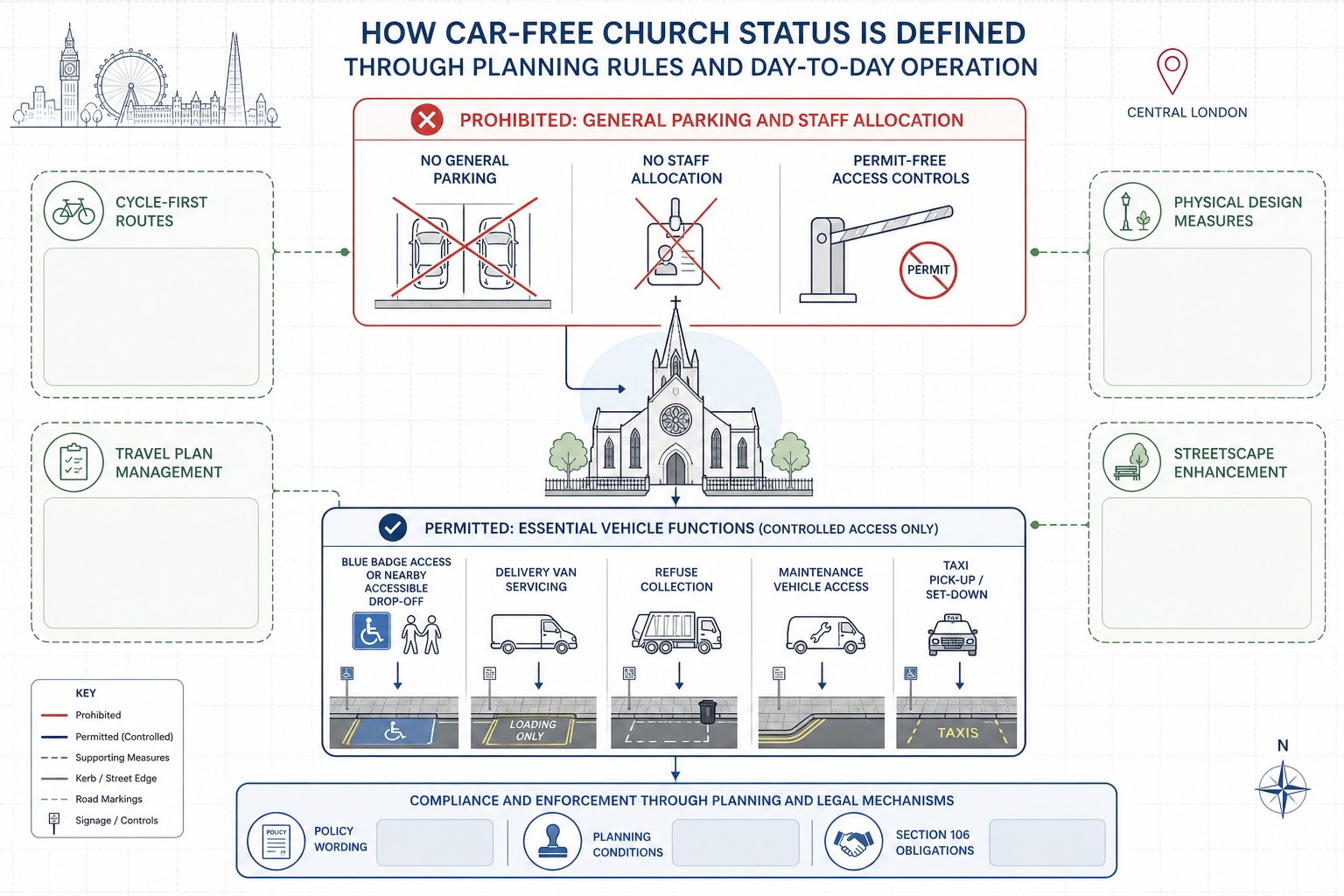
“Car-free” is often misunderstood. In planning terms, it generally means there is no general parking provision for staff, members or visitors and that the development is designed around sustainable access. It does not mean there can never be any vehicle associated with the site.
That distinction matters. A car-free church may still require:
- blue badge parking or a nearby accessible stopping arrangement:
- servicing and delivery activity:
- refuse collection access:
- occasional essential vehicle access for maintenance, removals or specialist equipment:
- taxi and private hire pick-up or set-down activity.
Planning officers will want clarity on all of those points. If a statement simply says “the church is car-free” without explaining how essential vehicle-related functions will be handled, it tends to raise more questions than it answers.
Operationally, we usually define car-free status through a combination of physical design and management controls. That can include no on-site general parking spaces, permit-free lease wording where relevant, no staff parking allocation, cycle-first access arrangements, and a travel plan that actively discourages private car use except where essential.
The strongest assessments are explicit about the limits of the car-free commitment. They explain what is prohibited, what is permitted, and under what controls. That is especially important where planning conditions or section 106 obligations may later rely on the report’s wording.
Where schemes involve technical interfaces with the street, support from a Traffic Engineer In London context can be useful in translating policy language into practical kerbside and highway arrangements.
Site Context And Accessibility Appraisal
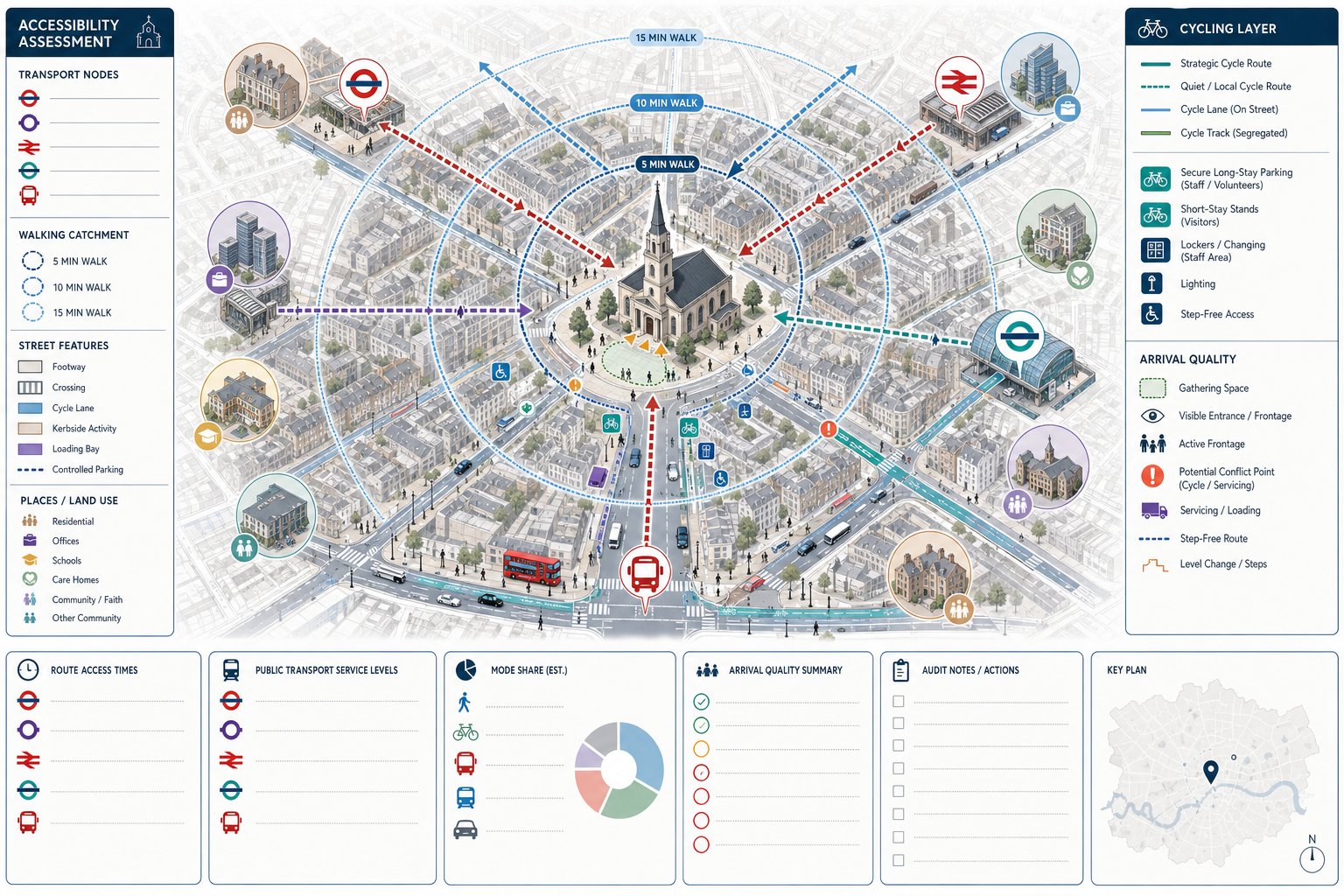
A convincing appraisal starts with the place, not the proposal in isolation. Officers need to understand how the church sits within its immediate urban context and whether that context genuinely supports a car-free model.
That means reviewing surrounding land uses, street hierarchy, footway widths, crossing points, bus stops, Underground and rail stations, cycling routes, controlled parking restrictions and existing kerbside activity. It should also identify likely origins and destinations linked to church use: nearby estates, student accommodation, offices, care homes, schools, community facilities and transport hubs.
We generally advise applicants to map the realistic access environment, not just the theoretical one. A station may be close as the crow flies but awkward in practice if the route involves narrow footways, heavy pedestrian congestion, multiple guardrailed crossings or steep gradients. Equally, a bus stop directly outside the site may materially improve accessibility for older worshippers even if the PTAL score alone looks ordinary.
The appraisal should also address the quality of arrival. Is there enough pavement space for people to gather before and after services? Is the entrance legible from the street? Are there conflicts with cycle tracks, loading bays or adjacent commercial frontages? These details often influence officer judgement more than applicants expect.
For more complex proposals, the site review may overlap with wider environmental impact assessment transport: considerations, particularly where cumulative local movement impacts are under scrutiny.
Public Transport Accessibility And Walking Catchment
Public transport evidence should be specific. Officers do not just want to know that buses and stations exist: they want confidence that the likely users of the church can reach the site conveniently and safely.
A good appraisal identifies nearby Underground, Elizabeth line, National Rail, DLR or bus connections, service frequencies, first and last services where relevant, and realistic walk times from each node. In Central London, a 5 to 10 minute walk may be entirely reasonable for many users, but the report should still acknowledge that some congregation members will be older, carrying instruments, accompanying children or arriving in formalwear for a ceremony. Real journeys matter more than idealised ones.
Walking catchments should be described with common sense. We normally assess route directness, crossing quality, lighting, surveillance and wayfinding, particularly for evening events. If multiple stations serve the site, that is useful because it disperses arrivals and departures rather than concentrating everyone onto a single route.
Where churches serve a local resident congregation as well as city-wide attendees, that split should be explained. Some users may arrive on foot from nearby neighbourhoods, while others rely heavily on rail and bus interchanges. The transport case is stronger when the report shows that both patterns have been considered.
Cycling Access, Parking, And Supporting Facilities
Cycling is rarely the sole access mode for a church, but in Central London it is often an important part of the mode share, especially for staff, volunteers and weekday community users.
The assessment should identify existing and proposed cycle routes, route quality on approach roads, and whether access into the site is straightforward. If a church entrance sits on a busy one-way street or next to a high-turnover loading bay, that needs to be acknowledged rather than glossed over.
Cycle parking should distinguish between long-stay and short-stay demand. Staff and volunteers need secure, convenient long-stay parking: worshippers and visitors may need short-stay stands close to the entrance. Design matters as much as quantity. Stands should be accessible, overlooked where possible, and compliant with current London guidance rather than tucked into a token leftover corner.
Supporting facilities can also make a difference: lockers, showers for staff in larger schemes, step-free access to cycle stores, lighting, and clear signing. If these are absent, the report should not overstate likely cycling uptake.
And where a church forms part of a larger redevelopment, lessons from mixed use masterplan transport: planning are often relevant, because shared access, servicing interfaces and public realm design can strongly affect cycle usability.
Trip Generation For Worship, Community, And Ancillary Uses
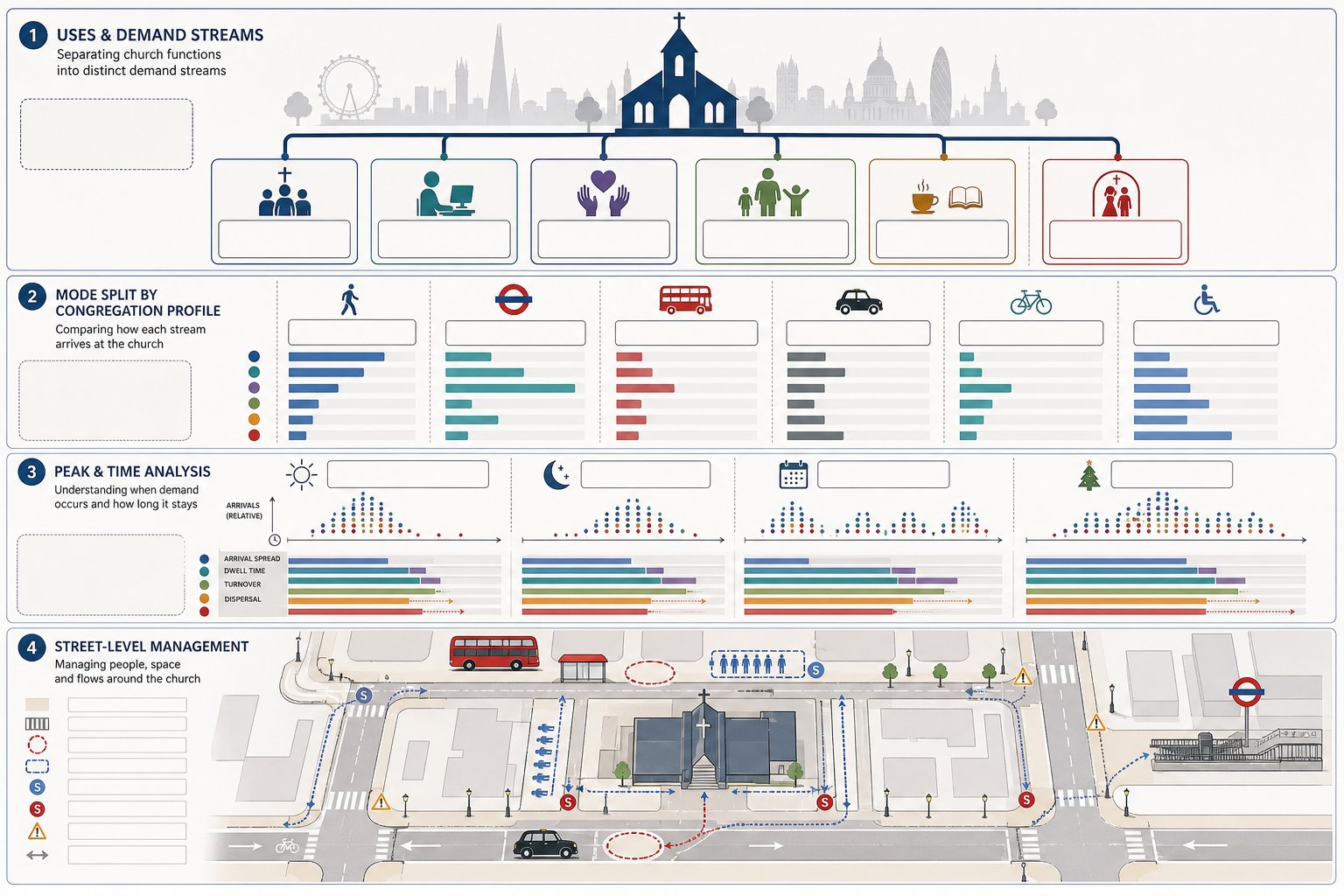
Trip generation is where many church assessments become either too vague or too simplistic. A church is not one land use: it is usually a bundle of related uses with different temporal patterns.
The assessment should hence separate out regular worship, weekday administration, volunteer activity, community uses and ancillary functions. Depending on the proposal, that may include classrooms, counselling rooms, kitchens, rehearsal space, food-bank operations, café use, or hall hire. Weddings and funerals should almost always be addressed separately because their attendance profile, dress, dwell time and mode choice can differ markedly from routine services.
Data can come from existing church surveys, comparable sites, clergy interviews, booking records and observed attendance patterns. In our view, that mix is often more persuasive than trying to force the scheme into a generic database category that does not fit. Officers usually respond well when assumptions are transparent and rooted in actual operation.
Mode split assumptions also need care. In Central London, high public transport and walking shares are often realistic, but they should be justified by catchment, congregation profile and service timing. A church with many elderly attendees may still be car-free in planning terms while relying more on taxis or blue badge arrivals than a younger urban congregation.
For applicants dealing with thresholds or wider report scope, a broader transport assessment for developments: approach helps frame church-specific demand within accepted planning methodology.
Peak Periods, Service Patterns, And Event-Based Demand
Average daily traffic tells only part of the story. Churches are often judged on peaks, and not always the standard highway peaks.
Sunday morning may be the principal concentration period, but evening services, midweek meetings and occasional festivals can be just as important. Christmas, Easter, harvest events, concerts, memorials and large prayer gatherings can produce short, intense surges in arrivals and departures. The question for officers is not whether those peaks exist: it is whether the local transport network and kerbside can absorb them safely.
A useful assessment sets out service patterns clearly: attendance by session, turnover between sessions, likely arrival spread, dwell times, stewarding arrangements and dispersal behaviour. If an event ends at the same time as nearby venue closing times or rail station crowding, that interaction should be acknowledged.
For larger congregations, crowd management may need to be more than a passing note. Footway pinch points, crossing demand, taxi call-up locations and waiting areas should be considered, especially where groups may gather outside before entering.
The aim is not to eliminate every operational peak. It is to demonstrate that peaks are understood, planned for and manageable without resorting to informal parking or unsafe stopping.
Servicing, Deliveries, And Refuse Collection Without General Car Parking
Car-free does not remove servicing: it makes servicing strategy more important.
Churches typically need deliveries for supplies, flowers, musical equipment, catering, charity activity, maintenance and occasional event set-up. Refuse and recycling collections must also be accommodated. In some buildings, there may be additional movements linked to food-bank donations or community support functions. If these activities are not planned properly, they can quickly undermine an otherwise strong car-free case.
The assessment should identify what vehicles are expected, how often they arrive, where they stop, how goods move between vehicle and building, and whether any manoeuvring risk arises. In Central London, timed loading from an existing bay or from an agreed kerbside location is often more realistic than trying to force a full on-site servicing solution into a tight plot.
What matters is operational credibility. If refuse bins have to cross a busy footway at peak pedestrian times, officers will notice. If delivery vehicles are likely to stop on yellow lines or block a cycle lane, they will ask for more detail. Swept path analysis may be needed for larger servicing vehicles: on more technical schemes, tools such as Junctions 11 Software In the wider assessment workflow can support movement analysis where access geometry is constrained.
Management measures are often as important as physical design: delivery booking, off-peak servicing windows, caretaker supervision, and clear instructions to suppliers. A church that can show disciplined servicing arrangements looks far more credible as a car-free operation.
Drop-Offs, Taxis, Blue Badge Access, And Inclusive Transport Provision
This is one of the most sensitive parts of a Car-Free Church in Central London Transport Assessment, because “car-free” can sound exclusionary if it is handled carelessly. It should never be.
Planning officers will expect the assessment to show how disabled people, older worshippers, people with temporary injuries, families with very young children and those attending emotionally difficult events such as funerals can access the church with dignity and practicality.
That does not necessarily require general parking. It may involve a combination of nearby on-street blue badge bays, an accessible set-down point, short-stay stopping under controlled conditions, taxi and private hire drop-off arrangements, and step-free pedestrian routes between vehicle stopping points and the entrance. The route quality between those points really matters: kerbs, gradients, paving condition, shelter and crossing distance can all change whether an arrangement is workable.
The report should also distinguish between routine and exceptional use. A wedding party or funeral cortege may justify more structured temporary kerbside management than a normal weekday prayer meeting. Officers tend to be receptive where the assessment is honest about those differences and explains how they will be managed.
Inclusive transport provision is not an add-on to make the report look rounded. It is central to policy compliance and often central to the life of the church itself. If the scheme promises sustainable access but leaves mobility-impaired users to improvise, the planning position becomes fragile very quickly.
Highway Safety, Kerbside Pressure, And Local Network Effects
Even where vehicle trip generation is modest, officers will still ask whether the proposal creates friction on the surrounding network. In Central London, that friction often happens at the kerb rather than at a junction.
A robust assessment should hence consider footway crowding, carriageway obstruction, cycle lane conflicts, crossing demand, bus stop interference, loading competition and informal waiting by taxis or private cars. The issue is not only the church’s direct traffic generation: it is whether church activity intensifies pressure at an already busy frontage.
Particular attention should be paid to arrival and dispersal moments. A group of 80 or 100 people leaving together can briefly narrow the effective footway width if they gather outside the entrance. A funeral vehicle stopping in an uncontrolled location can affect buses or cyclists. A burst of app-booked vehicles after an evening event can create short but real kerbside stress.
Where the local network is especially sensitive, the report may need observations, photos, parking beat surveys or junction review. On some schemes, broader benchmarking from a Residential Development Transport Assessment: style evidence base can be helpful in explaining kerbside interaction and pedestrian impact assessment methods, even though the land use differs.
Eventually, officers are looking for confidence that the proposal will not shift parking, stopping or safety problems onto neighbours. If the assessment addresses likely pressure points directly, that confidence is much easier to build.
Travel Plan Measures, Monitoring, And Planning Compliance
A travel plan is often where the operational promises in the transport assessment are turned into something enforceable. For a car-free church, it should do more than repeat that sustainable travel is encouraged.
A useful travel plan sets out realistic measures: congregation travel information, public transport guidance for event invitations, cycle parking management, staff cycle support, taxi and accessible drop-off instructions, delivery booking protocols, and stewardship arrangements for major services. If the church hosts third-party community users, the plan should explain how those organisers will also be informed of access expectations.
Monitoring is equally important. Officers increasingly want to know how mode share assumptions and operational impacts will be checked after occupation or intensification. That might include attendance and mode surveys, periodic reviews of cycle parking use, logs of servicing activity, complaints monitoring, and a mechanism for responding to kerbside issues if they arise.
Planning compliance should be framed clearly: what commitments are embedded in the design, what sits in management practice, and what may be secured by condition or obligation. We have found that concise, authority-aware reporting tends to be most effective, especially where local validation standards are strict: this is exactly the kind of issue addressed in practical Traffic Engineer In London: support for planning teams.
The best travel plans feel grounded in the life of the church. They recognise volunteers, seasonal events, pastoral needs and real behaviour. That makes them more useful operationally, and more persuasive at planning stage.
Conclusion
A successful Car-Free Church in Central London Transport Assessment is not a box-ticking report about the absence of parking. It is a practical demonstration that the church can function well, inclusively and safely within a dense urban setting.
In 2026, planning officers usually expect clear evidence on accessibility, realistic trip generation, event peaks, servicing, blue badge access, kerbside management and travel plan commitments. They also expect the report to reflect how a church actually operates, including worship, community use and occasional high-demand events.
When that evidence is site-specific and operationally honest, car-free status is rarely the problem. The real issue is whether the applicant has shown that all the transport consequences have been understood and managed. For architects, planners, lawyers, developers and councils, that is where a strong assessment earns its keep: it turns a policy ambition into a credible planning case.
Frequently Asked Questions about Car-Free Church Transport Assessments in Central London
What must a Car-Free Church Transport Assessment in Central London demonstrate?
It must show compliance with the London Plan and Healthy Streets approach, prove the church is operationally workable without general car parking, and ensure no unacceptable transport impacts occur to the surrounding network or kerbside.
Why do Central London churches require special transport planning considerations?
Churches have irregular, event-led travel patterns with weekend peaks, diverse uses, and operate in constrained urban environments with crowded footways and limited loading options, necessitating a detailed and nuanced transport assessment beyond generic community models.
How is ‘car-free’ defined operationally for a church in planning terms?
Car-free means no general parking spaces for staff, visitors, or members but allows limited vehicle access such as blue badge bays, servicing deliveries, refuse collection, maintenance vehicles, and managed drop-off for accessibility.
What elements should be included in the site context and accessibility appraisal?
The appraisal should assess surrounding land uses, street hierarchy, pedestrian routes, crossing quality, proximity to public transport stops and stations, controlled parking zones, and realistic walking routes relevant to all user groups of the church.
How should trip generation be assessed for different church activities?
Trip generation estimates must separate regular worship, community uses, special events like weddings and funerals, and ancillary functions, using data from church surveys, clergy interviews, booking records, and observed attendance patterns to reflect realistic mode share and timing.
What strategies support safe servicing, deliveries, and refuse collection in a car-free church setting?
Servicing should use timed deliveries from existing loading bays or agreed kerbside stops, with clear management controls like delivery booking and off-peak windows to prevent obstruction, ensuring no informal parking or unsafe stopping occurs on constrained Central London streets.