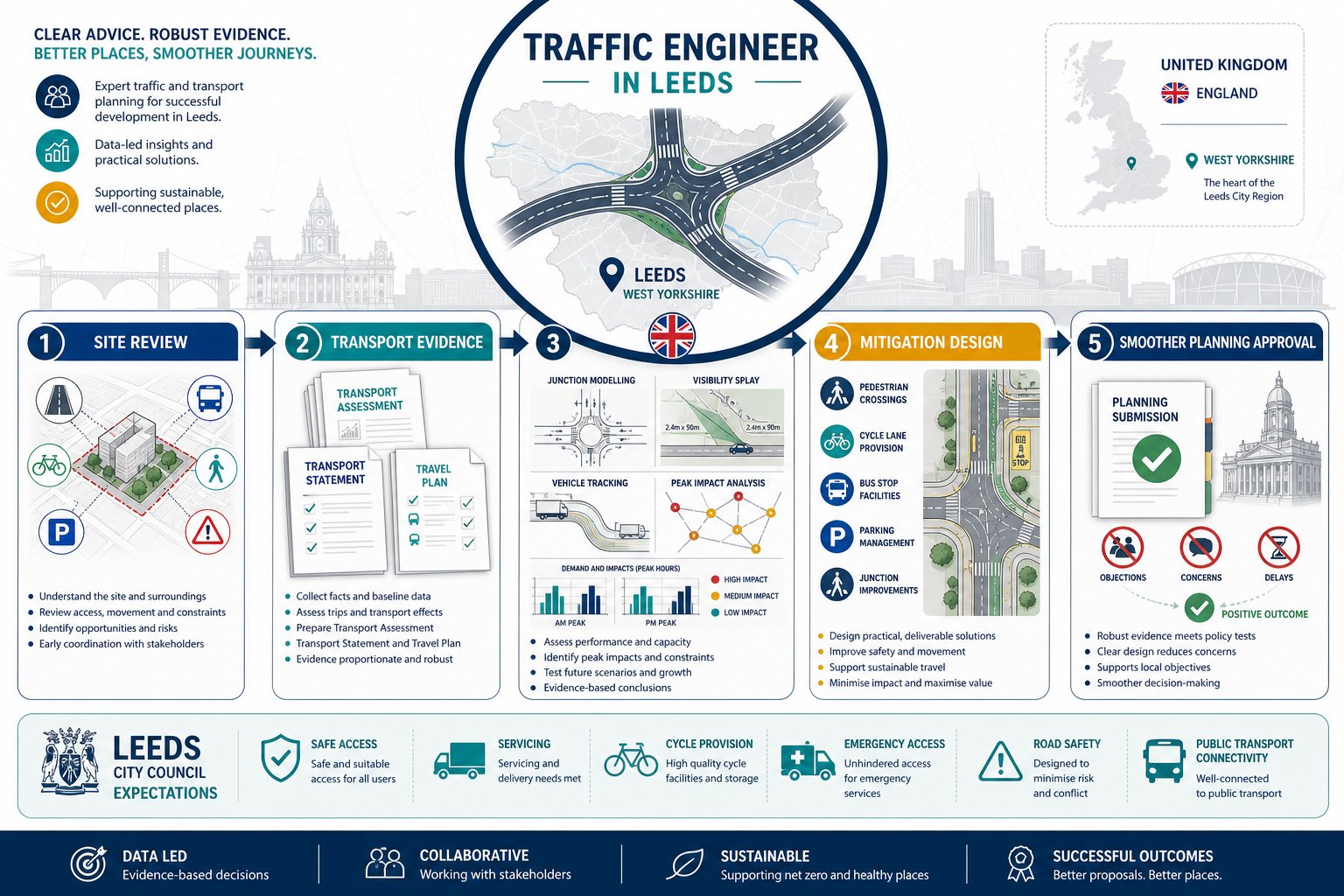
Planning applications in Leeds rarely fail on ambition alone. More often, they stall because the transport case underneath them is too thin, too late, or too generic for the site in question. A scheme may look commercially sound and architecturally polished, yet still hit resistance if access, servicing, parking, junction impact, or sustainable travel haven’t been addressed properly.
That is where a Traffic Engineer in Leeds becomes central rather than optional. We help turn development proposals into evidence-backed planning submissions that stand up to scrutiny from highways officers, planners, consultees, and sometimes committee members as well. In practice, that means testing whether a site can operate safely, whether the surrounding network can accommodate demand, and what mitigation is needed to make a proposal acceptable.
For architects, planning consultants, solicitors, surveyors, developers, and local authorities, the value is simple: fewer assumptions, fewer avoidable objections, and a clearer route through planning. Leeds has its own policy context, transport pressures, and expectations around active travel, public transport, and road safety. A generic national report often won’t do the job.
In this guide, we explain what a traffic engineer does, when Transport Assessments and Travel Plans are needed, how Leeds City Council typically approaches transport evidence, and what separates a useful report from one that creates delay.
Key Takeaways
- A Traffic Engineer in Leeds provides essential, site-specific transport evidence that ensures planning applications meet local transport policies and avoid generic, ineffective assessments.
- Robust transport reports must demonstrate safe access for all users, realistic traffic impacts, and deliverable mitigation aligned with Leeds City Council’s expectations and West Yorkshire’s transport strategies.
- Early engagement with traffic engineers helps define the right scope, surveys, and assessment type (Transport Assessment, Statement, or Travel Plan), reducing delays and costly resubmissions.
- Effective traffic engineering support includes detailed junction modelling, swept path analysis, and access reviews to solve site constraints and support sustainable travel initiatives.
- Clear, concise, and authority-aware reporting enhances the credibility of planning submissions, facilitating smoother approvals and fewer objections from highways officers and consultees.
- Choosing a traffic engineer experienced with Leeds’ policy context, capable of technical diversity, and responsive to evolving project needs is critical for successful planning outcomes.
What A Traffic Engineer In Leeds Does For Planning And Development
A traffic engineer working on Leeds schemes provides the technical transport evidence that helps a development move from concept to consent. That sounds neat on paper. In reality, the role spans analysis, design, negotiation, and a fair bit of problem-solving.
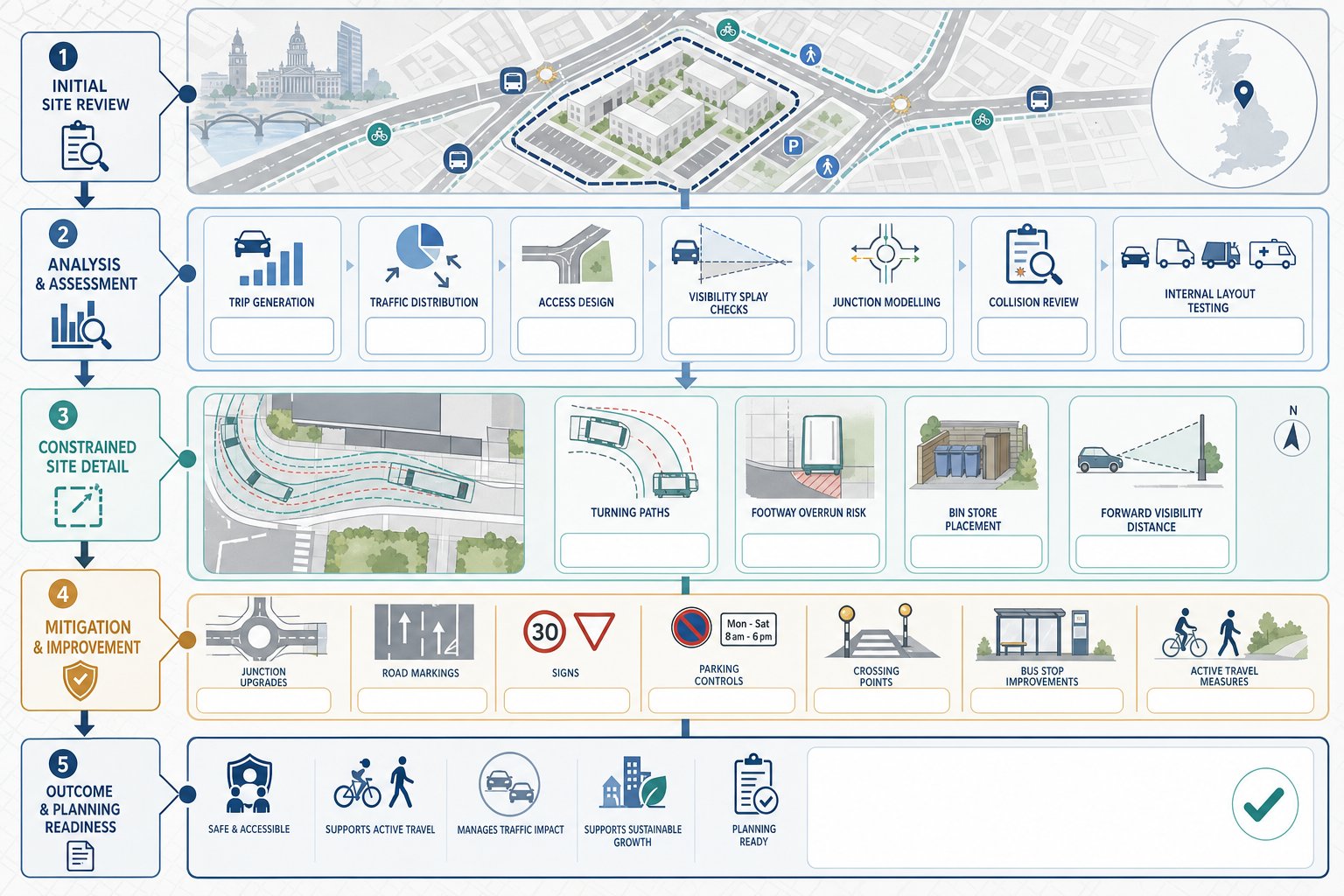
At the earliest stage, we review the site’s context: surrounding roads, nearby junctions, public transport availability, collision history, walking and cycling links, parking pressure, servicing constraints, and the way people already move through the area. We then test how a proposal is likely to change those conditions.
That usually includes trip generation, traffic distribution, access design, visibility checks, junction modelling, and review of internal layout for cars, delivery vehicles, refuse collection, and emergency access. On more constrained sites, small details become decisive. A few metres of forward visibility, an awkward bin store arrangement, or a delivery vehicle over-running a footway can create a planning headache surprisingly quickly.
We also advise on mitigation: junction amendments, lining and signing, parking management, crossing facilities, traffic regulation orders, bus stop improvements, or active travel measures. The aim is not just to identify impacts, but to show how those impacts can be reduced to an acceptable level.
For teams comparing approaches across different authorities, broader Traffic Engineering Consultants: support often matters because thresholds, validation expectations, and officer priorities vary from city to city. In Leeds, that local calibration is especially important.
Why Leeds Developments Need Robust Transport Evidence
Leeds is a growing city, but it is also a city where transport impacts are examined closely. Development pressure, busy radial corridors, mixed urban form, and a strong policy emphasis on sustainable travel mean transport reports need to do more than tick a box.
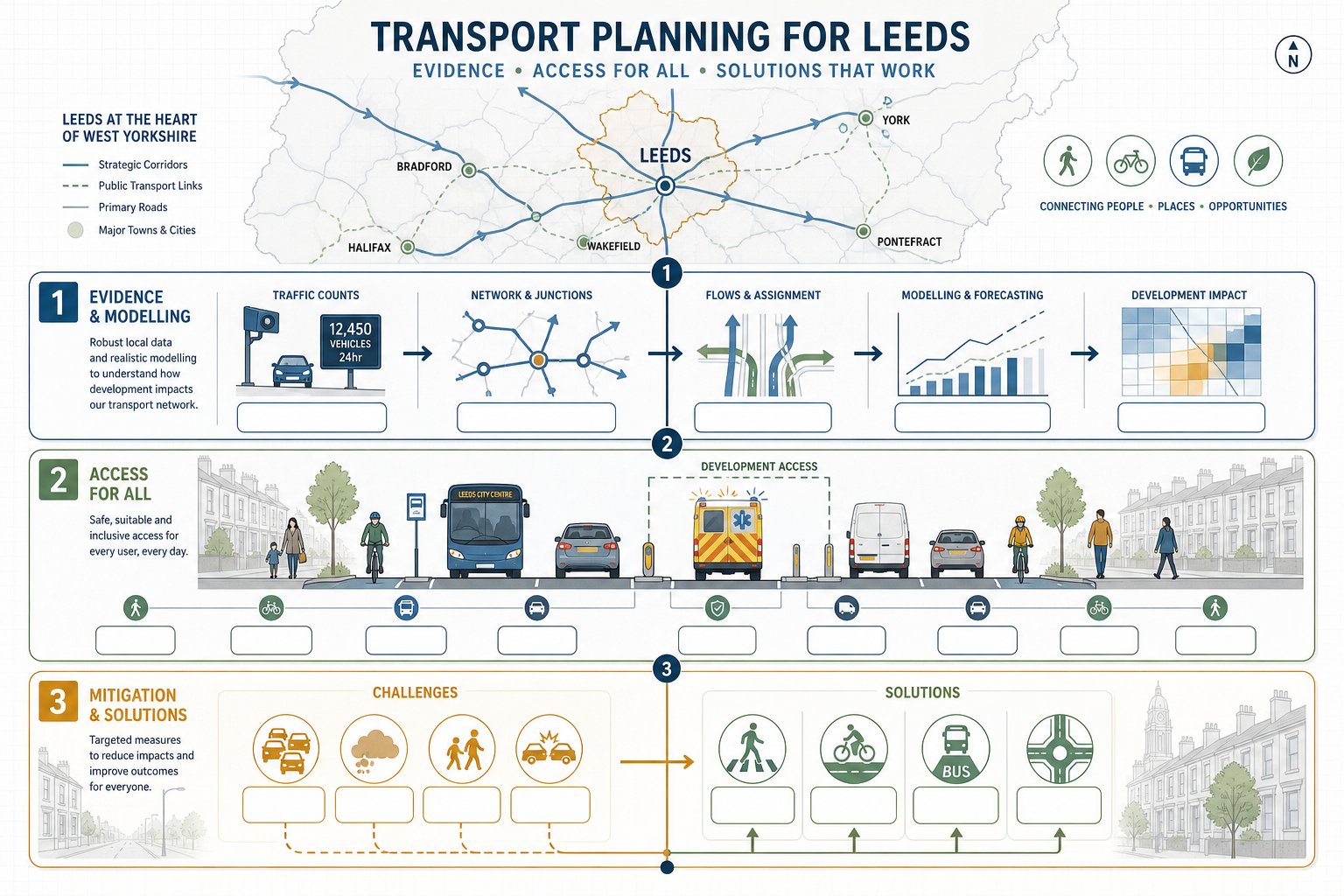
Robust evidence is needed for three main reasons.
First, it must demonstrate that the development does not create an unacceptable or “severe” transport impact in planning terms. That means showing the likely traffic effects with credible survey data, realistic assumptions, and modelling that reflects local conditions rather than generic templates.
Second, submissions need to show safe and suitable access for all users. Not just motorists. Leeds officers will typically expect proper consideration of pedestrians, cyclists, bus passengers, servicing vehicles, and emergency access. A car-dominated assessment with only a token paragraph on active travel is one of the quickest ways to invite challenge.
Third, transport evidence often becomes the bridge between planning ambition and deliverable mitigation. If local concern exists around congestion, air quality, school travel, or collision risk, a well-structured submission can frame solutions early rather than letting objections gather momentum.
That is why concise, authority-aware reporting tends to outperform bulky but unfocused documents. Our experience is that highways officers respond better to clear analysis, transparent assumptions, and mitigation that is actually deliverable. And when schemes have similarities with work in other major authorities, lessons from Traffic Engineer In Manchester: or comparable city-centre contexts can still be useful, provided they are adapted properly to Leeds rather than copied across.
Local Planning And Highways Context In Leeds
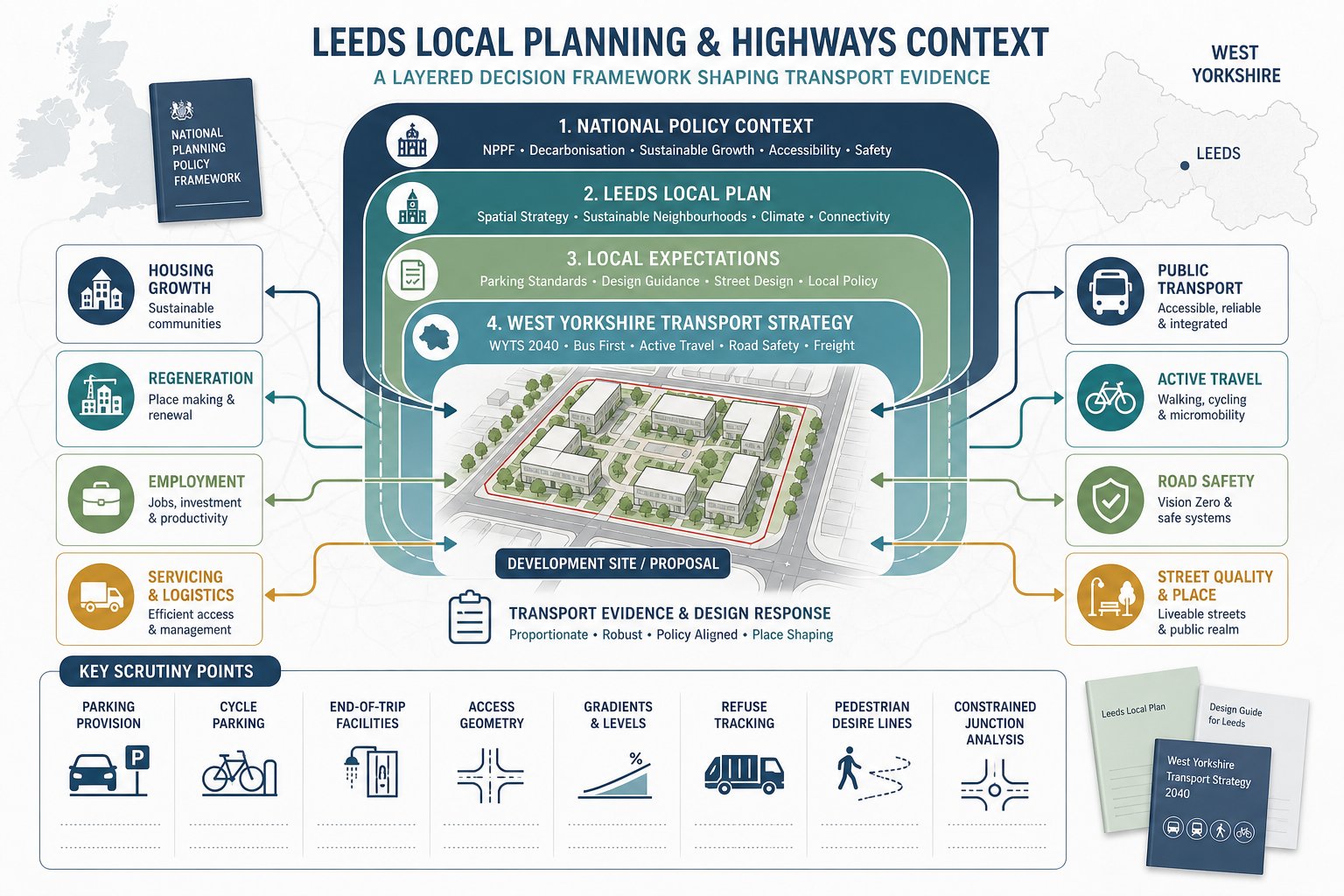
Leeds planning applications are assessed within a layered framework: national planning policy, the Leeds Local Plan, local parking and design expectations, and wider West Yorkshire transport strategies. For applicants, the practical message is straightforward: transport evidence must be locally grounded.
Leeds is not dealing with transport in isolation. It is balancing housing delivery, regeneration, employment growth, public transport reliability, active travel, road safety, and place quality at the same time. So when highways officers review a proposal, they are rarely asking only, “Can cars get in and out?” They are also asking whether the site supports mode shift, whether servicing is workable without conflict, and whether the design fits the street environment around it.
That local framing affects the scope of reports. Parking provision may need careful justification. Cycle parking and end-of-trip facilities can be material. Access geometry, gradients, refuse tracking, and pedestrian desire lines are often scrutinised closely. If a site sits near a constrained junction, school, or strategic corridor, the authority may also expect targeted analysis rather than broad assumptions.
Good transport work in Leeds hence starts with the policy and network context, not just with modelling software. The numbers matter, of course. But so does understanding what officers are trying to achieve on the ground.
Leeds City Council Expectations And West Yorkshire Considerations
Leeds City Council typically expects transport submissions to be proportionate, technically sound, and tied to the specifics of the site. Pre-application discussion can make a big difference here, especially where thresholds are marginal or where an applicant wants to agree the extent of survey work, modelling, or Travel Plan commitments early.
In practical terms, officers often focus on:
- safe and suitable site access
- adequate visibility splays
- servicing and refuse collection arrangements
- emergency vehicle access
- parking and cycle provision aligned with policy
- pedestrian and cycle connectivity
- impacts on bus operation and wider corridor schemes
- road safety, including potential conflict points
West Yorkshire considerations add another layer. Development may need to respond to broader transport objectives around bus priority, active travel corridors, decarbonisation, and safer streets. That means a report should not treat the site boundary as the end of the conversation. If a proposal interacts with nearby crossings, bus stops, junction upgrades, or strategic routes, that interaction needs to be addressed.
The same principle appears in other major urban authorities too, whether in Traffic Engineer In London: work or regional city planning. But Leeds has its own rhythm and thresholds. Knowing how local expectations translate into validation, consultation responses, and conditions is often what separates a smooth application from a drawn-out one.
When A Transport Assessment, Transport Statement, Or Travel Plan Is Needed
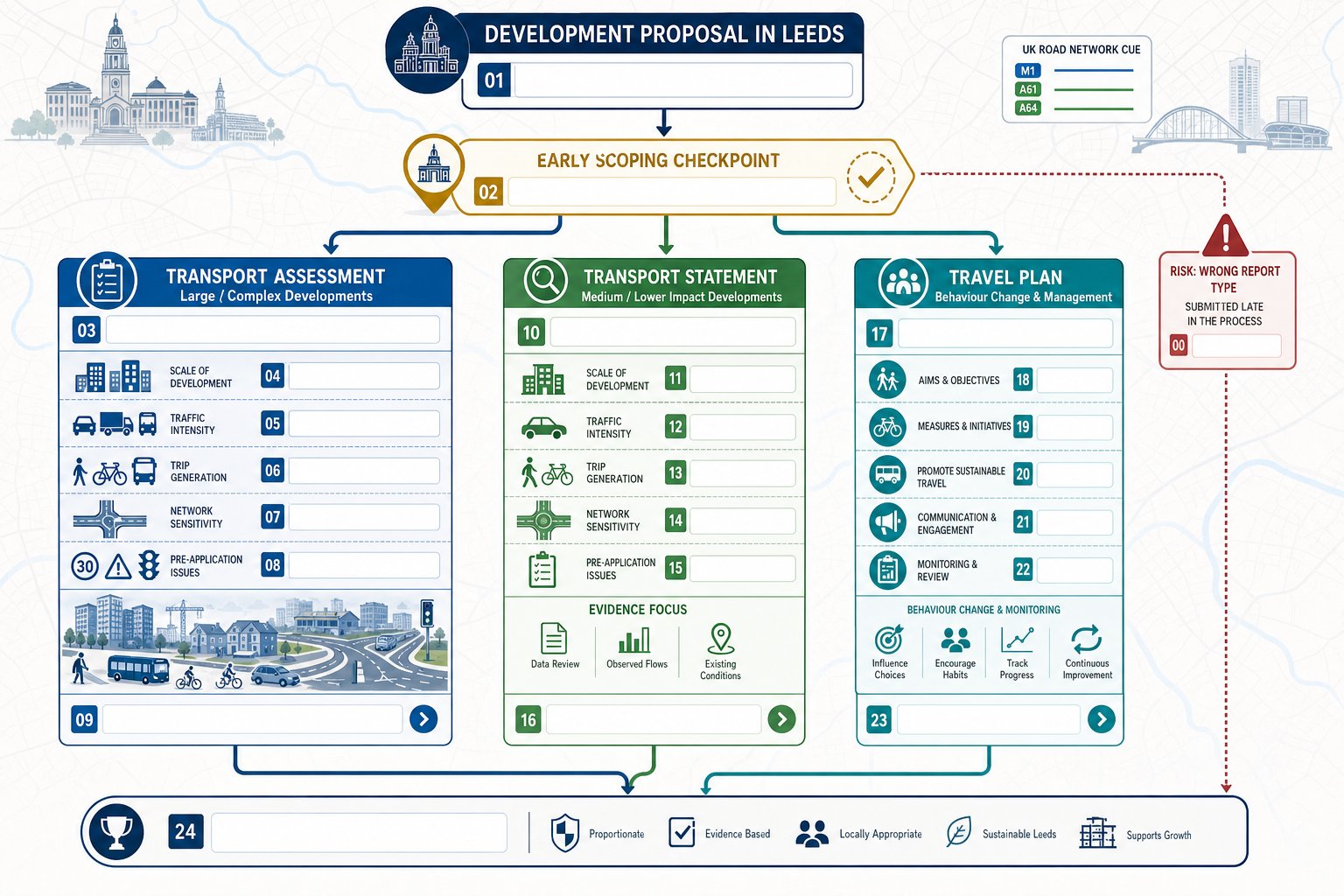
Not every Leeds application needs a full Transport Assessment, but many schemes need more than a short transport note. The right document depends on scale, use class, expected trip generation, network sensitivity, and the issues raised at pre-app stage.
A Transport Assessment (TA) is usually needed for larger or more traffic-intensive development, major housing, substantial employment uses, retail parks, roadside food and beverage, logistics, and mixed-use schemes with meaningful movement demand. A TA normally covers baseline conditions, traffic surveys, trip generation, distribution and assignment, junction impact, sustainable access, road safety, and mitigation.
A Transport Statement (TS) is typically used for medium-scale or lower-impact schemes where the transport effects are material but not extensive enough to justify a full TA. It still needs evidence, but often with a narrower scope.
A Travel Plan (TP) is commonly required for major development and sometimes for uses with concentrated staff or visitor trips. Its purpose is different. Rather than simply measuring traffic impact, it sets out how the development will encourage walking, cycling, public transport, car sharing, and monitoring over time.
The smart move is to agree scope early with LCC Highways. That avoids the classic problem: a team prepares a TS, only to be told late in the process that a TA and Travel Plan were expected. We have seen that happen more than once, and it rarely saves time or fees in the long run.
Where clients want a broader primer on report selection and timing, our Traffic Engineer in Leeds guidance sits alongside local scoping advice.
Key Traffic Engineering Services For Leeds Planning Applications
For planning applications in Leeds, traffic engineering support usually works best as a package rather than a single report dropped in at the eleventh hour. The core services typically include scoping, surveys, analysis, drawings, mitigation design, and responses to consultation comments.
We often begin by reviewing the proposal and identifying what the authority is likely to ask for. That can include whether traffic counts are needed, which junctions should be assessed, whether a swept path is necessary, how parking should be justified, and whether a Travel Plan is likely to be conditioned.
Beyond the headline reports, effective support often includes access strategy, servicing review, active travel review, and short technical notes responding to comments from highways officers or third parties. Those follow-up notes matter more than many teams expect. A well-aimed two-page response can sometimes remove an objection faster than a fifty-page appendix.
There is also a coordination role. Traffic engineers sit between architects, planners, flood consultants, drainage designers, and highways officers. If the site layout changes, the transport evidence may need to change with it. A revised refuse route, relocated substation, or altered parking court can have knock-on effects for tracking, visibility, and capacity work.
In other words, the service is not just about producing documents. It is about keeping the transport case coherent while the scheme evolves.
Transport Assessments, Statements, And Technical Notes
A strong TA or TS does more than assemble data. It explains the transport story of the site in a way that is proportionate, transparent, and defensible.
That generally means establishing the baseline first: existing highway network conditions, sustainable travel opportunities, local collision records, parking context, and observed peak-hour operation. From there, we estimate trip generation using recognised databases and comparable sites, distribute those trips across the likely network, and test the effects at the relevant junctions.
The report should then assess access arrangements, servicing, walking and cycling links, public transport accessibility, and road safety. If mitigation is needed, it should be described in practical terms, not buried in vague wording. Officers want to know what is proposed, whether it works, and whether it can realistically be delivered.
Technical notes are the quieter workhorses of the process. They may respond to comments on parking, justify survey validity, update modelling after a layout change, or provide targeted evidence on a single issue. A concise note is often all that is needed to move a file forward.
Junction Capacity Modelling, Swept Path Analysis, And Access Reviews
Junction modelling is often where transport debates become most technical. In Leeds applications, this may involve priority junction modelling with PICADY, roundabout testing with ARCADY, or signal analysis through LINSIG, depending on the network context. The model itself is not the point: the point is whether it reflects observed conditions and answers the planning question being asked.
If a junction is already under pressure, the authority will want confidence that the baseline is accurate and that growth assumptions are reasonable. That includes queue behaviour, lane use, signal staging, committed development, and the spread of traffic across the local network. Poorly scoped modelling can look precise while still being unconvincing.
Swept path analysis is equally important on constrained sites. Refuse vehicles, delivery vans, articulated HGVs, and fire appliances all need to move safely without excessive overrun, awkward reversing, or conflict with pedestrians and parked cars. Tracking drawings are often decisive on apartment schemes, schools, and commercial yards.
Access reviews bring those elements together. We check width, radii, gradients, visibility, interaction with crossings and cycle routes, and whether the layout works for real users rather than idealised ones. That is often where subtle issues show up, especially on tight urban plots.
Common Leeds Development Types That Require Traffic Engineering Input
In Leeds, traffic engineering input is needed across far more than just large housing sites. Many of the most contentious applications are medium-sized schemes on constrained plots where access, servicing, or local congestion create a disproportionate level of scrutiny.
Residential development is the obvious category: housing estates, apartment blocks, student accommodation, and later living schemes. Here, the recurring issues are access safety, parking demand, refuse and emergency access, and the quality of walking and cycling links.
Food retail, drive-thrus, and leisure uses often trigger detailed highways review because trips can be concentrated, peak periods can overlap with local congestion, and servicing can be awkward. Drive-thrus, in particular, raise questions around internal queuing, exit visibility, and interaction with adjacent highway movements.
Employment, warehousing, and logistics schemes tend to require robust HGV access analysis, servicing design, staff travel planning, and junction testing. A site may work perfectly well for cars yet still fail under heavy vehicle tracking.
Schools, healthcare, and mixed-use development bring a different profile. They can create highly peaked travel demand, sensitive pedestrian movements, and pressure on nearby kerbside space. In those cases, the design of drop-off arrangements and the credibility of the Travel Plan become central.
Across these sectors, Leeds schemes often benefit from advisers who understand both local issues and transferable city experience, whether from Traffic Engineer In Birmingham: work or comparable urban authority submissions.
How A Traffic Engineer Supports The Planning Application Process
The best traffic engineering input starts before the planning application is submitted. By the time a project reaches validation, many of the important transport decisions should already have been made.
At concept stage, we review site constraints and opportunities so the layout is not built around assumptions that later prove unworkable. That might mean repositioning an access, adjusting parking geometry, creating room for tracking, or strengthening pedestrian links before the design hardens.
Next comes scope agreement. We help define with LCC Highways what level of assessment is needed, which surveys should be undertaken, which junctions should be tested, and whether a Travel Plan or off-site works package is likely. This stage sounds procedural, but it can save weeks of avoidable back-and-forth.
We then prepare the reports and drawings needed for submission: TA, TS, Travel Plan, technical notes, access drawings, swept paths, and mitigation sketches where relevant. Once consultation responses land, the role becomes partly analytical and partly diplomatic. Highways comments need a measured reply, firm where the evidence supports it, but flexible enough to keep progress moving.
On some schemes, that extends to negotiating Section 106 obligations or Section 278 highway works. On others, it means supporting the planning team at committee or appeal. Expert evidence carries more weight when it is consistent, concise, and clearly tied to policy and local conditions.
That end-to-end support is often what clients actually need, more than a report in isolation.
Common Reasons Transport Submissions Are Delayed Or Challenged
Most transport objections are not caused by the existence of impact. They are caused by uncertainty about impact. If the authority cannot follow the logic, trust the data, or see how mitigation will work, delay tends to follow.
One of the biggest causes is poor scoping. When an application is submitted with the wrong level of assessment, the wrong study area, or no agreed basis for modelling, comments come back asking for more work. That can reset the programme.
Another common issue is weak or dated survey data. Leeds officers are unlikely to be persuaded by traffic counts that no longer reflect current conditions, abnormal survey periods, or unsupported assumptions about future demand. Survey timing matters, and so does explaining why the dataset is valid.
We also see challenges where junction models do not match local expectations. If lane allocations, queue patterns, signal staging, committed development, or growth assumptions are off, confidence in the whole submission drops.
Then there is underplaying sustainable travel and safety. A report that focuses heavily on car trips but barely addresses pedestrian routes, cycle parking, bus access, crossing demand, or collision history can look incomplete.
Finally, Travel Plans are often too generic. Officers want realistic measures, named responsibilities, baseline data, targets, and monitoring. Boilerplate wording does not travel well.
These problems are avoidable. Early dialogue, well-structured evidence, and concise follow-up notes usually cost less than repairing a weak submission after objections appear.
That is true in Leeds and elsewhere: even a Birmingham Transport Consultant: approach still has to be recast to fit local policy and officer expectations.
Choosing The Right Traffic Engineer In Leeds
Choosing the right consultant is not just about finding someone who can produce a Transport Assessment. Plenty of firms can do that. The better question is whether they can produce the right transport evidence for your particular Leeds site, in the right format, at the right time, with the confidence to defend it.
We would look for five things.
First, local authority awareness. Experience with Leeds City Council, West Yorkshire policy context, and local transport sensitivities matters. A report can be technically correct and still miss what officers are most concerned about.
Second, technical range. The consultant should be comfortable with TA/TS preparation, junction modelling, swept paths, parking review, access design, and Travel Plans. Gaps in capability can lead to fragmented advice and inconsistent submissions.
Third, clear writing. Planning teams do not need impenetrable prose. They need concise reports that explain assumptions, findings, and mitigation plainly. That sounds obvious, but it is surprisingly rare.
Fourth, responsiveness. Planning timetables shift. Layouts change. Consultation comments arrive late on a Friday afternoon, because of course they do. A useful traffic engineer can adjust quickly without losing the thread.
Fifth, credibility in discussion. The ability to engage calmly with officers, planning consultants, architects, and sometimes members is part of the job.
For clients comparing city-specific support, examples from Traffic Engineer In Liverpool: or Traffic Engineer In Bristol: can show how good transport advice adapts to place rather than relying on a single template. In Leeds, that adaptability is a genuine advantage.
Conclusion
A well-prepared planning application in Leeds needs transport evidence that is proportionate, policy-aware, and grounded in how the site will actually function. That is the practical value of working with an experienced Traffic Engineer in Leeds: we identify the transport risks early, shape the right scope, and provide analysis that highways officers can properly test rather than pick apart.
For architects, planners, solicitors, developers, and public sector teams, the goal is not simply to produce another report. It is to reduce uncertainty, answer likely objections before they arise, and present mitigation that is realistic enough to be approved and delivered.
In 2026, as Leeds continues to balance growth with safer streets, active travel, public transport, and network resilience, transport input remains one of the clearest ways to de-risk an application. Get it right early, and the whole planning process tends to move with far less friction.
Frequently Asked Questions About Traffic Engineers in Leeds
What role does a traffic engineer in Leeds play in planning applications?
A traffic engineer in Leeds provides technical transport evidence for planning proposals, assessing access, parking, junction impact, and sustainable travel. They analyse site context, model traffic flow, and design mitigation to ensure safe, policy-compliant development that meets Leeds City Council requirements.
When is a Transport Assessment or Travel Plan required for Leeds developments?
Transport Assessments are needed for larger or traffic-intensive schemes, such as major housing and retail parks, while Transport Statements suit medium-impact projects. Travel Plans are often required for major developments to promote walking, cycling, public transport, and monitor travel behaviour, with scope agreed early with Leeds City Council.
How do local policies in Leeds influence transport evidence submissions?
Leeds planning decisions are guided by national policy, the Leeds Local Plan, and West Yorkshire transport strategies prioritising sustainable travel and Vision Zero road safety goals. Transport evidence must address local parking standards, safe access for all modes, and integration with active travel and bus priority corridors.
What common issues cause delays in transport submissions for Leeds planning?
Delays often result from inadequate scoping with Leeds Highways, outdated or unvalidated traffic data, junction models not matching officer expectations, inadequate consideration of pedestrian, cycling or bus access, and generic Travel Plans lacking realistic measures or monitoring commitments.
How can a traffic engineer help reduce planning objections in Leeds?
By producing clear, locally-tailored transport evidence aligned with Leeds policies, a traffic engineer helps de-risk applications. Early engagement, accurate modelling, realistic mitigation, and concise responses to consultation avoid assumptions and objections, ensuring smoother approval processes and fewer delays.
What services do traffic engineers typically offer for Leeds planning applications?
They provide scoping advice, conduct traffic surveys, prepare Transport Assessments, Statements, and Travel Plans, design site access and mitigation measures, undertake junction modelling and swept path analysis, and handle consultation responses. Their role includes coordinating transport evidence with evolving site design and planning teams.