
Coventry schemes rarely succeed on planning merit alone. If access is awkward, junctions are already under pressure, parking is poorly justified, or sustainable travel has been treated as an afterthought, even a promising proposal can slow down fast. That is why a Traffic Engineer in Coventry often becomes central to the planning process far earlier than many teams expect.
For architects, planners, developers, surveyors and legal teams, transport work is not just a technical appendix. It shapes site capacity, informs design, affects viability, and can influence whether highway officers support, question, or resist an application. In a city with strategic corridors such as the A444, A45 and the ring road, plus busy local centres, bus routes and constrained urban streets, local context matters.
We approach transport advice as part of the wider planning strategy, not a box-ticking exercise. That means understanding Coventry City Council expectations, applying national policy proportionately, and producing reports that are concise, defensible and useful in practice. Whether the issue is a full Transport Assessment, a proportionate Transport Statement, swept path checks, parking evidence or technical responses to consultation comments, the quality of the transport case can make a measurable difference.
This guide explains what a traffic engineer does, when formal reporting is needed, how Coventry’s local context shapes advice, and what to look for when appointing support for 2026 projects.
Key Takeaways
- A Traffic Engineer in Coventry plays a crucial role early in the planning process to address local transport challenges and improve application success.
- Transport Assessments or Statements are required based on the development’s size, location, and impact on Coventry’s congested road network.
- Effective transport advice must align with Coventry’s local policies, urban context, and sustainable travel goals to shape practical, proportionate planning submissions.
- Key concerns include site access, junction capacity, parking strategy, sustainable travel options, and servicing arrangements, all of which impact planning decisions.
- Choosing a Traffic Engineer with local authority experience, broad technical skills, clear communication, and reliable delivery is essential for navigating Coventry’s planning requirements.
- Early traffic engineering involvement helps identify risks, optimise designs, and ensure transport evidence supports planning permission without unnecessary delays.
What A Traffic Engineer In Coventry Does For Planning And Development

A traffic engineer involved in Coventry planning work does much more than count vehicles or produce a standard report. Our role usually begins with one simple question: will transport be a planning risk on this site, and if so, how do we manage it early?
That can mean reviewing a prospective development site before land is acquired, testing whether an access arrangement is realistic, or identifying whether local junction pressure is likely to trigger a more detailed assessment. On some schemes, the key issue is network impact. On others, it is servicing, refuse collection, parking layout, pedestrian safety, or whether the proposal aligns with sustainable transport policy.
For housing, employment, retail and mixed-use projects, we assess likely trip generation, where those trips will travel, and how they interact with nearby roads and junctions. We also advise on site access geometry, visibility, internal circulation and loading arrangements so designs work not only on paper but in day-to-day operation.
In practical terms, that often means coordinating with planning consultants, architects and highway designers from the outset. A well-scoped transport strategy can avoid redesign later. It also helps ensure the submitted documents are proportionate. For broader context on the profession, our overview of Traffic Engineering Consultants: explains how transport input fits into planning success across different authorities.
In Coventry especially, the strongest transport advice is local, policy-aware and commercially realistic.
When A Transport Assessment Or Transport Statement Is Needed In Coventry
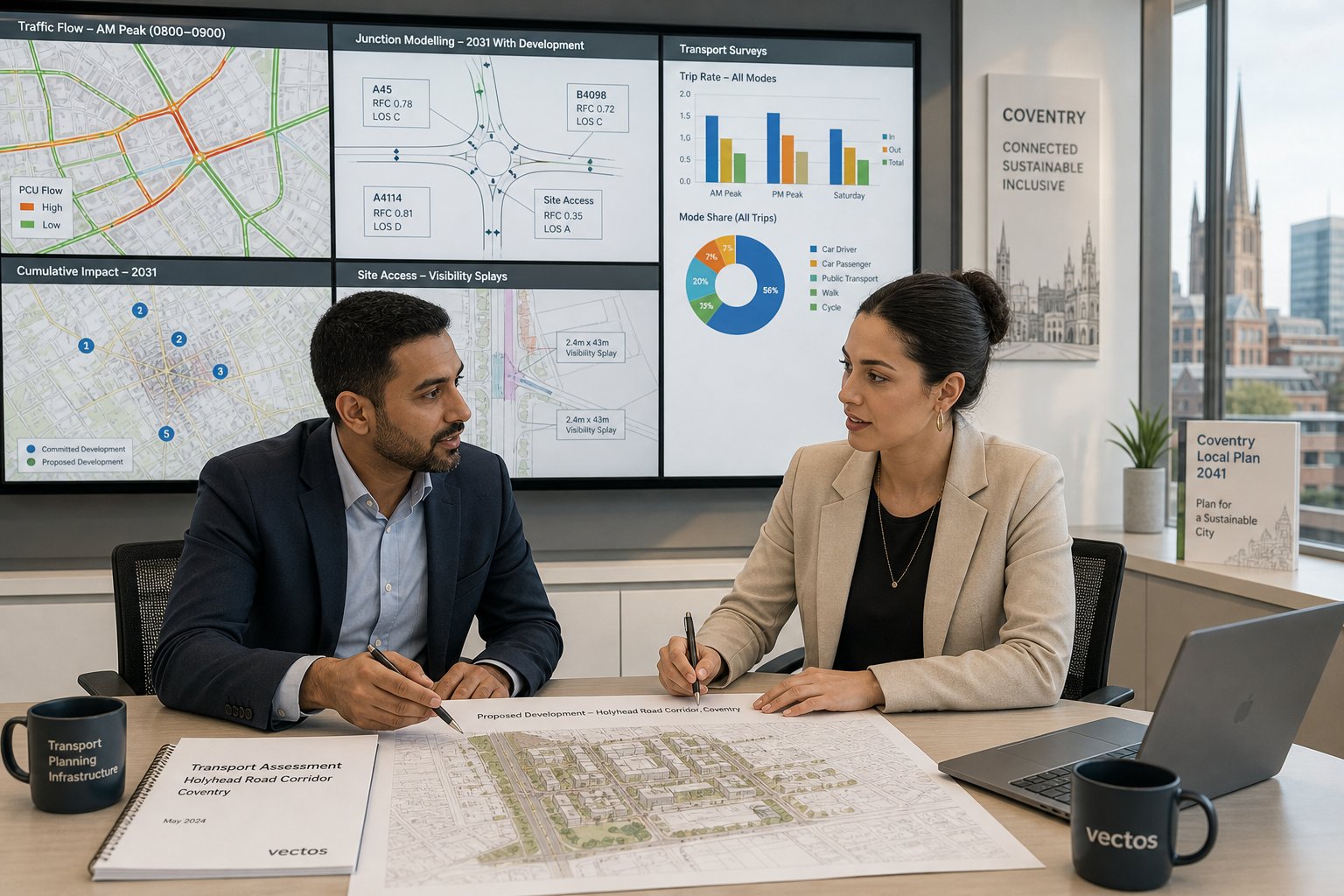
The short answer is: when a development is likely to create a level of transport impact that the local planning authority and highway officers need evidenced properly.
A Transport Assessment is typically required for larger or more traffic-intensive proposals where the impact may be material. Think major residential schemes, substantial commercial floorspace, roadside development, education uses, logistics activity or mixed-use proposals with notable peak-hour movement. A Transport Statement is generally used for smaller developments where effects are more limited, but still need to be demonstrated clearly.
There is no sensible one-size-fits-all threshold. Coventry City Council will consider scale, land use, local sensitivity, access conditions and cumulative impact. A modest scheme in a constrained location near a busy corridor may need more analysis than a larger scheme in a highly accessible area with spare network capacity.
That is why pre-application scoping matters. We normally agree the scope of work with officers early where possible: study area, survey requirements, assessment years, junctions to model, and whether a Travel Plan should accompany the application. National guidance under the NPPF sets the broad framework, but local judgement drives the detail.
This proportional approach is similar to what we see in other authorities, whether on a Traffic Engineer In Birmingham: commission or work for dense urban applications in other city settings. The point is not to overproduce paperwork: it is to give officers the evidence they actually need to reach a decision.
How Local Planning And Highway Context Shapes Transport Advice In Coventry
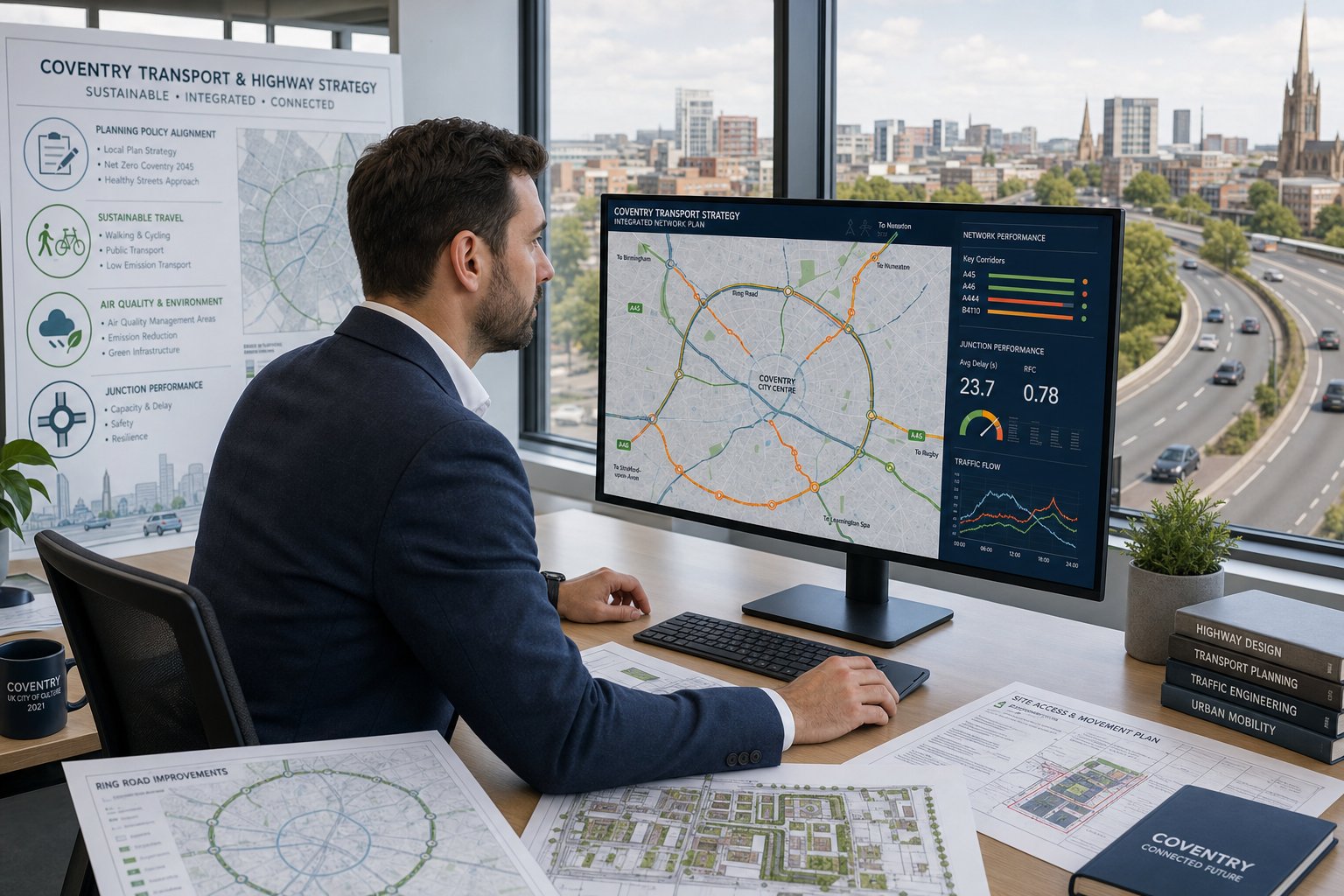
Transport advice in Coventry has to reflect both policy and place. That sounds obvious, but it is where many weak reports fall down.
At policy level, we consider national planning guidance alongside the Coventry Local Plan, local parking expectations, sustainable travel objectives, air quality concerns and relevant highway design standards used across Coventry and the wider West Midlands context. Those documents influence what is likely to be acceptable on parking levels, accessibility claims, mitigation design and the weight given to non-car travel options.
At place level, Coventry has a transport network with very different operating conditions from one area to another. Sites affected by the ring road function differently from suburban plots near local centres. The A45 and A444 corridors can create strategic sensitivity, while some urban sites face tighter geometric constraints, active frontage issues, bus stop interactions or limited servicing space.
That local reading changes the advice. A scheme with strong walking and bus accessibility may justify a different parking approach than an edge location with weaker mode choice. A junction that appears acceptable from a desktop plan may be problematic once queueing, lane discipline or nearby signals are understood properly.
Our work is strongest when transport planning is integrated with planning strategy, not bolted on at the end. That is also why clients often compare local authority expectations across cities: work on a Traffic Engineer In Bristol: project, for example, may share core methodology, but Coventry’s highway context will still shape the final judgement.
Key Factors That Influence Traffic Impact In Coventry Developments

Not every Coventry development creates the same kind of traffic issue. In practice, several overlapping factors determine whether a proposal is likely to be straightforward or contentious.
First is the nature of the use itself. Residential, student, industrial, roadside retail, healthcare and mixed-use schemes all generate movement differently, and not just in volume. Timing matters. A development that produces sharp peak-hour demand near already stressed junctions may be more problematic than one with higher daily traffic spread across the day.
Second is location. Accessibility by foot, cycle and bus can materially influence trip patterns, parking demand and the strength of a Travel Plan. Sites close to local services and public transport usually perform better in planning terms than isolated layouts dependent on private car use.
Third is the baseline network. Existing congestion, collision history, school-related peaks, on-street parking pressure and nearby committed development all affect the transport case. Officers will reasonably ask not only what your site does in isolation, but what it adds to an already changing network.
Fourth is design quality. Poor servicing arrangements, weak visibility, awkward turning movements or undercooked parking strategy can create objections even where traffic generation itself is manageable.
These issues are not unique to Coventry: they are common themes across urban authorities and are often explored through Highway And Traffic planning work. The difference is always in the local detail.
Trip Generation, Distribution, And Junction Capacity Modelling
Trip generation usually begins with comparable-site evidence, often using TRICS-type methodology, then refined to reflect local circumstances. We look at development type, scale, likely mode share and whether standard rates need adjustment for urban context, mixed uses or sustainability credentials.
Distribution and assignment come next: where do trips come from, where do they go, and how should they be loaded onto the network? Census travel-to-work data, local routing logic, committed development evidence and observed traffic conditions all help build a defensible picture.
Then there is capacity testing. Depending on the site, we may use priority junction assessment, signal modelling, corridor analysis or more detailed tools such as SYNCHRO, HCM-based methods or microsimulation. The goal is not to create a dramatic model for its own sake. It is to answer a planning question clearly: does the development cause a severe effect, and if there is pressure, what mitigation is reasonable?
In Coventry, modelling also has to account for local junction interactions, bus movement, signal coordination and the very practical reality that a technically compliant output still needs to make sense to officers and stakeholders.
Sustainable Travel, Parking, And Servicing Considerations
Sustainable travel is now central, not decorative. A convincing Coventry application needs to show how people can realistically walk, cycle and use public transport, not merely that a bus stop exists somewhere on a plan.
We assess footway continuity, crossing opportunities, cycle route connections, journey times to key destinations and the quality of access to nearby services. Where appropriate, we support measures such as improved crossings, cycle parking, wayfinding, public transport information and Travel Plan commitments.
Parking is equally sensitive. Under-provision can trigger overspill concerns: over-provision can undermine sustainability arguments and waste land. We hence test parking against local expectations, accessibility, likely user profile, disabled provision, visitor demand, EV charging and operational needs.
Servicing often becomes the issue that catches teams late. Retail units, apartment refuse collection, care uses and urban infill schemes all need workable delivery and waste strategies. Swept path analysis helps demonstrate that vehicles can enter, turn, load and leave safely without relying on optimistic manoeuvres.
And frankly, if servicing looks awkward to a case officer, it usually looks awkward to everyone else too.
Common Reports Prepared By A Traffic Engineer For Coventry Applications
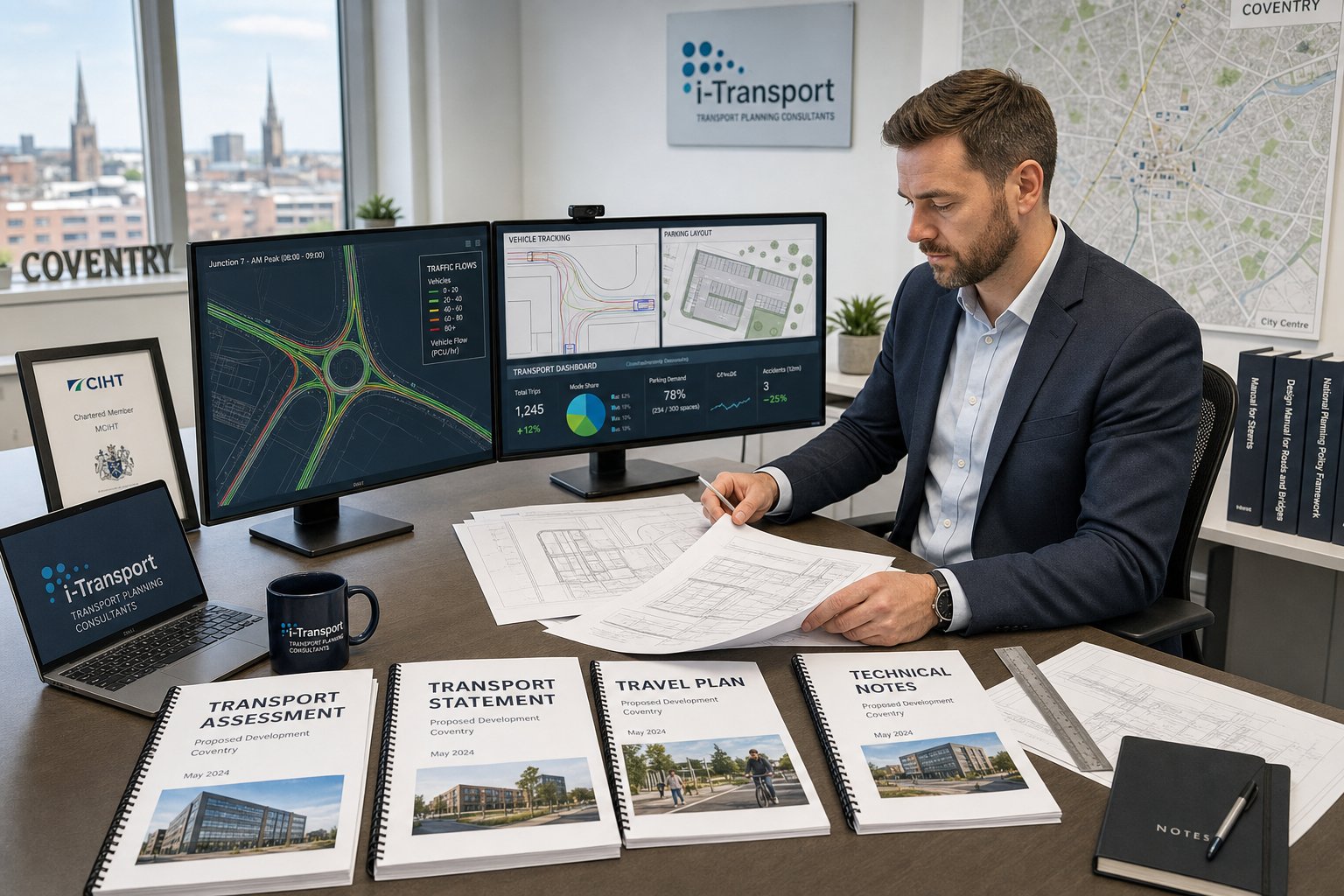
The documents needed for a Coventry application depend on scale, complexity and the planning risks on the site. But most projects fall into a fairly familiar family of reports.
Some require a full Transport Assessment with surveys, trip generation, distribution, modelling and mitigation proposals. Others need a Transport Statement focused on access, parking, sustainable travel and a proportionate review of local effects. Many applications also benefit from a Travel Plan, especially where mode shift will form part of the planning case.
Beyond those core reports, we often prepare technical notes to answer consultation comments, short evidence pieces to justify design amendments, and vehicle tracking material to demonstrate operational practicality. In appeal scenarios, or where objections become technical, more formal highway evidence may also be needed.
The best reporting is concise, not thin. Officers do not need 150 pages of recycled theory: they need a document that addresses the real transport questions. That principle applies in Coventry just as much as on a Traffic Engineer In Manchester: instruction or for major-city regeneration work elsewhere.
Transport Assessments, Transport Statements, And Travel Plans
A Transport Assessment is the fuller document. It usually sets out the site context, planning background, accessibility review, survey data, trip generation, trip distribution, capacity testing, accident review, parking and servicing assessment, and any proposed mitigation. It is suited to schemes where transport effects may be significant enough to influence determination materially.
A Transport Statement is shorter and more proportionate. It still needs to be robust, but it is generally used where impacts are lower and extensive modelling may not be justified. For many small-to-medium urban developments, a well-argued TS is the right answer.
A Travel Plan complements either document where encouraging sustainable travel is important. This can include welcome packs, cycle provision, public transport information, monitoring commitments, car club measures, management arrangements and targets for reducing single-occupancy car use.
The distinction matters because over-scoping can waste time and fees, while under-scoping can lead to objections and delay.
Technical Notes, Swept Path Analysis, And Highway Evidence
Technical notes are often the unsung workhorses of planning transport support. When a consultee raises a specific concern about parking stress, visibility, delivery turning, or revised unit mix, a focused note can deal with the issue faster than reopening an entire report.
Swept path analysis is equally important on constrained Coventry sites. Using vehicle tracking software, we test whether refuse vehicles, fire appliances, delivery vans and larger service vehicles can manoeuvre safely. This is particularly valuable for tight urban plots, student accommodation, town centre servicing yards and mixed-use schemes with limited frontage.
Highway evidence tends to come into play where decisions are challenged, conditions are disputed, or a planning appeal requires a more formal expert position. In those cases, clarity is everything. Technical confidence helps, but so does writing evidence that non-engineers can actually follow.
That blend of engineering and planning communication is a hallmark of strong Traffic Engineer In London: work as well as Coventry-facing applications.
How Traffic Engineers Support Planning Applications From Early Feasibility To Decision
The biggest value we add often comes before an application is submitted.
At feasibility stage, we review access options, likely reporting requirements, junction sensitivity, parking implications and whether the proposal has any obvious transport red flags. That early view can shape land bids, layout options and the wider planning strategy. It can also save clients from pushing a concept that looks efficient on an architectural drawing but is weak once vehicles, pedestrians and servicing are tested.
During pre-application work, we help define scope with highway officers and planning teams. Agreeing the right survey periods, study area and assessment methodology early reduces argument later. It also gives the wider consultant team more certainty on programme.
At submission stage, we prepare the relevant reports and drawings, coordinating closely with architects, planning consultants and drainage or civil teams where needed. If officers request clarification, we respond through technical notes, revised drawings or additional evidence. If mitigation is needed, we help refine what is proportionate and deliverable, whether through planning conditions, Section 106 obligations or Section 278 works.
And when a scheme becomes contentious, continuity matters. The same transport team that shaped feasibility should ideally support the negotiations, because they understand not just the numbers, but the commercial and planning logic behind them.
That end-to-end involvement is one reason experienced clients often compare local approaches across cities, from Coventry to a Traffic Engineer In Leeds: instruction with similar planning pressure points.
Common Challenges On Coventry Sites And How They Are Addressed
Coventry sites can be deceptively difficult. A plot may look straightforward until the transport detail is unpacked.
One common challenge is the constrained urban site, especially near the ring road or within established built-up areas. Access widths, turning space, visibility and servicing can all become tight. Here, we often look at refined access geometry, delivery management, one-way circulation or carefully justified servicing arrangements supported by swept path testing.
Another issue is junction stress on nearby corridors. Existing queues, signal staging and interaction between closely spaced junctions can mean even modest additional trips attract scrutiny. In those cases, robust baseline evidence and proportionate modelling are essential. Sometimes the answer is physical mitigation: sometimes it is a clearer explanation of why the impact is not severe in policy terms.
Parking pressure is also a recurring concern, particularly where surrounding streets are already busy. We address this through parking accumulation analysis, accessibility review, user-profile evidence and realistic management measures rather than vague claims that residents will simply not drive.
Air quality and sustainable travel frequently sit behind officer concerns too. Stronger pedestrian links, cycle facilities, EV provision and meaningful Travel Plan measures can materially improve the planning position.
Most importantly, challenges are easier to solve when identified early. By the time a refusal reason is drafted, options usually narrow quite quickly.
How To Choose The Right Traffic Engineer In Coventry
If you are appointing a traffic engineer in Coventry, technical competence is only the starting point. Plenty of consultants can produce a report. Fewer can produce one that is proportionate, locally aware, easy for officers to navigate, and strategically useful to the wider project team.
We would look for five things.
First, local authority experience. Familiarity with Coventry City Council processes, officer expectations and common transport concerns helps enormously. It means the advice is grounded in how decisions are actually made, not just in generic national guidance.
Second, breadth of capability. The right consultant should be able to handle Transport Assessments, Transport Statements, Travel Plans, parking reviews, access design input, swept path analysis, and where necessary junction modelling or appeal evidence.
Third, communication. Transport work often sits between planning, design and legal issues. Reports need to be concise, structured and defensible. Meetings with officers require diplomacy as much as technical skill.
Fourth, software and methodology. Recognised modelling tools matter, but so does knowing when not to overcomplicate the task.
Fifth, reliability. Fast turnaround is useful only if the output is accurate. For clients comparing options, examples from a Traffic Engineer In Liverpool: or Coventry commission can reveal whether a consultant writes with genuine planning clarity.
In short: choose a team that understands roads, planning and people.
Conclusion
A strong planning submission in Coventry usually needs more than a standard transport chapter. It needs evidence that the development has been tested properly against local network conditions, policy expectations and day-to-day operational reality.
That is where a Traffic Engineer in Coventry can make a meaningful difference. From early feasibility and pre-application strategy to Transport Assessments, Travel Plans, servicing checks and responses to highway comments, the right advice helps teams reduce risk and keep schemes moving.
For architects, planners, developers, surveyors and legal teams, the practical question is not simply whether transport work is required. It is whether the work is proportionate, credible and aligned with how Coventry decisions are actually made in 2026.
When that happens, transport evidence stops being a hurdle and becomes part of the route to permission.
Frequently Asked Questions about Traffic Engineers in Coventry
What role does a traffic engineer play in Coventry planning applications?
A traffic engineer in Coventry assesses transport impacts, designs site access and junction layouts, and advises on mitigation measures such as sustainable travel and parking. Their input shapes planning strategy to align with local policies and ensures developments operate safely and efficiently on the local road network.
When is a Transport Assessment or Transport Statement required in Coventry?
Transport Assessments are needed for larger, traffic-intensive developments, while Transport Statements suit smaller schemes with limited impact. Coventry City Council determines the scope based on site size, location, and traffic sensitivity, coordinated through pre-application discussions to avoid unnecessary work.
How does Coventry’s local context influence traffic engineering advice?
Coventry’s transport advice considers local road network constraints, strategic corridors like the A45 and ring road, parking standards, sustainable travel policies, and air quality concerns. This ensures site access, parking, and mitigation proposals are realistic and meet both national guidance and Coventry City Council expectations.
What sustainable travel considerations do traffic engineers in Coventry incorporate?
Traffic engineers assess walking and cycling connectivity, public transport accessibility, and design of safe crossings. They promote Travel Plans, cycle parking, EV charging provision, and measures that support reducing private car use, reflecting Coventry’s commitment to sustainable transport within planning applications.
How do traffic engineers support planning applications from start to finish in Coventry?
They provide early feasibility reviews of access and transport risks, scope assessment requirements with local officers, prepare Transport Assessments or Statements, develop Travel Plans, respond to consultation comments, and negotiate necessary highway mitigation. Continuous involvement ensures alignment with planning decisions and efficient application progression.
What should I look for when choosing a traffic engineer in Coventry?
Select a traffic engineer with proven Coventry City Council experience, broad expertise in assessments, strong communication and concise reporting skills, familiarity with recognised modelling software like SYNCHRO, and relevant professional qualifications. Such a consultant ensures locally aware, strategic, and dependable transport advice.