
Oxford is one of those places where transport planning looks straightforward on a plan and complicated the moment it meets the street. Tight historic corridors, heavy cycling flows, bus priority, air quality pressures, university-related movement, Controlled Parking Zones, and a strong policy push toward sustainable travel all mean the same thing: planning applications need transport evidence that is proportionate, credible, and locally aware.
That is where a Traffic Engineer in Oxford becomes central to the planning process. We do far more than calculate vehicle trips. We help shape access, test whether a development can function on a constrained network, prepare the right transport documents, and respond to the concerns that often determine whether an application moves smoothly or stalls.
For architects, planners, developers, solicitors, surveyors, and public-sector teams, the main challenge is rarely just technical compliance. It is knowing what Oxford City Council and Oxfordshire County Council are likely to focus on, what level of reporting is justified, and how to present a scheme so it supports wider transport and environmental objectives.
In this guide, we explain what a traffic engineer in Oxford actually does, when input is needed, what documents are usually required, and how a planning-led approach can de-risk development from early feasibility through to decision.
Key Takeaways
- A Traffic Engineer in Oxford plays a crucial role by providing locally aware, credible transport evidence that aligns with the city’s unique planning and environmental policies.
- Early involvement of a traffic engineer in the planning process helps shape access, parking, and sustainable travel strategies, reducing risks and delays in applications.
- Transport Assessments, Transport Statements, and Technical Notes must be proportionate and tailored to the scale and sensitivity of Oxford developments to support planning submissions effectively.
- Oxford’s constrained historic infrastructure demands a planning-led transport approach that prioritises active travel, air quality, and network efficiency over conventional car-focused solutions.
- Understanding Oxford City Council and Oxfordshire County Council’s expectations, including Controlled Parking Zones and Low Traffic Neighbourhoods, is essential for a credible transport submission.
- Effective travel planning and integration with wider transport policies can improve the chances of planning approval by demonstrating commitment to sustainable and low-impact development.
What A Traffic Engineer In Oxford Does For Planning Applications
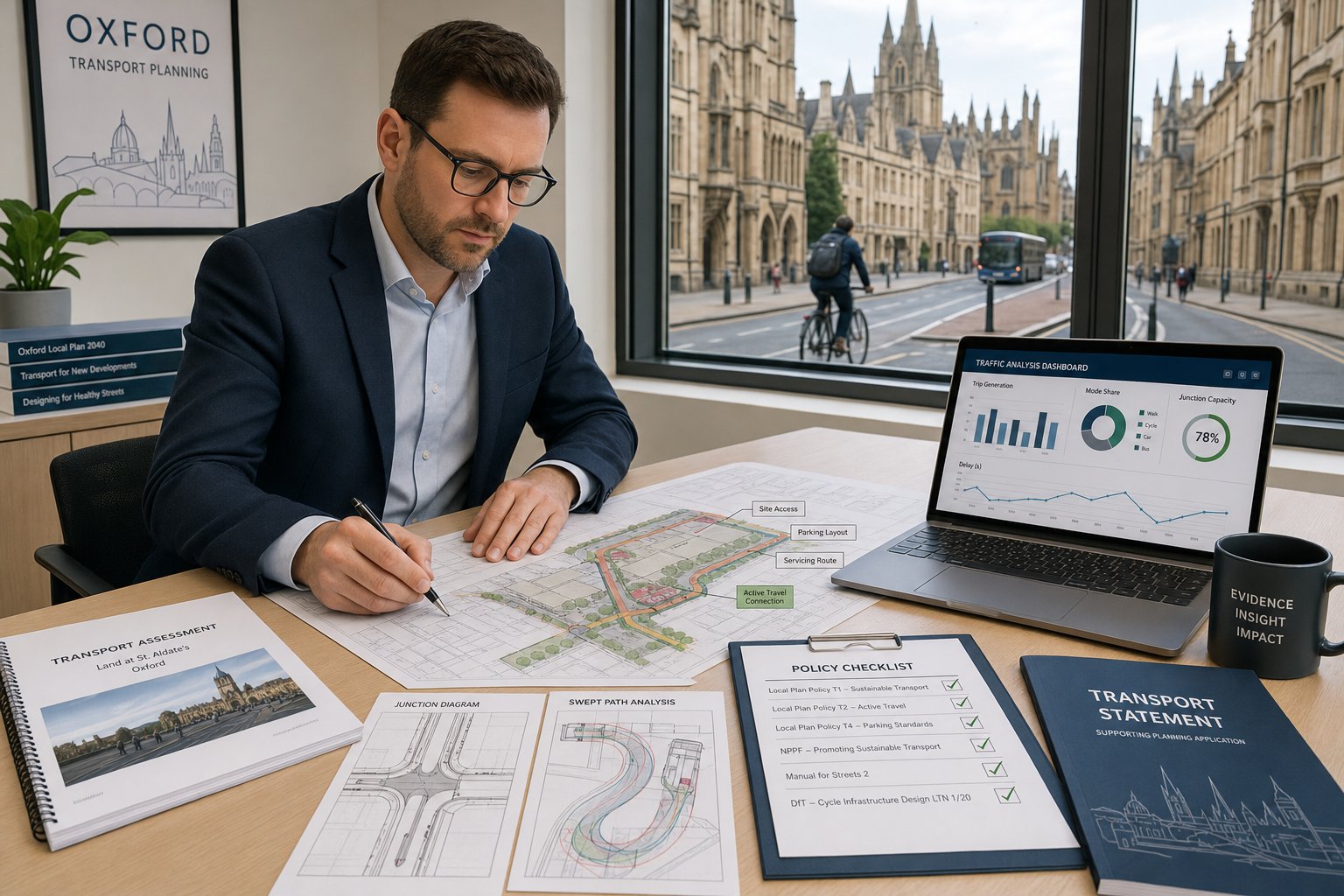
A traffic engineer in Oxford supports planning applications by turning transport risk into clear, evidence-based advice. In practical terms, that usually means reviewing a site, understanding the proposed land use, checking local policy and constraints, and producing the transport material needed to support a planning submission.
The core outputs are typically Transport Assessments, Transport Statements and Technical Notes. These documents examine how people are likely to travel to and from a site, what effect that movement may have on the surrounding highway network, whether access is safe, and whether parking, servicing and active travel provision are appropriate. On some schemes we also prepare Travel Plans, junction capacity reviews, swept path analysis and parking strategy notes.
But planning support is not just about reports. A good consultant helps shape the scheme itself. That can mean advising on whether an access point is likely to be acceptable, whether a layout gives enough room for servicing, or whether a car-light approach is more realistic than trying to defend conventional parking in a highly constrained location.
On Oxford projects, that planning focus matters. The technical work has to align with local policy, not sit beside it. Broader guidance on how traffic engineering consultants support planning applies nationally, but Oxford demands tighter integration between transport evidence and development strategy than many authorities.
Why Oxford Requires A Local, Planning-Led Transport Approach
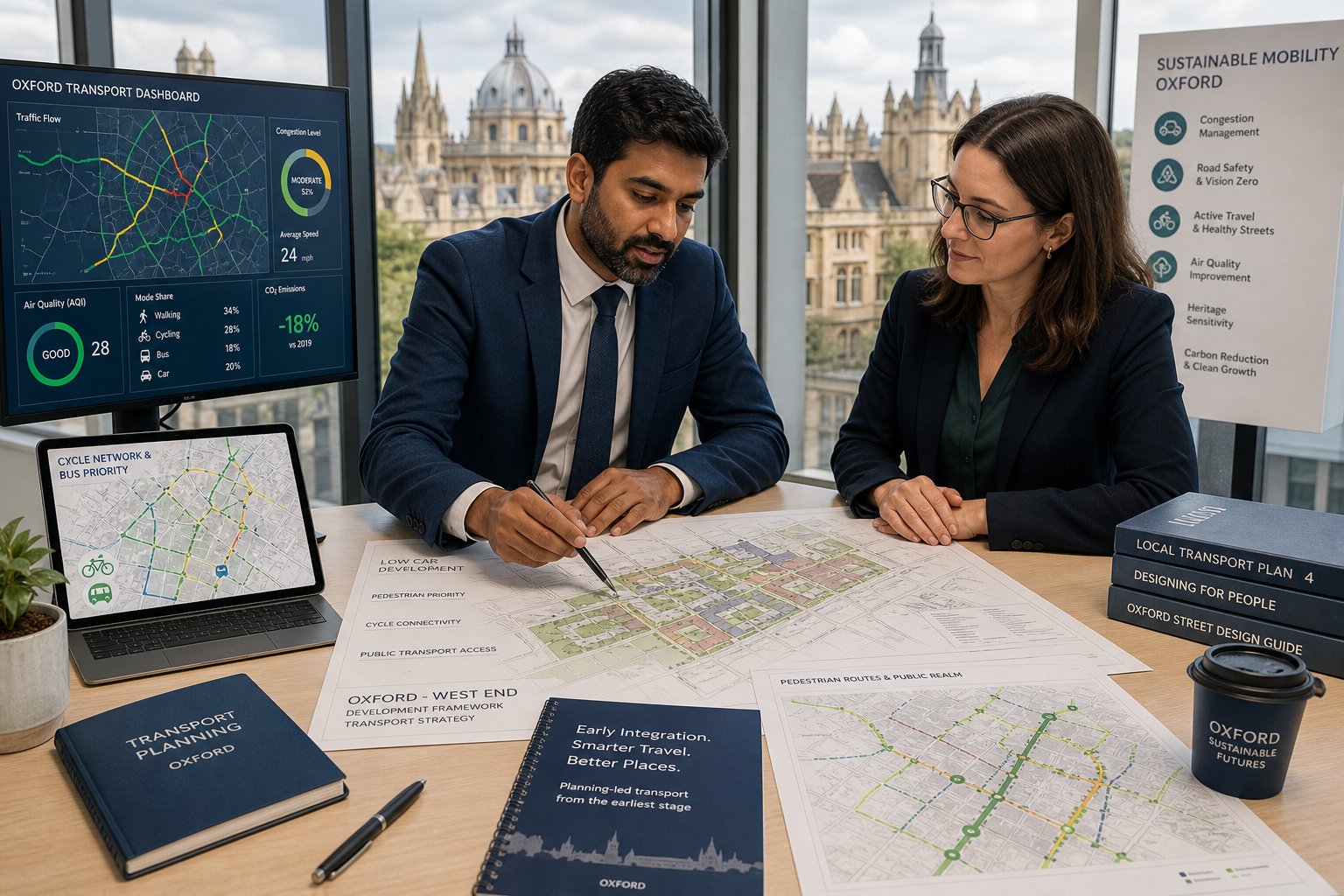
Oxford is not a standard highway authority context. The city’s network is constrained, historic and politically sensitive. A scheme that might be routine elsewhere can become contentious here because transport effects are judged through several lenses at once: congestion, road safety, mode shift, public transport priority, cycling quality, air quality, heritage setting and carbon reduction.
That is why a planning-led approach matters. If transport input starts only after the layout is fixed, the engineer is often left trying to justify weak access, over-provision of parking or poor walking links. In Oxford, that tends not to work. The stronger route is to use transport advice early so the scheme reflects policy from the start.
Local expectations are shaped by Oxford’s emphasis on sustainable movement, including bus and cycle priority, low-car development in accessible locations, and the wider direction of travel represented by measures such as the Zero Emission Zone and corridor management. Oxfordshire’s Local Transport and Connectivity Plan has reinforced that shift, with a clear focus on reducing unnecessary car trips and improving active travel conditions.
We also find that Oxford decision-makers expect applicants to understand local context properly. The approach used by a Traffic Engineer In London: or a consultant in another major city may offer useful parallels, but Oxford’s combination of heritage sensitivity and transport policy means local judgement is essential.
Common Development Types That Need Traffic Engineering Input
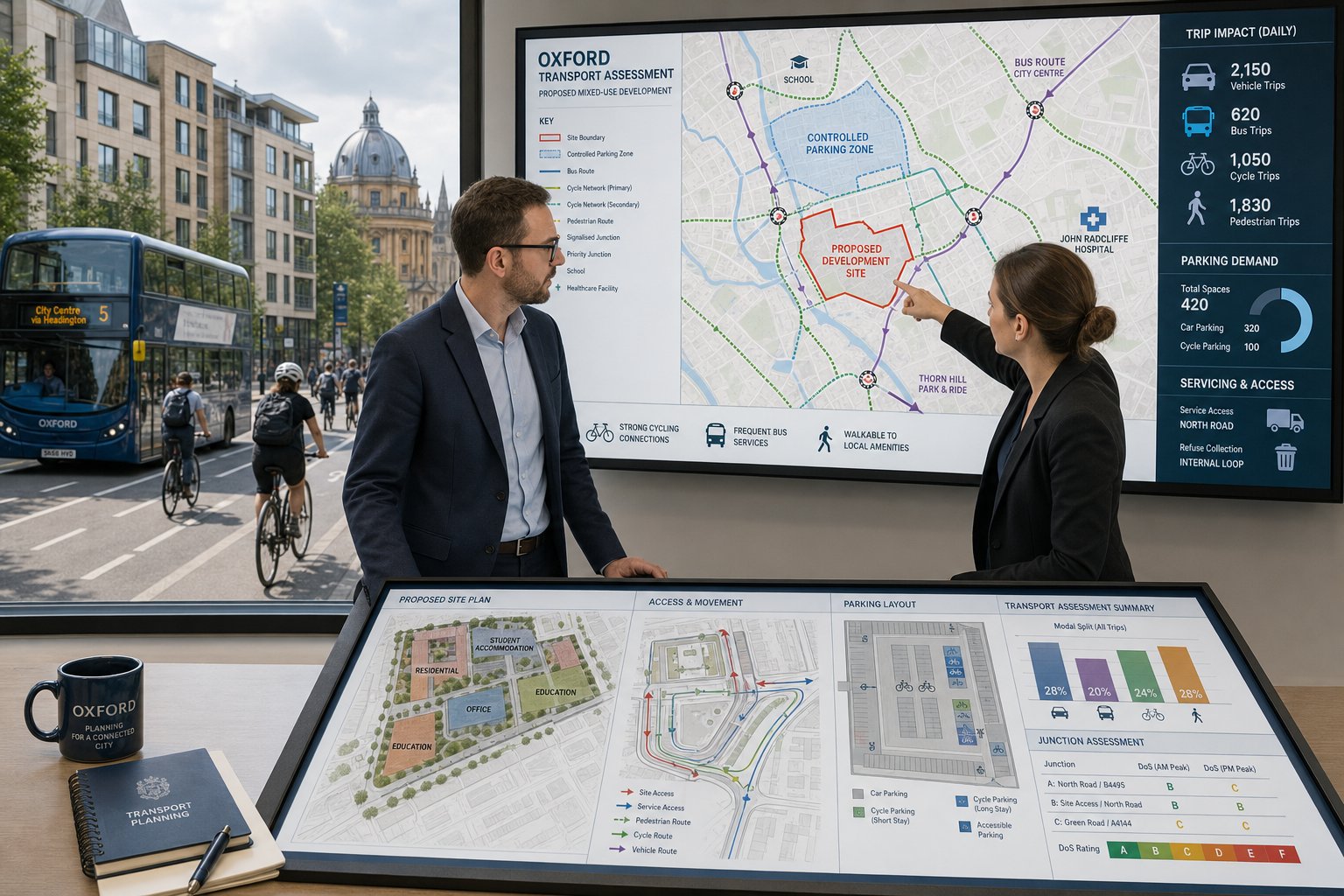
Traffic engineering input is needed on far more schemes than many clients first assume. In Oxford, even modest development can trigger transport questions if the site sits on a constrained corridor, within or near a Controlled Parking Zone, close to a school, on a bus route, or in an area with strong cycling demand.
Residential development is the most common example. That includes everything from infill housing and apartment schemes to larger edge-of-settlement or urban extension proposals. Access geometry, refuse collection, parking demand, cycle parking and trip impact all need careful review.
Student accommodation and university-related development also regularly need specialist input. These schemes often have lower private car ownership, but much higher demand for walking, cycling and public transport access, plus servicing peaks at term changeover. Offices, laboratories and research space around Oxford’s science and innovation clusters can raise similar issues, especially where staff travel patterns do not fit standard assumptions.
Retail, leisure, healthcare, education and mixed-use sites can all require a Transport Statement or full Assessment depending on scale and location. Even changes of use may justify a Technical Note where parking stress, servicing or local junction operation is disputed.
The point is simple: if movement implications could become material to planning, input should start early. That is as true in Oxford as it is for schemes considered by a Traffic Engineer In Manchester: or elsewhere, though local policy emphasis differs.
Transport Assessments, Statements, And Technical Notes Explained
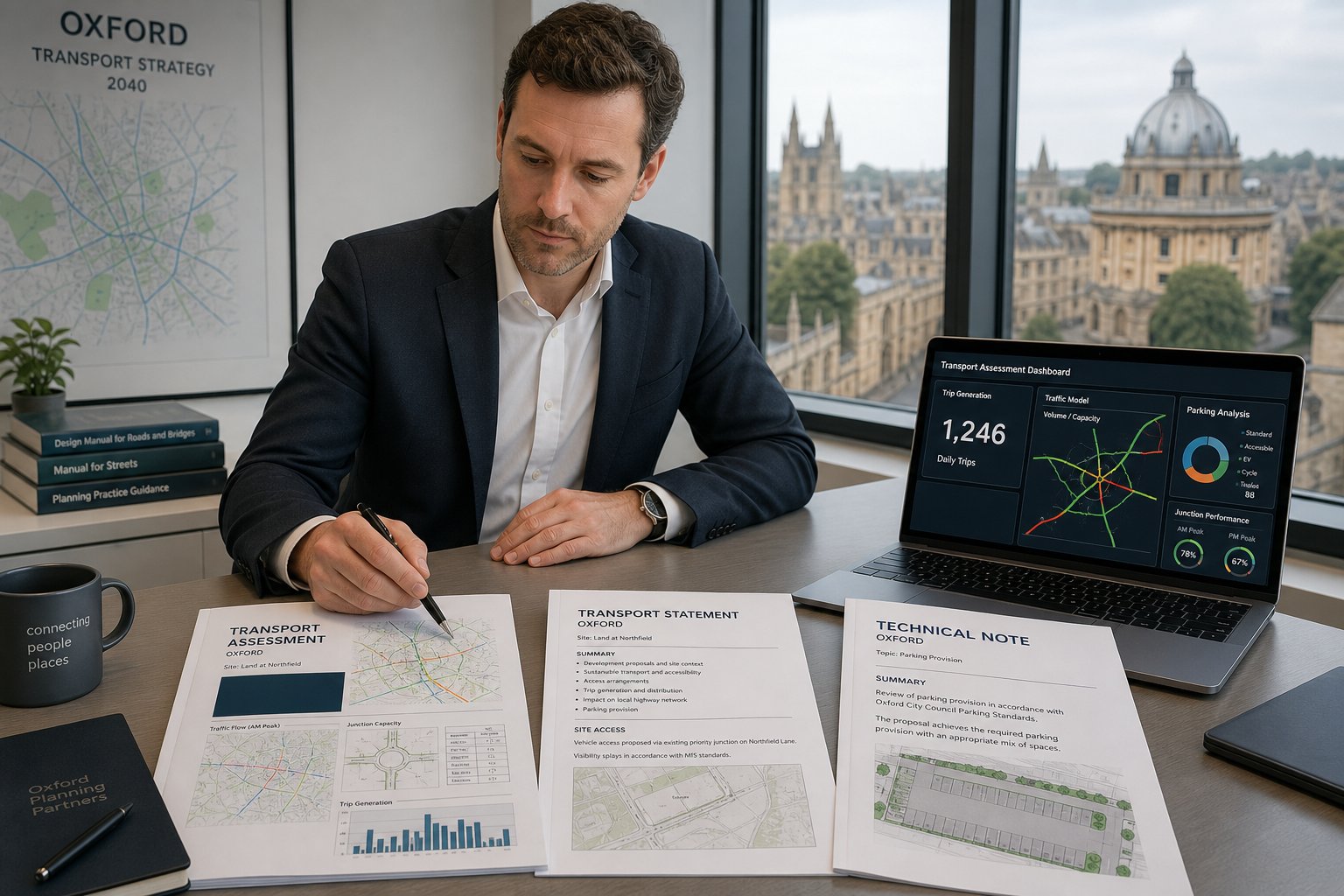
These three documents do similar jobs at different scales.
A Transport Assessment (TA) is the more detailed option, usually prepared for larger or potentially more impactful schemes. It assesses existing conditions, likely trip generation, trip distribution, modal split, parking demand, servicing, highway safety and the effect of development traffic on nearby junctions and roads. Where necessary, it includes junction modelling and mitigation proposals.
A Transport Statement (TS) is a proportionate, shorter document for smaller schemes where transport effects are expected to be limited. It still addresses access, sustainable travel, parking and traffic impact, but without the depth of a full TA unless specific issues justify it.
A Technical Note is more focused. It may deal with one issue only: an amended access design, updated trip rates, parking review, swept path check, rebuttal to an objection, or a short response to county highway comments. In practice, Technical Notes are often what keeps an application moving after submission.
The right document depends on scale, use, local sensitivity and officer expectations. We advise clients not to over-produce, but also not to undercook transport evidence. A weak TS where a robust TA is needed usually creates delay, not savings. The wider principles behind Traffic Engineering: Your Complete are relevant here, but Oxford schemes especially benefit from properly scoped, proportionate reporting.
How Traffic Engineers Support The Planning Process From Early Feasibility To Decision

The best transport work starts before an application is drafted. By the time an authority or highway consultee sees a scheme, many of the transport risks are already baked in: a weak access arrangement, too much reliance on private car travel, not enough cycle parking, or no credible servicing strategy. Early review helps avoid that.
We typically support projects in stages. First comes feasibility: can the site be accessed safely, is the parking approach realistic, are there policy issues that might limit development intensity, and will a TA or TS likely be required? Then comes pre-application input, where transport advice helps refine layout, access, servicing, and sustainable travel measures before formal submission.
At application stage, we prepare the final evidence package and, if needed, coordinate with architects and planners so the drawings, Design and Access Statement, and transport reporting all tell the same story. After submission, support often continues through responses to consultee comments, revised notes and attendance at meetings.
That staged involvement is one reason experienced firms can move quickly without being superficial. On projects similar to those handled by a Traffic Engineer In Leeds: or other regional specialists, the value lies in combining technical transport analysis with planning judgement rather than treating them as separate exercises.
Pre-Application Review And Site Access Strategy
Pre-application review is usually where the biggest planning risks can be reduced at the lowest cost. We look first at the basics: where vehicles, pedestrians and cyclists will enter and leave the site, whether visibility splays can be achieved, whether the road geometry works, and how the proposal interacts with waiting restrictions, bus stops, cycle routes, crossing points and nearby junctions.
In Oxford, site access strategy often goes beyond a simple visibility check. We may need to consider bus lane operation, low-traffic restrictions, peak cyclist movements, freight access on constrained streets, emergency access, refuse vehicle manoeuvring and the implications of Controlled Parking Zones. A technically achievable access is not always a planning-friendly one.
This stage is also where we test options. Would a left-in/left-out arrangement be more acceptable? Is a shared surface entrance likely to create conflict? Can servicing occur on-site without awkward reversing? These are the questions that influence whether the scheme is refined early or challenged later.
Junction Capacity, Trip Generation, And Parking Review
Once access principles are clearer, we assess how the development will actually function. Trip generation estimates are built using appropriate survey data, comparable sites and local context, with increasing emphasis on multi-modal travel rather than simply forecasting car use in isolation. In Oxford, unrealistic car trip assumptions are quickly exposed.
Junction capacity review may involve priority junction assessments, signal analysis or more detailed modelling depending on scale and sensitivity. The objective is not to make modelling look impressive: it is to determine whether the network can accommodate development traffic and whether mitigation is justified. We also consider highway safety and routeing, not just capacity numbers.
Parking review is equally important. Car parking levels, disabled bays, electric vehicle charging, secure cycle parking, visitor parking and servicing arrangements all need to align with demand and local standards. Over-parking can be as problematic as under-parking in policy terms, especially in accessible Oxford locations. A robust review explains the logic, rather than leaving the planning team to defend it by assertion alone.
Travel Planning, Active Travel, And Highway Mitigation Measures
Travel planning is not a bolt-on appendix. In Oxford, it is often one of the clearest ways to show that a development will support sustainable movement rather than simply adding demand to an already pressured network. A well-structured Residential or Workplace Travel Plan sets out realistic measures, targets, monitoring and management responsibilities.
The strongest Travel Plans are specific to the site. They identify walking routes to nearby services, cycle links to key destinations, public transport opportunities, on-site cycle provision, welcome information for new occupants, car club potential and incentives that can genuinely influence behaviour. Generic promises rarely carry much weight.
Active travel design matters just as much as the written plan. Secure and convenient cycle parking, legible pedestrian access, inclusive routes, and good connections to the surrounding network can materially affect officer and consultee response. In Oxford, where cycling mode share is high by UK standards, weak cycle provision stands out immediately.
Where impact needs addressing, mitigation can include junction improvements, access amendments, local traffic management, crossing facilities, parking controls, bus stop upgrades, Travel Plan commitments or financial contributions secured through planning obligations. Similar mitigation principles arise in work by a Traffic Engineer In Birmingham:, but Oxford usually requires stronger justification around mode shift and corridor constraints.
Key Oxford Planning And Highway Considerations For Developers And Consultants
Oxford-specific context often determines whether a transport submission feels credible. The first issue is policy alignment. Applicants need to show awareness of both planning and highway expectations, including the Oxford Local Plan context, Oxfordshire transport policy, active travel priorities, and the city’s broader environmental direction.
The second issue is network character. Historic streets are narrow. Junctions are often already stressed. Bus movement and cycling flows can be more significant than raw traffic volumes suggest. A small change in access location or servicing pattern may be more important than a headline trip number.
Then there are local measures and constraints: Low Traffic Neighbourhoods, bus gates, Controlled Parking Zones, workplace parking sensitivities, and areas affected by the Zero Emission Zone. These do not automatically prevent development, but they do influence how a scheme should be designed and how its transport case should be framed.
Heritage and townscape can also shape highway advice. In conservation areas or near listed buildings, seemingly ordinary mitigation such as signage, widening or kerb changes may be difficult to deliver or undesirable in design terms. That means transport recommendations must be practical, not theoretical.
And finally, Oxford is a city where stakeholder scrutiny can be intense. Universities, hospitals, residents’ groups, ward members and transport campaigners may all take an interest. That makes concise, defensible evidence especially important, much like on complex urban projects handled by a Traffic Engineer In Bristol:.
When To Instruct A Traffic Engineer For An Oxford Scheme
The short answer: earlier than most teams think.
For anything beyond minor householder development, it is usually sensible to involve a traffic engineer at site selection or concept stage. That does not always mean commissioning a full TA immediately. It may just mean an early constraints review to understand likely access issues, parking expectations, transport policy risks and probable document requirements.
Early advice is particularly valuable where a site fronts a classified road, sits near a busy junction, relies on a new or altered access, lies within a Controlled Parking Zone, is close to a school or hospital, or falls in a sensitive city-centre or district-centre location. Those are the schemes where transport matters can quickly dominate planning discussion.
There is also a timing issue around surveys and strategy. If junction counts, parking beat surveys, or on-site observations are likely to be needed, leaving instruction too late can compress the programme and weaken the application. By contrast, an early review can often identify a proportionate route that saves time overall.
We often tell clients that good transport input should inform the scheme before it starts defending it. That principle applies whether the project resembles work by a Traffic Engineer In Liverpool: or an Oxford-based team, but the consequences of delay are often sharper in Oxford because local transport policy is so active.
What To Look For In A Traffic Engineer In Oxford
Not all transport consultants are equally suited to Oxford schemes. Technical capability matters, of course, but local planning awareness matters just as much. You want someone who understands how Oxfordshire County Council and Oxford City Council are likely to read a proposal, what level of evidence is proportionate, and which issues tend to become sticking points.
The basics should include solid experience preparing Transport Assessments, Transport Statements and Technical Notes, plus competence in trip generation analysis, junction review, parking strategy and Travel Plans. If a scheme is more complex, experience with access design, swept paths, modelling and multi-disciplinary coordination becomes essential.
But the softer skills count too. A useful traffic engineer can explain issues clearly to architects, planners, clients, highway officers and, when necessary, members or local stakeholders. They should be able to say when a point is defensible and when it is better to revise the scheme. That honesty saves time.
We would also look for responsiveness and proportionality. A 200-page report is not automatically a better one. For many projects, concise and accurate reporting delivered quickly is far more valuable. That is the approach we prioritise at ML Traffic: over 30 years of experience, locally tailored advice, and reporting that fits the planning question rather than overwhelming it.
Typical Outputs And Information Needed To Start
Most Oxford projects begin with a fairly standard set of inputs, even though the final outputs vary by scheme. The core information we usually need includes a red-line boundary plan, site location plan, proposed development schedule, land use details, unit numbers or floorspace, anticipated phasing, draft layout drawings and any known planning history.
If available, previous appeal decisions, officer comments, transport notes, survey data or highway correspondence are also helpful. These often reveal what has already been debated and where the real risks lie. On more developed schemes, architects’ plans showing cycle parking, bin stores, servicing and access dimensions can materially speed up review.
Typical outputs may include a Transport Assessment, Transport Statement, Technical Note, access appraisal, swept path drawings, parking strategy, junction capacity review, Travel Plan or mitigation schedule. Not every project needs all of them. The value lies in scoping the right package.
At ML Traffic, we aim to keep that start-up process straightforward: identify the likely planning transport requirement, agree the proportionate evidence base, then produce concise reporting suited to local authority expectations. That is usually what clients want, frankly, not a maze of unnecessary analysis, but clear advice that helps the application move.
Conclusion
A traffic engineer in Oxford is not just there to add numbers to a planning file. The role is to help shape development so it works in a city with demanding transport objectives, constrained streets, and close scrutiny of how people move.
When transport advice is brought in early, schemes are easier to refine, risks are easier to spot, and planning submissions are usually stronger. Access strategy improves. Parking becomes more defensible. Travel planning becomes credible. And the application stands a better chance of aligning with Oxford’s wider goals around active travel, air quality, heritage and network efficiency.
For developers, planners, architects and public-sector teams, the practical takeaway is simple: treat transport as part of the design and planning strategy, not as a late-stage document exercise. In Oxford, that shift in timing often makes the difference between a report that merely accompanies an application and one that genuinely helps secure it.
Frequently Asked Questions about Traffic Engineers in Oxford
What role does a traffic engineer in Oxford play in supporting planning applications?
A traffic engineer in Oxford prepares vital documents like Transport Assessments and Statements, evaluating access, parking, and traffic impact to ensure developments comply with local policies including Oxford City and Oxfordshire County Councils.
Why is a planning-led transport approach essential in Oxford?
Oxford’s historic streets, congestion, air quality goals, and priorities for cycling and public transport mean transport planning must align with local policies to support sustainable travel and minimise car-based congestion.
When should developers engage a traffic engineer for an Oxford development?
It is advisable to involve a traffic engineer at the site selection or concept stage—especially for anything beyond minor changes—to assess access, parking, transport policy risks, and required documentation proportionately early on.
What types of developments in Oxford commonly require traffic engineering input?
Projects such as residential housing, student accommodation, university buildings, offices, retail, healthcare, schools, and mixed-use developments often need traffic engineering assessments to address local network constraints and sustainable travel demands.
How do transport assessments differ from transport statements and technical notes?
Transport Assessments are detailed reports for larger schemes, covering trip generation, junction impact, and mitigation. Transport Statements are shorter for smaller developments, while Technical Notes address specific issues like amended access or parking reviews.
How does a traffic engineer in Oxford contribute to sustainable travel and active travel planning?
Traffic engineers design and justify walking and cycling infrastructure, prepare Residential or Workplace Travel Plans with mode-shift targets, and propose mitigation measures such as junction improvements and bus priority to align development with Oxford’s sustainable transport goals.