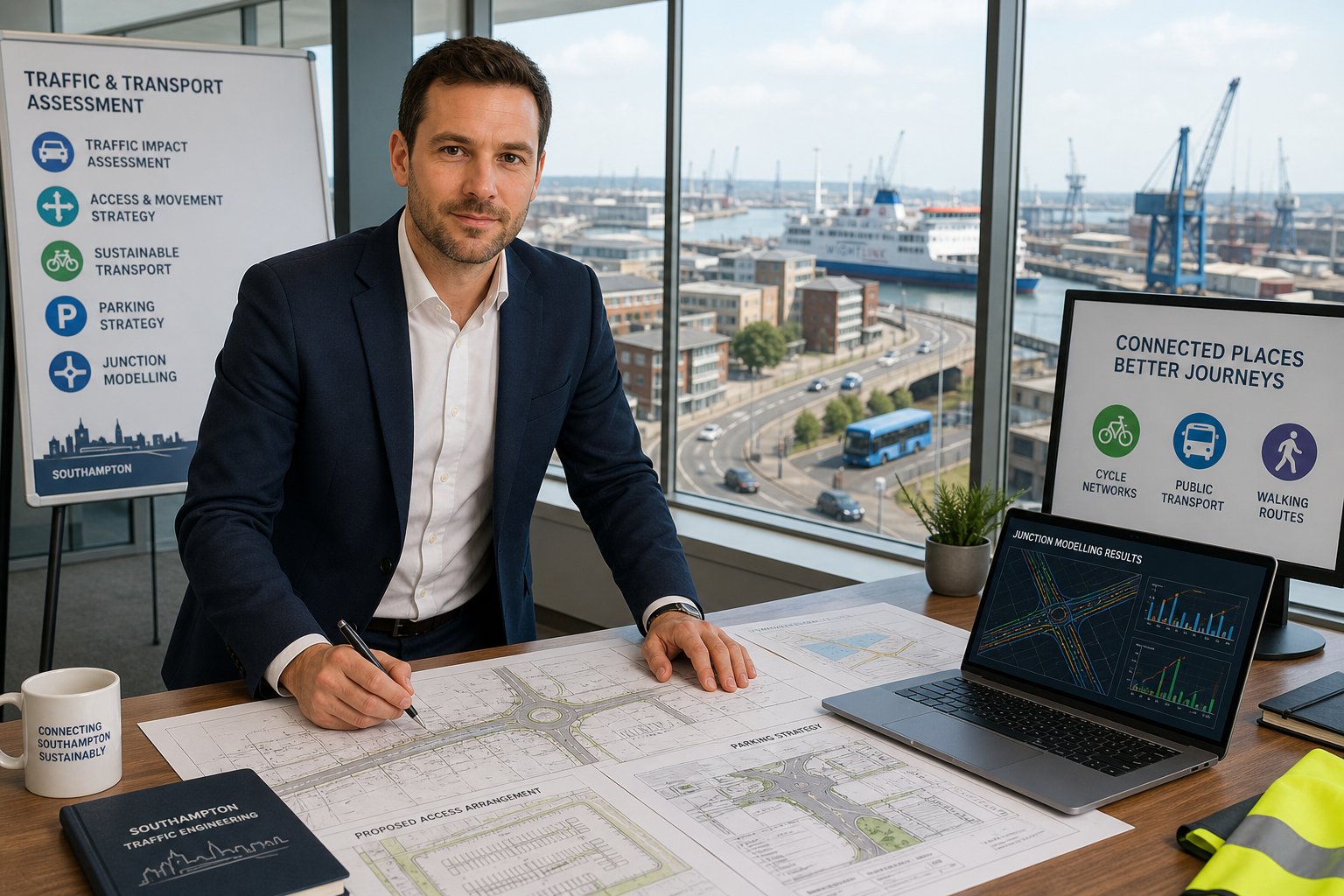
If a development in Southampton is likely to change traffic flows, parking demand, access arrangements, or travel behaviour, transport input stops being a box-ticking exercise very quickly. It becomes a planning risk issue. A scheme that looks straightforward on a layout drawing can run into avoidable objections once highway capacity, servicing, cycle provision, or road safety are examined in detail.
That is why appointing a traffic engineer in Southampton early usually saves time rather than adding another consultant to the pile. We help clients understand what Southampton City Council is likely to expect, whether a Transport Statement or full Transport Assessment is needed, and how access, parking, servicing, and sustainable travel measures should be presented to support an application properly.
In Southampton, local context matters more than many teams first assume. Port activity, cruise traffic, busy radial routes, city-centre constraints, air quality issues, and a strong policy push towards walking, cycling, and public transport all shape what is likely to be accepted. The technical work still relies on recognised tools and national guidance, of course, but the judgement behind the assumptions is often where schemes succeed or stall.
Below, we set out what a traffic engineer does, when transport reports are usually required, and how local knowledge can lead to faster, cleaner, more robust planning submissions in 2026.
Key Takeaways
- Appointing a traffic engineer in Southampton early helps align development proposals with local council expectations and reduces planning risks.
- Transport Statements suit smaller schemes while larger developments typically require detailed Transport Assessments including junction modelling and mitigation.
- Local factors like port activity, constrained radial routes, air quality issues, and sustainable travel policies critically influence traffic engineering in Southampton.
- Effective traffic engineering addresses access design, parking strategy, servicing, and road safety to prevent operational delays in planning approval.
- Sustainable travel measures prioritising walking, cycling, and public transport are central to convincing transport cases for Southampton developments.
- Experienced local traffic engineers improve report accuracy and timescales by understanding Southampton’s unique transport context and council scrutiny points.
What A Traffic Engineer Does For Southampton Planning Applications
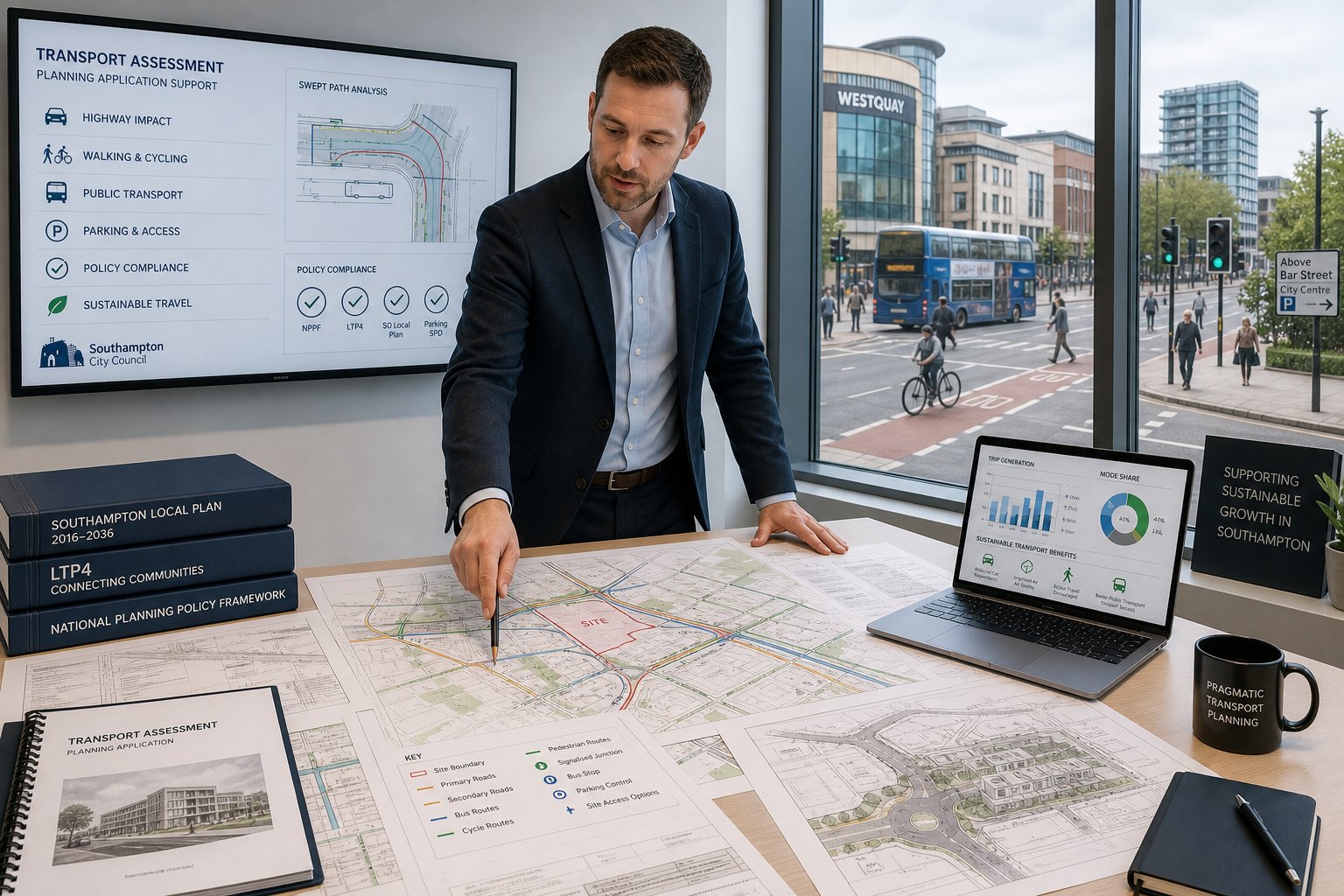
A traffic engineer in Southampton supports the planning process by testing whether a proposal can work on the local highway network, and by presenting that case in a form the council and highway officers can assess with confidence. In practice, that means much more than producing a report at the end.
We typically review the site in context first: surrounding roads, walking and cycling links, bus accessibility, nearby junctions, parking controls, servicing constraints, and known local pressure points. Then we advise the design team on the practical issues that can influence planning outcomes, such as where access should sit, how many parking spaces are likely to be acceptable, whether swept-path analysis will be needed, or whether a turning head that works on paper will fail in operation.
For Southampton schemes, that advice needs to align with the National Planning Policy Framework, Department for Transport guidance, local parking standards, and the city’s wider planning direction, including sustainable travel priorities and city-centre policy. The council will want to know not just whether vehicles can get in and out, but whether the proposal supports safe, efficient, and policy-compliant movement overall.
That is why early transport input often influences layout, unit mix, servicing strategy, cycle storage, and mitigation before the planning package is fixed. Broadly, this is the same discipline discussed in Traffic Engineering Consultants: and in our wider overview of Traffic Engineering: Your, but Southampton requires its own local lens.
When A Transport Assessment Or Transport Statement Is Usually Required
Not every planning application needs a full transport package, but many developments in Southampton need at least some formal transport evidence. The question is usually one of scale, impact, and sensitivity.
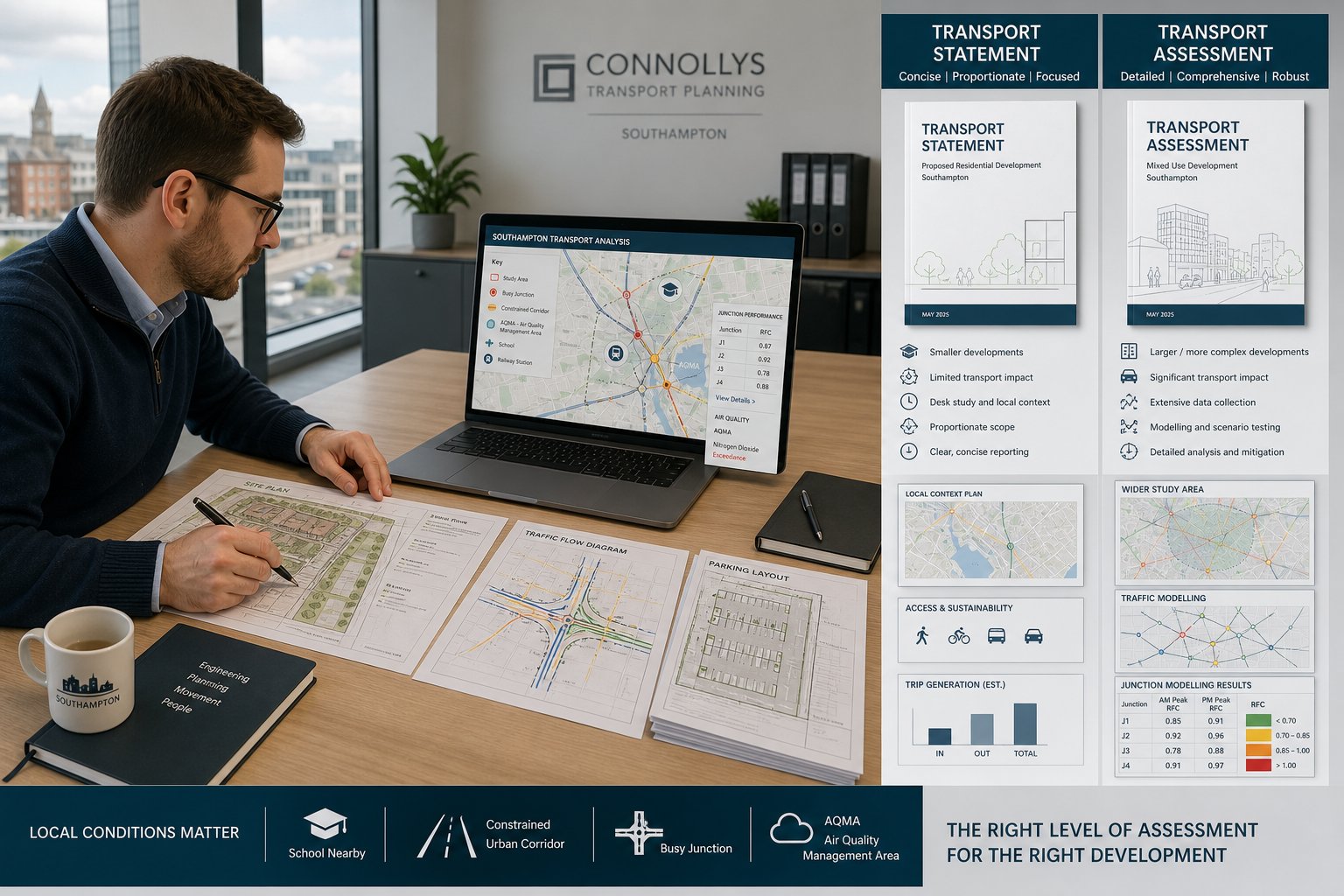
A Transport Statement (TS) is generally used for smaller schemes where traffic effects are material but relatively limited. It explains existing conditions, expected trip generation, access arrangements, parking, servicing, and any local issues that officers should understand. For a modest residential scheme, small commercial redevelopment, or change of use with manageable transport effects, a TS may be proportionate.
A Transport Assessment (TA) is more detailed and is usually expected for larger or more complex proposals: major residential sites, retail schemes, employment development, projects affecting key junctions, or proposals near constrained corridors. A TA typically includes broader network analysis, more detailed forecasting, junction modelling, and clearer mitigation proposals.
Thresholds are not entirely mechanical. Department for Transport guidance gives the framework, but local authority expectations and site circumstances matter. A scheme below a notional threshold may still require detailed assessment if it sits on a sensitive corridor, close to schools, near an Air Quality Management Area, or where cumulative development pressure is already an issue.
That is why scoping matters. We usually advise clients not to guess whether the council will accept a lighter-touch submission. A short early review can prevent under-scoping, rework, and delay.
Southampton Planning And Highway Context That Can Shape A Development Proposal
Southampton has transport characteristics that make local judgement especially important. It is not just another city where generic trip rates and standard access drawings will do.
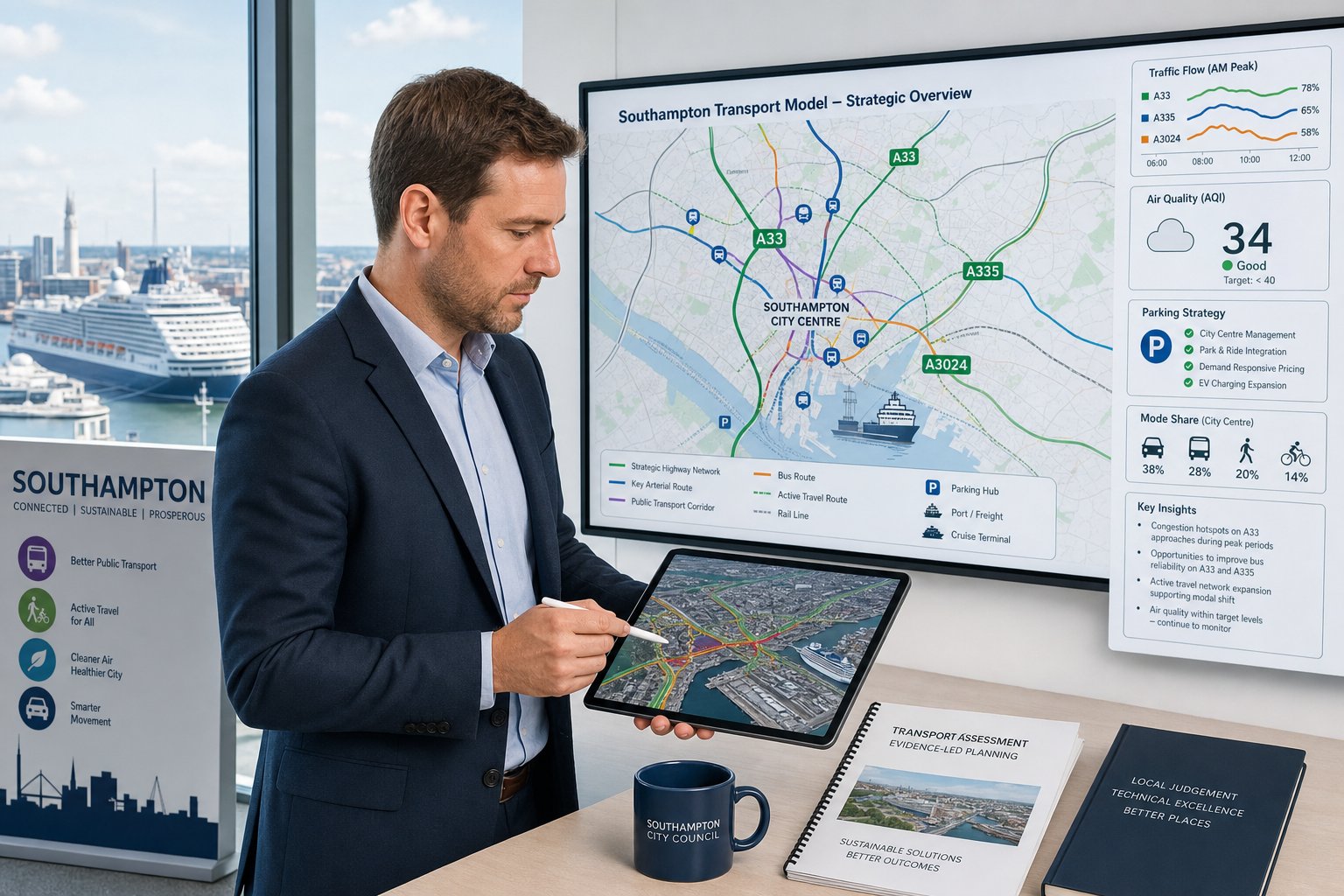
Port activity and cruise terminal traffic can create unusual peaks and routing pressures. The city also relies on constrained radial corridors such as the A33, A335, and A3024, where even moderate development traffic can raise concerns if queues already form at key times. In some locations, a proposal may appear acceptable in isolation but become more difficult once background congestion, committed development, or event-related traffic is considered.
Air quality is another live issue. Where development could affect already sensitive routes, the transport case often needs to show a realistic approach to mode choice, parking restraint, and mitigation rather than assuming every trip will be made by private car. Southampton’s planning direction has for some time pushed strongly towards active travel and better public transport integration, particularly in accessible urban locations.
Parking policy can also shape viability and design. In central or well-connected areas, lower parking provision may be acceptable, even encouraged, if the justification is strong and backed by good walking, cycling, and bus accessibility. But that needs evidence, not optimism.
We see similar city-specific dynamics in places covered by our work on Traffic Engineer In London: and Traffic Engineer In Bristol:, though Southampton’s port and corridor constraints give it a very particular transport planning profile.
Typical Projects That Need Traffic Engineering Input
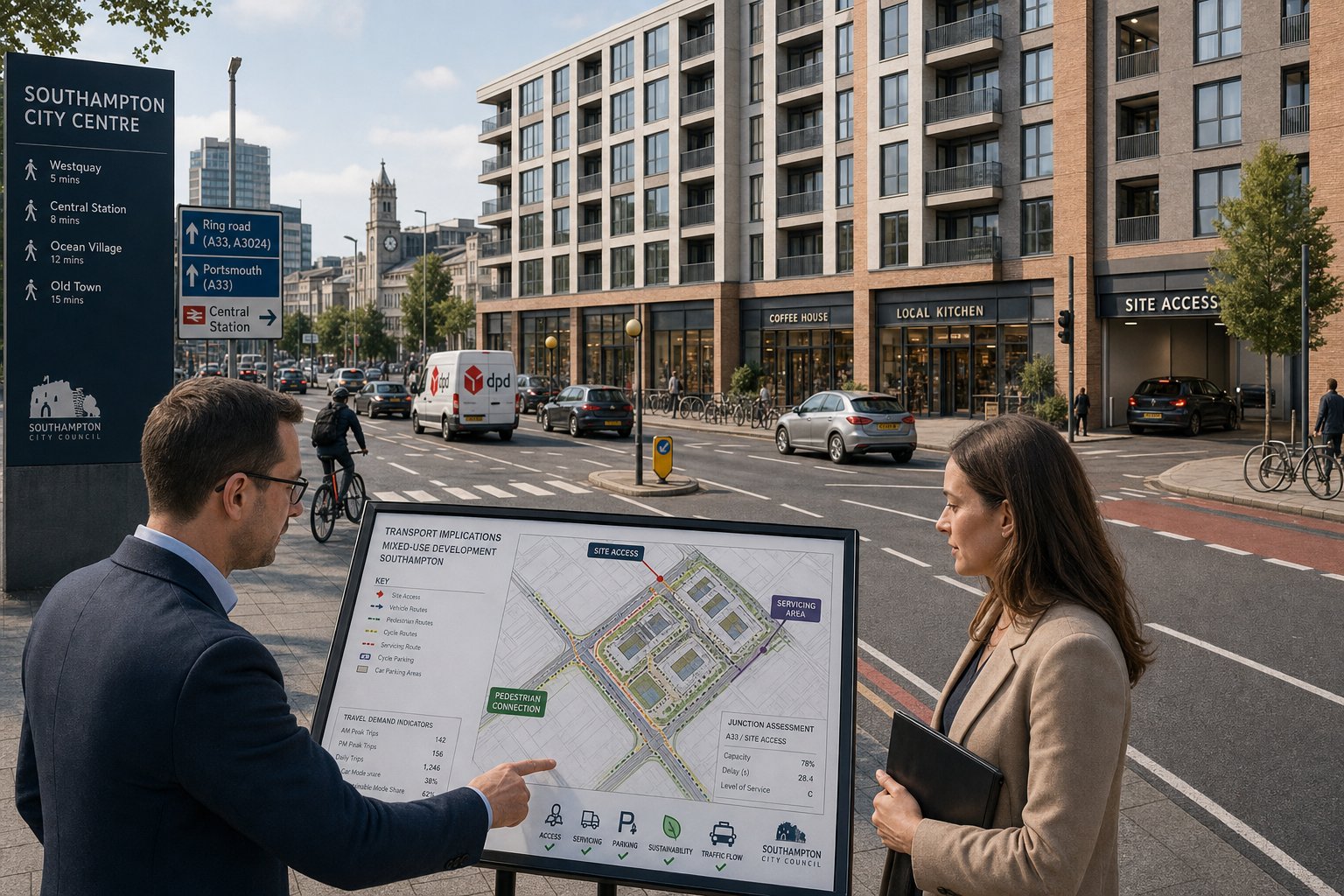
Many applicants still assume traffic engineering is only for very large sites. In reality, plenty of modest Southampton proposals benefit from formal transport input because local constraints, access issues, or operational details can become planning sticking points.
Residential Developments
Residential work is one of the most common triggers. That includes small infill schemes, apartment blocks, estate regeneration, specialist housing, student accommodation, and larger urban extensions. The transport questions vary with scale. A ten-flat city scheme may focus on parking demand, cycle provision, servicing, and safe pedestrian access. A larger site may require trip forecasting, junction modelling, off-site mitigation, and a Travel Plan.
Student and build-to-rent schemes often need careful work around car ownership assumptions, servicing, pick-up and drop-off activity, and cycle storage quality. Family housing tends to raise different concerns, especially around school-run peaks and overspill parking.
Commercial, Mixed-Use, And Change-Of-Use Schemes
Commercial projects are equally varied. Food retail, drive-thrus, industrial units, logistics uses, offices, hotels, healthcare, leisure, and mixed-use redevelopment can all trigger transport review. In Southampton, change-of-use proposals can be particularly sensitive because the headline floorspace may stay similar while traffic patterns change sharply.
A new use might increase peak-hour trips, alter delivery patterns, create queueing at access points, or shift parking demand into nearby streets. Mixed-use schemes add another layer: internal trip capture can help, but only if assumptions are credible. That is where measured evidence and clear operational thinking make a difference.
Core Traffic Engineering Reports Used To Support An Application
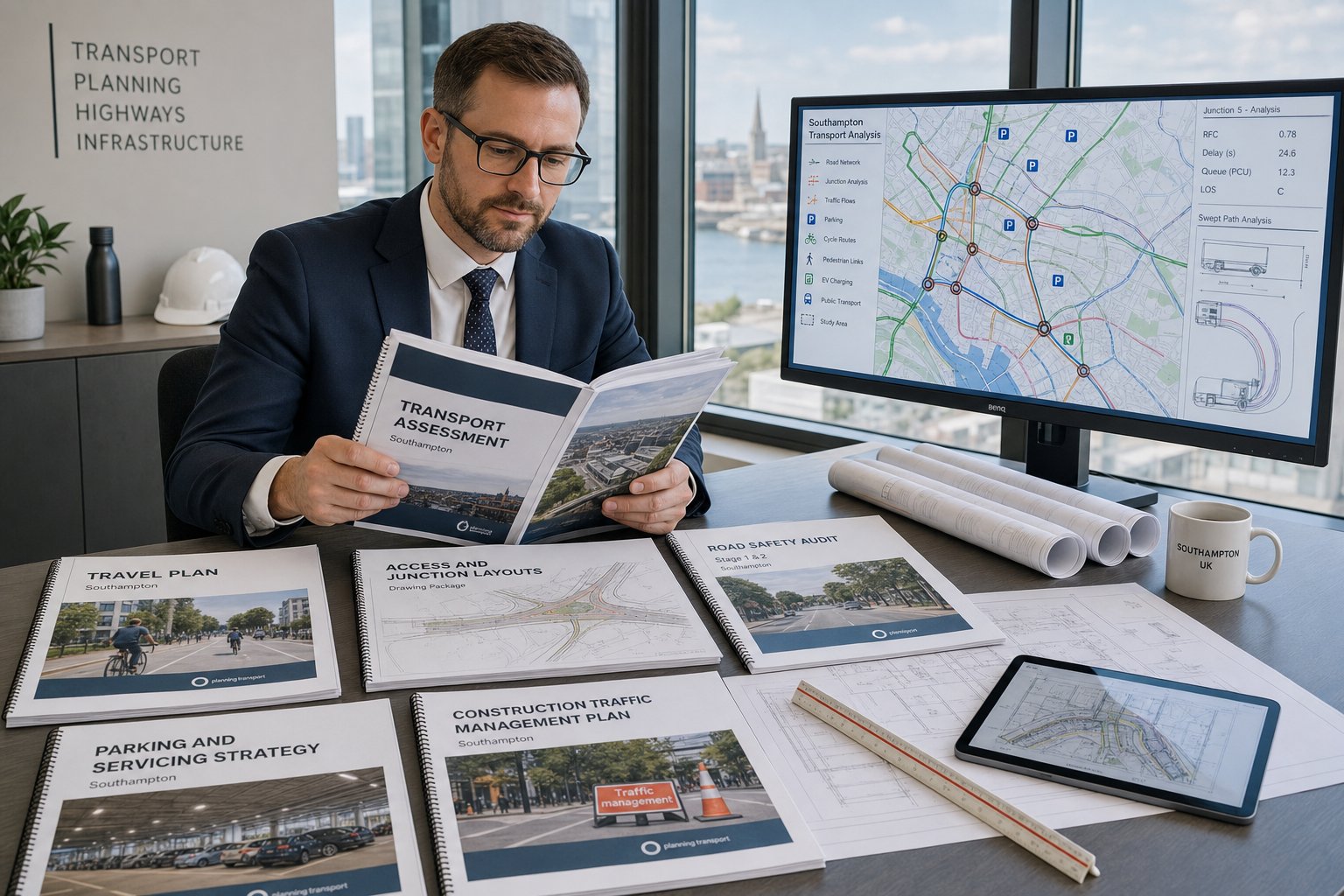
The right reporting package depends on the scheme, but most Southampton planning submissions draw from a familiar set of transport documents.
The starting point is usually a Transport Assessment or Transport Statement. That report explains baseline conditions, trip generation, access arrangements, impact on the network, parking, servicing, and any mitigation. Alongside that, a Travel Plan may be needed to show how walking, cycling, public transport use, and reduced car dependency will be encouraged over time.
For physical highway changes, we often prepare access and junction drawings to demonstrate geometry, visibility, pedestrian provision, and how the site ties into the surrounding network. Where a proposal affects road layout or introduces a new access, a Road Safety Audit, often at Stage 1/2 in pre-planning form, may be expected or strongly advisable.
Many schemes also need a parking and servicing strategy, particularly where space is tight or operational activity is sensitive. That can include disabled bays, EV charging, cycle parking, refuse movements, delivery patterns, and swept-path analysis for service or emergency vehicles. On some sites, a Construction Traffic Management Plan is prepared at application stage or later by condition discharge.
The key is not producing every report possible. It is producing the right package, in the right level of detail, at the right stage. Over-scoping wastes time. Under-scoping usually wastes more.
How Trip Generation, Traffic Impact, And Junction Capacity Are Assessed
This is the part many teams think of first, but good modelling depends on good judgement before the software starts.
Trip generation is commonly estimated using the TRICS database, supported by local survey evidence and sensible filtering. We select comparable sites, review context carefully, and test whether the resulting trip rates genuinely reflect a Southampton location. A central site near frequent bus services and strong cycle links should not be assessed like a car-dependent out-of-town development. The reverse is also true.
From there, we distribute and assign trips across the network based on observed flows, local travel patterns, committed development, and agreed assumptions. The study area needs to be proportionate but robust enough to capture the junctions officers are likely to focus on.
Junction capacity is then tested using recognised tools such as PICADY, ARCADY, LINSIG, Synchro, or equivalent platforms, depending on the junction type. We normally assess baseline conditions, future year scenarios, and with-development cases, often with sensitivity testing where growth, mode share, or background traffic could materially alter the result.
If impacts are identified, mitigation might include signal optimisation, lane amendments, access redesign, TROs, or demand-management measures through the Travel Plan. Similar modelling principles apply in other urban authorities, including our work on Traffic Engineer In Manchester: and Traffic Engineer In Leeds:, but assumptions always need local calibration.
Access, Servicing, Parking, And Road Safety Considerations
A surprising number of planning delays come from practical site operation rather than strategic traffic impact. If the access is awkward, deliveries block the carriageway, visibility is compromised, or parking provision is poorly justified, the application can quickly lose momentum.
Access design should respond to recognised standards such as Manual for Streets, DMRB where relevant, and Southampton’s own expectations. That includes junction geometry, visibility splays, pedestrian crossing points, cycle priority, gradient, and how vehicles enter and leave without conflict. The best answer is not always the widest access. In urban settings, design quality and pedestrian legibility matter too.
Servicing needs equal attention. Refuse vehicles, delivery vans, moving lorries, and emergency access all need to be demonstrated credibly. Swept-path analysis is often central here, particularly on constrained plots. If a large vehicle can technically manoeuvre only by dominating footways or requiring unrealistic marshalling, officers will spot it.
Parking is rarely just a numbers exercise. Southampton City Council will usually want to understand the type of parking proposed, disabled provision, EV charging, cycle storage, visitor demand, and whether overspill risk has been considered realistically. A restrained parking strategy can be acceptable, but only when location, accessibility, and Travel Plan measures genuinely support it.
And road safety runs through everything. Where changes to highway layout or access create potential conflict, a Road Safety Audit can help identify issues early, when they are still relatively easy to fix.
Sustainable Travel, Active Travel, And Public Transport Requirements
In Southampton, sustainable travel is not a decorative add-on at the back of the report. It is often central to whether the transport case is persuasive.
Most schemes need to show how walking, cycling, and public transport have been prioritised in a practical way. That starts with accessibility: distance to bus stops, service frequency, rail links where relevant, walk routes to local facilities, and the quality of nearby cycle infrastructure. But policy support alone is not enough. The measures proposed on site have to match the ambition.
That might include direct pedestrian links, secure and convenient cycle parking, shower and locker provision for employment uses, wayfinding, reduced car parking justified by location, car club spaces, or public realm improvements that make short local trips more attractive without a car. For larger schemes, a robust Travel Plan with targets, measures, management responsibility, and monitoring arrangements is usually expected.
In city-centre and highly accessible areas, Southampton may support lower parking provision if the mode share assumptions are properly evidenced. In less connected locations, the burden of proof is higher. We cannot simply claim people will cycle more because the statement says they should.
This is one area where broad best practice from Traffic Engineer In Birmingham: and Traffic Engineer In Liverpool: is useful, but Southampton-specific networks and policy wording still need to drive the final case.
Why Local Southampton Knowledge Can Improve Report Quality And Timescales
Local knowledge does not replace technical rigour: it makes technical work more realistic. And that often saves weeks.
A Southampton-experienced consultant is more likely to scope the right junctions from the start, recognise where port-related traffic or cruise activity may distort surveys, and understand which corridors tend to attract the greatest officer scrutiny. We are also better placed to sense when a proposal may need more work on parking restraint, cycle access, servicing detail, or air quality-sensitive routing before the application is lodged.
That familiarity improves report quality in small but important ways. Local count data can reduce the need for challenge later. Reasonable assumptions about mode share can be framed in a way that reflects actual city conditions. Collision history, committed developments, and recent changes to the network can be captured before they become consultation comments.
It also helps with timescales. When the scope is proportionate and the likely pressure points are dealt with early, there is less chance of the council requesting reruns, extra technical notes, or revised drawings after validation. That is a big part of how we work at ML Traffic: concise technical reporting, tailored to local authority thresholds and planning context, rather than generic over-production.
Put simply, local understanding often shows up as fewer surprises.
How To Prepare For A Smooth And Efficient Transport Assessment Process
The smoothest transport assessments usually begin before the design is fixed. Once the layout, parking quantum, and access arrangement are locked in, options narrow and every change becomes slower.
Our advice is to bring transport input in early enough to shape the proposal, not just justify it. That means confirming site access assumptions, likely report type, survey needs, and possible mitigation while the architect and planner still have room to move. Early discussion with Southampton City Council highways officers can also be valuable, especially on the study area, survey periods, committed developments, modelling tools, and whether a Travel Plan or Road Safety Audit is likely to be expected.
Clients can make the process much faster by providing clear development parameters from the outset: unit mix, gross floor area, staffing numbers, opening hours, servicing patterns, likely phasing, operational constraints, and any known design non-negotiables. If those basics shift repeatedly, the technical work usually has to shift with them.
Time should also be allowed for traffic surveys, data processing, modelling, quality checks, and coordination with the wider planning team. If off-site works are proposed, design development and safety audit stages can add further lead-in. Rushed submissions often look rushed.
A well-scoped, well-timed process is not glamorous, admittedly. But it is often the difference between one transport submission and three.
Conclusion
A well-prepared planning application in Southampton needs more than a generic transport report. It needs evidence that reflects the city’s roads, travel patterns, policy priorities, and practical constraints. That is where an experienced traffic engineer adds real value.
We help development teams scope the right level of assessment, build realistic trip and junction analysis, resolve access and servicing issues early, and present sustainable travel measures in a way that stands up to scrutiny. For architects, planners, lawyers, developers, and local authorities alike, that usually means lower planning risk, fewer technical surprises, and better timescales.
In 2026, with policy pressure on active travel, air quality, and efficient network operation only increasing, the strongest Southampton applications will be the ones that get transport strategy right from the start.
Frequently Asked Questions about Traffic Engineering in Southampton
What role does a traffic engineer play in Southampton planning applications?
A traffic engineer in Southampton evaluates how a development impacts local highways, access, parking, and travel behaviour. They prepare transport reports aligned with Southampton City Council’s requirements to support planning applications effectively.
When is a Transport Assessment or Transport Statement required for a Southampton development?
Smaller developments with limited traffic impact usually need a Transport Statement, while larger or complex projects—such as major residential or retail schemes—require a detailed Transport Assessment, following Department for Transport and local Southampton thresholds.
How does Southampton’s local context influence traffic engineering for developments?
Southampton’s port traffic, constrained radial routes, air quality areas, and emphasis on sustainable travel shape traffic engineering. Proposals must address these, ensuring alignment with local policies promoting walking, cycling, and public transport integration.
What reports and analyses are typically prepared by traffic engineers in Southampton?
Core documents include Transport Assessments or Statements, Travel Plans, access and junction drawings, Road Safety Audits, parking and servicing strategies, and sometimes Construction Traffic Management Plans, all tailored to Southampton’s local authority standards.
How can early engagement with a traffic engineer benefit a Southampton planning application?
Engaging a traffic engineer early helps shape site layout, access, parking, and mitigation before finalising designs. This reduces planning risks, prevents delays, and ensures compliance with Southampton City Council’s transport policies and technical expectations.
What sustainable travel measures are important in Southampton developments?
Effective sustainable travel measures include prioritising walking, cycling, and bus access, providing secure cycle parking, reducing car parking where justified, and implementing robust Travel Plans with monitoring, reflecting Southampton’s strong policy focus on active and public travel.