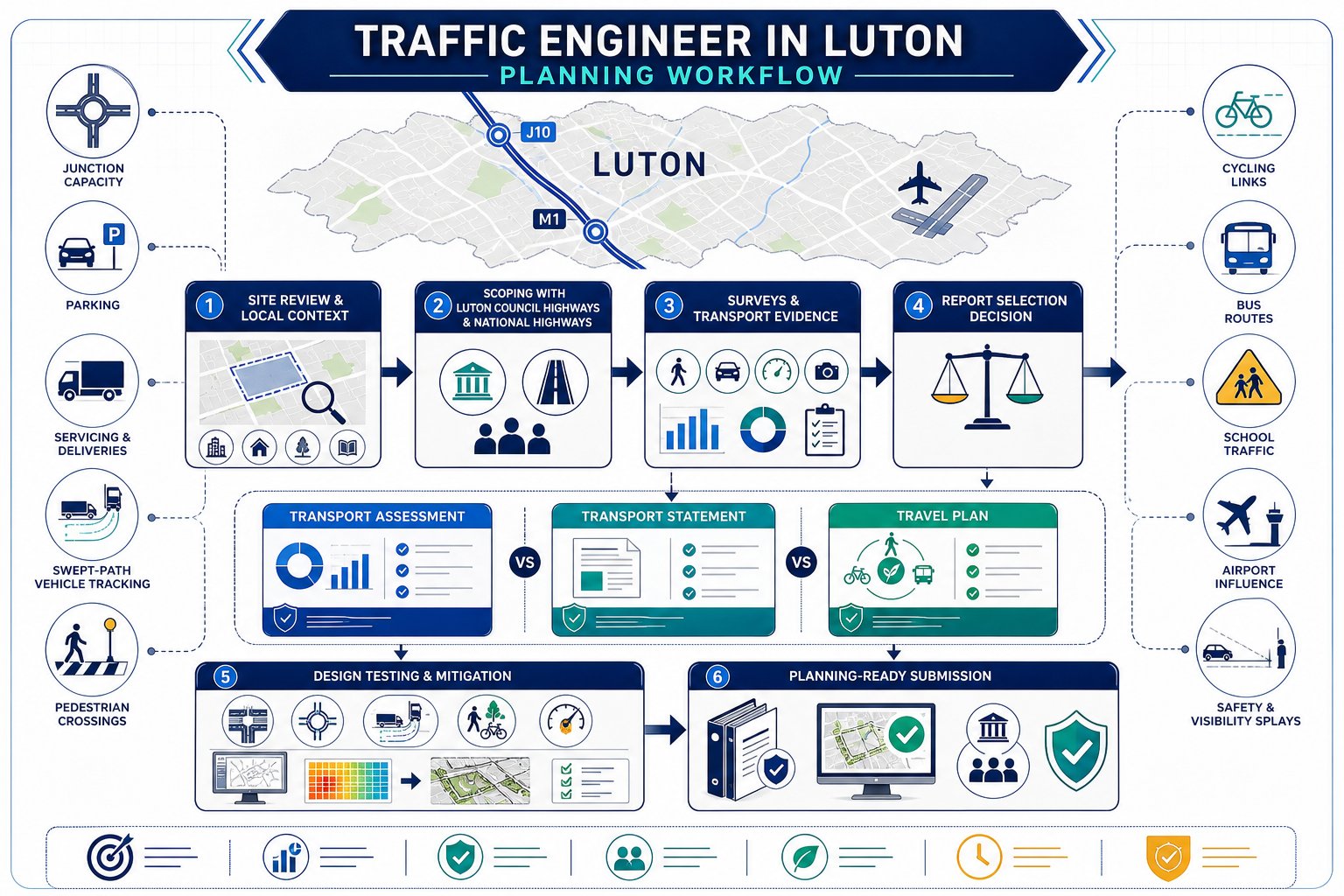
Planning in Luton rarely fails because of one dramatic issue. More often, schemes slow down because transport questions were left too late, scoped too lightly, or answered in a way that doesn’t quite line up with local expectations. A junction that looks acceptable on a drawing can unravel under peak-hour testing. A modest access can become contentious if visibility, servicing or parking standards are missed. And on sites influenced by the M1, airport-related movement, school traffic or town-centre constraints, small errors can have outsized consequences.
That’s where a traffic engineer in Luton becomes central to the project team. We help turn transport risk into a clear, evidence-based strategy that supports planning rather than holding it back. For architects, planners, surveyors, developers, solicitors and councils, that usually means one thing: getting the right report, with the right scope, backed by data and local policy awareness.
In this guide, we explain what a traffic engineer in Luton actually does, which types of development most often need transport input, how Transport Assessments differ from Transport Statements and Travel Plans, and why Luton Council and National Highways requirements can shape the whole submission. We’ll also cover the practical issues that most often affect outcomes in 2026: access design, parking, servicing, walking and cycling links, and the avoidable mistakes that lead to delays or objections.
Key Takeaways
- A traffic engineer in Luton transforms transport risks into clear, evidence-based strategies that support planning applications effectively.
- Early involvement of a traffic engineer can prevent costly redesigns by addressing access constraints, parking standards, and local highway expectations from the start.
- Transport Assessments, Transport Statements, and Travel Plans serve distinct roles, with the choice depending on the development’s scale and impact on local transport.
- Local planning policies and Luton Council Highways’ requirements heavily influence transport reports, making scoping discussions crucial to align assessments with expectations.
- Key factors affecting planning in Luton include access design, safety, parking, servicing, and sustainable travel options like walking, cycling, and public transport.
- Selecting a traffic engineer with local experience, technical competence, clear reporting skills, and responsiveness ensures smoother planning approvals and fewer objections.
What A Traffic Engineer In Luton Does For Planning Applications
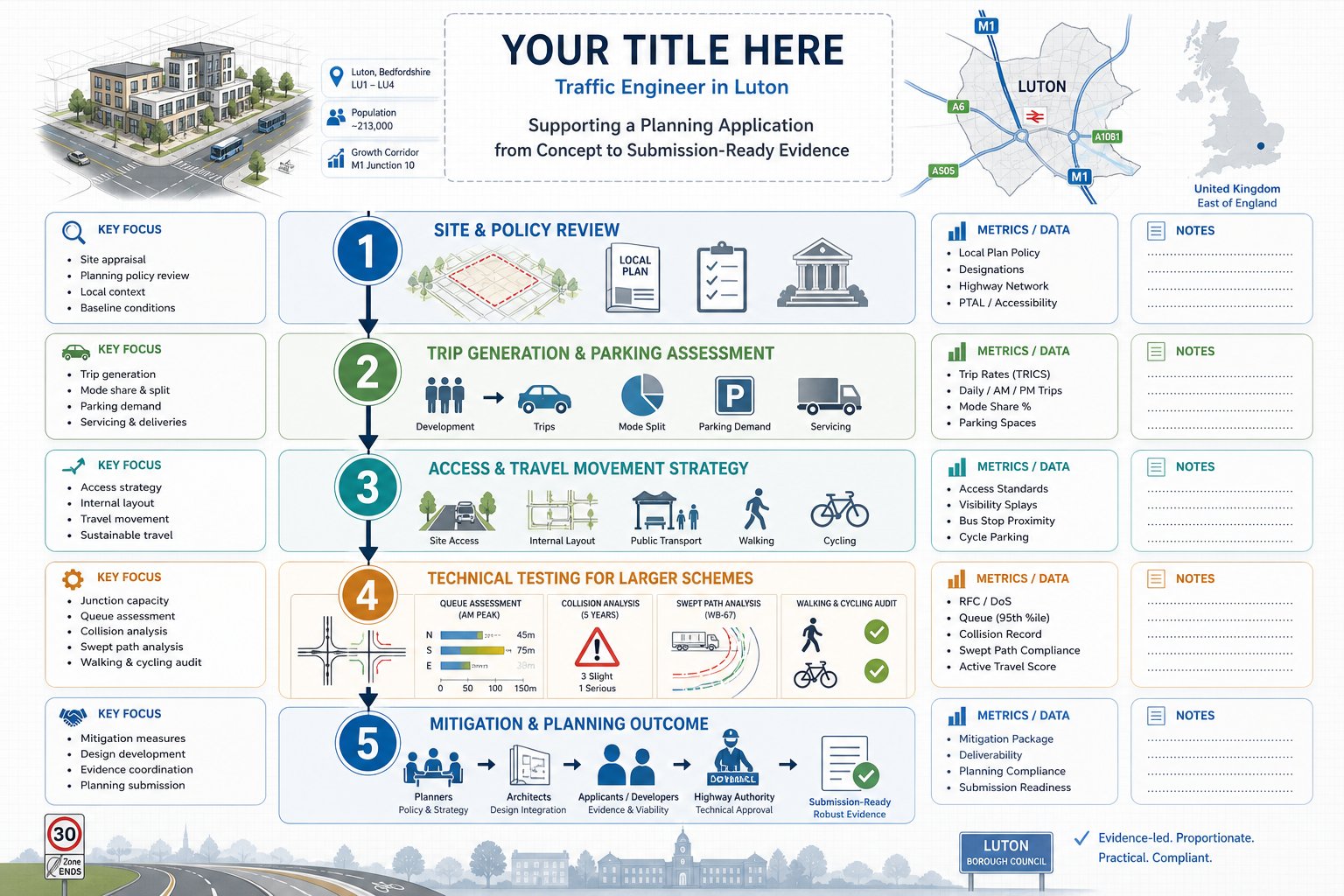
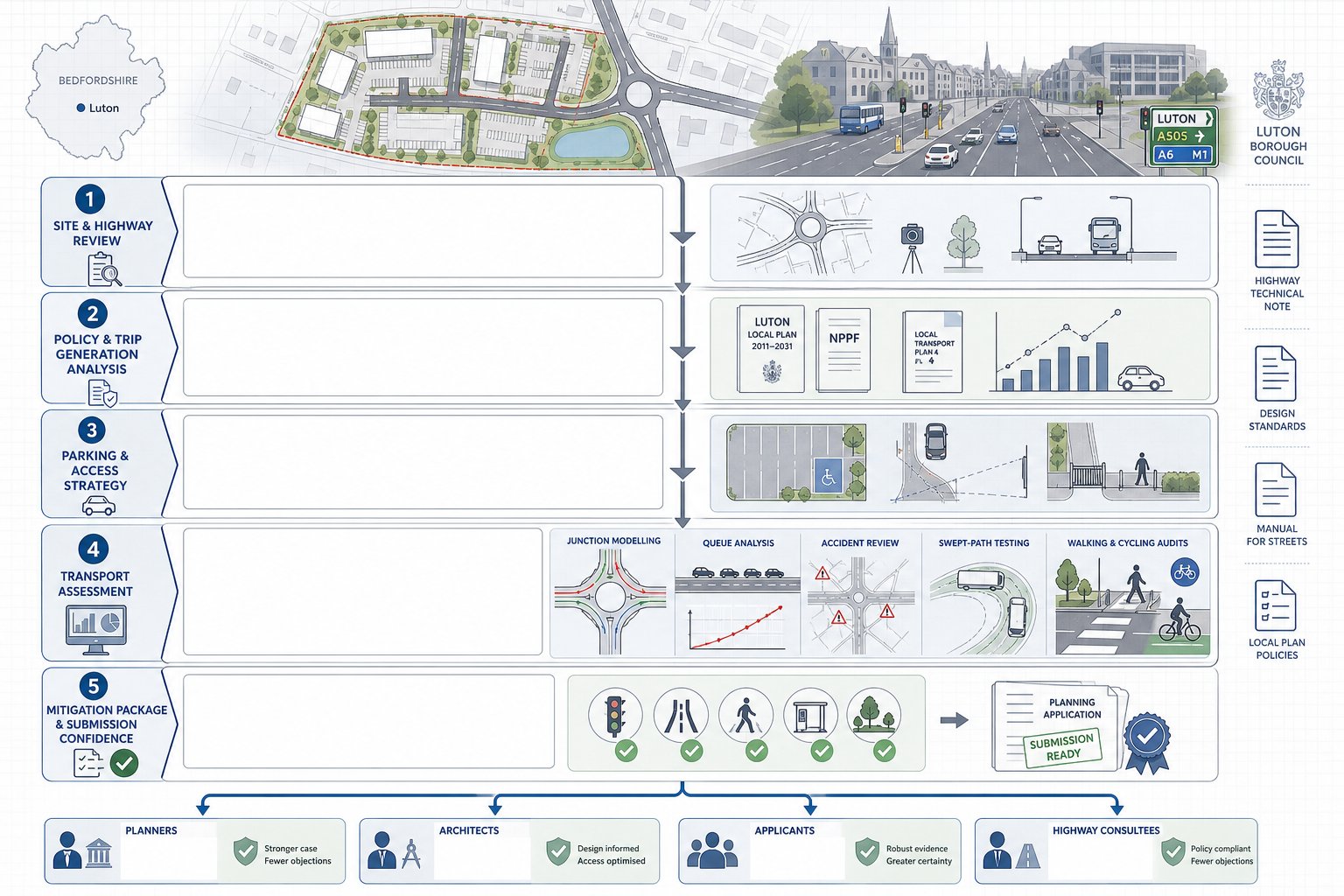
A traffic engineer in Luton supports planning applications by translating a development proposal into measurable transport effects, then showing how those effects can be managed acceptably. In practice, that means much more than “doing a report”. We review the site, surrounding highway network, local policy position, likely trip generation, parking demand, access strategy and the way people are expected to travel to and from the scheme.
For smaller applications, the work may be proportionate and concise. For larger or more sensitive proposals, it can involve junction modelling, queue analysis, accident review, swept-path testing, walking and cycling audits, and a carefully structured mitigation package. The key is not volume. It’s relevance. Planning officers and highway consultees want clear evidence that the proposal has been assessed properly and that the conclusions are defensible.
We also help teams understand when transport input needs to start. Too often, layout, unit mix or servicing assumptions are fixed before anyone has tested whether the site can actually operate safely. Early advice from Traffic Engineering Consultants: can prevent redesign later, especially where access constraints or local parking standards are tight.
At its best, transport input helps the rest of the consultant team move faster. It gives planners a stronger policy case, architects clearer design parameters, and applicants a better chance of avoiding late-stage objections from Luton Council Highways or National Highways.
Projects In Luton That Commonly Need Transport Input
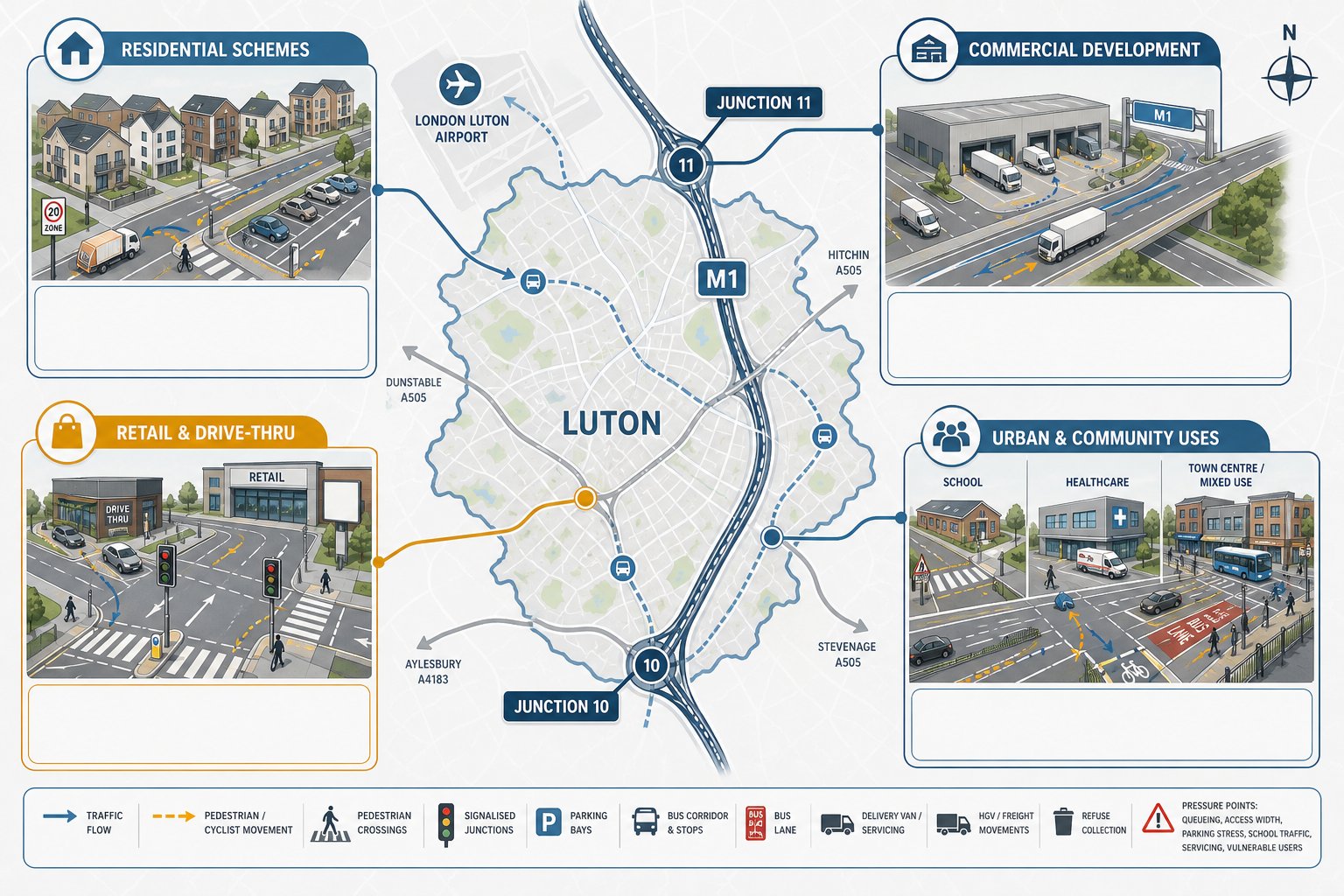
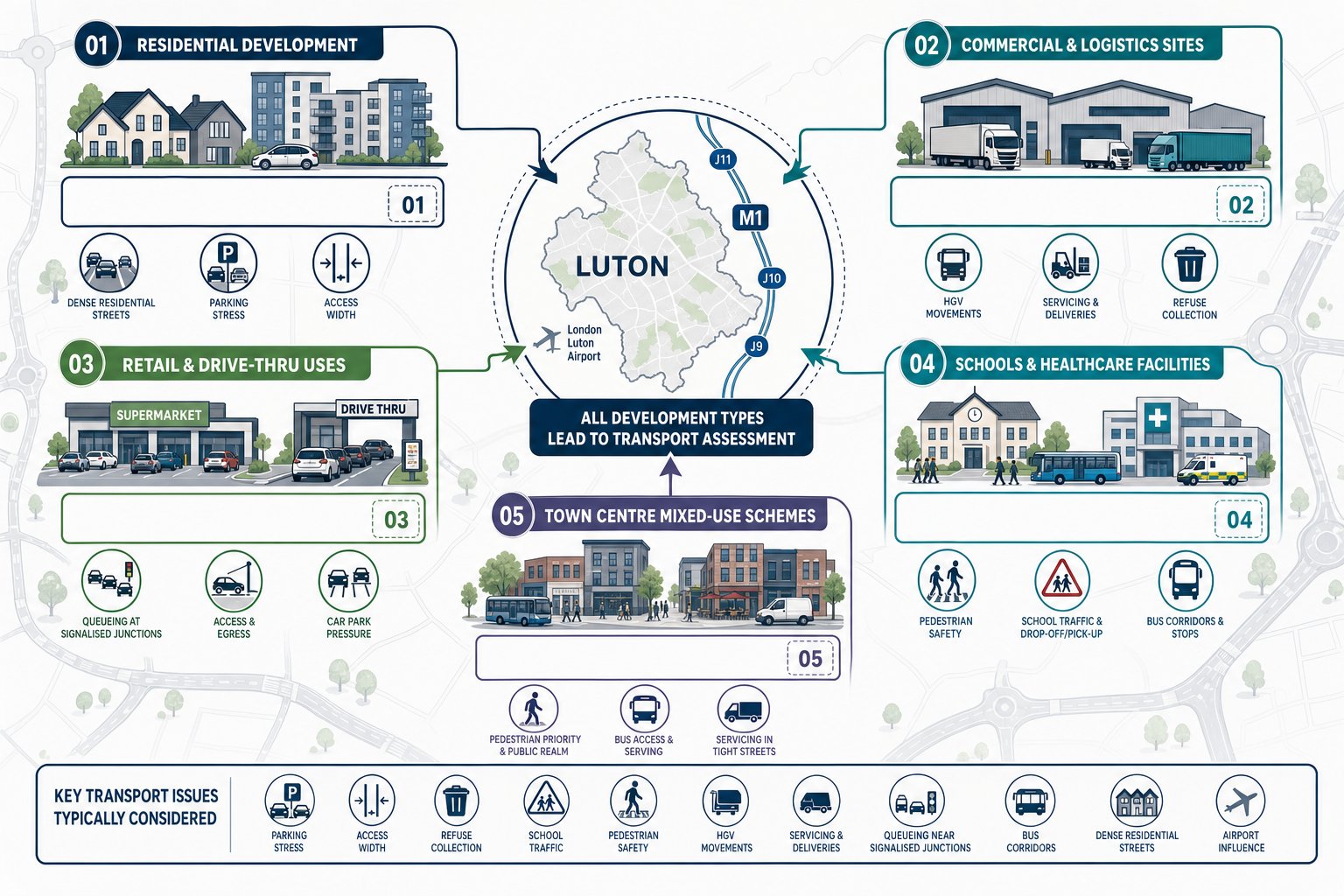
Luton has a development pattern that makes transport evidence especially important. Residential schemes are a major part of the workload, ranging from small infill sites and flat conversions to larger estates and mixed-use urban regeneration. Even when trip rates are modest, local concerns around parking stress, access width, refuse collection, school traffic and pedestrian safety can push transport matters high up the agenda.
Commercial development is another common trigger. Employment sites, warehousing, trade counters and roadside uses near the M1 corridor, Junctions 10 and 11, or key distributor roads often need robust analysis because HGV movements, shift patterns and servicing can materially affect the surrounding network. Retail and drive-thru proposals also attract scrutiny, particularly where short-stay turnover, queueing and proximity to signalised junctions are involved. On these schemes, principles from Commercial Traffic Engineering become highly relevant.
Schools, healthcare facilities and town-centre mixed-use schemes regularly require transport input too. These uses can generate peaky travel patterns, vulnerable road user interactions and delivery constraints that simple headline trip numbers don’t capture.
In Luton specifically, sites influenced by airport activity, strategic roads, bus corridors or dense residential streets often need a more careful transport narrative than applicants first expect. The threshold for concern is not just scheme size. It’s context, sensitivity and whether the local highway authority can see that the proposal has been thought through properly.
Transport Assessment Vs Transport Statement Vs Travel Plan
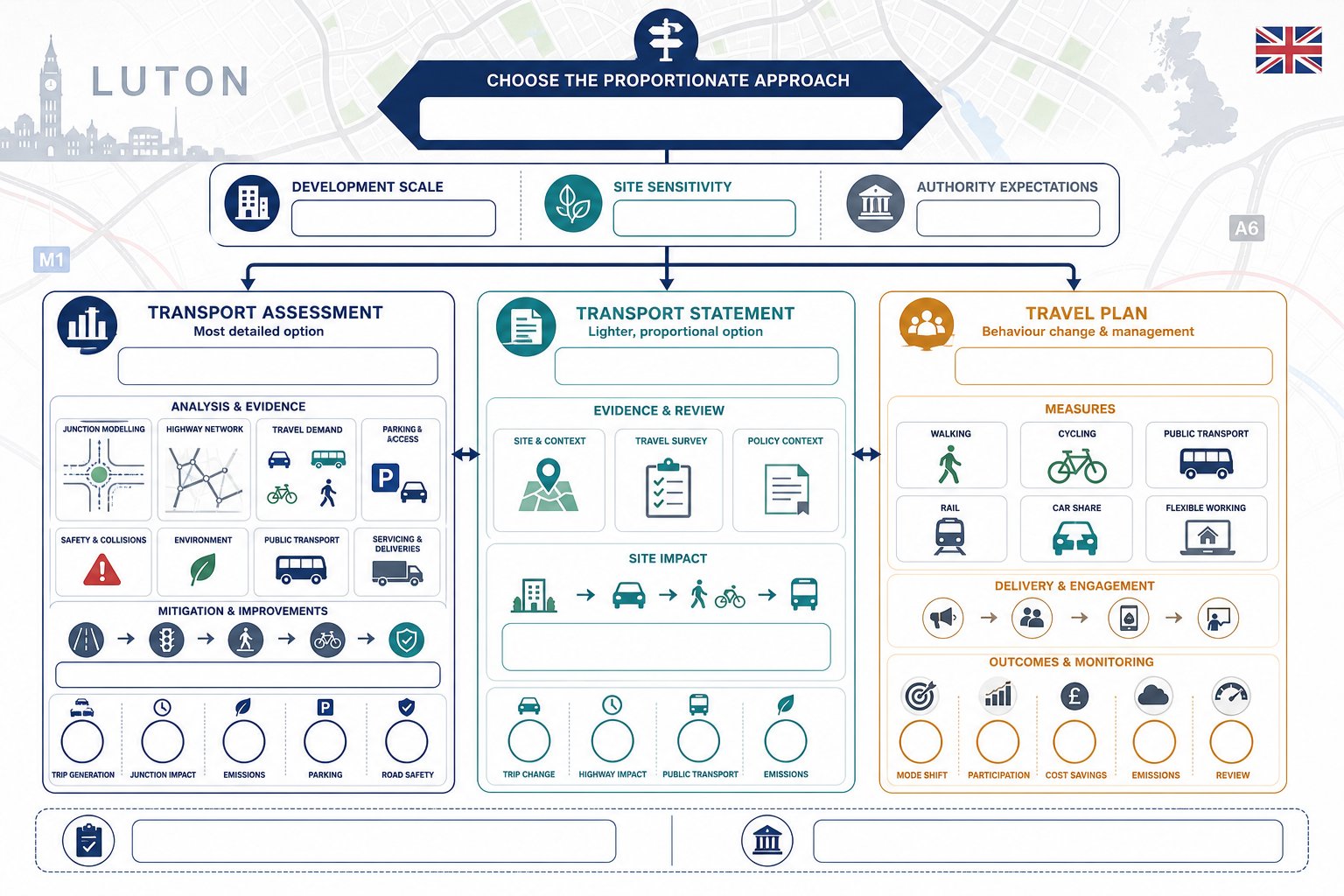
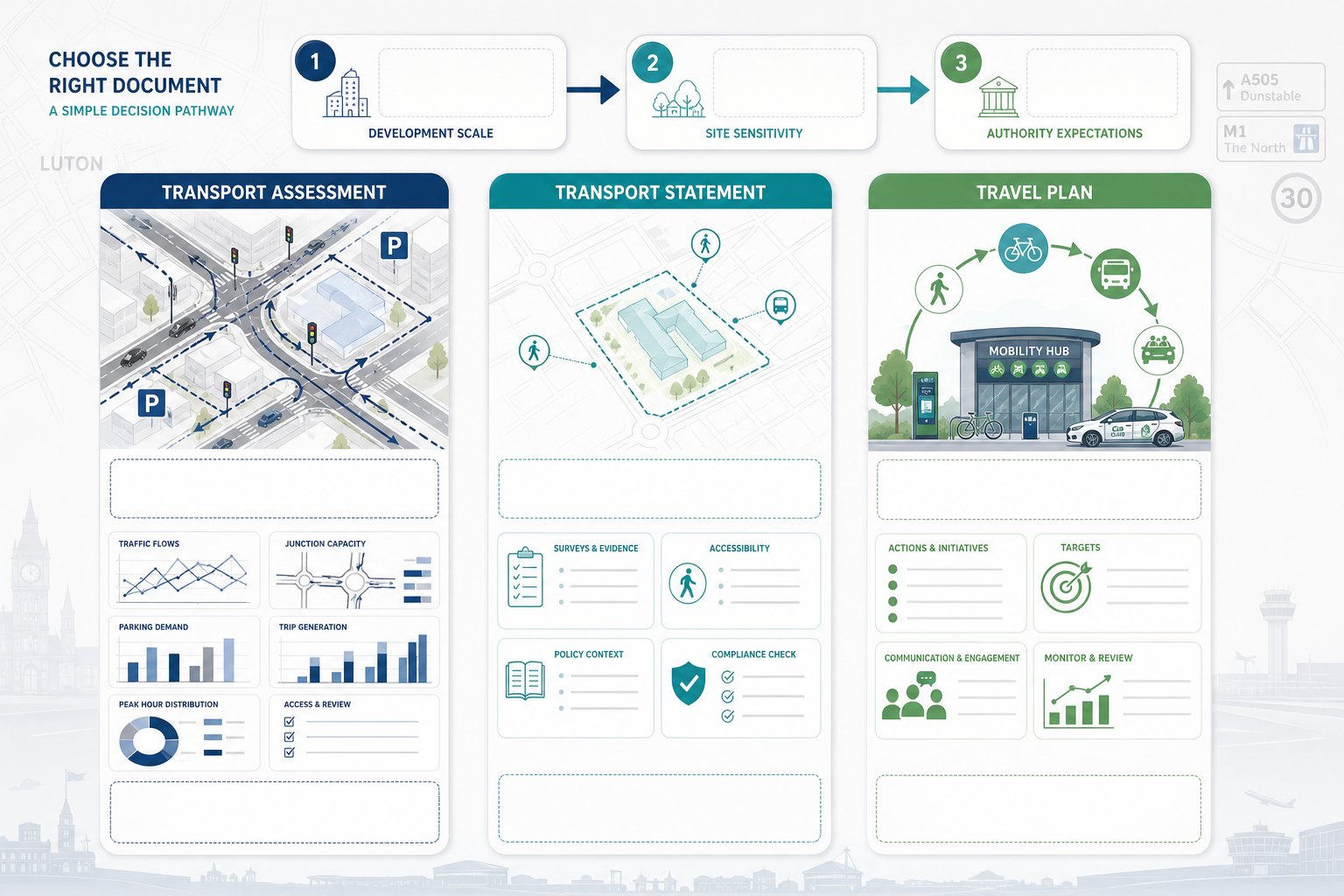
These three documents are often mentioned together, but they do different jobs.
A Transport Assessment (TA) is the more detailed option. It is generally used where a development is likely to have a material transport impact or where the site context is sensitive enough to justify fuller analysis. A TA may include multi-modal trip generation, distribution and assignment, committed development review, junction modelling, road safety commentary, parking analysis and mitigation proposals. It is the document most likely to be scrutinised line by line by highway consultees.
A Transport Statement (TS) is lighter and more proportionate. It is usually suitable for smaller schemes where impacts are limited and can be explained without extensive modelling. That does not mean it can be vague. A good TS still needs sound survey evidence, policy alignment and a reasoned conclusion.
A Travel Plan is different again. It focuses on behaviour, not just capacity. It sets out measures, targets and monitoring to encourage walking, cycling, public transport, car sharing and lower car dependency. For many developments, especially employment, education and larger residential schemes, it forms an important part of the planning package.
The challenge is choosing the right tool for the application. We often advise teams using a framework similar to Traffic Engineering and Transportation: start with scale, then test sensitivity, then align scope with the authority’s expectations. Getting that judgment right early can save weeks.
How Local Planning And Highway Requirements Shape Transport Reports In Luton
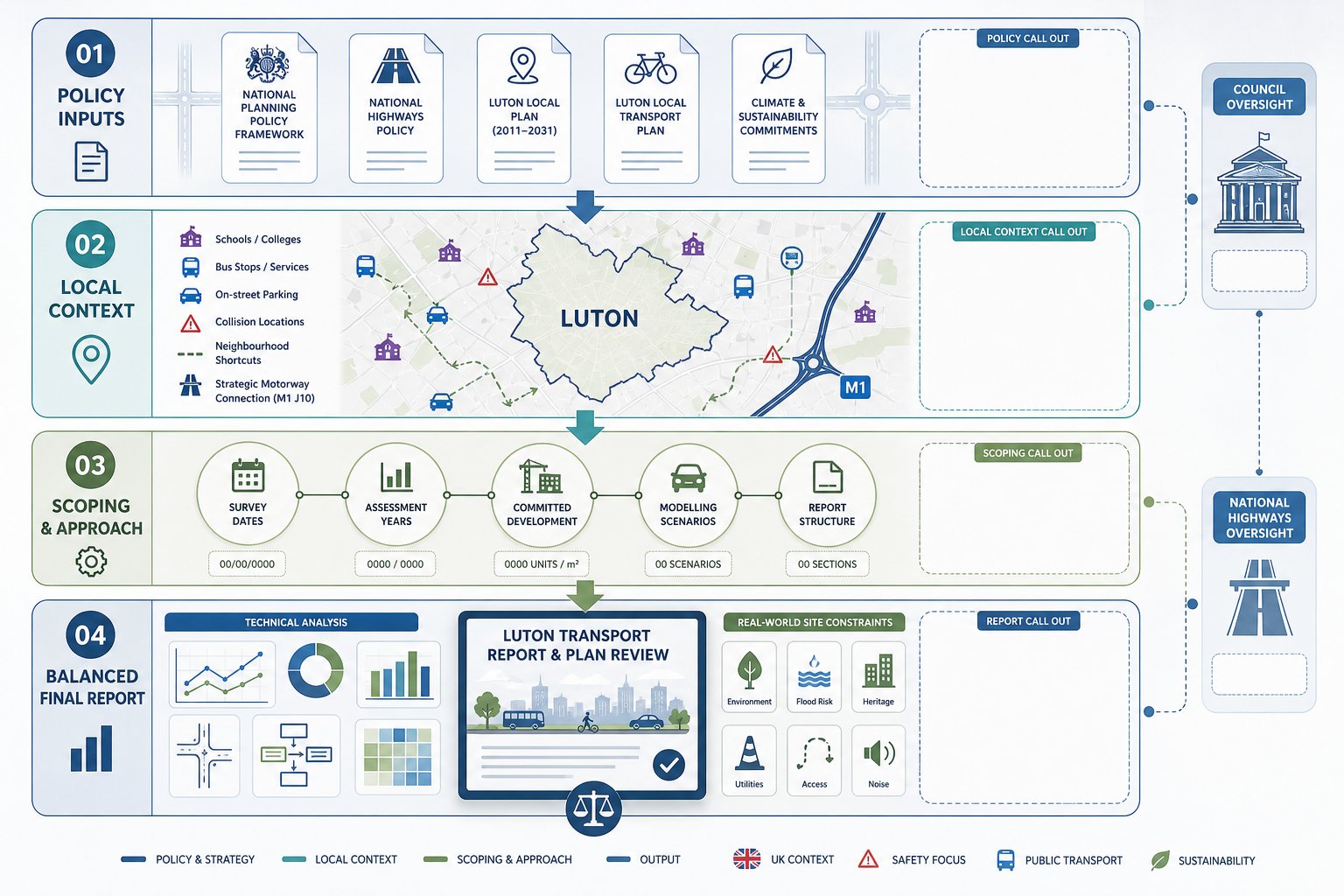
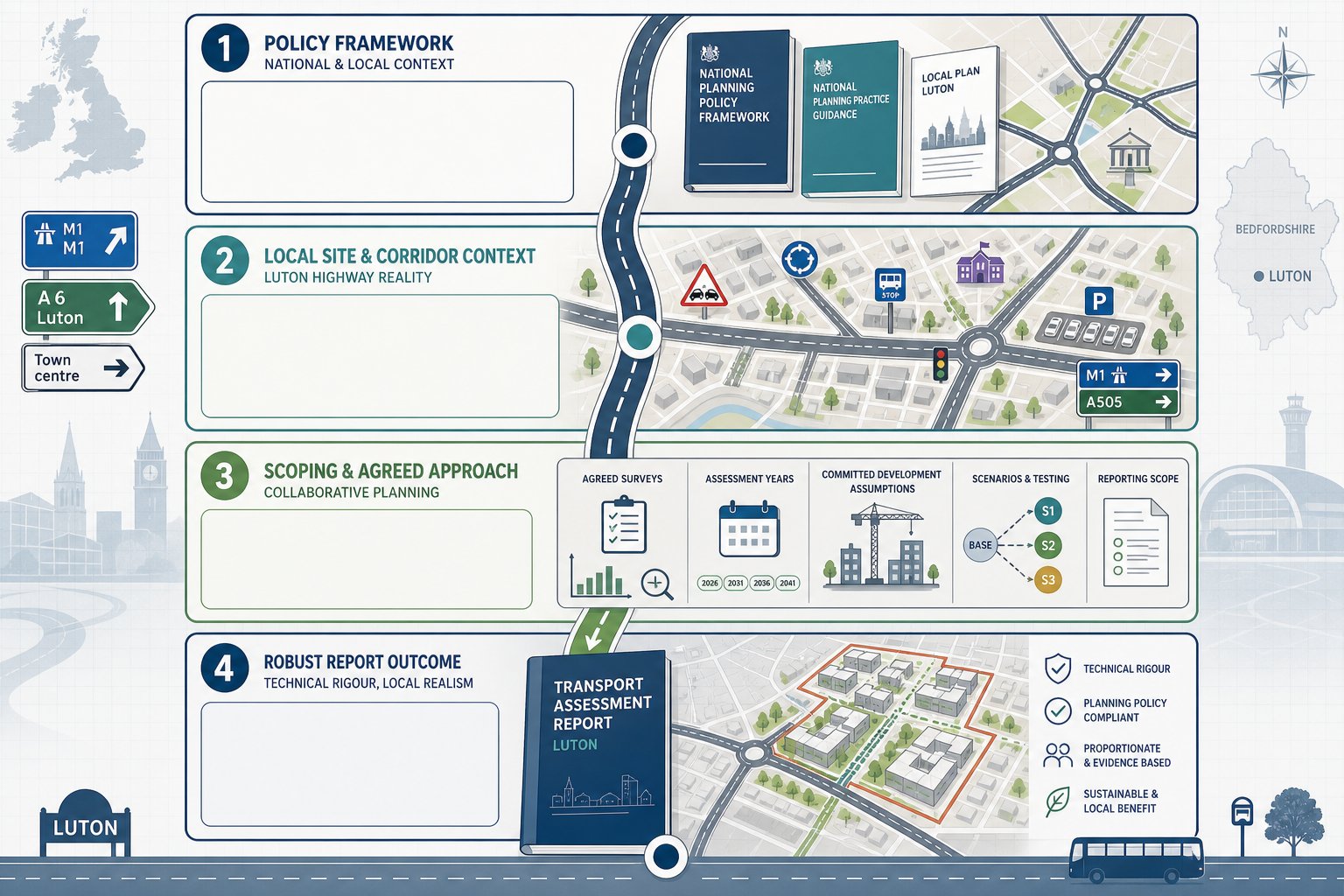
Transport reports in Luton aren’t written in a vacuum. They need to fit the local planning framework, the practical expectations of Luton Council Highways, and, on some schemes, the strategic concerns of National Highways. National guidance matters, of course: the National Planning Policy Framework, Manual for Streets, relevant DfT advice, parking and design guidance, and accepted trip-rate sources such as TRICS or other recognised evidence bases all feed into the work. But local interpretation is what often decides whether a report lands well.
That means understanding Luton’s Local Plan policies, parking standards, sustainable transport objectives and the characteristics of the surrounding network. Authorities will usually want the scope to reflect the site’s actual constraints: nearby schools, bus stop placement, established on-street parking pressure, existing collision history, rat-running patterns, or strategic road interfaces.
Scoping discussions are especially valuable here. Agreeing survey dates, assessment years, committed development assumptions, modelling scenarios and report format before drafting reduces the chance of later challenge. This is where broad experience in Highway And Traffic Engineering helps, because the issue is rarely just calculation. It’s judgment.
In our experience, the strongest transport reports for Luton combine technical rigour with local realism. They don’t overstate benefits, and they don’t duck awkward constraints. They show that the applicant understands how the site functions today and how the proposal will sit within that network tomorrow.
Key Traffic And Access Issues That Affect Development Sites
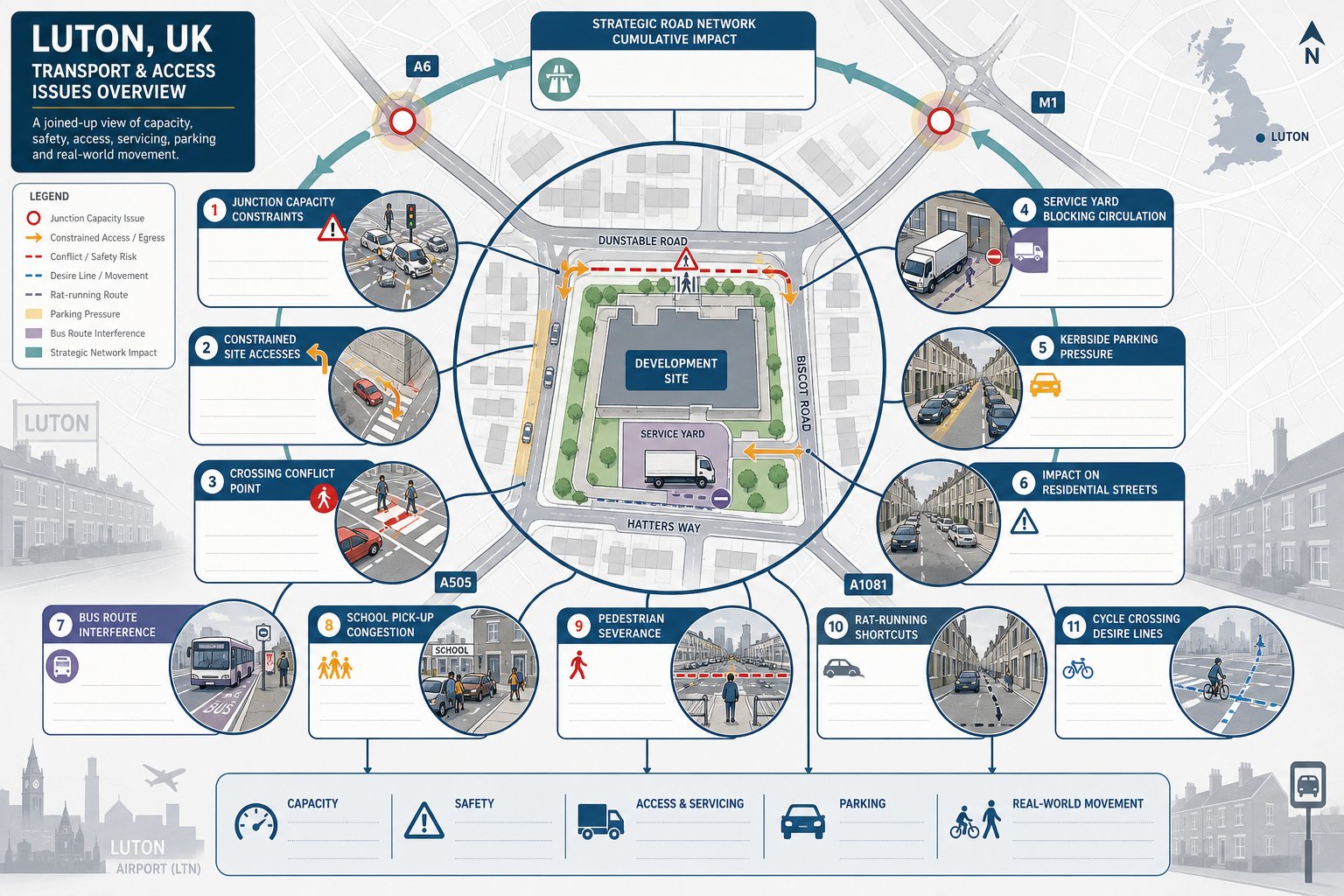
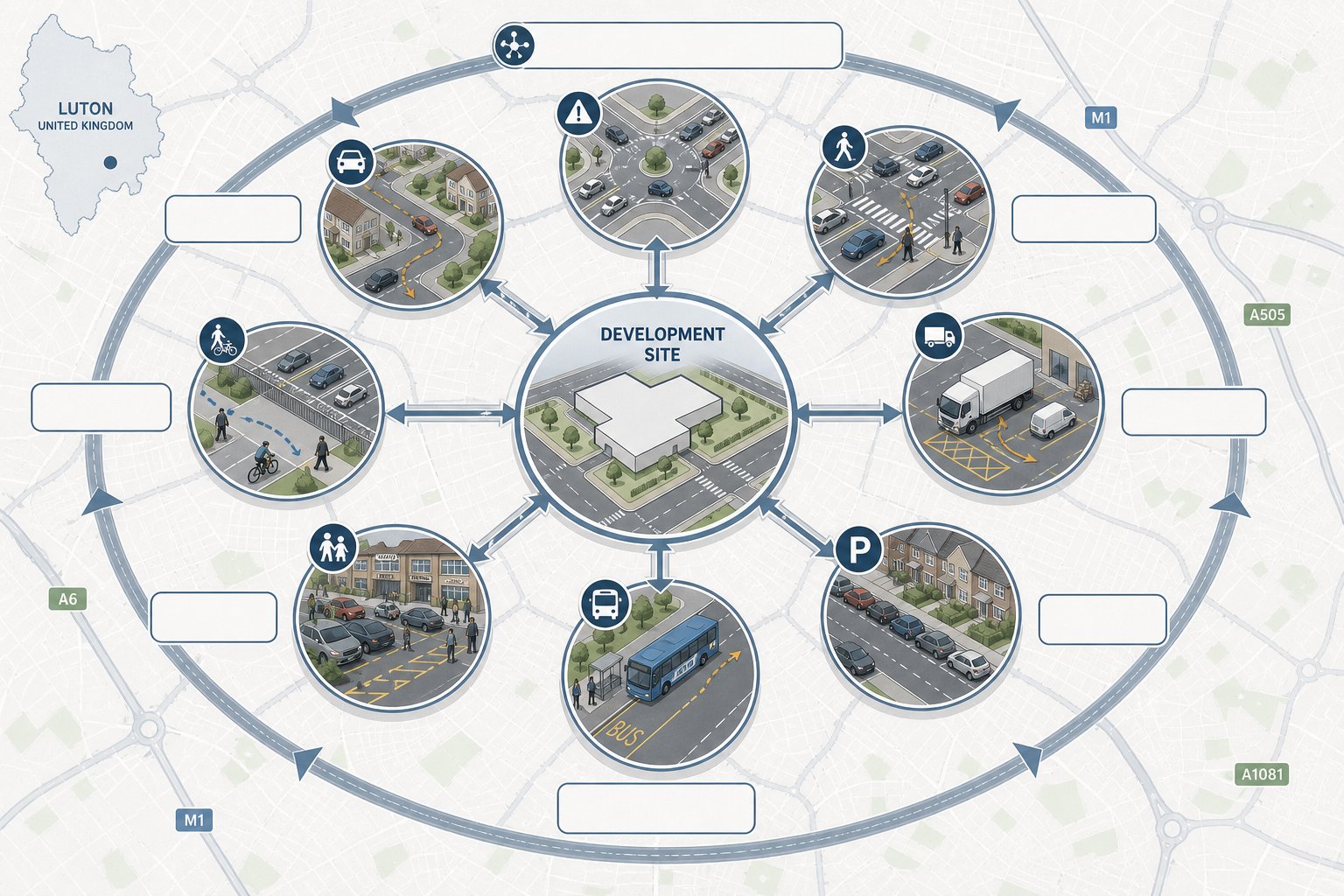
Some transport issues appear again and again in Luton planning work. Junction capacity is one of them, particularly where a site loads traffic onto already stressed corridors or where a “small” increase still affects a constrained arm at peak times. But capacity is only part of the picture. Safety, access quality, operational practicality and neighbourhood effects can be just as influential.
For example, a site may generate relatively few trips yet still attract concern because vehicles must turn across traffic near a crossing point, because deliveries would block internal circulation, or because displaced parking could intensify pressure on nearby residential streets. Likewise, a proposal close to the strategic road network may need to prove not only that its access works locally, but that cumulative effects at a wider level remain acceptable.
We also see recurring concerns around bus route interference, school pick-up conflict, pedestrian severance and informal rat-running. These aren’t always easy to capture in a single spreadsheet or model output. They require a practical reading of how people actually move through a place.
Good transport input hence looks at the whole chain: how vehicles enter, turn, park, service and leave: how pedestrians and cyclists cross desire lines: and whether the layout works in the messy, real-world conditions that officers and neighbours will notice immediately.
Access Design, Visibility, And Highway Safety Considerations
Access design is often where planning transport work becomes tangible. But persuasive a trip forecast may be, a scheme can still stall if the proposed access is awkward, substandard or unsafe. In Luton, this frequently means close attention to visibility splays, carriageway width, radii, gradients, forward visibility, pedestrian crossing points and the relationship between the access and surrounding kerbside activity.
The applicable standard depends on context. Some sites are best assessed with Manual for Streets principles: others, particularly those touching faster roads or more strategic conditions, need a more conservative approach informed by DMRB or authority-specific expectations. The important point is that the chosen standard has to be justified and applied consistently.
Highway safety review should also go beyond geometry. We need to understand whether an access sits near a bus stop, a school entrance, a bend, a loading bay or habitual on-street parking. Those details can materially change how safe an arrangement is in practice.
On many projects, early coordination between transport and design teams avoids expensive revision. Broader principles from Traffic Engineering: Your are useful here, but every Luton site still needs its own evidence-led response. A neat plan is not enough if drivers, cyclists or pedestrians won’t interact with it predictably on the ground.
Parking, Servicing, And Vehicle Tracking Requirements
Parking and servicing are where otherwise viable schemes often become vulnerable. Luton Council will typically expect proposals to align with local parking standards or, where a departure is proposed, explain clearly why that variation is justified. For residential schemes, that can involve unit mix, visitor provision, disabled bays, electric vehicle charging and cycle storage. For commercial uses, turnover, staff travel patterns, delivery frequency and operational dwell times become critical.
Servicing is just as important. If refuse vehicles, delivery vans or emergency vehicles cannot enter and leave safely, the report will be challenged quickly. This is why swept-path analysis matters. Vehicle tracking demonstrates whether the site layout works for the design vehicles it claims to accommodate, including turning, reversing, overrun and conflict points.
We also look carefully at the real operational question: will servicing happen as designed, or will drivers default to kerbside stopping because the service yard is too tight, inconvenient or poorly sequenced? That gap between drawing-board logic and on-site behaviour is where objections often emerge.
Clear transport reporting helps bridge that gap. When layout, parking supply and servicing strategy are tested together rather than in isolation, the planning case becomes much more robust and much easier for officers to support.
Sustainable Travel, Walking, Cycling, And Public Transport Expectations
By 2026, it is no longer enough for a planning submission to show that cars can get in and out. Luton schemes are increasingly expected to demonstrate credible sustainable travel choices as part of the development strategy. That means safe walking routes, direct pedestrian links, secure and convenient cycle parking, and realistic access to bus or rail services where those options exist.
This is not just policy theatre. Sustainable access can directly affect trip generation assumptions, parking demand, Travel Plan commitments and the authority’s overall view of whether a site is in an appropriate location for the proposed use. If a development relies heavily on car travel in a place where walking, cycling or public transport should be viable, that tension usually needs to be addressed head on.
A strong package may include footway improvements, crossing upgrades, better cycle access, contributions to bus stop infrastructure, wayfinding, welcome packs, car club measures or phased Travel Plan targets. The level of intervention depends on scale and context.
For project teams working across regions, comparisons with places such as Traffic Engineer In London: can be instructive, but Luton’s own network and policy context still set the benchmark. The most persuasive submissions show that sustainable travel has been designed in from the outset, not bolted on at the end as a token paragraph.
The Typical Process From Site Review To Planning Submission
A well-run transport input process usually follows a clear sequence, even though the details vary by project.
First comes the initial brief: what is proposed, what drawings exist, what planning route is intended, and where the likely transport pressure points are. Then we review policy, planning history, site constraints and the surrounding highway context. That early stage often reveals whether the scheme is likely to need a TS, a TA, a Travel Plan, access drawings, swept paths, junction modelling or some combination of these.
Next comes scoping with the relevant authority or authorities. In Luton, this is often one of the most valuable steps, because it can settle questions on survey coverage, peak periods, assessment years, baseline conditions and whether National Highways needs to be engaged.
After that, surveys and data collection are carried out, followed by trip forecasting, capacity testing, design review and iterative coordination with the wider consultant team. Draft reporting is then prepared, checked and refined before submission. If comments come back from the local highway authority, a good transport consultant responds with evidence rather than defensiveness.
That workflow sounds straightforward, but timing matters. Late instruction, incomplete drawings or unagreed assumptions can quickly compress the programme and reduce the quality of the submission.
What Information A Traffic Engineer Needs At The Start
The quality of the final report is heavily influenced by the quality of the information we receive at the beginning. At a minimum, we normally need the red-line boundary, a clear description of the proposed development, existing and proposed site layout drawings, access arrangements, parking numbers, cycle provision, servicing strategy and any known phasing.
We also need to understand the planning history. Previous refusals, appeal decisions, pre-application advice, old highway comments or legacy access concerns can all shape the right approach. If there are known constraints around easements, land control, visibility ownership or nearby highway works, those should be flagged early rather than surfaced later.
For larger or phased schemes, detail on build-out assumptions, staff numbers, opening hours, delivery patterns and anticipated mode split can materially affect the analysis. The same applies to adjacent developments that may already be committed.
This is where experienced teams often benefit from the discipline used by Traffic Engineer In Liverpool: and similar project-led approaches elsewhere: define the practical questions first, then gather the data that genuinely answers them. Better inputs lead to clearer scoping, fewer revisions and reports that stand up more confidently under scrutiny.
Common Reasons Transport Reports Are Delayed Or Challenged
Most delayed transport submissions don’t fail because the maths is impossible. They fail because the basics weren’t handled cleanly.
A common issue is out-of-date or incomplete traffic survey data. If surveys were collected in unusual conditions, outside agreed periods, or without enough coverage of nearby junctions and pedestrian routes, the authority may simply not accept the baseline. Another regular problem is skipping formal scoping. When applicants assume what Luton Council Highways will want, rather than agreeing it, they risk producing a report that answers the wrong questions.
We also see schemes challenged for weak junction modelling, unrealistic trip assumptions, omission of committed developments, or failure to test peak periods that actually matter locally. Parking is another frequent source of difficulty. A development might look compliant at headline level yet still face objections if disabled provision, cycle parking, EV charging, visitor demand or servicing overlap have not been resolved properly.
And then there’s presentation. Even technically sound analysis can lose credibility if the report is inconsistent, poorly explained or missing audit trails. Teams that work with the discipline associated with Traffic Engineer In Manchester: style reporting tend to avoid that trap: clear assumptions, transparent appendices, and conclusions that genuinely follow from the evidence.
Choosing The Right Traffic Engineer In Luton For Your Project Team
Not every consultant offering transport reports is equally well suited to a Luton planning application. The right choice is usually a team that combines technical competence with local awareness and commercial realism. In plain terms, they should know what a report needs to say, what evidence needs to sit behind it, and how Luton and nearby authorities are likely to interrogate it.
We’d suggest looking for four things.
First, relevant planning-facing experience. Pure highway design knowledge is useful, but planning support requires proportionate judgment, policy literacy and the ability to write clearly for officers, not just engineers.
Second, practical command of the tools. Junction modelling, trip forecasting, swept-path analysis, CAD-based access review and parking assessment should all be within reach where the project demands them.
Third, a track record of producing concise, audit-ready reports. Long reports do not automatically perform better. Decision-makers value clarity.
Fourth, responsiveness. Development programmes move quickly, and transport advice is most valuable when it informs the scheme early rather than reacting after the layout is fixed.
For many clients, that is why specialist teams with a focused Traffic Engineer in Luton perspective are easier to work with than generalists. The best consultant doesn’t just identify risks. They help the wider team solve them in time to keep the application moving.
Conclusion
For planning applications in Luton, transport input is rarely a box-ticking exercise. It affects layout, access, parking, servicing, sustainability credentials and, eventually, whether an authority feels comfortable granting permission. The schemes that move most smoothly are usually the ones where transport issues are identified early, scoped properly with the relevant highway bodies, and addressed in a way that reflects both local policy and real on-street conditions.
A capable traffic engineer in Luton helps turn that into a practical strategy. We test assumptions, identify risks before they harden into objections, and produce reports that are proportionate, technically sound and easier for decision-makers to trust. For architects, planners, developers, surveyors and councils alike, that early clarity can make the difference between a submission that drifts and one that progresses with confidence in 2026.
Frequently Asked Questions about Traffic Engineering in Luton
What role does a traffic engineer in Luton play in planning applications?
A traffic engineer in Luton assesses the transport impact of a development, forecasting trip generation, parking demand, and junction capacity. They prepare Transport Assessments, Statements, and Travel Plans to ensure schemes comply with Luton Council and National Highways requirements, supporting smoother planning approvals.
How do Transport Assessments differ from Transport Statements and Travel Plans in Luton?
Transport Assessments (TAs) are detailed reports for developments with significant transport impact, including modelling and safety reviews. Transport Statements (TSs) are lighter, proportionate documents for smaller schemes. Travel Plans focus on behavioural strategies to promote sustainable travel and reduce car use.
Which types of development in Luton typically require transport engineering input?
Residential projects, especially larger estates or infill schemes, retail and drive-thru outlets near M1 junctions, employment and warehousing sites, schools, healthcare facilities, and town-centre mixed-use developments usually need transport assessments due to their impact on local traffic, parking, and safety.
Why is early engagement with a traffic engineer recommended for Luton developments?
Early involvement helps identify transport risks and constraints before finalising layout or servicing plans, preventing costly redesigns. It ensures alignment with Luton Council Highways on scope, survey needs, and access design, which improves the chances of timely planning approval and reduces objections.
What are common transport-related issues that can delay or challenge planning approval in Luton?
Delays often arise from outdated or insufficient traffic survey data, lack of scoping with highway authorities, inadequate junction modelling, not accounting for committed developments, and failure to meet local parking or visibility standards. Poorly explained or inconsistent reports also risk rejection.
How do sustainable travel considerations affect transport reports in Luton?
Schemes must demonstrate provision for walking, cycling, and public transport access, with secure cycle parking and links to bus or rail. Travel Plans outlining targets to reduce car dependency are essential, aligning with Luton’s Local Transport Plan and influencing parking demand and trip forecasts.