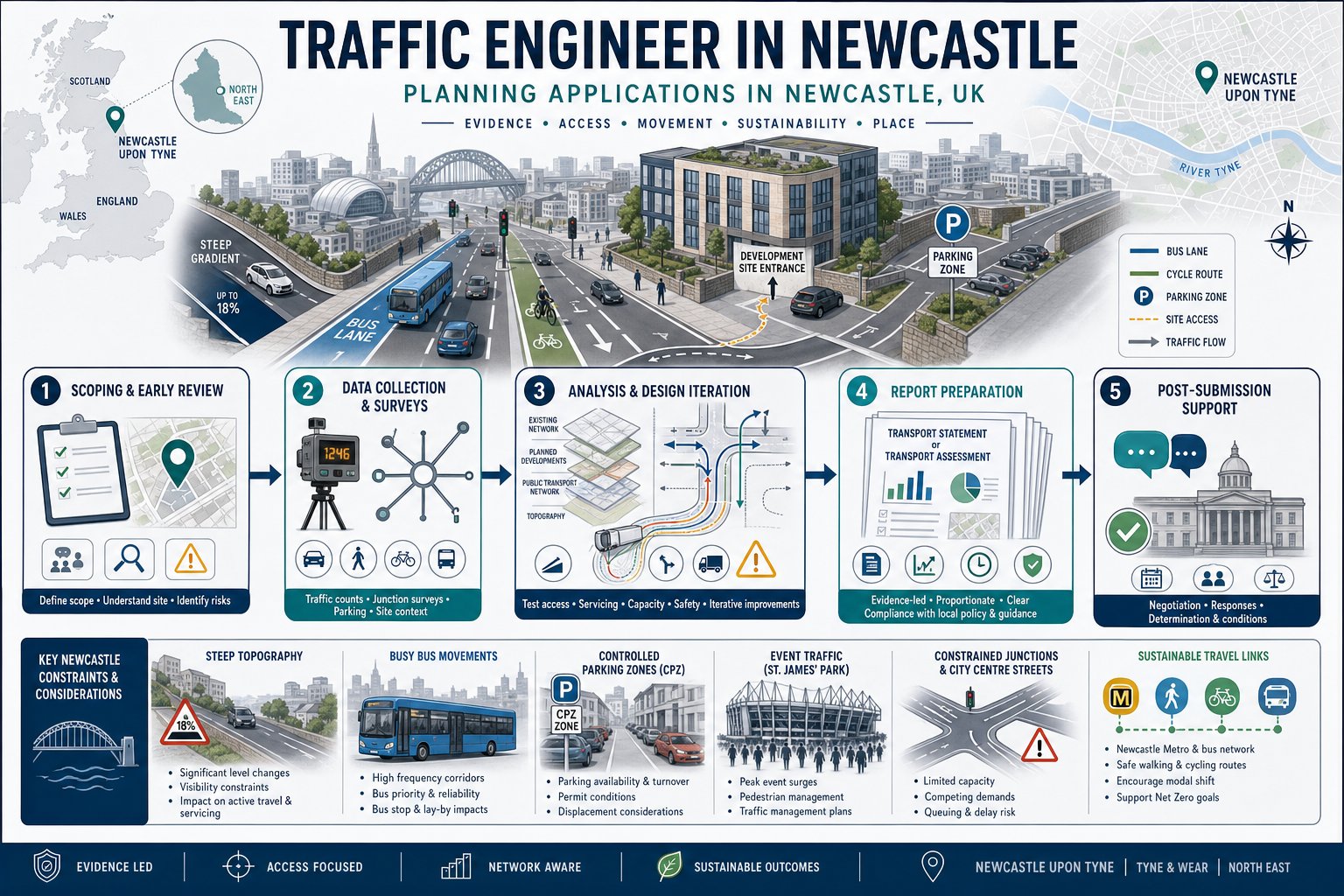
A planning application can look straightforward on paper and still stall the moment highways become an issue. That’s especially true in Newcastle, where steep streets, constrained city-centre corridors, Controlled Parking Zones, busy bus movements and event traffic can turn a simple access question into a long planning exchange.
That’s where a Traffic Engineer in Newcastle earns their keep. We’re not just producing a report to tick a validation box. We’re helping project teams show, with evidence, that a scheme can operate safely, fit local policy, and support sustainable movement choices without creating avoidable objections from highways officers or consultees.
For architects, planners, surveyors, solicitors, developers and local authorities, the value is usually the same: less guesswork, clearer advice early on, and a better chance of getting to determination without rounds of preventable revisions. In practice, that means understanding Newcastle City Council requirements, knowing when a Transport Statement is enough and when a fuller Transport Assessment is needed, and shaping mitigation so it is realistic rather than theoretical.
In this guide, we explain what a traffic engineer does for planning applications in Newcastle, when transport input becomes necessary, which documents matter most, and how local conditions influence what gets accepted. We’ll also cover how we work with the wider consultant team and what to look for when appointing the right specialist.
Key Takeaways
- A Traffic Engineer in Newcastle provides crucial, evidence-based transport input to ensure planning applications meet local policy and operate safely within the city’s unique conditions.
- Early engagement with a traffic engineer helps identify potential issues with site access, parking, and servicing, reducing costly revisions during the planning process.
- Not all schemes require the same level of transport assessment; proportionality is key, with options ranging from concise Transport Statements to comprehensive Transport Assessments.
- Local factors such as Newcastle’s steep topography, Controlled Parking Zones, and event-related traffic must be considered to produce credible and acceptable transport reports.
- Effective collaboration between traffic engineers, architects, planners, lawyers, and developers leads to more efficient planning outcomes and clearer, realistic proposals.
- Choosing a traffic engineer with local knowledge, technical competence, and negotiation skills is vital to navigate Newcastle City Council requirements and streamline application approval.
What A Traffic Engineer In Newcastle Does For Planning Applications
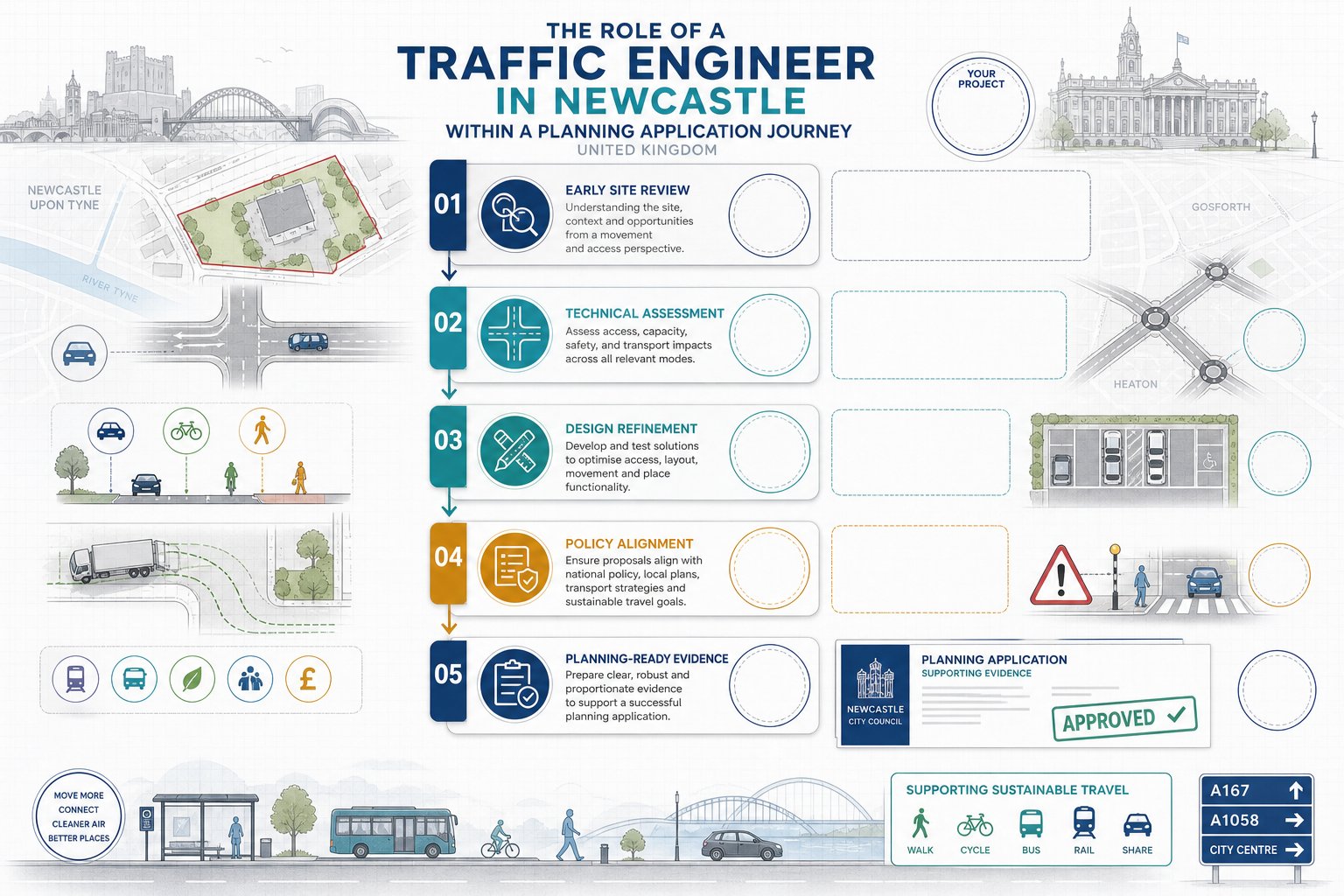
A Traffic Engineer in Newcastle provides the technical evidence that helps a planning proposal stand up to scrutiny. At its simplest, that means reviewing how people, vehicles, cycles and service movements will reach and use a site. But in planning terms, the job is broader than many expect.
We assess likely trip generation, parking demand, servicing patterns, site access, road safety considerations and the potential effect on nearby junctions and streets. We then compare that evidence against national policy such as the National Planning Policy Framework, guidance such as Manual for Streets, and local expectations set by Newcastle City Council. The aim is to show that the development is safe, efficient and sustainable for all users, not only drivers.
Good transport input also starts early. If access geometry is weak, if visibility is constrained, or if a layout creates awkward refuse tracking, those issues are usually cheaper to solve before the design is fixed. That is why transport advice often sits alongside architectural and planning strategy from the outset.
For multi-site operators and project teams working beyond the North East, the same planning logic appears in other cities too, although thresholds and local emphasis differ. That wider context is reflected in work such as Traffic Engineering Consultants: and regional planning support like Traffic Engineer In Leeds:.
In short, our role is part analyst, part designer, part negotiator. The report matters, yes, but so does the judgement behind it.
When You Need Transport Input For A Newcastle Development
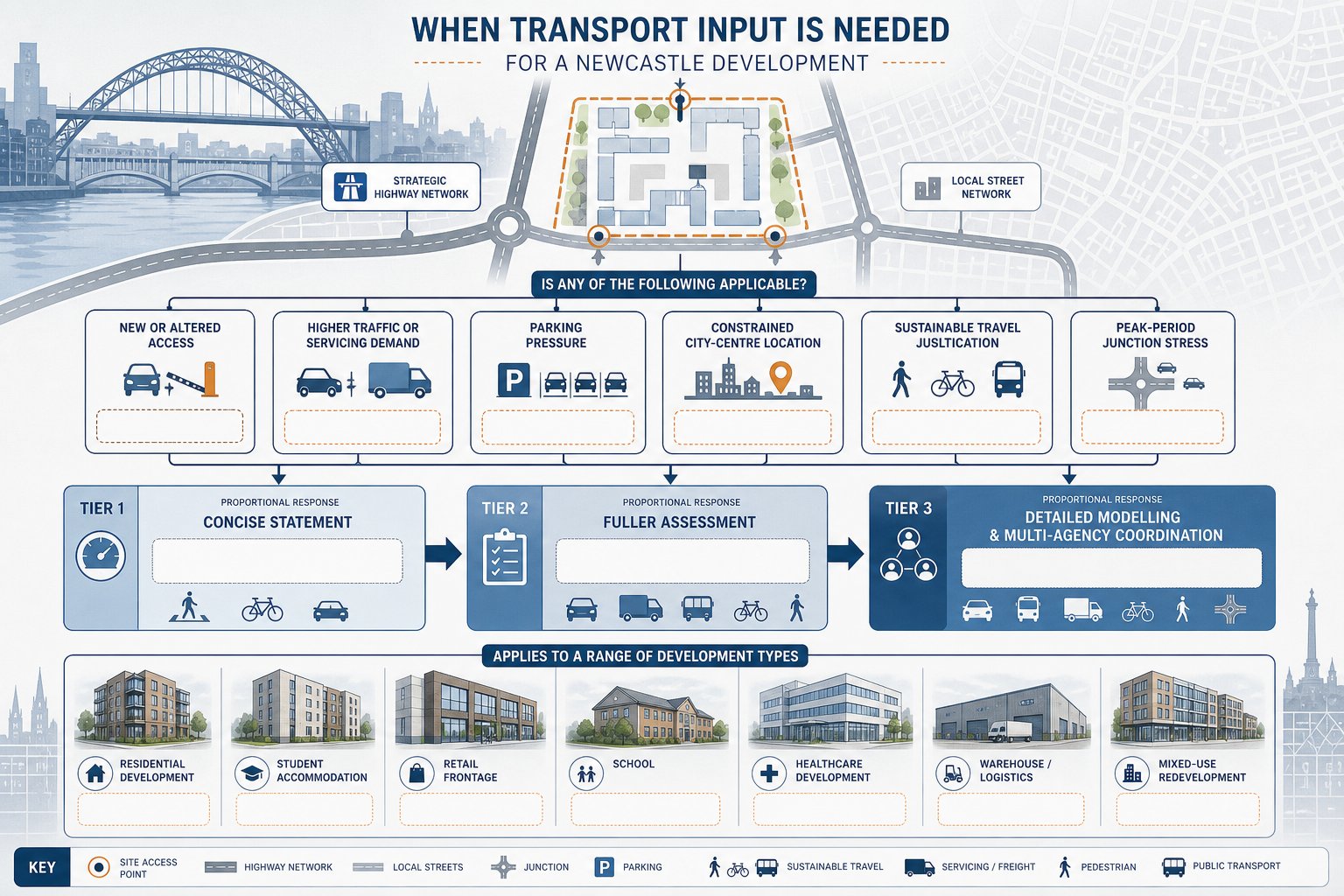
Transport input is usually needed when a scheme changes how a site connects to the highway network or increases movement in a way the local authority will want tested. Sometimes that trigger is obvious: a new residential development, a foodstore, a student scheme or an employment site. Sometimes it is less dramatic, such as a change of use that intensifies deliveries, raises parking stress, or introduces a new access point onto the public highway.
In Newcastle, we would normally advise early transport review where a development involves:
- a new or altered vehicular access
- increased traffic generation or servicing demand
- material parking pressure
- a site in a constrained urban location
- policy-sensitive uses where mode share and sustainable travel need careful justification
- junctions already known to experience peak-period pressure
The key point is proportionality. Not every scheme needs a lengthy Transport Assessment. Some only require a concise Transport Statement supported by sensible drawings and baseline evidence. Others need junction modelling, travel planning and negotiation with multiple parties, including National Highways where the strategic network could be affected.
That judgement call is where experience counts. Early scoping can prevent both under-reporting and over-reporting, two very different problems, but both expensive in their own way.
Common Project Types That Require Traffic Engineering Support
The most frequent project types include residential schemes, PBSA, retail and leisure uses, schools, healthcare, industrial and logistics premises, and mixed-use urban redevelopment. Newcastle also sees plenty of city-centre conversion projects where transport is shaped less by raw trip numbers and more by servicing, car parking restraint, cycle provision and walkability.
We’re often asked to support sites where the planning issue is not whether development can happen, but how it should function. A student accommodation scheme might need robust evidence on car ownership assumptions and servicing. A trade counter may hinge on swept path analysis and peak delivery patterns. A suburban housing site may stand or fall on access visibility, internal tracking and whether nearby junctions can accommodate additional demand.
Comparable issues arise in other city regions: work delivered by Highway And Traffic Engineering teams or in places such as Traffic Engineer In Manchester: follows a similar principle: identify the real transport risk early, then assess it at the right level.
How Newcastle Planning And Highway Requirements Shape Transport Reports
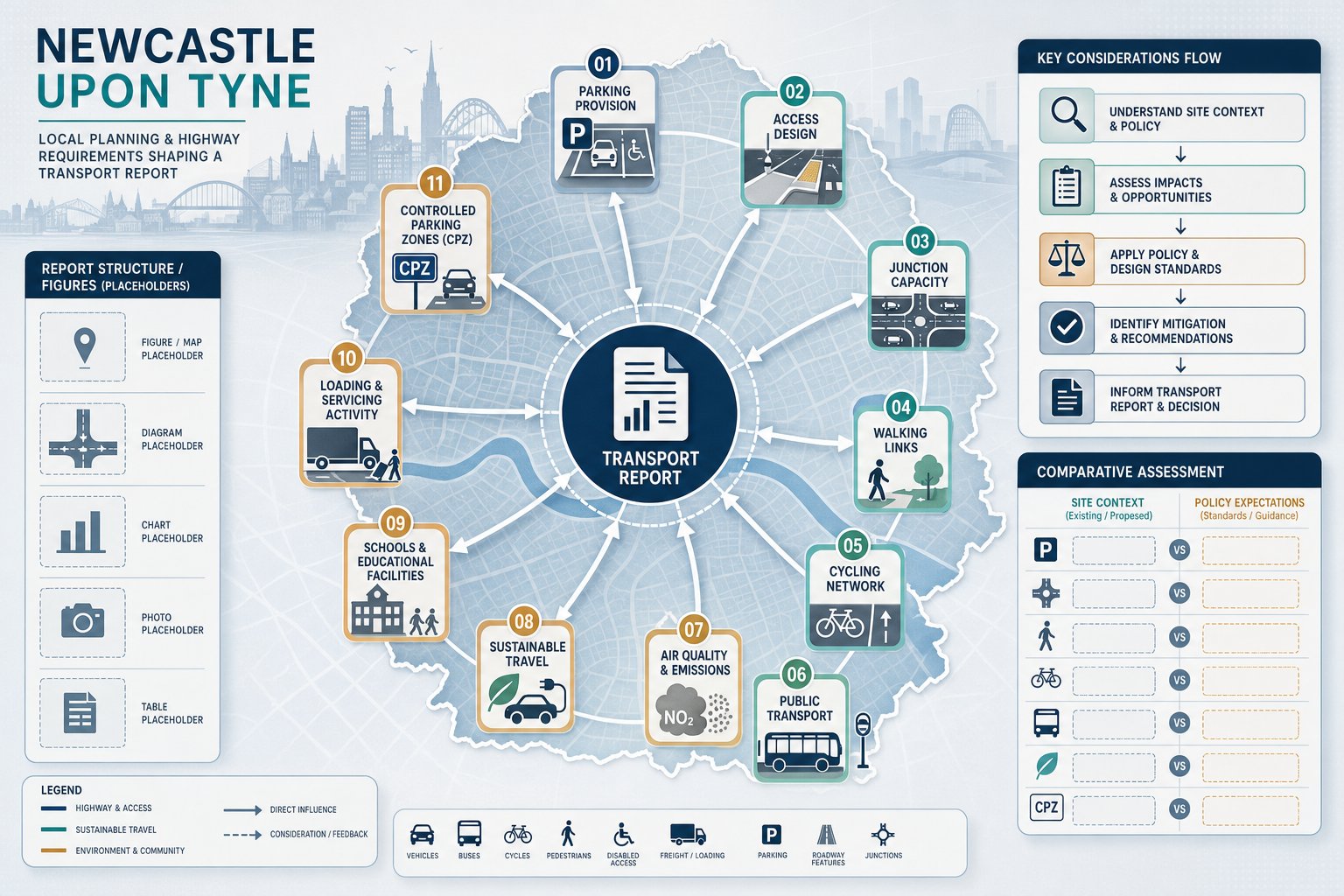
Transport reports are never written in a vacuum. In Newcastle, the content and depth of a report are shaped by local plan policy, parking expectations, site context and the concerns highways officers are likely to focus on.
That means a Newcastle report should do more than recite national guidance. It needs to respond to local corridor pressures, public transport accessibility, the city’s cycling network, pedestrian connections, and any site-specific constraints such as nearby schools, loading activity or Controlled Parking Zones. Air quality and sustainable travel objectives can also influence what is expected, particularly on central or highly accessible sites where reduced car dependence is part of the planning argument.
Parking is a good example. The issue is rarely just whether spaces meet a numeric standard. Officers may also want to understand overspill risk, disabled provision, servicing compatibility, cycle parking quality, and how the proposal aligns with the location’s accessibility profile. Likewise, access design is not only about drawing a bellmouth: it is about whether the arrangement feels safe and intuitive in real conditions.
We also tailor scope to likely consultation dynamics. If a site is close to a sensitive junction or major route, capacity testing may be unavoidable. If the proposal relies on sustainable travel credentials, the evidence around walking, cycling and public transport needs to be robust rather than optimistic.
That locally tuned approach is central to our work at ML Traffic, and it is the same principle behind regional planning support such as Traffic Engineer In Liverpool: and Traffic Engineer In Birmingham:: national standards matter, but local interpretation is what often decides the outcome.
Key Documents Prepared By A Traffic Engineer
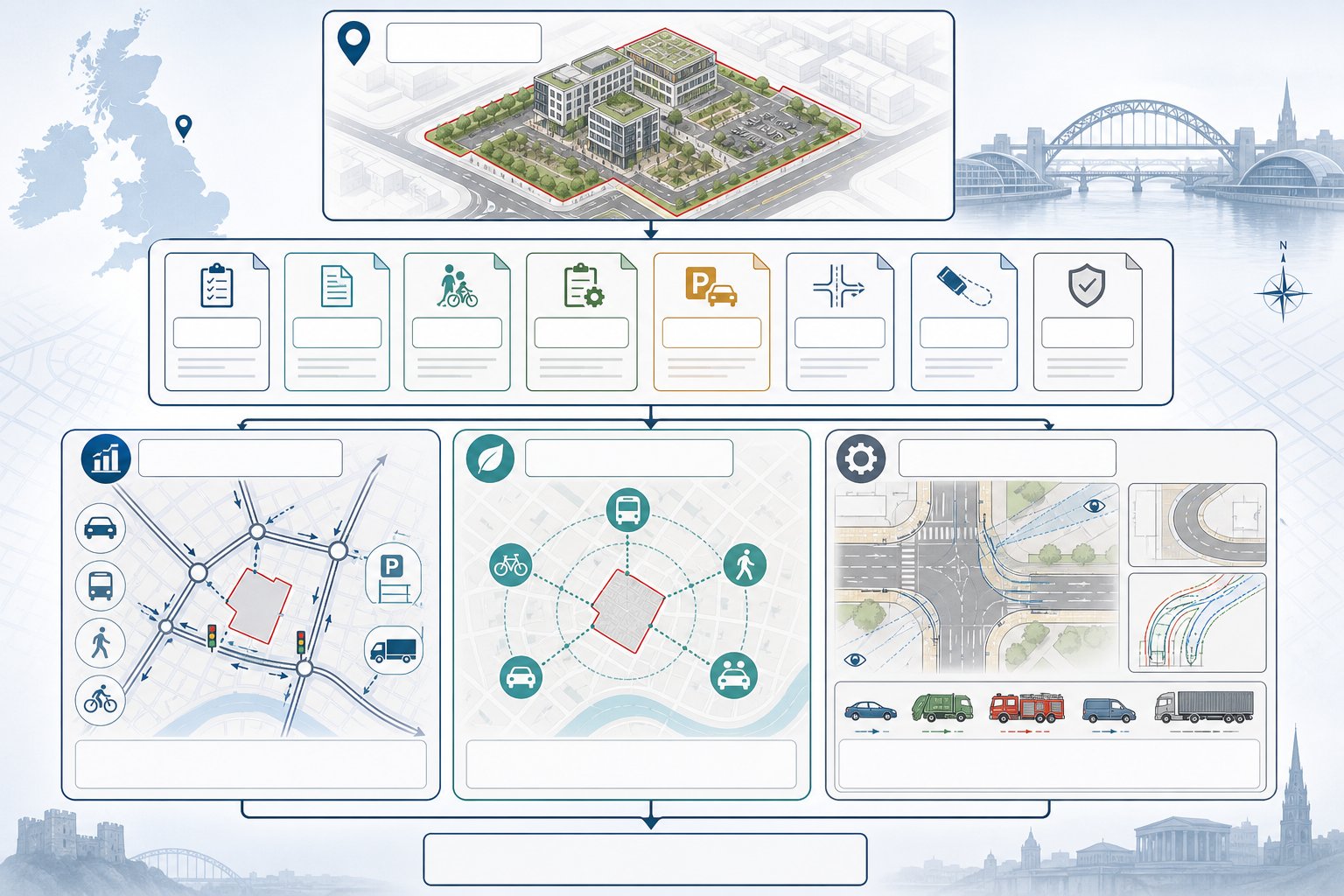
The documents we prepare depend on the scale of development, the site constraints and the likely planning questions. Some schemes need one concise report. Others need a coordinated pack of technical documents supporting access, parking, servicing, sustainable travel and delivery management.
Common outputs include:
- Transport Assessments
- Transport Statements
- Travel Plans
- Construction Traffic Management Plans
- Parking and Servicing Strategies
- access appraisals and preliminary highway design input
- swept path analysis plans
- road safety audit support and responses
The trick is not producing more paperwork than a project needs. A short, well-targeted submission often performs better than a bulky document that avoids the actual issue. Local authorities generally respond best when reports are proportionate, evidence-led and clear about mitigation.
Transport Assessments, Transport Statements, And Travel Plans
A Transport Assessment is the fuller, data-rich option used for larger or more sensitive proposals. It typically examines baseline network conditions, trip generation, trip distribution, modal split, traffic impact, parking, servicing and, where necessary, junction capacity. It is designed to answer the question: what effect will this development have, and is that effect acceptable?
A Transport Statement is usually used for smaller schemes where impacts are expected to be limited. It is still evidence-based, but more concise and proportionate. A good TS doesn’t feel thin: it simply focuses on the issues that genuinely matter.
A Travel Plan sits slightly differently. Its purpose is to encourage sustainable travel through practical measures and targets, public transport information, cycle facilities, appointment of a coordinator, welcome packs, car-club promotion, monitoring arrangements and so on. For many urban Newcastle sites, the Travel Plan is where the sustainable movement story becomes tangible.
Junction Reviews, Access Appraisals, And Swept Path Analysis
Junction reviews test whether nearby nodes can accommodate development traffic safely and efficiently. Depending on the case, that may involve observed operations, queue review, modelling software such as Junctions or LinSig, and sensitivity testing. The point is not to produce dramatic diagrams: it is to understand whether the network can absorb change and, if not, what mitigation would be proportionate.
Access appraisals look at the direct interface between site and street. We review geometry, visibility, pedestrian crossing points, gradients, proximity to junctions, and the practical operation of entry and exit movements. Many planning delays start here because an access was assumed to work before it was properly tested.
Swept path analysis then shows whether vehicles can manoeuvre safely within the site and at its access. Cars matter, but so do refuse vehicles, fire appliances, delivery vans and larger HGVs where relevant. Tracking often reveals layout conflicts that are easy to miss on an architectural plan, bin stores clipped by turning movements, awkward reversing, or service yards that technically fit but don’t really function. Fixing those issues before submission saves time, and usually a few headaches too.
The Traffic Engineering Process From First Enquiry To Submission
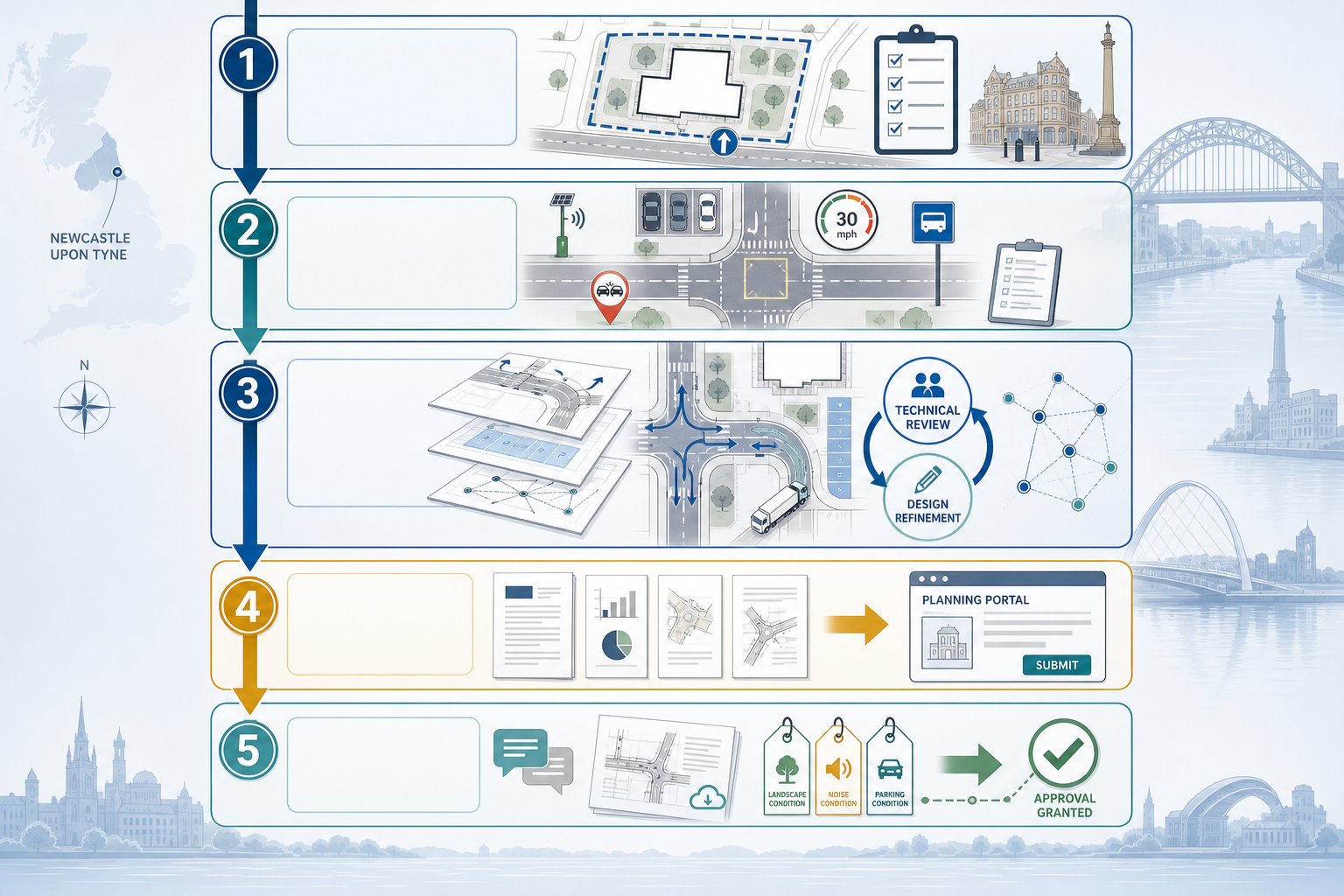
A well-run process makes planning smoother because it reduces late surprises. Our approach usually follows five broad stages.
First comes scoping. We review the proposal, site access, likely policy triggers and whether engagement with Newcastle City Council, or in some cases National Highways, would be helpful before the application is submitted. This stage sets the assessment level and identifies the decisions that could affect layout, quantum or programme.
Second is data collection. That may include traffic counts, junction observations, parking surveys, speed surveys, site visits, collision review and public transport accessibility checks. The objective is to replace assumptions with a defendable baseline.
Third is analysis and design iteration. We test trip generation, parking demand, servicing and network effects, then work with the design team to refine layouts, access points, internal circulation and mitigation. This is often the most valuable stage because technical review can improve the scheme itself, not just the report.
Fourth is report writing and submission support. We prepare the TA, TS, Travel Plan or other documents in a format suited to the application strategy.
Fifth is post-submission support. Highways comments rarely arrive as a neat yes or no. They usually involve clarification, additional evidence, drawing amendments or condition wording. Staying involved during that period is often what gets the scheme over the line.
For teams operating across multiple authorities, the broad process is familiar even where local detail changes, which is why approaches used in Traffic Engineer In London: or Traffic Engineer In Bristol: still translate well, provided the local policy and highway context are properly understood.
Local Factors That Influence Traffic Assessments In Newcastle
Newcastle is not a generic road network, and transport reports that treat it as one tend to feel flimsy. Local geography and movement patterns matter.
Topography is one of the most obvious influences. Steep gradients affect walking catchments, cycle attractiveness, visibility considerations and, occasionally, servicing practicality. River crossings and bridge approaches create pinch points that can shape route choice well beyond the immediate site area. Then there are the radial routes into and around the city centre, where congestion, bus activity and signal coordination can turn a small increase in traffic into a more complex discussion about peak-hour operation.
Parking controls are another recurring factor. Controlled Parking Zones can support lower car parking provision on well-located sites, but only if the wider parking strategy is credible. If overspill risk is brushed aside, objections come quickly.
And Newcastle has event dynamics that aren’t trivial. St James’ Park, major venues and city-centre activity can alter traffic conditions, kerbside pressure and pedestrian flows in ways that matter for access and servicing. That does not mean every scheme needs event-day modelling, but it does mean local awareness is essential.
Public transport accessibility across Tyne and Wear also shapes mode share assumptions. Metro connectivity, bus corridors, walking links and cycle infrastructure can strongly support a sustainable case, but only where those links are realistic, direct and attractive in practice. That “in practice” bit matters more than people think.
Working With Architects, Planners, Lawyers, And Developers
Traffic engineering works best when it is integrated, not bolted on late. Most planning schemes move faster when the transport engineer is in the room early with the architect, planner and client team, because transport issues often affect layout, viability and legal strategy all at once.
With architects, we usually focus on site access, internal circulation, parking layout, servicing, tracking and the relationship between movement and placemaking. A neat-looking drawing is not necessarily an operable one. Minor changes to a corner radius, ramp alignment or bin collection point can remove a whole chain of technical objections.
With planning consultants, the emphasis is policy alignment and application strategy. We help decide whether the transport case should lead with accessibility, capacity, highway safety, reduced parking demand, or a mitigation package. That alignment matters because a strong TA can still underperform if it does not support the wider planning narrative.
With lawyers, transport input often feeds into Section 106 and Section 278 discussions, condition wording, access rights and appeal evidence. The legal drafting needs technical precision: vague commitments tend to create trouble later.
With developers and land teams, the conversation is usually about risk, cost and programme. We help identify what is genuinely needed, what can be phased, and what design or mitigation options are likely to be accepted. It is rarely glamorous work, but it saves money, time and awkward meetings, which is close enough.
How To Choose The Right Traffic Engineer For A Newcastle Project
Not all transport consultants are equally suited to a Newcastle planning application. Technical competence is the baseline, but local judgement is what usually separates a useful appointment from a merely adequate one.
Start with local experience. Has the consultant worked on Newcastle or wider North East schemes with similar characteristics? Do they understand how the authority tends to approach access, parking, sustainability and mitigation? That familiarity can sharpen scoping and improve the tone of technical dialogue from day one.
Then look at technical range. A good consultant should be comfortable with TRICS, Junctions, LinSig, AutoTrack and the broader toolkit needed for transport planning and highway design support. But software alone proves very little. The real question is whether they know when each tool is necessary, and when it isn’t.
Ask about negotiation and planning support. Can they deal directly with highways officers, respond efficiently to consultee comments, and defend evidence if an application becomes contentious or goes to appeal? Plenty of reports are competent on paper. Fewer are written by people who can carry the argument through.
Finally, consider clarity and speed. In our experience, teams value concise advice, realistic programmes and reports that answer questions plainly. That’s especially important for architects, surveyors and lawyers who need something they can actually use in decision-making, not a 70-page exercise in throat-clearing.
A strong Traffic Engineer in Newcastle should make the project clearer, not more complicated.
Conclusion
For planning applications in 2026, transport input is no longer a late-stage technical add-on. In Newcastle, it is often a core part of how a scheme is designed, justified and negotiated.
The right traffic engineer helps you identify risk early, choose the correct level of assessment, respond to local policy and highway expectations, and present evidence in a form the authority can work with. That might mean a concise Transport Statement for a modest change of use, or a fuller package covering access, junction capacity, parking, servicing and sustainable travel measures for a larger development.
Either way, the goal is the same: a proposal that is credible, proportionate and easier to approve.
When project teams want transport advice that is concise, accurate and grounded in local planning reality, early involvement usually pays for itself. And in a city as varied and constrained as Newcastle, that early clarity can make all the difference between a smooth application and a slow one.
Frequently Asked Questions About Traffic Engineers in Newcastle
What role does a traffic engineer play in Newcastle planning applications?
A traffic engineer in Newcastle assesses trip generation, parking demand, site access, and road safety to ensure developments meet national policies and Newcastle City Council standards, supporting schemes that are safe, efficient, and sustainable for all users.
When is transport input required for a development project in Newcastle?
Transport input is needed when there is new or altered vehicular access, increased traffic or servicing demands, notable parking pressure, or use changes affecting sustainable travel modes, especially for residential, retail, or employment developments.
What are the key transport documents prepared by a traffic engineer in Newcastle?
Traffic engineers commonly prepare Transport Assessments (TAs) for large schemes, Transport Statements (TSs) for smaller projects, Travel Plans to promote sustainable travel, along with parking and servicing strategies, access appraisals, and swept path analyses.
How do local Newcastle conditions influence traffic engineering reports?
Newcastle’s steep topography, Controlled Parking Zones, event traffic, and public transport network shape traffic assessments, requiring analyses to address congestion, parking overspill, sustainable travel, and site-specific constraints for realistic mitigation.
How do traffic engineers collaborate with planning teams on Newcastle projects?
Traffic engineers work early with architects, planners, lawyers, and developers to optimise site layouts, align transport strategies with planning policies, assist legal drafting for access and conditions, and manage project risk, cost, and programme efficiently.
What should you consider when choosing a traffic engineer for a Newcastle development?
Select a traffic engineer with proven Newcastle or North East experience, technical skills in industry tools, negotiation ability with local authorities, and a reputation for clear, concise advice to facilitate timely and credible planning approvals.