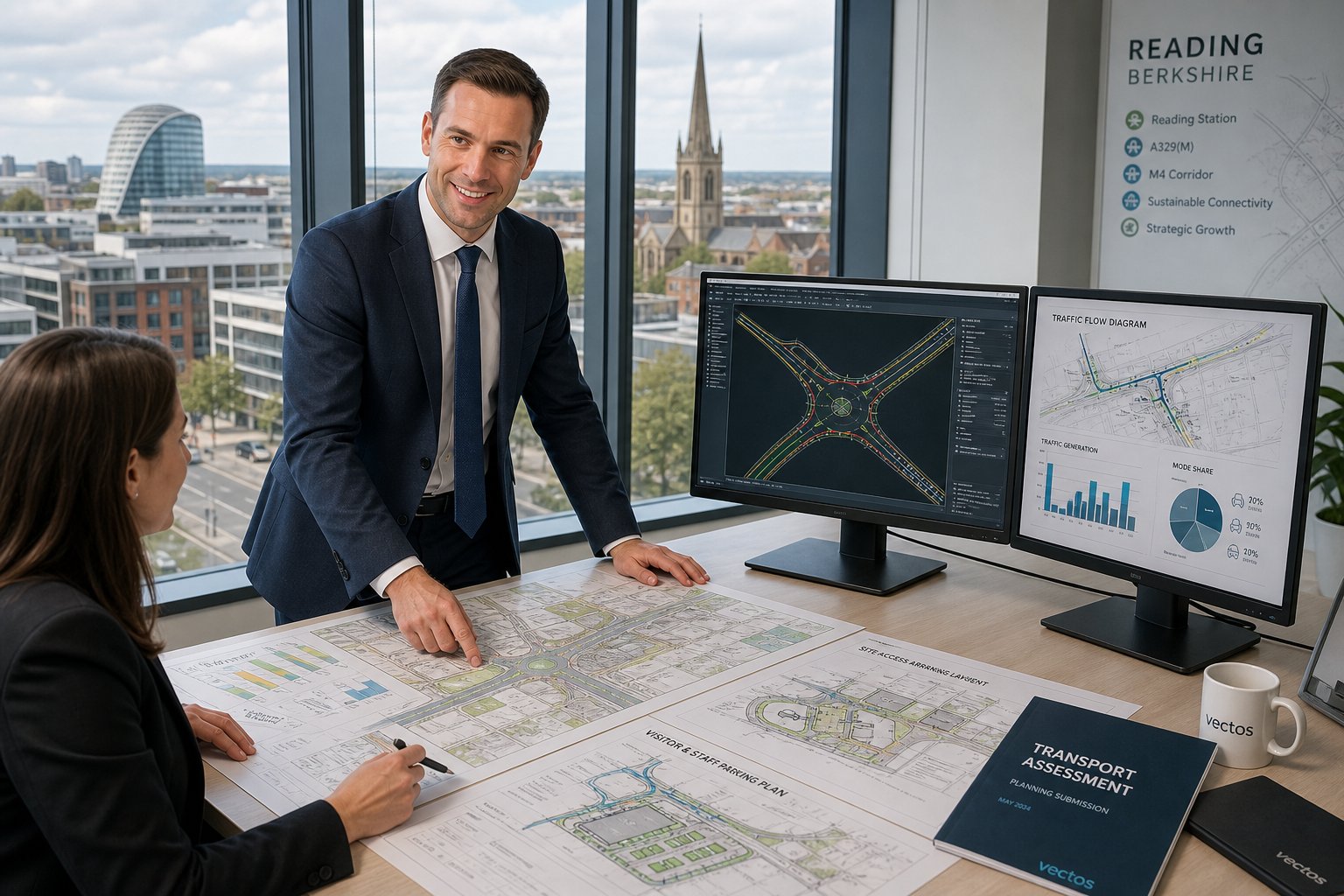
If a scheme in Reading is likely to change traffic flow, parking demand, access arrangements or road safety conditions, transport evidence stops being a “nice to have” and becomes part of the planning strategy. That applies whether we’re dealing with a town-centre mixed-use proposal, a logistics unit near the strategic road network, a school expansion, or a residential site with awkward access constraints.
A traffic engineer in Reading helps turn those risks into something that can be tested, explained and, where needed, mitigated. In practice, that means forecasting trips, assessing junction performance, checking servicing and visibility, preparing Transport Statements or full Transport Assessments, and making sure the transport case lines up with local planning expectations.
In Reading and the wider Berkshire area, that local layer matters more than many teams first assume. Policy thresholds, congestion pinch points, school-run patterns, station-related movement, and the expectations of different highway authorities can shape both the scope of work and the tone of technical negotiations.
In this guide, we set out what a traffic engineer does, when transport input is usually needed, how key reports and modelling are prepared, what commonly causes delay, and how to choose the right consultant for a Reading planning submission in 2026.
Key Takeaways
- A traffic engineer in Reading plays a crucial role in assessing and managing the transport impact of development projects, ensuring safe access, parking, and junction performance.
- Local knowledge of Reading’s unique traffic patterns and policies is essential for accurate trip forecasting, credible assumptions, and effective negotiation with authorities.
- Transport Statements, Assessments, and Travel Plans differ in scope and detail, with the right choice depending on project size and local planning thresholds.
- Swept Path Analysis and detailed junction modelling are vital to confirm vehicle manoeuvrability and network capacity, preventing costly redesigns and objections.
- Successful planning submissions rely on early and integrated transport input involving architects, planners, lawyers, and local authorities to align design and evidence.
- Choosing a traffic engineer with local experience, broad technical capabilities, and responsive communication enhances the chances of smooth, timely planning approval in Reading.
What A Traffic Engineer In Reading Does For Development Projects
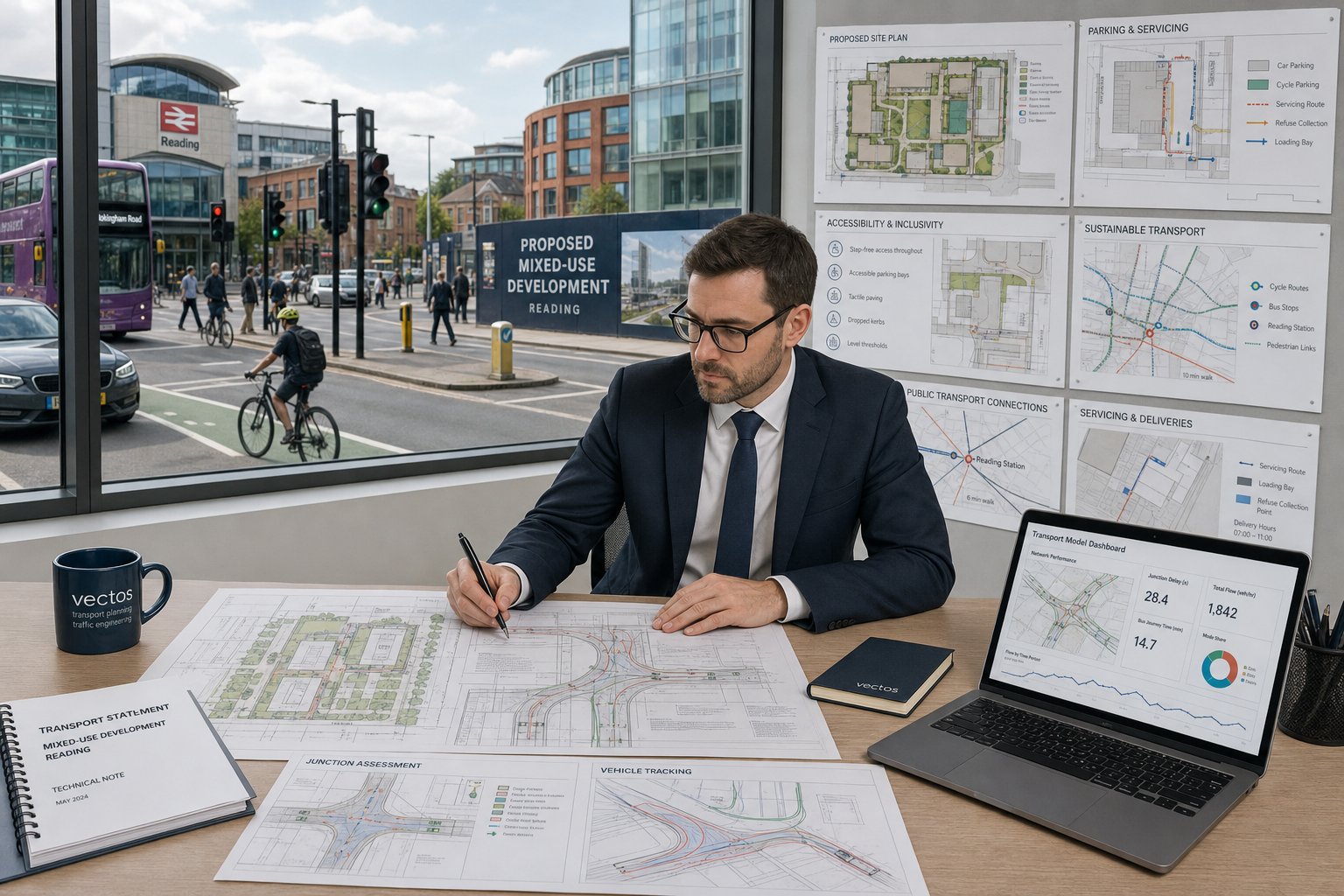
A traffic engineer in Reading supports the planning process by answering a simple but high-stakes question: what will this development do to movement on and around the site, and is that impact acceptable?
That sounds straightforward. It rarely is.
For most projects, we start with the basics: the scale of development, likely land use, access points, surrounding highway conditions and the policy context. From there, we forecast trip generation, estimate where those trips are likely to travel, and test whether the local network can accommodate them. We also look beyond cars. Walking, cycling, bus access, rail connectivity, servicing movements, disabled access and highway safety all sit within the transport picture.
The output is usually a technical package for planning: a Transport Statement, Transport Assessment, Travel Plan, technical note, junction modelling or vehicle-tracking exercise. On some schemes, our work is heavily design-led. We may advise on internal layout, refuse tracking, loading arrangements, car and cycle parking, or access geometry at an early stage so the architect doesn’t develop a layout that falls apart under highways review.
On others, the emphasis is strategy. A developer may need concise evidence that the scheme stays below impact thresholds, or a lawyer may need robust technical support for an appeal.
That broader role is why teams often involve specialist Traffic Engineering Consultants: early. The transport case isn’t just a report: it shapes design, viability, timing and, sometimes, whether consent is realistic at all.
Why Local Knowledge Matters In Reading And Berkshire
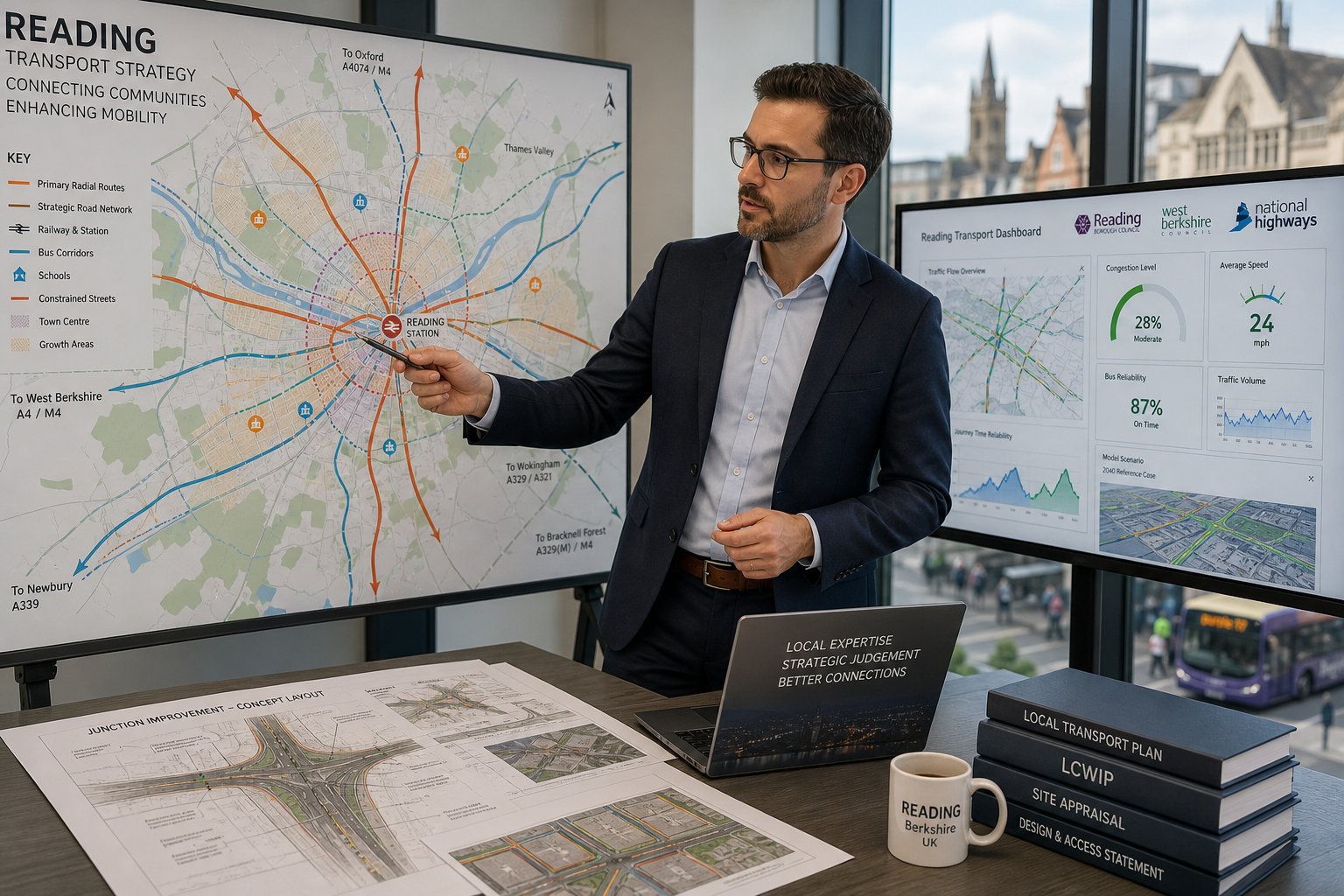
Transport planning is never done in a vacuum, and Reading proves the point. A technically correct report can still struggle if it doesn’t reflect local reality.
Reading has its own movement patterns: peak congestion around key radial routes, station-related activity, school-run pressure points, bus-heavy corridors, constrained urban streets, and the knock-on effects of nearby strategic routes. Add cross-boundary movement into Wokingham, West Berkshire, Bracknell Forest and beyond, and a generic transport assessment quickly starts to look thin.
Local knowledge helps in three ways.
First, it sharpens scoping. We can identify early whether Reading Borough Council, Wokingham Borough Council, West Berkshire Council or National Highways are likely to take an interest, and what each will expect in terms of surveys, modelling, mitigation and policy references.
Second, it improves assumptions. Trip distribution, school peak effects, shift overlaps, rail-linked travel and event-related surges are all more credible when they reflect actual Berkshire conditions rather than national averages used lazily.
Third, it helps with negotiation. Knowing which junctions are politically sensitive, where parking pressure is already contested, or how officers tend to review Travel Plans can save weeks.
That local overlay is one reason firms with wider regional experience can still add value. Lessons from places facing similar planning pressures, including Traffic Engineer In London: work on constrained urban sites, often translate well when paired with Reading-specific judgement.
Planning Applications That Commonly Need Traffic Engineering Input

Not every planning application needs a detailed transport package. But many more need traffic input than applicants expect.
The clearest examples are larger residential developments. New-build housing, apartment blocks, HMOs, retirement living and purpose-built student accommodation often raise questions around trip generation, parking demand, access safety, refuse collection and cumulative impact. Even modest schemes can trigger transport concerns where the site sits on a narrow frontage road, near a school, or in an area already under parking stress.
Commercial development is another common trigger. Offices, industrial units, warehousing, trade counters, roadside uses, retail parks and leisure schemes all create distinct movement profiles. A logistics scheme may hinge on HGV routing and servicing hours: a gym or food-led use may be more about peak overlap and parking turnover.
Education and healthcare projects nearly always benefit from traffic engineering input because their impacts are concentrated into short, intense periods. School drop-off, staff parking, pedestrian conflict and coach access can become decisive planning issues very quickly.
Town-centre and mixed-use schemes also tend to need careful transport evidence. They often rely on linked trips, public transport accessibility and shared parking assumptions, all of which need to be demonstrated, not merely asserted.
Where thresholds or report scope are unclear, broader practice from comparable cities can be helpful. Experience from Traffic Engineer In Bristol: schemes, for example, often highlights the same issue: smaller urban proposals can still attract significant highways scrutiny if the context is sensitive.
Transport Statements, Transport Assessments, And Travel Plans Explained
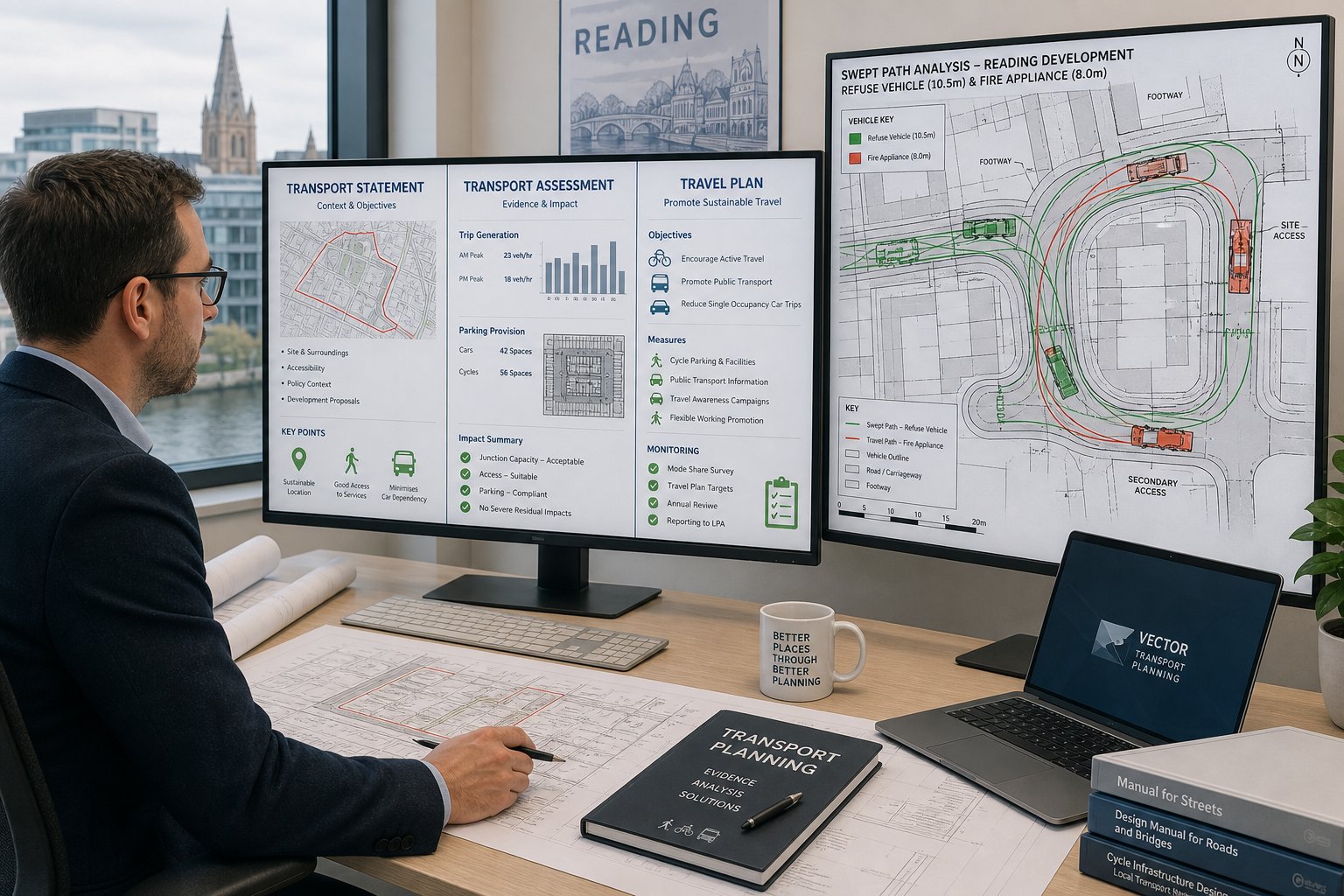
These documents are often mentioned together, but they do different jobs.
A Transport Statement (TS) is usually the lighter-touch option. It suits smaller schemes where transport effects are expected to be limited. A TS typically summarises the site context, sustainable travel options, access arrangements, parking provision, and an initial view on traffic impact. The key word is proportionate.
A Transport Assessment (TA) is more detailed. It is used where a proposal is likely to generate material movement effects and requires a fuller multi-modal appraisal. A TA may include survey analysis, trip generation, distribution and assignment, junction modelling, road safety review, parking accumulation, servicing strategy and mitigation testing. If officers or highway authorities are likely to ask “show us the numbers”, you are usually in TA territory.
A Travel Plan (TP) sits alongside either document when the authority wants a strategy to manage travel behaviour. That can include mode-share targets, cycle measures, welcome packs, bus information, car club measures, monitoring, and a framework for review after occupation. A weak Travel Plan is one of those details that can undermine an otherwise strong submission.
The right scope depends on local thresholds, the site context and the sensitivity of surrounding roads. At ML Traffic, our approach is to keep reports concise where the planning position allows, but not so thin that they invite avoidable objections.
When A Swept Path Analysis Is Needed
Swept Path Analysis is needed where the authority, design team or operator must be satisfied that vehicles can enter, manoeuvre and leave safely. That usually covers refuse vehicles, fire tenders, delivery vans, articulated lorries, coaches and, in tighter residential layouts, ordinary cars.
Using vehicle-tracking software, we test whether a design actually works rather than assuming it will. Can a refuse truck turn without overrunning footways? Can a fire appliance reach the required point? Can a servicing vehicle reverse safely, or should the layout be redesigned? These are not academic questions. One failed tracking plan can force a redraw late in the programme.
This is where grounding in wider Traffic Engineering: Your Complete principles matters: geometry, visibility, conflict points and operational realism all need to line up, not just the software output.
How Junction Capacity And Traffic Impact Are Assessed
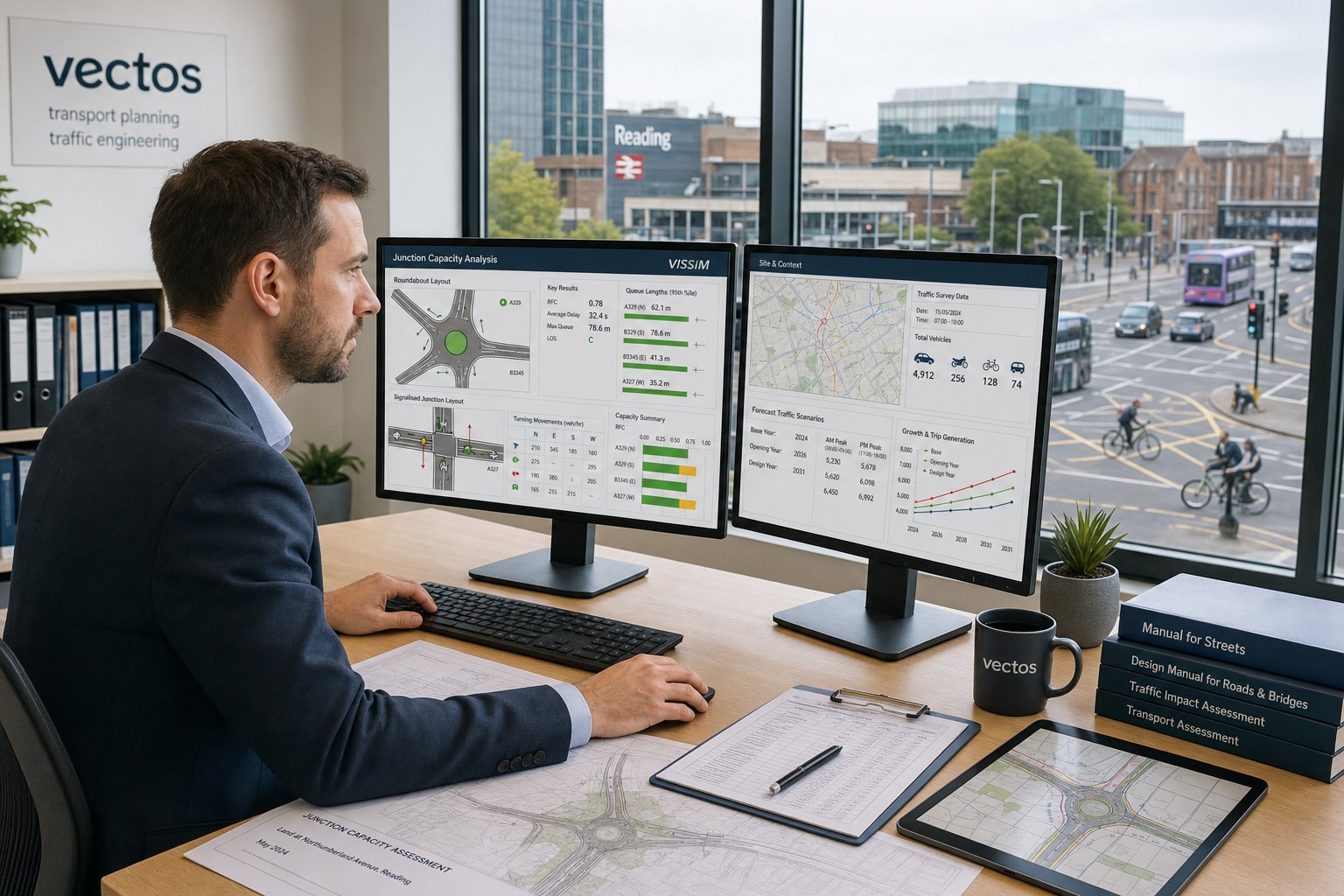
When a scheme adds traffic to the network, the next issue is whether nearby junctions can cope. That assessment usually starts with observed conditions: traffic counts, queue surveys, turning movements, signal data and site observations taken at the right time of year and on representative days.
We then establish the future baseline. In other words, what will happen on the network if the development does not go ahead? Only after that do we add development trips and test the combined scenario.
The tools depend on the junction type. Priority junctions are commonly tested in PICADY, roundabouts in ARCADY, signals in LINSIG, and larger or more complex networks may require microsimulation such as VISSIM. On some projects, SIDRA, HCS or spreadsheet-based analysis may also be appropriate. Software doesn’t replace judgement, but it gives a transparent basis for discussing capacity, delay, queueing and reserve.
A sound assessment also needs believable inputs: trip rates, pass-by assumptions, distribution patterns, committed development, growth factors and sensitivity tests. That is often where weak reports unravel.
If issues are identified, mitigation can range from lining and signal changes to access amendments, Travel Plan measures, staging adjustments or, occasionally, a more strategic package. Experience from Traffic Engineer In Manchester: and other busy urban authorities reinforces the same lesson: junction modelling is only persuasive when the assumptions behind it are clearly justified and locally grounded.
Parking, Access, Servicing, And Highway Safety Considerations
A surprising number of planning refusals or lengthy transport negotiations come down not to headline traffic growth, but to practical design details.
Parking is the obvious one. Authorities will usually expect the level and type of parking to reflect local standards and actual use. That includes general spaces, disabled bays, electric vehicle provision, cycle parking and, for some uses, motorcycle spaces. Under-provision can push parking stress onto nearby streets: over-provision can undermine sustainable transport objectives.
Access design matters just as much. We look at visibility splays, carriageway width, gradients, pedestrian crossing points, gate set-back, swept paths and interaction with existing street features. A site entrance that works on plan but forces awkward two-way movement in reality can become a major objection.
Servicing needs to be credible from day one. Delivery vehicles, bin stores, loading times and refuse collection arrangements should align with operator expectations and council practice. If a scheme relies on unrealistic servicing assumptions, officers tend to spot it quickly.
Then there is highway safety. Collision records, pedestrian desire lines, school movements, vulnerable users and conflict at access points all inform the review. Some schemes may also require a Road Safety Audit or a designer’s response.
This is often where cross-disciplinary coordination matters most. Approaches used on Traffic Engineer In Birmingham: work, where constrained accesses and parking pressure are common, translate well to Reading sites with similarly tight urban edges.
Supporting Residential, Commercial, Education, And Mixed-Use Schemes
Different schemes fail for different transport reasons, so the evidence should never be one-size-fits-all.
For residential development, the focus is often on trip rates, parking layout, access safety, refuse tracking, pedestrian links and the realism of sustainable travel claims. Family housing near schools behaves differently from town-centre flats near Reading station, and the report needs to reflect that.
For commercial and logistics schemes, operational detail becomes central. We assess HGV routing, delivery windows, yard circulation, staff shift patterns, loading demand and any interaction with strategic roads. A warehouse with poor servicing logic can create more planning concern than its gross floorspace suggests.
For education projects, the issue is concentrated peaks. Pupil mode split, staff travel, coach movements, school streets, informal parking and drop-off management all need close attention. Numbers alone rarely tell the whole story: observation and workable management measures matter.
For mixed-use proposals, we often examine internal trip capture, linked trips, shared parking and whether the combination of uses reduces or redistributes demand across the day. In central Reading, those arguments can be persuasive if properly evidenced.
A consultant used to multiple urban typologies can often spot patterns quickly. Lessons from Traffic Engineer In Leeds: and similar city-centre schemes are particularly relevant where mixed-use design, active travel and constrained servicing have to coexist.
Working With Architects, Planners, Lawyers, And Local Authorities
Transport input works best when it is integrated early, not bolted on after the layout is effectively fixed.
With architects, we typically review site access, internal circulation, parking geometry, cycle provision, servicing routes and frontage constraints. A small adjustment at concept stage can avoid a much more painful redesign later.
With planners, the goal is alignment. The planning statement, design rationale and transport evidence should support the same case. If the planning team says a site is highly sustainable but the TA quietly assumes heavy car dependency, that inconsistency won’t go unnoticed.
With lawyers, the work often turns to conditions, obligations, committee support and, where necessary, appeal evidence. Precise wording matters. So does making sure technical mitigation is actually deliverable.
And with local authorities, good engagement usually starts before submission. Pre-application discussions can help agree survey requirements, modelling scope, Travel Plan expectations and whether National Highways or neighbouring authorities should be involved.
The practical value here is coordination. Transport is rarely the only moving part in a planning application, but it can affect almost every other part. That is why we prefer collaborative programmes, clear issue logs and early technical review. The same joined-up approach appears across comparable work, including Traffic Engineer In Liverpool: submissions, where planning, highways and design constraints often need to be balanced at the same time.
What To Prepare Before Instructing A Traffic Engineer
Good instructions save time, reduce abortive work and usually lead to a cleaner planning submission.
Before appointing a traffic engineer, it helps to assemble a basic project pack. At minimum, we would want the red-line boundary, site address, draft layout, proposed unit schedule or floorspace, access strategy if available, and a note of intended planning use classes. Even an early sketch plan is useful if it reflects the likely direction of travel.
Planning history also matters. Previous refusals, appeal decisions, pre-app comments and local objections often reveal the transport issues that are likely to return. If survey data already exists, we can review whether it is recent enough and whether it covers the right periods.
We also need programme clarity. Are you targeting validation quickly? Is committee timing fixed? Are there land or funding milestones that make a delay expensive? Those details affect survey strategy and report scope more than clients sometimes realise.
Budget matters too, though not in the blunt “how cheaply can this be done?” sense. The right question is what level of evidence the authority is likely to require. A lean, proportionate report is sensible. An under-scoped one that triggers rounds of challenge is not.
If the wider team is new to transport submissions, our own Traffic Engineering Consultants: What overview is often a useful starting point for framing what information the consultant will need and why.
Common Reasons Transport Reports Are Delayed Or Challenged
Most transport delays are avoidable. Not all, but most.
The biggest issue is late instruction. If the transport team only joins once the layout is nearly final, there is little room to correct access geometry, servicing conflicts or parking shortfalls without affecting the wider design.
The second is poor or outdated data. Traffic surveys may be too old, taken in an unrepresentative month, or missing the very peak periods that matter for the site. Base assumptions can also drift if a project sits for months and no one refreshes the evidence.
Another frequent problem is misreading local requirements. Authorities do not all apply thresholds or modelling expectations in quite the same way. A technically competent report can still be challenged if it ignores a borough-specific standard, omits a key junction, or relies too heavily on generic national benchmarks.
We also regularly see underestimated trip generation, weak distribution logic, thin cumulative-impact review and Travel Plans that read like boilerplate. Officers are familiar with these patterns. So are objectors.
Finally, reports can be delayed simply because the design keeps moving. Every change to unit numbers, servicing, access width or parking mix can ripple through the transport case.
That is why concise, locally aware reporting matters. Teams comparing methods across cities, including Traffic Engineer In and other authority-specific examples, usually come to the same conclusion: realistic assumptions and stable design inputs save more time than rushed drafting ever will.
Choosing The Right Traffic Engineer For A Reading Planning Submission
Not all transport consultants are the right fit for a Reading planning application. The key is not just technical competence, but relevant competence.
We would look first for local and regional experience. Has the consultant worked with Reading Borough Council and neighbouring Berkshire authorities? Do they understand likely thresholds, local parking expectations, known congestion locations and how cross-boundary issues can affect scoping?
Second, check the range of services. A consultant may be able to write a basic Transport Statement but struggle when the scheme requires junction modelling, swept path analysis, servicing design, Travel Plan negotiation or appeal support.
Third, review their approach to proportionate reporting. Over-engineered reports waste budget: underpowered ones create risk. The best consultants know when to keep matters concise and when more evidence is essential.
Fourth, ask about software capability and guidance familiarity. ARCADY, PICADY, LINSIG, VISSIM, current DfT and CIHT guidance, and relevant ITE or local database experience all matter where impacts are disputed.
And finally, look at responsiveness. Planning programmes move quickly. A good consultant should be able to coordinate with the architect, planning lead and client team without turning every technical point into a long detour.
For Reading submissions, we think the strongest support comes from teams that combine local authority awareness with clear writing, robust analysis and practical design input, exactly the qualities that reduce friction between planning ambition and highways reality.
Conclusion
A strong planning submission in Reading rarely depends on transport evidence alone, but weak transport evidence can derail an otherwise good scheme remarkably fast.
The role of a traffic engineer in Reading is to give decision-makers confidence: confidence that trips have been forecast properly, access is safe, parking and servicing are workable, junction effects are understood, and mitigation is proportionate. For architects, planners, lawyers, developers and local authorities, that technical clarity reduces risk on all sides.
In 2026, the bar is not simply producing a report. It is producing one that is locally aware, policy-aligned, concise where it can be, and detailed where it must be. When that happens, transport stops being a planning obstacle and becomes part of the route to consent.
Frequently Asked Questions about Traffic Engineering in Reading
What does a traffic engineer in Reading typically do for development projects?
A traffic engineer in Reading forecasts trip generation, assesses junction performance, designs access and parking layouts, and prepares transport reports like Transport Assessments to support planning applications in line with local policies.
Why is local knowledge important for traffic engineering in Reading and Berkshire?
Local knowledge ensures transport assessments incorporate Reading’s specific congestion points, school-run patterns, and local authority requirements, making the evidence more credible and helping negotiate practical mitigation.
Which types of planning applications usually require traffic engineering input in Reading?
Larger residential schemes, commercial developments, educational and healthcare projects, as well as mixed-use town-centre developments often need detailed transport evidence to address trip generation, parking, and access concerns.
What is the difference between a Transport Statement and a Transport Assessment?
A Transport Statement is a concise report for smaller schemes with limited transport impact, while a Transport Assessment offers a detailed multi-modal analysis for larger projects likely to affect traffic flows significantly.
When is a Swept Path Analysis necessary in traffic engineering?
Swept Path Analysis is needed to verify that vehicles like refuse trucks, fire tenders, and delivery vans can safely manoeuvre within site layouts and accesses, ensuring practical and safe movement on the development.
How are junction capacity and traffic impact typically assessed in Reading?
Traffic impact in Reading is assessed using specialised software such as ARCADY, PICADY, LINSIG, or VISSIM, coupled with local traffic surveys to model future flows against junction capacity and identify necessary mitigation.