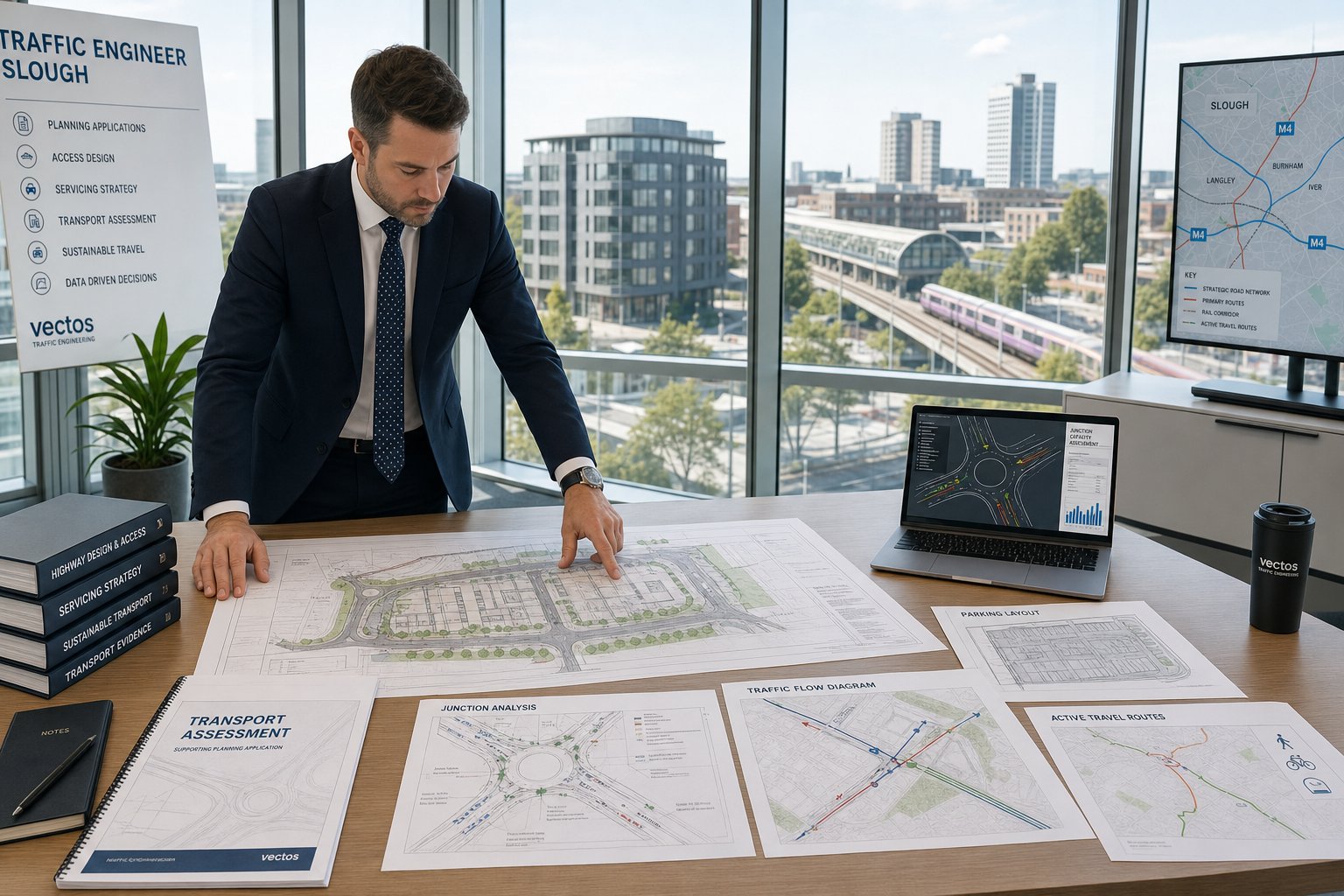
Planning in Slough can move quickly when an application is well prepared, and stall just as quickly when transport issues are left vague, generic, or unresolved. That’s why the role of a Traffic Engineer in Slough matters so much. For architects, planners, developers, lawyers, and land teams, transport isn’t a side note to tidy up later. It often becomes one of the main technical threads that determines whether a scheme feels credible to the local planning authority and highway officers.
Slough is not a place where copy-and-paste transport reports do well. Proximity to the M4, Heathrow-related movement, industrial and logistics pressure, busy commuter patterns, constrained urban streets, and growing expectations around active travel all shape how development proposals are judged. A modest change in access design, servicing strategy, parking mix, or trip assumptions can make the difference between a straightforward approval and a long round of objections.
In practice, our job is to translate development proposals into robust, policy-aware transport evidence. We assess likely impacts, identify risks early, and produce the reports and supporting technical work that planning teams need to keep applications moving. In this guide, we explain what a traffic engineer in Slough actually does, which reports are commonly required, what tends to cause planning friction, and how to choose support that is accurate, concise, and genuinely useful from pre-app through to decision.
Key Takeaways
- A Traffic Engineer in Slough ensures planning applications address specific local transport challenges linked to the M4 corridor, Heathrow movements, and dense urban streets.
- Early traffic engineering input helps refine access, parking, servicing, and sustainable travel measures to prevent planning delays and objections.
- Accurate, site-specific transport reports like Transport Statements, Assessments, and Travel Plans are critical for meeting Slough’s local authority expectations.
- Common transport concerns include highway safety, network capacity, parking balance, servicing practicality, and policy compliance, all of which must be clearly addressed.
- Choosing a local expert traffic engineer with relevant UK experience, responsiveness, and practical judgement increases the chance of smooth planning approvals.
- Providing detailed scheme information upfront enables tailored advice and more effective transport evidence for the planning process in Slough.
What A Traffic Engineer In Slough Does For Planning Applications

A traffic engineer supporting planning applications does far more than calculate vehicle movements. We look at how a proposal will function in the real network, how it aligns with local and national policy, and whether the transport case is strong enough to satisfy consultees.
At the start, we review the scheme basics: site location, surrounding highway conditions, nearby junctions, public transport links, walking and cycling opportunities, parking context, servicing requirements, and likely trip patterns. We then advise whether the development is likely to require a Transport Statement, a Transport Assessment, a Travel Plan, or more detailed technical inputs.
For Slough schemes, this usually includes checking proposals against local plan policies, parking standards, access expectations, and road safety considerations. We assess trip generation, trip distribution, servicing, refuse access, cycle storage, disabled parking, visibility splays, and whether the site layout works in practical terms, not just on paper.
Just as importantly, we help shape the proposal before issues harden into objections. That may mean adjusting an access point, refining the parking arrangement, testing a junction, or tightening assumptions in the report so the application stands up better under scrutiny. On more complex projects, we also coordinate with architects, planning consultants, flood engineers, and highways officers so the transport story remains consistent across the submission.
Why Slough Developments Need Location-Specific Transport Advice
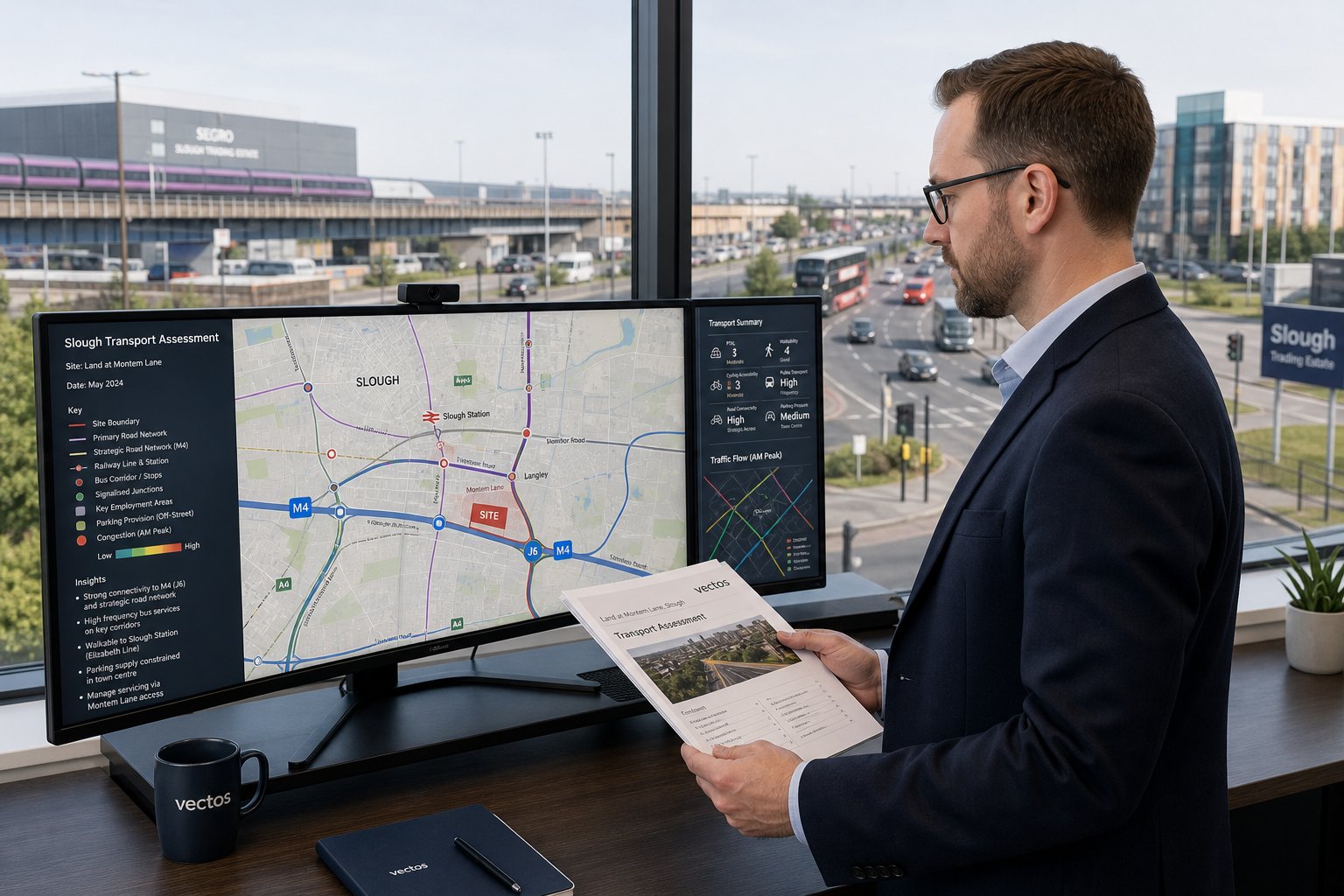
Slough has transport conditions that make local judgement essential. A generic report might describe a site as “accessible” or claim impacts are “not severe”, but that language means little unless it is tied to actual local roads, travel choices, congestion patterns, and planning expectations.
This is a borough shaped by strategic movement and local constraint at the same time. The M4 corridor, major employment areas, freight and warehouse activity, Heathrow influence, rail connectivity, bus corridors, and dense urban neighbourhoods all pull in different directions. Some sites perform well because they sit near strong public transport and walkable services. Others face pressure from existing parking stress, peak-hour queuing, or awkward servicing arrangements on constrained streets.
That’s why localised evidence matters. We need to understand whether nearby junctions are already sensitive, whether a proposed access sits on a road with speed or visibility concerns, whether on-street parking is likely to spill over, and whether the council will expect stronger sustainable travel measures. In that sense, a Traffic Engineer in Slough is not simply producing a report: we are interpreting a local planning and highway environment.
The same principle appears in other urban authorities too. Work undertaken by a Traffic Engineer In London: or a Traffic Engineer In Birmingham: also depends on understanding how local thresholds and officer expectations differ. In Slough, that local sensitivity is especially important because relatively small design changes can have a disproportionate effect on acceptability.
Common Projects That Require Traffic Engineering Input
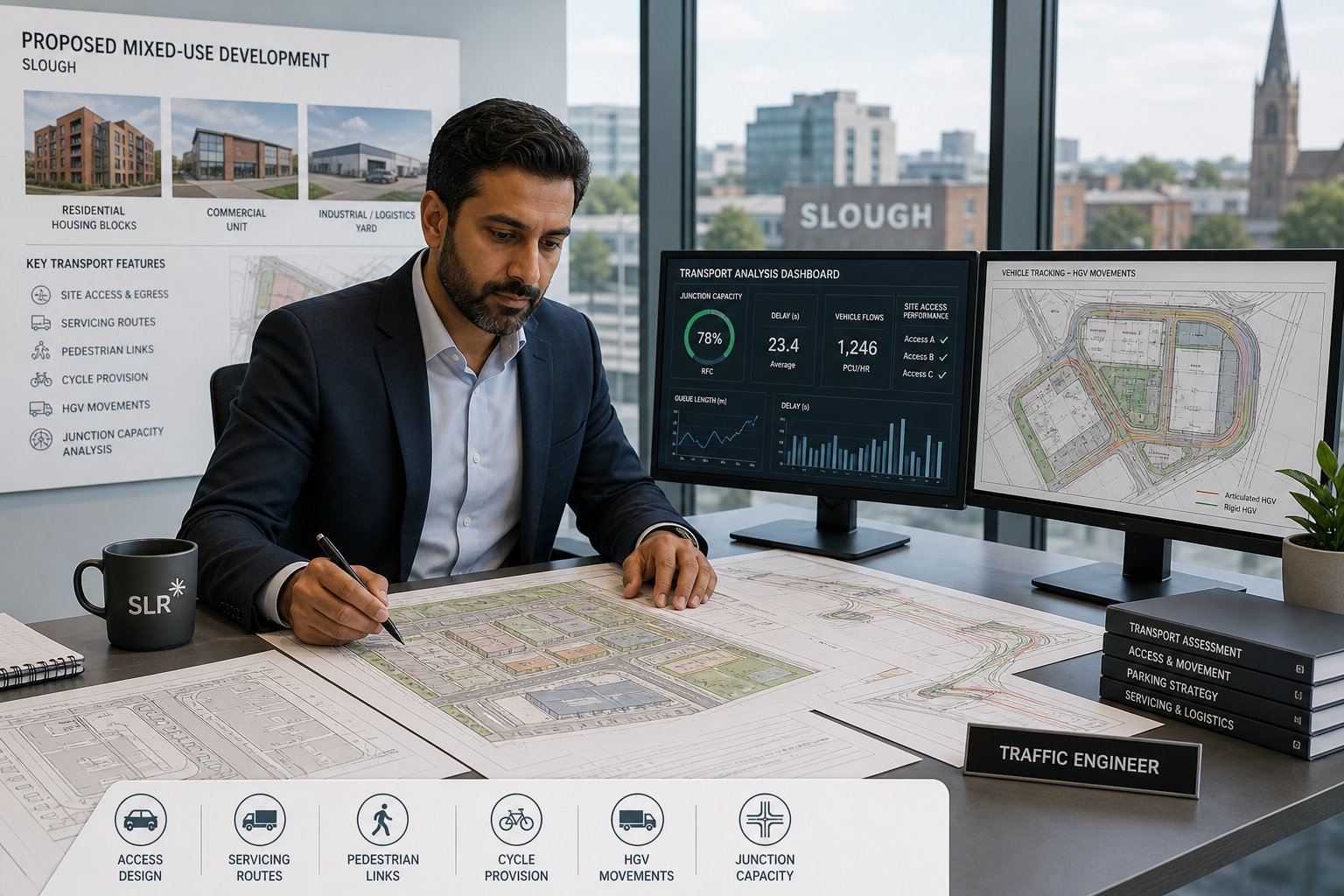
Not every planning application needs a lengthy transport document, but a wide range of schemes benefit from early traffic engineering input, especially where access, servicing, parking, road safety, or cumulative impact might become planning issues.
Residential, Mixed-Use, Commercial, And Industrial Schemes
Residential development is one of the most common triggers. Even smaller housing schemes can raise questions around access width, refuse vehicle tracking, visibility, parking ratios, cycle provision, and pedestrian connectivity. As site sizes grow, so does the expectation for a robust transport statement or full assessment.
Mixed-use schemes add another layer because the trip profile becomes more complex. A development with homes, retail, workspace, or leisure floorspace may spread demand across the day, but it also creates servicing, short-stay parking, and internal layout issues that need to be resolved properly.
Commercial and industrial proposals in Slough often attract close highway attention because employment land, warehousing, and logistics uses can generate significant van and HGV activity. In those cases, we usually assess routing, yard operation, servicing geometry, staff travel, and whether nearby junctions can comfortably accommodate the development.
Across the UK, that planning-led approach is similar to work handled by a Traffic Engineer In Manchester: or a Traffic Engineer In Leeds:, but the local evidence in Slough still needs to be site specific rather than borrowed from another authority.
Change Of Use, Redevelopment, And Expansion Proposals
A surprising number of transport issues arise on schemes that appear modest at first glance. A change of use from office to residential, a retail unit becoming a food-led use, an industrial site increasing floorspace, or a business extending operating hours can all alter traffic patterns materially.
Redevelopment proposals also require careful baseline thinking. If a site has historic lawful use, the obvious question is not only “what will the new scheme generate?” but also “what could happen under the existing consent?” That fallback comparison can be highly relevant when we’re demonstrating that the practical impact is acceptable.
Expansion schemes can be especially sensitive where access arrangements were never designed for a more intensive operation. Extra staff, more deliveries, later hours, and changing vehicle types often expose weaknesses in visibility, turning space, or parking layout. In those cases, early engineering input helps avoid the classic planning problem: a good commercial idea undermined by a poor transport explanation.
Transport Reports Commonly Needed In Slough
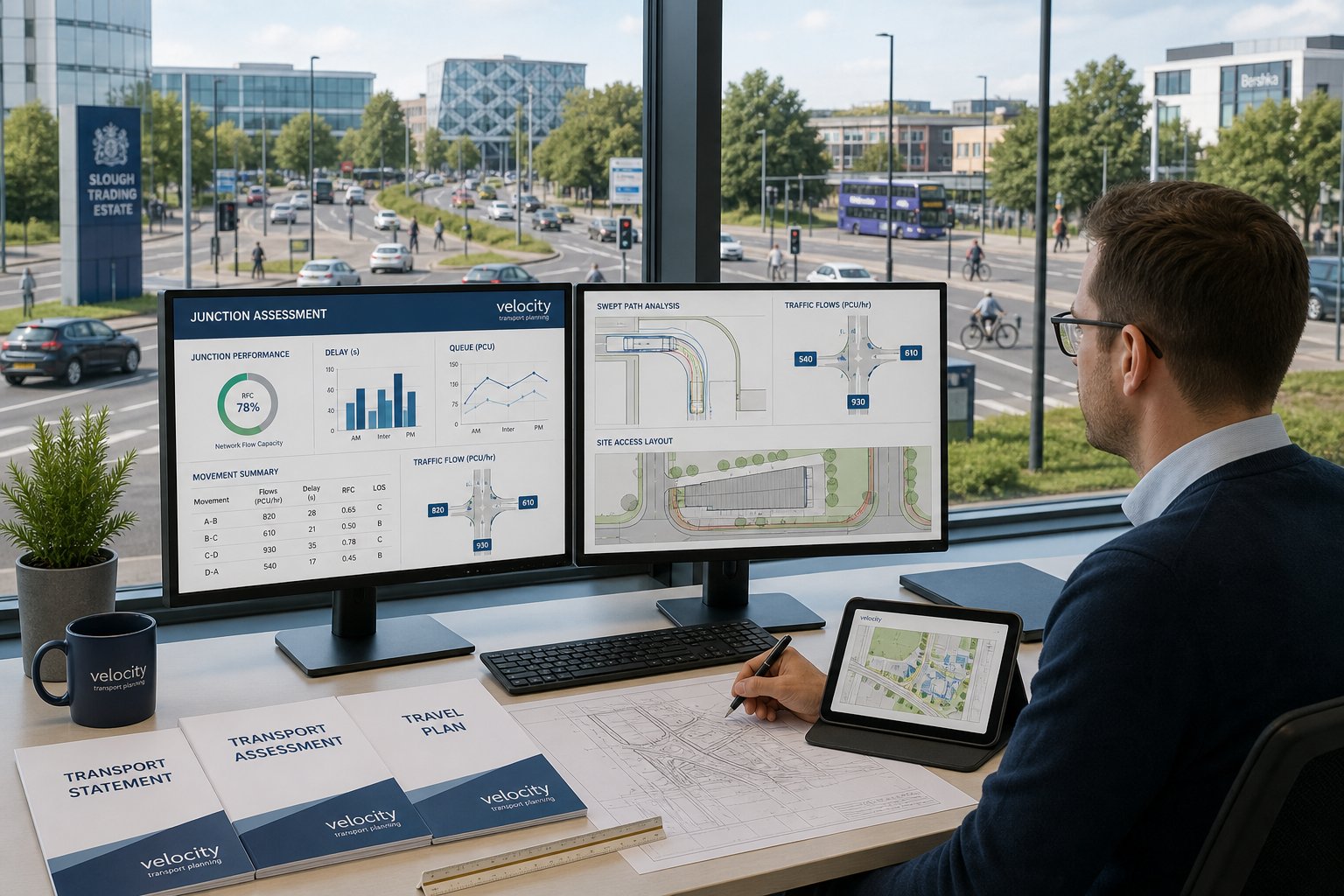
The right report depends on scale, site sensitivity, and likely transport effects. One of the most useful things we do early on is scope the level of assessment correctly. Too little evidence invites objections: too much can waste time and budget without improving the application.
Transport Statements, Transport Assessments, And Travel Plans
A Transport Statement is usually appropriate for smaller developments with limited transport impacts. It explains the site context, access arrangements, parking, servicing, local travel options, and why the effect on the network is expected to be modest. The best ones are concise, evidence-based, and clearly tied to the actual proposal.
A Transport Assessment is more detailed and is normally needed for larger or more sensitive schemes. Here we analyse trip generation, distribution, assignment, junction performance, sustainable travel opportunities, road safety, and cumulative impacts in a more formal way. If junction modelling is required, that sits within or alongside the TA.
A Travel Plan supports behaviour change. It sets out measures to encourage walking, cycling, public transport use, car sharing, and lower single-occupancy car demand. Councils increasingly expect these to be practical rather than generic, with targets, monitoring, and meaningful actions.
For teams wanting a broader overview of how these documents fit together, our work as Traffic Engineering Consultants: often involves helping clients decide not just what report is required, but what level of evidence will actually persuade officers.
Speed Surveys, Visibility Reviews, Swept Path Analysis, And Junction Assessments
These are the technical pieces that often sit behind the headline report. If a new or altered access is proposed, we may commission speed surveys to establish observed vehicle speeds and then test whether appropriate visibility splays can be achieved. On some sites, that one exercise determines whether the access is workable at all.
Visibility reviews look at geometry, boundary features, parking interference, gradients, and the realism of what a driver can actually see. They sound simple. They rarely are.
Swept path analysis checks whether the vehicles that need to use the site, refuse trucks, articulated deliveries, fire appliances, service vehicles, can enter, turn, load, and exit safely. A layout can look generous on an architect’s drawing and still fail operationally once a realistic vehicle is tracked through it.
Junction assessments test whether surrounding priority junctions, roundabouts, or signal-controlled nodes can operate acceptably with development traffic. That may involve industry-standard modelling, queue analysis, ratio-to-flow review, or practical operational judgement. On strategic or more technical jobs, methods used by a Birmingham Transport Consultant: or a Traffic Engineer In Bristol: are comparable in principle, but the assumptions must still reflect Slough conditions.
Key Planning And Highway Issues That Can Affect Approval
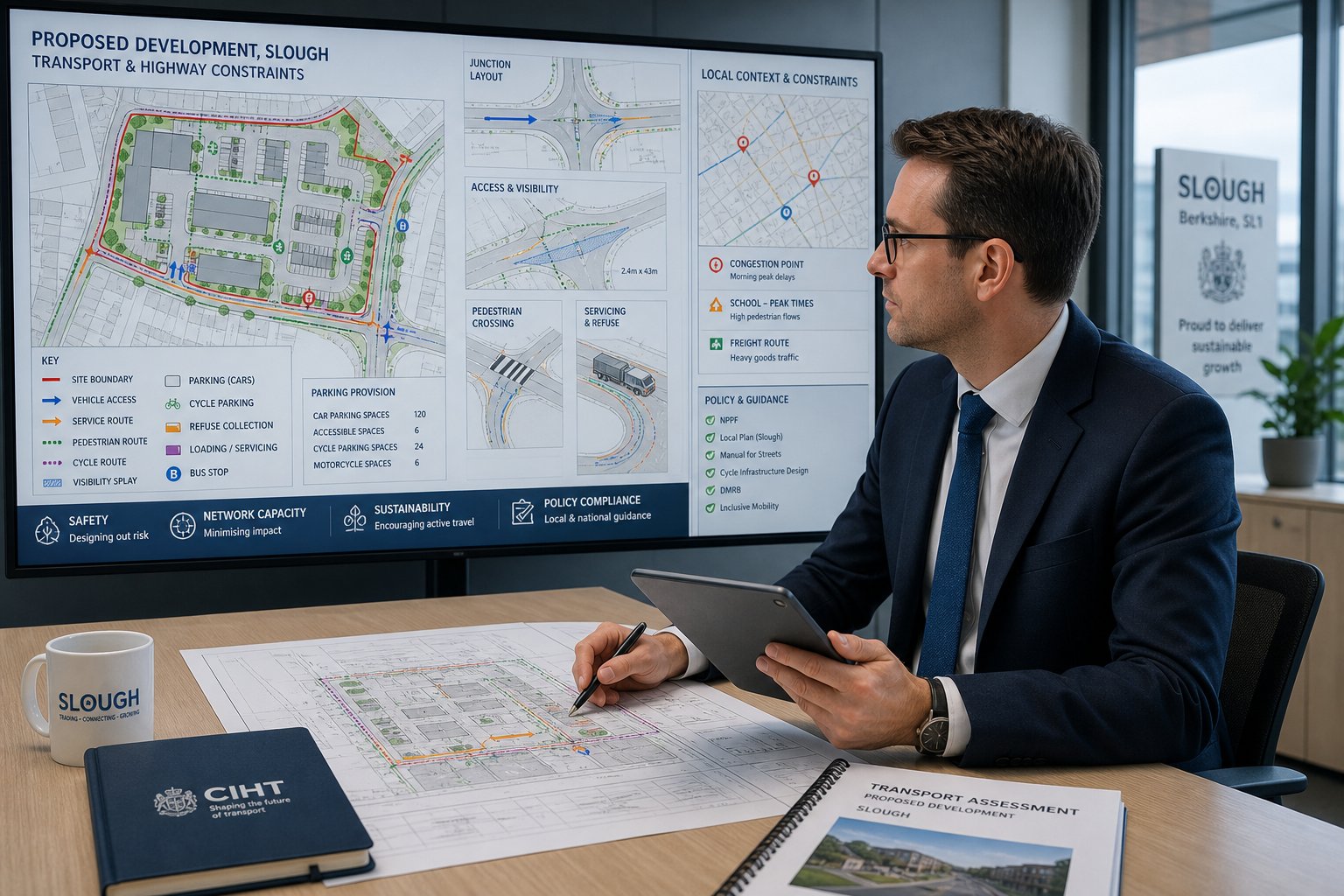
Most transport objections in planning are not mysterious. They usually come back to a fairly consistent set of concerns: safety, capacity, access quality, parking, servicing, and policy compliance.
Highway safety is often first. If visibility is substandard, speeds are high, the access geometry is weak, or vulnerable users are exposed to conflict, officers will have little appetite to support the scheme. Even where an issue looks solvable, planning teams need confidence that the fix is real and deliverable.
Network impact is another major area. A development doesn’t need to create gridlock to attract concern: it just needs to add pressure at the wrong place and the wrong time. Existing congestion, nearby schools, freight activity, constrained junctions, and cumulative development all matter. That is why trip assumptions and local junction selection must be realistic.
Parking can be surprisingly contentious too. Too little parking may create overspill and neighbour objection. Too much can conflict with sustainability policy or compromise site layout. The same goes for cycle parking: token provision is rarely enough now.
Servicing and refuse collection regularly trip schemes up. If delivery vehicles have to reverse excessively, wait on the highway, or perform awkward manoeuvres, the proposal may look unsafe or impractical.
And then there is policy narrative. A technically sound scheme can still struggle if the report does not clearly explain how it supports walking, cycling, public transport, and a balanced transport strategy. That explanatory layer matters just as much as the raw calculations.
How A Traffic Engineer Supports The Planning Process From Start To Decision
The strongest transport input usually starts before the application is submitted. Early involvement lets us identify risk while the design is still flexible, which is far cheaper than trying to repair transport problems after objections arrive.
Typically, we begin with a review of the scheme, planning context, and likely transport requirements. From there, we advise whether pre-application engagement is worthwhile, what surveys or data are needed, and which highway issues are likely to matter most. On some projects, that first stage alone reshapes the site plan in a useful way.
We then move into evidence gathering: site visits, access review, traffic counts if needed, speed data, collision history review, trip generation analysis, junction modelling, and parking or servicing assessment. Once the technical work is complete, we prepare the supporting reports in a form that planners, officers, and design teams can actually use.
But the process does not end at submission. We often respond to consultee comments, clarify assumptions, revise drawings, or provide supplementary notes where highways officers have asked follow-up questions. That back-and-forth is normal. What matters is that the response is measured, technically sound, and quick enough to avoid drift.
At ML Traffic, that practical responsiveness is central to how we work. Our focus is concise, accurate reporting with local-authority awareness, and that tends to matter just as much as technical skill when programmes are tight and planning decisions are moving.
What To Prepare Before Instructing A Traffic Engineer
A little preparation at the start saves a lot of time later. The more clearly a project team can define the scheme, the quicker we can advise on likely requirements and risks.
At minimum, we usually need a red line boundary plan, a draft site layout, proposed land uses, floorspace or unit numbers, access points, and any known changes to parking or servicing. If the scheme is operationally driven, for example logistics, industrial, roadside retail, or food-led use, we also need likely staff numbers, visitor patterns, delivery activity, and hours of operation.
Previous planning history is valuable. Earlier refusals, consultee comments, appeal decisions, and pre-app responses often reveal exactly where highway concerns sit. Ignoring that history is a good way to repeat avoidable mistakes.
It also helps to provide topographical constraints, nearby ownership limitations, collision concerns raised by neighbours, and any architectural assumptions that are fixed versus still negotiable. That allows us to distinguish between genuine technical barriers and issues that can be solved through small design adjustments.
For wider project teams comparing approaches across authorities, examples from a Traffic Engineer In Liverpool: can be useful for process benchmarking, but the evidence package for Slough still needs to respond to Slough’s own local standards, network sensitivities, and planning context.
In short, bring us the scheme as it really is, not the cleaned-up version you hope will sail through. Honest inputs make for better advice.
Choosing The Right Traffic Engineer In Slough
Not all transport support is equal, and most experienced planning teams know that already. The right consultant is not simply the cheapest or the one promising the fastest report. It is the one that understands how to produce evidence that is proportionate, technically credible, and aligned with the way local decisions are actually made.
We would look first for relevant UK planning experience: Transport Statements, Transport Assessments, Travel Plans, access reviews, swept path analysis, and junction modelling where required. Then we would test whether the engineer understands local authority expectations and can explain why a particular level of work is, or is not, necessary.
Professional standards matter too. Chartered status, ICE or CIHT membership, and a sound track record all help, but they are not the whole story. Good judgement is often what separates a useful report from a decorative one.
A strong traffic engineer in Slough should also be commercially aware. Developers, architects, and lawyers do not need ten pages of throat-clearing before the advice starts. They need clear risk identification, sensible scope, realistic timescales, and reports that support the wider planning strategy rather than sitting awkwardly beside it.
We also think responsiveness matters more than many people admit. Highways comments often arrive late and require quick, calm technical replies. If your consultant disappears once the report is issued, that creates avoidable exposure.
So the real question is simple: can they help move the application forward, not just produce paperwork? That is the standard worth using.
Conclusion
A well-prepared planning application in Slough needs transport input that is local, proportionate, and technically robust. Whether the scheme involves housing, commercial floorspace, industrial expansion, or a change of use, the transport case has to do more than exist, it has to answer the right questions in a way the council and highway authority can rely on.
That is where early involvement pays off. When transport issues are tested at the design stage, teams can refine access, parking, servicing, trip assumptions, and sustainable travel measures before they become formal objections. The result is usually a cleaner submission, fewer surprises, and a stronger route to approval.
For architects, planners, developers, surveyors, and legal teams, the value of a Slough-experienced consultant is not just in producing reports. It is in helping the entire application stand up better. And in a planning environment where delays are expensive, that practical difference matters.
Traffic Engineer in Slough: Frequently Asked Questions
What does a traffic engineer in Slough do for planning applications?
A traffic engineer in Slough assesses site-specific transport issues, reviews proposals against local policies, and produces evidence such as Transport Statements or Assessments. They address access, parking, servicing, and road safety to ensure applications align with council expectations and move through planning smoothly.
Why is localised transport advice important for developments in Slough?
Slough’s transport environment, shaped by M4 proximity, Heathrow traffic, and urban constraints, means generic reports often fail. Localised advice considers nearby junction performance, parking pressures, and public transport accessibility to create credible, site-specific transport evidence for planning approval.
Which types of projects typically require traffic engineering input in Slough?
Residential, mixed-use, commercial, and industrial developments often need traffic engineering support. Changes of use, redevelopments, or expansions that alter traffic patterns also require assessments to address access, servicing, parking, and safety – all vital for local planning consent.
What transport reports are commonly required for planning applications in Slough?
Small schemes generally need a Transport Statement outlining modest impacts, while larger or sensitive proposals require a detailed Transport Assessment. Travel Plans may be necessary to promote sustainable travel. Supporting technical work can include speed surveys, visibility checks, and junction assessments.
How does involving a traffic engineer early benefit a Slough planning application?
Early engagement allows identification and resolution of transport risks while designs are flexible. This proactive approach helps refine access, parking, and servicing arrangements before formal objections arise, resulting in a stronger, more compliant application and faster planning approval.
What should be prepared before instructing a traffic engineer in Slough?
Provide a clear scheme outline including red line boundary, site layout, land use, floorspace, access points, and operational details like staff numbers and delivery patterns. Previous planning feedback and known site constraints also help produce accurate, locally relevant transport advice.