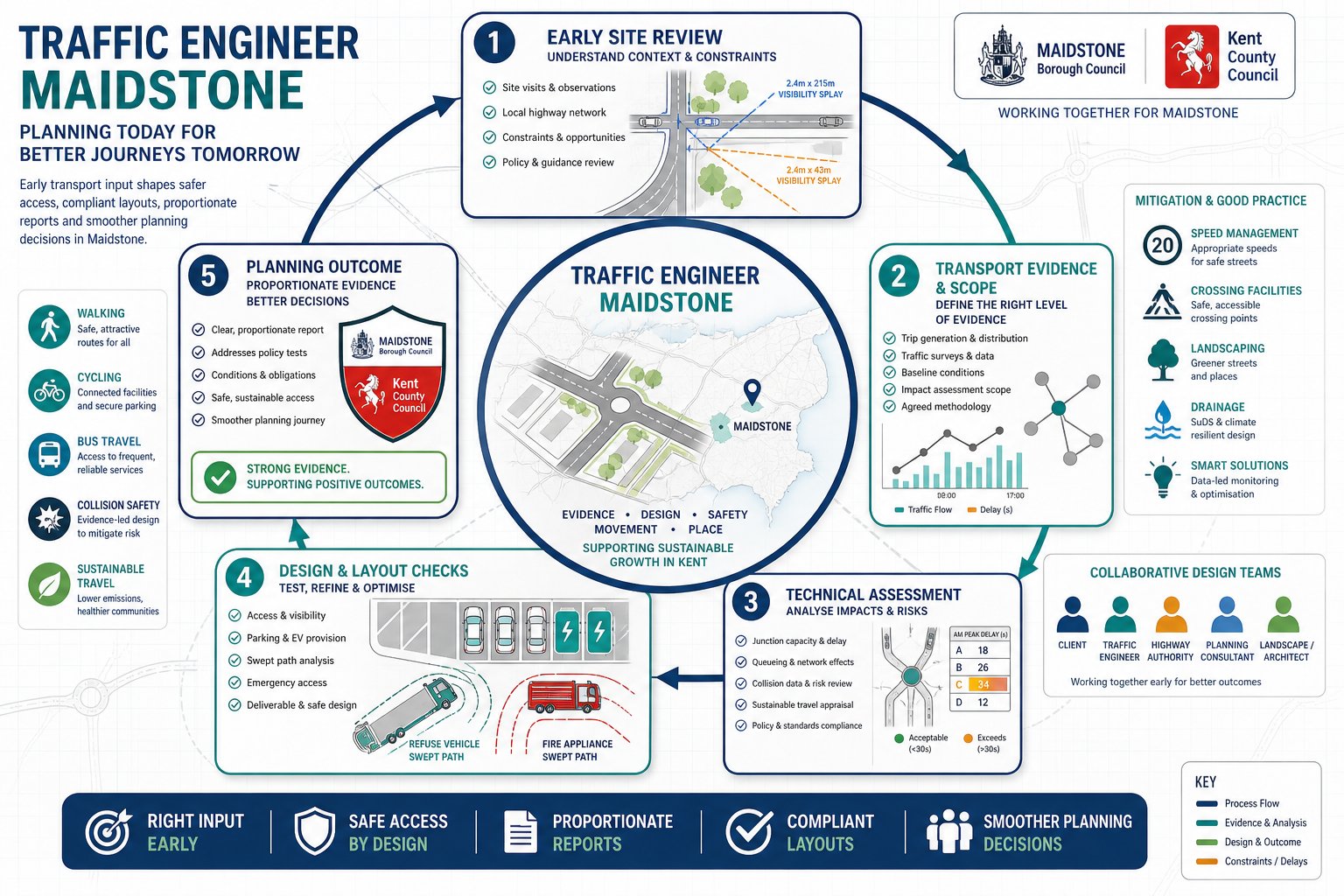
A planning application can look perfectly sound on paper and still stall because the highways case isn’t there. In Maidstone, that happens more often than many project teams expect. Access geometry, parking provision, junction pressure, visibility, servicing, sustainable travel, cumulative impact, these are the details that can turn a straightforward scheme into months of extra work.
That’s where a Traffic Engineer in Maidstone becomes central to the process, not peripheral to it. For architects, planners, surveyors, developers and legal teams, transport input is often what connects an attractive design to a planning submission that can actually withstand scrutiny from Maidstone Borough Council and Kent County Council.
We approach this work with a practical planning mindset. The job is not just to produce a report: it’s to identify risk early, shape a workable access strategy, and present evidence in a way officers can assess quickly and confidently. With over 30 years of transport planning experience behind our work, we know that concise, accurate reporting usually saves far more time than it costs.
In this guide, we set out what a traffic engineer does on Maidstone schemes, when a Transport Assessment or Transport Statement is likely to be needed, what typically delays applications, and how the right local advice can make a material difference to 2026 projects.
Key Takeaways
- A Traffic Engineer in Maidstone is essential early in planning projects to ensure access, parking, and junction details comply with local authority standards and avoid delays.
- Transport Assessments or Statements must be tailored to the scale and context of the development, reflecting Maidstone-specific conditions like local traffic pressures and sustainable travel options.
- Early coordination with architects and planners enables adjustments to site layouts that balance design ambition with highway safety and operational efficiency.
- Maidstone planning applications often require concise, credible transport reports addressing local policies, safety, and cumulative impact to satisfy both Maidstone Borough Council and Kent County Council.
- Choosing a traffic engineer with strong local knowledge and technical skills enhances the likelihood of a smooth planning process through clear communication and targeted, proportionate advice.
- Well-prepared Travel Plans and mitigation strategies can address highway capacity concerns while promoting sustainable travel, improving the overall success of Maidstone developments.
What A Traffic Engineer Does In Maidstone Planning Projects
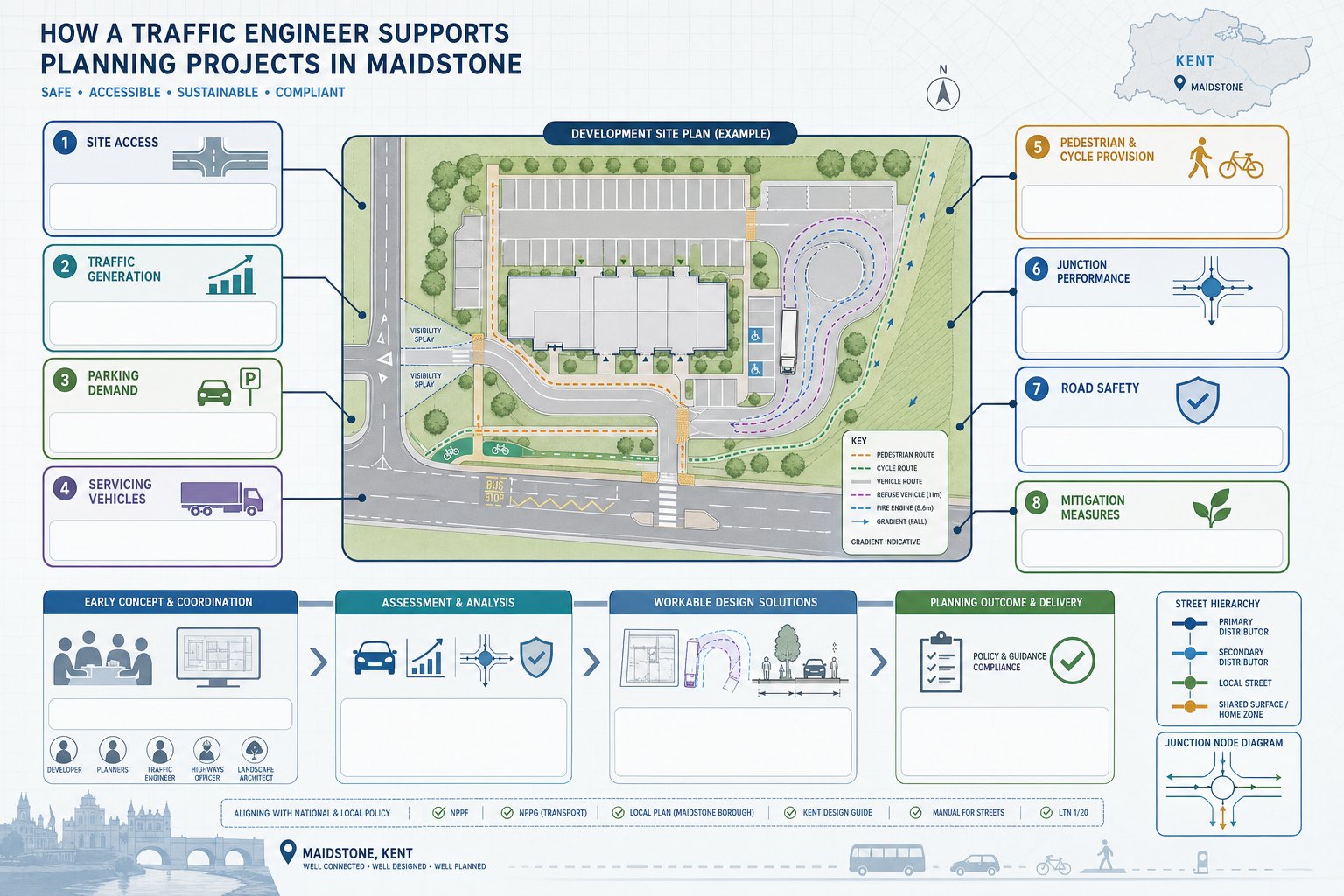
A traffic engineer in the Maidstone planning context looks at how a proposed development will interact with the transport network around it, and whether that interaction is acceptable, safe and policy-compliant. That sounds simple. In practice, it touches almost every part of site design.
We typically assess proposed access arrangements, likely traffic generation, parking demand, servicing movements, pedestrian connections, cycle provision and visibility. On larger schemes, we may also review nearby junction performance, routeing effects and whether mitigation is needed to keep the local network operating acceptably. For some projects, that means proving a development’s impact is limited. For others, it means identifying proportionate changes that make the scheme workable.
In Maidstone, this often includes reviewing site access widths, gradients, refuse vehicle tracking, emergency access, turning areas, and the relationship between a site and the surrounding street hierarchy. Safety matters just as much as capacity. Collision history, crossing demand, frontage activity and vehicle speeds can all influence the transport case.
The role is also highly collaborative. We coordinate with planning consultants, architects and project managers so transport advice feeds into the layout before positions harden. That early coordination matters. A minor adjustment to an access point or parking arrangement at concept stage is easy: after the full design team has signed off, it rarely is.
Across our wider work as Traffic Engineering Consultants: transport advisers, the same principle applies: good highways evidence is most useful when it shapes the scheme rather than simply defends it at the end.
Why Maidstone Developments Often Need Transport Input Early
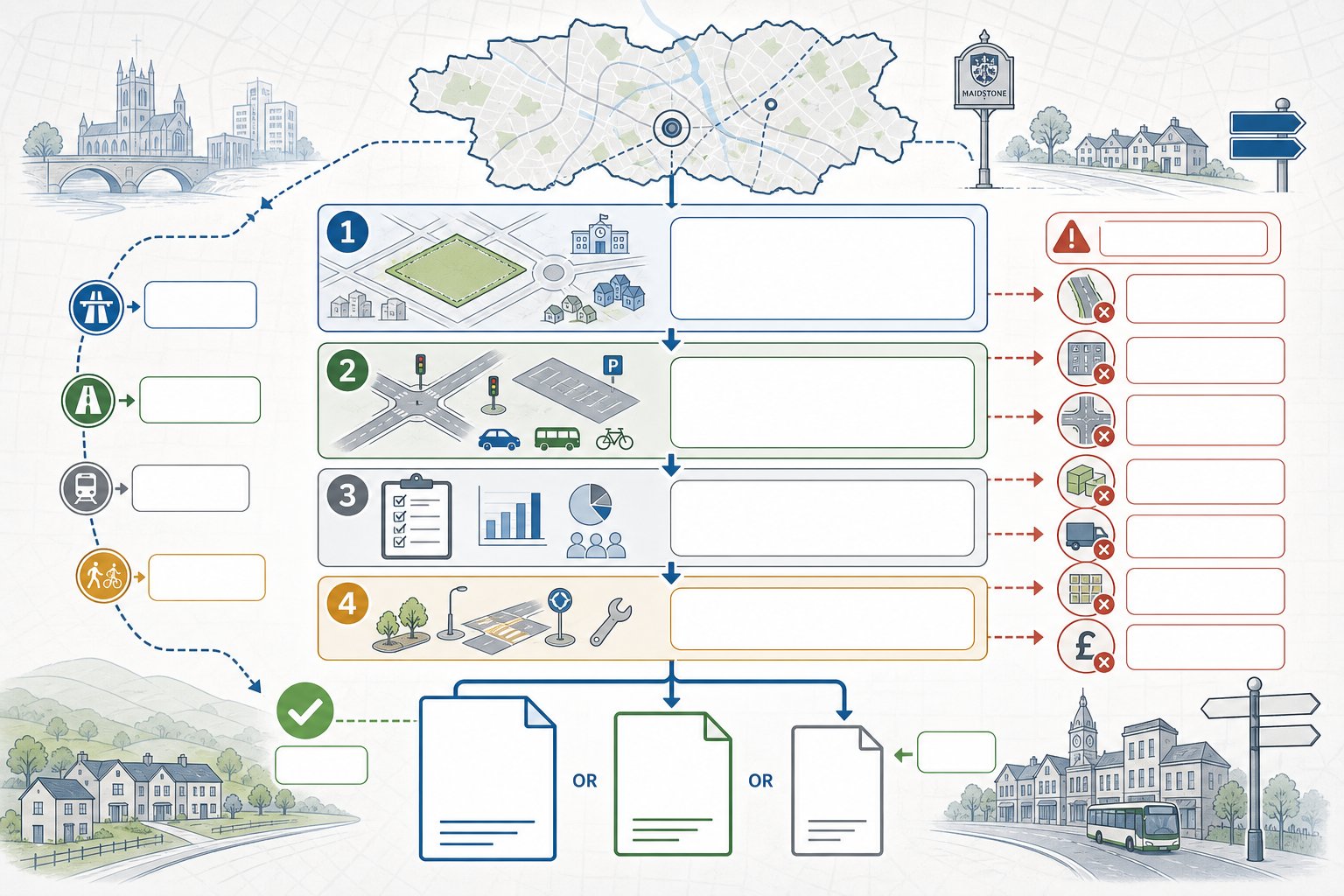
Transport issues are one of the most common reasons otherwise viable developments slow down. In Maidstone, early input is especially important because the right transport strategy depends on site context: urban centre, suburban edge, village location, constrained frontage, existing parking pressure, school proximity, or a road network already operating close to practical capacity.
If transport advice comes in late, the team may discover the access is sub-standard, the parking layout falls short of expectations, or the local junction evidence needs far more work than assumed. At that point, a redesign can affect density, unit mix, servicing arrangements and viability. We’ve seen projects lose weeks simply because no one tested the basics before a layout was fixed.
Early engagement helps define the likely submission pathway. Some schemes need a full Transport Assessment. Others are more suited to a concise Transport Statement or a focused technical note. That distinction is usually best discussed at pre-application stage or through early scoping with the authority and design team.
It also allows us to frame sensible assumptions from the start: study area, committed development review, baseline traffic conditions, parking accumulation, sustainable accessibility and likely mitigation. Those decisions shape everything that follows.
The same pattern appears on schemes in other cities too, whether in Traffic Engineer In London: major authority areas or more regionally focused projects. But Maidstone has its own mix of town centre pressures, strategic routes and local sensitivity, so copying a generic approach rarely works well.
Planning, Highways And Local Authority Context In Maidstone
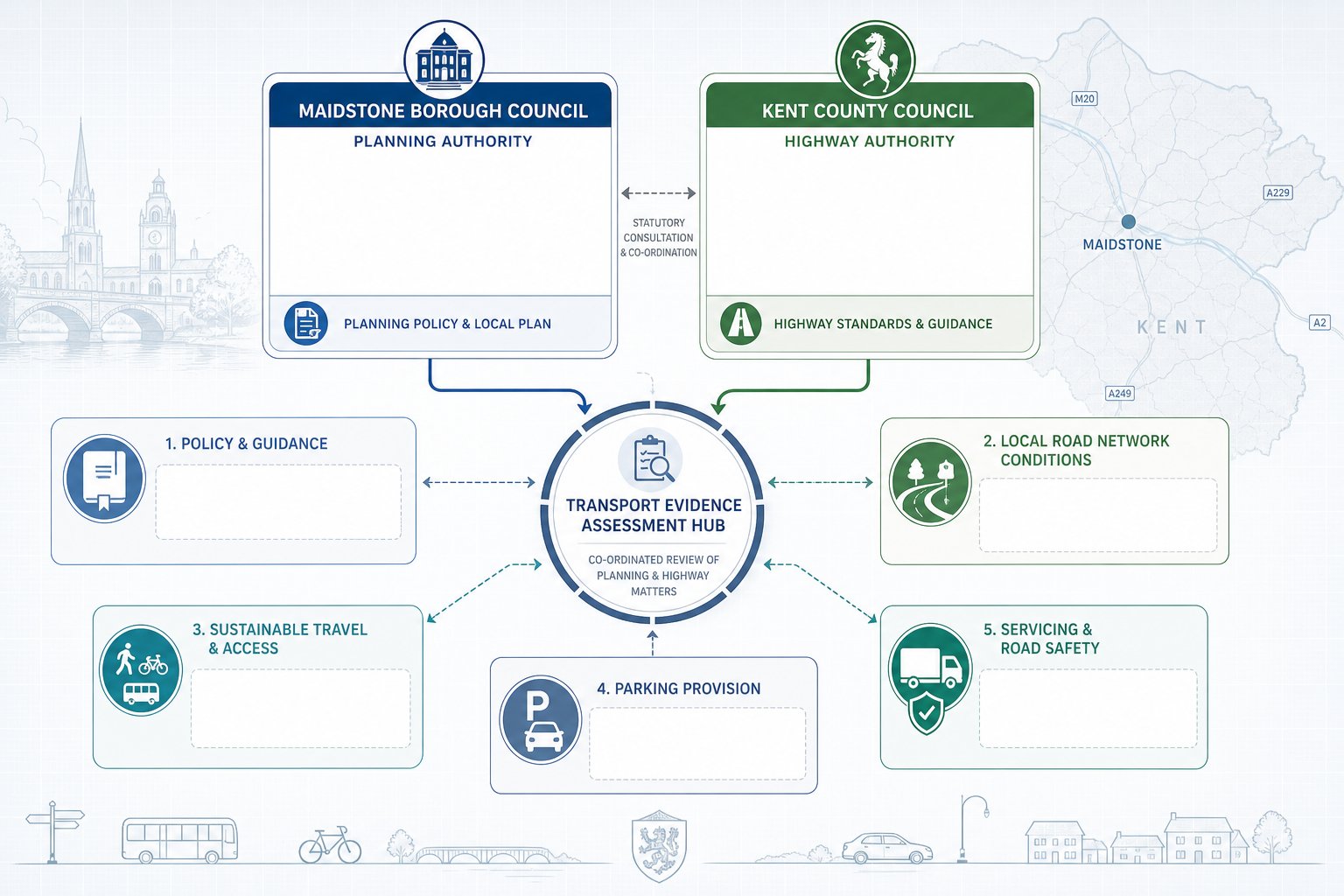
For most Maidstone planning applications, Maidstone Borough Council acts as the local planning authority, while Kent County Council typically comments as the local highway authority. That split matters because a transport submission has to satisfy both planning policy considerations and practical highway standards.
At a national level, transport work is usually framed by the National Planning Policy Framework and relevant Department for Transport guidance, particularly on whether the cumulative impact of development would be severe and whether opportunities for sustainable travel have been properly addressed. Locally, the picture becomes more specific: Kent design standards, parking expectations, road safety concerns, and borough-level policy context can all influence what supporting evidence is expected.
In real terms, this means a Maidstone application is not judged only on headline trip numbers. Officers will often want to understand whether the site is genuinely accessible by non-car modes, whether access design reflects local conditions, whether parking provision is realistic, and whether servicing can happen without creating conflict on the highway.
That local nuance is why experience matters. A technical report can be mathematically correct and still unpersuasive if it doesn’t address the authority’s likely concerns in a direct, readable way. We aim to keep reports concise, but never thin.
Our approach follows established principles used across Traffic Engineering and Transportation planning work: understand policy, understand the network, and tailor the level of evidence to the actual planning risk rather than producing paperwork for its own sake.
When A Transport Assessment Or Transport Statement Is Required
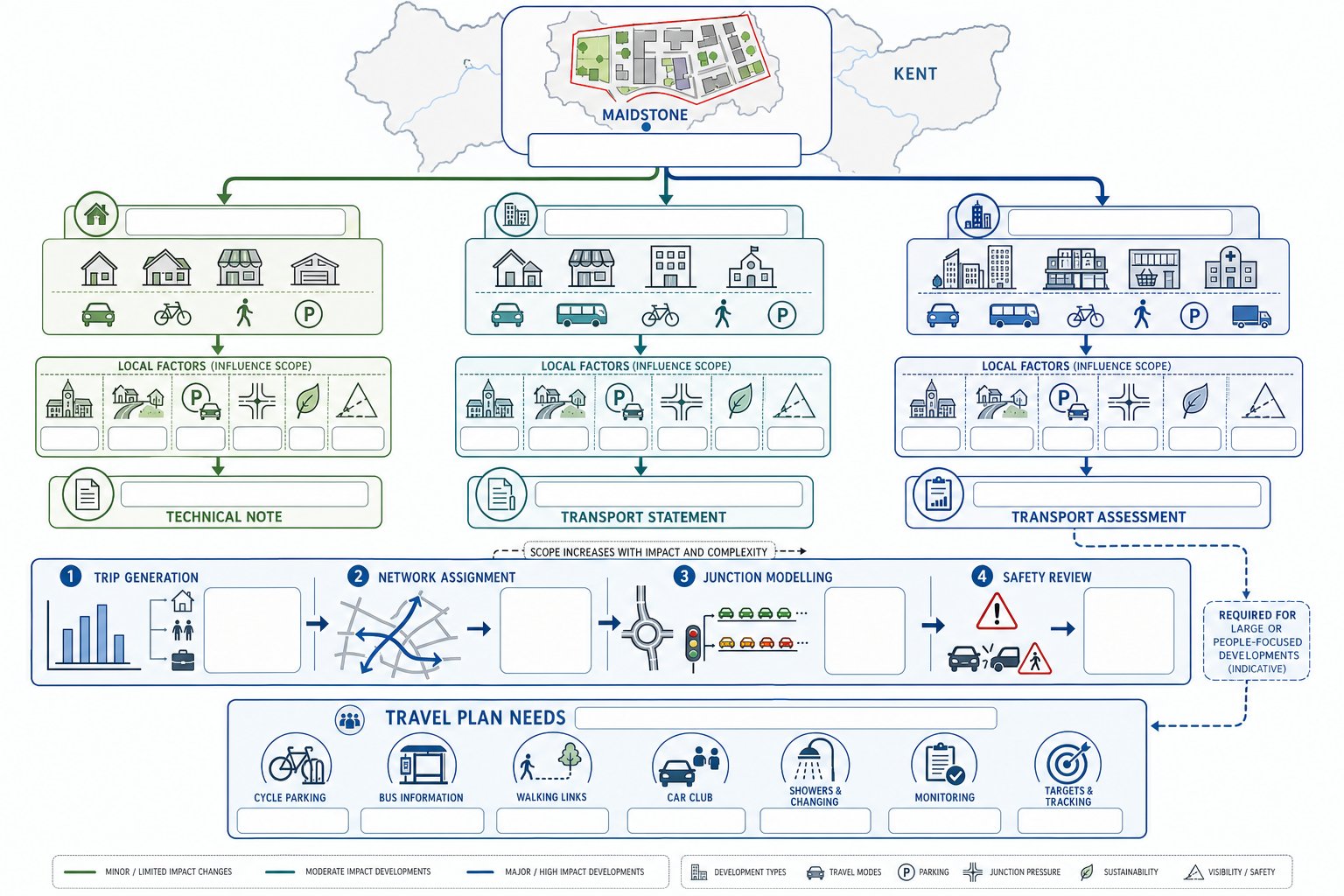
There is no single universal trigger that covers every site, because local context matters as much as scale. Still, the broad pattern is familiar. A full Transport Assessment (TA) is usually expected for larger or more traffic-intensive developments, major residential schemes, retail proposals, employment uses, education sites, and mixed-use developments with material network effects. A Transport Statement (TS) is more common for smaller schemes where transport effects are present but unlikely to be severe. For modest amendments or tightly defined issues, a technical note may be enough.
In Maidstone, the decision is often best agreed through early dialogue rather than assumption. Two sites with the same number of dwellings can require different levels of transport evidence depending on location, existing parking stress, nearby junction performance, visibility constraints or sustainability credentials. A town-centre infill site near frequent bus services may justify a different scope from an edge-of-settlement site reliant on the private car.
The key point is proportionality. Authorities generally want enough analysis to understand the likely effect of development, the safety implications, and any need for mitigation. They do not usually want a fifty-page report where a robust ten-page statement would do, but nor will they accept an overly light submission for a scheme with obvious transport consequences.
How Trip Generation And Traffic Impact Are Typically Assessed
Trip generation is commonly estimated using TRICS or comparable evidence sources, then checked against the character of the proposal and local land-use context. We consider not just vehicle trips but also pedestrian, cycle and public transport movements where relevant. For residential schemes, for example, the useful question is not simply “how many cars?” but “when, in which direction, and compared with what assumptions?”
Those trips are then assigned to the surrounding network using observed patterns, local knowledge and committed development data. Junction capacity may be tested using industry-standard tools such as PICADY, ARCADY or LINSIG, depending on junction type. We may also review queueing, delay and practical reserve capacity. On constrained sites, operational effects at the access itself can matter as much as off-site junction performance.
Safety review is another core element. Collision records, site lines, crossing conditions and road user conflict help establish whether a proposal introduces or worsens identifiable risk. Cumulative impact must also be considered, especially where nearby schemes are already committed.
When A Travel Plan May Also Be Needed
A Travel Plan is often required where a development is large enough, sensitive enough or sufficiently people-focused that travel behaviour can realistically be influenced. Schools, offices, large residential developments and mixed-use schemes are common examples. Sometimes the requirement is for a full Travel Plan: sometimes a Framework Travel Plan is accepted at application stage, with fuller detail secured later.
The aim is practical rather than theoretical. A credible Travel Plan sets out measures that support sustainable travel choices: cycle parking, bus information, welcome packs, car club measures, pedestrian links, shower facilities, monitoring arrangements and named responsibility for delivery. It should also include targets and review mechanisms.
Done properly, a Travel Plan can help address residual concerns where highway capacity is tight but the site has realistic sustainable travel potential. Done badly, it reads like a copy-and-paste appendix and convinces nobody.
Common Reports Prepared For Maidstone Planning Applications
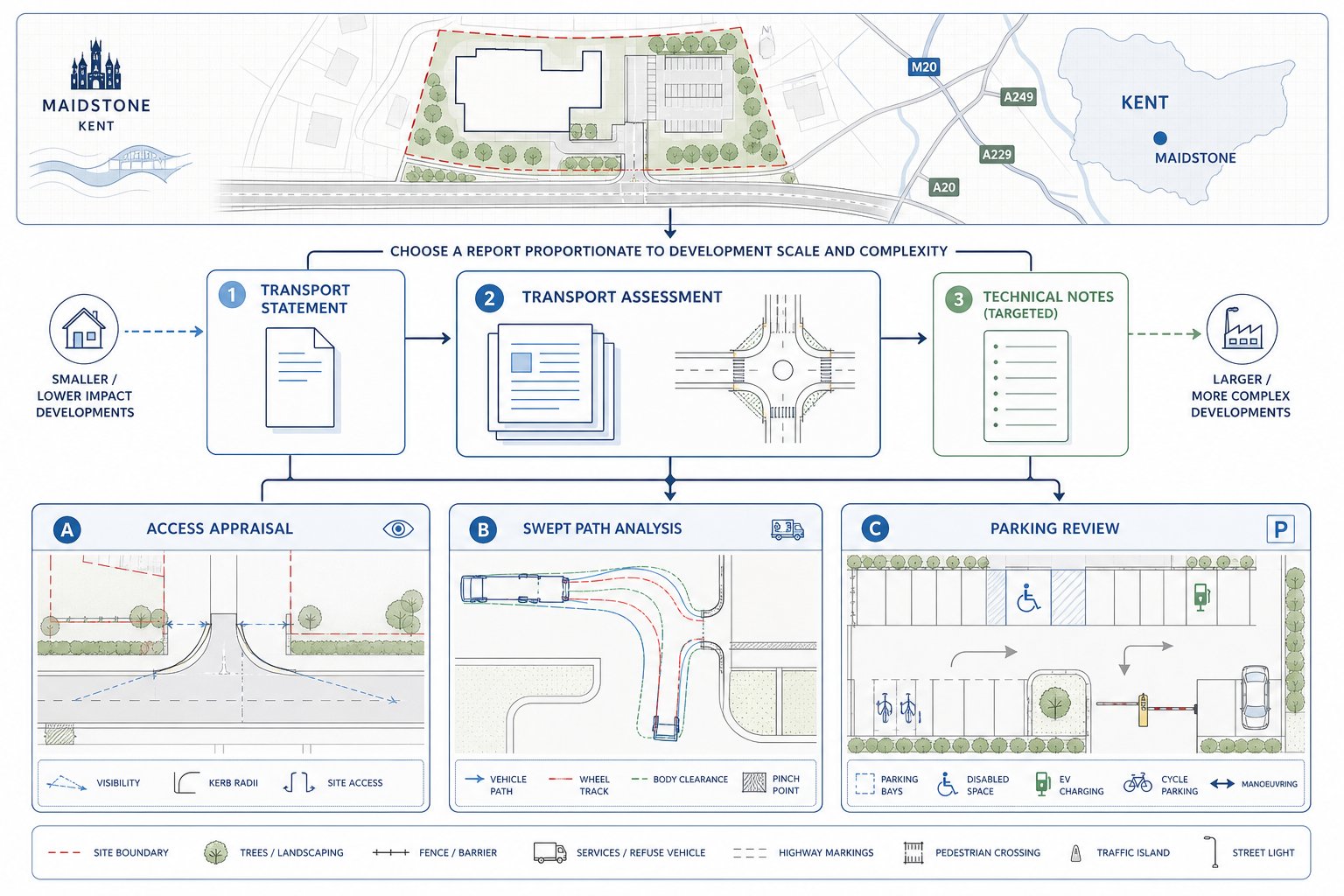
The right transport submission depends on the site, the scale of development and the authority’s likely concerns. In Maidstone, we commonly prepare Transport Statements, Transport Assessments, Travel Plans, access appraisals, swept path drawings, parking reviews and targeted technical notes responding to officer comments.
Some reports are standalone. Others work together. A planning application for a modest residential site may need a Transport Statement plus vehicle tracking and a parking review. A more substantial mixed-use scheme might require a detailed TA, Framework Travel Plan, junction modelling outputs and mitigation sketches. The skill lies in knowing what is enough, and what is unnecessary.
A concise report is often stronger than a bulky one if it answers the actual questions being asked. Equally, a report that avoids difficult issues rarely survives review for long.
Transport Statements, Transport Assessments And Technical Notes
A Transport Statement is usually the proportionate choice for smaller schemes. It tends to cover accessibility, existing conditions, access arrangements, trip generation, parking, servicing and a reasoned view on likely transport effects. It is not “lightweight” in the casual sense: it still needs to be evidence-based and policy-aware.
A Transport Assessment goes further. We would usually include broader baseline review, multi-junction impact testing, committed development analysis, mitigation strategy, sustainable travel review and, where needed, appendices with survey data and model outputs. For major applications, this is often the document that carries much of the negotiation with highway officers.
A technical note is more focused. It may respond to a single highways comment, test a revised layout, update trip rates, or clarify why a particular junction does not need separate modelling. These notes are often crucial in live applications because they allow proportionate updates without reopening the whole submission.
Work on schemes beyond Kent, including Traffic Engineer In Manchester: comparable planning support, reinforces the same lesson: targeted technical responses often resolve objections faster than broad, defensive rewrites.
Access Appraisals, Swept Path Analysis And Parking Reviews
Access appraisals focus on whether vehicles can enter and leave safely and conveniently. That includes visibility splays, carriageway width, junction spacing, radii, gradients and the relationship between the proposed access and the existing highway. On some sites, a seemingly minor boundary wall, tree line or change in level can become the key issue.
Swept path analysis tests whether the vehicles that need to use the site can actually do so. Refuse vehicles, delivery vans, fire appliances and larger service vehicles all have different turning requirements. Tracking drawings can reveal pinch points, overrun risk, reversing problems or conflicts with parked cars long before they appear on site.
Parking reviews are equally important. We assess quantity, layout efficiency, disabled bays, EV charging provision, cycle parking and likely operational realism. A plan can technically meet a numerical standard and still fail in practice if manoeuvring is awkward or servicing blocks spaces.
We apply the same disciplined review methods used on Traffic Engineer In Birmingham: and other urban schemes, but always against Maidstone’s local context rather than a generic template.
Key Issues That Can Delay A Planning Application
Most transport-related delays are avoidable. They usually stem from timing, scope or credibility.
One frequent problem is a submission that is simply too thin. If a scheme clearly generates movement but no TA or TS is provided, officers are likely to ask for more information, and the timetable slips immediately. A close cousin to that issue is the report that exists, but underestimates trip generation, excludes sensitive junctions from the study area, or relies on assumptions that don’t reflect local conditions.
Access design causes another set of delays. Inadequate visibility, awkward geometry, insufficient turning space, poor pedestrian priority or conflict between servicing and parking can all trigger concern. Sometimes the transport issue is not off-site at all: it is entirely within the red line boundary.
Parking is a quieter but very common source of friction. Under-provision, poor disabled access, lack of cycle storage, weak EV provision or layouts that are technically compliant but operationally poor can all lead to requests for revision.
Then there is process. If mitigation is needed but not discussed early, negotiations can drag on. If a Travel Plan obligation is likely, waiting until late-stage comments to start drafting it is rarely efficient. And where cumulative impact matters, missing nearby committed developments can undermine confidence in the whole submission.
We often find that projects move faster when teams borrow lessons from comparable authority work, whether that is Traffic Engineer In Leeds: urban infill experience or edge-of-centre access strategies elsewhere. Not because Maidstone is the same, but because the planning risks are recognisable.
How A Traffic Engineer Supports Architects, Planners And Developers
The best transport input starts before the report stage. At feasibility level, we help test whether a site can be accessed safely, whether a concept layout is likely to satisfy highway requirements, and whether the development quantum is realistic once parking, servicing and movement are taken seriously. That can influence land value, massing and even whether an acquisition proceeds.
For architects, our role is often to resolve tension between design ambition and highway practicality. A cleaner frontage may conflict with refuse tracking. A strong courtyard layout may weaken access efficiency. A parking court may meet numbers but create poor turning conditions. These are solvable problems when identified early.
For planning consultants and town planners, we provide the evidence base that supports statements on accessibility, transport effects and mitigation. That includes pre-application input, scoping advice, draft application reviews and responses to officer comments. For developers, speed and clarity matter just as much as technical accuracy. A concise report with a clear position usually helps decisions move along.
We also support lawyers, appeal teams and expert witnesses where transport evidence becomes contested. In those cases, the value is not only in analysis but in explaining it plainly. Highway officers, planning committees and inspectors do not reward jargon for its own sake.
That practical, cross-discipline role is central to our wider work, whether on Maidstone schemes or projects comparable to Traffic Engineer In Bristol: support where local thresholds and officer expectations materially shape the submission strategy.
Choosing The Right Traffic Engineer For A Maidstone Site
Not every transport consultant is the right fit for every site. For Maidstone projects, we’d look first at local planning fluency. Does the consultant understand how Maidstone Borough Council and Kent County Council typically approach transport matters? Do they know when a concise note is likely to be enough and when deeper modelling is unavoidable? Local familiarity does not replace technical skill, but it often improves judgement.
Second, look at relevant scheme experience. A consultant who mainly handles strategic employment sites may not be the best fit for a constrained town-centre residential proposal, and vice versa. Similar scale, similar land use and similar access constraints matter more than a long but generic project list.
Third, check technical capability. The team should be comfortable with TRICS analysis, junction modelling where needed, swept path review, parking assessment, collision analysis and current policy guidance. But software alone is not the differentiator. The real test is whether they can translate technical work into a planning case that officers can follow.
Communication is often the deciding factor. Good consultants explain risk early, avoid drama, and write clearly enough that both technical officers and non-technical stakeholders understand the argument. That tends to reduce friction across the whole team.
We’d say the same when comparing work in other regions, including Traffic Engineer In Liverpool: planning contexts: local insight matters most when paired with concise, defensible reporting and realistic advice.
Conclusion
For 2026 Maidstone projects, transport input is rarely a box-ticking exercise. It influences site layout, planning risk, programme and, in some cases, whether a development is likely to succeed at all.
A well-chosen traffic engineer helps teams answer the questions authorities actually care about: can the site be accessed safely, will the network operate acceptably, is parking realistic, are sustainable modes properly considered, and is any mitigation proportionate and deliverable? When those points are addressed early, applications tend to move more smoothly.
Our view is simple: the strongest Maidstone planning submissions are usually the ones where transport advice starts at concept stage, stays practical throughout, and is tailored to local authority expectations rather than lifted from a generic template. That approach reduces avoidable delay and gives project teams a clearer route through planning.
Frequently Asked Questions About Traffic Engineering in Maidstone
What role does a traffic engineer play in Maidstone planning projects?
A traffic engineer in Maidstone assesses how developments impact local transport networks, including access, parking, junction capacity, and safety. They help design workable access strategies and prepare transport reports that satisfy Maidstone Borough Council and Kent County Council requirements.
When is a Transport Assessment or Transport Statement needed for Maidstone developments?
Larger or traffic-intensive schemes typically require a Transport Assessment, while smaller developments often need a Transport Statement. The specific requirement is usually determined early through pre-application discussions with Kent County Council and Maidstone Borough Council, considering site context and traffic impact.
How does early transport input benefit development projects in Maidstone?
Early transport advice helps identify risks, shape access and parking layouts, and define the scope of necessary transport evidence. This prevents costly delays caused by sub-standard access or underestimated trip generation, enabling smoother planning through engagement with highways and planning officers.
What common transport reports support planning applications in Maidstone?
Common reports include Transport Statements, Transport Assessments, Travel Plans, technical notes, access appraisals, swept path analyses, and parking reviews. These documents assess traffic impact, safety, parking provision, and mitigation measures tailored to Maidstone’s local context and standards.
How do traffic engineers assess trip generation and traffic impact for Maidstone developments?
They use TRICS or similar databases to estimate vehicle and sustainable travel trips, model junction capacities with software like PICADY or ARCADY, and review safety data and cumulative impacts. This comprehensive approach ensures developments comply with national and local transport policies.
What should developers consider when choosing a traffic engineer for a Maidstone site?
Developers should select engineers with local experience in Maidstone and Kent policies, proven work on similar scale and land use projects, strong technical skills in modelling and analysis, and clear communication abilities that facilitate understanding among both technical officers and non-technical stakeholders.