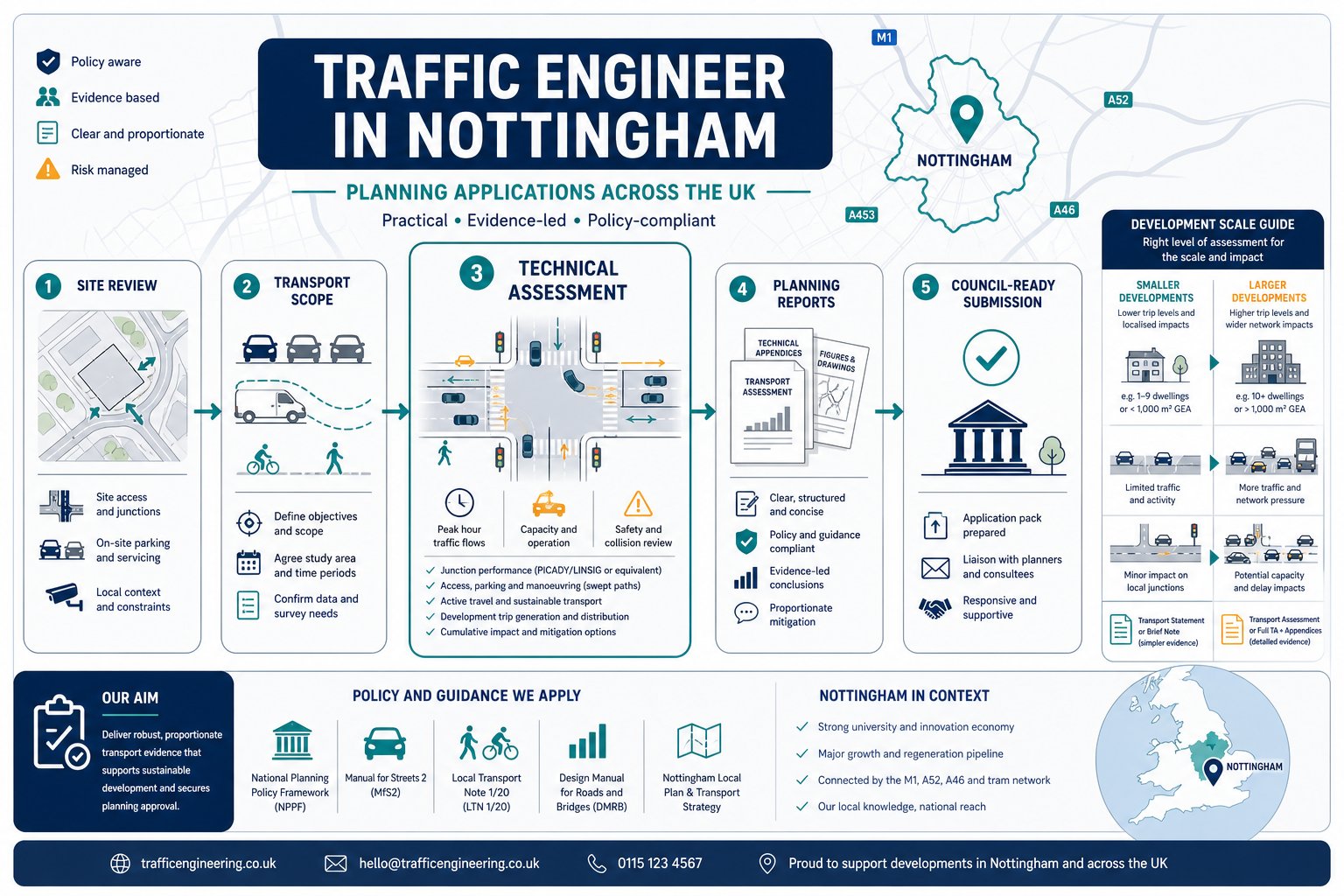
A planning application can look perfectly sound on paper and still stall the moment transport questions land on the case officer’s desk. Will the access work safely? Is parking realistic? Can servicing happen without blocking the street? Could nearby junctions cope at peak times? In Nottingham, those questions come up early and often, especially on schemes that intensify land use, alter access, or sit near sensitive parts of the network.
That is where a Traffic Engineer in Nottingham becomes central to the planning process. We help turn transport risk into clear evidence: assessing highway impact, reviewing access and layout proposals, advising on parking and servicing, and producing the reports local authorities expect to see. For architects, planners, developers, surveyors, and legal teams, that support is rarely just a box-ticking exercise. It can shape site layout, strengthen negotiation with the council, and reduce expensive redesign later.
In 2026, that role is even more important. Authorities want concise, policy-aware submissions backed by realistic assumptions and local context. A transport document that is technically correct but badly scoped can still delay validation or trigger avoidable objections. The aim is simple: get the right level of reporting, at the right time, with findings that fit Nottingham’s planning and highway environment. The sections below set out how that works in practice, what documents are usually required, and what to look for when appointing transport support.
Key Takeaways
- A Traffic Engineer in Nottingham is essential for translating transport risks into clear, credible evidence that supports planning applications effectively.
- Early involvement of a traffic engineer helps identify and resolve transport-related design issues, reducing delays and costly redesigns.
- Transport submissions must be tailored to Nottingham’s local policies, highway standards, and site-specific conditions to avoid objections and facilitate approval.
- Common transport documents include Transport Statements and Transport Assessments, chosen based on the scale and impact of the development.
- Assessments focus on safe access, realistic parking, servicing logistics, and overall highway impact with a goal of practical, proportionate reporting.
- Choosing a Nottingham traffic engineer with local planning experience and clear, concise reporting skills ensures faster, more accurate planning outcomes.
What A Traffic Engineer In Nottingham Does For Planning And Development
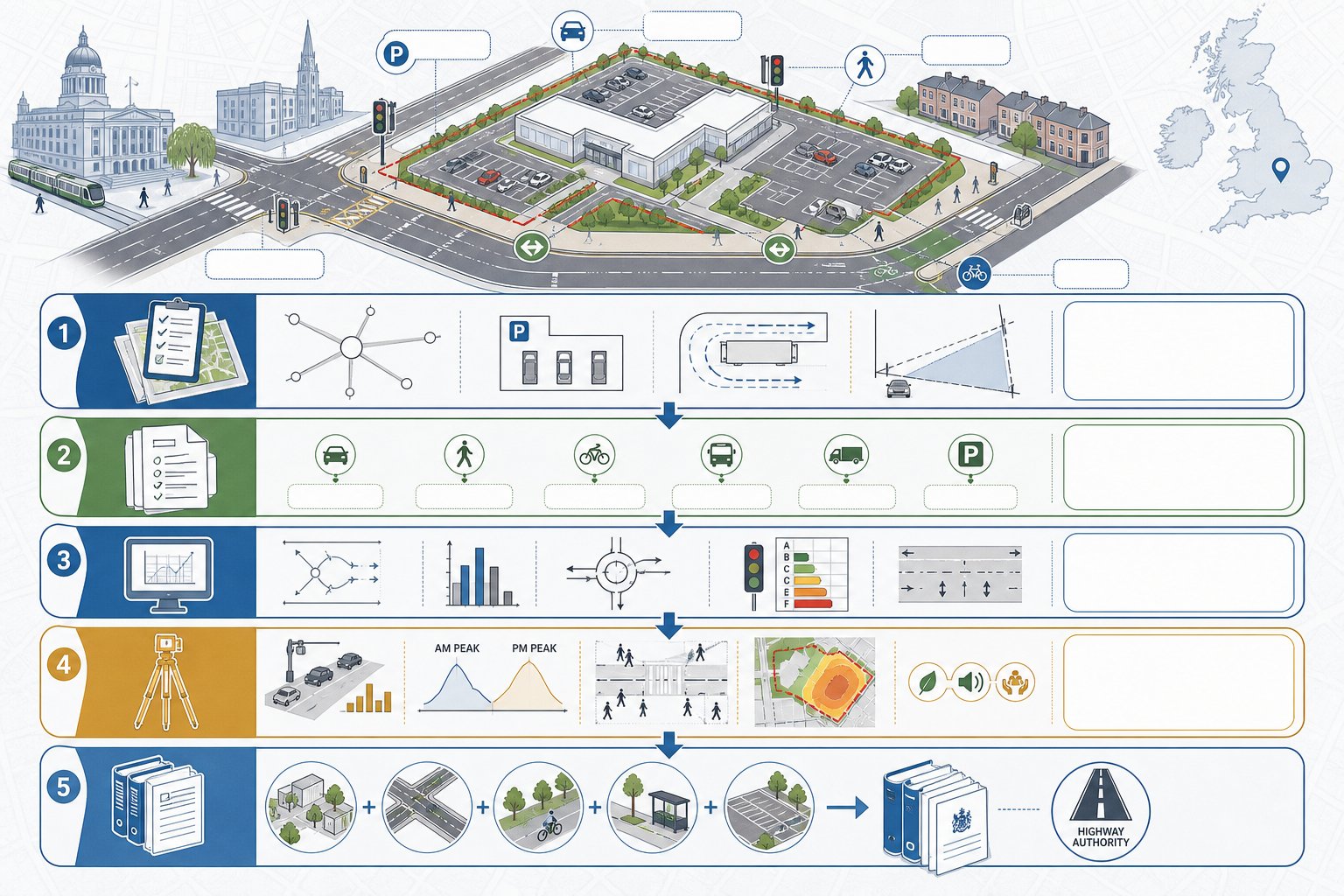
A traffic engineer working on planning and development sits at the point where design ambition meets real-world highway operation. In practical terms, we assess how a proposed development will interact with the surrounding network, then present that evidence in a form a planning officer, highway authority, and design team can actually use.
That usually starts with reviewing the site and proposal in detail: existing access arrangements, nearby junctions, parking conditions, servicing constraints, pedestrian connections, cycling provision, and likely trip generation. From there, we advise whether the scheme is likely to need a Transport Statement, a full Transport Assessment, a Travel Plan, swept path analysis, junction capacity work, or shorter technical notes to support particular points.
The role is broader than many teams expect. We often comment on site layout before an application is submitted, helping avoid design choices that later create transport objections. We may test visibility splays, review tracking for refuse or delivery vehicles, check parking accumulation, or consider whether turning can happen on-site safely. On larger jobs, we coordinate traffic surveys, analyse peak-hour movement patterns, and assess cumulative impact.
There is also a strategic side. Good transport advice means understanding how planning policy, local thresholds, and highway standards fit together. That is why experienced Traffic Engineering Consultants: What do more than produce calculations. We help teams frame a planning case that is technically credible and proportionate to the scheme.
Why Nottingham Developments Need Early Transport Input
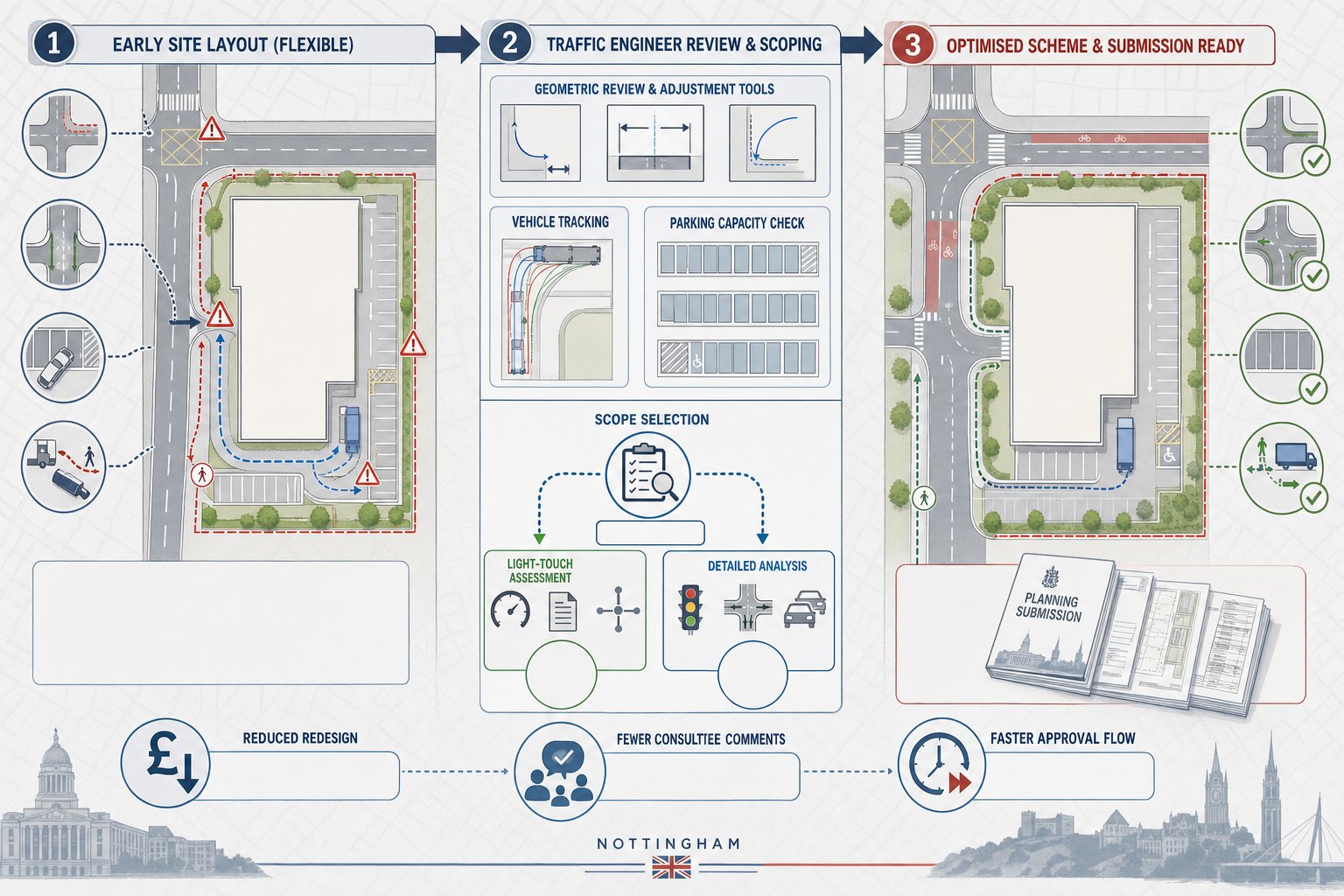
Transport input is most valuable before the planning pack is assembled, not after objections arrive. We say that because many transport issues are design issues in disguise. If the access is too tight, the parking arrangement is awkward, or servicing depends on unrealistic manoeuvres, the fix is rarely a better paragraph in a report. It usually means changing the layout.
Early review lets us identify problems while the scheme is still flexible. That might mean spotting that a proposed access sits too close to a junction, that the number of spaces is likely to trigger challenge, or that vehicle tracking will clash with pedestrian desire lines. On urban sites around Nottingham, even small geometry changes can make a submission much more robust.
It also helps with scope. Some schemes only need a focused statement and a few supporting notes: others need detailed analysis because they create meaningful new traffic, alter priority arrangements, or affect established parking patterns. Getting that call right at the start saves time and avoids over- or under-reporting.
We often find that early transport advice pays for itself by reducing redesign, limiting back-and-forth with consultees, and giving the wider team confidence in the submission strategy. The same pattern appears in other cities too, whether on a Traffic Engineer In London: project with dense urban constraints or a more suburban East Midlands site. The principle is consistent: front-load the transport thinking, and planning usually moves more cleanly.
Planning Context In Nottingham And The Wider East Midlands
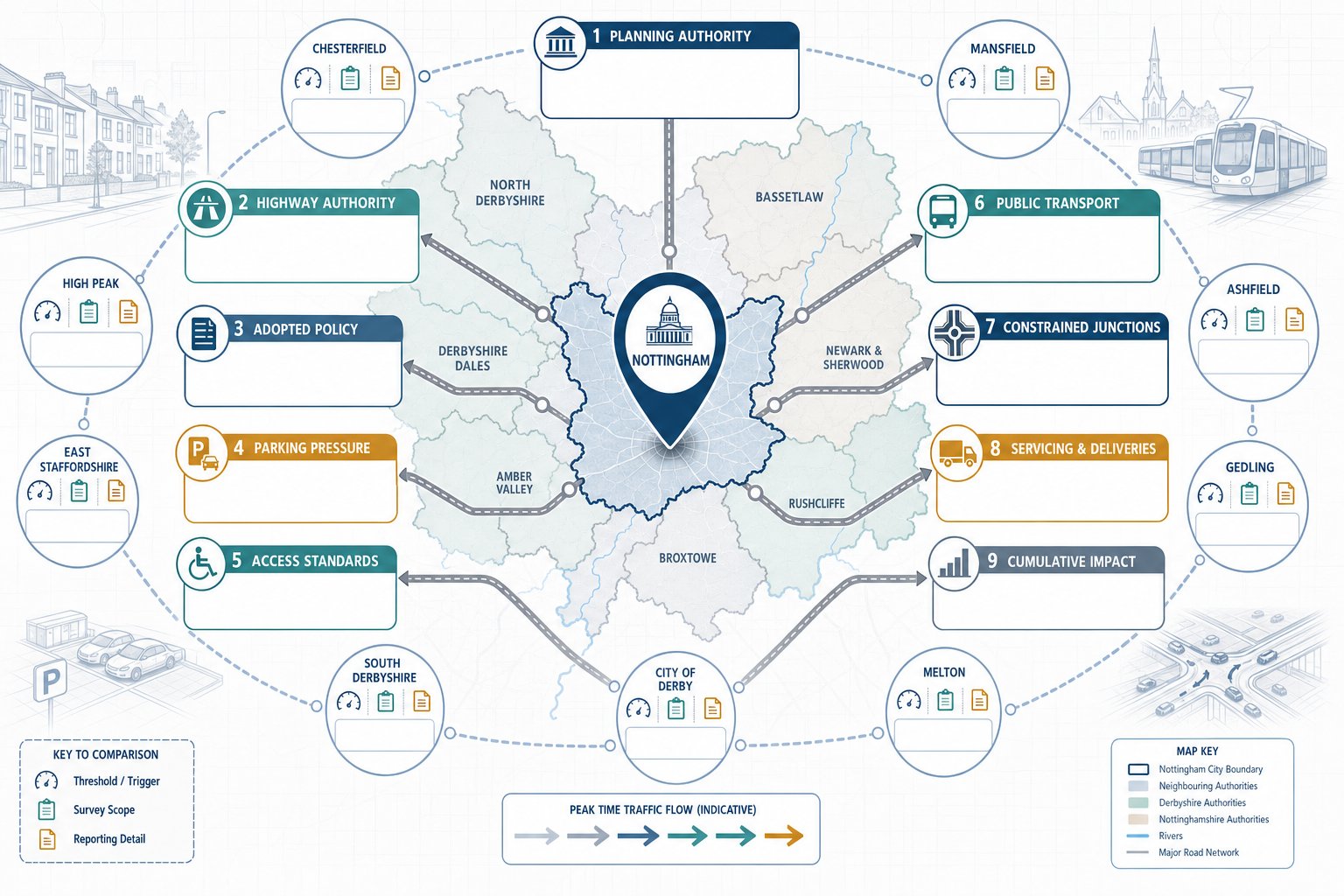
Nottingham transport work does not happen in a vacuum. Every planning submission sits within a local policy and highway context, and a report that ignores that context tends to create friction quickly. We hence begin by identifying the decision-making framework around the site: the local planning authority, the relevant highway authority, adopted policy, parking expectations, access standards, and any site-specific sensitivities.
Within Nottingham and the wider East Midlands, that can involve urban constraints, established residential parking pressure, public transport accessibility, and roads where operational performance matters disproportionately at peak times. The technical answer is not always the same from one authority area to the next. Thresholds, expectations around survey coverage, and the level of detail sought in supporting notes can vary.
That is why local interpretation matters as much as technical competence. We look at what the authority is likely to focus on: safe access, highway capacity, sustainable travel opportunities, servicing realism, or cumulative development impact. If a proposal sits near a constrained junction or on a corridor with existing pressure, the report should address that directly rather than hope it passes unnoticed.
Experience across multiple authority areas helps too. Comparing how similar work is approached on a Traffic Engineer In Birmingham: scheme or by Highway And Traffic Engineering teams elsewhere can sharpen judgement. But the final report still needs to feel rooted in Nottingham’s own planning and highway environment, not copied in from another city.
Common Transport Documents Required For Planning Applications
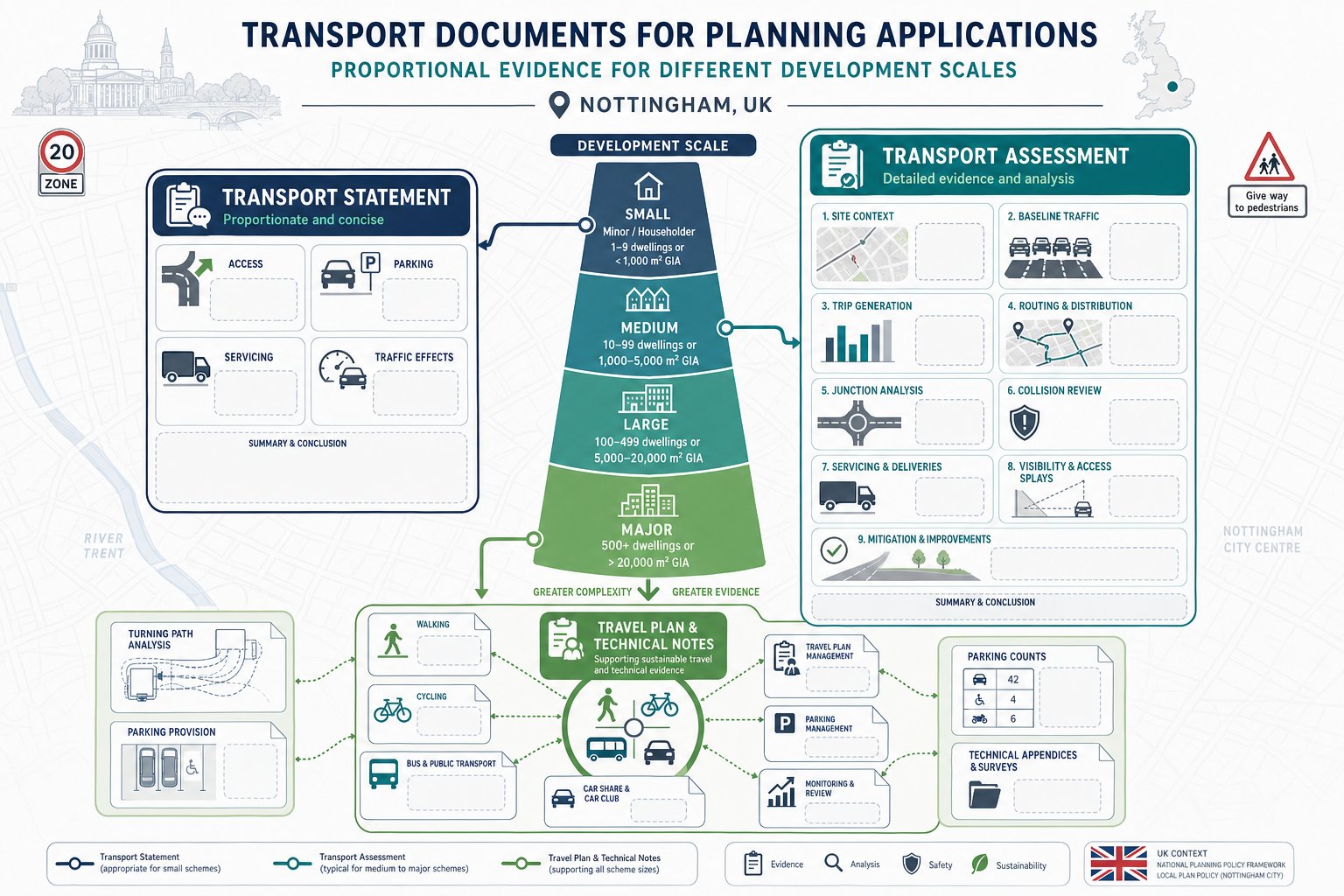
The transport documents needed for planning depend on scale, use, and likely network effect. Most projects fall into a fairly familiar pattern, with one main report supported by more focused technical material where necessary. The key is proportionality. A modest proposal should not carry the same reporting burden as a larger or more traffic-intensive scheme, but it still needs enough evidence to answer predictable questions.
Transport Assessment
A Transport Assessment is the fuller option. We normally prepare one where a development could have a more notable effect on traffic movements, site access, parking demand, junction performance, or wider highway operation. It typically covers the site context, baseline conditions, sustainable transport opportunities, trip generation, distribution, potential assignment, and an assessment of likely impact.
Depending on the proposal, it may also include junction capacity analysis, personal injury collision review, servicing assessment, visibility checks, and mitigation recommendations. The purpose is not simply to prove a scheme is harmless. It is to provide a transparent, evidence-led account of impact and, where needed, a practical route to acceptability.
Transport Statement
A Transport Statement is usually shorter and more targeted. We use it for smaller or less impactful schemes where a concise explanation of transport effects is enough. That might still involve access review, parking analysis, servicing commentary, and a reasoned estimate of traffic generation, but without the breadth of a full assessment.
A good statement is lean, not thin. It should anticipate likely concerns and deal with them directly, using the right level of evidence rather than blanket detail.
Travel Plan And Supporting Technical Notes
Travel Plans set out measures intended to influence travel behaviour and support more sustainable journeys. For some developments they are formal commitments: for others they sit as lighter supporting material. Technical notes can cover swept path analysis, parking accumulation, delivery and servicing logic, or explanatory calculations.
Together, these documents make the planning submission coherent. They show not just what the development is, but how it will function day to day.
When A Transport Statement Or Transport Assessment Is Likely To Be Needed
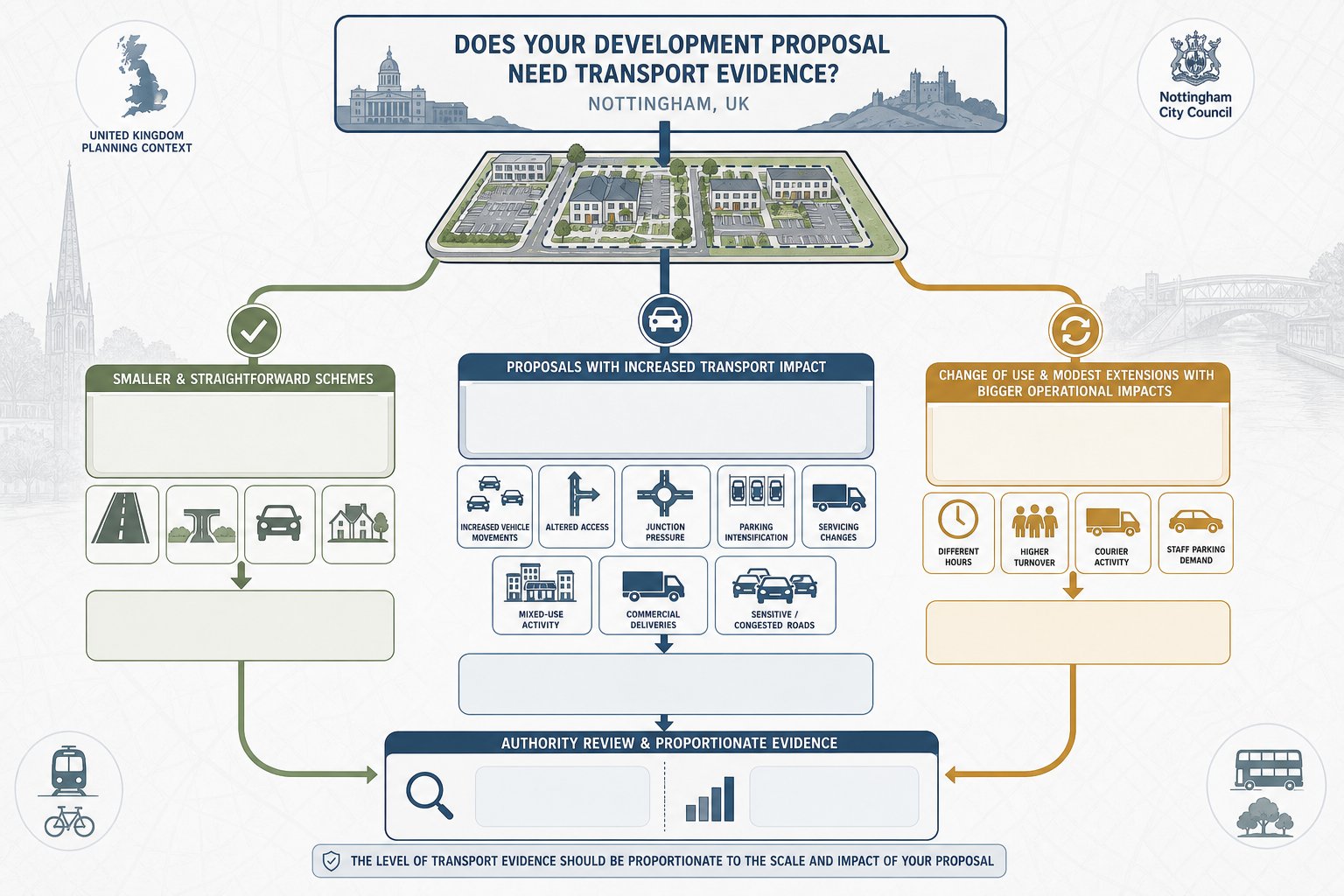
There is no single national trigger that neatly decides every case, so judgement matters. In broad terms, a Transport Statement or Transport Assessment is likely to be needed when a proposal introduces new vehicle movements, materially changes an access arrangement, affects junction operation, intensifies parking demand, or alters how servicing takes place.
For example, a small infill housing scheme with straightforward access and limited traffic generation may only need a concise statement. A larger residential development, a mixed-use scheme, or a commercial proposal with delivery activity may need a fuller assessment, especially if nearby roads are already sensitive or congested at certain times.
Change-of-use schemes can catch teams out here. On paper, the site already exists: in practice, the transport effects may change significantly. Different hours, higher turnover, courier activity, or staff parking demand can all justify formal transport evidence. The same goes for extensions or site intensification where the headline physical change looks modest but the operational change is not.
We also look at whether the authority is likely to ask detailed follow-up questions. If the answer is yes, it is usually smarter to address them in the initial submission. Similar judgement calls appear on projects beyond Nottingham, from a Traffic Engineer In Bristol: instruction to urban redevelopment elsewhere. The test is always the same: what level of reporting is proportionate, credible, and likely to satisfy the authority first time?
Typical Nottingham Schemes That Need Traffic Engineering Support
In Nottingham, we most often support schemes where transport is not incidental to planning but part of the core risk profile. Residential development is the obvious category, from small apartment blocks and infill housing to larger edge-of-settlement sites. Questions around access safety, parking provision, visibility, refuse collection, and local junction impact come up repeatedly.
Mixed-use schemes also need careful handling because they combine movement patterns. Residential demand, customer parking, servicing, and delivery activity can overlap awkwardly if they are not designed from the outset. A layout that works at 11am may fail badly at school-run time or during evening arrivals.
Commercial and employment proposals are another common area. Warehousing, trade counters, roadside uses, food retail, leisure, and office intensification all bring distinct transport considerations. HGV access, turning space, loading arrangements, staff mode share, and interaction with neighbouring uses can become the decisive planning issues.
Then there are the schemes that look simple but are not: a revised access point, a subdivision of units, a change in parking layout, or redevelopment on a constrained brownfield plot. These often need a sharper technical explanation than larger greenfield sites because the margin for error is tighter.
Across all of these, the need is rarely just for numbers. It is for a transport story that fits the site. That is as true in Nottingham as it is on a Traffic Engineer In Leeds: commission or a city-centre regeneration scheme elsewhere.
How Traffic Engineers Assess Access, Parking, Servicing, And Highway Impact
This is where transport engineering becomes very concrete. We look at whether the proposal can operate safely and practically, not just whether it works in principle. Access assessment often starts with the basics: site frontage, visibility, junction spacing, geometry, gradients, and how drivers, cyclists, and pedestrians are likely to interact. But the detail matters. A few metres, a boundary wall, or an awkward tracking path can change the planning position.
Parking assessment is more than counting spaces. We consider likely demand, user type, turnover, disabled provision, cycle parking, and how the arrangement functions. Can vehicles enter and leave in a practical way? Will overspill create pressure on nearby streets? Does the layout create conflict or dead space? Those are the questions authorities and neighbours tend to ask, so we answer them explicitly.
Servicing is often underestimated. We assess what vehicles the development will attract, how frequently they are likely to attend, where loading will happen, whether turning can take place on-site, and whether the arrangement is realistic in day-to-day operation. Refuse collection can be just as important as commercial deliveries, especially on tighter sites.
For wider highway impact, we review traffic generation, peak-hour patterns, routeing, and potential effects on surrounding junctions or corridors. On some projects that means reasoned professional judgement: on others it means survey data and technical modelling. Our aim is straightforward: clear evidence, proportionate analysis, and conclusions that will stand up under scrutiny. With more than 30 years of experience behind many Traffic Engineer In Liverpool: and regional instructions, that discipline matters.
Working With Architects, Planners, Developers, And Local Councils
The best transport work is collaborative. If we are brought in early enough, we can help shape a scheme before positions harden. That usually means working closely with architects on access geometry, parking arrangement, tracking, and frontage design: with planners on policy fit and submission strategy: and with developers on programme, risk, and the level of evidence likely to be needed.
Lawyers and surveyors often come into the picture too, especially where access rights, servicing assumptions, or appeal positions need technical support. In those situations, clarity matters as much as analysis. A report may be read by several audiences with very different priorities, so it has to be technically sound without becoming unreadable.
Engagement with councils is equally important. We cannot assume that a technically competent report will speak for itself. The submission needs to reflect how the authority is likely to test it. That may mean addressing a known local concern around on-street parking, public transport accessibility, school-run pressure, or cumulative traffic on a nearby route.
At our best, we act as the thread that keeps the transport narrative consistent across the planning package. The architecture, access drawings, planning statement, and transport evidence should all point in the same direction. That is one reason teams often value experienced support from practices such as Traffic Engineer In Manchester: specialists or regionally focused consultants: alignment avoids delay.
Choosing A Traffic Engineer In Nottingham For Fast, Accurate Reporting
Fast reporting is useful. Fast reporting that misses the planning point is not. When choosing a traffic engineer in Nottingham, we would focus on four things: relevant planning experience, local authority awareness, technical clarity, and responsiveness under programme pressure.
First, look for direct experience of planning-led transport work rather than purely operational highways design. Planning reports need judgement about proportionality, evidence, and policy framing. Second, ask how the consultant approaches local thresholds and authority expectations. A generic national template may save time at draft stage but often costs time later.
Third, review the quality of writing. This sounds simple, but it matters a lot. A Transport Statement or Assessment must be readable, logically structured, and capable of answering objections before they are made. Dense jargon and vague conclusions are not signs of technical strength: they are usually signs that the report has not been properly thought through.
Finally, test the process. Can the team review a site quickly? Will they flag scope honestly? Can they coordinate with architects and planners without constant chasing? Firms such as ML Traffic, drawing on decades of experience and a focus on concise reporting, tend to stand out because they combine speed with authority-aware judgement. That blend is what clients really need from a Traffic Engineer in Nottingham when planning timetables are tight and revision cycles are expensive.
Conclusion
A strong planning submission depends on more than a well-designed building. It depends on proving that people, vehicles, servicing, and access will work in the real world, on the actual streets around the site. That is the job of a Traffic Engineer in Nottingham: to translate transport risk into credible evidence and practical solutions.
For architects, planners, developers, councils, and legal teams, the value of that support is usually clearest before the application is lodged. Early scoping, proportionate reporting, and local awareness can prevent avoidable objections and shorten the path to determination. And when transport is likely to be a live issue, the difference between a weak report and a precise one is often the difference between delay and momentum.
In 2026, the standard expected by authorities is not simply more paperwork. It is better judgement. That means accurate analysis, concise writing, and advice grounded in Nottingham’s planning context rather than lifted from a generic template.
Frequently Asked Questions About Traffic Engineers in Nottingham
What role does a Traffic Engineer in Nottingham play in the planning process?
A Traffic Engineer in Nottingham assesses how a development impacts local roads, access, parking, and servicing. They provide evidence-based transport reports that help planning officers and authorities understand and manage transport risks associated with new developments.
Why is it important to involve a Traffic Engineer early in Nottingham development projects?
Early involvement allows the Traffic Engineer to identify and resolve transport-related design issues, such as access safety or parking challenges, before planning submission. This reduces redesign risks, speeds up approval, and ensures submissions meet local authority expectations efficiently.
What types of transport documents might be required for a Nottingham planning application?
Common documents include Transport Assessments for significant impacts, shorter Transport Statements for smaller schemes, Travel Plans to influence travel behaviour, and supporting technical notes like swept path analysis—all tailored to the scale and nature of the development.
How do Traffic Engineers assess the impact of a development on access, parking, and overall highway operation in Nottingham?
They examine site access geometry, visibility, vehicle turning movements, parking demands including disabled and cycle spaces, servicing arrangements, and potential traffic effects on nearby junctions using local standards and transport data to provide proportionate, credible analysis.
What factors determine whether a Transport Statement or a Transport Assessment is needed for a development?
A Transport Statement is sufficient for smaller schemes with limited traffic effect, while a Transport Assessment is required when a proposal introduces significant new vehicle movements, changes site access, or materially affects parking or local junction performance.
How should one choose a Traffic Engineer in Nottingham for planning support?
Select professionals with proven experience in planning-related transport studies, local authority requirements awareness, clear technical writing skills, and responsiveness. Their ability to coordinate with architects and planners efficiently ensures authoritative, timely reports.