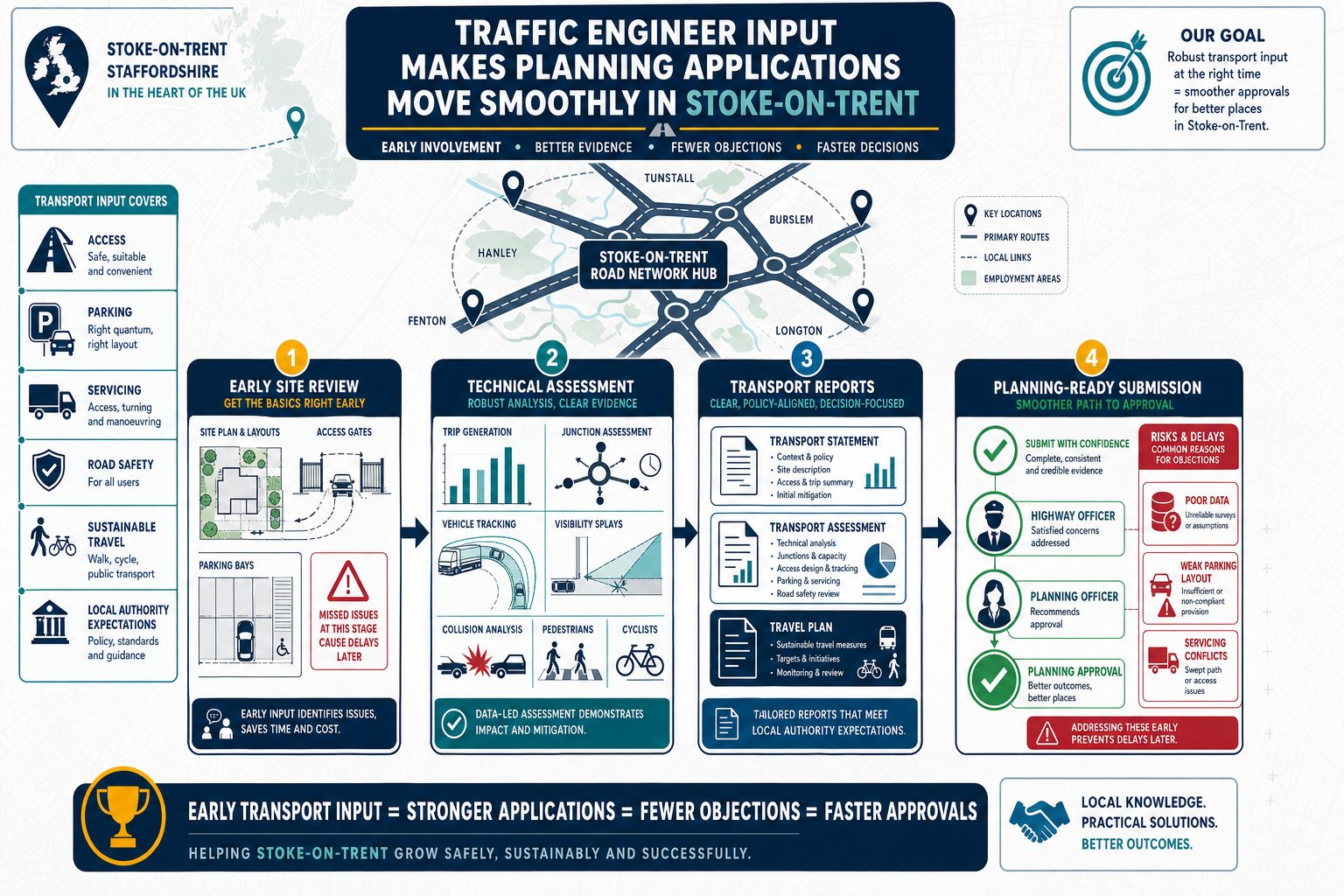
Planning applications in Stoke-on-Trent rarely fail on one dramatic issue. More often, they slow down because a transport point was missed early: an access that looks tight on refuse tracking, parking that doesn’t match likely demand, a junction impact that hasn’t been tested properly, or a report that doesn’t line up with what local officers expect to see. That’s where a traffic engineer in Stoke-on-Trent becomes central to the project team rather than an afterthought.
For architects, planners, surveyors, developers and legal teams, transport input is often the difference between a clean submission and months of avoidable queries. We’re not just talking about counting vehicles. Good traffic engineering ties together planning policy, highway design, road safety, servicing, sustainable travel and local authority requirements in a way that is proportionate, defensible and practical.
In Stoke-on-Trent, that means understanding how proposals interact with the local road network, how Staffordshire and city-level expectations can shape technical evidence, and what level of reporting is likely to be needed for a particular scheme. Below, we break down what a traffic engineer does, when input is needed, what the main report types actually cover, and how to reduce the risk of objections before a planning application goes in.
Key Takeaways
- A traffic engineer in Stoke-on-Trent is essential early in planning to prevent delays caused by overlooked transport issues such as access, parking, or junction impacts.
- Effective traffic engineering combines local policy knowledge with practical design and safety assessments to create planning-ready, defensible transport reports.
- Transport Statements, Assessments, and Travel Plans differ in scope but collectively ensure developments address trip generation, impact, and sustainable travel effectively.
- Early transport engineering input helps identify and resolve issues like visibility splays, vehicle turning, and parking demands before planning submission, reducing costly redesign.
- Local highway and planning requirements heavily influence the content and detail of transport reports, making local experience a critical asset for traffic engineers in Stoke-on-Trent.
- Choosing a traffic engineer with technical competence, local insight, and clear communication skills ensures smooth, proportionate planning support tailored to Stoke-on-Trent’s context.
What A Traffic Engineer Does In Stoke-On-Trent Planning Projects
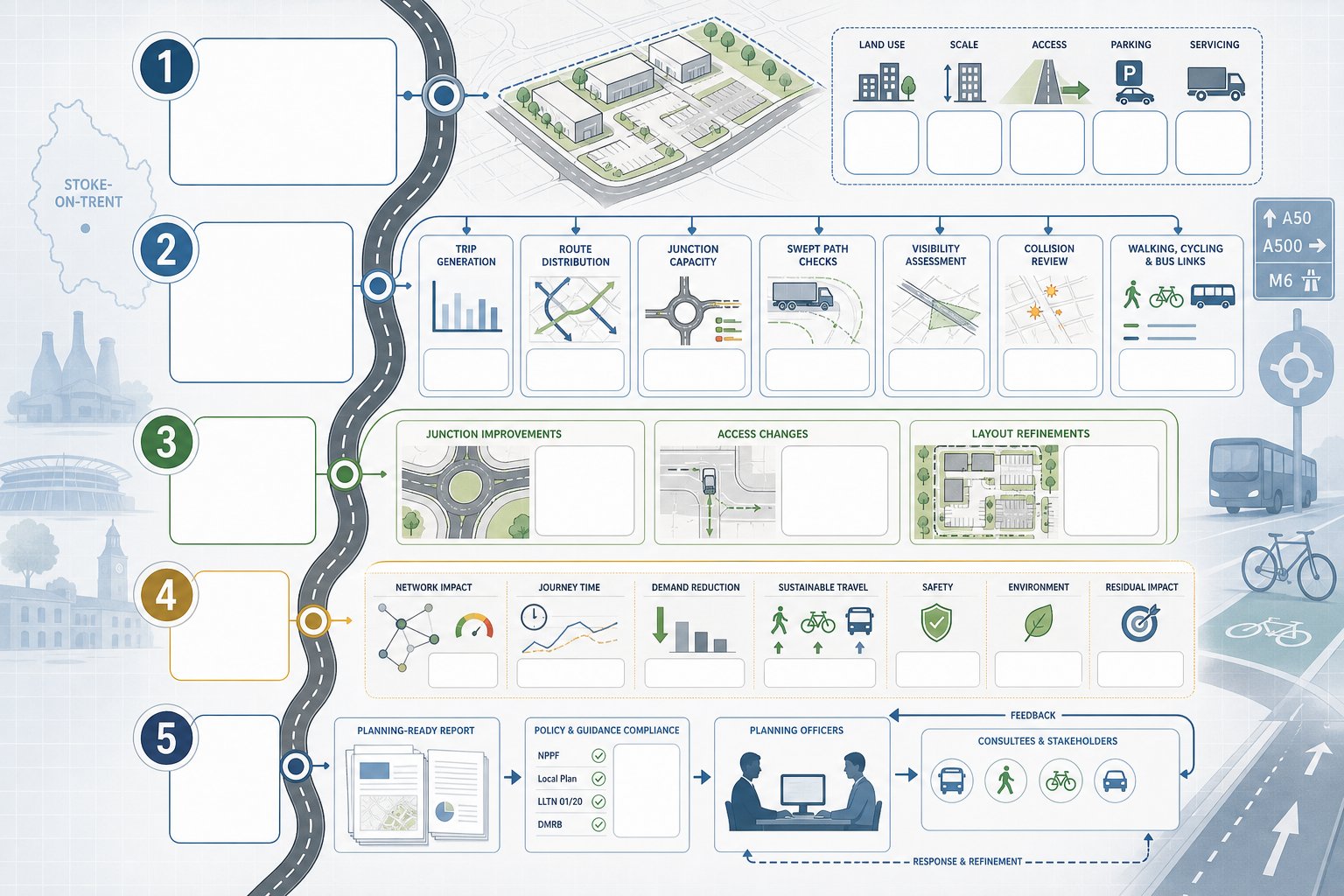
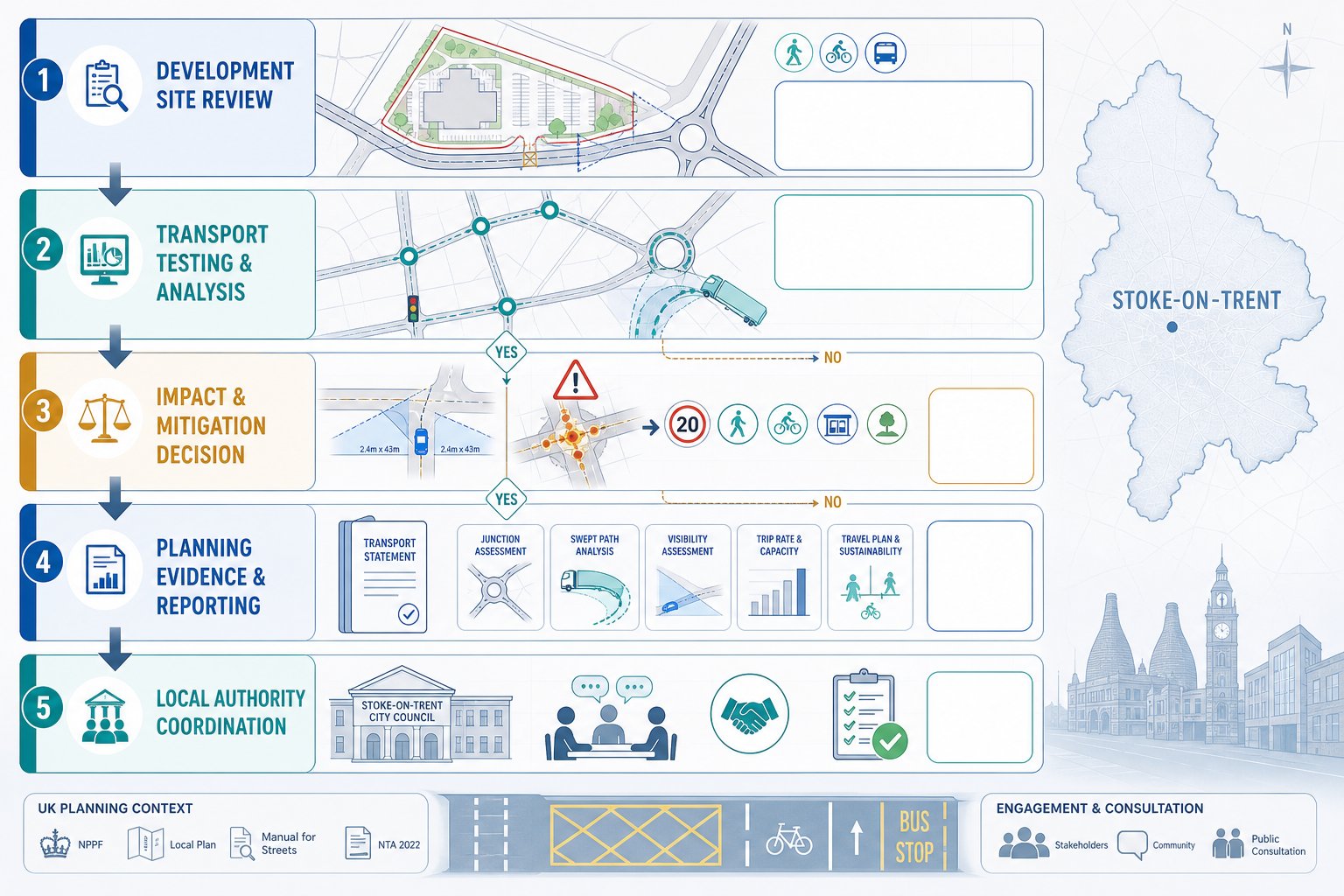
A traffic engineer in Stoke-on-Trent assesses how a development will function in transport terms and whether it can be supported through planning. In practice, that starts with a review of the proposal itself: the land use, scale, likely trip generation, access arrangements, parking, servicing needs and relationship to the surrounding highway network.
From there, we test the transport effects using recognised methods. That may include trip rate assessment, traffic distribution, junction capacity modelling, swept path analysis, visibility reviews, collision analysis and appraisal of walking, cycling and public transport connections. The aim is simple enough: identify whether the scheme would create a material impact, and if so, what changes or mitigation are needed.
A good engineer also translates technical detail into planning-ready evidence. That matters because highway officers, planning case officers and design teams need reports that are concise, accurate and rooted in policy. On more complex jobs, that can involve pre-application discussions, agreement of survey scope, refinement of site layout and responses to consultee comments.
This is also why broader experience helps. The principles applied by a Traffic Engineer In Manchester: or a Traffic Engineer In Leeds: are transferable, but local interpretation still matters. In Stoke-on-Trent, that local layer often shapes whether a report feels genuinely decision-ready.
When A Development In Stoke-On-Trent Needs Traffic Engineering Input
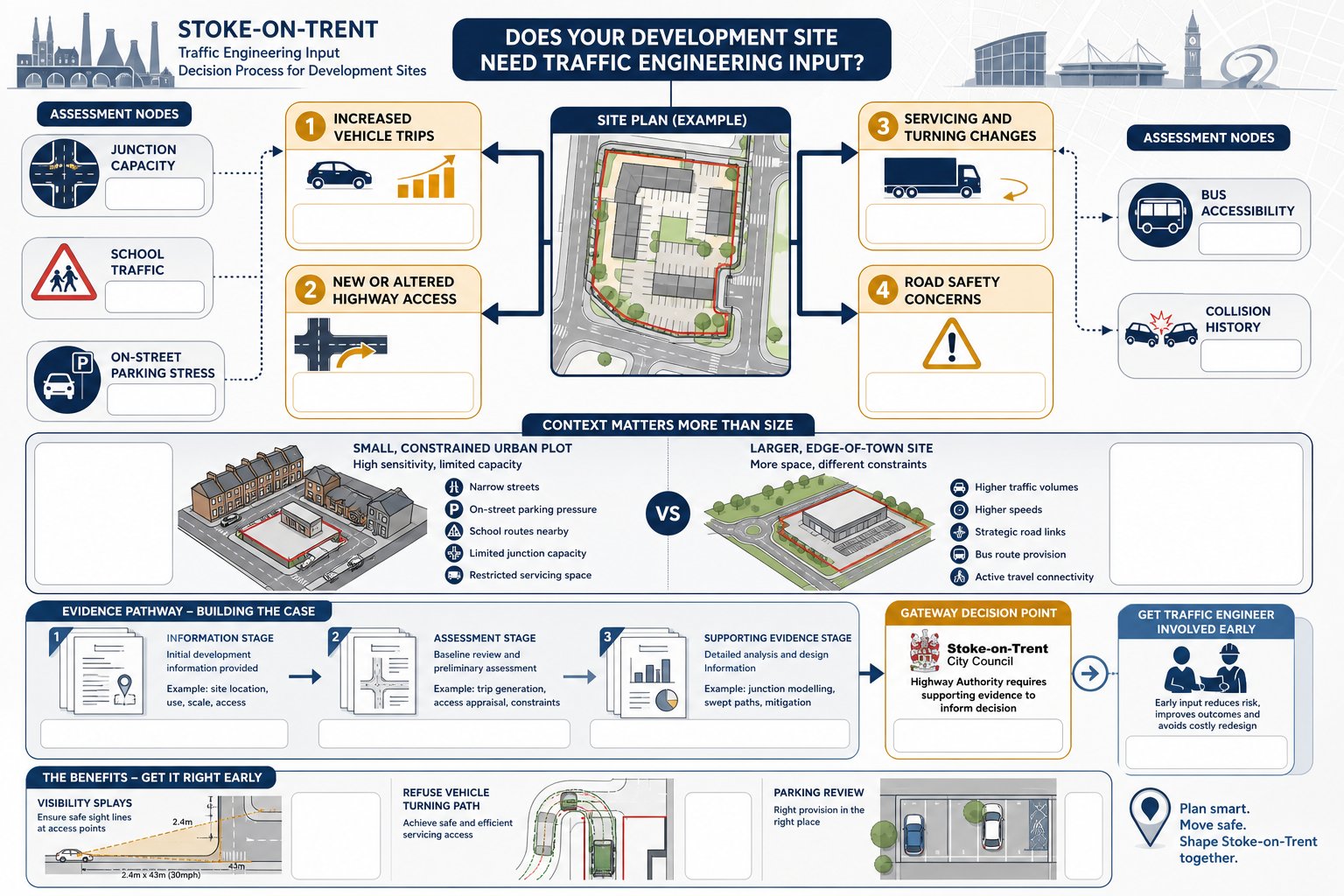
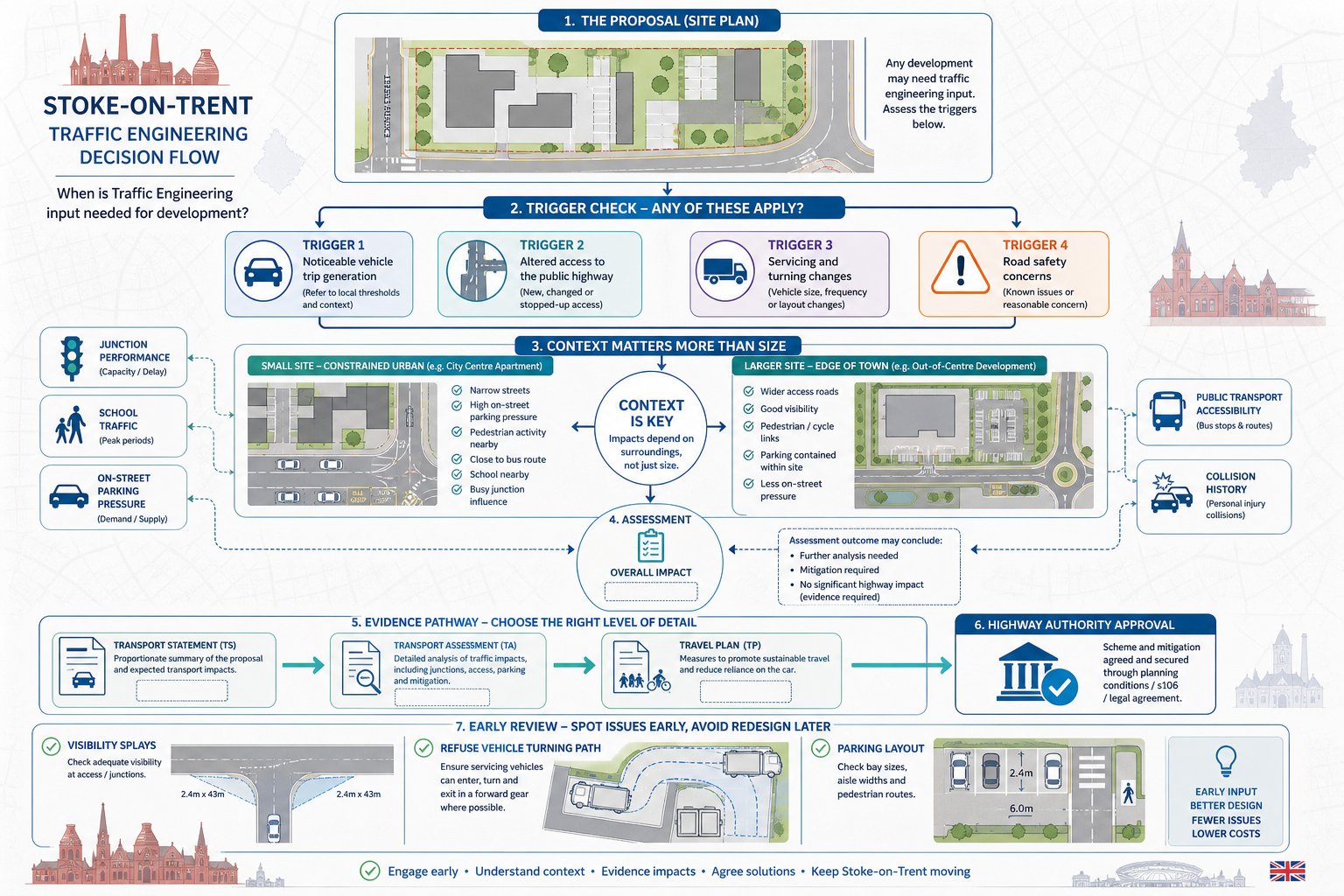
Not every planning application needs a full Transport Assessment, but plenty of schemes benefit from traffic engineering input much earlier than applicants expect. As a rule, we get involved when a proposal is likely to generate noticeable vehicle trips, alter an access onto the public highway, change the way a site is serviced, or raise road safety concerns.
That can apply to modest schemes as well as major ones. A small apartment block on a constrained urban plot may need more transport scrutiny than a larger edge-of-town site with straightforward access and strong walking links. Context matters: nearby junction performance, school traffic, on-street parking pressure, bus accessibility and collision history can all increase the level of attention a site receives.
Local validation requirements and national guidance usually determine whether a Transport Statement, Transport Assessment or Travel Plan is required. But in reality, the threshold question is often less important than this one: will the highway authority need clear evidence before it can support the proposal? If the answer is yes, a traffic engineer should already be in the room.
We often find that early involvement avoids expensive redesign later. A quick technical review can flag whether visibility splays are achievable, whether a refuse vehicle can turn, or whether parking numbers are likely to be challenged before an application is fixed in place.
Transport Statements, Transport Assessments, And Travel Plans Explained
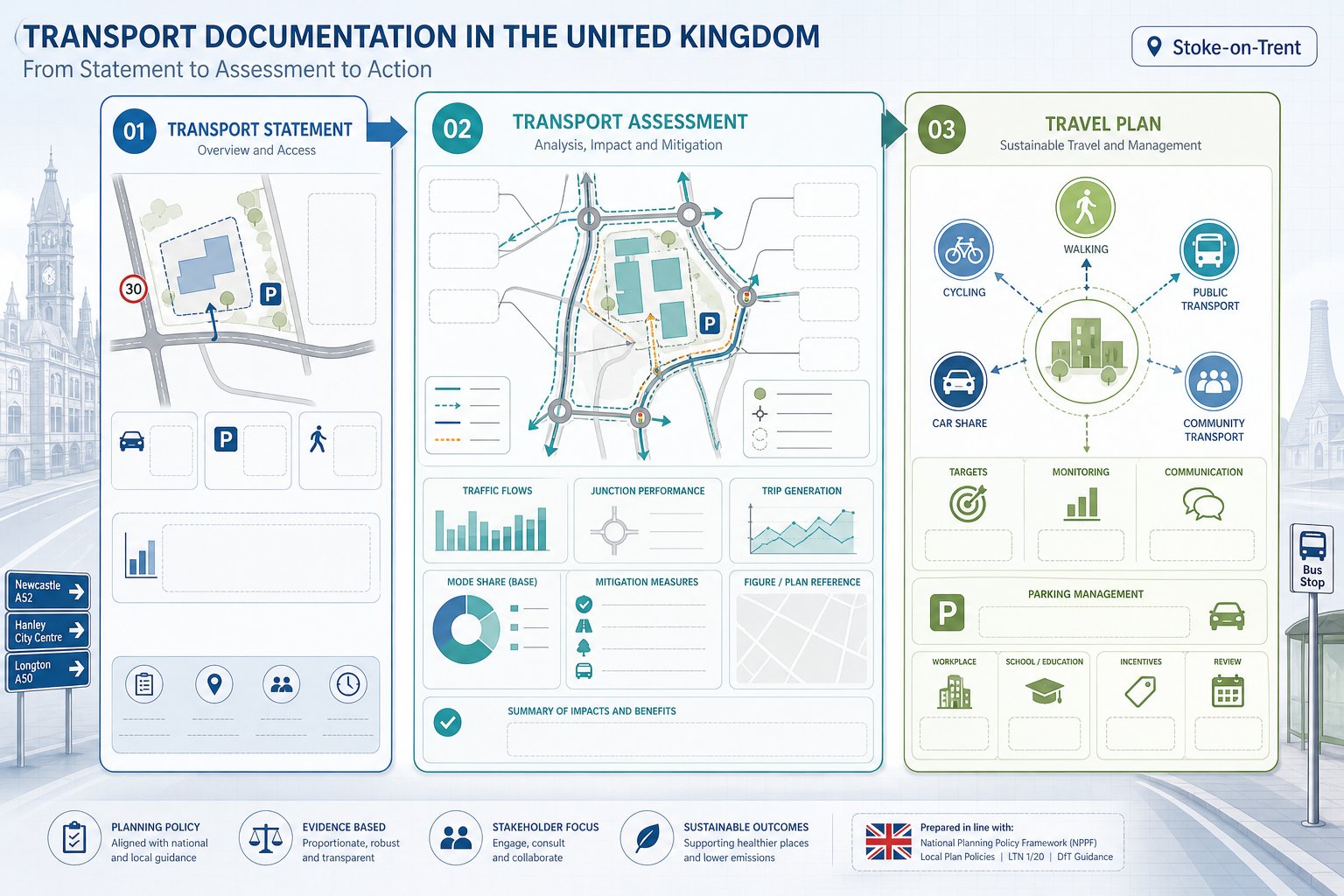
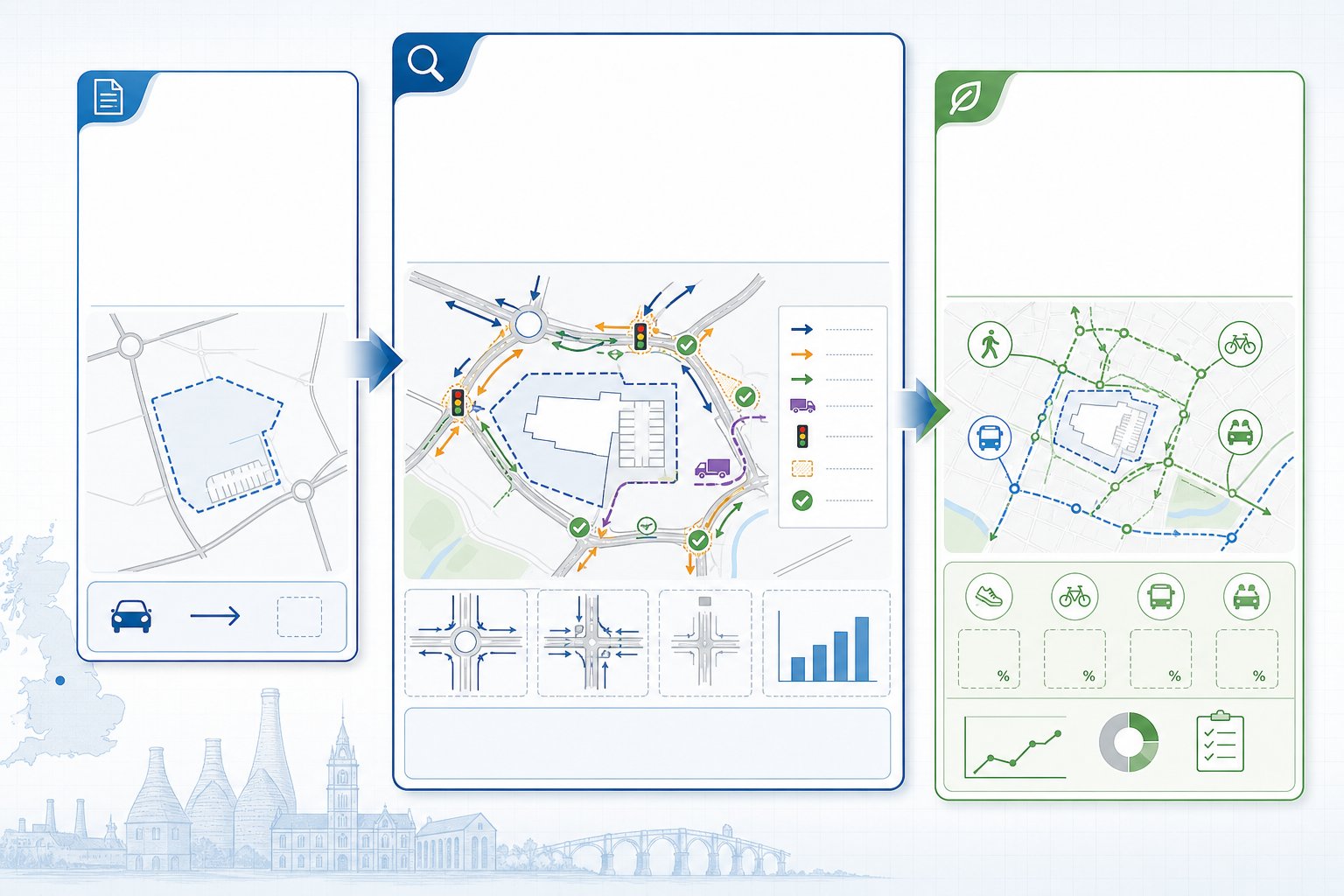
These three documents are related, but they do different jobs.
A Transport Statement is typically used for smaller or less intensive schemes. It gives a proportionate review of existing conditions, expected trips, site access, parking provision and likely effects on the local network. The keyword there is proportionate. It should still be robust, but it doesn’t usually require the same modelling depth as a larger study.
A Transport Assessment is the more detailed document used for bigger or more complex developments. It usually covers baseline conditions, committed development, trip generation, distribution and assignment, junction impact analysis, sustainable travel opportunities, servicing and mitigation proposals. If a site is likely to raise concerns about capacity or safety, this is often the core planning transport document.
A Travel Plan sits alongside either of the above where sustainable travel measures are needed. It sets out how future users of the site will be encouraged to walk, cycle, use public transport or share car trips, while also managing parking demand. Targets, monitoring and implementation measures are normally included.
For clients unfamiliar with the terminology, we often point them first to broader guides on Traffic Engineering Consultants: and the wider discipline of Traffic Engineering: Your Complete, because the report type only makes sense once the planning function behind it is clear.
How Local Highway And Planning Requirements Shape Transport Reports
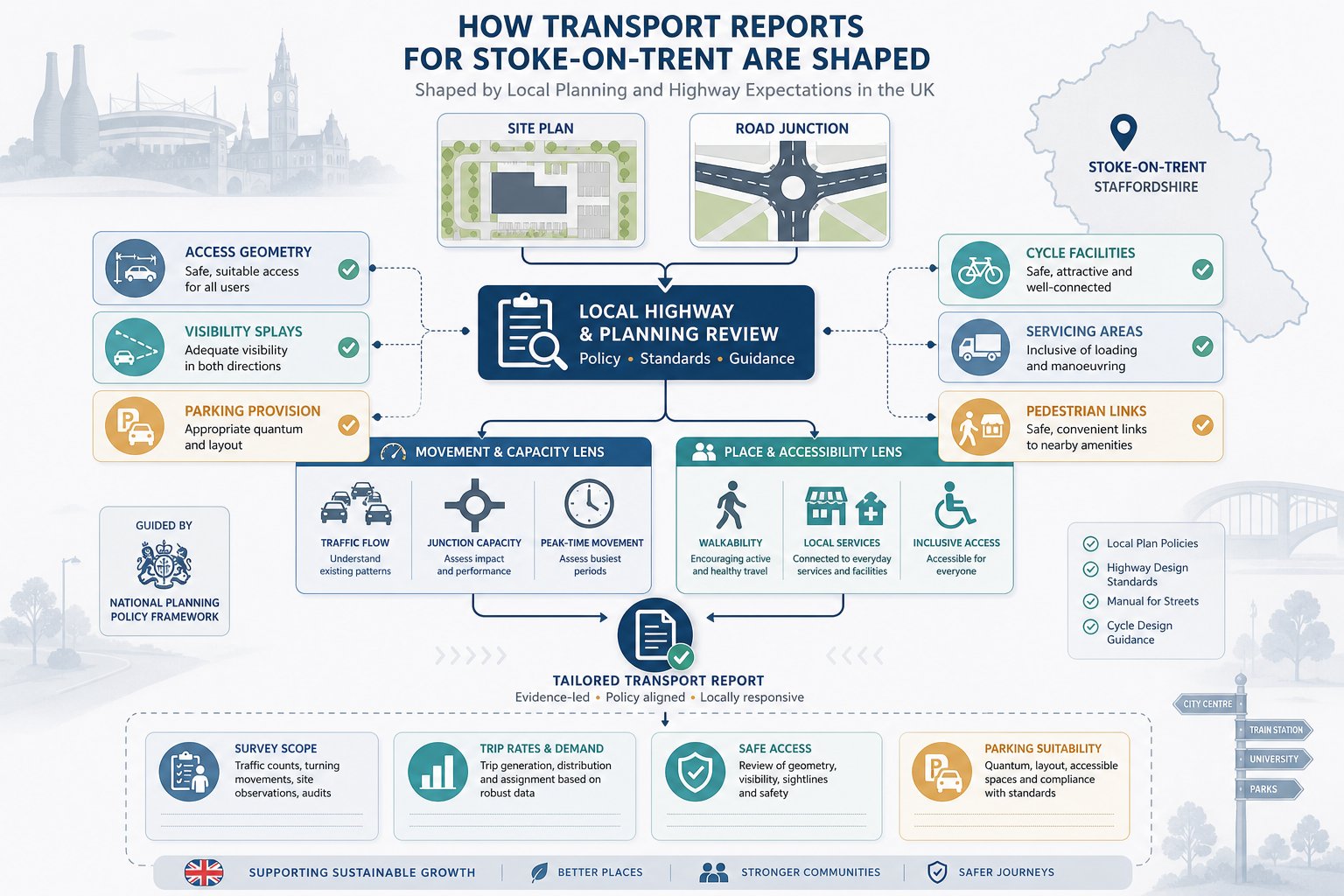
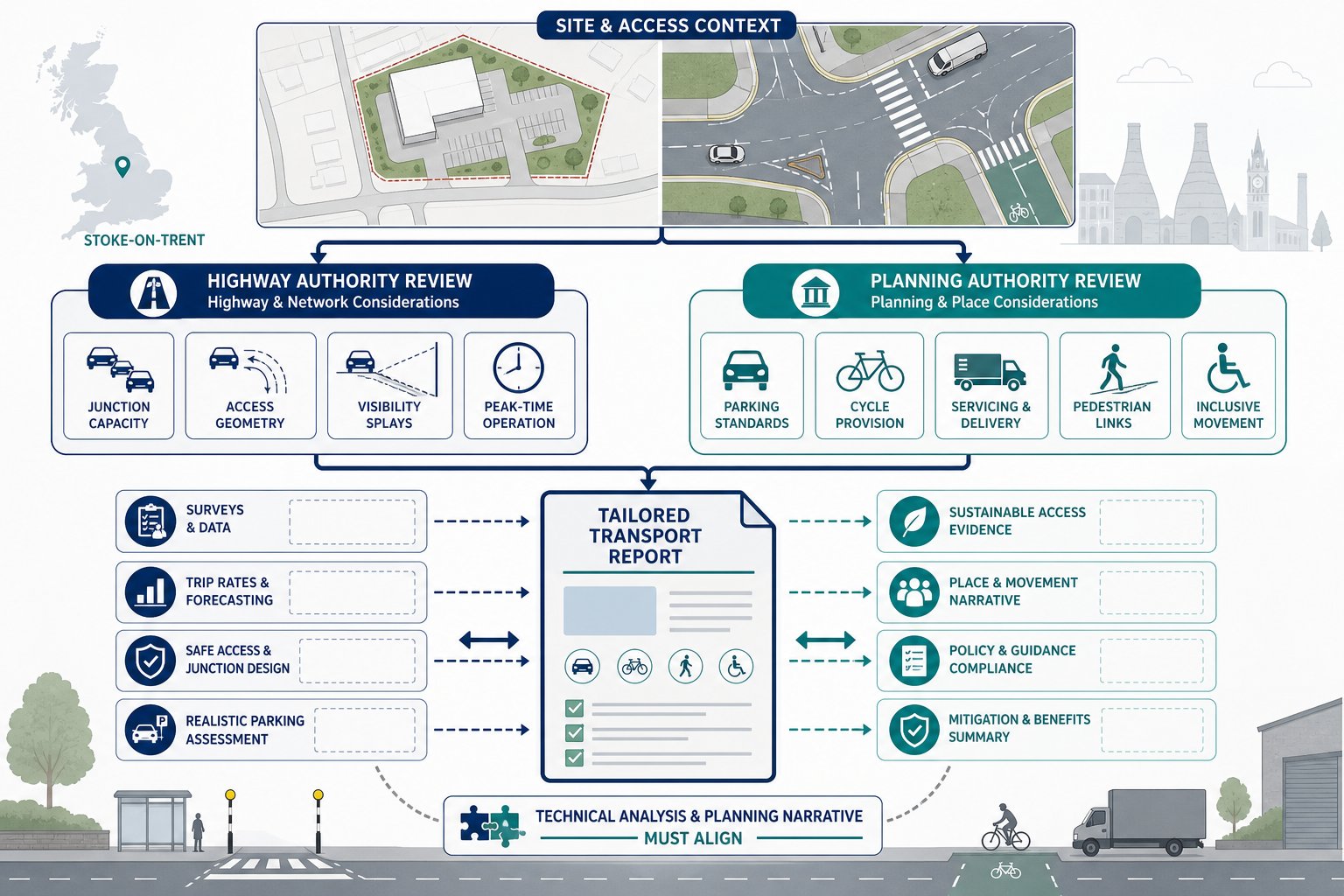
Transport reports are never written in a vacuum. In Stoke-on-Trent, the content and level of detail are shaped by local planning policy, highway design expectations, validation lists and consultee practice. That includes matters such as access geometry, visibility splays, parking standards, cycle provision, servicing arrangements and the quality of pedestrian links to nearby facilities.
This is where applicants can come unstuck. A technically competent report can still face objections if it doesn’t answer the questions local officers are actually asking. For example, a highway authority may focus heavily on junction operation at peak times, while planners may be more concerned with sustainable access to local services and whether the layout supports inclusive movement.
We hence approach reports as local planning documents, not just transport calculations. The methodology needs to be defensible, but so does the narrative. Why is the survey scope appropriate? Why are trip rates realistic? Why is the access safe? Why is the level of parking suitable for the use and location? Those answers need to be explicit.
That local tailoring is one reason region-specific experience matters. The reporting approach used by a Traffic Engineer In London: or a Traffic Engineer In Birmingham: may be technically sound, but Stoke-on-Trent schemes still need evidence framed around the concerns of local decision-makers.
Typical Development Types That Commonly Require Assessment
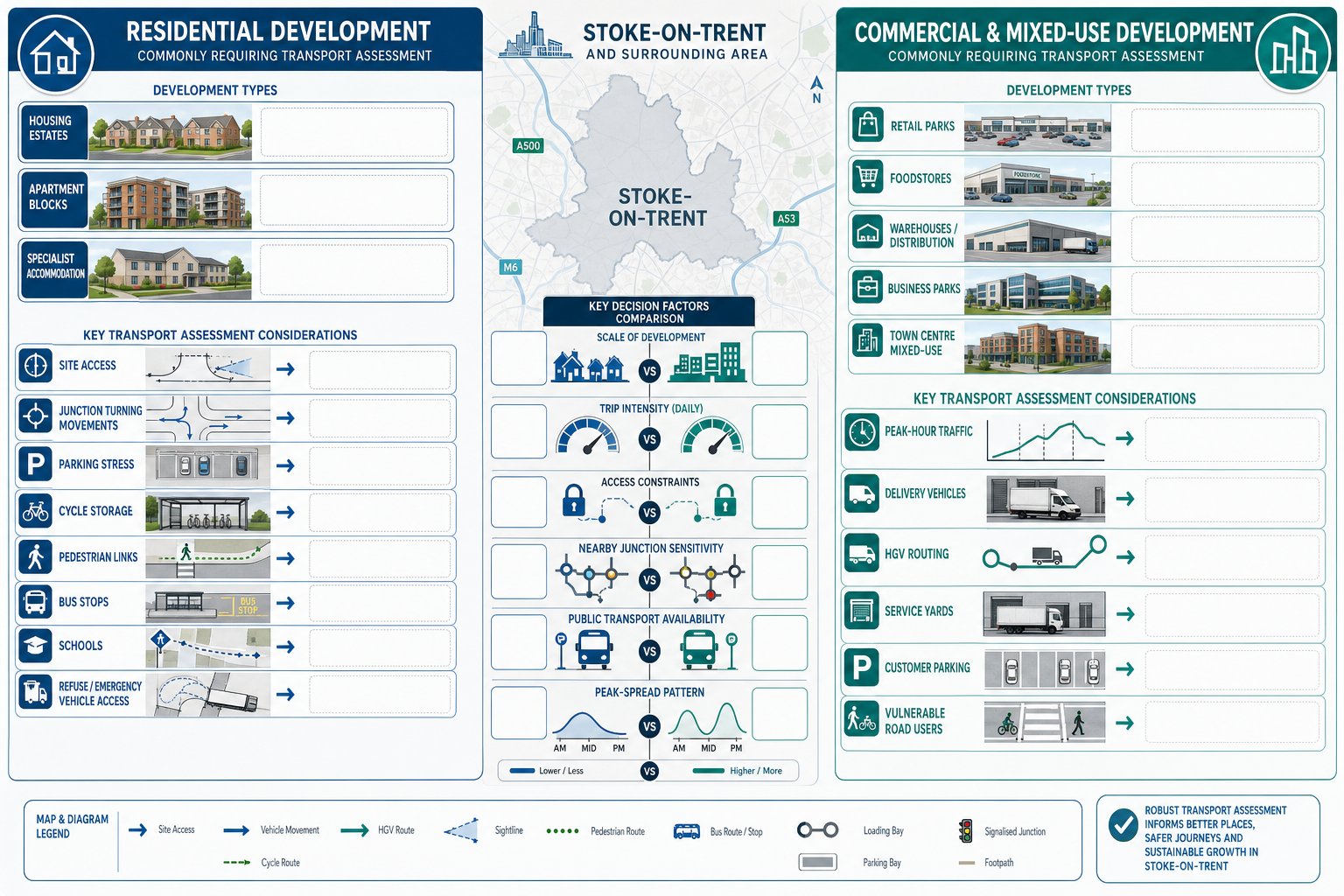
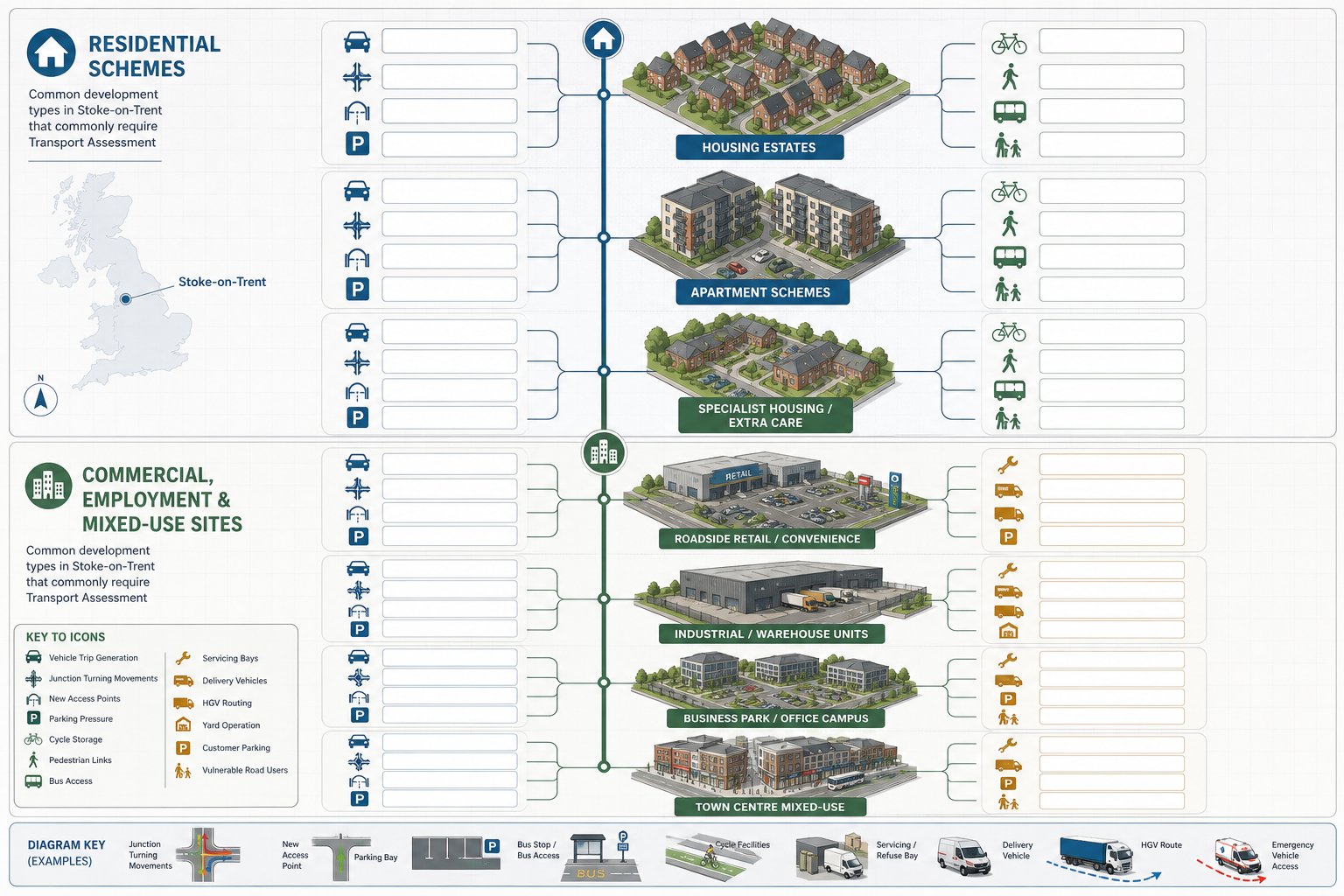
Certain development categories trigger transport review again and again, either because of scale, trip intensity or the sensitivity of the location. In Stoke-on-Trent, residential growth, town-centre redevelopment, roadside commercial schemes and employment sites are all common examples.
What matters is not just use class, but operational reality. Two sites of the same floorspace can perform very differently depending on access constraints, nearby junctions, public transport availability and whether demand is spread through the day or concentrated in sharp peaks.
Residential Schemes
Residential development frequently requires some level of transport evidence, especially where a site introduces a new access, increases turning movements at an existing junction, or places pressure on local parking. Housing estates, apartment buildings and specialist accommodation can all trigger requests for a Transport Statement or fuller assessment.
For residential sites, we typically examine trip generation by dwelling type, access visibility, internal layout, emergency and refuse access, parking allocation, cycle storage and pedestrian links to schools, shops and bus stops. In denser urban locations, overspill parking and the interaction with controlled or informal on-street parking become especially relevant.
Commercial, Employment, And Mixed-Use Sites
Commercial and employment schemes often attract more scrutiny because operational patterns can be harder to predict and servicing demands are greater. Retail parks, foodstores, industrial units, business parks, leisure uses and mixed-use town centre sites can all generate concerns around peak hour traffic, delivery activity, customer parking and interaction with vulnerable road users.
On these schemes, the transport case often turns on timing and logistics as much as trip totals. A warehouse may not create severe commuter peaks but could still raise issues around HGV routing and yard operation. A mixed-use proposal may reduce some trip lengths but increase complexity at the access point. That’s why proportionate, site-specific assessment matters.
Key Traffic And Transport Issues Reviewed During An Assessment
A transport assessment is essentially a structured answer to one question: can the development operate acceptably on the network, and can any impacts be managed? To answer that, we review a cluster of linked issues rather than a single traffic number.
First comes trip generation: how many person trips and vehicle trips the scheme is likely to create, and at what times. Then trip distribution and assignment: where those trips will come from and which routes they are expected to use. From there, we assess junction capacity, delay and queuing, often at nearby priority junctions, roundabouts or signalised nodes.
But the job doesn’t stop with modelling. We also review road safety, including collision history and the way drivers, pedestrians and cyclists interact with the site. Sustainable accessibility is another key area, covering footways, crossing opportunities, bus services, cycle routes and practical walk distances to everyday destinations. And then there’s servicing and operational function: can delivery vehicles enter, turn, load and leave without conflict?
A report that focuses only on vehicle counts can feel thin very quickly. Comparable work prepared by a Traffic Engineer In Liverpool: or a Traffic Engineer In Bristol: shows the same principle: planning officers want a rounded transport picture, not a spreadsheet dropped into a PDF.
Access, Parking, Servicing, And Highway Safety Considerations
These are the issues that regularly decide whether a scheme looks workable before anyone debates wider planning merits.
Access has to be safe, legible and buildable. That usually means suitable geometry, adequate visibility, realistic vehicle tracking and a layout that doesn’t force awkward manoeuvres close to the public highway. If the proposed access sits on a road with higher speeds, difficult gradients or existing turning conflicts, scrutiny increases quickly.
Parking is not just about numbers. Officers will also look at arrangement, usability, disabled provision, electric vehicle charging, cycle storage, turning space and whether bays can actually be used without creating friction. Under-provide and you risk overspill. Over-provide and you may undermine the sustainable travel case.
Servicing often gets left too late, which is a mistake. Refuse wagons, delivery vans and larger HGVs all need to be accommodated safely, especially on commercial and mixed-use schemes. If servicing blocks parking aisles or requires reversing onto the highway, objections become much more likely.
Then there’s highway safety. Collision records, visibility constraints, pedestrian desire lines and the interface between vehicles and vulnerable users all need proper review. Sometimes the answer is design refinement: sometimes it’s mitigation, such as lining, signing, crossing improvements or access control. Either way, these points are best resolved before submission, not in a rushed response after consultation.
The Traffic Engineering Process From Initial Review To Planning Submission
Most successful transport work follows a clear sequence, even if the detail varies by project.
We usually begin with an initial review of the site, proposal, planning status and likely transport risks. At this stage, we identify what report type is likely to be needed and whether early engagement with the local highway authority would help. Sometimes a short scoping note saves weeks later.
Next comes data collection. That may include traffic counts, queue surveys, speed surveys, parking beat surveys, collision data review, site observations and accessibility audits. The evidence has to be current, seasonally sensible and matched to the right peak periods. Old or poorly scoped survey data is one of the easiest ways to weaken an application.
After that, we carry out trip generation, distribution and junction analysis, followed by access design and mitigation review. This is usually where the transport evidence and site layout start influencing each other properly. A minor geometry change at this point can remove a major objection later.
The final stage is report preparation and planning support: drafting the Transport Statement, Transport Assessment or Travel Plan, coordinating with the wider consultant team, and responding to consultee comments after submission. For firms like ML Traffic, the value is often in keeping this process tight, practical and proportionate rather than overcomplicating what should be a clear planning case.
What To Prepare Before Instructing A Traffic Engineer
The more complete the starting information, the faster we can tell you what level of work is needed and where the likely risks sit.
At minimum, we would want a red-line site plan, a draft site layout, the proposed number of dwellings or floorspace, a clear description of use, and any available phasing assumptions. If the site has more than one access option under consideration, that’s worth flagging early rather than waiting until design has progressed too far.
Planning context matters as well. Existing permissions, refused schemes, appeal decisions, pre-application feedback and known local sensitivities can all shape the transport strategy. If officers have already raised concerns about parking, servicing or sustainable travel, that should inform the brief from day one.
It also helps to provide whatever the wider team already knows about levels, utilities, visibility constraints, land control and likely build programme. We don’t need a polished package to start, but we do need enough to avoid advising in the dark.
In practical terms, the best instructions are the ones that let us identify the real issue early. Sometimes that issue is network capacity. Just as often, it’s a simple but stubborn design constraint that would have been cheaper to solve a month earlier.
Common Reasons Transport Reports Face Delays Or Objections
Most transport objections are predictable. They’re rarely caused by the existence of a report: they’re caused by the wrong report, weak evidence, or a mismatch between the technical work and the submitted design.
One common problem is outdated or inadequate survey data. If counts were undertaken in an unrepresentative period, or if the scope misses the junction officers care about most, confidence in the rest of the assessment drops. Another is underestimated trip generation. Highway authorities are quick to challenge assumptions that feel optimistic, particularly on uses with variable peak patterns.
A third issue is insufficient junction analysis. We still see applications where access capacity is tested but nearby network effects are not, even though the local concern plainly sits off-site. Then there are the classic design-based objections: substandard visibility, poor parking layout, inadequate turning for service vehicles, or weak walking and cycling provision.
Sometimes the delay is procedural rather than technical. The transport report may be fine, but it arrives late, doesn’t reflect the final drawings, or conflicts with the Design and Access Statement. That sort of inconsistency creates unnecessary back-and-forth and can make a competent scheme look less credible than it really is.
The pattern is fairly universal, whether a team is dealing with Stoke-on-Trent or working with a Traffic Engineer In another major city. Early coordination still beats post-submission firefighting.
Choosing The Right Traffic Engineer For A Stoke-On-Trent Project
Not all transport consultants are equally suited to planning work, and not all planning transport work needs the same type of consultant. For a Stoke-on-Trent project, we would look for three things straight away: technical competence, local awareness and the ability to write reports that actually help secure a decision.
Technical competence means more than owning modelling software. It means understanding when a short, sharp Transport Statement is enough and when a fuller assessment is unavoidable: knowing how to test a design properly: and being able to defend assumptions if challenged by the highway authority.
Local awareness matters because Stoke-on-Trent schemes sit within a specific policy and decision-making context. Familiarity with the kinds of issues raised by local officers, and the thresholds that tend to trigger deeper scrutiny, can save a surprising amount of time.
And then there is communication. The best consultant is often the one who can explain transport risk clearly to the whole team, architects, planning consultants, lawyers, developers and councils alike, without burying the point in jargon.
In our experience, the right appointment is usually the firm that combines speed, accuracy and proportionate judgment. If they can identify the real issue early, tailor the evidence to local expectations and keep the submission focused, the planning process tends to feel a lot less painful. That’s the practical value a traffic engineer in Stoke-on-Trent should bring in 2026.
Frequently Asked Questions about Traffic Engineers in Stoke-on-Trent
What does a traffic engineer in Stoke-on-Trent do for planning projects?
A traffic engineer in Stoke-on-Trent assesses development proposals by reviewing trip generation, access, parking, servicing, and junction capacity. They ensure reports meet local highway and planning policies, helping secure planning approval with accurate, policy-aligned evidence.
When is traffic engineering input required for a development in Stoke-on-Trent?
Traffic engineering input is needed when a development generates significant vehicle trips, changes site access, or raises road safety concerns, following thresholds in national guidance and local validation requirements by Staffordshire and Stoke-on-Trent councils.
What are the differences between a Transport Statement, Transport Assessment, and Travel Plan?
A Transport Statement offers a proportionate review for small schemes, a Transport Assessment provides detailed traffic modelling for larger developments, and a Travel Plan promotes sustainable travel and manages parking demand, all tailored to Stoke-on-Trent planning needs.
How do local highway and planning requirements affect transport reports in Stoke-on-Trent?
Transport reports must align with Stoke-on-Trent and Staffordshire standards on access geometry, visibility splays, parking, and active travel provisions. Non-compliance often causes objections from local highway authorities and delays planning approvals.
What key issues are reviewed during a traffic assessment in Stoke-on-Trent?
Key issues include trip generation, junction capacity, parking and servicing arrangements, highway safety, collision history, and sustainable access by walking, cycling, and public transport, ensuring developments operate acceptably on the local network.
How should I prepare before hiring a traffic engineer for my Stoke-on-Trent project?
Provide a red-line site plan, draft layout, expected floorspace or dwellings, use description, phasing assumptions, and any known planning history or pre-application advice to help the traffic engineer assess risks and scope the work efficiently.