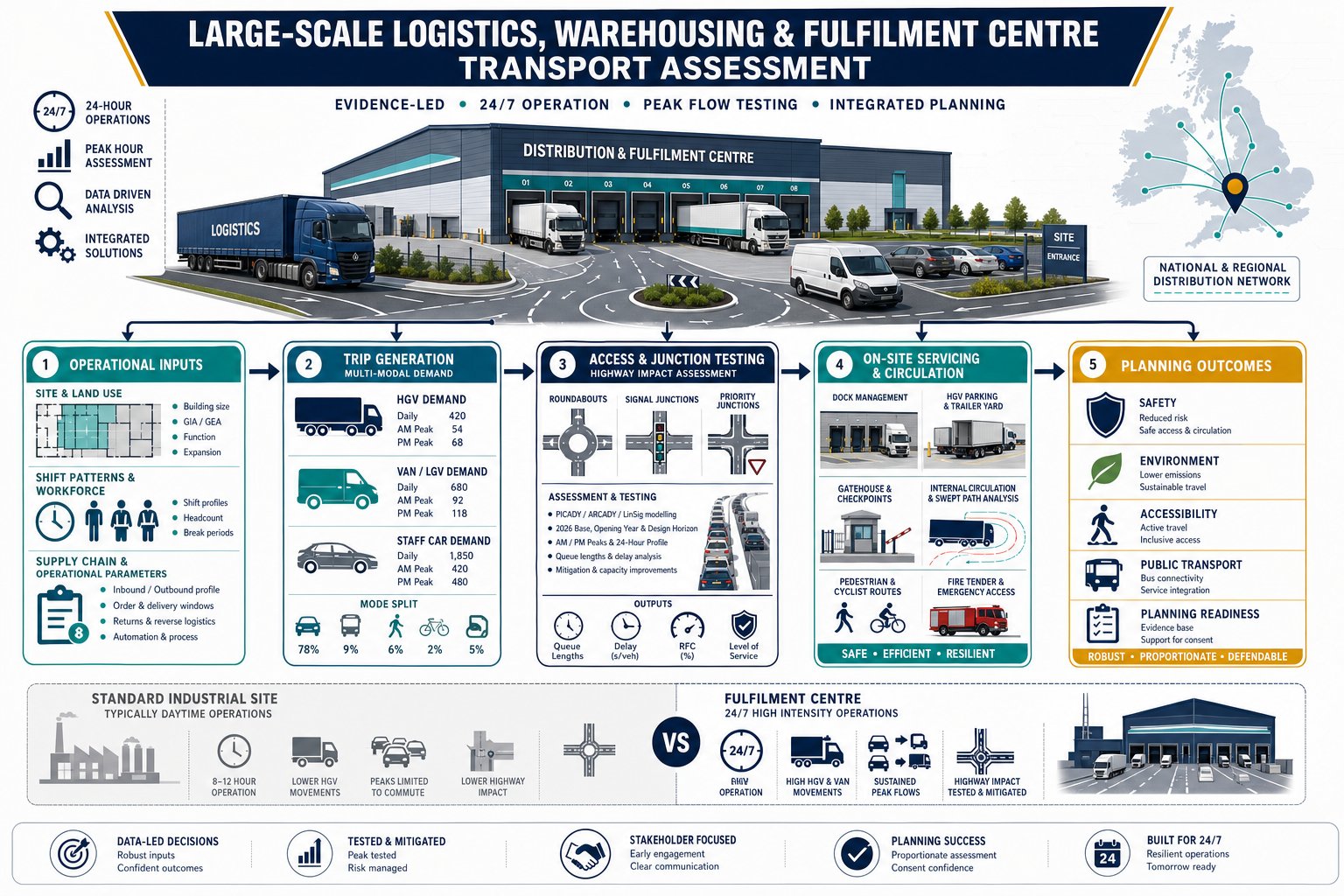
Large logistics and fulfilment schemes rarely fail at planning because the warehouse is too small or the cladding colour is wrong. More often, trouble starts on the road network: a queue that backs into a roundabout, an access design that doesn’t work for artics, a shift pattern that was never properly reflected in staff arrivals, or a local authority unconvinced that the site can operate safely at 3am as well as 3pm.
That is why a Large-Scale Logistics, Warehousing and Fulfilment Centre Transport Assessment needs to be far more than a standard planning appendix. For architects, planners, lawyers, surveyors, developers and councils, it is the evidence base that shows how a scheme will function in the real world, not just on a red-line plan. It has to quantify HGV, van and staff movements, test junction impacts, explain servicing logic, and address the practical questions decision-makers nearly always ask.
In 2026, that task is getting more exacting. E-commerce demand remains volatile, automation is changing operating profiles, and local planning authorities are increasingly alert to night-time activity, environmental effects and employee accessibility. We’ve seen that the strongest submissions are the ones scoped early, built around the actual operation, and tailored to local thresholds rather than copied from a generic industrial template.
The sections below break down what planning teams need to get right, where logistics assessments differ from ordinary employment schemes, and the mistakes most likely to slow down consent.
Key Takeaways
- A Large-Scale Logistics, Warehousing and Fulfilment Centre Transport Assessment must provide detailed, evidence-led analysis of how the site connects with and impacts the local transport network, beyond a basic planning appendix.
- Such assessments need to reflect the unique intensity, timing, and physical layout of logistics schemes, including sustained HGV flows, non-traditional peak hours, and precise vehicle manoeuvring requirements.
- Early scoping with local authorities is essential to define study areas, assessment years, and modelling approaches, ensuring the transport assessment aligns with local thresholds and concerns.
- Accurate operational data including floorspace, shift patterns, vehicle types, and on-site circulation is critical to generate credible trip profiles and test access and junction capacity effectively.
- Sustainable travel plans must be realistic and tailored to staff accessibility challenges unique to out-of-centre logistics sites, incorporating feasible measures like shuttle services, cycle infrastructure, and shift coordination.
- Coordination among planning, architecture, highways, and operations teams from the start avoids inconsistencies, making the transport assessment a proactive tool to design safer, efficient, and easier-to-consent logistics developments.
What A Transport Assessment Covers For Logistics And Fulfilment Developments
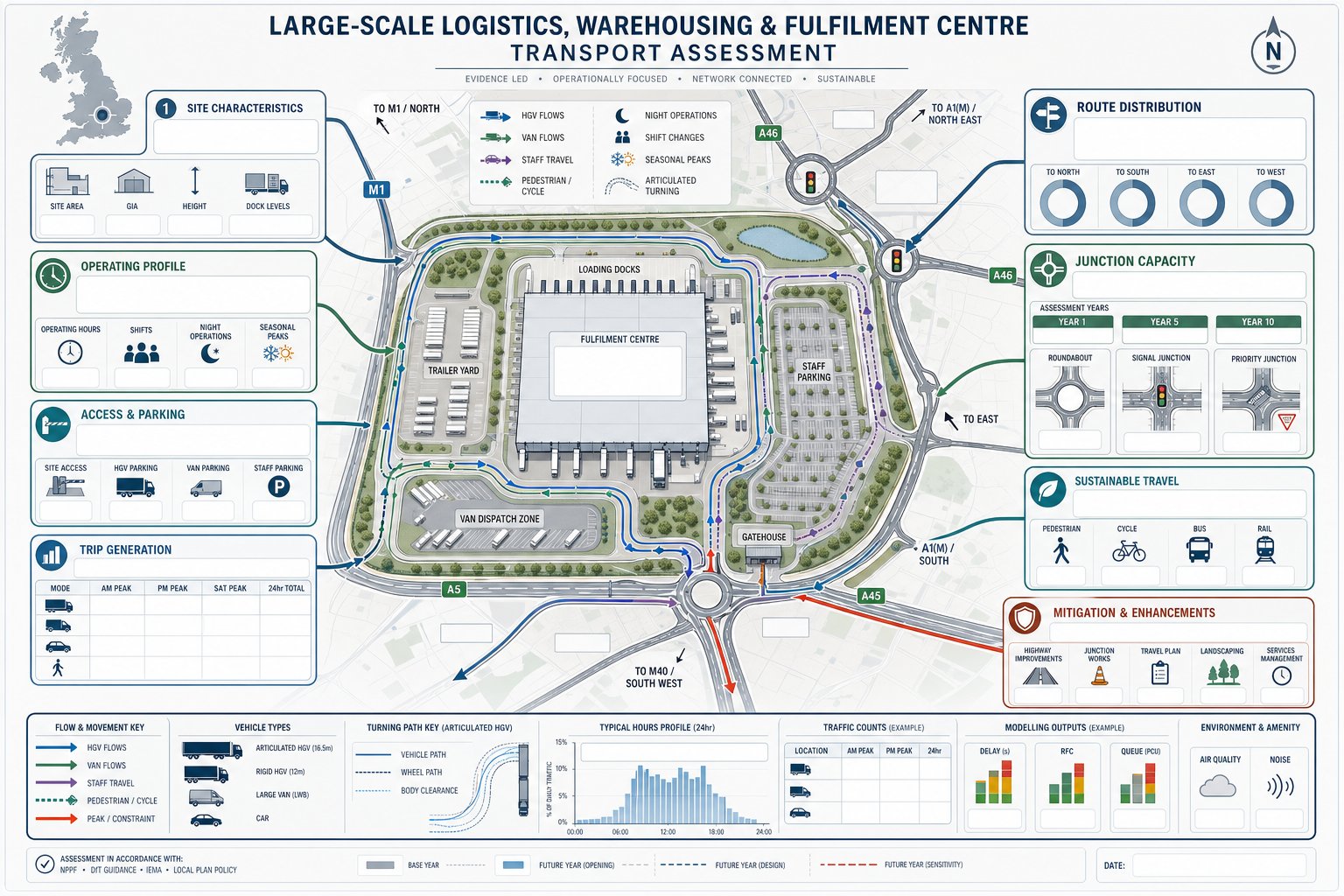
A transport assessment for a major logistics or fulfilment proposal should explain one simple thing in rigorous detail: how the development will connect to, use and affect the surrounding transport network. In practice, that means much more than counting vehicles.
A robust submission normally covers the proposed floorspace, use, hours of operation, staffing numbers, shift patterns, access arrangements, parking strategy, servicing, internal layout, trip generation, distribution by route, junction performance and sustainable travel opportunities. It should also set out the study area, baseline conditions, committed development assumptions and the years being assessed. If the site is sensitive, the TA often sits alongside wider technical work on safety, air quality, noise or an environmental impact assessment.
For planning teams, the key point is that the TA is not only descriptive: it is evidence-led. It should demonstrate whether the proposed access works, whether nearby junctions can accommodate traffic, whether staff can realistically reach the site, and what mitigation is needed if impacts arise. That usually includes drawings, traffic data, modelling outputs, swept path checks and a clear narrative linking the operation of the building to movement on and off site.
Done properly, it becomes a decision-making document rather than a box-ticking exercise.
How These Schemes Differ From Standard Industrial Or Commercial Sites
Large logistics parks and fulfilment centres behave differently from ordinary industrial estates, and the TA has to reflect that reality. The first difference is intensity. A conventional business park might generate commuter peaks with relatively modest servicing demand. A fulfilment centre can generate sustained HGV flows, concentrated van dispatch activity, shift changes outside traditional peak hours, and operational movements that continue through the night.
The second difference is timing. Parcel activity often spikes in the evening, while inbound trunking may occur very early or very late. Seasonal pressure can be dramatic too, particularly in the run-up to Christmas or during retail events. Using broad industrial trip rates without interrogating the operating model is one of the quickest ways to undermine credibility.
The third difference is physical layout. These sites need large yards, dock provision, trailer storage, circulation space and access geometry that can cope with regular articulated vehicle movements. In many cases, automation changes labour demand but increases delivery precision and dispatch frequency.
So while the principles of a TA are familiar, the content has to be logistics-specific. That is where a generalised transport assessment for methodology needs adapting to the operational complexity of B8 and fulfilment-led schemes.
When A Full Transport Assessment Is Likely To Be Required
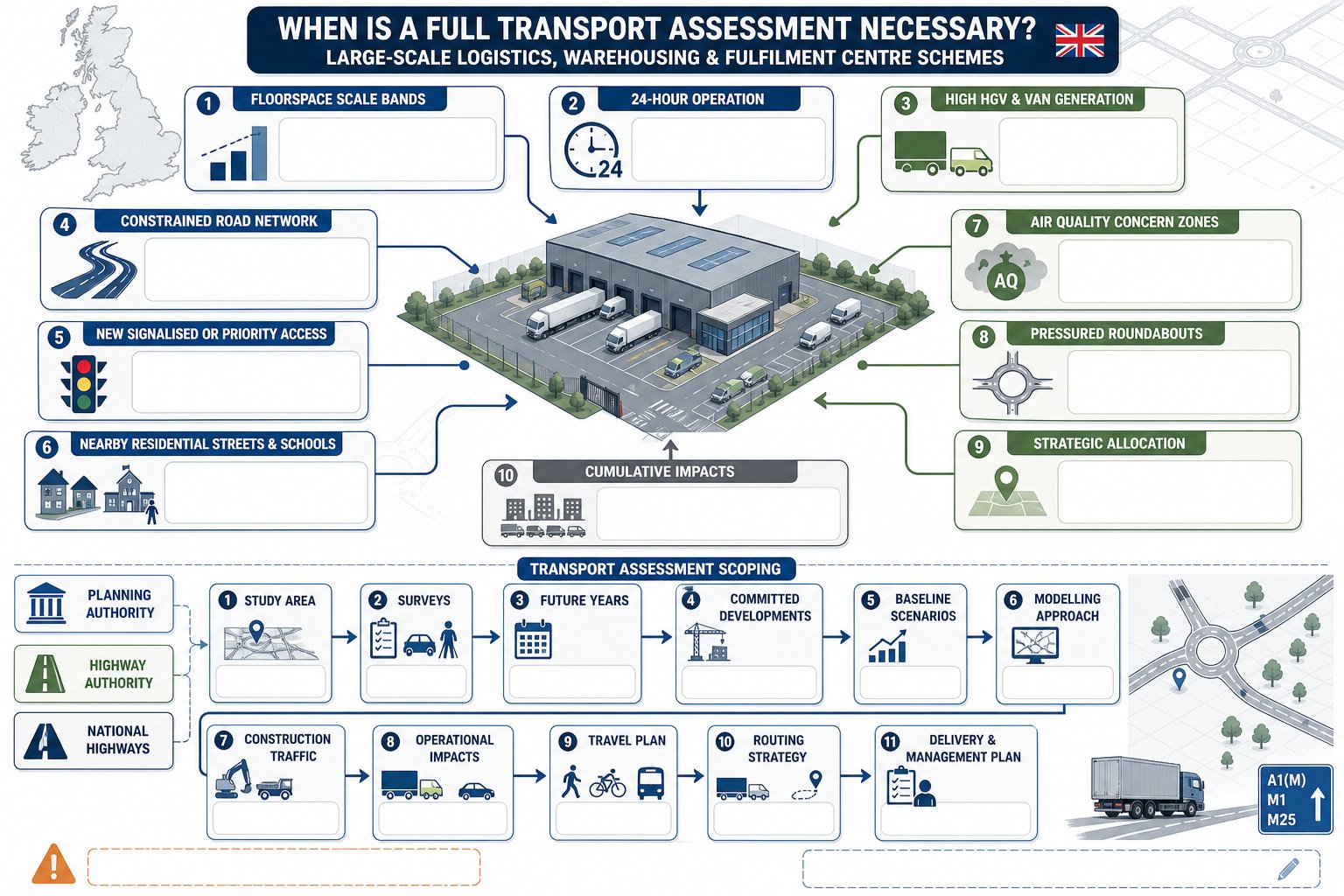
For large-scale logistics proposals, a full TA is often expected rather than optional. Exact thresholds vary by authority, but once a scheme reaches substantial warehouse floorspace, often somewhere from around 5,000 to 10,000 square metres upward, planning teams should assume that transport evidence will be scrutinised closely. And floorspace alone is not the whole story.
A smaller scheme may still trigger a full assessment if it proposes 24-hour use, sits on a constrained road network, relies on a new priority or signalised access, or is expected to generate material HGV and van traffic. Authorities are particularly alert where a site connects to already pressured roundabouts, passes near residential streets, schools or air quality management areas, or forms part of a wider strategic allocation where cumulative effects matter.
National guidance still points toward proportionality, but “proportionate” for a fulfilment centre usually means substantial technical work. The likely questions are predictable: what traffic comes when, by what vehicle type, along which routes, and with what effect on safety, operation and amenity? If the answers are not obvious from the application, a fuller TA becomes necessary.
In practice, teams save time by assuming detailed assessment early rather than trying to backfill evidence after consultation comments land.
Typical Planning Triggers, Local Authority Expectations, And Scoping
The best logistics TAs begin with scoping. Before surveys are commissioned and modelling starts, it is worth agreeing the broad rules of the exercise with the local planning authority and, where relevant, the highway authority or National Highways. That early step can settle the study area, survey locations, future assessment years, committed developments, baseline scenarios and modelling approach.
Typical triggers include local plan thresholds for B8 warehousing, departures from normal operating hours, high employee numbers, substantial HGV routing implications and the need for off-site highway works. Authorities also commonly expect sensitivity to local context: junctions that may look acceptable on a plan can become highly contentious if they are known pressure points in practice.
Scoping should also clarify whether the TA needs to address only operational impacts or construction traffic as well, and whether a framework Travel Plan, routing strategy or delivery management plan will be expected. On complex sites, we find an end to end transport approach avoids the familiar problem of transport, architecture and servicing being designed in parallel but not quite agreeing with each other.
One small but important point: agree assumptions in writing where possible. It is much easier to defend a planning submission when the scope was discussed upfront rather than inferred afterwards.
Core Development Information Needed At The Start
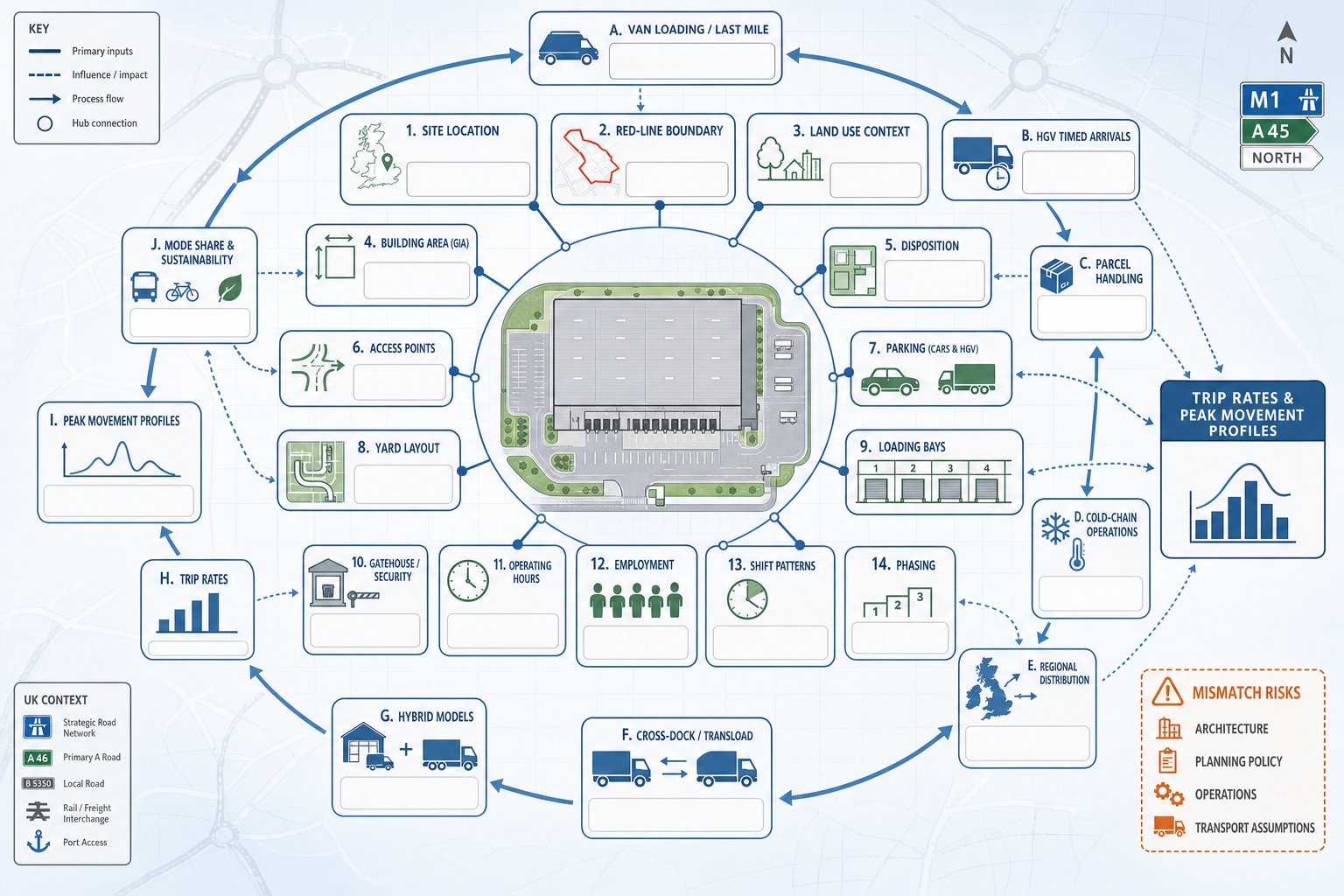
Transport work on logistics schemes becomes inefficient very quickly when the basic operational brief is vague. A credible TA needs accurate inputs from the outset, and not just headline floorspace.
At minimum, the assessment team should have the site location, red-line boundary, proposed use, gross internal or external areas as relevant, building disposition, access points, parking provision, yard layout, loading arrangements, gatehouse strategy, operating hours, forecast employment and shift structure. If the site will be phased, that phasing needs to be explicit. If occupiers are not yet known, the team still needs a realistic parameter-based operating scenario.
This is where many applications wobble. Architects may be developing a building envelope while the planning team refers to one staffing assumption and the transport team models another. Meanwhile, the operational adviser is talking about trailer storage numbers that do not fit the yard. Those mismatches are avoidable, but only if the project team treats movement planning as core design information rather than a later report-writing exercise.
We also need to know how the site is meant to function day to day. Are vans loaded on site or dispatched from elsewhere? Will HGVs arrive on timed slots? Is the operation parcel-led, ambient storage, cold-chain, regional distribution, cross-dock or something hybrid? Those details directly shape trip rates and peak profiles.
For applicants aiming to move quickly, experienced Transport Assessment Consultants: usually add most value right here, when the factual brief is still forming rather than after layouts have hardened.
Trip Generation, Operating Profiles, And Peak Activity Patterns
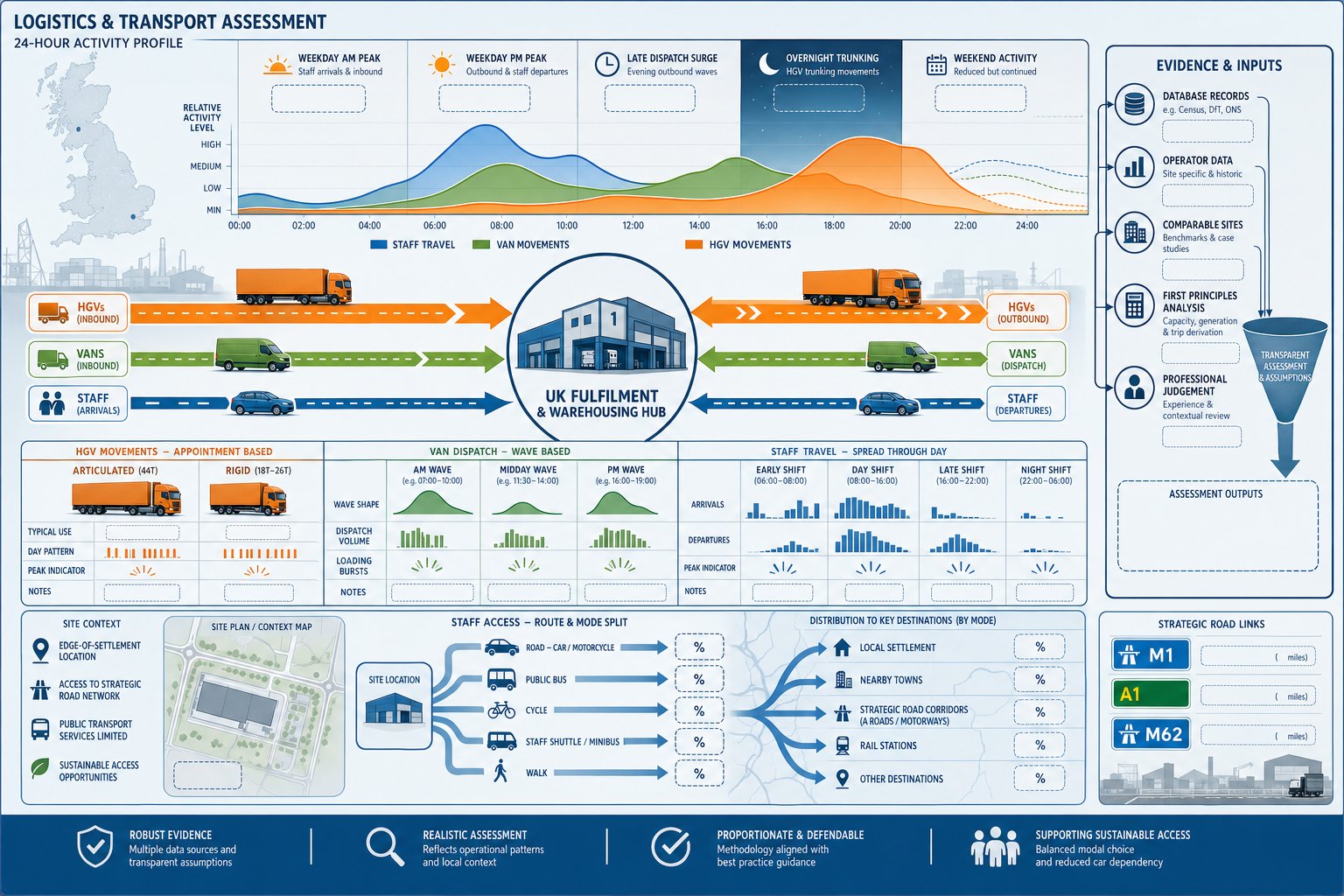
Trip generation is where a logistics TA either starts to feel site-specific or falls into generic guesswork. A serious assessment should break demand down by vehicle type, hour and direction of travel, and it should reflect the operational profile of the proposed use rather than broad industrial averages.
For many large warehousing and fulfilment schemes, weekday AM and PM highway peaks are only part of the story. Dispatch and returns activity can intensify later in the day. Some sites experience strong overnight trunking. Weekend operations may be almost as important as weekdays, especially in e-commerce-led fulfilment. Seasonal peaks can also be material, even if the core TA is based on neutral conditions.
The evidence base for trip generation may include TRICS where suitable, but for specialised logistics proposals it often needs supplementing with operator data, comparable sites, first principles analysis and professional judgement. Planning teams should not be nervous about that. Authorities are generally more persuaded by transparent, reasoned logistics evidence than by a generic database selection that clearly does not match the use.
The output should be intelligible: what trips occur, when they occur, how they split by mode and route, and which periods should be tested in capacity assessments.
HGV, Van, Staff, And Shift-Based Travel Demand
Separating demand streams is essential. HGVs, vans and staff do not behave the same way, and combining them into a single hourly total often hides the issue everyone actually cares about.
HGV assessment should distinguish articulated and rigid vehicles where relevant, identify inbound and outbound flows, and explain whether movements are appointment-based, wave-based or spread through the day. Van activity may have sharp dispatch peaks tied to order cut-offs and route departures. Staff demand is usually linked to shift starts and finishes, with overlap periods that can create short bursts of parking and access pressure.
Then there is mode share. On edge-of-settlement logistics sites, staff travel can be heavily car-dependent unless bus provision, shuttle links, cycling infrastructure and shift timing are genuinely workable. Assuming optimistic walking and bus mode shares without evidence tends to invite challenge. A better approach is to start with realistic accessibility conditions, then show what demand management transport: measures could improve outcomes over time.
The strongest TAs also explain non-standard peaks plainly. If the operational peak does not coincide with the network peak, say so and test both where needed. That sounds obvious, but it is still missed surprisingly often.
Access Strategy, Junction Capacity, And Highway Impact Testing
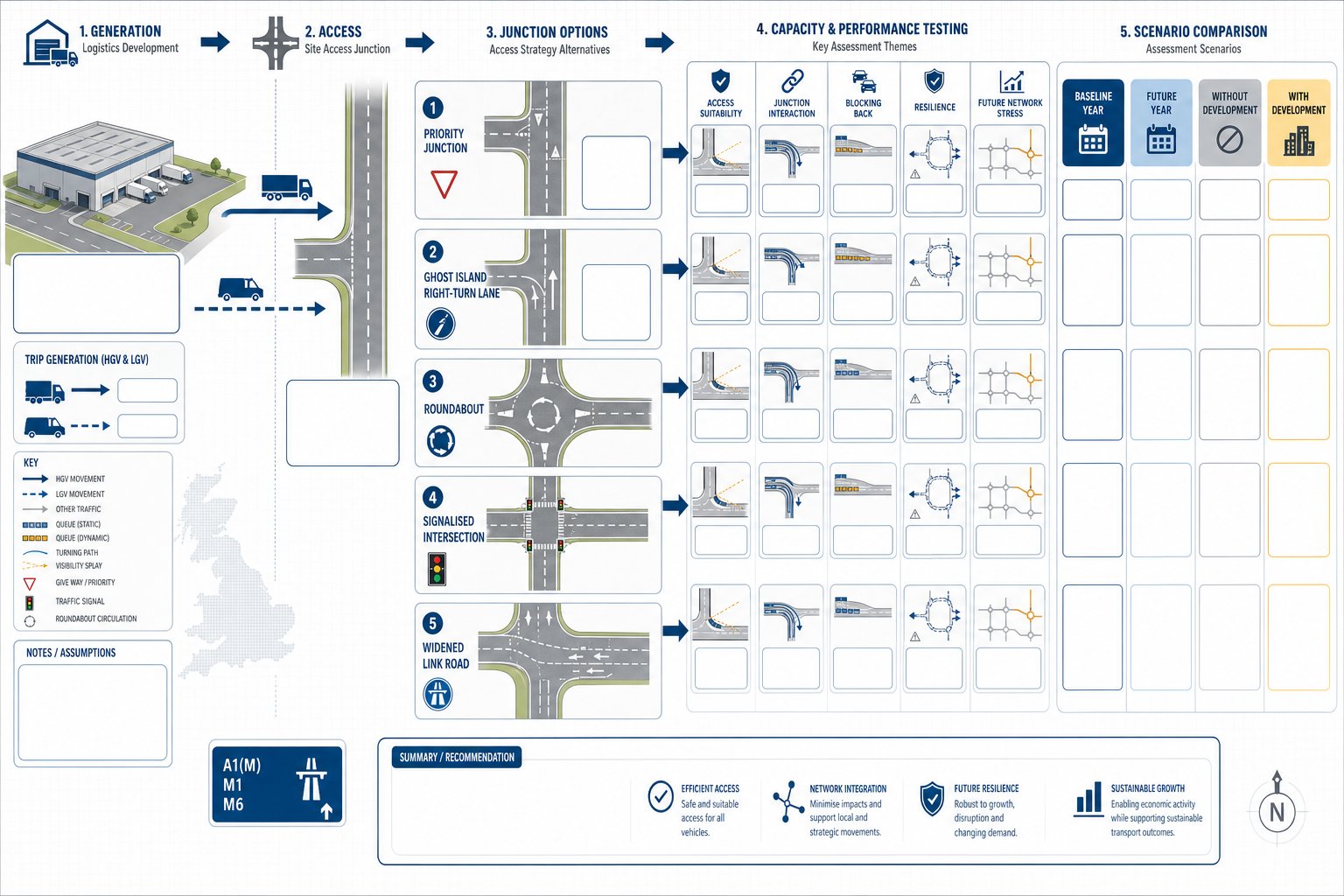
Once trip generation is established, the next question is whether the network can accommodate it. That begins with access strategy. Planning teams need to show that the proposed access arrangement is appropriate for the scale and type of traffic expected, that visibility and geometry are suitable, and that the design aligns with the function of the host road.
For logistics sites, access design is rarely a minor detail. A priority junction may be adequate in one location and wholly unsuitable in another. Ghost islands, roundabouts, signal control, lane widening or link improvements may all be on the table depending on traffic volumes, speed environment and turning patterns. If the site sits close to an existing junction, interactions between queues and turning traffic have to be thought through carefully.
Capacity testing should focus on the junctions and links that are genuinely likely to experience material change, including cumulative effects where committed development is relevant. That usually means comparing baseline and future scenarios, with and without development, and assessing practical operation rather than simply quoting a ratio or reserve capacity figure. Queue length, blocking back and resilience matter.
Where modelling is required, the chosen tool should fit the junction type and local authority expectations. In many cases, Junctions 11 Software remains central to that process, but software outputs are only as reliable as the assumptions behind them.
A good TA does not stop at “impact is acceptable”. It explains why.
Servicing, Yard Management, Swept Path Analysis, And On-Site Circulation
For a fulfilment centre, internal operation is part of transport planning, not a separate afterthought. Local authorities may focus heavily on off-site traffic, but if the yard cannot function safely and efficiently, the problems tend to spill back onto the public highway sooner or later.
A robust TA should hence explain how HGVs, vans, staff cars, visitors and emergency vehicles move through the site. That includes access control, waiting space, security checks, dock allocation, trailer parking, one-way systems, reversing policy, turning areas and any segregation between pedestrian and vehicle routes. Gatehouse queues deserve particular attention: if they can extend to the site entrance, the effect is immediately a highway concern.
Swept path analysis is fundamental. It should test the largest design vehicles likely to use the site at all constrained points: the access, internal bends, dock approaches, service yards and any emergency routes. Too often, applications provide a technically possible movement that is not operationally comfortable. Drivers need realistic tolerance, not perfect choreography.
Yard management also needs narrative detail. How many dock doors are active at peak times? Is trailer storage static or dynamic? Are vans marshalled on site? What happens when arrivals are early? These operational questions can make the difference between a smooth planning process and a long round of revisions.
On big sites, transport strategy and layout planning need to function almost as one discipline.
Sustainable Travel, Staff Accessibility, And Travel Plan Measures
Sustainable travel can feel awkward on remote logistics sites, but that is exactly why it needs proper attention. A weak accessibility case is now one of the most common pressure points in planning discussions for major warehousing proposals, especially where large workforces are expected across early, late or night shifts.
The first task is to assess what access actually exists. Walking catchments, cycle routes, nearby bus services, rail links, crossing points, footway continuity and personal safety conditions all matter. Then we need to test those options against shift times. A bus route that looks acceptable on a daytime plan may be useless for a 5am start or an 11pm finish.
The Travel Plan should be practical rather than aspirational. That might include staff shuttle services from nearby stations or town centres, car-sharing systems, secure cycle parking, lockers and showers, discounted public transport, shift coordination with bus operators, EV charging, and targeted monitoring. For some schemes, phased interventions are sensible: start with realistic baseline mode share, then commit to measures that can scale with occupancy.
There is no point borrowing sustainable transport language from a town-centre office development. Logistics staff accessibility needs a tailored response grounded in actual labour catchments and operational patterns. The same thinking that supports Residential Development Transport or mixed urban schemes does not automatically transfer to an out-of-centre fulfilment park.
Authorities can accept challenges here, but only if the application is candid and solutions-focused.
Environmental, Safety, And Amenity Issues Often Reviewed Alongside Transport
A logistics TA does not sit in isolation. On many applications, transport findings feed directly into wider planning concerns about noise, air quality, carbon, lighting, road safety and residential amenity. Sometimes those topics are covered in separate reports: sometimes they are cross-referenced. Either way, the transport evidence needs to be consistent with them.
Noise is a classic example. If the TA shows regular night-time HGV arrivals, reversing alarms, trailer movements or van dispatch peaks, that operational pattern may have consequences for acoustic assessment and layout design. Air quality can also become sensitive where a site adds traffic to congested corridors or affects receptors close to access routes. Routeing assumptions hence matter beyond the highway chapter.
Road safety deserves careful treatment too. Collision data, access visibility, pedestrian crossing demand, cycle conflict points and the behaviour of large vehicles near local streets should all be considered. For sites near settlements, amenity concerns often focus not just on volume but on character: people may tolerate additional traffic more readily than repeated HGV movements at unsocial hours.
Where a proposal forms part of a larger planning package, consistency with the wider environmental impact assessment narrative is crucial. Contradictions between reports are surprisingly common, and objectors notice them fast.
The practical lesson is simple: transport assumptions should be shared early across the consultant team, not copied across at the end.
Common Mistakes In Planning Applications For Logistics Sites
Most weak logistics TAs do not fail because the authors do not understand transport. They fail because the development has been treated as a generic warehouse instead of a specific operation.
One common mistake is relying on standard B8 or industrial trip rates that understate HGV or van intensity. That may look neat in a spreadsheet, but it quickly unravels if the occupier model is parcel-led, time-critical or 24/7. Another is assessing only traditional highway peaks and ignoring the actual operational peaks that drive yard pressure, gatehouse queues or local amenity concerns.
We also see layouts advanced too far before vehicle tracking has been done properly. Then the project team discovers that dock approaches are tight, trailer storage is insufficient, or staff parking conflicts with service circulation. At that stage, fixes are possible, but they are slower and usually more expensive.
A further weakness is overpromising on sustainable travel. Authorities are increasingly sceptical of optimistic mode shares unsupported by local conditions, particularly on edge-of-town sites with sparse public transport. Better to present a grounded baseline with targeted improvement measures than a glossy but brittle narrative.
And finally, there is the coordination problem. If planning, architecture, highways and operations are not aligned, inconsistencies creep in everywhere. That is why logistics schemes benefit from a genuinely integrated end to end process rather than a late-stage report assembled from half-settled assumptions.
Conclusion
A successful transport assessment for a large logistics, warehousing or fulfilment scheme has to do more than satisfy a validation checklist. It needs to show, convincingly and in operational terms, that the proposal can function on site and within the wider network without unacceptable effects.
In 2026, the schemes that move more smoothly through planning are usually the ones built around realistic logistics evidence: clear trip profiles by vehicle type, honest treatment of shift and night-time activity, well-tested access and junction performance, workable yard circulation, and a staff accessibility strategy that reflects how people actually travel. Get those elements right early, and the TA becomes a tool for design and decision-making rather than damage control.
For planning teams, that is the real opportunity. A logistics-specific assessment does not just answer objections after they appear: it helps shape a scheme that is safer, more efficient and easier to consent in the first place.
Frequently Asked Questions about Large-Scale Logistics Transport Assessments
What is a Large-Scale Logistics, Warehousing and Fulfilment Centre Transport Assessment?
It is a detailed evidence-based report explaining how a logistics or fulfilment centre will generate and manage transport impacts, covering vehicle trips, access design, junction capacity, staffing shifts, and sustainable travel measures to support planning applications.
Why do logistics transport assessments differ from standard industrial site assessments?
Logistics centres involve higher HGV and van activity, operate often 24/7, have complex shift patterns, and require specialized yards and access designs, making their transport assessments more detailed and specific than typical industrial sites.
When is a full Transport Assessment usually required for a logistics development?
A full Transport Assessment is typically needed for logistics sites with floorspace over around 5,000 to 10,000 m², especially if they have 24-hour operations, sensitive access points, or generate substantial HGV and van traffic affecting local highway networks.
How does a Transport Assessment address shift patterns and peak transport demand for fulfilment centres?
It separates vehicle and staff trip profiles by time and type, capturing peaks outside traditional rush hours, including night-time and seasonal variations, to accurately reflect operational realities and impacts on the transport network.
What role does swept path analysis play in logistics transport assessments?
Swept path analysis verifies that large vehicles like articulated HGVs can safely manoeuvre through access points, loading docks, and yards, ensuring that internal circulation and vehicle movements are realistically accommodated in the site design.
How are sustainable travel and staff accessibility managed in logistics transport assessments?
Assessments evaluate actual walking, cycling, and public transport availability relative to shift times, proposing practical Travel Plan measures such as shuttle buses, car-sharing, and cycling facilities tailored to off-peak shifts and remote locations.