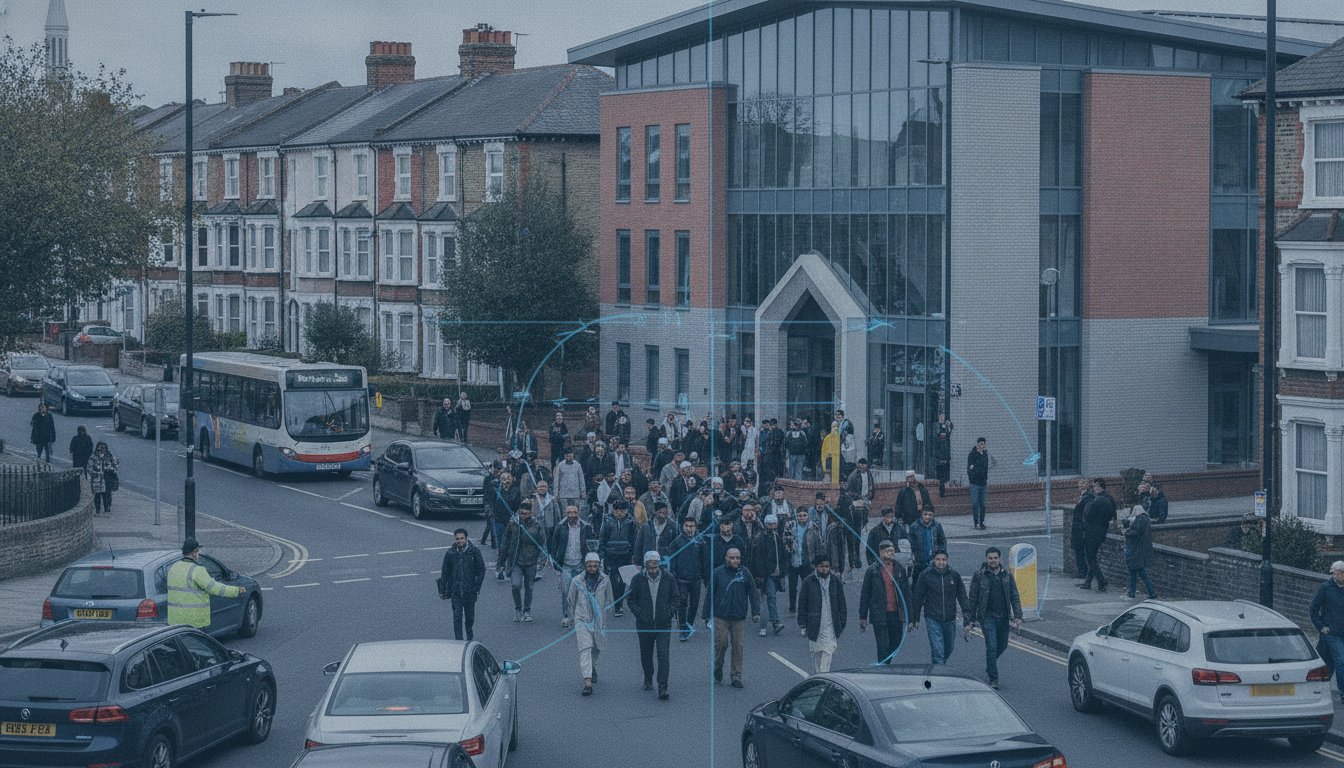
Why do so many mosque planning applications fail even when the architectural design is perfect? The answer usually lies in the Highway Authority’s concerns regarding the “Friday peak” and its impact on the local road network. It’s a common frustration for community leaders who face rejection because of perceived traffic congestion or parking overspill. Securing approval requires more than just a standard traffic report; you need a specialized mosque transport assessment that addresses the unique, concentrated arrival patterns of worshipers.
We understand that navigating the National Planning Policy Framework and specific local validation guidance is a high-stakes challenge. You’re likely concerned about how to justify parking requirements in high-density areas or how to prove that Jumu’ah prayers won’t cause gridlock. This guide provides a clear roadmap to help you secure planning permission with minimal delays. We’ll explain how to use site-specific parking beat surveys and classified turning counts to build a robust case for your development. You’ll learn how to implement practical mitigation measures, such as volunteer stewarding and formal Travel Plans, that satisfy regulators and ensure the safety of the surrounding community.
Key Takeaways
- Understand the statutory requirements under the NPPF that make a professional mosque transport assessment essential for securing planning permission.
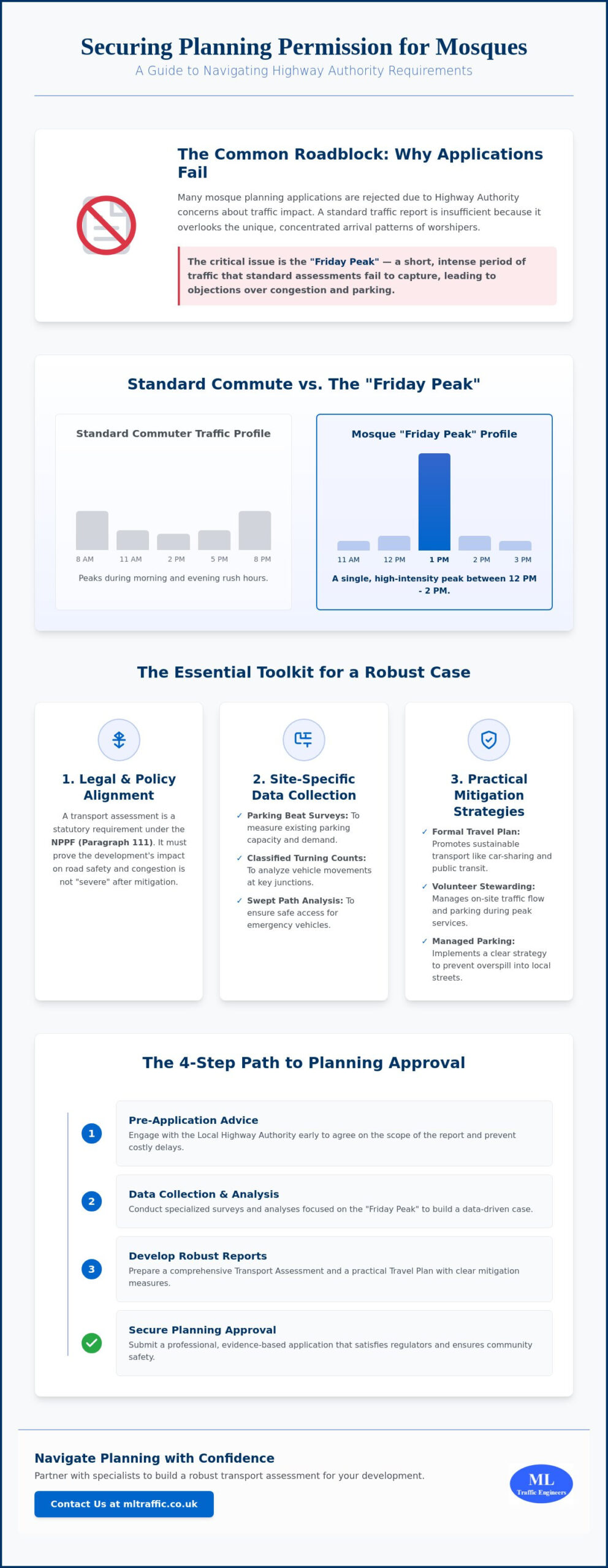
- Identify why the “Friday Peak” between 12 PM and 2 PM is the critical window for traffic analysis rather than standard commuter hours.
- Learn how to use Parking Surveys and Swept Path Analysis to provide the technical evidence required by Local Highway Authorities.
- Discover how a robust Travel Plan can mitigate community concerns through managed car-sharing and sustainable transport initiatives.
- Gain strategies for navigating complex negotiations with planning officials to avoid costly delays and project rejections.
What is a Mosque Transport Assessment in the UK Planning Process?
A mosque transport assessment is a specialized technical report that evaluates how a proposed place of worship will affect the local highway network. It’s a statutory requirement under the National Planning Policy Framework (NPPF) for any new build or significant extension that generates substantial movement. This document provides the Highway Authority with the data they need to judge if the local roads can handle the influx of worshipers safely. Without this evidence, planning applications for religious buildings often face immediate rejection due to concerns over traffic congestion and pedestrian safety.
A transport planning consultant bridges the gap between the community’s needs and the council’s strict regulatory expectations. They don’t just calculate vehicle numbers; they translate religious practice into technical data. This process follows the UK’s approach to transport appraisal, which focuses on safety, environmental impact, and accessibility. Depending on the size of the project, you might need a full assessment or a simplified Transport Statement. Smaller sites with lower footfall typically qualify for a statement, while larger regional hubs require the exhaustive detail of a full Transport Assessment.
To better understand how transit planning affects local accessibility, watch this helpful video:
When is a Mosque-Specific Assessment Required?
In England, thresholds for these reports are usually set by local planning authorities. Generally, any development exceeding 500 to 1,000 square meters will trigger a formal report. However, even small projects often require technical scrutiny during change-of-use applications. Converting an existing office or retail unit into a place of worship (Class F1) fundamentally shifts the traffic profile of a residential street. It’s vital to seek pre-application advice from the Local Highway Authority to agree on the scope of the report early. This proactive step prevents expensive delays and ensures the data collected meets specific council standards.
The Legal Framework: NPPF and Local Transport Policies
Paragraph 111 of the NPPF serves as the primary legal benchmark for planning decisions. It dictates that development should only be refused on highways grounds if there’s an unacceptable impact on safety, or if the residual cumulative impacts on the road network would be severe. In 2026 planning terms, residual cumulative impact is the total remaining pressure on local infrastructure after all physical and operational mitigation strategies have been fully implemented. A professional mosque transport assessment must align with regional parking standards, such as those found in the London Plan, which often prioritize public transport over private car use to reduce urban congestion.
Identifying Specialized Peak Hours for Religious Developments
Standard traffic models often fail to capture the operational reality of religious buildings. While a typical office or retail unit sees peaks during the morning and evening commute, a mosque operates on a unique temporal cycle. A robust mosque transport assessment must account for these specific surges to satisfy local highway authorities. If an assessment only analyzes the standard 8-9 AM and 5-6 PM windows, it ignores the moments of highest impact, leading to inevitable planning objections.
The “Friday Peak” occurring between 12 PM and 2 PM represents the most significant stress test for the local highway network. This short, high-intensity window involves concentrated arrivals and departures that don’t align with standard network peaks. Beyond the weekly Jumu’ah prayers, we must also analyze seasonal peaks. Ramadan evening prayers (Taraweeh) and the biannual Eid festivals create massive, short-term surges. Additionally, weekday Madrasa sessions, usually between 4:30 PM and 6:30 PM, often coincide with the evening rush hour, requiring careful management of drop-off and pick-up activity in residential areas.
TRICS Database and Faith-Based Trip Generation
To forecast traffic volume, we utilize the TRICS database to select comparable sites based on size, location, and PTAL (Public Transport Accessibility Level) ratings. You can find more technical detail on what is the TRICS Database in our resource center. We align our data collection with the UK government’s official guidance to ensure the methodology withstands technical scrutiny from council officers. It’s not enough to use generic data; we must adjust these figures to reflect the specific demographic and travel habits of your congregation.
Modal Split Analysis
Understanding how worshipers travel is as important as knowing how many arrive. We conduct modal split analysis to determine the percentage of visitors who will arrive by car, bus, foot, or cycle. This isn’t just guesswork. We use empirical evidence from existing local mosques or site-specific surveys to provide a realistic picture of the “catchment area.” If your site has a high PTAL rating, we can often justify lower parking provision by proving that the majority of the congregation lives within walking distance or has access to reliable public transport. If you need help identifying these unique peaks for your project, our team can conduct detailed traffic surveys to provide the necessary evidence.
Critical Data Collection: Parking Surveys and Swept Path Analysis
Establishing a baseline for the local road network requires precise Traffic Surveys. These surveys record current traffic volumes, queue lengths, and junction delays before the mosque project begins. This data is the foundation of any professional mosque transport assessment. It allows us to compare the “with development” scenario against the existing conditions, ensuring that the Highway Authority has a clear picture of the potential impact on local residents.
We follow the official government guidance to ensure all data collection meets rigorous technical standards. This includes conducting parking accumulation surveys to prove whether there’s sufficient on-site or on-street capacity to handle the peak worship times discussed in previous sections. Hard data is the only way to satisfy council officers who are often under pressure from local residents concerned about congestion.
Parking Stress and Accumulation
Measuring parking “stress” involves surveying all available on-street parking spaces within a 200-meter walking distance of the site. We typically apply the Lambeth Methodology, which requires surveys during the day and overnight to determine the “baseline” occupancy. For a mosque, we must also perform these surveys during the Friday Jumu’ah peak. This evidence is vital when justifying “zero-parking” developments in high PTAL areas like Central London, where the council’s policy often discourages private car ownership. By proving that the existing street capacity can absorb the surge without creating safety hazards, we can overcome one of the biggest hurdles to planning permission. This empirical approach replaces speculation with hard data, which is essential for projects in sensitive residential areas.
Vehicle Manoeuvrability (Swept Path)
It’s not enough to show that cars can park; you must also prove that larger vehicles can move. Our Swept Path Analysis Services in London use AutoCAD and AutoTurn software to simulate the movements of refuse trucks and fire tenders. This simulation ensures that these essential services can enter, turn, and exit the site safely without being obstructed by parked cars or narrow access points. Proving that delivery vehicles won’t block the public highway is a non-negotiable requirement for modern planning. Swept Path Analysis provides the technical certainty needed to prove that even the tightest urban mosque sites can accommodate emergency and service vehicle access without compromising local road safety. These detailed technical simulations are a cornerstone of a successful mosque transport assessment, turning potential planning objections into manageable design solutions.
Mitigating Traffic Impact with Effective Travel Plans
While the technical data in your mosque transport assessment establishes the potential impact of the development, a Travel Plan dictates how the site will actually operate. This document serves as a live management tool for promoting sustainable transport and reducing reliance on private cars. For many councils, a robust Travel Plan is the deciding factor that overcomes Highway Authority objections. It demonstrates that the mosque is a proactive neighbor committed to active management rather than passive observation.
Effective mitigation strategies often include car-sharing schemes and “walking bus” initiatives specifically designed for Madrasa students. By organizing groups of children to walk together under supervision, the mosque significantly reduces the volume of individual car trips during the sensitive evening peak. Managing dedicated drop-off and pick-up zones is equally critical. These zones prevent local congestion by ensuring that vehicles don’t idle in the public highway or block residential driveways. Our travel plan consultants specialize in designing these operational frameworks to ensure they’re both practical for the congregation and acceptable to the council.
Soft Measures and Community Engagement
Monitoring and Enforcement
Councils frequently use Section 106 agreements to ensure that travel plans remain effective over the long term. These legal agreements make the implementation of the plan a non-negotiable condition of the planning permission. Regular monitoring through annual travel surveys allows the mosque to track progress against its initial targets and adjust strategies if needed. Modern technology provides efficient ways to manage demand. We often suggest using SMS alerts or dedicated apps to coordinate parking bookings during high-attendance events. This proactive approach proves to the Highway Authority that the mosque has the tools to manage its impact on the local community effectively. If you’re ready to develop a strategy that secures your project’s future, contact us to start your Travel Plan today.
Securing Planning Approval with ML Traffic Engineers UK
Planning permission for religious buildings involves complex regulatory hurdles that can stall even the most well-funded projects. At ML Traffic Engineers UK, we provide the technical authority needed to overcome these obstacles. A professional mosque transport assessment isn’t just a checkbox; it’s a strategic document designed to protect your project’s future. We manage every stage of the process, ensuring that your application meets the stringent requirements of local councils and the Highway Authority. Our engineers don’t just submit reports; we advocate for your project. We understand the specific benchmarks that planning officers use to evaluate applications, allowing us to anticipate and address objections before they become formal roadblocks.
We manage the entire lifecycle of your transport planning needs. This end-to-end approach reduces project risk and ensures that all data is robust enough to withstand public inquiry or planning committee scrutiny. Our comprehensive service includes:
- Site-specific data collection and Traffic Surveys to establish baseline conditions.
- Technical reporting that aligns with current NPPF and regional policy requirements.
- Direct liaison and negotiation with Local Highway Authority officers across England.
- Operational mitigation strategies that satisfy safety and capacity concerns.
Tailored Solutions for Faith-Based Projects
Community and religious hubs have unique logistical needs that standard traffic reports often ignore. ML Traffic Engineers UK has built a track record of securing approvals for complex urban sites by providing bespoke solutions that address specific local concerns. Whether you’re dealing with high-density residential areas or restrictive parking zones, we provide the evidence needed to move forward. Our expertise ensures that your mosque’s operational reality is accurately reflected in the planning data. For developers working within the capital, our Transport Assessment London: 2026 Guide offers essential insights into navigating regional planning success and meeting Transport for London’s rigorous standards.
Get Started with Your Mosque Transport Assessment
Early engagement is the most effective way to avoid costly design changes and planning delays. By consulting with ML Traffic Engineers UK during the initial stages of your project, you ensure that transport considerations are integrated into your site layout from the beginning. This proactive strategy demonstrates professional integrity and a commitment to public safety, which builds trust with local planning officers. We handle the technical negotiations so you can focus on building your community. Contact us today to request a bespoke quote for your mosque transport assessment and take the first step toward a successful planning outcome.
Move Forward with Technical Certainty
Securing planning permission for a place of worship requires a shift from standard traffic modeling to a specialized approach that respects the operational reality of your congregation. By focusing on the Friday peak and utilizing precise data, you provide the technical certainty that local highway authorities demand. A comprehensive mosque transport assessment ensures that every potential objection, from parking stress to emergency vehicle access, is addressed with empirical evidence and practical mitigation strategies.
ML Traffic Engineers UK brings specialized expertise in religious building transport planning to every project we manage. We understand the high stakes involved in community developments and offer the precision and rapid response needed to meet tight planning deadlines. Our team handles the complex regulatory negotiations so you don’t have to worry about technical pushback. Contact ML Traffic Engineers UK for a Professional Mosque Transport Assessment to secure your project’s approval. You’re one step closer to establishing a vital community hub with a partner that values precision, safety, and professional integrity.
Frequently Asked Questions
Do I need a transport assessment for a small mosque extension?
You will likely need an assessment if the extension increases the capacity for worshipers or triggers local planning thresholds. Even small additions can fundamentally change the traffic profile of a residential street. Councils require this data to ensure the increased footfall doesn’t compromise local safety or exceed parking capacity. In many cases, a simplified Transport Statement is sufficient for smaller extensions.
What is the “Friday Peak” and why does the council care about it?
The Friday Peak is the high-intensity window between 12 PM and 2 PM during Jumu’ah prayers. Councils prioritize this window because the concentrated arrival of worshipers creates a unique stress test for the local highway network. A professional mosque transport assessment must prove that this specific surge won’t lead to severe congestion or safety hazards for other road users in the immediate area.
Can we get planning permission for a mosque with no on-site parking?
Yes, securing approval for a car-free mosque is possible if the site has excellent public transport links or high PTAL ratings. You must provide technical evidence through a parking survey to show that local streets can absorb any potential overflow. In high-density urban areas, many councils actually prefer developments that discourage private car use in favor of sustainable travel methods.
How long does it take to complete a mosque transport assessment?
A standard mosque transport assessment typically takes four to six weeks to finalize. This timeline accounts for the specialized data collection required, such as parking beat surveys conducted during Friday prayers or evening Madrasa sessions. We prioritize precision during this phase to ensure the final technical report withstands the scrutiny of the Highway Authority and avoids unnecessary planning delays.
What is the TRICS database and how is it used for religious buildings?
TRICS is the national standard system for trip generation analysis in the UK. We use it to identify comparable religious sites and forecast the number of vehicle and pedestrian movements your specific mosque will generate. This allows us to build a credible traffic model based on established industry benchmarks rather than using generic assumptions that councils might reject.
How does Swept Path Analysis help our mosque application?
Swept Path Analysis uses computer simulations to prove that large vehicles, such as fire tenders and refuse trucks, can safely navigate your site. This is a critical safety requirement for tight urban developments where maneuverability is limited. By showing that emergency services can access the building without obstruction, you remove a major technical hurdle that often leads to planning objections.
Will a Travel Plan really make a difference to the council’s decision?
A Travel Plan is often the deciding factor in a successful application because it demonstrates proactive management of transport impacts. It provides a formal framework for car-sharing, walking buses, and other sustainable initiatives. Councils view a robust plan as a securable commitment to community safety, which helps mitigate concerns about the long-term impact of the development on local infrastructure.
What happens if the parking survey shows high local stress?
If surveys indicate high parking stress, we focus on operational mitigation strategies to manage demand effectively. This might involve implementing staggered prayer times or a managed parking booking system for peak events. We work with you to design practical solutions that satisfy the Highway Authority’s requirements while ensuring the mosque remains accessible and functional for your congregation.

Disclaimer
The content on mltraffic.co.uk, including all technical articles, guides, and resources, is provided for general informational and educational purposes only. It is not intended to constitute professional advice in traffic engineering, transportation planning, development approvals, or any other technical or legal field.
While ML Traffic Engineers makes every reasonable effort to ensure the accuracy, completeness, and timeliness of the information published, we do not provide any warranties or representations (express or implied) regarding its reliability, suitability, or availability for any particular purpose. Any reliance you place on the content is strictly at your own risk.
In no event shall ML Traffic Engineers, its directors, employees, authors, or affiliates be liable for any direct, indirect, incidental, special, consequential, or punitive damages (including, without limitation, loss of profits, data, or business opportunities) arising out of or in connection with the use of, or inability to use, any information provided on this website.
The articles and guides on this site are not a substitute for engaging a qualified, professional traffic engineer to assess your specific project requirements. For tailored advice, compliance assessments, or traffic engineering services, please contact a competent professional.
This disclaimer may be updated from time to time without notice. By accessing or using this website, you agree to be bound by the most current version of this disclaimer.