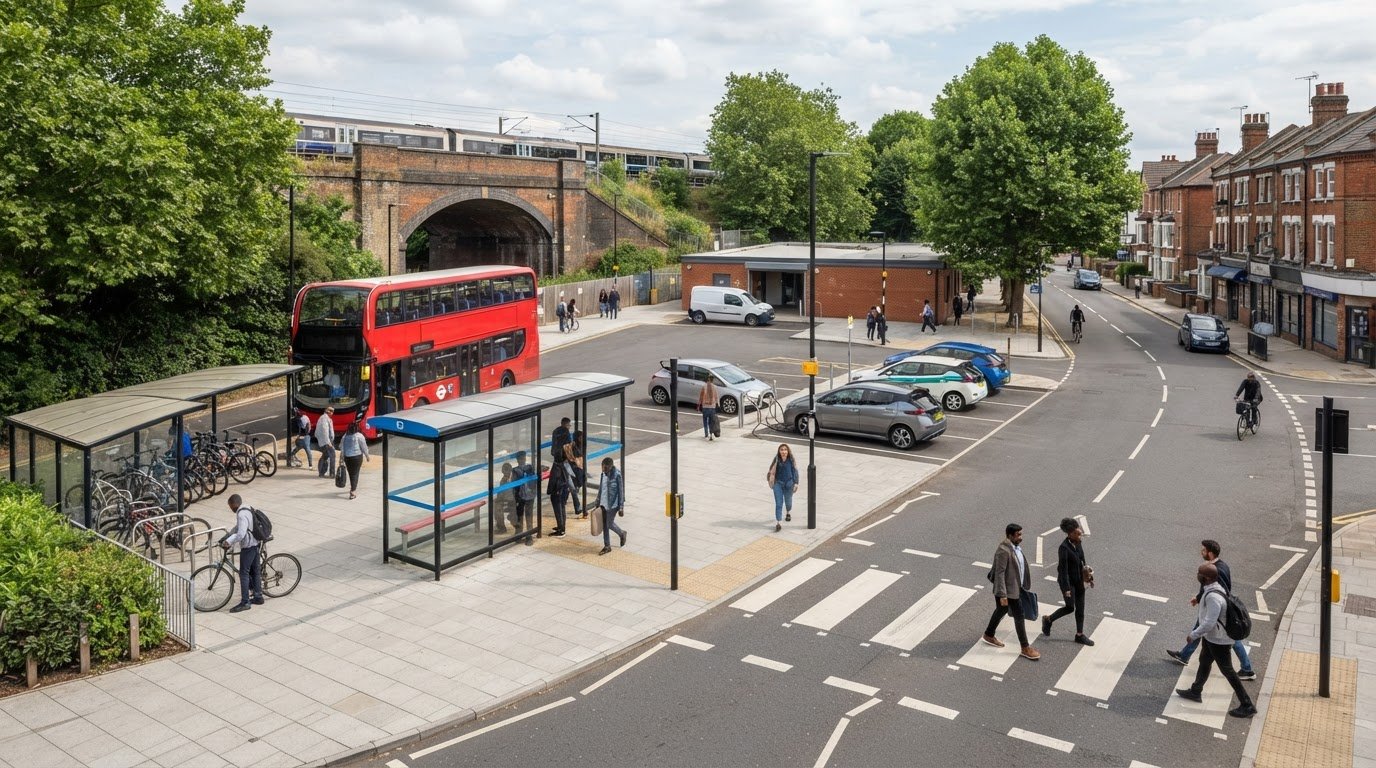
A mobility hub’s transport impact can’t be understood by counting car trips alone. A transport assessment for mobility hub proposals needs to consider how people reach, use and move between its different services, and how those journeys affect the surrounding network.
Scoping a mixed-use destination, forecasting demand across travel modes and understanding local planning and highway authority expectations all take careful thought. The right level of assessment depends on the proposal and its likely impacts, so a clear, evidence-led approach matters from the outset.
This guide explains what a proportionate assessment should examine, including access for people walking, wheeling, cycling and using public transport, vehicle movements, servicing, parking and network effects. It also outlines the project information and survey evidence that can support a credible planning submission. ML Traffic Engineers UK prepares Transport Assessments and can provide traffic and parking surveys and technical analysis to help present a mobility hub’s likely impacts and proposed mitigation clearly to decision-makers.
Key Takeaways
- Scope a transport assessment for mobility hub around the proposal’s uses, location, scale and expected travel demand.
- Build a clear evidence base by combining project details, relevant surveys and justified assumptions to explain likely transport impacts.
- Understand how a Transport Assessment differs from a Transport Statement, and why the local planning authority’s expectations matter.
- Coordinate access, interchange, servicing, cycle provision and parking decisions so the site layout supports connected journeys.
- See how Transport Assessments, traffic and parking surveys, and Swept Path Analysis can support a clear planning submission.
What does a transport assessment for a mobility hub need to establish?
A Transport Assessment explains how a development is likely to affect transport and how its effects will be addressed. For a mobility hub, that means looking beyond the site entrance. The assessment should show how the hub’s services connect with surrounding routes and how people are expected to arrive, transfer and continue their journeys.
Scope the work around the hub’s scale, mix of uses, location and expected travel demand. A hub beside a railway station with shared vehicles and cycle facilities raises different questions from a neighbourhood site combining a bus stop, cycle parking and local services. A general overview of mobility hubs can help explain the concept, but it can’t replace a project-specific assessment.
For a visual introduction to the concept, watch this short video:
Which mobility hub elements can affect travel demand?
Start by defining the scheme. Identify its transport connections, on-site uses and facilities, such as public transport interchange, cycle parking, shared mobility, waiting areas or retail. Consider who will use each element, including people transferring between modes, visitors to on-site businesses, staff and people accessing the hub on foot, by cycle or by vehicle.
Separate existing journeys from new trips generated by the development. Some users may already travel through the area and simply change mode at the hub. Others may make a new journey or visit an on-site use. Opening hours and the hub’s interchange role can affect when people arrive and depart, so assumptions should reflect how the facilities are intended to operate.
Why assess the hub and its surrounding network together?
Map connections between the site and nearby public transport stops, walking and cycling routes, and local streets. Review how people reach the hub, move between its facilities and continue their journey. Consider access and movement beyond the red line where the proposal could affect wider routes, rather than treating the boundary as the limit of its transport influence.
A mobility hub assessment evaluates how the development’s connected services shape journeys to, through and beyond the site, and what those journeys mean for the surrounding transport network. Tailor the report to the proposal and planning context. There’s no single template that can replace proportionate consideration of local conditions and the expectations of the relevant planning and highway authorities.
How should the assessment examine mobility hub travel demand and impacts?
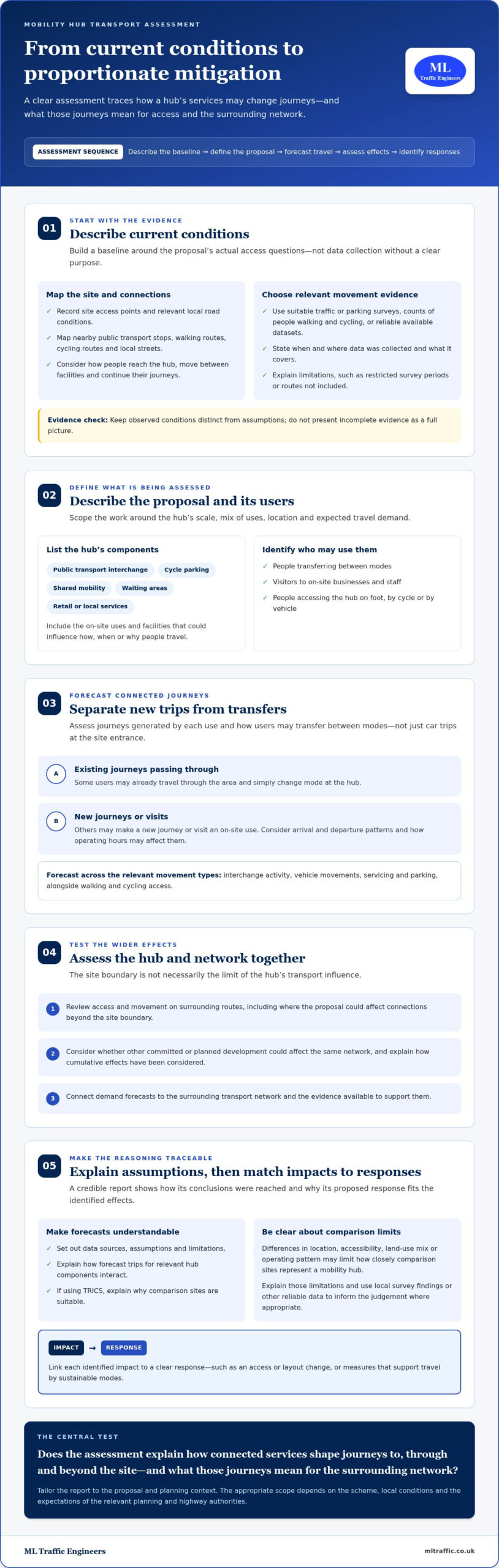
A robust assessment follows a clear sequence: describe current conditions, define the proposal, estimate how it may change travel, assess effects on access and the surrounding network, then identify proportionate mitigation. This makes the reasoning traceable for decision-makers. A transport assessment for mobility hub should consider the journeys generated by each use as well as transfers between modes, rather than treating the hub as a single source of vehicle trips.
The UK Government guidance on Transport Assessments provides a national reference point for assessment scope. The report should also respond to the scheme and its planning context, setting out data sources, assumptions and limitations so readers can follow how conclusions were reached.
What baseline information helps describe the site?
Record site access points and relevant local road conditions, alongside walking and cycling connections and nearby public transport services. Establish existing movement patterns using suitable traffic or parking surveys, counts of people walking and cycling, or reliable available datasets. Choose evidence to answer specific questions raised by the proposal rather than collecting data without a clear purpose.
State when and where data was collected, what it covers and any factors that could affect its representativeness. For example, explain if a count covers only particular periods or excludes a route that may influence access. Documenting limitations helps distinguish observed conditions from assumptions and avoids presenting incomplete evidence as a full picture.
How can the report assess forecast trips and network effects?
Estimate demand for each relevant hub component, then explain how those trips interact. A traveller transferring from a bus to a shared bicycle is different from a new visitor arriving by car to use an on-site facility. Consider arrival and departure patterns, interchange activity, vehicle movements, servicing and parking, as well as walking and cycling access. Where other committed or planned development could affect the same network, explain how cumulative effects have been considered.
Forecasts depend on a proposal’s uses, location and the evidence available to support the assumptions. If TRICS is used, select comparison sites with relevant characteristics and explain why they are suitable. Differences in location, accessibility, land-use mix or operating pattern may limit how closely those sites represent a mobility hub. Set out those limitations and use local survey findings or other reliable data to inform the judgement where appropriate.
Finally, connect each identified impact to a clear response, such as an access or layout change, or measures that support travel by sustainable modes. For project-specific assessment and supporting transport evidence, see ML Traffic Engineers.
When does a mobility hub need a Transport Assessment rather than a shorter report?
There’s no universal trip threshold that determines the right report for every mobility hub. The local planning authority considers the proposal, its likely transport effects and relevant planning guidance. A transport assessment for mobility hub proposals may need to be more detailed where several uses and travel modes interact, but the appropriate scope depends on the site and the evidence needed to explain its effects.
A Transport Assessment generally provides a more comprehensive examination of transport impacts, forecast demand and mitigation. A Transport Statement is a shorter, proportionate report for proposals where a more limited level of analysis is appropriate. For a hub, the distinction isn’t simply the number of facilities. A compact scheme could still raise complex access or interchange questions, while a larger proposal in a well-connected location may present a different evidence task. The report type and scope should reflect the planning context, not a generic template.
Which project characteristics may widen the assessment scope?
Consider the scale and mix of uses, anticipated demand, access arrangements and sensitivity of the surrounding network. A hub bringing together public transport, cycle facilities, shared vehicles and commercial uses can generate linked journeys that need to be explained as one movement pattern. Accessibility belongs in that picture too. Examine how people can reach the site and transfer between facilities, including the continuity of walking routes and the practical relationship between entrances and transport stops.
Authority feedback and local site conditions may also affect what evidence is proportionate. Constrained access, nearby junctions or a proposal connecting with several routes could prompt more detailed analysis than a straightforward site with limited effects.
How do local planning and highway authority expectations fit?
The local planning authority determines the planning information it expects to assess the application. The relevant highway authority may provide technical advice on effects involving roads or transport infrastructure within its remit. Understanding both roles can help shape a clear scope. Current national guidance and local validation requirements should inform the approach for the specific application.
Requirements can differ between Greater London, Manchester, Birmingham, the West Midlands, Liverpool, Surrey, East Sussex, West Sussex, Hampshire, Berkshire and Buckinghamshire because local planning policy, transport networks and authority guidance vary. Don’t assume that an approach accepted in one location will suit another. For wider London planning context, see this Transport Assessment London guide.
For a mobility hub, the practical choice is the report that gives decision-makers enough reliable evidence to understand the scheme’s connected travel effects, without adding analysis that doesn’t help answer a planning question. Shape the scope around the relevant authority guidance and feedback before finalising the assessment approach.
What evidence and design decisions make a mobility hub assessment more useful?
A useful assessment starts with coordinated project information, then tests how the proposed layout works for people and vehicles. Transport questions should inform design from the outset: access, interchange, cycle provision, parking and servicing all compete for space and can affect one another. Reviewing them together helps identify conflicts before the report is finalised.
Which project information should the assessment team review?
Prepare a clear evidence trail from the scheme brief to the assessment conclusions. A practical sequence is:
- 1. Define the proposal. Set out the location, intended uses, facilities, operating arrangements and phasing.
- 2. Share the plans. Provide location plans, site layouts and access drawings that show entrances, cycle facilities, parking, servicing areas and connections to nearby routes.
- 3. Explain travel assumptions. Record available estimates of users, journey types and arrival patterns, noting their source and any limitations.
- 4. Review the evidence. Compare the project information with relevant surveys and available transport data to identify gaps that could affect the analysis.
- 5. Resolve uncertainties. Flag missing inputs early. If assumptions are needed, state them clearly and explain how they influence the assessment’s findings.
This sequence keeps the report grounded in the actual design rather than a generic description of a mobility hub. For related preparation considerations in London, see the Transport Assessment London guide.
How can inclusive access and interchange be assessed?
Trace a complete journey from the surrounding network to the site and between its facilities. Check how people reach entrances from public transport stops, walking and cycling routes, and onward destinations. Consider whether routes are continuous and legible, where crossing points sit, and whether the layout makes transfers straightforward. Include different users’ access needs in this review, rather than treating accessibility as a separate item after the site plan is settled.
Inclusive access is measured by the quality of the complete journey, not just the facilities provided at the hub. A cycle parking area, for example, is less useful if its approach conflicts with servicing movements or leaves a gap in the onward route.
Mitigation should respond directly to the impacts identified in the assessment. It might involve refining access arrangements, improving route connections or adjusting the position of facilities. Explain how each measure addresses a specific issue and ensure it is practical within the proposed design and phasing. To develop a clear, project-specific evidence base, discuss your mobility hub Transport Assessment.
How can ML Traffic Engineers support a mobility hub planning submission?
A clear planning submission needs more than a description of the proposed facilities. It should connect the scheme’s plans and intended uses with relevant transport evidence, explain likely impacts, and show how those impacts have informed the design or mitigation. ML Traffic Engineers prepares Transport Assessments and supporting technical evidence for planning applications, tailored to the proposal and its context.
What can a tailored Transport Assessment bring together?
The work follows a practical sequence: understand the proposal, define the evidence needed, analyse the transport effects, then present findings and responses in a structured report. For a mobility hub, that means assessing the relationship between its facilities and expected journeys, not treating each component in isolation.
Traffic surveys can help describe movement on relevant routes, while parking surveys can provide evidence about existing parking conditions. Where vehicle access or manoeuvrability is a project question, Swept Path Analysis can test vehicle movements against the proposed layout. The appropriate evidence depends on the site and the issues the assessment needs to address.
Bringing these inputs together helps decision-makers follow how the project information and evidence support the assessment’s conclusions. For wider London planning context, see the Transport Assessment London guide.
What are the next steps for a mobility hub proposal?
Organise the current project information before preparing the assessment brief. Useful starting materials include:
- Location and layout plans, including access points and proposed transport facilities.
- A summary of proposed uses, operating arrangements and expected project stages.
- Available information about travel demand, parking, servicing and vehicle access.
- Any existing survey data or relevant discussions with the planning or highway authority.
These inputs help define the assessment scope and identify evidence gaps early. If plans are still developing, share the current version and clearly identify what remains subject to change. The assessment can then reflect the proposal accurately and explain any assumptions used.
ML Traffic Engineers prepares project-specific Transport Assessments for mobility hubs, supported by traffic or parking survey evidence and Swept Path Analysis where relevant. Discuss your mobility hub transport assessment and take the next step towards a clear, evidence-led planning submission.
Prepare a Clear Case for Your Mobility Hub
A credible mobility hub submission explains how the proposal’s uses and transport connections shape journeys, not just what facilities sit on the site. A proportionate transport assessment for mobility hub should draw on suitable evidence, make its assumptions clear and connect forecast impacts to practical mitigation.
Start with the project plans, access arrangements and available travel information, then shape the assessment around the site and relevant authority expectations. Consider how public transport, walking, cycling, servicing and parking work together, including the complete journey for different users. Clear, project-specific analysis gives decision-makers a stronger basis for understanding the proposal.
ML Traffic Engineers prepares Transport Assessments and Transport Statements for planning applications, supported where relevant by traffic surveys, parking surveys and Swept Path Analysis. These inputs help bring the proposal, evidence and transport conclusions together in a focused report.
Ready to progress your planning submission? Discuss your mobility hub transport assessment with ML Traffic Engineers and take the next step with confidence.
Frequently Asked Questions
What is a transport assessment for a mobility hub?
A transport assessment for a mobility hub is a project-specific report explaining how the proposal may affect travel and how those effects can be addressed. It considers the hub’s uses, transport connections, access arrangements and expected journeys, alongside relevant conditions on nearby routes. The report brings evidence and analysis together so planning decision-makers can understand the proposal’s likely impacts and the reasoning behind proposed mitigation.
When does a mobility hub need a Transport Assessment?
The local planning authority determines the transport information expected for an application, based on the proposal, its likely impacts and relevant guidance. There is no single threshold that applies to every mobility hub. Local context matters across Greater London, Manchester, Birmingham, the West Midlands, Liverpool, Surrey, East Sussex, West Sussex, Hampshire, Berkshire and Buckinghamshire. Establish the proportionate scope for the specific site using applicable authority guidance.
What should a mobility hub transport assessment include?
It should set out the proposal and relevant baseline conditions, then assess expected travel demand, access and effects on the surrounding network. Depending on the scheme, evidence may cover walking, cycling, public transport, vehicle movements, interchange, servicing and parking. The report should explain its data sources, assumptions and limitations, then connect identified impacts to practical mitigation. Its scope should reflect the hub’s uses, location and likely transport effects.
How are trips to and from a mobility hub assessed?
Assessment starts by identifying the journeys associated with each proposed use and facility. It distinguishes new trips from existing journeys that transfer between modes, then considers arrival and departure patterns, vehicle movements and effects on nearby routes. Surveys and suitable available datasets can inform forecasts. Where TRICS is used, the report should explain why comparison sites are relevant and note limitations that affect how well they represent the proposed hub.
Does a mobility hub assessment need to consider accessibility?
Yes. Accessibility should inform the assessment of the complete journey, from surrounding streets and public transport stops to site entrances, facilities and onward routes. Consider route continuity, crossing points, wayfinding and how people with different access needs can move between modes. This helps identify barriers that a review of facilities inside the site alone could miss, and supports a more complete understanding of how the hub is likely to function.
Who reviews a transport assessment for a mobility hub?
The local planning authority considers the application’s transport evidence as part of its planning decision. The relevant highway authority may provide technical input on transport effects and roads within its remit. The precise review arrangements depend on the site and application context. A clear report that explains its evidence, assumptions and proposed responses can help decision-makers and technical consultees understand how the assessment reaches its conclusions.
How early should transport assessment work start for a mobility hub?
Start during early project planning, while the site layout and access arrangements can still respond to transport findings. Share current plans, proposed uses, access details and known project stages so the assessment scope and evidence needs can be identified. Early work can also highlight data gaps and help align the design with likely user journeys. If plans change, update the assessment inputs so its conclusions remain relevant to the proposal.

Disclaimer
The content on mltraffic.co.uk, including all technical articles, guides, and resources, is provided for general informational and educational purposes only. It is not intended to constitute professional advice in traffic engineering, transportation planning, development approvals, or any other technical or legal field.
While ML Traffic Engineers makes every reasonable effort to ensure the accuracy, completeness, and timeliness of the information published, we do not provide any warranties or representations (express or implied) regarding its reliability, suitability, or availability for any particular purpose. Any reliance you place on the content is strictly at your own risk.
In no event shall ML Traffic Engineers, its directors, employees, authors, or affiliates be liable for any direct, indirect, incidental, special, consequential, or punitive damages (including, without limitation, loss of profits, data, or business opportunities) arising out of or in connection with the use of, or inability to use, any information provided on this website.
The articles and guides on this site are not a substitute for engaging a qualified, professional traffic engineer to assess your specific project requirements. For tailored advice, compliance assessments, or traffic engineering services, please contact a competent professional.
This disclaimer may be updated from time to time without notice. By accessing or using this website, you agree to be bound by the most current version of this disclaimer.