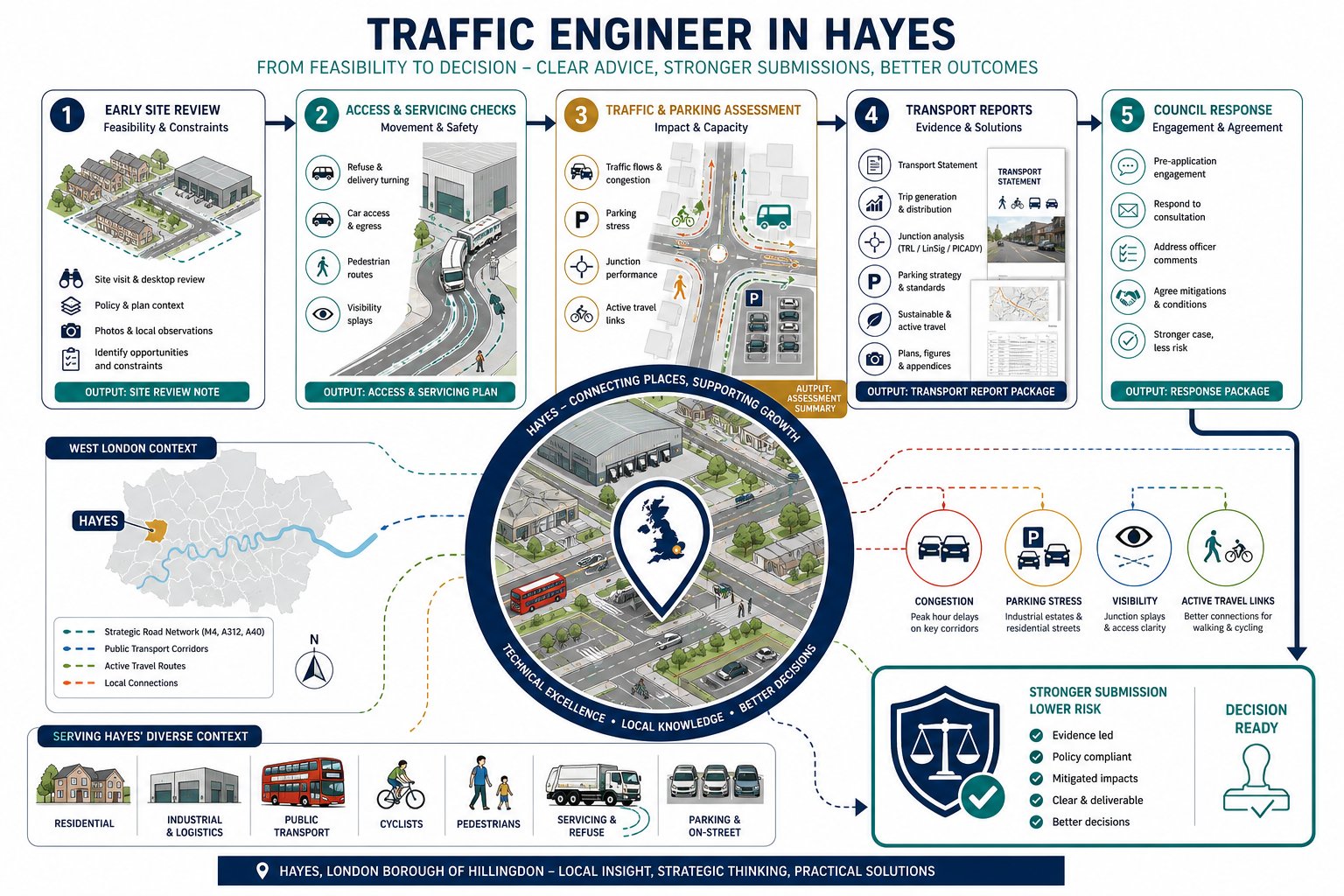
Hayes is rarely a simple planning environment from a transport point of view. Between strategic road links, established residential streets, industrial activity, public transport connections, servicing demands and local parking pressure, even a modest scheme can raise detailed questions from highways officers and planning teams. That is exactly where a Traffic Engineer in Hayes becomes valuable.
We support planning applications by turning transport risk into clear, technical evidence. In practice, that means assessing likely traffic effects, reviewing access and servicing, checking parking strategy, considering pedestrian and cycle movement, and preparing reports that align with local planning expectations. For architects, planners, developers, lawyers and surveyors, the benefit is straightforward: fewer late surprises, better-informed design decisions, and a stronger submission when an application goes in.
In Hayes, early transport input often makes the difference between a coordinated application and one that gets delayed by avoidable objections. A site may look workable at first glance, but trip generation, junction stress, refuse tracking, visibility, or travel plan commitments can quickly become live issues once the local authority reviews the proposal.
In this guide, we explain what a traffic engineer does for planning applications in Hayes, which projects usually need transport input, the reports commonly requested, and how we support schemes from feasibility through to decision.
Key Takeaways
- Engaging a Traffic Engineer in Hayes early in the planning process helps identify and mitigate transport-related risks, ensuring smoother and faster application outcomes.
- Traffic Engineers assess trip generation, access, parking, pedestrian and cycle movement, and servicing to align development proposals with local planning and highway requirements in Hayes.
- Transport reports such as Transport Statements, Assessments, Travel Plans, and Access Reviews are tailored to project scale and local context to provide clear and actionable evidence for planning authorities.
- Residential, commercial, and mixed-use developments in Hayes often require detailed transport input due to local congestion, parking pressures, and junction sensitivity.
- Choosing a Traffic Engineer with local Hayes experience, clear communication, responsiveness, and planning expertise is crucial for accurate and timely transport reporting.
- Effective transport engineering in Hayes not only satisfies planning requirements but also improves design quality and reduces costly delays by addressing practical site operation issues upfront.
What A Traffic Engineer In Hayes Does For Planning Applications
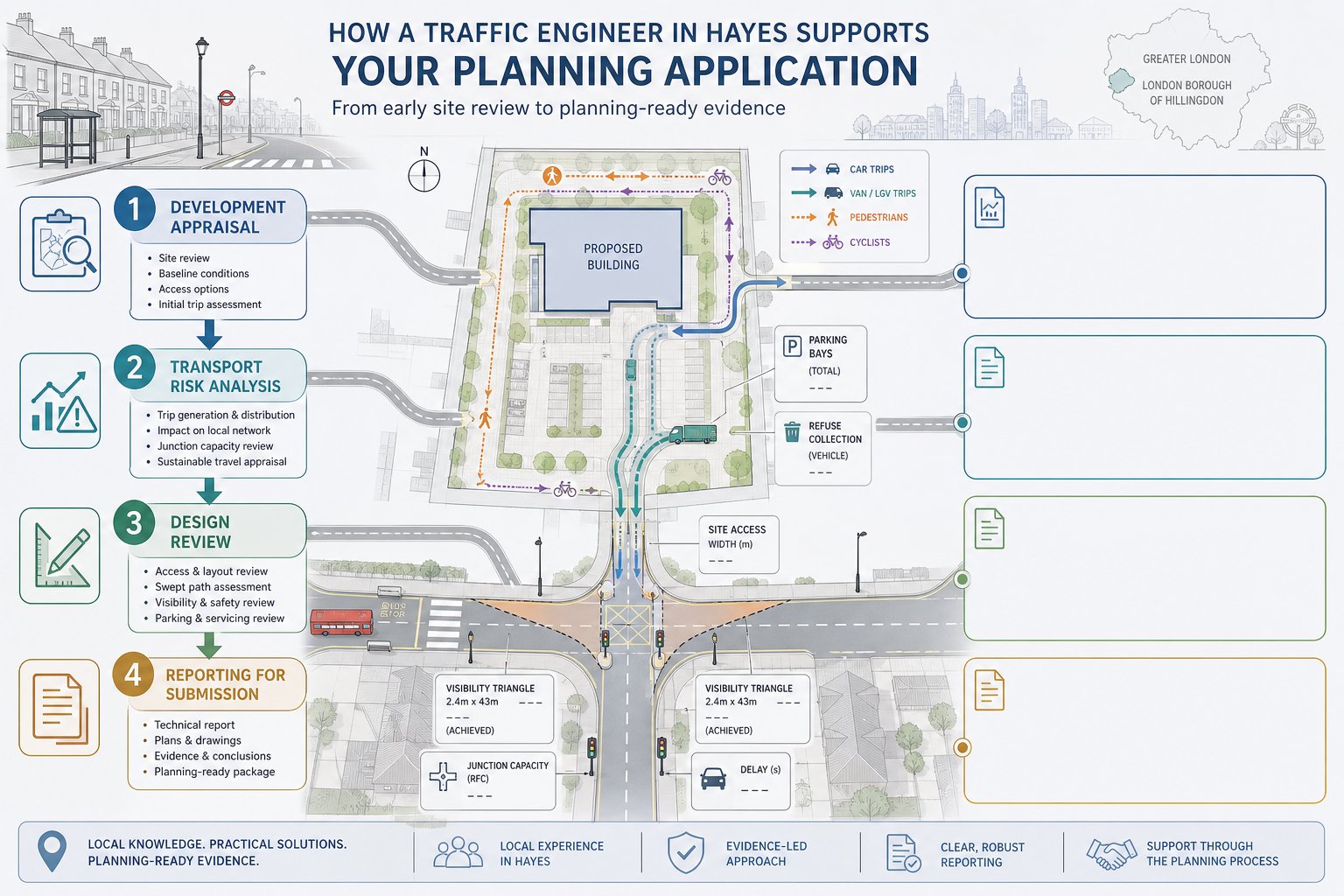
A traffic engineer working on a planning application does far more than produce a single report. Our role is to identify transport-related risks early, quantify likely effects, and present evidence in a format that planners, highway officers and project teams can act on.
For Hayes schemes, that usually starts with understanding the development itself: what is being proposed, how many trips it is likely to generate, what kind of users will access the site, and whether the surrounding network can accommodate those movements safely and efficiently. We review vehicle access, pedestrian routes, cycle links, parking layout, servicing strategy and the relationship between the site and nearby junctions.
We also translate technical transport matters into planning-ready advice. That might mean telling a design team that an access needs widening, that a swept path is too tight for a refuse vehicle, that visibility splays need protecting, or that parking demand assumptions should be revisited before submission. Those changes are often easiest, and cheapest, when made early.
For wider context, many of the same planning principles appear across urban authorities, whether a project needs input from a Traffic Engineer In London: or support from broader Traffic Engineering Consultants:. In Hayes, though, local conditions and borough expectations still matter.
At ML Traffic, our job is to provide concise, accurate reporting quickly, backed by decades of planning-focused transport experience. That includes transport statements, transport assessments, access reviews, technical notes and responses to consultation comments, always geared to the practical question behind the application: will the proposal work on the ground, and can that be demonstrated clearly?
Why Hayes Developments Often Need Transport Input Early
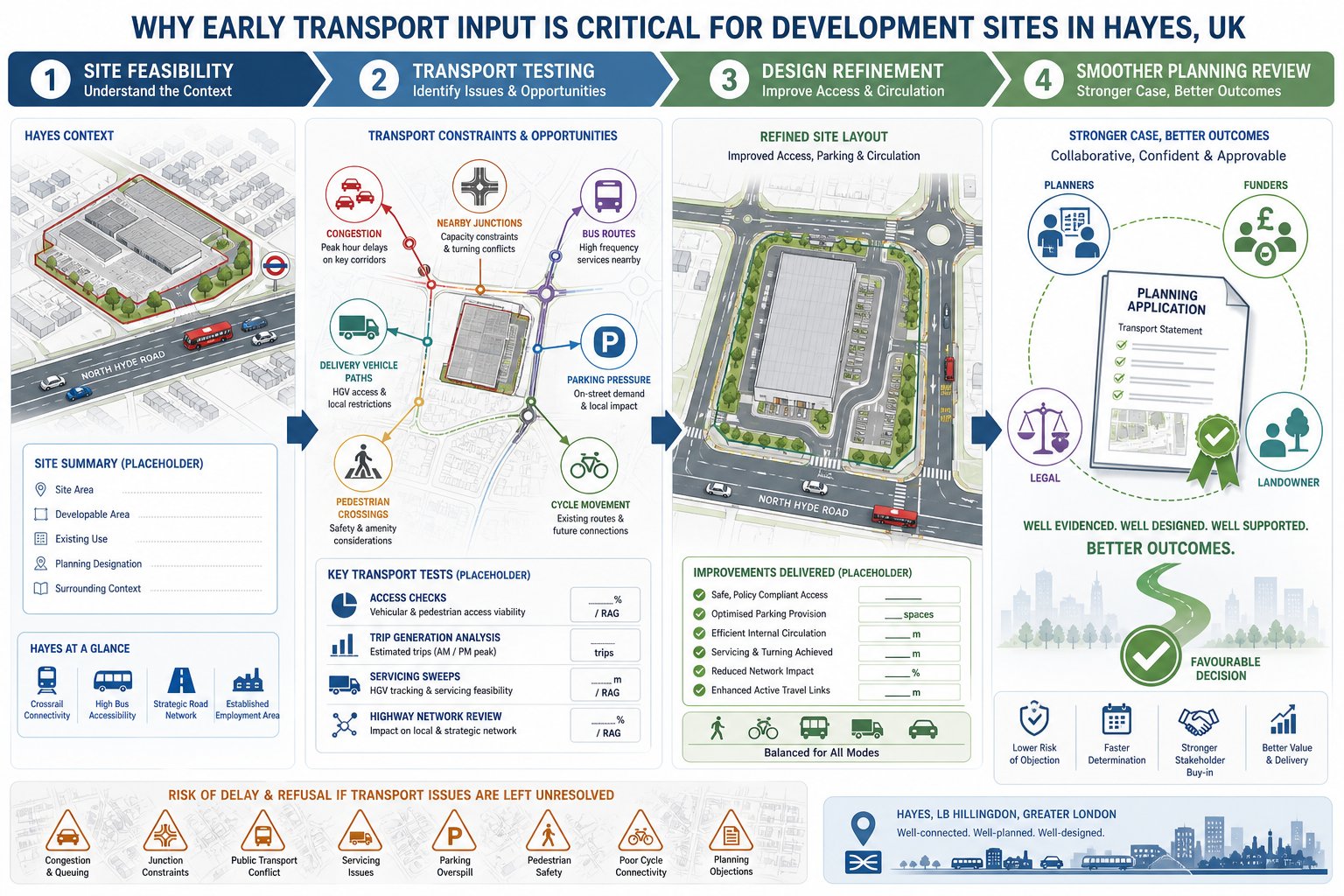
Early transport input is one of the easiest ways to reduce planning friction. Too many projects treat highways and transport as a final reporting exercise, only to discover that the layout, access strategy or parking provision does not stack up under review.
In Hayes, that can be a costly mistake. Sites are often influenced by existing congestion, constrained frontages, nearby junctions, delivery requirements, bus movements, or competing demands between vehicles, pedestrians and cyclists. A scheme may be commercially strong and architecturally sound, but if the access is weak or the operational picture is unclear, planning progress slows down fast.
We usually advise teams to bring transport in at feasibility or pre-application stage. That allows us to test whether the site access is realistic, whether likely trip rates are manageable, whether servicing can be safely accommodated, and whether the local highway network raises obvious concerns. Once those issues are understood, the design can respond before the application is fixed.
This is especially important where stakeholders need confidence early, planners, legal teams, funders and landowners alike. A measured transport strategy can prevent redesign, reduce rounds of highways comments, and support a cleaner planning narrative. Comparable city-by-city issues arise in work by a Traffic Engineer In Manchester: or Traffic Engineer In Leeds:, but Hayes often combines suburban, industrial and strategic movement pressures in a particularly site-specific way.
In simple terms, early transport advice helps answer difficult questions before the council asks them.
Common Projects That Require Traffic Engineering In Hayes
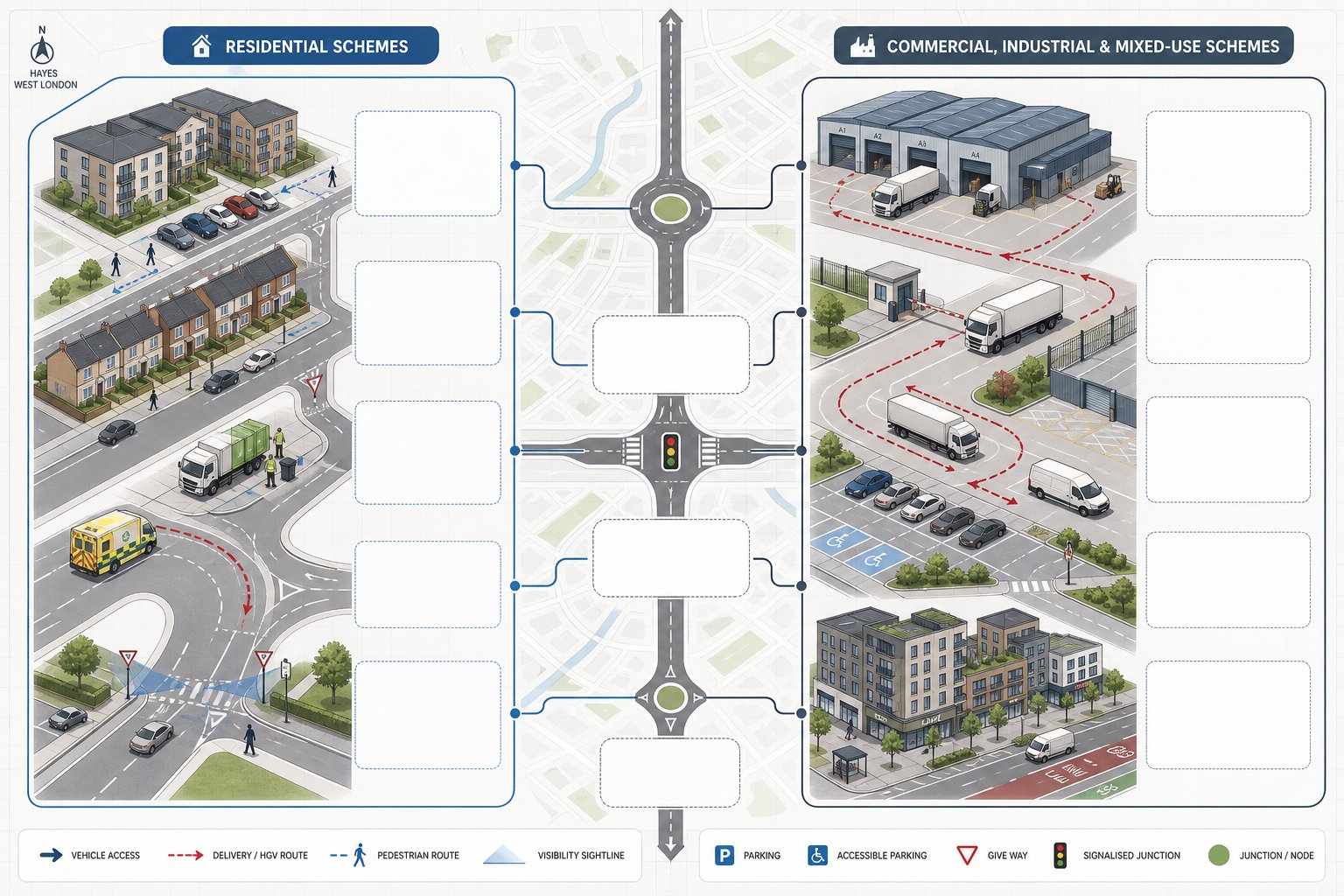
Not every planning application in Hayes needs the same depth of transport input, but a wide range of schemes benefit from it. The common thread is straightforward: if a development changes how people, vehicles, goods or service movements interact with the local network, transport evidence is usually needed.
That applies to infill housing, larger residential-led sites, warehousing, trade counters, office redevelopment, education, healthcare, roadside schemes and mixed-use proposals. It can also apply to changes of use where the building remains largely the same but the movement profile changes significantly.
The level of work depends on scale, sensitivity and local context. A smaller proposal may need a concise transport statement or technical note. A more demanding site may call for a fuller assessment, parking analysis, swept path review, travel plan framework or junction capacity work. We look first at likely planning triggers, but just as importantly, we look at the practical transport questions that could become objections later.
Residential Schemes
Residential development in Hayes often brings immediate scrutiny around trip generation, parking pressure, access design and the effect on surrounding streets. Even on modest schemes, highways officers may want comfort that vehicle movements are not being underestimated and that the access works safely for residents, visitors, deliveries and emergency vehicles.
We typically review expected traffic generation, parking accumulation, visibility splays, turning arrangements, refuse collection access and pedestrian connectivity to nearby facilities. On some sites, the biggest issue is not total traffic volume but how the scheme interacts with already sensitive local roads, particularly where on-street parking stress is a known concern.
Flats, family housing and specialist housing can all generate different transport patterns, so assumptions need to be proportionate and defensible. A layout that looks efficient on plan can fail operationally if bin stores are awkward to access, if service vehicles have nowhere to turn, or if walking routes feel secondary.
Commercial, Industrial, And Mixed-Use Sites
Commercial and industrial schemes in Hayes often need a more operationally detailed review. Staff trips matter, of course, but so do deliveries, loading activity, larger vehicle manoeuvres, gatehouse arrangements, yard circulation and peak-hour overlap with surrounding network demand.
For industrial and logistics-led sites, we often assess HGV routing assumptions, servicing frequency, internal turning, access geometry and the relationship between proposed movements and nearby junction operation. For mixed-use sites, the challenge is often cumulative: different land uses create different peak patterns, and the access strategy has to work for all of them without causing conflict.
Retail, trade, light industrial and hybrid employment schemes can also raise practical questions around short-stay parking, customer circulation and servicing windows. In those cases, transport engineering is partly about policy and partly about realism, how the site will actually function on a Tuesday morning, not just how it appears on a drawing.
Key Transport Reports Often Needed In Hayes
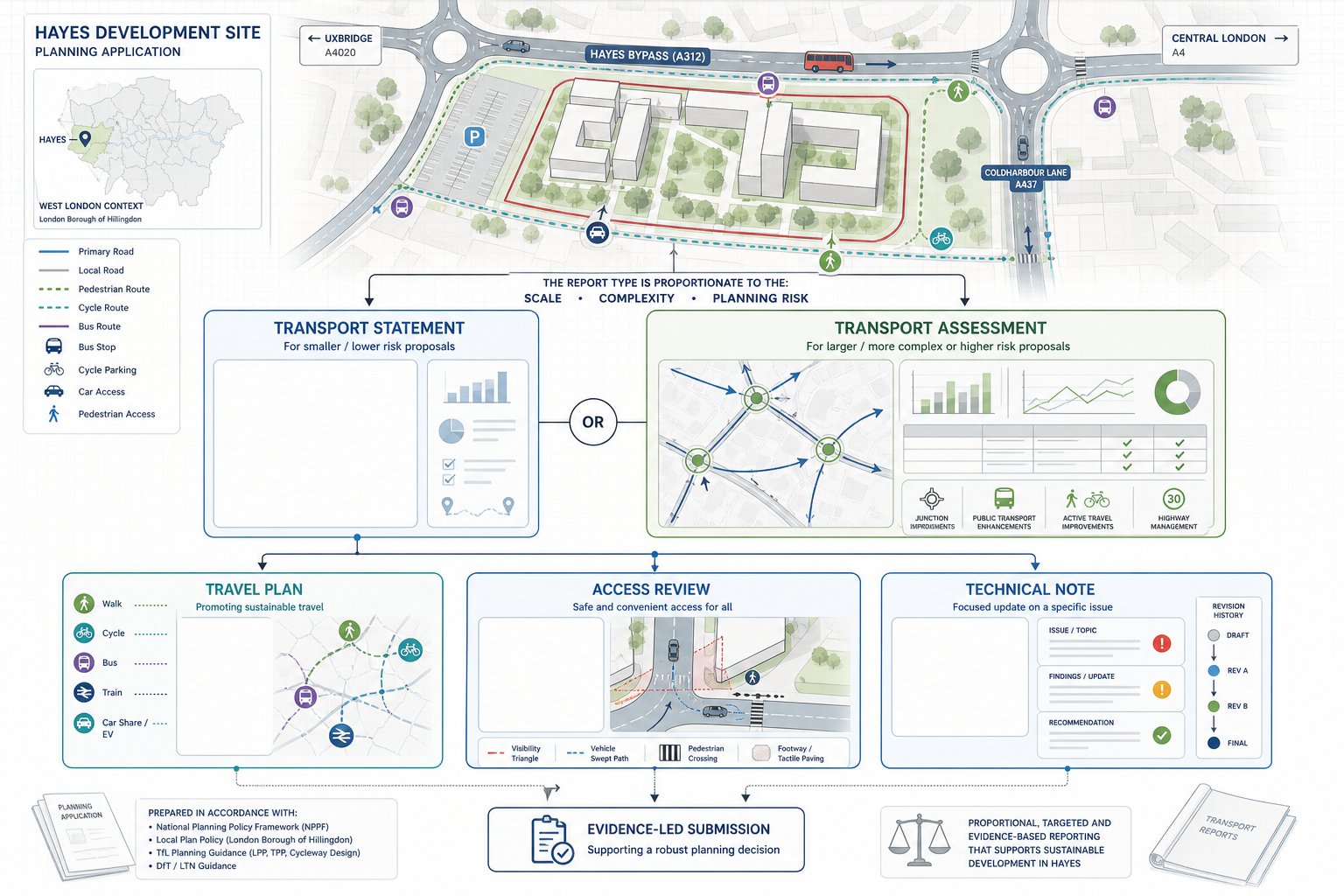
Planning applications in Hayes are rarely supported by transport commentary alone. Local authorities typically expect a formal document, proportionate to the size and impact of the proposal, setting out the transport case clearly and with enough evidence to review.
The exact report depends on the scheme, but most projects fall within a familiar set of documents. Our role is to recommend the right level of reporting, not the heaviest possible package. That matters because over-reporting wastes time, while under-reporting can create objections or validation issues.
In practical terms, reports need to explain what is proposed, how the site will be accessed, what level of movement will be generated, whether the impact is acceptable, and what mitigation or management measures are proposed where needed. They also need to be clear. A technically correct report that is hard to navigate is still a weak planning document.
The wider discipline overlaps with work undertaken by Highway And Traffic specialists and a Traffic Engineer In Birmingham: on comparable planning submissions, but each Hayes project still needs a site-specific response.
Transport Statements And Transport Assessments
Transport Statements and Transport Assessments are the documents most professionals think of first. Both evaluate how a development interacts with the transport network, but they differ in depth.
A Transport Statement is usually used for smaller or less complex schemes where the expected effect is limited and the transport case can be made succinctly. It may cover existing conditions, accessibility, expected trip generation, parking, access arrangements and a reasoned conclusion on impact.
A Transport Assessment goes further. It is generally used where a scheme is larger, more sensitive, or more likely to attract detailed scrutiny. It may include baseline analysis, committed development context, trip distribution and assignment, junction impact review, sustainable travel analysis, parking strategy and mitigation proposals.
The key is proportionality. We do not recommend a Transport Assessment simply because it sounds more substantial: we recommend the document that best matches the planning risk.
Travel Plans, Access Reviews, And Technical Notes
Many Hayes schemes also require supporting transport documents beyond the main statement or assessment. Travel Plans are common where a development should encourage sustainable travel choices, particularly for staff, residents or visitors. A good Travel Plan is not generic window dressing. It should reflect how people are realistically likely to travel to and from the site and what measures can support that.
Access Reviews focus more directly on the physical and operational suitability of the site entrance and circulation arrangement. They may consider visibility, carriageway geometry, vehicle tracking, pedestrian crossing points and conflict risks between different users.
Technical Notes are often used when a targeted issue needs to be addressed without rewriting the full transport report. That might include responding to a highways comment, clarifying parking demand, updating trip rates, or dealing with a design revision. Used properly, they can keep an application moving without unnecessary delay.
Local Factors That Can Influence Transport Planning In Hayes
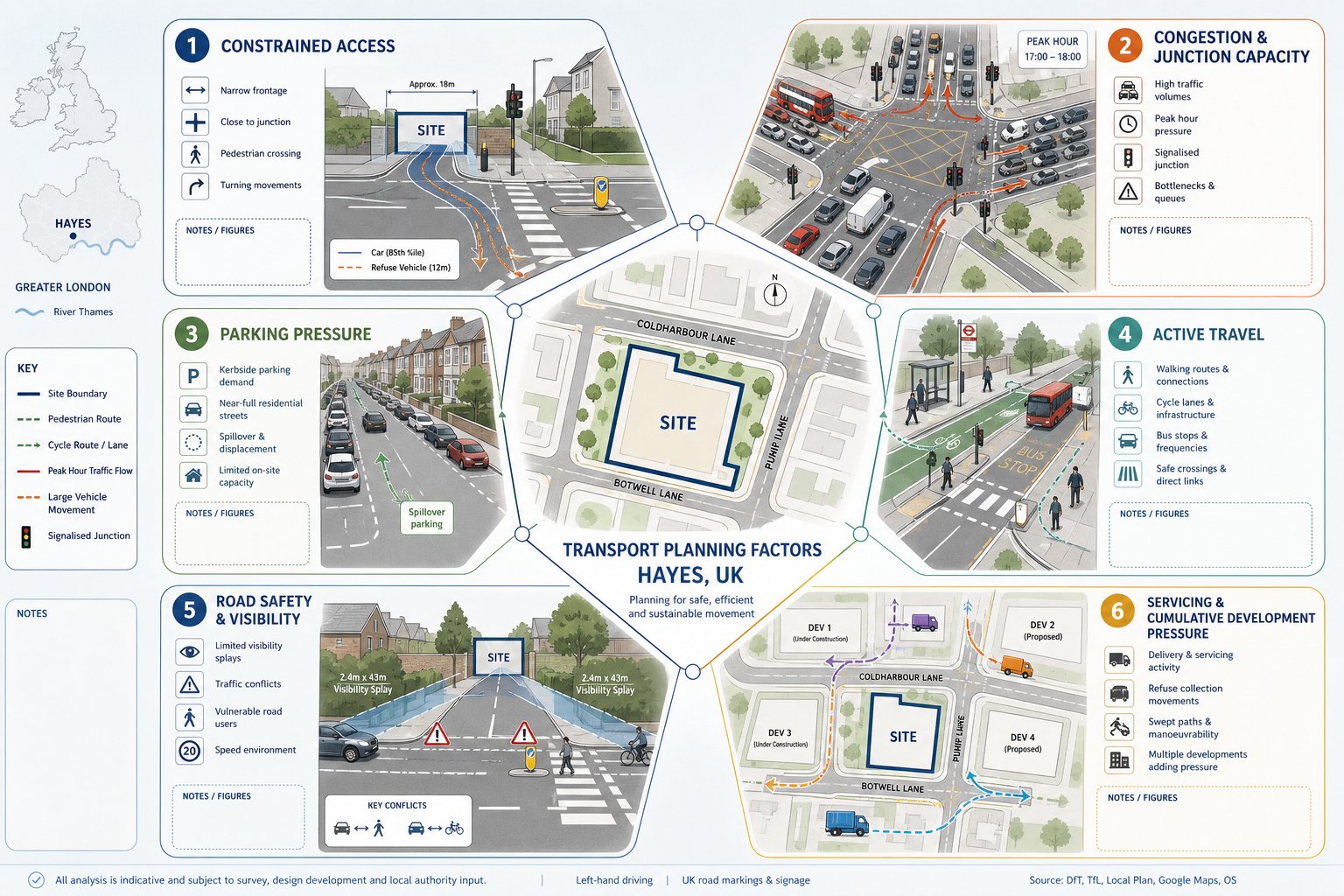
Transport planning in Hayes is shaped by more than policy wording or standard thresholds. Local conditions often determine whether a scheme is straightforward or contentious.
One of the first issues is access. Some Hayes sites have constrained frontages, nearby junctions, existing crossings, or frontage activity that limits what can be achieved safely. Others are technically accessible but operationally awkward once deliveries, refuse movements or two-way flows are tested. We look closely at how the site joins the public highway because that is often where planning concerns begin.
Congestion and junction capacity also matter. Even where a proposal adds a relatively modest number of trips, timing can be critical. A development that performs acceptably in daily terms may still raise concern if movements cluster at sensitive peak periods or at a stressed junction nearby.
Parking pressure is another recurring issue, especially where surrounding streets already operate informally at or near capacity. In those cases, the council’s concern is not only whether parking numbers meet policy, but whether the proposal will function in the real world. Similar concerns appear in work by a Traffic Engineer In Liverpool: or Traffic Engineer In Bristol:, though local evidence remains decisive.
Then there is active travel. Walking and cycling links, crossing quality, bus accessibility and route directness can all influence the strength of a planning submission. A site with decent connectivity usually has a stronger transport story than one that depends almost entirely on private car access.
Road safety, visibility, servicing practicality and cumulative development pressure complete the picture. In Hayes, these details are rarely side issues: they are often the reasons applications are challenged or approved.
How A Traffic Engineer Supports The Planning Process From Start To Decision
The most effective transport input is continuous, not one-off. We usually support a Hayes planning application in stages, starting well before submission and often continuing through consultation and determination.
At feasibility stage, we review the site, likely land use, access opportunities, parking implications and probable transport reporting needs. This is where we help teams avoid dead ends. If the access is unworkable or servicing cannot be resolved, it is better to know before a full design package is developed.
During design development, we coordinate with architects, planners and other consultants so that the transport strategy and layout evolve together. That might involve reviewing swept paths, checking vehicle tracking against boundary constraints, advising on cycle parking, or refining servicing arrangements to fit operational reality.
At submission stage, we prepare the required technical material in a planning-ready format. That includes the main report, plans, appendices and any supporting note needed to explain assumptions clearly. We aim for reports that are concise but robust, something that matters to busy case officers and highways reviewers.
After submission, the work often continues. Councils may ask follow-up questions, challenge assumptions, or request revisions. We respond with technical notes, clarifications or updated analysis where necessary. This stage is often underestimated, yet it can be decisive.
Over the years, we have found that planning teams value transport consultants who communicate plainly and respond quickly. That is a core part of our approach at ML Traffic: technically accurate work, delivered on time, with the practical understanding needed to keep an application moving toward decision.
Typical Transport Issues Reviewed For Hayes Sites
When we assess a Hayes site, the review is rarely limited to “how many cars will it generate?” That question matters, but planning decisions usually turn on a broader set of transport issues.
Traffic volume and trip generation are central because they frame likely impact on the surrounding network. We examine whether the expected movements are reasonable for the proposed use and whether those trips are likely to affect nearby junctions materially. For some sites, a simple proportional review is enough. For others, junction modelling or a more detailed operational assessment may be needed.
Parking is another frequent issue. We review not only the quantity of parking proposed but also layout efficiency, accessibility, visitor provision, cycle parking integration and whether overspill risk is credible. A compliant number on paper is not always operationally sound.
Access safety remains a core planning test. That includes visibility, entry width, turning movements, pedestrian interaction and whether vehicles can enter and leave the site without awkward or unsafe manoeuvres. On tighter sites, swept path analysis can be critical, particularly where servicing vehicles, refuse wagons or emergency access must be demonstrated.
Servicing itself is often underappreciated. A development may function perfectly for cars and still fail because deliveries block circulation or large vehicles cannot turn safely. We also review pedestrian routes, crossing opportunities, cycle access, internal circulation, potential conflict points and, where relevant, signal or junction design considerations.
In short, we assess how the site works as a living transport environment, not just as a set of numbers in a report.
Choosing A Traffic Engineer In Hayes For Accurate, Timely Reporting
Choosing the right traffic engineer in Hayes is partly about qualifications and partly about judgement. Plenty of consultants can produce a report. The more useful question is whether they can identify the real planning risk early, advise the wider team clearly, and deliver evidence in time for the programme.
We would usually suggest looking for four things.
First, planning experience. Transport reporting for development is different from pure highway design or academic modelling. The consultant needs to understand how local authorities review evidence, what level of detail is proportionate, and how to write for planners as well as engineers.
Second, clarity. Dense technical writing can hide weak reasoning. Good reporting should be concise, structured and easy to interrogate. If a highway officer has to work too hard to understand the case, that is not a strength.
Third, responsiveness. Planning programmes rarely move in a straight line. Layouts change, red lines shift, queries arrive late, and submissions need turning around quickly. A consultant who understands programme pressure is often worth far more than one who simply promises detailed analysis.
Fourth, local awareness. Hayes-specific conditions matter, but so does broader comparative experience. Teams often benefit from consultants who handle urban and regional submissions across different authorities, whether that is through a Traffic Engineer In northern context or a Traffic Engineer In Birmingham: style of metropolitan review.
At ML Traffic, we focus on exactly that mix: over 30 years of experience, concise reporting, and fast, practical support tailored to planning thresholds and local authority expectations.
Conclusion
For many schemes, transport is one of the areas most likely to affect planning timescales, design quality and decision risk. In Hayes, that is especially true where access constraints, parking pressure, servicing needs or junction sensitivity are already part of the local picture.
A well-prepared transport case does not just satisfy a planning requirement. It helps shape a more credible development from the outset. That is why early advice, proportionate reporting and clear responses to consultation matter so much.
Whether the project is residential, commercial or mixed-use, the value of a Traffic Engineer in Hayes lies in turning transport issues into manageable planning tasks. When the evidence is clear and the reporting is timely, teams can move forward with more confidence, and with fewer avoidable delays along the way.
Frequently Asked Questions about Traffic Engineering in Hayes
What does a traffic engineer in Hayes do for planning applications?
A traffic engineer in Hayes assesses traffic impacts, access, parking, pedestrian and cycle movements, and prepares clear reports aligned with local planning expectations to support applications efficiently.
Why is early transport input important for Hayes developments?
Early transport input helps identify access constraints, parking pressures, and local network issues, reducing delays and objections by addressing transport risks before finalising planning applications.
Which types of projects typically require traffic engineering in Hayes?
Projects that change movement patterns, including residential, commercial, industrial, and mixed-use developments, usually need transport assessments or statements to evaluate traffic and access effects.
What are common transport reports needed for planning in Hayes?
Planning applications often require Transport Statements or Assessments, plus Travel Plans, Access Reviews, or Technical Notes, depending on the scheme’s size and complexity, to demonstrate transport impact and mitigation.
How do local conditions in Hayes affect transport planning?
Factors like site access constraints, congestion, parking stress, pedestrian and cycle connectivity, and junction capacity influence transport assessments and can be key to planning approval in Hayes.
How can I choose the right traffic engineer for a project in Hayes?
Select a traffic engineer with planning submission experience, clear reporting skills, responsiveness to change, and local knowledge of Hayes conditions to ensure accurate and timely transport advice.