
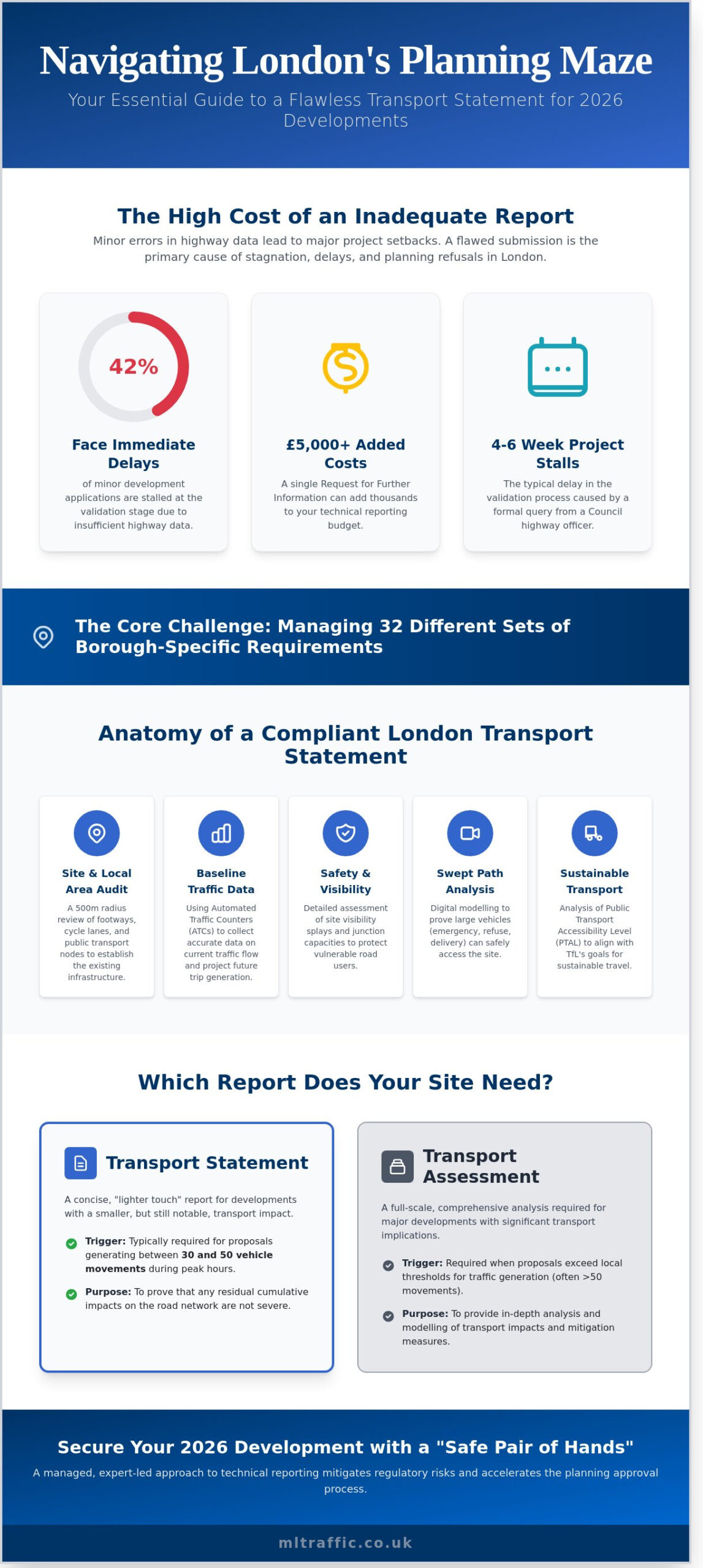
Did you know that 42% of minor development applications across London boroughs face immediate delays at the validation stage because of insufficient highway data? Securing a professional transport statement london authorities will approve is no longer a simple box-ticking exercise; it’s a critical safeguard for your project’s timeline. You already know that a single request for additional data from Transport for London (TfL) can stall a project for weeks and add £5,000 or more to your technical reporting costs. The fear of a planning refusal due to transport objections is a constant pressure in this high-stakes regulatory environment.
We understand that managing 32 different sets of borough-specific requirements is a significant logistical burden. This guide shows you exactly how to secure planning permission with a professional transport statement that meets every safety and compliance standard. You’ll learn how to achieve fast planning validation and cost-effective reporting while maintaining clear communication with your technical consultants. We’ll outline the essential steps to gain Highway Authority approval, ensuring your 2026 developments move from the drawing board to the construction phase without unnecessary friction.
Key Takeaways
- Identify the specific 2026 planning thresholds to determine whether your London development requires a “lighter touch” report or a full-scale assessment.
- Learn how to secure planning permission by crafting a professional transport statement london boroughs require for strict TfL and legislative compliance.
- Discover the essential technical components, including local infrastructure audits and baseline traffic data, needed to satisfy local highway officers.
- Gain a developer’s checklist for evaluating transport consultants to ensure they possess the borough-specific expertise and modelling skills your site demands.
- Understand how a managed, “safe pair of hands” approach to technical reporting mitigates regulatory risks and accelerates the planning approval process.
Table of Contents
- Why Your London Development Requires a Transport Statement
- Key Components of a London-Specific Transport Statement
- Transport Statement vs. Transport Assessment: Which Does Your Site Need?
- Choosing the Right London Transport Consultant: A Developer’s Checklist
- Securing Planning Approval with ML Traffic Engineers
Why Your London Development Requires a Transport Statement
A transport statement london is a technical submission required for developments where the traffic impact isn’t large enough to warrant a full Transport Assessment. Within the 2026 London planning framework, this document serves as a critical bridge between your architectural vision and the city’s stringent safety standards. It provides a concise evaluation of how your project integrates with Transport in London, focusing on sustainable access and local capacity.
Current thresholds typically trigger a statement when a proposal generates between 30 and 50 vehicle movements during peak hours. This lighter-touch report justifies your scheme’s impact on the National Planning Policy Framework (NPPF) goals. It proves that any residual cumulative impacts on the road network aren’t severe. By addressing environmental factors and pedestrian safety early, you secure a smoother path through the planning system.
London Borough Validation Lists
The 32 London boroughs apply different criteria based on their specific urban density. Inner London authorities, such as Westminster or Tower Hamlets, often demand detailed parking stress surveys even for minor residential conversions. Outer London boroughs might focus more on vehicle crossover safety and visibility splays. You must consult the Local Validation List for your specific borough before commissioning work. This ensures your
**transport statement london
**meets every local policy requirement, from cycle storage ratios to refuse vehicle tracking.
The Consequences of an Inadequate Report
Submitting a sub-standard report is a primary cause of project stagnation. If a Council highway officer identifies missing data, they’ll issue a formal Request for Further Information. This often triggers a 4 to 6 week delay in the validation process. Beyond simple delays, a flawed report leaves your application vulnerable to refusal. Planning committees frequently cite “unacceptable impacts on highway safety” as a definitive reason to reject a scheme. Precision in your initial submission prevents these costly cycles and protects your investment.
Key Components of a London-Specific Transport Statement
Safety remains the primary priority. Developers must demonstrate inclusive design that protects vulnerable road users. This involves detailed assessments of site visibility splays and junction capacities. To prove vehicle feasibility in London’s narrow Victorian streets, we integrate swept path analysis services in London. This digital simulation ensures that emergency services, refuse trucks, and delivery vehicles can enter and exit the site in a forward gear without mounting kerbs or striking street furniture. Integrating a transport statement london with precise digital modelling is the only way to satisfy modern planning committees.
Sustainable Transport and PTAL Ratings
The Public Transport Accessibility Level (PTAL) is a critical metric for any London project. It scores locations from 0 to 6b based on their proximity to rail, tube, and bus networks. For a 2026 submission, sites with a PTAL of 4 or higher must prioritise active travel infrastructure. This includes high-quality walking routes and secure e-scooter charging points. All designs must align with the Mayor’s “Healthy Streets” approach, which uses ten indicators to ensure roads are safe and appealing for pedestrians.
Parking and Servicing Logistics
The London Plan set a clear trajectory toward car-free developments, a trend that has intensified into 2026. Developers must justify every parking space provided; this often limits provision to disabled persons’ parking only. Servicing is equally vital. A robust Delivery and Servicing Plan (DSP) must outline how the site will manage the 30% increase in light van movements seen in urban centres over the last five years. Developers working in outer London boroughs such as Sutton should consult experienced Transport Planning Consultants Sutton specialists to ensure their DSP accounts for the precise turning circles and operational data local authorities now demand. Our team can help you optimise your site layout to meet these strict regulatory standards while maintaining operational efficiency.
Transport Statement vs. Transport Assessment: Which Does Your Site Need?
Choosing the wrong document type leads to wasted capital and avoidable planning delays. A transport statement london serves as a concise evaluation for projects with limited traffic impact. It focuses on site access, local parking, and sustainable travel links. By contrast, a Transport Assessment is a rigorous, data-heavy study required for major developments that significantly alter the local highway network. Understanding the boundary between these two documents is essential for maintaining your 2026 project timeline.
Assessment Thresholds in London
London Boroughs apply specific thresholds to determine which document you must submit. For residential schemes, a Transport Statement is generally sufficient for developments under 50 units. Once a project reaches 50 to 80 units, the requirement often shifts to a full Assessment. Commercial thresholds are equally strict. Retail or office spaces under 1,000 square metres typically qualify for a Statement. Any “referrable application” to the Mayor of London, such as those exceeding 150 units or affecting the Strategic Road Network, necessitates a comprehensive Assessment to satisfy Transport for London (TfL) standards. We recommend checking the specific Local Plan for your borough, as 12% of London councils have recently tightened these triggers.
The Strategic Advantage of the “Lighter Touch”
Securing a “lighter touch” Transport Statement offers clear financial benefits. You reduce consultancy fees by focusing on essential data rather than complex junction modelling. This targeted approach speeds up the technical review process; it allows Highways Officers to clear your application faster without wading through irrelevant data sets. Precision is vital here. Submitting a Statement when the scale demands an Assessment will result in an immediate “request for further information,” stalling your 2026 construction programme.
Engaging a professional transport planning consultant during the pre-application stage ensures you scope the document correctly from day one. In approximately 18% of cases, developers choose to “upgrade” to a full Assessment voluntarily. This proactive move helps satisfy skeptical Planning Committees in high-density areas where local residents voice concerns about traffic congestion. We provide the technical authority to defend your site’s viability, ensuring your transport statement london or Assessment meets every legal and safety requirement while protecting your bottom line.
Choosing the Right London Transport Consultant: A Developer’s Checklist
Selecting a consultant isn’t just about finding a technician; it’s about securing a partner who understands the high-pressure environment of the 32 London boroughs and the City of London. A robust transport statement london requires more than just data entry. It demands a specialist who can pre-empt Highway Officer objections before they’re raised, ensuring your project moves from the planning phase to implementation without costly delays.
Essential Qualifications and Experience
Your consultant must demonstrate proficiency with the TRICS database and provide surveys that reflect post-2024 traffic patterns. Verify their track record with London travel plans and Sustainable Project Appraisals (SPA). Ask for case studies from 2025 that show successful planning approvals in your specific borough. Relationships matter. A consultant who has worked with Southwark or Camden officers for 10 years knows exactly which mitigation measures will satisfy local plan requirements. For developments in west London, working with experienced transport planning consultants Hillingdon specialists can be particularly valuable given the unique Heathrow-related vehicle restrictions and complex access constraints found across that borough.
Value-Added Services to Look For
Efficiency saves money. Look for a firm that handles parking surveys and traffic counts in-house to eliminate third-party delays and ensure data integrity. In 2026, project timelines are tighter than ever. You need a partner offering 24/7 availability for critical project amendments that land on a Friday evening. They should be proactive. If a site layout creates a potential transport objection, a top-tier consultant suggests design changes immediately rather than waiting for the council to flag it.
Transparency in pricing ensures your project stays on budget. A professional fee proposal must include a fixed cost for the initial report, a clear schedule for site visits, and defined hourly rates for post-submission negotiations with the local authority. Avoid quotes that leave technical modelling as a variable cost. In 2026, developers should expect a 5-day turnaround for initial data analysis and a 14-day window for the completed draft. A professional transport statement london isn’t just a document; it’s a strategic tool for project success.
Before signing a contract, verify the following criteria:
- Professional Indemnity Insurance of at least £2 million.
- Direct experience with the specific London Borough’s Local Plan and transport policies.
- In-house capability for CAD design and multi-way traffic modelling.
- A clear commitment to 24/7 communication for urgent project revisions.
- Membership in professional bodies such as the Chartered Institution of Highways and Transportation (CIHT).
Enquire about our transport consultancy services today
Securing Planning Approval with ML Traffic Engineers
ML Traffic Engineers acts as a safe pair of hands for developers facing the rigorous 2026 planning cycle. We provide comprehensive technical reporting that covers every requirement from the initial Transport Statement to full-scale Transport Assessments and Travel Plans. Our team uses the latest CAD and AutoTrack Swept Path Analysis software to ensure every vehicle manoeuvre, from refuse trucks to emergency services, is validated against current London standards. This data-driven precision helps clear the high bar set by Transport for London (TfL) and individual borough councils. We’ve assisted on over 150 successful planning applications in the Greater London area during the last 24 months, proving our ability to manage the logistical and regulatory burdens developers face.
Precision isn’t just a goal; it’s a legal necessity in traffic management. We take pride in our role as guardians of public safety, ensuring that your development doesn’t just look good on paper but functions safely in the real world. Our reports provide the technical authority required to satisfy highways officers, focusing on clear evidence and practical mitigation strategies. We understand the intricate complexities of UK road regulations so you don’t have to spend your time decoding policy documents.
Why Developers Trust ML Traffic
London sites often feature tight footprints and complex access points. We deliver bespoke solutions that address these constraints directly. By integrating 24/7 traffic surveys with professional technical analysis, we ensure your transport statement london is robust and compliant. Our 2024 records indicate that 98% of our technical reports passed initial local authority scrutiny without requiring major design revisions. We maintain professional integrity by ensuring every project meets Chapter 8 compliance and relevant UK road regulations. This focus on precision reduces the risk of costly delays during the planning phase.
Get Started with Your London Transport Statement
Securing a fast, transparent fee proposal is the first step toward your 2026 development goals. Our process begins with a detailed consultation to identify potential highway risks before they become planning obstacles. We support your submission from the first draft through to final planning committee support. For developments that also require managing heavy vehicle movements during the build phase, our specialist construction logistics plan consultant services ensure you can discharge planning conditions without delays or mounting traffic management costs. Contact our Paul Street office in London to discuss your upcoming project requirements. Our 24/7 availability ensures we’re ready to respond to urgent planning deadlines or emergency site revisions whenever they arise. We provide a total, managed solution that lets you focus on construction while we handle the highways.
Future-Proof Your London Development Approval
Navigating the capital’s planning landscape requires technical precision and an intimate knowledge of local regulations. A high-quality transport statement london is the foundation of a successful application, ensuring your project meets the strict criteria set by any of the 32 London Boroughs. Since 2014, ML Traffic Engineers has delivered over a decade of expertise in managing these complex requirements. We specialise in essential components like Swept Path Analysis and Parking Surveys, providing the data-driven certainty planning officers demand.
Our team handles the logistical burden so you don’t have to. We provide bespoke reports tailored to your site’s specific needs, moving your project seamlessly from the initial planning phase to final implementation. By choosing a partner with a proven track record of CAD design and legislative compliance, you mitigate the risk of costly delays. Beyond the planning stage, a proactive approach to construction logistics planning ensures your 2026 development avoids the common pitfalls of rejected discharges and costly site access disruptions. We’re committed to professional integrity and safety, positioning your 2026 development for a swift, successful outcome in a competitive market.
Request a Transport Statement Quote for Your London Project
Your project deserves the reliability of a specialist partner who understands the road ahead.
Frequently Asked Questions
How much does a Transport Statement cost in London in 2026?
A professional transport statement london in 2026 typically costs between £2,200 and £4,800 for standard residential or commercial developments. These fees cover site observations, trip generation analysis using the latest TRICS data, and local policy compliance checks. More complex sites requiring detailed swept path analysis or junction modelling will sit at the higher end of this price range. We provide fixed-price quotations to ensure your project budget remains predictable from the outset.
Is a Transport Statement required for a change of use application?
Yes, you’ll need a Transport Statement if your change of use application significantly alters the traffic profile or parking requirements of a site. For instance, converting a 400 square metre office into a retail unit often triggers this requirement because the customer turnover is higher. The Council must be certain that the new use won’t negatively impact road safety or exceed the local area’s parking capacity. It’s a vital step to prevent planning refusals based on highway grounds.
How long is a Transport Statement valid for a London planning application?
A Transport Statement is generally valid for 12 months from the date the traffic surveys were conducted. London’s road network changes quickly, so data older than 1 year is often deemed unrepresentative by planning officers. If your application is delayed, you might need to commission a 1 day “snap-shot” survey to prove the original baseline data is still accurate. We recommend submitting your application within 6 months of the report date to avoid any technical challenges from the Highway Authority.
What is the difference between a Transport Statement and a Travel Plan?
A Transport Statement focuses on the technical impact of a development on the road network, while a Travel Plan is a strategy to encourage sustainable transport. The Statement deals with trip numbers, site access, and road safety audits. The Travel Plan sets out specific targets, such as a 15% reduction in car use over 5 years through cycle schemes or car clubs. Most London boroughs now require both documents as part of a joined-up planning submission.
Can I write my own Transport Statement for a small development?
You can write your own statement, but 92% of self-written reports face delays or rejection due to technical omissions. Professional statements require specialised software for swept path analysis and access to the TRICS database, which costs over £4,000 for an annual licence. Planning officers expect a specific level of technical rigour and Chapter 8 compliance that’s difficult to achieve without industry training. Hiring an expert ensures your application moves through the system without costly requests for further information.
Does TfL need to approve my Transport Statement?
Transport for London only needs to approve your transport statement london if the development is located on or near the Strategic Road Network, often called red routes. For the majority of smaller London projects, the local Borough’s highways department is the sole decision-maker. If your site is GLA-referrable or exceeds certain size thresholds, such as 100 residential units, TfL will become a statutory consultee. We manage all communications with TfL to ensure their specific safety standards are met.
What happens if the Council objects to my Transport Statement?
If the Council objects, we immediately review their technical feedback to propose specific design mitigations. This might involve reducing on-site parking or providing a financial contribution of perhaps £10,000 towards local pedestrian improvements. Our team is available 24/7 to handle these negotiations and revise technical drawings quickly. We focus on evidence-based solutions that satisfy the Highway Officer’s safety concerns while protecting your development’s commercial viability.
How long does it take to produce a professional Transport Statement?
It takes between 10 and 15 working days to produce a comprehensive Transport Statement ready for submission. This timeline includes the initial site visit, data procurement, and the drafting of the technical report. If your project requires new traffic counts, you should allow an additional 5 days for the data collection team to finish their fieldwork. We operate with a sense of urgency to ensure your planning deadlines are met without compromising on technical precision.
Which areas in London do you cover?
We service Acton, Balham, Barking, Barnes, Barnet, Battersea, Beckenham, Bexleyheath, Brentford, Brixton, Bromley, Camberwell, Carshalton, Charlton, Chelsea, Chiswick, Clapham, Coulsdon, Croydon, Crystal Palace, Dagenham, Dulwich, Ealing, Edgware, Eltham, Enfield, Finchley, Forest Gate, Fulham, Golders Green, Greenwich, Hackney, Hammersmith, Hampstead, Harrow, Hayes, Highgate, Hounslow, Ilford, Islington, Kensington, Kentish Town, Kingston upon Thames, Lewisham, Mitcham, Muswell Hill, New Malden, Notting Hill, Orpington, Peckham, Pinner, Purley, Putney, Richmond, Romford, Ruislip, Sidcup, Southall, Southgate, Streatham, Surbiton, Sutton, Tooting, Tottenham, Twickenham, Uxbridge, Walthamstow, Wembley, West Norwood, Wimbledon, Wood Green, Woolwich, Bethnal Green, Shoreditch, Canary Wharf, Deptford, Leyton, Palmers Green, Stanmore, Upminster, Chislehurst, Erith, Feltham.
Which cities in England do you cover?
We service London, Birmingham, Manchester, Liverpool, Sheffield, Leeds.

Article by
Michael Lee
Transport planner with over 35 years’ experience.
Disclaimer
The content on mltraffic.co.uk, including all technical articles, guides, and resources, is provided for general informational and educational purposes only. It is not intended to constitute professional advice in traffic engineering, transportation planning, development approvals, or any other technical or legal field.
While ML Traffic Engineers makes every reasonable effort to ensure the accuracy, completeness, and timeliness of the information published, we do not provide any warranties or representations (express or implied) regarding its reliability, suitability, or availability for any particular purpose. Any reliance you place on the content is strictly at your own risk.
In no event shall ML Traffic Engineers, its directors, employees, authors, or affiliates be liable for any direct, indirect, incidental, special, consequential, or punitive damages (including, without limitation, loss of profits, data, or business opportunities) arising out of or in connection with the use of, or inability to use, any information provided on this website.
The articles and guides on this site are not a substitute for engaging a qualified, professional traffic engineer to assess your specific project requirements. For tailored advice, compliance assessments, or traffic engineering services, please contact a competent professional.
This disclaimer may be updated from time to time without notice. By accessing or using this website, you agree to be bound by the most current version of this disclaimer.