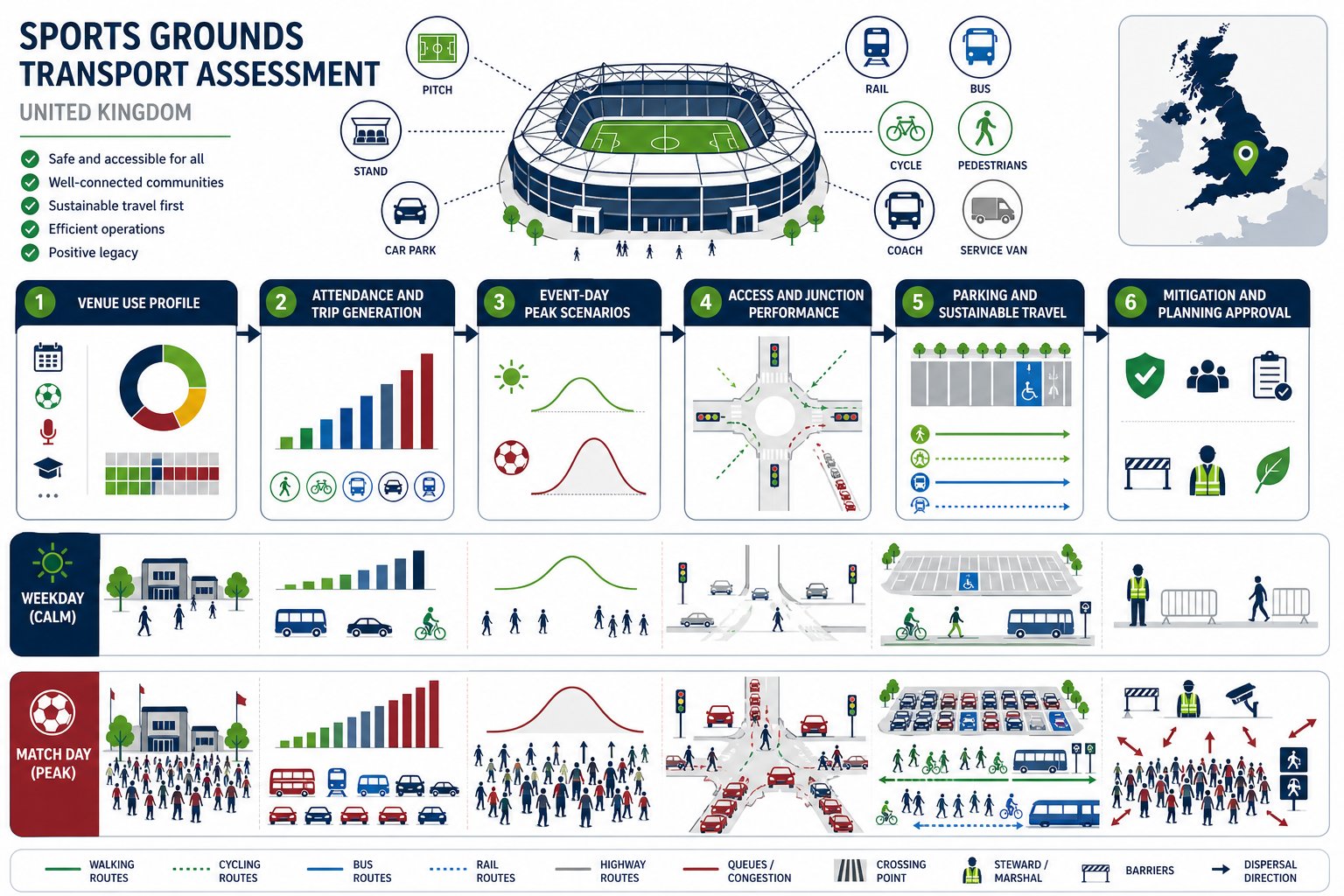
A sports ground can look straightforward on a site plan: a pitch, a stand, some parking, maybe an indoor hall and a café. In planning terms, though, it rarely behaves like a standard development. Traffic arrives in waves. Pedestrians appear in large numbers within short windows. A quiet weekday training session can sit alongside a Saturday sell-out fixture, a school tournament, or an evening community event. That mismatch between ordinary use and event-day intensity is exactly why a Sports Grounds Transport Assessment matters.
In 2026, local planning authorities and highway authorities are expecting more than a basic note on parking numbers. They want evidence. They want clear scenarios. And they want confidence that residual transport impacts will be acceptable not only on an average day, but under realistic peak conditions.
For architects, planning consultants, developers, solicitors, surveyors and councils, the challenge is usually not whether transport should be considered. It is how to present a robust, proportionate case that reflects the real operating pattern of the venue. We find that the strongest assessments combine technical analysis with operational realism: who arrives when, by what mode, through which gates, and what happens when the final whistle goes.
This guide sets out what a sports grounds transport assessment should cover, when it is likely to be required, and how to prepare one that stands up in the planning process.
Key Takeaways
- A Sports Grounds Transport Assessment is essential to manage transport impacts for sports venues by addressing both typical use and event-day peaks.
- The assessment must be based on robust attendance-led trip generation data and consider multiple scenarios such as match days, training sessions, and multi-use events.
- Access design and highway impact evaluations should reflect realistic crowd movements, including safe pedestrian routes and effective vehicle circulation during peak times.
- Parking demand analysis must be detailed and supported by evidence, incorporating management strategies to prevent neighbourhood overspill and ensure safety.
- Sustainable transport modes like walking, cycling, and public transport are critical and should be realistically appraised and enhanced to reduce private car dependency.
- Early and integrated planning with local authorities, clear scenario testing, and operational detail ensures a credible assessment that supports planning approval decisions.
What A Sports Grounds Transport Assessment Covers
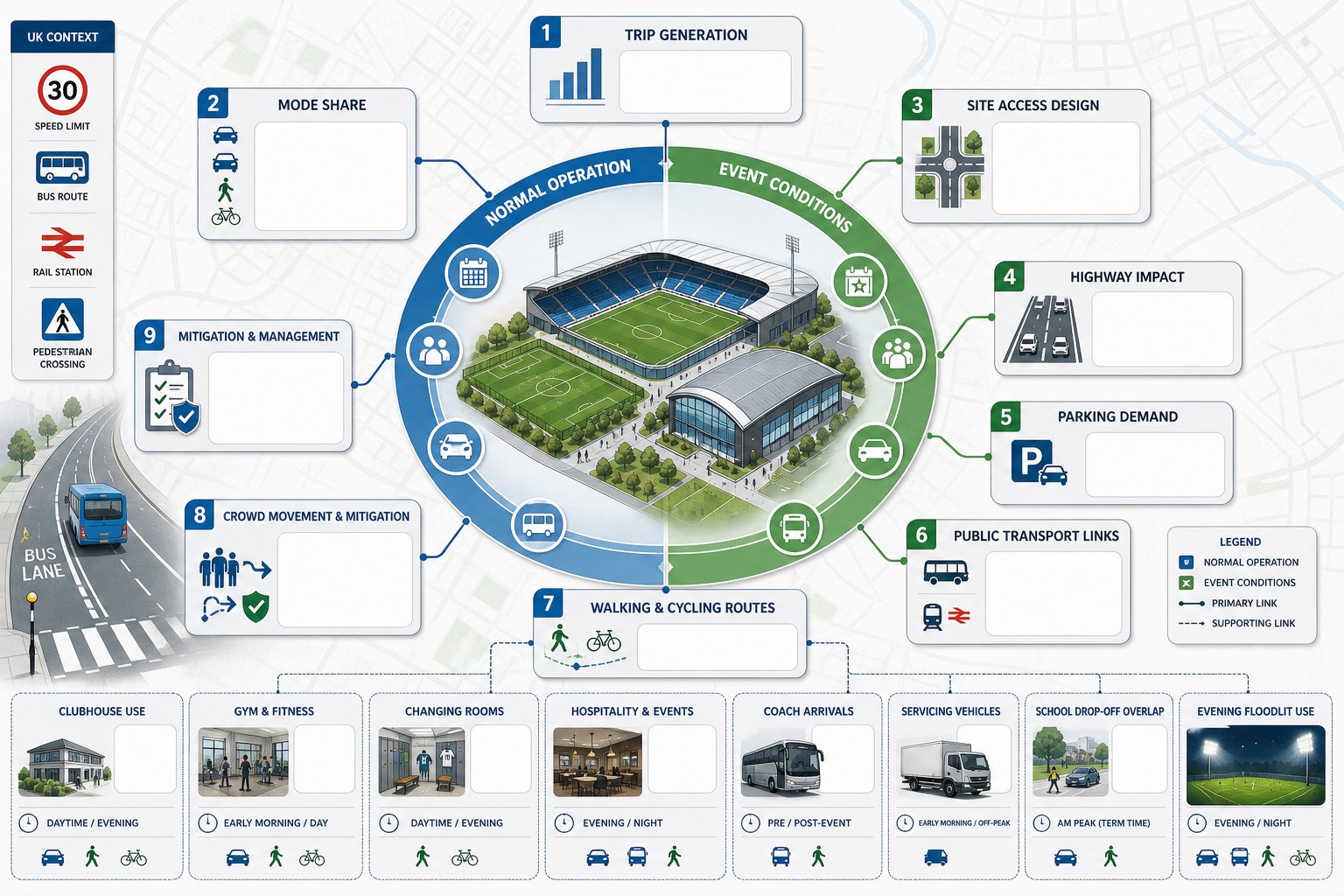
A sports grounds transport assessment is a planning document that identifies, quantifies and manages the transport effects of a stadium, sports centre, playing fields complex or similar venue. In practical terms, it explains how people, vehicles and servicing activity will get to and from the site under normal operation and event conditions.
The scope usually starts with the development description: pitches, spectator seating, indoor facilities, hospitality areas, clubhouses, gyms, changing rooms, floodlit training areas and ancillary uses. That matters because each element generates different travel patterns. A community pitch block behaves differently from a semi-professional ground with turnstiles and coach arrivals.
From there, the assessment normally covers trip generation, mode share, access design, highway impact, parking demand, public transport accessibility, walking and cycling conditions, crowd movement and mitigation. For many schemes, it sits alongside a wider transport assessment for planning strategy, but sports venues need a more event-led lens than most development types.
A good TA also distinguishes between day-to-day operation and special event conditions. That distinction is often where weaker submissions fall short. If the document only describes a “typical day”, it may tell the authority very little about the periods they actually care about: pre-match arrivals, post-match dispersal, concurrent pitch use, school drop-off overlap, or an evening event in poor weather when walking and cycling mode share falls.
The aim is simple enough: provide a transparent evidence base so decision-makers can judge whether access is suitable, impacts are acceptable, and mitigation is properly secured.
When A Transport Assessment Is Needed For Sports Ground Planning Applications
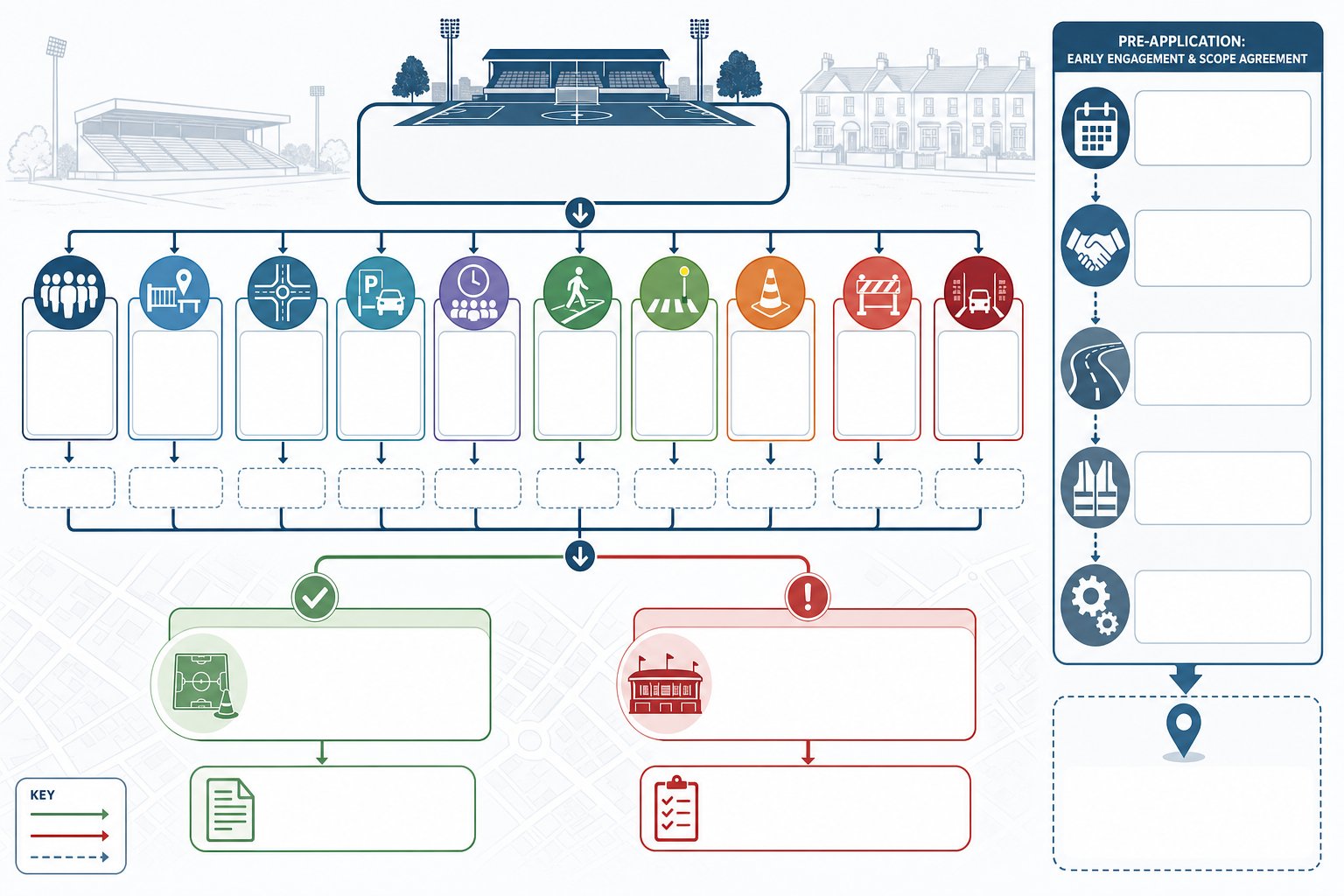
Not every sports proposal needs a full transport assessment, but many do. The trigger is usually material transport impact rather than land use label alone. If a proposal is likely to create significant attendance, alter access arrangements, affect junction operation, increase on-street parking pressure, or generate event peaks at sensitive times, a TA is commonly expected.
In the UK planning context, local validation requirements, local plan policies and standing advice from the highway authority often shape the threshold. A modest training facility with limited spectator use may only need a concise transport statement. A new stand, expanded clubhouse, floodlit all-weather pitches, or a ground intended to host larger fixtures may require much more. So may schemes that introduce a new vehicular access, rely on temporary traffic management, or sit within constrained urban streets.
Timing is critical. We usually advise agreeing scope early through pre-application discussion, especially where match-day patterns differ sharply from weekday use. This is where wider end to end transport thinking helps: planning, operations, safety and highways need to align from the outset, not after a design has hardened.
Authorities are particularly likely to ask for a TA where events overlap with network peak periods, where local residents may experience parking overspill, or where walking routes have limited width or crossing opportunities. Even if trip totals look manageable on paper, the concentration of movements in 30- to 60-minute windows can justify assessment.
The practical test is this: could the development create transport effects that a planning officer or highway authority cannot comfortably infer without evidence? If yes, a sports grounds transport assessment is usually the prudent route.
How Sports Grounds Differ From Standard Development Sites
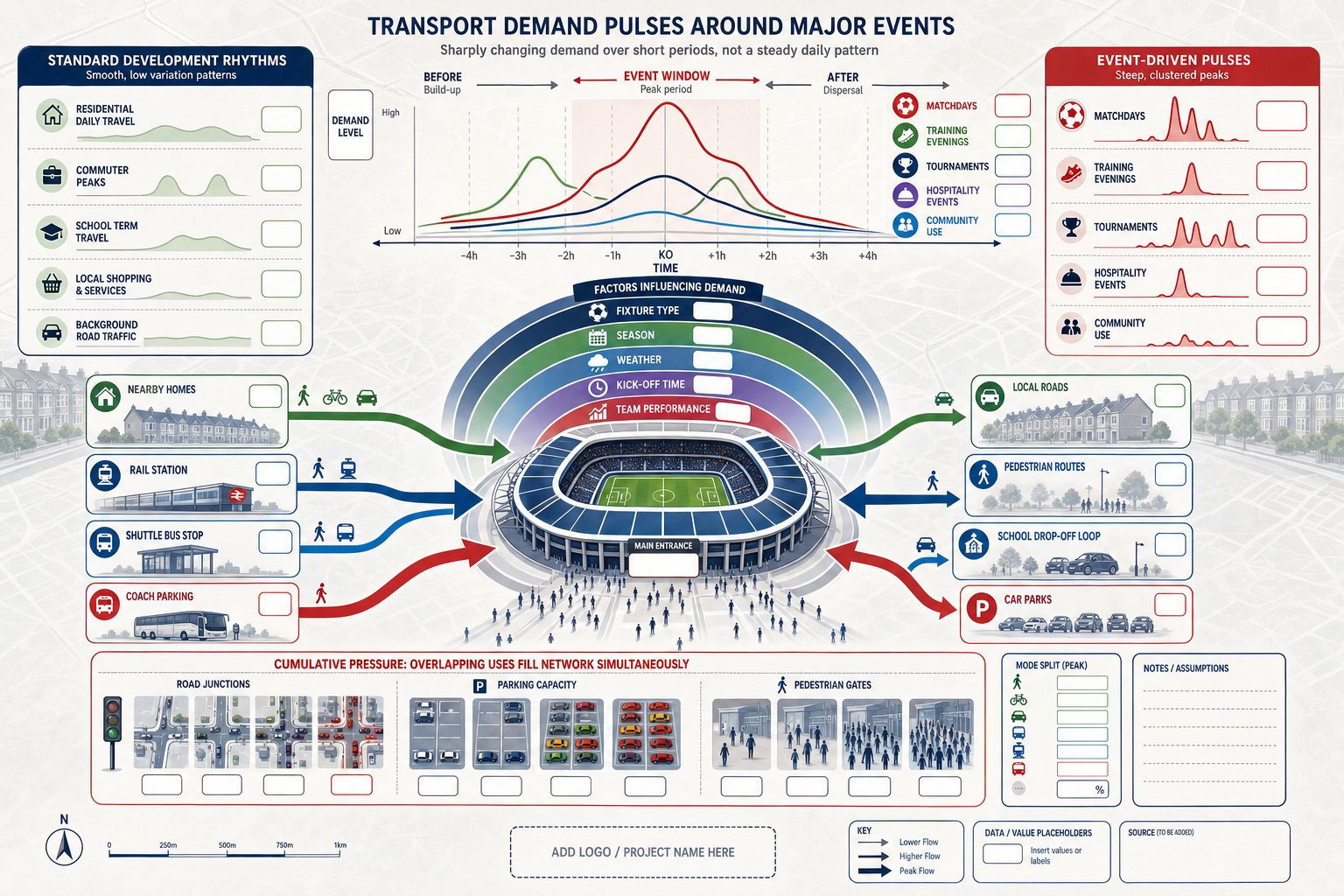
Sports grounds are unusual because they are not governed by one stable peak profile. A housing scheme, office building or industrial unit tends to produce comparatively predictable daily rhythms. A sports venue often does not. Demand is highly peaked, operationally sensitive and heavily influenced by fixture type, season, weather, kick-off time and the success of the home team. Anyone who has seen a quiet ground turn into a crowded local hotspot within 45 minutes will understand the point.
That means person-trip density can be very high for short periods. It also means mode split may differ sharply from conventional assumptions. Some venues attract a larger share of walking trips from nearby neighbourhoods. Others depend on rail, shuttle buses or organised coaches. Some school and community sites have intense but short evening peaks with a strong parent drop-off element.
Multi-use operation complicates matters further. A single site may host league matches, weekday training, children’s tournaments, community hire, hospitality events and non-sport functions. Those overlapping uses can create cumulative pressure on access roads and parking areas that would be missed in a generic assessment.
The analytical tools are often familiar, but the framing is not. We may still use a traffic impact assessment and junction modelling, yet the assumptions must reflect crowd behaviour and event operations rather than ordinary commuter patterns.
In short, sports grounds demand a more scenario-based, operationally grounded approach. The planning question is rarely “what happens on a normal Tuesday?” It is “what happens when the venue is doing what it was built to do?”
Key Trip Generation And Attendance Considerations
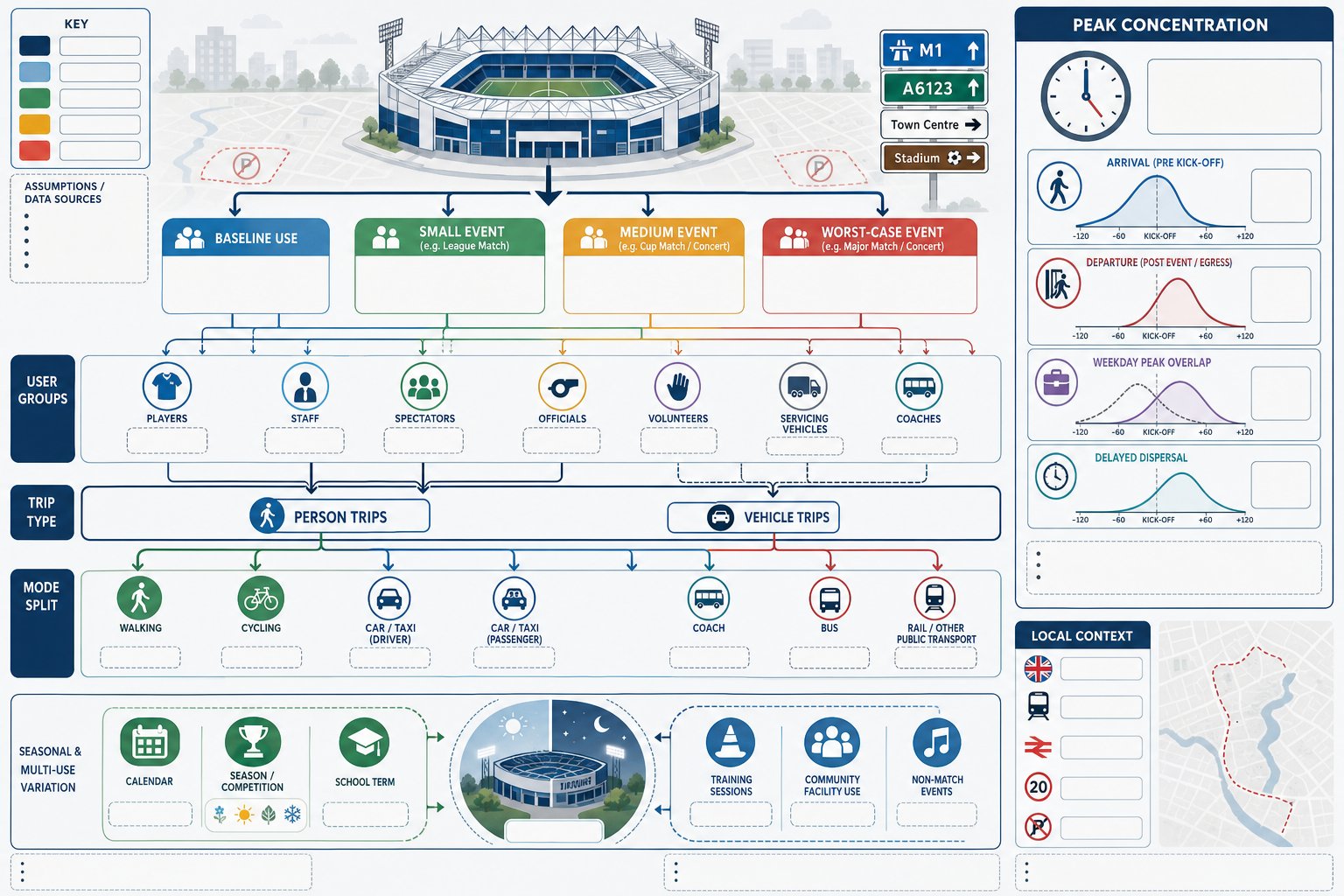
Trip generation is at the heart of any sports grounds transport assessment, but it should never be reduced to a single trip rate multiplied by floor area. For sports venues, attendance-led analysis is usually more credible. We need to understand who uses the site, in what numbers, at what times, and by which modes.
Typical inputs include historic attendance data, ticketing records, club forecasts, comparable sites, census travel patterns, local parking constraints, public transport availability and observed surveys where available. The assessment should separate players, staff, spectators, officials, volunteers, servicing traffic and coach movements. That matters because their arrival and departure profiles are different.
For many applications, it is helpful to define attendance bands such as baseline use, small event, medium event and worst-case event. Each scenario can then be tested with a corresponding mode split and parking demand assumption. This is usually more transparent than presenting one blended figure that hides the important variations.
We also need to distinguish person trips from vehicle trips. A crowd of 1,500 does not equal 1,500 cars, obviously, but neither can we assume ideal car occupancy or perfect public transport uptake. Robust analysis sits in the middle: evidence-led, locally grounded and clear about uncertainty.
Where assumptions are likely to be scrutinised, a wider Development Transport Assessment: A style methodology can help structure the narrative, but the numbers still need to reflect sports-specific operation.
Match Days, Peak Periods, And Event Scenario Testing
Match-day assessment should focus on concentration, not just volume. Two hundred cars spread over three hours may be manageable: the same number arriving in 25 minutes before kick-off is another matter. That is why scenario testing should examine pre-event arrival, post-event egress and any overlap with weekday highway peaks.
Common scenarios include a sell-out fixture, evening kick-off, poor weather reducing active travel, and concurrent use of adjacent facilities. For larger venues, we may also test delayed dispersal, phased exits, or a policing plan that temporarily holds supporters back. The point is not to invent dramatic edge cases. It is to capture realistic conditions that the authority would reasonably expect the site to handle.
Seasonal Variation, Training Use, And Multi-Use Activity
Seasonality can materially change the transport picture. League fixtures, cup ties, school terms and summer tournaments all affect travel demand. A ground may be quiet off-season but busy during a concentrated fixture list. Floodlit training can generate regular weekday evening trips even where spectator demand is minimal.
Multi-use sites need special care. A sports hall, fitness suite, café or community room can create a second layer of demand that overlaps with formal sport. We should hence assess not only headline events but the site’s operating calendar as a whole. That is often where cumulative impacts emerge.
Access, Highway Impact, And Junction Capacity Assessment
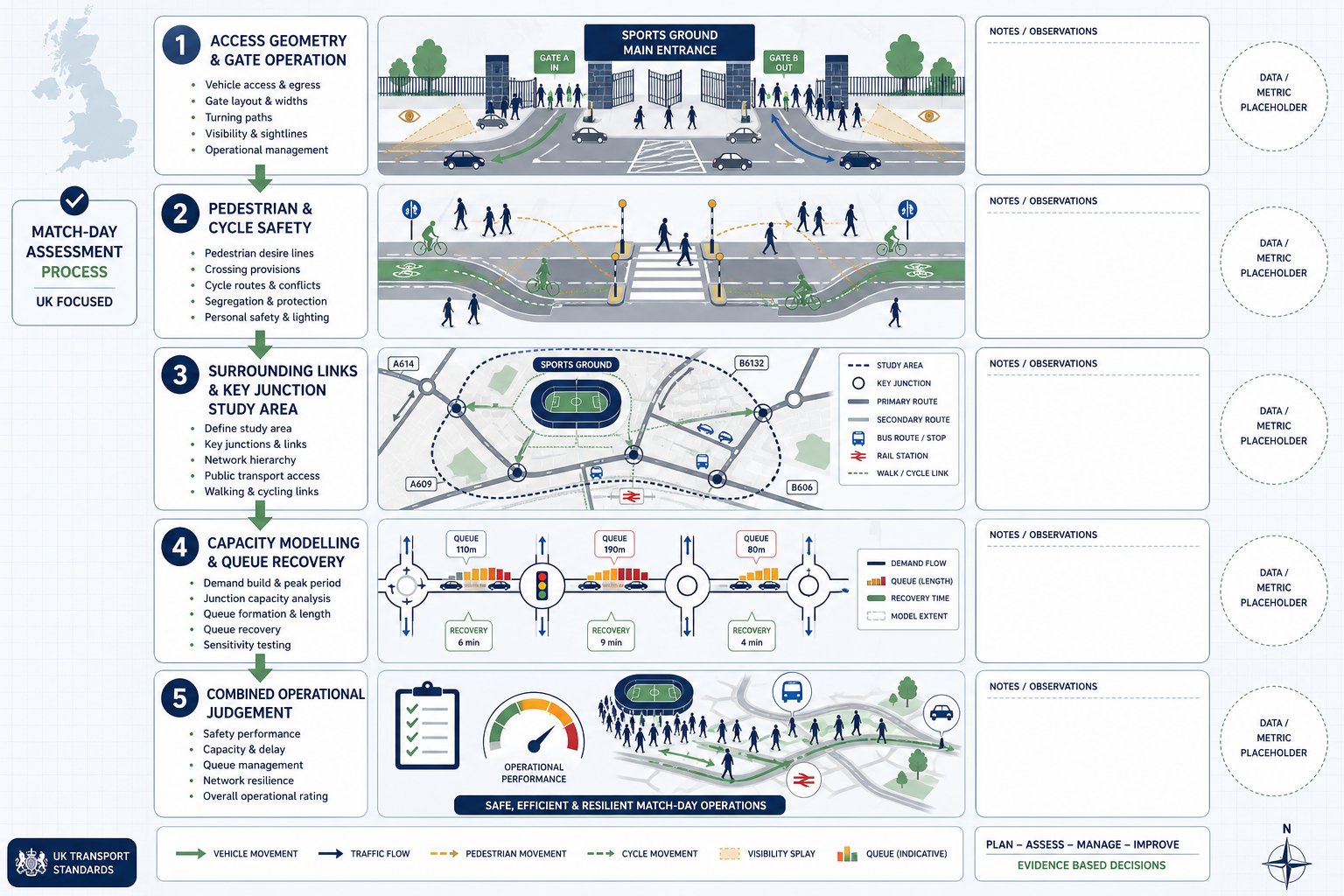
Access assessment begins with geometry and function. Can vehicles enter and leave safely? Are pedestrian and cycle routes legible and protected? Is there enough space for queueing, turning and gate control without traffic spilling back into the highway? For sports venues, those questions are operational as much as physical.
The highway impact side then considers how nearby links and junctions perform with development traffic added. The study area should reflect the routes people are actually likely to use, not just the easiest roads to model. Key junctions often include the site access itself, nearby signal junctions, mini-roundabouts, residential pinch points and approaches to strategic roads or stations.
Capacity testing may involve priority junction assessment, signal modelling or network tools depending on site context. Where relevant, practitioners often use Junctions 11 Software or equivalent packages, but software output is only as good as the scenarios and inputs behind it. For sports grounds, queueing and recovery times after events can be as important as ratio or delay metrics.
Road safety should also be addressed. That can include visibility splays, collision record review, crossing desire lines, temporary traffic control and conflict between pedestrians and cars close to the venue. A technically compliant access can still perform poorly if hundreds of people spill across it after a final whistle.
The most persuasive assessments connect layout, operations and modelling. They show not only that a junction works numerically, but why the access strategy is realistic under live event conditions.
Parking, Drop-Off, Coaches, And Servicing Requirements
Parking arguments can become the make-or-break issue on sports schemes, particularly where nearby residential streets are sensitive. A robust sports grounds transport assessment should hence quantify parking demand by scenario, explain the assumptions behind it, and show how demand will be managed rather than merely absorbed.
Car parking provision should account for spectators, players, staff, officials and accessible users. But that is only part of the picture. Many venues also need dedicated coach spaces, team minibuses, taxi or ride-hail pick-up areas, parent drop-off loops, and on-site servicing that does not conflict with pedestrian peaks. If those functions are pushed into the public highway, objection risk rises quickly.
The design matters as much as the headline number. Poorly arranged car parks can cause internal congestion, block coaches, or create unsafe reversing close to crowds. We often find that a carefully managed lower-parking strategy works better than a nominally generous layout with weak circulation and no stewarding plan.
Evidence should include parking beat surveys, local restrictions, match-day controls and likely displacement risk. Where overspill is a concern, mitigation may involve permit protection, event-day management, pre-booked parking, shuttle links or staggered egress. In more constrained cases, parking strategy may sit within a broader Private Sector Transport Planning framework that balances operations, neighbour impacts and planning policy.
Servicing is sometimes overlooked. Deliveries, refuse collection, catering vehicles and broadcast units all need space and routing clarity. If they cannot be accommodated on site, the authority will usually notice.
Walking, Cycling, And Public Transport Accessibility
For many sports venues, sustainable access is not a box-ticking exercise: it is the reason the scheme can function acceptably at all. If a ground relies too heavily on private car use, peak arrival and departure flows can overwhelm local streets even where the absolute crowd size is modest.
A proper assessment should map pedestrian catchments, likely desire lines and route quality. That means footway widths, lighting, gradients, crossings, step-free access, personal security and capacity at obvious pinch points. Post-match egress is often the stress test. A route that feels adequate for scattered daytime movement may struggle when large crowds leave at once.
Cycling analysis should cover route connectivity, road conditions, secure parking and realistic demand. Overpromising cycle mode share without safe routes is an easy way to lose credibility. Equally, underestimating demand can leave facilities full and informal parking scattered around entrances.
Public transport review should consider distance to rail and bus services, frequency, timing, spare capacity and the practical walk from stop to gate. For larger schemes, authorities may expect more explicit multi-modal accessibility analysis and discussions with operators.
Where a site forms part of an environmental impact assessment process, sustainable mode evidence often has wider importance because it feeds air quality, carbon and placemaking arguments as well as traffic impact.
The key is realism. We should show how people are likely to travel, and what improvements are needed to support a better mode split over time.
Crowd Management, Safety, And Operational Movement Planning
A sports grounds transport assessment cannot stop at traffic numbers. It has to reflect how crowds actually move. That means ingress and egress planning, gate operation, queue storage, stewarding arrangements, segregation where required, emergency access and the relationship between the venue boundary and the public highway.
This is one area where planning and licensing-style operational thinking overlap. The transport document does not need to become a full safety certificate submission, but it should show that access arrangements are consistent with the venue’s operational strategy. If spectators queue onto a live carriageway, or if coach arrivals cut across principal pedestrian routes, the issue is not just inconvenience: it is risk.
Good assessments show where people wait, where they cross, how they disperse and what temporary measures apply on larger event days. That can include barriers, marshals, cones, road closures, signed walking routes, contraflow systems and emergency vehicle protocols. The more complex the site, the more important a plan-led approach becomes.
In practice, councils and applicants benefit from bringing transport and operations together early. Experienced Transport Assessment Consultants: will usually spot movement conflicts before they become formal objections.
There is also a reputational point here. A ground that feels orderly and safe to approach is more likely to maintain community support than one that repeatedly creates local confusion after every big fixture.
Travel Plans, Mitigation Measures, And Planning Conditions
Mitigation is where the assessment becomes a decision-making tool rather than a descriptive report. If the TA identifies pressure on junctions, parking, crossings or public transport access, it should set out practical measures that reduce those impacts to an acceptable level.
Travel plans are often central to that package. For sports grounds, these may include event-day travel information, ticket-based travel messaging, shuttle buses, cycle parking delivery, staff travel measures, coach management, car share initiatives and coordination with public transport operators. Done well, the travel plan is not fluffy policy language. It is an operational document with actions, responsibilities, monitoring and review points.
Physical mitigation may involve new crossings, widened footways, access redesign, signage, dropped kerbs, junction works, temporary traffic management or parking controls. The right package depends on local context. Some sites need infrastructure. Others need tighter event management and enforceable caps on attendance or frequency.
Planning conditions and legal agreements often secure these measures. Typical mechanisms include approved travel plans, event management plans, parking management plans, maximum spectator numbers, monitoring requirements and trigger points for further action. We usually advise making those triggers precise. Vague commitments rarely reassure authorities.
The strongest applications explain not just what is proposed, but why it is proportionate. A concise transport assessment for developments: style framework can help, but sports sites still need bespoke event-day detail.
And one truth worth stating plainly: mitigation is easier to defend when it is designed into the scheme early, not added hurriedly after highways comments land.
Common Evidence, Surveys, And Data Needed To Support An Application
A robust sports grounds transport assessment lives or dies on evidence quality. Assumptions are unavoidable, but they should be traceable and tested. In most cases, supporting data will include classified traffic counts, turning counts at key junctions, parking surveys, pedestrian and cycle counts, public transport timetables and service frequency information.
For existing or replacement venues, historic attendance records, ticket scans, fixture schedules and club travel surveys can be extremely valuable. Comparable site data is also useful, provided the comparator is genuinely comparable in location, level of competition, mode share context and access constraints. A town-centre stadium next to a rail hub is not a clean proxy for a semi-rural sports complex.
Parking evidence deserves particular care. Authorities often want both on-site capacity analysis and local on-street survey work at representative times. If overspill is a concern, weekday daytime counts alone will not do the job.
We also recommend clear plans and summary tables. Decision-makers rarely object because too much information was presented clearly: they object because critical assumptions were buried. This is where a disciplined traffic impact assessment developers: approach helps, especially when multiple datasets need to support one planning narrative.
Where seasonality is important, survey timing should be explained. Data collected in school holidays, off-season weeks or abnormal weather conditions may need adjustment or cautious interpretation.
How To Prepare A Robust Sports Grounds Transport Assessment
The best way to prepare a robust sports grounds transport assessment is to treat it as an integrated planning exercise from day one. We should agree the scope early with the local highway authority, define realistic scenarios, and make sure the design team, operator and planning advisers are all working from the same assumptions.
First, describe the venue properly. Not in marketing language, but in operational terms: capacities, pitch use, event types, opening hours, staffing, servicing, gate arrangements and likely attendance profiles. Second, establish a clear baseline using surveys and local network evidence. Third, build transparent scenarios that distinguish everyday use from event conditions and identify a credible worst case.
From there, the assessment should connect trip generation, parking, access design, highway modelling, active travel routes, public transport and crowd management into one coherent narrative. If one part relies on another, say so. For example, if junction performance depends on a stewarded one-way circulation system, that needs to be explicit and enforceable.
Presentation matters too. Clear figures, legible plans and summary tables make a real difference in planning. So does honesty. If there is uncertainty, explain it and test sensitivity rather than hiding it.
For applicants working to tight programmes, the advantage of experienced support is speed without guesswork. With over 30 years of sector experience, our approach at ML Traffic is built around concise, accurate reporting tailored to local authority thresholds and real planning contexts.
A successful TA does not try to prove that a sports venue creates no impact. It proves that impacts are understood, mitigated and acceptable in planning terms.
Well-prepared, a Sports Grounds Transport Assessment gives planners and councils the confidence to say yes for the right reasons.
Frequently Asked Questions About Sports Grounds Transport Assessment
What is a Sports Grounds Transport Assessment and why is it important?
A Sports Grounds Transport Assessment is a planning document that examines how people and vehicles access a sports venue, addressing both typical use and peak event conditions. It ensures transport impacts are understood and managed, helping planning authorities make informed decisions.
When is a transport assessment typically required for sports ground planning applications?
A transport assessment is needed when a sports facility is likely to generate significant attendance, alter access arrangements, affect junction capacity, or cause on-street parking issues, especially during peak traffic periods or events that require traffic management.
How do sports grounds differ from standard development sites in terms of transport impact?
Unlike standard sites with predictable daily traffic, sports grounds experience highly peaked demand around event start and finish, strong seasonal and multi-use activity variations, and unique travel patterns including high walking, coach, and rail use, requiring scenario-based assessments.
What key factors are considered in trip generation and attendance analysis for sports grounds?
Trip generation analyses attendance bands such as baseline use, small, medium, and large events, distinguishing person trips by mode of travel. It considers historic data, ticketing records, mode share, and separates staff, spectators, officials, and servicing traffic for accurate modelling.
How are crowd management and safety addressed in a Sports Grounds Transport Assessment?
Crowd management plans within a Transport Assessment include ingress and egress routes, queue storage, stewarding, segregation, emergency access, and temporary traffic controls. These plans ensure pedestrian safety and operational efficiency during high-peak event times.
What mitigation measures are typically included to manage transport impacts at sports grounds?
Mitigation often involves event-day travel plans, parking controls, shuttle services, pedestrian and cycling improvements, junction upgrades, and enforcement through planning conditions. Early integration of these measures ensures residual impacts remain acceptable to authorities.