Your Transport Assessment just became a public health document. That shift in how London’s planning authorities evaluate development proposals is the reality facing applicants in 2026, and understanding the transport assessment ULEZ considerations embedded within that process is now the difference between approval and refusal. Air quality impacts are no longer a footnote; they sit at the heart of how TfL and borough planners judge whether a scheme is acceptable.
If you’ve felt the pressure of submitting a Transport Assessment and wondered whether you’ve adequately addressed the Mayor’s air quality agenda alongside conventional traffic impact, you’re not alone. The London Plan layers policy upon policy, TfL’s referral thresholds add another tier of scrutiny, and the distinction between a Transport Statement and a full Transport Assessment continues to trip up even experienced applicants.
This article gives you a clear, practical roadmap. You’ll learn exactly how ULEZ compliance requirements integrate into the Transport Assessment process, what TfL and local highway authorities expect to see, and how to build a technically robust submission that avoids a “severe” impact refusal. From scoping to mitigation, we cover the full picture.
Key Takeaways
- Understanding the transport assessment ULEZ considerations embedded in London’s planning process is now essential — air quality impact sits alongside traffic impact as a primary basis for approval or refusal.
- Every London development must demonstrate compliance with the 10 Healthy Streets indicators and Vision Zero principles, not just conventional highway capacity metrics.
- Knowing whether your scheme requires a full Transport Assessment or a simpler Transport Statement can save significant time and cost — the threshold depends on scale, location, and trip generation within the ULEZ zone.
- Robust Travel Plans and integrated EV charging infrastructure are among the most effective mitigation tools available to demonstrate a net-positive transport impact to TfL and borough planners.
- Professional technical reporting from specialists in TfL-referable applications is the single most reliable way to avoid a “severe” impact refusal and navigate London’s layered regulatory framework with confidence.
The Intersection of ULEZ and Transport Assessments in 2026
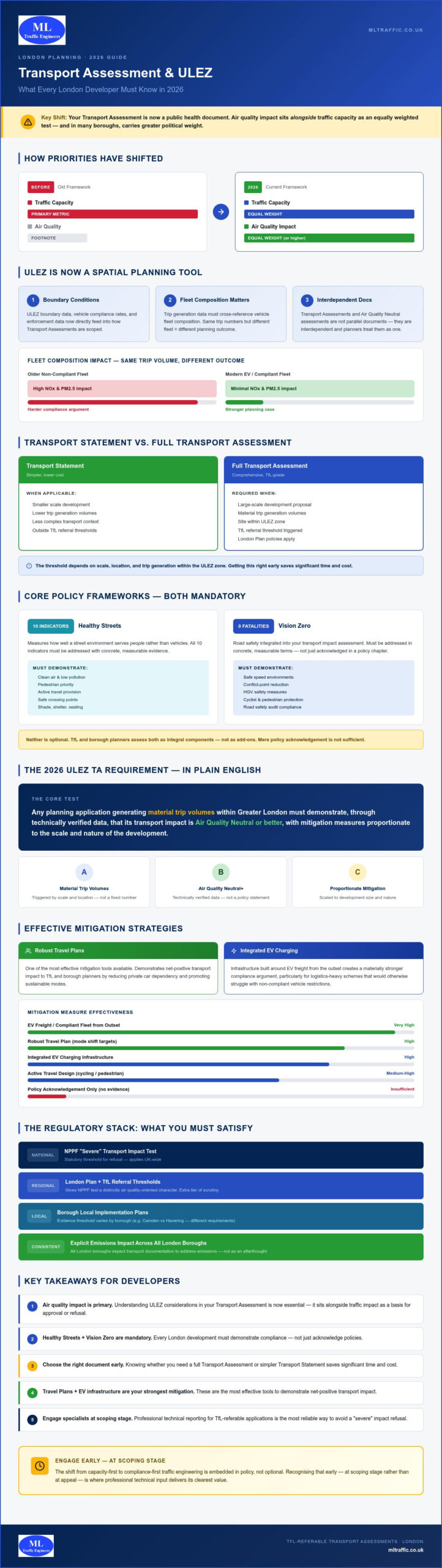
London’s planning system has fundamentally reordered its priorities. Traffic capacity was once the dominant metric by which a development’s transport impact was judged. In 2026, air quality compliance sits alongside it as an equally weighted test, and in many borough contexts, it carries greater political weight. Understanding this shift is essential before you put a single figure into your trip generation model.
The Ultra Low Emission Zone is no longer a congestion-charge adjacent policy instrument. It’s a spatial planning tool. Its boundary conditions, vehicle compliance rates, and enforcement data now feed directly into how Transport Assessments are scoped, what baseline conditions look like, and how mitigation measures are evaluated by TfL and borough planners alike.
Why ULEZ Matters for Your Planning Application
The London-wide ULEZ boundary means that virtually every development site within Greater London sits inside a zone where non-compliant vehicle trips carry a different planning weight than they did five years ago. This has a direct technical consequence: trip generation data can’t be modelled in isolation from vehicle fleet composition. A development that attracts a high proportion of older, non-compliant HGVs or private cars generates a materially different air quality impact than one with equivalent trip numbers but a modern, compliant fleet.
This is where transport assessment ULEZ considerations become technically complex. Your Transport Assessment must now cross-reference trip generation outputs with Air Quality Neutral assessments, demonstrating that the development won’t worsen local nitrogen dioxide or particulate matter concentrations beyond the thresholds set out in the GLA’s guidance. These aren’t parallel documents. They’re interdependent, and planners treat them as such.
Critically, non-compliant vehicle restrictions influence how accessible a site is perceived to be. A logistics-heavy scheme that relies on older delivery vehicles faces a harder compliance argument than one built around EV freight from the outset.
To ensure operational success within these zones, many developers look to logistics partners with modern fleets; for instance, you can discover SpeedLink Transport Limited and their specialist courier solutions which are designed for efficiency in regulated urban environments.
Regulatory Framework: NPPF and the London Plan
The National Planning Policy Framework’s “severe” transport impact test remains the statutory threshold for refusal, but the London Plan has layered additional requirements that give that test a distinctly air quality-oriented character in the capital. Local boroughs interpret TfL’s clean air mandates through their own Local Implementation Plans, which means the specific evidence threshold varies between, for example, Camden and Havering. What’s consistent across all London boroughs is the expectation that transport documentation addresses emissions impact explicitly, not as an afterthought.
The 2026 ULEZ Transport Assessment requirement, put plainly, is this: any planning application generating material trip volumes within Greater London must demonstrate, through technically verified data, that its transport impact is Air Quality Neutral or better, with mitigation measures proportionate to the scale and nature of the development.
The shift from capacity-first to compliance-first traffic engineering isn’t a philosophical preference. It’s embedded in the policy framework applicants must satisfy. Recognising that early, at scoping stage rather than at appeal, is where professional technical input from specialists in London Transport Assessments delivers its clearest value.
Core Requirements: Healthy Streets and Vision Zero
Two policy frameworks now define what a technically acceptable Transport Assessment looks like in London: the Healthy Streets Approach and Vision Zero. Neither is optional. TfL and borough planners assess both as integral components of any development’s transport impact, and your submission must demonstrate engagement with each in concrete, measurable terms, not just acknowledge their existence in a policy chapter.
The Healthy Streets Approach is built around 10 indicators that collectively measure how well a street environment serves people rather than vehicles. For developers, these indicators translate directly into design requirements that must be evidenced within your Transport Assessment documentation:
- People choose to walk, cycle, and use public transport — evidenced through mode share targets in your Travel Plan
- Clean air — directly where transport assessment ULEZ considerations intersect with Healthy Streets scoring
- People feel safe — requires conflict point analysis at site entrances and surrounding junctions
- Not too noisy — relevant to delivery management and routing strategies
- Easy to cross — pedestrian crossing provision assessed against desire line data
- Shade and shelter — physical infrastructure requirements for walking routes to and from the site
- Places to stop and rest — seating and dwell space within the site’s public realm contribution
- People feel relaxed — reduced vehicle dominance in the immediate environment
- Things to see and do — active frontages and ground-floor uses that support pedestrian activity
- People don’t feel isolated — connectivity to existing walking and cycling networks
What TfL’s own guidance doesn’t tell you is how to translate these indicators into planning evidence. That’s the practical gap most applicants struggle with.
Implementing the Healthy Streets Approach
Designing for shade, shelter, and pedestrian comfort isn’t an aesthetic exercise; it’s a technical deliverable that planners will assess against your site layout drawings and supporting documentation. Reducing private vehicle dominance means demonstrating, through your site access strategy, that pedestrian and cycle routes aren’t compromised by vehicle tracking envelopes. Swept Path Analysis is the tool that makes this argument credible. It shows precisely how vehicles manoeuvre within the site, confirming that pedestrian zones aren’t encroached upon and that safe separation distances are maintained at every conflict point.
Vision Zero in Transport Assessments
Vision Zero requires that site access design eliminates, rather than merely reduces, the risk of fatal or serious collisions. For junctions and entrances, this means safety-led geometry: low vehicle speeds, high pedestrian visibility, and the physical separation of cyclist routes from HGV turning movements. The conflict between cyclists and large vehicles at site entrances is one of the most scrutinised elements in any TfL referral, and your Transport Assessment must address it with specificity.
While Road Safety Audits sit outside the scope of services a transport consultant provides directly, the Transport Assessment must be structured to support that audit process, identifying conflict points and proposing mitigation measures that a subsequent audit can verify. Getting this structure right from the outset, with transport assessment ULEZ considerations woven into the safety narrative, is where specialist input from London Transport Assessment experts makes a demonstrable difference to how your submission is received.
Evaluating Impact: Transport Statements vs. Assessments
Choosing the wrong document type at the outset is a costly mistake. Submit a Transport Statement where a full Transport Assessment is required and you’ll face a validation rejection or, worse, a refusal on procedural grounds. Over-engineer a full Assessment for a scheme that warranted a Statement and you’ve spent budget unnecessarily. Getting this decision right, before scoping begins, is where the process either accelerates or stalls.
In London, the threshold isn’t determined by a single trigger. Trip generation, site location, PTAL rating, and proximity to the ULEZ boundary all feed into the decision. A development generating fewer than 30 two-way vehicle trips in the peak hour will typically qualify for a Transport Statement rather than a full Assessment, but that threshold isn’t absolute. Borough-specific requirements, TfL referral status, and the sensitivity of the surrounding network can each push a scheme into full Assessment territory regardless of raw trip numbers.
PTAL rating carries particular weight in this determination. A site with a PTAL of 5 or 6, well-connected to bus, rail, and Underground services, supports a lower-car mode share assumption. That directly reduces the modelled vehicle trip generation, which can bring a scheme below the full Assessment threshold. Conversely, a PTAL 1 or 2 site in outer London, even for a modest residential development, may generate sufficient vehicle trips to require the wider network analysis that only a full Transport Assessment delivers.
Transport assessment ULEZ considerations add another layer to this calculation. A scheme that sits within the ULEZ boundary and can demonstrate a high proportion of compliant or zero-emission vehicle trips has a materially different impact profile than an equivalent scheme relying on older fleet vehicles. Where compliance rates are demonstrably high, the air quality argument supports a proportionate, streamlined approach to transport documentation rather than exhaustive modelling.
Choosing the Right Report for Your Project
A Transport Statement addresses localised impact: site access, pedestrian connectivity, and immediate junction performance. A full Transport Assessment extends that analysis to the wider highway network, cumulative development impacts, and detailed modal shift modelling. The practical question is whether your scheme’s trip generation materially affects junctions beyond the immediate site frontage. If it does, a Statement won’t satisfy TfL or the borough highway authority. Pre-application scoping with ML Traffic Engineers resolves this question early, before you’ve committed to a documentation strategy that the local planning authority will reject. You can also review the Transport Statement buying guide to understand exactly where the boundary between these two document types sits in practice.
Data Collection in the ULEZ Era
Traffic surveys in London now capture more than volume and turning counts. Fleet composition data, distinguishing compliant from non-compliant vehicles, is increasingly expected as part of baseline evidence, particularly for sites near air quality management areas. Automatic Number Plate Recognition surveys and roadside classification counts both support this requirement.
EV uptake must be factored into trip generation modelling. The TRICS database includes sites with low or zero parking provision, making it a robust evidential tool for schemes designed around sustainable travel. Using TRICS comparators that reflect your site’s PTAL, land use, and urban context produces a defensible modal split assumption, one that planners and TfL can scrutinise without querying the methodology. Selecting appropriate comparators and demonstrating their relevance to your specific scheme is a technical judgement that underpins the credibility of the entire transport assessment ULEZ considerations argument.
Effective Mitigation Strategies for ULEZ-Compliant Planning
Identifying a transport impact is only half the work. The other half is demonstrating, through technically credible mitigation, that the development won’t worsen air quality or highway performance beyond acceptable thresholds. In 2026, the most effective mitigation strategies don’t treat ULEZ compliance as a separate layer bolted onto conventional transport planning. They integrate it from the outset, shaping site design, infrastructure provision, and management commitments into a coherent package that planners and TfL can assess with confidence.
Four mitigation tools carry the most weight in London applications right now: robust Travel Plans, EV charging infrastructure, car-free or car-capped development models, and S278 agreements for off-site improvements. Each addresses a different dimension of transport assessment ULEZ considerations, and together they form the core of a defensible mitigation strategy.
S278 agreements deserve particular attention. They allow developers to fund off-site highway and public realm improvements as a direct condition of planning consent. In ULEZ-sensitive locations, this mechanism can deliver junction upgrades, pedestrian crossing improvements, and cycle infrastructure that reduce vehicle dominance in the surrounding network. Crucially, these improvements are enforceable and time-bound, which gives borough planners the certainty they need to approve schemes that would otherwise face challenge on air quality grounds.
Car-free and car-capped development models work most effectively in high PTAL areas. A site with a PTAL of 5 or 6 supports the argument that residents and employees don’t need private vehicle access, which directly reduces vehicle trip generation and the associated emissions burden. Removing parking provision isn’t just a sustainability statement; it’s a technically grounded response to the air quality evidence that underpins the planning case.
EV charging infrastructure has moved from a planning benefit to a planning expectation. Schemes that integrate active EV charging bays, rather than passive cable routes, demonstrate a commitment to fleet compliance that aligns directly with ULEZ objectives. The London Plan sets minimum EV charging standards, but exceeding those standards strengthens the air quality neutral argument and reduces the risk of objection from borough environmental health officers. This commitment to low-emission transport can be further bolstered by ensuring that fleets are maintained efficiently on-site; for example, Mobile Tyre Service can provide the necessary support to minimize unnecessary mileage.
The Role of Travel Plans in 2026
A Travel Plan isn’t a document you produce to satisfy a condition. It’s a live management tool that demonstrates measurable modal shift over time. In 2026, planners expect Travel Plans to include specific mode share targets, monitoring protocols, and remediation measures if targets aren’t met. Incentivising sustainable travel through staff or resident benefits, cycle purchase schemes, and public transport subsidies gives the Travel Plan credibility beyond its submission date. You can explore the full scope of what’s required in our guide to London Travel Plans.
Infrastructure and Design Solutions
Cycle parking that exceeds London Plan minimums signals a genuine commitment to active travel rather than box-ticking. Secure, covered, well-lit cycle storage positioned close to building entrances directly influences mode choice. For mixed-use and commercial schemes, designing “last-mile” delivery and service vehicle access around EV-compatible loading bays reduces the proportion of non-compliant vehicle trips entering the site. These design decisions, when documented through a Transport Assessment, also justify reduced car parking provision, a position TfL actively supports in accessible locations.
Getting the mitigation package right requires technical judgement, not guesswork. ML Traffic Engineers builds mitigation strategies that are proportionate to your scheme’s impact, technically defensible under scrutiny, and structured to satisfy both TfL and borough planners from first submission.
Securing Planning Approval with ML Traffic Engineers
London’s planning system doesn’t reward guesswork. The regulatory framework surrounding transport assessment ULEZ considerations has become precise enough that a technically incomplete submission isn’t just a minor setback; it’s a direct route to refusal, delay, or costly appeal. Professional technical reporting isn’t a premium option for complex schemes. It’s the baseline requirement for any application that expects to succeed in 2026.
Generic transport consultants frequently miss the borough-specific nuances that determine whether an air quality argument holds up under scrutiny. Camden’s environmental health officers apply different evidential expectations to a logistics-heavy development than Havering’s highway authority applies to a suburban residential scheme. That difference isn’t navigable through template documentation. It requires consultants who understand how individual borough planning teams interpret TfL’s clean air mandates, and who structure submissions accordingly from the outset.
Our Expertise in London Transport Planning
ML Traffic Engineers specialises in TfL-referable applications and London Plan transport policy. That focus matters. Every service in the practice, from Swept Path Analysis to Travel Plans, Traffic Surveys, Parking Surveys, Transport Statements, and full Transport Assessments, is calibrated to the specific technical and political environment of London planning. Reports are tailored to address the air quality concerns of the borough receiving them, not produced to a standard format that planners recognise as a compliance exercise rather than a genuine technical argument.
Safety-conscious design sits at the core of every submission ML Traffic Engineers produces, ensuring that conflict point analysis, pedestrian connectivity, and cycle infrastructure are addressed with the rigour that Vision Zero requires, not treated as secondary considerations after highway capacity has been resolved.
The data-led methodology underpinning each instruction ensures that trip generation modelling, fleet composition analysis, and TRICS comparator selection are all defensible under TfL scrutiny. That technical credibility is what reduces the risk of objection, condition overload, or a “severe” impact refusal at determination.
Next Steps for Your Development
Early engagement is the single most effective risk-reduction measure available to any developer operating in London. Initiating a pre-application transport review before committing to a documentation strategy gives you clarity on three critical questions: whether your scheme requires a full Transport Assessment or a Transport Statement, what transport assessment ULEZ considerations are specific to your site and borough, and what mitigation package will satisfy TfL from first submission.
Waiting until design is fixed or a planning application is imminent compresses the time available to resolve scoping disputes, gather baseline survey data, or negotiate pre-application advice with the local planning authority. Starting the transport planning process early, with the right specialist input, is where planning programmes are protected and approval risk is genuinely managed.
To initiate a pre-application transport review, contact ML Traffic Engineers directly or explore the full range of services available through the What We Do page.
Take Control of Your Transport Assessment Before London’s Planners Do
Transport assessment ULEZ considerations have fundamentally changed what planning approval requires in London. Air quality compliance, Healthy Streets evidence, and Vision Zero design principles now sit alongside conventional traffic impact as tests that can determine whether your application succeeds or fails. Choosing the right document, whether a Transport Statement or a full Transport Assessment, and backing it with technically defensible mitigation is no longer optional.
The stakes are clear. A submission that doesn’t address fleet composition, modal shift targets, and EV infrastructure with precision gives borough planners and TfL grounds for refusal. Getting the technical argument right from scoping stage is where approval risk is genuinely controlled.
Established in 2014, ML Traffic Engineers specialises in London planning applications, bringing expertise in Swept Path Analysis, Traffic Surveys, and TfL-referable submissions to every instruction. Don’t leave your application vulnerable to avoidable challenge.
Contact ML Traffic Engineers for a professional Transport Assessment quote and move your development forward with confidence.
Frequently Asked Questions
Does every London development need a Transport Assessment for ULEZ?
Not every development requires a full Transport Assessment, but every London application must address air quality impact in some form. Smaller schemes generating fewer than 30 two-way vehicle trips in the peak hour may qualify for a Transport Statement instead. However, site location, borough-specific requirements, and TfL referral status can override that threshold regardless of trip volumes.
The transport assessment ULEZ considerations relevant to your scheme depend on its scale, land use, and proximity to air quality management areas. Pre-application scoping with a specialist consultant is the most reliable way to confirm which document type your local planning authority will accept at validation.
How does a low PTAL rating affect my Transport Assessment requirements?
A low PTAL rating, typically 1 or 2 in outer London, indicates limited access to public transport, which means your scheme will likely generate higher vehicle trip volumes. That directly increases the likelihood of requiring a full Transport Assessment rather than a Statement, because the wider highway network analysis becomes necessary to demonstrate acceptable impact.
Low PTAL sites also face greater scrutiny on modal shift assumptions. Without credible public transport alternatives nearby, planners will challenge any optimistic mode share targets in your Travel Plan, so the baseline evidence must be robust and site-specific.
Can a Travel Plan help offset negative air quality impacts in a TA?
Yes, a well-structured Travel Plan is one of the most effective tools for demonstrating reduced air quality impact. By setting binding mode share targets, monitoring protocols, and remediation triggers, it provides planners with measurable commitments that reduce the modelled proportion of private vehicle trips and the associated emissions burden over time.
Planners treat Travel Plans as live management instruments, not static documents. Including incentives such as cycle purchase schemes, public transport subsidies, and car-sharing platforms gives the plan credibility and demonstrates that modal shift targets are genuinely achievable rather than aspirational figures inserted to satisfy a condition.
What is the difference between a Transport Statement and a Transport Assessment in London?
A Transport Statement addresses localised impacts: site access arrangements, immediate pedestrian connectivity, and junction performance at the site frontage. A full Transport Assessment extends that analysis to the wider highway network, cumulative development impacts, detailed modal split modelling, and fleet composition data relevant to air quality compliance.
The practical test is whether your scheme’s trip generation materially affects junctions beyond the immediate site boundary. If it does, a Statement won’t satisfy TfL or the borough highway authority. Trip volumes, PTAL rating, and site sensitivity all feed into that determination, and getting it wrong at the outset costs time and budget.
How does TfL evaluate “Healthy Streets” in a planning application?
TfL assesses Healthy Streets compliance against the 10 indicators by examining specific technical evidence within your submission, not just policy acknowledgement. Conflict point analysis, pedestrian crossing provision against desire line data, cycle storage quality and positioning, and vehicle tracking envelopes are all scrutinised to confirm that street-level design genuinely prioritises people over vehicles.
Swept Path Analysis is a key evidential tool here, demonstrating that vehicle manoeuvres don’t encroach on pedestrian zones. TfL expects this evidence to be integrated into the Transport Assessment itself, not deferred to a separate design document that arrives later in the application process.
What happens if my Transport Assessment shows a “severe” impact?
A “severe” transport impact finding under the NPPF is a statutory ground for refusal. If your assessment identifies that level of impact, the application either requires a redesign to reduce trip generation, a substantive mitigation package that demonstrably resolves the severity, or a fundamental reconsideration of the scheme’s scale or access strategy.
Mitigation measures such as S278 highway improvements, car-free development models, and enhanced EV charging infrastructure can reduce a severe finding to an acceptable one, but only if they’re proportionate, enforceable, and technically verified. Submitting a scheme with an unresolved severe impact finding, hoping planners will accept a vague commitment to future mitigation, is a reliable route to refusal.
Are EV charging points mandatory in new London developments in 2026?
The London Plan sets minimum EV charging standards that apply to new residential and commercial developments, covering both active charging bays and passive cable routes for future installation. These aren’t discretionary; they’re a planning requirement that borough planners will condition if not addressed within the application documents.
Exceeding the minimum standard strengthens the air quality neutral argument within your Transport Assessment, particularly for schemes with higher parking provision or logistics-heavy uses. Active EV charging bays, rather than passive infrastructure alone, demonstrate a credible commitment to fleet compliance that directly supports the ULEZ-related elements of your transport planning case.
How long does it take to complete a full Transport Assessment?
A full Transport Assessment typically takes between six and twelve weeks from instruction to submission-ready report, depending on the complexity of the scheme, the volume of baseline surveys required, and the responsiveness of the local planning authority during pre-application scoping. Traffic and parking surveys must be conducted during representative periods, which can extend the programme if school holidays or network disruptions affect data quality.
Schemes requiring TfL referral or involving Air Quality Neutral assessments alongside the transport documentation generally sit toward the longer end of that range. Engaging a specialist consultant early, before design is fixed, protects the programme and avoids the delays that come from resolving scoping disputes after surveys have already been commissioned.

Disclaimer
The content on mltraffic.co.uk, including all technical articles, guides, and resources, is provided for general informational and educational purposes only. It is not intended to constitute professional advice in traffic engineering, transportation planning, development approvals, or any other technical or legal field.
While ML Traffic Engineers makes every reasonable effort to ensure the accuracy, completeness, and timeliness of the information published, we do not provide any warranties or representations (express or implied) regarding its reliability, suitability, or availability for any particular purpose. Any reliance you place on the content is strictly at your own risk.
In no event shall ML Traffic Engineers, its directors, employees, authors, or affiliates be liable for any direct, indirect, incidental, special, consequential, or punitive damages (including, without limitation, loss of profits, data, or business opportunities) arising out of or in connection with the use of, or inability to use, any information provided on this website.
The articles and guides on this site are not a substitute for engaging a qualified, professional traffic engineer to assess your specific project requirements. For tailored advice, compliance assessments, or traffic engineering services, please contact a competent professional.
This disclaimer may be updated from time to time without notice. By accessing or using this website, you agree to be bound by the most current version of this disclaimer.