Author: adminmltuk

  • Traffic Engineer In Ruislip: Transport Planning Support For Smoother Planning Approvals In 2026

    Traffic Engineer In Ruislip: Transport Planning Support For Smoother Planning Approvals In 2026

    A planning application can look perfectly sensible on paper and still come unstuck once transport issues are tested. In Ruislip, that happens more often than many project teams expect. A scheme may fit the site, meet broad policy aims, and even respond well to design feedback, but if access is awkward, parking pressure is already high, or nearby junctions are stretched at school-run times, transport becomes the detail that decides everything.

    That is why a traffic engineer in Ruislip plays such a practical role in the planning process. We do far more than produce a report to tick a box. We help show that development can function safely, that trips can be accommodated, that servicing is realistic, and that the proposal aligns with the expectations of the London Borough of Hillingdon, the London Plan, and, where relevant, Transport for London.

    For architects, planners, solicitors, surveyors, developers, and local authorities, the value is simple: stronger evidence, fewer surprises, and a better chance of moving from concept to consent without avoidable delays. In this guide, we set out where traffic engineering input matters most in Ruislip, what supporting documents are typically required, and how to prepare a project so the transport case is proportionate, robust, and planning-ready.

    Key Takeaways

    • A traffic engineer in Ruislip plays a crucial role in ensuring development projects have safe, efficient, and policy-compliant transport solutions before planning consent.
    • Early engagement with a traffic engineer can prevent delays by addressing local transport issues such as parking pressure, access geometry, and junction capacity tests.
    • Transport assessments or statements in Ruislip must be proportionate to the project’s scale and local sensitivities, especially in areas affected by school peak traffic or station catchments.
    • Tailored Travel Plans are essential for larger developments to promote sustainable travel and reduce car dependency while meeting London Borough of Hillingdon and London Plan requirements.
    • Vehicle tracking and servicing strategies must demonstrate that manoeuvres can be repeated safely without conflicting with pedestrians or obstructing the highway.
    • Coordinated collaboration with design teams and local councils ensures transport considerations are integrated early, resulting in clearer applications and higher chances of planning approval.

    Why A Traffic Engineer Matters For Development Projects In Ruislip

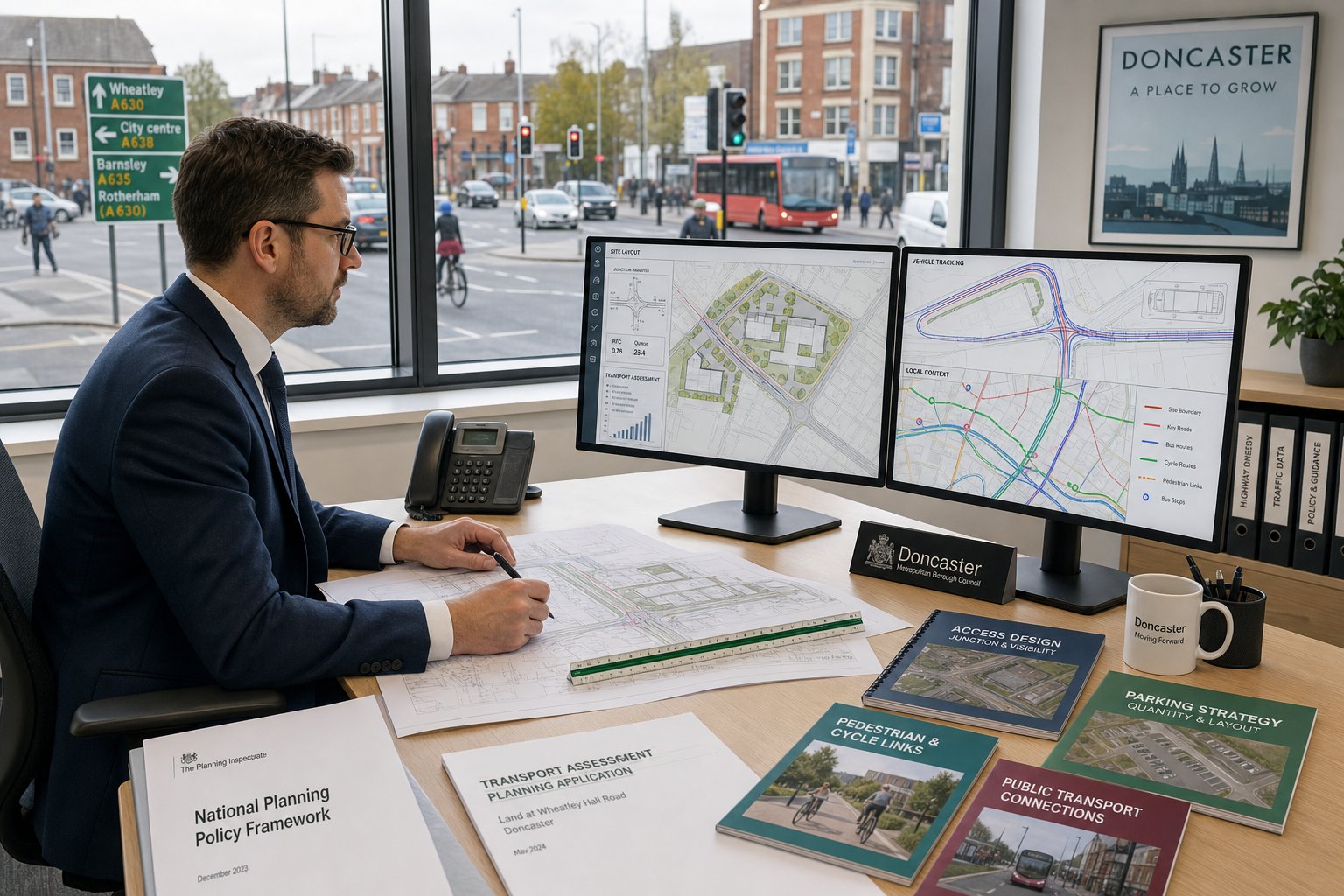
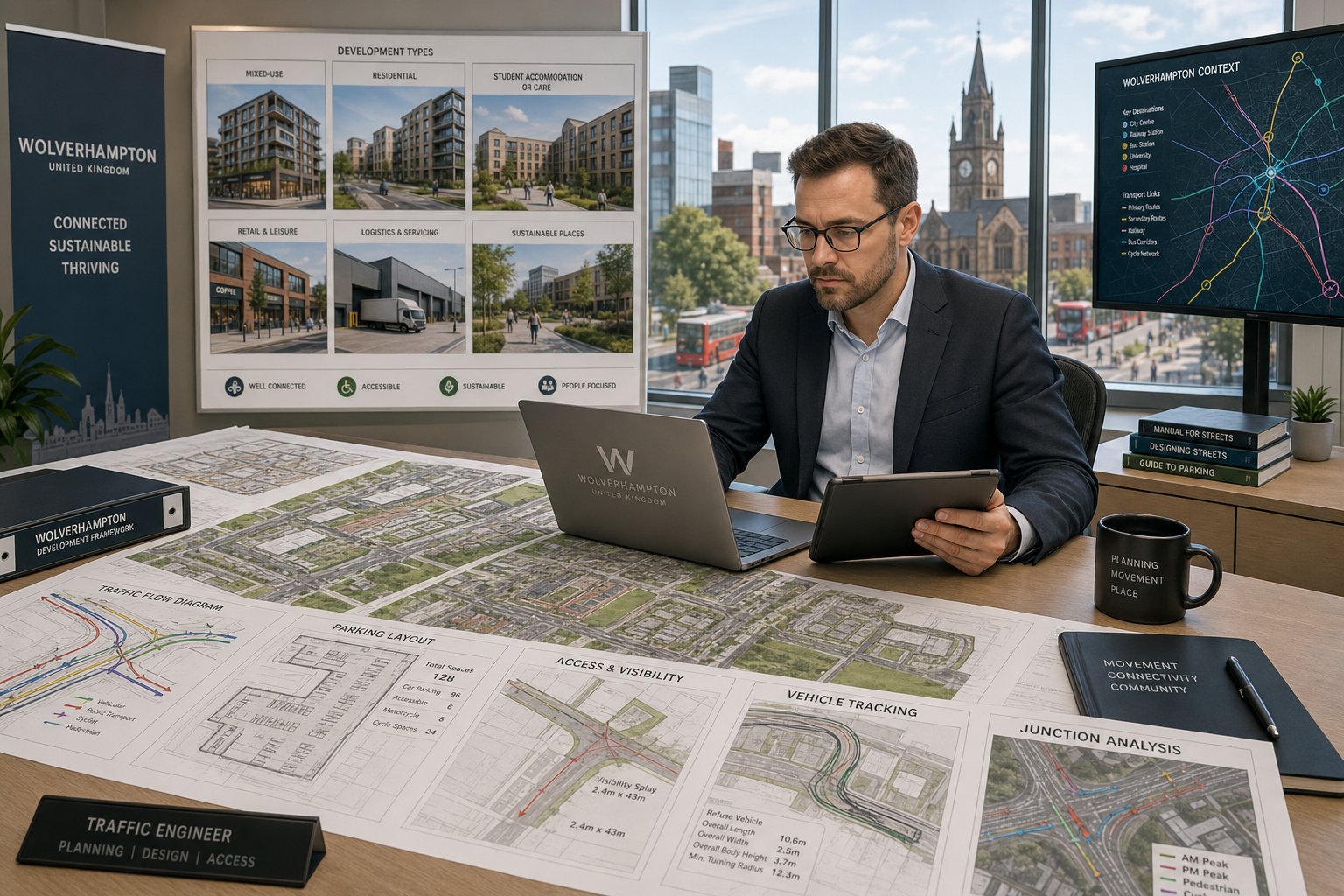
    Traffic engineer reviewing development transport plans in a modern Ruislip office.

    Transport is often one of the first technical disciplines to influence whether a proposal feels deliverable. A well-prepared transport case can answer concerns before they harden into objections: will vehicles enter and leave safely, will refuse collection work, is there enough parking, will local roads cope, and does the design encourage realistic non-car travel?

    In Ruislip, those questions are rarely abstract. Streets can be constrained, station catchments can create competing parking demand, and school peaks can sharply affect local operation over short time windows. A traffic engineer in Ruislip helps turn those issues into measurable evidence rather than assumption. That usually means reviewing access geometry, visibility, traffic generation, parking effects, servicing, walking and cycling links, and the likely performance of surrounding junctions.

    Done early, this input can save redesign costs and reduce risk. We regularly find that a modest layout amendment, a different bin collection arrangement, or a more realistic delivery strategy resolves the very issue that might otherwise delay validation or trigger objections. Broader strategic thinking matters too, which is why many teams also draw on wider guidance around Traffic Engineering Consultants: and Highway And Traffic support when deciding how much evidence a scheme needs.

    In short, our role is to de-risk planning by showing a scheme is safe, efficient, policy-aware, and capable of operating in the real world, not just on a drawing.

    Understanding Ruislip’s Transport And Planning Context

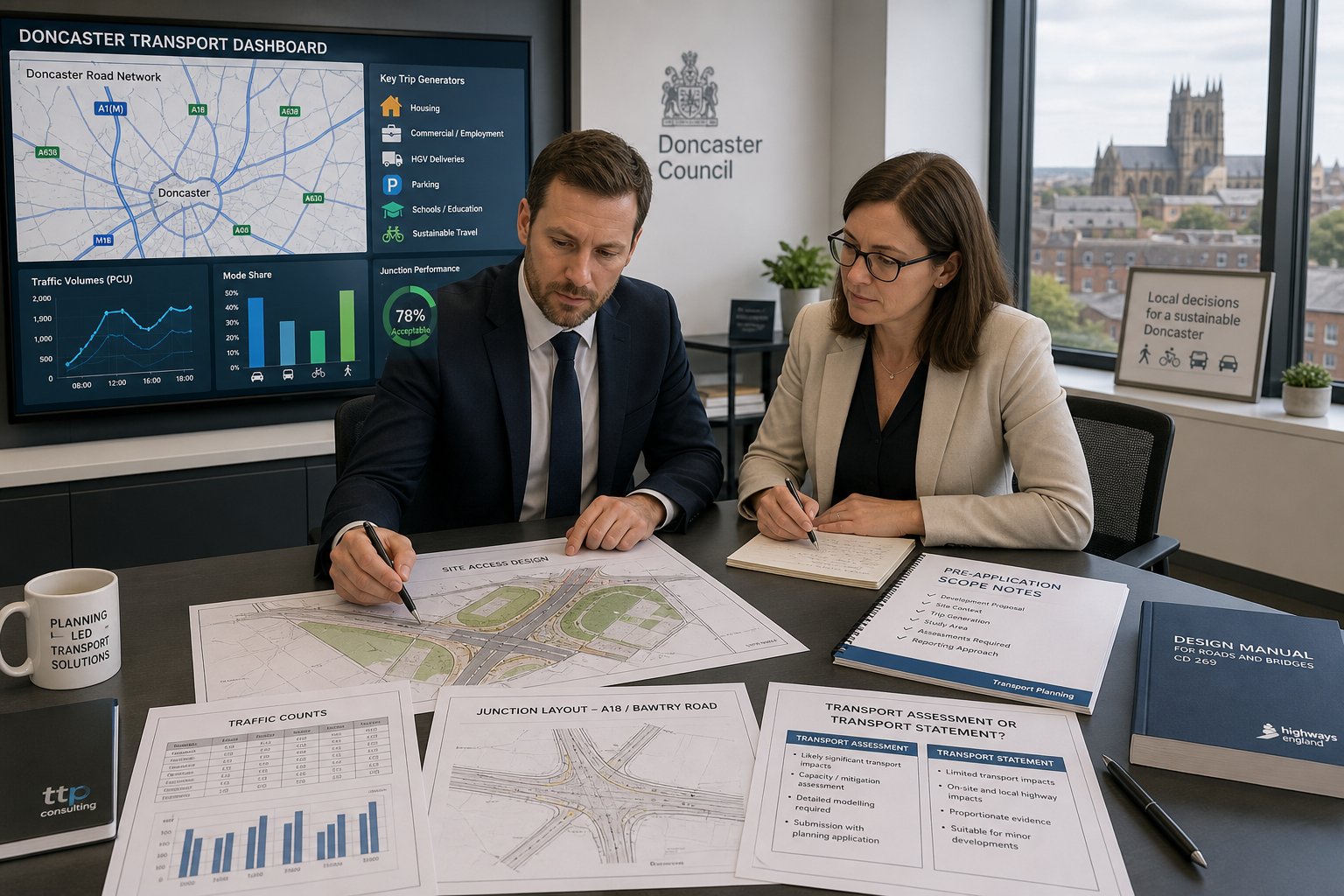
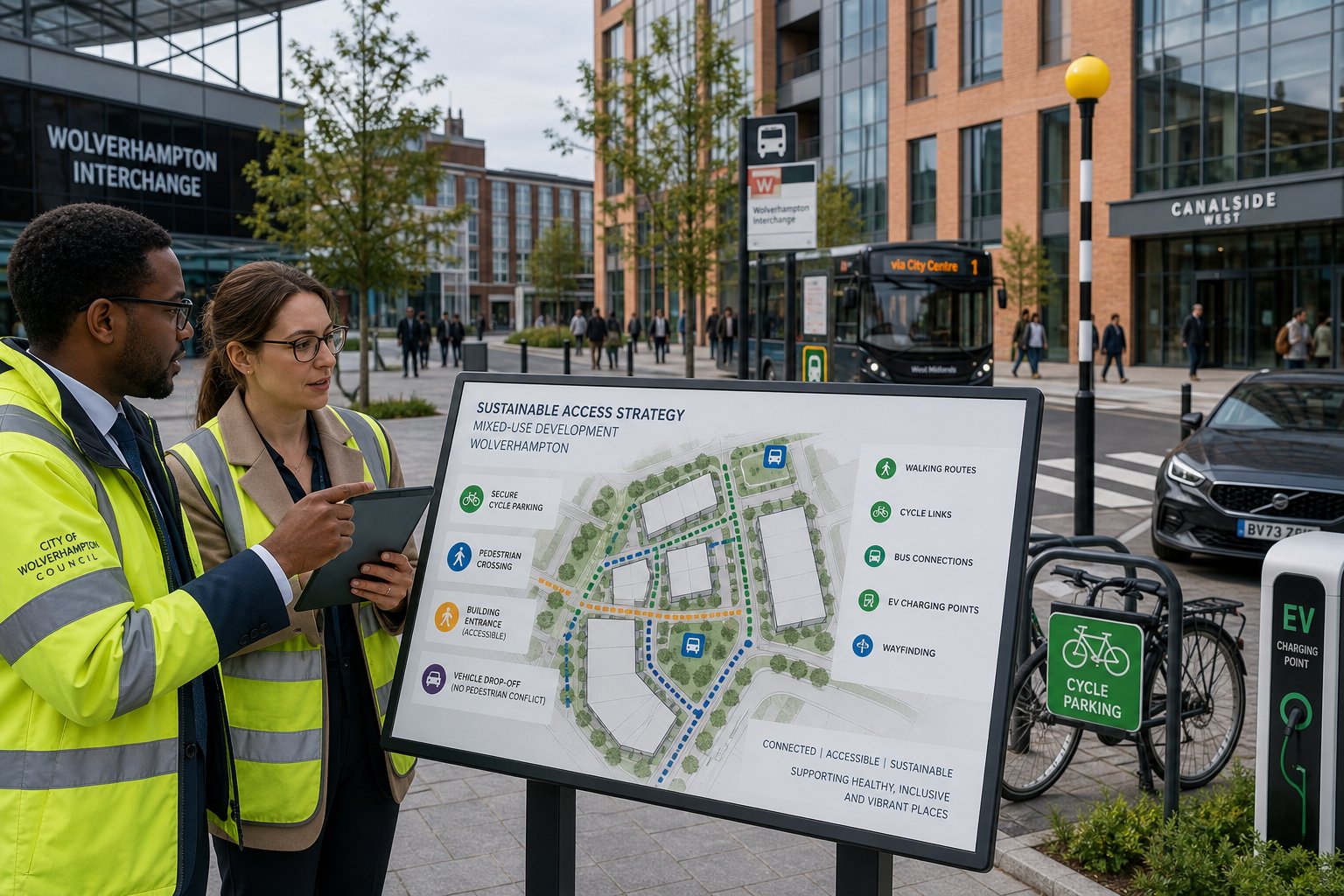
    Traffic engineer reviewing Ruislip transport plans with local street context.

    Ruislip sits within the London Borough of Hillingdon, so transport submissions are shaped by a layered policy context rather than a single checklist. The National Planning Policy Framework sets the broad test around safe and suitable access. The London Plan then adds sharper expectations on mode shift, active travel, healthy streets, public transport accessibility, and parking restraint in appropriate locations. Hillingdon’s own planning and highway considerations sit on top of that, along with any site-specific pre-application advice.

    That matters because Ruislip is not uniform. Areas around stations can have stronger public transport connections and tighter parking expectations, while quieter residential streets may be far more sensitive to overspill parking, turning conflicts, and visibility constraints. In some locations, controlled parking zones, narrow carriageways, bus movement, school travel patterns, and existing congestion are central to the planning story.

    We hence approach each site with local conditions first, policy second. The order is important. Policy tells us what authorities want to achieve: site evidence shows whether this scheme can credibly support it. A proposal near established public transport may justify a different parking and travel plan approach from one on a constrained suburban frontage.

    For project teams working across regions, the local nuances often matter as much as the report type itself. That is one reason clients who use our broader Traffic Engineer In London: support tend to value authority-specific thresholds and expectations, especially where TfL considerations may overlap with borough review.

    Common Schemes That Need Traffic Engineering Input

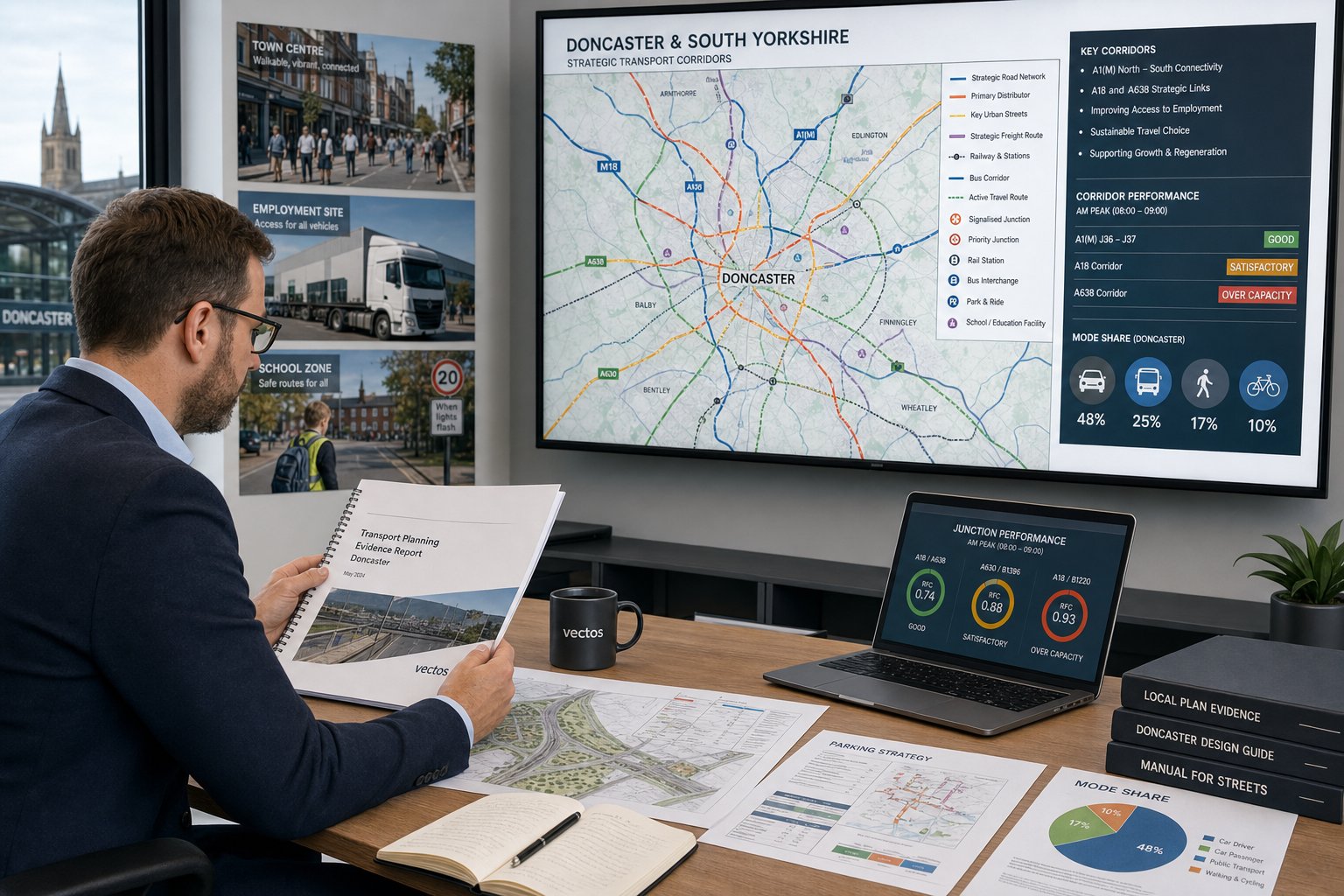
    Traffic engineer reviewing development access, parking, and traffic plans in a modern office.

    Not every proposal needs a full Transport Assessment, but plenty of schemes benefit from early traffic engineering input long before that threshold is tested. The common thread is change: a new access, intensified use, altered servicing, higher trip generation, or a layout that could affect highway safety.

    Typical projects in Ruislip include infill residential schemes, redevelopment of commercial plots, school extensions, health facilities, mixed-use town centre proposals, changes of use with different peak-hour profiles, and sites where existing access arrangements are simply not fit for the proposed operation. Even relatively modest developments can trigger transport concerns if they sit on constrained roads or in locations with known parking stress.

    We are often instructed where the issue is not just traffic volume, but practical operation. Can a refuse vehicle turn on site? Will delivery vans stop on the highway? Does a widened access remove too much kerbside parking? Is the likely trip distribution going to load a sensitive junction already under pressure?

    That is why proportionate advice matters. Some projects need only a concise statement and tracking plan: others require surveys, junction modelling, travel planning, and mitigation design. The aim is never to over-engineer the response. It is to match the evidence to the planning risk, using the same practical discipline that underpins effective Traffic Engineering and work on development sites more broadly.

    Residential Developments

    Residential proposals are among the most common instructions for a traffic engineer in Ruislip, and they often look deceptively straightforward. A small block of flats, a backland scheme, or a conversion with additional units may seem modest in planning terms, yet access and parking issues can become the main technical hurdle.

    For residential schemes, we usually test five things early: safe access geometry, visibility splays, vehicle tracking, parking provision, and likely trip impact. Refuse and emergency access are especially important. A layout that works for a private car but fails for a fire appliance or refuse vehicle is unlikely to survive detailed scrutiny.

    Parking and cycle storage also need to reflect London and local standards while remaining realistic for the site’s context. That means understanding PTAL, nearby station access, on-street pressure, and whether displaced demand could affect neighbouring roads. Where local residents already perceive parking to be at capacity, survey evidence becomes crucial.

    Trip generation for residential development is rarely dramatic in isolation, but cumulative impact can matter, particularly where several sites are coming forward in the same area. We hence assess not just how many trips are likely, but when they occur and which junctions or streets are most affected.

    Commercial, Education, And Mixed-Use Projects

    Commercial, education, and mixed-use schemes tend to generate more complex travel patterns than standard housing. Staff arrivals, visitor peaks, servicing windows, delivery activity, and school drop-off behaviour can overlap in ways that create very localised stress. In Ruislip, that can be the difference between an acceptable scheme and one that draws detailed objection from highways officers or neighbours.

    For commercial proposals, we look closely at trip profiles by land use, parking accumulation, servicing demand, and whether loading can happen without blocking the network. Office, retail, health, and leisure uses each behave differently. A convenience retail unit may have short-stay churn: a medical use may create more evenly spread arrivals but higher accessibility needs.

    Education projects require particular care. School peaks are intense, compressed, and emotionally charged in planning terms because local experience of congestion is so immediate. A robust school travel plan, sensible pickup arrangements, and honest parking analysis carry real weight here.

    Mixed-use schemes add another layer because shared access, staggered demand, and combined servicing can either help or hinder. Sometimes a balanced mix smooths peak demand. Sometimes it creates conflict. This is where Commercial Traffic Engineering thinking becomes useful: understanding how each use actually operates, not just how it is labelled in the application.

    Transport Assessments And Transport Statements For Planning Applications

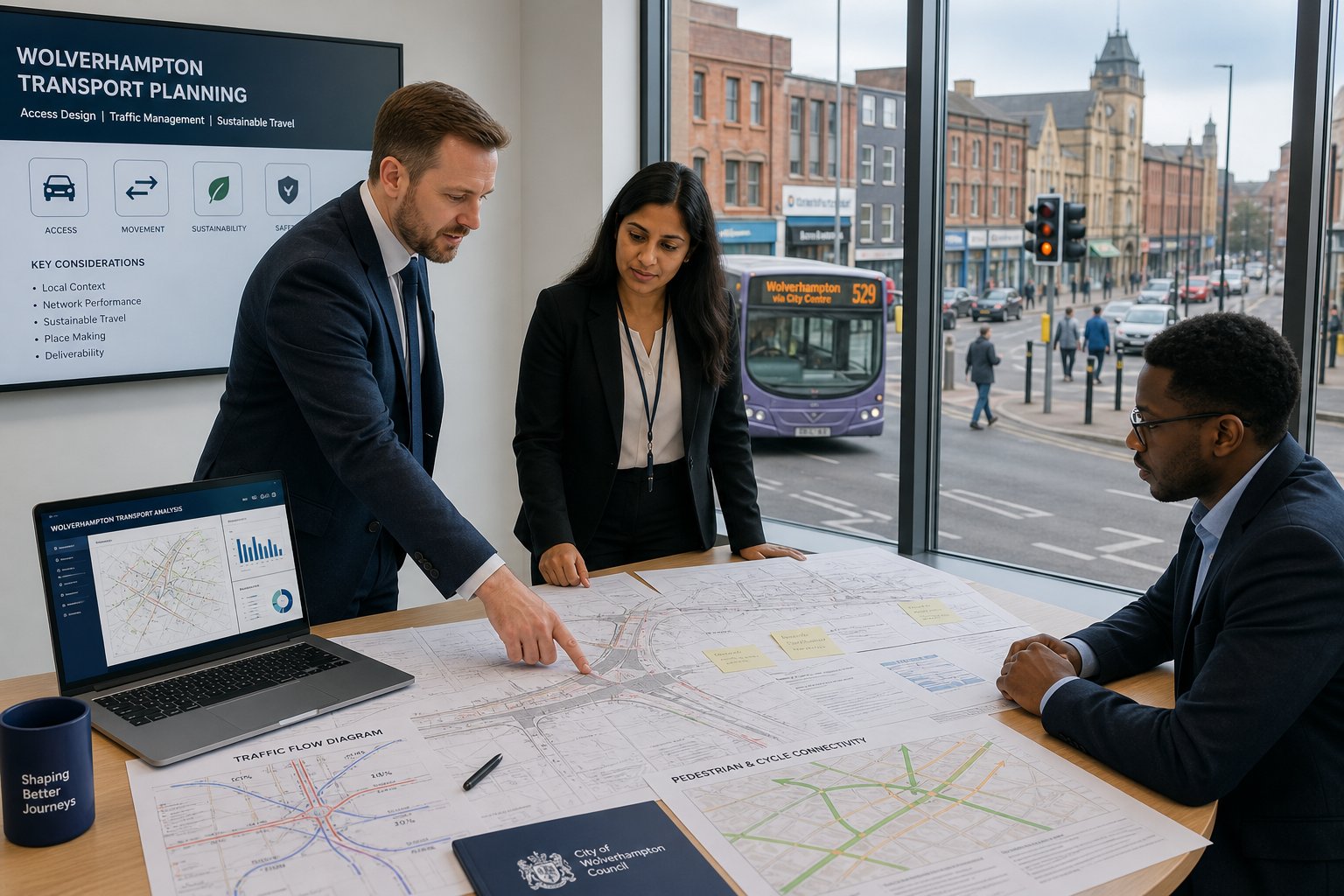
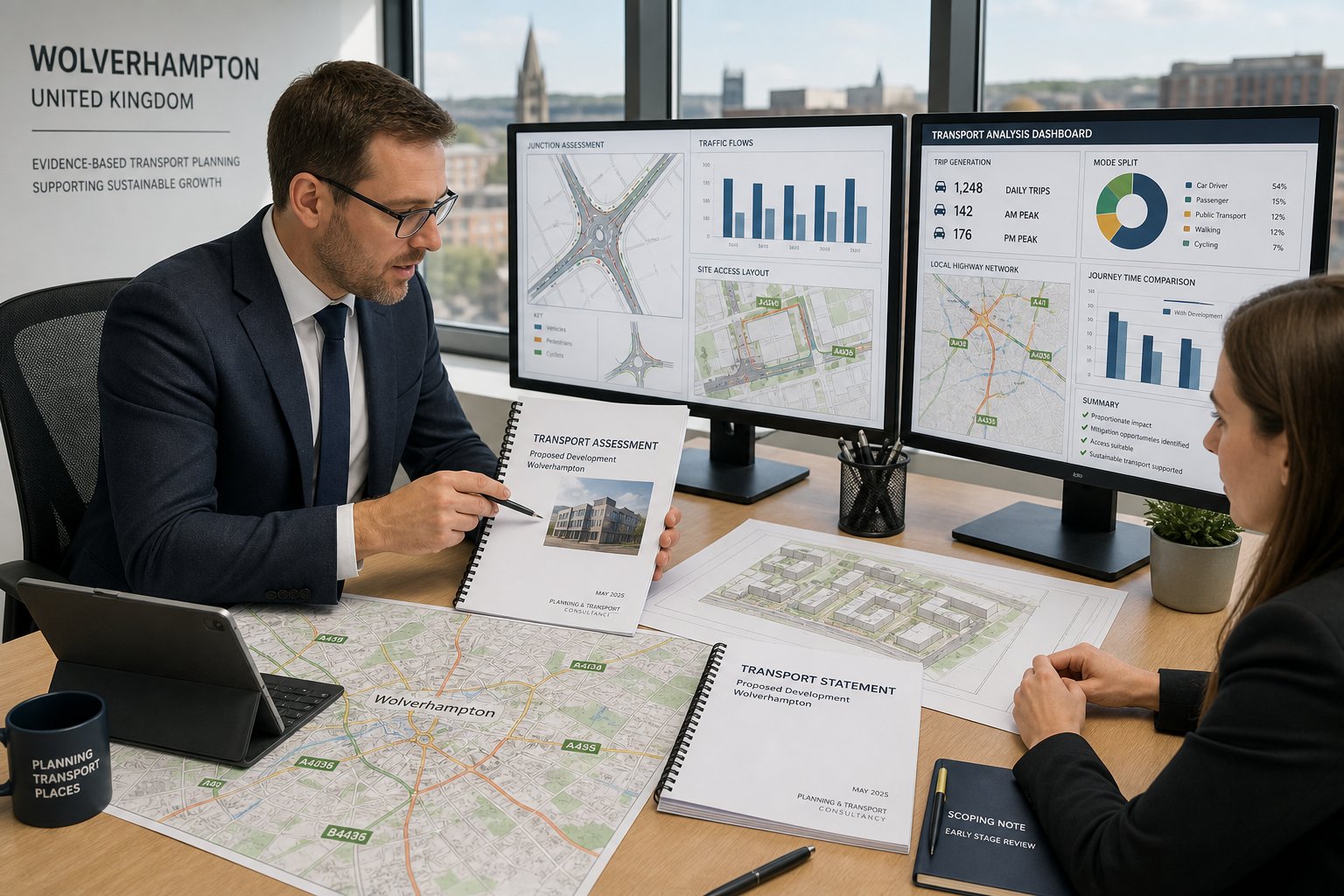
    Traffic engineer reviewing transport assessment plans in a modern UK office.

    One of the most common early questions is whether a scheme needs a Transport Assessment or a Transport Statement. The short answer: it depends on scale, impact, and local sensitivity.

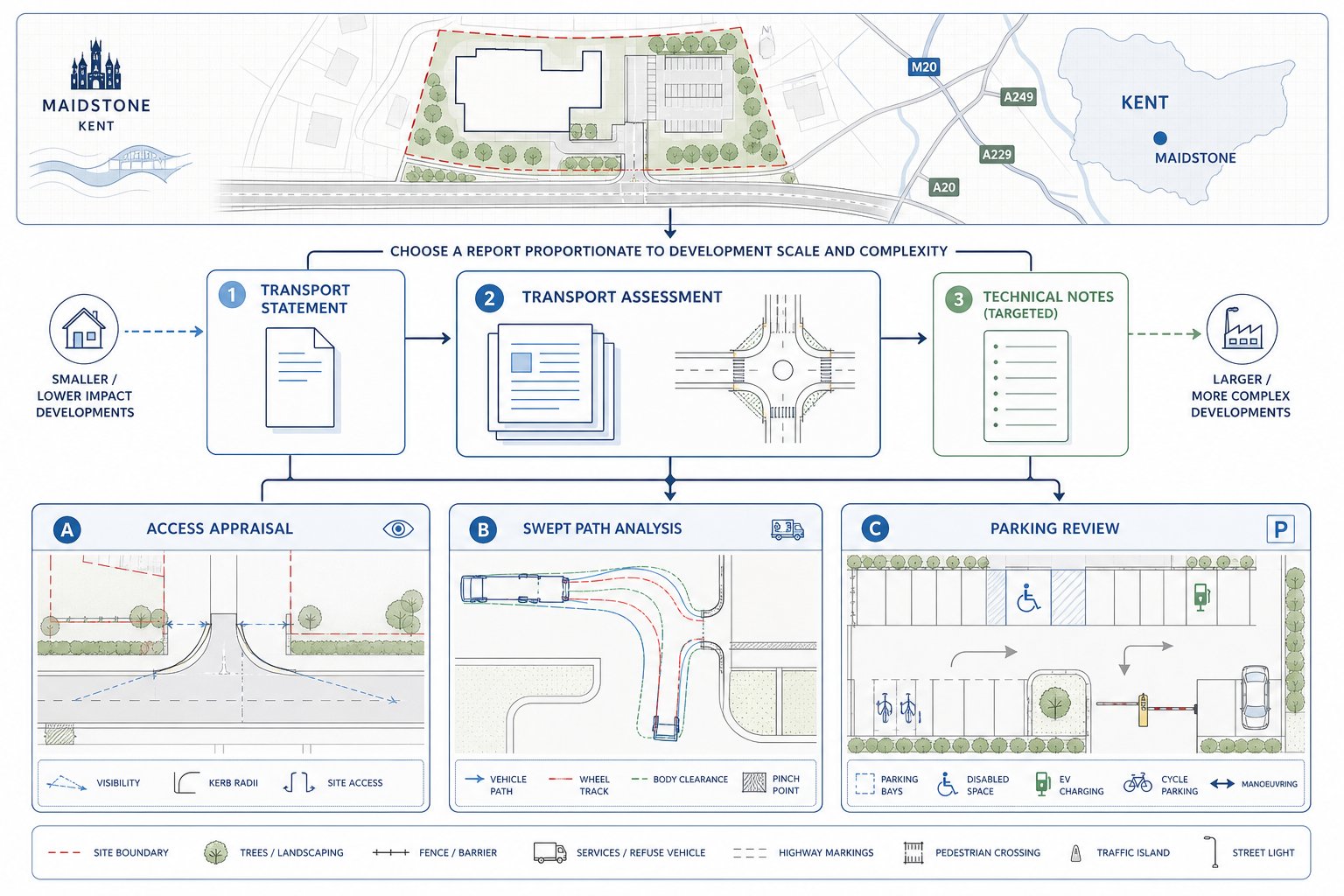
    A Transport Assessment is the fuller document. It typically covers existing conditions, site accessibility, policy context, traffic surveys where needed, trip generation, trip distribution and assignment, junction impact, parking implications, road safety considerations, servicing, and mitigation. We prepare TAs where a proposal is large enough, intensive enough, or sensitive enough to warrant detailed evidence.

    A Transport Statement is lighter and more proportionate. It is generally suited to smaller developments with more limited transport effects, though “small” does not automatically mean “simple”. In constrained Ruislip locations, even relatively modest schemes may still need careful assessment of access, parking stress, and local highway operation.

    The key is proportionality backed by judgement. A weak TS submitted for a scheme that clearly needs a TA often causes delay: an oversized TA for a genuinely low-impact proposal can waste time and budget without adding planning value. We focus on the threshold question early, then scope the report to fit the risk.

    Good reports are not just descriptive. They explain why a development is acceptable, acknowledge constraints honestly, and identify mitigation where needed. In practice, that might include revised access design, footway improvements, servicing controls, cycle parking upgrades, or targeted junction works. The best transport documents do not merely record impact: they help shape a scheme the authority can support.

    When A Travel Plan Is Required And What It Should Include

    Traffic engineer reviewing a travel plan in a modern UK office.

    Travel Plans are commonly required for larger schemes and for uses with concentrated staff, student, or visitor demand. In Ruislip, schools, offices, healthcare schemes, and major residential development are the obvious examples, but the exact trigger often comes from local authority judgement, pre-application feedback, or planning conditions.

    A useful Travel Plan is not a generic list of aspirations. It should be tailored to the site, the likely users, and the realistic alternatives to private car travel. That starts with baseline conditions: walking links, cycling routes, public transport availability, car parking controls, and any barriers that make sustainable travel harder than policy might assume.

    From there, the document should set out clear objectives, target mode shares where appropriate, practical measures, and who is responsible for implementation. Typical measures include cycle parking and showers for staff, personalised travel information, public transport incentives, car-share systems, school travel campaigns, delivery management, and monitoring arrangements.

    The management structure matters more than many applicants expect. If no one is named to carry out and review the plan, officers may treat it as wishful thinking. We hence make sure Travel Plans identify responsibility, timescales, monitoring periods, review triggers, and fallback actions if mode share targets are missed.

    Used properly, a Travel Plan is not just a policy attachment. It can be part of the mitigation strategy that makes a scheme acceptable, especially where parking is constrained or where the authority expects clear support for mode shift and Vision Zero objectives.

    Vehicle Tracking, Access Design, And Servicing Strategy

    This is often where planning drawings meet operational reality. A site may look neat on a layout, yet fail once actual vehicle movement is tested. Vehicle tracking, access design, and servicing strategy are hence core parts of many planning submissions in Ruislip.

    Using swept-path analysis, we test whether vehicles can safely enter, manoeuvre, and exit the site. That usually includes private cars, refuse vehicles, emergency appliances, and delivery vehicles relevant to the proposed use. The purpose is not simply to prove something can just about happen on paper: it is to show it can happen repeatedly, safely, and without unreasonable conflict with pedestrians, cyclists, parked vehicles, or boundary features.

    Access design must also respond to visibility, carriageway width, footway continuity, gradients, gates, and the relationship with nearby junctions or crossings. On constrained suburban plots, a few centimetres in the wrong place can affect whether a design is workable.

    Servicing strategy is just as important. If deliveries are likely to occur from the carriageway, block a bus route, or reverse across a footway, the planning risk climbs quickly. We look at vehicle size, frequency, dwell time, delivery management, and whether on-site servicing is realistically achievable.

    For many teams, this is the point where broader Traffic Engineering: Your principles become very tangible: making sure the proposal works day after day, not only under ideal conditions shown on a CAD drawing.

    Parking Surveys, Capacity Reviews, And Local Highway Considerations

    Parking can dominate planning discussions in Ruislip because it is both technical and highly visible to neighbours. A transport authority may be interested in standards and capacity: residents are often focused on what happens at 7pm on their street. Both viewpoints matter.

    Where a proposal could displace parking onto surrounding roads or relies on spare on-street capacity, surveys are usually essential. Depending on the site and use, that may involve overnight beat surveys, weekday daytime observations, Saturday checks, or more targeted review of school peak conditions. The goal is to establish occupancy, turnover, and realistic residual capacity rather than relying on anecdote.

    But parking is only part of the local highway picture. We also review collision history, speed environment, visibility, crossing desire lines, existing restrictions, bus stop locations, and any evidence of informal behaviour such as verge parking or turning conflicts. A new access that technically meets standards can still be problematic if it sits next to a heavily used crossing route or within a pattern of poor driver behaviour.

    Capacity reviews should hence be rounded, not narrow. We ask whether the site can function without creating knock-on effects, and whether local constraints suggest mitigation is needed. Sometimes that means revised parking provision or a stronger Travel Plan. Sometimes it means accepting that a lower-car approach is supportable, but only if backed by credible local evidence and careful condition wording.

    Junction Capacity Assessments And Traffic Impact Analysis

    Where development is likely to add material traffic to the network, junction capacity assessment becomes a key part of the planning evidence. The purpose is straightforward: quantify whether surrounding junctions can accommodate forecast demand, and if not, identify mitigation.

    In practice, that can involve priority junction modelling, roundabout assessment, signal analysis, or corridor review depending on the road layout and authority concerns. We establish baseline conditions, forecast development traffic, and test future-year scenarios with and without the scheme. The outputs usually focus on queueing, delay, reserve capacity, and operational performance during relevant peaks.

    For Ruislip sites, the right peak period is not always obvious. AM and PM commuter peaks may matter, but school-run conditions or Saturday retail periods can be more critical for some proposals. Using the wrong scenario can make an assessment look tidy while missing the issue everyone local actually cares about.

    Traffic impact analysis should also be interpreted sensibly. A small numerical increase at a highly sensitive junction may warrant mitigation: a larger increase on a resilient route may not. We combine model outputs with engineering judgement, observed conditions, and policy context.

    Where mitigation is needed, it should be proportionate and deliverable: lining changes, localised widening, signal optimisation, crossing upgrades, or management measures tied to phasing. Teams working across multiple authorities often recognise the same discipline in places beyond west London too, whether through a Traffic Engineer In Manchester: brief or Traffic Engineer In Birmingham: support for urban schemes under different local standards.

    Working With Local Councils, Design Teams, And Planning Consultants

    Transport planning works best when it is integrated early rather than added at the end. By the time a layout is fixed, options can be limited. That is why we prefer to work alongside architects, planning consultants, solicitors, drainage engineers, landscape teams, and project managers from the outset.

    With local councils, the value of early engagement is obvious. Hillingdon officers may flag concerns about parking stress, access width, school traffic, or report scope long before a formal determination. Where a strategic road or TfL interest is involved, understanding who needs to be consulted, and when, can prevent avoidable delay.

    Internally, coordination is just as important. Drainage features can affect vehicle tracking. Bin stores can compromise turning space. Landscaping can obstruct visibility. Cycle parking can improve a Travel Plan but reduce room for servicing. None of these are dramatic problems individually, yet they are exactly the sort of issues that unravel submissions late in the programme.

    We find the best results come from iterative review: test the concept, identify transport risks, refine the layout, and then write the supporting case around a scheme that already works. With over 30 years of experience reflected in the approach behind mltraffic.co.uk, speed matters, but accuracy and local judgement matter more. A concise report is useful only when it has been built on sound assumptions and coordinated design input.

    What To Prepare Before Instructing A Traffic Engineer In Ruislip

    A good brief makes transport advice faster, sharper, and more cost-effective. Too many projects lose time because key information arrives in fragments after the transport scope has already been agreed.

    Before instructing a traffic engineer in Ruislip, it helps to assemble the red-line boundary, draft site layout, site address, existing and proposed land uses, floorspace or unit numbers, expected staffing, parking proposals, cycle parking numbers, and any phasing assumptions. If there are unusual operational features, delivery restrictions, school pickup management, blue-light access needs, or shared servicing, those should be flagged early.

    Pre-application feedback is especially valuable. Comments from Hillingdon, TfL, or the design team can shape the report scope immediately and avoid unnecessary work. We also ask about known local sensitivities: existing parking pressure, neighbour complaints, collision concerns, school peaks, bus route issues, and nearby developments that may affect cumulative impact.

    Topographical survey information, site photographs, and any previous planning history can also help. And if a layout is still fluid, that is not a problem, provided we know which elements are fixed and which are open to change.

    In practical terms, the more clearly the project team explains the scheme’s operation, the easier it is for us to judge whether the site needs a TS, a TA, a Travel Plan, tracking, parking surveys, junction modelling, or a combination of these. Good upfront information usually means fewer late revisions and a stronger planning submission.

    Conclusion

    A traffic engineer in Ruislip is not there simply to produce a transport document for the planning portal. Our role is to help prove that a development can work safely, efficiently, and in line with local and London-wide policy expectations.

    That means understanding how Ruislip actually functions: its residential streets, station influences, school peaks, parking constraints, and authority priorities. It means matching the level of assessment to the real planning risk, whether that involves a concise Transport Statement, a full Transport Assessment, a Travel Plan, vehicle tracking, parking surveys, or junction analysis. And it means coordinating transport evidence with design decisions early enough to solve problems before they become objections.

    For architects, developers, planners, lawyers, surveyors, and councils, the benefit is straightforward. Stronger transport input usually leads to clearer applications, fewer surprises during determination, and better prospects of securing consent on a scheme that is genuinely deliverable.

    Frequently Asked Questions About Traffic Engineering in Ruislip

    What role does a traffic engineer play in Ruislip’s planning applications?

    A traffic engineer in Ruislip ensures developments are safe and efficient by assessing access, parking, traffic impact, and servicing arrangements, aligning proposals with London Borough of Hillingdon and London Plan policies to support planning approval.

    How do traffic engineers in Ruislip address parking pressures around stations and residential areas?

    They conduct on-street parking surveys and capacity reviews to measure demand and available space, advising designs that minimise overspill and meet PTAL-based and local parking standards, crucial in areas with controlled parking zones and high local sensitivity.

    When is a Transport Assessment required instead of a Transport Statement for developments in Ruislip?

    Larger or more intensive projects needing detailed analysis of traffic flows, junction capacity, and mitigation require a Transport Assessment, while smaller or lower-impact schemes typically submit a proportionate Transport Statement based on national and local thresholds.

    What should be included in a Travel Plan for a large residential or commercial development in Ruislip?

    A Travel Plan must set clear objectives and mode-share targets, include practical measures such as cycle parking, car sharing, and public transport incentives, and define management, monitoring, and review structures to encourage sustainable travel and comply with local policies.

    How does vehicle tracking and access design affect planning approval in Ruislip?

    Using swept-path analysis, traffic engineers verify that all vehicles—including emergency and refuse—can safely manoeuvre on site without obstructing roads or pedestrian routes, ensuring layouts are practical and compliant with local highway safety and operational requirements.

    Why is early involvement of a traffic engineer recommended for Ruislip development projects?

    Engaging a traffic engineer early helps identify transport-related risks and solutions, promoting efficient design iterations that avoid delays, objections, and costly revisions, while facilitating coordinated input with architects, planners, and local authorities including Hillingdon and TfL.

  • Traffic Engineer In Wembley: Expert Transport Support For Planning Applications In 2026

    Traffic Engineer In Wembley: Expert Transport Support For Planning Applications In 2026

    Wembley is one of those places where transport issues stop being a background technical matter and become central to whether a scheme is workable at all. Between Wembley Stadium, major regeneration areas, busy town centre streets, rail and Underground stations, and strategic routes such as the A406 North Circular and A404 Harrow Road, even relatively straightforward development proposals can raise detailed questions about access, traffic impact, servicing and road safety.

    That is why appointing a traffic engineer in Wembley early usually pays off. We are often asked to step into projects where the design is already moving, the planning timetable is tight, and Brent Council or Transport for London will expect clear, policy-led evidence rather than broad assurances. In practice, good transport input does more than produce a report. It shapes layouts, reduces avoidable planning risk, and helps teams demonstrate that a proposal can operate safely on normal days as well as in a more complex event-day environment.

    For architects, planners, lawyers, surveyors, developers and local authorities, the real issue is not whether transport matters. It is what level of evidence is likely to be needed, how local planning context affects that evidence, and how to assemble a robust package that supports permission rather than delays it. That is what we cover here.

    Key Takeaways

    • Appointing a traffic engineer in Wembley early in the planning process helps address complex transport challenges unique to the area, including event-day impacts and strategic route interactions.
    • Traffic engineering input is crucial for meeting Brent Council and TfL requirements by providing clear, policy-led transport evidence that supports planning permission and reduces risks.
    • A traffic engineer shapes development layouts by advising on access, parking, servicing, and pedestrian connectivity, ensuring proposals operate safely during normal and event days.
    • Transport assessments and statements in Wembley must be concise, focused, and proportionate to the scheme’s size and location, often including junction capacity and safety analyses.
    • Travel plans are essential for larger Wembley developments to promote sustainable travel and comply with policy-led parking restrictions, especially in high-PTAL locations.
    • Choosing a traffic engineer familiar with Wembley’s local context, policy environment, and event-related pressures is key to producing credible, robust transport evidence and facilitating smooth planning approvals.

    Why Traffic Engineering Matters For Development In Wembley

    Traffic engineer reviewing Wembley development transport plans in a modern office.

    Wembley is a transport-sensitive location by any measure. It combines high-density housing growth, town centre activity, strategic highway movements, strong public transport accessibility in many areas, and the unusual operational reality of major stadium events. That mix means transport evidence is rarely a tick-box exercise.

    From a planning perspective, traffic engineering matters because applicants must show that development will not create an unacceptable impact on highway safety and will not result in severe residual cumulative impacts on the road network, reflecting the National Planning Policy Framework. In Wembley, that often means looking beyond a site boundary. We may need to consider nearby junctions, bus activity, pedestrian routes to stations, controlled parking zones, delivery patterns and how the network behaves at different times.

    It also matters because policy in London pushes projects toward sustainable movement. Lower car dependency, stronger walking and cycling links, and realistic public transport use are not just good ideas: they are often central to making an application policy-compliant. That is especially true in higher PTAL locations around Wembley Park and nearby stations.

    For some schemes, the transport challenge is obvious. For others, it is more subtle: a tight access, a servicing conflict, a poor visibility line, or an understated parking pressure issue. We find that early technical review usually exposes these issues while they are still fixable, rather than after submission when redesign becomes slower and more expensive.

    The Role Of A Traffic Engineer In The Planning Process

    Traffic engineer reviewing Wembley site plans in a modern office.

    A traffic engineer supports a planning application from far earlier than many teams expect. In the best-case scenario, we are involved while the site layout is still flexible. That lets us advise on access position, internal circulation, parking provision, servicing space, pedestrian connections and whether junction or capacity analysis is likely to be needed.

    As the proposal develops, we prepare the technical evidence that planning officers and highway consultees will rely on. That may include a Transport Statement, a full Transport Assessment, a Travel Plan, swept path analysis, a junction capacity assessment, a preliminary access design review or road safety input. On schemes with a broader urban movement focus, the work may also sit alongside Traffic Engineering Consultants: support covering strategy, standards and stakeholder coordination.

    In Wembley, consultation is a big part of the role. Brent Council may lead on local highway matters, but Transport for London can become important where the strategic road network, bus operations or wider movement impacts are relevant. Schools, healthcare sites, mixed-use schemes and stadium-influenced uses can all trigger wider transport conversations.

    A good traffic engineer is not there simply to defend a scheme. We help shape one that can actually be defended. With over 30 years of experience, our approach is to keep reports concise, technically sound and aligned to local thresholds and planning context, because that is what tends to move applications forward.

    Common Projects That Need Traffic Engineering Input In Wembley

    Traffic engineer reviewing Wembley development transport impacts in a modern urban setting.

    In Wembley, traffic input is commonly required across a wide range of development types, not just large headline schemes.

    Residential developments are the most obvious example, especially flats in areas with constrained access or limited on-street capacity. Even where car parking is relatively low, Brent will still expect evidence on trip generation, servicing, refuse collection, cycle parking and pedestrian access.

    Mixed-use schemes also frequently need transport review because combining homes with retail, food and beverage, workspace or leisure uses can create very different daily movement patterns. Arrival peaks, delivery activity and short-stay turnover often need closer attention than applicants first assume.

    Hotels, leisure venues and stadium-related uses are particularly sensitive in Wembley. The issue is not only standard weekday impact but also event-day interaction, coach or taxi activity, pick-up and drop-off pressure, and whether visitors will move safely between the site and nearby stations or destinations.

    Education, health and community uses are another common category. Schools, colleges, health centres and places of worship can create concentrated peaks, informal parking behaviour and site access pressure. For commercial-led schemes, the principles discussed in Commercial Traffic Engineering In wider planning contexts apply strongly here too.

    In short, the trigger is not just size. It is whether the development changes how people, vehicles and servicing activity interact with a constrained local network.

    Transport Assessments And Transport Statements: What Is Usually Required

    Traffic engineer reviewing transport assessment plans in a modern Wembley office.

    The level of transport reporting normally depends on the scale of the proposal, the type of land use, and the sensitivity of the surrounding network. In Wembley, scope should ideally be agreed early with Brent Council and, where relevant, TfL.

    A Transport Statement is generally used for smaller schemes with more limited transport effects. A Transport Assessment is more detailed and is usually expected where trip generation is higher, where the local network is already under pressure, or where the proposal raises strategic access questions.

    Either way, the report typically covers:

    • existing site and highway conditions
    • relevant planning and transport policy
    • accessibility by walking, cycling and public transport
    • baseline traffic and parking conditions
    • trip generation and distribution
    • impact on local roads and junctions
    • servicing and refuse strategy
    • access proposals and road safety considerations
    • mitigation, where needed

    The best reports are not bloated. They are targeted, evidence-led and proportionate to risk. We often find that planning teams benefit when transport reporting is prepared in the same practical spirit as broader Highway And Traffic Engineering support: answer the authority’s likely questions before they have to ask them.

    Data sources may include traffic counts, parking beat surveys, delivery observations, collision records, accessibility mapping and junction modelling. In more complex parts of Wembley, event-day conditions may also need to be addressed explicitly rather than treated as an afterthought.

    When A Travel Plan May Be Needed

    A Travel Plan is commonly requested for larger or more trip-intensive developments, especially major residential, education, employment, leisure or stadium-related proposals. Its purpose is simple: show how the site will encourage sustainable travel and manage demand realistically.

    That can include measures such as cycle facilities, resident or staff travel information, car club membership, visitor travel advice, monitoring targets, welcome packs, appointment scheduling, delivery management or incentives linked to public transport and active travel.

    In Wembley, Travel Plans matter because parking restraint is often policy-led. If a scheme provides low car parking in a high-accessibility location, the supporting strategy for walking, cycling and public transport needs to be credible, not just aspirational.

    Junction Capacity And Traffic Modelling For Local Roads

    Traffic engineer reviewing junction modelling data in a modern Wembley office.

    Junction capacity work is often where transport evidence becomes more technical and, frankly, more contested. If a development is likely to add material traffic to nearby roads, Brent or TfL may expect modelling of the relevant junctions and links.

    The right tool depends on the junction type and the issue under review. We may use ARCADY for roundabouts, PICADY for priority junctions, LINSIG for traffic signals, TRANSYT for coordinated signal corridors, or more detailed microsimulation where network interaction is complex. Wembley can justify that deeper review because local roads do not operate in isolation: queueing, pedestrian crossings, bus movements and event management can all influence performance.

    But modelling is only as good as its assumptions. Trip rates, distribution patterns, committed development, future year scenarios and sensitivity testing all matter. A weak model with optimistic inputs rarely survives scrutiny for long.

    For Wembley applications, we usually focus on whether the scheme would materially worsen delay, queue lengths or reserve capacity at local pinch points, and whether any mitigation is feasible within the available highway envelope. Sometimes the outcome supports the design as submitted. Sometimes it points to a revised access arrangement, altered servicing timing, or a stronger sustainable transport package.

    Broader practice set out in Traffic Engineering: Your planning work still applies here: model only what is necessary, but model it properly.

    Parking, Servicing, And Vehicle Swept Path Analysis

    Parking in Wembley is rarely just a numbers exercise. The starting point is usually the London Plan and local Brent standards, but the planning discussion quickly broadens into how parking will function, who will use it, how disabled bays are provided, whether cycle parking is practical, and how overspill risk will be controlled.

    For high-PTAL sites, lower car parking levels may be appropriate and often expected. That does not remove the need for evidence. Authorities still want to understand likely car ownership, visitor demand, blue badge provision, electric vehicle charging, and the relationship with any local controlled parking zone.

    Servicing can be even more important. Deliveries, refuse collection, moving vans, taxis and occasional larger vehicles need a workable strategy that does not create unsafe reversing, obstruct the highway or undermine pedestrian movement. On tight urban sites, this is often where apparently elegant layouts start to struggle.

    Swept path analysis helps resolve those questions. Using software such as AutoTrack, we test whether vehicles can enter, manoeuvre and exit safely within the site or from the highway. Basement ramps, loading bays, refuse stores and shared courtyards all need careful testing. Similar operational issues arise across dense urban schemes, including those discussed in Traffic Engineer In London: broader planning support.

    If the manoeuvre only works perfectly on a drawing but not in reality, it is usually better to find that out before submission.

    Road Safety, Visibility, And Access Design Considerations

    Planning authorities are understandably cautious about access safety, and Wembley sites often present constraints: busy frontages, high pedestrian flows, bus activity, narrow margins, existing street furniture, and varied vehicle speeds depending on the road type.

    A robust traffic engineering review will usually consider whether the proposed access aligns with standards in the Design Manual for Roads and Bridges, Manual for Streets and relevant local guidance. That includes visibility splays, turning geometry, pedestrian crossing desire lines, footway continuity, gradient, boundary treatments and the interaction between vehicles and cyclists.

    Road safety is not just about whether a car can get in and out. It is about conflict points. Can drivers emerging from the site see clearly? Will refuse vehicles overrun footways? Is there enough waiting space so vehicles do not block the road? Are pedestrians forced into awkward crossings because the access has been positioned for convenience rather than safety?

    On some projects, a Road Safety Audit may be expected, often at Stage 1/2 during planning or pre-delivery design development. Even where it is not formally required, thinking like an auditor is useful. It exposes hidden risks early.

    In Wembley, this matters especially around schools, town centre frontages, and event-influenced routes where pedestrian volumes can spike. A safe access that works only in quiet periods is not really a safe access.

    How Wembley Planning Context Influences Transport Evidence

    Transport evidence in Wembley has to respond to local context, not just generic planning standards. That sounds obvious, but it is where many weak submissions fall down.

    For sites near Wembley Park, Wembley Central or other well-connected locations, high PTAL can support lower car parking and a stronger emphasis on walking, cycling and public transport. That can be a major planning advantage. At the same time, authorities may expect a more robust explanation of travel behaviour, cycle provision and pedestrian connectivity because the case for reduced parking rests on those alternatives actually being credible.

    Event-day conditions are another local factor that can change the analysis. Around the stadium and associated routes, traffic, parking controls, crowd movement and temporary management arrangements may all affect how a development operates. Even if the site itself is not event-related, cumulative pressure can still be relevant.

    Brent’s regeneration objectives also shape expectations. Growth is welcomed, but not at the expense of safety or network resilience. So transport reports need to show not just compliance, but understanding. We sometimes point clients to examples from Traffic Engineer In Manchester: or Traffic Engineer In Leeds: work to illustrate how local authority context changes the evidence base from city to city.

    In Wembley, local knowledge is not a nice extra. It often determines whether a report feels relevant or generic.

    Working With Architects, Planners, And Developers To Support An Application

    The strongest planning applications usually come from coordinated teams rather than isolated technical inputs. Traffic engineering works best when it feeds into design early and stays involved as the scheme evolves.

    With architects, we typically review access location, vehicle tracking, servicing yards, basement entries, refuse strategy, cycle stores and pedestrian routes. Small layout moves can make a big difference. A gate moved a few metres, a ramp gradient softened, a bin store repositioned, or a corner chamfer widened can remove a transport objection that would otherwise linger.

    With planners, the focus is often on proportionality and strategy: what level of reporting is likely to be needed, which policy tests matter most, how to frame mitigation, and whether pre-application engagement with Brent or TfL is sensible.

    Developers and project managers usually need something more practical: clear advice, quick turnarounds and realistic risk assessment. That is where our own site approach at ML Traffic is simple, concise, accurate transport reports delivered quickly, with local-authority awareness built in rather than added at the end.

    Lawyers and surveyors also have a role, especially where rights, highway status, servicing constraints or planning conditions need to be understood precisely. Transport evidence tends to be stronger when the whole team shares information early instead of passing issues downstream.

    What To Prepare Before Instructing A Traffic Engineer

    A traffic engineer can start with limited information, but the process is smoother and faster when the basics are ready.

    At minimum, we would usually want:

    • a red-line boundary plan
    • an emerging site layout
    • proposed land uses and floorspace or unit schedule
    • access points under consideration
    • any known servicing assumptions
    • planning history or earlier transport advice
    • pre-application feedback, if available
    • details of local concerns already raised
    • existing survey information or topographical data

    If the scheme is in Wembley, it also helps to flag nearby junction concerns, event-day sensitivity, controlled parking zone issues, adjacent bus stops, or any previous refusal reasons linked to transport. Those details can materially affect scope.

    The point is not to create a perfect package before appointment. It is to avoid wasting time. If we know, for example, that a basement car park is being considered, or that Brent has already raised visibility concerns, we can target work from day one.

    This is especially useful on live planning programmes where architecture, drainage, servicing and fire strategy are all moving at once. Good transport advice depends on current information: outdated layouts are one of the fastest ways to generate avoidable revisions.

    Choosing A Traffic Engineer For Wembley Projects

    Not every consultant is the right fit for a Wembley scheme. Technical competence is essential, of course, but local planning awareness matters just as much.

    We would generally suggest looking for Chartered Engineers or similarly experienced transport professionals with clear evidence of work in London boroughs and, ideally, with TfL-facing projects. Wembley is not the easiest place to learn on the job. High-density design, event-day pressures, parking restraint, and close policy scrutiny reward consultants who understand urban transport trade-offs.

    It also helps to ask practical questions. Will they scope proportionately, or default to over-reporting? Can they coordinate with architects and planners rather than work in isolation? Do they explain risks clearly? Are their reports concise enough to be read, but robust enough to stand up in planning?

    Past experience with stadium-area, mixed-use or similarly constrained urban schemes is valuable. So is responsiveness. Planning timetables do not usually wait for perfect conditions.

    For many applicants, the right choice is the consultant who can combine solid modelling and standards knowledge with real planning judgement. That blend tends to matter more than flashy presentation. In transport planning, credibility still wins.

    Conclusion

    A specialist traffic engineer in Wembley can make the difference between a scheme that merely looks acceptable on paper and one that is genuinely ready for planning scrutiny. In a location shaped by regeneration, public transport accessibility, constrained local roads and the added complexity of stadium-related movement, transport evidence has to be specific, proportionate and locally aware.

    The strongest applications usually come from early engagement, realistic assumptions and careful coordination between design, planning and transport teams. Whether the issue is a Transport Assessment, a Travel Plan, junction modelling, servicing, parking or access safety, the aim is the same: demonstrate that the development will function safely and efficiently, and that any impacts can be managed in line with policy.

    For Wembley projects, robust transport support is not an optional extra. It is often one of the foundations of planning success.

    Frequently Asked Questions about Traffic Engineering in Wembley

    Why is hiring a traffic engineer important for developments in Wembley?

    Hiring a traffic engineer early helps ensure developments will have safe access, minimise severe traffic impacts, and comply with Brent Council and TfL policies, especially near Wembley Stadium and major roads, improving chances of planning approval.

    What types of projects in Wembley typically require traffic engineering input?

    Projects needing traffic engineering include residential, mixed-use, stadium-related venues, hotels, schools, health centres and community buildings, where vehicle and pedestrian interactions affect local roads and transport networks.

    What reports does a traffic engineer prepare for Wembley planning applications?

    Traffic engineers prepare Transport Statements for smaller schemes and detailed Transport Assessments for larger or sensitive sites, covering trip generation, highway impact, access, servicing, and mitigation measures as agreed with Brent and TfL.

    How do event-day conditions near Wembley Stadium affect traffic engineering considerations?

    Event days create additional traffic, parking pressure and pedestrian flows around Wembley, requiring traffic engineers to assess cumulative impacts and design mitigations ensuring developments operate safely during these peak conditions.

    What factors influence parking and servicing strategies in Wembley developments?

    Parking aligns with London Plan and Brent standards, with special attention to disabled bays, cycle parking, and controlled parking zone risks. Servicing must accommodate deliveries and refuse vehicles safely, often tested through vehicle swept path analysis.

    How should one choose the right traffic engineer for a Wembley project?

    Select Chartered Engineers with proven experience in London and TfL projects, ideally with stadium-area or urban scheme expertise and a practical approach to balancing design and transport compliance for efficient planning approval.

  • Traffic Engineer In Southall: Planning, Transport Assessments, And Local Insight For 2026 Projects

    Traffic Engineer In Southall: Planning, Transport Assessments, And Local Insight For 2026 Projects

    Southall is not the sort of place where transport can be treated as a planning afterthought. Between busy local roads, rail and bus connectivity, town-centre pressure, servicing demands, and the steady pace of redevelopment, even modest schemes can raise pointed questions from planners and highway officers. A small access change can affect visibility. A handful of extra trips can matter at the wrong junction, at the wrong hour. And parking, as anyone who works locally already knows, rarely stays a “minor detail” for long.

    That is where a traffic engineer in Southall becomes central to the planning process. We help translate a proposal into transport evidence that local authorities can actually use: how many trips are likely, where they will go, whether the access works, how deliveries will operate, whether walking, cycling, and public transport are realistic alternatives, and what mitigation may be needed if pressure on the network increases.

    For architects, planners, lawyers, surveyors, builders, developers, and local councils, the aim is usually the same: a scheme that is accessible, safe, policy-aligned, and defensible at application stage. In practice, getting there requires more than a generic report. It needs local judgement, proportionate assessment, and technical work that responds to Southall’s streets, constraints, and planning context in 2026. This guide explains where traffic engineering fits, when formal assessments are needed, and how the right evidence can strengthen an application rather than simply accompany it.

    Key Takeaways

    • A traffic engineer in Southall is essential for preparing transport evidence that ensures planning applications are accessible, safe, and aligned with local policies.
    • Transport Statements and Transport Assessments are tailored based on the scheme’s scale and impact, requiring early professional judgement to determine the appropriate level of analysis.
    • Local road network constraints, junction capacity, and parking demand are critical factors that a Southall traffic engineer must address through detailed technical surveys and modelling.
    • Sustainable travel considerations, including public transport accessibility, walking, and cycling routes, must be pragmatically evaluated and incorporated into transport assessments.
    • Effective traffic engineering involves proactive collaboration with local planning and highway authorities to address concerns promptly and adapt designs to avoid delays or objections.
    • Choosing the right traffic engineer involves assessing their relevant experience, technical competence, local knowledge, clear reporting skills, and responsiveness to strict planning timelines.

    What A Traffic Engineer In Southall Does For Planning Applications

    Traffic engineer planning application process for a Southall development site.
    traffic planning application process infographic for a development site in Southall

    A traffic engineer in Southall supports planning applications by testing whether a development will function acceptably on the transport network and by preparing the evidence needed to show that to decision-makers. That sounds simple. It rarely is.

    In practical terms, we start by understanding the scheme: land use, scale, access arrangements, likely trip generation, parking demand, servicing needs, and how people are expected to arrive and leave. From there, we assess the proposal against local and national policy, site conditions, and the authority’s likely concerns. On one project, the key issue may be junction capacity. On another, it may be refuse vehicle access, blue-badge parking, or whether walking links to bus stops are credible.

    The work often includes traffic data review, site visits, swept path analysis, accident record review, accessibility assessment, and trip-rate forecasting. If needed, we also prepare mitigation strategies, whether that means access amendments, servicing controls, parking management, or travel plan measures. Broader strategic context can matter too, which is why teams often draw on approaches used by Traffic Engineering Consultants: working across comparable planning environments.

    Good transport input is not just about “getting a report done”. It is about anticipating objections early, shaping a workable layout, and helping the planning statement stand up to scrutiny. That is especially important in areas such as Southall, where local roads, bus routes, rail access, and kerbside pressure interact very quickly with development proposals.

    When A Transport Assessment Or Transport Statement Is Needed In Southall

    Decision infographic showing when transport statements or assessments are needed in Southall.
    Decision tree showing when a transport statement or assessment is needed in Southall.

    The answer depends on scale, impact, and local sensitivity rather than a single universal trigger. In Southall, a Transport Statement is generally used where impacts are likely to be limited but still need to be explained clearly. A Transport Assessment is usually required where a proposal could materially affect trip generation, highway capacity, site access, road safety, servicing, parking demand, or sustainable travel patterns.

    For example, a relatively small infill scheme may still need formal transport evidence if access is constrained, if the surrounding roads already experience pressure, or if the site sits in an area where parking and servicing are contentious. By contrast, some developments with lower trip intensity may only need a concise statement, provided the impacts are demonstrably modest and the evidence is proportionate.

    This is where early professional judgement matters. We typically review the planning use class, floor area or unit numbers, local authority validation requirements, likely trip rates, and any known sensitivities around buses, pedestrians, cyclists, or nearby junctions. We then advise whether a statement, full assessment, travel plan, technical note, or a bundle of supporting documents is the right route.

    On more complex schemes, lessons from wider urban work, including Commercial Traffic Engineering, can be useful because the real issue is often not raw size alone but operational effect. If a proposal changes how the street works, planners usually want that demonstrated with evidence rather than assumption.

    Key Highways And Transport Issues That Affect Development In Southall

    Infographic of Southall development traffic, junction capacity, walking, cycling, and public transport.
    Infographic of Southall development transport issues, junction capacity, and sustainable travel links.

    Southall schemes are rarely assessed in a vacuum. Highway and transport questions are shaped by a dense local pattern of movement: through-traffic, bus activity, station-related travel, school-run peaks, deliveries, and constrained kerbside conditions. That means development proposals often need to address more than a simple “net increase in cars” calculation.

    Typical issues include local junction stress, access visibility, turning movements, parking overspill, servicing practicality, pedestrian comfort, cycle connectivity, and whether the site genuinely supports non-car travel. There may also be policy-led expectations around reducing car dependence, especially where public transport accessibility is relatively strong. But that policy position has to be backed by site reality. A drawing that shows cycle storage is not the same thing as a route people will actually use.

    For many applications, the technical challenge is balancing local detail with strategic context. A site may sit within a highly connected part of west London, but if the immediate approach roads are awkward, if servicing blocks movement, or if a nearby junction is already operating close to practical capacity, those local conditions can dominate the planning discussion. Comparable urban methodologies used by Traffic Engineer In London: teams are often relevant here because Southall’s planning questions are both place-specific and metropolitan in character.

    Local Road Network Constraints And Junction Capacity

    Southall developments are commonly influenced by the performance of nearby priority junctions, signalised junctions, mini-roundabouts, and side-road accesses. The key question is not whether the road network is busy, it usually is, but whether the proposal would make conditions materially worse and, if so, whether mitigation can reduce that effect.

    We typically review baseline traffic counts, turning movements, queue patterns, and peak-hour operation. Capacity modelling may then be used to test a committed-development scenario and a future-year scenario with the proposed development added. That helps establish whether reserve capacity exists or whether delays, queue growth, or blocked turning movements are likely to become problematic.

    Sometimes the issue is subtle. A development may generate limited overall trips but concentrate them at a sensitive access or at a junction already affected by right-turn delay, bus interference, or pedestrian stages. In those cases, technical evidence needs to be precise. General statements about “negligible impact” are unlikely to carry much weight if the authority expects model outputs and clear assumptions.

    Public Transport, Walking, And Cycling Considerations

    Southall is not assessed solely through a highway lens. Public transport accessibility, walkability, and cycle potential are core parts of modern planning submissions, and rightly so. A credible application should show how the site connects to bus stops, rail services, local centres, schools, employment, and everyday facilities without defaulting to car use.

    That means reviewing footway continuity, crossing opportunities, street lighting, gradient, route attractiveness, bus service availability, and cycle links in practical terms. We also consider whether the development itself supports sustainable travel through layout, secure cycle parking, travel information, and sensible access design. The design of the first 20 metres outside a site can influence travel behaviour more than broad policy language.

    Where needed, we align this work with access design highway principles so the frontage and access arrangement support safe entry, exit, and onward movement for all users. In Southall, that balanced approach matters: highway acceptability and sustainable accessibility are usually judged together, not in separate silos.

    How Traffic Surveys And Technical Evidence Support An Application

    traffic survey data flowing into technical planning analysis for a Southall application
    traffic survey evidence flowing into technical analysis for a planning application

    Planning authorities are far more likely to accept a transport case that is measured, evidenced, and transparent. That is why traffic surveys and technical analysis sit at the centre of many Southall applications. They turn a broad claim, “the impact is acceptable”, into something that can be examined and defended.

    The evidence base may include automatic traffic counts, classified turning counts, queue surveys, parking beat surveys, pedestrian and cycle counts, and delivery observations. We choose the survey type according to the likely impact of the scheme. A residential development with constrained on-street conditions may need detailed parking evidence. A commercial scheme may need robust servicing observations and peak-hour turning data. A new access arrangement may require geometry checks, speed data, and visibility review.

    Once collected, the information feeds into technical assessment: trip generation, distribution and assignment, junction modelling, parking accumulation review, and access appraisal. The value is not in producing data for its own sake. It is in using the right evidence to answer the authority’s actual questions.

    This is also where experience shows. Teams grounded in broader Traffic Engineering: Your Complete methods tend to scope surveys more intelligently, avoiding both under-assessment and costly overkill. In planning terms, proportionate evidence is usually stronger than a thick report full of unnecessary tables. The objective is clear: enough technical depth to prove the point, no more and no less.

    Common Reports Prepared For Southall Developments

    infographic of transport reports and site access checks for Southall developments.
    infographic showing transport reports and site access checks for Southall developments.

    The report package for a Southall scheme depends on what is being proposed, how sensitive the site is, and what the local authority is likely to ask for. Some applications need one concise transport document. Others need a coordinated set of reports and appendices that address movement, access, servicing, parking, and sustainable travel in detail.

    At the core, most projects fall into a familiar group of outputs: Transport Statements, Transport Assessments, Travel Plans, technical notes, traffic survey summaries, junction capacity assessments, parking reviews, swept path drawings, and delivery or refuse management documents. The challenge is not naming the report. It is matching the right level of work to the planning risk.

    That is why we usually recommend scoping early, ideally before the layout hardens or the application is submitted. If a key transport issue emerges late, say, a refused refuse tracking movement, poor visibility, or unsupported trip assumptions, it can force redesign, delay validation, or invite objections that were avoidable a month earlier.

    Transport Statements, Transport Assessments, And Travel Plans

    These are the most common planning-support documents. A Transport Statement is generally shorter and proportionate, used where impacts are expected to be limited but still require explanation. It typically covers existing conditions, site accessibility, trip generation, parking, servicing, and a reasoned conclusion on impact.

    A Transport Assessment goes further. It is used where the proposal may materially affect movement or highway operation and often includes more detailed forecast trips, distribution, capacity analysis, safety review, and mitigation proposals. Travel Plans then support behaviour change by setting out measures to encourage walking, cycling, public transport use, car sharing, and lower car dependency over time.

    In practice, these documents are strongest when they are coordinated rather than treated as separate compliance exercises. A realistic travel plan should follow from the accessibility evidence. A transport assessment should reflect actual site design, not a generic assumption set. For teams working across multiple UK planning contexts, approaches similar to Traffic Engineer In Manchester: schemes show how locally tailored reports tend to perform better than templates.

    Delivery, Servicing, Parking, And Swept Path Analysis

    This is where many seemingly straightforward applications become complicated. Southall sites often face limited frontage, tight internal circulation, existing kerbside stress, and practical servicing constraints. If delivery vehicles cannot enter, turn, wait, or leave safely, planners and highway officers will usually focus on that quickly.

    We hence test how refuse vehicles, vans, emergency vehicles, and in some cases larger servicing vehicles interact with the layout. Swept path analysis demonstrates whether those movements are physically possible. Parking review then considers quantity, layout, disabled provision, cycle parking, and whether manoeuvring is workable without conflict or overspill.

    The detail matters. A scheme can meet parking numbers on paper and still fail operationally if turning is awkward or if a van blocks access every morning. Likewise, a minor adjustment to gate position, aisle width, or internal geometry can resolve an objection that looked serious at first. These are technical issues, but they have very real planning consequences.

    Working With Local Planning Authorities And Highway Authorities

    A strong report is important, but planning success in Southall often depends just as much on how the transport case is coordinated with the authority process. Local planning officers and highway officers want clear, proportionate, policy-aware evidence that addresses the actual characteristics of the site. They do not want to spend time decoding a generic document.

    Our role usually involves more than authoring a report. We help agree scope where appropriate, respond to consultee comments, refine assumptions, and align transport inputs with the wider design and planning strategy. If an authority questions trip rates, parking restraint, access geometry, or servicing operation, the response has to be technically robust and quick enough not to stall the application.

    This is where local authority familiarity becomes valuable. Different authorities place emphasis on different transport matters, and thresholds or validation expectations are not always identical in practice. Experience from schemes handled by Traffic Engineer In Birmingham: and other urban teams can help, but the submission still has to be tuned to Southall’s local planning reality.

    Good collaboration also means knowing when to adjust the design rather than argue a weak point. Sometimes a revised access, clearer servicing plan, or modest travel plan commitment will do more for an application than pages of defensive text. That is not giving ground unnecessarily. It is using transport engineering properly: to make a scheme more acceptable, not just more documented.

    How To Choose The Right Traffic Engineer For A Southall Project

    Not all transport support is equal, and in a place like Southall that difference shows up quickly. The right consultant should be able to do more than produce a competent report. They should understand planning strategy, local highway concerns, proportionality, and how to keep technical work tied to the actual development proposal.

    We would usually look for five things. First, relevant experience with planning-led transport work rather than purely highway design or broad strategic policy work. Second, confidence with the core technical tools: trip generation, junction capacity analysis, swept path assessment, parking review, access appraisal, and travel planning. Third, report-writing quality. Even good analysis can be undermined by a report that is vague, bloated, or poorly structured. Fourth, local awareness, not necessarily based only on one postcode, but on repeated work in comparable urban settings. And fifth, responsiveness. Planning timetables are not forgiving.

    It also helps to ask practical questions: Who will scope the work? What surveys are likely to be needed? Have they worked with west London authorities before? Can they advise early on whether a statement or full assessment is more realistic? Broader service perspective matters too, which is why some clients compare support models across pieces such as Traffic Engineer In Leeds: and related planning-led transport services.

    For many clients, speed matters. But speed without judgement is risky. The best choice is usually a team that can move quickly, write clearly, and identify the transport issue that is most likely to decide the application.

    Conclusion

    Southall projects succeed more often when transport is treated as part of the planning strategy from the beginning, not as a supporting document bolted on at the end. A capable traffic engineer in Southall helps define that strategy with evidence: whether a Transport Statement is enough, whether a full Transport Assessment is needed, how junctions and access should be tested, and what practical mitigation will make the scheme more acceptable.

    For architects, planners, surveyors, lawyers, developers, and local councils, the value is straightforward. Better scoping reduces delay. Better technical work reduces avoidable objections. Better local judgement produces reports that are not only policy-compliant, but credible. And in a transport-sensitive location, credibility is often the difference between a smooth application and a prolonged one.

    In 2026, the strongest submissions will be the ones that show a development is safe, accessible, and workable in real-world terms. That is the standard transport evidence needs to meet in Southall.

    Frequently Asked Questions About Traffic Engineering in Southall

    What does a traffic engineer in Southall do for planning applications?

    A traffic engineer in Southall assesses how a proposed development affects local transport, including trip generation, access, parking, and sustainable travel, then prepares detailed transport evidence to satisfy planners and highway authorities, ensuring the scheme is safe and policy-compliant.

    When is a Transport Assessment or Transport Statement required in Southall?

    A Transport Statement is needed for developments with limited impacts, while a Transport Assessment is required when a proposal could materially affect traffic levels, junction capacity, safety, parking, or sustainable travel. The decision depends on scheme scale, impact, and local requirements.

    How do traffic surveys support planning applications in Southall?

    Traffic surveys like turning counts, volume measurements, and parking studies provide accurate data on existing conditions. This evidence enables precise assessment of development impacts and helps design mitigation strategies to address local road and junction constraints effectively.

    What are common transport concerns for developments in Southall?

    Key issues include junction delays, access visibility, parking demand and overspill, servicing logistics, and promoting walking, cycling, and public transport. Mitigating negative impacts on busy local roads and ensuring safe, efficient access are central to successful planning.

    How can a traffic engineer help improve sustainable transport options in Southall developments?

    They assess the site’s connectivity to bus routes, rail stations, and walking and cycling paths, ensuring proposals support realistic, safe alternatives to car travel. They also advise on features like cycle storage and access design to encourage sustainable travel behaviours.

    What should I consider when choosing a traffic engineer for a Southall project?

    Look for expertise in transport planning related to local authority processes, strong skills in traffic modelling and report writing, knowledge of Southall’s specific transport challenges, and a proven ability to deliver clear, timely, and proportionate evidence to support planning approvals.

  • Traffic Engineer In Hounslow: Planning Reports, Local Highways Insight, And Faster Application Support In 2026

    Traffic Engineer In Hounslow: Planning Reports, Local Highways Insight, And Faster Application Support In 2026

    A planning application can be well designed architecturally and still run into trouble on highways grounds. In Hounslow, that happens more often than many teams expect. A scheme may look straightforward on paper, yet questions quickly surface around access geometry, parking stress, servicing, bus movements, cycle routes, junction capacity, or whether Transport for London needs to be involved. That is usually the point where a traffic engineer in Hounslow stops being a “nice to have” and becomes central to getting the application over the line.

    We work with architects, planners, developers, solicitors and land teams who need transport input that is proportionate, technically sound and grounded in local reality. In this borough, generic reporting rarely goes far enough. Hounslow combines town centre pressure, residential parking controls, strategic routes, Heathrow-related movement, school travel patterns and a road network that can change character very quickly from one neighbourhood to the next.

    The practical value of a traffic engineer is not just in producing a report. It is in spotting risk early, shaping layouts before they become fixed, and presenting evidence in a form that planning officers, highways officers and TfL can actually use. In the sections below, we explain what that support looks like in 2026, which developments usually need it, what documents may be required, and how the right transport advice can make the planning process noticeably smoother.

    Key Takeaways

    • A traffic engineer in Hounslow is essential for ensuring planning applications address local highway safety, access, parking, and servicing to meet borough and TfL requirements.
    • Early engagement with a traffic engineer helps identify and mitigate transport risks before design finalisation, streamlining the planning process.
    • Transport Statements, Assessments, Travel Plans, Delivery and Servicing Plans, and Construction Logistics Plans are tailored documents that address scale and impact of developments in Hounslow.
    • Local knowledge is critical in Hounslow due to varied road networks, strategic routes, parking pressures, and proximity to Heathrow, affecting transport assessments and policy compliance.
    • The key transport issues often involve junction capacity, parking stress, pedestrian and cyclist safety, and cumulative impact, requiring both qualitative and technical analysis.
    • Choosing a traffic engineer with strong local experience, technical expertise, and clear communication skills significantly improves planning outcomes for developments in Hounslow.

    What A Traffic Engineer In Hounslow Does For Planning Applications

    Traffic engineer reviewing development transport plans in a modern office.

    A traffic engineer in Hounslow assesses how a proposed development will interact with the surrounding highway network and whether that interaction is acceptable in planning terms. In plain English, we look at whether people, vehicles, deliveries and servicing can get to and from the site safely and without creating unreasonable impact on nearby roads.

    That starts with the basics: access points, visibility splays, internal circulation, parking provision, cycle parking, refuse collection, servicing arrangements and pedestrian movement. But it rarely ends there. For many schemes, we also review likely trip generation, peak-hour effects, nearby junction performance, sustainable travel options and whether the proposal aligns with borough and London-wide policy.

    The formal output depends on the scale and nature of the project. We may prepare a Transport Statement for a smaller site, a more detailed Transport Assessment for a larger or more sensitive one, or supporting documents such as Travel Plans, Delivery and Servicing Plans, and Construction Logistics Plans. Much of this work sits within broader Traffic Engineering Consultants: support, but in Hounslow the local layer matters a lot.

    At application stage, our role is also strategic. We identify likely highways objections before submission, advise design teams on revisions, and respond to consultation comments if the council or TfL asks for clarification. Done properly, transport input does not just document a scheme. It improves it.

    Why Hounslow Requires A Local Transport And Highways Perspective

    Traffic engineer reviewing Hounslow transport plans with a professional planning team.

    Hounslow is not a borough where a standard, off-the-shelf transport report feels convincing for long. The local context is too varied. You have major corridors feeding Heathrow, busy district centres, residential streets under parking pressure, bus-heavy corridors, cycling infrastructure in parts of the borough, and locations where a short distance can mean a completely different highways response.

    That matters because planning transport work is not only about national guidance. It is about how local officers apply policy, what existing constraints are already sensitive, and where the real pressure points sit on the network. A site near a strategic road, a controlled parking zone, a school street, or a heavily used bus route may trigger a very different level of scrutiny from an otherwise similar site elsewhere.

    A local perspective also helps with judgement. We often find that the strongest reports are not the longest ones: they are the ones that correctly identify what Hounslow and TfL are most likely to focus on. That can include road safety records, parking overspill, turning conflicts, servicing practicality, or cumulative impact with nearby developments.

    For teams delivering projects across the capital, broader Traffic Engineer In London: insight is useful, but Hounslow-specific understanding is what usually sharpens the advice. It helps us be proportionate where possible and robust where necessary, which is exactly what planning teams want.

    Typical Developments That Need Traffic Engineering Input

    Traffic engineer reviewing a Hounslow development near a busy urban junction.

    Not every proposal in Hounslow needs a lengthy transport package, but many schemes benefit from some level of traffic engineering input far earlier than applicants expect.

    Residential development is the most obvious category. That includes flat schemes, estate infill, backland development, conversions, HMOs and care-related housing. Even relatively modest residential proposals can raise concerns around parking demand, refuse collection, access width, emergency vehicle movement and the effect on nearby junctions or bus stops.

    Mixed-use and commercial schemes often require more structured analysis because their movement patterns are less predictable. Retail units, employment space, industrial redevelopment, last-mile logistics, healthcare uses, schools, nurseries, places of worship and leisure schemes can all generate questions about peak traffic, delivery activity, pick-up and drop-off behaviour, and interaction with pedestrians or cyclists. On these schemes, elements of Commercial Traffic Engineering become particularly relevant.

    Location can make the need for input stronger. A development on or near a TfL road, a signalised junction, a corridor with frequent bus services, or a site with constrained frontage will usually need careful technical review. The same goes for proposals where access changes are required, where parking is reduced, or where servicing has to happen in tight urban conditions.

    In practice, if a scheme changes how people or vehicles use a site in any meaningful way, it is worth having a traffic engineer look at it before the design hardens.

    Transport Statements, Transport Assessments, And Travel Plans Explained

    Traffic engineer reviewing transport planning documents and urban traffic maps in office.

    These three documents are often mentioned together, but they serve different functions.

    A Transport Statement is usually the proportionate option for smaller or less intensive schemes. Its job is to explain existing conditions, describe the proposed development, estimate likely movement impact at an appropriate level, and demonstrate that access, parking, servicing and safety issues are acceptable. It is concise by design. The point is not to over-model a straightforward scheme: it is to answer the right questions clearly.

    A Transport Assessment is more detailed and is typically required where impacts could be greater or where the site context is more sensitive. It may include surveyed baseline conditions, trip generation using TRICS, distribution and assignment, junction capacity modelling, parking analysis, active travel review, and mitigation proposals. Depending on the site, tools such as PICADY, ARCADY, LINSIG, Synchro or VISSIM may be appropriate. This sits within the wider discipline of Traffic Engineering and transportation planning, but the planning focus remains key: the evidence must be useful for decision-making.

    A Travel Plan is different again. It is a strategy document aimed at encouraging sustainable travel choices. It sets out measures, targets, monitoring and responsibilities for walking, cycling, public transport, car clubs and, where relevant, low-car or car-free operation. In Hounslow, Travel Plans can carry real weight, especially where mode share is part of the planning balance.

    The right document depends on scale, use, location and risk. Getting that call right early saves both time and argument.

    When A Delivery And Servicing Plan May Be Needed

    A Delivery and Servicing Plan, or DSP, becomes important where routine operational activity could affect the highway or neighbouring uses. That is common with commercial, mixed-use and denser residential schemes where there are regular parcel deliveries, refuse collections, catering supplies, maintenance visits or servicing by vans and rigid vehicles.

    In Hounslow, the issue is rarely just whether deliveries happen. Of course they do. The question is whether they can happen safely and practically. Can vehicles enter and leave in forward gear? Is there enough space on site? Will loading happen from the carriageway? Are delivery times likely to clash with school peak periods, bus activity or local congestion? A good DSP deals with routing, management, booking systems where relevant, and operator guidance.

    For applicants, the benefit is simple: a DSP shows that the day-to-day life of the development has been thought through. That can reduce officer concern where servicing looks tight on plan.

    When A Construction Logistics Plan Becomes Relevant

    A Construction Logistics Plan, or CLP, is usually needed when the build phase itself could create material transport impacts. Demolition-heavy schemes, constrained urban sites, developments on busy roads, and projects near schools, shops or cycle routes often fall into this category.

    The CLP focuses on temporary but potentially disruptive effects: HGV routing, delivery scheduling, contractor parking, holding areas, vehicle types, site marshals, pedestrian protection and coordination with local restrictions. In some Hounslow locations, this can be as important as the permanent transport case because poorly controlled construction traffic can generate immediate objections.

    A strong CLP demonstrates that the applicant understands not just how the finished building will function, but how it can be built responsibly in a live urban environment.

    Key Traffic Engineering Issues In Hounslow Developments

    Traffic engineer reviewing Hounslow development transport plans in a modern office.

    The recurring transport issues in Hounslow are fairly consistent, even though each site has its own nuances. Congestion on strategic corridors and at signalised junctions is one. Parking stress on surrounding residential streets is another. Then there are bus operations, cycle movements, school-related safety concerns, and the simple but crucial question of whether servicing can occur without conflict.

    What makes these issues important in planning is cumulative pressure. A single proposal may not seem dramatic in isolation, but if it adds turning movements to an already sensitive junction, removes kerbside capacity, or introduces servicing on a constrained frontage, the local impact can become much more significant than the floor area suggests.

    That is why we try to separate perceived risk from actual risk. Some concerns can be addressed by geometry changes, operational controls or clearer evidence. Others require fuller technical analysis and, sometimes, genuine mitigation. The value of experienced Highway And Traffic input is that it helps project teams understand which category they are in before the council tells them.

    Below are the two broad groups of issues that most often shape officer comments and the final quality of a planning submission.

    Access, Parking, Servicing, And Highway Safety Considerations

    Access is usually the first practical test of a scheme. We assess whether the proposed entry and exit arrangement has suitable visibility, width, alignment and relationship to nearby junctions, crossings, bus stops and frontage activity. In urban boroughs like Hounslow, small geometric details can make a big difference.

    Parking is rarely just a numerical exercise. We review London Plan and borough standards, likely demand, disabled provision, cycle parking quality, electric vehicle charging, and the risk of overspill into surrounding streets. Where a development is low-car or car-free, the supporting case needs to be particularly clear.

    Servicing matters too. Refuse vehicles, delivery vans and occasional larger vehicles must be able to operate safely. That often requires swept-path analysis, loading strategy and evidence that vehicles do not block the highway unreasonably. Schemes with tight access arrangements often benefit from early work on access design highway considerations.

    Highway safety cuts across all of this. We look at pedestrian desire lines, crossing points, lighting, visibility, conflict with cyclists, and any nearby collision history that may increase officer concern.

    Trip Generation, Junction Capacity, And Network Impact

    Where development scale or sensitivity justifies it, we estimate how many trips a scheme is likely to generate and when those trips will occur. TRICS is commonly used for that purpose, although professional judgement remains essential, particularly in London locations with stronger sustainable mode share.

    The next step is understanding where those trips go and what they do to the surrounding network. For some sites, a reasoned qualitative review is enough. For others, junction modelling is needed to test whether key nodes continue to operate acceptably with development traffic included. Depending on the junction type, that may involve PICADY, ARCADY, LINSIG, Synchro or more advanced modelling.

    Importantly, we do not only focus on private car traffic. In Hounslow, public transport accessibility, bus reliability, cycle access and walkability can materially change the analysis. A scheme beside strong public transport may not produce the same highway effect as an equivalent scheme in a more car-dependent location.

    Where impacts are identified, mitigation can range from layout refinements and signal optimisation to travel demand measures, improved cycle provision or servicing controls. The aim is not to bury risk under data. It is to demonstrate that the network can cope, or that practical steps have been taken where it cannot.

    How Traffic Engineers Support A Smoother Planning Process

    The best traffic engineering input usually happens before the application is submitted. When we are brought in early, we can test whether a proposed access is realistic, whether parking assumptions are likely to be challenged, whether a swept path works in practice, and whether the level of reporting is proportionate. That often prevents avoidable redesign later.

    Pre-application support can be especially useful in Hounslow where local highways concerns may not be obvious from planning drawings alone. We help teams prepare for discussion with officers, identify if TfL engagement is likely, and frame transport responses in a way that addresses the real decision points rather than producing generic commentary. This is one reason clients often value concise, decision-focused reporting over bulky appendices.

    Once an application is live, our role shifts slightly. We interpret consultation comments, respond to queries, revise technical notes where justified, and explain why a particular impact is either negligible, manageable or mitigated. Speed matters here. Planning timetables rarely pause just because a highways question appears late.

    At ML Traffic, our approach is built around accurate, planning-led output delivered quickly, which reflects the same principles discussed in broader Traffic Engineering: Your guidance. In practical terms, smoother planning comes from fewer surprises, better evidence, and transport advice that genuinely supports the design team rather than sitting off to the side.

    What To Prepare Before Instructing A Traffic Engineer

    A little preparation at the start can save days, sometimes weeks, once technical work begins. The most helpful item is a clear red-line boundary plan together with the latest site layout drawings. If levels, access widths, tracking constraints or servicing bays are likely to matter, those drawings should be as developed as possible.

    We also need a straightforward description of the proposal: land use, number of units, GIA, staff numbers, operational assumptions, proposed hours, delivery patterns and any phasing. For residential schemes, unit mix and parking approach are important. For commercial or community uses, peak activity patterns often matter more than floor area alone.

    If there has been pre-application feedback, that is gold dust. The same applies to known policy concerns, site allocation material, previous refusals, committee reports on nearby schemes, or any indication that TfL may need to comment. Existing transport evidence is useful too, including traffic counts, parking beat surveys, travel survey data or collision records if already obtained.

    Where the project team is still deciding what level of report may be needed, we can usually advise from a concise briefing pack. Many clients first engage us through wider Traffic Engineer In planning support comparisons across authorities, then narrow down the Hounslow-specific requirement.

    In short: better inputs mean faster, clearer outputs and fewer assumptions that need revisiting later.

    Choosing The Right Traffic Engineer For A Hounslow Project

    Not all transport consultants approach planning work in the same way. For a Hounslow project, the right choice is usually someone who combines technical capability with local judgement and a pragmatic understanding of how planning decisions are actually made.

    First, look for London experience that goes beyond theory. The consultant should be comfortable with borough standards, London Plan policy, TfL expectations and the difference between a document that is technically correct and one that is persuasive in a planning context. Familiarity with schemes similar to yours matters as well. A town centre mixed-use proposal, for example, raises very different issues from an edge-of-estate residential infill site.

    Second, check technical range. If a project may require junction modelling, swept-path work, parking surveys, Travel Plans or servicing strategy, the engineer should be able to handle those in-house or coordinate them efficiently. Competence with recognised tools is part of credibility, especially if objections emerge and assumptions are tested.

    Third, assess communication. A strong traffic engineer should explain risk plainly, write concise reports, and respond quickly when comments arrive. That sounds obvious, but it often determines whether the planning team experiences transport input as a help or a headache.

    We would also suggest reviewing how the consultant frames its wider Traffic Engineer in Hounslow and London planning support, because it reveals whether they understand local authority thresholds, proportionality and the practical pace of live applications. Those details matter more than glossy wording.

    Conclusion

    For many schemes, highways issues do not kill an application because they are impossible to solve. They cause delay because they are identified too late, analysed too broadly, or presented without enough local context. In Hounslow, where strategic movement, parking pressure, servicing constraints and TfL interfaces can all affect planning judgement, that distinction matters.

    Engaging the right traffic engineer early gives the wider project team something very practical: clarity. Clarity on what level of reporting is needed, where the transport risks sit, how the design may need to adapt, and how to answer officer concerns before they harden into objections.

    Whether the scheme is residential, mixed-use, commercial or community-based, well-judged traffic engineering can reduce friction in the planning process and strengthen the application overall. And in 2026, faster support only really helps if it is also accurate, locally informed and built around the realities of Hounslow’s streets.

    Frequently Asked Questions About Traffic Engineering in Hounslow

    What does a traffic engineer in Hounslow do for planning applications?

    A traffic engineer in Hounslow assesses site access, parking, servicing, and highway safety, evaluates trip generation and junction performance using modelling tools, and prepares transport reports to support planning submissions, ensuring schemes align with local policies and highway requirements.

    Why is local knowledge important for traffic engineering in Hounslow?

    Hounslow’s mix of strategic roads, Heathrow-related traffic, controlled parking zones, and diverse neighbourhoods means local transport policies and conditions vary widely. A traffic engineer with local knowledge can provide accurate advice tailored to borough standards and TfL requirements for effective planning support.

    When is a Transport Statement, Transport Assessment, or Travel Plan needed in Hounslow?

    Smaller or less intensive developments typically require a Transport Statement to demonstrate acceptable impact, larger or sensitive sites need a detailed Transport Assessment analysing traffic and junction capacity, while Travel Plans promote sustainable travel for schemes seeking to reduce car dependency.

    What developments in Hounslow usually need traffic engineering input?

    Residential projects like flats, HMOs, or infill schemes; mixed-use and commercial developments such as retail, schools, or healthcare; and any proposal affecting busy junctions, TfL roads, or bus routes generally require traffic engineering support to address access, parking, and highway impact.

    How can a traffic engineer help ensure a smoother planning process in Hounslow?

    Early involvement enables traffic engineers to identify risks, shape design layouts, and produce clear, proportionate reports addressing local highways concerns. They also liaise with Hounslow council and TfL during consultations, reducing objections and delays to help planning applications proceed more smoothly.

    What should be prepared before instructing a traffic engineer in Hounslow?

    Applicants should provide detailed site boundary plans, up-to-date layout drawings, description of the proposal including land use and unit counts, any pre-application feedback, policy notes, and available traffic surveys. Clear inputs enable faster, tailored advice and accurate transport reports.

  • Traffic Engineer In Feltham: Expert Support For Planning Applications And Transport Reports In 2026

    Traffic Engineer In Feltham: Expert Support For Planning Applications And Transport Reports In 2026

    Planning applications rarely fail on transport alone, but transport is often where weak schemes start to unravel. A promising site layout can suddenly look far less convincing once trip rates, access geometry, servicing movements, parking demand, or junction stress are tested properly. In Feltham, that matters more than many applicants first assume. The area combines busy corridors, local centres, residential streets, public transport links, school-run pressure, and the very real expectations of planning officers and highway consultees.

    That is where a traffic engineer in Feltham becomes commercially useful, not just technically necessary. We help project teams show how a development will actually function in the real network around it, rather than in a neat red-line drawing detached from day-to-day conditions. For architects, planners, lawyers, developers, surveyors, and councils, the value is straightforward: clearer evidence, fewer assumptions, and a better chance of addressing transport issues before they become objections.

    In practice, our role usually centres on Transport Statements, Transport Assessments, Travel Plans, access reviews, servicing analysis, junction capacity work, and parking evidence tailored to the scale of the proposal. But the most effective input often starts earlier than the formal report. We use transport evidence to influence design, strategy, and planning positioning from the start, so the final submission is more robust, more defensible, and usually far easier for decision-makers to assess.

    Key Takeaways

    • A traffic engineer in Feltham plays a crucial role in ensuring development proposals align with local transport conditions, making planning submissions more robust and defensible.
    • Early involvement of a traffic engineer can influence site layout, access, parking, and servicing strategies to avoid common objections and support smoother planning approval processes.
    • Transport Statements, Transport Assessments, and Travel Plans are vital reports tailored to the scale and sensitivity of Feltham developments, addressing trip generation, junction capacity, and sustainable travel.
    • Local transport evidence specific to Feltham’s busy corridors, public transport links, and residential pressures is essential for credible assessments that satisfy planning officers and highway consultees.
    • Collaboration between traffic engineers, architects, planners, and developers ensures transport issues are integrated early, reducing redesign and improving the overall planning outcome.
    • Choosing a traffic engineer with relevant local experience, strong analytical skills, and clear communication significantly enhances the transport evidence quality and planning success in Feltham.

    What A Traffic Engineer In Feltham Does For Planning And Development Projects

    Traffic engineer reviewing development plans and road data in a modern office.

    A traffic engineer in Feltham supports the planning process by testing whether a development can be accessed safely, accommodated on the surrounding highway network, and aligned with sustainable transport expectations. That sounds simple. It rarely is.

    Our work normally begins with the proposal itself: what land use is proposed, how many units or how much floor area is involved, what access points are being considered, and which users will rely on the site. From there, we assess likely trip generation, distribution, parking demand, servicing needs, walking and cycling connectivity, and the effect on nearby junctions or streets. On smaller schemes, this may lead to a concise evidence base. On larger or more sensitive sites, it becomes a detailed modelling and strategy exercise.

    We also translate technical transport issues into planning-ready evidence. That matters because planning officers, committees, and consultants need clear reasoning, not just data tables. Good reporting explains what is happening, why it matters, and whether mitigation is needed.

    For teams comparing broader regional approaches, work in Feltham often sits within the same discipline described in Traffic Engineering: Your, but local context still drives the final advice. Equally, the practical role outlined in Traffic Engineering Consultants: is highly relevant here: we are there to identify transport risk early, shape the scheme, and support a more credible planning submission.

    Why Local Transport Evidence Matters In Feltham

    Traffic engineer assessing local road and transport conditions in Feltham.

    Transport evidence only becomes persuasive when it reflects the place the scheme will sit in. In Feltham, local conditions can shift the planning position considerably. A site close to rail and bus links may support a stronger sustainability case than one dependent on private car travel. A frontage on a strategic route creates different access and safety issues from a quiet side street. And a proposal near schools, retail activity, or constrained residential parking will often attract closer scrutiny.

    That is why local surveys, site observations, and network understanding matter. We look at peak-hour conditions, turning patterns, nearby junction operation, pedestrian movement, on-street parking stress, and the character of the surrounding road hierarchy. Generic assumptions borrowed from another borough or another site type can undermine an otherwise strong application.

    Feltham also sits within a wider London planning and transport context, so local authority expectations tend to be evidence-led and fairly pragmatic. The benchmark is not whether a report looks substantial: it is whether it answers the real transport questions raised by the site.

    That local emphasis mirrors what teams often encounter across the capital, as discussed in Traffic Engineer In London:, but Feltham has its own development patterns, congestion points, and access constraints. In other words, local transport evidence is not a formality. It is the difference between a report that sounds competent and one that actually helps unlock consent.

    Planning Applications That Often Require Traffic Engineering Input

    Traffic engineer reviewing planning and transport reports in a modern UK office.

    Not every planning application needs the same level of transport evidence, but many development types trigger the need for traffic engineering input much earlier than expected. Residential schemes, mixed-use developments, retail units, offices, industrial premises, schools, healthcare uses, and changes of use can all raise transport questions. Sometimes the issue is total trip impact. Sometimes it is parking overspill, delivery activity, refuse access, or unsafe vehicle manoeuvring.

    In practice, the planning authority usually wants evidence proportionate to the likely effect of the proposal. A modest infill scheme may only need a focused statement. A larger redevelopment or site with operational sensitivity may require full assessment, modelling, and a structured package of mitigation. The three report types below form the backbone of that process.

    Transport Statement

    A Transport Statement is generally used for smaller or lower-impact proposals. Its purpose is to explain the transport characteristics of the site and development in a concise, proportionate way. We would typically cover the existing transport context, access arrangements, sustainable travel opportunities, trip generation at an appropriate level, parking provision, and whether any obvious highway safety or operational concerns arise.

    A good Transport Statement is short because the scheme allows it, not because the analysis is superficial. The report still needs to show that the proposal has been examined properly and that any likely effects are understood.

    Transport Assessment

    A Transport Assessment goes further. It is usually prepared for larger schemes or for proposals where the transport implications are more complex, more sensitive, or more likely to be contested. Here, we analyse baseline conditions in more detail, estimate development trips more rigorously, assign those trips onto the network, and test junction capacity where required. We may also review accident patterns, servicing, active travel links, public transport accessibility, and mitigation options.

    For developers working on employment and trading locations, the same principles often overlap with Commercial Traffic Engineering, where operational patterns and delivery activity can be just as important as peak-hour commuting trips.

    Travel Plan

    A Travel Plan is the behavioural side of the transport package. It sets out practical measures to reduce reliance on single-occupancy car use and encourage walking, cycling, public transport, car sharing, and other sustainable choices. Depending on the scheme, that might include cycle parking, welcome packs, public transport information, monitoring, incentives, coordinator roles, or targeted measures for staff, residents, or visitors.

    The strongest Travel Plans are realistic. They reflect who will use the site, what alternatives are genuinely available, and what commitments can actually be delivered after occupation. Planning officers usually spot boilerplate text immediately, so a site-specific Travel Plan tends to carry far more weight.

    The Core Traffic Engineering Reports Used To Support Applications

    Traffic engineer reviewing transport planning reports in a modern UK office.

    Most planning submissions in this space revolve around a recognisable suite of transport documents. The exact mix depends on scheme scale, use, local thresholds, and pre-application feedback, but several report types appear again and again.

    Transport Statements and Transport Assessments are the main planning reports. They are often accompanied by a Travel Plan where sustainable travel management is expected. Depending on the site, we may also prepare junction capacity assessments, swept path analysis, parking surveys, delivery and servicing notes, construction transport material, or standalone traffic impact work.

    What matters is not producing more documents than necessary. It is producing the right evidence, in the right depth, at the right point in the planning programme. A concise but targeted package can be far stronger than a bulky submission full of generic appendices.

    This is one reason early scoping helps. If the likely transport concerns are known upfront, we can agree a proportionate evidence base with the wider team and avoid late surprises. On comparable urban projects, approaches seen in Traffic Engineer In Birmingham: or Traffic Engineer In Leeds: often show the same pattern: the better the scope is defined, the more efficient the planning process becomes.

    In Feltham, the core reports should always answer practical questions. Can vehicles get in and out safely? Will the local network cope? Is parking realistic? Are sustainable travel options credible? If the documents answer those clearly, they are doing their job.

    How Trip Generation, Junction Capacity, And Parking Assessments Are Evaluated

    Traffic engineer reviewing junction, trip, and parking assessment data in office.

    These three topics often carry the most scrutiny because they go to the heart of operational impact.

    Trip generation is assessed by estimating how many movements a development is likely to create and when those trips occur. We usually derive this from recognised databases, comparable sites, census-based context, public transport accessibility, and the nature of the proposed land use. But raw benchmark data is never enough on its own. In Feltham, local mode share, nearby rail and bus provision, parking restraint, and surrounding land uses can all justify careful adjustment. Decision-makers want to know not just the number of trips, but why that number is reasonable.

    Junction capacity assessment then examines whether nearby junctions can accommodate forecast traffic within acceptable operational limits. Depending on the layout, this may involve priority junction models, roundabout modelling, signal assessment, or network-level review. The quality of this work depends as much on assumptions as on software. If future flows, distribution patterns, or baseline traffic conditions are unrealistic, the model may look precise while proving very little.

    Parking assessment is similarly context-sensitive. We compare likely demand with local standards, development characteristics, accessibility, existing on-street conditions, and the balance between resident, visitor, staff, and service vehicle needs. An undersupplied car park is not always unacceptable, but it must be justified. Equally, oversupplying parking can weaken the sustainability case.

    We often remind clients that these strands are interconnected: lower car trip rates may be credible only if parking restraint and sustainable travel measures are credible too. That is where sound methodology makes the difference between a report that survives challenge and one that does not.

    Key Feltham Site Factors That Can Influence Transport Strategy

    Feltham is not a one-condition market. Transport strategy can change sharply from one site to the next, even within a short distance. Several local factors tend to shape the advice.

    First, proximity to rail and bus services can materially affect trip generation, mode split assumptions, and Travel Plan ambitions. Sites within comfortable reach of strong public transport are often better placed to support reduced parking or stronger sustainable travel arguments. Second, the surrounding road hierarchy matters. Access onto a heavily trafficked route may raise capacity and safety issues that do not arise on lower-order roads, while quieter residential streets may create sensitivity around rat-running, overspill parking, or refuse activity.

    Third, peak-period congestion is a genuine issue in many suburban London locations, and Feltham is no exception. A scheme that appears manageable in daily traffic terms may still face objection if it intensifies pressure at already stressed junctions during school-run or commuter peaks. Fourth, pedestrian and cycle routes can either strengthen or weaken a planning case. A site may be geographically close to local services but still function poorly if crossings, footways, or cycle links are weak.

    Nearby schools, centres, stations, and constrained service yards also influence strategy. Some sites need parking restraint: others need more attention on servicing windows, refuse collection, or delivery management. The lesson is simple: the best transport strategy starts with the actual site, not a template. A traffic engineer in Feltham should be able to spot those constraints early and use them to shape the development approach before the design hardens.

    Access, Servicing, And Highway Safety Considerations

    Access and safety issues are often where planning discussions become most detailed. A site may have acceptable trip generation overall but still struggle because vehicles cannot enter, turn, load, unload, or exit safely.

    We usually begin by reviewing the proposed access geometry, visibility splays, interaction with pedestrians and cyclists, likely vehicle speeds on the frontage, and whether the access sits in a sensible relationship to nearby junctions or crossings. For many schemes, especially tighter urban plots, the question is less “can an access be drawn?” and more “will it work repeatedly in real operation without creating conflict?”

    Servicing needs similar scrutiny. Delivery vans, refuse vehicles, maintenance traffic, and in some cases larger goods vehicles must be able to approach, stop, manoeuvre, and depart in a way that is practical for the operator and acceptable to the highway authority. If servicing relies on awkward reversing, prolonged kerbside obstruction, or unrealistic time windows, officers will usually notice.

    Highway safety review can include collision history, user conflict points, visibility standards, swept path analysis, footway continuity, and the relationship between parking and manoeuvring. Sometimes modest design changes solve the problem: a widened access, adjusted gate line, revised bin store position, or altered servicing arrangement.

    Comparable lessons appear on projects discussed in Traffic Engineer In Manchester:, where constrained urban access points often shape the whole planning narrative. In Feltham too, practical access and safety design can determine whether a transport submission feels convincing or fragile.

    Working With Architects, Planning Consultants, And Developers

    Traffic engineering works best when it is integrated into the project team rather than bolted on near submission. We regularly work alongside architects, planning consultants, developers, surveyors, and legal advisers to make sure transport evidence aligns with design, policy, viability, and programme.

    That collaboration matters because transport issues rarely sit in isolation. An architect may adjust building placement to improve servicing or visibility. A planner may need transport wording that supports a planning balance case. A developer may need to understand whether reducing parking helps policy compliance or simply creates a refusal risk. Lawyers may need clear, defensible commitments where conditions or obligations are likely.

    Our role is often part technical adviser, part translator. We explain what the authority is likely to focus on, what evidence is proportionate, and where the scheme can be improved before formal submission. This is especially valuable on mixed teams where design decisions are moving quickly and one small layout change can alter access performance, cycle provision, refuse movement, or vehicle tracking.

    When this coordination happens early, the final package tends to read as one coherent planning case rather than a collection of disconnected documents. That saves time, reduces redesign, and usually improves credibility with consultees. In truth, some of the best transport work is invisible to the end reader because the layout has already been shaped to avoid predictable objections.

    When To Appoint A Traffic Engineer During The Planning Process

    Earlier than most teams think.

    The ideal time to appoint a traffic engineer is before the site layout is fixed and before assumptions about access, parking, or servicing become embedded in the scheme. At that point, transport advice can influence the fundamentals: where the access should go, whether the amount of development is operationally realistic, how much parking is defensible, and what evidence will be needed for planning.

    If we are brought in only after the design is effectively complete, the scope narrows. We can still test the proposal and prepare reports, but options for improving the scheme may be limited. That is when teams discover that a bin collection route does not work, a visibility line is compromised, junction modelling is required unexpectedly, or parking numbers are difficult to justify.

    Early appointment also helps with pre-application strategy. We can support proportionate scoping, identify likely authority concerns, advise on surveys, and coordinate transport inputs with the wider planning narrative. That usually means fewer late changes and a more efficient path to submission.

    Across UK planning work, whether in Feltham or in places referenced through Traffic Engineer In Bristol:, the pattern is consistent: early transport input is cheaper than late transport correction. It also tends to produce better schemes, not just better reports.

    What To Look For In A Traffic Engineer In Feltham

    If you are appointing a traffic engineer in Feltham, technical competence is the starting point, not the full answer. You need someone who understands UK planning evidence, knows how local highway and planning concerns are typically framed, and can produce reports that are concise, accurate, and genuinely useful to the decision-making process.

    We would look for five things.

    First, relevant project experience. Residential, commercial, education, mixed-use, and urban infill schemes all raise different transport issues, so comparable case history matters. Second, strong analytical ability. Trip generation, capacity testing, parking assessment, and servicing review need judgement as well as software. Third, practical communication. A good engineer should be able to explain risk clearly to non-technical project teams and produce reports that planning officers can follow without decoding jargon.

    Fourth, local sensitivity. Feltham-specific conditions, London policy context, and authority expectations should inform the advice from the outset. And fifth, responsiveness. Planning programmes move fast: transport inputs often affect layout, statements, committee preparation, and condition discharge, so delays can ripple across the whole team.

    From our perspective, the best appointment is not just the consultant who can write a Transport Assessment. It is the one who can help shape the scheme so the report has a stronger story to tell. With more than 30 years of experience and a focus on concise, planning-ready evidence, that is exactly how we approach transport support for applications in and around Feltham.

    Frequently Asked Questions about Traffic Engineer Services in Feltham

    What does a traffic engineer in Feltham do to support planning applications?

    A traffic engineer in Feltham assesses access, trip generation, parking, servicing, and highway safety to prepare evidence like Transport Statements and Transport Assessments that show how a development will function safely within the local transport network.

    Why is local transport evidence particularly important for developments in Feltham?

    Feltham’s busy corridors, nearby schools, and public transport links mean local site surveys and network understanding are crucial to accurately evaluate junction capacity, trip patterns, and parking demand, ensuring transport reports reflect real operational conditions.

    Which types of planning applications in Feltham usually require traffic engineering input?

    Residential, mixed-use, retail, office, industrial, schools, and healthcare developments often trigger the need for traffic engineering, especially when they impact vehicle trips, parking demand, servicing arrangements, or local highway safety.

    What is the difference between a Transport Statement and a Transport Assessment?

    A Transport Statement is a concise report for smaller or low-impact proposals covering basic transport impacts, while a Transport Assessment is a detailed analysis including junction modelling, trip distribution, and mitigation options, used for larger or more complex schemes.

    When should a developer appoint a traffic engineer during the planning process in Feltham?

    Early appointment is best, ideally before fixing site layout or access details, so transport constraints can shape design decisions and planning evidence can be developed efficiently, reducing late changes and improving submission quality.

    How do traffic engineers evaluate trip generation and parking assessments for Feltham developments?

    They estimate trips using recognised data adjusted for local factors like public transport access, then compare parking demand against local standards and on-street conditions to balance operational needs and sustainability aims in the planning evidence.

  • Traffic Engineer In Sunbury-On-Thames: Planning Reports, Local Insight, And Faster Project Progress In 2026

    Traffic Engineer In Sunbury-On-Thames: Planning Reports, Local Insight, And Faster Project Progress In 2026

    Planning in Sunbury-on-Thames rarely succeeds on design alone. But strong the architecture or planning case may be, transport is often where schemes slow down, pick up conditions, or run into outright objections. That’s especially true in a location shaped by constrained junctions, commuter flows, school traffic, strategic routes and the overlapping expectations of Spelthorne Borough Council and Surrey County Council.

    For architects, planners, developers, solicitors and land teams, the practical question is usually straightforward: what transport evidence do we actually need, and how do we prepare it well enough to keep the application moving? A good traffic engineer in Sunbury-on-Thames answers that early, not after a consultee response lands with a list of problems.

    In our experience, the best results come from matching the report to the scheme, the site and the authority context from the outset. Sometimes that means a focused Transport Statement and access review. Sometimes it means a fuller Transport Assessment, junction modelling, swept path work, Travel Plan measures or construction logistics evidence. Either way, the goal is the same: concise, defensible transport input that deals with local risk before it becomes delay.

    Below, we set out what a traffic engineer does for Sunbury projects, when formal assessments are usually needed, and how local highway conditions influence the evidence expected in 2026.

    Key Takeaways

    • A skilled traffic engineer in Sunbury-on-Thames provides tailored transport evidence early to prevent planning delays caused by local highway constraints and council requirements.
    • Transport Assessments or Statements are needed based on development scale, site sensitivity, and local factors; small schemes near sensitive areas may require detailed evidence despite size.
    • Effective transport input addresses specific local conditions around key corridors like the A308, A244, and M3, considering congestion, school traffic, and residential impacts.
    • Accurate swept path analysis and access design ensure safe, practical vehicle movements, crucial for tight urban sites and commercial developments in Sunbury-on-Thames.
    • Construction logistics and delivery management plans help mitigate temporary traffic impacts, enhancing safety and community acceptance during build phases.
    • Choosing a traffic engineer with local Surrey and Spelthorne experience, who can communicate clearly and engage with councils, significantly speeds up the planning application process.

    What A Traffic Engineer Does For Sunbury-On-Thames Planning Applications

    Traffic engineer reviewing planning and transport documents in a modern office.

    A traffic engineer supporting a Sunbury-on-Thames planning application does far more than produce a report at the end of the design process. We review how a proposal interacts with the surrounding network, identify likely transport concerns early, and assemble technical evidence in a form that planning and highway officers can actually use.

    At application stage, that usually means testing the proposal against the National Planning Policy Framework, relevant Department for Transport guidance, Surrey County Council requirements as highway authority, and local planning considerations within Spelthorne. The detail varies by scheme, but the core questions are fairly consistent: will the development create material transport effects, can vehicles and people access the site safely, is parking adequate, and are there mitigation measures needed to make the scheme acceptable?

    Typical outputs include Transport Assessments, Transport Statements, access appraisals, parking notes, Travel Plans, junction modelling results, and responses to consultee comments. On more constrained sites, we may also prepare swept path drawings, servicing strategies, collision analysis, construction logistics material and technical rebuttals.

    Good transport input is also about timing. If we’re brought in while layouts are still flexible, we can often resolve issues that would otherwise trigger redesign later. That early-stage role is one reason many teams lean on broader Traffic Engineering Consultants: support rather than treating transport as a last-minute validation task.

    And, in practice, a strong traffic engineer in Sunbury-on-Thames also acts as translator: turning policy, surveys and modelling into a clear planning narrative that helps officers understand why a scheme should proceed.

    When A Transport Assessment Or Transport Statement Is Needed

    Traffic engineer reviewing transport assessment plans in a modern UK office.

    Not every application in Sunbury needs a full Transport Assessment. But many schemes do need some form of transport evidence, even where the development looks modest on paper.

    The usual starting point is scale and use. Residential development, retail proposals, employment schemes, education uses and mixed-use sites can all trigger the need for a TA or TS depending on expected trip generation and local sensitivity. National guidance from the DfT still matters, but local validation requirements and officer judgement often determine what is proportionate in practice.

    A Transport Statement is generally suitable where impacts are likely to be limited and can be explained through a concise review of access, parking, sustainable travel and local highway effects. A Transport Assessment is more detailed. It usually includes survey data, trip generation, distribution, assignment, capacity testing and mitigation where required.

    The catch is that thresholds are not purely mathematical. A relatively small scheme on a constrained road, near a school, close to a busy junction or within an area already affected by queueing may need more evidence than a larger scheme in a less sensitive location. That’s why we advise teams not to rely on generic national thresholds alone.

    For some applicants, a short access note is enough. For others, a scoped package covering TA, Travel Plan and junction modelling is the realistic route. Where there’s uncertainty, early review against local authority expectations and the wider discipline set out in Traffic Engineering: Your Complete often saves weeks later.

    How Local Planning And Highway Context Shapes Transport Evidence In Sunbury-On-Thames

    Traffic engineer reviewing local highway plans in a modern Sunbury office.

    Sunbury-on-Thames is not a place where generic transport text works well. Evidence has to reflect the town’s particular geography, commuting pattern and planning context.

    Sunbury sits within Spelthorne but is strongly influenced by wider movements towards London, Heathrow and the strategic road network. Add the River Thames, Green Belt constraints, established residential streets and local air quality sensitivities, and you get a transport environment where even small changes in movement can attract close scrutiny. Surrey County Council’s role as highway authority is central here: methodology, survey extents, junction selection and mitigation expectations all need to be aligned with what the authority is likely to accept.

    We hence shape reports around real local conditions rather than template assumptions. That includes existing congestion points, walk and cycle connectivity, bus accessibility, school-related peaks, station access patterns, and whether traffic is likely to reroute through nearby residential roads. Comparable work in other authority areas can help with process, but the local lens is decisive: that is why experience across places such as Traffic Engineer In London: settings is useful only when it is translated properly into the Surrey and Spelthorne context.

    Key Considerations Around The A308, A244, M3, And Local Network Constraints

    The transport case for a Sunbury site often turns on how it relates to a few critical corridors and junctions. The A308 Staines Road East carries significant movement and can be sensitive to additional peak traffic. The A244 corridor, including Cadbury Road and Gaston Bridge Road, also matters for circulation, local access and junction performance. Depending on the site, M3 junction influence may be relevant, particularly where development affects strategic distribution or attracts wider-area vehicle trips.

    Beyond the headline roads, there are local pinch points that can be just as important: river crossings, signalised junctions, roundabouts, school frontage conditions, rail level crossing effects and known rat-running routes. Queueing in one location can spill back surprisingly quickly into another. That means survey design and modelling scope need to reflect how the network actually behaves, not just the nearest site access.

    Parking, Access, Servicing, And Highway Safety Requirements

    Parking and access are often where transport evidence becomes most tangible to decision-makers. Surrey parking standards, disabled bays, electric vehicle charging provision and cycle parking all need to be addressed properly. Under-provision can create overspill concerns: over-provision can undermine sustainability arguments. The right answer depends on use, layout and local context.

    Access design needs to show safe visibility splays, acceptable gradients, turning arrangements and practical day-to-day operation. Refuse collection, service vehicles and emergency access should not be left vague. We also review pedestrian routes, crossing opportunities and the relationship between vehicle movements and vulnerable users.

    Highway safety work may include collision review, site observations and design checks against relevant standards. Where servicing is tight or access geometry is awkward, combining the written case with Traffic Engineer In Leeds: style planning-led transport analysis is helpful in showing not just that a layout works, but why it works safely in operational terms.

    Transport Assessments For Residential Development

    Traffic engineer reviewing residential transport plans in a modern UK office.

    Residential development in Sunbury-on-Thames tends to bring a familiar set of transport questions, but the answer is never quite off-the-shelf. Officers will want to understand not only how many vehicle trips a scheme is likely to generate, but when those trips occur, where they go, how they affect nearby junctions and whether the layout supports safe, practical travel choices.

    A residential Transport Assessment usually starts with the baseline: traffic counts, site observations, sustainable transport review and a record of existing constraints. We then establish trip generation, commonly using TRICS with careful selection of comparable sites rather than broad-brush averages. Distribution and assignment follow, informed by local movement patterns, strategic links and likely destinations for work, school, retail and leisure.

    For smaller schemes, that may be enough. For larger or more sensitive proposals, junction capacity modelling becomes central. Peak-hour performance, queue lengths and reserve capacity at nearby priority junctions, roundabouts or signals often shape the discussion with the highway authority.

    Residential work also needs a robust parking strategy. That includes allocated and visitor spaces, cycle storage, disabled provision and the risk of overspill onto already pressured streets. Just as important are walking and cycling links, public transport accessibility and opportunities for mitigation, whether through improved crossings, local highway amendments, TROs or proportionate financial contributions.

    We’ve found that the most persuasive residential assessments are the ones that recognise daily life on the site: school runs, delivery activity, refuse collection, visitors arriving at awkward times, and the way one badly arranged turning head can unravel an otherwise good scheme.

    Transport Input For Commercial, Industrial, And Mixed-Use Schemes

    Traffic engineer reviewing commercial site access and HGV servicing plans.

    Commercial and employment-led proposals usually demand a different level of scrutiny from residential schemes, especially where servicing and HGV activity are involved. In Sunbury-on-Thames, that matters because local roads can feel relatively ordinary until a site starts generating regular deliveries, shift changes or larger vehicle movements.

    For offices, industrial units, trade counters, warehousing and mixed-use projects, we examine trip profiles across the day rather than focusing only on a standard commuter peak. Shift overlap, delivery windows, staff arrivals, customer visits and contractor traffic can create very different network effects. Industrial proposals, in particular, need clear evidence on HGV routing, loading arrangements, internal circulation and whether vehicles can enter and leave in forward gear.

    Mixed-use schemes add another layer. Shared parking, staggered peaks and linked trips can be beneficial, but only if the assumptions are realistic and well explained. A weak cumulative assessment is one of the quickest ways to attract highway queries.

    Servicing strategy is often the hinge point. Loading bays that work on a drawing but block circulation in practice won’t satisfy officers for long. The same goes for abnormal loads, refuse collection and visitor coach or van activity where relevant. For developer teams dealing with these issues regularly, the broader lessons from Commercial Traffic Engineering are directly relevant: operational detail matters just as much as headline trip totals.

    In short, the transport case for commercial land uses has to prove the site functions in the real world, not merely that average daily traffic appears manageable.

    Travel Plans, Trip Generation, And Junction Capacity Modelling

    These three elements are often grouped together in planning discussions, but each plays a distinct role in getting an application over the line.

    Trip generation is the foundation. If the forecast is poorly evidenced, every later conclusion becomes vulnerable. We generally use TRICS selectively, sense-check outputs against local context, and explain why the chosen comparators are suitable. For mixed or unusual uses, that explanation can matter as much as the numbers themselves.

    Travel Plans sit slightly differently. They are part technical document, part management tool. A good Travel Plan sets out realistic mode-share objectives, practical measures, monitoring arrangements and responsibilities. In Sunbury, the credibility of a Travel Plan often depends on the actual travel choices available from the site: bus access, station distance, walking routes, cycle infrastructure, secure parking and end-of-trip facilities. If those ingredients are weak, lofty sustainable mode targets won’t carry much weight.

    Then there’s capacity modelling. Where a development affects nearby junctions, we may use industry-standard tools such as PICADY, ARCADY or LINSIG to test operation in future-year scenarios, with and without development traffic. Queue length and delay can be just as important as RFC or degree of saturation, particularly on constrained local roads where practical driver experience matters.

    It’s worth saying this plainly: modelling is not there to impress anyone. It is there to answer focused planning questions. Good modelling simplifies decisions: bad modelling creates debates about inputs and assumptions. That principle applies whether the scheme is in Sunbury or in other authority contexts such as Traffic Engineer In Manchester: areas where local network behaviour equally drives the final judgment.

    Swept Path Analysis And Vehicle Tracking For Site Access Design

    Some planning applications rise or fall on a single practical question: can the vehicles that need to use the site actually do so safely and efficiently? That’s where swept path analysis becomes essential.

    Using vehicle-tracking software such as AutoTrack or similar tools, we test how specific design vehicles move through accesses, internal roads, bends, loading areas and turning heads. In Sunbury-on-Thames, this is particularly important on tighter urban plots, backland sites, redevelopment land with legacy constraints, and schemes where visibility or frontage width is limited.

    The design vehicle has to reflect reality. For housing, that might include refuse vehicles and fire appliances. For commercial sites, vans, rigid HGVs or articulated vehicles may be necessary. It’s not enough to show a vehicle can technically squeeze through if that movement relies on mounting footways excessively, conflicting with waiting vehicles, or making awkward repeated shunts.

    Swept path work also supports discussions about access width, gate positions, parking layout, bin collection points and whether servicing can happen on-site rather than from the carriageway. When done early, it often prevents expensive redesign. When left late, it tends to expose avoidable problems.

    We usually pair the drawings with concise explanation, because officers and project teams need to understand the operational implication, not just the linework. A neat tracking plot is useful: a tracking plot tied to highway safety and workable daily management is what really moves the application forward.

    Construction Logistics, Delivery Management, And Temporary Traffic Impacts

    Temporary transport effects can generate just as much resistance as the completed development, especially on constrained roads or near sensitive neighbours. In Sunbury, where residential streets, schools and busy corridors sit close together, construction traffic management often needs more than a token paragraph.

    A Construction Logistics Plan typically addresses HGV routing, contractor parking, delivery booking, hours of operation, wheel washing where needed, temporary traffic management, pedestrian protection and communication procedures. The aim is to show that build-out can happen without creating unreasonable safety or amenity problems.

    For occupied developments, Delivery and Servicing Plans can be equally important. These set out how deliveries will be timed and managed once the site is operational, helping to avoid repeat conflict with peak traffic, school arrival times or neighbouring frontages.

    The planning value here is simple: temporary impacts become much easier for authorities to accept when they are anticipated and controlled. Vague promises to “manage construction responsibly” don’t do much. Specific routing plans, restrictions on larger vehicles, marshal arrangements, and details on footway closures or temporary loading controls do.

    We also look at whether construction phasing changes the traffic picture. A scheme delivered in stages may create short-term network effects that differ materially from the final arrangement. That kind of realism is often what separates a credible logistics document from a box-ticking one, and it’s a point that strong Traffic Engineer In Birmingham: style planning support also tends to handle well.

    Supporting Planning Appeals, Objections, And Highway Responses

    Even well-prepared schemes can run into transport objections. Sometimes the issue is technical. Sometimes it’s a disagreement over judgment, proportionality or the interpretation of limited evidence. Either way, the response needs to be precise.

    When supporting an appeal or rebutting a highway objection, we start by isolating the real point in dispute. Is the authority saying the trip generation is underestimated? That junction modelling is incomplete? That the access is unsafe? Or that the mitigation offered is insufficient? The answer shapes everything that follows.

    We prepare technical notes, revised assessments, formal rebuttals and, where necessary, expert evidence for hearings or inquiries. The strongest appeal work is usually not the loudest. It is the clearest: identify the allegation, test it against data and policy, and explain why the scheme is or is not acceptable.

    The same skills apply when acting for third parties raising transport objections. A credible objection letter needs evidence, not just local frustration. Collision history, visibility concerns, swept path failures, parking displacement risk and cumulative effects can all be legitimate points if handled properly.

    Highway responses from Surrey County Council also benefit from direct, professional engagement. A short conversation to clarify survey scope or modelling assumptions can avoid pages of unnecessary dispute. In many cases, progress comes from narrowing disagreement rather than trying to win every point.

    What To Prepare Before Instructing A Traffic Engineer

    Projects move faster when the transport brief starts with the right information. We don’t need every detail fixed, but a traffic engineer can only advise properly if the basics are clear.

    At minimum, it helps to provide the red-line boundary, a draft site layout, proposed land use, floorspace or unit numbers, anticipated servicing needs and the intended programme for submission. If phasing is likely, say so early. A phased scheme may require different assumptions, survey strategy or mitigation logic.

    Previous planning history is also valuable. Old highway comments, refused layouts, committee concerns or appeal findings often reveal the authority’s likely focus. The same goes for known local issues: school traffic, informal parking, neighbour complaints, rat-running or access restrictions. Sometimes a five-minute explanation from the design team saves days of back-and-forth later.

    We also recommend sharing any existing topographical information, speed survey data, collision concerns, public transport material and contact details for the wider consultant team. Transport work rarely sits in isolation: it touches drainage, landscape, refuse strategy, fire access and urban design more than people expect.

    If the goal is a fast planning submission, be candid about deadlines. A realistic programme allows survey booking, analysis, drawing coordination and, where appropriate, pre-application input. Rushed instructions can still be managed, of course, but the best results come when transport evidence is allowed to shape the scheme rather than chase it.

    Choosing A Traffic Engineer For Sunbury-On-Thames Projects

    Choosing the right consultant is not just about finding someone who can write a Transport Assessment. It is about finding someone who can judge what level of evidence is proportionate, spot local risk early, and communicate effectively with officers, planners and the rest of the project team.

    For Sunbury-on-Thames, we’d look for a traffic engineer with solid UK transport planning experience, preferably chartered or working within a senior-led team, and with a track record in Surrey, Spelthorne or comparable authorities. Local familiarity matters because report quality is only part of the equation: knowing how authorities typically approach survey scope, parking standards, access design and mitigation discussions can materially reduce delay.

    Capability should cover the full spread, not just one report type: TA/TS work, Travel Plans, junction modelling, swept path analysis, servicing reviews and construction logistics. Equally important is clarity. A technically correct report that buries the key planning points under dense text won’t help your application much.

    We also think responsiveness matters more than many teams admit. Planning timetables rarely wait politely. Consultant teams need concise answers, practical recommendations and a willingness to liaise directly with Surrey County Council and Spelthorne officers where needed.

    That’s the standard we aim for in our own work at ML Traffic: concise, accurate transport evidence delivered quickly and shaped around the authority context rather than generic templates. For teams comparing wider regional experience, examples from Traffic Engineer In Bristol: and similar location-specific work show why local planning nuance, not just technical competence, is what usually drives faster project progress.

    A good traffic engineer in Sunbury-on-Thames should make the planning route feel clearer. If the advice makes the scheme more certain, more defensible and easier to explain, you’re probably talking to the right team.

    Frequently Asked Questions About Traffic Engineering in Sunbury-on-Thames

    What role does a traffic engineer play in planning applications in Sunbury-on-Thames?

    A traffic engineer reviews how development proposals interact with Sunbury’s local transport network and policies, producing Transport Assessments, access appraisals, travel plans, and responding to highway consultations to support planning applications effectively.

    When is a Transport Assessment or Transport Statement required for Sunbury-on-Thames projects?

    A Transport Assessment or Transport Statement is needed based on the scale and use of the development, considering trip generation and local sensitivity, following Department for Transport guidance and Surrey County Council’s local requirements.

    How do local road conditions in Sunbury-on-Thames influence transport evidence requirements?

    Transport evidence must reflect Sunbury’s proximity to London, Heathrow, key corridors like the A308 and A244, congestion points, school traffic, and the role of Surrey County Council as highway authority to meet local planning expectations.

    What parking and access considerations must a traffic engineer address in Sunbury-on-Thames?

    They ensure compliance with Surrey parking standards including disabled and EV spaces, safe visibility splays, gradients, service access, pedestrian and cycle routes, and review collision history to support safe and practical site operation.

    How does swept path analysis support planning applications in Sunbury-on-Thames?

    Swept path analysis uses vehicle tracking software to verify that design vehicles like refuse trucks, fire appliances, and HGVs can safely manoeuvre through site accesses and internal roads, preventing costly redesign and ensuring highway safety.

    What should developers prepare before instructing a traffic engineer for a Sunbury-on-Thames project?

    Developers should provide red-line boundaries, draft layouts, proposed land uses and floorspace, phasing plans, previous highway comments, known local transport issues, and a realistic submission programme to enable effective transport assessment.

  • Traffic Engineer In Thorpe Park: Expert Support For Planning, Access, And Transport Assessments In 2026

    Traffic Engineer In Thorpe Park: Expert Support For Planning, Access, And Transport Assessments In 2026

    Getting a development approved in and around Thorpe Park isn’t just about good design, commercial viability, or a polished planning statement. In practice, transport is often where schemes are tested hardest. Can the local road network cope? Will access work safely for cars, coaches, servicing, and emergency vehicles? And will the proposal satisfy Surrey highways officers, National Highways, and local communities already sensitive to congestion?

    That is exactly where a traffic engineer in Thorpe Park becomes critical. We help turn a transport concern into a structured, evidence-led planning case. For developers, architects, planners, lawyers, and local authorities, the challenge is rarely limited to one document. It usually involves a joined-up package: baseline traffic data, realistic trip generation, junction analysis, access design, parking strategy, travel planning, and responses to technical comments as a project evolves.

    Thorpe Park and its surrounding area bring their own complications. Leisure-driven peaks don’t always look like standard weekday commuter patterns. Seasonal demand can skew assumptions. Nearby villages, strategic routes, and visitor expectations all shape what is and isn’t acceptable. In 2026, that means transport work has to be accurate, locally informed, and prepared early enough to support planning rather than scramble behind it.

    In this text, we set out where traffic engineering fits, what reports may be needed, the common risks to avoid, and what to look for when appointing the right consultant for a Thorpe Park project.

    Key Takeaways

    • A traffic engineer in Thorpe Park plays a critical role in demonstrating with clear evidence that developments can be safely and efficiently accommodated, addressing peak visitor patterns and local congestion.
    • Transport assessments, including Transport Assessments, Statements, and Travel Plans, must be tailored to the scale and impact of the project, considering seasonal and event-driven traffic variations unique to Thorpe Park.
    • Early engagement and agreed scoping with local authorities and National Highways prevent delays by ensuring surveys, trip generation, and mitigation strategies meet strict local requirements.
    • Effective traffic engineering integrates access design, parking strategy, junction appraisal, and sustainable travel to form a coherent transport package that supports planning approval.
    • Choosing a traffic engineer with specific experience in leisure destinations like Thorpe Park and familiarity with Surrey’s planning context increases the likelihood of a smooth, successful planning process.
    • Proactive transport planning that addresses potential objections related to congestion, safety, and parking overspill early on reduces planning risks and accelerates decision-making.

    Why A Traffic Engineer Matters For Developments In Thorpe Park

    Infographic showing traffic engineering steps and planning benefits around Thorpe Park.

    Transport evidence often decides whether a scheme moves smoothly through planning or gets stuck in rounds of queries, objections, and redesign. Around Thorpe Park, that pressure is even sharper because proposals can affect not only local roads but also wider movements connected to the M25, M3, nearby settlements, and visitor traffic patterns.

    A traffic engineer’s role is to show, with evidence, that a development can be accommodated safely and efficiently. That usually means we establish existing conditions, forecast future demand, test the effect of development traffic, and identify mitigation where required. For a leisure-led destination, that may include visitor peaks, coach arrivals, parking turnover, pedestrian movement between car parks and entrances, and servicing patterns that don’t neatly fit a standard office or housing model.

    We also help shape the scheme itself. Sometimes the right answer is not simply a longer report: it is a better access arrangement, a revised parking layout, clearer servicing strategy, or stronger Travel Plan measures. That early design input can prevent a proposal from drifting into avoidable transport problems.

    For planning teams, the value is straightforward: fewer assumptions left exposed, fewer surprises late in the process, and a stronger basis for discussion with highways officers. Our approach reflects the same planning-led thinking we apply across wider Traffic Engineering Consultants: support, where transport work is built around decision-making, not paperwork for its own sake.

    Just as importantly, a good traffic engineer helps reduce the likelihood of objection. If resident amenity, queueing, rat-running, parking overspill, or safety concerns are likely to arise, those issues need to be addressed before submission, not after.

    Key Planning And Transport Challenges In The Thorpe Park Area

    Infographic of Thorpe Park traffic pressures, access routes, users, and planning constraints.

    Thorpe Park sits in a transport environment that is more sensitive than it may first appear on a location plan. On paper, there is strategic accessibility nearby. In reality, development proposals can run into a mix of local congestion, seasonal pressure, constrained routes, and heightened scrutiny from multiple stakeholders.

    Peak-hour conditions matter, but so do event and visitor peaks. That distinction is important. A scheme may look modest against a weekday baseline yet create very different pressure on access points, car parks, nearby junctions, and local roads at weekends, in school holidays, or during special events. Standard assumptions can miss that.

    There is also the issue of surrounding communities. Villages and residential streets near major visitor attractions are often sensitive to informal routeing, overspill parking, coach movements, and noise associated with traffic growth. Even where technical modelling shows operation within capacity, perceived impact on amenity can still shape consultation responses and committee discussion.

    And then there is the strategic layer. Where development has implications for key links or junctions connected to the wider network, National Highways may take an interest alongside local highway officers. That means the evidence base has to be coherent, transparent, and properly scoped.

    For comparable leisure and business-led sites, Commercial Traffic Engineering work often succeeds or fails on whether those local and strategic pressures are dealt with together rather than in isolation.

    How Thorpe Park Location, Access, And Network Conditions Affect Development Proposals

    Location drives transport impact. A new hotel, ride, event space, ancillary retail unit, or operational building may generate different traffic profiles, but each still interacts with the same underlying access constraints.

    First, access has to work for all users, not just private cars. Coaches, taxis, delivery vehicles, refuse vehicles, staff arrivals, and emergency access all need safe movement and adequate geometry. Swept paths, gate arrangements, queue storage, crossing points, and internal circulation can become decisive.

    Second, the surrounding network may limit scale unless mitigation is provided. If key junctions are already under pressure, even relatively contained growth can trigger requests for additional modelling, signal review, operational changes, or demand management measures.

    Third, mode choice is relevant but not limitless. Public transport and active travel opportunities may exist, yet they do not always absorb visitor demand at the same rate as urban centres with stronger rail and bus networks. That has to be reflected honestly in any assessment. Optimistic mode shift assumptions rarely survive technical review.

    In short, location is not background context. It directly shapes what level of development is feasible and what evidence is needed to support it.

    When A Transport Assessment, Transport Statement, Or Travel Plan May Be Required

    Decision infographic for TA, TS, and Travel Plan near Thorpe Park.

    Not every scheme near Thorpe Park needs the same level of reporting. The right submission depends on scale, likely impact, local policy, and the sensitivity of the site context. But choosing too light a route too early can slow everything down later.

    A Transport Assessment (TA) is usually required where a proposal is larger, more complex, or likely to affect the operation of surrounding junctions and routes. That could include a new hotel, a notable increase in visitor capacity, a mixed-use expansion, or a scheme with implications for strategic roads, internal access, or parking demand.

    A Transport Statement (TS) is typically more proportionate for smaller schemes where transport effects are expected to be limited. Even then, it still needs proper baseline evidence and a reasoned explanation of why impacts remain modest.

    A Travel Plan (TP) may be requested where staff or visitor travel generation is material and there is scope to encourage more sustainable travel choices. For leisure and hospitality uses, that can include staff travel measures, cycle provision, car sharing, coach management, public transport information, and parking management.

    This is where early advice matters. We often find the best route is agreed through pre-application discussion, with the scope tailored to the actual issues rather than guessed from generic thresholds alone. Broader principles around Traffic Engineering: Your Complete support apply here too: the report type is only useful if it matches the planning risk.

    Understanding Local Authority Expectations And Planning Thresholds

    Thresholds are rarely just a numbers exercise. Local authorities will usually consider land use, trip generation, network sensitivity, safety history, nearby committed developments, and whether the scheme sits in an already constrained location.

    In Surrey, as elsewhere, planning and highways officers typically expect assessment work to align with the National Planning Policy Framework, local transport policies, and standard industry methods. Trip rates are often drawn from TRICS or similarly defensible evidence. Assessment years, committed development assumptions, and study area extents should be agreed as early as possible.

    That early scoping step saves time. If the authority expects queue surveys at certain junctions, future-year modelling, or a Travel Plan framework, it is better to pin that down before surveys are commissioned and reports drafted. The same goes where National Highways may have an interest in the strategic network effects.

    We also advise clients not to rely on threshold tables alone. A modest proposal in a highly sensitive location may need more analysis than a larger scheme elsewhere. Equally, a well-scoped statement can be entirely adequate where impacts are demonstrably low.

    The key is proportionality backed by evidence. Local authorities are usually receptive to concise, accurate reporting. What they do not like, and fairly enough, is optimistic under-scoping followed by reactive addenda after submission.

    Core Traffic Engineering Services For Thorpe Park Projects

    Infographic of traffic engineering services and junction analysis for Thorpe Park projects.

    Traffic engineering support for Thorpe Park projects often extends well beyond a single planning report. Most schemes need a combination of analytical, design, and advisory input, especially where access arrangements and operational demands are part of the planning discussion.

    Typical services include site access design, internal circulation planning, parking layout review, junction appraisal, road safety review, swept-path analysis, and Travel Plan preparation. On more complex sites, we may also support servicing strategies, coach management, event traffic arrangements, and construction-phase planning.

    Parking is a good example of where transport and planning overlap. It is not only about counting spaces. We need to understand demand profiles, turnover, disabled provision, staff versus visitor allocation, overflow arrangements, and the knock-on effect on nearby roads if parking is misjudged. A sound parking strategy traffic approach can resolve issues before they become objections.

    For clients, the benefit of integrated support is consistency. The assumptions used in access design should match those used in the TA or TS. The parking strategy should reflect likely mode share and operating peaks. The mitigation package should align with what can actually be delivered on site. That sounds obvious, but plenty of applications stumble because separate pieces of work do not quite join up.

    Transport Assessments, Technical Notes, And Junction Capacity Appraisals

    A strong TA or TS usually covers existing conditions, trip generation, trip distribution, assignment, junction operation, parking effects, sustainable travel opportunities, and any mitigation needed to keep impacts within acceptable bounds. In Thorpe Park, that analysis may also need to reflect atypical demand patterns, including school holiday and weekend profiles.

    Junction capacity appraisal is often central. Depending on the layout, we may use tools such as PICADY, ARCADY, LINSIG, or other recognised software to test operation with and without the development. The point is not to bury decision-makers in model outputs: it is to show clearly how key junctions perform, where stress points arise, and what mitigation would be effective.

    Technical notes have a different job. They are targeted responses to specific comments from the highway authority, National Highways, or planning case officer. Sometimes a concise note dealing with trip rate sensitivity, queue reassessment, or revised parking data can unlock progress faster than producing a large rewritten report.

    We also support broader planning teams with the same practical mindset reflected in location-specific work such as Traffic Engineer In London: tailoring evidence to local authority expectations rather than relying on one-size-fits-all templates.

    Supporting Different Project Types Across Commercial, Residential, And Mixed-Use Sites

    Infographic comparing transport needs for commercial, residential, and mixed-use developments.

    Thorpe Park-related transport work is not limited to one project type. The issues differ depending on whether the proposal is commercial, residential, or mixed-use, and a good assessment needs to reflect those differences rather than force everything into a standard format.

    For commercial schemes, common examples include hotels, food and beverage units, retail elements, operational buildings, and other leisure-related facilities. These projects often bring varied arrival patterns across the day, stronger weekend demand, servicing needs, coach activity, and more complicated parking behaviour than a conventional employment site.

    For residential development, the key question is sometimes not only what the housing generates, but how the wider Thorpe Park traffic environment influences access, amenity, road safety, and parking stress. Staff accommodation, nearby housing, and edge-of-settlement schemes may all need careful consideration of background visitor traffic and seasonal variation.

    For mixed-use proposals, complexity increases. A hotel combined with conference space, leisure floorspace, and ancillary retail may produce overlapping peaks, or, in some cases, demand smoothing that can be beneficial if evidenced properly. The transport strategy has to explain that interaction clearly.

    Across all three categories, we look at the same fundamentals: access, safety, parking, servicing, network impact, and sustainable travel. But the evidence base, survey strategy, and mitigation package must suit the use. That’s one reason planners and developers often value consultants with cross-sector experience, whether on local leisure schemes or work comparable in structure to Traffic Engineer In Manchester: and other city-based, planning-led transport commissions.

    The practical lesson is simple: land use matters. The better the transport evidence reflects actual operational reality, the more credible the planning case becomes.

    The Data, Surveys, And Modelling Used To Build A Robust Planning Case

    Good transport reporting starts with good evidence. If the baseline data is weak, outdated, or unrepresentative, every conclusion built on it becomes easier to challenge.

    For Thorpe Park projects, that usually means assembling a data set that reflects both normal operating conditions and any relevant seasonal or peak visitor patterns. Depending on the scheme, this may include classified turning counts at key junctions, automatic traffic counts, queue length surveys, journey time information, parking occupancy surveys, and pedestrian movement observations.

    Car park data is often more important than teams expect. Arrival and departure profiles, occupancy by time of day, overflow use, and peak accumulation can reveal whether the real pressure point is the external highway network, internal circulation, or both. Visitor origin-destination information can also help explain routeing and strategic impacts, especially where wider network concerns are raised.

    Trip generation must be based on defensible evidence. That may involve TRICS, local survey data, comparable sites, or a blend of sources, depending on the use. Then comes distribution, assignment, and scenario testing for opening year and future year conditions, often including sensitivity tests.

    The modelling itself should answer planning questions, not just produce diagrams and ratios. What happens in the AM peak, PM peak, weekend peak, or event condition? Which junctions are critical? What difference does mitigation make? Clear reporting is essential.

    Our wider experience on regional planning work, including Traffic Engineer In Bristol: and other authority-facing studies, reinforces the same principle: robust inputs make for faster, more defensible outputs.

    And one final point, survey timing matters. Data gathered on the wrong day, in the wrong season, or without agreed scope can create weeks of avoidable delay.

    Common Risks That Delay Planning Applications And How To Avoid Them

    Most transport delays are predictable. They are rarely caused by one dramatic failure: more often, they come from small weaknesses that accumulate until the planning authority asks for more information.

    The first common risk is poor scoping. If the study area, survey requirements, or report type are not agreed early, applicants can end up revisiting core assumptions after submission. That is expensive and frustrating, and usually avoidable.

    The second is underestimating trip generation. Around Thorpe Park, this often shows up where weekday assumptions are applied to uses that have stronger holiday, weekend, or event demand. If local officers think the traffic forecast is too low, confidence in the whole report drops quickly.

    A third problem is vague mitigation. Saying that parking will be managed, active travel encouraged, or access improved is not enough. Authorities typically want specifics: layout changes, signage, operational measures, Travel Plan actions, monitoring triggers, or junction works that can actually be secured.

    Then there is technical quality. Drawings that do not match the text, swept paths prepared for the wrong vehicle, modelling files in the wrong format, or unsupported assumptions in appendices can all trigger delay.

    We advise clients to treat transport work as part of the planning strategy from day one. That means early scoping, realistic survey design, honest assumptions, and draft review before submission. The principles are consistent with planning-focused support across sectors, including Traffic Engineer In Leeds: style commissions where timing and clarity often matter as much as technical depth.

    Done properly, traffic engineering does not just respond to risk. It removes it before it reaches committee papers or objection letters.

    What To Look For When Choosing A Traffic Engineer In Thorpe Park

    Not every consultant is the right fit for a Thorpe Park project. The technical basics matter, of course, but so does relevant experience, judgement, and the ability to work comfortably within a planning-led process.

    First, look for proven experience with theme parks, leisure destinations, or major visitor attractions. These sites do not behave like standard office parks or suburban housing estates. Peak patterns, parking demand, coach operations, event management, and seasonal pressures all need sector-specific understanding.

    Second, choose a team familiar with Surrey requirements and National Highways processes. Local expectations on scoping, thresholds, modelling, and report presentation can make a real difference to programme and outcome.

    Third, ask whether the consultant can do more than produce a report. Can they advise on access design, parking strategy, swept-paths, road safety, and technical responses during determination? Planning applications rarely move in a straight line, so flexibility matters.

    Fourth, pay attention to reporting style. Decision-makers need concise, accurate, readable documents. Long reports are not automatically persuasive. In our experience, clients value clear evidence, direct recommendations, and prompt answers to officer queries, especially where a programme is tight.

    Finally, look at track record. Successful planning support usually reflects a mix of technical capability and stakeholder handling. If a consultant can gather robust data, model properly, explain issues plainly, and negotiate sensibly, the project is in safer hands.

    That is the standard we aim for through our work at ML Traffic: over 30 years of experience, concise reporting, and advice tailored to local authority thresholds and planning context.

    Conclusion

    For schemes at or near Thorpe Park, transport is rarely a side issue. It can determine the scale of development that is realistic, the mitigation that is necessary, and whether a planning application progresses smoothly or stalls under technical challenge.

    A capable traffic engineer in Thorpe Park helps bring structure to that process. We define the right scope early, build the evidence base properly, test impacts honestly, and shape mitigation that stands up to scrutiny. That applies whether the project is a hotel, leisure expansion, staff accommodation, mixed-use proposal, or a nearby site affected by resort traffic conditions.

    The strongest applications tend to have one thing in common: transport is considered early, not bolted on at the end. When access, parking, junction performance, servicing, and sustainable travel are addressed in a joined-up way, planning risk drops and decision-making becomes much clearer.

    In 2026, that kind of planning-led, locally aware transport support is not a luxury. For Thorpe Park projects, it is often what unlocks permission.

    Frequently Asked Questions about Traffic Engineering in Thorpe Park

    Why is a traffic engineer important for developments in Thorpe Park?

    A traffic engineer provides essential transport evidence to prove that a development can be safely accommodated, helping to address capacity, safety, and amenity concerns from Surrey authorities, National Highways, and local communities, which supports successful planning approvals.

    What transport assessments might be required for Thorpe Park projects?

    Larger schemes like new hotels or major expansions typically require a Transport Assessment, smaller developments may only need a Transport Statement, while Travel Plans are often required to promote sustainable travel and manage parking for significant visitor or staff travel.

    How do location and access influence development proposals near Thorpe Park?

    Thorpe Park’s transport environment involves seasonal peaks, coach movements, and limited public transport options. Access designs must accommodate cars, coaches, deliveries, and emergency vehicles safely, and network constraints may limit development scale without effective mitigation.

    What are the common risks that delay planning applications in Thorpe Park, and how can they be avoided?

    Delays often stem from poor early scoping, underestimating trip generation—especially seasonal or event peaks—vague mitigation plans, or technical errors. Early agreement on scope, realistic data, specific mitigation, and high-quality reports help avoid such issues.

    What core traffic engineering services are provided for Thorpe Park developments?

    Services include access and parking layout design, junction capacity modelling using tools like PICADY and LINSIG, road safety audits, swept-path analysis for large vehicles, and preparation of Travel Plans and construction traffic management strategies.

    How do traffic patterns at Thorpe Park differ from standard developments?

    Thorpe Park experiences leisure-driven visitor peaks, with higher weekend, holiday, and event traffic unlike typical weekday commuter flows. This requires tailored trip generation and modelling to capture seasonal variability and complex visitor movement patterns accurately.

  • Traffic Engineer In Watford: Planning Reports, Local Highways Insight, And Faster Application Support In 2026

    Traffic Engineer In Watford: Planning Reports, Local Highways Insight, And Faster Application Support In 2026

    Planning in Watford rarely falls over because of architecture alone. More often, schemes run into trouble when access doesn’t quite work, parking assumptions look optimistic, servicing is squeezed in as an afterthought, or the highway authority asks questions the design team can’t answer quickly. That’s where a traffic engineer in Watford becomes central rather than optional.

    We work with architects, planners, developers, surveyors and legal teams who need transport input that is practical, proportionate and tuned to local decision-making. In simple terms, our role is to show that a development can be accessed safely, function properly, and sit within the surrounding network without creating unacceptable impacts. But in practice, that means much more: advising on site layout before it hardens, identifying planning risks early, preparing transport reports that stand up to scrutiny, and helping teams respond fast when comments come back from consultees.

    Watford has its own pressures. It combines dense urban streets, strategic movement corridors, bus activity, rail influence, constrained sites and understandable sensitivity around parking, road safety and active travel. That mix means transport evidence has to be locally aware, not copied from a template.

    In this guide, we set out what a traffic engineer in Watford actually does, which reports are commonly needed, where applications tend to get delayed, and how to choose support that helps move a scheme forward rather than simply adding another document to the pile.

    Key Takeaways

    • A traffic engineer in Watford is essential early in the planning process to ensure safe access, realistic parking, and effective servicing that align with local conditions.
    • Transport reports in Watford must be tailored and proportionate, ranging from concise Transport Statements to detailed Transport Assessments based on scheme size and local sensitivities.
    • Close coordination with Hertfordshire County Council and Watford Borough Council is vital to address planning and highway authority concerns effectively.
    • Common planning delays arise from underestimating trip generation, poor access design, and insufficient supporting evidence, all avoidable with early and robust transport input.
    • Choosing a traffic engineer with local expertise, clear communication skills, and a proven track record in Watford can significantly streamline planning approval and reduce costly redesigns.
    • A strong transport submission in Watford integrates trip evidence, practical access design, and sustainable travel measures, demonstrating the development’s viability and safety to decision-makers.

    What A Traffic Engineer In Watford Does For Planning Applications

    Infographic showing traffic engineering steps for a Watford planning application.

    A traffic engineer in Watford supports the planning process by testing whether a development works in transport terms before the application is submitted, and by defending that position once the file is live. That usually starts with the basics: access arrangements, parking provision, cycle parking, refuse collection, delivery movements, pedestrian routes and visibility splays. If one of those elements is weak, it can trigger a highway objection surprisingly quickly.

    We also assess how many trips a site is likely to generate, where those trips may go, and whether nearby junctions can accommodate them. Depending on the scale of the proposal, that can involve database review, survey interpretation, junction capacity modelling and reasoned professional judgement. For some schemes, the issue is not headline congestion but something more specific, like whether a service vehicle can turn safely or whether informal parking pressure will spill into neighbouring streets.

    Just as important is coordination. In Watford, transport planning often sits between Hertfordshire County Council as highway authority and Watford Borough Council as local planning authority, so advice needs to be clear enough for both audiences. Our work often includes direct liaison, technical responses to consultee comments, and revised drawings that align the transport case with the design team’s wider planning strategy. Broader context from Traffic Engineering Consultants: is useful here, because planning success usually depends on integrated transport thinking rather than a standalone report.

    Why Watford Developments Need Transport Input Early In The Design Process

    Infographic showing early transport input improving Watford development design and planning outcomes.

    The biggest value we add is often before a formal report is written. Early transport input helps shape the scheme while options are still flexible. Once the red line boundary is fixed, the building massing is agreed and the parking court is drawn, changing access geometry or servicing strategy becomes slower, more expensive and politically awkward.

    In Watford, early review can flag classic show-stoppers: a substandard access width, poor visibility at the site frontage, conflict between servicing and pedestrian movement, insufficient cycle parking, or an internal layout that simply won’t accommodate expected vehicle movements. Those issues are much easier to resolve at concept stage than after a planning officer or highway consultee has raised them formally.

    Early advice also improves proportionality. Not every site needs a full Transport Assessment with detailed modelling: some need a concise Transport Statement, a focused highways note or a parking technical review. Scoping that correctly avoids overproducing paperwork in one case and under-supporting the application in another. The principles set out in Traffic Engineering and Transportation are especially relevant on constrained urban sites, where land use, movement and access all compete for the same space.

    There’s another practical benefit: programme certainty. When transport work is left late, applications can drift because surveys are missing, drawings need redrafting, or the design team discovers that the preferred access strategy is not likely to be accepted. A few hours of informed review at the front end can save weeks later.

    Key Transport Reports Commonly Required In Watford

    Infographic showing key transport reports for planning projects in Watford.

    The right report depends on the nature, scale and likely impact of the proposal. In Watford, local context matters just as much as scheme size. A modest development on a constrained town-centre street can attract more scrutiny than a larger site in a less sensitive location, particularly where parking stress, servicing or pedestrian safety are already live issues.

    At application stage, transport documents need to do two things well. First, they must answer the authority’s technical questions with evidence. Second, they must do so in a proportionate way that fits the proposal. A submission that is too thin invites objections: one that is bloated but unfocused can be nearly as unhelpful.

    Most projects we advise on fall into a familiar set of report types: Transport Assessments or Transport Statements, Travel Plans, technical notes and supporting highway documents such as access drawings, swept path plans, construction traffic information or Road Safety Audit material. On some schemes, one concise note is enough. On others, the package needs to be layered and carefully sequenced.

    For teams comparing report types across sectors and authorities, Highway And Traffic provides a useful wider frame. In Watford specifically, the key is not just knowing what each report is called, but understanding why it is needed and what decision-maker concern it is meant to resolve.

    Transport Assessments And Transport Statements

    A Transport Assessment (TA) is typically required for larger or more impactful proposals, or for sites where local sensitivity means the authority needs a fuller picture of transport effects. A well-prepared TA usually covers baseline conditions, trip generation, trip distribution, assignment assumptions, junction impact, access arrangements, parking, servicing, sustainable travel opportunities, collision review and mitigation. It should explain not only the outputs, but the logic behind them.

    A Transport Statement (TS) is usually more proportionate for smaller schemes. It is shorter and less modelling-heavy, but it still needs to be robust. The mistake we sometimes see is treating a TS as a light-touch narrative document. In practice, it still has to address the same core planning questions: can the site be accessed safely, is the parking strategy credible, are likely impacts acceptable, and does the proposal support sustainable travel in context?

    In Watford, the line between a TA and TS is not purely numerical. Existing congestion, site constraints, land use intensity and local objections can all influence what level of work is sensible. The strongest documents are tailored, not templated.

    Travel Plans, Technical Notes, And Supporting Highway Documents

    A Travel Plan sets out how a development will encourage sustainable travel choices over time. For residential schemes, that may focus on welcome packs, cycle facilities, public transport information and monitoring. For offices, education or healthcare uses, it can extend to staff travel surveys, targets, coordinator responsibilities and parking management measures. If written properly, a Travel Plan is not just a policy appendix: it helps show that the transport strategy is active rather than passive.

    Technical notes are often decisive in Watford because many applications hinge on one or two specific questions. A parking stress note, a visibility review, a swept path exercise or a short response on servicing can resolve a concern without requiring an entirely new core report. That’s particularly helpful where comments arrive late in the process and the team needs a clear, focused answer.

    Supporting highway documents may include access drawings, lining and signing concepts, construction traffic management information, tracking plans, or audit material. The detail matters. A good report can still stall if the drawing package does not show how the strategy works on the ground. For access-led schemes, access design highway guidance is often directly relevant, especially where frontage constraints, vehicle tracking and visibility need to line up precisely.

    How Local Highway And Planning Considerations Shape Development In Watford

    Infographic of Watford development factors including parking, safety, access, and planning obligations.

    Watford is not assessed in a vacuum. Planning decisions sit within local policy, existing network conditions and the expectations of consultees who know the area well. That means transport strategy has to respond to more than generic national guidance.

    Parking is a good example. On many Watford schemes, the debate is not simply about whether parking numbers meet a standard on paper. It is also about local street conditions, permit arrangements, likely overspill, visitor demand, cycle provision and whether the proposal’s location genuinely supports lower car dependency. The same goes for active travel. A statement that a site is “accessible” is rarely enough unless it is backed by realistic walking distances, route quality, crossing opportunities and public transport availability.

    Then there is road safety and network performance. Some sites sit near junctions with known pressure points, bus movement constraints or a collision history that makes highway officers understandably cautious. Others involve potential off-site works under section 278, or obligations through section 106 tied to travel planning, monitoring or local improvements. Those requirements can materially affect viability and programme, so they need to be anticipated early.

    We also find that urban character matters. Watford includes town-centre, suburban and edge conditions that behave very differently. Assumptions suitable in one part of Hertfordshire may not persuade decision-makers here. Practical grounding in Commercial Traffic Engineering can be especially useful for schemes where delivery activity, customer turnover or shared frontages create operational complexity beyond standard residential metrics.

    Typical Schemes That Benefit From Traffic Engineering Advice

    Infographic showing development types in Watford that need traffic engineering advice.

    A surprisingly wide range of projects benefit from traffic engineering advice in Watford. Some are obvious, larger housing developments, retail parks, mixed-use regeneration sites. Others look modest on the face of it but raise transport issues that become central once the application is reviewed.

    In our experience, the need for advice is driven less by planning label and more by transport consequence. If a scheme changes how people arrive, leave, park, receive deliveries or move around a site, transport input is worth having. And if the site frontage is constrained, near a sensitive junction, or likely to draw neighbour concern, that advice should come early.

    Residential, Mixed-Use, And Commercial Developments

    Residential schemes often hinge on parking provision, access geometry, refuse collection, emergency access, cycle storage and whether the local road network can absorb the additional movements. Even relatively small developments can become contentious if the parking ratio looks optimistic compared with surrounding street conditions.

    Mixed-use schemes are more demanding because they combine movement patterns. Residential arrivals may overlap with retail servicing, office peak trips, evening leisure demand or shared parking assumptions. That requires a transport strategy that is genuinely integrated rather than split into isolated land-use chapters.

    Commercial development adds another layer: servicing. Delivery frequency, loading bay design, turning space, staff parking and customer dwell times all need proper testing. For teams working across multiple urban locations, comparisons with a Traffic Engineer In London: context can be informative, but Watford usually demands its own response because site constraints and local expectations differ.

    Schools, Healthcare Sites, And Change-Of-Use Proposals

    Schools and healthcare sites are often among the most sensitive transport projects because peak movements are concentrated and operationally specific. A school may be acceptable in land-use terms yet still trigger severe concern over drop-off behaviour, walking routes, crossing points and staff parking. Healthcare uses can raise questions about ambulance access, patient turnover, blue badge provision and pharmacy or servicing activity.

    Change-of-use proposals are another area where applicants underestimate transport risk. An office-to-residential conversion might appear straightforward until parking demand, cycle storage, refuse collection and altered trip patterns are examined. Likewise, a retail-to-restaurant proposal can transform evening vehicle activity, delivery timing and short-stay parking demand.

    In these cases, the transport task is often less about major modelling and more about careful evidence. A clear note, credible survey information and an operationally realistic management plan can make the difference between a smooth determination and months of avoidable back-and-forth.

    What A Strong Watford Transport Submission Should Cover

    A strong submission is not the longest one. It is the one that gives planners and highway officers confidence that the proposal has been properly tested. In Watford, that usually means starting with a reliable baseline: existing traffic conditions, parking stress where relevant, collision data, site constraints, nearby public transport, and the practical quality of walking and cycling connections.

    From there, the core analytical pieces need to be joined up. Trip generation should be evidenced and sensible. Distribution and assignment assumptions should reflect local reality. Any junction assessment should be transparent about methodology and limitations. Access design must tie directly to the submitted drawings, not sit in a report as an abstract concept. Servicing and refuse collection should work in operational terms, with tracking where required.

    A good submission also addresses sustainable movement credibly. That includes pedestrian routes, cycle facilities, bus and rail accessibility, and any Travel Plan measures that support mode shift. But credibility is the key word. Authorities are less persuaded by generic sustainability claims than by practical measures suited to the site.

    Clarity matters too. We’ve found that concise, structured reporting often performs better than inflated documents full of copied guidance. The wider principles in Traffic Engineering: Your Complete align with this: explain the issue, show the evidence, and demonstrate how the design responds. If mitigation is proposed, it should be specific, deliverable and proportionate, not just a vague promise to fix details later.

    Common Issues That Delay Approval And How To Avoid Them

    Most transport-related planning delays are predictable. They usually stem from under-scoped work, weak evidence, or a mismatch between what the drawings show and what the report claims. The frustrating part is that many of these problems are avoidable with early coordination.

    One common issue is underestimating trips. If generation assumptions feel artificially low, officers will question the entire submission. The same applies to parking. A layout may technically provide the required number of spaces but still fail if bays are impractical, disabled provision is weak, cycle parking is poor, or likely overspill has not been addressed.

    Another frequent problem is access design. We regularly see schemes delayed because visibility splays are unclear, tracking has not been provided, kerb radii are wrong for the expected vehicle type, or pedestrian priority across access points has not been thought through. Those are not cosmetic details: they go to the heart of highway safety and operability.

    Then there is missing evidence. An application may mention servicing, construction traffic, or sustainable travel, but without the drawing, note or management detail needed to support the statement. Once consultees ask for that information, determination can slow sharply.

    The practical fix is straightforward: scope early, gather robust local data, coordinate closely with the architect, and respond to consultee comments directly rather than defensively. Experience from a Traffic Engineer In Manchester: setting shows the same pattern, but in Watford the compressed urban form often makes these details even less forgiving.

    How To Choose The Right Traffic Engineer In Watford

    Choosing the right consultant is partly about qualifications, but not only that. Yes, you want a suitably experienced transport or highways professional with UK development-planning expertise, sound knowledge of recognised guidance, and the technical ability to prepare or review modelling, access design and supporting reports. But competence on paper is only the starting point.

    For Watford work, local judgement matters. We would look for someone who understands how Hertfordshire highway considerations interact with borough planning concerns, knows when a concise note is enough and when a fuller assessment is wiser, and can speak plainly to architects, planners, solicitors and decision-makers without hiding behind jargon.

    Track record is important too. Has the consultant supported applications in Hertfordshire or similar urban authorities? Can they show examples across residential, commercial, education or change-of-use schemes? Are their reports readable and proportionate, or dense and defensive? Fast turnaround helps, but speed is only valuable if the advice is accurate.

    We’d also weigh responsiveness. Planning applications move in bursts: pre-app comments land unexpectedly, drawings change late, committee deadlines tighten. A good traffic engineer in Watford should be able to adapt quickly, coordinate with the wider team and, where needed, liaise directly with council officers to resolve technical points before they harden into formal objections.

    That blend of technical depth, local awareness and practical communication is what turns transport work from a compliance exercise into real planning support.

    Conclusion

    In Watford, transport input is rarely a box-ticking extra. It shapes whether a scheme can be accessed safely, whether parking and servicing work in practice, and whether the planning case feels credible to officers, consultees and neighbours. The earlier that work starts, the more useful it becomes.

    For architects, planners, developers and legal teams, the goal is not simply to produce a Transport Assessment or Statement because a list says one may be needed. It is to submit a transport case that is proportionate, evidence-based and clearly tied to the design. Done properly, that reduces redesign, shortens technical debates and improves the chances of a smoother determination.

    A capable traffic engineer in Watford brings more than modelling or drawings. We bring local judgement, realistic risk identification and the ability to turn transport concerns into workable solutions. And in a planning environment where delays are expensive, that can make a very real difference.

    FAQs About Traffic Engineers in Watford

    What does a traffic engineer in Watford do for planning applications?

    A traffic engineer in Watford assesses access, parking, servicing, and visibility splays to ensure safe and functional development. They analyse traffic generation, junction capacity, and work closely with Hertfordshire County Council and Watford Borough Council to support planning approvals.

    Why is early transport input important in Watford developments?

    Early transport input identifies potential issues like substandard access or parking shortfalls before plans are fixed. This proactive advice reduces redesign costs, avoids late objections, and ensures the transport strategy fits local policy and site constraints.

    What types of transport reports are commonly required in Watford?

    Common reports include Transport Assessments for larger schemes, Transport Statements for smaller proposals, Travel Plans to promote sustainable travel, technical notes addressing specific issues, and supporting documents like access drawings and Road Safety Audits.

    How do local highway and planning considerations affect developments in Watford?

    Developments must align with local parking standards, active travel priorities, and road safety policies. Considerations include existing congestion, collision history, and obligations under section 278 or 106 works, which influence viability and design requirements.

    Which developments in Watford typically need traffic engineering advice?

    Residential, mixed-use, and commercial projects often require input, as do schools, healthcare sites, and change-of-use proposals. Any scheme affecting access, parking, servicing, or local junctions benefits from expert transport assessment.

    How should I choose the right traffic engineer in Watford?

    Select a chartered transport or highways professional with UK planning experience and a track record in Hertfordshire. They should provide clear, proportionate reports, understand local policies, and communicate effectively with planning authorities and design teams.

  • Traffic Engineer In Harrow: Planning Reports, Assessments, And Local Highway Advice For 2026

    Traffic Engineer In Harrow: Planning Reports, Assessments, And Local Highway Advice For 2026

    Planning in Harrow rarely fails because of one dramatic traffic issue. More often, it stalls on smaller questions that weren’t answered clearly enough: Will the junction cope? Is parking stress already high? Can servicing happen without blocking the road? Is a Transport Statement enough, or will the council expect a fuller assessment?

    That’s where a traffic engineer in Harrow becomes central to the planning process. For architects, planning consultants, developers, surveyors and legal teams, transport evidence is often the bridge between a well-designed scheme and a delayed application. Done properly, it gives local officers and highway stakeholders confidence that access, highway safety, parking, walking, cycling and servicing have all been considered in a proportionate, policy-led way.

    In our work, we see the same pattern again and again: the earlier transport input is brought in, the easier it is to shape a proposal around real site constraints instead of trying to defend weak assumptions later. In Harrow, that usually means understanding local streets, residential parking pressures, public transport accessibility, school-run peaks, nearby junction performance and, where relevant, Transport for London expectations.

    This guide explains what a traffic engineer in Harrow actually does for planning applications, when key reports are needed, how impacts are assessed, and what project teams should look for when appointing the right consultant in 2026.

    Key Takeaways

    • A traffic engineer in Harrow plays a crucial role in shaping planning applications by providing clear, proportionate transport evidence that addresses local constraints and planning policies.
    • Early involvement of a traffic engineer ensures practical, site-specific solutions for access, parking, and servicing, reducing delays and objections in the planning process.
    • Transport Statements are suited for smaller developments with limited impact, while Transport Assessments are needed for larger or more complex projects requiring detailed traffic and junction analysis.
    • Accurate trip generation, junction capacity, and traffic impact assessments are essential to determine whether developments can be supported without causing severe transport issues.
    • Effective transport reports in Harrow must align with local conditions, including parking surveys, access appraisals, and engagement with council and TfL stakeholders to preempt objections.
    • Choosing the right traffic engineer involves ensuring local planning knowledge, proportional reporting, strong technical ability, clear communication, and relevant project experience.

    What A Traffic Engineer In Harrow Does For Planning Applications

    Traffic engineer planning application process for a Harrow development site.
    infographic showing traffic engineer steps for a Harrow planning application

    A traffic engineer in Harrow supports the planning case by turning transport risk into structured evidence. That sounds tidy on paper: in practice, it means reviewing the proposed land use, access strategy, parking provision, servicing arrangements, likely trip demand and the effect on surrounding streets.

    At the start of a project, we usually test the basics first. Is the site access workable? Does visibility look acceptable? Is the level of parking likely to be challenged? Are there collision records, loading constraints, controlled parking zones, bus route sensitivities or local congestion issues that could become planning objections? Those early checks often save weeks.

    For many schemes, the role goes well beyond writing a report. We coordinate with architects on swept paths, with planning consultants on application strategy, and with clients on whether the evidence should be light-touch or more detailed. A proportionate approach matters. A modest infill scheme should not carry the same technical burden as a major mixed-use redevelopment.

    We also collect and interpret traffic data, commission parking beat surveys where needed, review pedestrian and cycle connectivity, and assess whether mitigation is required. Sometimes the answer is design-led: a revised access width, better bin collection arrangements, or altered parking layout. Sometimes it is analytical, supported by trip generation and junction modelling.

    Broader Traffic Engineering and Transportation principles still apply, but local context always shapes the advice. And when teams need wider strategic support, experienced Traffic Engineering Consultants: can align technical evidence with planning strategy rather than treating transport as a last-minute add-on.

    When A Transport Assessment Or Transport Statement Is Needed In Harrow

    Decision infographic showing when Harrow developments need a transport statement or assessment.
    Decision infographic showing when a Harrow development needs transport review or assessment.

    The question clients ask most is simple: do we need a Transport Statement or a Transport Assessment? The answer depends less on labels and more on scale, location and likely impact.

    In Harrow, a Transport Statement is usually appropriate for smaller developments where transport effects are expected to be limited and can be addressed through a concise, evidence-based review. A Transport Assessment is typically required for larger or more complex schemes, or where the site sits on a sensitive part of the network and officers need a fuller understanding of traffic, access, mode share and mitigation.

    There is no one-size-fits-all trigger that covers every site neatly. The same number of units can generate very different expectations depending on parking restraint, PTAL, nearby schools, town centre conditions, servicing demand or whether the proposal affects a classified road. That is why early scoping is so important.

    We generally advise project teams to think in terms of proportionality. If a proposal may materially alter vehicle trips, pedestrian activity, servicing patterns or junction operation, a fuller assessment is often sensible even before the council formally asks. That can make pre-application discussion more productive and reduce the chance of transport objections later.

    For London-wide context, a Traffic Engineer In setting will often need to balance borough expectations with wider strategic policy. Equally, sound Highway And Traffic Engineering advice helps teams decide whether a short statement is genuinely enough or merely optimistic.

    How Trip Generation, Junction Capacity, And Traffic Impact Are Assessed

    Infographic of trip generation, junction testing, and traffic impact assessment stages.
    Infographic of trip generation, junction testing, and traffic impact assessment process.

    This is the technical core of many planning submissions. Once the development quantum and land use are known, we estimate how many person trips and vehicle trips the scheme is likely to generate. That is trip generation.

    Usually, we draw on comparable survey databases, census-style travel characteristics, local public transport accessibility, existing site use and scheme-specific factors. A car-free apartment block near strong bus and rail links should not be assessed in the same way as a low-density edge location with poor alternatives to driving.

    From there, we distribute and assign trips across the network. In plain English: where are people likely to come from, and which junctions will feel the effect? That lets us identify the links and nodes worth testing rather than modelling every road in the borough.

    Junction capacity analysis then checks whether nearby priority junctions, roundabouts or signalised layouts are likely to operate within acceptable limits with development traffic included. The output is not just a spreadsheet exercise. We consider practical operation too: queue interaction, blocked turning movements, school-run peaking, bus delay and whether constrained geometry already causes driver frustration.

    Traffic impact is the bigger planning judgement. We combine forecast trips, network performance, access safety, active travel conditions and servicing effects to decide whether the proposal would create severe residual impacts or whether mitigation can address concerns. Sometimes the answer is a simple access amendment: sometimes it requires parking restraint, a Travel Plan, delivery controls or off-site works.

    Good analysis is detailed, yes, but it should still be readable. Decision-makers need clear reasoning, not pages of unexplained modelling outputs.

    Key Transport Reports Commonly Required For Harrow Developments

    infographic of four transport planning reports for Harrow developments.
    Infographic showing four key transport reports for Harrow development planning.

    Most Harrow planning applications do not need every transport document available. They need the right ones, prepared at the right depth, for the right planning questions. The reports below are the ones we most commonly see requested or relied upon.

    Transport Statement

    A Transport Statement is generally a concise appraisal for smaller developments with limited transport effects. It explains the site context, reviews access and parking, summarises sustainable travel opportunities, and gives a proportionate view on traffic impact.

    In Harrow, a good statement usually covers existing highway conditions, local policy context, likely trip demand, parking provision, servicing arrangements and any design measures needed to make the scheme acceptable. It should be short enough to stay proportionate but not so thin that officers are left filling the gaps themselves.

    Transport Assessment

    A Transport Assessment is more detailed and is usually expected for larger, busier or more sensitive proposals. It expands on baseline conditions, multi-modal accessibility, trip generation, trip distribution, junction capacity, highway safety, servicing, and mitigation.

    The difference is not merely length. A proper assessment tests whether the surrounding network can accommodate the proposal and whether any residual impacts remain acceptable in planning terms. For commercial or employment-led sites, Commercial Traffic Engineering considerations often become central because delivery activity, staff travel and peak spreading can matter as much as headline traffic volumes.

    Travel Plan

    A Travel Plan supports more sustainable travel outcomes. It sets out measures to encourage walking, cycling, public transport use, car sharing, electric vehicle uptake where relevant, and practical occupier information.

    But it should not read like a generic wish list. In Harrow, an effective Travel Plan needs site-specific actions, realistic targets, monitoring arrangements and named responsibilities. For schools, healthcare, offices and larger residential schemes, this can be an important part of the planning package.

    Delivery And Servicing Plan

    A Delivery and Servicing Plan focuses on how goods, waste collection, courier activity and operational vehicle movements will be managed. This becomes especially important for mixed-use developments, food uses, constrained urban sites and schemes on roads where kerbside activity is already under pressure.

    We normally use it to show when servicing occurs, how vehicles enter and exit, whether they can manoeuvre safely on site, and what management controls are needed to avoid conflict with residents, buses, cyclists or school traffic. Sometimes this document quietly resolves the objection everyone was worried about.

    Parking Surveys, Access Appraisals, And Highway Design Considerations

    Infographic of parking surveys, site access checks, and highway design planning.
    Infographic of parking surveys, site access checks, and highway layout planning.

    Parking and access issues can look secondary at concept stage. In planning, they often become decisive.

    Parking surveys are commonly needed where a scheme proposes reduced parking, relies on existing on-street capacity, or sits in an area where officers and neighbours are likely to raise parking stress concerns. The survey work itself has to be robust: right days, right time periods, sensible beat coverage and a clear explanation of local controls such as CPZ restrictions. Weak parking evidence tends to unravel quickly under scrutiny.

    We use these surveys to answer practical questions. Is there genuine spare capacity nearby? Is it only available late at night? Are school pick-up periods skewing the picture? Does overspill parking already affect junction visibility or informal pedestrian crossing behaviour? Numbers matter, but so does interpretation.

    Access appraisals are equally important. They review whether vehicles can enter and leave safely, whether visibility splays are achievable, whether refuse and service vehicles can turn, and whether the access arrangement works for all users, not just confident drivers in ideal conditions. Detailed access design highway thinking is often the difference between a layout that survives highway review and one that comes back marked up in red.

    Highway design considerations may also include internal circulation, tracking, pedestrian priority, cycle parking access, dropped kerbs, gradient and surfacing transitions, and interface with the public highway. On parking-heavy schemes, a realistic parking strategy traffic approach can strengthen the planning case by showing the provision is not just compliant on paper, but workable in day-to-day use.

    Working With Harrow Council, TfL, And Other Planning Stakeholders

    Transport reports do not sit in a vacuum. They are part of a live planning conversation between applicants, consultants, local officers and, in some cases, Transport for London.

    In Harrow, we typically deal with the local planning authority and highway officers first, but the stakeholder map can widen quickly depending on the site. If a proposal affects the Transport for London Road Network, bus operations, strategic cycling routes or wider corridor performance, TfL may become a key consultee. On some projects, neighbouring borough concerns, land ownership issues or delivery operator requirements also come into play.

    The skill is not only technical accuracy. It is knowing how to frame evidence in a way that answers stakeholder concerns before they harden into objections. A council officer may want reassurance on residential parking stress. TfL may focus more on network resilience, servicing discipline or active travel quality. An architect may need quick feedback on whether a revised ramp or refuse strategy will trigger more work.

    That coordination role is why transport input should arrive early, not after the planning statement is nearly finalised. We often find that a short pre-application note, a scoped methodology or a targeted technical response can resolve issues more efficiently than a long report produced too late.

    And yes, revisions are normal. Schemes change. Tracking changes, unit mixes change, basements disappear, servicing gets moved. The right consultant helps teams adapt without losing the thread of the planning argument.

    Common Development Types That Need Traffic Engineering Input In Harrow

    Not every proposal in Harrow needs the same level of transport input, but several development types regularly do.

    Residential schemes are the most common. Even relatively small apartment or infill projects can raise questions on parking demand, cycle provision, refuse collection, access width, visibility and local junction impact. Larger residential-led schemes add Travel Plans, delivery management, trip forecasting and sometimes capacity testing.

    Mixed-use developments are more complex because they combine travel patterns. A scheme with homes above retail or workspace can spread demand across the day, but it can also create servicing conflicts, short-stay parking issues and more intensive kerbside pressure. These are rarely solved by a generic report.

    Office and employment uses often require close attention to staff travel patterns, peak hour generation, servicing demand and the realism of sustainable travel assumptions. Retail, food and drink proposals can generate stronger weekend and evening patterns, plus short dwell-time parking and frequent delivery activity.

    Health, education and community uses bring their own quirks. School-run conditions, patient drop-off, accessibility requirements and volunteer or staff travel all need careful thought. Redevelopment and intensification schemes can be particularly sensitive because they may replace a low-trip existing use with a much busier one, even where the site footprint barely changes.

    Across all of these, the point is the same: the transport evidence should reflect how the use will actually operate, not just what the floor area table says.

    How To Choose The Right Traffic Engineer For A Harrow Project

    Choosing the right consultant is partly about credentials and partly about judgement. You need someone who understands transport analysis, but also someone who knows how planning decisions are really made.

    First, look for local and policy awareness. A traffic engineer in Harrow should understand London planning context, borough-level expectations, parking restraint principles, active travel policy, and the practical realities of suburban and town-centre sites in northwest London. Generic national advice is not enough.

    Second, check whether the consultant writes proportionate reports. Overblown documents can waste time and cost: underpowered ones invite objections. The best teams know when a concise statement will do and when a fuller assessment, survey package or modelling exercise is needed.

    Third, ask about relevant technical capability. Can they handle trip generation, junction capacity analysis, swept-path work, access appraisals and parking surveys in-house or through trusted delivery? Can they respond quickly if officers request clarifications? Strong Traffic Engineering: Your fundamentals matter, but so does responsiveness under planning deadlines.

    Fourth, pay attention to communication. A good consultant should be able to explain risk clearly to architects, lawyers, planning consultants and clients without drowning the project team in jargon. That is one reason firms with long experience, like the team behind ML Traffic, often add value: concise reporting and realistic advice tend to move projects forward faster than technical theatre.

    Finally, ask for examples of similar schemes. Past work on residential, commercial, mixed-use or constrained urban sites tells you far more than a polished capabilities page ever will.

    Conclusion

    A strong planning submission does not treat transport as a box-ticking exercise. In Harrow, it is often one of the key disciplines shaping whether a scheme feels credible, policy-compliant and deliverable.

    The right traffic engineer in Harrow helps teams answer the questions that matter early: what evidence is proportionate, what risks are likely to be raised, how access and parking should be designed, and whether mitigation is needed before an application is submitted. That can mean the difference between a smooth determination and months of avoidable back-and-forth.

    For architects, planners, developers, surveyors and legal teams, the practical takeaway is simple: bring transport input in early, scope it properly, and make sure the consultant understands both the technical work and the local planning context. Good transport advice does not just defend a proposal. It improves it.

    Frequently Asked Questions about Traffic Engineering in Harrow

    What does a traffic engineer in Harrow do for planning applications?

    A traffic engineer in Harrow reviews proposed land use, access, parking, servicing, and highway safety. They collect traffic data, assess trip demand and impacts, recommend design changes or mitigation, and help turn transport risk into clear evidence for planning decisions. This ensures proposals are credible and policy-compliant.

    When is a Transport Assessment required instead of a Transport Statement in Harrow?

    In Harrow, a Transport Statement suits smaller developments with limited transport effects. Larger or more complex schemes that could significantly impact traffic or sensitive network areas typically need a fuller Transport Assessment. The exact requirement depends on development scale, location, and likely impact, assessed in consultation with local officers.

    How are trip generation and junction capacity assessed for developments in Harrow?

    Trip generation estimates the number of vehicle and pedestrian movements a development may produce using local data and travel patterns. Junction capacity analysis checks if nearby junctions can handle additional development traffic without delays or safety issues. Together, these assessments inform whether mitigation is needed to avoid harmful impacts.

    What key transport reports are commonly needed for Harrow planning applications?

    Common reports include a Transport Statement for smaller projects, a detailed Transport Assessment for larger schemes, a Travel Plan to encourage sustainable travel, a Delivery and Servicing Plan for managing operational vehicle movements, parking surveys to assess local parking capacity, and access appraisals to verify safe site entry and exit.

    How does a traffic engineer in Harrow work with local authorities like Harrow Council and TfL?

    Traffic engineers coordinate closely with Harrow Council’s planning and highway teams and, where relevant, Transport for London. They address local policy, road safety, servicing, and mitigation concerns to align technical evidence with planning strategy, ensuring smoother application processes and fewer objections from stakeholders.

    What should I look for when choosing a traffic engineer for a Harrow project?

    Choose a consultant with strong local knowledge of Harrow and London transport policy, experience in planning applications and highway negotiations, ability to produce proportionate reports, technical skills in junction analysis and access design, and clear communication skills to work effectively with councils and project teams.

  • Traffic Engineer In Swindon: Planning-Led Transport Advice For Faster, Stronger Applications In 2026

    Traffic Engineer In Swindon: Planning-Led Transport Advice For Faster, Stronger Applications In 2026

    A planning application can look well judged on paper and still run into trouble once highways comments arrive. We’ve seen it happen with schemes that seemed straightforward at concept stage: an access that just misses visibility standards, a parking layout that doesn’t quite work for servicing, or a report scope that was too light for the likely impact. In Swindon, those issues can slow validation, trigger extra technical queries, and push decisions further down the line than anyone wants.

    That’s where a traffic engineer in Swindon becomes more than a technical add-on. We help turn transport and highway matters into a planning-led strategy that matches the site, the scale of development, and the expectations of Swindon Borough Council. For architects, planners, surveyors, developers, and legal teams, the value is usually simple: fewer surprises, clearer evidence, and reports that are ready for scrutiny.

    In this guide, we break down what a traffic engineer in Swindon actually does, when a Transport Assessment or Transport Statement is likely to be needed, how local highway standards shape reporting, and why early advice often saves weeks later. The point isn’t to drown a scheme in analysis. It’s to produce the right level of evidence, at the right time, so an application stands up technically and moves forward with less friction.

    Key Takeaways

    • A traffic engineer in Swindon is essential for producing precise, council-ready transport reports that reduce planning delays and highway objections.
    • Early traffic engineering advice helps identify and resolve access, visibility, and parking issues before application submission, saving time and costs.
    • Transport Assessments or Statements should be proportionate to the development’s size and impact to provide the right level of evidence effectively.
    • Local knowledge of Swindon Borough Council’s policies allows tailoring of reports to address specific highway safety, parking, and sustainability standards.
    • Transport reports must incorporate sustainable travel considerations and practical Travel Plans to meet modern planning expectations.
    • Choosing a traffic engineer with relevant local project experience ensures accurate, clear, and defensible transport evidence aligned with planning strategy.

    What A Traffic Engineer In Swindon Does For Planning Applications

    Infographic showing traffic engineer steps for a Swindon planning application.
    Traffic engineer reviewing planning and highway layouts in a modern office.

    A traffic engineer in Swindon provides the technical transport evidence that sits behind a robust planning submission. In practice, that means reviewing how a proposed development will connect to the highway network, how people and vehicles will move through and around the site, and whether the scheme is likely to create any highway safety or capacity concerns.

    Our role often starts earlier than many teams expect. We review draft layouts, access points, swept paths, parking arrangements, and likely trip impacts before the planning package is fixed. That early review matters because once an architect has coordinated a layout around units, floor space, drainage, and landscape, changing an access geometry or visibility splay can be awkward and expensive.

    We also prepare the documents that local planning authorities and highway officers rely on: Transport Assessments, Transport Statements, Travel Plans, junction assessments, and focused technical notes. Where comments come back from officers, we respond with evidence rather than guesswork. That may involve collision analysis, traffic surveys, capacity modelling, or design revisions that improve the application’s chances.

    On more complex sites, we coordinate closely with the wider consultant team. A useful overview of that broader role sits within Highway And Traffic, but the key point is this: transport input is rarely separate from planning strategy. It shapes viability, layout, phasing, and often the tone of the authority’s response.

    When A Transport Assessment, Transport Statement, Or Technical Note Is Needed

    Flowchart showing when a Transport Assessment, Statement, or Technical Note is needed.
    Traffic engineer reviewing transport assessment options in a modern Swindon office.

    Not every site in Swindon needs a full Transport Assessment. But every scheme needs the right level of transport evidence. Getting that balance wrong is common. Some applicants over-prepare and spend money where a concise statement would do. Others under-scope the work and then have to retrofit surveys, modelling, and mitigation after highways objections land.

    A Transport Assessment is usually required where a proposal is likely to generate material traffic effects. That typically includes larger residential schemes, retail development, employment sites, roadside uses, and proposals with sensitive access arrangements or constrained nearby junctions. A TA tends to cover baseline conditions, trip generation, trip distribution, junction capacity, sustainable travel options, and the residual impact of the development.

    A Transport Statement is more proportionate for smaller or medium-sized schemes where transport effects are more limited. It still needs to be evidence-based, but it is lighter in scope and more focused on demonstrating that impacts are acceptable.

    A Technical Note is narrower. We often prepare one to address a specific issue raised during determination, such as revised parking numbers, an amended access, or a single junction modelling exercise. In some cases, a focused note is exactly what is needed to keep an application moving.

    Scope should ideally be agreed at pre-app stage. That approach mirrors the more general advice set out in Traffic Engineering Consultants: What: define the transport questions early, and the reporting becomes faster, leaner, and more defensible.

    How Swindon Planning Context And Local Highway Requirements Shape Transport Reports

    Infographic showing how Swindon planning and highway rules shape transport reports.
    Traffic engineer reviewing Swindon transport plans in a modern office.

    Transport reports are never written in a vacuum. In Swindon, they need to reflect the local planning context, the highway authority’s expectations, and national policy tests. That sounds obvious, yet many weak submissions fail because they rely on generic reporting that could have been written for almost anywhere.

    We tailor reports to the realities of the borough: local growth areas, town centre change, strategic routes, established residential streets, and the relationship between newer expansion areas and older highway infrastructure. A site near the urban edge, for example, raises different questions from an infill scheme close to public transport and established walking links.

    The policy framework matters too. National planning policy is clear that development should only be prevented or refused on highways grounds where there would be an unacceptable impact on highway safety, or where the residual cumulative impacts on the road network would be severe. Those are high bars, but they still demand properly structured evidence.

    Local parking standards, visibility requirements, road geometry, servicing expectations, and road safety considerations then shape the detail. We hence build reports around the standards and concerns most likely to arise in Swindon rather than relying on boilerplate assumptions. The same principle applies in other authorities, whether in Traffic Engineer In Birmingham: work or elsewhere: local knowledge changes the quality of the advice, and often the outcome.

    Common Development Types That Need Traffic Engineering Input

    Infographic comparing residential, commercial, and mixed-use developments needing traffic engineering input.
    Traffic engineer reviewing residential and commercial development transport plans.

    Some schemes clearly need transport input from day one. Others look modest at first glance, then reveal access, servicing, or cumulative impact issues once the detail is tested. In Swindon, the range is broad, but a few development categories come up again and again.

    Residential Schemes

    Residential development is probably the most frequent trigger for transport reporting. That includes single access apartment blocks, backland housing, roadside infill plots, medium-sized estates, and strategic urban extensions. The transport issues vary by scale. A small site might focus on access width, turning, parking, and visibility. A larger scheme will usually need trip generation, junction impact testing, internal street hierarchy, pedestrian links, and travel planning.

    Residential schemes also tend to attract detailed scrutiny on whether the site is genuinely sustainable. Officers will want to understand how future residents can walk to local facilities, access bus services, and cycle safely. Parking pressure on surrounding streets is another recurring concern, especially where on-site provision is tight.

    Commercial, Industrial, And Mixed-Use Proposals

    Commercial and industrial proposals often create more specialised transport questions. Warehousing and logistics schemes may hinge on HGV routing, servicing space, gatehouse operation, or peak hour interactions with nearby junctions. Office and retail schemes raise different issues: arrival profiles, linked trips, public transport accessibility, and town centre parking dynamics.

    Mixed-use proposals are often the most interesting technically because they combine several movement patterns in one place. Internal circulation, servicing conflicts, pedestrian priority, and phasing all need careful thought. On these schemes, our job is not just to prove acceptability but to show that the transport strategy supports the placemaking ambition as well.

    What A Traffic Engineer Will Review Before Preparing A Report

    Traffic engineer infographic showing site, road network, safety, servicing, and data review.
    Traffic engineer reviewing a Swindon road layout near a development site.

    Before we write a report, we need to understand both the site and the network around it. That groundwork is where good transport advice starts. If the baseline review is shallow, the final report usually is too.

    We typically begin with the proposed development itself: land use, scale, access points, parking numbers, servicing demands, internal layout, and likely build-out assumptions. Then we review the surrounding highway network, including road hierarchy, traffic conditions, nearby junction forms, speed environment, public transport links, and walking and cycling connections.

    A proper site review also looks closely at visibility splays, carriageway width, footway provision, crossing opportunities, collision history, and any features that could constrain safe access. Servicing can be a hidden issue. Plenty of layouts work well for cars but fail once delivery vehicles, refuse collection, or larger vans are tracked properly.

    Data collection may include traffic counts, queue observations, speed surveys, parking beat surveys, and accessibility mapping. On more technical schemes, we review committed development nearby and any background growth assumptions that should feed into modelling.

    This front-end work is one reason concise specialist input can outperform generic reporting. Across projects, whether in Swindon or in Traffic Engineer In Leeds:, the strongest submissions are usually the ones where the report writer has properly interrogated the site rather than simply described it.

    Access Design, Visibility, Parking, And Highway Safety Considerations

    Access is often where planning transport issues become very tangible. A drawing may look neat in plan form, but the highway authority will want to know whether vehicles can enter and leave safely, whether emerging drivers can see adequately, and whether the design works in the real street environment rather than just in CAD.

    Visibility is a common flashpoint. Required splays depend on traffic speed, road geometry, frontage conditions, and local standards. Achieving them can be awkward on constrained plots, especially where boundary walls, vegetation, parked vehicles, or vertical alignment interfere. We test these issues early because if visibility is fundamentally compromised, it is better to know before the application goes in.

    Parking is more nuanced than simply counting spaces. We review allocation, visitor demand, disabled provision, cycle parking, EV charging expectations, manoeuvring quality, and the risk of overspill onto nearby roads. Some sites benefit from reduced parking if they are in sustainable locations: others need stronger justification if provision sits below local expectations.

    Highway safety goes beyond geometry. We assess collision patterns, likely conflict points, pedestrian routes, servicing interactions, and whether the proposal introduces unusual or avoidable risk. Sometimes the right answer is a modest design amendment. Sometimes it is a clearer technical explanation. And sometimes, bluntly, the layout needs reworking.

    Junction Capacity, Trip Generation, And Traffic Impact Analysis

    When a scheme is likely to affect nearby junctions, transport reporting moves from descriptive to analytical. This is the point where decision-makers want to know not just what the proposal is, but what it does to the network.

    Trip generation is usually the starting point. We estimate how many vehicle, pedestrian, cycle, and public transport trips the development is likely to create, often using recognised database sources and local comparators where appropriate. The quality of professional judgement matters here. A suburban employment site in Swindon won’t necessarily behave like a city-centre scheme in another authority, even if the land use class is similar.

    From there, we consider trip distribution and assignment: where those trips are likely to come from and go to. That informs which junctions need testing and at what peak periods.

    For capacity analysis, we may use tools such as PICADY, ARCADY, LINSIG, SIDRA, or microsimulation on larger or more sensitive schemes. The right software depends on the junction form and the planning question being asked. What matters is not using complicated modelling for its own sake, but using proportionate analysis to show whether the residual impact is acceptable and whether mitigation is needed.

    This kind of evidence-led approach is a consistent feature in Traffic Engineer In Manchester: work as well: robust assumptions, transparent reporting, and conclusions that an officer can actually rely on.

    Travel Plans, Sustainable Transport, And Active Travel Expectations

    Modern transport reporting in Swindon is not only about vehicle impact. It is also about how a development supports sustainable movement from the outset. For many applications, especially residential, office, education, healthcare, and larger mixed-use proposals, the authority will expect a credible account of how walking, cycling, and public transport have been considered.

    That means reviewing footway continuity, crossing quality, local bus services, distance to everyday facilities, cycle parking, end-of-trip facilities, and the permeability of routes through and beyond the site. If a scheme relies on active travel claims that don’t survive a site walk, officers tend to spot it quickly.

    A Travel Plan can help convert broad sustainability aims into practical commitments. Depending on the development, that might include welcome packs, cycle facilities, travel information, public transport incentives, monitoring arrangements, or the appointment of a coordinator. The best Travel Plans are realistic. They reflect who will use the site and how people actually make travel choices, rather than reading like a policy template.

    We also look at whether the scheme can improve existing conditions. A new or widened footway, a cleaner crossing arrangement, better cycle access, or clearer wayfinding can make a material difference. In planning terms, those details often help a proposal feel aligned with current transport policy rather than merely compliant.

    How Early Traffic Engineering Advice Can Reduce Planning Delays

    The cheapest time to solve a transport problem is usually before the design hardens. Once an application is submitted, every highway concern becomes slower and more expensive to answer. Revised drawings need coordination, further surveys may require fresh commissioning, and determination timetables start to slip.

    Early traffic engineering advice reduces that risk in a few very practical ways. First, it identifies fatal or near-fatal issues at concept stage: substandard visibility, awkward refuse tracking, inadequate parking, unsuitable access gradients, or likely pressure on a nearby junction. Second, it helps define the correct reporting scope, so the application is supported by enough evidence from the beginning. Third, it gives the project team a basis for pre-application discussions with the authority.

    In our experience, pre-app transport engagement is often worth it for anything beyond the simplest site. It narrows the likely debates and helps avoid the classic mid-process request for “further clarification” that quietly adds a month.

    There’s also a softer benefit. When a submission reads as though transport has been properly thought through, officers tend to spend less time probing basic omissions. That does not guarantee approval, of course, but it improves the quality of the conversation. Similar lessons come through in Traffic Engineer In London: work, even if the local detail differs sharply.

    Choosing A Traffic Engineer In Swindon For Accurate, Council-Ready Reporting

    If you are appointing a traffic engineer in Swindon, technical competence is only part of the picture. The real test is whether the consultant can produce reporting that is proportionate, locally informed, and genuinely useful to the planning strategy.

    We would look for three things. First, local authority understanding. A consultant should know how Swindon Borough Council and its highway officers typically approach access, parking, sustainability, and impact thresholds. That local feel saves time because the report is framed around the questions the authority is most likely to ask.
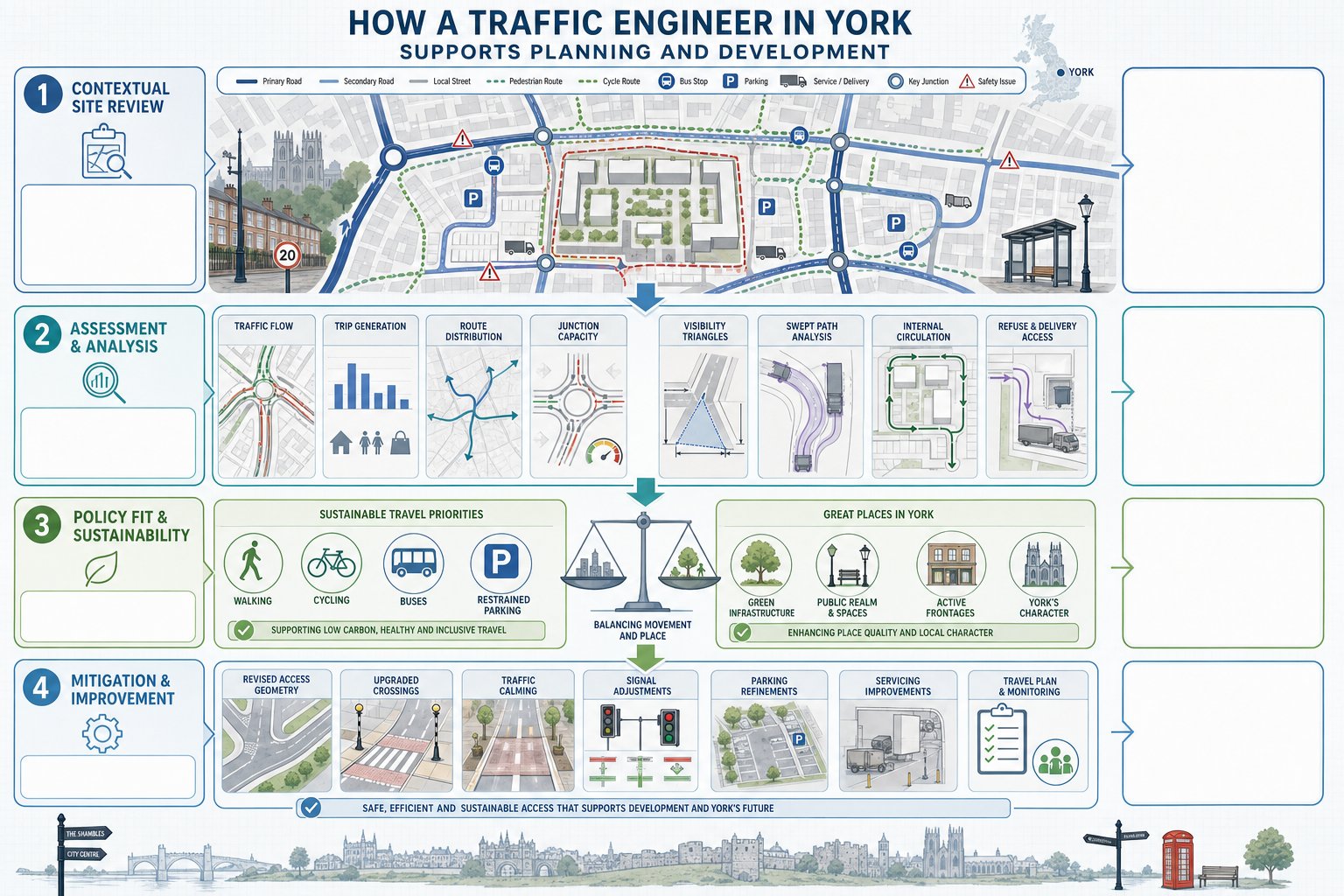
    Second, modelling and report-writing ability. Plenty of people can run software: fewer can explain assumptions clearly, justify professional judgement, and produce a document that reads well under scrutiny from planners, highways officers, and occasionally planning counsel. That matters.
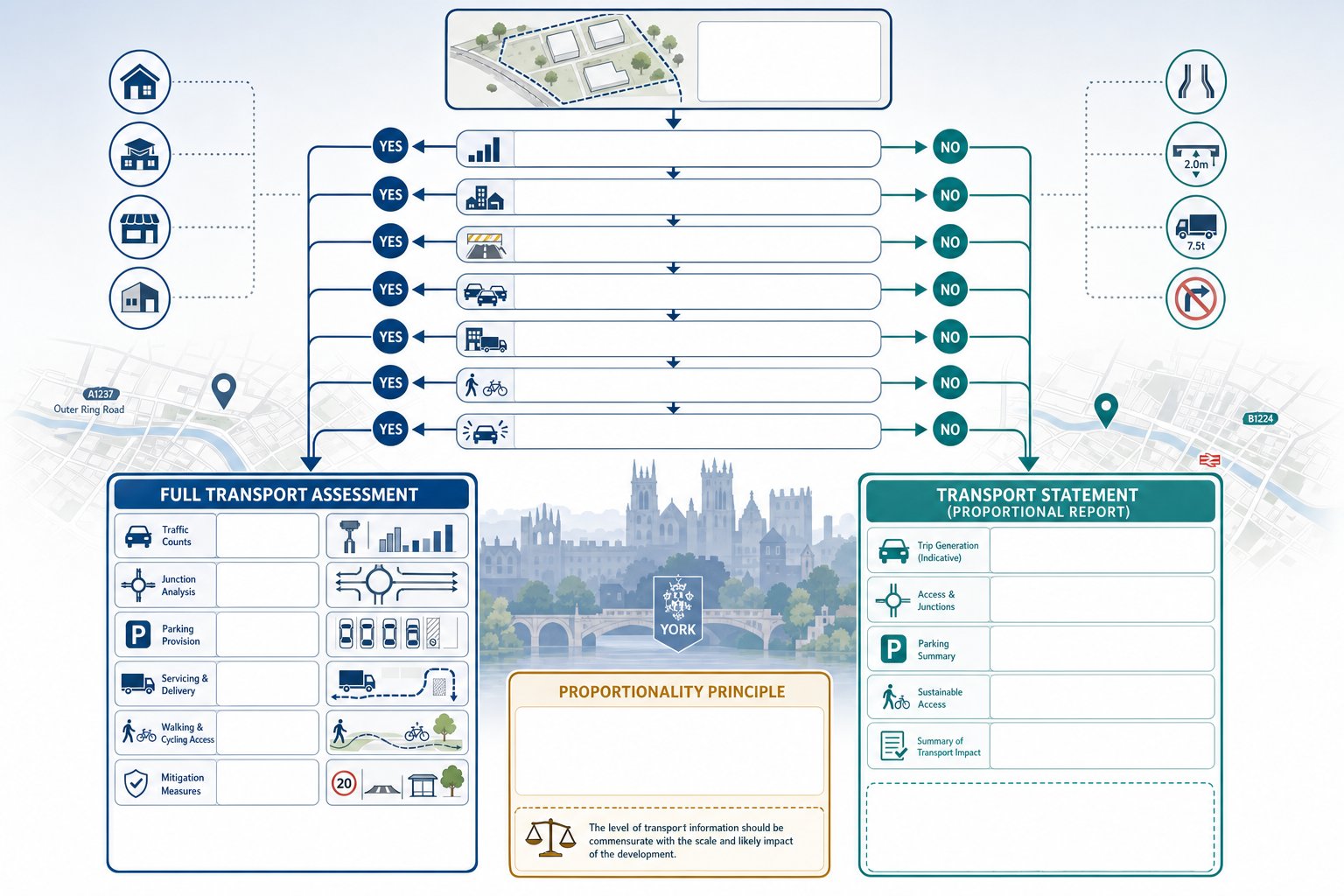
    Third, relevant project experience. Residential infill, commercial access strategies, and strategic allocations all carry different transport risks. A consultant who has handled similar schemes before will usually spot issues faster and propose cleaner solutions.
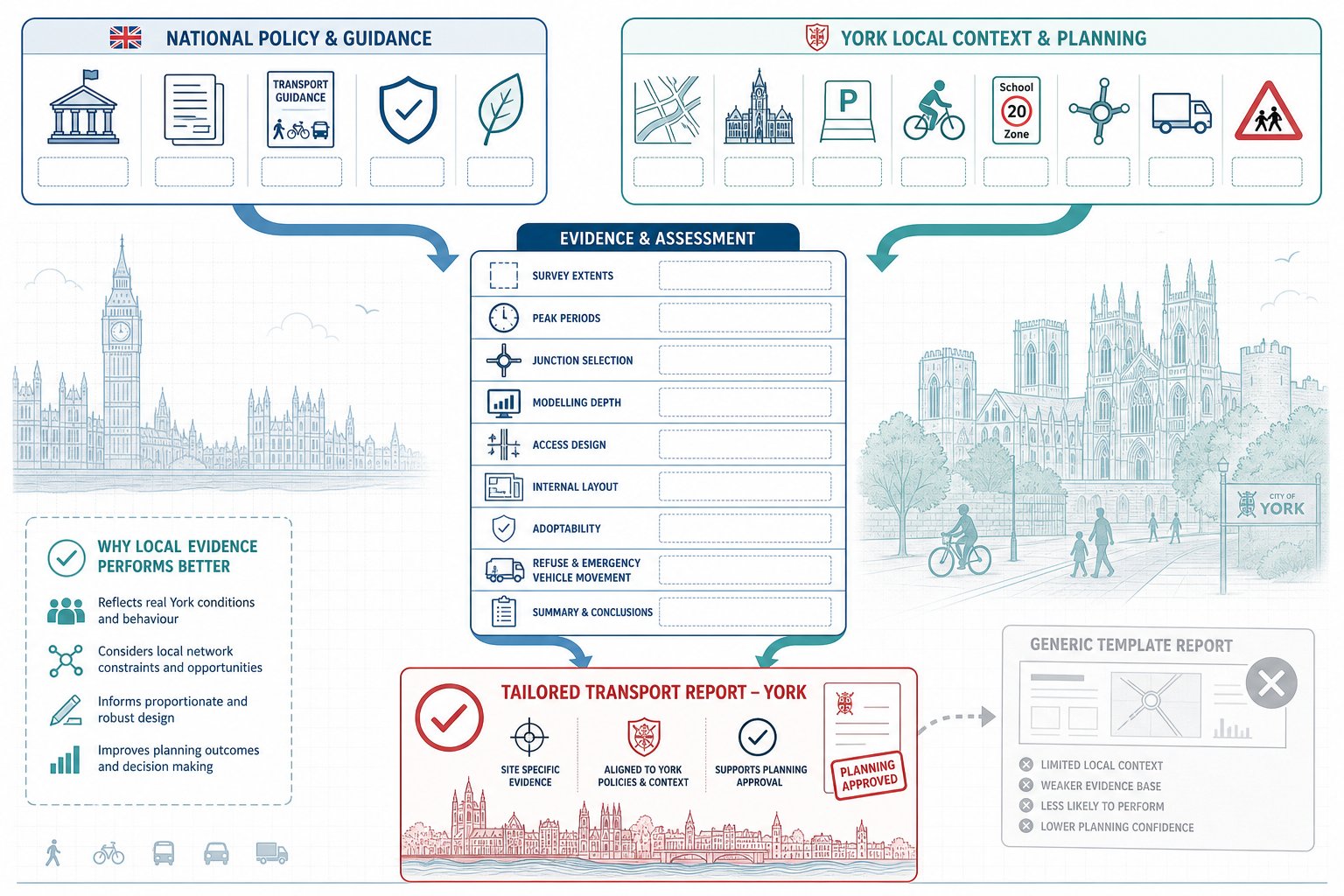
    At ML Traffic, that’s the space we work in: concise, accurate transport reports delivered quickly, shaped by more than 30 years of experience and tailored to local thresholds and planning contexts. If you need a broader sense of how specialist input supports approval pathways, Traffic Engineer In Liverpool: examples show the same principle in another local authority setting.

    Conclusion

    A strong planning submission is not just about good design or the right planning statement. It also depends on whether the transport case is proportionate, credible, and aligned with local expectations. That is exactly where a traffic engineer in Swindon adds value.

    When transport advice is brought in early, access issues are easier to fix, report scope is easier to agree, and the final application is far less likely to be weakened by avoidable highway objections. For architects, planners, developers, surveyors, and councils, the benefit is practical rather than theoretical: clearer evidence, smoother determination, and a better chance of securing a policy-compliant outcome.

    In 2026, with planning scrutiny still tight and transport policy still moving toward safer, more sustainable development, council-ready reporting is not a luxury. It is part of how stronger applications get over the line.

    Frequently Asked Questions about Traffic Engineering in Swindon

    What does a traffic engineer in Swindon do for planning applications?

    A traffic engineer in Swindon reviews development proposals, designs access and internal roads, prepares Transport Assessments and Statements, and addresses highway comments to ensure the scheme meets local standards and reduces planning delays.

    When is a Transport Assessment required for developments in Swindon?

    Transport Assessments are usually required for larger schemes with significant traffic impacts, such as major residential, retail, or employment sites, to evaluate trip generation, junction capacity, and potential highway effects.

    How do local planning policies in Swindon affect transport reports?

    Transport reports must reflect Swindon’s Local Plan allocations, highway design and parking standards, and comply with national policy like the NPPF, focusing on highway safety and avoiding severe residual impacts.

    What are common traffic engineering concerns for residential developments in Swindon?

    Key concerns include safe access, adequate visibility splays, parking allocation, sustainable travel options, and managing parking pressures on surrounding streets to meet Swindon Borough Council requirements.

    How does early traffic engineering advice help reduce planning delays?

    Early advice identifies potential access or safety issues before finalising designs, agrees the scope of Transport Assessments with highways, and minimises late requests for additional surveys or revisions, streamlining planning approval.

    What should I look for when choosing a traffic engineer in Swindon?

    Choose a traffic engineer with strong knowledge of Swindon Borough Council’s local standards, excellent modelling and report-writing skills, and experience handling similar residential or commercial schemes to ensure council-ready reports.