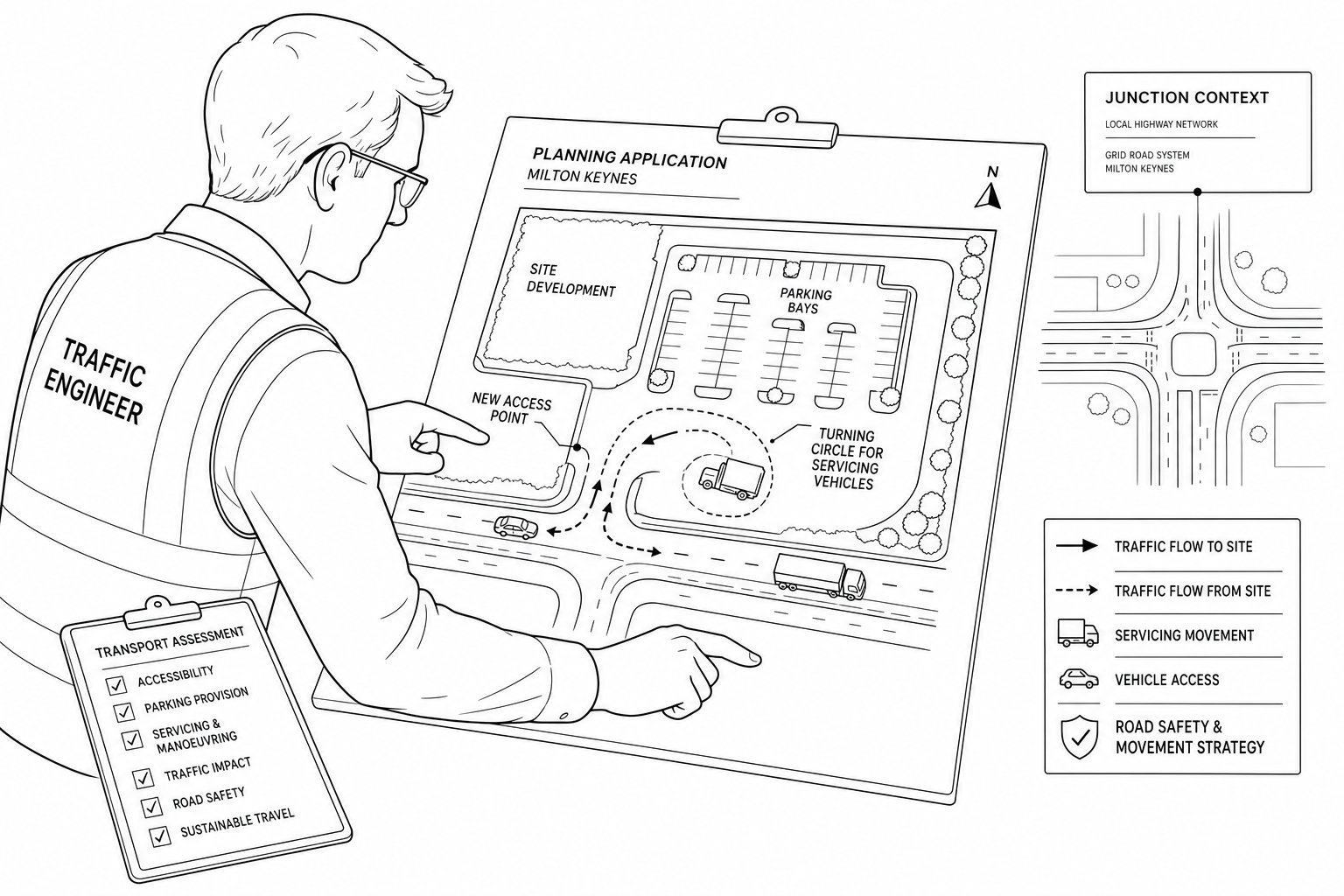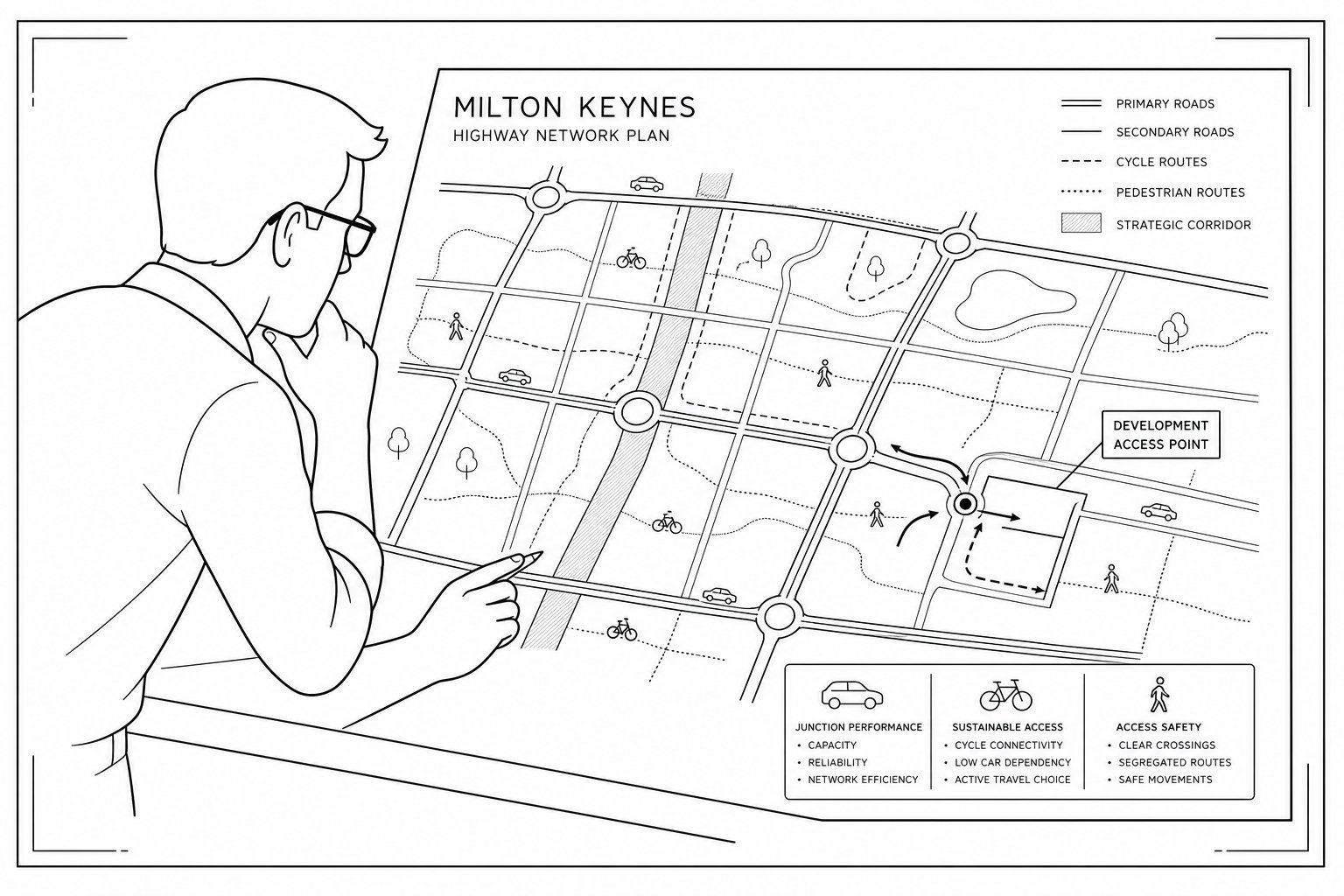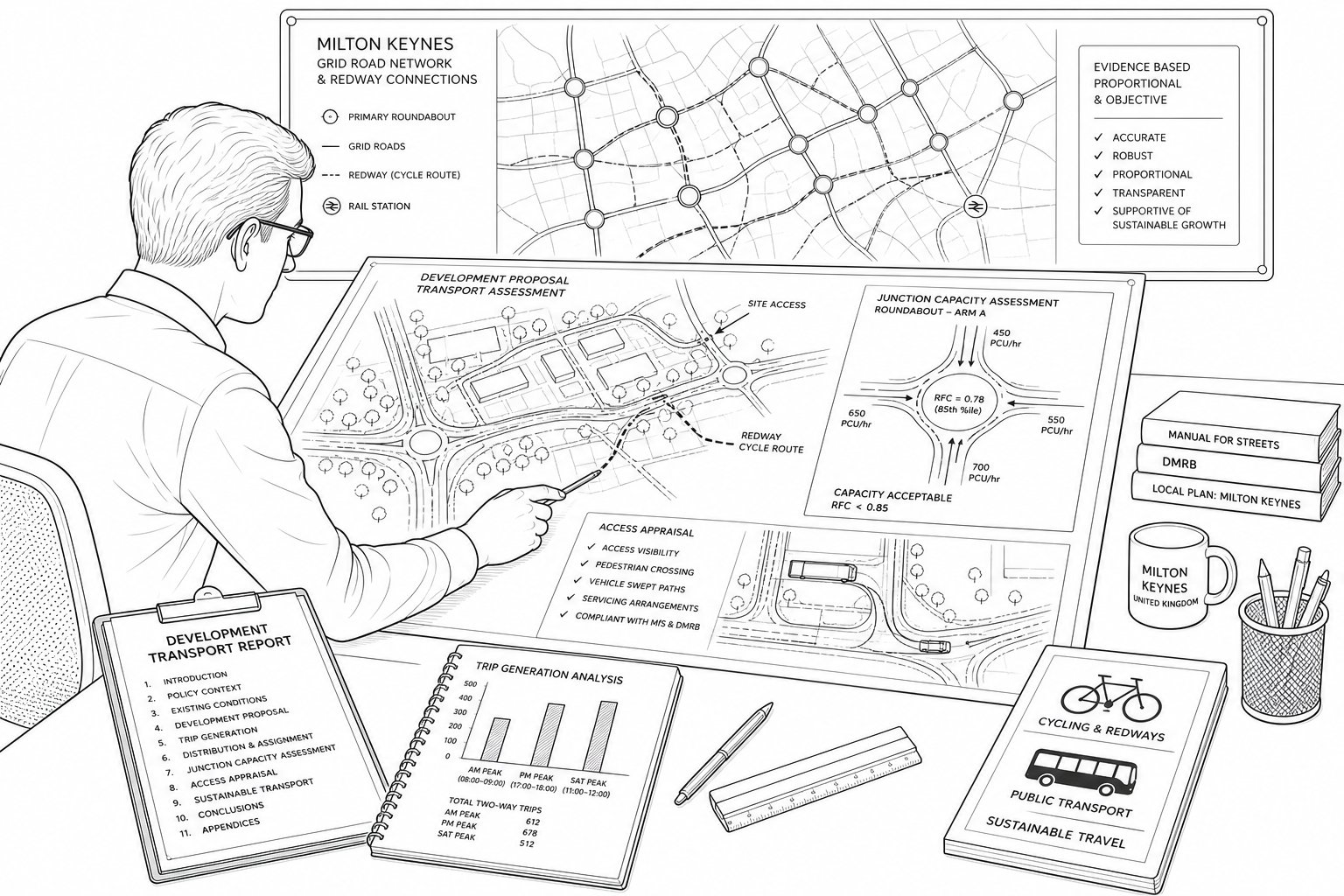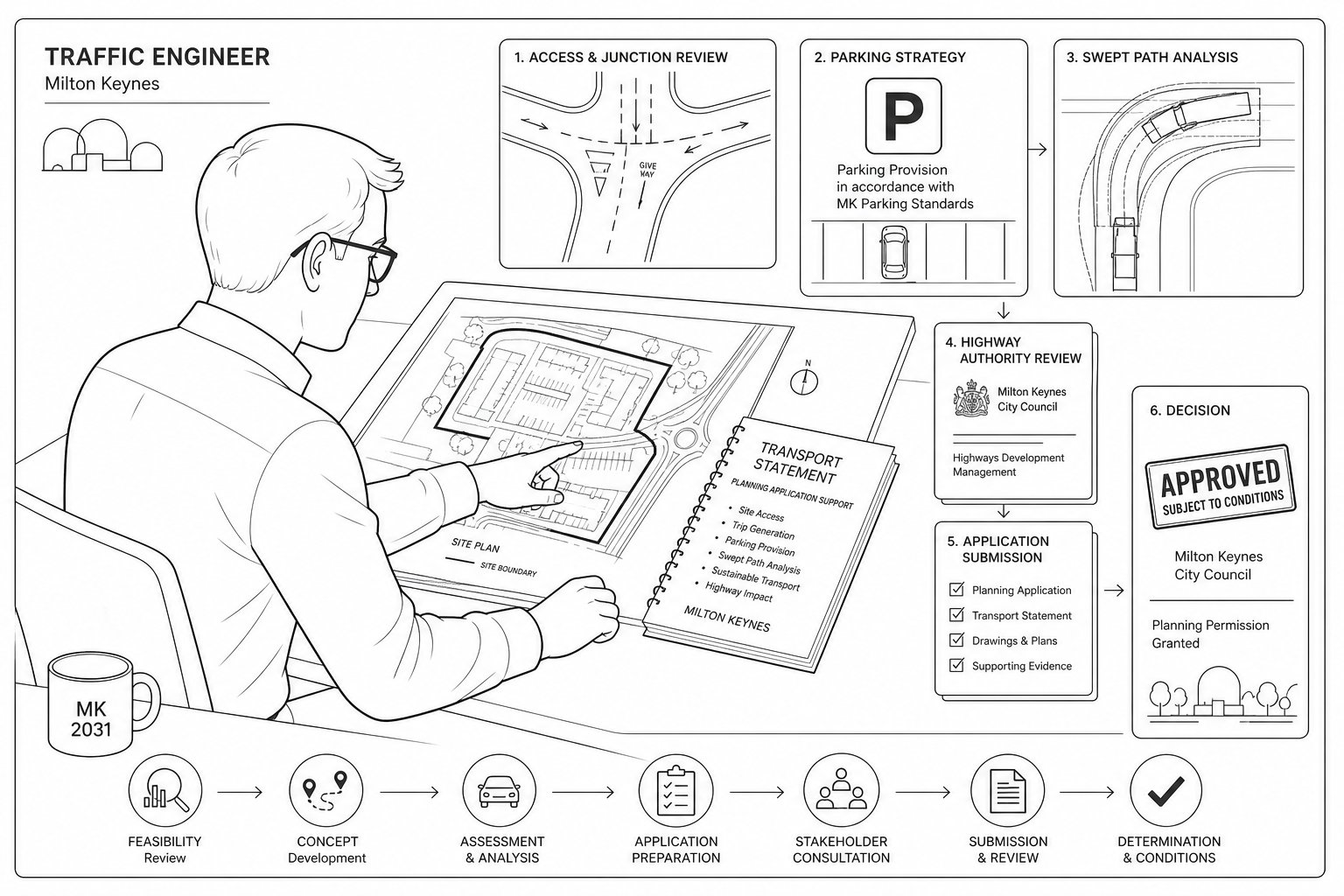
Category: High Frequency Posts

  • Transport Planning In Southend-On-Sea: A Practical Guide To Assessments, Policy, And Planning Success In 2026

    Transport Planning In Southend-On-Sea: A Practical Guide To Assessments, Policy, And Planning Success In 2026

    Planning development in a compact coastal city is rarely straightforward, and Southend-on-Sea proves the point. A scheme can look perfectly workable on paper, then run into immediate questions about peak-time congestion, seafront visitor traffic, parking pressure, rail accessibility, or whether a Travel Plan has any real substance behind it. That is why transport planning in Southend-on-Sea matters so much in 2026: it sits right between planning policy, highway capacity, regeneration ambition, and increasingly, climate expectations.

    For architects, developers, planners, legal teams and local authorities, the practical challenge is not simply producing a transport document. It is producing the right evidence, at the right scale, in a form that responds to Southend’s local context. A modest infill residential scheme, a healthcare extension, and a town-centre mixed-use proposal may all require transport input, but not the same level of analysis or the same mitigation strategy.

    In our experience, successful applications usually have one thing in common: transport is considered early, not bolted on at the end. With over 30 years of experience preparing concise, planning-ready reports through ML Traffic, we’ve seen how proportionate evidence, local knowledge, and clear engagement with policy can prevent avoidable delays. This guide explains what decision-makers typically look for, where applications often stumble, and how to build a transport case that stands up in Southend-on-Sea.

    Why Transport Planning Matters In Southend-On-Sea

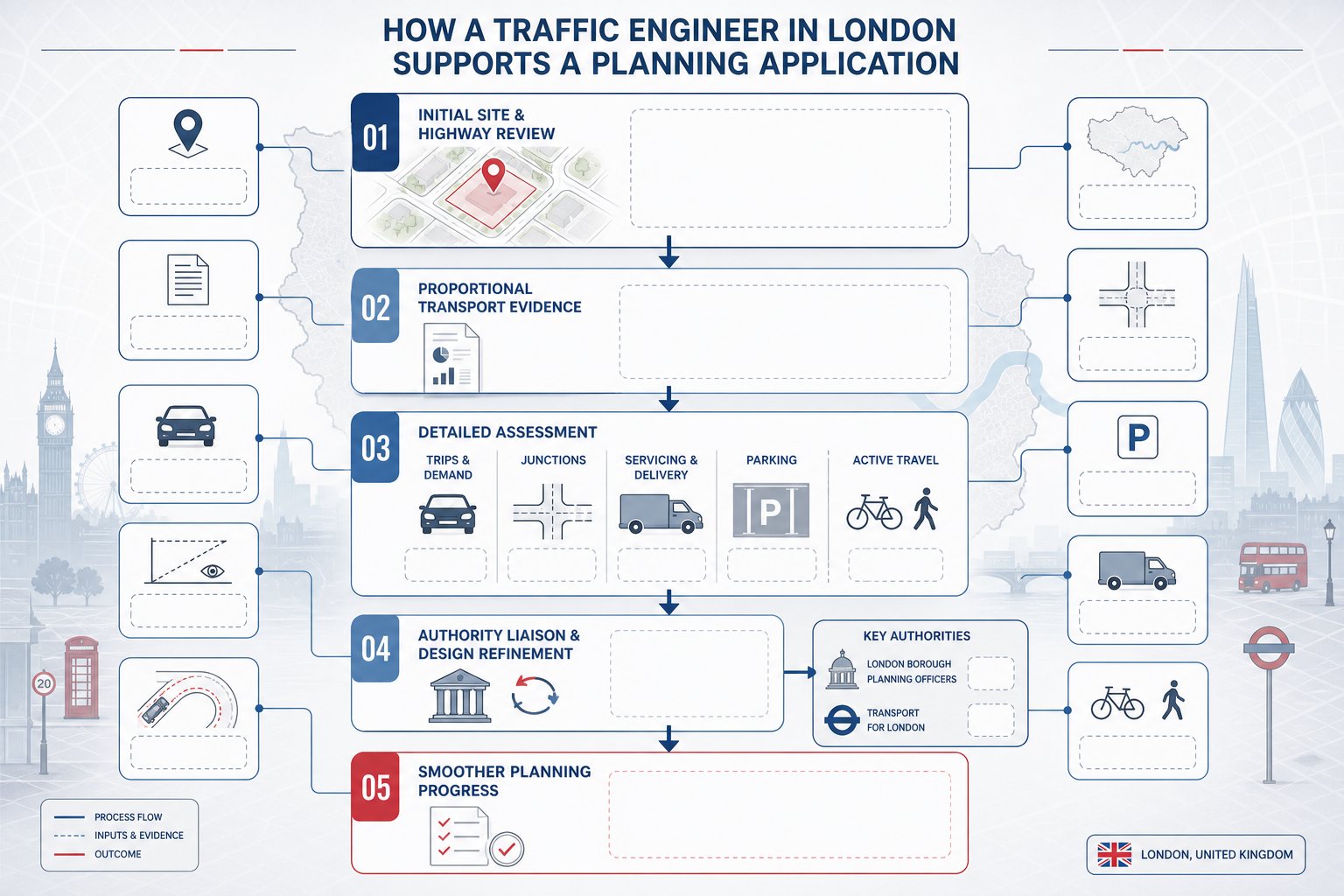
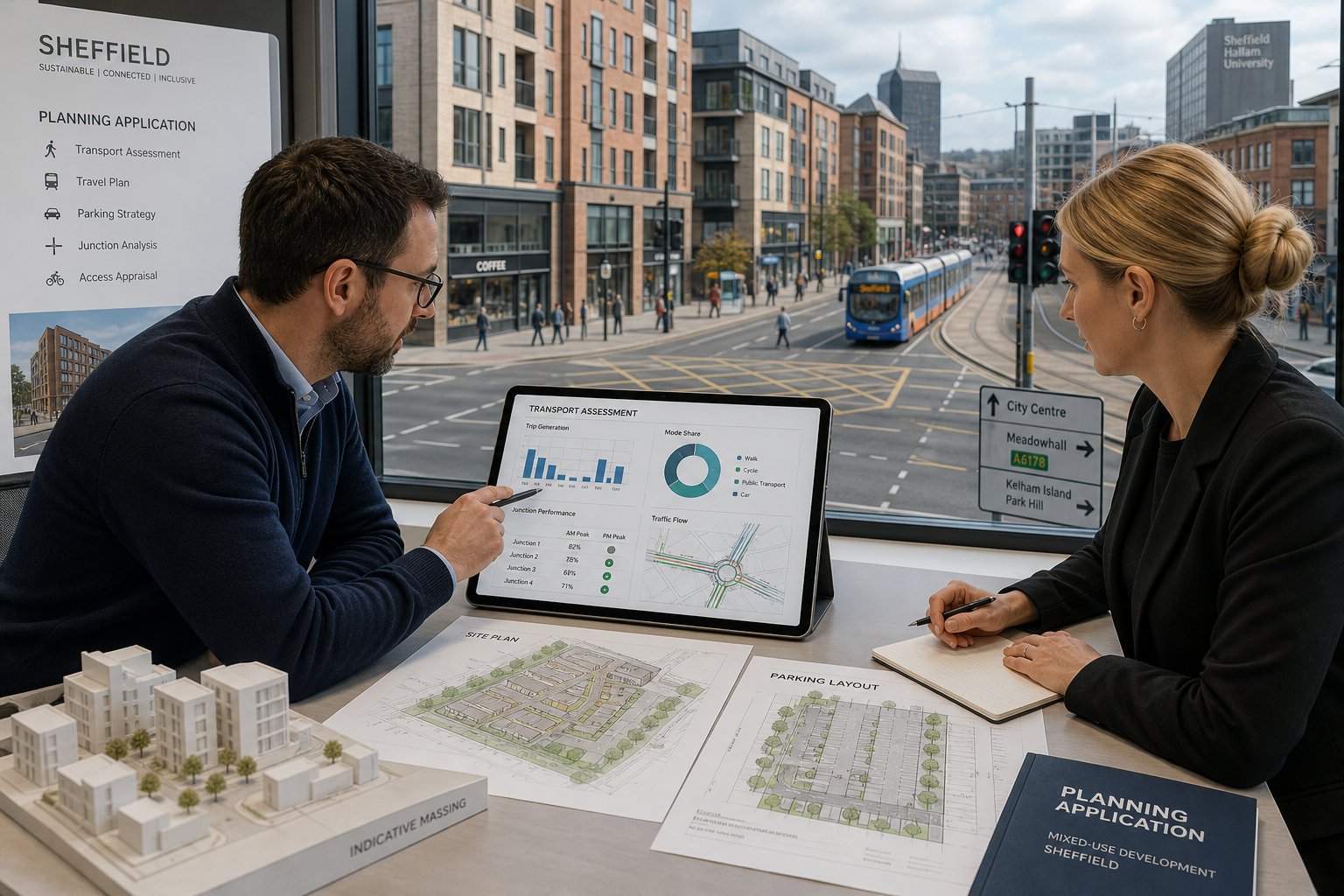
    Infographic showing Southend-on-Sea transport network, travel demand patterns, and planning priorities.

    Southend-on-Sea has a transport story that is more complicated than its size might suggest. It is a dense coastal city, a visitor destination, a centre for employment and education, and part of the wider Thames Gateway regeneration area. That combination means transport planning is never just about vehicle access. It is about supporting growth without making existing network pressures worse.

    The local economy depends heavily on movement. The town centre, seafront, rail corridors, airport-related activity and wider estuary economy all generate trips with different patterns across the day and year. Summer weekends can look very different from a standard weekday peak. So can school term conditions compared with holiday periods. Good transport planning recognises that Southend’s demand profile is not flat or predictable in the way a generic suburban authority might be.

    There is also a policy reason transport planning carries weight here. The city’s transport strategy links economic growth with carbon reduction, safety, accessibility and quality of life. In plain terms, schemes are increasingly expected to do more than avoid severe traffic harm. They should also support walking, cycling, bus use, rail access and healthier travel behaviour where reasonable.

    That matters for applicants because transport evidence often influences layout, parking, servicing, viability and eventually planning risk. Done well, it helps unlock consent. Done poorly, it can drag an application into rounds of queries, redesign and delay.

    The Local Development Context Shaping Transport Decisions

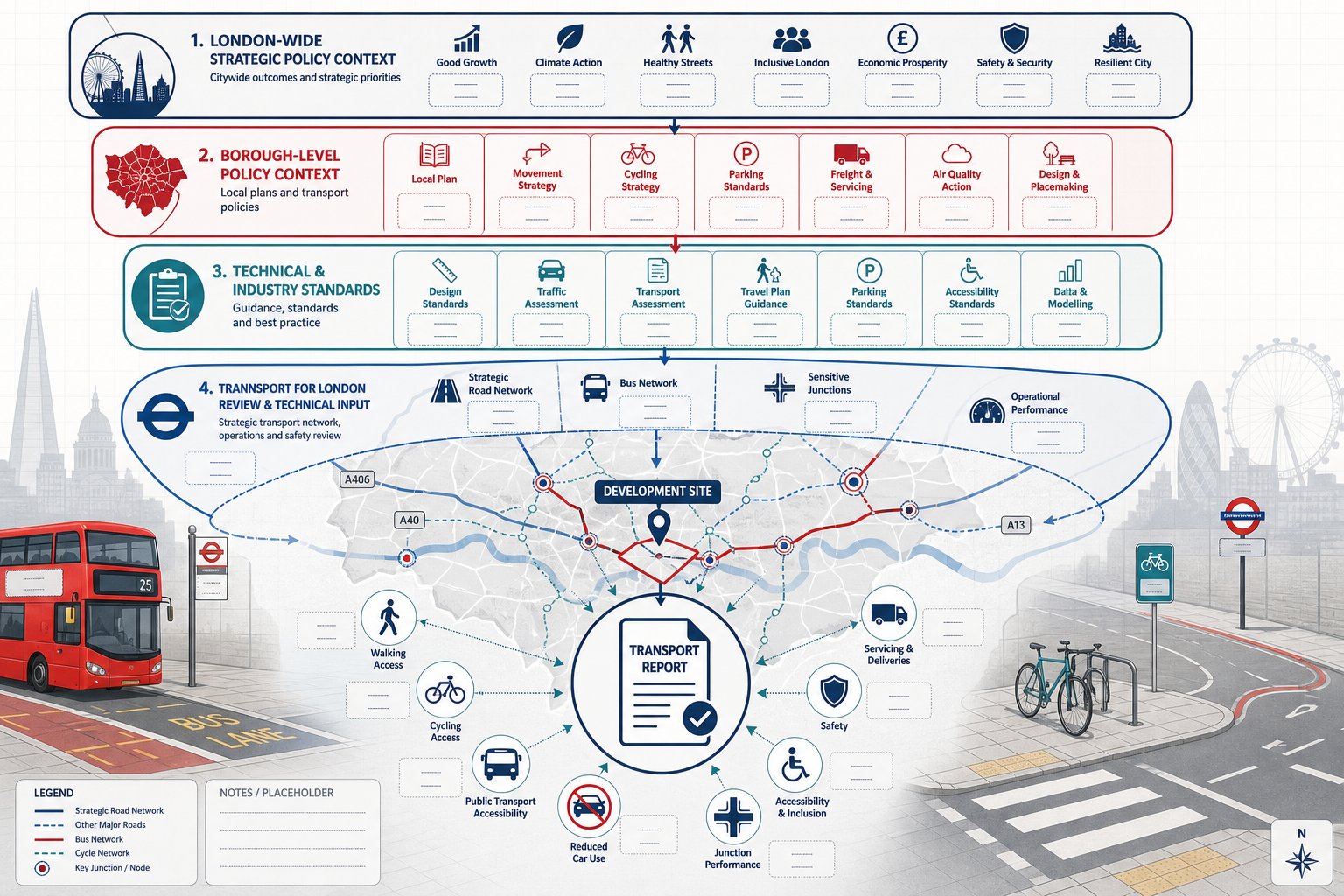
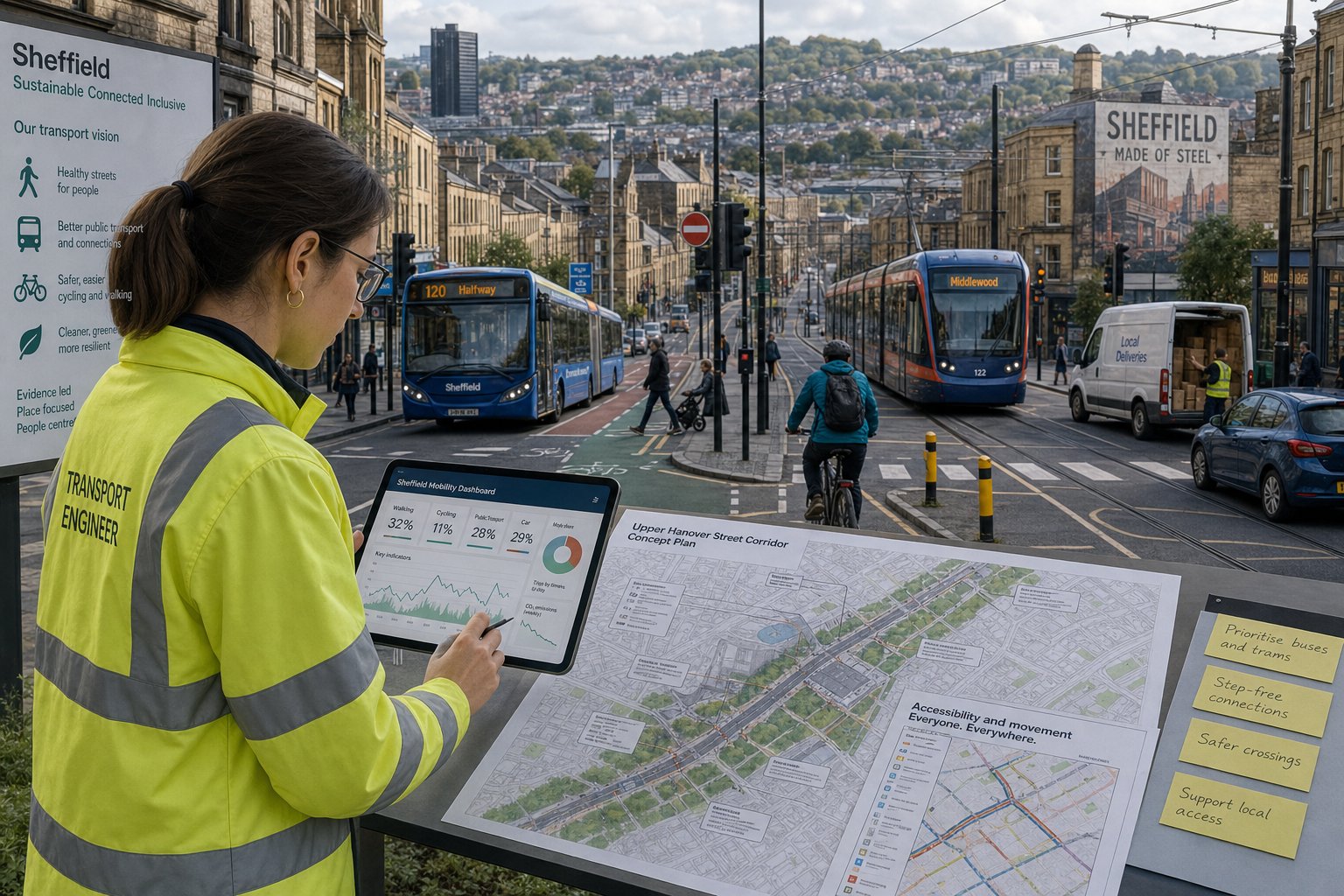
    Infographic of Southend transport planning factors, policy priorities, and key development scenarios.

    Southend’s development context shapes transport decisions in ways that are very local. Geography comes first. The city sits at the mouth of the Thames Estuary, with a constrained coastal form and strong east-west movement corridors. There are obvious attractions to developing in accessible urban locations, but there are also limits: some routes are already busy, some junctions are sensitive, and seafront-related travel can create sharp peaks.

    Policy adds another layer. The Local Transport Plan 2011-2026 established long-term priorities around economic growth, reducing carbon emissions, equality of opportunity, safety and better quality of life. Although transport policy language evolves, those broad themes still frame how proposals are judged. Emerging strategies and interim work have pushed even harder on sustainable mobility, behaviour change and better integration between modes.

    For applicants, this means Southend transport planning is not only a technical exercise. It is also a policy exercise. A report needs to show not just what traffic a proposal may generate, but how the development fits a wider vision for movement across the borough.

    That often affects the emphasis within an assessment. A site near a rail station may need stronger discussion of mode share assumptions. A seafront or leisure-led scheme may need closer consideration of seasonal peaks. A residential proposal in an urban area may be judged partly on whether its parking strategy genuinely supports sustainable travel rather than simply displacing demand onto nearby streets.

    Key Trip Generators And Network Pressures Across The Borough

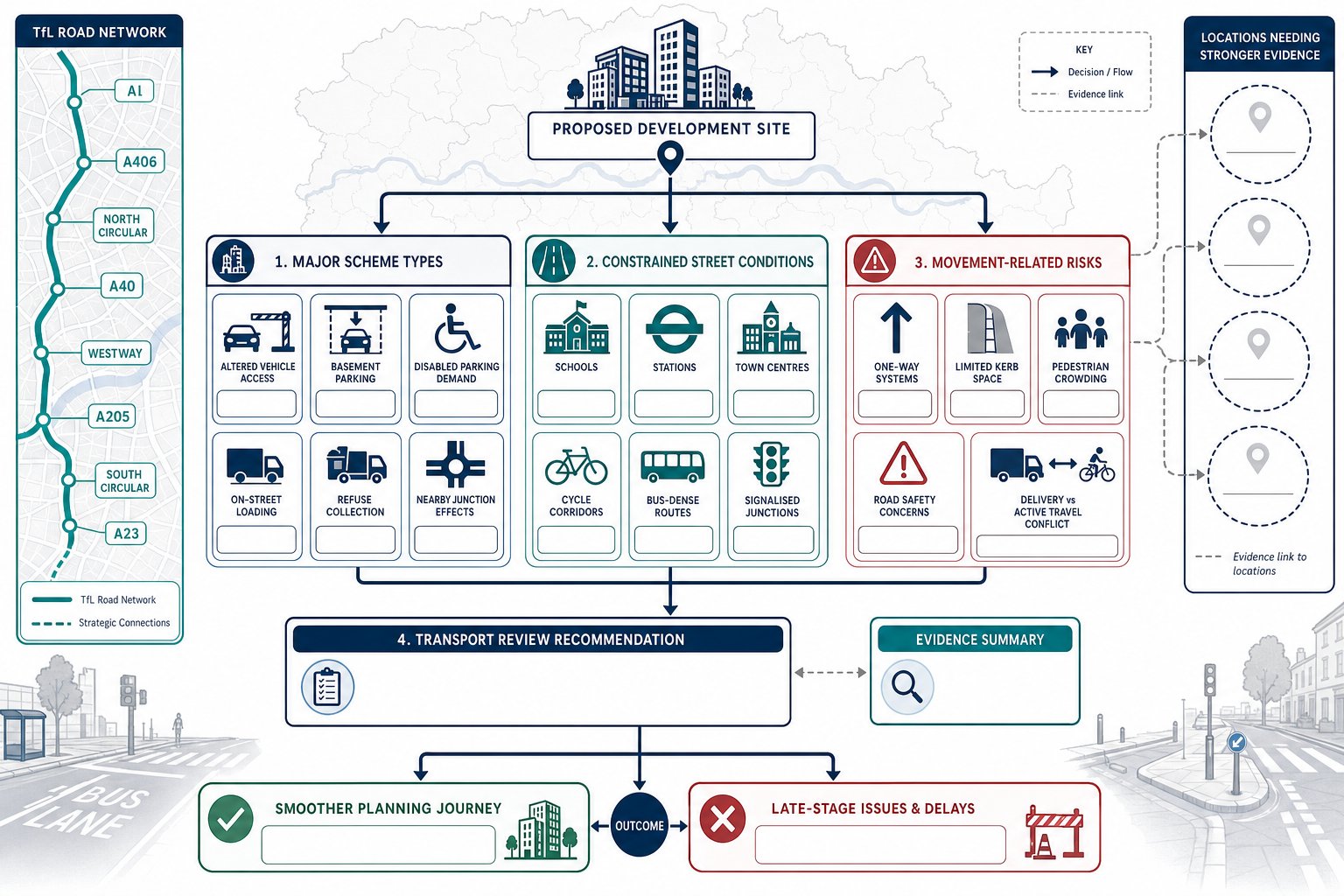
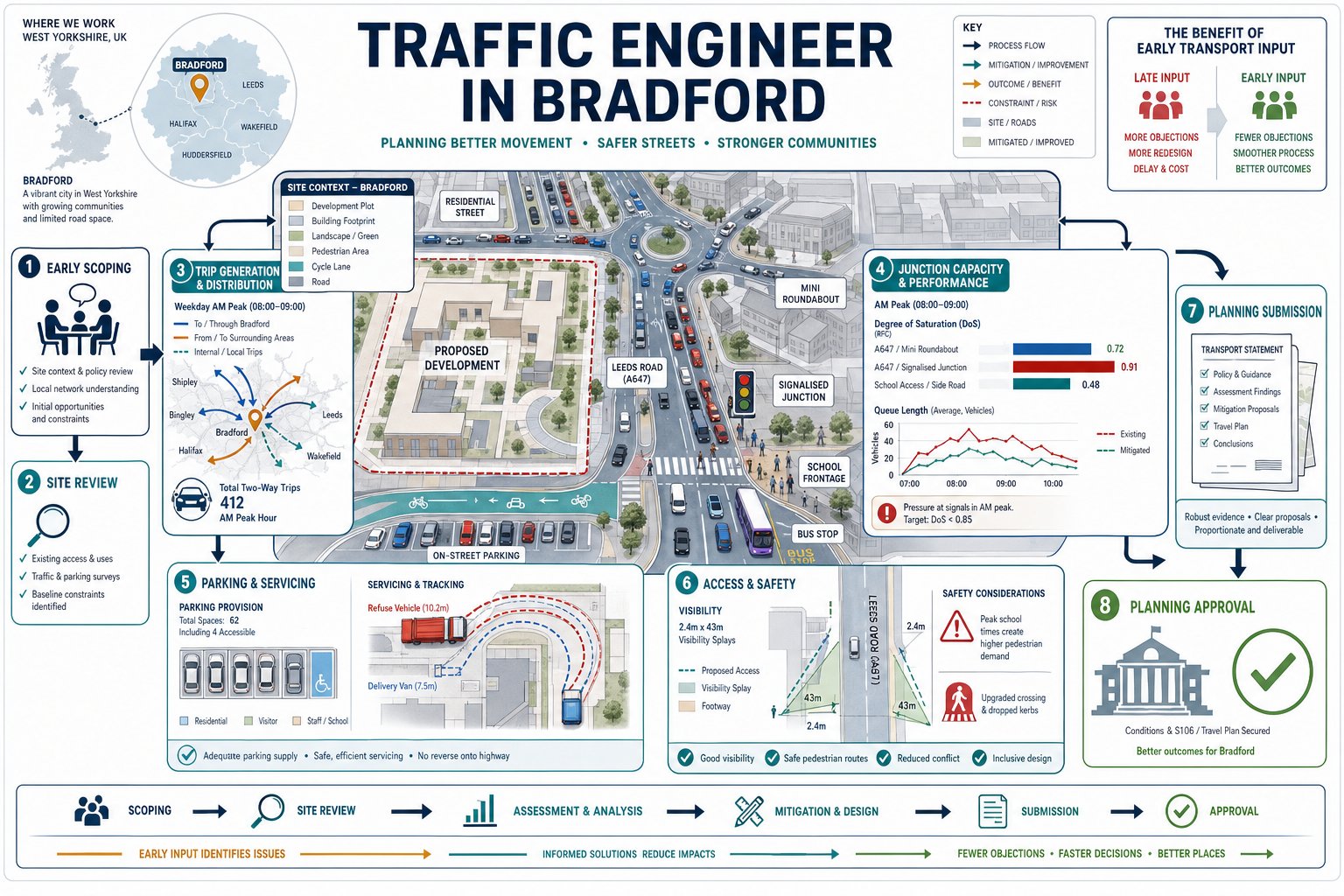
    Infographic map showing Southend trip generators, rail links, and pressure points.

    Several trip generators dominate transport planning in Southend-on-Sea, and understanding them is essential if we want to produce credible assessments.

    The town centre remains a major attractor, combining retail, employment, civic uses and leisure. The seafront adds another very specific layer of demand, especially during warmer months, event days and school holidays. That is where generic weekday-only thinking can quickly fall apart. If a development is likely to interact with visitor traffic, the analysis needs to acknowledge it.

    Rail is another defining feature. Southend benefits from two lines to London, which is a real strength for sustainable access and commuting patterns. But rail accessibility is not uniform across all sites, and proximity to a station does not automatically remove highway concerns. The quality of walking routes, bus interchange and actual service convenience all matter.

    Southend Airport, schools, colleges and healthcare facilities also create concentrated travel demand. Education and healthcare uses, in particular, can produce sharp arrival and departure peaks, parking stress and sensitive pedestrian movements. Add in servicing activity, taxis, drop-off behaviour and occasional network incidents, and even modest development can have noticeable local effects.

    Across the borough, pressure tends to be strongest on main radial routes, key junctions and seafront corridors. The practical lesson is simple: transport evidence should be based on how Southend actually functions, not how a spreadsheet says a place of similar size ought to function.

    When A Planning Application Needs Transport Evidence

    Not every planning application in Southend requires a full Transport Assessment, but many schemes do need some form of transport evidence. The threshold is usually not about a single magic number. It is about whether development is likely to generate significant trips, change travel patterns, affect access arrangements, or create impacts that planning officers and the highway authority need properly tested.

    In practice, larger residential schemes, employment sites, education uses, healthcare development, retail proposals and leisure schemes are the most obvious candidates. But smaller applications can still trigger transport questions where the local highway context is constrained, where parking is already stressed, or where a site has awkward access or servicing conditions.

    This is where early judgement matters. If an applicant under-scopes the transport requirement, the submission may look incomplete from day one. That tends to lead to requests for more data, further modelling, revised drawings or a belated Travel Plan. Time gets lost, and confidence in the application can slip.

    We generally advise clients to treat transport evidence as a proportional exercise rather than a box-ticking one. The question should be: what does the authority need to understand to make a robust planning decision? In Southend-on-Sea, that often means linking trip impacts to local constraints, public transport opportunities, parking conditions and policy expectations around sustainable travel.

    Transport Assessment Vs Transport Statement Vs Travel Plan

    A Transport Assessment is the most detailed option. It is typically needed for larger or higher-impact schemes where trip generation, distribution, assignment, junction operation, access design and mitigation all require quantitative review. A good TA is evidence-led and site-specific, not just a template with traffic numbers dropped in.

    A Transport Statement is lighter touch and usually suited to smaller schemes where impacts are expected to be limited. It still needs to be robust. Authorities will rightly push back if a TS is used to avoid proper analysis on a scheme that plainly needs more.

    A Travel Plan is different again. It focuses on travel behaviour, setting out measures to encourage walking, cycling, public transport, car sharing or other alternatives to single-occupancy car use. In Southend, Travel Plans are often important because policy increasingly expects developments to contribute to sustainable mobility, not merely absorb traffic impacts. The best ones include targets, monitoring, responsibilities and realistic interventions rather than generic aspirations.

    How Southend-On-Sea Highway And Planning Reviews Typically Work

    Although each application has its quirks, the review process in Southend-on-Sea follows a familiar pattern. Planning officers assess the scheme against development plan policy, national guidance and material considerations, while the council’s highway or transport specialists review the technical transport evidence.

    Their focus is usually practical. Is the access safe and suitable? Are trip rates credible? Has the applicant assessed the right junctions and time periods? Do parking and servicing arrangements work in real life, not just on a drawing? Are the sustainable travel claims backed by actual measures?

    This is why a clear, proportionate report matters. Officers are not helped by overblown documents full of standard text but light on local explanation. Nor are they persuaded by selective analysis that avoids inconvenient issues. A submission tends to perform better when methodology is transparent, assumptions are explained, and any limitations are acknowledged honestly.

    Southend reviews can also involve iterative discussion. Officers may ask for sensitivity testing, updated traffic data, refined tracking, amendments to cycle parking, changes to visibility splays, or stronger Travel Plan commitments. That is normal. The danger comes when the original submission leaves too much unresolved.

    From our side, we see the best outcomes where transport strategy aligns with site design from the outset. If a layout creates poor servicing, awkward refuse collection, excessive parking dominance or weak pedestrian links, no amount of technical wording will fully rescue it. Review teams usually spot that quickly.

    Core Topics A Robust Transport Report Should Cover

    A robust transport report for Southend-on-Sea should give decision-makers confidence that the likely effects of a scheme have been properly understood and, where needed, mitigated. That starts with baseline conditions. We need to explain how the surrounding network currently operates for vehicles, buses, pedestrians and cyclists, and where existing sensitivities already sit.

    From there, the report should cover trip generation, trip distribution and assignment using a methodology that fits the development type and the site context. For some schemes, that will also mean junction capacity modelling, queue analysis or link impact review. Parking demand, servicing, delivery arrangements and construction traffic should not be treated as afterthoughts either. In many urban Southend locations, those issues are where the real planning tension sits.

    Road safety is another core topic. Collision data, site observations and design review help establish whether a proposal could worsen existing risks or whether mitigation is needed. And increasingly, sustainable travel measures need proper weight, not a token paragraph at the end.

    The exact scope should always be proportionate. Still, even a smaller report should make it easy for the authority to answer the central planning question: would this development function acceptably on the transport network, and is the residual impact acceptable?

    Access, Servicing, Parking, And Road Safety Considerations

    Access design needs to work for everyone who will use the site: drivers, pedestrians, cyclists, deliveries, refuse vehicles and often emergency services. In Southend, where many sites are constrained, access is regularly one of the first points of challenge. Visibility, geometry, swept paths and relationship to nearby junctions all matter.

    Servicing is often underestimated. A scheme may appear acceptable until someone asks where delivery vehicles will wait, turn or unload without obstructing traffic or footways. Town-centre, mixed-use and leisure schemes are especially exposed here.

    Parking requires similar realism. The issue is not simply whether enough spaces are provided, but whether the proposed level reflects local standards, likely demand, nearby controls and the intended mode share. Too little parking can create overspill and neighbour objections. Too much can undermine sustainable travel objectives and weaken urban design.

    Road safety should pull these strands together. We should test whether the proposal introduces conflict points, increases risk near schools or busy pedestrian routes, or interacts with known collision patterns. If it does, mitigation must be credible and specific.

    Sustainable Travel, Public Transport, Walking, And Cycling

    Southend’s policy direction is clear: new development should support more sustainable movement wherever feasible. That means a transport report should examine public transport accessibility, walkability, cycling links and the practical steps a scheme can take to improve travel choices.

    This does not mean pretending every site can achieve city-centre London mode shares. Authorities respond better to realistic evidence than wishful thinking. But where bus routes, rail stations, local services or cycle corridors are available, the report should show how the development will connect to them.

    Measures may include improved pedestrian routes, secure cycle parking, shower and locker provision for employees, travel information packs, bus ticket incentives, car club measures or phased Travel Plan monitoring. Schools, workplaces and larger residential schemes often benefit from tailored behaviour-change initiatives rather than generic promises.

    In Southend, sustainable travel arguments are strongest when they relate directly to the site and to local opportunity. If we say residents will walk to rail, the route should actually feel walkable. If we expect staff to cycle, the parking and end-of-trip facilities should be meaningful. That level of practicality is what turns policy compliance into a convincing planning case.

    Common Development Types And Their Transport Planning Issues

    Different land uses create very different transport issues in Southend-on-Sea, so transport planning should never rely on a one-size-fits-all template.

    For residential development, the recurring concerns are parking pressure, school-run traffic, accessibility to bus and rail, internal layout, refuse collection and cycle storage. Even small apartment schemes can become contentious where surrounding streets already operate under heavy parking stress.

    For town centre mixed-use, retail and leisure schemes, servicing usually becomes critical. So do visitor peaks, taxi activity, pedestrian flows and interactions with car park management. On seafront-related schemes, seasonal demand can skew what looks acceptable in a normal weekday peak. That is exactly the kind of issue review officers notice when a report feels too generic.

    For education and healthcare development, the challenge is often concentrated timing. Drop-off and pick-up activity, staff parking, patient access, blue badge provision, ambulance or servicing needs, and safe walking routes all deserve careful treatment. These uses can generate intense localised pressure even when daily trip totals do not look dramatic.

    Employment and industrial uses bring their own issues, especially HGV routing, servicing yard operation, shift patterns and staff travel options.

    What ties all of these together is proportionality. A robust Southend transport submission should respond to the actual operational characteristics of the proposed use, the surrounding network, and the way people are likely to travel in that part of the borough.

    Frequent Reasons Transport Submissions Are Challenged Or Delayed

    Most delayed transport submissions are not delayed because transport is unusually controversial. They are delayed because key questions were left half-answered.

    One common problem is underestimated trip generation. That can happen when an applicant chooses low comparator sites, ignores mixed-use interactions, or forgets that Southend’s seasonal and visitor economy can materially affect demand. A weekday average is sometimes neat, but neat is not the same as convincing.

    Another frequent issue is weak or outdated evidence. Old traffic counts, incomplete surveys, unrepresentative dates or limited local observations can quickly undermine confidence. The same applies to junction modelling that does not reflect the authority’s likely concerns.

    We also see challenges where sustainable travel assumptions are overstated. Claiming major modal shift without reference to actual bus quality, walking conditions, cycle provision or Travel Plan delivery rarely lands well. Officers usually want to know what will change on the ground, who is responsible, and how success will be monitored.

    Then there is non-compliance with local standards: substandard visibility, awkward access geometry, poorly resolved servicing, or parking layouts that do not function properly. These are often avoidable with earlier design input.

    Finally, many Travel Plans are simply too generic. If targets are vague, measures unfunded and monitoring unclear, the document may satisfy nobody. A tailored, realistic submission is nearly always faster than a polished but hollow one.

    How Early Transport Input Can Improve Planning Outcomes

    Early transport input often saves far more time than it costs. That is especially true in Southend-on-Sea, where site constraints, parking sensitivity, visitor pressures and policy expectations around sustainable travel can all shape whether a scheme feels credible.

    At concept stage, transport advice can influence the fundamentals: access position, internal circulation, bin and servicing strategy, parking quantum, cycle provision, visibility, and the relationship between buildings and movement routes. If these basics are wrong, later reporting becomes an exercise in justification rather than problem-solving.

    Early input also helps us identify the likely evidence pathway. Does the scheme need a Transport Statement or a full Assessment? Will junction modelling be expected? Are there school-run sensitivities nearby? Could rail accessibility genuinely support lower parking? These are useful questions before drawings are fixed and committee deadlines loom.

    There is a strategic benefit too. Pre-application engagement with the council and, where relevant, operators or other stakeholders can flush out concerns before they harden into objections. That often leads to more proportionate mitigation and fewer surprises during determination.

    For clients using ML Traffic, the value is usually speed plus fit. We focus on concise, accurate reporting shaped to local authority thresholds and planning context, which means transport work supports the wider application rather than slowing it down. In practical terms, earlier transport planning usually means fewer redesigns, stronger evidence and a better chance of planning success.

    Conclusion

    In 2026, transport planning in Southend-on-Sea is not a peripheral planning exercise. It is central to how development is tested, shaped and, eventually, approved. The borough’s coastal geography, regeneration ambitions, constrained corridors, visitor economy and sustainable travel goals all mean transport evidence has to be both technically sound and locally aware.

    For applicants, the lesson is straightforward: be proportionate, be realistic, and start early. A strong submission should explain existing conditions clearly, assess likely effects honestly, and set out mitigation that can actually be delivered. It should also reflect Southend’s policy direction, where growth is expected to sit alongside safer streets, healthier travel and better network efficiency.

    When transport is handled early and well, it reduces friction across the whole planning process. And that is usually what clients, consultants and authorities all want: clearer decisions, fewer surprises, and development that works in practice as well as on paper.

    Frequently Asked Questions about Transport Planning in Southend-on-Sea

    Why is transport planning important in Southend-on-Sea?

    Transport planning supports Southend-on-Sea’s economic growth, manages congestion on constrained corridors, and helps meet climate, air quality, and health targets by promoting sustainable travel modes across the coastal city.

    When does a planning application in Southend-on-Sea require transport evidence?

    Applications likely to generate significant trips or change travel patterns, such as larger residential, employment, education, healthcare, retail, or leisure schemes, generally need Transport Assessments, Statements, or Travel Plans in Southend-on-Sea.

    What are the key topics a robust transport report should cover for developments in Southend-on-Sea?

    A thorough transport report should detail baseline conditions, trip generation, junction capacity, parking and servicing strategies, road safety analysis, and sustainable transport measures relevant to the site’s local context.

    How do Transport Assessments, Transport Statements, and Travel Plans differ?

    Transport Assessments are detailed quantitative analyses for larger developments; Transport Statements are lighter reviews suitable for smaller schemes; Travel Plans focus on managing travel behaviour to encourage walking, cycling, and public transport use.

    What common transport issues arise with residential developments in Southend-on-Sea?

    Residential schemes often face challenges with parking pressure, school-run traffic, accessibility to buses and trains, internal layouts, refuse collection, and provision for cycling.

    How can early transport planning input benefit a development project in Southend-on-Sea?

    Early transport involvement helps align site design with access, parking, and public transport realities, facilitates engagement with local authorities, reduces redesigns and objections, and increases the likelihood of swift planning approval.

  • Transport Planning In Oxford: A Practical Guide To Assessments, Access, And Planning Success In 2026

    Transport Planning In Oxford: A Practical Guide To Assessments, Access, And Planning Success In 2026

    Oxford is rarely a place where transport can be treated as a planning afterthought. Even modest schemes can run into detailed questions about access, cycle provision, servicing, parking restraint, bus connectivity, and the practical reality of moving people through a tight historic street network. For architects, developers, planning consultants and local authorities, that means transport planning in Oxford often becomes one of the key workstreams in getting an application over the line.

    That is not just because roads are busy. It is because the policy direction is clear. Oxford and Oxfordshire increasingly expect development to support non-polluting movement, stronger walking and cycling links, better use of public transport, and less dependence on private car travel, especially in and around the city centre. The county’s wider net-zero ambitions have only sharpened that focus.

    In practice, we see the same pattern again and again: schemes succeed more smoothly when transport evidence is prepared early, scoped properly, and grounded in Oxford’s local constraints rather than generic assumptions. A submission that might feel adequate elsewhere can look thin very quickly here.

    In this guide, we set out what transport planning in Oxford usually involves in 2026: the main documents, when a Transport Assessment or Transport Statement is typically needed, the local issues that shape evidence, and the common reasons transport submissions are challenged. The aim is simple, help teams prepare clearer, more robust planning support from the start.

    Why Transport Planning Matters In Oxford’s Planning Environment

    Infographic showing transport planning shaping development decisions in Oxford.

    Transport planning matters in Oxford because movement, land use and environmental policy are tightly intertwined. The city is not planning for unconstrained car-led growth. Instead, the direction of travel is toward healthier streets, reduced emissions, improved public transport integration, and development patterns that make walking and cycling more realistic day to day.

    That has direct planning consequences. A transport submission is not only there to answer whether junctions will cope. It also needs to show whether a proposal aligns with wider policy aims: accessibility, sustainable mode share, parking restraint, safe operation, and reasonable servicing arrangements within a constrained urban form.

    Oxfordshire’s Local Transport and Connectivity Plan has reinforced this position with a net-zero transport vision. In practical terms, that raises expectations. Decision-makers are more likely to ask how a scheme supports mode shift, whether it avoids unnecessary private vehicle trips, and whether its access strategy works without pushing problems onto nearby streets.

    For applicants, the key point is this: transport planning in Oxford is often central to acceptability, not a supporting appendix. A weak report can slow validation, trigger objections from highways officers, or undermine the planning balance. A well-scoped one does the opposite, it gives the design team a credible evidence base and helps show that the proposal can function in the real world, not only on a site plan.

    The Main Transport Planning Documents Used In Oxford Applications

    Infographic showing key transport planning documents used in Oxford applications.

    Most Oxford planning applications with transport implications rely on a familiar set of technical documents, but the exact package depends on scale, use, and site sensitivity.

    A Transport Assessment (TA) is the more detailed option, generally prepared for larger or higher-impact schemes. It examines likely trip generation, distribution, network effects, access arrangements, servicing, parking, road safety, and sustainable travel opportunities.

    A Transport Statement (TS) is usually used for smaller developments where impacts are expected to be more limited. It still needs to be robust, but the analysis is normally more proportionate.

    A Travel Plan is also common, especially for developments that will generate regular trips, residential, student, office, education, and mixed-use schemes in particular. In Oxford, Travel Plans are often important because they show how the development will actively support walking, cycling, bus use and, where relevant, car-sharing.

    Other supporting documents often matter just as much:

    • parking management strategies

    n- servicing and delivery plans

    • refuse collection access evidence
    • walking, cycling and public transport accessibility reviews
    • swept path analysis for larger vehicles
    • road safety or collision review information

    Together, these documents explain how a scheme will operate and whether it reflects Oxford’s transport priorities. The strongest applications avoid a tick-box bundle. They make the documents work together, so access, parking, servicing and sustainability tell one coherent story.

    When A Transport Assessment Or Transport Statement Is Usually Required

    Decision flow showing when transport statements or assessments are needed in Oxford.

    There is no single Oxford rule that says every site above a certain size must always provide the same transport document. In reality, the requirement is shaped by development scale, land use, trip intensity, location, local sensitivity and the likely effect on the surrounding network.

    Broadly, a Transport Assessment is usually required where a scheme is larger, more complex, or likely to create material transport effects. That may include substantial residential development, student accommodation, commercial floorspace, schools, healthcare uses, or mixed-use schemes with notable servicing demand.

    A Transport Statement is more commonly appropriate for smaller proposals where impacts are expected to be modest and can be explained proportionately. But “smaller” does not always mean “simple”. In Oxford, even relatively modest development can justify transport evidence if it sits on a constrained street, near sensitive parking controls, within a busy district centre, or in a location where access and servicing are awkward.

    We usually advise clients not to think only in terms of floor area or unit numbers. Ask a more practical question: will the application invite reasonable scrutiny on access, parking, deliveries, sustainable travel, or highway safety? If yes, some form of transport submission is likely to help, and may be expected.

    Early scoping with the design team is often the difference between a proportionate, targeted report and a late scramble after validation comments or consultee concerns.

    How Oxford’s Local Context Shapes Transport Planning Evidence

    Oxford is one of those places where local context genuinely changes the technical job. Generic transport reporting can fall flat because the city’s constraints, travel patterns and policy expectations are unusually pronounced. Evidence has to respond to how Oxford actually works on the ground, not how an unconstrained suburban site might operate elsewhere.

    That means looking beyond traffic counts. In many Oxford applications, the more important questions are about accessibility, parking displacement, cycle movement, pedestrian comfort, bus links, servicing practicality and whether the development supports the city’s low-car direction of travel.

    City Centre Constraints, Parking Pressure, And Street Network Limitations

    The city centre and many surrounding neighbourhoods operate within obvious physical and policy limits. Streets are often narrow, historic, busy and multifunctional. The same corridor may need to serve buses, cyclists, pedestrians, loading activity, taxis, emergency access and local traffic, with very little spare space.

    Parking is another regular pressure point. Even where an application is not proposing much car parking, that does not make the issue disappear. Officers and neighbours will often want to know whether overspill parking could affect nearby streets, permit-controlled areas or already stretched kerbside space. A report that shrugs this off tends to attract challenge.

    Access design also needs realism. Can service vehicles enter, manoeuvre and leave safely? Is there a workable refuse strategy? Will drop-off activity block the street? In Oxford, these operational questions can be as important as classic capacity testing.

    Active Travel, Public Transport, And Wider Sustainability Expectations

    Oxford’s planning environment places real weight on active travel. So a transport submission should not treat walking and cycling as a brief afterthought with a map and a few distances. It should explain route quality, crossings, permeability, cycle parking standards, likely desire lines, and whether users can reach key destinations safely and conveniently.

    Public transport matters too. Accessibility is not just about whether a bus stop exists nearby. We need to consider service frequency, destination coverage, journey time practicality, and how attractive the mode is for the likely users of the site.

    And then there is the wider sustainability picture. Oxfordshire’s net-zero direction means assumptions around car ownership, trip rates and mode share need to feel credible in policy terms as well as technical ones. Reports that rely on generic, car-heavy patterns without local justification can feel out of step quickly. Stronger evidence shows how the proposal can contribute to a lower-car, better-connected form of development.

    Key Development Types That Commonly Need Transport Input

    Not every development in Oxford needs the same depth of transport work, but certain categories regularly raise transport questions early in the planning process. The common thread is simple: if the use affects trip generation, access, parking, servicing or sustainable travel expectations, transport input is usually worthwhile.

    Residential, Student, And Mixed-Use Schemes

    Residential schemes frequently need transport input because they bring together several issues at once: vehicle access, parking restraint, visitor parking, cycle provision, refuse collection, delivery activity and day-to-day travel patterns. In Oxford, assumptions about car ownership are often closely tested, especially in accessible locations or on low-car proposals.

    Student accommodation can be particularly sensitive. Trip profiles may differ from standard housing, but that does not remove the need to assess arrivals and departures, taxi activity, servicing, cycle demand and links to university facilities, public transport and nearby amenities. The management model matters as much as the headline use.

    Mixed-use schemes are often more complex again. Different uses can have different peak times, servicing needs and modal patterns. That can be a positive if internal trip capture reduces external travel, but only if the evidence is properly explained.

    Commercial, Education, And Community Developments

    Commercial development often raises questions around staff travel, customer access, servicing and delivery demand. For offices, the focus may be on commuter mode share and parking restraint. For retail or light industrial uses, servicing and operational access can become the dominant issue.

    Education schemes, whether schools, colleges or university-related buildings, can be especially transport-sensitive in Oxford. Peak-time movement, walking routes, cycle flows, bus demand, pick-up and drop-off pressure, and safeguarding the surrounding street network all tend to matter.

    Community uses can look modest on paper yet still generate concentrated transport effects. A health centre, place of worship, leisure facility or civic building may attract sharp peaks, vulnerable users, or demand for accessible parking and taxi access. In each case, the question is not whether the use is “major” in abstract terms, but how it will function in its local context.

    What A Robust Oxford Transport Assessment Should Cover

    A robust Oxford Transport Assessment should be proportionate, but it also needs enough depth to answer the questions local officers are likely to ask. In our experience, the best reports are structured around operation, impact and policy fit, not just traffic numbers.

    At a minimum, a strong assessment will usually cover:

    • Existing conditions: site context, surrounding highway layout, nearby walking and cycling links, public transport accessibility, parking controls and local constraints.
    • Development proposals: land use, scale, access points, internal layout, servicing arrangements, cycle parking, refuse strategy and any mobility-related management measures.
    • Trip generation and distribution: realistic assumptions based on the proposed use, local comparators and Oxford context.
    • Junction and network effects: where relevant, analysis of whether the surrounding network can accommodate the development safely and efficiently.
    • Parking demand and management: including disabled spaces, visitor demand, overspill risk and how any low-car strategy will work in practice.
    • Servicing and deliveries: vehicle types, routing, loading arrangements, swept paths and likely operational conflicts.
    • Road safety: review of local collision records and site-specific risks.
    • Sustainable travel measures: walking, cycling, bus access and Travel Plan commitments.

    Just as important is the quality of judgement. Oxford reports need to explain why assumptions are credible here. A spreadsheet may generate a number, but that alone will not address concerns about parking pressure on side streets, weak pedestrian routes, or an awkward service yard. The technical work has to connect with place.

    Common Planning Risks And Reasons Transport Submissions Are Challenged

    Transport submissions in Oxford are often challenged for predictable reasons. The pattern is familiar, and most problems are avoidable if they are identified early.

    One common issue is underestimating parking pressure. A proposal may claim low car ownership or limited demand, but if the evidence is thin, or if surrounding streets are already under stress, that argument can unravel fast. Officers tend to want a realistic account of what residents, staff, visitors and contractors will actually do.

    Another weak spot is poorly justified access or servicing. A scheme can look acceptable on drawings yet fail operationally once delivery vans, refuse vehicles, taxis or emergency access are considered. If turning movements are tight, waiting space is limited, or loading would interfere with cyclists and pedestrians, concerns are likely.

    We also see challenges where there is insufficient active travel and public transport evidence. In Oxford, it is not enough to say a site is sustainable because it lies within walking distance of facilities. The quality of routes matters. So does how practical public transport is for the likely users.

    Then there is the broader problem of misalignment with Oxford’s policy direction. Reports that feel car-dependent, generic or disconnected from the city’s low-car ambitions can struggle even if the technical modelling appears tidy.

    And, bluntly, some submissions are challenged because they are assembled too late. If transport is used to defend a fixed layout rather than shape it, options narrow and weaknesses become harder to solve.

    How Early Transport Advice Can Help Keep Applications On Track

    Early transport advice is often the cheapest way to avoid expensive delay. That sounds obvious, but it is surprising how many schemes still leave transport questions until the layout is nearly fixed and the planning statement is being drafted.

    In Oxford, early input helps in several practical ways. First, it clarifies whether a Transport Assessment, Transport Statement, Travel Plan or supporting servicing and parking evidence is likely to be needed. That alone helps teams scope work properly and avoid under-submission.

    Second, early advice can shape the design itself. We can test whether an access works before it becomes embedded in the proposal, sense-check parking strategy, identify refuse and delivery issues, and review whether cycle provision and pedestrian links are likely to meet expectations. Those changes are far easier at concept stage than after consultation comments arrive.

    Third, it improves planning strategy. When transport evidence is prepared alongside architecture, planning and landscape input, the application reads as one joined-up proposal rather than a series of separate reports. That matters.

    For clients using specialist support such as ML Traffic, the practical value is speed as well as accuracy: concise reporting, local-authority-aware thresholds, and transport advice tailored to the actual planning context rather than a standard template. In a city like Oxford, that kind of early, focused work can make the difference between a smooth determination period and months of avoidable back-and-forth.

    Conclusion

    Transport planning in Oxford is rarely just about vehicle movements. It sits at the heart of whether a development is accessible, workable, policy-compliant and credible in a city shaped by historic constraints, parking pressure, active travel priorities and a strong push toward lower-carbon movement.

    For applicants, the lesson is straightforward: treat transport as a core planning issue from day one. Choose the right level of reporting, ground assumptions in Oxford’s local conditions, and make sure access, servicing, parking and sustainable travel measures work together.

    When that happens, transport evidence becomes more than a technical requirement. It becomes a tool for de-risking design, answering consultee concerns and improving the overall quality of the application. And in Oxford’s planning environment, that can have a very real effect on timescales, negotiations and ultimate planning success in 2026.

    Transport Planning in Oxford: Frequently Asked Questions

    Why is transport planning so important for development in Oxford?

    Transport planning is vital in Oxford because the city prioritises non-polluting movement, walking, and cycling, and aims to reduce private car dependency. Effective transport planning ensures developments align with these policies and operate well within Oxford’s constrained, historic street network.

    When is a Transport Assessment or Transport Statement required for a planning application in Oxford?

    A Transport Assessment is typically required for larger or higher-impact developments, while a Transport Statement suits smaller schemes with limited transport effects. In Oxford, the need depends on site sensitivity, trip intensity, and local constraints like narrow streets and parking pressure.

    What key elements should a robust Transport Assessment for Oxford include?

    A thorough Oxford Transport Assessment covers trip generation and distribution, parking demand and management, servicing and refuse access, walking and cycling routes, public transport accessibility, road safety, and how the development supports sustainable mode share in line with local policies.

    How does Oxford’s local context influence transport planning requirements?

    Oxford’s historic, narrow streets and high parking pressure require transport evidence to focus beyond traffic counts. Reports must show realistic access, parking impact, active travel facilities, public transport quality, and practical servicing arrangements consistent with the city’s low-car ambitions.

    What types of developments commonly need detailed transport planning input in Oxford?

    Residential, student accommodation, mixed-use, commercial, education, and community developments often require transport planning input due to their impacts on trip generation, parking demand, servicing needs, and sustainable travel expectations within Oxford’s constrained environment.

    How can early transport advice benefit planning applications in Oxford?

    Early transport advice helps identify the appropriate level of transport reporting, shape access, parking, and servicing strategies, and ensure alignment with local policies. This proactive approach reduces delays and objections, producing a coherent application tailored to Oxford’s unique transport challenges.

  • Transport Planning In Canterbury: What Developers And Councils Need To Know In 2026

    Transport Planning In Canterbury: What Developers And Councils Need To Know In 2026

    Canterbury is one of those places where transport planning looks simple on a map and becomes complicated the moment you zoom in. A compact historic centre, narrow streets, major education sites, commuter movements, tourism, freight, edge-of-city growth and a strong policy push towards walking, cycling and public transport all pull in different directions at once. For developers and local authorities, that means transport evidence has to do more than count cars. It has to show that a scheme can work in a constrained network, align with local policy and support the wider direction of travel for the district.

    In 2026, Transport Planning in Canterbury sits squarely within the framework of the Canterbury District Local Plan, the Draft Canterbury District Transport Strategy to 2042/43, Kent County Council’s transport role as highway authority, and the familiar national tests around severe impact, accessibility and sustainable development. In practice, we’re usually dealing with a sharper question: will this proposal make movement in Canterbury better, worse, or simply more difficult to manage?

    That’s why early, locally informed transport input matters. Whether we’re advising on housing, student accommodation, retail, employment or mixed-use proposals, the strongest planning applications tend to be the ones that anticipate Canterbury’s constraints from the start rather than trying to explain them away later.

    Why Transport Planning Matters For Canterbury Developments

    Infographic showing how transport planning shapes development decisions in Canterbury.

    Transport planning matters in Canterbury because growth is rarely judged on land use alone. A development may be acceptable in principle, but if access is poor, junction impacts are unclear, bus links are weak, or walking and cycling connections feel tokenistic, planning risk rises quickly.

    The district’s policy direction is clear enough. Growth needs to support housing and jobs while also managing congestion, carbon emissions and air quality. That’s especially important in Canterbury, where the network is sensitive and the city centre cannot simply absorb more traffic forever. In other words, transport is not a side report. It often becomes one of the main tests of whether development is deliverable.

    For applicants, good transport planning helps us demonstrate three things early: first, what travel demand a site is likely to create: second, how that demand interacts with the surrounding network: and third, what realistic measures can reduce car dependency. That might mean improved pedestrian links, cycle parking, bus stop upgrades, travel planning, servicing controls, parking restraint or junction improvements. Often it’s a combination.

    For councils, transport evidence supports defensible decision-making. It helps planning officers and members understand whether impacts are acceptable, whether mitigation is proportionate, and whether a scheme genuinely supports local movement objectives rather than adding pressure to known trouble spots. In Canterbury, that’s not academic. It’s central to planning outcomes.

    The Planning And Transport Context In Canterbury

    Layered infographic of Canterbury transport planning policies and site assessment factors.

    The planning and transport context in Canterbury is shaped by a layered policy structure. At district level, the Canterbury District Local Plan sets the development framework, including movement and transport policies that influence site allocation, access design, parking, sustainable travel and mitigation. Alongside that, the Draft Canterbury District Transport Strategy to 2042/43 sets out a longer-term direction for managing growth and changing travel behaviour across the district.

    Then there is Kent County Council, acting as local highway authority. That matters because highway and transport responses to planning applications are filtered through county-level standards, evidence expectations and local transport strategy considerations. National policy still sits above all of this, but the local context usually determines what a robust submission actually looks like.

    What we see in practice is that Canterbury schemes are rarely assessed in isolation. Officers will want to know how a proposal relates to committed developments, known network constraints, active travel ambitions, public transport accessibility and air quality concerns. The strongest reports connect those threads instead of treating them as separate technical boxes.

    This is also where local experience helps. A concise report is useful only if it answers the authority’s real questions. On projects across Kent, we’ve found that speed alone is never enough: transport evidence has to be tailored to the local thresholds, sensitivities and policy wording that decision-makers are working with.

    How Canterbury’s Historic Street Network Shapes Transport Strategy

    Infographic of Canterbury’s historic streets shaping transport choices and development planning.

    Canterbury’s historic street pattern is not a minor backdrop: it drives transport strategy. The medieval core was not designed for modern traffic volumes, large delivery vehicles, peak-period school runs, tourist coaches and everyday commuter movement all competing for space. Narrow carriageways, constrained junctions, short visibility in places and limited opportunities to widen routes mean conventional capacity-led solutions are often unrealistic.

    That physical constraint is one reason local strategy leans heavily towards walking, cycling, bus priority and a reduction in unnecessary through-traffic in the city centre. Put bluntly, the city cannot build its way out of congestion in the traditional sense. It has to manage demand and rebalance street space.

    For development proposals, this changes the emphasis of a transport assessment. We still need to understand vehicle impacts, of course. But we also need to demonstrate how people can reach the site without driving, whether pedestrian routes are genuinely direct and safe, how cycle access works in practice, and whether bus services are usable enough to support mode shift.

    It also means small design choices matter more in Canterbury than they might on a less constrained network. A poor servicing arrangement, an awkward access geometry, or a parking strategy that encourages avoidable car trips can have an outsized effect when the surrounding streets already operate with very little slack.

    When A Transport Assessment Or Transport Statement Is Needed

    A Transport Assessment or Transport Statement is generally needed where a proposal is likely to have a material impact on movement. The exact threshold depends on scale, land use, location and sensitivity, but larger residential schemes, retail development, education uses, employment floorspace, healthcare sites and mixed-use proposals commonly trigger transport input.

    In Canterbury, location can be just as important as size. A relatively modest scheme near the historic core, within an Air Quality Management Area, close to constrained junctions, or in a place with difficult servicing arrangements may need more evidence than a larger proposal in a less sensitive setting. That’s why relying on generic national thresholds alone can be risky.

    As a rule, a Transport Statement is more appropriate where impacts are expected to be limited and straightforward to explain. A full Transport Assessment is usually required where trip generation is higher, junction effects are uncertain, mitigation is needed, or there are wider questions around sustainable access, cumulative impact or policy compliance.

    Early scoping is the smart move. Before design has hardened, we should be asking: what is the highway authority likely to want tested, what survey data will be needed, what committed development should be included, and are there local issues such as school traffic, seasonal peaks or parking displacement that could become objections later? Getting that answer early can save months.

    What A Canterbury Transport Assessment Typically Covers

    A Canterbury Transport Assessment typically needs to do more than provide traffic diagrams and a few junction outputs. It should explain the policy context, describe baseline conditions, quantify travel demand, assess effects on the surrounding network and set out a credible package of mitigation and sustainable transport measures.

    At minimum, we would expect to cover site location, existing access conditions, nearby walking, cycling and public transport infrastructure, collision history where relevant, parking context, servicing arrangements and the relationship to local and committed development. The report should also be explicit about the assessment years and why they are appropriate.

    Policy alignment matters throughout. Decision-makers will expect the assessment to show how the scheme responds to the Canterbury District Local Plan, the emerging district transport strategy, Kent requirements and national planning policy. In Canterbury particularly, a weak policy narrative can undermine even technically competent modelling.

    Mitigation should be practical rather than aspirational. If the scheme depends on mode shift, we need to show how that shift is supported. If a junction improvement is proposed, it has to be deliverable. If parking is restrained, there should be a coherent explanation of how overspill will be managed. Good assessments join evidence, design and policy into one argument, not three separate appendices.

    Trip Generation, Distribution And Junction Impact

    Trip generation is often where scrutiny begins. We need robust estimates of both vehicle trips and person trips, derived from suitable comparable sites, local census or travel behaviour evidence, and realistic assumptions about mode share. In Canterbury, using generic suburban comparators for a central or highly accessible site can quickly weaken credibility.

    Distribution and assignment come next. It’s not enough to know how many trips are generated: we need to understand where they will go and which links and junctions they will affect. That usually means building a reasoned distribution pattern based on local travel attractors, strategic routes, existing turning data and the characteristics of the site.
    Junction impact testing should focus on the locations that genuinely matter, including known congestion hotspots and sensitive nodes identified through local evidence. Depending on the proposal, that might involve priority junction modelling, signal modelling, roundabout assessment or microsimulation. But the software is only part of the job. The important question is whether the assumptions reflect how Canterbury actually operates.

    And there’s a practical point here: authorities are often more persuaded by transparent, well-explained assumptions than by black-box complexity. If trip rates, growth factors, distribution and committed development have been selected carefully and justified clearly, the resulting assessment is far easier to defend during consultation and, if necessary, at appeal.

    Active Travel, Public Transport And Accessibility Requirements

    Canterbury places real weight on sustainable access. That means active travel and public transport are not optional extras to bolt on after the traffic work is finished: they are core to how a scheme is judged.

    For walking and cycling, the test is practical usability. Are routes direct, legible and safe? Do they connect to the city centre, schools, universities, local centres and surrounding neighbourhoods without awkward detours? Is cycle parking secure, covered and convenient? Are crossings in the right place, or simply drawn on a plan because they looked neat? These details affect whether people actually change travel habits.

    Public transport matters too, especially for larger residential, student and employment schemes. We need to demonstrate realistic access to bus corridors and, where relevant, rail stations. Frequency, journey time, service span and walking distance all count. A bus stop technically nearby but difficult to reach, poorly lit or lightly served may not carry much weight.

    Accessibility analysis should show what people can reach and how. In Canterbury, that often means considering education sites, the historic centre, employment areas and healthcare destinations. Where mode shift is part of the planning case, a travel plan should back it up with specific measures, monitoring and review mechanisms. Vague promises about encouraging sustainable travel won’t get far anymore.

    Key Local Factors That Can Affect Planning Approval

    Several local factors can materially affect planning outcomes in Canterbury, even where headline traffic numbers appear manageable.

    First, congestion hotspots matter. If a scheme adds pressure to already stressed corridors or junctions, officers will want to know whether the increase is noticeable, whether queues could spill back to affect wider movement, and whether any mitigation is realistic. In a constrained urban network, relatively small additions can become contentious.

    Second, air quality remains an important consideration, particularly around the city centre and other sensitive corridors. Development that appears to encourage unnecessary vehicle movement, idling or poor routing can face sharper scrutiny where air quality concerns already exist.

    Third, the quality of sustainable transport provision is increasingly decisive. A scheme that technically passes a capacity test but offers weak pedestrian links, poor cycle access or little meaningful public transport integration may still struggle because it conflicts with the wider local direction of travel.

    There is also a broader strategic point. Canterbury’s emerging transport approach is not simply predict-and-provide: it is closer to a vision-led or vision-and-validate model, where development should support the future network the district wants, not just fit within old travel patterns. That changes the tone of transport planning. We are not only asking, “Can cars get in and out?” We are also asking, “Does this scheme help move Canterbury in the right direction?”

    Common Development Types That Need Transport Input

    Some development types almost always benefit from early transport input in Canterbury.

    Strategic housing and urban extensions are the obvious examples. They generate multi-directional travel demand, raise questions about school access, bus service viability, phased mitigation and cumulative impact, and often require a broader movement strategy rather than a single-site fix.

    Student accommodation is another key category. Canterbury’s higher education presence makes this locally significant. Student schemes may have lower car ownership than mainstream housing, but they still need careful work around servicing, arrivals and departures, coach activity, active travel demand and links to campus and the city centre.

    Retail, leisure and town-centre uses can be sensitive because trip timing, parking demand, servicing and pedestrian interaction are often more important than gross floorspace alone would suggest. A site can be central and still function poorly if deliveries and customer access are not thought through.

    Employment, industrial and business park development often requires a different lens: staff mode share, shift patterns, freight, HGV routing, access geometry and operational safety. Education and healthcare facilities also regularly need transport evidence because of peak concentration, safeguarding concerns and the way short-duration trips can affect local streets.

    In short, if a scheme changes how people or goods move at a noticeable scale, transport planning should start early rather than halfway through a planning submission.

    Typical Transport Planning Risks And How To Avoid Delays

    The most common transport planning risk is underestimating how much evidence a Canterbury site will need. Teams sometimes assume a proposal is too small for detailed work, only to discover late in the process that the authority wants surveys, junction testing, swept paths, parking analysis, a travel plan and policy justification. By then, programme pressure has usually crept in.

    Another frequent problem is relying on weak assumptions. Over-optimistic mode share, selective comparator sites, outdated traffic data or vague distribution patterns can all lead to objections. Once credibility slips, even sensible conclusions become harder to defend.

    Late engagement is a third risk. If Kent County Council and the local planning authority are brought in only after the layout is fixed, opportunities to resolve concerns cheaply may already be gone. Early discussion about scope, methodology and likely pressure points can save redesign work later.

    Mitigation can also be mishandled. Some applications identify impacts but offer responses that are either too generic, not clearly deliverable, or detached from local strategy. In Canterbury, mitigation needs to support sustainable travel goals as well as address direct network effects.

    The best way to avoid delay is simple, if not always glamorous: scope early, use recent evidence, be realistic about constraints, and make sure the transport narrative matches the planning narrative. When those pieces align, consultation tends to be faster and less combative.

    How To Prepare Strong Evidence For A Planning Application

    Strong transport evidence starts with a clear strategy. Before writing a report, we need to understand what the application is trying to prove, what the likely transport objections are, and which policies the scheme must satisfy. In Canterbury, that usually means addressing movement and transport policies in the Local Plan, responding to the direction of the Draft Canterbury District Transport Strategy, and showing that the proposal supports sustainable, safe and accessible travel.

    The evidence base should be current and proportionate. That may include traffic counts, queue surveys, pedestrian and cycle observations, parking beat surveys, personal injury collision data, public transport information and accessibility analysis. For larger schemes, we should also consider committed development, future year scenarios and realistic sensitivity testing. The key word is realistic. Authorities are unlikely to be persuaded by a best-case world that nobody expects to happen.

    Presentation matters as well. A strong assessment is easy to follow. It explains assumptions, justifies data sources, maps trip routes clearly and links impacts to mitigation in a way non-transport readers can understand. Planning officers, lawyers, committee members and local stakeholders all need to see the logic.

    Where appropriate, it helps to combine technical rigour with speed and local tailoring. That is exactly where experienced transport consultants add value: producing concise, accurate reporting that speaks to authority expectations rather than drowning the application in unnecessary volume. Good evidence does not just answer questions. It reduces the number of new ones.

    Conclusion

    Transport planning in Canterbury is rarely routine. The city’s historic form, constrained network, air quality concerns and strong policy emphasis on sustainable movement mean planning applications need transport evidence that is local, credible and forward-looking.

    For developers, designers and councils, the message in 2026 is straightforward: treat transport as part of the scheme strategy from day one. Identify whether a Transport Statement or full Transport Assessment is needed, scope the work early, test realistic assumptions and build mitigation around how Canterbury actually functions rather than how we might wish it functioned.

    The best outcomes usually come from evidence that is concise, policy-led and tailored to local authority expectations. That means showing not only that impacts are understood, but that the proposal contributes to a better pattern of movement across the district. In Canterbury, that is often the difference between a report that merely accompanies an application and one that actively helps secure permission.
    Frequently Asked Questions about Transport Planning in Canterbury

    Why is transport planning especially important for developments in Canterbury?

    Transport planning in Canterbury is vital because growth impacts go beyond land use. Developments must manage access, congestion, air quality, and support sustainable travel modes in a constrained historic network, ensuring schemes align with local policies and deliverable movement improvements.

    What policies shape transport planning decisions in Canterbury?

    Canterbury transport planning follows the Canterbury District Local Plan, the Draft Canterbury District Transport Strategy to 2042/43, Kent County Council’s highway authority standards, and national planning policies, creating a layered framework for assessing development impacts and sustainable travel.

    How does Canterbury’s historic street network influence transport strategy?

    The compact medieval core with narrow streets restricts vehicle capacity, making conventional road expansion impractical. This leads to strategies prioritising walking, cycling, bus priority, and reducing through-traffic to manage congestion and improve sustainable travel accessibility.

    When is a Transport Assessment or Transport Statement required in Canterbury?

    A Transport Assessment or Statement is needed for developments likely to materially affect traffic, such as large residential, retail, education, employment or mixed-use proposals. Sensitive locations like the historic centre, Air Quality Management Areas, or constrained junctions often require detailed assessments.

    What key elements should a Transport Assessment in Canterbury include?

    It should cover compliance with local and national policies, baseline traffic and accessibility conditions, trip generation and distribution, junction impact, and a practical mitigation package promoting sustainable travel. The assessment horizon aligns with the Local Plan period and committed developments.

    How can developers ensure strong transport evidence to support planning applications in Canterbury?

    Early scoping with local authorities, using current and robust multimodal data, realistic mode shift assumptions, clear policy alignment, concise reporting, and credible, deliverable mitigation measures tailored to Canterbury’s transport context help avoid delays and improve application success.

  • Transport Planning In Preston: What Developers Need To Know For Smoother Planning Approvals In 2026

    Transport Planning In Preston: What Developers Need To Know For Smoother Planning Approvals In 2026

    Getting a planning application over the line in Preston isn’t just about good architecture, viable layouts or a neat planning statement. If the transport case is weak, the whole proposal can slow down fast. We see it time and again: a scheme that looks sensible on paper gets stuck because traffic impacts weren’t scoped properly, the access strategy feels undercooked, or the supporting evidence doesn’t match what Preston City Council and Lancashire County Council expect.
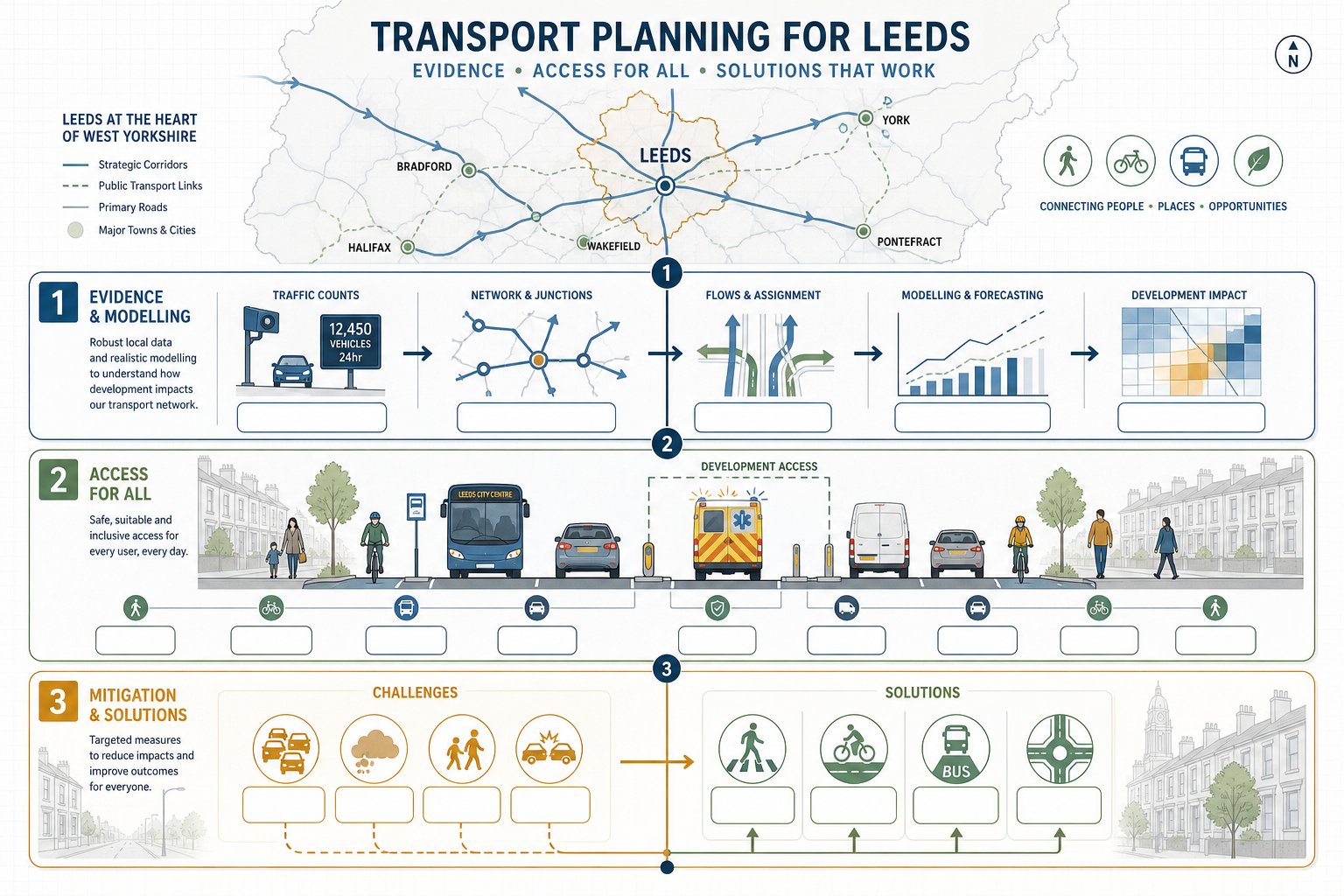
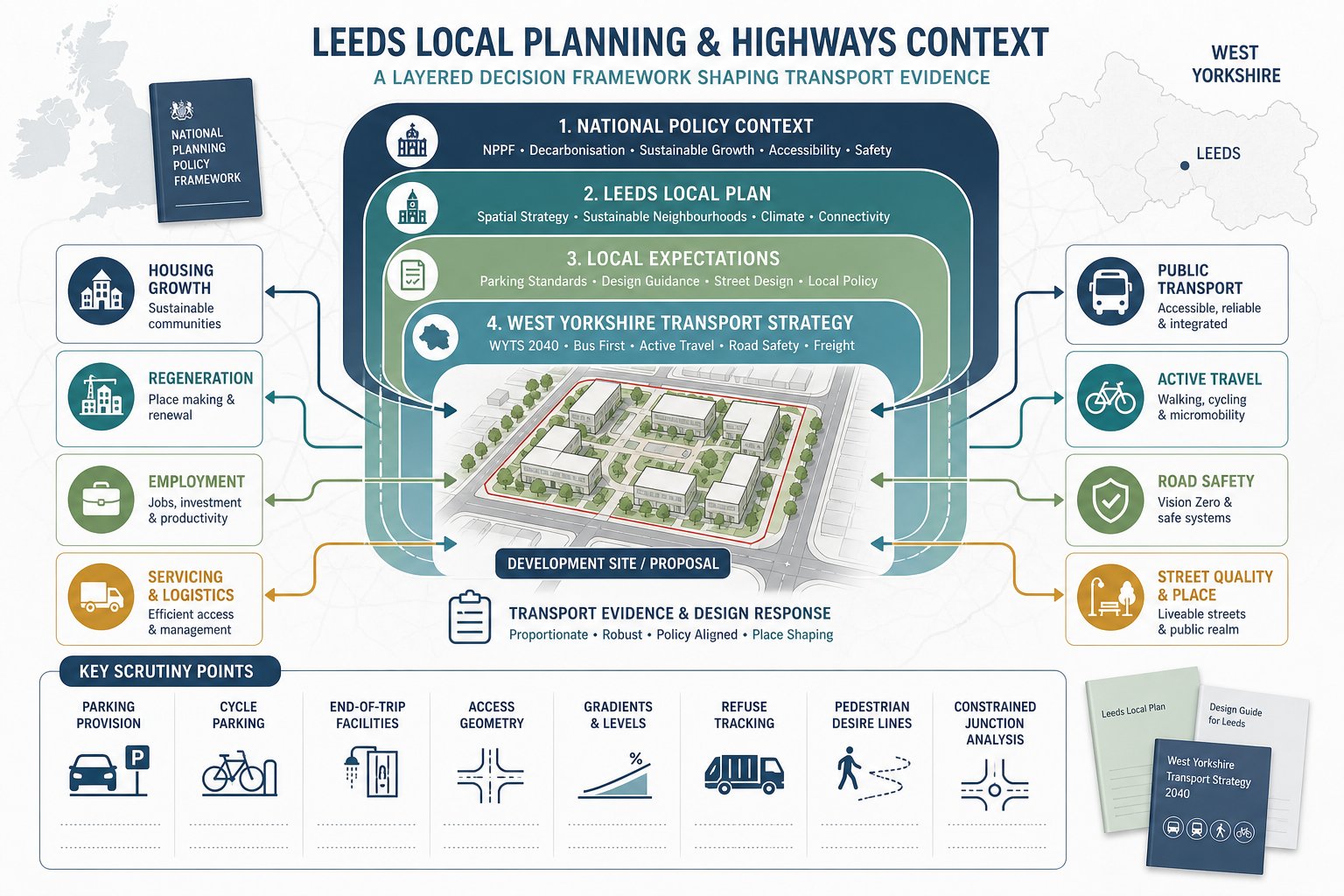
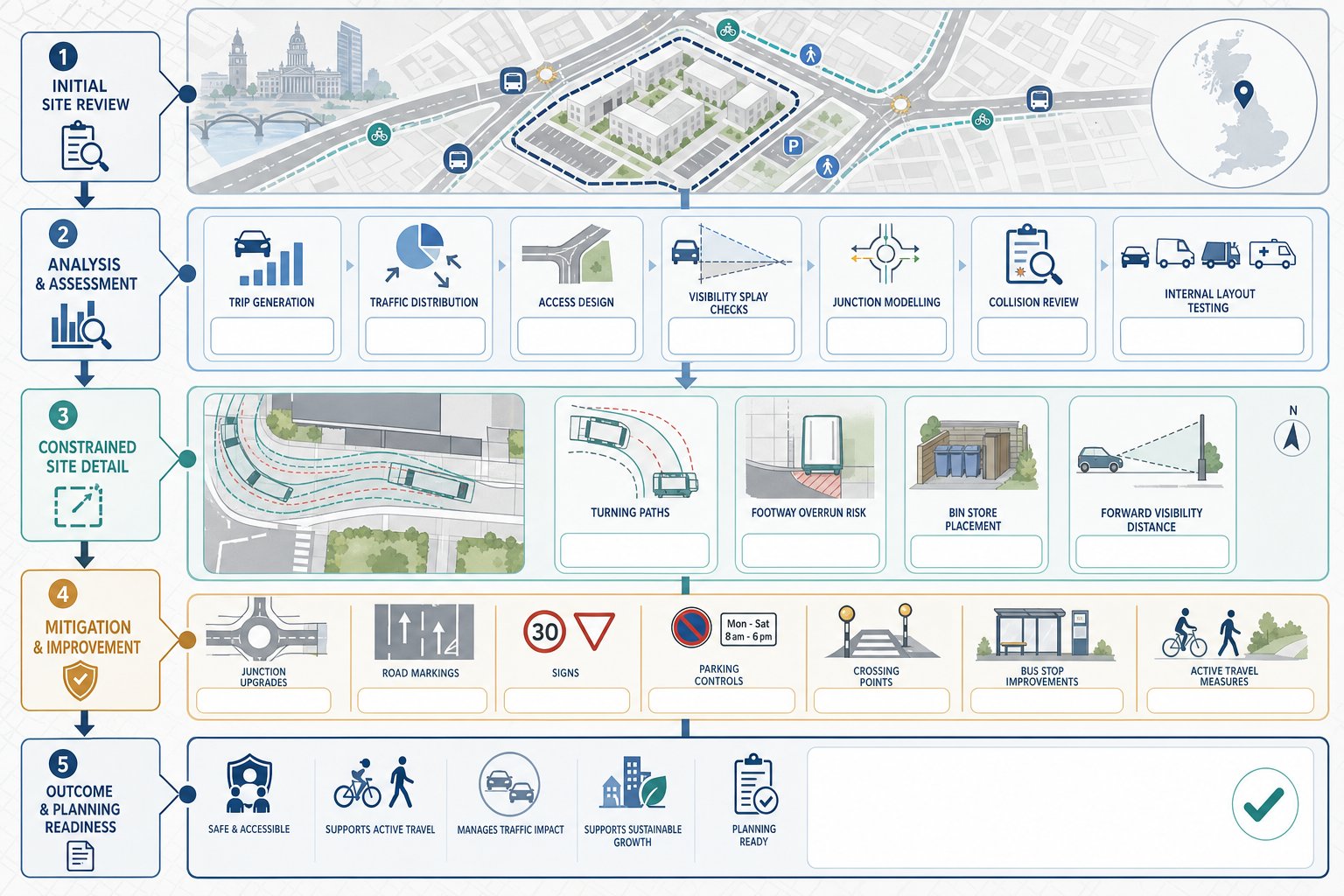
    That matters even more in 2026. Preston continues to balance housing delivery, employment growth, regeneration and movement across a network that includes the M6, M55, A6, A59 and A582, alongside busy local corridors, town-centre streets and established residential areas. In that setting, transport planning in Preston has become one of the practical make-or-break issues for developers, architects, planners and land teams.

    The good news? Most transport objections are not mysterious. They usually come down to scope, timing, evidence quality and whether the submission reflects local policy and local highway realities. When we prepare transport reports, the aim is simple: give decision-makers confidence that a development can function safely, fit within the surrounding network and support sustainable travel rather than just adding pressure to it.

    In this guide, we’ll break down what developers need to know about transport planning in Preston, from local policy context and evidence thresholds to the issues most likely to trigger delay, challenge or redesign.

    Why Transport Planning Matters For Development In Preston

    Infographic showing how transport planning supports safe and sustainable development in Preston.

    Transport planning is one of those disciplines that often gets noticed only when it’s missing. But for development in Preston, it sits close to the centre of the planning process. A well-prepared transport submission helps show not only that a site can be accessed, but that it can operate safely, accommodate servicing, manage parking demand and connect people to jobs, schools, shops and public transport.

    That broader role is important in Preston. Growth pressures don’t sit in a vacuum: they interact with strategic routes, local junctions and existing neighbourhoods that already experience congestion at peak times. Development can support regeneration and housing delivery, yes, but it also has to work on the ground. Councils and consultees will want to know what happens at the nearby roundabout, whether the access geometry is safe, how many car trips are likely to be generated, and whether future users have realistic alternatives to driving.

    Transport planning in Preston also ties directly into policy goals beyond traffic flow. Air quality, carbon reduction, active travel and town-centre vitality all shape how schemes are assessed. A proposal in a sustainable location with credible walking, cycling and bus links will usually start from a stronger position than one that relies almost entirely on the private car.

    From our side, good transport planning isn’t about producing a thick report for the sake of it. It’s about reducing uncertainty. For developers, that means fewer avoidable objections, clearer design decisions earlier in the process, and a better chance of achieving smoother planning approvals.

    The Local Planning And Highway Context Shaping Preston Applications

    Infographic of Preston transport planning roles, policy layers, and site review factors.

    Any serious discussion of transport planning in Preston has to start with who does what. Preston City Council is the local planning authority, but Lancashire County Council is typically the local highway authority and will review the highway and transport implications of most planning applications. In practice, that means applicants need to satisfy both the planning case and the technical transport case.

    The policy framework is layered. At national level, transport evidence is expected to be proportionate but robust, and developments should only be refused on highways grounds where impacts would be severe or safety issues unacceptable. Locally, that sits alongside the Central Lancashire planning framework, Preston’s development plan policies and Lancashire’s wider transport objectives. These documents work together to align land use, connectivity and infrastructure delivery.

    For applicants, the key point is this: local context matters just as much as national guidance. A scheme might look modest in pure floorspace terms, yet still attract scrutiny if it sits near a sensitive junction, affects a constrained access, or adds pressure to a route already carrying commuter traffic. Equally, a town-centre or corridor location with strong bus and rail accessibility may support a more flexible discussion around parking and mode share.

    This is where early review pays off. We generally advise teams to assess the planning and highway context at the same time as site promotion or concept design, not after a layout has hardened. At mltraffic.co.uk, our approach is to tailor transport reports to local authority thresholds and local decision-making realities, because generic submissions rarely perform well when consultees want place-specific evidence.

    Key Development Types That Commonly Trigger Transport Evidence

    Infographic of development types in Preston that commonly require transport evidence.

    Not every scheme in Preston needs a full transport evidence package, but many more require some form of transport input than applicants first assume. The trigger is not only development size: it’s also the type of use, likely trip generation, site constraints and surrounding network sensitivity.

    Major housing schemes are an obvious example. Once residential development reaches the sort of scale that materially affects local junctions or creates a substantial number of peak-hour trips, a detailed assessment is usually expected. The same applies to retail development, where arrival patterns can be concentrated and parking demand becomes a live issue, and to employment schemes such as industrial parks, warehouses and business space, particularly where staff travel overlaps with peak periods or HGV movements are significant.

    Education, healthcare, stadium and leisure uses also attract close review because their travel patterns can be intense, irregular or highly site-specific. A school may create sharp morning and afternoon peaks. A health facility may raise questions around patient access, drop-off, taxis and servicing. A leisure scheme can generate evening and weekend demand when nearby roads are already under pressure for other reasons.

    Then there are developments with unusually high servicing requirements. Even a scheme that doesn’t look major on paper can trigger detailed analysis if refuse vehicles, delivery lorries or articulated HGVs need to enter, turn and exit safely.

    In short, transport evidence is commonly required wherever a proposal has the potential to change movement patterns in a noticeable way. The smartest approach is to identify that early, rather than hoping the issue won’t come up at validation or consultation stage.

    Transport Assessments, Transport Statements And Travel Plans Explained

    The terminology can sound deceptively simple. In practice, choosing the right document is one of the most important early decisions in transport planning in Preston, because submitting too little creates challenge, while submitting the wrong thing can waste time and budget.

    A Transport Assessment (TA) is the most detailed of the three. It typically includes baseline transport conditions, trip generation, distribution and assignment, junction impact testing, access appraisal, parking and servicing review, road safety considerations, and mitigation proposals. It is evidence-heavy and usually quantitative.

    A Transport Statement (TS) is lighter-touch. It still examines access and transport implications, but in a more proportionate way for schemes where impacts are likely to be lower. It may not require the same level of modelling or network analysis as a full TA.

    A Travel Plan (TP) is different again. Rather than focusing primarily on impact prediction, it sets out how travel behaviour will be managed and improved. That might include walking and cycling measures, bus information, incentives, monitoring and targets for reducing single-occupancy car trips.

    The three are not interchangeable, and they are often combined. A larger scheme may need a TA plus a Travel Plan. A smaller change of use may only need a TS, perhaps with a simple travel strategy. What matters is proportionality backed by judgement.

    When A Full Transport Assessment Is Usually Needed

    A full TA is usually expected for major development, but scale alone doesn’t decide it. In broad terms, residential schemes above around 80 to 100 dwellings, larger retail proposals, substantial employment floorspace or schemes with clearly material network effects will often justify a full assessment. That’s especially true where a development could affect sensitive junctions, congested corridors or links to the strategic road network.

    In Preston, a full TA is commonly needed where there are existing pressure points on routes such as the A6, A59 or A582, or where a proposal may influence motorway-related movements connected to the M6 or M55. If the site has a constrained access arrangement, unusual servicing demand, or potential safety concerns for pedestrians and cyclists, that can also push a scheme into TA territory.

    A proper TA should do more than present traffic numbers. It should explain the development story logically: existing conditions, future baseline, predicted trips, operational effect, and what mitigation is required, if any. Weak TAs often fail because they skip one of those steps or rely on assumptions that haven’t been agreed in advance.

    When A Transport Statement Or Travel Plan May Be More Appropriate

    A TS is often suitable for smaller developments, modest changes of use, or schemes where trip generation is limited and transport effects are material but not extensive. Think infill housing, smaller commercial units, redevelopments using an existing access, or town-centre proposals in accessible locations where car dependency is lower.

    That said, “smaller” doesn’t mean “casual.” A good Transport Statement still needs reliable baseline information, sensible trip assumptions and a clear explanation of access, parking, servicing and sustainable travel opportunities. If those basics are missing, consultees may simply ask for more.

    A Travel Plan becomes particularly relevant where the authority wants confidence that sustainable travel will be actively supported rather than vaguely referenced. Residential, school, office, healthcare and mixed-use schemes often benefit from one. The strongest plans are practical: they identify real walking routes, local bus services, cycle parking, welcome packs, monitoring arrangements and named responsibilities. The weakest ones read like copy-and-paste promises no one expects to carry out.

    As a rule, if the likely impact is limited but travel behaviour still matters, a TS and/or TP may be the right proportionate response.

    Core Issues Assessed In A Preston Transport Planning Review

    A transport review in Preston will usually focus on a familiar set of questions, but the detail matters enormously. Authorities and consultees are rarely looking for textbook theory: they want confidence that the proposal works in this exact place, on this exact network, with this exact mix of users.

    Access, Junction Capacity, Parking, Servicing And Road Safety

    First comes access. Is the proposed point of entry and exit safe, visible and suitable for the expected vehicles? Can emergency, refuse and delivery vehicles manoeuvre properly? Will pedestrians cross near the access in a way that creates conflict? These are basic questions, yet they’re often where schemes start to unravel.

    Then there’s junction capacity. If a development adds trips to nearby priority junctions, roundabouts or signalised nodes, the likely operational effect may need to be tested. In Preston, that can be especially relevant where local traffic already interacts with strategic movements, school traffic or commuter peaks.

    Parking is another frequent flashpoint. Under-provision can create overspill stress on nearby streets: over-provision can undermine sustainable travel objectives and weaken the planning case in accessible locations. The same balancing exercise applies to servicing, particularly for commercial and mixed-use schemes where vehicle sweep paths and loading arrangements need to function without blocking circulation.

    And road safety can’t be treated as an afterthought. Collision history, visibility splays, internal layout risks and the experience of vulnerable road users all feed into whether a proposal is seen as acceptable.

    Walking, Cycling, Public Transport And Sustainable Travel Expectations

    Transport planning in Preston isn’t only about whether cars can get in and out. Authorities also want to know whether people can reach the site without driving, and whether the development makes that realistic rather than theoretical.

    That means reviewing walking connections to nearby services, schools, bus stops and local centres. Footway continuity, crossing opportunities, gradients, lighting and natural surveillance can all affect whether a route is genuinely usable. Cycling matters too, especially where sites can connect into local routes or wider assets such as the Guild Wheel, which remains one of Preston’s better-known active travel features.

    Public transport is another key test. How close are the nearest bus stops? What service frequency exists at the times people actually travel? Is Preston railway station a realistic option for some users, or too remote to influence mode choice in practice? These questions shape both impact assessment and mitigation.

    Sustainable travel expectations have become sharper in recent years. Vague claims that residents or employees will “use public transport where possible” don’t carry much weight. What helps is specificity: secure cycle parking, pedestrian links, travel information, welcome packs, bus ticket initiatives, EV infrastructure where relevant, and site design that doesn’t force every short trip to start with a car journey.

    How Site Location In Preston Can Influence Planning Outcomes

    Two developments of similar size can receive very different transport responses simply because they sit in different parts of Preston. Location shapes trip patterns, accessibility, mitigation options and, frankly, the credibility of the planning argument.

    Sites near the town centre, established bus corridors, local centres or Preston railway station often benefit from a stronger sustainable transport narrative. If future residents, staff or visitors can reasonably walk to services, catch frequent buses, or cycle via attractive routes, that can reduce reliance on the private car and support a more policy-aligned case. It may also influence discussions around parking restraint, Travel Plan measures and trip generation assumptions.

    By contrast, peripheral or semi-rural locations can face tougher scrutiny, especially where footways are fragmented, bus services are limited or nearby roads already feel dominated by higher-speed traffic. In those cases, applicants may need to work harder to demonstrate safe access, realistic pedestrian links and mitigation that goes beyond standard wording.

    Location also affects the nature of local objection. In established residential areas, concerns may centre on rat-running, overspill parking or school-run congestion. On edge-of-network sites, the focus may be on strategic capacity, route choice or HGV impact.

    We often advise clients not to treat location as a backdrop. It is part of the transport case itself. A site that is technically developable may still present a difficult planning journey if its transport geography works against the proposal and there is little realistic scope to improve it.

    Common Reasons Transport Submissions Are Delayed Or Challenged

    Most delayed transport submissions are not sunk by one dramatic flaw. They’re weakened by a cluster of smaller issues that signal a lack of rigour. And once that confidence is lost, requests for clarification tend to multiply.

    One common problem is incomplete baseline data. Traffic counts may be out of date, collected at the wrong locations, or missing seasonal context. Another is poor trip generation logic, for example, selecting TRICS sites that don’t reflect the actual land use, location type or scale of the proposal. If the trip rates look engineered to minimise impact, reviewers will notice.

    Applicants also run into trouble by ignoring committed development and background growth. A junction may appear acceptable in isolation, but not once nearby permissions are factored in. Similarly, some reports focus heavily on vehicle movements while giving only token coverage to walking, cycling, buses, parking stress or road safety.

    Lack of early engagement with Lancashire County Council is another recurring issue. If scope, assessment years or modelling assumptions haven’t been discussed in advance, technical debates can erupt late in the process, when redesign is expensive.

    And then there’s presentation. Even a technically competent report can be challenged if drawings are inconsistent, figures are unclear, or the conclusions overreach the evidence. Transport planning in Preston is partly about analysis and partly about trust. A concise, well-structured submission that answers the right questions will usually travel further than a bulky report that leaves readers hunting for the basics.

    How To Prepare A Stronger Transport Submission For A Planning Application

    A stronger submission starts well before the application is uploaded. The best results usually come when transport planning is integrated into site appraisal, layout design and planning strategy from the outset, not bolted on at the end.

    First, engage early. Where appropriate, discuss scope with the local planning authority and Lancashire County Council so there is a shared understanding of whether a TA, TS or Travel Plan is needed, which junctions should be reviewed and what survey work is expected. That early alignment can save weeks later.

    Second, use current and defensible evidence. That means up-to-date traffic counts, well-chosen TRICS data, realistic modal assumptions and robust modelling where required. If there are local constraints, acknowledge them rather than trying to talk past them. A candid report with sensible mitigation is often more persuasive than an optimistic one that appears selective.

    Third, make sure the submission covers the practical essentials: safe access design, visibility, swept paths, parking provision, cycle parking, servicing strategy, refuse collection, pedestrian links and any road safety issues. These details are sometimes treated as appendices-only material, but they often shape the consultation response.

    Fourth, be specific about sustainable travel measures. Name the bus stops. Show the walking routes. Explain cycle storage. Set out who implements the Travel Plan and how monitoring works.

    This is exactly where specialist support can help. At ML Traffic, we focus on concise, accurate transport engineering reports shaped around local thresholds and planning contexts, which is often what decision-makers actually need: not more pages, just better evidence.

    Conclusion

    If there’s one takeaway, it’s this: transport planning in Preston is rarely a box-ticking exercise. It is a core part of the planning case, and in many applications it has an outsized influence on timing, design changes and final determination.

    For developers and their consultant teams, the winning formula is usually straightforward, even if the work isn’t: understand the local policy and highway context, scope the right level of assessment early, use sound data, and address access, safety, parking, servicing and sustainable travel with real precision. Do that, and objections become easier to answer, sometimes easier to avoid altogether.

    Preston will continue to grow, and that growth will keep testing the balance between movement, place quality and infrastructure capacity. The schemes most likely to secure smoother approvals in 2026 will be the ones that treat transport as part of the development strategy from day one, not as a technical afterthought once the plans are already fixed.

    Transport Planning in Preston: Frequently Asked Questions

    Why is transport planning important for development projects in Preston?

    Transport planning supports housing and employment growth while managing congestion on key routes like the M6 and A6. It also underpins local objectives such as air quality, carbon reduction, and town-centre regeneration, ensuring developments operate safely and sustainably within Preston’s transport network.

    When is a full Transport Assessment required for a Preston planning application?

    A full Transport Assessment is typically needed for major developments exceeding national thresholds, such as over 80–100 dwellings, significant retail or employment floorspace, or proposals affecting sensitive junctions, congested corridors, or strategic roads like the M6 or M55 around Preston.

    What roles do Preston City Council and Lancashire County Council play in transport planning?

    Preston City Council acts as the local planning authority, setting policies through local and Central Lancashire plans. Lancashire County Council is the local highway authority, responsible for reviewing highway and transport impacts of planning applications to ensure safety and network efficiency.

    How can developers prepare stronger transport submissions for planning approval in Preston?

    Developers should engage early with Lancashire County Council to agree on scope and methodology, use up-to-date traffic data and robust modelling, and ensure submissions cover safe access, parking, servicing, and specific sustainable travel measures like walking and cycling links.

    What types of developments in Preston typically require transport evidence?

    Transport submissions are commonly required for major housing schemes, retail parks, industrial or business parks, education and healthcare facilities, stadiums, leisure uses, and developments with significant heavy goods vehicle or servicing traffic due to their notable impact on movement patterns.

    How does site location affect transport planning outcomes in Preston?

    Sites near Preston’s town centre or along strong bus, rail, and cycle corridors usually benefit from favourable sustainable transport assessments. Conversely, peripheral or rural sites with limited public transport and fragmented pedestrian links face greater scrutiny and must demonstrate realistic access and mitigation.

  • Transport Planning In Cambridge: A Practical Guide To Assessments, Strategy, And Planning Success In 2026

    Transport Planning In Cambridge: A Practical Guide To Assessments, Strategy, And Planning Success In 2026

    Cambridge is one of those places where transport planning is never just a box to tick. A modest scheme on paper can trigger detailed scrutiny once it meets a compact street network, heavy cycle flows, constrained parking, heritage sensitivities, and a clear policy push toward lower-carbon travel. For architects, planners, developers, lawyers, surveyors, builders, and local authorities, that means transport evidence needs to be proportionate, credible, and closely aligned with local expectations from the outset.

    In practice, Transport Planning in Cambridge sits at the intersection of planning policy, highway safety, place-making, and development viability. The city’s growth ambitions are significant, but so is the expectation that new development will reduce car dependency, support walking and cycling, and work with public transport rather than against it. That balance is where many applications succeed or stall.

    In this guide, we set out the practical side of the process in 2026: when a Transport Assessment or Transport Statement is likely to be needed, what supporting documents typically matter, how Cambridge’s travel patterns shape technical decisions, and where delays usually arise. We also draw on the realities of local authority thresholds and planning contexts that experienced transport consultants deal with every day. The aim is simple: help teams prepare stronger, faster, more defensible planning submissions in Cambridge and the wider Greater Cambridge area.

    Why Transport Planning Matters In Cambridge

    Infographic showing Cambridge growth, street constraints, and sustainable transport priorities.

    Cambridge places unusual pressure on transport strategy because it combines rapid growth with a street network that was never designed for high car volumes. The city is economically strong, land values are high, and demand for housing, research space, education, and employment floorspace continues to rise. But the transport network has real physical limits. Historic streets, sensitive junctions, constrained frontage access, and competing demands for road space all make movement a planning issue from day one.

    That matters because planning decisions here are not based only on whether vehicles can technically enter and leave a site. They are shaped by wider outcomes: reducing congestion, improving air quality, protecting the historic environment, encouraging healthier travel choices, and supporting climate targets. In Cambridge, a development that relies too heavily on private car use can face resistance even if its highway impacts seem manageable on a narrow engineering reading.

    The local policy direction is clear. New schemes are expected to prioritise walking, cycling, and public transport, and to demonstrate that sustainable access is practical, not theoretical. For some sites, that means rethinking parking assumptions. For others, it means proving that pedestrian routes are direct, cycle parking is genuinely usable, servicing is safe, and travel demand can be managed over time.

    In short, transport planning in Cambridge is central to planning success because it affects policy compliance, scheme design, public acceptability, and delivery risk all at once.

    The Local Planning And Policy Context

    Cambridge transport planning policy layers guiding site access, mode shift, and mitigation.

    The policy framework in Cambridge is detailed, and applicants are expected to engage with it properly rather than cite it superficially. At the local level, the Greater Cambridge Local Plan and related supplementary guidance shape how movement, accessibility, and transport impacts are assessed. The Sustainable Design and Construction SPD, including its transport, movement, and accessibility content, is especially important because it connects development design with practical travel outcomes.

    Alongside district planning policy, county-level transport policy carries real weight. Cambridgeshire’s transport plans, active travel strategies, and Local Cycling and Walking Infrastructure Plan help define what good looks like for access, route quality, and integration with the wider network. The Greater Cambridge Partnership programme also influences expectations by promoting sustainable transport interventions across the area, from corridor improvements to bus priority and walking and cycling infrastructure.

    For applicants, the key point is this: Cambridge does not assess transport in isolation. A site may appear acceptable in purely geometric terms, yet still attract challenge if it fails to support mode shift or sits awkwardly with strategic transport objectives. That is why early policy review matters. We need to understand not just the land use allocation or planning history, but also whether the scheme aligns with local accessibility aims, parking restraint, and active travel priorities.

    When we prepare reports, we treat policy as an operational tool, not a decorative appendix. Done well, policy alignment helps explain why a scheme is suitable, what mitigation is proportionate, and how transport impacts should be judged in context.

    How Cambridge’s Travel Patterns Shape Development Decisions

    Infographic showing how Cambridge travel patterns affect development and transport decisions.

    Cambridge has travel characteristics that differ sharply from many UK towns and cities. Cycling levels are notably high, bus travel plays a major role on key corridors, and road capacity is limited. That combination changes how development proposals are reviewed. Assessors will often look closely at whether a scheme is designed around realistic local travel behaviour rather than default national assumptions about car use.

    This has practical consequences. A residential or mixed-use scheme near strong cycle routes, employment areas, colleges, or frequent bus services may be expected to generate lower car mode share than an equivalent development elsewhere. But that lower car use cannot simply be asserted. It needs to be evidenced through site context, accessibility analysis, parking strategy, and the quality of active and public transport links.

    Equally, constrained road capacity means even modest additional vehicle trips can become a concern at sensitive locations. In Cambridge, cumulative impacts matter. Officers may ask whether vehicle movements would affect already stressed junctions, bus reliability, pedestrian comfort, or cycle safety. So the question is rarely just “how many trips?” It is also “where, when, by what mode, and with what effect on a network already under pressure?”

    Developments that respond well tend to do three things: minimise unnecessary car demand, make sustainable travel easy in everyday terms, and present a transport case grounded in local reality. That often makes the difference between a report that feels generic and one that helps move an application forward.

    When A Transport Assessment Or Transport Statement Is Needed

    Whether a Cambridge application needs a Transport Assessment (TA) or Transport Statement (TS) depends on scale, land use, likely transport effects, and site sensitivity. In broad terms, larger or more impact-intensive proposals usually require a TA, while smaller schemes with more limited implications may be supported by a TS. But in Cambridge, thresholds are only part of the story.

    A site in a highly accessible urban location may still require detailed analysis if access is constrained, cycle flows are intense, servicing is awkward, or local parking pressure is already high. Equally, a relatively small scheme can attract transport scrutiny if it sits on a sensitive corridor, affects vulnerable road users, or proposes departures from normal parking expectations. Car-free and low-parking schemes are a good example: they may reduce highway impact, but they still need robust evidence on accessibility, mode share, and how travel demand will be managed in practice.

    A TA normally goes further on trip generation, distribution, assignment, operational impact, mitigation, and cumulative effects. A TS is shorter and more proportionate, but it still needs to show that transport implications have been properly considered. Neither document should be treated as a template exercise.

    The safest approach is early review of local policy, site context, and likely consultee concerns. In our experience, clarity at the beginning saves weeks later on, especially where applications involve mixed uses, phased delivery, unusual access arrangements, or constrained city-centre and edge-of-centre locations.

    How Local Authority Thresholds And Site Context Affect Requirements

    Published thresholds provide a starting point, not a guarantee. Local planning and highway authorities routinely consider whether the surrounding network, the proposed use, and local travel conditions justify more or less detail than a standard threshold table might suggest.

    In Cambridge, context is everything. A student accommodation scheme near central cycle corridors will be looked at differently from an edge-of-settlement logistics use. A small infill development on a narrow street with limited visibility and resident parking stress may need more technical evidence than its unit count alone would suggest. Meanwhile, a well-located office scheme with excellent bus and cycle access may be able to support a restrained parking provision if the wider evidence is strong.

    That means scoping is critical. We usually advise agreeing, as far as possible, the study area, baseline data, trip rates, survey requirements, and modelling expectations before drafting the main report. If this is left too late, applicants can end up revisiting fundamentals after submission, which is expensive and avoidable.

    The best results come from proportionality. Authorities want enough evidence to understand the likely effects and secure mitigation where needed. They do not usually want unnecessary bulk. The challenge is judging where that line sits for the specific site, not for an imaginary average scheme.

    Core Transport Planning Documents For Cambridge Applications

    A strong transport submission in Cambridge is rarely just one report. The TA or TS is the backbone, but decision-makers often need a package of documents that explain how the site will function, how people will reach it, and how transport impacts will be managed through design and operation.

    At minimum, many schemes will need a clear movement strategy embedded across the planning set. That can include the TA or TS, a Travel Plan, transport-related content within the Design and Access Statement, and technical notes dealing with issues such as junction capacity, swept path analysis, parking demand, cycle provision, delivery management, or construction effects. The exact mix depends on the scheme.

    This is where coordination matters. A transport consultant can produce an excellent report, but if the site layout, landscape strategy, refuse collection arrangement, and planning statement all point in slightly different directions, problems follow. Cambridge officers and consultees will notice inconsistencies quickly, especially around access hierarchy, parking numbers, or sustainable travel commitments.

    From a project management perspective, transport documents should be developed early enough to influence design, not merely justify it after key decisions are fixed. That sounds obvious, but it is still one of the most common reasons applications run into friction.

    For firms needing concise, authority-aware reporting, this is exactly where experienced local transport input adds value. On complex or time-sensitive schemes, clear and accurate reporting at the right level of detail can materially improve the planning timetable.

    Transport Assessment, Transport Statement, And Travel Plan

    The Transport Assessment is the most comprehensive of the core documents. It typically explains existing conditions, accessibility, baseline travel choices, trip generation, distribution and assignment, parking and servicing arrangements, safety issues, and any mitigation needed to make the development acceptable. Where junction impacts are relevant, modelling or operational analysis may sit within or alongside it.

    The Transport Statement is more concise, used for proposals where impacts are expected to be limited. But concise does not mean light on reasoning. A good TS still addresses accessibility, access design, likely trip effects, parking, cycle provision, servicing, and policy compliance in a way that is tailored to the site.

    The Travel Plan deals with ongoing travel behaviour. In Cambridge, this can be particularly significant because policy emphasis is not just on infrastructure but on reducing car dependence over time. A useful Travel Plan sets measurable objectives, identifies site-specific measures, allocates responsibility, and explains monitoring and review. Generic promises are rarely persuasive.

    Taken together, these documents tell the authority not only what impact the scheme may have, but how that impact will be managed in real life.

    Supporting Technical Notes And Delivery Strategy Evidence

    Supporting notes often carry more weight than applicants expect. If the main report states that parking demand will be acceptable, a parking survey or parking accumulation note may be needed to back that up. If refuse or servicing vehicles must turn within the site, swept path drawings and a delivery strategy become important. If the site affects a sensitive junction, local modelling or queue observations may be required.

    Other supporting material can include speed surveys, visibility analysis, stage 1 road safety audit responses, cycling connectivity plans, public transport accessibility notes, construction traffic management principles, and servicing or logistics plans. For phased developments, delivery strategy evidence can be essential in showing how transport measures will align with occupation triggers.

    In Cambridge, supporting evidence often matters most where a proposal is trying to do something slightly unconventional: reduced parking, constrained access, shared surfaces, car-free living, or a strong shift toward cycle-based access. Those approaches can absolutely succeed, but only when the evidence is coherent.

    The point is not to produce paperwork for its own sake. It is to anticipate the questions officers, highway authorities, and sometimes neighbours are likely to ask, and answer them before they become objections.

    Key Issues Assessed For Development Sites

    Transport review in Cambridge tends to focus on how a site will actually work day to day, not just on headline trip numbers. That includes whether people can reach the site safely and conveniently, whether vehicles can access and service it without conflict, and whether the overall arrangement supports local policy aims on sustainable travel.

    The assessment is hence multi-layered. Highway geometry still matters, of course, but so do route quality, connectivity, parking behaviour, accessibility for disabled users, and the interaction between private vehicles, service vehicles, cyclists, and pedestrians. On some sites, the technical challenge lies in junction impact. On others, it lies in making a low-car or car-free proposition credible.

    What Cambridge often does especially well, from a policy perspective, is look beyond the red line boundary. Authorities will want to know how the site connects into the surrounding network, whether nearby crossing points are adequate, how direct the cycle routes really are, whether bus stops are useful in practice, and whether the proposed layout will create friction for existing users.

    That broader lens means transport planning needs to be integrated with urban design and site operation. A development can have a compliant access width and still perform poorly if cycle parking is hidden, servicing blocks pedestrian desire lines, or visitors end up circulating for parking. Those are the details that often shape technical responses.

    Access, Parking, Servicing, And Road Safety Considerations

    Access design is usually the starting point. Authorities will consider visibility, geometry, gradient, junction form, vehicle tracking, and whether different users can move safely through the site entrance. In Cambridge, where cycle movement can be intense and footway continuity matters, even a simple access can become a sensitive design issue.

    Parking is another recurring pressure point. The headline number of spaces matters, but not in isolation. Officers will also ask how parking provision supports the proposed mode split, whether disabled and visitor parking is appropriate, how cycle parking is designed, and whether overspill risk has been honestly assessed. Underestimating local parking stress is a common own goal.

    Servicing deserves the same level of attention. Can delivery vehicles enter, turn, wait, and leave safely? Will refuse collection block access roads or pedestrian space? Are loading arrangements realistic for the intended occupier? These questions can delay applications when left vague.

    Road safety considerations cut across all of this. Recent collision history, conflict points, vulnerable user movement, visibility constraints, and design responses all need to be addressed proportionately. A scheme does not need to eliminate every risk, but it does need to show that risks have been understood and reduced through competent design.

    Walking, Cycling, Public Transport, And Sustainable Travel

    In Cambridge, sustainable travel is not a secondary chapter. It is often the heart of the transport case. Applicants are expected to show that walking, cycling, and public transport are practical first-choice options for the people who will use the development.

    For walking, that means more than measuring distance. We need to consider directness, crossing opportunities, footway quality, lighting, overlooked routes, and whether key destinations can be reached comfortably by different users. A ten-minute walk can be acceptable on paper but unattractive in reality if the route is hostile.

    Cycling analysis is equally important. Cambridge has strong cycling culture, so cycle parking quality, route continuity, junction comfort, and links to the wider network are all closely examined. Poorly located or awkward cycle stores can undermine an otherwise good strategy.

    Public transport assessment should address access to stops, service frequency, route coverage, journey time usefulness, and the quality of connections. On some sites, bus accessibility will be a major strength. On others, it may need to be supplemented by Travel Plan measures, improved wayfinding, or contributions toward local enhancements.

    What matters most is coherence. Sustainable travel claims need to match the physical design, management measures, and likely behaviour of future users.

    The Transport Planning Process From Feasibility To Decision

    The transport planning process works best when it starts before the planning application is assembled, not after. At feasibility stage, we should already be testing whether the access concept is workable, what the surrounding movement network looks like, where the likely pressure points are, and whether the proposed land use matches the site’s accessibility profile.

    A typical process begins with site appraisal: existing highway conditions, walking and cycling links, public transport access, parking controls, collision history, servicing constraints, and any nearby junctions or corridors likely to be sensitive. That baseline work informs early design choices and helps avoid expensive redesign later.

    The next step is usually scoping with planning and highway officers where appropriate. This is where study area, survey scope, trip methodology, scenario testing, and report type can be clarified. Not every detail will be formally agreed, but early dialogue often narrows the room for dispute.

    Then comes preparation of the TA or TS, Travel Plan, and any supporting technical notes. The strongest submissions keep the story consistent across all documents: the site is accessible, the design reflects local policy, impacts are understood, and mitigation is proportionate and deliverable.

    After submission, transport work rarely stops. Technical comments may require clarification, revised analysis, updated drawings, or negotiation over conditions and obligations. Sometimes that is straightforward: sometimes it is where programmes slip. Clear evidence, prompt responses, and realistic mitigation proposals usually make that stage far smoother.

    For developers and consultants under time pressure, this is why quick, accurate and locally tailored reporting matters so much. It is not just about submission quality. It is about keeping the planning process moving.

    Common Risks, Delays, And How To Strengthen An Application

    Most transport-related delays in Cambridge are not caused by one dramatic flaw. They are caused by a series of smaller weaknesses that, together, make the authority lose confidence in the submission. A trip-rate assumption that feels too optimistic. A cycle route plan that ignores a difficult crossing. Parking that is numerically compliant but operationally awkward. A servicing strategy that exists only in theory.

    One common risk is underestimating car demand or overspill effects, especially on lower-parking schemes. Another is relying on generic statements about sustainable travel without proving that the routes, facilities, and management measures are strong enough to support the claimed mode share. Late engagement with the highway authority is another regular problem. By the time concerns emerge through formal consultation, redesign can be expensive.

    Applications are also weakened when transport evidence is internally inconsistent. If the Planning Statement promises one thing, the site plan shows another, and the TA quietly assumes something else, objections become more likely. Cambridge consultees tend to read across documents carefully.

    So how do we strengthen an application? Start early. Scope properly. Use robust local data. Be honest about constraints. Design access and servicing around real operation, not idealised diagrams. Treat walking, cycling, and bus accessibility as core evidence, not a compliance add-on. And where mitigation is needed, make it specific, proportionate, and linked to the identified impact.

    If there is one practical lesson from years of transport work, it is this: authorities are much more receptive when a report shows mature judgement. Not just technical competence, but evidence that the team understands Cambridge’s streets, policy priorities, and development pressures.

    That is exactly where experienced support helps. At ML Traffic, the value is not simply producing a report quickly: it is producing one that is concise, accurate, and tailored to local authority thresholds and planning context. In a place as exacting as Cambridge, that difference can be decisive.

    Good transport planning does not guarantee consent. But weak transport planning can absolutely put a viable scheme at risk. The better approach is to build the transport case early, align it with design and policy, and give decision-makers clear reasons to say yes.

    Frequently Asked Questions about Transport Planning in Cambridge

    Why is transport planning particularly important in Cambridge?

    Transport planning in Cambridge is critical due to its compact, historic street network combined with rapid growth in housing, jobs, and research. The city’s policies prioritize reducing car dependency, improving air quality, and supporting walking, cycling, and public transport to meet climate and health goals.

    When is a Transport Assessment or Transport Statement required for developments in Cambridge?

    A Transport Assessment (TA) is needed for larger or more impact-intensive developments, while smaller or less impactful schemes usually require a Transport Statement (TS). However, local context, site sensitivity, and parking levels can influence this, and even small schemes may need detailed evidence if they affect sensitive areas or propose reduced parking.

    How do Cambridge’s travel patterns influence transport planning for new developments?

    High cycling levels, significant bus use, and limited road capacity in Cambridge mean developments must minimise car trips and provide practical sustainable access. Transport planning assesses realistic local travel behaviour, often expecting lower car mode share than in other cities, backed by evidence of accessibility, parking strategy, and quality of active travel links.

    What key issues are usually assessed in transport planning submissions in Cambridge?

    Submissions focus on access design, parking provision, servicing arrangements, and road safety, alongside walking and cycling connectivity, public transport accessibility, and integration with local policy priorities. Authorities also consider how a site connects to the wider network, impacts on vulnerable users, and whether sustainable travel options are practical and well supported by design.

    How can developers strengthen their transport planning applications in Cambridge to avoid delays?

    Early engagement with planning and highway authorities, using robust local data, agreeing on scope and methodology upfront, and providing coherent evidence across all documents improve applications. Clear mitigation strategies, realistic trip and parking assumptions, strong sustainable travel plans, and integration with local policies significantly reduce the risk of objections and delays.

    What documents typically support transport planning applications in Cambridge?

    Applications usually include a Transport Assessment or Transport Statement, a Travel Plan managing ongoing travel behaviour, a Design and Access Statement with movement evidence, and supporting technical notes such as junction modelling, parking surveys, servicing strategies, and cycle infrastructure plans to demonstrate compliance with local policies and technical requirements.

  • Transport Planning In St Albans: A Practical Guide To Local Requirements And Planning Success In 2026

    Transport Planning In St Albans: A Practical Guide To Local Requirements And Planning Success In 2026

    Planning in St Albans is rarely just about the red line boundary. On many schemes, the real pressure point sits outside the site: the junction that already queues at school-run time, the constrained historic street that was never designed for modern traffic, the station catchment under strain, or the local concern that another development will tip an already busy corridor over the edge.

    That is exactly why Transport Planning in St Albans matters so much in 2026. For architects, developers, planning consultants, solicitors, surveyors and local authorities, transport evidence is often the difference between a smooth application and a drawn-out exchange with Hertfordshire Highways and the local planning authority. A report that is too generic, too late, or poorly scoped can create avoidable objections. A report that is proportionate, policy-aware and rooted in local conditions can do the opposite: reduce uncertainty and help a scheme move forward.

    In our experience, St Albans applications succeed when transport work is treated as part of the design process, not a box-ticking exercise at the end. The local policy framework, network constraints, sustainable travel expectations and highway safety issues all need to be considered together.

    In this guide, we set out the practical local requirements, the documents typically needed, how assessments are usually prepared, where objections tend to arise, and what teams can do from the outset to give an application the best chance of planning success.

    Why Transport Planning Matters In St Albans

    Infographic showing key transport planning factors and local network pressures in St Albans.

    St Albans presents a transport planning challenge that is more nuanced than it may first appear. It has strong strategic connections, a prosperous commuter profile and attractive residential and commercial locations, but it also has constrained streets, busy peak periods and high expectations around design quality and sustainable travel. That combination means transport is often a central planning issue rather than a supporting technical note.

    At application stage, transport planning helps answer the questions decision-makers actually care about: will the proposal operate safely, can the network accommodate it, are the access arrangements workable, does parking make sense, and have realistic alternatives to private car use been built into the scheme? Those questions run through everything from small infill developments to major mixed-use proposals.

    For St Albans in particular, the stakes are higher because cumulative growth matters. Even where one development appears modest in isolation, officers and consultees will often consider how it sits within wider housing and employment growth, corridor pressure and local sustainability objectives. A robust submission hence needs to show not only what the development does, but why its effects are acceptable in context.

    Well-prepared transport evidence also saves time. It can narrow the scope of debate, support negotiations on mitigation and prevent avoidable requests for further information. For teams working to programme and budget, that practical benefit should not be underestimated.

    The Local Context That Shapes Transport Decisions

    The local context in St Albans shapes almost every transport judgement. The district sits within the wider Hertfordshire transport framework, while the city itself has a historic urban form that limits easy highway widening or major geometric change. In plain terms, there often isn’t much spare room to solve a transport issue later.

    A few local characteristics repeatedly influence assessments:

    • Historic street pattern and constrained townscape: many routes are narrow, sensitive and already busy.
    • Strategic road access: links to the M1, M25 and A414 increase connectivity but also concentrate demand on key corridors and junctions.
    • Strong rail relationship with London: station access, parking pressure, walking routes and bus interchange can all become relevant.
    • Air quality and environmental considerations: where congestion is already a concern, transport effects may attract closer scrutiny.
    • Planned growth: Local Plan allocations and broader Hertfordshire strategies increase focus on cumulative impact and sustainable mode shift.

    The St Albans Urban Transport Plan, the Hertfordshire Local Transport Plan, and the development plan framework all feed into decision-making. That means transport submissions should never be written as if the site exists in a vacuum. We need to show how a proposal responds to the real network, real policy priorities and real local patterns of movement.

    When A Planning Application Needs Transport Input

    Infographic showing when St Albans planning projects need transport assessment.

    Not every planning application in St Albans requires a full technical package, but many need some form of transport input far earlier than applicants expect. The trigger is not simply development size. It is also about likely trip generation, access complexity, sensitivity of the surrounding network, parking implications, and whether the proposal could raise safety or sustainability concerns.

    In practice, formal transport input is commonly required where a scheme is likely to generate noticeable travel demand, alter an access arrangement, intensify use of a site, or sit in a location where local constraints are already evident. Hertfordshire Highways, acting as the highway authority, will often expect proportionate evidence that follows national policy principles and local standing advice.

    The National Planning Policy Framework remains the broad policy backdrop: transport issues should be considered from the earliest stages so that opportunities for sustainable movement, safe access and suitable mitigation are properly addressed. Locally, that principle translates into a need to agree scope early and avoid under-submitting.

    For smaller schemes, transport input may be limited to access advice, parking review, swept-path analysis or a concise transport note. For larger or more complex proposals, a Transport Statement, Transport Assessment, Travel Plan, or a combination of those documents is usually expected.

    A good rule of thumb is this: if transport could become a reason for delay, objection or redesign, it should be addressed before submission, not after validation.

    Common Development Types That Trigger Assessment

    Certain land uses regularly prompt transport review in St Albans because their traffic and travel patterns are harder to absorb without evidence.

    Common examples include:

    • Residential development, especially major housing sites, apartment-led schemes in accessible areas, or proposals with contested parking provision.
    • Retail and leisure schemes, where peak demand, servicing activity and weekend traffic patterns can affect nearby junctions.
    • Employment development, including offices, industrial sites and business parks with staff, visitor and delivery movements.
    • Education uses, where school-run peaks and road safety issues often dominate the assessment.
    • Healthcare proposals, which may generate dispersed but sensitive trip patterns and require strong accessibility planning.
    • Mixed-use developments, where the interaction between uses, internal layout and cumulative demand needs careful explanation.

    Even where thresholds do not obviously point to a full assessment, local circumstances can push a scheme into more detailed review. A modest proposal on a constrained road, close to a difficult junction, near a school, or within an area of parking stress may attract more highway scrutiny than a larger proposal in a straightforward location.

    That is why we usually advise teams not to think in terms of “Do we technically need a report?” but rather “What level of transport evidence will make this application credible?”

    Key Transport Planning Documents For St Albans Applications

    Infographic showing key transport planning documents for St Albans applications.

    The transport documents required for a St Albans planning application should reflect both the scale of the proposal and the local policy context. In most cases, the technical work sits within a wider planning framework rather than standing alone. If the reports do not align with local strategy, they tend to feel incomplete even where the calculations are sound.

    Three policy sources are especially important:

    • The St Albans Urban Transport Plan, which identifies local transport issues, priorities and interventions.
    • The Hertfordshire Local Transport Plan, which sets the county-wide strategy for movement, network management and sustainable travel.
    • The St Albans City & District Local Plan and relevant supplementary guidance, which frame development expectations at district level.

    Depending on the scheme, applicants may also need supporting technical drawings and appendices such as visibility splays, speed surveys, collision analysis, swept-path plans, junction modelling outputs and cycle parking schedules.

    The key point is that transport documentation should tell one joined-up story. The policy context, baseline evidence, design response, impact testing and mitigation need to reinforce each other. If the access drawing says one thing, the parking layout suggests another, and the transport report glosses over both, the submission becomes vulnerable quickly.

    Transport Statements, Transport Assessments, And Travel Plans Explained

    These three documents are often mentioned together, but they do different jobs.

    A Transport Statement (TS) is usually used for smaller or less traffic-intensive schemes. It provides a proportionate review of existing conditions, site accessibility, expected trip generation, access arrangements, parking and likely transport effects. The emphasis is on clear evidence without unnecessary modelling.

    A Transport Assessment (TA) is more detailed and is typically required for larger or more complex proposals. It may include:

    • surveyed baseline traffic conditions
    • junction capacity modelling
    • queue and delay analysis
    • trip distribution and assignment
    • cumulative impact testing
    • mitigation proposals

    A Travel Plan (TP) is different again. It focuses on behaviour, not just infrastructure. Its purpose is to encourage walking, cycling, bus use, rail use, car sharing and other non-single-occupancy-car choices by residents, staff or visitors. A strong TP usually includes measures, targets, management arrangements and monitoring.

    In St Albans, the most effective submissions use these documents in a complementary way. The TS or TA explains the transport impacts and physical response: the TP shows how the development will support sustainable travel in practice. Together, they help demonstrate policy compliance and reduce the risk of the scheme being seen as car-dependent by default.

    How St Albans Transport Planning Assessments Are Typically Prepared

    A sound transport planning assessment is rarely produced in a single pass. In St Albans, the better approach is staged and evidence-led: first agree the likely scope, then build a realistic baseline, then test the effect of the development, and finally tie the findings back into design and policy.

    At the start, we usually look at the site in local context rather than jumping straight into trip rates. That means understanding surrounding land uses, road hierarchy, walking catchments, cycle routes, bus and rail availability, school or commuter peaks, parking pressure and any known safety concerns. This is the point where many later problems can be avoided.

    From there, the technical work typically progresses through data collection, trip generation, impact analysis and mitigation review. For more complex sites, pre-application engagement with Hertfordshire Highways and the local planning authority is especially valuable. It helps establish which junctions matter, what survey information is likely to be accepted, and whether cumulative development needs to be addressed in a particular way.

    The overall aim is not simply to produce a compliant report. It is to produce one that is proportionate, locally grounded and difficult to dismiss. In our experience, concise and accurate reporting often carries more weight than a long document that avoids clear conclusions.

    Existing Conditions, Trip Generation, And Impact Review

    This is the core technical sequence behind most Transport Statements and Transport Assessments.

    Existing conditions come first. That usually includes traffic counts, observed queueing, vehicle speeds, road geometry, visibility, parking conditions, walking and cycling facilities, bus services, rail accessibility, and often a review of personal injury collision data. The purpose is to establish what the network is doing now, not what we assume it does.

    Trip generation comes next. Comparable sites, census-style data and industry tools such as TRICS are often used to estimate likely arrivals and departures. That assessment should reflect the actual characteristics of the scheme, including location, accessibility and probable mode split. Overstated assumptions can make a scheme look worse than it is: optimistic assumptions can undermine credibility.

    Impact review then tests what those trips mean in practice. Depending on the proposal, that may involve:

    • priority junction modelling
    • roundabout or signal junction analysis
    • queue and delay review
    • operational assessment of access points
    • internal circulation checks
    • cumulative impact consideration alongside committed development

    If impacts are identified, mitigation should be specific and workable. That might involve access amendments, visibility improvements, layout changes, travel plan measures, parking refinements, pedestrian links or contributions to off-site works. The key is to show that the development has been engineered with transport reality in mind, not simply defended after the fact.

    Access, Parking, Servicing, And Road Safety Considerations

    These four issues are where many planning applications become either convincingly practical or unexpectedly fragile.

    Access must work safely and intuitively for all users. In St Albans, where streets can be constrained and frontage conditions irregular, the details matter: junction geometry, visibility splays, gradients, pedestrian priority, interaction with nearby parking, and whether vehicles can enter and leave without awkward manoeuvres. A technically possible access is not always a planning-acceptable one.

    Parking often needs careful balancing. Too little parking can lead to overspill and local objection: too much can conflict with sustainable transport policy, weaken placemaking and consume valuable land. Car parking levels should hence be justified in relation to site accessibility, local standards, development type and likely user profile. Cycle parking deserves the same seriousness. Poorly located or token cycle stores rarely support genuine uptake.

    Servicing is another common pressure point. Delivery vehicles, refuse collection, moving vans and emergency access all need to be considered. Swept-path analysis is often essential, particularly on tighter sites or mixed-use schemes. If servicing can only occur by blocking the highway or conflicting with pedestrian desire lines, objections are not far away.

    Road safety ties the whole picture together. Collision analysis, design checks and route review help demonstrate whether the proposal introduces unacceptable risk. In many cases, safety concerns arise not from headline traffic growth but from poor layout detail: hidden exits, reversing movements, pedestrian conflict points, or awkward school-time interactions.

    Good transport planning addresses these issues early, while the site layout is still flexible. Once a design is fixed, solving access or servicing problems tends to become slower, costlier and more political.

    Walking, Cycling, Public Transport, And Sustainable Travel

    In St Albans, sustainable travel is not a soft add-on to a planning submission. It is a core part of the transport case. That reflects both policy direction and local reality: many sites sit within reach of town centres, schools, bus routes or rail services, but the quality of the connection often determines whether people will actually use them.

    A convincing submission should assess more than distance alone. We need to consider whether walking routes are direct, well lit, overlooked, step-free where necessary and comfortable at crossing points. For cycling, the same principle applies: nominal proximity is not enough if the route feels hostile or disconnected.

    Public transport assessment should cover bus stops, service frequency, operating hours, rail station access and interchange quality. On stronger sites, these factors can materially support lower car reliance. On weaker sites, they may point to the need for mitigation or a more realistic parking and travel strategy.

    Travel Plan measures can make a real difference when they are specific rather than generic. Useful examples include:

    • welcome packs with local walking, cycling and public transport information
    • personalised travel planning
    • cycle parking and changing facilities
    • car-club spaces where viable
    • EV charging infrastructure
    • discounted public transport incentives or travel vouchers
    • monitoring and review mechanisms

    The local policy objective is clear: new development should help manage growth without deepening congestion or car dependency. In St Albans, that means showing how a scheme connects to everyday destinations and how the design actively supports lower-impact travel choices. If sustainable transport is treated as an appendix issue, consultees usually notice.

    Working With Hertfordshire Highways And The Local Planning Authority

    Transport planning in St Albans works best when applicants understand the distinct but linked roles of the key public bodies involved.

    Hertfordshire Highways, as highway authority, is a principal technical consultee on many applications. Its focus is usually on matters such as network impact, safety, access suitability, parking and servicing logic, and whether the submitted evidence is robust. If the methodology is weak or the baseline incomplete, that will usually surface here first.

    The local planning authority then considers that transport advice alongside wider planning issues such as design, land use, amenity, heritage, sustainability and overall policy balance. In other words, a transport issue is rarely judged in isolation, but poor transport evidence can still undermine the whole planning case.

    This is why early engagement matters. Pre-application discussion can help clarify:

    • whether a TS, TA or TP is expected
    • which junctions or routes should be assessed
    • whether committed development needs to be included
    • what survey periods and data sources are appropriate
    • how access and parking principles should be framed

    Not every point will be agreed in advance, and pre-app feedback is not a guarantee. But it usually reduces the risk of writing a report to the wrong scope.

    For applicants and consultants, there is also a softer skill involved: presenting evidence in a way that is technically sound but easy to audit. Clear assumptions, transparent appendices, legible plans and direct conclusions help officers and consultees review the submission efficiently. That may sound obvious, but many delays arise because the information is there somewhere, just not where anyone can sensibly find it.

    Where specialist support is needed, firms with local authority-facing transport report experience can often add value by keeping the analysis concise, targeted and aligned with the relevant Hertfordshire context.

    Common Reasons Transport Planning Objections Arise

    Most transport objections in St Albans are predictable. They usually stem from one of three problems: the development creates a genuine transport concern, the evidence has not adequately addressed a foreseeable issue, or the submission underestimates the importance of local policy and site context.

    One of the most common objections is unacceptable residual cumulative impact. Even where a single scheme does not appear dramatic, its effect on already pressured junctions or corridors can become contentious, especially when combined with committed growth.

    Another frequent issue is substandard access design. Poor visibility, awkward geometry, insufficient turning space or unresolved pedestrian conflict can quickly trigger highway safety concerns. These are often easier to resolve before submission than after objection.

    We also see objections where the assessment itself is weak. Typical examples include:

    • outdated or incomplete survey data
    • incorrect trip rates or unrealistic mode split assumptions
    • limited explanation of junction modelling inputs
    • missing collision analysis
    • no meaningful review of nearby walking or cycling conditions

    Parking can go either way. Some schemes are challenged for under-provision, with fears of overspill onto surrounding roads. Others are criticised for over-provision, particularly where the location could support lower car use and the layout becomes dominated by vehicles.

    Then there is the policy issue. If a submission does not engage properly with the Urban Transport Plan, the Local Transport Plan or the Local Plan, it may look technically competent but strategically tone-deaf.

    The pattern is consistent: objections arise where transport work is generic, late or detached from design. Strong submissions tend to be the opposite, specific, transparent and rooted in the real characteristics of St Albans.

    How To Strengthen A Planning Submission From The Start

    The strongest transport submissions are usually built early, not rescued late. By the time an application is being assembled for submission, the main transport risks should already be understood and, ideally, designed through.

    A practical starting point is to scope the work early with both the site team and, where appropriate, Hertfordshire Highways or the local planning authority. That helps identify whether the development needs a concise statement or a more detailed assessment, which junctions are likely to matter, and what supporting analysis should be prepared from the outset.

    From there, a few principles consistently improve the quality of an application:

    • Use current and relevant data. Old traffic counts or generic assumptions can weaken the entire submission.
    • Design access, parking and servicing together. These elements should support each other rather than compete within the layout.
    • Apply recognised tools properly. TRICS, swept-path software and junction modelling are useful only when their assumptions are explained and suited to the site.
    • Align with policy. The St Albans Urban Transport Plan, Hertfordshire Local Transport Plan and Local Plan should be reflected in both the narrative and the design response.
    • Prepare a tailored Travel Plan. Specific commitments, realistic targets and clear monitoring arrangements carry more weight than stock text.
    • Be honest about constraints. A transparent explanation of trade-offs is usually more credible than pretending they do not exist.

    For project teams working to tight timescales, specialist support can also make a measurable difference. At ML Traffic, for example, the emphasis is on concise, accurate transport engineering reports tailored to local authority thresholds and planning contexts, which is often exactly what a time-sensitive application needs.

    Eventually, successful Transport Planning in St Albans comes down to fit: fitting the evidence to the scale of the proposal, fitting the design to the site, and fitting the whole submission to local policy and network conditions. When that happens, planning risk usually drops, and the application stands on much firmer ground.

    Planning success in St Albans rarely turns on transport alone, but transport can absolutely decide the tone of an application. If the evidence is proportionate, locally informed and tied closely to the design, consultees are far more likely to engage constructively. If it is generic or reactive, problems tend to multiply.

    For architects, planners, lawyers, developers and public-sector teams, the practical lesson is simple: treat transport planning as an early design discipline, not an end-stage report. Understand the local network, engage with policy, test the impacts honestly, and make sustainable travel measures real rather than decorative.

    That approach does more than satisfy a consultee. It helps create schemes that work on the ground, for residents, businesses, visitors and the wider St Albans network. And in a district where growth, congestion and place quality are constantly in tension, that is what good planning should do.

    Transport Planning FAQs for St Albans

    Why is transport planning important in St Albans?

    Transport planning in St Albans manages growth, congestion, and supports sustainable travel amidst historic street constraints, busy peak periods, and local air quality concerns. It helps ensure developments operate safely and fit within the wider network and policy context.

    When does a planning application in St Albans require transport input?

    Transport input is required for developments likely to generate significant travel demand, alter access arrangements, or be located on constrained roads. This includes larger housing, retail, employment, education, healthcare, or mixed-use schemes, following Hertfordshire Highways guidance and national policy.

    What transport documents are typically needed for planning applications in St Albans?

    Depending on scheme scale, a Transport Statement (TS) for smaller sites, Transport Assessment (TA) for larger schemes, and a Travel Plan (TP) promoting sustainable travel are commonly needed. These documents must align with the St Albans Urban Transport Plan, Hertfordshire Local Transport Plan, and Local Plan policies.

    How are transport assessments prepared for St Albans developments?

    Assessments start with scoping with Hertfordshire Highways and local planning authorities, followed by collecting baseline data on traffic, parking, and public transport. Trip generation is estimated using tools like TRICS, then impacts are modelled and mitigation proposed, with a strong focus on local context and sustainability.

    What common transport-related objections arise in St Albans planning applications?

    Objections often stem from cumulative traffic impact on busy roads, substandard access design, insufficient or excessive parking, weak sustainable travel measures, poor walking or cycling links, or failure to comply with local transport policies. Inadequate or outdated transport evidence also triggers concerns.

    How can planning submissions be strengthened with regard to transport in St Albans?

    Early engagement with Hertfordshire Highways and the local authority to agree scope, using up-to-date data and recognised modelling tools, designing for safe access, parking, and servicing together, and delivering a robust Travel Plan with clear targets all improve submission quality and reduce planning risks.

  • Transport Planning In Lancaster: A Practical Guide To Smoother Planning Applications In 2026

    Transport Planning In Lancaster: A Practical Guide To Smoother Planning Applications In 2026

    In Lancaster, a planning application can look perfectly sound on paper and still stall once transport questions start landing. Can vehicles enter and leave safely? Will a nearby junction stack traffic back at peak times? Is the site genuinely walkable, cyclable, and reachable by bus, or does that claim fall apart under scrutiny? Those points often decide whether an application moves forward smoothly or gets bogged down in requests for further evidence.

    That is why Transport Planning in Lancaster matters so much in 2026. For architects, planners, developers, surveyors, and local authorities, transport evidence is no longer a box-ticking exercise. It is a core part of showing that development can be accommodated by the surrounding network without creating unacceptable effects on congestion, safety, accessibility, parking, or servicing.

    We see this regularly across Lancashire. The strongest applications are usually the ones that tackle transport early: they test access before layouts are fixed, use realistic trip and parking assumptions, and align their reports with local authority expectations from the start. With more than 30 years’ experience preparing concise transport reports for planning applications, we know that early clarity saves time, fees, and friction.

    This guide explains the local context, the issues that most often affect Lancaster sites, when a Transport Statement or Transport Assessment is likely to be needed, and how to prepare evidence that is more likely to stand up to review.

    Why Transport Planning Matters For Development In Lancaster

    Infographic showing how transport planning supports safe access and smoother development in Lancaster.

    Transport planning sits at the point where design ambition meets operational reality. A site may be allocated, commercially attractive, and supported in principle, but if it cannot be accessed safely or if its traffic impact has not been properly understood, the application becomes vulnerable.

    In Lancaster, this is especially important because development often has to fit into an established network with local pinch points, sensitive frontages, and routes that already serve several competing demands. A proposal does not need to create gridlock to become problematic: a modest increase in turning movements, poor visibility at an access, or unconvincing sustainable travel measures can be enough to trigger objections or delays.

    Good transport planning helps answer three practical questions early:

    • Can the site be accessed safely and efficiently?
    • Can the surrounding network accommodate the development?
    • Does the scheme support a credible pattern of sustainable travel?

    If those questions are addressed from the outset, the whole planning process tends to run better. Layouts are more realistic. Highways comments are more focused. Mitigation can be designed in rather than bolted on late.

    For project teams, that means fewer redesigns and a stronger planning narrative. For councils, it means clearer evidence on whether the development is acceptable. And for applicants, it often means a better chance of avoiding the dreaded “please provide further transport information” letter that quietly adds months to a programme.

    The Local Planning And Transport Context In Lancaster

    Infographic of Lancaster transport planning factors for different development site contexts.

    Transport planning in Lancaster is shaped by a mix of national policy, local plan requirements, and the expectations of the highway authority in Lancashire. In simple terms, applicants need to show that a proposal is suitable for its location and that its transport effects are acceptable, or can be made acceptable through mitigation.

    That sounds straightforward. In practice, local context matters a lot.

    Lancaster’s planning framework places weight on connected communities, accessibility, and reducing unnecessary car dependence. So transport evidence usually needs to go beyond vehicle impact alone. We would normally expect site appraisals to address:

    • vehicular access arrangements
    • nearby junction performance
    • walking and cycling links
    • public transport availability
    • parking provision
    • servicing and refuse access
    • road safety considerations

    The character of Lancaster also means context can vary sharply from one site to another. Urban sites near established bus routes and local services may be judged very differently from edge-of-settlement or more car-dependent locations. A scheme in a constrained built-up area may have to work harder on servicing, swept paths, and parking management. Meanwhile, greenerfield or expansion sites often attract greater scrutiny around junction impact and sustainable connectivity.

    That is why we always recommend aligning transport evidence with local authority thresholds and the specific planning context of the site, not just generic national assumptions. A report that is technically competent but tone-deaf to Lancaster’s local transport issues is rarely as persuasive as it should be.

    Key Transport Issues That Commonly Affect Lancaster Sites

    Infographic showing six common transport planning issues for Lancaster development sites.

    Certain transport issues come up again and again on Lancaster planning applications. They are not exotic technical traps: they are the recurring points that decision-makers and consultees look for because they often determine whether a scheme works in the real world.

    First is access and visibility. Can drivers emerge safely? Are there conflicts with pedestrians or cyclists? Is the proposed access geometry suitable for the vehicles expected to use it?

    Second is junction capacity and queueing. Even relatively small developments can become contentious if they feed traffic into already pressured junctions at the wrong time of day. Peak-hour interaction matters more than headline daily totals.

    Third is pedestrian and cycle safety. A site may be close to services “as the crow flies”, yet still function poorly if the walking route is indirect, crossings are weak, or cyclists are pushed into uncomfortable traffic conditions.

    Fourth is public transport accessibility. If bus stops are distant, infrequent, or disconnected from the site entrance, claims about sustainable travel start to look optimistic.

    Then there is parking demand and overspill. Underprovide and neighbouring streets may object loudly. Overprovide and the sustainability story weakens. The right balance depends on use, location, and likely user behaviour.

    Finally, servicing and refuse manoeuvring often catches applicants out. Delivery vehicles need to enter, turn, and leave safely without awkward reversing or conflict with residents, customers, or staff.

    Most transport objections in Lancaster are built from some combination of these issues rather than one dramatic single flaw.

    When A Transport Assessment Or Transport Statement Is Needed

    Not every planning application needs a full Transport Assessment, but many developments in Lancaster will need at least some form of transport evidence. The key question is whether the proposal is likely to create material effects on traffic, access, safety, or travel patterns.

    Broadly speaking, a Transport Statement is used where impacts are expected to be limited and can be explained proportionately. A Transport Assessment is more detailed and is normally required where a scheme is larger, more traffic-intensive, or more complex in transport terms.

    That need can arise because of:

    • the scale of development
    • the type of land use
    • constrained or unusual access arrangements
    • likely peak-hour trip generation
    • sensitivity of nearby junctions
    • existing road safety concerns
    • parking or servicing pressures

    In other words, it is not just about floorspace or dwelling numbers. A smaller proposal on a difficult site may justify more evidence than a larger one in a highly accessible location.

    We usually advise teams to confirm scope early, ideally before a detailed layout is fixed. That allows the right surveys, baseline data, and access testing to be commissioned in time. It also reduces the risk of producing a report that is technically correct but not what the case officer or highway authority actually wanted.

    And yes, this happens more often than it should.

    A short scoping discussion at pre-application stage can save a surprising amount of time. If the authority expects junction modelling, a travel plan framework, or swept path analysis, it is far better to know that before submission than after the first round of consultation.

    How Trip Generation And Traffic Impact Are Evaluated

    Trip generation is the starting point for most transport assessments. The exercise is simple in principle: estimate how many journeys a development is likely to create, identify when they occur, and then test what those movements mean for the surrounding network.

    The detail, though, matters a great deal.

    A robust assessment will normally consider the proposed land use, local travel characteristics, comparable survey data, and the site’s level of accessibility. For residential schemes, the focus is often on weekday commuter peaks. For commercial development, trading patterns, staffing, delivery activity, and customer demand may all influence the profile. Mixed-use schemes add another layer because some trips may be linked internally or spread differently across the day.

    Once trip rates are agreed, the next steps usually include:

    • assigning trips across the road network
    • comparing them with existing and committed flows
    • identifying which junctions or links should be assessed
    • testing peak period effects on operation and delay

    This is where weak reports often unravel. If trip rates are cherry-picked, if pass-by or internal trip assumptions are too optimistic, or if committed development has been ignored, the credibility of the whole assessment starts to wobble.

    In Lancaster, where network performance can be sensitive at particular locations, we generally favour transparent assumptions and clear justification over aggressive forecasting. A slightly conservative assessment that is well explained is often more persuasive than a “best-case” model that invites challenge.

    Transport planning in Lancaster works best when applicants show their workings, not just their conclusion.

    Junction Capacity, Access Design, And Highway Safety Considerations

    Once development traffic has been estimated, attention usually turns to whether the network and the site access can operate safely and effectively. This is where technical detail starts to influence planning risk quite directly.

    Junction capacity assessments look at how additional movements affect delay, queueing, and reserve capacity at key points on the network. The right study area matters. Too narrow, and important effects may be missed. Too broad, and the report becomes noisy and unfocused.

    Access design then examines whether the site entrance is fit for purpose. Typical questions include:

    • Is visibility adequate in both directions?
    • Is the geometry suitable for expected vehicle types?
    • Can vehicles enter and leave without conflict?
    • Are pedestrian routes protected and legible?
    • Does the design work in wet weather, darkness, and busy periods, not just on a drawing?

    Highway safety should never be treated as a token paragraph. Existing collision patterns, observed behaviour, speed environment, crossing demand, and interactions with cyclists all matter. A technically compliant access can still perform poorly if driver behaviour or local street conditions are not properly understood.

    For Lancaster sites, safety concerns often overlap with layout and placemaking. Tight frontage conditions, multiple user types, school-related traffic, and constrained carriageways can all complicate what first looked like a straightforward access solution.

    The best assessments do not just state that an arrangement is safe: they demonstrate why, with evidence, tracking, visibility checks, and a design rationale tied to the way the site will actually operate.

    Sustainable Travel Expectations For New Development

    In 2026, sustainable travel is not an optional flourish in a planning submission. It is a core test of whether development supports a more connected and less car-dependent pattern of movement.

    Lancaster’s policy context places clear emphasis on active travel and accessibility. That means applicants are generally expected to show more than the presence of a nearby bus stop or a token cycle store. The question is whether future users can make practical, safe, and attractive non-car journeys from day one.

    A credible sustainable travel strategy often includes:

    • direct pedestrian links from the site to surrounding streets
    • safe and convenient cycle access
    • public transport routes within reasonable reach
    • secure cycle parking and supporting facilities
    • travel plan measures scaled to the development
    • layout choices that make walking the obvious short-trip option

    This is especially important where the traffic case is tight. Strong sustainable travel provision can help reduce car trip assumptions and support the broader planning balance, but only if the measures are realistic.

    We have seen many submissions overclaim here. A route that looks short on a plan may involve poor crossings, steep gradients, weak lighting, or severance from a busy road. Decision-makers know the difference between theoretical accessibility and day-to-day usability.

    So the objective is not to produce a fashionable sustainability section. It is to show that the development genuinely broadens travel choice in a way that fits Lancaster’s active transport ambitions.

    Parking, Servicing, And Operational Layout Requirements

    Parking and servicing are often where transport planning becomes very practical, very quickly. Even when the strategic traffic case is acceptable, a scheme can still struggle if the site does not function properly on the ground.

    Parking provision needs to reflect the use, the accessibility of the location, likely user behaviour, and any local standards or authority expectations. Too little parking may lead to overspill, neighbour objections, and safety concerns on surrounding streets. Too much can consume valuable site area and undermine sustainable travel objectives.

    But numbers alone are not enough. Layout matters just as much. We would usually test whether parking spaces are usable, whether aisles allow comfortable manoeuvring, and whether disabled bays, cycle parking, and electric charging provision are sensibly positioned.

    Servicing is similarly important. The assessment should establish:

    • what vehicles will serve the site
    • how often they will arrive
    • where loading or collection takes place
    • whether turning can occur on site
    • how refuse collection will operate
    • whether servicing conflicts with occupiers or visitors

    For residential schemes, bin collection strategy is a common weak point. For commercial schemes, delivery timing and loading bay management can be decisive. For mixed-use sites, there may be competing peaks that need to be separated by design or management.

    Operationally efficient layouts do more than satisfy highways comments. They reduce future friction for occupiers, operators, and neighbours. That tends to make them worth getting right early.

    Transport Planning For Residential, Commercial, And Mixed-Use Schemes

    Different development types create different transport questions, so the evidence should reflect that rather than relying on a generic template.

    For residential schemes, the emphasis is often on peak-hour trip generation, access safety, internal road layout, pedestrian links, parking demand, and refuse strategy. Family housing, apartments, and older persons’ accommodation can produce very different travel patterns, so comparability matters.

    For commercial development, the operational picture is usually broader. Staff arrivals, customer turnover, servicing activity, delivery windows, and sometimes abnormal vehicle access all need attention. A light industrial unit, roadside use, office scheme, and foodstore may all sit under “commercial”, but they behave very differently in transport terms.

    For mixed-use schemes, transport planning becomes more interesting and, frankly, more delicate. Multiple land uses interact across the day. Some trips are shared or internalised, while others stack on top of one another. Parking may need to serve different users at different times. Servicing may need careful separation from pedestrian areas. The benefit is that mixed-use development can support more sustainable local movement, but the evidence needs to prove that operationally.

    In Lancaster, mixed-use proposals often need particularly clear explanation because they can promise wider planning benefits while also raising detailed questions on how the site will function.

    This is one reason we tailor our reports to the authority, the land use, and the actual site constraints. A transport statement for ten houses should not read like one for an urban employment-led masterplan, and vice versa.

    Common Reasons Transport Evidence Is Challenged During Planning

    Most transport objections do not arise because applicants submitted nothing. They arise because the evidence submitted is not persuasive enough for the scale or sensitivity of the proposal.

    Common problems include poorly justified trip generation, especially where survey data has been selected without explaining why it matches the proposed use or location. Authorities also challenge incomplete junction modelling, particularly when an assessment ignores nearby committed development or tests only one peak period.

    Another frequent issue is weak access design evidence. Plans may show an access point, but without proper visibility assessment, tracking, speed data, or safety reasoning, consultees are left unconvinced.

    Sustainable travel sections are also often challenged where the measures feel theoretical rather than usable. Saying a site is “accessible” is not enough if real walking, cycling, or bus journeys are awkward.

    Other regular pressure points include:

    • parking surveys that do not reflect local conditions
    • servicing strategies that rely on impractical manoeuvres
    • baseline data that is too old or incomplete
    • mitigation that is vague, unfunded, or unsupported by design work
    • reports that conflict with the submitted layout plans

    Sometimes the issue is not the technical content itself but the way it is communicated. If the methodology is opaque, assumptions are buried, or conclusions jump ahead of the evidence, reviewers tend to probe harder.

    In our experience, clarity is underrated. A concise report with sound logic usually travels further than a bulky one that leaves obvious questions hanging.

    How To Prepare Stronger Transport Reports For Lancaster Applications

    Stronger reports usually begin before the report writing does. They start with early site review, realistic design testing, and a clear understanding of what the local authority is likely to want to see.

    For Lancaster applications, we recommend a few practical disciplines.

    First, establish scope early. Confirm whether a Transport Statement, Transport Assessment, travel plan material, junction modelling, road safety review, or swept path analysis is likely to be required.

    Second, use site-specific evidence wherever possible. That may include recent traffic counts, parking surveys, accessibility audits, or operational observations. Generic assumptions can be useful, but local data is usually harder to argue with.

    Third, make assumptions explicit. Explain trip rates, distribution, modal assumptions, servicing patterns, and mitigation logic clearly. If a judgment call has been made, say so and justify it.

    Fourth, align the transport work with the design team. Access, parking, bin storage, cycle parking, and internal layout should all tell the same story across the application set.

    Fifth, engage early with the highway authority where appropriate. A short pre-application conversation can flush out concerns before they become formal objections.

    This is very much how we approach projects at ML Traffic: concise reporting, locally aware thresholds, and evidence that is proportionate but robust. Not every scheme needs a 100-page assessment. Quite a lot need a sharper 20 pages with the right technical content.

    That balance is usually what makes transport planning in Lancaster more efficient.

    What To Consider Before Submitting A Planning Application

    Before submission, the best question is not “Do we have a transport report?” but “Have we answered the transport risks this site is likely to face?” That shift in mindset catches a lot of avoidable problems.

    We generally suggest a final pre-submission check against six core points:

    1. Need for evidence – Have we confirmed the right level of transport reporting?
    2. Access feasibility – Does the proposed access work geometrically and safely?
    3. Junction impact – Have we assessed the right locations with credible assumptions?
    4. Parking and servicing – Will day-to-day operation work without overspill or conflict?
    5. Active and public transport provision – Are walking, cycling, and bus links genuinely usable?
    6. Mitigation and commitments – Are proposed works, management measures, or travel plan actions realistic and deliverable?

    It is also worth checking consistency across the application package. Highway comments often pick up contradictions between transport reports, site plans, landscape drawings, and design statements. A swept path that works on one drawing but not another is the sort of thing that creates instant doubt.

    If there is a sensitive issue, address it directly. Do not hope it slides by unnoticed. A frank explanation with evidence is almost always better than silence.

    Done properly, pre-submission review turns transport from a planning vulnerability into a controlled part of the application strategy. That is usually the difference between a smooth consultation and a long one.

    In short, good preparation is not glamorous, but it gets schemes over the line.

    Transport Planning in Lancaster: Frequently Asked Questions

    Why is transport planning important for development in Lancaster?

    Transport planning ensures that new developments can be served by the local network without causing unacceptable congestion, safety risks, parking issues, or accessibility problems. It is critical in Lancaster due to existing traffic pressures and the need to support sustainable travel options.

    When is a Transport Statement or Transport Assessment required for a planning application in Lancaster?

    A Transport Statement is needed for developments with limited transport impact, while a more detailed Transport Assessment is required for larger, more traffic-intensive, or complex proposals, especially where site access or local junctions may be affected.

    What are the key transport issues commonly considered in Lancaster planning applications?

    Common issues include safe and visible site access, junction capacity and peak-hour queueing, pedestrian and cycle safety, public transport accessibility, parking demand and overspill, and servicing and refuse vehicle manoeuvring.

    How does Lancaster’s transport planning support sustainable travel?

    The local planning framework emphasises active travel and connected communities by expecting developments to provide safe, direct, and practical walking, cycling, and public transport links that encourage reduced car dependency from day one.

    How can developers prepare stronger transport reports for Lancaster planning submissions?

    Strong reports use early scoping to confirm evidence needs, site-specific data, clear assumptions, coordinated design and transport plans, and early engagement with the highway authority to ensure the evidence is proportionate, robust, and aligned with local expectations.

    What should be checked before submitting a planning application involving transport in Lancaster?

    Applicants should verify the need for transport evidence, assess access feasibility, evaluate junction impacts, ensure parking and servicing work operationally, confirm active and public transport links are usable, and provide realistic mitigation or travel plan commitments to avoid delays.

  • Transport Planning In Norwich: What Developers And Planning Teams Need To Know In 2026

    Transport Planning In Norwich: What Developers And Planning Teams Need To Know In 2026

    Norwich isn’t a place where transport evidence can be treated as a box-ticking exercise. It’s a compact historic city with medieval streets, busy radial routes, a sensitive inner ring road, and a planning environment that increasingly expects developments to support walking, cycling and public transport rather than simply absorb more car trips. For developers, architects, planners and local authorities, that creates both risk and opportunity.

    Done badly, transport planning can slow an application, trigger objections from Norfolk County Council as highway authority, and force late design changes that cost time and money. Done properly, it helps a scheme fit its context, respond to local policy, and move through planning with fewer surprises.

    That matters even more in 2026. Norwich’s growth agenda continues through the Greater Norwich Local Plan, while the Transport for Norwich approach keeps the focus on sustainable movement, strategic connections and managing pressure on a constrained network. City-centre schemes face one set of issues: edge-of-city employment and mixed-use sites face another.

    In this guide, we set out what teams really need to know about Transport Planning in Norwich: when a Transport Assessment or Statement is likely to be required, what local officers usually expect, the evidence that tends to make applications more robust, and the common pitfalls we see in practice. Where useful, we also draw on the kind of concise, locally tailored reporting approach used by teams such as ML Traffic, where speed and accuracy matter just as much as technical compliance.

    Why Transport Planning Matters For Norwich Developments

    Transport planners reviewing Norwich development access, roads, walking and cycling connections.

    Transport planning matters in Norwich because the city’s network has very little slack in it. A modest change in vehicle demand at the wrong location can have noticeable effects on queueing, journey time reliability and the experience of people walking or cycling nearby. That’s especially true on radial corridors feeding the centre and around key junctions on the inner ring road.

    For planning teams, the purpose of transport work is not just to forecast traffic. It is to show that development can be accessed safely, function acceptably within the local network, and support policy objectives around sustainable travel. Under national planning policy, schemes should provide safe and suitable access for all users, and residual cumulative impacts should not be severe. In Norwich, that test tends to be applied with close attention to local context rather than in the abstract.

    There’s also a strategic layer. The Greater Norwich Local Plan supports growth, but that growth is expected to be planned around realistic travel choices. So a credible transport strategy often needs to do more than show there is room for cars. It needs to demonstrate walkability, cycle connectivity, bus accessibility and sensible servicing arrangements.

    In our experience, the strongest applications are the ones that treat transport planning as part of placemaking early on. That usually leads to better layouts, cleaner evidence, and fewer planning headaches later.

    How Norwich’s Local Context Shapes Transport Planning Requirements

    Transport planners reviewing Norwich development and sustainable travel plans in a modern office.

    Norwich has a transport planning context that is unusually layered for a city of its size. Norwich City Council is the local planning authority for many schemes, while Norfolk County Council acts as highway authority. That split means transport submissions need to be technically robust and framed in a way that aligns with both development management and highway concerns.

    Policy context matters too. The Transport for Norwich strategy has long pushed a more sustainable approach to movement, with attention on bus reliability, active travel and the management of pressure on constrained corridors. The Greater Norwich Local Plan adds another dimension by directing growth across the wider area, including locations where travel patterns are more car-dependent.

    That combination changes what “good” looks like. A suburban employment scheme, for example, may be judged not only on junction performance but on whether it creates realistic bus, walking and cycling links. Likewise, a city-centre proposal may need to accept that highway capacity gains are limited and focus instead on access quality, demand management and servicing discipline.

    So the local context is not background detail. It directly shapes scope, methodology, mitigation and, often, the tone of discussions with officers.

    When A Transport Assessment, Transport Statement, Or Travel Plan Is Needed

    Transport planners reviewing development traffic and travel plan documents in a modern office.

    Whether a scheme needs a Transport Assessment (TA), Transport Statement (TS) or Travel Plan (TP) depends on scale, use, trip generation and site sensitivity. In Norwich, that last point is important. A development that might appear modest in floorspace terms can still trigger detailed transport scrutiny if it sits on a constrained corridor, near a sensitive junction, or in an area with strong sustainable travel expectations.

    As a rule, larger or more traffic-intensive proposals will normally require a TA supported by a Framework or Full Travel Plan. Smaller schemes may only need a TS, sometimes paired with a lighter-touch Travel Plan Statement. Norfolk County Council will typically screen applications against development thresholds, expected trips and local network characteristics.

    The practical difference is worth understanding:

    • Transport Assessment: a fuller technical document covering baseline conditions, trip generation, distribution, assignment, capacity testing, access design and mitigation.
    • Transport Statement: a proportionate report for smaller schemes, usually more concise and less modelling-heavy.
    • Travel Plan: a strategy to encourage sustainable travel, with measures, monitoring and targets.

    The trap is assuming one document type can be swapped for another late in the process. If a scheme is likely to generate debate over network impact or mode share, it is usually better to agree scope early with the highway authority. That can prevent under-scoping at validation stage, then over-correcting once comments come in.

    What Norwich Planning Officers And Highway Authorities Commonly Expect

    Across Norwich applications, officers and highway reviewers usually want the same core thing: evidence that is proportionate, locally grounded and honest about constraints. They are rarely impressed by generic transport text copied from another authority area.

    Early engagement is often expected, particularly on schemes with non-standard access, sensitive land uses, significant trip generation or constrained servicing arrangements. In practice, that means speaking with both the planning authority and Norfolk County Council before layouts are fixed. It is far easier to agree assumptions on scope, assessment years, committed development and modelling approach at the start than to argue over them after submission.

    They also tend to expect proposals to reflect local priorities. In Norwich, that means reducing car dominance where reasonable, maximising sustainable travel opportunities, and demonstrating access for all users rather than only drivers. Walking routes, cycle storage, bus stop connections and crossing quality matter.

    Another common expectation is clarity. Officers want to see a clear narrative from site context through to mitigation: what the issue is, how it has been assessed, what impact is predicted, and why the proposed response is enough. If cumulative impact is relevant, say so plainly and test it properly. If there are trade-offs, acknowledge them. That kind of straightforwardness tends to carry weight.

    Core Evidence Required To Support A Planning Application

    Most Norwich transport submissions stand or fall on the quality of their evidence base. The exact package varies by scheme, but a robust planning application will usually include a clear site description, access strategy, baseline traffic conditions, collision data review, trip forecasting, sustainable travel appraisal, parking and servicing proposals, and an appropriate Travel Plan.

    What matters is not just having the right headings. It is showing that the evidence has been assembled in a way that matches the site and the authority’s likely concerns. For example, a city-centre scheme may need more focus on delivery management, swept paths and pedestrian environment quality than on major junction modelling. An edge-of-city site may need the opposite, with more work on strategic distribution and bus accessibility.

    We also find that presentation matters more than people admit. Officers are working through large volumes of material. A concise report that explains assumptions, references accepted tools, and keeps appendices organised is often more useful than a long document full of boilerplate.

    For consultancies like ML Traffic, that balance between brevity and technical accuracy is part of the value: reports need to be quick to review without leaving obvious gaps that invite follow-up queries.

    Trip Generation, Distribution, And Junction Capacity

    Trip forecasting is usually the backbone of the assessment. For Norwich schemes, that often starts with TRICS or a comparable evidence source to derive person trips and vehicle trips by time period. But raw rates are only the beginning. The real question is whether the selected sites, assumptions and adjustments reflect local reality.

    Distribution and assignment should respond to actual movement patterns in and around Norwich. Census journey-to-work data can help, but it should be read alongside local network logic: radial trips into the centre, orbital movements between edge-of-city destinations, and interactions with the ring road and strategic junctions. Committed development and background growth assumptions need to be reasonable and transparent.

    Where capacity testing is required, the choice of tool matters. Priority junctions may call for PICADY, roundabouts for ARCADY, signalised junctions for LINSIG, and more strategic effects may need broader modelling discussion. The goal is not to produce impressive spreadsheets. It is to demonstrate, credibly, whether a development causes material operational issues and whether mitigation is proportionate.

    In Norwich, mitigation is not always about adding lanes. Sometimes optimisation, revised access arrangements, mode shift measures or servicing controls will be the more realistic answer.

    Walking, Cycling, Public Transport, And Accessibility Review

    Accessibility work is where many applications either become convincing or start to unravel. Norwich policy and strategy place real weight on sustainable travel, so an audit cannot stop at measuring straight-line distances to a bus stop and calling it done.

    A useful review should examine pedestrian routes to nearby facilities, local centres, schools, employment areas and transport interchanges. Are footways continuous? Are crossings convenient and safe? Is the route legible, lit and direct? A 600-metre walk on paper can feel much longer if the route is poor.

    Cycling analysis should look at how the site connects into existing and planned corridors, including key radial and orbital routes associated with the Transport for Norwich approach. Secure, covered cycle parking is important, but so is the quality of the onward route once someone leaves the site.

    Public transport review should cover stop locations, service frequency, operating hours, journey times and likely attractiveness to end users. For larger sites, it may also need to consider opportunities for service enhancement, travel information, or integration with park-and-ride and interchange facilities. The strongest Norwich submissions show not just that alternatives exist, but that people are genuinely likely to use them.

    Parking, Servicing, Refuse Collection, And Site Access Design

    These issues sound routine. In Norwich, they often aren’t.

    Parking needs to be considered against Norfolk standards, but with proper regard to context. Central and highly accessible sites may justify lower car parking provision, particularly where sustainable travel opportunities are strong. That said, a reduced parking strategy only works if the rest of the transport case is coherent. If cycle parking is poor, bus access is weak and local on-street conditions are already stressed, officers may question whether the strategy is realistic.

    Servicing and refuse collection are common flashpoints, especially on constrained streets and mixed-use sites. Swept-path analysis is often essential to show that delivery vehicles, refuse wagons and emergency vehicles can enter, turn and leave safely. On tighter urban plots, timed deliveries, smaller vehicles, shared loading arrangements or off-site servicing management may be necessary. Heritage-sensitive locations can make all of this trickier, because kerb changes, widening and visibility improvements may be heavily constrained.

    Site access design must also stand up technically. Visibility splays, gradients, turning radii, pedestrian crossing points, cycle interactions and the effect of waiting restrictions all need to be thought through. One weak point here can overshadow an otherwise decent assessment.

    If there is a recurring lesson, it is this: don’t leave servicing and access to the end. They have a habit of becoming the reason a scheme stalls.

    Common Transport Planning Challenges In Norwich And How To Address Them

    The first big challenge is historic constraint. Norwich city centre was not laid out for modern servicing patterns, large refuse vehicles or frequent private car access. Narrow streets, tight geometry and conservation considerations limit what can be altered. In these locations, the answer is often not more highway engineering. It is a more disciplined transport strategy: car-lite design, consolidated servicing, delivery time controls, smaller vehicle assumptions and very strong walking and cycling provision.

    The second challenge is congestion on radial routes and around the ring road. Developments can quickly become controversial if they appear to add traffic at already pressured points. Trying to solve that solely through capacity expansion is often unrealistic. Better responses may include demand management, revised site access strategy, travel plan measures, bus priority support, or targeted junction optimisation.

    The third is the wider catchment. Greater Norwich includes travel patterns that remain relatively car-oriented, especially for trips from rural areas and edge-of-city employment destinations. That doesn’t mean sustainable travel arguments are impossible. But they need to be credible. For some sites, that may mean better interchange with bus services, links to park-and-ride, high-quality cycle facilities and phasing that supports mode shift over time.

    And finally, there is the challenge of overconfidence. Teams sometimes assume Norwich is small enough to be straightforward. It isn’t. The city rewards detail, local knowledge and proportionate realism.

    How Early Transport Input Can Reduce Planning Delays And Objections

    Early transport input saves time because it changes the design conversation before positions harden. If access geometry, tracking, parking demand or junction effects are tested while a layout is still flexible, the project team can adapt quickly. If the same issues emerge after submission, they become delay, redesign and negotiation.

    This is particularly important in Norwich, where small layout choices can have outsized consequences. Moving an access point a short distance, adjusting servicing arrangements, or improving cycle permeability early can remove a future objection entirely. Left late, those same issues may require revised drawings, updated modelling and another round of consultation.

    There is also a policy benefit. When transport work is aligned early with Transport for Norwich priorities and Greater Norwich Local Plan expectations, applications tend to read as intentional rather than reactive. Officers can see that sustainable travel, not just car access, has shaped the proposal from the outset.

    Pre-application discussion helps too. Agreeing survey scope, assessment years, committed development assumptions and document requirements with Norfolk County Council can significantly reduce argument later. It won’t remove every issue, obviously. But it usually means disagreements are narrower and easier to resolve.

    That’s why we almost always recommend bringing transport consultants in before the planning statement is drafted, not after.

    Conclusion

    Good transport planning in Norwich is less about producing a thick report and more about producing the right evidence, at the right time, in the right local context. The city’s historic core, constrained network, edge-of-city growth areas and strong sustainable travel policy direction mean generic approaches rarely work well.

    For developers and planning teams in 2026, the priorities are fairly clear: engage early, scope properly with the highway authority, respond to Transport for Norwich and GNLP objectives, and make sure the scheme works for pedestrians, cyclists, bus users and servicing vehicles as well as drivers. If cumulative effects could be an issue, address them directly. If constraints limit conventional highway mitigation, be realistic and design around them.

    That’s usually what gets applications moving.

    And, in practice, that’s where experienced local support can make a real difference: concise technical work, tailored to thresholds, policy and site conditions, is often what separates a smooth determination from months of unnecessary back-and-forth.

    Transport Planning in Norwich – Frequently Asked Questions

    Why is transport planning particularly important for developments in Norwich?

    Transport planning is crucial in Norwich due to its constrained road network and historic city layout. Appropriate planning helps manage congestion on busy radial routes and the inner ring road, supports sustainable travel priorities, and ensures developments provide safe, suitable access without causing severe traffic impacts.

    When is a Transport Assessment or Transport Statement required for a Norwich development?

    Larger or more traffic-intensive projects in Norwich typically require a detailed Transport Assessment and a full or framework Travel Plan. Smaller developments may only need a concise Transport Statement and a lighter Travel Plan Statement. Norfolk County Council screens schemes based on size, expected trips, and local sensitivities.

    How do Norwich’s local policies influence transport planning requirements?

    Transport planning must align with Transport for Norwich (TfN) and Greater Norwich Local Plan strategies. This means prioritising walking, cycling, and public transport, reflecting sustainable growth targets, and addressing travel patterns unique to Norwich’s historic centre and surrounding rural areas with car-dependent travel.

    What evidence do planning officers and highway authorities expect in transport submissions?

    They expect proportionate, locally relevant evidence including site descriptions, trip forecasting, network impact assessments, sustainable travel audits, parking and servicing strategies, and Travel Plans. Early engagement and clear explanation of assessment and mitigation measures in line with local priorities are also important.

    How can early transport consultant involvement benefit a Norwich planning application?

    Early involvement enables identification and resolution of access, servicing, and traffic impact issues before designs are fixed, reducing delays, costly redesigns, and objections. It helps align proposals with TfN and GNLP objectives, facilitating smoother approval processes with planning and highway authorities.

    What are common transport challenges in Norwich and how can they be addressed?

    Key challenges include historic city centre constraints limiting road capacity and servicing, congested radial routes and ring roads, and car-oriented travel in rural catchments. Solutions focus on car-lite designs, demand management, enhanced walking, cycling and bus infrastructure, timed deliveries, and strategic public transport links including park-and-ride.

  • Transport Planning In Chester: A Practical Guide To Smarter Planning Applications In 2026

    Transport Planning In Chester: A Practical Guide To Smarter Planning Applications In 2026

    Getting a planning application over the line in Chester rarely comes down to drawings alone. But strong the architecture or commercial case may be, transport is often where schemes either gain momentum or start to stall. Access, parking, servicing, junction impact, walking and cycling links, Travel Plan commitments, these points are regularly scrutinised by Cheshire West and Chester Council, and for good reason.

    Transport Planning in Chester now sits in a policy environment that is more joined-up, sustainability-led and evidence-heavy than many applicants expect. The borough’s transport strategy is not just about moving vehicles. It is about supporting growth, improving place quality, reducing car dependence where possible, and making sure development is genuinely accessible.

    For architects, planners, developers, lawyers and local authorities, that means transport evidence has to be proportionate, technically sound and locally aware. A generic report lifted from another authority area usually shows. And it tends to create delays.

    In this guide, we set out how transport planning works in Chester in practical terms: what local policy is looking for, when a Transport Statement or Transport Assessment is likely to be needed, the issues that commonly trigger objections, and how to assemble a stronger planning submission from the outset. Drawing on the realities of development management and transport engineering practice, we will focus on what actually helps schemes move forward in 2026.

    Why Transport Planning Matters For Development In Chester

    Infographic showing how transport planning supports development in Chester.

    Transport planning matters in Chester because it sits right at the meeting point between growth and constraint. The city and wider borough need new homes, employment floorspace, education provision and regeneration. But they also contain historic streets, sensitive centres, established neighbourhoods, and road corridors that can experience congestion quickly if development is not planned carefully.

    In practice, transport evidence helps answer a simple question: can a proposal be accommodated safely and sustainably? That covers more than vehicle capacity. We need to show how people will walk, cycle, catch the bus, receive deliveries, access the site in an emergency, and move through surrounding streets without creating unacceptable impacts.

    For Cheshire West and Chester, transport planning also supports wider economic and environmental goals. The borough-wide Local Transport Plan Core Strategy for 2025-2045 places strong emphasis on accessibility, cleaner movement, integrated networks and better places. So when we prepare transport reports, we are not only justifying a planning application: we are showing how development contributes to a broader public strategy.

    That is especially important in Chester, where a seemingly modest scheme can affect a constrained junction, a town-centre servicing route, or a key walking connection. Good transport planning identifies those issues early, tests them properly and, where necessary, builds in mitigation before they become reasons for objection. Done well, it reduces risk, strengthens planning arguments and gives the whole design team a much firmer footing.

    Chester’s Planning And Movement Context At A Glance

    Infographic map of Chester transport planning, constraints, routes and sustainable travel options.

    Chester sits within the administrative area of Cheshire West and Chester Council, so transport planning for local applications is framed by borough-wide policy rather than a city-only rulebook. That matters because development in Chester is assessed not just against urban conditions in the centre, but also against strategic movement patterns across the wider authority area, including surrounding settlements, commuter corridors and rural connections.

    The current direction of travel is clear. The council’s Local Transport Plan Core Strategy looks across buses, rail, walking, cycling, freight and private car travel, with a strong focus on sustainability, accessibility and place quality. In other words, applicants are increasingly expected to think beyond simple highway capacity and address how a site fits into a broader movement network.

    Chester itself adds another layer of complexity. It is a historic city with constrained streets, sensitive frontages, popular visitor destinations and well-used radial routes. Parking pressure can be acute. Servicing can be awkward. Small geometric changes may have outsized consequences. And because some routes are already busy at peak times, local concerns about queuing and rat-running can become central to planning discussions.

    At the same time, Chester has real opportunities for sustainable travel. Many sites are within reach of bus services, walkable destinations and cycle routes, especially in and around the urban area. That means well-located schemes can often make a credible case for lower car dependence, but only if the evidence is realistic, site-specific and tied to genuine design measures rather than wishful statements.

    How Local Highway And Planning Policy Shapes Transport Evidence

    Infographic showing how Chester planning policy shapes transport evidence requirements.

    Transport evidence in Chester is shaped by a combination of national planning policy, local planning policy, and the transport priorities embedded in the borough’s Local Transport Plan. At national level, the National Planning Policy Framework sets the broad test: development should provide safe and suitable access for all users, and impacts on the transport network should not be severe. Useful as that is, it is only the starting point.

    At local level, Cheshire West and Chester’s policies give those national principles sharper edges. The Local Transport Plan Core Strategy establishes the authority’s long-term transport vision and its core policies around sustainable movement, accessibility, integrated modes and network function. Those themes directly influence what highways and transport officers expect to see in a planning submission.

    So the scope of a Transport Statement or Transport Assessment is rarely neutral. A site near a bus corridor may need stronger public transport analysis. A town-centre redevelopment may require closer scrutiny of servicing and pedestrian interaction. A strategic housing site may need phased modelling, active travel links and a robust Travel Plan framework.

    This is why locally tailored reporting matters. We cannot assume that a report format accepted by another authority will satisfy CWAC. The policy emphasis, local standards, network sensitivities and evidence expectations may differ considerably. Our job is to translate policy into technical work: selecting the right surveys, defining the right study area, using transparent assumptions and addressing the transport outcomes the council is actually trying to achieve.

    For applicants, that policy alignment often makes the difference between a report that merely exists and one that genuinely assists determination.

    When A Transport Statement, Transport Assessment, Or Travel Plan Is Needed

    Not every development in Chester needs a full Transport Assessment, but many more schemes require transport input than applicants first assume. The trigger is usually not the size of the building by itself. It is whether the proposal is likely to have material effects on traffic, highway safety, access arrangements or sustainable travel patterns.

    In broad terms, a Transport Statement (TS) is used for developments with relatively limited transport impacts, where the main issues can be addressed proportionately through a concise assessment. A Transport Assessment (TA) is appropriate where impacts are more significant, the site is more complex, or network effects need to be tested in detail through trip analysis and modelling. A Travel Plan is usually required for developments expected to generate sustained person trips over time and where mode shift measures can realistically influence travel behaviour.

    CWAC will often apply national and local threshold thinking in practice, particularly for major housing, employment, retail, leisure, education and healthcare uses. But thresholds should never be treated as automatic safe harbours. A modest proposal on a constrained street in Chester can justify transport evidence, while a larger site in a highly accessible location may be scoped proportionately if impacts are well understood.

    The practical lesson is simple: scope early. A brief pre-application discussion with highways officers can clarify whether a TS, TA, Travel Plan, or a package of all three is likely to be expected. That can save weeks of rework later.

    Typical Development Types That Trigger Transport Planning Input

    In Chester, transport planning input is commonly required for major residential schemes, whether they are strategic allocations, edge-of-settlement sites or denser urban redevelopments. Housing tends to raise familiar questions around peak-hour trip generation, access design, internal street hierarchy, school travel, and cumulative impact at nearby junctions.

    Retail and leisure developments are also regular triggers because trip profiles can be intense, seasonal or weekend-led, and parking demand can become contentious very quickly. Employment parks, logistics uses and mixed-use commercial schemes often require close review of HGV access, servicing patterns, staff travel and shift-based demand.

    Education and health facilities deserve particular care. School arrivals and departures can place heavy pressure on local roads within narrow time windows, while healthcare uses may generate a wider mix of visitor, patient, staff and servicing trips across the day. Town-centre redevelopments can be equally sensitive, especially where they interact with pedestrian-heavy streets, bus movements, loading restrictions or historic constraints.

    Even smaller schemes may need transport analysis if they affect a known problem junction, rely on substandard access geometry, or sit on a corridor where sustainable travel connections are weak. In other words, use class matters, but local context matters just as much.

    Key Transport Issues Commonly Raised In Chester Planning Applications

    Certain transport issues come up repeatedly in Chester planning applications, and they are worth anticipating from the start rather than answering defensively later. The first is junction performance. Because parts of the network are constrained and already busy, objections often focus on whether a development will worsen queueing, delay or driver behaviour at nearby nodes, particularly on radial routes and key urban links.

    The second is how the scheme fits into the street around it. A proposal may appear acceptable in isolation but still raise concerns if it disrupts bus operations, weakens a walking route, introduces awkward turning movements, or increases pressure on parking in nearby streets. In Chester’s historic and mixed-use areas, these street-level details are not secondary issues: they are often the core planning issues.

    A third recurring theme is whether the development genuinely supports sustainable travel. Councils are increasingly sceptical of boilerplate claims that residents will simply walk or cycle more. They want to see direct routes, practical cycle parking, bus accessibility, legible layouts and credible Travel Plan measures.

    And finally, there is safety. Visibility, vehicle tracking, crossing provision, speed environment, servicing conflict and road-user interaction all feature regularly in consultee responses. Where access changes are material, the authority may also expect Stage 1 Road Safety Audit input or at least a clear demonstration that the design has been safety-tested.

    Access, Parking, Servicing, And Highway Safety Considerations

    Access design in Chester has to do more than meet minimum geometry. We need to show that the site can be entered and exited safely by all expected users, including pedestrians, cyclists, refuse vehicles, delivery vehicles and emergency services. That usually means clear visibility splays, suitable junction form, workable gradients, and turning layouts that function in the real world rather than just on a neat drawing.

    Parking is another classic flashpoint. Too little parking can generate overspill and neighbour objection: too much can undermine sustainable travel claims and consume valuable site area. The right answer depends on land use, accessibility, local standards and how the site will actually operate day to day. In Chester, historic streets and space constraints often make the parking balance especially sensitive.

    Servicing is often underestimated. A scheme may have acceptable general access but still fail because delivery vehicles cannot manoeuvre safely, waiting areas are poorly placed, or refuse collection relies on awkward reversing. These issues are magnified in tighter urban sites, mixed-use schemes and locations with pedestrian activity.

    Highway safety threads through all of this. If there are collision patterns nearby, speed concerns, difficult crossing points or unusual turning conflicts, they need to be addressed openly. Trying to skate past them rarely works.

    Sustainable Travel, Walking, Cycling, And Public Transport Expectations

    Chester’s policy context increasingly expects developments to offer real travel choices rather than defaulting to car access. For us, that means assessing whether a site is genuinely walkable, whether cycle links are usable rather than tokenistic, and whether public transport access is practical for everyday trips.

    Walking should start with directness and convenience. Are there continuous footways? Safe crossing points? Attractive routes to schools, shops, bus stops and local services? A site can be geographically close to destinations but functionally poor if the walking environment is unpleasant or fragmented.

    Cycling expectations are also rising. Secure cycle parking, internal permeability, connections to surrounding routes and conflict-free access all matter. For larger schemes, we should also think about how cycling works for different users, not just confident commuters but families, younger people and occasional riders.

    Public transport analysis needs to go beyond listing nearby bus stops. Frequency, destination coverage, stop quality, walk routes and service reliability all shape whether bus use is plausible. Where appropriate, mitigation might include stop upgrades, information provision or contributions secured through planning obligations.

    Travel Plans tie these strands together. The better ones are practical documents with targets, monitoring and incentives. The weaker ones read like afterthoughts. Officers can tell the difference in about two pages.

    The Core Stages Of A Transport Planning Assessment

    A strong transport planning assessment usually follows a clear sequence, even though the level of detail varies by scheme. The first stage is scoping. We engage early with Cheshire West and Chester highways or transport officers to agree what the application needs: study area, survey requirements, assessment years, committed development assumptions, modelling approach and whether a Travel Plan is expected. This is one of the most valuable stages because it reduces later disagreement.

    Next comes the baseline review. We examine planning policy, transport policy, site accessibility, local network characteristics, collision data, existing traffic conditions and known constraints. That baseline should tell a coherent story about how the site currently functions and where pressure points are likely to arise.

    After that we assess trip generation, distribution and mode split. For some schemes this can be relatively straightforward: for others, especially mixed-use or strategic development, it requires more nuanced judgement. We estimate person and vehicle trips, identify where they are likely to travel, and test assumptions against local evidence where possible.

    The fourth stage is impact testing, often including junction capacity modelling. We compare baseline and future scenarios, consider committed development, and determine whether mitigation is needed. Alongside this, we review access design, internal layout and operational matters such as parking, servicing and active travel links.

    Finally, we prepare the Transport Statement or Transport Assessment, and where needed a Travel Plan. The report should be proportionate, transparent and technically robust, but also readable. Decision-makers need to follow the logic, not just receive a stack of appendices.

    Surveys, Data Collection, And Junction Capacity Modelling

    Good transport evidence depends on good inputs. In Chester, that usually means collecting a mix of traffic, movement and accessibility data that reflects both the site and the surrounding network. Typical survey work may include automatic traffic counts, turning counts at junctions, queue length surveys, speed surveys, parking beat surveys, pedestrian and cycle counts, and public transport observations where relevant.

    The key is not to gather everything possible, but to gather the right data and make sure it is agreed, recent and representative. Survey timing matters. So do school terms, local events, roadworks and seasonal distortions. We have all seen cases where a technically valid count still becomes unusable because it captured an abnormal day.

    Junction capacity modelling is then used to test how the network performs with and without the development. The modelling method depends on junction type: priority, roundabout and signalised junctions each require appropriate tools and assumptions. For Chester applications, officers will often want to understand not just headline ratios or delays, but what the outputs mean on the ground. Does queueing block another arm? Does it affect a crossing point? Does the development materially worsen an already sensitive condition?

    Growth assumptions and future year scenarios also need care. They should align with agreed datasets, committed development and local evidence wherever possible. Transparent modelling is vital. If assumptions are hidden, unexplained or overly optimistic, objections tend to follow.

    This is where experience counts. A concise, accurate report backed by credible modelling often carries more weight than a longer document that buries key judgements.

    How To Prepare A Strong Planning Submission And Avoid Delays

    If we want to avoid delays, the best approach is usually boringly effective: start early, scope properly and resolve obvious transport risks before the application is lodged. Most transport-related delays are not caused by one fatal flaw. They stem from avoidable gaps, missing surveys, unclear assumptions, untested access points, weak Travel Plans or policy references that do not quite fit Chester’s context.

    Pre-application engagement is the first safeguard. A short, focused discussion with CWAC can confirm what level of assessment is needed, which junctions are likely to be in scope, whether sustainable travel measures will be expected, and what local concerns may shape the review. That early clarity can save major redesign later.

    The submission itself should be proportionate and easy to interrogate. We should explain assumptions openly, set out baseline conditions clearly, and make sure plans, swept paths, parking layouts and modelling outputs all align. Internal inconsistencies are surprisingly common and can erode confidence quickly.

    It also helps to address likely objections before they are raised. If parking will be tight, explain the rationale and management approach. If a junction is sensitive, present the mitigation honestly. If bus accessibility is central to the case, demonstrate it properly.

    From our perspective at ML Traffic, speed matters, but only when paired with precision. A concise report tailored to CWAC thresholds and local planning realities is usually far more effective than a generic national template. That is what gives planning officers and consultees something they can work with rather than push back on.

    Working With Developers, Design Teams, And Local Authorities

    Transport planning works best when it is integrated into the project team rather than bolted on near submission. In Chester, that is particularly important because access geometry, parking strategy, street design, drainage constraints, landscape treatment and even heritage considerations can all interact. If transport input arrives too late, the design may already be fighting against the site.

    We typically need to work closely with architects, masterplanners, drainage engineers, environmental consultants, planning advisers and, on larger schemes, viability and legal teams as well. A change in one discipline can ripple across the transport case. Move a building entrance, for example, and the walking desire line changes. Relocate a substation, and suddenly a service yard no longer tracks properly. These are not rare problems.

    Dialogue with the local authority matters just as much. Ongoing engagement with CWAC officers can help narrow issues, confirm assumptions and keep the application focused on the real points of concern. Depending on the site, there may also be a need to engage bus operators, rail interests or National Highways if strategic routes are affected.

    Then there is delivery. Some mitigation measures are secured through planning conditions, while others rely on legal and highway mechanisms such as Section 106 contributions or Section 278 works. Those routes should be considered early, not after determination, so that costs, land requirements and programme implications are understood.

    In short, transport planning in Chester is rarely a solo exercise. It is collaborative work, and the schemes that progress most smoothly are usually the ones where that collaboration starts early and stays practical.

    Conclusion

    Transport planning in Chester is no longer a narrow highways exercise. It is a core part of how development is tested, shaped and eventually approved. The borough’s Local Transport Plan Core Strategy, together with national policy and local development management practice, pushes all of us toward a more rounded approach, one that balances growth with safety, accessibility, place quality and lower-carbon travel.

    For applicants, the message is straightforward. Scope transport work early. Base it on local policy and local evidence. Treat access, parking, servicing and sustainable travel as design issues, not reporting afterthoughts. And make sure the submission is proportionate, transparent and technically credible.

    When that happens, transport evidence stops being a hurdle and starts becoming a useful planning tool. It helps de-risk applications, supports better negotiation with officers, and gives developments in Chester a stronger foundation for delivery in 2026 and beyond.

    Transport Planning in Chester – Frequently Asked Questions

    Why is transport planning important for developments in Chester?

    Transport planning in Chester supports housing and employment growth by ensuring safe, accessible routes for all users. It helps balance growth with sustainability, reducing car dependence, and fits developments within the borough’s Local Transport Plan Core Strategy to create greener, more accessible communities.

    When is a Transport Statement or Transport Assessment required in Chester?

    A Transport Statement (TS) is needed for developments with limited transport impact, while a Transport Assessment (TA) is required for major or complex schemes affecting traffic, safety or sustainable travel. Cheshire West and Chester Council applies national and local thresholds based on development type and local context to decide requirements.

    How does the Local Transport Plan influence transport planning submissions?

    The Local Transport Plan Core Strategy (2025–2045) guides the transport evidence needed by emphasizing sustainability, accessibility and place quality. It shapes scope, data requirements, and mitigation expectations to ensure developments support public transport, walking, cycling, and reduce highway impacts in line with Cheshire West and Chester policies.

    What common transport issues cause objections in Chester planning applications?

    Objections frequently arise from junction capacity and congestion concerns, impacts on bus routes and pedestrian or cycle links, inadequate parking or servicing arrangements, especially in historic areas, and road safety issues such as poor visibility or unsafe crossings around development sites.

    How can developers prepare strong transport planning submissions to avoid delays?

    Early engagement with Cheshire West and Chester highways officers to scope requirements, clear and locally tailored transport reports, transparent assumptions, robust junction modelling and addressing likely objections—like access or parking—help streamline approvals. Coordinating with design teams and aligning with local policies is also essential.

    What sustainable travel measures are expected in Chester developments?

    Developments should prioritise walkable layouts, safe cycle networks with good parking, and integrate effectively with public transport including quality bus stops. Travel Plans with practical, monitored targets to reduce car use are expected, ensuring real travel choices that align with the borough’s focus on accessibility and lower-carbon transport.

  • Transport Planning In Exeter: What Developers And Planning Teams Need To Know In 2026

    Transport Planning In Exeter: What Developers And Planning Teams Need To Know In 2026

    Exeter isn’t a place where transport can be treated as a planning afterthought. The city is growing, road space is tight, and policy direction is unmistakably geared towards walking, cycling, bus use, and better placemaking rather than simply accommodating more car traffic. For developers, architects, planners and legal teams, that changes the shape of a planning submission from day one.

    In practical terms, Transport Planning in Exeter now sits at the point where local plan policy, Devon County Council highway requirements, sustainable transport expectations, and site viability all meet. A scheme that looks straightforward on paper can quickly run into delay if access design, parking levels, trip assumptions, or Travel Plan measures don’t align with local expectations. Equally, a well-scoped submission can de-risk an application early and help keep design teams moving.

    We’ve seen that the most successful applications in Exeter tend to do two things well: they understand the city’s local transport logic, and they present evidence in a concise, policy-aware way. That matters whether you’re promoting housing, mixed-use development, education, commercial floorspace or a change of use on a constrained urban site.

    This guide explains what developers and planning teams need to know in 2026: the policy context, when a Transport Statement or Assessment is likely to be required, what evidence usually matters most, and the common issues that delay approval.

    Why Transport Planning Matters In Exeter’s Planning Context

    Planning team reviewing transport plans for sustainable development in Exeter.

    Exeter’s planning context is shaped by a simple reality: growth has to be accommodated without worsening congestion, harming air quality, or locking in greater car dependency. That is why transport evidence carries real weight in planning decisions here. It is not just about whether vehicles can enter and leave a site: it is about whether a proposal supports the city’s wider direction of travel.

    The local policy backdrop is clear. Devon County Council’s transport strategies and Exeter City Council’s planning framework place strong emphasis on sustainable movement, healthier streets, and development in accessible locations. In Exeter, transport planning often influences site layout, frontage treatment, parking quantum, servicing arrangements, phasing, and even whether a site is considered suitable for its proposed intensity of use.

    For planning teams, the key point is this: transport is often both a technical discipline and a strategic planning issue. A weak submission can create objections on highways, sustainability, urban design and climate grounds all at once. A strong one can do the opposite, showing that a scheme is workable, policy-compliant and proportionate.

    This is especially important in a city where cumulative impact matters. Individual schemes may appear modest, but authorities will still want confidence that they sit sensibly within broader growth and network pressures. That’s why good Transport Planning in Exeter usually starts early, alongside site appraisal, not after the architecture has been fixed.

    Key Local Policy And Decision-Making Factors That Shape Transport Assessments

    Transport planners reviewing Exeter development access, walking, cycling, and bus connections.

    Transport submissions in Exeter need to respond to both national guidance and local policy nuance. The main local reference points are the Exeter Transport Strategy 2020–2030, the Devon & Torbay Local Transport Plan (LTP4 2025–2040), and Exeter’s Sustainable Transport Supplementary Planning Document. Together, they set the tone for what decision-makers expect to see.

    The Exeter Transport Strategy promotes better travel choices, more people-focused streets, and innovation in how trips are made. LTP4 reinforces that direction by favouring development in locations where walking, cycling and public transport are realistic first choices. The Sustainable Transport SPD then gets more practical, informing expectations around accessibility, parking, cycle provision and mode share.

    That means transport assessments are not judged only on technical capacity questions. They are also judged on whether they reflect local ambitions for reduced car reliance and improved quality of place. A submission that says, in effect, “there is enough road capacity, so the scheme is acceptable” will often be incomplete in Exeter.

    Decision-making also reflects local sensitivity to constrained streets, school travel, bus reliability, and public realm impacts. So the best assessments connect policy to evidence: how people will reach the site, what improvements are proposed, and why the access strategy is appropriate for the site’s location. We find that when reports are clearly aligned with those local policy documents from the outset, conversations with the planning and highway authorities tend to be more productive.

    How Exeter’s Growth Areas Influence Trip Generation And Access Strategy

    Transport planners reviewing Exeter growth areas, access routes, and trip data.

    Growth distribution matters hugely in Exeter because it affects what trip rates are reasonable, what access modes are credible, and how cumulative effects should be assessed. Strategic growth in and around Exeter has long been tied to the principle that development should sit in places with meaningful access to jobs, schools, services and public transport. That directly influences transport planning assumptions.

    For example, a site close to established bus corridors, local centres and everyday services may justify lower car trip rates than a more isolated location. But that argument only works if the accessibility case is evidenced properly. Walking distances, cycling routes, bus frequencies, gradients, crossing points and quality of links all matter. On the other hand, edge-of-settlement or severed sites may need more infrastructure, more mitigation, and a much more careful explanation of likely travel behaviour.

    Growth areas also bring cumulative assessment into sharper focus. Local authorities will not look only at your site in isolation: they will consider committed development, planned allocations, and whether nearby corridors or junctions are already under pressure. So trip generation is rarely just a spreadsheet exercise. It feeds directly into the wider access strategy, including whether the scheme should prioritise bus access, deliver off-site walking and cycling links, or phase occupation against infrastructure triggers.

    In practice, the most robust approach is to treat trip generation and access as one joined-up story: how many trips are likely, by which modes, using which routes, and with what realistic mitigation if pressure points emerge.

    City Centre Constraints, Active Travel Priorities, And Network Capacity Considerations

    Exeter city centre presents a transport challenge that many historic cities know well: high demand, limited street space, and little appetite for solving everything with more road capacity. The urban form is constrained, air quality and placemaking considerations remain important, and policy strongly favours walking, cycling and public transport over additional private car dominance.

    That has two direct implications for development proposals. First, access strategies need to respect physical constraints. Tight junction geometry, narrow frontages, servicing conflicts, pedestrian-heavy streets and restricted kerbside space can all become critical design issues. Second, even where highway capacity exists in a purely technical sense, proposals may still be challenged if they undermine active travel priorities or create poor public realm outcomes.

    Exeter’s strategic direction includes ambitious mode shift aims, including a significant share of trips by walking and cycling. For central and highly accessible sites, that changes what is considered reasonable in relation to parking provision, cycle facilities, car-free or low-car approaches, and Travel Plan commitments. Developers sometimes underestimate this and assume city-centre accessibility is enough on its own. Usually it isn’t. Authorities will still want to see direct, safe and attractive walking and cycling connections, plus a practical strategy for deliveries, disabled access and short-stay operational needs.

    Network capacity work also needs judgment. Not every city-centre proposal requires extensive modelling, but the impact on sensitive junctions, bus operations, or pedestrian movement can quickly become the issue that matters most. Capacity is important: context is just as important.

    When A Transport Statement, Transport Assessment, Or Travel Plan Is Needed

    Whether a proposal needs a Transport Statement (TS), Transport Assessment (TA), or Travel Plan (TP) depends on scale, use, location and likely impact. In broad terms, smaller developments with limited transport implications are more likely to submit a Transport Statement. Larger, more traffic-intensive, or more sensitive proposals usually require a full Transport Assessment, often alongside a Travel Plan.

    In Exeter, the decision is shaped by national guidance but applied through Devon County Council as local highway authority, along with local validation requirements and the city’s own policy expectations. A relatively modest scheme can still trigger detailed transport work if it affects a constrained junction, varies materially from parking standards, introduces servicing complexity, or sits in a particularly sensitive location.

    Travel Plans are commonly expected where mode shift is a genuine planning objective rather than a nice extra. That includes many employment, education, residential and mixed-use proposals, especially where sustainable transport opportunities are strong and authorities want measurable commitments around travel behaviour.

    The safest route is not to guess. Early review of local requirements and pre-application engagement usually saves time, because the real issue is not just the document title, but the agreed scope underneath it.

    How Planning Thresholds And Validation Requirements Typically Apply

    Thresholds are rarely as simple as a single dwellings number or floorspace figure. Yes, development scale matters. But in Exeter, validation and scoping decisions are also influenced by land use, local network sensitivity, parking provision, and whether the proposal raises specific access or safety questions.

    A small scheme on a straightforward site with compliant parking and no obvious highway concerns may need only concise supporting transport information. A similar-sized scheme on a difficult frontage, near a school, on a congested corridor, or with reduced parking might require materially more evidence. That is why local lists and officer expectations need to be read in context rather than treated as a tick-box exercise.

    For significant applications, pre-application discussions with Devon County Council are strongly advisable and, frankly, often essential. Agreeing the study area, survey requirements, junctions to be assessed, and modelling methodology at the start can prevent expensive rework later. We generally advise clients to scope the likely transport package before the planning design is frozen, because threshold questions often spill into layout, unit mix, servicing and viability.

    In short, thresholds tell you where to start: local validation expectations tell you what will actually be accepted.

    Core Evidence Required To Support A Planning Application In Exeter

    A robust transport submission in Exeter usually needs more than a trip rate table and an access drawing. Authorities will expect a coherent package of evidence showing how the site works, how people will travel, and why the proposal is safe and policy-aligned.

    Core evidence commonly includes:

    • a clear description of the proposed development and its transport characteristics
    • site access details, internal layout and movement hierarchy
    • trip generation, distribution and assignment using suitable databases, local surveys or comparable evidence
    • walking, cycling and public transport accessibility analysis
    • parking, cycle parking and servicing strategy
    • road safety review, often including personal injury collision data where relevant
    • mitigation proposals, both on-site and off-site
    • Travel Plan measures for schemes where sustainable mode shift is material

    The quality of explanation matters as much as the datasets. If distribution assumptions are unrealistic, if active travel routes are mapped but not audited properly, or if parking is justified without reference to local standards, the report can unravel quickly under review.

    This is where concise technical writing helps. At ML Traffic, our experience is that planning officers and highway officers respond best to evidence that is proportionate, transparent and clearly tied to policy. Good transport reporting doesn’t try to bury the issue in pages: it makes the decision easier to follow.

    Highways Access, Visibility, Parking, And Servicing Issues Commonly Reviewed

    Some issues recur on Exeter applications again and again: access geometry, visibility, parking levels, turning space, and the practical reality of servicing. These can look like routine technical matters, but they often decide whether an application moves smoothly or stalls.

    Devon County Council will typically review whether the access arrangement is suitable for the proposed use, including width, gradient, junction radii, visibility splays and interaction with pedestrians, cyclists and existing road users. If a frontage is constrained, the design may need to show very clearly how conflicting movements will be managed. Visibility can become contentious on urban sites where walls, planting, retained structures or parking pressure affect sightlines.

    Parking is another frequent pressure point. Exeter’s Sustainable Transport SPD guides expectations for residential and non-residential parking, accessible spaces, electric vehicle charging and cycle parking. In highly accessible locations, reduced car parking may be acceptable, sometimes desirable, but it needs to be supported by a genuine sustainable transport strategy rather than optimistic wording.

    Servicing is often overlooked until late stage. Yet refuse collection, delivery vans, emergency access and larger service vehicles all need to work in reality, not just in concept. Swept path analysis is commonly required, and one badly resolved servicing movement can trigger redesign across the whole site. It’s not glamorous, but it’s where plenty of applications come unstuck.

    Sustainable Transport Expectations For Walking, Cycling, And Public Transport

    Exeter’s sustainable transport expectations are not decorative policy wording. They are central to how schemes are assessed. Authorities will typically want to see that walking, cycling and public transport have been designed in from the start, not bolted on after the car layout is complete.

    For walking, that means direct, legible and safe routes from the site to local destinations, with suitable crossing opportunities, overlooked paths, and connections that people will actually choose to use. A route that is technically available but inconvenient, poorly lit, steep, or disconnected may carry little weight.

    For cycling, quality matters more than token provision. Secure, convenient cycle parking, access to local routes, and treatment of desire lines are all relevant. On larger or strategic schemes, missing links or route upgrades may be necessary to make the development acceptable.

    Public transport is equally important. Good access to bus stops and rail stations, safe waiting environments, and realistic walking routes to public transport are all part of the picture. For some proposals, contributions to service enhancements, stop upgrades, or improved infrastructure may be expected.

    Travel Plans are often the mechanism that ties these strands together, setting out targets, measures, monitoring and responsibilities. In Transport Planning in Exeter, that practical commitment to mode shift is often what persuades authorities that reduced parking or a more sustainable access strategy is credible rather than aspirational.

    Junction Capacity Modelling, Traffic Surveys, And Data Collection Considerations

    Data quality can make or break a transport case. If surveys are out of date, undertaken in unusual conditions, or not agreed with the highway authority, even a technically sophisticated model can lose credibility fast.

    In Exeter, the right evidence base depends on the proposal and the affected network. That may include automatic traffic counts, turning counts, queue length surveys, journey time observations, pedestrian and cycle counts, and personal injury collision data. For some schemes, especially those affecting sensitive corridors or strategic growth areas, junction capacity or wider network modelling will also be required.

    The choice of modelling tool should fit the problem. Priority junctions, roundabouts, signals and corridor interactions each call for the appropriate software and assumptions. But the bigger point is scope. Authorities will usually want committed development, background growth and cumulative impacts to be reflected sensibly rather than treated as an afterthought.

    We generally recommend agreeing survey dates, peak periods, study junctions and modelling scenarios with Devon County Council before data collection starts. That sounds obvious. Yet many delays begin with unagreed surveys or a study area that is too narrow. Good modelling is not about producing the most pages: it is about answering the right planning question with evidence the authority accepts.

    Working With Devon County Council, Exeter City Council, And Statutory Consultees

    One of the most practical parts of Transport Planning in Exeter is understanding who decides what. Devon County Council is the local highway and transport authority, so it is the primary consultee on access, safety, traffic impact, sustainable transport measures and technical acceptability. Exeter City Council is the local planning authority and weighs those transport issues alongside housing delivery, design, heritage, climate and wider land-use considerations.

    That distinction matters. A scheme can be technically workable in highway terms and still raise planning concerns. Equally, a planning-led aspiration can fail if the technical transport evidence does not stand up. The strongest applications recognise both sides of that equation from the outset.

    For larger or strategically located developments, other consultees may also become relevant. National Highways may be involved where effects on the strategic road network are possible. Bus operators, rail stakeholders, emergency services or waste collection teams can also become important depending on the proposal.

    The best working approach is collaborative but disciplined. Pre-application meetings should have a clear agenda, with drawings and questions circulated early. Follow-up notes should record what was agreed on surveys, modelling, access principles and likely document requirements. That sounds procedural, but it reduces ambiguity later when officer comments arrive and the programme is suddenly tight.

    Common Risks That Delay Approval And How To Address Them Early

    Most transport-related delays in Exeter are predictable. They tend to arise not from obscure technical disputes, but from early assumptions that were never properly tested.

    A common issue is inadequate scoping. If the study area is too narrow, the wrong peak periods are used, or the authority expected modelling that was never agreed, the application can be pushed into revision. Another frequent problem is underestimating trip generation or presenting distributions that look convenient rather than credible. On growth-area sites especially, cumulative impact is rarely something officers will allow applicants to sidestep.

    Parking and sustainable transport are also regular pressure points. A reduced parking strategy without strong accessibility evidence, cycle provision, and Travel Plan measures can look like policy avoidance rather than thoughtful design. Likewise, access arrangements that leave unresolved safety concerns, visibility shortfalls, or awkward servicing movements will often trigger objections even where the overall development principle is acceptable.

    Early mitigation is usually straightforward in concept, if not always easy in design terms:

    • scope the work with DCC before surveys begin
    • audit walking, cycling and bus access honestly
    • test realistic trip scenarios, including cumulative growth
    • resolve access and servicing geometry before submission
    • align parking and mode share arguments with the SPD and local strategy

    In other words: do the awkward work early, while change is still possible.

    A Practical Approach To Preparing A Robust Transport Submission For Exeter

    A robust submission for Exeter usually follows a disciplined sequence rather than a rush to produce a report at the end.

    First, review the policy framework properly: the Exeter Transport Strategy, LTP4, local parking and sustainable transport guidance, and relevant validation requirements. This establishes what the authorities are likely to care about on your site.

    Second, engage early with Devon County Council and, where appropriate, Exeter City Council. Agree whether the scheme needs a Transport Statement, Transport Assessment, Travel Plan, or a combination. More importantly, agree the scope behind those documents.

    Third, collect current data that reflects local conditions and has been accepted in principle by the highway authority. That includes traffic data where needed, but also active travel and public transport evidence.

    Fourth, build the transport case around the actual site design. Access, internal layout, parking, servicing, walking and cycling links, and mitigation should read as one joined-up strategy. If capacity modelling is required, it should support that strategy rather than sit apart from it.

    Finally, include a realistic Travel Plan where the scheme calls for one, with named measures, monitoring and funding commitments. That last point often separates a generic submission from a credible one.

    Done well, the process is not just about obtaining approval. It helps teams shape better, more resilient development proposals in the first place. And in Exeter, that usually pays off.

    Transport Planning in Exeter: Frequently Asked Questions

    Why is transport planning important in Exeter’s development process?

    Transport planning in Exeter supports growth while reducing congestion, emissions and car dependency. It aligns new developments with local policies promoting walking, cycling and public transport to ensure healthier, more accessible places without worsening traffic and air quality.

    When is a Transport Statement, Transport Assessment or Travel Plan required in Exeter?

    Smaller developments with limited transport impact generally submit a Transport Statement. Larger, more traffic-intensive or sensitive schemes need a full Transport Assessment and often a Travel Plan. Thresholds depend on scale, use, location, and local highway authority guidance from Devon County Council.

    How do Exeter’s growth areas affect trip generation and access strategies?

    Growth areas near services and good public transport tend to generate fewer car trips and support multi-modal access. Transport planning must evidence accessible walking, cycling routes and quality bus connections. Cumulative impacts and infrastructure needs are carefully assessed to manage pressure on corridors and junctions.

    What are Exeter’s sustainable transport priorities for new developments?

    Exeter prioritises walking, cycling and public transport over additional car use. Developments must provide safe, direct, and attractive routes for active travel, secure cycle parking, and good public transport access. Travel Plans often play a key role in setting mode share targets and supporting these sustainable travel outcomes.

    How should planners work with Devon County Council and Exeter City Council on transport submissions?

    Early and clear engagement is essential. Agreeing the scope, methodology, and data requirements upfront with Devon County Council (the highway authority) and Exeter City Council (the planning authority) helps ensure submissions meet technical and policy expectations, reducing delays and facilitating coordinated decision-making.

    What common issues cause delays in transport planning approval in Exeter and how can they be mitigated?

    Delays often stem from inadequate scoping, underestimating trip generation, ignoring cumulative impacts, or insufficient sustainable travel measures. Mitigation includes early pre-application discussions, thorough policy review, realistic trip and access assessments, compliant parking strategies, and well-designed access and servicing solutions.