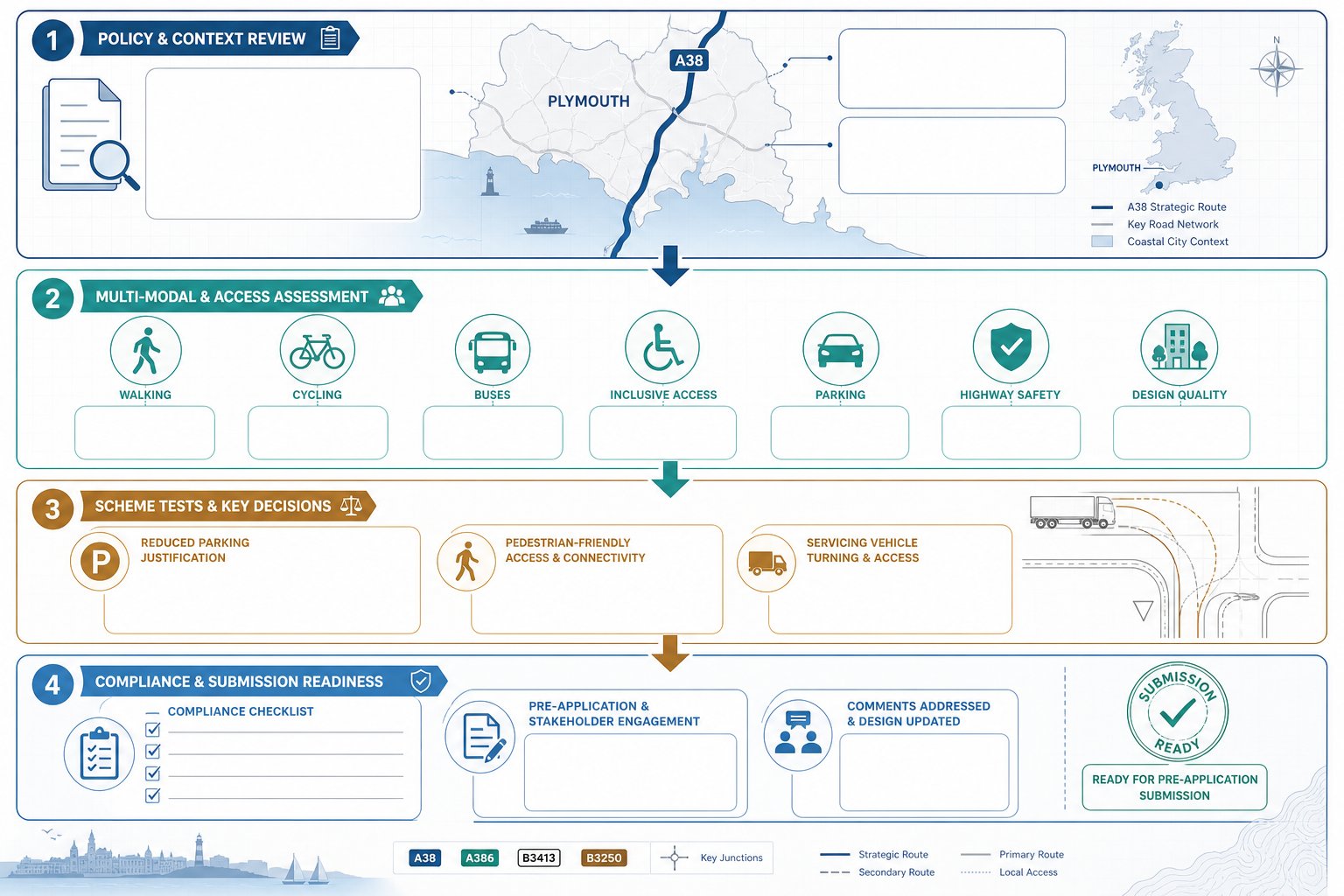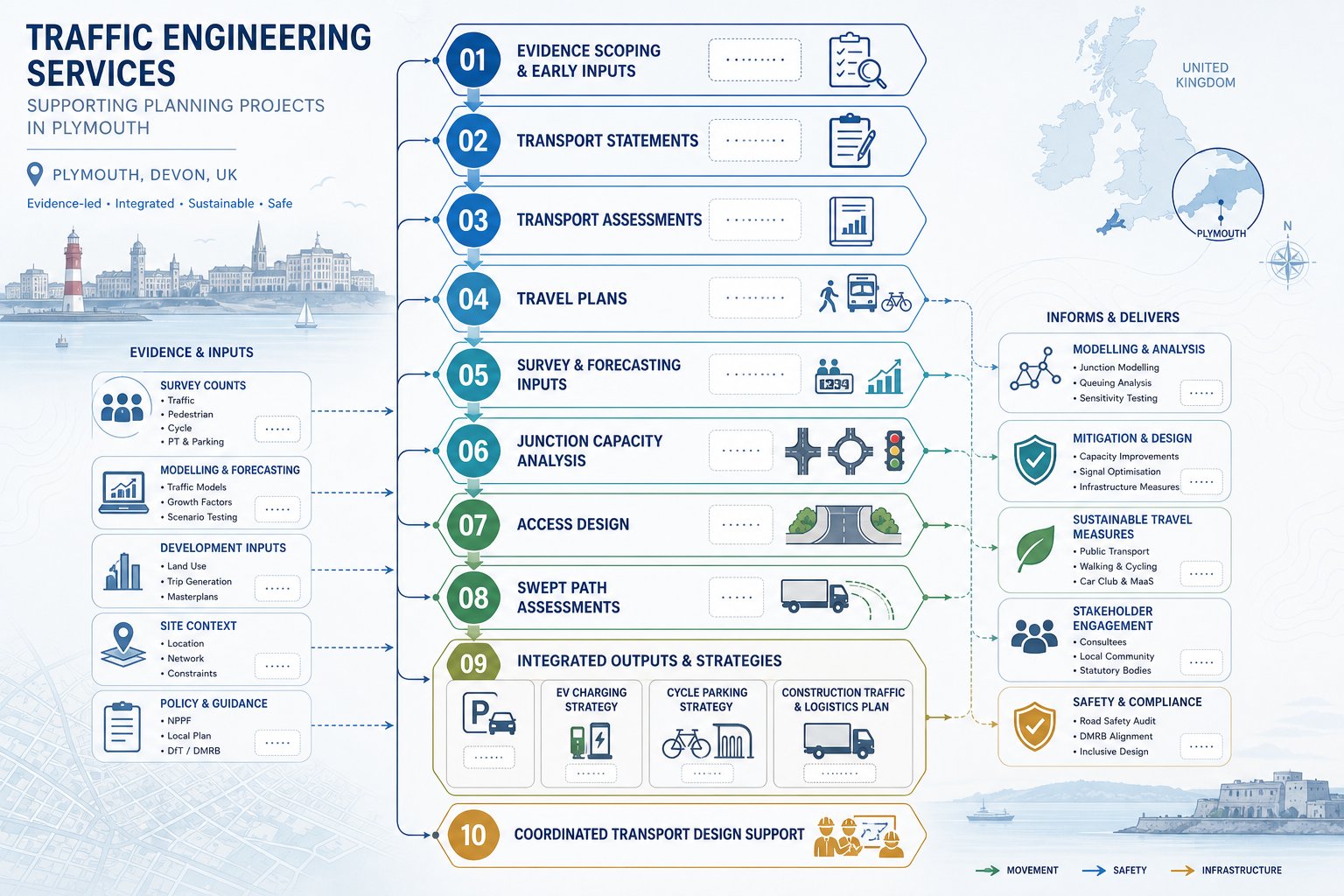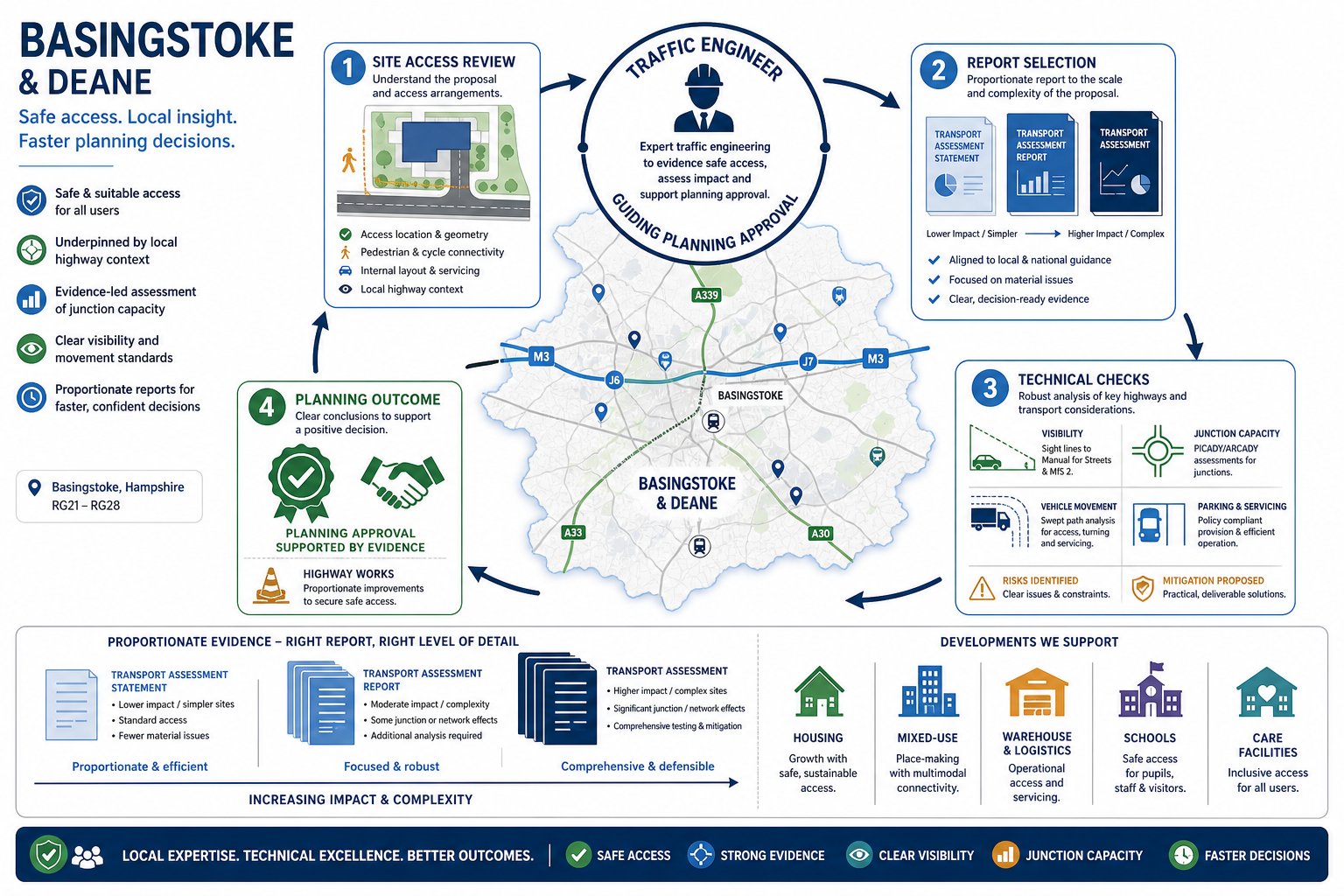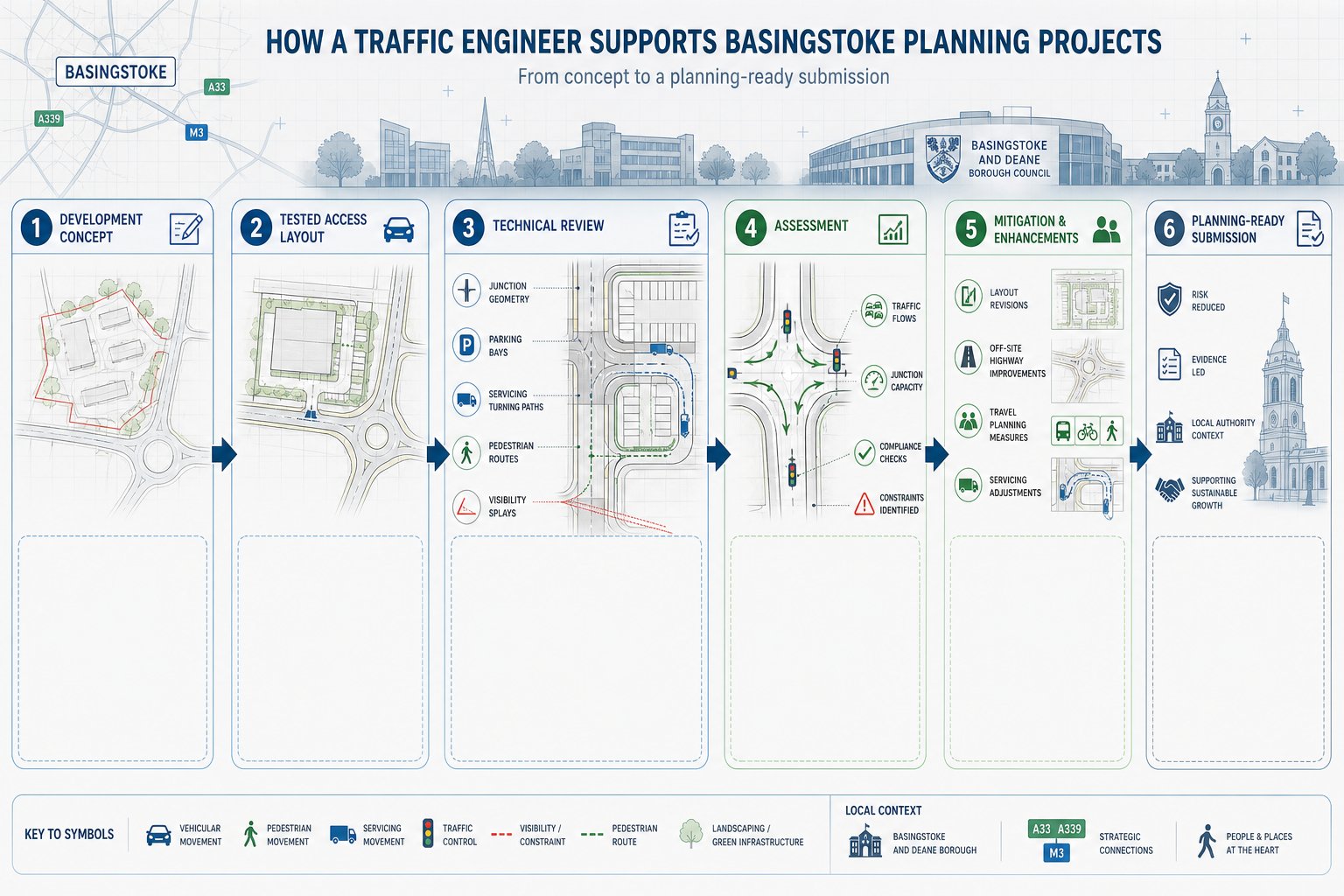
Category: High Frequency Posts

  • Transport Planning In Gloucester: A Practical Guide To Assessments, Access, And Planning Success In 2026

    Transport Planning In Gloucester: A Practical Guide To Assessments, Access, And Planning Success In 2026

    Planning applications in Gloucester rarely fail on one dramatic point. More often, they slow down because the transport case is thin, late, or out of step with what the local authority expects. A scheme can look sound in planning terms, but if access is unresolved, parking is poorly justified, or the transport evidence feels generic rather than locally grounded, the process gets harder very quickly.

    That is why transport planning in Gloucester deserves early attention. For architects, planners, lawyers, surveyors, developers, builders, and public-sector teams, the question is not simply whether a Transport Assessment is needed. It is whether the whole submission properly explains how people, deliveries, servicing vehicles, and emergency access will work on the ground, and whether that position aligns with Gloucestershire’s transport strategy.

    In Gloucester, those expectations are shaped by national planning policy, local validation requirements, and the wider Gloucestershire Local Transport Plan 2020–2041, which places real weight on mode shift, congestion management, safety, and integration with land use. That affects everything from trip generation assumptions to cycle parking, refuse tracking, visibility splays, and Travel Plan commitments.

    In this guide, we set out what transport planning in Gloucester usually involves, when formal reports are likely to be needed, where submissions commonly come unstuck, and how to give schemes a better chance of moving through planning without avoidable transport objections.

    What Transport Planning In Gloucester Covers And When It Is Needed

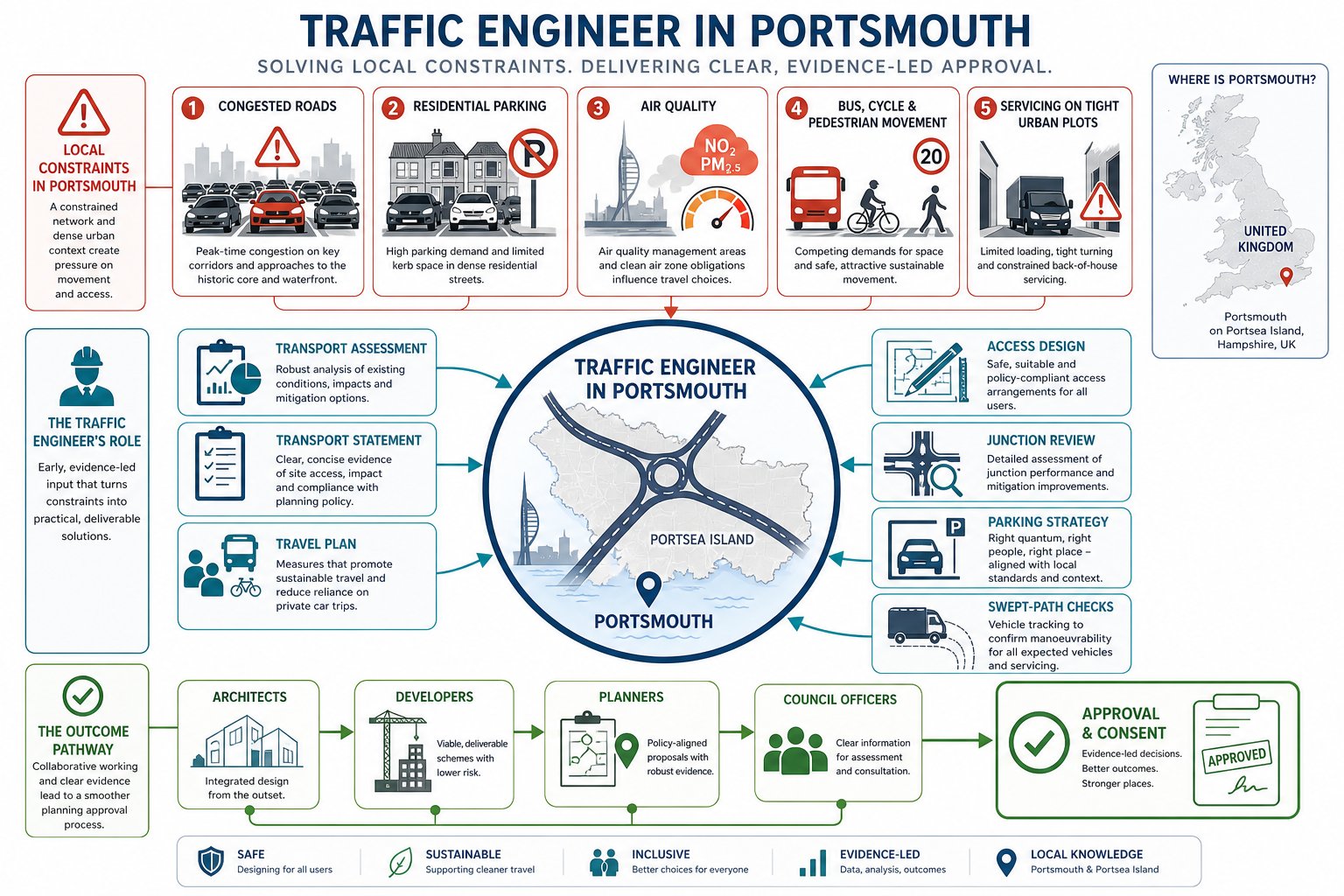
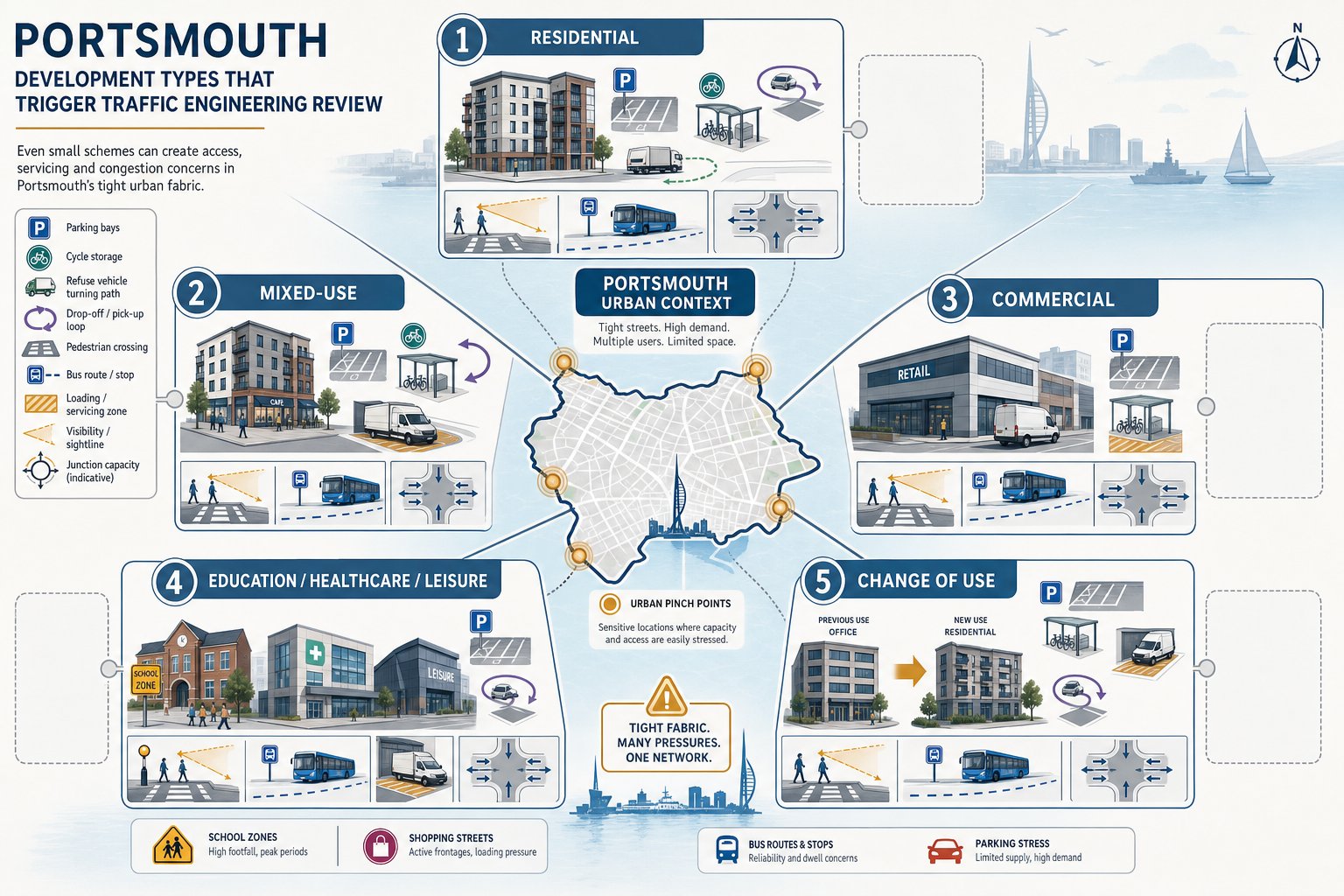
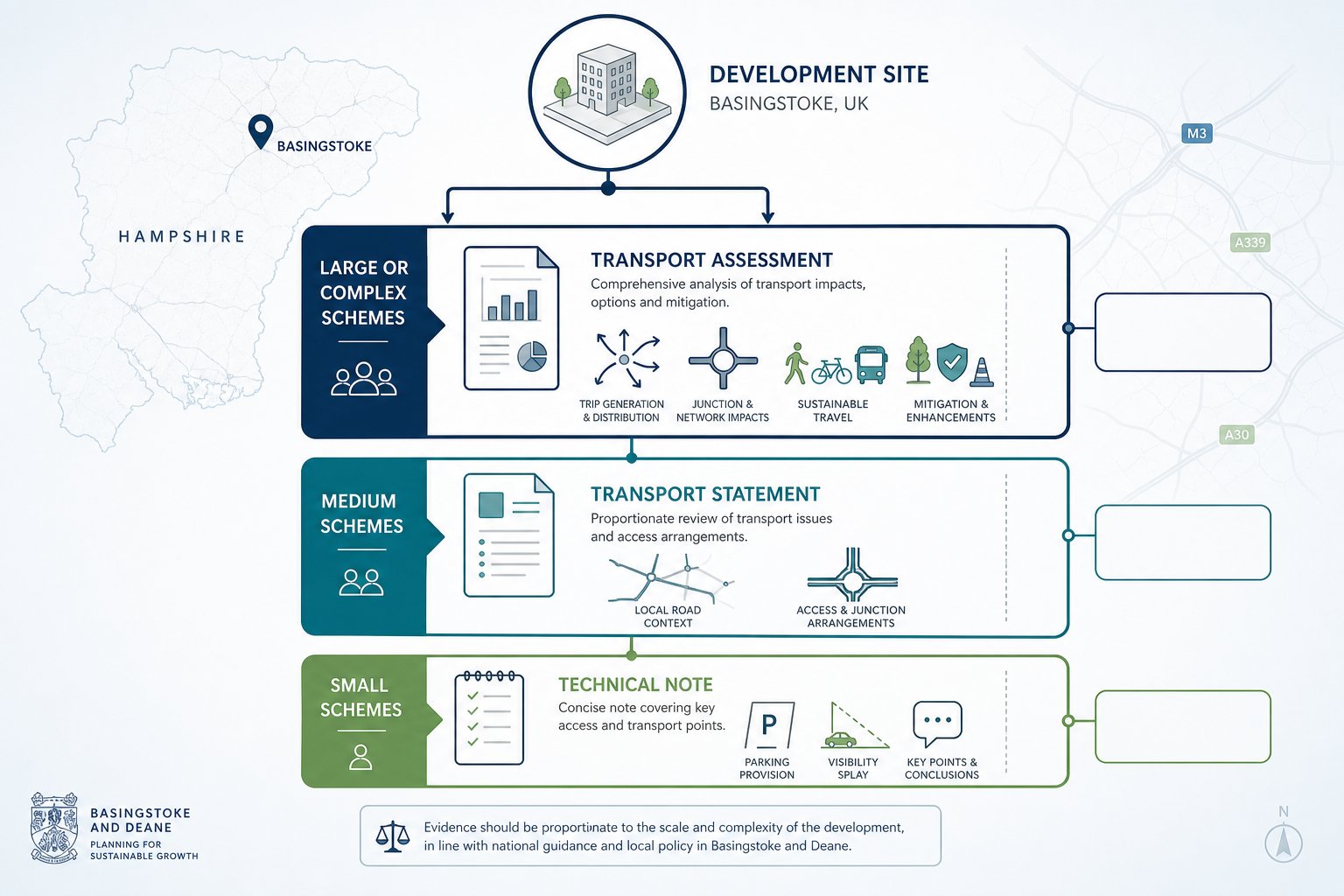
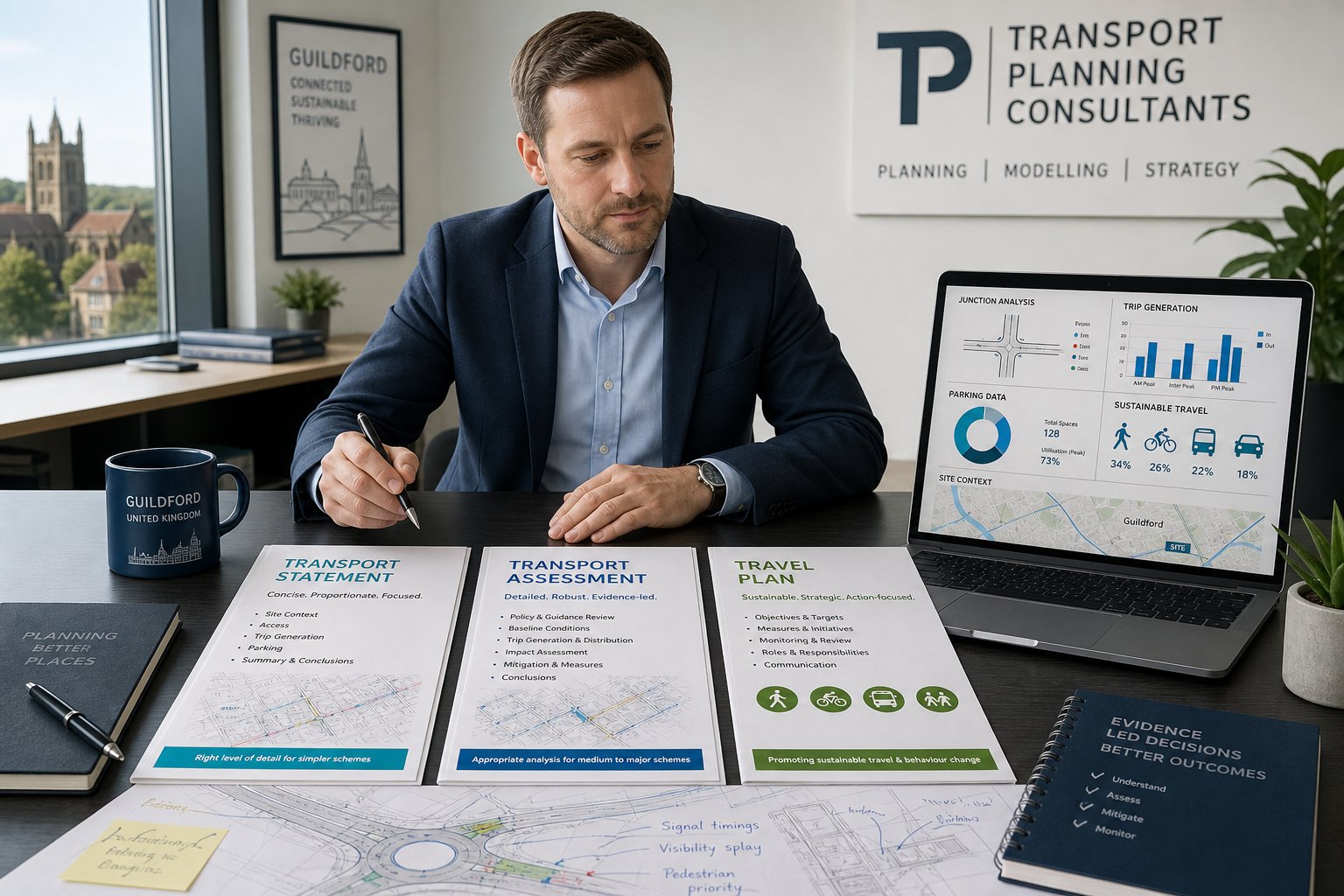
    Infographic showing when transport planning is needed for developments in Gloucester.

    Transport planning in Gloucester covers far more than predicting traffic flows. In practical planning terms, it is the evidence base that shows whether a development can be accessed safely, served efficiently, and integrated with the surrounding transport network in a proportionate way.

    That usually includes trip generation, traffic distribution, junction operation, highway safety, access design, parking provision, servicing arrangements, and opportunities for walking, cycling, bus, and rail travel. On some sites, the emphasis falls on one issue, perhaps a tight access geometry or constrained servicing yard. On others, especially larger mixed-use or residential schemes, the focus expands to cumulative traffic impact, mitigation, and longer-term Travel Plan measures.

    A transport submission is generally needed where a proposal may materially affect the highway network or local travel patterns. That tends to include major development, traffic-intensive uses, sensitive town-centre locations, schools, care uses, roadside retail, industrial schemes with frequent HGV movements, and sites with known safety or congestion issues. Smaller schemes can trigger transport work too, particularly where access visibility is poor, on-street parking pressure is already high, or policy support depends on sustainable travel credentials.

    The key point is proportionality. Not every application needs a full Transport Assessment, but most sites benefit from some transport planning input early on. In our experience, identifying likely triggers at feasibility stage is usually cheaper, and much less painful, than trying to retrofit a justification once comments come back from consultees.

    How Gloucester’s Planning Context Shapes Transport Requirements

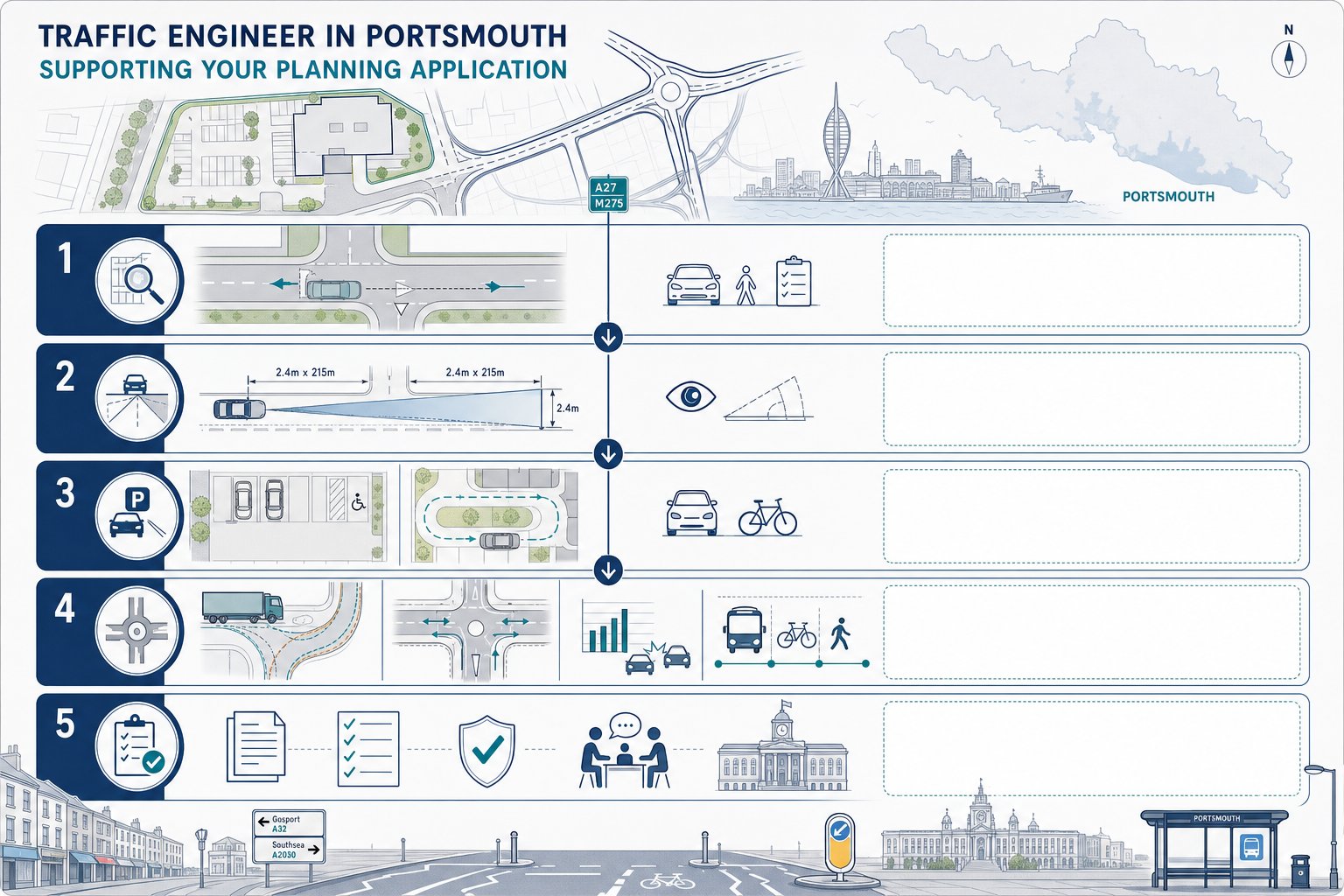
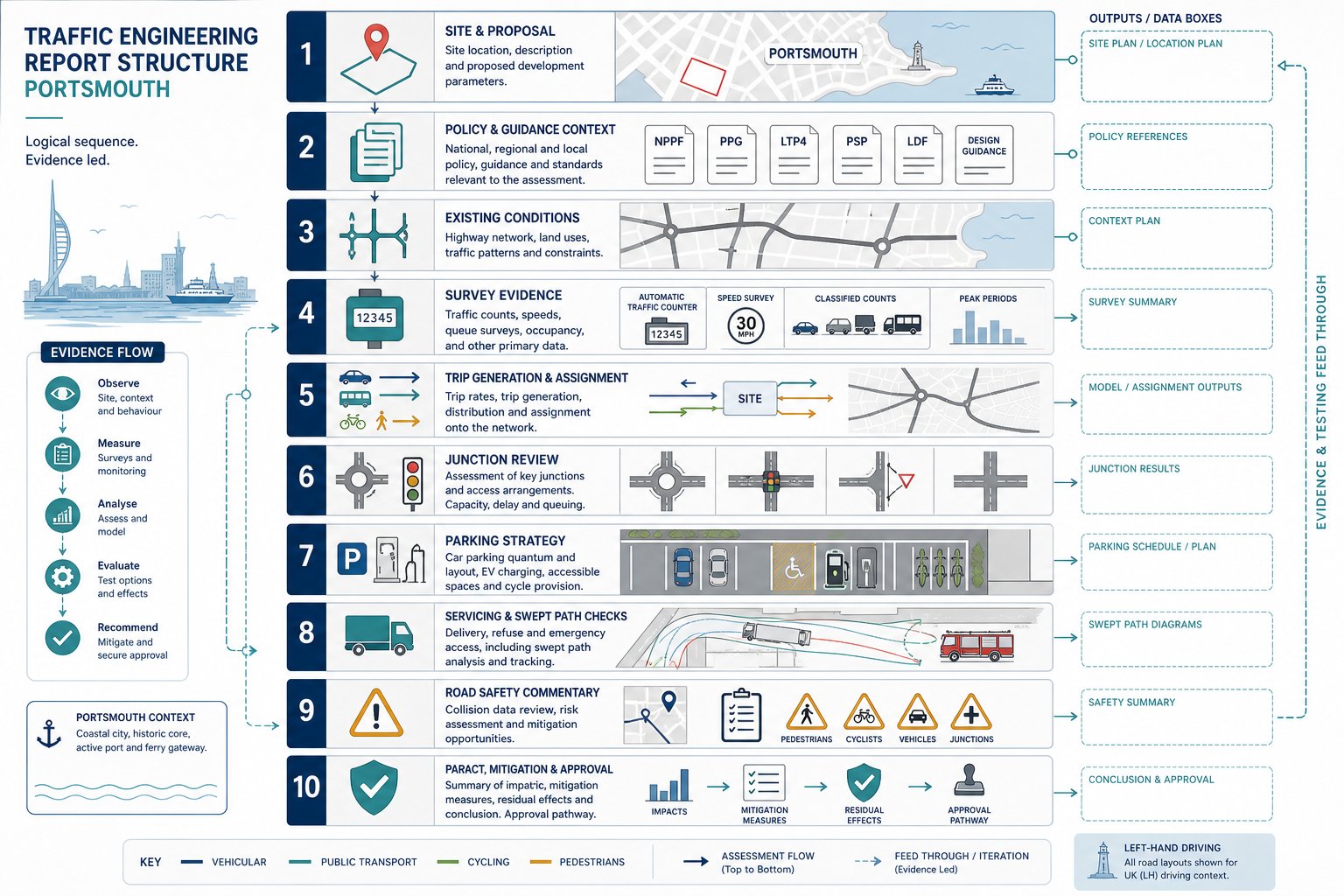
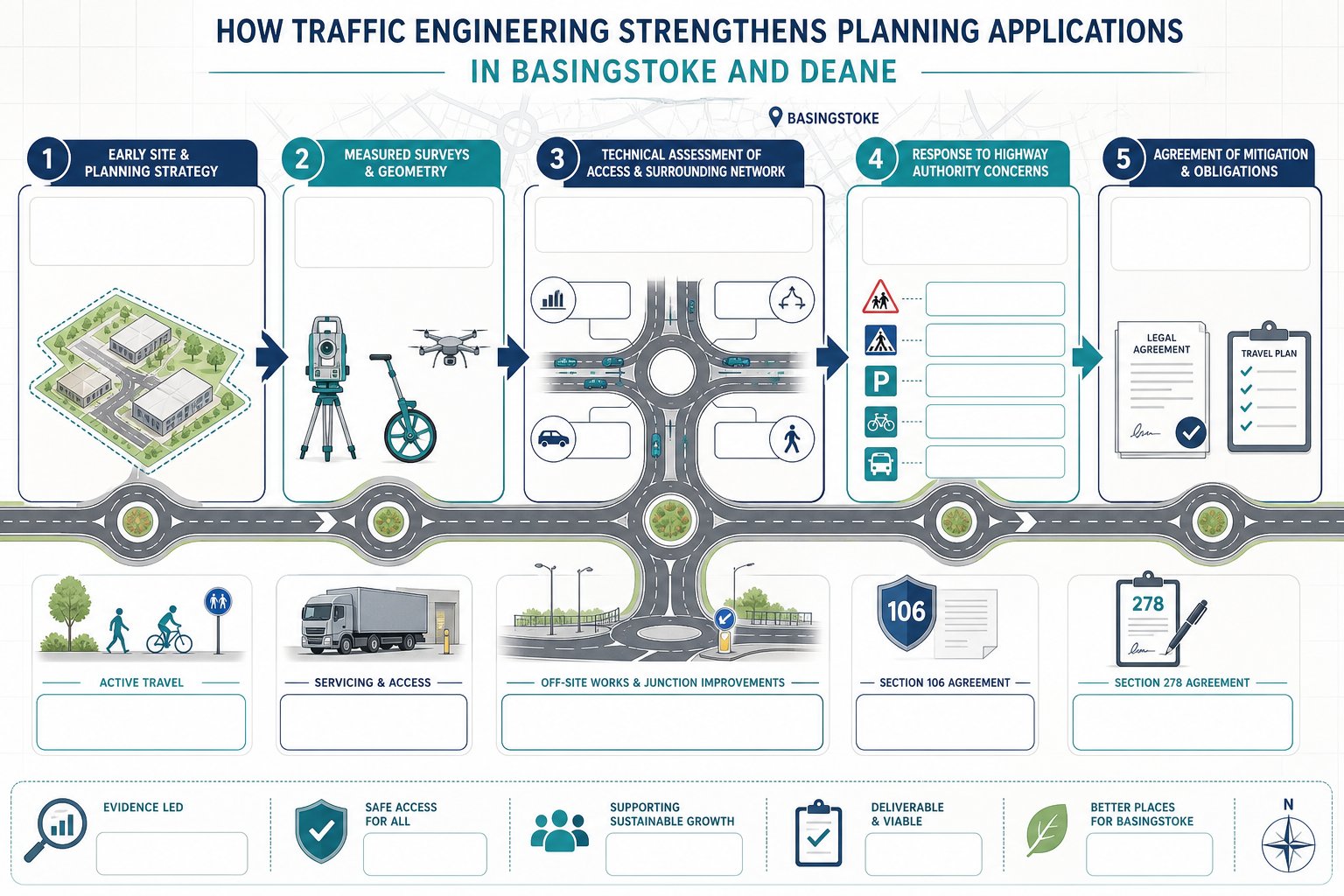
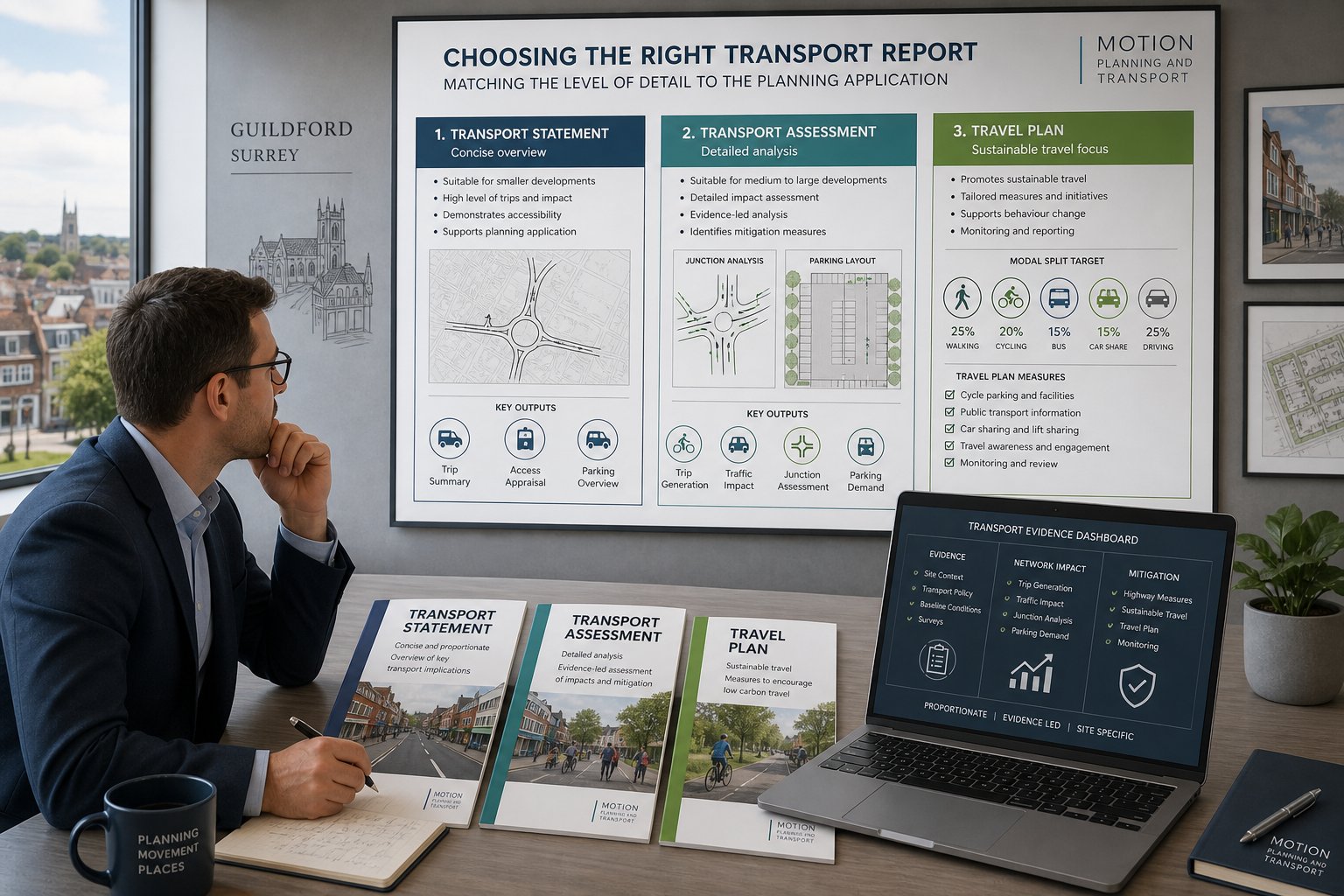
    Infographic of Gloucester transport planning shaped by policy, network pressures, and sustainable travel.

    Gloucester’s transport requirements are not created in a vacuum. They sit within the wider policy framework of the Gloucestershire Local Transport Plan (LTP) 2020–2041, alongside national planning policy and local development management practice. That matters because the LTP does not just talk in broad aspirations: it influences how transport impacts are judged at application stage.

    For Gloucester, the county’s strategy places strong emphasis on the Central Severn Vale context, where Gloucester and Cheltenham function as key economic and movement hubs. In plain English: there is pressure on the network, pressure on air quality in certain corridors, and growing expectation that new development will support mode shift rather than simply accommodate more private car trips.

    So transport planning in Gloucester often has to do two things at once. First, it must demonstrate that a proposal is technically workable in highway terms. Second, it must show that the development responds to wider policy objectives around active travel, public transport access, and network management. A technically acceptable junction can still attract challenge if the overall package ignores obvious walking or cycling links, underplays bus accessibility, or relies too heavily on car-based assumptions.

    This is particularly relevant in city-centre and edge-of-centre locations, where land-use intensity, parking expectations, and sustainable access opportunities are all scrutinised more closely. It also affects strategic sites, where the authority may expect phased mitigation, internal movement strategies, or contributions tied to wider network improvements.

    In short, local context shapes both the scope of the report and the standard of explanation needed to make it persuasive.

    Local Highway Authority Expectations And Common Validation Triggers

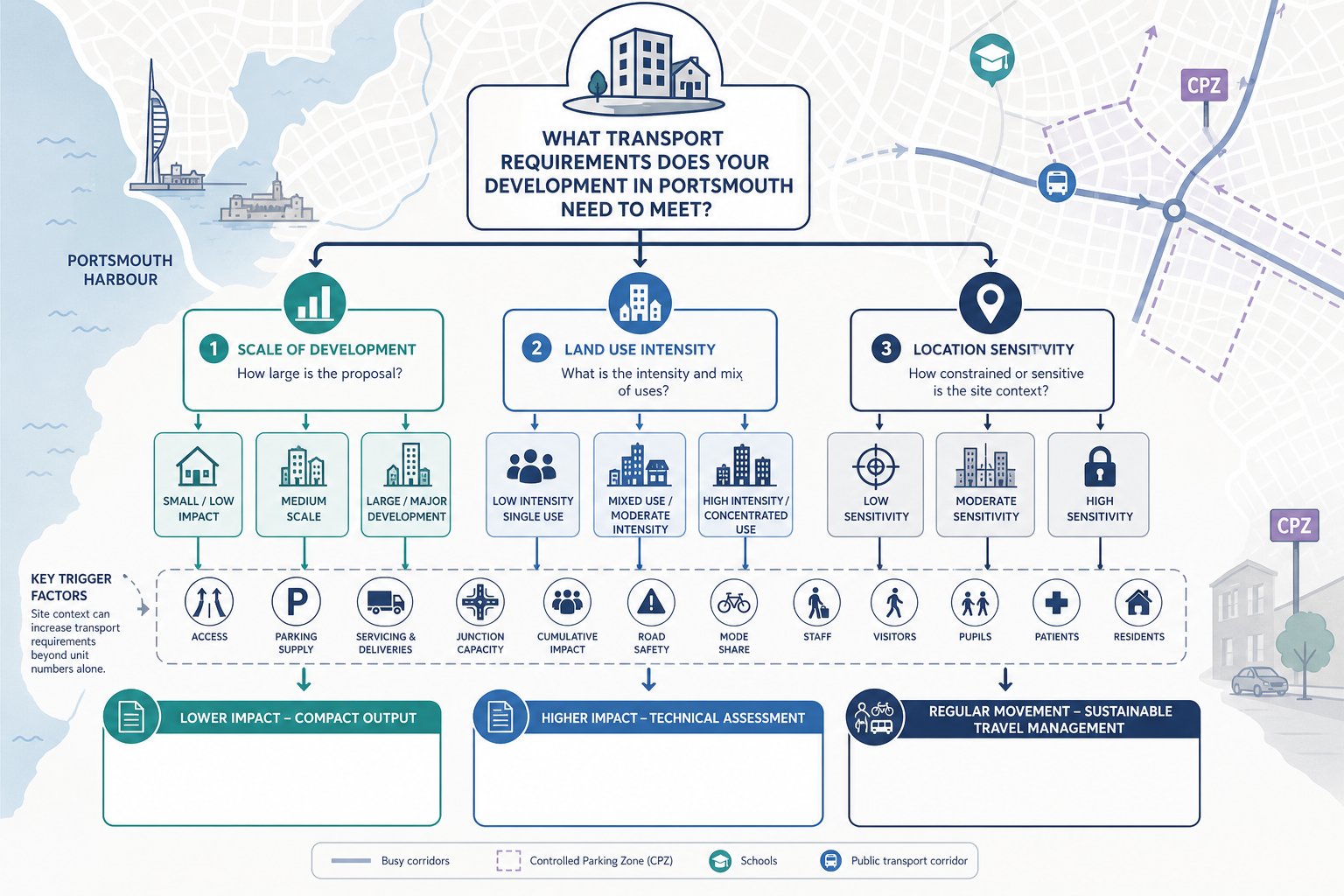
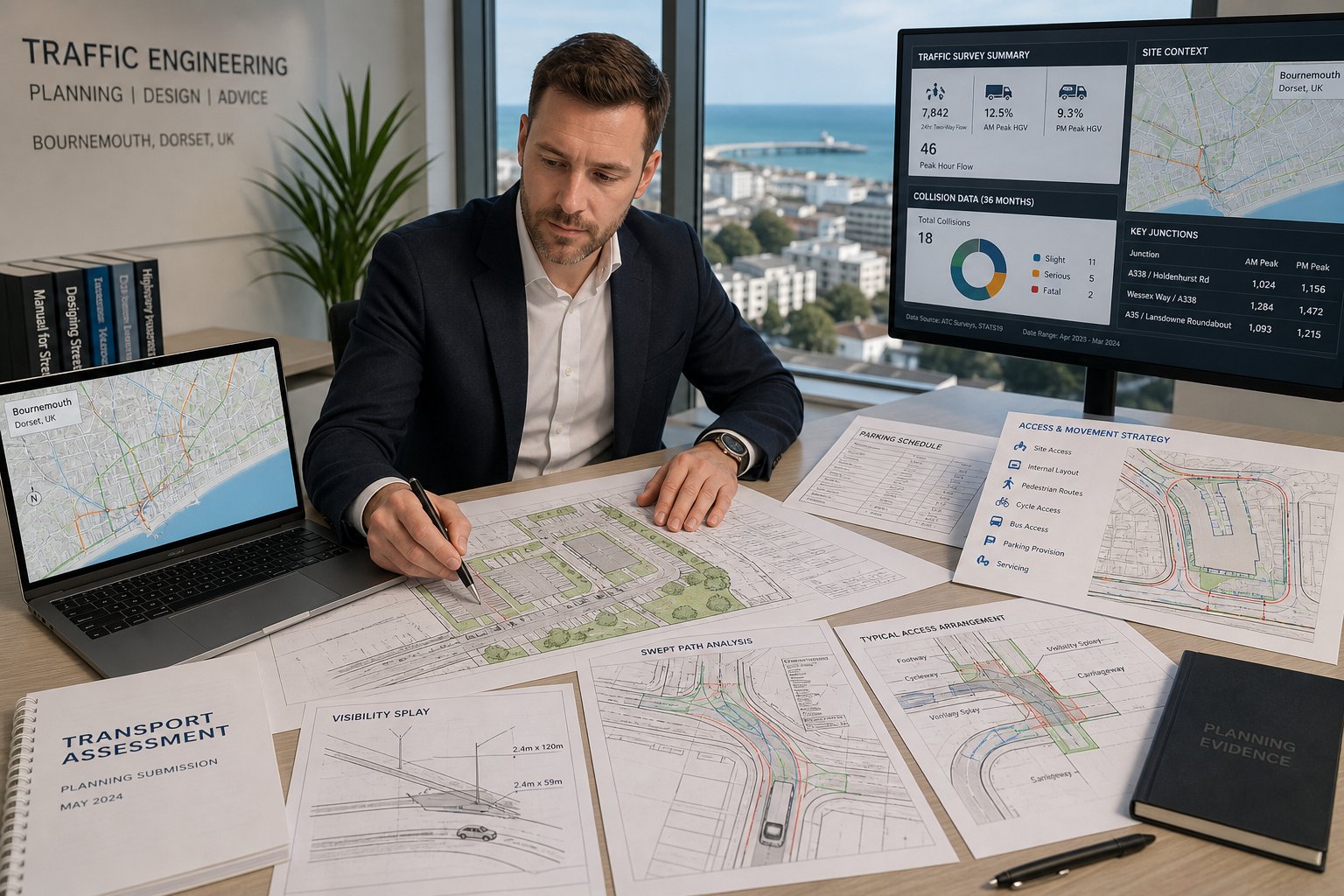
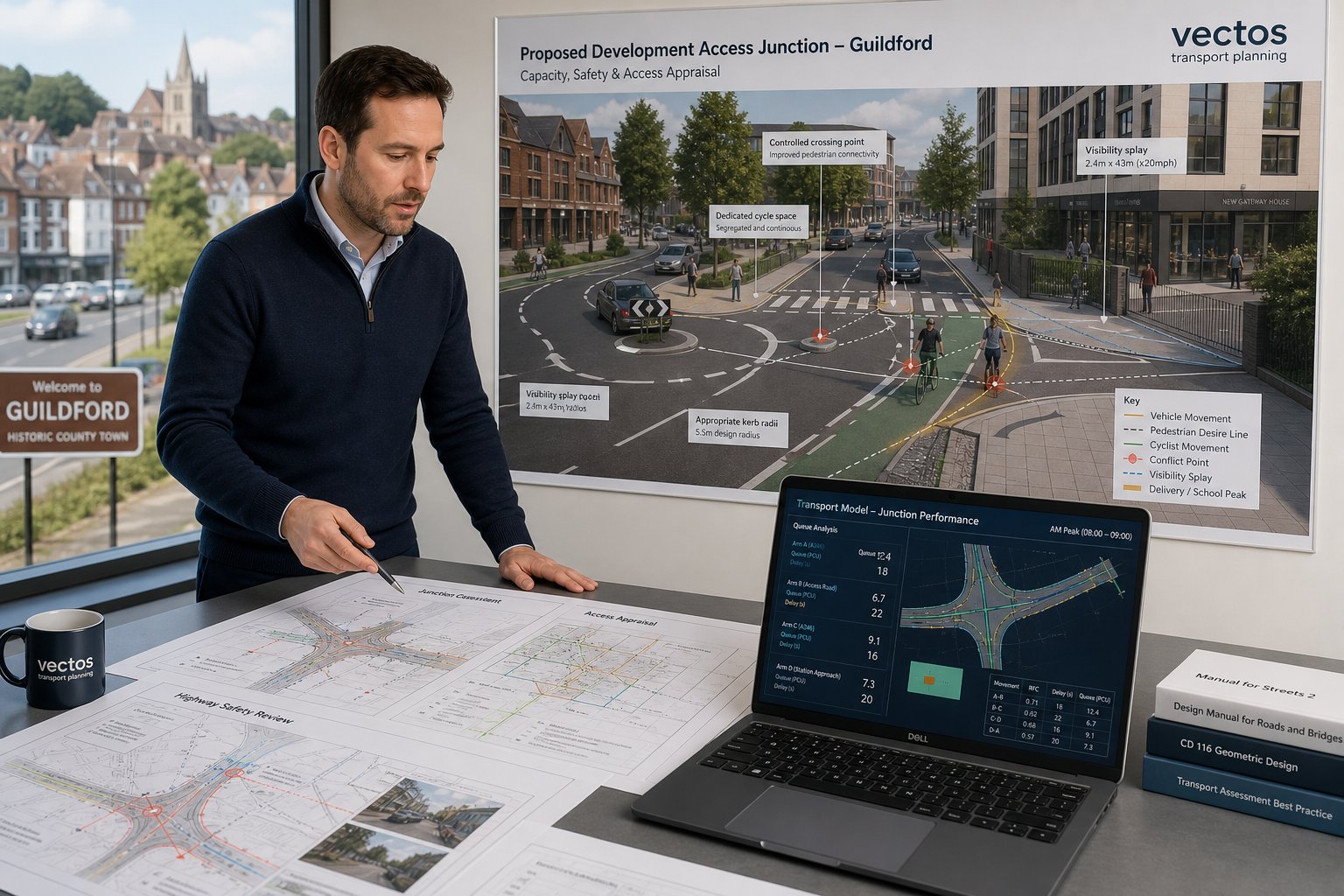
    Infographic showing Gloucester transport planning review stages and common validation triggers.

    Gloucestershire County Council, acting as local highway authority, is central to how transport evidence is framed and reviewed. While each application turns on its own merits, the authority will typically expect transport documents to be proportionate, site-specific, and clearly linked to the scale and type of development proposed.

    Common validation triggers include major development thresholds, uses likely to generate noticeable traffic, schemes on constrained frontage roads, and proposals where access, parking, servicing, or safety are already live concerns. Travel Plans are often expected for larger employment, education, healthcare, residential, and mixed-use proposals, especially where policy support depends on reducing reliance on single-occupancy car trips.

    There is also a practical point that sometimes gets overlooked: validation and acceptability are not the same thing. A report may be submitted, tick the list administratively, and still be found lacking because the analysis is too generic, the survey data is weak, or the mitigation is not clearly tied to identified impacts.

    Typical authority expectations include:

    • clear red-line and access drawings
    • robust trip-rate justification
    • realistic multi-modal accessibility review
    • parking and cycle provision evidence
    • servicing and refuse collection tracking where relevant
    • junction capacity analysis for affected nodes
    • road safety review, often including collision data
    • visibility splays and geometry to accepted standards

    Early dialogue helps. When scoping is agreed upfront, applicants are less likely to waste time producing either too little evidence or a bloated document that answers the wrong questions.

    The Main Transport Reports Used For Planning Applications

    Most Gloucester planning applications do not need every possible transport document. But they do need the right ones. Choosing the correct report set is one of the simplest ways to avoid delay, because the authority wants evidence that is proportionate, readable, and directly relevant to the planning issues in play.

    At the lighter end, a concise transport note may be enough to address access, parking, and basic trip expectations. At the heavier end, a full package may include a Transport Assessment, Travel Plan, site access appraisal, swept path analysis, capacity modelling, and a parking or servicing review.

    The balance depends on scale, use class, location, and sensitivity of the surrounding network. A modest infill residential scheme on a calm street is a different proposition from roadside retail near a busy corridor, or a logistics unit with regular articulated vehicle movements. That sounds obvious, but many weak submissions still rely on standard templates that could have been written for almost any site in the country.

    For Gloucester schemes, the strongest reports usually have three characteristics. They are proportionate. They are rooted in local conditions. And they connect transport evidence to planning strategy rather than treating it as a separate engineering appendix nobody really wants to read.

    Below are the main report types we see used most often and the role each tends to play in moving an application forward.

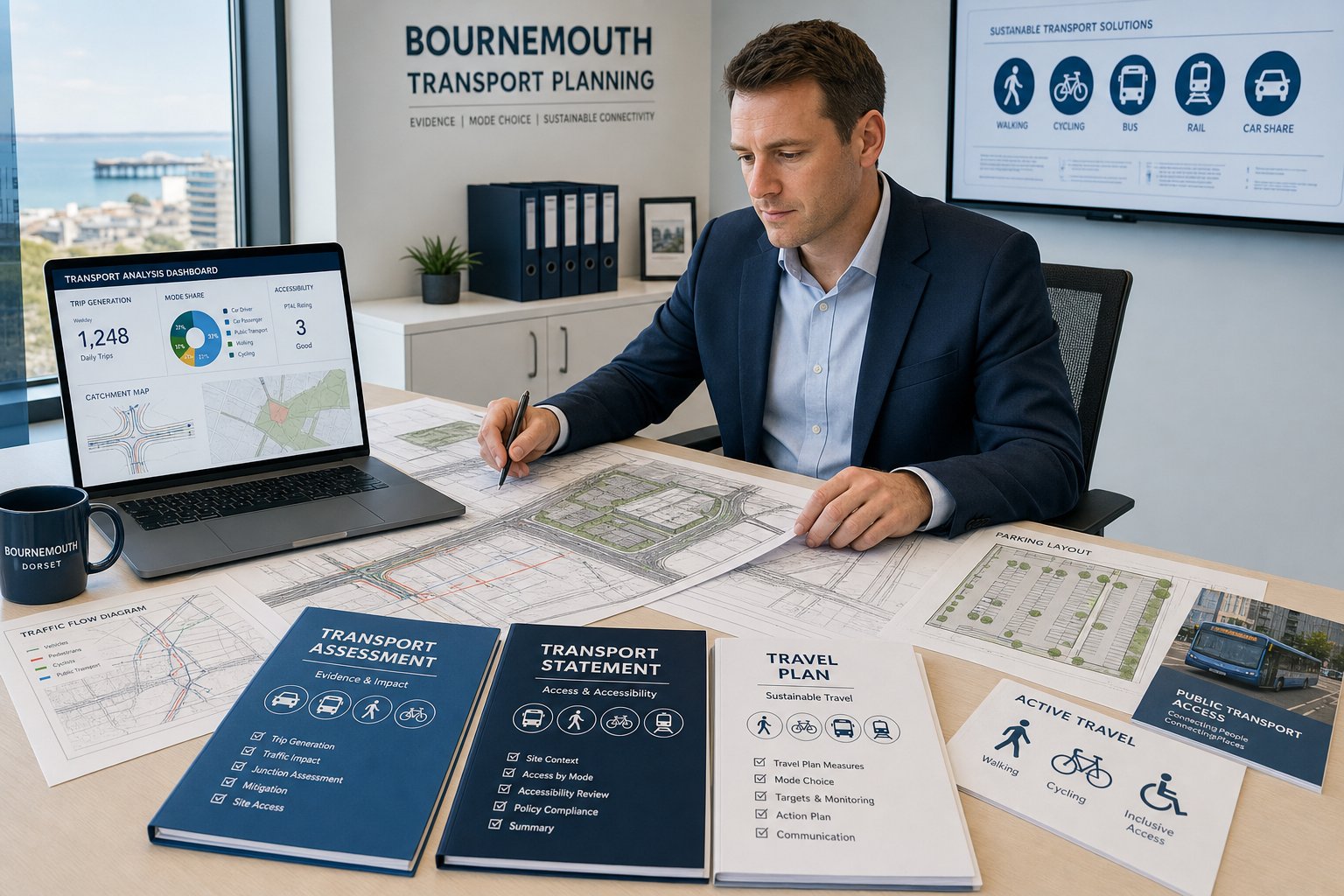
    Transport Assessments, Transport Statements, And Travel Plans

    A Transport Assessment (TA) is the most detailed of the standard planning transport reports. It is normally prepared for major or traffic-intensive proposals and examines baseline conditions, predicted trips, distribution patterns, junction effects, accessibility, and mitigation. In Gloucester, a TA often needs to show not only that the road network can accommodate development, but that the scheme has been planned in a way that supports walking, cycling, and public transport where these are realistic options.

    A Transport Statement (TS) is lighter-touch. It is suitable for smaller or less impactful schemes where a full TA would be disproportionate. That does not mean it can be vague. A good TS still needs to explain the proposal, likely movements, access arrangements, parking, servicing, and any local constraints. Think of it as concise, not casual.

    A Travel Plan is different again. Rather than focusing only on impact, it sets out how travel behaviour will be influenced over time. This can include welcome packs, cycle facilities, bus information, car-share measures, monitoring, and targets. For larger Gloucester developments, especially employment, school, healthcare, or residential-led schemes, a Travel Plan can be a significant part of the planning package.

    The mistake we sometimes see is treating the Travel Plan as an afterthought. In policy terms, it is often one of the clearest demonstrations that a scheme aligns with the LTP’s direction on mode shift. If the TA explains what the impact is, the Travel Plan helps explain how that impact will be managed.

    Site Access Appraisals, Swept Path Analysis, And Parking Reviews

    Some planning issues are not about network capacity at all. They are about whether vehicles can physically and safely get in and out of a site, whether parking is workable, and whether servicing has been designed around reality rather than hope.

    A site access appraisal typically looks at frontage conditions, visibility splays, access width, junction form, gradients, pedestrian interaction, and how the proposal fits with the surrounding highway environment. On constrained Gloucester sites, particularly conversions, infill plots, and edge-of-centre commercial premises, this can be the document that makes or breaks an application.

    Swept path analysis shows whether vehicles can manoeuvre safely within the site and at the access point. This is essential where refuse vehicles, delivery vans, emergency appliances, or articulated HGVs need to enter, turn, load, and exit. If tracking is missing for a site that clearly requires it, objections are almost inevitable.

    A parking review examines the quantum, layout, accessibility spaces, cycle provision, turning, and often the relationship with local parking stress. For city-centre Gloucester sites, under-provision may be justified if sustainable travel options are strong. Elsewhere, undercooked parking arguments can lead to concerns about overspill parking, neighbour impact, and operational conflict.

    These documents are sometimes seen as technical add-ons. In truth, they are often where the local authority tests whether a scheme has been designed properly at all.

    Key Transport Planning Considerations For Gloucester Development Sites

    Gloucester sites vary hugely. A central urban redevelopment plot, an edge-of-centre student scheme, a suburban care home, and a strategic expansion site will not be assessed in the same way, nor should they be. The transport issues change with scale, context, frontage conditions, and surrounding travel options.

    Still, a few themes recur again and again. The first is constraint. Gloucester contains historic streets, busy corridors, sensitive junctions, and areas where there is simply not much room to solve problems physically. The second is expectation. Policy increasingly pushes development to make genuine use of sustainable travel opportunities, especially where bus routes, rail access, or walkable destinations are nearby. The third is credibility. If a submission claims low car dependency in a location that plainly functions car-first, reviewers will notice.

    This means transport planning in Gloucester has to be realistic as well as policy-aware. Applicants need to understand where flexibility exists and where it doesn’t. Parking can sometimes be argued down. Vehicle tracking cannot be wished away. Cycle links can support a case strongly, but only if they are direct, safe, and useful in everyday terms.

    The sections below look at how this plays out across different Gloucester site types and the recurring issues around sustainable travel, servicing, and safety.

    City Centre, Edge-Of-Centre, And Strategic Expansion Locations

    In city-centre Gloucester, transport work often revolves around constraint, accessibility, and operational practicality. Streets may be tighter, pedestrian activity higher, and parking provision more politically and technically sensitive. The upside is that central sites can often make a stronger case on sustainable travel. If a development is within easy reach of jobs, services, bus corridors, and the rail station, lower car trip assumptions or reduced parking can be more credible, provided the evidence is honest and the Travel Plan is not tokenistic.

    Edge-of-centre sites are trickier. They can have some sustainable advantages without quite delivering the convenience of the centre. Here, transport planning needs to be nuanced. Walking routes may look short on a plan but feel poor in practice because of severance, crossing difficulty, lighting, or steep gradients. Bus accessibility may exist, but frequency and destination coverage matter. This is where a site-specific audit adds real value.

    For strategic expansion locations and larger urban extensions, the scope broadens significantly. The authority may expect phased access strategies, internal street hierarchy, public transport penetration, walking and cycling connections, and mitigation linked to nearby junctions or corridors. Cumulative impact becomes more important too, particularly where other allocations or committed developments are in play.

    Different location types demand different evidence. A one-size-fits-all transport narrative almost always feels thin, because it is.

    Sustainable Travel, Servicing, And Highway Safety Issues

    Three issues repeatedly sit at the centre of Gloucester transport reviews: sustainable travel, servicing, and highway safety.

    Sustainable travel is no longer a polite extra. Authorities increasingly expect developments to show how walking, cycling, and public transport have shaped the layout and access strategy from the outset. That includes pedestrian links, crossing points, cycle storage, connection to local routes, and realistic assessment of bus access. We say realistic because overstating weak provision is one of the quickest ways to undermine an otherwise decent report.

    Servicing is often underappreciated until late in the day. Retail, industrial, food, residential, and mixed-use schemes all need practical arrangements for deliveries, refuse, maintenance, and emergency access. Questions include: Can vehicles enter and leave in forward gear? Will servicing block parking aisles or shared surfaces? Are delivery times compatible with nearby residential uses? A neat site plan can conceal awkward operations if tracking and management assumptions are not properly tested.

    Highway safety remains fundamental. Visibility, access geometry, speed environment, collision history, pedestrian crossing risk, and internal conflict points all matter. Even where network capacity is acceptable, a scheme can face resistance if the authority is not persuaded that the access is safe for all users, including cyclists and pedestrians.

    The strongest transport planning in Gloucester brings these strands together. It shows not only that a scheme can function, but that it can function safely, efficiently, and in a way that matches policy expectations.

    The Transport Planning Process From Feasibility To Decision

    A good transport submission usually starts long before the planning application is uploaded. At feasibility stage, we need to understand the site context, development quantum, likely access points, known constraints, and whether there are obvious red flags around capacity, visibility, servicing, or parking. This early review is where proportionate strategy is set: full TA, TS, access note, Travel Plan, or a wider package.

    The next step is baseline evidence. That may include traffic surveys, queue observations, collision data, speed surveys, public transport review, walking and cycling audits, parking beat surveys, or vehicle tracking assumptions. Once the baseline is clear, trip generation and distribution can be established and the likely network effects assessed.

    From there, design and mitigation evolve together. Access geometry may change. Parking layouts may need reworking. A better pedestrian route might strengthen the overall planning case. Sometimes the transport work does not merely support the design, it materially improves it.

    Where appropriate, early scoping with Gloucestershire County Council can be invaluable. It helps confirm the likely level of assessment, modelling expectations, and whether particular junctions, standards, or Travel Plan measures are likely to be scrutinised.

    After submission, consultation comments often focus on gaps rather than headline conclusions. If those gaps are small, they can be addressed quickly. If they reveal that the scheme was never properly tested, delay becomes much more likely.

    That is why experienced, locally aware input matters. At ML Traffic, for example, the value is not just producing a report quickly: it is producing one that is calibrated to local authority thresholds and the planning context the application will actually face.

    Common Reasons Transport Evidence Delays Planning Applications

    Most transport delays are avoidable. They rarely come from the existence of a problem alone: they come from discovering the problem too late, explaining it poorly, or submitting evidence that does not match the site.

    One common issue is the wrong report type. A short note is submitted where a Transport Statement was plainly needed, or a TS is prepared for a scheme whose scale and sensitivity really justify a full TA. The authority then asks for more work, and the timetable slips.

    Another frequent problem is weak baseline data. Out-of-date traffic counts, generic trip rates without proper justification, missing collision analysis, or vague accessibility commentary all make it harder for reviewers to trust the conclusions.

    We also see delays caused by underdeveloped access design. Visibility splays are shown but not achievable. Swept path drawings are absent. Parking layouts ignore turning needs or fail to account for cycle storage and servicing. On paper, everything fits. On site, it probably doesn’t.

    Then there is policy misalignment. If a Gloucester scheme says sustainable travel opportunities are limited when nearby bus routes, footways, or cycle links suggest otherwise, that invites challenge. Equally, claiming strong mode shift potential without credible supporting measures does the same.

    Finally, late coordination between planning, architecture, highways, and legal teams can be surprisingly costly. A red-line change, new unit mix, or altered servicing arrangement can quietly invalidate earlier transport work. And suddenly a nearly-ready application is back in draft.

    How To Prepare A Stronger Submission For Gloucester Schemes

    The strongest Gloucester submissions are usually the ones that feel joined up. Not over-engineered, not padded with unnecessary appendices, just coherent, proportionate, and clearly rooted in the site.

    First, start early. Even a brief feasibility review can flag whether the real risk sits with access, parking, junction impact, or policy positioning. That gives the wider consultant team a fair chance to respond before layouts harden.

    Second, scope the work properly. Where possible, engage early with Gloucestershire County Council so the expected level of assessment is understood. This can save a surprising amount of time and expense, particularly on schemes that sit near the boundary between a TS and a TA.

    Third, build the transport case around local reality. That means using site-specific access analysis, credible trip-rate selection, honest commentary on walk and cycle routes, and practical servicing assumptions. If a route is unattractive or discontinuous, say so, then explain the consequence. Candour tends to land better than spin.

    Fourth, align with the Gloucestershire LTP 2020–2041. Show how the proposal supports mode shift, network management, and safe multi-modal access where relevant. For many applications, this policy alignment is what turns a technically adequate report into a persuasive one.

    Finally, make the package easy to review. Clear plans, concise reasoning, consistent numbers, and properly labelled appendices go a long way. Planning officers and highway reviewers should not have to hunt for the answer to basic operational questions.

    In our experience, that combination, early strategy, proportionate evidence, and local policy awareness, gives Gloucester schemes the best chance of a smoother planning journey.

    Conclusion

    Transport planning in Gloucester is rarely just a box-ticking exercise. It sits at the intersection of design, policy, movement, safety, and deliverability. When it is handled early and proportionately, it can sharpen a scheme, reduce risk, and make planning conversations more straightforward. When it is left late, it tends to expose weaknesses nobody enjoys unpicking under deadline.

    For teams preparing applications in 2026, the main lesson is simple: match the evidence to the site, the scale, and the local context. Gloucester’s transport expectations are shaped by the county’s wider strategy, and successful submissions usually reflect that from the start.

    Whether the issue is a full Transport Assessment, a concise Transport Statement, a Travel Plan, access tracking, or parking justification, quality matters more than volume. A clear, locally informed report will usually outperform a generic one twice the length.

    And that is really the heart of planning success here, not more paperwork, but better judgement, earlier in the process.

    Transport Planning in Gloucester: Frequently Asked Questions

    What does transport planning in Gloucester typically involve?

    Transport planning in Gloucester covers trip generation, traffic distribution, junction operation, highway safety, access design, parking, servicing, and promoting walking, cycling, and public transport, ensuring developments can be accessed safely and efficiently while supporting local transport goals.

    When is a Transport Assessment required for a planning application in Gloucester?

    A Transport Assessment is generally required for major or traffic-intensive developments that may significantly affect the highway network or local travel patterns, such as large residential, commercial, or mixed-use schemes, in line with Gloucestershire’s transport policy.

    How does the Gloucestershire Local Transport Plan influence transport planning in Gloucester?

    The Local Transport Plan 2020–2041 guides transport planning by emphasizing mode shift from private cars, congestion management, safety, and integration with land use, shaping requirements for sustainable travel, access design, and mitigation measures in planning applications.

    What are common reasons transport evidence causes delays in Gloucester planning applications?

    Delays often occur due to submitting incorrect report types, weak or out-of-date baseline data, inadequate access or parking design, non-compliance with local policies, and late coordination between project teams, all of which affect credibility and review efficiency.

    How can developers improve the chances of successful transport planning submissions in Gloucester?

    Developers should engage early with Gloucestershire County Council for scoping, provide proportionate and locally relevant transport evidence, align proposals with Local Transport Plan policies on sustainable travel and network management, and ensure clear, concise, and coordinated transport reports.

    What role do Travel Plans play in Gloucester’s transport planning process?

    Travel Plans outline how a development will manage and reduce car use over time through measures like cycle facilities, bus information, and car-sharing, demonstrating alignment with mode shift objectives and forming a key part of the planning package for larger developments.

  • Transport Planning In Winchester: A Practical Guide To Assessments, Policy, And Planning Success In 2026

    Transport Planning In Winchester: A Practical Guide To Assessments, Policy, And Planning Success In 2026

    Winchester is one of those places where transport planning looks straightforward on a location plan and decidedly less simple once you get into the detail. A site may sit close to the city centre, a rail station or a strategic route, yet the real planning questions quickly become more nuanced: can people reach it safely on foot, how will vehicles turn and service it, what happens at nearby junctions in the peak, and does the evidence actually match what Hampshire County Council and Winchester City Council expect to see?

    That matters because transport planning in Winchester rarely gets judged on traffic numbers alone. Historic streets, conservation sensitivities, strong walking activity, commuter flows, tourism and growth pressures all shape the way applications are reviewed. A weak scope, an undercooked Transport Statement or a generic Travel Plan can slow validation, trigger rounds of technical queries, or in some cases undermine an otherwise sound proposal.

    In this guide, we set out the practical side of Transport Planning in Winchester for architects, planners, developers, surveyors, lawyers and councils preparing planning submissions in 2026. We focus on when a Transport Assessment or Transport Statement is needed, what local policy and validation requirements mean in practice, the technical issues authorities usually scrutinise, and the common mistakes that cause delay. Where relevant, we also reflect the value of concise, authority-specific reporting – the kind of approach we prioritise at ML Traffic when supporting planning teams across Hampshire.

    Why Transport Planning Matters For Development In Winchester

    Infographic showing how transport planning shapes development decisions in Winchester.

    Transport planning is often treated as a supporting discipline, something to be commissioned once the layout is nearly fixed. In Winchester, that approach can be expensive. Access constraints, parking expectations, servicing needs and sustainable travel requirements can shape the developable area, the form of frontage, and even the overall scale of a scheme.

    At planning stage, good transport evidence does three jobs at once. First, it shows that a development can be accessed safely and suitably by all users, not just drivers. Second, it helps decision-makers understand whether the proposal would place unacceptable pressure on the local or wider highway network. Third, it demonstrates alignment with broader policy aims around carbon reduction, air quality, place-making and healthier travel choices.

    That last point is increasingly important. Under the National Planning Policy Framework (NPPF), development should promote sustainable transport modes, provide safe and suitable access, and only be refused on transport grounds where the residual cumulative impacts are severe. In practice, the word severe gets a lot of attention, but so does the quality of the evidence used to reach that conclusion.

    For Winchester schemes, transport planning also helps reconcile competing objectives: growth versus heritage, movement versus public realm, parking demand versus townscape, and operational efficiency versus pedestrian comfort. When done well, it is not just a defensive report. It is a design and planning tool that can materially improve the prospects of consent.

    The Winchester Context: Historic Streets, Growth Pressures, And Travel Demand

    Infographic of Winchester transport pressures, historic streets, growth corridors, and travel demand.

    Winchester has a transport character all of its own. It is a compact historic city with narrow streets, sensitive frontages, constrained junctions and strong pedestrian activity, especially in and around the centre. Those qualities make it attractive, but they also limit how easily the network can absorb change.

    Many sites are affected by conditions that do not show up neatly in a desktop review. A right turn may be technically possible but operationally poor. A servicing manoeuvre may fit on a swept path drawing yet feel wholly out of place in a tight heritage street. A short walking route to the station may involve gradients, narrow footways or awkward crossings that matter greatly in accessibility terms.

    On top of that, Winchester experiences persistent growth pressures. Strategic development in and around the district, including large housing allocations and employment growth, adds demand to key corridors and junctions. The city also functions as a commuter destination and interchange point, with the rail station, bus services and park-and-ride sites playing an important role in daily travel patterns.

    Tourism adds another layer. Peak conditions are not driven solely by weekday commuters: retail, leisure and visitor activity can alter parking demand, walking movements and town-centre servicing needs. For transport planning in Winchester, that means context is not a box-ticking exercise. We need to understand how the site sits within a living network that is constrained, busy and highly sensitive to poor design assumptions.

    When A Transport Assessment Or Transport Statement Is Needed

    Decision tree showing when transport assessment or statement is needed in Winchester.

    Whether a planning application needs a Transport Assessment (TA) or Transport Statement (TS) depends on scale, land use, likely impact and local validation expectations. There is no single national threshold that works in every case, which is why early scoping with the highway authority is so valuable.

    The starting point is national policy and the Department for Transport’s guidance on transport assessment. Broadly, a Transport Assessment is expected for larger or impact-intensive developments – major housing, schools, sizeable retail, business or mixed-use schemes, and proposals likely to affect busy junctions or sensitive corridors. A Transport Statement is usually appropriate for smaller developments with more limited transport implications, where a proportionate narrative and targeted analysis can properly address the likely effects.

    But proportionate does not mean superficial. In Winchester, relatively modest schemes can still require careful evidence if they sit in constrained locations, involve a new access onto a busy route, alter servicing in the city centre, or raise local parking stress. Conversely, not every small scheme needs extensive modelling.

    As a rule, we advise teams to confirm scope at pre-application stage with Hampshire County Council as local highway authority, particularly where there is any doubt over study area, survey requirements or whether junction modelling is likely to be expected. That early agreement can save weeks later. It also reduces the risk of preparing the wrong document – one of the most avoidable reasons applications run into delay.

    How Local Validation Requirements And Planning Policy Shape Evidence

    In Winchester, the technical report is only part of the picture. The application also has to satisfy local validation requirements and respond credibly to the policy framework that officers and consultees will use in assessing it.

    Winchester City Council’s local validation checklist is central here. It can determine whether a TA, TS, Travel Plan, access information, parking details or other supporting material is required before the application is even validated. If those documents are missing, too generic, or inconsistent with the submitted drawings, the process can stall before the merits are fully considered.

    Policy then shapes content. At national level, the NPPF remains the key reference point on sustainable transport, safe access and severe impacts. Locally, the development plan, emerging plan context where relevant, parking standards, climate-related policies and accessibility expectations all influence the evidence base. Hampshire County Council’s design guidance, highway advice and approach to standards also carry weight, especially on access geometry, visibility, parking layout, turning, and the realism of active travel measures.

    This is where local tailoring matters. A report that might pass muster elsewhere can struggle in Winchester if it ignores heritage constraints, assumes over-optimistic mode share shifts, or sidesteps local parking and servicing concerns. We find the strongest submissions are usually the clearest ones: concise, policy-aware, and explicit about how the evidence has been scoped to local authority expectations rather than copied from a previous project.

    Key Transport Planning Documents Used In Winchester Applications

    Most Winchester planning applications with transport implications revolve around three core documents. They overlap, but each serves a distinct purpose. Understanding the difference helps project teams commission the right evidence at the right time.

    Transport Assessment

    A Transport Assessment is the more comprehensive document. It sets out baseline conditions, describes the site and surrounding transport context, estimates trip generation, considers trip distribution and assignment, reviews access arrangements, and assesses likely effects on junctions, links and sustainable modes. Where impacts are identified, it also explains mitigation and residual effects.

    For Winchester schemes, a good TA is rarely just a stack of appendices. It needs to tell a coherent story: why the assumptions are appropriate, why the study area is proportionate, and why the mitigation would work in a constrained local environment. If modelling is included, the narrative should still be readable by planning officers and committee members, not only technical reviewers.

    Transport Statement

    A Transport Statement is lighter-touch, but it should still be evidence-led. It normally describes existing conditions, access arrangements, forecast trips, parking provision, servicing and any focused mitigation, without the full breadth of analysis expected in a TA.

    The trap with a TS is underestimating what proportionate means. A short report can be perfectly acceptable if the proposal is genuinely low impact. It becomes a problem when a TS is used to avoid addressing issues that are obviously material – nearby congestion, constrained access, or pressure on parking and loading, for example.

    Travel Plan

    A Travel Plan sets out measures to encourage sustainable travel by residents, staff, visitors or pupils, depending on the land use. It may include welcome packs, cycle facilities, public transport information, car club measures, appointment of a Travel Plan coordinator, monitoring arrangements, and target mode shares.

    In Winchester, Travel Plans are often secured by condition or legal agreement. That means they need to be practical and enforceable. Generic promises about encouraging cycling are not enough. Authorities will usually want to see specific measures, monitoring periods, targets and triggers for review. The best Travel Plans reflect the realities of the site rather than recycling standard wording.

    The Core Technical Issues Reviewed By Planning And Highway Authorities

    When officers and highway engineers review a transport submission, they are typically testing a fairly consistent set of questions – though the emphasis varies by site.

    First comes policy compliance. Does the proposal align with the NPPF, local plan policies, parking standards and relevant design guidance? If a scheme departs from standards, is there a robust place-based justification?

    Second is safe and suitable access. Can vehicles enter and leave without creating undue risk? Are pedestrians, cyclists and disabled users properly accounted for? Is visibility adequate? Can service, refuse and emergency vehicles manoeuvre acceptably? If adoption is proposed, are the design details compatible with likely highway authority expectations?

    Third is network effect. The authority will consider whether the development’s transport impacts, alone and cumulatively, would materially worsen operation at nearby junctions, links or sensitive locations. This is not simply about daily traffic totals. Peak-hour concentration, turning patterns and interaction with existing stress points often matter more.

    Fourth is sustainable travel realism. Are walking, cycling and public transport opportunities genuinely available and attractive, or merely asserted? Are routes safe, direct and inclusive? Is the Travel Plan meaningful?

    And finally, there is deliverability. Proposed mitigation has to be technically feasible, fundable and capable of implementation. A report may identify a crossing, parking restraint or access amendment in principle, but if land control, geometry or third-party approvals are doubtful, officers will notice. In short, the review is as much about credibility as technical competence.

    Access, Parking, And Servicing Considerations For Different Site Types

    Different land uses trigger different transport concerns, and Winchester’s constraints tend to sharpen them.

    For residential development, authorities will usually examine vehicular access geometry, pedestrian links, internal layout, turning for refuse and emergency vehicles, parking provision, cycle storage and EV charging. Overspill parking can be especially sensitive near existing residential streets or close to the centre, where on-street capacity may already be under pressure.

    For retail and leisure uses, the practicalities of customer arrival, short-stay parking, servicing and peak-time activity are often central. A unit that appears modest in floorspace can still generate concentrated parking turnover or awkward delivery activity. In historic or central locations, the question is often less “can vehicles get in” and more “can they do so without undermining pedestrian priority or townscape quality?”

    For employment uses, trip profiles may vary by shift pattern, visitor activity and freight demand. Staff parking, disabled spaces, cycle provision, HGV routing and servicing hours can all be material. Warehouse and industrial proposals, in particular, need a realistic view of swept paths, waiting space and conflicts between heavy vehicles and more vulnerable users.

    And for town-centre or heritage sites, subtlety matters. Loading may need to be timed rather than expanded. Parking restraint may be acceptable if accessibility is strong. In these locations, a compact, well-argued strategy often performs better than a standards-led one that ignores the setting. Transport planning in Winchester is rarely one-size-fits-all: site type and urban context have to be read together.

    Sustainable Travel Expectations: Walking, Cycling, Public Transport, And Accessibility

    Sustainable travel is not an optional extra in modern planning submissions. In Winchester, it is usually a central part of the case for development, especially where highway capacity is constrained and local policy places weight on healthier, lower-carbon travel.

    For walking, authorities generally want to see continuous and direct routes to local services, schools, bus stops and other everyday destinations. That includes crossing opportunities, footway widths, surface quality, gradients and legibility. A route may be short on paper but poor in reality if it involves narrow pinch points, severance or awkward crossings.

    For cycling, secure and convenient parking is the baseline, not the whole answer. Reviewers also look at whether the site connects sensibly to local routes and whether junctions or access points create unnecessary conflict. In some cases, calmer street environments or targeted link improvements are more useful than ambitious but unrealistic cycling claims.

    For public transport, proximity matters, but so does quality. Walking routes to stops or stations need to be safe and attractive, services need to be reasonably useful for the development type, and any proposed contributions should be justified and specific.

    Then there is accessibility in the wider sense. Inclusive design should run through the whole submission: step-free routes where possible, usable gradients, dropped kerbs, crossing design, disabled parking, and layouts that work for wheelchair users, pushchairs and visually impaired people. If sustainable travel measures are not inclusive, they are not genuinely sustainable. That is a point authorities increasingly make, and rightly so.

    Junction Capacity, Safety, And Network Impact: What Supporting Analysis May Be Required

    Not every application in Winchester needs detailed modelling, but many schemes do require some form of analytical support beyond a descriptive statement. The right package depends on scale, sensitivity of location, and what has been agreed at scoping stage.

    A typical starting point is survey data – manual classified turning counts, automatic traffic counts, parking beat surveys, queue observations or pedestrian/cycle counts, depending on the issue. Data needs to be recent, representative and clearly tied to the assessment periods used.

    Where junction impact is material, capacity modelling may be needed. That could include PICADY for priority junctions, ARCADY for roundabouts, LINSIG for signal junctions, or other tools suited to the local network question. The purpose is not to drown the authority in software outputs: it is to test whether development traffic would cause unacceptable increases in delay, queueing or operational stress.

    A road safety review may also be expected, often informed by collision data, site observations and design checks on visibility, crossing provision or speed environment. If access changes are proposed, safety reasoning needs to be clear and specific.

    Some schemes also require construction traffic assessment or a construction management approach, particularly where routes are constrained, neighbours are sensitive, or the site sits close to schools or pedestrian-heavy streets.

    The common theme is proportionality with discipline. Supporting analysis should answer the real question at hand – and no more – but it must do so robustly. Thin evidence can be just as risky as excessive, unfocused technical material.

    Common Reasons Transport Planning Submissions Run Into Difficulty

    Most problematic submissions do not fail because transport issues are impossible to solve. They fail because the evidence is poorly scoped, locally tone-deaf, or too generic to withstand scrutiny.

    One common problem is the wrong study area. Key junctions are omitted, nearby constraints are ignored, or only the most convenient peak hour is assessed. Another is weak or outdated data – surveys collected at the wrong time, not aligned with agreed methodology, or no longer representative of conditions on the ground.

    We also see applications stumble over local standards and validation requirements. Parking layouts may not work operationally. Cycle stores may be technically provided but unusable. Access drawings and the written report may contradict each other. Or the submission simply misses documents the local checklist expects, leading to validation delays or immediate requests for further information.

    Then there are sustainable travel claims that read better than they function. Mode share assumptions can be over-optimistic. Travel Plans can be generic and unenforceable. Public transport references may ignore actual service quality or first/last-leg conditions.

    Finally, servicing and access design are frequent pressure points, especially in constrained Winchester locations. A delivery vehicle that blocks pedestrian movement, a refuse vehicle with no practical turning solution, or an access that works only if everybody behaves perfectly – those issues quickly undermine confidence.

    In our experience, the best way to avoid trouble is simple: scope early, align with local authority expectations, and produce concise evidence that genuinely engages with the site. That sounds obvious. It is. But it is also where many applications come unstuck.

    Transport planning in Winchester rewards precision. If the submission is proportionate, policy-aware and grounded in how the place actually works, planning success becomes much more likely. And if it is not, even a promising scheme can spend months answering questions that should have been resolved before submission.

    Transport Planning in Winchester – Frequently Asked Questions

    What is the role of transport planning in development projects in Winchester?

    Transport planning ensures new developments in Winchester can be safely and efficiently accessed by all users, protects the local and strategic road network, and supports policy goals on carbon reduction, air quality, and promoting healthier, sustainable travel choices.

    When is a Transport Assessment (TA) or Transport Statement (TS) required for planning applications in Winchester?

    A Transport Assessment is generally needed for larger or impact-intensive developments such as major housing, schools, or retail schemes. Smaller projects with limited transport effects may require a proportionate Transport Statement. Scoping with Hampshire County Council at pre-application stage helps determine the appropriate document.

    How do Winchester’s historic streets and growth pressures affect transport planning?

    Winchester’s compact historic centre, narrow streets, and conservation areas limit highway capacity, making access and servicing challenging. Growth in housing and employment adds demand on busy roads, while strong pedestrian activity and tourism peak pressures require sensitive, context-aware transport solutions.

    What key issues do planning and highway authorities review in transport planning submissions in Winchester?

    They assess policy compliance, safe and suitable access for all users, whether development traffic causes severe residual cumulative impacts, realism and delivery of sustainable travel measures, and the technical and practical feasibility of proposed mitigation.

    What sustainable travel considerations are essential in Winchester transport planning?

    Plans must promote walking with safe, direct routes and good crossings; provide secure cycle parking connected to local routes; ensure quality public transport access; and incorporate inclusive design for all users including those with disabilities, reflecting local policies and national guidance.

    Why do some transport planning submissions face delays or difficulties in Winchester?

    Common issues include poorly scoped assessments missing key junctions or peak hours, outdated or insufficient survey data, failure to meet local parking and access standards, unrealistic sustainable travel claims, unsafe servicing designs, weak or unenforceable Travel Plans, and failure to satisfy local validation requirements.

  • Transport Planning In Durham: A Practical Guide To Stronger Planning Applications In 2026

    Transport Planning In Durham: A Practical Guide To Stronger Planning Applications In 2026

    A planning application can rise or fall on transport. Not because transport is always the headline issue, but because it often becomes the point where design ambition meets real-world scrutiny: can people get in and out safely, will the local road network cope, is parking workable, and does the scheme support sustainable travel rather than simply adding more car dependency?

    That’s exactly why Transport Planning in Durham needs to be handled carefully. Across County Durham, transport evidence sits within a clear policy framework shaped by the National Planning Policy Framework, the County Durham Plan, local highway standards, and the practical expectations of Durham County Council as highway authority. Whether we’re advising on a housing site, a roadside commercial unit, a school expansion or a mixed-use scheme, the same principle applies: the transport case must be proportionate, technically sound, and tailored to the site.

    In our experience, the strongest submissions aren’t the longest. They’re the ones that answer the right questions early, use robust survey evidence, and align design, planning and highways thinking from the outset. That’s where concise technical reporting really matters.

    This guide sets out what transport planning in Durham covers, when transport evidence is likely to be required, which documents are commonly needed, and how we can prepare a submission that gives planning applications the best possible footing in 2026.

    What Transport Planning In Durham Covers And Why It Matters

    Infographic showing six key parts of transport planning in Durham.

    Transport planning in Durham is wider than a single traffic report attached at the end of an application. It covers how a development connects to the surrounding highway network, how people arrive on foot, by cycle, bus or car, how deliveries and refuse vehicles operate, and what effect the proposal may have on nearby junctions and streets.

    In practical terms, that usually means reviewing six recurring themes:

    • Access and highway safety
    • Parking, turning and servicing
    • Trip generation and traffic impact
    • Walking, cycling and public transport links
    • Road safety and collision history
    • Mitigation and sustainable travel measures

    Why does it matter so much? Because transport evidence goes directly to policy compliance. The planning system is looking for safe and suitable access for all users, realistic travel choices, and impacts that are not severe in NPPF terms. A scheme that ignores these points can quickly run into objections from highways officers, planning officers, members, or local residents.

    And there’s a commercial angle too. Weak transport planning often leads to redesign, delayed validation, extra technical queries and avoidable negotiation late in the process. Strong transport planning, by contrast, helps us shape the scheme before positions harden.

    For applicants, that can mean fewer surprises. For design teams, it means clearer constraints. For local councils, it means decisions can be made on evidence rather than assumption. That’s why transport planning is rarely just a supporting document: in many Durham applications, it’s one of the central tests of whether development is genuinely deliverable.

    How Durham’s Planning Context Shapes Transport Requirements

    Infographic showing Durham transport planning policy, site context, and local highway checks.

    Durham’s planning context matters because transport requirements are never assessed in a vacuum. A small infill site near a town centre bus corridor will not be judged in the same way as a larger edge-of-settlement housing site served from a constrained rural road. The policy framework sets the principles, but local context decides how those principles are applied.

    At national level, the starting point is the National Planning Policy Framework (NPPF). In transport terms, that means development should provide safe and suitable access for all users, focus on sustainable movement, and only be refused on highways grounds where the residual cumulative impacts are severe. That word, severe, gets quoted often, but in practice it depends on evidence, not rhetoric.

    Locally, the County Durham Plan adds a more specific layer. Its policies on transport, design quality, parking, climate and air quality all shape what supporting evidence is needed. Durham County Council will usually expect transport documents to reflect the nature of the site, the scale of development, nearby receptors such as schools or local centres, and the quality of existing walking, cycling and bus connections.

    This is where local knowledge makes a difference. A report that simply repeats generic national policy rarely carries much weight. One that responds to the character of Durham’s roads, settlement pattern, public transport availability and local standards is far more persuasive.

    County Durham Policy Expectations And Local Highway Considerations

    In County Durham, transport review often comes down to a set of practical local questions.

    First, can the access work safely? That includes visibility splays, geometry, gradients, pedestrian crossing points and the relationship with nearby junctions. On rural or semi-rural sites, speed surveys and a careful understanding of roadside conditions can be critical.

    Second, does the parking and servicing arrangement reflect local expectations? Durham applications are commonly scrutinised for car parking levels, disabled spaces, EV provision, cycle parking, delivery access, refuse collection and turning. Underprovided parking can trigger overspill concerns: overprovided parking can undermine sustainable objectives.

    Third, are works needed within the public highway? If so, Section 278 or Section 38 implications may need to be considered early. That can affect cost, programme and design coordination.

    Finally, Durham’s local network includes sensitive locations: town centres, school frontages, air quality pressure points, strategic routes and villages with limited footway provision. Those settings can elevate the need for detailed evidence even where a scheme might look modest on paper. In other words, transport requirements are shaped as much by where a site sits as by how many units or square metres it proposes.

    When A Development In Durham Is Likely To Need Transport Evidence

    Decision-tree infographic showing when Durham developments need transport evidence.

    Not every development in Durham needs a full Transport Assessment. But many schemes do require some level of transport evidence, and one of the most common mistakes is assuming that “small” automatically means “simple”. A modest proposal can still raise real highway concerns if it changes access, intensifies parking demand or sits on a constrained route.

    As a rule, transport evidence is likely to be needed where development would:

    • create material additional trips, especially in peak periods:
    • alter or introduce an access onto the public highway:
    • affect parking, servicing or manoeuvring:
    • sit in a sensitive location, such as near a school, on an A-road, close to a town centre, or within an area with existing congestion or air quality pressures:
    • generate concern around road safety, visibility or pedestrian movement.

    The form of evidence depends on scale and risk. Some schemes need only a focused note on access and parking. Others need a full assessment with traffic forecasts, junction modelling and a Travel Plan.

    In our work, the key is proportionality. Highway authorities generally respond well when the scope clearly matches the development. Too little evidence creates obvious gaps. Too much can bury the important points under unnecessary detail. The aim is a robust submission that answers likely questions before they are asked.

    Common Triggers For Transport Statements, Assessments, And Travel Plans

    A Transport Statement (TS) is commonly used for smaller to medium schemes where impacts are noticeable but not expected to be severe. That might include modest residential development, smaller commercial schemes, or change-of-use proposals where access, parking and local trip effects need to be reviewed.

    A Transport Assessment (TA) is more likely where proposals are larger or where the network is already sensitive. As a broad guide, schemes of around 80–100 dwellings or more, or 1,000+ m² of employment, retail or similar floorspace, often move into TA territory. But thresholds are not mechanical. A smaller scheme can still justify a TA if it affects a constrained junction or a difficult access.

    A Travel Plan (TP) is typically expected for major residential, education, healthcare, employment and other higher trip-generating development. In Durham, Travel Plans matter because they show how sustainable travel will be encouraged in practice rather than simply referenced in principle.

    Then there are Technical Notes. These can be invaluable where the issue is narrow: a parking stress review, a visibility justification, a speed survey note, or a response to officer comments. Used well, they can solve a specific concern without reopening the whole transport case.

    Key Transport Planning Documents Used For Durham Applications

    Most Durham planning applications involving transport evidence rely on a relatively small set of core documents. The challenge isn’t choosing from dozens of options: it’s selecting the right level of reporting and making sure each document does a clear job.

    At a glance, the main documents are:

    • Transport Statement
    • Transport Assessment
    • Travel Plan
    • Technical Note or supporting addendum

    Each serves a different purpose, and confusion between them can slow an application down. A planning team may assume a brief statement is enough, while the highway authority may be expecting multi-modal analysis and junction modelling. That gap is avoidable if scope is agreed early.

    For sites in Durham, the strongest approach is usually to treat these documents as part of one evidence package rather than isolated reports. The transport narrative should be consistent throughout: the access strategy, parking approach, trip assumptions, sustainable travel measures and mitigation should all point in the same direction.

    That sounds obvious, but it is surprisingly common to see discrepancies between site layout plans, drainage drawings, refuse tracking, and the transport report. Once that happens, objections multiply. Good transport planning is partly technical competence and partly disciplined coordination.

    Transport Statements, Transport Assessments, Travel Plans, And Technical Notes

    A Transport Statement is a proportionate report. It normally covers existing site conditions, access proposals, parking and servicing, likely trip generation, sustainable travel opportunities and, where needed, a light-touch review of nearby junctions. For many smaller schemes, that is enough.

    A Transport Assessment goes further. It typically includes baseline transport conditions, committed development review, forecast trip generation and distribution, junction capacity analysis, road safety review, accessibility audit, and mitigation proposals. In Durham, a TA should be evidence-led and transparent about assumptions, especially where development traffic is being tested against constrained links or junctions.

    A Travel Plan sets out how the development will reduce reliance on the private car and encourage walking, cycling, public transport, car sharing and other sustainable choices. A credible Travel Plan includes targets, measures, monitoring, timescales and a responsible coordinator, not just a list of good intentions.

    A Technical Note is often the most efficient tool when one issue needs focused attention. It can clarify a modelling assumption, respond to consultee comments, justify parking provision, or provide a specific piece of supplementary analysis. For applicants, that flexibility is useful: for planning officers, it can make technical questions much easier to resolve.

    Core Issues Reviewed In A Durham Transport Assessment

    A Durham Transport Assessment is not simply about counting cars. It is a structured examination of how a proposal fits into its surroundings, how safely and efficiently it can operate, and whether any mitigation is needed to make the impacts acceptable.

    Most assessments are built around the same core strands: site access, internal layout, parking, servicing, trip generation, distribution, junction performance, sustainable travel, and road safety. The exact depth depends on the proposal, but the logic stays consistent, understand baseline conditions, forecast change, then test whether the development works.

    The quality of this analysis matters because transport objections rarely arise from one dramatic flaw. More often, concern builds through several smaller weaknesses: an access that feels tight, parking that looks marginal, a junction model with unexplained assumptions, or a Travel Plan that reads as boilerplate. A solid TA removes those weak points.

    For Durham sites, there is also a strong local dimension. Urban sites may raise questions about congestion, pedestrian movement and parking stress. Rural sites often bring visibility, speed environment and limited non-car travel options into sharper focus. So while the report structure may be familiar, the evidence needs to be site-specific.

    Access, Parking, Servicing, Visibility, Trip Generation, And Network Impact

    Access is usually the first test. We need to show that the proposed point of access is appropriately located, can accommodate expected vehicle types, and provides safe movement for pedestrians, cyclists and drivers. That may involve visibility splay drawings, swept-path analysis, gradient checks and commentary on junction form.

    Parking and servicing come next. Durham applications are typically reviewed for car parking numbers, disabled bays, EV charging, cycle parking, delivery arrangements, refuse collection and turning. Internal layout matters just as much as quantity: a cramped parking court or awkward servicing area can undermine an otherwise acceptable proposal.

    Visibility is especially important where sites front roads with higher traffic speeds, bends, vertical alignment issues or roadside vegetation. In those cases, speed surveys and a realistic view of observed conditions can become central to the application.

    Trip generation and distribution are commonly derived from TRICS, then refined where local context justifies it. The important thing is not just producing numbers but explaining them persuasively.

    Finally, network impact is assessed through junction modelling or qualitative review, depending on scale. Tools such as PICADY, ARCADY and LINSIG may be used to test queueing, delay and reserve capacity. If problems arise, the assessment should identify workable mitigation rather than simply describing the issue and stopping there.

    Sustainable Travel And Accessibility Expectations In Durham

    Transport planning in Durham is not limited to vehicle access. Increasingly, applications are expected to show how a site supports walking, cycling and public transport in a meaningful way. That is partly a policy issue, but it is also a practical one: sustainable travel only carries weight when the routes, facilities and local connections are genuinely usable.

    The expectation across Durham is fairly clear. Development should minimise unnecessary car dependency, connect safely to local facilities, and provide infrastructure that supports everyday trips by foot, cycle or bus. For some sites, especially in or near built-up areas, that means demonstrating strong links to schools, shops, employment areas and public transport corridors. For more peripheral sites, it means being honest about constraints and showing what reasonable mitigation can still be achieved.

    Typical benchmarks often include walk distances of roughly 400–800 metres to bus stops and local facilities, and cycle catchments of around 5 km for many routine trips. Those aren’t rigid pass-fail lines, but they are useful indicators when assessing how accessible a site really is.

    Done properly, accessibility analysis can strengthen the whole planning case. It shows that transport planning is not just about accommodating traffic: it is about shaping travel behaviour over time.

    Walking, Cycling, Public Transport, And Site Connectivity

    For walking, Durham applications should consider whether footways are continuous, crossing points are safe, gradients are manageable, lighting is adequate and routes feel direct rather than theoretical. A route that exists on a plan but involves narrow verges, poor crossing opportunities or hostile traffic conditions will not carry much persuasive force.

    For cycling, the key questions are whether people can reach local destinations safely, whether cycle parking is secure and convenient, and whether the development links into existing or planned active travel routes. On some sites, a small off-site connection or dropped kerb can make a disproportionate difference.

    For public transport, proximity alone is not enough. We should assess the quality of the route to bus stops or stations, service frequency, likely destinations, and whether the timetable supports realistic day-to-day journeys.

    Then there is site connectivity overall. This is where transport planning often overlaps with urban design. Good permeability, overlooked walking routes, convenient cycle storage, and legible links to surrounding streets all help make sustainable travel credible. If a scheme is designed around the car from the outset, no amount of wording in a Travel Plan will fully disguise it.

    How To Prepare A Strong Transport Submission For A Durham Site

    A strong transport submission is rarely produced by reacting late. The best results usually come when transport planning starts early enough to influence site design, not just justify it afterwards. That matters in Durham because many highway concerns, visibility, access geometry, parking pressure, servicing conflicts, poor walk links, are much easier to solve on a drawing board than during a planning appeal or post-submission negotiation.

    For applicants, we usually think in four stages: understand the site, collect the right evidence, develop the design iteratively, and engage early with the authority where appropriate. This creates a cleaner technical narrative and reduces the risk of contradictory information appearing across reports and plans.

    It is also where specialist input can save time. On complex or time-sensitive applications, concise and accurate reporting is worth a lot more than a bulky document delivered too late. That is one reason firms such as ML Traffic are often brought in early: local-authority-aware advice tends to prevent avoidable rework.

    Site Appraisal, Survey Data, Design Development, And Early Authority Engagement

    A robust submission starts with site appraisal. We need to understand the surrounding road hierarchy, existing access conditions, speed environment, collision history, nearby schools or sensitive receptors, parking conditions and the location of everyday facilities. This stage often reveals whether the main issue is network capacity, access design, parking, sustainability, or a combination of several.

    Next comes survey data. Depending on the site, that may include classified turning counts, queue surveys, automatic traffic counts, speed surveys, parking beat surveys, pedestrian and cycle counts, and public transport information. Out-of-date or poorly targeted surveys can weaken an otherwise good report, so scoping them properly matters.

    Then comes design development. Access arrangements, swept paths, refuse collection, cycle parking, drainage features and internal road geometry need to be coordinated rather than designed in silos. We often find that small layout changes at this stage remove the need for bigger mitigation later.

    Finally, early authority engagement can be extremely valuable. Pre-application discussion with Durham County Council can help agree the study area, survey scope, whether a TS or TA is needed, and what level of modelling or Travel Plan detail is expected. That does not guarantee agreement, of course, but it usually makes the application process more predictable.

    If there is one consistent lesson, it is this: the strongest transport submissions are clear, proportionate, evidence-led and site-specific. That combination gives planning applications in Durham a much better chance of moving forward without unnecessary friction.

    Strong transport planning in Durham is eventually about credibility. When the access works, the survey evidence is sound, the assumptions are transparent, and the sustainable travel case is realistic, the planning application stands on firmer ground.

    For architects, planners, developers, lawyers and local councils, that means fewer technical surprises and a clearer path through determination. And for applicants, it often means something even more valuable: confidence that the scheme is not just policy-compliant on paper, but genuinely workable in the real world.

    In 2026, that practical credibility matters more than ever. Durham’s planning context is not becoming simpler, and highway scrutiny is not getting lighter. So the winning approach is straightforward: start early, scope the evidence properly, tailor it to the site, and make sure the transport story holds together from first drawing to final submission.

    Transport Planning in Durham: Frequently Asked Questions

    What does transport planning in Durham typically cover and why is it important?

    Transport planning in Durham covers highway access and safety, parking and servicing, trip generation and traffic impact, walking, cycling, public transport connectivity, and sustainable travel measures. It is important to ensure safe access, manage network capacity, reduce car dependency, improve air quality, and ensure compliance with local and national planning policies.

    When is transport evidence required for a development application in Durham?

    Transport evidence is usually needed when a development generates material additional trips, changes access to the public highway, affects parking or servicing, lies in sensitive locations like near schools or A-roads, or raises safety concerns. The scale and context of the development determine whether a Transport Statement, Transport Assessment, or Travel Plan is necessary.

    What are the differences between a Transport Statement and a Transport Assessment in Durham?

    A Transport Statement is a proportionate report for smaller to medium developments reviewing access, parking, and trip generation with limited junction analysis. A Transport Assessment is a detailed multi-modal study for larger or sensitive schemes, including baseline conditions, traffic forecasts, junction capacity modelling, road safety review, and mitigation proposals, ensuring evidence-led transport planning.

    How does Durham’s planning context influence transport planning requirements?

    Durham’s transport planning requirements are shaped by the National Planning Policy Framework, the County Durham Plan, and local highway standards. The approach varies with site location, scale, and local network sensitivity. For example, urban sites focus on congestion and parking stress, while rural sites emphasise access visibility and sustainable travel opportunities tailored to local conditions.

    What are the key sustainable travel expectations for developments in Durham?

    Developments must prioritise walking and cycling through safe, direct routes; provide secure cycle parking; ensure good connectivity to frequent public transport within 400–800 metres walking distance and 5 km cycling catchments; and demonstrate measures to minimise car dependency in support of air quality and climate objectives.

    What are the best practices for preparing a strong transport submission in Durham?

    Start transport planning early, conduct a thorough site appraisal, collect up-to-date survey data (traffic, speed, parking), develop access and layout designs iteratively, engage early with Durham County Council to agree scope and requirements, and prepare clear, consistent, evidence-led reports including an actionable Travel Plan to support sustainable travel and efficient highway use.

  • Transport Planning In Carlisle: A Practical Guide To Assessments, Access, And Planning Success In 2026

    Transport Planning In Carlisle: A Practical Guide To Assessments, Access, And Planning Success In 2026

    Planning permission in Carlisle rarely turns on transport alone, but transport issues can absolutely derail an otherwise well-designed scheme. We see it all the time: a site looks strong on land use, design and viability, yet progress slows because access visibility is tight, a nearby junction is already under strain, or the application lacks the right level of transport evidence.

    That matters even more in Carlisle. The city’s historic street pattern, strategic links to the M6, A7 and A69, flood-sensitive areas, and a broad rural catchment all shape how the local authority and highway authority look at development. A modest residential site can raise questions about walkability, school traffic or parking pressure. A commercial scheme near a key corridor can quickly trigger requests for trip analysis, junction modelling or a Travel Plan.

    In this guide, we set out the practical side of Transport Planning in Carlisle for architects, planners, surveyors, developers, legal teams and local authorities. We explain when a Transport Statement, Transport Assessment or Travel Plan is likely to be needed, what a typical study includes, where planning risks usually arise, and how to build a stronger application from the outset.

    The principles below reflect standard UK practice, tailored to Carlisle’s planning and highway context in 2026. As ever, scheme-specific advice matters, and it’s wise to check the latest Cumberland Council and highway guidance at pre-application stage.

    Why Transport Planning Matters For Development In Carlisle

    Infographic showing how transport planning shapes safe development decisions in Carlisle.
    Infographic showing why transport planning guides development decisions in Carlisle.

    Transport planning is not just a planning application add-on. In Carlisle, it often becomes one of the main pieces of evidence used to judge whether a proposal is acceptable in practical, policy and safety terms.

    At the heart of it is a simple question: can the development function without creating unacceptable impacts on the transport network, and can people reach it safely and reasonably by more than just the private car? That question sits squarely within the National Planning Policy Framework, local plan policy and the wider Cumbria transport planning approach.

    For Carlisle, this is especially important because growth has to fit into a network that mixes historic streets, strategic roads, residential neighbourhoods and rural approaches. Some corridors have limited spare capacity. Some sites look straightforward on a plan but have awkward access constraints or sensitive nearby uses. Schools, local centres, healthcare sites and edge-of-city employment areas all bring their own transport pressures.

    Good transport planning helps decision-makers understand whether impacts might be severe, which is the key NPPF test. It also helps design teams shape better schemes early: better access geometry, better internal layouts, stronger pedestrian links, more realistic parking, and mitigation that can actually be delivered.

    In practice, strong transport input reduces planning risk. It gives councils confidence, helps applicants answer technical objections, and can save a great deal of time compared with trying to repair avoidable issues after submission.

    How Carlisle’s Local Transport Context Shapes Planning Decisions

    Infographic map showing Carlisle transport constraints, key routes, rail, floodplain, and rural travel patterns.
    Infographic map showing Carlisle transport routes, rail links, floodplain, and rural travel patterns.

    Carlisle is not a blank canvas. Planning decisions are shaped by the city’s physical form, strategic role and travel patterns.

    The historic core creates obvious constraints. Street widths, junction arrangements, pedestrian activity and heritage sensitivity can limit what is possible in access design or highway alteration. Then there are the radial routes feeding movement into and around the city, plus the influence of the M6, A7 and A69. Development that loads traffic onto already sensitive corridors will usually attract closer scrutiny.

    The West Coast Main Line also matters. Rail connectivity is a strength, particularly for some town centre, employment and mixed-use schemes, but it does not remove the need to address local road and active travel impacts properly. And Carlisle’s floodplain context can affect route resilience, emergency access considerations and the attractiveness of certain walking and cycling connections.

    Another local factor is the rural hinterland. Many trips into Carlisle originate from villages and smaller settlements where car ownership and car reliance are relatively high. That means authorities may be cautious about optimistic assumptions around mode shift. If a site is urban and well connected, they will often expect meaningful sustainable travel measures. If it is more peripheral, they may expect applicants to be realistic about travel behaviour rather than dressing up a car-dependent site as something it is not.

    So, transport planning in Carlisle works best when it responds to local conditions honestly. Generic assessments tend to unravel quickly. Place-specific evidence usually stands up much better.

    Key Development Types That Commonly Require Transport Input

    Infographic of Carlisle development types that often need transport planning input.
    Infographic showing development types in Carlisle that may need transport planning input.

    Not every planning application in Carlisle needs a full transport package, but many do need at least some transport input. The trigger is usually not just size. It is also about trip generation, network sensitivity and access circumstances.

    Residential development is one of the most common examples. Even fairly modest housing schemes can raise questions about peak-hour traffic, pedestrian links, school travel, refuse vehicle access and parking. Larger sites almost always need formal assessment.

    Employment parks, industrial uses, logistics and warehousing often require detailed work because they can generate staff trips, HGV movements and operational activity at specific peak times. For roadside or edge-of-network sites, that can mean closer examination of junction capacity and turning movements.

    Retail and leisure development can be just as sensitive. Trip patterns may be concentrated at weekends, evenings or seasonal peaks, and linked trips are not always as generous as applicants hope. Town centre context, servicing strategy and pedestrian safety often become central issues.

    Education and healthcare uses also attract attention because of concentrated arrivals and departures, vulnerable users, and the potential for localised congestion. A school expansion near constrained roads, for instance, can need more transport evidence than a larger but less sensitive site.

    We also see transport input required for mixed-use schemes, care developments, roadside facilities and rural sites with direct access onto faster roads. In short: if a scheme creates meaningful trips, has a constrained access, or sits near a sensitive location, transport planning should be considered early.

    When A Transport Statement, Transport Assessment, Or Travel Plan Is Needed

    The level of transport documentation should match the scale and likely impact of the development. That sounds obvious, but it is where many applications go wrong. Some submit too little and face objections. Others submit a bulky assessment when a focused statement would have done.

    In broad terms, a Transport Statement is typically suited to smaller or medium-sized schemes with relatively modest effects. It still needs to be robust, but it is usually a concise evidence document covering access, baseline conditions, parking, traffic impact and safety considerations.

    A Transport Assessment is generally required for larger schemes, more intensive land uses, or developments affecting important junctions, busy corridors or the strategic road network. Here, the authority will usually expect more detailed forecasting, trip assignment, capacity assessment and mitigation testing.

    A Travel Plan is different again. It is not primarily about measuring impact but about managing travel behaviour. It is commonly requested for housing, schools, workplaces, healthcare and other major trip-generating uses, often by condition or planning obligation.

    Thresholds are not universal, and Carlisle-specific expectations can vary by site and sensitivity. That is why pre-application scoping matters. We usually advise agreeing the study area, assessment years, survey requirements and expected outputs before the application is finalised.

    Transport Statements Vs Transport Assessments Vs Travel Plans

    A useful way to think about these documents is this:

    • Transport Statement: a proportionate snapshot of transport effects and access suitability.
    • Transport Assessment: a fuller technical case, often with modelling and tested mitigation.
    • Travel Plan: a delivery tool for reducing reliance on the private car over time.

    A Transport Statement may include traffic counts, collision analysis, site accessibility review, parking provision and a short discussion of local junctions. A Transport Assessment goes further, typically using TRICS trip rates, distribution and assignment assumptions, and recognised models such as PICADY, ARCADY or LINSIG where junctions need testing.

    The Travel Plan then complements either document by setting out measures, targets, responsibilities and monitoring. For example, welcome packs, cycle parking, bus information, car-sharing measures, EV support or school/workplace travel coordination.

    These documents are related, but they are not interchangeable. Using the wrong one can create delay for no good reason.

    What A Carlisle Transport Planning Study Typically Includes

    A well-prepared Carlisle transport study is usually structured around evidence, policy and design logic. It should tell a clear story: what the site is, how people will reach it, what impact it will have, and what measures make the proposal acceptable.

    Most studies begin with a policy review, covering the NPPF, relevant local plan policies, the Local Transport Plan and any local guidance on parking or transport assessments. That policy context matters because it frames what the authority will expect in terms of accessibility, safety and mitigation.

    Then comes the site and context description. This is where a good report moves beyond the red line boundary. Nearby junctions, bus stops, footways, cycle routes, schools, local centres and constraints all need to be understood.

    Baseline evidence often includes:

    • traffic counts and turning counts
    • personal injury collision data
    • speed survey data where access visibility is an issue
    • parking accumulation or beat surveys where pressure is relevant
    • public transport accessibility information

    From there, the study usually addresses the proposed access strategy, trip generation, trip distribution, junction impact, sustainable travel opportunities, parking and servicing. If mitigation is needed, it should be shown clearly and linked back to the identified issue.

    The strongest reports are proportionate and readable. They do not bury key points in technical appendices. They explain assumptions, acknowledge limitations and make it easy for officers, consultees and committee members to follow the reasoning. That clarity often matters just as much as the technical work itself.

    Site Access, Highway Safety, And Visibility Requirements

    Access is one of the first things highway officers examine, and with good reason. If a site cannot be accessed safely and conveniently, the rest of the transport case becomes much harder to defend.

    In Carlisle, access design needs to respond to actual local conditions rather than relying on standard drawings alone. Manual for Streets and, where relevant, DMRB principles are commonly used to assess geometry, visibility, gradients, radii and user safety. The right standard depends on road function, traffic speed and context.

    Visibility splays are a regular pressure point. Applicants sometimes assume an access is workable because vehicles already enter the land informally. Planning assessment is stricter than that. The authority will normally want evidence that the achieved visibility is appropriate for observed vehicle speeds and that the splay can be maintained within land under the applicant’s control.

    Highway safety is broader than vehicle access. Footway continuity, crossing points, cycling provision, bin collection arrangements, emergency access and inclusive movement all matter. A technically adequate bellmouth is not enough if pedestrians are forced into conflict or disabled users face awkward gradients and dropped kerb arrangements.

    Collision analysis also plays a role. If there is a local pattern of shunts, turning collisions or vulnerable user incidents, the authority may look more critically at a proposal, even if the scheme itself is not the sole cause.

    We find it is far easier to deal with access and visibility early, while layouts are still flexible. Once architecture, levels and red line boundaries harden, simple fixes stop being simple.

    Junction Capacity, Trip Generation, And Network Impact

    This is often the section that decides whether a scheme feels manageable or risky.

    Trip generation normally starts with TRICS, unless there is strong local survey data or another justified source. But taking rates from TRICS is only the beginning. The real work lies in selecting comparable sites properly, applying sensible assumptions on mode share and temporal spread, and explaining those choices transparently.

    Once trips are estimated, they need to be assigned onto the network. In Carlisle, that means understanding how drivers are likely to use the radial routes, strategic links and local junctions in reality, not in an idealised spreadsheet world. Peak periods should reflect the development type. Residential schemes may focus on weekday commuter peaks: retail and leisure schemes may need weekend testing too.

    Junction capacity is then tested using recognised tools such as PICADY for priority junctions, ARCADY for roundabouts and LINSIG for signals. The purpose is not just to generate ratio figures. It is to understand whether queues, delays and reserve capacity remain acceptable, and whether the cumulative effect with committed development changes the picture.

    Where impact is material, mitigation might include ghost islands, lane widening, signal staging changes, revised access design, relocation of crossings or targeted sustainable travel measures. Sometimes the answer is operational rather than geometric.

    The important point is this: authorities are rarely persuaded by vague statements that extra trips will be “minimal”. They want to see the mechanics. And if the numbers are tight, they will usually want mitigation that is specific and deliverable.

    Sustainable Travel, Walkability, And Public Transport Considerations

    Sustainable travel is no longer a soft appendix to a highways report. In Carlisle, as elsewhere, it is a central planning issue.

    The authority will usually want to know whether future residents, staff, visitors or students can realistically walk, wheel, cycle or use public transport for at least a proportion of trips. That means looking at actual routes and desire lines rather than simply drawing circles on a location plan.

    A good assessment will consider:

    • footway quality and continuity
    • crossing opportunities on busy roads
    • gradients and route directness
    • cycling connections and road environment
    • bus stop proximity, service frequency and destination coverage
    • access to Carlisle railway station where relevant

    For urban sites, expectations may be relatively high. If a school, local shop, employment area or bus stop is close by, the report should show how people will get there comfortably and safely. For more peripheral or semi-rural sites, we need to be realistic: public transport may be limited, and travel by car may remain dominant. Even then, the application can still be strengthened through practical measures such as new footway links, upgraded crossings, cycle parking, improved waiting facilities, travel information packs or support for bus infrastructure.

    Travel Plans often sit here as the delivery mechanism. But the physical environment comes first. A glossy Travel Plan cannot compensate for a site where walking routes are poor and the nearest bus stop feels like an afterthought. Built-in accessibility usually performs better than promised behaviour change.

    Parking, Servicing, And Operational Vehicle Movements

    Parking and servicing are frequently underestimated, especially on constrained sites where the design team is trying to make every square metre work twice.

    In Carlisle, parking provision should align with local standards and the site context. Too little parking can push overspill onto surrounding streets and trigger local objection very quickly. Too much can undermine sustainability goals, weaken placemaking and waste developable space. The right answer is rarely at either extreme.

    Cycle parking deserves the same seriousness. It should be secure, convenient and usable, not hidden behind bins or squeezed into left-over corners. EV charging is also increasingly expected, and future-proofing matters because standards keep moving.

    Servicing is where many schemes become operationally awkward. Deliveries, refuse collection, maintenance access and emergency movements all need to work without blocking internal circulation or spilling onto the public highway. Swept-path analysis is usually essential for anything more than the smallest proposal.

    For employment, retail, food, healthcare and education schemes, timing matters too. A layout that technically accommodates a service vehicle may still be poor if deliveries coincide with school drop-off, customer peaks or shift changeovers. Management measures can help, but only if they are realistic and enforceable.

    The most robust transport planning in Carlisle tends to address parking and servicing as part of the site design conversation, not as a compliance exercise at the end. If it is left too late, compromises start to stack up.

    Common Planning Risks And How To Address Them Early

    Most transport objections do not appear out of nowhere. They usually grow from a handful of predictable mistakes.

    One common risk is underestimating trip generation or selecting overly favourable assumptions. That can undermine confidence in the whole submission once officers or consultees start testing the numbers. Another is failing to assess the right junctions. If local concern focuses on a pinch-point and the report barely addresses it, expect questions.

    Access problems are another regular issue: inadequate visibility, uncertain land control, steep gradients, weak pedestrian provision or a layout that works on paper but not for larger vehicles. Parking shortfalls, ignored cycle safety concerns and superficial public transport analysis are also familiar pressure points.

    Then there is timing. Bringing transport consultants in after the site layout is fixed often means the report becomes defensive rather than helpful. At that stage, even sensible officer comments can be hard to resolve without redesign.

    The best way to reduce risk is to scope early and honestly. We usually recommend:

    • early review of access feasibility
    • agreement on likely TS/TA/TP requirements
    • up-to-date surveys and collision data
    • realistic trip and distribution assumptions
    • testing of mitigation while design is still flexible
    • pre-application discussion with the authority where the site is sensitive

    It sounds basic, but it works. Strong evidence gathered early nearly always costs less than repeated redesign, holding objections at bay, or an appeal built around avoidable technical weaknesses.

    Working With Local Planning And Highway Authorities In Carlisle

    Good technical work helps, but good engagement helps just as much.

    In Carlisle, early dialogue with the local planning authority and highway authority can save weeks or months later on. Pre-application discussions are especially useful for agreeing scope: which junctions should be assessed, which survey periods are appropriate, whether a Transport Statement is enough, whether a Travel Plan will be needed, and what local concerns already exist.

    That matters because transport planning is often as much about proportionality as raw analysis. If the authority is expecting a focused statement and receives a sprawling, generic assessment, it may still be dissatisfied. Equally, if it expects junction modelling and receives only broad narrative, the application can stall.

    Once comments are received, transparency is crucial. Assumptions should be explained, not hidden. Limitations should be acknowledged rather than glossed over. If there is uncertainty around committed development, survey conditions or land control, it is usually better to state it clearly and show how it has been dealt with.

    We also find that officers respond better when mitigation is specific. A drawing, a swept path, a visibility plan, a trigger point for a crossing upgrade, or a clearly worded Travel Plan measure goes much further than “details to be agreed later”.

    For applicants working across disciplines, this collaborative approach matters internally too. Architects, planning consultants, drainage engineers and highways specialists need to coordinate. In reality, many transport issues are solved through integrated design, not transport text alone.

    Choosing The Right Evidence To Support A Planning Application

    The quality of the evidence base often determines how quickly a transport submission is accepted. Decision-makers do not just want conclusions: they want confidence in the route taken to get there.

    At minimum, that usually means current traffic counts, relevant collision data, clear site and access drawings, and justified trip generation evidence. Where junctions are sensitive, recognised modelling tools should be used and the input assumptions should be traceable. If parking stress is part of the discussion, survey methodology needs to be clear. If walkability is central, route audits should reflect the actual experience on the ground.

    Policy alignment matters as well. The strongest reports tie conclusions back to the NPPF, the local plan, the Local Transport Plan and any local parking or transport assessment guidance. That policy thread helps show not just that the scheme works technically, but that it fits the decision-making framework.

    Presentation counts more than many people think. Plans should be legible. Appendices should support the report, not bury it. Key findings should be easy to locate. A planning officer or committee member should be able to understand the practical story without needing to reverse-engineer the evidence.

    This is one reason specialist support can make a tangible difference. At ML Traffic, for example, the value is not only in producing transport reports quickly but in tailoring them to local authority thresholds, likely consultee questions and the planning reality of the site. That kind of focus tends to give applications a cleaner run.

    Transport planning in Carlisle is rarely about producing the biggest report. It is about producing the right evidence, at the right level, in the right way.

    Transport Planning in Carlisle – Frequently Asked Questions

    Why is transport planning critical for development projects in Carlisle?

    Transport planning ensures new developments in Carlisle do not cause unacceptable traffic impacts, supports safe access by various modes beyond private cars, and aligns with local and national policies like the NPPF, helping decision-makers assess scheme acceptability.

    When is a Transport Statement, Transport Assessment, or Travel Plan required for a planning application in Carlisle?

    A Transport Statement is needed for smaller schemes with modest effects; a Transport Assessment suits larger or more impactful developments requiring detailed analysis; a Travel Plan manages travel behaviour for major trip generators, often by planning condition.

    How does Carlisle’s unique local transport context affect transport planning requirements?

    Carlisle’s historic streets, strategic road links (M6, A7, A69), floodplains, and rural hinterland influence planning by limiting access options, increasing scrutiny on sensitive junctions, and prompting realistic sustainable travel measures particularly for urban versus rural locations.

    What factors are assessed in a typical transport planning study for Carlisle developments?

    Studies review policy context, baseline traffic and collision data, site access, trip generation and distribution, junction capacity, sustainable travel opportunities, parking and servicing strategies, and mitigation measures ensuring developments are safe and sustainable.

    How can developers minimise transport-related planning risks in Carlisle?

    Early, honest scoping with local authorities, robust data collection, realistic trip assumptions, addressing access visibility and junction impacts upfront, integrating mitigation into design, and early engagement with highways reduce delays and objections.

    What roles do parking and servicing considerations play in Carlisle transport planning?

    Appropriate car and cycle parking aligned with local standards, inclusion of EV charging, and carefully designed servicing and refuse access are essential to prevent operational issues and parking overspill, supporting both sustainability goals and functional site layouts.

  • Transport Planning In Worcester: A Practical Guide To Assessments, Policy, And Planning Success In 2026

    Transport Planning In Worcester: A Practical Guide To Assessments, Policy, And Planning Success In 2026

    If you’ve worked on planning applications in Worcester for any length of time, you’ll know transport is rarely a side note. It can be the issue that quietly determines whether a scheme moves forward smoothly, gets buried in consultation rounds, or stalls altogether.

    That’s because transport planning in Worcester sits at the intersection of several pressures at once: growth around the city and wider South Worcestershire area, congestion on already stressed corridors, air quality concerns near the centre, and a policy climate that expects development to support walking, cycling and public transport rather than simply add more car trips to the network.

    For architects, planners, surveyors, developers and legal teams, the practical challenge is straightforward in theory but demanding in reality: prove that a proposal is accessible, safe, policy-compliant and capable of being accommodated on the local and strategic highway network. In Worcester, that often means careful attention to routes such as the A38, A44, A449 and the M5 junctions, alongside a credible strategy for sustainable travel and on-site operation.

    In this guide, we set out what transport planning in Worcester typically involves in 2026, when a Transport Assessment or Transport Statement is likely to be needed, what Worcestershire County Council is likely to focus on, and how to prepare submissions that stand up to scrutiny. Where useful, we draw on the kind of practical reporting approach used by specialist consultants such as ML Traffic, where speed matters, but accuracy matters more.

    Why Transport Planning Matters For Development In Worcester

    Infographic showing key transport planning factors affecting development in Worcester.

    Transport planning is central to development in Worcester because the acceptability of a site is not judged only by land use, design or viability. It is also judged by whether people can reach it safely and efficiently, and whether the proposal creates unacceptable impacts on the surrounding network.

    Under the South Worcestershire Development Plan, transport and access are core planning considerations. In practice, that means local authorities and highway officers will look closely at congestion, road safety, accessibility to services, air quality, and the extent to which a scheme supports sustainable travel choices. A development that works on paper but overloads nearby junctions, worsens conditions in an Air Quality Management Area, or leaves future users dependent on the private car is likely to face problems.

    Worcester is especially sensitive because its network has a mix of strategic routes, constrained urban streets and heavily used radial corridors. Once pressure builds at the wrong junction, delays can spread quickly. And because many sites are tied into existing neighbourhoods, schools, employment areas and the city centre, transport effects are rarely isolated.

    That’s why good transport planning in Worcester is not just about producing a report to satisfy validation requirements. It is about identifying impacts early, aligning with policy, and shaping a scheme so that access, mitigation and travel behaviour all work together. Done well, it reduces planning risk. Done poorly, it can undo an otherwise strong application.

    Worcester’s Growth Context And What It Means For Planning Applications

    Infographic map of Worcester growth corridors, M5 junctions, and transport mitigation measures.

    Worcester is not planning in a vacuum. The city and wider South Worcestershire area have been expected to accommodate significant housing and employment growth for years, and that growth has very real transport consequences. Strategic allocations, urban extensions and employment sites near the motorway all place additional demands on a network that already experiences peak-hour stress.

    For applicants, the key point is this: planning applications are assessed in the context of cumulative growth, not just the trips generated by a single red line boundary. If nearby allocations, committed schemes or consented developments are likely to alter traffic conditions, those flows usually need to be considered. Highway authorities will often want to know not simply whether a site access works today, but whether it still works once background traffic growth and local build-out are taken into account.

    This is particularly relevant around major corridors and interfaces with the strategic road network, including routes feeding the M5. Junctions 6 and 7, along with parts of the A38, A44 and A449 corridors, can become focal points for scrutiny because they affect both local movement and wider connectivity.

    The practical implication is that mitigation may be needed even where a proposal’s direct impact looks modest at first glance. That might involve access improvements, off-site junction works, financial contributions through Section 106 mechanisms, Travel Plan measures, or a phased strategy linked to occupation. In short, Worcester’s growth agenda creates opportunity, but it also raises the evidential bar for transport submissions.

    The Role Of Worcestershire County Council And Worcester City Planning Policy

    Infographic showing County and City Council roles in Worcester transport planning.

    One of the most important distinctions in transport planning in Worcester is understanding who does what. Worcestershire County Council is the local highway authority, so it leads on transport policy, technical review and highway recommendations on planning applications. Worcester City Council, meanwhile, determines most planning applications within the city and applies the development plan and local material considerations, taking advice from the county on transport matters.

    That division matters because a successful submission must satisfy both policy and technical expectations. At policy level, applicants need to demonstrate alignment with the National Planning Policy Framework, Planning Practice Guidance, the South Worcestershire Development Plan and relevant county transport strategies such as Worcestershire’s Local Transport Plan. At technical level, the submission must give the highway authority enough evidence to conclude that the development is acceptable in terms of safety, capacity, accessibility and operation.

    In practical terms, Worcestershire County Council will often comment on assessment scope, survey methodology, modelling tools, visibility standards, access geometry, parking arrangements, servicing and Travel Plan content. Worcester City Council will consider those comments alongside broader planning issues such as design, sustainability and place-making.

    The schemes that tend to progress more smoothly are the ones where this relationship is understood early. We generally advise teams to treat county and city requirements as part of a single joined-up planning exercise, not as separate hurdles. That usually leads to better scoping, fewer surprises in consultation, and a clearer route to a defensible recommendation.

    When A Transport Assessment Or Transport Statement Is Likely To Be Required

    Not every planning application in Worcester needs a full Transport Assessment, but many schemes require more than a brief transport note. The question is usually one of scale, sensitivity and likely impact.

    In broad terms, a Transport Assessment (TA) is typically expected for larger or higher-impact proposals: sizeable residential schemes, retail development, schools, employment sites, mixed-use proposals and schemes in locations where the network is already under pressure. National Planning Practice Guidance gives threshold indicators, but local context is often just as important. A development below a national threshold may still need a TA if it sits near a constrained junction, affects a strategic corridor, or has unusual trip characteristics.

    A Transport Statement (TS) is more common for smaller but still material proposals. These are schemes where impacts are not expected to be severe, but where the authority still needs evidence on access, trips, parking, servicing and sustainable travel. In Worcester, a TS is often appropriate where there are known local issues, even if the development is relatively modest.

    Worcestershire County Council is likely to take a closer interest where proposals affect the M5 junctions, key radial routes into the city, strategic bus corridors, park-and-ride interfaces, or walking and cycling connections to nearby services. The requirement can also be triggered by cumulative impacts rather than site scale alone.

    The best approach is not to guess. Early scoping with the highway authority can save weeks later on.

    Key Elements Of A Transport Planning Assessment In Worcester

    A robust transport planning assessment in Worcester usually combines policy analysis, field evidence, technical modelling and a practical mitigation strategy. The exact scope will vary by site, but certain components appear again and again because they address the questions decision-makers routinely ask.

    First comes the policy framework: national policy, Planning Practice Guidance, the South Worcestershire Development Plan, Worcester City considerations and Worcestershire transport policy. That policy review should do more than quote paragraphs. It should explain what the scheme must prove.

    Next is the baseline. This includes traffic counts, queue observations, speed surveys where needed, collision data, public transport availability, walking and cycling links, and existing parking or servicing conditions. If the baseline is weak, the whole assessment becomes vulnerable.

    From there, the assessment usually moves into trip generation, distribution and assignment using recognised sources such as TRICS, together with a clear account of committed development and future year assumptions. Junction modelling may then be needed using tools such as PICADY, ARCADY or LINSIG depending on junction type.

    Access design, visibility, internal circulation, parking provision, servicing arrangements and swept-path analysis are often critical too. And increasingly, sustainable travel measures are not an appendix afterthought: they are a central part of the argument.

    At its best, a Worcester transport assessment tells a coherent story: this is the site, this is how people will reach it, this is the impact, and this is why the proposal remains acceptable.

    Parking, Servicing, And Vehicle Manoeuvring Requirements

    Parking and servicing can look like detailed design issues, but in Worcester they often become planning issues very quickly. A development may have acceptable traffic generation overall and still run into trouble if vehicles cannot enter, turn, serve or leave the site safely and efficiently.

    Local parking expectations tend to reflect context. Central and highly accessible locations may support lower provision, especially where good walking, cycling and public transport links exist. Peripheral or less connected sites often require a more conventional level of parking. The key is evidence. If a scheme proposes a car-light approach, it needs a genuine accessibility case and usually a credible Travel Plan to match.

    Servicing is just as important, particularly for commercial, mixed-use, education and apartment-led schemes. Refuse collection, delivery activity, maintenance vehicles and emergency access all need to be considered. We regularly see avoidable delays where a layout works for cars but not for a refuse vehicle or rigid HGV.

    That is why swept-path analysis matters. It demonstrates whether the proposed geometry, aisle widths, turning heads and loading areas are functional in reality, not just attractive on a layout drawing. Highway officers will also look at forward gear movement, reversing risks, pedestrian conflict and whether servicing blocks parking aisles or access routes.

    EV charging provision is now part of the conversation too. In 2026, it is no longer a nice extra. It should be integrated early so that parking design, power infrastructure and user expectations are aligned.

    Common Worcester Transport Constraints That Affect Development Proposals

    Worcester has several transport constraints that repeatedly shape planning outcomes, and ignoring them is one of the fastest ways to weaken an application.

    The first is peak-hour congestion on key radial routes and at strategic junctions. Routes feeding the city and motorway network can experience limited spare capacity, especially where signalised junctions and roundabouts are already operating near practical limits. Even relatively modest additional trips can hence trigger scrutiny if they arrive at the wrong place and time.

    The second is air quality sensitivity. Parts of the city have long-standing concerns linked to traffic concentration, particularly nearer the centre. Where a scheme risks increasing delay, stop-start traffic or routing through sensitive corridors, transport evidence may need to sit alongside broader environmental considerations.

    Then there is Worcester’s physical form. Historic streets, narrow frontages, constrained junctions and established built fabric can make access design far more challenging than a simple standards exercise suggests. You may have visibility limitations, limited space for turning, or a tension between parking demand and public realm quality.

    Accessibility is also uneven. Some locations are well served by buses, walkable routes and cycle connections: others, especially parts of the fringe or more disconnected suburban areas, are not. That affects what can realistically be said about mode share and parking restraint.

    In short, Worcester is not usually a place where generic transport reporting works. Local constraints matter, and they need to be reflected in the evidence from the outset.

    How To Prepare A Strong Transport Submission For A Planning Application

    The strongest transport submissions are rarely the longest. They are the ones that are properly scoped, locally aware and easy for officers to follow.

    Start early with Worcestershire County Council and, where relevant, Worcester City planning officers. Agreeing the study area, survey dates, future year scenarios, modelling approach and likely mitigation framework at the beginning can prevent major disagreements later. It also helps avoid the classic problem of producing a technically detailed report that still misses something the authority considers fundamental.

    Use current and defensible data. That means recent traffic surveys, realistic peak periods, transparent trip assumptions and an explicit review of committed developments. If local circumstances have changed because of nearby schemes, road layout changes or emerging growth, the submission should say so plainly.

    A strong report also demonstrates alternatives. Authorities increasingly expect applicants to show how walking, cycling, bus access and Travel Plan measures have been embedded in the design, not simply mentioned after a car-based layout has been fixed. That could involve better pedestrian desire lines, safer crossings, cycle parking in the right place, or contributions to nearby bus stop improvements where justified.

    Clarity matters more than people sometimes think. Good drawings, legible appendices, concise tables and a non-technical summary can make a real difference for planning officers, committee members and third parties trying to understand the case.

    And yes, it helps to use consultants who understand local thresholds and authority preferences. Experience saves time.

    Frequent Issues That Delay Approval And How To Avoid Them

    Most transport-related delays in Worcester are not caused by one dramatic flaw. They come from a collection of smaller weaknesses that erode confidence in the submission.

    A common issue is under-scoping. Perhaps the report models one access junction but omits a nearby signal junction where queues already stack back in the peak. Or it assesses AM traffic but not the school-related PM period that local officers know is problematic. These gaps invite further information requests and can reset programme expectations almost overnight.

    Outdated or poorly explained data is another regular problem. If survey information is old, taken in unusual conditions, or not validated against local observations, the authority may question the entire analysis. The same applies to trip rates that look selectively optimistic or that fail to include committed development flows.

    We also see sustainable travel treated too lightly. Weak pedestrian links, awkward cycle access, missing crossing points or a generic Travel Plan with no targets or monitoring mechanism can all undermine the planning balance. Worcester authorities increasingly expect genuine mode-shift thinking, not box-ticking.

    Parking can cut both ways. Too little, and overspill concerns appear. Too much, and the scheme may conflict with accessibility and sustainability objectives. Without evidence, either position is vulnerable.

    The best way to avoid delay is simple, though not always easy: scope carefully, use current data, explain assumptions, test the right junctions, and make sure the mitigation directly responds to the impacts you’ve identified.

    Conclusion

    Effective transport planning in Worcester comes down to realism. The network is constrained, growth pressures are ongoing, and local policy is clear that development must do more than just avoid severe highway harm. It must also support safer, more sustainable patterns of movement.

    For applicants, that means starting early, understanding Worcestershire County Council’s likely concerns, and producing evidence that is technically robust but also practical and readable. A strong Transport Assessment or Transport Statement should not merely quantify trips: it should show how the proposal fits its location, how impacts will be managed, and how people will be given credible alternatives to driving.

    That is where experienced local reporting can make a meaningful difference. At ML Traffic, the emphasis is on concise, accurate transport engineering reports shaped around local authority thresholds and real planning contexts. And in Worcester, that kind of grounded approach is often what turns a transport submission from a planning risk into a planning asset.

    Transport Planning in Worcester: Frequently Asked Questions

    What is the importance of transport planning for development in Worcester?

    Transport planning ensures developments in Worcester are accessible, safe, and policy-compliant. It helps manage congestion, air quality, and supports sustainable travel, preventing unacceptable impacts on the local and strategic highway network.

    When is a Transport Assessment or Transport Statement required in Worcester?

    A Transport Assessment is generally needed for larger or higher-impact developments such as sizable residential schemes, schools, or retail projects, especially near congested areas. Smaller proposals with material impacts may require a Transport Statement, particularly if affecting key routes or junctions.

    How do Worcestershire County Council and Worcester City Council collaborate on transport planning?

    Worcestershire County Council sets transport policy and leads technical reviews as the local highway authority, while Worcester City Council handles planning applications and applies development policies, consulting the county on transport to ensure submissions meet both policy and technical standards.
    What are common transport constraints that affect development proposals in Worcester?

    Worcester faces peak-hour congestion on key radial routes and M5 junctions, air quality issues near the city centre, historic narrow streets limiting access, and uneven public transport and active travel options, all of which must be addressed in transport planning submissions.

    How should developers prepare a strong transport planning submission for Worcester?

    Developers should engage early with local authorities to agree survey and modelling scope, use up-to-date traffic data including committed developments, demonstrate sustainable travel alternatives, and produce clear, well-evidenced reports linking mitigation directly to identified impacts.

    What role does sustainable travel play in transport planning in Worcester?

    Sustainable travel is prioritised through policies that promote walking, cycling, and public transport over private car use. Developments are expected to provide safe active travel links, contribute to local transport improvements, and implement Travel Plans to encourage mode shift and reduce car dependency.

  • Transport Planning In Lincoln: What Developers Need To Know For Smoother Planning Approval In 2026

    Transport Planning In Lincoln: What Developers Need To Know For Smoother Planning Approval In 2026

    Planning in Lincoln rarely turns on land use alone. Access, traffic impact, sustainable travel, servicing, parking, and highway safety often become the issues that decide whether an application moves smoothly or stalls in consultation. That’s especially true in a city shaped by a historic core, tight streets, strategic radial routes, and clear policy pressure to reduce car dependence.

    For developers, architects, planners, surveyors, and legal teams, that means one thing: transport evidence can’t be left until the end. A scheme that looks straightforward on a site plan may trigger detailed questions from both the local planning authority and highway authority once trip generation, junction capacity, pedestrian movement, or servicing are tested properly.

    In our experience, good Transport Planning in Lincoln is less about producing a long report for its own sake and more about getting the right scope early, focusing on the junctions and access issues that matter locally, and aligning the development with the ambitions of the Central Lincolnshire Local Plan, the Lincolnshire Local Transport Plan, and the Lincoln Transport Strategy. If that work is done well, planning risk usually drops. If it’s done late, delay tends to creep in.

    This guide sets out what developers need to know in 2026: when transport evidence is likely to be needed, which documents commonly support an application, the local constraints that shape assessments in Lincoln, and the practical steps that make approvals more achievable.

    Why Transport Planning Matters In Lincoln’s Planning Landscape

    Transport planners reviewing sustainable city access and movement in Lincoln.

    Lincoln is not a place where transport can be treated as a standard planning checkbox. The city’s development pattern creates pressure points that are unusually visible in decision-making: a historic centre, constrained bridges and corridors, steep gradients, busy pedestrian areas, and a road network that channels strategic and local traffic through a limited number of critical routes.

    That is why transport planning sits so firmly within the policy framework. The Central Lincolnshire Local Plan, the Lincolnshire Local Transport Plan, and the Lincoln Transport Strategy all push in a similar direction: support growth, but do it in a way that improves access to jobs, education, and services while reducing over-reliance on the private car. Walking, cycling, bus use, rail connectivity, and well-planned interchange are not side issues: they are central to whether a scheme is considered sustainable.

    In practice, officers and consultees often look beyond the red line boundary very quickly. They want to know how a development connects to the surrounding movement network, whether it worsens pressure on already stressed junctions, and whether the layout genuinely supports non-car travel. In Lincoln, those questions can carry real weight because congestion, air quality, road safety, and public realm are closely tied together.

    We also see another local reality: transport concerns are often intertwined with design and heritage. On constrained sites, access geometry, servicing movements, and parking provision can affect frontage design, active travel links, and the quality of the street scene. So transport planning in Lincoln is rarely just about vehicle counts. It is often about proving that a scheme can work in a sensitive urban setting without undermining the city’s wider transport and placemaking objectives.

    When A Development In Lincoln Is Likely To Need Transport Evidence

    Transport planners reviewing development traffic evidence in a modern Lincoln office.

    Not every application needs a full Transport Assessment, but many more schemes need transport input than developers first assume. In Lincoln, evidence is typically required where a proposal is expected to create a material increase in trips, servicing activity, parking demand, or pressure on nearby junctions and streets.

    The obvious cases are major residential, mixed-use, employment, education, healthcare, and retail schemes. But smaller developments can also trigger requests for transport evidence where the context is sensitive. A modest city-centre proposal, for example, may raise questions about servicing, delivery timing, pedestrian conflict, taxi activity, or displaced parking even if overall vehicle generation is not especially high.

    Applications are also more likely to need transport evidence where they affect important parts of the network, including the A46 bypass, A15, A57, A1434, and key approaches into the city centre. If the development traffic routes through constrained junctions or onto roads already operating under pressure at peak times, the need for analysis increases quickly.

    Sensitive uses matter too. Schools, student accommodation, care uses, healthcare facilities, and schemes with concentrated arrival and departure patterns can create transport issues out of proportion to their floorspace. Likewise, developments in highly walkable central locations may still need a strong transport case to justify reduced parking or a car-lite approach.

    The safest position is usually to confirm requirements early through local validation guidance and pre-application discussion with City of Lincoln Council and Lincolnshire County Council. We’ve found that early agreement on scope often avoids a common problem: an application being submitted with too little evidence, only for the highway response to ask for more modelling, more surveys, or a revised travel strategy halfway through determination.

    Common Transport Documents Required For Planning Applications

    Transport planner reviewing planning documents and maps in a modern office.

    The documents required depend on scale, location, and likely impact, but there is a fairly familiar hierarchy in Lincoln planning work. At the core are Transport Assessments, Transport Statements, Travel Plans, and shorter Technical Notes prepared to answer specific points.

    The important thing is proportionality. Decision-makers generally do not want unnecessary paperwork, but they do expect the right evidence in the right format. A well-scoped package should explain existing conditions, estimate demand credibly, test network effects where needed, and show how sustainable access and mitigation have been built into the scheme.

    For developers, the practical distinction matters because the wrong document can create delay. A report that is too slight for the site may be challenged. Equally, an over-engineered report can waste time and budget without improving the planning outcome. Good transport planning is about matching evidence to risk.

    Key Local Factors That Influence Transport Planning In Lincoln

    Local context shapes almost every transport judgement in Lincoln. Two sites with similar floor area can require very different evidence depending on whether they sit in the historic core, on an edge-of-centre corridor, or near a strategic route.

    That is why generic assumptions can be risky. A standard national assessment approach still matters, of course, but it has to be adapted to Lincoln’s geography, movement patterns, and policy priorities. The city’s topography, heritage assets, rail and river constraints, central interchange, and strategic road dependencies all influence how access and impact are assessed.

    Understanding those local factors early helps in two ways. First, it improves the technical case by focusing surveys and modelling on the right issues. Second, it allows scheme teams to shape layout, servicing, parking, and travel plan measures before those choices harden into planning problems.

    How A Lincoln Transport Planning Assessment Is Typically Prepared

    A robust assessment usually starts with scoping. Before traffic counts are commissioned or trip rates discussed, it is sensible to agree the broad study area, likely assessment years, committed development assumptions, and the level of technical work expected by the highway authority. That early alignment is one of the biggest time-savers in practice.

    Next comes the baseline picture. We typically assemble traffic counts, queue observations, speed and turning data, collision records, parking conditions, bus and rail information, and pedestrian/cycle movement data where relevant. In Lincoln, baseline quality really matters because local conditions can vary sharply between the historic centre, university areas, suburban corridors, and strategic approaches.

    From there, the assessment moves to trip generation and distribution. That normally involves using comparable sites, census and travel datasets, local mode share evidence, and judgement about how the site’s location affects travel behaviour. A central, walkable site near Lincoln Transport Hub may justify a very different mode split from an edge location with weaker bus access.

    The next stage is modelling and testing. Depending on the scheme, that may include junction capacity analysis, network modelling, parking stress review, swept path analysis, or walking and cycling accessibility work. Lincoln applications often need careful attention to peak conditions, committed growth, and the cumulative effect of nearby development.

    Finally, the package is translated into deliverables: a TA or TS, site access drawings, a Travel Plan, and any supporting Technical Notes needed for planning submission or later discussion around section 106 and section 278 obligations. Firms such as ML Traffic position their value here by producing concise, locally tailored reports that match authority expectations rather than flooding the application with generic material.

    Frequent Planning Risks And Reasons Applications Are Delayed

    Most transport-related delays in Lincoln are not caused by exotic technical disputes. They usually come from preventable gaps in scope, evidence, or design.

    A common issue is late engagement with Lincolnshire County Council as highway authority. If the study area, survey approach, or modelling method is not discussed early, there is a real chance the submitted work will miss a junction, scenario, or sensitivity test the authority expects. That can set off a frustrating cycle of review and revision.

    Another frequent problem is underestimating the importance of strategic routes and peak-time operation. A development may appear acceptable at the site access itself but still draw concern because of impacts on nearby signals, roundabouts, or radial approaches. Where key links already experience pressure, officers will often want confidence that the proposal has considered cumulative effects properly.

    Parking and servicing also cause trouble more often than developers expect. Too little parking can lead to overspill and local objection: too much can weaken the sustainability case. And badly resolved servicing can create conflict with pedestrians, cyclists, or heritage-sensitive streets. The same goes for cycle parking and active travel facilities: if they are tokenistic, the Travel Plan reads as wishful thinking.

    Then there is the policy mismatch issue. Applications can struggle where the transport narrative leans too heavily on car use and does not convincingly support walking, cycling, bus, and rail access in line with local strategy. In central Lincoln especially, a weak sustainability case can be just as damaging as a weak junction model.

    Finally, mitigation must be realistic. If highway works are conceptually vague, land control is uncertain, or Travel Plan measures lack delivery and monitoring detail, consultees may doubt whether the impacts have really been addressed.

    How To Strengthen A Planning Application With Early Transport Input

    The strongest applications usually treat transport as part of site strategy, not a report commissioned just before submission. That sounds obvious, but plenty of schemes still leave transport input until layouts, parking numbers, and access assumptions are already fixed.

    A better approach is to bring transport planning into the design conversation at the site selection or concept stage. We can then test whether the access works, whether the parking level is defensible, how servicing should operate, which junctions may need modelling, and whether a lower-car solution is credible in that location. Those answers are far more useful when the scheme is still flexible.

    Early pre-application discussions are equally valuable. Agreeing principles with planning and highway officers can de-risk the application materially, especially on sites with city-centre constraints, heritage sensitivities, or strategic route implications. It also helps the wider consultant team: architects can refine layouts, planning consultants can shape policy arguments, and lawyers can anticipate heads of terms.

    The practical goal is alignment. Layouts should support realistic walking and cycling routes, convenient cycle storage, legible bus access, and sensible servicing. Parking strategy should reflect actual local conditions rather than default standards applied without context. Travel Plan measures should be built into the scheme from day one, not attached as a last-minute appendix.

    Early modelling can also be powerful. Even a preliminary test can show whether a junction issue is manageable through design tweaks, signal optimisation, contributions, or a different trip distribution assumption. That is much cheaper to solve on a draft plan than after objections land.

    In short, early transport input strengthens planning applications because it turns uncertainty into evidence. And in Lincoln, that often makes the difference between a scheme that feels prepared and one that feels hopeful.

    Conclusion

    In Lincoln, transport evidence is rarely a procedural extra. It is often a central part of whether development is judged acceptable, deliverable, and policy-compliant. The city’s historic centre, constrained streets, strategic road dependencies, and strong push toward sustainable travel mean access and movement issues can shape planning outcomes very quickly.

    For developers and their teams, the lesson is straightforward: start early, scope properly, and tailor the evidence to Lincoln rather than relying on generic assumptions. A clear TA or TS, a realistic Travel Plan, sound modelling where needed, and a scheme design that genuinely supports walking, cycling, bus and rail access will usually travel much better through the planning process.

    Done well, Transport Planning in Lincoln reduces avoidable risk. It can shorten consultation loops, support negotiations on mitigation, and improve confidence among officers, consultees, and stakeholders. And in a planning environment where delay is expensive, that is not a technical detail. It is a commercial advantage.

    Transport Planning FAQs for Lincoln Developments

    Why is transport planning particularly important in Lincoln?

    Transport planning in Lincoln is vital due to the city’s historic core, narrow streets, steep topography, and strategic radial routes. These factors, combined with local policies prioritising sustainable travel, make access, traffic impact, and highway safety key to successful planning applications.

    When is transport evidence required for a planning application in Lincoln?

    Transport evidence is typically required when a development generates significant additional trips, affects key junctions or strategic routes like the A46 or A15, involves sensitive uses such as schools or healthcare, or is located in constrained areas like the city centre.

    What types of transport documents support planning applications in Lincoln?

    Common documents include Transport Assessments (full impact analysis), Transport Statements (for smaller schemes), Travel Plans promoting sustainable travel, and Technical Notes addressing specific issues like junction modelling or parking surveys, all tailored to local requirements.

    How can early transport planning input strengthen a Lincoln planning application?

    Engaging transport consultants early allows testing of access, parking, and mitigation options aligned with local strategies. Early discussions with planning authorities help agree scope, reduce risks of delays, and enable design adaptations that support walking, cycling, and public transport access.

    What local factors must be considered in transport planning assessments in Lincoln?

    Assessments must consider Lincoln’s historic streets and gradients, the role of Lincoln Transport Hub, sustainable transport priorities, key radial routes, junction capacity, pedestrian flows, and heritage sensitivities to ensure developments fit local context and policy ambitions.

    How does Lincoln’s transport policy promote sustainable travel in development planning?

    The Central Lincolnshire Local Plan and Lincoln Transport Strategy prioritise reducing car dependence by encouraging walking, cycling, bus, and rail use. Developments are expected to support accessible, low-car lifestyles with well-planned interchange and active travel facilities to improve air quality and reduce congestion.

  • Transport Planning In Bath: What Developers And Planning Teams Need To Know In 2026

    Transport Planning In Bath: What Developers And Planning Teams Need To Know In 2026

    Bath is one of those places where transport planning can’t be treated as a box-ticking exercise. A scheme that might move smoothly through planning elsewhere can run into real friction here, simply because Bath’s streets, heritage constraints, parking controls and movement priorities are unusually tight. Add in local expectations around active travel, public transport and carbon reduction, and the transport case behind a planning application becomes central rather than peripheral.

    That matters for architects, developers, planners, solicitors and project teams trying to keep programmes on track. In our experience, the difference between a clean submission and a delayed one often comes down to whether transport issues were understood early enough: not just traffic numbers, but servicing, access geometry, cycle provision, walking links, CPZ pressures and the practical question of how people will actually reach the site.

    Transport Planning in Bath is shaped heavily by Bath & North East Somerset Council’s strategic direction, especially the city’s movement and delivery plans, which push clearly towards lower-carbon travel, reduced car dependence and protection of Bath’s historic fabric. So in 2026, the strongest submissions are the ones that respond to Bath as it really is, constrained, highly sensitive and policy-led, rather than relying on generic national templates.

    In this guide, we set out what planning teams need to know, where applications most often come unstuck, and how to prepare transport evidence that is proportionate, credible and much easier for the Council to review.

    Why Transport Planning Matters For Development In Bath

    Transport planners reviewing Bath development and street network in a modern office.

    In Bath, transport planning sits close to the heart of development management. That’s partly because the city has to balance growth with a long list of competing pressures: congestion on constrained corridors, air quality, climate commitments, public realm quality, heritage protection and the day-to-day functioning of a compact city centre. The Council’s direction of travel is clear. Development is expected to support mode shift away from private car use and towards walking, cycling and public transport, while avoiding harm to a network that already operates under strain.

    For planning teams, that means transport evidence does more than measure traffic. It helps show whether a proposal fits Bath’s wider movement strategy, whether access and servicing are workable, whether parking is realistic, and whether the site can function safely for all users. In practice, transport is often one of the disciplines that joins up planning policy, urban design, highways and viability.

    We’ve found that this is especially important on schemes in or near the city centre, along strategic corridors, close to Park & Ride routes, and around sensitive heritage locations. A robust transport approach can reduce objections, focus design decisions early and give decision-makers confidence that the development will work in the real world, not only on a drawing.

    How Bath’s Historic Street Network Shapes Transport Strategy

    Bath’s transport strategy is inseparable from its physical form. The Georgian street pattern, narrow carriageways, limited river crossings and compact World Heritage setting leave very little room for conventional capacity-led highway solutions. Put simply, Bath cannot widen its way out of transport pressure.

    That has a direct effect on development expectations. The Council tends to favour measures such as traffic reduction, access management, improved crossings, better cycle links, public transport accessibility and public realm enhancement over proposals that assume significant growth in car movements can be absorbed without consequence. In historic streets, even seemingly small changes in access arrangement, turning movements or kerbside demand can create disproportionate effects.

    This is why site context matters so much in Bath. A development may have acceptable trip generation in headline terms, yet still trigger concern if it relies on awkward servicing, poor visibility, excessive on-street loading or movements through already sensitive streets. For us, the key is to understand the local network from the outset: how the street actually operates, where conflict points sit, and which movements the Council is trying to reduce rather than accommodate.

    When A Transport Assessment Or Transport Statement Is Needed

    Transport planning team reviewing Bath development assessment requirements in a modern office.

    Not every Bath planning application needs a full Transport Assessment, but many more require transport input than applicants initially assume. Broadly, the need depends on scale, likely trip generation, site sensitivity and whether the proposal could affect the safe or efficient operation of the network. A smaller scheme may only justify a concise Transport Statement. A larger or more sensitive one may need a detailed assessment, technical appendices, junction modelling, a Travel Plan and supporting plans for parking or servicing.

    The important point is proportionality. The Council is unlikely to welcome an overblown national-template report that says a lot without resolving local issues. Equally, an undercooked statement that avoids core questions usually creates delay. In Bath, threshold questions are only the start. A site in a constrained central location, near a key junction, within a Controlled Parking Zone, or on an important walking and bus route can require more transport evidence than the floor area alone might suggest.

    That is where early judgement matters. We normally advise teams to test likely requirements before the application is finalised, especially for residential, education, mixed-use and commercial schemes where travel patterns, servicing and parking need careful justification.

    How Local Validation Requirements And Planning Thresholds Influence Scope

    Bath & North East Somerset Council’s local validation requirements are critical here. They set out when documents such as a Transport Assessment, Transport Statement, Travel Plan and Parking Strategy are expected, and they help officers decide whether an application is valid in the first place.

    But thresholds don’t operate in a vacuum. Scope is influenced by local context, planning history, access conditions and strategic importance. A scheme above a threshold may need modelling of nearby junctions, queue analysis, swept paths, delivery management detail and sustainable travel measures. A scheme below that threshold may still need transport evidence if it sits in a highly constrained location or raises local concern.

    Pre-application discussion is often the smartest route. It allows the applicant team to agree what level of assessment is likely to be proportionate and where effort should be focused. That can save a surprising amount of time. It also helps avoid the common problem of submitting the wrong type of report, or the right type of report with the wrong scope.

    For specialist consultants, this is where local experience genuinely counts. Tailoring a report to Bath’s thresholds and planning context is far more useful than recycling a standard format from another authority.

    Key Transport Issues Commonly Reviewed In Bath Planning Applications

    Professionals reviewing transport plans on a historic Bath street.

    When Bath applications are reviewed from a transport perspective, a fairly consistent set of issues tends to come under scrutiny. Access arrangements are usually first. Can vehicles enter and leave safely? Are visibility splays realistic in a dense urban context? Is the geometry suitable for the intended vehicles without harming pedestrian movement or heritage setting?

    Then there’s operational practicality. Can refuse vehicles access the site? Is there space for emergency access? Will servicing happen on-site, at the kerbside, or by informal loading that spills into the street? In Bath, these aren’t minor technical details. They often become deciding issues because the margin for error on the network is small.

    Parking is another regular pressure point. The Council will look closely at parking numbers, the balance between car and cycle parking, likely overspill into surrounding streets, and whether the proposal aligns with local standards and Controlled Parking Zone conditions. This is particularly important in areas where residents and existing businesses already feel the network and kerbside are stretched.

    Finally, highway safety runs through everything. Officers will consider the effect on pedestrians, cyclists, buses and general traffic, not just vehicle-to-vehicle conflict. A proposal that works for a driver but creates friction for vulnerable users is unlikely to satisfy policy expectations in Bath.

    Access, Servicing, Parking, And Highway Safety Considerations

    These four topics are often where a scheme either settles into credibility or starts to wobble.

    Access needs to be designed around actual site constraints, not idealised geometry. Tight corners, gradients, walls, listed structures and pedestrian activity all matter.

    Servicing needs to be realistic. If deliveries are expected, there must be a workable strategy for vans, refuse collection and, where relevant, larger vehicles. Unsupported assumptions like “servicing can occur from the street” rarely survive scrutiny in constrained parts of Bath.

    Parking has to be justified rather than simply provided. The Council will consider maximum standards, local car ownership patterns, public transport accessibility, cycle provision and CPZ context. Too much parking can be a policy problem: too little, without evidence, can suggest overspill risk.

    Highway safety is broader than collision data. It includes whether pedestrians can cross comfortably, whether cyclists are protected from turning conflicts, whether vehicles reverse unsafely, and whether the design supports legible, low-stress movement.

    A well-prepared submission joins these threads together. It shows that the site can function day to day, not merely that a vehicle can technically squeeze in and out.

    Walking, Cycling, And Public Transport Expectations For New Schemes

    In Bath, sustainable travel is not a decorative add-on to a planning submission. It is a core expectation. The Council’s strategy places clear emphasis on walking, cycling and public transport, particularly in locations where daily needs can be met without routine car use. For new development, that means the quality of non-car access often carries as much weight as the treatment of vehicle access.

    For walking, the basic test is straightforward: can people reach the site safely, directly and comfortably? But the detail matters. Missing dropped kerbs, poor crossing opportunities, indirect links, steep gradients, cluttered footways and awkward frontage design can all weaken the case.

    For cycling, Bath’s topography and historic streets mean design has to be practical rather than tokenistic. Secure cycle parking, step-free access to stores where possible, links to existing or planned routes, and low-stress access on surrounding streets all matter. A bike store hidden behind multiple doors and stairs won’t persuade anyone.

    Public transport expectations are similarly grounded in real use. Applications should show access to bus stops, service frequency, walk routes and, where relevant, links to Park & Ride. For larger trip generators, there is often an expectation that the scheme will actively support mode shift rather than merely point to nearby bus services.

    In other words, if a scheme says it will reduce car dependence, the site layout and local connections need to prove it.

    Traffic Impact, Junction Capacity, And Network Performance

    Traffic impact in Bath has to be assessed with care because the network is constrained, sensitive and often already operating close to practical limits at key times. That is particularly true around river crossings, radial routes and city-centre approaches, where small increases in traffic can have visible effects on queues and delay.

    A sound assessment typically looks at peak-hour trip generation, distribution, assignment and the likely impact on nearby junctions and links. But raw numbers alone aren’t enough. The question is whether the proposal creates material harm in a location where resilience is limited. In Bath, one stressed junction can influence a wider corridor, and the cumulative effect of development is often part of the conversation.

    This is why local network understanding matters so much. Not every site needs complex modelling, but many need more than a generic traffic note. Junction capacity assessments, queue observations, sensitivity testing and evidence on network performance may all be relevant depending on scale and location.

    Mitigation also needs to be realistic. Sometimes that means junction optimisation or access redesign. Sometimes it means traffic management, delivery controls, improved walking and cycling infrastructure, or contributions to sustainable transport measures. The strongest transport planning in Bath does not treat mitigation as a shopping list at the end. It is built into the development strategy from the start.

    And frankly, that is usually what makes the difference between a defensible assessment and one that invites a long round of technical queries.

    The Role Of Travel Plans In Bath Developments

    Travel Plans play a bigger role in Bath than some applicants expect. For major residential, education, employment and university-related schemes in particular, they are often a key mechanism for showing how mode shift will actually happen once the development is occupied.

    A good Travel Plan is not a generic appendix copied from another scheme. It sets out clear targets, realistic measures, management responsibilities, monitoring arrangements and review points. It explains how residents, staff, students or visitors will be encouraged to walk, cycle, use public transport and reduce unnecessary car trips. In Bath, that might include cycle facilities, public transport information, personalised travel support, car club measures, parking restraint, visitor management, welcome packs or ticketing initiatives.

    The Council is usually looking for deliverability. Who is responsible for implementation? When do measures start? How is monitoring secured? What happens if targets are missed? These questions matter because a Travel Plan is meant to be an operational tool, not just a planning statement.

    We’ve seen many schemes improve significantly once the Travel Plan is treated as part of the design and management strategy rather than a late-stage obligation. For developments in Bath’s constrained locations, that shift in mindset is often essential. If the proposal depends on reduced car use, the Travel Plan is part of the evidence that the assumption is credible.

    How Transport Planning Supports Different Types Of Development

    Transport planning in Bath is never one-size-fits-all. The issues, evidence base and likely mitigation vary sharply depending on what is being proposed and how people will use it. That is why transport strategy should be shaped around development type from the outset, rather than retrofitted once the site layout is fixed.

    For some schemes, the key challenge is daily resident travel and parking behaviour. For others, it is delivery activity, visitor turnover, school peaks or the interaction between multiple land uses sharing one constrained frontage. Bath’s policy context pushes all of these towards lower-car, better-connected outcomes, but the route to get there differs by scheme.

    This is where tailored advice can save time. A residential site with limited parking and strong bus access needs a different transport narrative from a commercial redevelopment with regular servicing demand. An education proposal may stand or fall on peak-period management and safe walking routes. A mixed-use site often needs all of the above, plus careful internal coordination.

    The common thread is this: transport planning helps show that the development can function in a way that matches Bath’s streets, policy priorities and practical constraints. Without that, even a well-designed scheme can look unresolved.

    Residential, Mixed-Use, Education, And Commercial Scheme Considerations

    Residential schemes are usually judged on low-car design, safe internal movement, access to buses, cycle parking, walkability and likely parking stress. Family housing, student accommodation and later-living schemes may all generate different travel patterns, so assumptions should be evidence-based.

    Mixed-use development needs a coordinated approach. Different uses may peak at different times, which can help, or complicate matters. Shared servicing areas, visitor parking, refuse strategy and pedestrian priority all need careful handling.

    Education and university schemes attract close attention in Bath. Peak-hour concentrations, school run behaviour, coach or drop-off activity, and safe walking and cycling routes can be decisive. Travel Plans are often central here.

    Commercial development typically raises questions around staff travel, visitor access, servicing, freight routing and loading controls. If the site relies on tight urban streets, the logistics strategy has to be especially robust.

    In each case, a proportionate but locally informed assessment gives the planning authority confidence that the proposal has been designed around real movement patterns rather than assumptions.

    Common Mistakes That Delay Transport Approval

    Most transport delays in Bath are avoidable. They tend to arise not from obscure technical disputes, but from a handful of recurring mistakes.

    One of the most common is underestimating trip generation or selecting weak comparators to make impacts look lower than they are. That rarely ends well, especially where officers know the local network is sensitive. Another is failing to assess the right junctions. Applicants sometimes focus narrowly on the site access while overlooking constrained nearby nodes, river crossings or city-centre approaches where impacts are more likely to be felt.

    Parking is another frequent stumbling block. Submissions can fall into either extreme: too much parking without policy justification, or too little without a credible explanation of why overspill will not occur. In Bath, Controlled Parking Zones and local kerbside pressure make this especially important.

    We also see weak sustainable transport provision dressed up as strong policy compliance. A token bike store, poor walking links or a vague reference to nearby buses will not carry much weight. The same goes for generic Travel Plans with no meaningful targets or implementation detail.

    And then there is timing. Bringing transport consultants in after the layout is effectively fixed can leave the team trying to defend poor access, awkward servicing or impossible refuse arrangements. By that point, choices narrow fast.

    If there’s one practical lesson, it’s this: Bath rewards early, site-specific transport thinking and exposes generic reporting very quickly.

    How To Prepare A Strong Transport Submission For Bath

    A strong transport submission for Bath starts well before the application is lodged. We’d usually begin with the obvious but often skipped step: understand the site in its actual context. That means reviewing local policy, visiting the area, observing movement patterns, checking parking controls, identifying sensitive junctions and testing whether the design genuinely supports sustainable travel.

    Pre-application engagement with Bath & North East Somerset Council is often worth the effort. It can help confirm whether a Transport Assessment or Transport Statement is required, what modelling may be expected, and whether a Travel Plan, Parking Strategy or servicing detail will be needed. Early agreement on scope can prevent wasted work later.

    The submission itself should be proportionate, current and local. Refer to the city’s movement and delivery strategies, use up-to-date survey data where needed, and explain assumptions clearly. Show the quality of walking and cycling links, not just their existence. Be realistic about parking demand. Address servicing and refuse without hand-waving. If junction impacts are relevant, assess them properly and present mitigation that is deliverable.

    Just as importantly, make the report readable. Decision-makers and consultees should be able to see the logic: existing conditions, proposal, likely effects, and how any impacts are managed. Concise, accurate reporting usually travels further than bulk.

    For teams needing specialist input, firms with experience in local authority thresholds and planning contexts can make a tangible difference. That is very much the approach we take at ML Traffic: clear, tailored transport engineering reports produced quickly, with local planning realities in mind.

    In Bath, the strongest submission is rarely the longest. It is the one that understands the city, answers the real questions and leaves as little room for doubt as possible.

    Transport Planning in Bath: Frequently Asked Questions

    Why is transport planning particularly important in Bath?

    Transport planning in Bath is crucial due to its constrained historic street network, heritage protections, and local policies promoting low-carbon travel. It ensures developments support growth while managing congestion, air quality, and protecting the city’s unique fabric, aligning with Bath & North East Somerset Council’s strategic movement plans.

    When is a Transport Assessment or Transport Statement required for planning applications in Bath?

    Transport Assessments or Statements are needed based on local thresholds related to scheme size, trip generation, and site sensitivity. Larger or strategically located developments demand detailed assessment, while smaller or less sensitive proposals may require a concise Transport Statement, as defined in Bath & North East Somerset Council’s local validation requirements.

    How does Bath’s historic street network influence transport strategy and development expectations?

    Bath’s narrow Georgian streets and limited river crossings restrict conventional road capacity, so transport strategy favours traffic reduction, access management, improved crossings, and sustainable travel over road widening. Developments must respect these constraints with workable servicing, safe access, and minimised car movements to preserve the city’s heritage and functionality.

    What are the key transport issues planners focus on in Bath development applications?

    Planning teams scrutinise vehicular access safety and visibility, practical servicing and refuse arrangements, parking quantity aligned with Controlled Parking Zones, and overall highway safety for pedestrians and cyclists. These factors ensure developments function safely without adding pressure to Bath’s sensitive transport network.

    How do walking, cycling, and public transport feature in Bath’s transport planning for new developments?

    Sustainable travel modes are central; developments must provide safe, direct, and comfortable walking routes, secure cycle facilities with step-free access, and easy access to frequent bus services and Park & Ride. Proposals should demonstrate credible support for reduced car dependence in line with Bath’s transport strategy.

    What common mistakes delay transport approval for developments in Bath?

    Delays often result from underestimating trip generation, ignoring the impact on sensitive junctions, non-compliance with parking standards, vague or weak Travel Plans, poor sustainable travel provision, and consulting transport experts too late. Early, Bath-specific, detailed transport planning helps avoid these pitfalls and expedites approval.

  • Visibility Splays In Built-Up Areas: UK Planning Rules, Design Standards, and Common Pitfalls

    Visibility Splays In Built-Up Areas: UK Planning Rules, Design Standards, and Common Pitfalls

    A visibility splay built up area issue can look deceptively simple on a planning drawing: two lines, a triangle, job done. In practice, it is often one of the first things a highway officer, transport consultant, or planning lawyer will scrutinise when a proposed access sits on an urban street. And for good reason. In built-up areas, drivers are not just looking for approaching cars. They are reading a much busier scene, parked vehicles, cyclists, pedestrians stepping off kerbs, delivery vans, bus stops, trees, signs, and tight frontage boundaries.

    That is why visibility splays remain a central part of UK planning and access design in 2026. The question is rarely just whether a textbook splay can be drawn. The real question is whether the proposed access provides sufficient inter-visibility, for the actual speeds and conditions on site, under the standards the local highway authority expects us to use.

    We see this regularly when preparing transport statements, access appraisals and technical notes for planning applications. A site can appear constrained at first glance, yet become acceptable once measured speeds, boundary alterations, parking controls, or a realistic interpretation of urban guidance are brought into the assessment. Equally, some schemes look straightforward until a topographical survey reveals the obvious problem: the hedge, cabinet or parked-car pattern that blocks the critical line of sight.

    In this guide, we break down what visibility splays mean in a built-up area, the UK standards that matter, how measurements are made, when reduced splays may still be accepted, and what usually makes or breaks an application.

    What A Visibility Splay Is And Why It Matters In A Built-Up Area

    A visibility splay is the clear area at a junction or access that allows drivers to see, and be seen by, traffic on the main road in sufficient time to stop safely. Most often, it is shown as a triangular envelope formed from the driver’s eye position on the minor arm and the required sight distance along the major road.

    At a practical level, the point is simple: if a driver emerging from a site cannot see an approaching vehicle, cyclist, or in some cases a pedestrian moving through the conflict area, the risk of collision rises sharply. That matters on every road type, but in a built-up area the stakes are slightly different from a rural access. Speeds are usually lower, yet the street is far more complex.

    Urban collision risk is shaped by clutter and activity as much as by speed. A residential or mixed-use street can have parked cars close to the junction, narrow footways, frequent crossings, bins on collection day, and people moving unpredictably. So when we assess a visibility splay in a built-up area, we are not just testing a geometric standard in isolation. We are asking whether the access works safely in a real street environment.

    This is also why planning decisions often turn on evidence, not assumptions. A clean drawing that ignores existing obstructions is weak. A well-supported appraisal that ties the splay to surveyed kerb lines, actual highway conditions and observed speed environment is much stronger. For councils, developers and project teams alike, visibility splays are hence both a safety issue and a planning risk issue.

    How Built-Up Areas Change Visibility Requirements

    Visibility splays to traffic as per Manual for Streets

    Built-up areas change the way visibility is assessed because the road environment is usually slower, tighter and more heavily used by people outside vehicles. That combination shifts the analysis away from a one-size-fits-all highway standard and towards a more contextual judgement.

    The biggest change is speed. On urban streets, the posted limit may be 30 mph, but actual 85th percentile speeds are often materially lower because of frontage activity, parking, traffic calming, carriageway width or junction frequency. Under Manual for Streets principles, those lower observed speeds can justify shorter Y distances than older, more conservative assumptions. That can make the difference between a site being deliverable or not.

    But lower speed does not mean lower scrutiny. In fact, built-up areas often require more nuanced evidence because the street contains pedestrians, cyclists and turning movements in close proximity. A splay that may be numerically acceptable can still be questioned if it fails to account for a crossing desire line, a school route, a bus stop, or regular parking stress outside the site.

    Another urban complication is that some obstruction within the wider splay envelope is normal. On-street parking, lighting columns and street trees are not unusual exceptions: they are part of the street scene. Many authorities recognise this and may accept a degree of encroachment where it does not materially compromise safety, particularly on low-speed roads. Even so, that acceptance usually depends on showing the context clearly and explaining why the residual risk remains acceptable.

    In short, urban visibility requirements are often more flexible than rural ones, but they are rarely more casual.

    The Main UK Standards Used To Assess Visibility Splays

    In UK planning work, visibility splay assessments usually sit within three overlapping frameworks: Manual for Streets, Manual for Streets 2, DMRB, and the local authority’s own highway design guidance. The challenge is not simply knowing these documents exist. It is understanding which one carries the most weight for the road and access in question.

    For most built-up area schemes, highway officers expect us to justify both the standard selected and the way it has been applied to the local context. That is where many weak reports fall down. They cite a table, but not the reason the table is appropriate.

    Manual For Streets And Manual For Streets 2

    Manual for Streets, published in 2007, remains the key point of reference for lower-speed streets in urban areas. Its significance was not just technical: it shifted design thinking from a purely movement-led approach to one that balances movement with place. That matters in towns and cities where roads serve homes, shops, schools and public life, not merely vehicle throughput.

    For visibility splays, MfS allows sight distances to be linked to actual measured speeds, typically using 85th percentile speeds. That is why it often supports shorter Y distances than older standards would have required. On a genuinely low-speed street, that flexibility is entirely rational.

    Manual for Streets also acknowledges something every practitioner knows: parking within visibility areas is common in built-up locations and does not automatically create a safety problem. The surrounding geometry, approach speed, and street function all matter.

    MfS2, published in 2010, did not replace MfS so much as broaden and clarify its application, especially on somewhat busier urban roads. In practice, we use MfS and MfS2 together when arguing a place-sensitive approach to visibility on non-strategic streets.

    DMRB, Local Guidance, And Planning Authority Expectations

    DMRB is generally associated with strategic roads, higher-speed roads and more movement-focused design. Yet it still appears frequently in planning discussions, particularly where a site access fronts an A-road, a principal route, or any highway authority network where officers expect a stopping sight distance approach.

    A typical DMRB-style assessment uses a driver eye height of 1.05 m and an object height of 0.26 m for stopping sight distance. In built-up areas, some authorities still refer back to these parameters even where MfS principles might seem relevant. That can create friction unless the transport report explains clearly why one methodology is more suitable than the other.

    Then there is local guidance. County and unitary authorities often publish design guides that translate national principles into local requirements: standard X distances, Y distances by measured speed, visibility envelopes, and expectations for vertical as well as horizontal sight lines. In real planning work, these local documents often carry enormous weight.

    So the practical rule is this: national standards provide the framework, but local highway authority expectations usually determine what is acceptable in an application. At ML Traffic, that is why we tailor each visibility review to the authority’s thresholds, preferred guidance and decision-making history rather than relying on a generic template.

    How X Distance And Y Distance Are Measured In Practice

    Most disagreements about visibility splays are not theoretical. They arise from how the geometry has actually been measured.

    X distance is the set-back from which the emerging driver is assumed to wait and look. It is measured back from the nearside edge of the major-road carriageway along the centreline of the minor arm, or in some local guidance from the rear of footway depending on layout. A common value for residential access is 2.4 m, while 4.5 m may be expected for larger, commercial or industrial accesses where the driver position is farther back.

    Y distance is measured along the nearside edge of the major road from the point where the minor access meets it. This is the distance over which the driver at the X point must be able to see approaching traffic.

    That sounds neat on paper. On site, but, details matter. We need accurate kerb lines, carriageway width, footway widths, radii, gradients and boundary positions. A splay drawn from an OS base rather than a proper topographical survey is often unreliable, especially on older urban streets where kerb geometry is irregular.

    Height also matters. Authorities commonly require the visibility area to be clear of obstructions above around 1.0 m, though some define the relevant envelope differently, for example between 0.6 m and 2.0 m. This is why walls, fences, hedges, signs and cabinets need to be surveyed with positions and heights, not merely sketched.

    And where there is a gradient or crest, vertical visibility must be checked too. In those cases, a plan-only drawing may tell only half the story.

    Typical Constraints In Urban Streets

    Urban visibility splay work is often an exercise in dealing with everything that exists before the development arrives. The technical standard may be clear enough, but the surrounding street seldom is.

    The usual constraints are familiar: buildings close to the back of footway, narrow frontages, limited highway land, mature landscaping, kerbside parking, and a street pattern that evolved long before current design guidance. Even small junction alterations can become contentious when there is little physical room to achieve standard splays without affecting neighbouring property or public realm.

    Parked Vehicles, Street Furniture, And Boundary Treatments

    Parked vehicles are probably the most common urban issue. A standard visibility triangle may cut straight through lengths of kerb that are regularly occupied, particularly near terraced housing, shops or schools. In some cases, that is fatal to the proposal. In others, authorities may accept the reality of occasional parking if speeds are low and collision risk is demonstrably limited.

    Street furniture creates a different kind of problem. Lighting columns, signs, cabinets, bus shelters, bins and guardrailing can all obstruct critical lines of sight, even if they look minor on a layout plan. Trees are more nuanced: clear-stemmed trees may be acceptable, while low canopies or dense planting often are not.

    Boundary treatments are another recurring pinch point. A 1.8 m brick wall might give privacy and acoustic benefit, but if it sits inside the splay envelope it can block the driver’s view entirely. Often the most efficient mitigation is simply to reduce, set back or redesign the boundary, for example by switching from a solid wall to railings above a low plinth.

    Junction Geometry, Bends, Gradients, And Pedestrian Activity

    Not all visibility problems are caused by objects. Sometimes the street geometry itself is the obstacle.

    A bend on the major road can shorten effective sight distance well below what a straight-line plan suggests. A crest or sag can affect vertical visibility. Tight radii can alter the emerging driver’s position. And on heavily trafficked urban streets, the access may need to function safely not just for vehicle-to-vehicle conflicts but for driver awareness of pedestrians and cyclists moving across the mouth of the junction.

    This matters especially near schools, local centres and public transport stops, where pedestrian activity can be intense. A technically compliant vehicle splay is less convincing if the design encourages vehicles to edge across the footway before drivers can see who is using it.

    That is why robust urban assessments go beyond a flat triangle. We need to understand how the road curves, rises, narrows, and is actually used through the day. Sometimes the drawing says “compliant” while the street says “not so fast”.

    When A Substandard Visibility Splay May Still Be Accepted

    A substandard visibility splay is not automatically unacceptable. In built-up areas, planning and highway authorities will sometimes accept reduced visibility where the evidence shows that risk remains acceptable in context.

    The strongest basis for that argument is often measured speed. If the posted limit is 30 mph but the 85th percentile speed is, say, closer to the low 20s because of parking, frontage activity or traffic calming, then a shorter Y distance may be entirely consistent with Manual for Streets principles and local guidance.

    Other factors can help. Low traffic volume on the major road, one-way operation, constrained geometry that naturally slows turning speeds, or an access serving only a small number of dwellings can all support a more flexible view. Heritage constraints also matter. If a listed wall or established building line makes a standard splay impossible, authorities may look more closely at whether the actual safety effect is acceptable rather than insisting on a theoretical ideal.

    That said, reduced splays are rarely accepted on assertion alone. We usually need a package of evidence: speed data, clear survey drawings, collision context where available, details of parking behaviour, and often some form of mitigation. The case becomes stronger if the proposal also improves the existing situation, even if it does not reach a full standard.

    There is a legal and planning dimension here too. Appeals and committee decisions often turn on whether the authority can show a severe or unacceptable residual impact, not merely a technical shortfall. A substandard splay that is well evidenced and sensibly mitigated can hence be defensible. A poor-quality assessment with optimistic assumptions usually is not.

    What To Include In A Planning Application Or Transport Report

    If visibility is likely to be a live issue, the application material needs to be complete from the outset. Missing evidence is one of the easiest ways to trigger delay, objections or a request for further information.

    At minimum, we would normally include:

    • a scaled plan showing the proposed access and the X and Y splays:
    • surveyed kerb lines, carriageway edges, footways, verges and centreline geometry where relevant:
    • all potential obstructions within the visibility envelope, with positions and heights:
    • a clear statement of the standards used, MfS, MfS2, DMRB, local guidance, or a justified combination:
    • speed survey data where reduced Y distances are proposed or where actual speed is central to the argument:
    • photographs that match the technical appraisal and help officers understand the site quickly.

    For constrained sites, the report should also explain what has been tested and why certain options are not feasible. That may include rejected access positions, boundary amendments, parking restrictions, or the reason a 2.4 m X distance has been used in place of 4.5 m.

    If the geometry is unusual, swept-path analysis may be needed to show that vehicles can enter and leave without awkward manoeuvres that undermine the visibility assumptions. And if the road alignment rises or bends, a vertical visibility check can be just as important as the plan drawing.

    The broader point is that a planning visibility assessment should read like a reasoned professional judgement, not a pasted standard detail. Concise is fine. Thin is not.

    How To Improve A Visibility Splay On A Constrained Site

    Improving a visibility splay on a tight urban site is usually about small, targeted moves rather than one dramatic fix. The right answer depends on what is actually causing the restriction.

    A common step is to review the X distance. If an initial design assumes 4.5 m but the access is residential in character, moving to 2.4 m may bring the driver’s eye point closer to the main road and materially improve the available Y distance. That sounds modest, but on a narrow frontage it can transform the geometry.

    Boundary treatment is often next. Lowering a wall, cutting back a hedge, replacing close-board fencing with railings, or setting the boundary behind the required envelope can clear the critical sight line without changing the access location. These are sometimes the cheapest changes and, oddly enough, the ones overlooked most often early on.

    Where street furniture is the issue, discussions with the highway authority may allow relocation of a sign, cabinet or pole. That is not always easy, but it can be feasible if the obstruction is singular and the benefit is clear.

    Parking management is another powerful tool. If the critical problem is vehicles habitually parking across the key part of the splay, yellow lines, bollards, planters or a build-out may protect the visibility envelope. Authorities are more receptive to this where the restrictions are limited and clearly linked to access safety.

    Finally, speed reduction can support a better outcome. If the street environment can be calmed, or if existing calming already keeps speeds low, the required Y distance may reduce accordingly under the relevant guidance.

    On difficult sites, we often test several combinations in sequence. The best solution is usually the one that is technically defensible, affordable, and realistic for the planning authority to accept.

    Conclusion

    Visibility splays in built-up areas are rarely just a drafting exercise. They sit at the junction of highway safety, planning judgement and real-world street conditions. In 2026, the key to a credible assessment is still the same: use the right standard for the road, base the analysis on accurate survey information, and relate the required X and Y distances to the actual speed and activity environment.

    For urban schemes, that usually means working carefully through MfS, MfS2, DMRB and local authority guidance rather than treating any one document as universally decisive. It also means being honest about constraints, parking, walls, bends, gradients, pedestrian flows, and then showing how those constraints are mitigated or why a reduced but evidence-based splay remains acceptable.

    Where applications succeed, it is often because the transport evidence is practical, local and proportionate. That is the approach we favour: clear drawings, measured data, realistic design fixes and reporting that aligns with what decision-makers actually need. On constrained sites, that can make all the difference between a technical objection and a workable planning consent.

    Visibility Splay in Built-Up Areas: Frequently Asked Questions

    What is a visibility splay in a built-up area and why is it important?

    A visibility splay is the clear triangular area at a junction or access allowing drivers to see and be seen by traffic on the main road, ensuring vehicles can stop safely. In built-up areas, it is vital due to lower speeds and complex street activity involving pedestrians and cyclists to reduce collision risks.

    How do built-up areas affect visibility splay requirements compared to rural locations?

    Built-up areas usually have lower vehicle speeds and more street activity like parking, pedestrians, and cyclists. This allows for potentially shorter Y distances based on measured 85th percentile speeds and some acceptance of parking within splays if safety is maintained, unlike the more rigid standards used in rural areas.

    Which UK standards are used to assess visibility splays in urban areas?

    Visibility splays in built-up areas are assessed mainly using Manual for Streets (MfS), Manual for Streets 2 (MfS2), the Design Manual for Roads and Bridges (DMRB), and local highway authority design guides. Choice depends on road type and local expectations, which often require evidence-based justifications.

    How are the X and Y distances defined and measured for a visibility splay?

    The X distance is the set-back from the major road where the driver waits, typically 2.4 m for residential accesses and 4.5 m for commercial sites, measured along the minor arm’s centreline. The Y distance is measured along the nearside edge of the main road from the junction, representing the sight distance needed for safe vehicle visibility.

    Can substandard visibility splays be accepted in built-up areas?

    Yes. Planning authorities may accept reduced splays if supported by evidence such as lower actual traffic speeds, traffic calming, low volumes, or physical constraints. A comprehensive safety assessment and mitigation measures often underpin acceptance of substandard splays.

    What practical steps can improve a visibility splay on a constrained urban site?

    Common improvements include reducing X distance to bring the driver closer to the road, setting back or lowering boundary walls and hedges, relocating obstructive street furniture, implementing parking controls to prevent vehicles blocking sight lines, and introducing speed-reducing measures to justify shorter Y distances.

  • Role of Transport Planning Consultants: How To De-Risk Your Planning Application And Get To Decision Faster (2026 Guide)

    Role of Transport Planning Consultants: How To De-Risk Your Planning Application And Get To Decision Faster (2026 Guide)

    A planning application can look watertight on design, ecology, drainage and heritage, then stall because highways “can’t support it”. And the frustrating bit is that the transport issue is often solvable: it just wasn’t framed, evidenced, or scoped in the way the local highway authority (LHA) needed to say yes.

    That’s where transport planning consultants earn their keep. We don’t just “do a Transport Statement” at the end. We help you shape the scheme early, agree the right scope with the LHA, collect defensible data, model and design the access properly, and present the transport case in planning-friendly language, so the decision-maker can conclude impacts are acceptable (or can be mitigated).

    In 2026, the pressure on councils to support growth sits alongside tougher expectations around road safety, active travel, EV charging, servicing, and place-making. The result: transport evidence has to be proportionate, locally tuned, and joined-up with the layout.

    This guide is written for architects, planners, lawyers, surveyors, developers, contractors, and local authorities who need transport assessments for UK planning applications. We’ll cover what transport planning consultants actually do, how transport evidence fits the UK planning system, what reports you’ll need, how to avoid delays, and how to choose the right team. (We’ll also reference how we approach it at ML Traffic: concise, accurate reports delivered quickly, shaped by 30+ years of local authority experience.)

    What Transport Planning Consultants Do (And When You Need One)

    Transport planning consultants sit at the junction (pun intended) of planning policy, highway engineering, and real-world travel behaviour. Our job is to assess how people and goods will access a site, what impact that creates on the surrounding network, and what design/mitigation makes the proposal acceptable.

    In practical terms, we typically:

    • Assess highways, traffic, parking, safety, and sustainable/active travel impacts of development, proportionate to scale.
    • Design access solutions, priority junctions, roundabouts, ghost islands, internal layouts, visibility splays, tracking, and occasionally signal strategy.
    • Prepare the transport evidence base required by policy and validation checklists (TS/TA, Travel Plans, servicing and construction plans, parking strategies, technical notes).
    • Negotiate with the LHA and planning officer, scoping, methodology, mitigation, conditions, and (where needed) Section 106/278 heads of terms.
    • Support appeals and inquiries as expert witnesses or technical advisors when a refusal turns into a planning battle.

    When do you need one? Usually earlier than people think. If there’s any chance transport will be material, tight access, sensitive receptors, parking pressure, a busy junction nearby, or policy emphasis on active travel, bringing us in at feasibility/pre-app stage is almost always cheaper than redesigning later.

    Who Typically Needs Transport Input And At Which Project Stages

    Across the UK planning system, the clients who most commonly require transport planning input include:

    • Developers and housebuilders (from a handful of dwellings to strategic land).
    • Retail, logistics, commercial and institutional operators (food stores, gyms, care homes, schools, industrial, last‑mile logistics).
    • Local authorities and transport authorities (development management, estate rationalisation, regeneration, highway schemes).

    And the stage matters as much as the sector:

    • Site feasibility & land promotion: we sanity-check access constraints, likely report requirements, and whether a site is promotable without disproportionate highway works.
    • Pre-application & outline planning: we scope the evidence, agree surveys, set design parameters, and build a transport narrative that aligns with local policy.
    • Reserved matters / detailed design / discharge: we lock down tracking, junction geometry, parking layouts, and condition submissions.
    • Construction & operation: we produce and iterate Construction Traffic Management Plans (CTMPs) and Delivery & Servicing Plans (DSPs) so the “how it works day-to-day” question doesn’t derail determination.

    If we had to put it bluntly: transport input isn’t a bolt-on report: it’s a design and consent strategy that runs through the whole programme.

    How Transport Evidence Fits Into The UK Planning System

    Transport evidence is part of the planning application’s technical case, alongside flood risk, drainage, ecology, heritage, design and access. The transport piece answers a simple committee-level question: will this development function safely and efficiently, and is it aligned with policy objectives?

    To do that, we interpret:

    • National policy (notably the NPPF and associated guidance) which pushes decision-makers to avoid refusing schemes on transport grounds unless impacts are “severe”, while still requiring safe, suitable access and appropriate mitigation.
    • Local plan and local transport policy (parking standards, active travel expectations, city centre car restraint, freight routing, safeguarding).
    • Evidence and precedent in that authority, what the LHA has accepted (and challenged) on recent applications.

    A good transport planning submission doesn’t just throw data at the problem. It creates a clear chain:

    1. Baseline conditions (what’s happening now)
    2. Development proposals (what’s changing)
    3. Trip generation and distribution (how people will travel)
    4. Network impact (capacity, queues, safety)
    5. Mitigation and design response (what we’ll do about it)
    6. Residual effects and planning balance (why it’s acceptable)

    And crucially, it’s written so the planning officer can lift the conclusions into their report without needing to translate jargon.

    Local Authority Thresholds, Scoping, And Pre-Application Engagement

    Most councils (or their LHAs) publish thresholds to indicate when a Transport Statement (TS), Transport Assessment (TA) and/or Travel Plan will be required. Thresholds vary by place and context, town centre vs rural, constrained network vs resilient network, so we never assume last year’s approach in a neighbouring authority will fly.

    In our experience, the fastest route to a decision is:

    • Agree the scope early: document type (TS/TA), study area, peak periods, scenarios (committed development), and mitigation principles.
    • Agree the survey plan: locations, duration, seasonality, and whether weekend peaks matter (retail/leisure often = yes).
    • Agree the modelling method: which junctions need modelling, and the model form (e.g. priority, roundabout, signals), plus sensitivity tests.

    That happens at pre-app meetings, formal scoping, or, on smaller schemes, via a focused email exchange supported by a short scoping note. Either way, getting the LHA’s buy-in up front is how we avoid the classic late-stage objection: “methodology not agreed: please provide additional assessment.”

    This is one area where local experience really shows. A consultant who understands an authority’s usual expectations can tailor the scope so it’s proportionate, robust enough to be defensible, but not an open-ended modelling exercise.

    The Core Reports Consultants Produce For Planning Applications

    Transport planning consultants produce a family of documents that, together, form the transport evidence base. What you need depends on scale, use, and sensitivity, but the most common deliverables include:

    • Transport Statement (TS) or Transport Assessment (TA)
    • Framework or Full Travel Plan
    • Access strategy, junction design drawings, and technical notes
    • Parking strategy (car, cycle, accessible bays, EV charging, coach/servicing where relevant)
    • Construction Traffic Management Plan (CTMP)
    • Delivery & Servicing Plan (DSP)
    • Junction modelling outputs and, on larger schemes, broader transport modelling
    • Inputs to Environmental Statements (where EIA is required), especially where transport links to noise and air quality assessments

    A strong submission reads like a joined-up story rather than separate PDFs created in silos. For example, if the TA demonstrates capacity is fine because mode share shifts are expected, the Travel Plan has to make those shifts credible, and the site layout must physically enable them.

    Transport Statement Vs Transport Assessment Vs Travel Plan

    These three are often spoken about interchangeably on projects, but they do different jobs.

    • Transport Statement (TS): a proportionate appraisal for smaller or less impactful schemes. We typically cover baseline conditions, accessibility, trip generation (often TRICS-based), visibility/access, parking, and any modest mitigation.
    • Transport Assessment (TA): a more detailed technical assessment for larger or sensitive proposals. This commonly includes junction modelling, capacity and queue analysis, road safety review, committed development scenarios, and a clearer mitigation strategy. For many authorities, the TA is where the “severe impact” test is evidenced one way or the other.
    • Travel Plan: the behaviour-change and operational strategy. A Travel Plan sets measures (e.g. travel information packs, cycle facilities, season ticket loans, car club membership), targets, monitoring, and enforcement/management. For employment, education and larger residential, it can be pivotal.

    One practical point we’ve learned: if a Travel Plan is required, it’s rarely helpful to treat it as an afterthought. The measures have to match the design (showers, lockers, cycle parking location, pedestrian permeability) and the management reality (who will run it, with what budget).

    Junction Modelling, Swept Path Analysis, And Parking Strategies

    Three technical workstreams tend to drive LHA comfort (or discomfort):

    1) Junction capacity modelling

    We model key junctions to show how they operate:

    • Without development (baseline)
    • With committed development (the “future base”)
    • With the proposed development (and mitigation where needed)

    The modelling method depends on junction type. The important thing is not the software brand: it’s whether assumptions are transparent and agreed, flows, growth, peak hour factors, saturation, signal staging, and sensitivity tests.

    2) Swept path analysis (vehicle tracking)

    Tracking is where small layout decisions become big planning issues. We test whether:

    • refuse vehicles can collect without unsafe reversing,
    • fire appliances can access turning heads,
    • HGVs can service loading bays, and
    • coaches (schools/hotels) can manoeuvre.

    A single tracking plot, done early, can prevent weeks of redesign later.

    3) Parking strategies

    Parking is now less about “how many spaces can we fit” and more about balancing:

    • local maximum/minimum standards,
    • accessibility by public transport/active travel,
    • displaced parking and controlled parking zones,
    • EV charging provision and passive/active infrastructure,
    • blue badge and parent/child provision,
    • cycle parking quantity, quality and security.

    We often find that a clear parking strategy, explaining the why, not just the what, diffuses objections before they become refusal reasons.

    Data Collection And Baseline Analysis: Getting The Inputs Right

    Transport assessments are only as credible as their inputs. If the baseline is weak, wrong dates, unrepresentative conditions, missing queues, or questionable trip rates, the LHA will (rightly) challenge the outputs. And once trust is lost, everything takes longer.

    A robust baseline typically draws on:

    • Automatic traffic counts (ATCs) for daily/weekly profiles and seasonal context.
    • Turning counts (manual or video) at junctions, usually focused on weekday commuter peaks, plus weekend peaks for retail/leisure.
    • Queue and journey time surveys where congestion is a known issue (because modelling without observed queues often feels detached from reality).
    • Speed surveys (particularly where visibility, stopping sight distance, or speed management is relevant).
    • Parking beat surveys for on-street stress and displacement risk.
    • Personal injury collision (PIC) data review and a site-specific safety narrative.
    • TRICS (or equivalent) trip generation combined with local comparables where they exist and are robust.
    • Accessibility audits: walk/cycle catchments, gradients, crossing points, lighting, bus frequencies, and rail access.

    The craft is in selecting the right blend. For example, on a small infill scheme, we might prioritise visibility, parking stress, and swept paths over junction modelling. On a supermarket, weekend peaks and servicing dominate. On a care home, staff shift patterns matter more than commuter peaks.

    Two programme realities we always flag early:

    1. Survey lead-in can be the critical path. If you need term-time data, or to avoid holiday bias, your entire determination timetable can hinge on survey windows.
    2. Agreement beats perfection. A “perfect” dataset that the LHA didn’t ask for won’t save you, but an agreed dataset that answers their concerns usually will.

    At ML Traffic, this is a big part of how we deliver quickly without cutting corners: we scope surveys tightly to the authority’s thresholds and likely committee questions, then we present the baseline clearly so it’s easy to interrogate.

    Designing Access, Highways, And Active Travel That Planners Will Support

    Transport planning isn’t just about defending impact: it’s about designing a scheme that feels like it belongs.

    In 2026, LHAs and planners are generally aligned on a few themes: safe access, fewer unnecessary vehicle conflicts, credible active travel, and layouts that don’t create future maintenance or safety headaches. To meet that bar, we typically focus on three interlocking design layers.

    1) Access design that’s safe and adoptable

    We develop access proposals that consider:

    • Visibility splays and forward visibility,
    • appropriate junction form (simple priority vs right-turn ghost island vs roundabout),
    • pedestrian crossing desire lines,
    • gradients, drainage interfaces, and street lighting,
    • refuse/fire requirements and adoption standards.
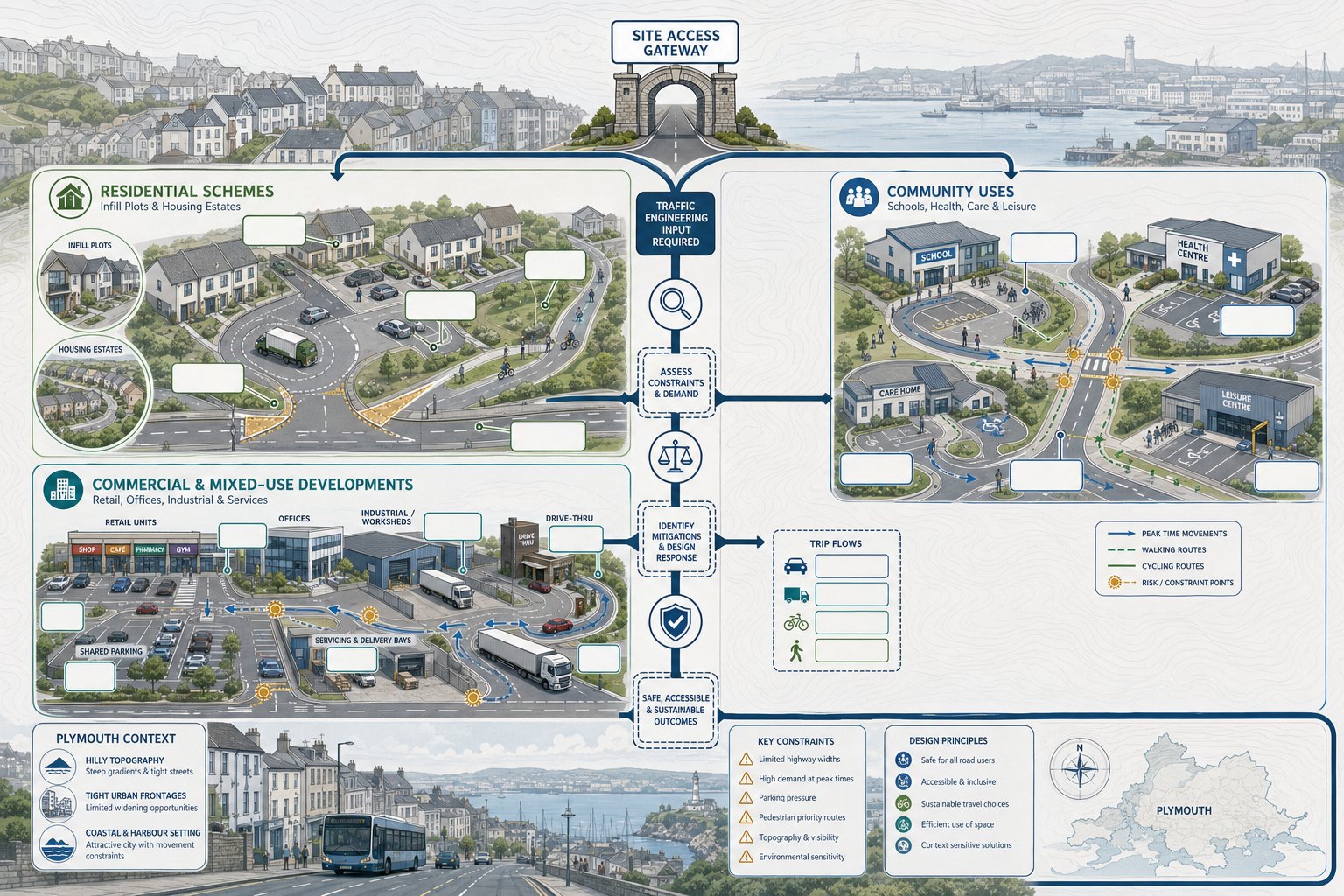
    If adoption is likely, we coordinate early with the civil engineer so what gets drawn at planning stage can actually be built and maintained.

    2) Internal layout that works operationally

    Internal geometry is where many schemes quietly fail. We help align the layout with the end-user reality:

    • service yards that don’t rely on risky reversing,
    • turning heads that match the actual vehicle types,
    • clear separation (or managed interaction) between pedestrians and HGVs,
    • realistic parking circulation so drivers don’t improvise.

    3) Active travel and “place” as more than a diagram

    Planners increasingly expect walking and cycling to be designed-in, not “noted”. That can mean:

    • direct, overlooked pedestrian routes to the public footway network,
    • cycle access that avoids awkward kerbs/steps and feels safe at night,
    • secure cycle parking in the right place (near entrances, not hidden behind bin stores),
    • links to existing or proposed cycle corridors,
    • bus stop upgrades or repositioning where a development would otherwise worsen access.

    A useful rule of thumb: if you wouldn’t be happy for a teenager or older resident to walk/cycle the route in winter, the LHA probably won’t be either.

    When we get this right, the transport submission stops being defensive. It becomes a positive planning argument: the development improves connectivity, supports mode shift, and addresses road safety, so officers have something constructive to recommend.

    How To Choose The Right Transport Planning Consultant

    Most teams can produce a TS. The difference is whether the consultant can consistently get schemes to decision with minimal drama.

    When we help clients select (or act as) transport planning consultants, we look for evidence in five areas.

    1) Local authority “fit”

    Ask: have they secured consents in this LHA recently? Do they understand the authority’s thresholds, preferred modelling approaches, and pain points (school run congestion, town centre parking stress, rural highway safety)? Local nuance saves time.

    2) Scope discipline and programme management

    A good consultant will tell you what not to do. If the scope balloons unnecessarily, or worse, stays vague until validation, determination risk rises. We prefer an early scoping note that nails down surveys, models, and outputs so everyone can programme around it.

    3) In-house capability (or well-managed partners)

    Depending on the scheme, you may need:

    • junction/highway design,
    • modelling,
    • Travel Plan strategy,
    • tracking,
    • appeal support.

    The key is not whether everything is in-house, but whether one person is accountable for coordinating it so assumptions don’t conflict.

    4) Writing quality and “committee-readability”

    A transport report can be technically correct and still unhelpful if it’s unreadable. Look for clear structure, explicit assumptions, and conclusions that map to policy tests.

    5) Ability to stand behind the work

    If a scheme is controversial, can the consultant defend it at committee, appeal, or inquiry? Even on non-contentious applications, confidence in defendability changes how negotiations go.

    On mltraffic.co.uk, our pitch is simple: we produce concise, accurate transport engineering reports quickly, shaped by 30+ years of experience and tuned to local authority expectations. For many project teams, that combination, speed and credibility, is what keeps transport from becoming the long pole in the tent.

    Costs, Timescales, And Common Pitfalls That Delay Determinations

    Budgets and programmes vary wildly, but we can still be practical about what drives cost, how long things take, and why applications get stuck.

    Costs (what actually drives them)

    Transport planning fees typically scale with:

    • Document type and complexity (a straightforward TS vs a TA with multiple junction models and mitigation design).
    • Survey requirements (number of sites, duration, weekday/weekend, specialist surveys like parking stress).
    • Design iterations (if the layout is moving weekly, you’ll pay for repeated tracking and drawing updates).
    • Stakeholder engagement (pre-app meetings, public exhibitions, member briefings).
    • Risk/controversy (legal scrutiny, call-ins, appeals).

    As a broad reality check: fees range from modest for a small TS with limited surveys to substantial multi-disciplinary budgets for strategic sites with modelling, EIA inputs, and potential inquiry support.

    Timescales (what sets the critical path)

    Common timeline components include:

    • Scoping agreement: a week or two on simple schemes: longer if multiple stakeholders or a strategic model is involved.
    • Surveys: often the critical path, especially if you need term-time data, neutral months, or to avoid major roadworks.
    • Analysis and drafting: usually efficient once data is in, but slowed by repeated layout changes.
    • LHA review cycles: you can produce a great TA and still wait on consultation responses: building review time into the programme is non-negotiable.

    If you’re trying to “get to decision faster”, the biggest lever is simple: start transport early enough that design and evidence can develop together.

    Common pitfalls that delay determinations

    These are the issues we see repeatedly when applications drift:

    • Commissioning too late: the access is fixed, the architect has frozen the layout, then tracking shows the refuse vehicle can’t turn. That’s redesign plus re-consultation.
    • Inadequate or outdated surveys: old counts, wrong season, school holidays, abnormal traffic conditions. The LHA asks for repeats, and the clock resets.
    • Scope not agreed: a TA submitted without agreed study junctions or modelling assumptions invites an objection that’s hard to argue against.
    • Ignoring construction and servicing: committees worry about HGV routing, deliveries at peak times, and local amenity impacts. Without a CTMP/DSP, officers often can’t recommend.
    • Parking treated as a numbers game: if local streets are already under stress, you need a narrative (and sometimes controls) to avoid displacement.
    • Mitigation that isn’t deliverable: measures without land control, without cost estimates, or without clarity on S278/S106 mechanisms get challenged.
    • Travel Plan “wish lists”: generic measures with no management responsibility, targets, or monitoring. LHAs can spot copy‑paste a mile off.

    When we’re brought in early, we can usually eliminate most of these before submission, by agreeing scope, designing with real vehicles in mind, and presenting the transport case so it’s easy to sign off.

    Conclusion

    In UK development management, transport isn’t a side issue, it’s one of the most common reasons applications stall, attract holding objections, or end up with painful late-stage redesign. The good news is that most transport risk is manageable when we treat it as part of the project strategy, not a report-writing exercise.

    Transport planning consultants help you de-risk by scoping proportionately with the local highway authority, collecting defensible baseline data, designing access and layouts that actually function, and producing clear TS/TA/Travel Plan documents that planning officers can rely on. Done well, it shortens the path to determination because fewer questions get asked late, and the answers are already in the submission.

    If you’re aiming to get to decision faster in 2026, our advice is simple: bring transport in early, agree the scope, and make sure the consultant you appoint can combine policy awareness with practical design. That’s the difference between “highways will object” and “highways are satisfied, subject to conditions”.

    Frequently Asked Questions about Transport Planning Consultants

    What do transport planning consultants do in UK development projects?

    Transport planning consultants assess highways, traffic, parking, and sustainable travel impacts, design access and junctions, prepare transport reports, and liaise with local highway authorities to support planning applications efficiently and safely.

    When should I engage a transport planning consultant for a development scheme?

    You should involve a transport planning consultant early, ideally at feasibility or pre-application stages, especially if transport issues could be material, such as tight access, parking pressure, or proximity to busy junctions, to avoid costly redesign later.

    How does transport evidence fit into the UK planning system?

    Transport evidence is a key part of planning applications, demonstrating compliance with national and local policies by showing that development impacts on the transport network are acceptable or mitigated, thereby supporting the planning decision process.

    What is the difference between a Transport Statement, Transport Assessment, and Travel Plan?

    A Transport Statement offers a proportionate review for smaller schemes; a Transport Assessment provides a detailed, technical analysis for larger or sensitive developments; a Travel Plan outlines strategies to promote sustainable travel, including targets and monitoring.

    How do transport consultants ensure their reports meet local highway authority requirements?

    They engage early with the local highway authority to agree on the scope, surveys, and modelling methods, tailoring reports to local thresholds and policy, which reduces objections and speeds approval.

    What are common reasons for delays in planning applications related to transport?

    Delays often occur due to late commissioning of transport input, outdated or insufficient survey data, unagreed scopes, ignoring construction traffic impacts, ineffective parking strategies, and non-deliverable Travel Plan measures.

  • Considering Transport Planning Consultants: What They Do, When You Need One, and How They Help Planning Applications Succeed

    Considering Transport Planning Consultants: What They Do, When You Need One, and How They Help Planning Applications Succeed

    Planning applications rarely fail on design alone. More often, they stall because somebody asks a deceptively simple question: how will people and vehicles get to, from, and around the site safely? That is where transport planning consultants come in.

    In the UK planning system, transport is not a side issue. It affects site suitability, access design, parking, servicing, sustainability, road safety, neighbour impact, and eventually whether a local planning authority and highway authority are willing to support a proposal. For architects, planners, lawyers, developers and councils, the transport case can either smooth the route to consent or become the reason an application gets delayed, amended, or refused.

    We’ve seen this first-hand. With more than 30 years of experience behind the work delivered through ML Traffic, we know that concise, accurate transport reports prepared early and tailored to local authority thresholds can save weeks of redesign and rounds of objections.

    This article explains what transport planning consultants actually do in 2026, when to bring one in, which reports may be required, how site access and highway impacts are assessed, and what a good consultant should contribute beyond simply producing a Transport Statement. If you’re preparing a planning application, the aim is simple: fewer surprises, stronger evidence, and a better chance of success.

    What Transport Planning Consultants Do In The Planning Process

    Transport planning consultants assess how a development will affect the movement of people and goods, then turn that assessment into practical planning evidence. In simple terms, we help answer whether a site can be accessed safely, whether the surrounding network can accommodate the proposal, and what mitigation or design changes may be needed to make the scheme acceptable.

    That work starts earlier than many teams expect. At feasibility stage, we review local roads, junctions, footways, cycle links, bus access, parking conditions, servicing constraints and policy requirements. We look at the site in context rather than in isolation. A seemingly workable access point on a drawing may be undermined by poor visibility, a steep gradient, an existing parking beat, or a nearby junction already operating close to capacity.

    As projects move forward, transport planning consultants prepare reports for planning submission, coordinate surveys, commission junction modelling where needed, advise on access geometry and servicing, and respond to comments from local authority officers. We also support pre-application discussions, help shape mitigation packages, and provide evidence at appeal where proposals are challenged.

    The strongest transport advice is not just technical. It is strategic. It connects highways evidence, planning policy, design standards and commercial realities so that the wider consultant team can make informed decisions before issues harden into objections.

    How Transport Advice Supports Different Project Types

    Transport advice is never one-size-fits-all. A small residential infill site, a last-mile logistics unit, a school expansion and a mixed-use town-centre redevelopment each raise very different questions.

    For residential schemes, the focus often falls on site access, parking demand, refuse collection, visibility, pedestrian links and the likely traffic effect on nearby junctions. For commercial and employment sites, servicing, HGV routing, loading arrangements and peak-hour traffic can become central. Education and healthcare developments bring their own patterns too: concentrated arrival windows, drop-off pressure, staff parking and sustainable travel expectations.

    Regeneration and mixed-use schemes tend to be broader again. They may require us to consider street hierarchy, connectivity, public realm, cycle provision, bus accessibility and phased impacts over time. On some urban sites, the challenge is reducing car dependence. On rural or edge-of-settlement sites, it may be about proving safe access where alternatives to the private car are limited.

    This is why experienced transport planning consultants tailor their advice to land use, scale and local context. The report title might be similar from project to project, but the evidence behind it should never be generic.

    When To Appoint A Transport Planning Consultant

    Transport consultant reviewing site access and planning strategy with a professional team.

    The best time to appoint a transport planning consultant is usually before the planning strategy is fixed. Waiting until the application pack is almost complete often means the transport work becomes reactive: testing an access that cannot realistically be delivered, defending parking numbers chosen without evidence, or trying to explain away a junction issue that should have influenced site layout much earlier.

    We generally advise bringing transport input in at one of three moments. First, during site selection or feasibility, when several options are being compared. A quick review can reveal whether a promising site has hidden access, servicing or highway adoption constraints. Second, before pre-application engagement, so the transport strategy aligns with the planning narrative from the outset. Third, immediately after a site is secured, when the design team is setting access points, internal circulation, parking and servicing principles.

    Early appointment does two things. It reduces risk, and it saves money. A transport issue identified on day one might mean a modest design adjustment. The same issue discovered after detailed design, surveys and consultations can trigger expensive redesign, new modelling and programme delay.

    In practice, transport should not be an afterthought for any scheme where access, parking, servicing, sustainability or local congestion are likely to attract scrutiny.

    Planning Triggers, Local Thresholds, And Common Red Flags

    Not every planning application requires the same level of transport evidence, but every local authority has its own validation expectations. These are typically set out in local validation lists, local plan policies and, in many cases, standing advice from the highway authority. That means the threshold for a Transport Statement, Transport Assessment or Travel Plan can vary from one authority to another.

    Common triggers include development scale, predicted vehicle trips, changes in land use, impact on a classified road, proximity to sensitive receptors such as schools, and proposals affecting road safety or parking stress. Even relatively modest schemes can require transport input if they sit on constrained sites.

    Red flags are usually visible early if you know what to look for. They include:

    • substandard access width or geometry
    • poor visibility splays
    • steep or awkward gradients
    • proximity to busy junctions
    • limited pedestrian links to local facilities
    • weak public transport accessibility
    • severe existing on-street parking pressure
    • known congestion or collision hotspots
    • servicing that depends on reversing or difficult manoeuvres

    And one more, often overlooked: inconsistent drawings. If the site plan, refuse strategy, parking layout and access design tell different stories, officers notice. Early transport review helps make sure the scheme is technically coherent before it is tested in public.

    Core Transport Reports Required For Planning Applications

    Most planning applications that need formal transport evidence will involve one or more of three familiar documents: a Transport Statement, a Transport Assessment, and a Travel Plan. Depending on the site and scale, those may be supported by junction modelling, swept path drawings, speed surveys, parking studies, road safety analysis or access appraisals.

    The purpose of these documents is not simply to satisfy a checklist. They explain the transport effects of the proposal in a way that planning and highway officers can test. Done well, they show that the consultant understands both the technical details and the policy context. Done badly, they read like boilerplate and invite further questions.

    A good report should be proportionate. Authorities generally do not want a 150-page technical submission for a scheme with negligible transport impact. Equally, a short note will not satisfy scrutiny where a proposal generates substantial new trips, affects a constrained junction, or relies on mitigation to become acceptable.

    This is where experienced judgement matters. The right evidence package should be scoped around the application, the authority and the site conditions. It should also be internally consistent with the design drawings, planning statement and any environmental material submitted alongside it.

    Transport Statements, Transport Assessments, And Travel Plans

    A Transport Statement (TS) is usually prepared for smaller or lower-impact proposals. It provides a concise review of the existing transport context and explains why the scheme is unlikely to create severe highway impact. A TS typically covers site location, access, local highway conditions, sustainable travel options, parking, servicing and a proportionate assessment of trip generation.

    A Transport Assessment (TA) is more detailed and is generally required where a development is larger, more complex, or likely to have material traffic effects. A TA often includes surveyed baseline conditions, forecast trip generation, distribution and assignment assumptions, junction capacity modelling, parking analysis, road safety review and mitigation proposals. It is the document used to demonstrate, with evidence, that the residual cumulative impact would not be severe in planning terms.

    A Travel Plan (TP) sits alongside either document when authorities want to see active management of travel behaviour. It sets out measures to encourage walking, cycling, bus use, rail use, car sharing and other sustainable modes. It may include targets, monitoring periods, management responsibilities and action plans if targets are not met.

    The distinction sounds neat on paper. In practice, the boundary between a robust TS and a light TA can depend heavily on local expectations, so early scoping is always worth it.

    Junction Modelling, Swept Path Analysis, And Technical Evidence

    Where a proposal could materially affect network performance, junction modelling is often needed. In the UK, that may involve tools such as PICADY for priority junctions, ARCADY for roundabouts, or LINSIG for signal-controlled junctions. The point is straightforward: to test whether the junction can continue to operate acceptably with development traffic, usually in future-year scenarios as well as present-day conditions.

    But modelling is only one part of the story. Highway officers also want confidence that vehicles can physically get in and out of the site and move around it safely. That is where swept path analysis comes in. Using tracked vehicle drawings, we show whether cars, refuse vehicles, emergency vehicles and delivery vehicles can manoeuvre without overrunning footways, clipping structures or relying on unrealistic shunts.

    Other technical evidence may include speed surveys to set visibility requirements, parking beat surveys to understand local stress, personal injury collision reviews, pedestrian accessibility mapping, or access appraisals based on current design guidance. These pieces can seem small individually. Together, they often determine whether an authority sees the scheme as low-risk or problematic.

    The key is proportionality. Technical evidence should answer the questions the authority is likely to ask before they have to ask them.

    How Transport Planning Consultants Assess Site Access And Highway Impact

    Assessing site access is more than checking whether a vehicle can turn into a gate. We look at the full interaction between the site and the surrounding transport network.

    First, we review the physical characteristics of the proposed access: width, radii, alignment, gradient, surfacing, relationship with adjacent uses and whether it can accommodate expected vehicle types. Visibility splays are a core consideration. If drivers cannot see approaching traffic, pedestrians or cyclists clearly and at the required distance, the access may be considered unsafe regardless of how elegant the architecture looks.

    Second, we consider the access in context. Is it too close to a junction? Does it conflict with existing parking, bus stops, crossings or trees? Will vehicles queue back into the highway? Can refuse, delivery and emergency vehicles use it without awkward reversing? Is there a clear route for pedestrians from the site to nearby destinations?

    Third, we assess the wider highway impact. That usually means understanding trip generation, where those trips are likely to go, and whether local junctions can absorb them. We also examine sustainable travel opportunities, because impact is not only about cars. A site with strong walking, cycling and public transport links may support lower car dependence than one in a poorly connected location.

    Road safety matters throughout. We review local collision data, traffic speeds, crossing opportunities and the quality of footway and cycle connections. If there is a weakness, we identify whether it can be mitigated through design, off-site works, operational measures or travel planning.

    This is why transport planning consultants are valuable at layout stage. Access strategy is not a box to tick at the end: it is one of the design decisions that shapes whether the planning application stands up under scrutiny.

    Working With Architects, Planners, Lawyers, And Developers

    Transport planning is collaborative by nature. The best outcomes usually come when transport advice is woven into the wider design and planning process rather than delivered as a stand-alone technical note at the eleventh hour.

    With architects, we help shape access positions, internal circulation, servicing yards, parking layouts, cycle storage and refuse strategies. Sometimes a small amendment to a kerb line or turning head solves a problem that would otherwise trigger a long technical debate. Sometimes the transport evidence shows the original concept needs more fundamental change. Either way, coordination matters.

    With town planners, we align technical evidence with planning policy and the broader case for development. A transport report should reinforce the planning statement, not contradict it. If the scheme is being presented as sustainable, for example, the evidence on walking routes, bus access and travel planning has to support that narrative credibly.

    Lawyers often become involved where there are planning obligations, highway agreements, appeals or contentious neighbour issues. Here, transport consultants provide robust evidence, explain standards and assumptions, and help distinguish genuine technical risk from tactical objection. At appeal or inquiry, that role can extend to expert witness work.

    For developers and landowners, we also keep an eye on programme and viability. There is little value in technically perfect advice that arrives too late to influence the submission timetable. Clear scoping, realistic assumptions and quick, accurate reporting are often what make the difference in live projects.

    That is one reason specialist firms such as ML Traffic focus on concise, planning-ready reports tailored to local authority expectations rather than unnecessary bulk.

    Common Transport Planning Issues That Delay Or Derail Applications

    Most transport-related delays are avoidable. They happen not because the issues are obscure, but because they were spotted too late or addressed too lightly.

    A very common problem is inadequate site access. That might mean insufficient visibility, geometry that does not suit the expected vehicle mix, or an arrangement that conflicts with pedestrians, parked cars or a nearby junction. If the access cannot be shown to work safely, the application is immediately on the back foot.

    Another recurring issue is underestimating trip generation or relying on weak comparisons. Highway officers are quick to challenge assumptions that appear optimistic, especially for commercial, roadside or mixed-use schemes. If the forecast traffic case looks fragile, officers may ask for fresh analysis, more survey data, or full modelling that was not budgeted for originally.

    Parking and servicing also trip up many applications. Too little parking can create overspill concerns. Too much can undermine sustainability arguments. Servicing plans that look fine in narrative form may fall apart once swept path analysis is done. Refuse collection, delivery access and emergency routes need to be workable on the ground, not only on paper.

    Then there are omissions: missing speed surveys, no collision analysis, unclear travel plan measures, outdated traffic counts, or drawings that do not match the transport report. These gaps can seem minor. In reality, they create doubt, and doubt leads to requests for more information.

    The wider point is simple. A planning authority does not need transport perfection. It needs confidence that the scheme has been tested properly, the impacts are understood, and any problems have credible solutions.

    How To Choose The Right Transport Planning Consultant

    Not all consultants approach planning work in the same way. Some are excellent at strategic transport studies but less agile on smaller planning applications. Others can produce reports quickly but lack the judgement to anticipate authority concerns. Choosing well matters.

    We’d suggest starting with relevant experience. Has the consultant worked on your type of development before: residential, education, logistics, mixed-use, roadside retail, healthcare? Scale matters too. A firm that mostly handles major infrastructure may not be the best fit for a tight infill scheme with an awkward urban access, and vice versa.

    Local authority familiarity is another big factor. Consultants do not need to know every officer personally, but they should understand how the relevant authority tends to interpret thresholds, validation requirements and technical expectations. That local awareness often saves time during scoping and review.

    Then look at capability. Can the consultant handle not just a Transport Statement, but also junction modelling, swept path analysis, access design input and responses to highway comments? If an appeal becomes necessary, can they support it? Breadth helps.

    Equally important is communication. Good transport planning consultants explain risks early, write clearly, and avoid burying the team in jargon. They should be able to tell you when the transport case is strong, when it is marginal, and what can realistically improve it.

    Finally, ask to see examples. Not to admire glossy covers, but to judge clarity, proportionality and whether the work appears genuinely tailored. In planning, credibility usually beats volume.

    What To Expect From The Instruction, Survey, And Reporting Process

    A well-run transport instruction follows a fairly predictable sequence, even though each scheme has its own complications.

    It usually begins with scoping. We review the proposal, the location, likely policy triggers and what the authority is expected to require. At this stage, we identify whether the job is likely to need a Transport Statement, Transport Assessment, Travel Plan, access appraisal, modelling, swept path work, parking surveys or speed surveys. If pre-application engagement is planned, this is often the point to agree the scope before too much is done.

    Next comes data collection. Depending on the scheme, that may include traffic counts, queue surveys, speed surveys, parking beat surveys, site observations, accessibility audits and review of collision records. For some projects, census travel-to-work patterns or local trip-rate evidence may also feed in. The aim is to create a robust baseline, because weak baseline data tends to produce weak conclusions.

    After that, the design and assessment stages start to overlap. We test access options, review parking and servicing, estimate trip generation, and, where needed, run junction models. Often there is some iteration here. An architect moves the access. A planner wants stronger sustainable travel measures. A delivery vehicle path does not quite work. This is normal.

    The reporting stage then pulls the evidence together into a submission-ready document set. That may include the main TS, TA or TP, appendices, technical drawings and mitigation proposals. Once submitted, there is often a follow-up phase where we respond to highway authority comments, clarify assumptions, or refine measures. On more contentious schemes, support can continue through committee, appeal or inquiry.

    Planning Triggers, Local Thresholds, And Common Red Flags

    Although every project is different, clients often want to know one practical thing: what tends to trigger more transport work than they first expected?

    Usually, it is a combination of scale and sensitivity. A modest scheme on a simple, well-connected urban site may only need a short, evidence-led statement. But a similar-sized scheme beside a busy junction, on a road with poor visibility, or in an area already under parking pressure can quickly require extra surveys and technical justification.

    Local thresholds matter because they are not fully standardised across the UK. One authority may request a Travel Plan at a lower development scale than another. Another may expect parking surveys for uses that routinely create on-street demand. Some councils are especially alert to school-run impacts, logistics routing, or town-centre servicing.

    The red flags are familiar: constrained access, difficult levels, limited footways, weak bus connectivity, collision history, neighbour parking stress, and sites where large vehicles must perform awkward manoeuvres. Add public objection to that mix and the authority is far more likely to interrogate the transport case in detail.

    That is why we usually prefer to identify the likely sticking points before surveys are commissioned. Better scoping leads to cleaner submissions.

    Conclusion

    In 2026, transport planning consultants do far more than produce a report at the end of the planning process. We help test site suitability, shape access and layout, assess network effects, support sustainable travel strategies and respond to authority concerns with evidence that stands up.

    For architects, planners, lawyers, surveyors, developers and councils, the practical lesson is straightforward: involve transport input early enough for it to influence the scheme, not merely explain it afterwards. That is when the value is highest.
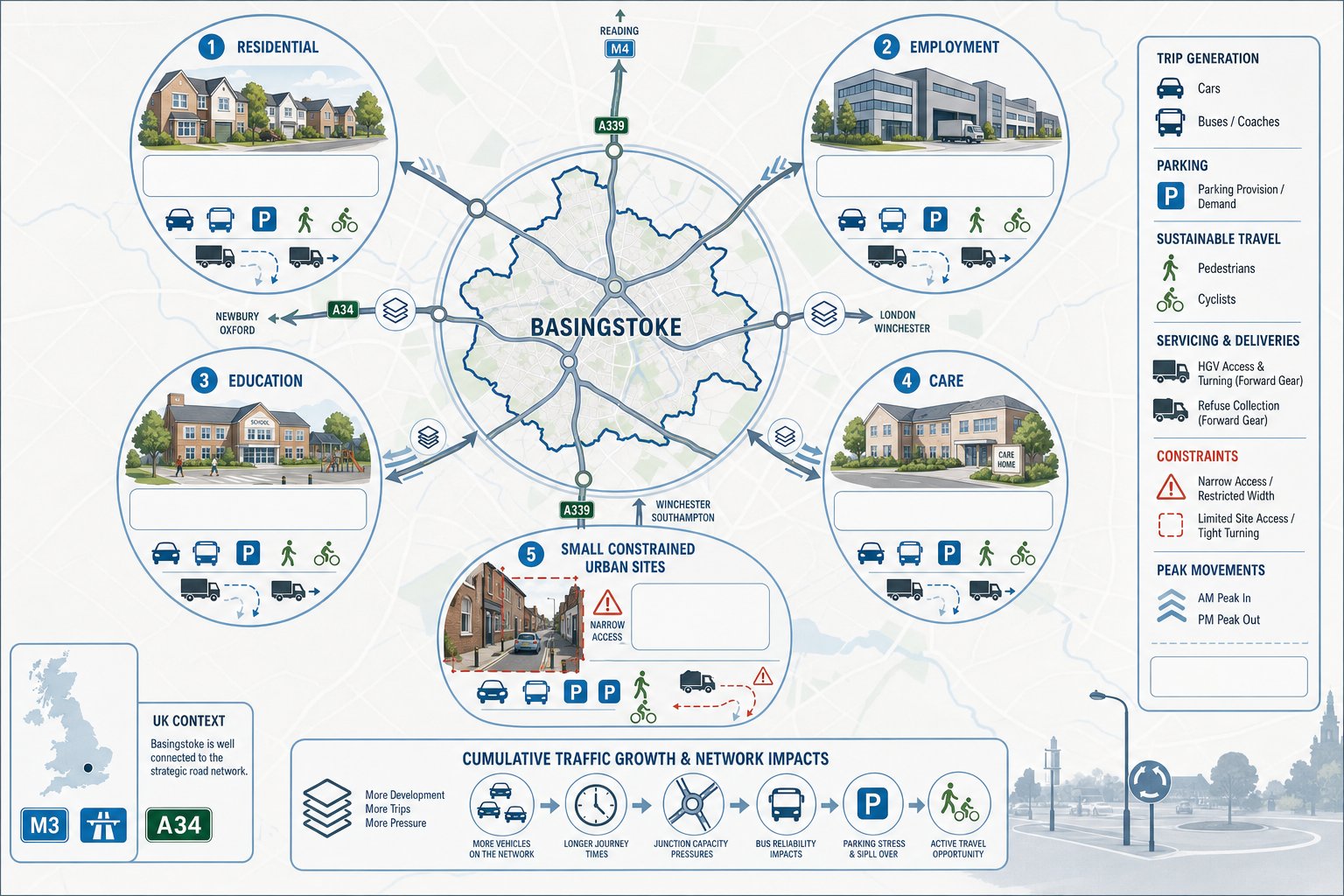
    Whether the requirement is a concise Transport Statement, a detailed Transport Assessment, a Travel Plan, junction modelling or access advice, the goal is the same, to reduce uncertainty and give decision-makers confidence that the proposal works in the real world.

    And that, really, is the point. Planning success often depends on making complex issues feel clear, proportionate and resolved. Good transport planning consultants help do exactly that.

    Transport Planning Consultants: Frequently Asked Questions

    What do transport planning consultants do in the UK planning process?

    Transport planning consultants assess how developments affect the movement of people and vehicles, advise on safe site access, parking, servicing, and highway impacts, and prepare evidence to support planning applications in line with local authority requirements.
    When is the best time to involve a transport planning consultant in a development project?

    The best time to appoint a transport planning consultant is early—during site selection or feasibility, before pre-application discussions, or immediately after securing the site—to address access and transport issues proactively and reduce delays.
    What are the main types of transport reports required for planning applications?

    Core reports include Transport Statements for smaller schemes, detailed Transport Assessments for larger or complex developments, and Travel Plans to promote sustainable travel options, all tailored to local authority thresholds and site conditions.

    How do transport planning consultants assess site access and highway impact?

    They evaluate physical access features like width, visibility splays, and gradients, consider surrounding junctions and pedestrian routes, forecast trip generation, and assess the wider network and road safety to ensure safe and acceptable access.

    What common issues cause transport-related delays or refusals in planning applications?

    Typical problems include inadequate access or visibility, underestimating traffic impacts, insufficient parking or servicing arrangements, missing technical surveys, inconsistent drawings, and weak sustainable travel strategies.

    How do transport planning consultants support different types of development projects?

    They tailor advice to the project’s land use and scale, addressing site access, parking, servicing needs, and sustainable travel expectations specific to residential, commercial, education, healthcare, logistics, or mixed-use developments.