Category: High Frequency Posts

  • Transport Modelling Consultants In 2026: How To Choose The Right Expert For Planning Success

    Transport Modelling Consultants In 2026: How To Choose The Right Expert For Planning Success

    Planning risk rarely starts with a red line on a drawing. More often, it starts with a deceptively simple question from a local highway authority: what will this do to the network? That’s where transport modelling consultants come in.

    For architects, planners, developers, lawyers and local councils, modelling is no longer a niche add-on reserved for very large schemes. In 2026, it’s often central to proving that a proposal can function, be mitigated properly, and withstand scrutiny from case officers, highways teams, members and, sometimes, public inquiry. Whether the issue is a new residential access, a town-centre junction under pressure, a phased mixed-use masterplan, or a wider infrastructure bid, the quality of the modelling can shape the outcome.

    The challenge is that not all transport modelling support is equal. Some consultants produce technically competent work that still leaves planners unconvinced. Others understand exactly how to align analysis with authority expectations, planning thresholds, programme pressures and real-world decision-making.

    In this guide, we set out what transport modelling consultants actually do, when you need one, the main modelling approaches used in the UK, and how to judge whether a consultant is likely to reduce planning risk rather than add to it. We also cover the technical quality checks worth making before you rely on a model in support of an application or strategy.

    What Transport Modelling Consultants Do And When You Need One

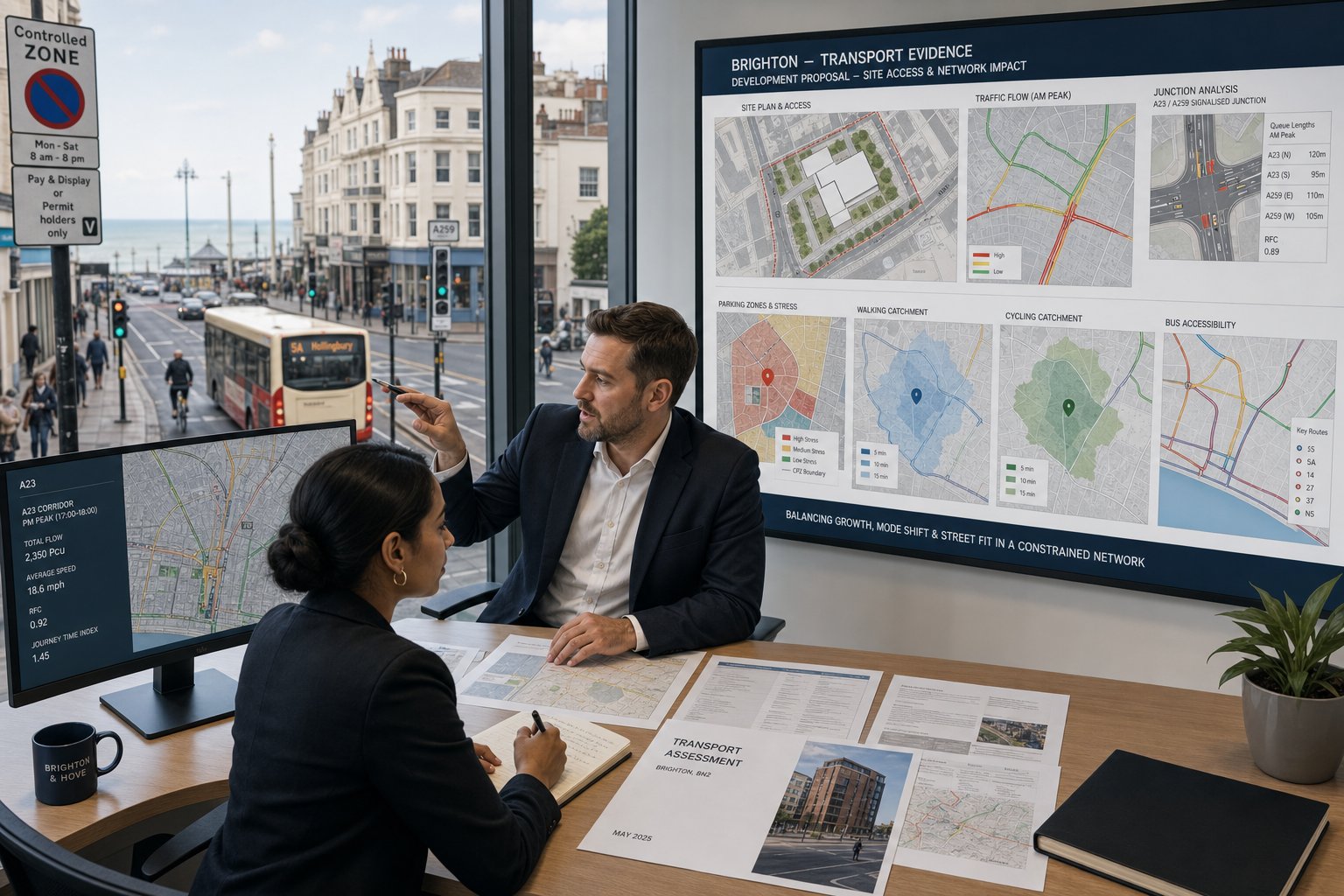
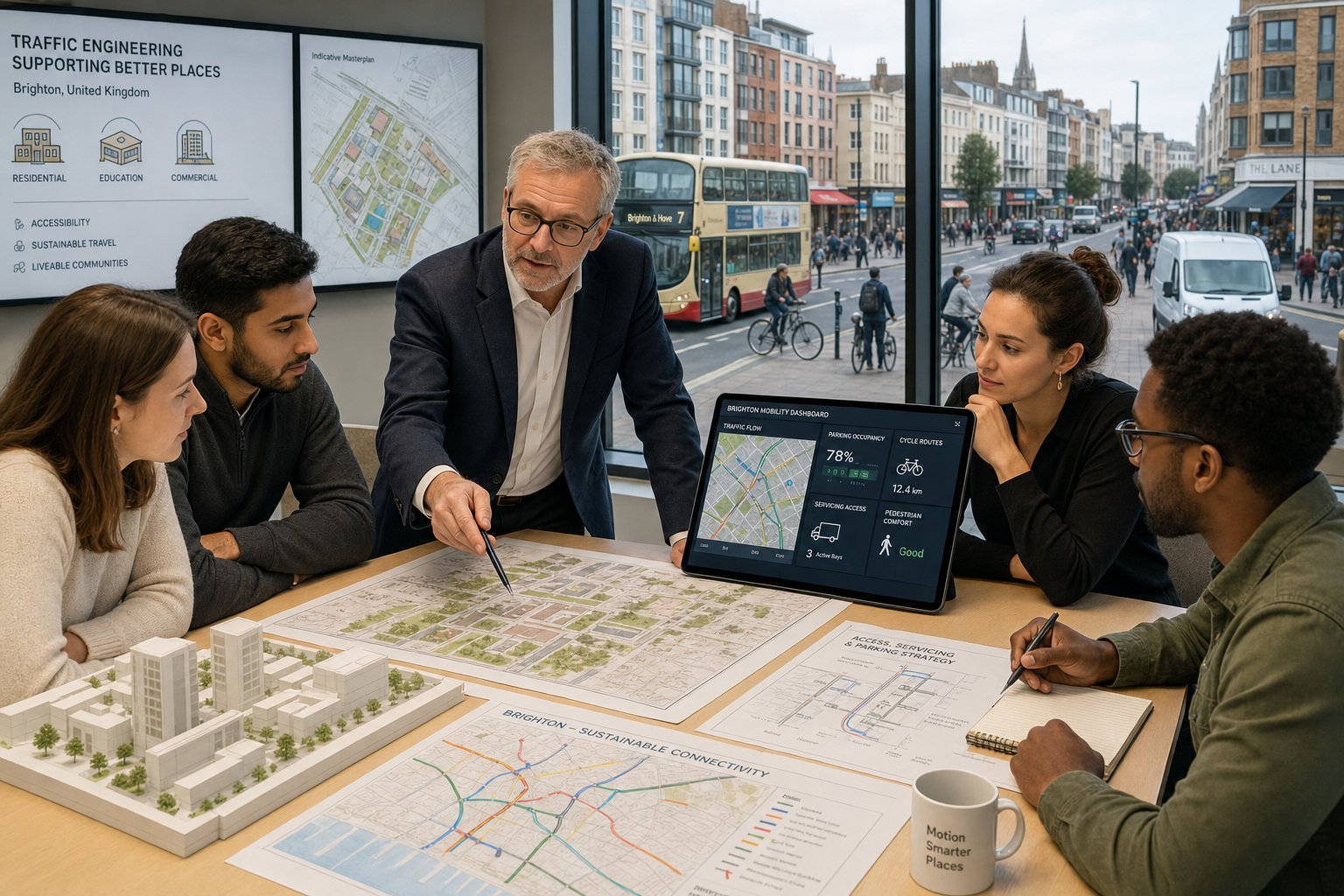
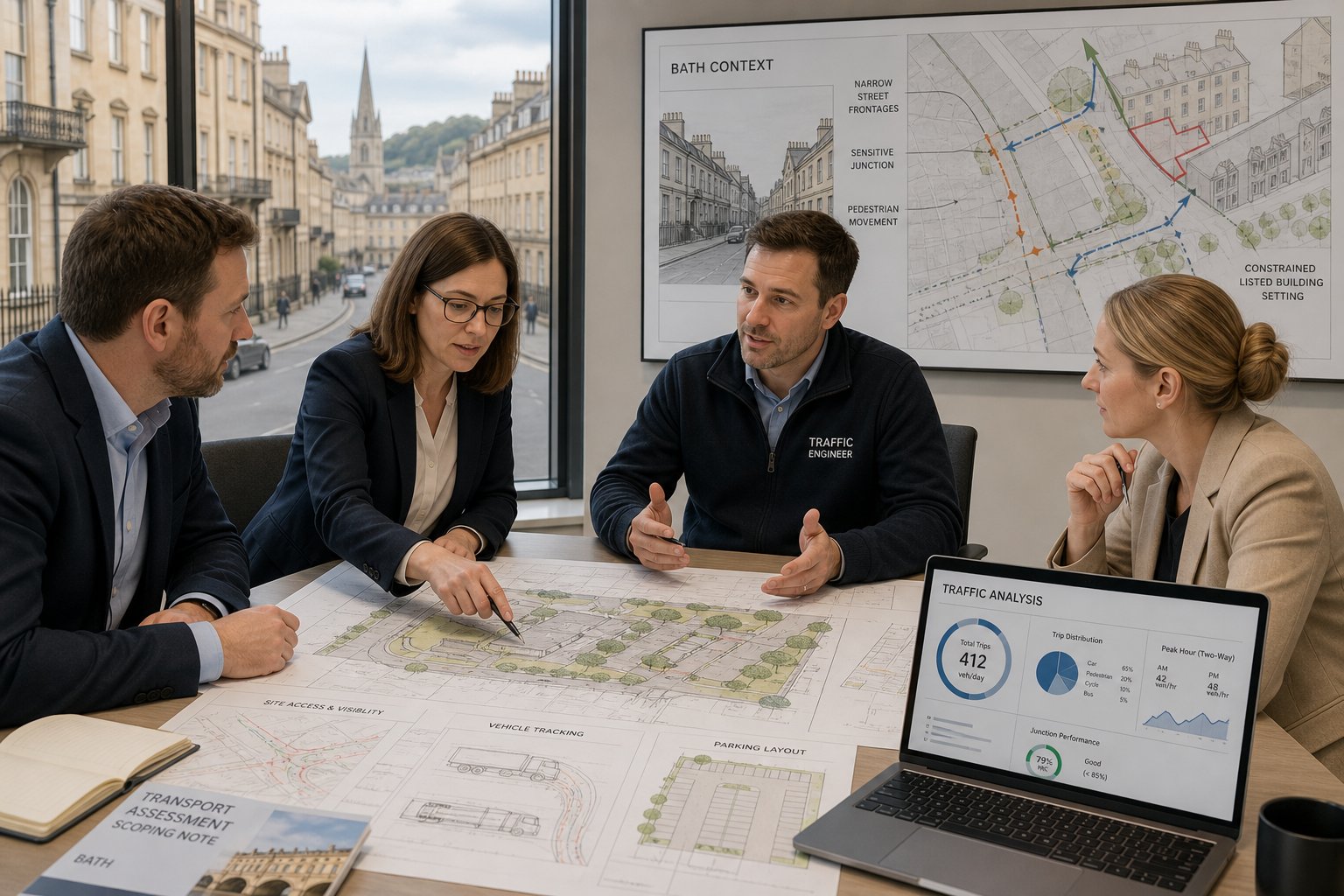
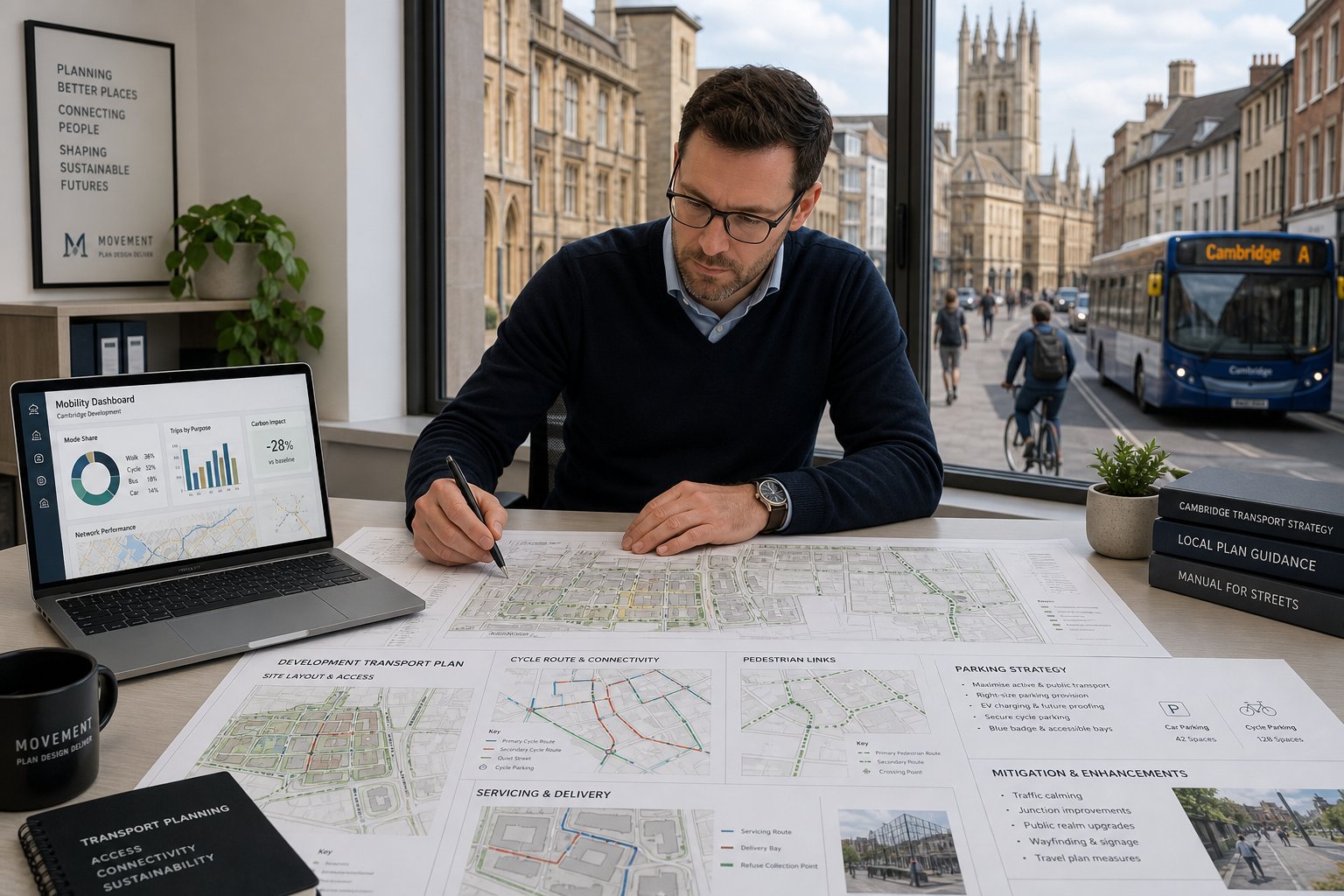
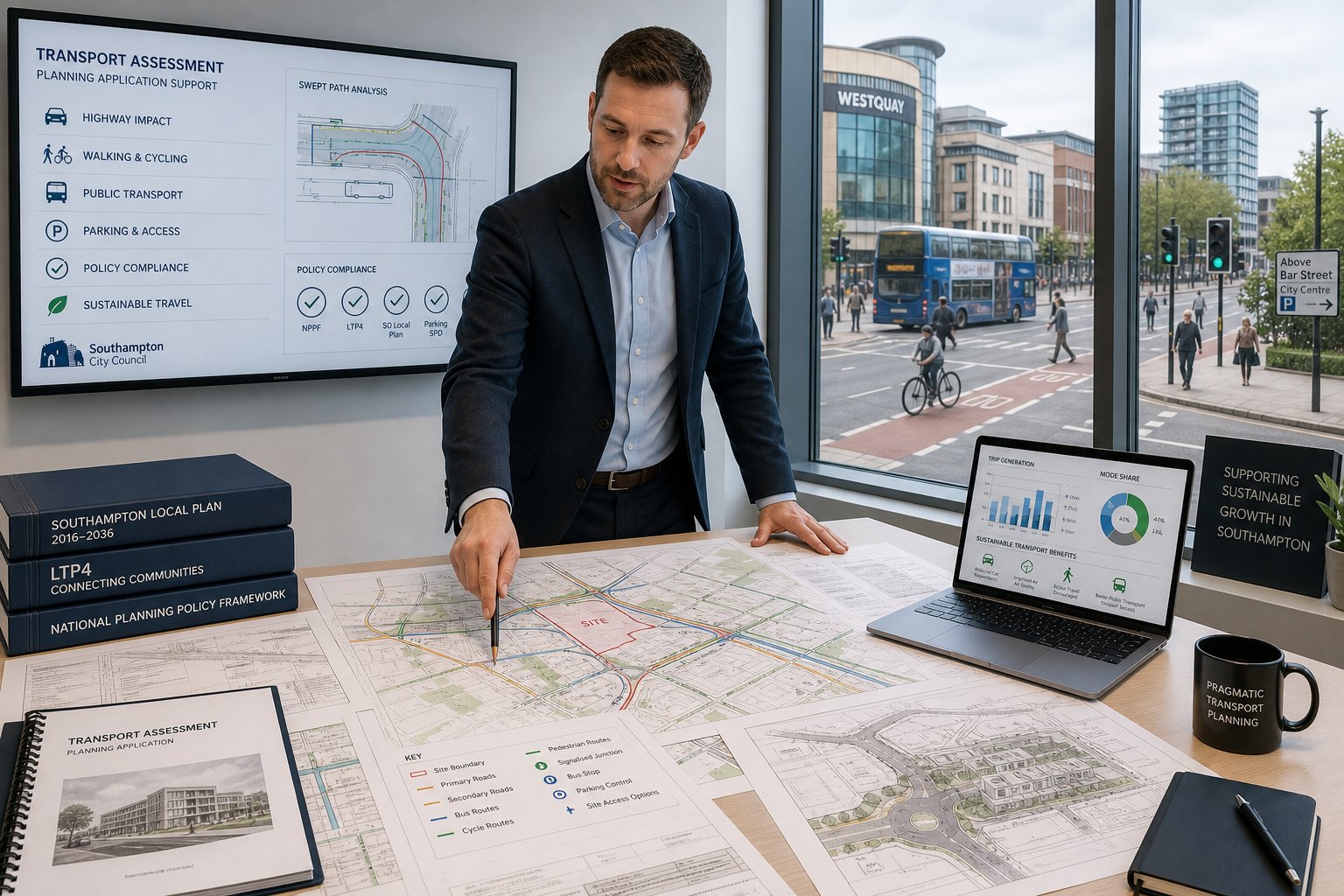
    Transport consultants reviewing UK traffic models in a modern office.

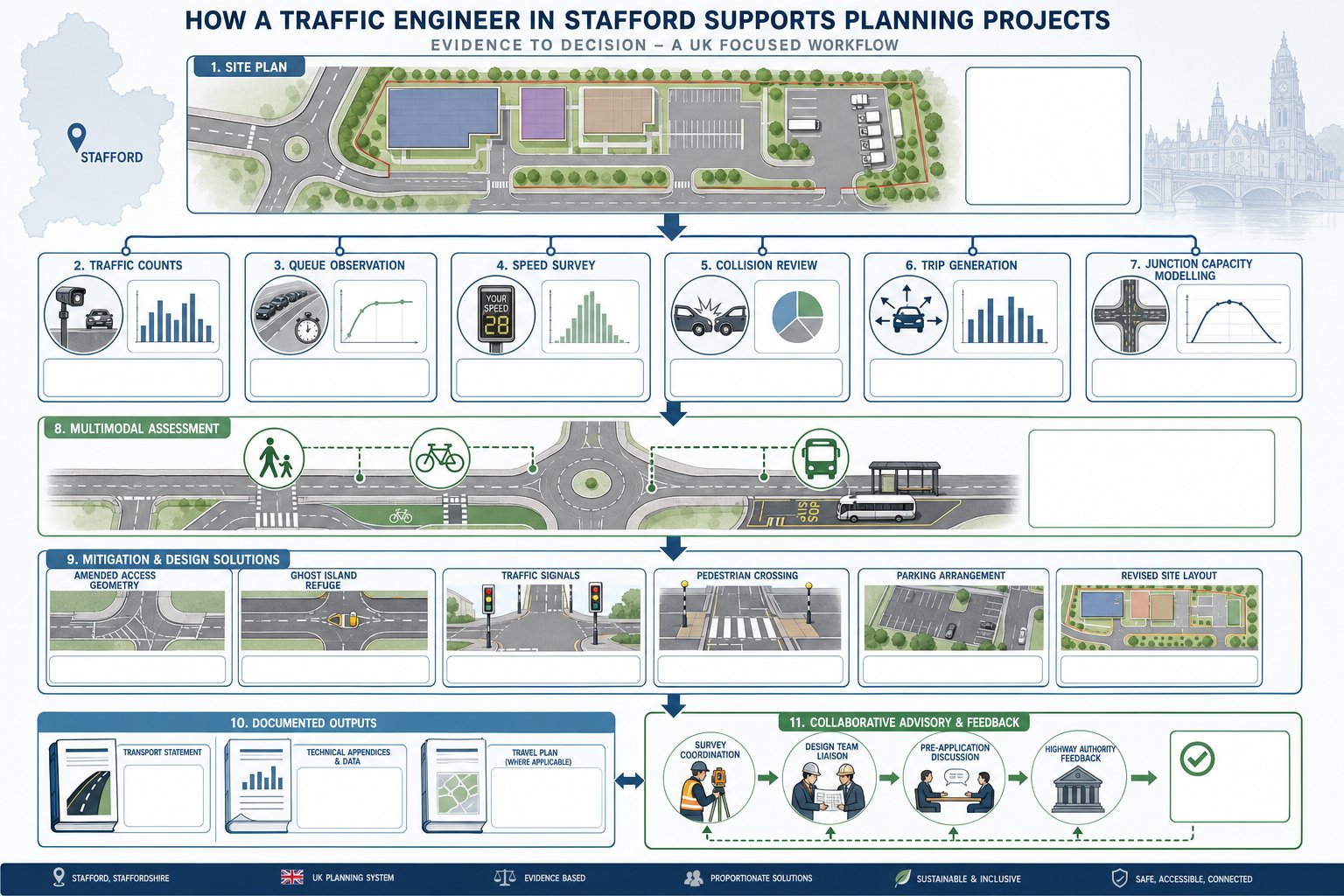
    Transport modelling consultants are specialist transport planners who use quantitative methods to test how people and vehicles move through a network, and how that movement changes when a development or scheme is introduced. In practice, that means they analyse existing conditions, build or adapt models, forecast future scenarios, and assess impacts such as capacity, delay, queuing, route choice, mode share and sometimes environmental effects.

    Their role is partly technical and partly strategic. The technical side involves handling traffic counts, surveys, land-use assumptions, junction layouts, growth factors and software models. The strategic side is just as important: deciding what level of modelling is proportionate, what scenarios need testing, what the local authority is likely to challenge, and what mitigation options are worth pursuing before an application is submitted.

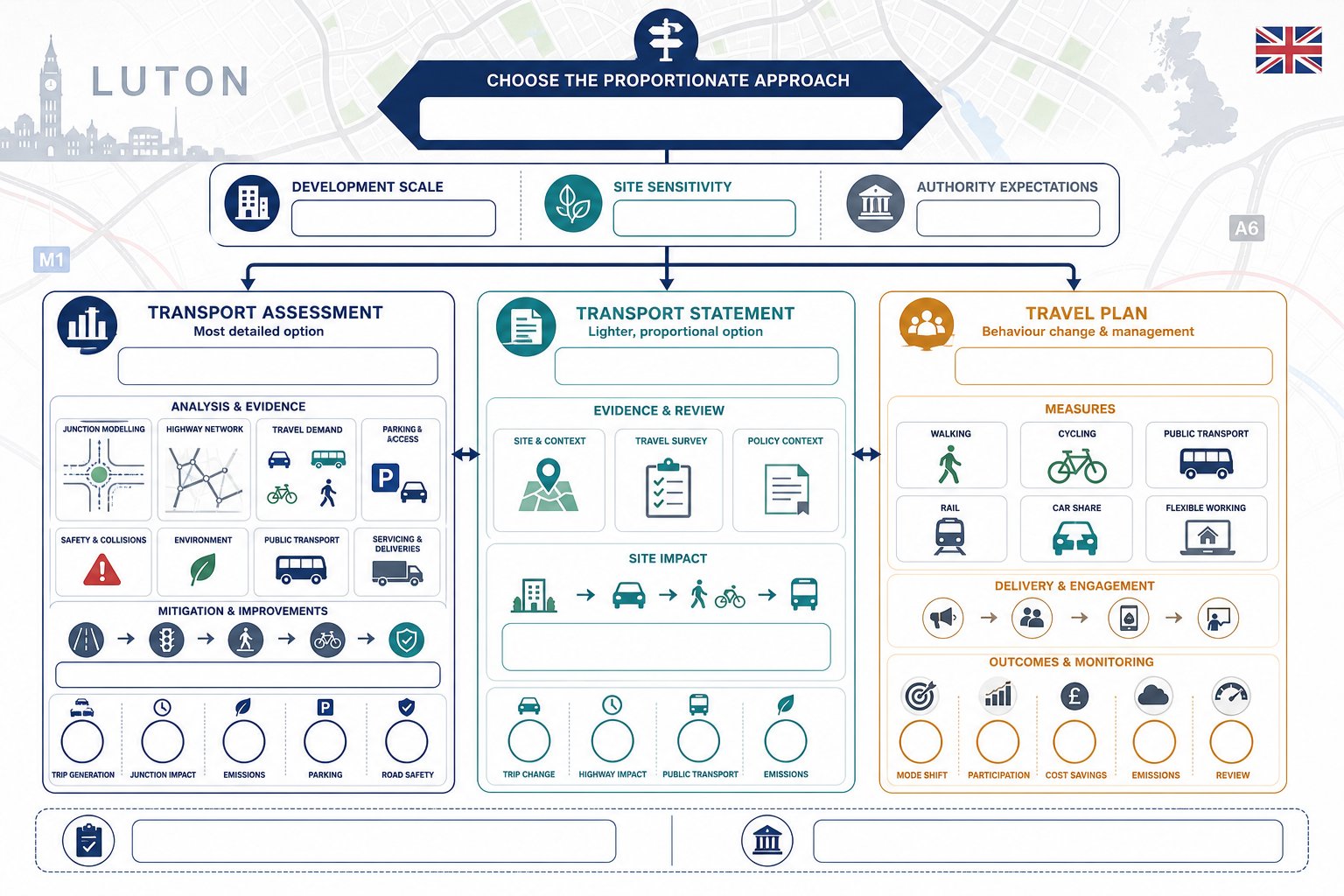
    You typically need transport modelling consultants when a scheme is likely to have material transport impacts, or when a highway authority specifically requests modelling to support a Transport Assessment. That could be for a single junction, a corridor, or a wider network. We also see modelling become essential for large allocations, infrastructure schemes and funding cases where a WebTAG-style evidence base is expected.

    And timing matters. Bringing a consultant in early usually saves pain later. A model developed alongside site design can influence access strategy, servicing, parking and phasing before positions harden. That tends to be cheaper than redesigning late in the process after transport objections land on the table.

    How Transport Modelling Supports Planning Applications And Development Strategy

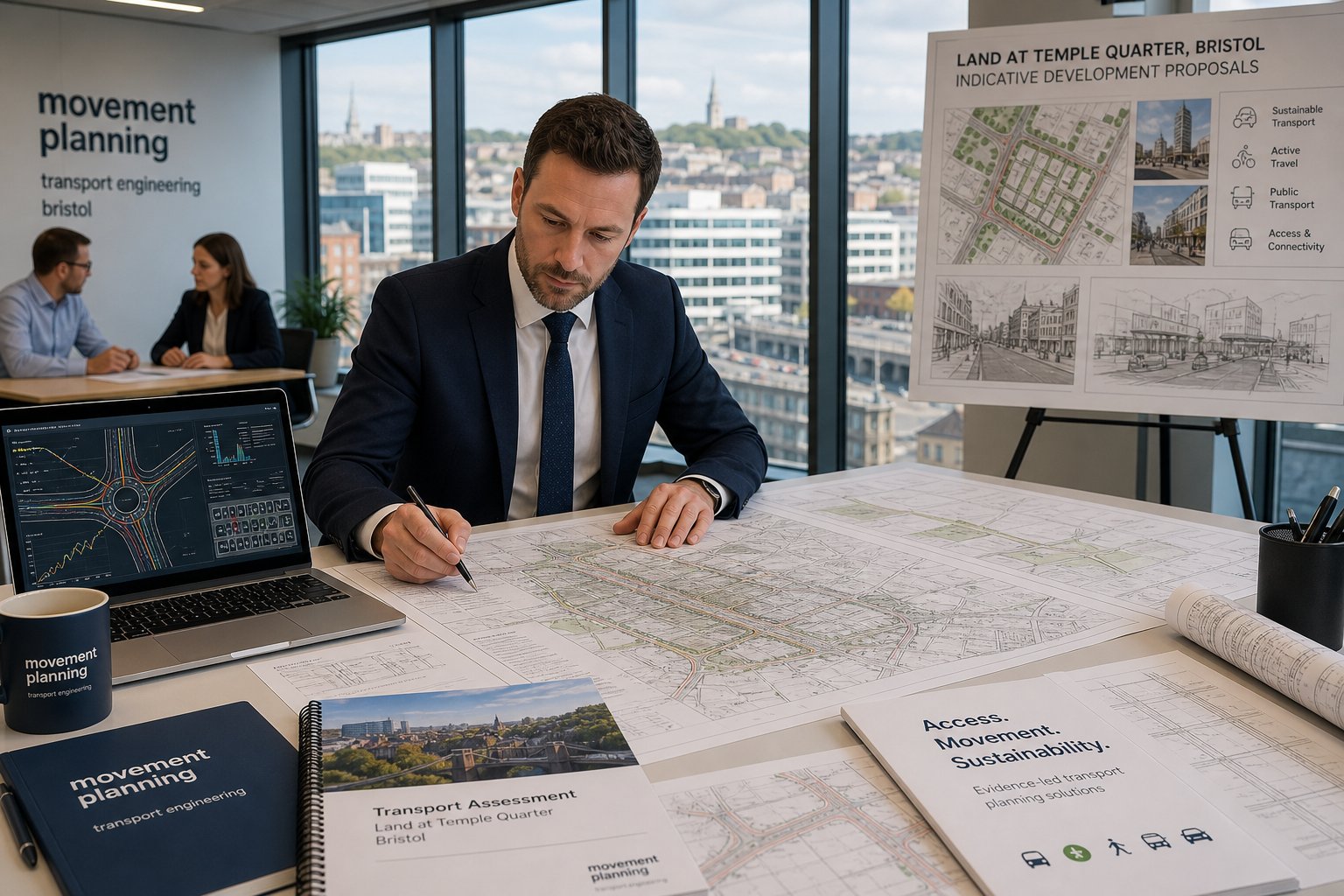
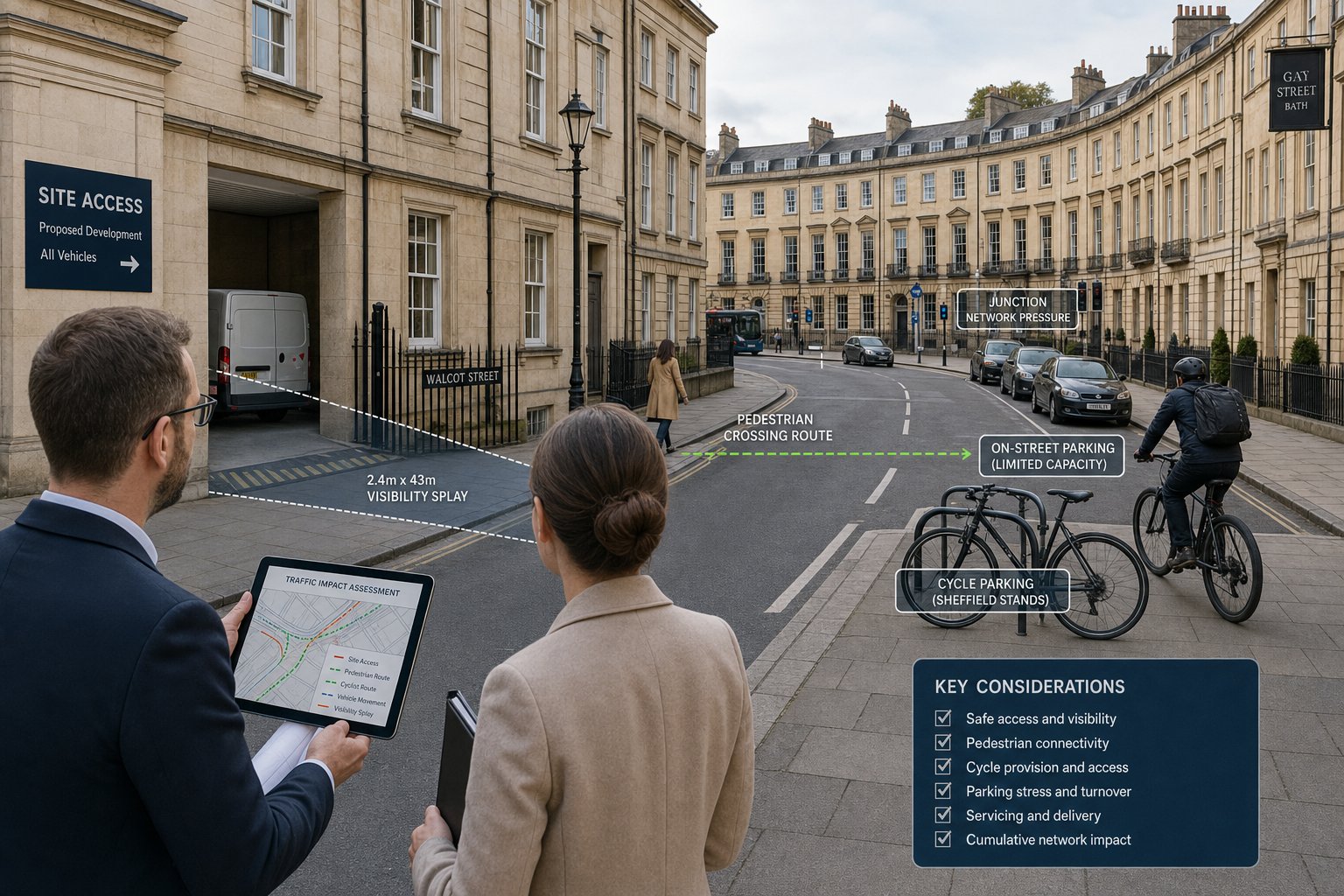
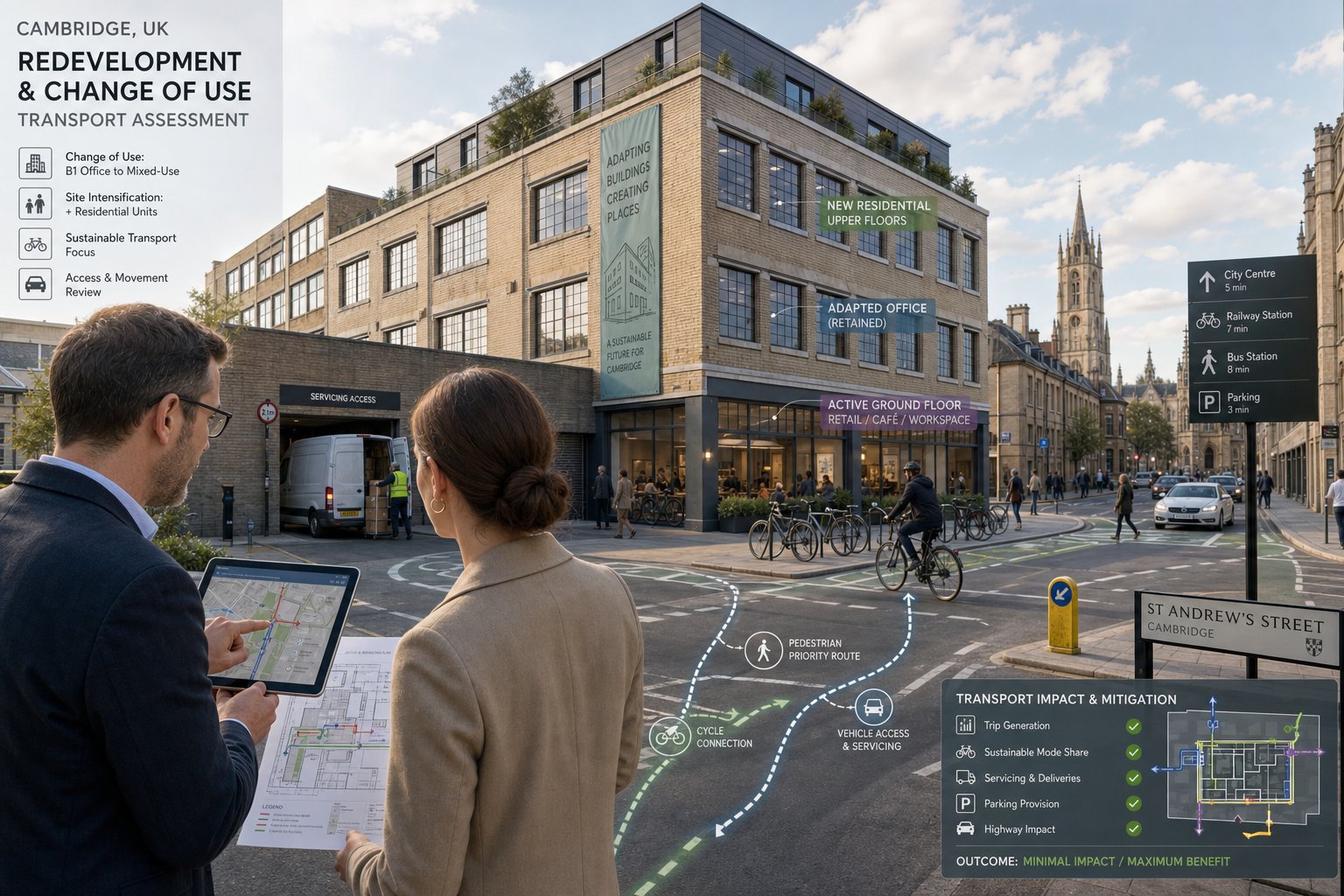
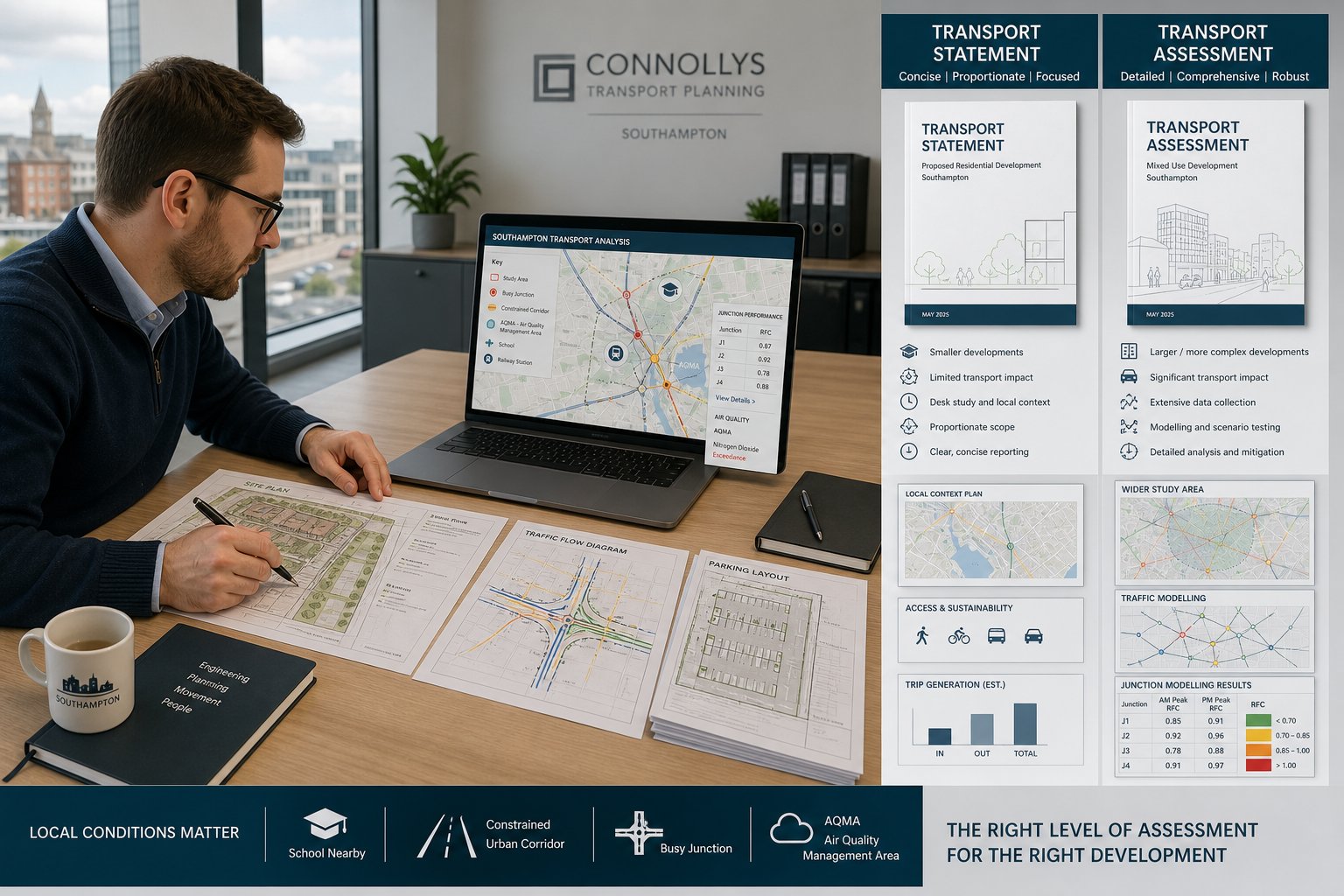
    Transport consultants reviewing development traffic plans in a modern UK office.

    Good modelling does more than answer whether a junction is over capacity. It gives decision-makers confidence that a proposal has been tested properly, that likely impacts are understood, and that mitigation is realistic.

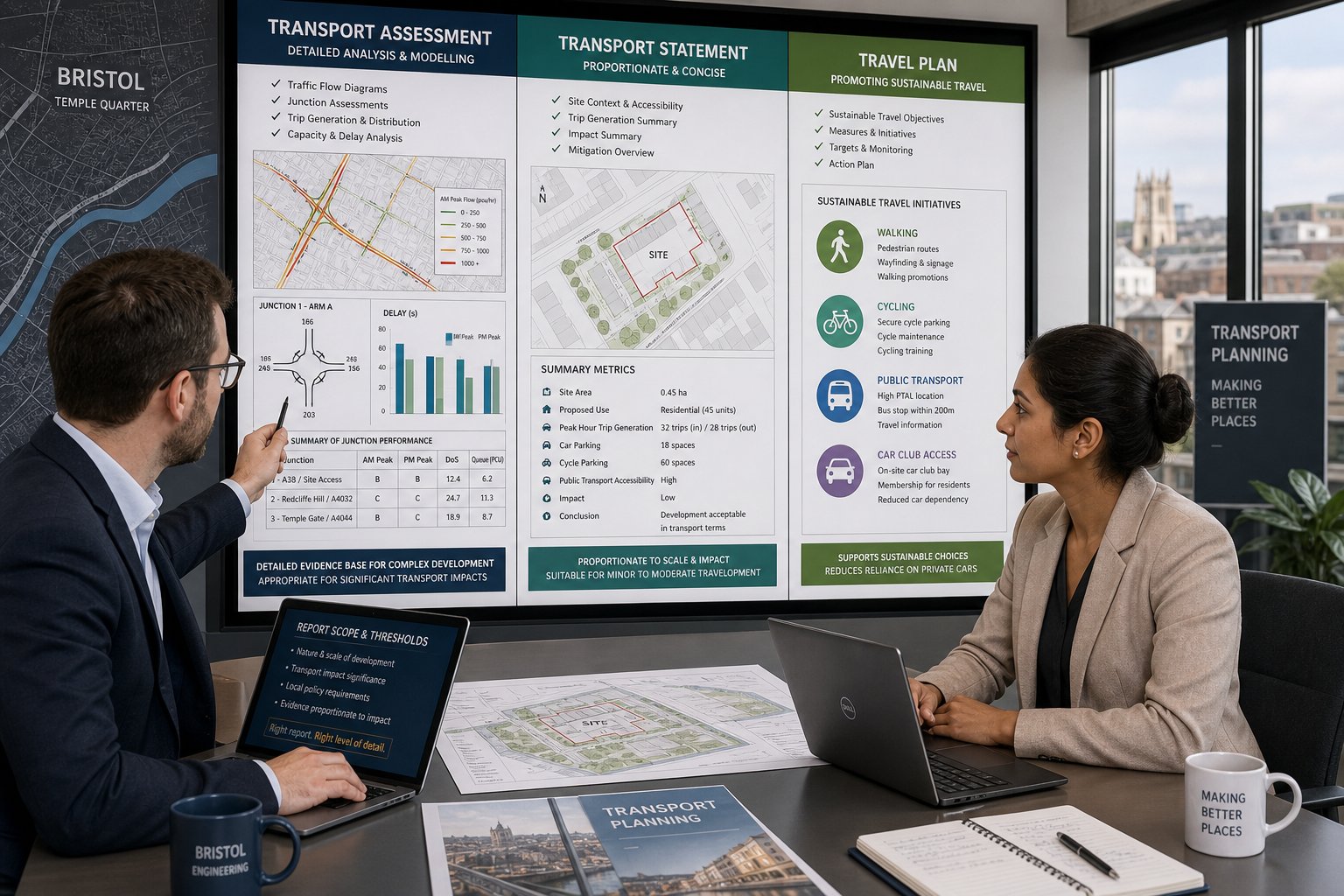
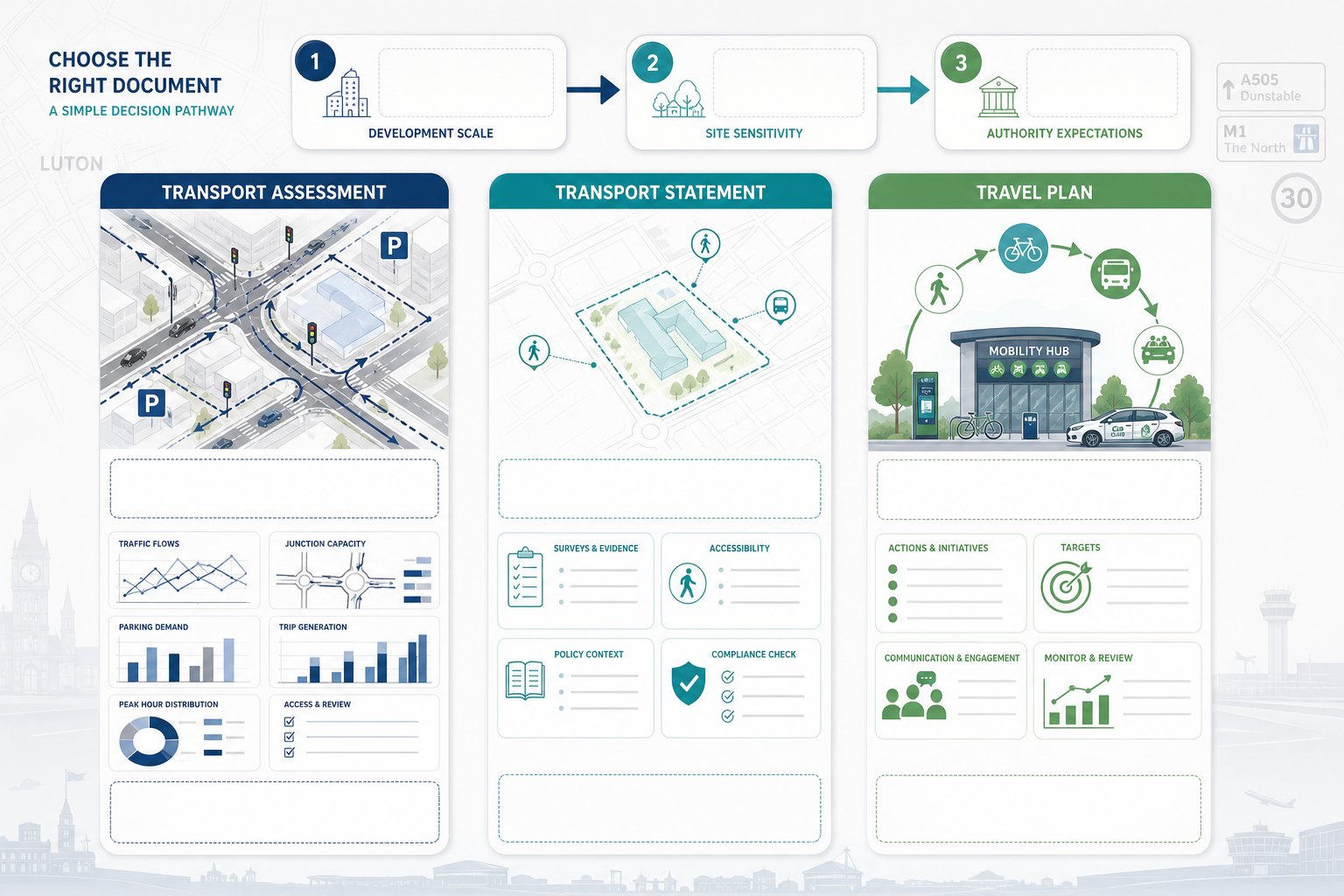
    For planning applications, modelling often underpins Transport Assessments, Transport Statements and, on larger or more sensitive schemes, Environmental Impact Assessment chapters. It can show how development traffic would distribute across the network, whether queues remain within acceptable bounds, where rat-running or operational stress may emerge, and what improvements could offset harm. That evidence can be critical where local concerns focus on congestion, access safety, bus reliability or cumulative development impacts.

    At strategy stage, modelling helps shape the scheme itself. It can inform where an access should sit, whether a ghost island right-turn lane is needed, how internal roads should operate, what parking levels look robust, and whether travel plan measures have a realistic chance of changing mode share. On phased developments, it also supports infrastructure trigger points: what needs to be delivered first, what can wait, and what future monitoring may be appropriate.

    For local plans, regeneration frameworks and major masterplans, the value is broader still. Modelling helps test policy-led growth options, compare scenarios, and understand trade-offs between development capacity and transport investment. In other words, it is not just a defensive planning tool. Used well, it becomes a design and strategy tool too.

    Common Project Types That Require Transport Modelling Input

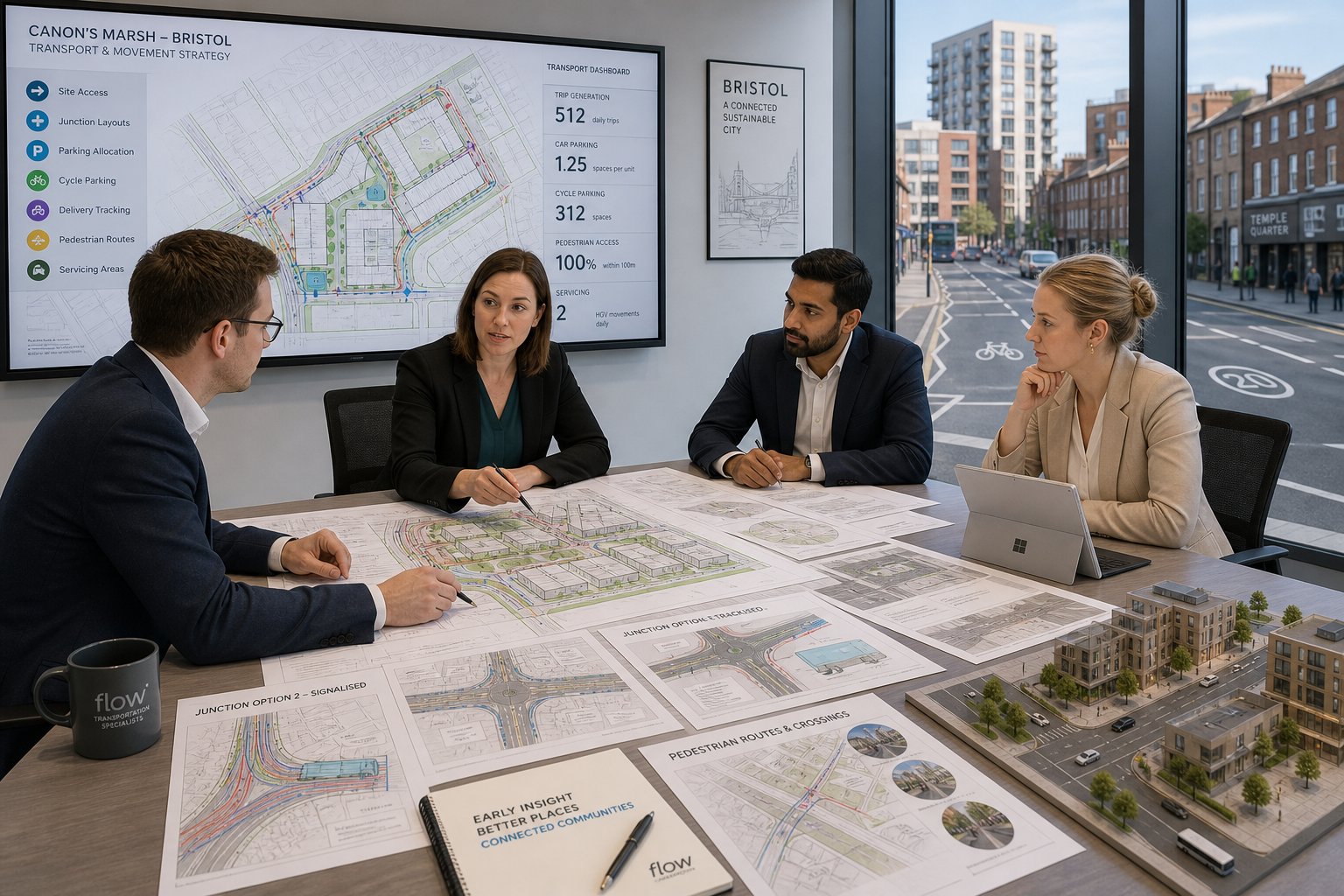
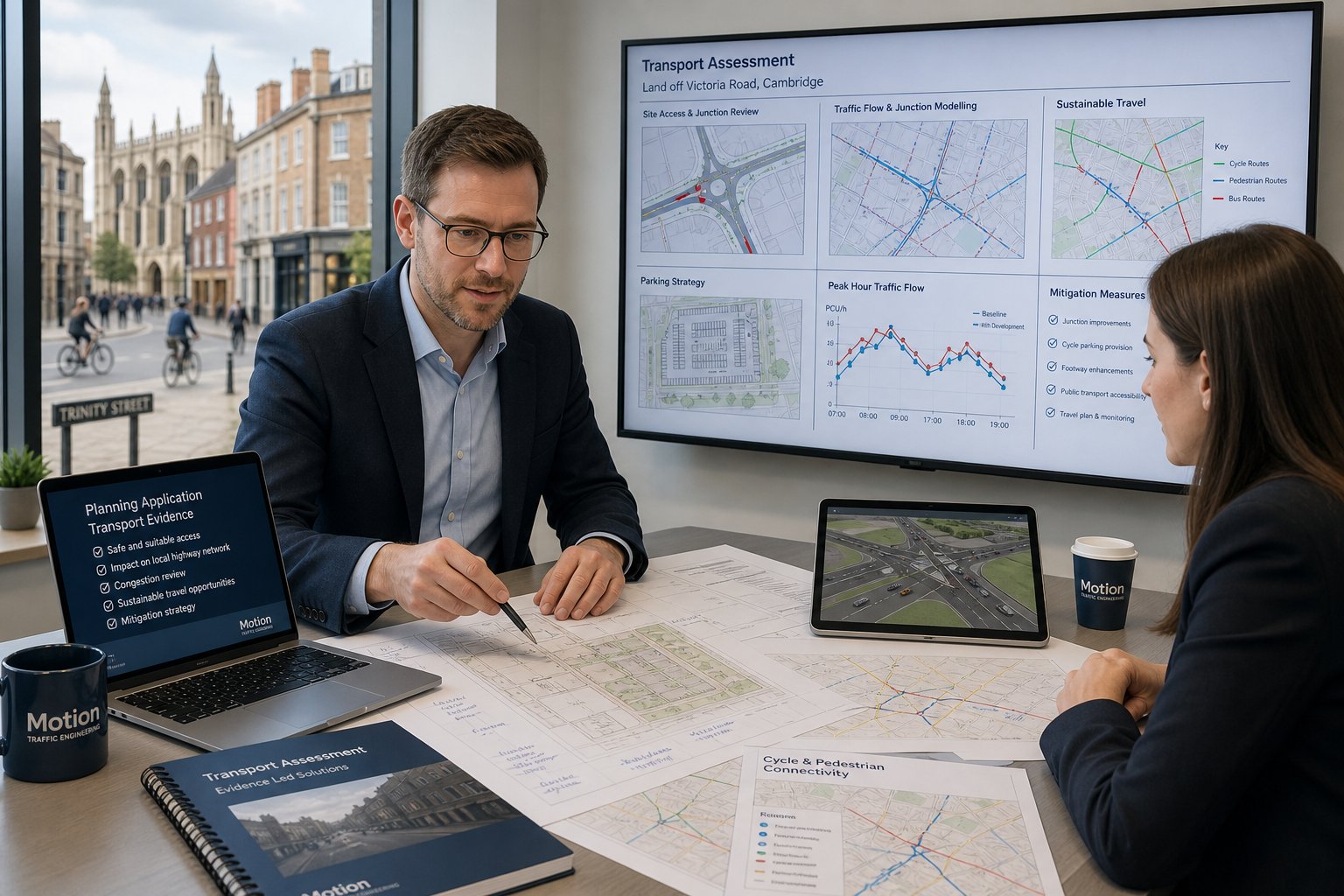
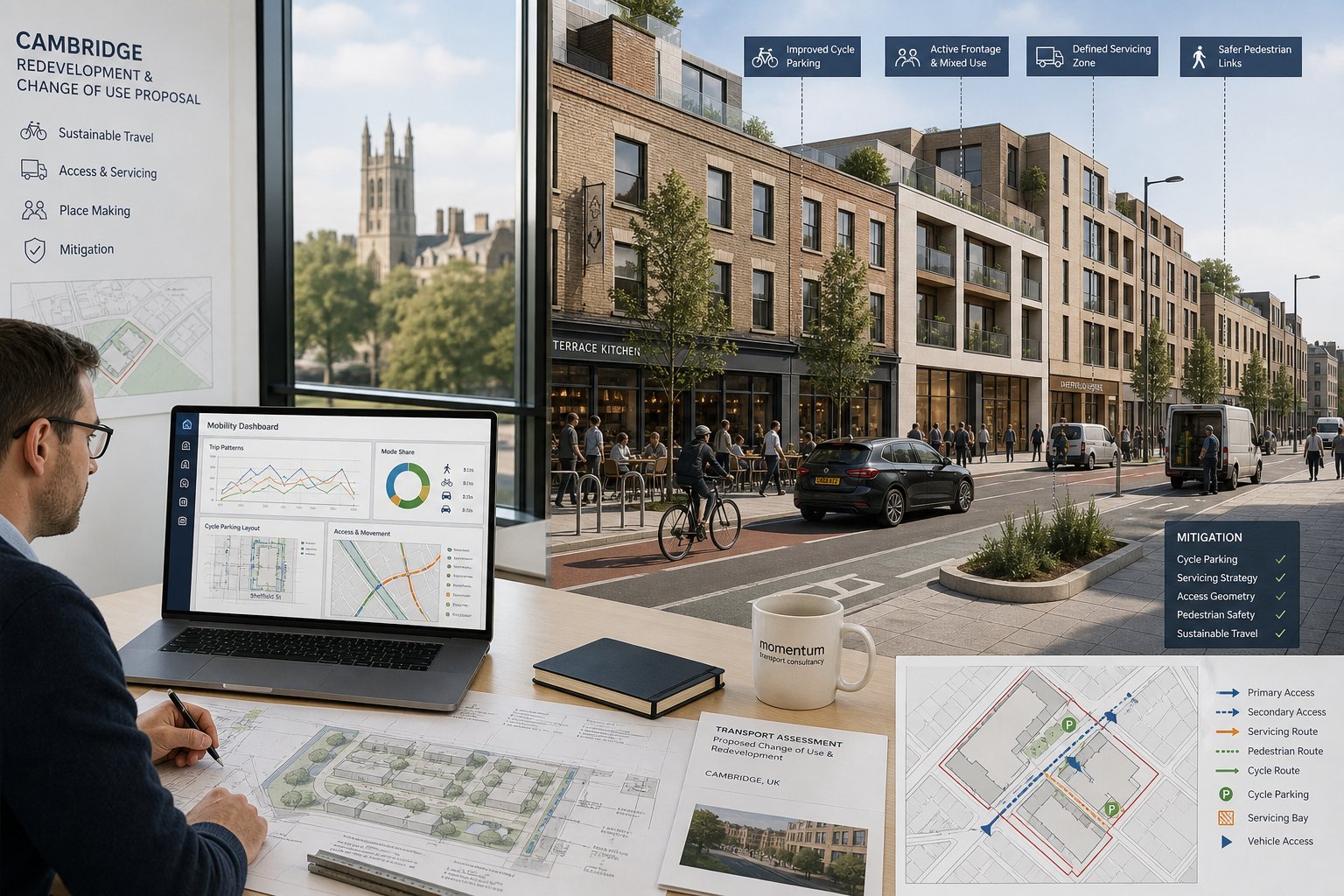
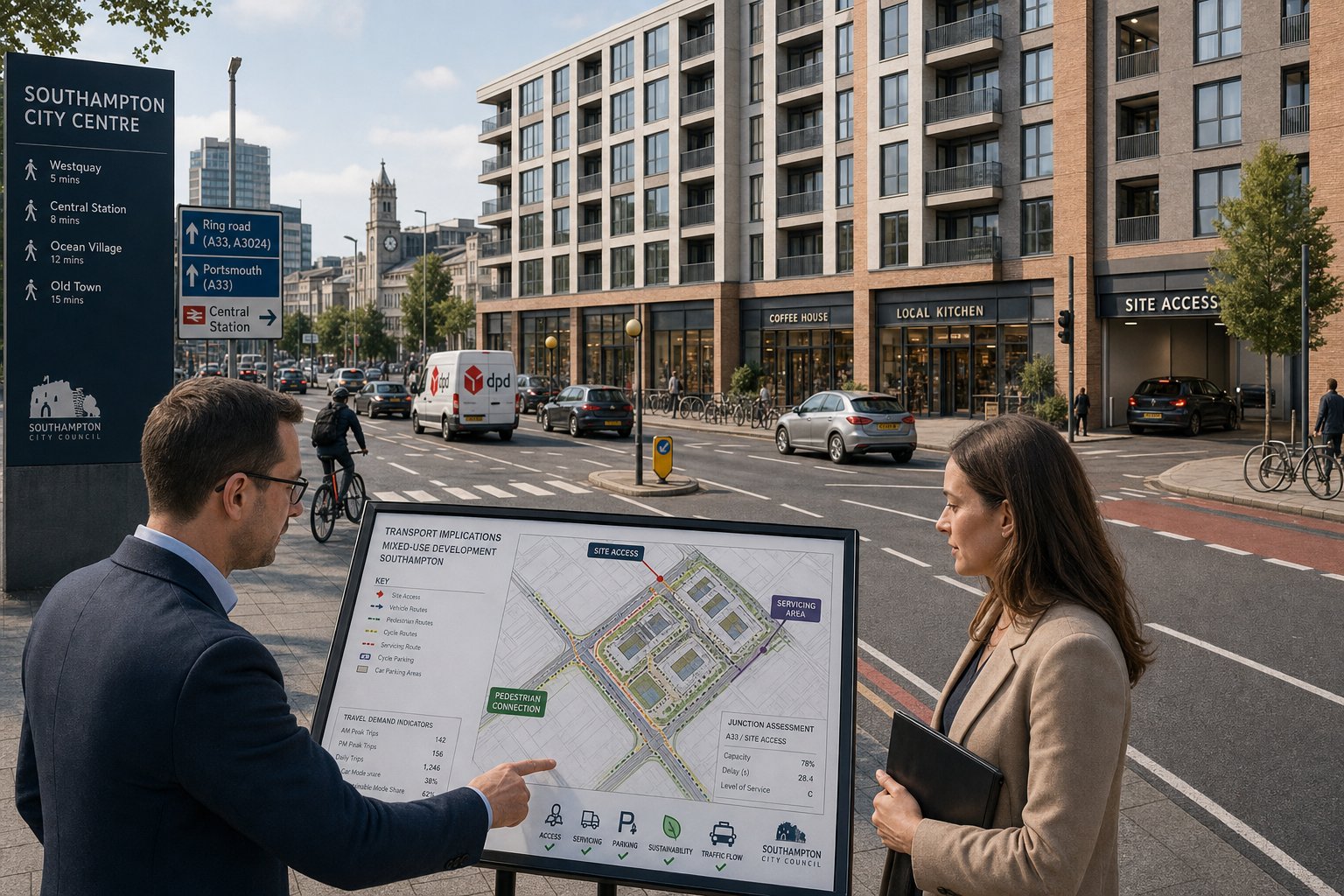
    Consultants reviewing transport impact maps and planning documents in a modern office.

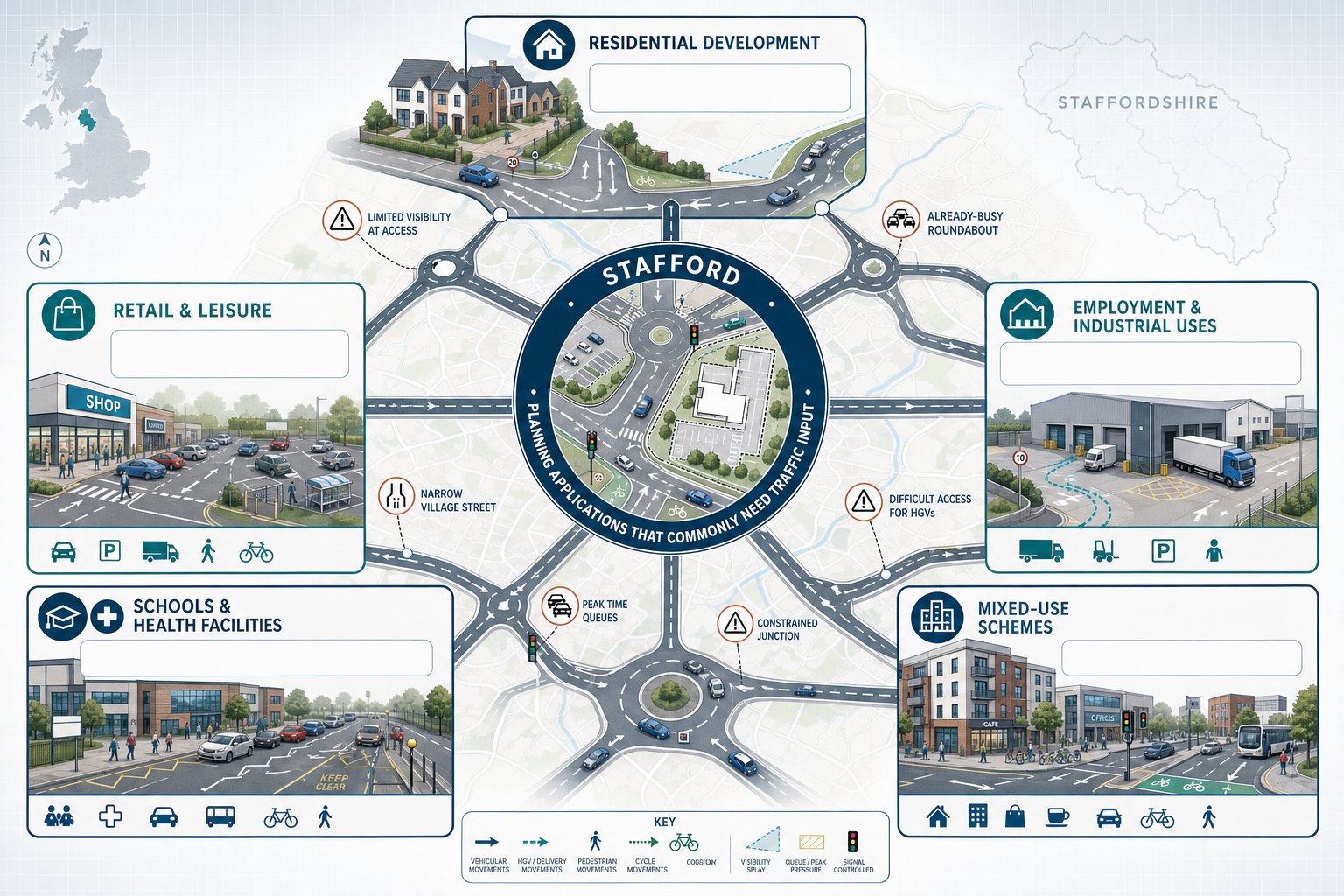
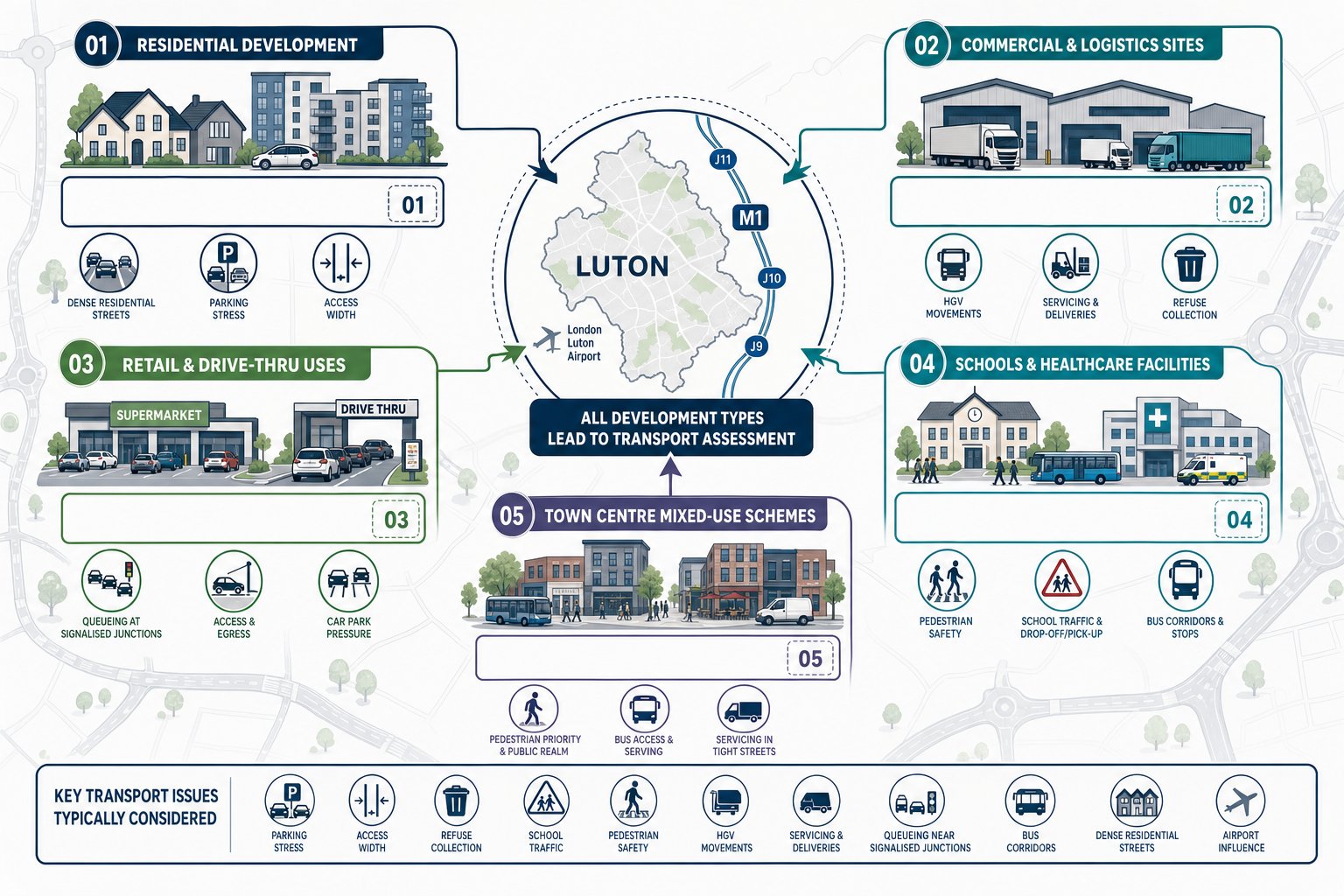
    Not every planning proposal needs a sophisticated model, but many more schemes require transport modelling input than clients first assume. The deciding factor is usually the scale and sensitivity of the impact rather than the headline size alone.

    Residential, Mixed-Use, Commercial, And Employment Schemes

    Residential schemes are a common trigger, especially where access is onto a constrained road network or where cumulative growth is already an issue. Even a moderately sized housing site can prompt requests for junction modelling if nearby priority junctions, roundabouts or signals are close to capacity.

    Mixed-use development often needs a broader approach because trip patterns vary by time of day and by land use. Offices, retail, leisure and residential uses can overlap in awkward ways, and internalisation assumptions need to be credible. Employment and logistics schemes add another layer: vehicle mix, servicing patterns, shift changes and routing restrictions can all materially affect local roads.

    Commercial schemes, particularly roadside retail, drive-thru formats, trade counters and urban warehousing, also attract scrutiny because peak effects may not align neatly with standard commuter peaks. That’s where experienced consultants earn their keep: they know when standard assumptions will be challenged and when bespoke surveys or sensitivity tests are wiser.

    For development teams, the practical point is simple. If your site relies on highway capacity, access performance, parking operation or sustainable travel claims to make the planning case, modelling is often part of the evidential backbone.

    Local Authority, Infrastructure, And Junction Improvement Projects

    Local authorities use transport modelling for a different, though related, set of reasons. Here the goal is often to justify intervention, compare options and demonstrate value for money rather than simply establish development acceptability.

    Corridor studies, junction upgrades, bus priority measures, public realm schemes and active travel interventions all benefit from modelling when network effects are uncertain or politically sensitive. A change that looks minor on a drawing can have knock-on effects several links away. Councillors and stakeholders will usually want evidence that those effects have been thought through.

    On larger infrastructure projects, modelling may feed strategic business cases, outline business cases and funding submissions. That can involve testing future demand, reassignment across the wider network, mode shift, public transport impacts and economic appraisal assumptions. Strategic road links, rapid transit proposals and rail-related access projects often sit in this category.

    There is also a middle ground: authority-backed regeneration and masterplanning work. In these cases, modelling helps answer how much growth the network can absorb, what package of measures is needed, and whether delivery can be phased. It becomes a tool for consensus-building as much as analysis.

    The Main Types Of Transport Modelling Used In The UK

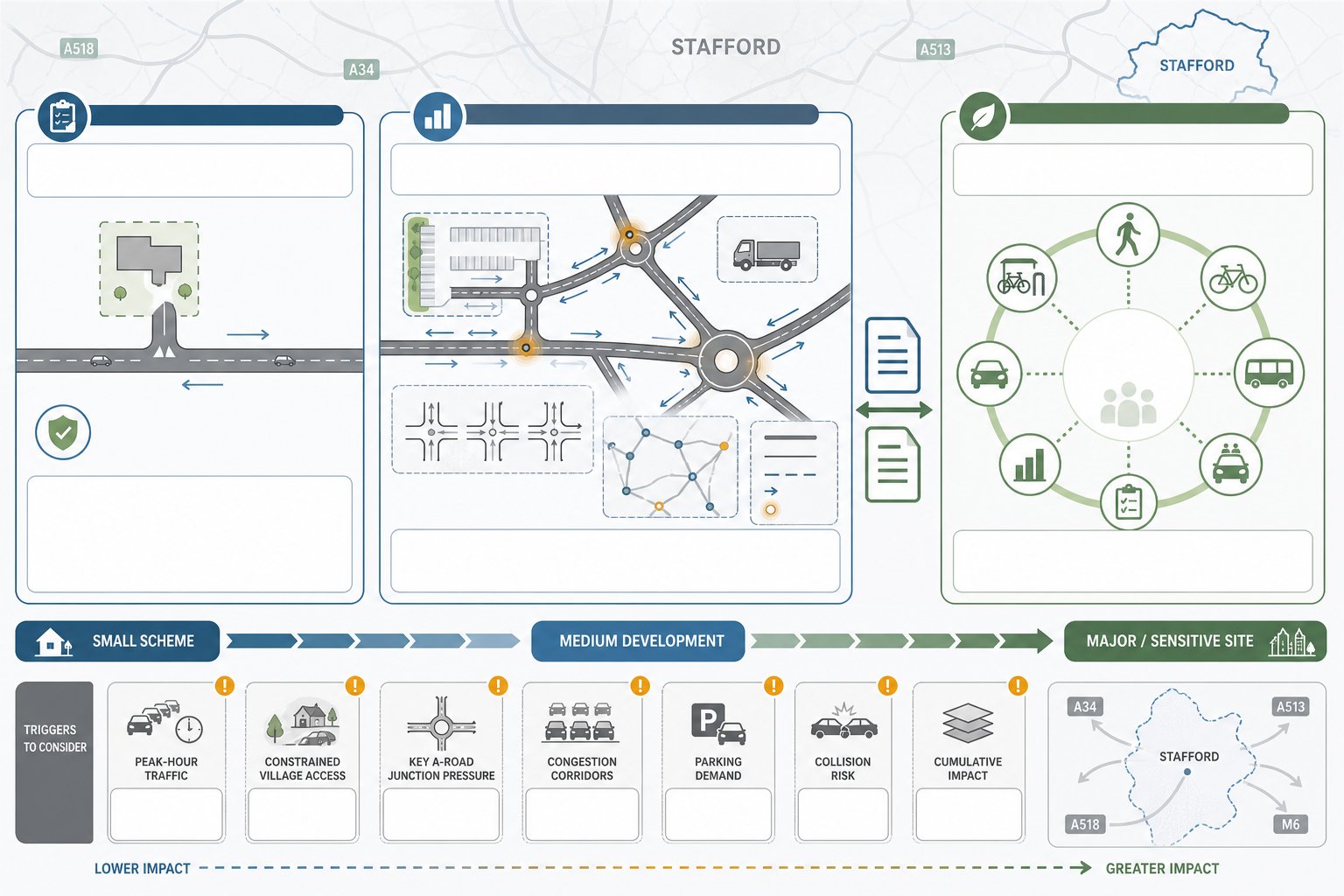
    The phrase transport modelling covers a wide range of methods. Choosing the right one is part science, part judgement. The best consultants are rarely those who reach for the most complicated model first: they are the ones who match the method to the question being asked.

    Junction Modelling, Micro-Simulation, And Strategic Network Models

    At the more focused end, junction modelling is used to test the operational performance of individual priority junctions, roundabouts and signal-controlled layouts. It is commonly used for planning applications because it can assess practical questions quickly: will queues increase, will reserve capacity fall below acceptable levels, and does a revised layout solve the issue?

    Micro-simulation sits a level up in complexity. It models individual vehicle movements across more complex areas such as linked junctions, gyratories, town centres or multi-arm signal systems. This is useful where driver interaction, lane choice, blocking back or pedestrian activity materially affects outcomes. If a simple junction model strips too much reality away, micro-simulation can give a more representative picture.

    Strategic network models operate at a wider scale. They divide an area into zones and estimate trips between them, often across multiple modes. These models are used to test broader growth scenarios, local plan options, major infrastructure proposals and cumulative impacts across towns, cities or regions. In some areas, local authorities already maintain strategic models that developers must use or interface with.

    Each model type has strengths and blind spots. A single-junction model won’t answer strategic rerouting effects, and a strategic model won’t tell you much about lane discipline outside one access. That sounds obvious, but poor project scoping often starts exactly there.

    Active Travel, Public Transport, And Multi-Modal Assessment Approaches

    UK practice is gradually moving beyond a car-only lens, and rightly so. Many planning decisions now turn on whether sustainable travel claims are evidenced, not just asserted.

    Active travel modelling can assess likely walking and cycling demand, route attractiveness, connectivity and sometimes level of service. This is especially useful on urban extensions, school-related schemes, regeneration projects and places where policy expectations around healthy streets or low-traffic design are strong. If a scheme depends on short local trips shifting away from the car, that assumption needs support.

    Public transport modelling may examine service accessibility, passenger assignment, timetable interactions, interchange quality and crowding. For developments near rail stations, bus hubs or proposed rapid transit corridors, this can be highly relevant. It also matters where a development’s acceptability rests partly on bus service enhancements or changes to public transport provision.

    Multi-modal assessment brings these strands together. Instead of asking only how many extra cars arrive at a junction, it looks at how travel demand is distributed across car, public transport, walking and cycling, and whether that pattern aligns with policy and investment objectives. On major schemes and public sector programmes, this broader perspective is often essential. It better reflects how places actually function, and how they are increasingly expected to function in planning policy.

    How Consultants Use Modelling To Address Local Authority Concerns

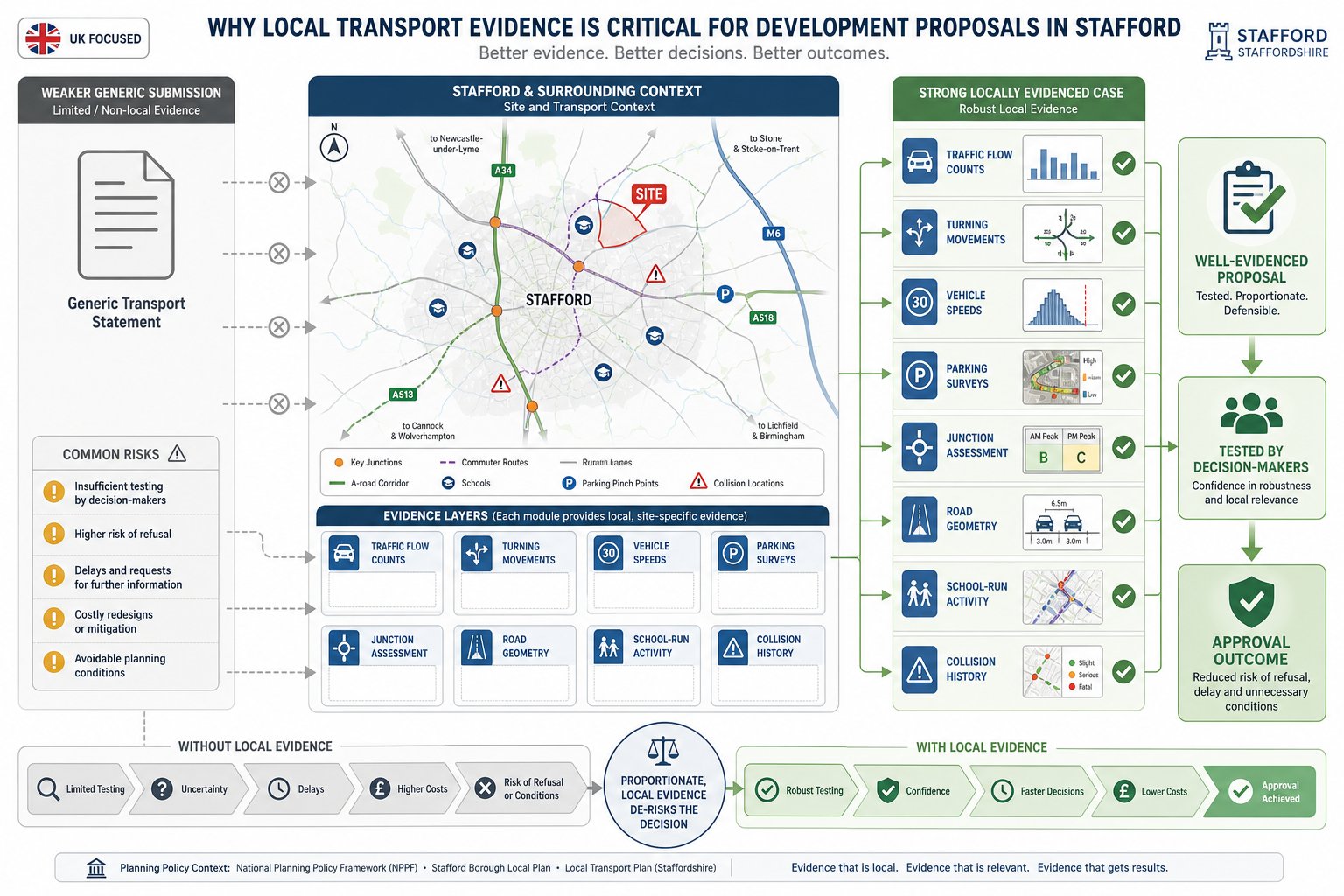
    Most transport objections from local authorities follow familiar themes: congestion, safety, cumulative impact, unrealistic trip assumptions, weak sustainable transport claims, or mitigation that looks tidy on a plan but fails operationally. Good consultants use modelling to deal with those concerns before they become reasons for refusal.

    One way is through mitigation testing. Rather than presenting a single preferred layout and hoping for approval, consultants can compare options: revised signal timings, geometry changes, ghost islands, lane allocation changes, access relocation, or package measures that spread demand more sensibly. This gives highway officers something they can interrogate, rather than something they must simply trust.

    Another is policy alignment. Authorities increasingly want to see evidence that a proposal supports sustainable mode share, parking restraint where appropriate, and network management objectives. Modelling can help demonstrate that assumptions about mode shift or public transport uptake are not plucked from thin air.

    Sensitivity testing is also crucial. Highway officers often ask: what if growth is higher, committed development comes forward sooner, or the travel plan underperforms? Robust modelling should answer those questions with calm, documented scenarios.

    Just as importantly, consultants need to communicate results clearly. Planners, committee members and residents are not reading software outputs for fun. They need straightforward explanations, sensible graphics and a transparent narrative. That is an area where experienced firms, including those used to producing concise authority-facing reports, tend to make a real difference.

    What Good Transport Modelling Consultants Should Provide

    At a minimum, good transport modelling consultants should provide a clear brief, a proportionate methodology, transparent assumptions and reporting that a non-specialist can follow. That sounds basic. It isn’t always delivered.

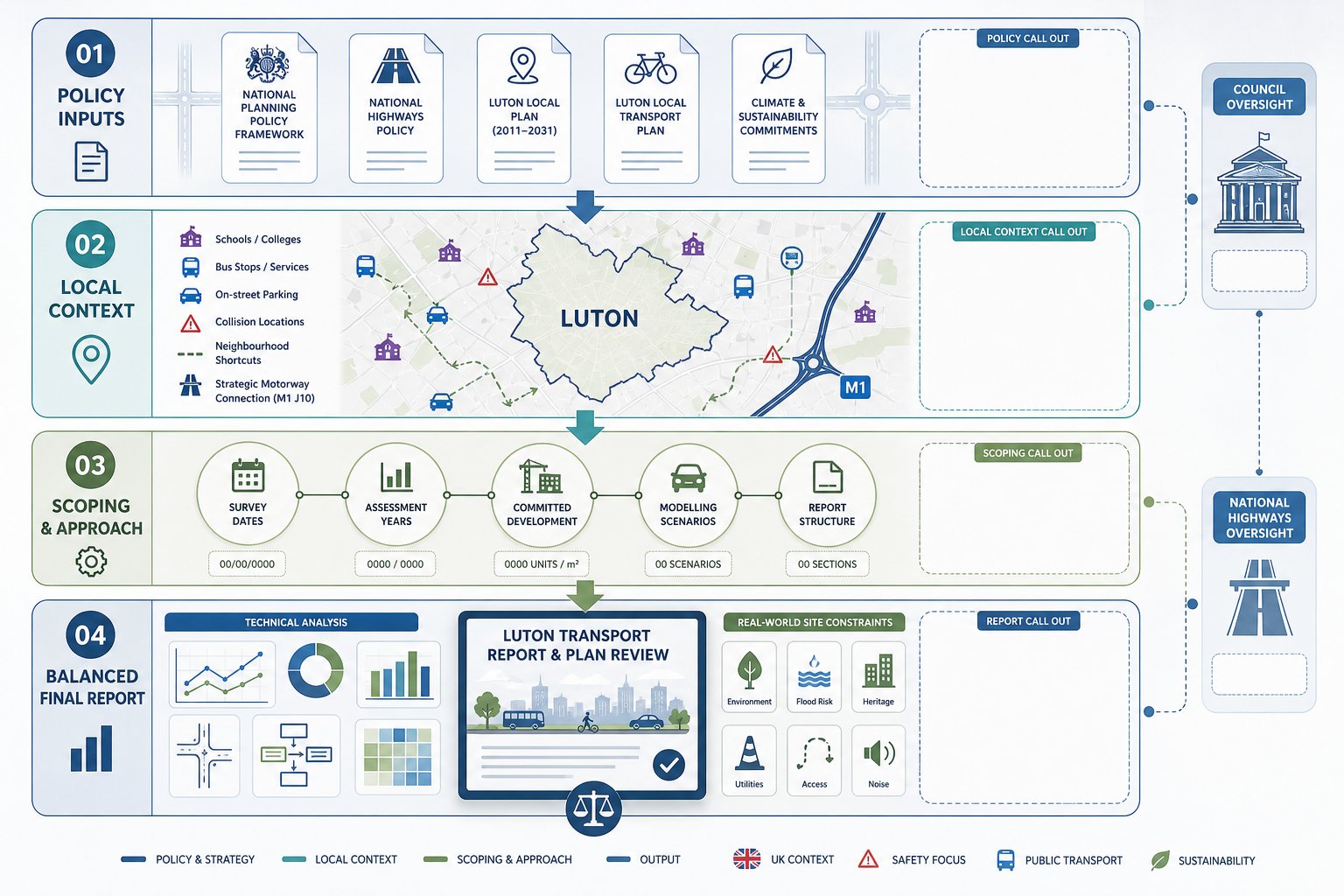
    We’d expect the methodology to reference relevant local and national guidance, whether that is DfT TAG principles, local validation requirements, or authority-specific expectations around future year scenarios and committed development. The consultant should also explain why the chosen model type is suitable. If a simple priority junction model is enough, they should say so. If the situation needs micro-simulation or a strategic model interface, that should be justified too.

    Data transparency matters just as much. Reports should identify count sources, survey dates, any seasonal adjustments, land-use assumptions, trip generation methods, trip distribution logic, mode split assumptions, and growth rates. A good consultant leaves an audit trail.

    Calibration and validation are another dividing line. If a model does not replicate observed conditions credibly, confidence in forecasts falls apart quickly. And forecasts are what planning decisions rely on.

    Finally, the outputs should be useful in the real world: readable plots, explainable scenario comparisons, and recommendations linked to design or planning strategy. On a practical level, firms such as ML Traffic position themselves around concise, accurate reporting tailored to local authority thresholds and planning contexts. That emphasis is not cosmetic: it is often what helps technical work land properly with decision-makers.

    Data, Assumptions, And Technical Quality Standards To Check

    If you are commissioning modelling, don’t just ask whether the consultant can run the software. Ask what sits underneath the outputs. Weak data and opaque assumptions can sink an otherwise polished report.

    Start with the base model. Are traffic flows, turning counts, queue lengths and journey times grounded in observed conditions? Were surveys carried out on representative days, avoiding school holidays, abnormal roadworks or unusual weather where possible? If older data is used, is there a convincing reason and an appropriate update method?

    Then look at development assumptions. Are trip rates drawn from appropriate sources and filtered sensibly? Is mode split realistic for the site context, not merely aspirational? Has trip distribution been explained in a way that reflects local travel patterns? And are future year growth assumptions consistent with accepted guidance and local evidence?

    Technical quality also depends on documented network coding, model checks, scenario control and peer review. For larger or strategic models, calibration and validation against observed counts and journey times should be demonstrable. For junction work, the geometry, lane use and signal staging need to match what exists or what is genuinely proposed.

    Three client questions are especially useful:

    • Are the base flows and queues believable to anyone who knows the site?
    • Are development trips and growth assumptions proportionate and evidence-led?
    • Have mitigation options been tested systematically, not just presented as a single answer?

    If those points are weak, planning risk tends to rise very quickly.

    How To Choose A Consultant For Your Site, Programme, And Planning Risk

    Choosing between transport modelling consultants is not just about technical capability. It is about fit: fit with your scheme type, fit with the local authority, fit with your programme, and fit with the level of planning risk you can tolerate.

    First, look for relevant experience. A consultant who understands residential edge-of-settlement sites may not be the right choice for an urban regeneration framework or a logistics park with complex HGV routing issues. Ask what similar projects they have handled, what modelling tools they used, and what the planning outcome was.

    Second, check local authority familiarity. Many UK authorities have particular preferences about assessment years, committed development assumptions, strategic model interfaces or presentation style. A consultant who knows those expectations can often avoid avoidable debates.

    Third, test how they think about programme. Can they sequence survey work, scoping, modelling, mitigation design and reporting in a way that supports your application timetable? Can they move quickly if the authority asks for further sensitivity tests? Speed without rigour is dangerous, but rigour without responsiveness can be just as costly.

    Fourth, assess communication. You want a consultant who can talk comfortably with architects, highways engineers, planners, solicitors and committee audiences. Transport modelling is one of those disciplines where technical brilliance loses value if nobody understands the implications.

    Finally, ask how they manage planning risk. Do they flag weaknesses early? Do they recommend proportional work, or sell complexity for its own sake? The right consultant should make the route to consent clearer, not murkier.

    Conclusion

    In 2026, transport modelling consultants play a much bigger role than simply producing traffic numbers for the appendix of a Transport Assessment. They help shape access strategies, test mitigation, support policy compliance, and reduce the risk that a scheme stalls on transport grounds.

    For developers, planners, architects, lawyers and councils, the key is choosing a consultant who combines sound technical modelling with planning judgement and clear communication. The best teams understand local authority concerns, use proportionate methods, document their assumptions properly, and turn evidence into a decision-ready story.

    If we are selecting support for a live project, we should be asking a straightforward question: will this consultant help us understand risk early and present a robust, credible case when scrutiny comes? If the answer is yes, the modelling is likely to do its job. If not, even a sophisticated model may become just another hurdle in the planning process.

    Transport Modelling Consultants – Frequently Asked Questions

    What do transport modelling consultants do in the planning process?

    Transport modelling consultants analyse travel patterns, build models to test development impacts, assess capacity and safety, and provide evidence for planning applications and funding bids to support informed decision-making and mitigate planning risks.

    When is it necessary to hire a transport modelling consultant?

    You need a transport modelling consultant when a scheme has material traffic impacts, when a local highway authority requests modelling for a Transport Assessment, or for preparing business cases for major infrastructure schemes requiring detailed traffic and travel demand analysis.

    How does transport modelling support development strategy and planning applications?

    Modelling underpins Transport Assessments and Environmental Impact Assessments by demonstrating traffic impacts and mitigation options. It also informs access strategies, site design, phasing, and policy-led masterplans, ensuring developments function sustainably and comply with local authority expectations.

    What types of projects commonly require transport modelling input in the UK?

    Projects include residential, mixed-use, commercial, employment and logistics sites, town and city centre regeneration schemes, local authority corridor and junction improvements, and strategic road or public transport infrastructure developments.

    What are the main transport modelling methods used by consultants in the UK?

    Consultants use junction models for single intersections, micro-simulation for complex corridors or town centres, and strategic network models for multi-zone, multi-modal urban or regional analysis, complemented by active travel and public transport modelling as needed.

    How can I select the right transport modelling consultant for my project?

    Choose a consultant with relevant UK experience for your scheme type and local authority, proficiency in required software and standards, a strong track record in securing planning permissions, capability to integrate planning and engineering, and the ability to manage programme and planning risk effectively.

  • Cycling Infrastructure Design In 2026: What Good Schemes Get Right From Planning To Delivery

    Cycling Infrastructure Design In 2026: What Good Schemes Get Right From Planning To Delivery

    Good cycling infrastructure design is no longer a ‘nice to have’ in planning. For architects, developers, councils and transport consultants, it has become one of the clearest tests of whether a scheme is genuinely future-ready. If a route feels unsafe, indirect or awkward at junctions, people simply won’t use it. And that has consequences far beyond transport: weaker sustainability credentials, poorer accessibility, tougher planning negotiations and, often, avoidable redesign.

    We’re seeing this shift across the UK. Local authorities are leaning more heavily on active travel policy, while applicants are under greater pressure to show how developments support low-carbon movement, healthier streets and realistic alternatives to private car use. High-quality cycle provision can help unlock mode shift, reduce pressure on parking, improve access to town centres and public transport, and strengthen the overall planning case.

    But quality is the operative word. A painted lane squeezed into the door zone or a shared path that disappears at every side road won’t meet modern expectations. The benchmark is now much clearer, shaped by LTN 1/20, local policy, collision evidence and lessons from successful Dutch-style networks.

    In this guide, we set out what good cycling infrastructure design gets right from the earliest planning stages through to delivery and long-term operation, with a focus on the issues that matter most in planning applications, transport assessments and development-led street design.

    Why Cycling Infrastructure Design Matters In Planning And Development

    Infographic showing how cycling infrastructure improves safety, access, planning and sustainability.

    Cycling infrastructure design matters because it sits at the intersection of transport, placemaking, public health and policy compliance. In practical planning terms, it helps answer a basic question: can people reach the site safely and conveniently without relying on a car?

    That question now carries real weight. National and local planning policy increasingly expects development to support sustainable travel, cut emissions and create healthier communities. Proper cycle provision helps schemes do all three. It can reduce local congestion, lower carbon impacts and improve access to jobs, schools, centres and interchanges. For compact urban extensions and mixed-use sites especially, that is central rather than peripheral.

    There is also a safety dimension. Evidence is fairly consistent: where routes are protected from fast or heavy traffic, and where junctions are designed to reduce conflict, cycling levels rise and perceived risk falls. That combination matters in development planning because uptake depends as much on comfort as on technical connectivity.

    From our side of the industry, we also know this is where planning applications can strengthen or weaken quickly. A transport statement that mentions cycling in broad terms but shows no coherent network logic, no desire-line analysis and no realistic route quality will attract scrutiny. By contrast, a scheme that embeds cycling from the outset tends to present a much more credible case for sustainable access, often making wider transport discussions easier to resolve.

    The Core Principles Of Safe, Direct And Attractive Cycle Networks

    Infographic of five principles for safe and connected UK cycle networks.

    Good cycle networks are not defined by a single facility type. They are defined by whether the whole journey works.

    LTN 1/20 and established Dutch practice broadly converge around five principles: cohesion, directness, safety, comfort and attractiveness. Those are not abstract ideals: they are practical tests we can apply to any route or development frontage.

    Cohesion means the network joins up. Homes should connect to schools, employment areas, local centres and stations without awkward breaks or sudden downgrades. A 300-metre missing link can undermine an otherwise decent corridor.

    Directness is about time and effort. Cyclists should not be sent on unnecessary detours, forced to give way repeatedly at side roads, or delayed by cumbersome two-stage crossings where motor traffic gets the straight line.

    Safety includes both objective risk and subjective confidence. A route may technically exist, but if it places a parent with a child beside 40 mph traffic with no protection, it fails the real-world test.

    Comfort covers width, surface quality, gradients, drainage and the ability to overtake or use adapted cycles. And attractiveness matters more than some teams admit. Well-lit, legible, overlooked routes with decent public realm are more likely to be used.

    When these principles are applied consistently, cycling infrastructure design stops being a bolt-on and starts functioning as part of a serious movement network.

    Understanding User Needs Across Different Trip Types And Rider Groups

    Inclusive cycling network infographic for different riders, trip types, comfort, and safety.

    One of the most common design errors is to imagine a confident commuter on a road bike and treat that as the default user. Real networks need to work for many more people than that.

    We should be designing for all ages and abilities: children travelling to school, older riders, people cycling slowly, users of adapted cycles, parents with trailers, and the growing number of e-bike and cargo-bike users. Their needs are not fringe cases. In many locations, they are the users who determine whether a route has broad appeal or remains niche.

    Trip purpose matters too. A commute into a city centre has different patterns from school drop-off, shopping trips, station access or leisure travel. Utility cycling often depends on direct local links, secure parking and routes that feel safe in ordinary clothes, not just at peak hour.

    This is where user comfort becomes decisive. Less confident riders are especially sensitive to close passing, poor lighting, blind corners, hostile junction geometry and surfaces that feel unreliable in wet weather. Social safety matters as well: isolated routes hidden behind buildings or landscaping may look neat on a plan but perform badly after dark.

    For planning work, that means we need to test routes against realistic users, not idealised ones. If an eight-year-old, an older resident or someone using a wider cycle cannot reasonably make the trip, the scheme probably needs another look.

    Choosing The Right Facility Type For Street Context And Traffic Conditions

    There is no universal cross-section that suits every street. The right answer depends on traffic speed, traffic volume, frontage activity, bus movements, available width and the strategic role of the corridor.

    As a rule, segregated cycle tracks are the preferred option on busier or faster roads. Where motor traffic volumes are significant, asking cyclists to mix with general traffic usually suppresses uptake, even if speeds are technically within limits at certain times of day.

    Light segregation can be useful where budgets or physical constraints are tighter and where a scheme needs quick deliverability. But it is not a magic fix. If the route becomes ambiguous at side roads, loading areas or bus stops, users still experience conflict.

    Mixed-traffic streets can work well, but only in genuinely low-speed, low-volume environments. In practice that often means 20 mph streets with traffic calming, filtered permeability or low-traffic neighbourhood principles, not simply a posted speed limit with unchanged geometry.

    Shared-use space tends to be over-prescribed. It may have a role in parks, green corridors or lower-footfall locations, but on busy urban desire lines it often transfers conflict from carriageway to footway rather than resolving it.

    The key is to match facility type to context honestly, not optimistically.

    Segregated Cycle Tracks, Light Segregation And Mixed-Traffic Streets

    Fully segregated tracks generally offer the strongest safety case and the highest level of user confidence. They are especially appropriate on strategic corridors, around major development frontages and on roads carrying heavier vehicles or higher speeds. If the objective is genuine mode shift, this is often where we need to land.

    Light segregation, using wands, bolt-down kerbs or similar separators, can provide a meaningful interim step. It is faster to carry out and sometimes the only realistic short-term option. Still, it needs careful detailing at every crossing point, otherwise protection evaporates exactly where risk increases.

    Mixed-traffic streets can be excellent when they are designed, not merely labelled, for cycle priority. Filtered permeability, narrow entry treatments, reduced turning speeds and low volumes can create streets where cycling feels normal. That is very different from expecting cyclists to “take the lane” in hostile conditions.

    Junction Design: The Critical Point For Safety, Capacity And Compliance

    If links are important, junctions are decisive. Most serious conflicts for cyclists happen where paths cross, turn or merge with motor traffic. A route that feels comfortable mid-block but becomes stressful at every major node will underperform, but attractive it appears on a plan.

    Good junction design reduces conflict, lowers turning speeds and clarifies priority. That can include protected junction layouts, set-back crossings, dedicated cycle signals, early-release stages, low-level signal heads, waiting islands and two-stage turn provision where appropriate. The precise arrangement varies, but the objective is consistent: remove ambiguity and minimise exposure.

    From a planning and compliance perspective, this is also where schemes often come unstuck. Reviewers tend to look closely at whether cyclists retain priority, whether crossing distances are reasonable, whether signal staging causes excessive delay, and whether design vehicles have been prioritised at the expense of rider safety.

    Capacity matters too. Narrow waiting areas, tight radii and poor alignment can create pinch points just where cycle flows are likely to be highest. With e-bikes and cargo bikes becoming more common, assumptions based on older, narrower user profiles are increasingly outdated.

    In short, if a development claims to support active travel, its junctions need to prove it.

    Designing For Side Roads, Signal-Controlled Junctions And Roundabouts

    At side roads, continuous footway and cycleway treatments or raised tables can make priority legible and physically slow turning traffic. Without that, drivers tend to treat cycle crossings as optional interruptions.

    At signal-controlled junctions, we should be looking carefully at dedicated cycle stages, early starts, separate turning movements and detection technology that reduces unnecessary delay. Riders are much less likely to comply with convoluted staging if the direct route feels withheld for no clear reason.

    Roundabouts require particular care. Large, multi-lane, high-speed forms are generally poor for cycling and difficult to justify where safer alternatives exist. Compact roundabouts with low entry speeds, or perimeter cycle tracks with clear priority crossings, tend to perform far better. This is one area where design ambition really shows.

    Width, Alignment, Visibility And Surface Quality Requirements

    These are sometimes treated as technical details to be tidied up later. They are not. Width, alignment, visibility and surface quality shape whether a route feels usable every day.

    Width must reflect actual operation, not a bare minimum squeezed between other priorities. Two-way movement, overtaking, cargo bikes, adapted cycles and occasional maintenance access all affect what is workable. A route that is technically compliant on paper can still fail in practice if users cannot pass comfortably or if edge constraints reduce effective width.

    Alignment should be intuitive and forgiving. Sudden deflections, awkward chicanes, unnecessary vertical changes and sharp turns near conflict points create discomfort and risk. They also make cycle movement feel like an afterthought compared with the straighter path given to cars.

    Visibility is critical at side roads, private accesses, bends and crossing points. Parking bays, planting, cabinets and signage can all create hidden conflicts if not managed carefully. We often see layouts where visibility splays for drivers are considered meticulously while cyclists are screened from view at exactly the wrong moment.

    And then there is the surface. Cycles are far less tolerant than cars of cracking, ponding, utility covers, poor reinstatements or slippery materials. Smooth, machine-laid asphalt is often the benchmark for good reason. If the route is uncomfortable in winter or after heavy rain, people notice immediately, and planning promises about active travel start to ring hollow.

    Integrating Cycling With Walking, Public Transport And Accessibility Duties

    Cycling should not be planned in isolation. The strongest schemes are the ones that work as part of a wider access strategy, complementing walking routes, public transport and inclusive design obligations.

    The relationship with walking is especially important. In busy centres and around schools, hospitals or stations, defaulting to shared-use can generate friction rather than convenience. Pedestrians need clear, legible footways, safe crossings and confidence that cycle movement will not intrude into space intended primarily for walking. Where cycling and walking are brought together, delineation and low-conflict design become essential.

    Integration with public transport is another planning priority. Safe cycle access to bus stops, rail stations and mobility hubs extends the reach of public transport and helps solve the “last mile” problem. That may involve careful bus stop bypass design, direct links to station entrances and secure parking at interchanges.

    Then there are accessibility and equality duties. Designers need to account for disabled people, visually impaired users, wheelchair users and others who depend on clarity in the street environment. Tactile paving, step-free movement, controlled crossing points, kerb upstands and unambiguous route delineation all matter. This is not just good design practice: it is part of legal and policy compliance.

    When these layers are considered together, schemes become more robust and much easier to defend through planning review.

    Cycle Parking, End-Of-Trip Facilities And Development Site Layout

    A high-quality route to a site is only half the job. If people arrive and find nowhere secure or convenient to leave a bike, the journey chain breaks.

    Cycle parking should be secure, accessible and close to destinations. For many schemes, that means well-placed Sheffield stands for visitors, covered long-stay parking for staff and residents, and secure stores for higher-value bikes and e-bikes. Spacing matters. So does ease of use. Two-tier systems can be efficient, but they are not ideal for everyone, especially where heavy bikes or adapted cycles are expected.

    End-of-trip facilities are often overlooked in commercial development yet can make a real difference to commuting by bike. Showers, lockers, drying rooms and changing space are not glamorous planning items, but on office, education and larger employment sites they can materially improve uptake.

    The wider site layout is just as important. Internal roads should not force cyclists into secondary, indirect routes behind servicing yards or parking courts. Good masterplanning gives cycle movement direct access through the site, priority where possible, and clear links to surrounding streets and off-site networks.

    This is an area where we often advise clients early. At ML Traffic, much of the value in transport reporting comes from identifying these layout issues before they harden into planning constraints or expensive redesign later.

    Drainage, Maintenance, Materials And Long-Term Operational Performance

    Delivery is not the finish line. A route that opens well but deteriorates quickly will lose users and attract complaints, sometimes within a single winter.

    Drainage is one of the most underestimated issues. Poor crossfalls, badly placed gullies and low spots on the cyclist desire line create ponding, debris build-up and skid risk. Because cycles track a narrower line than cars, defects that seem minor in a general highway audit can be disproportionately harmful.

    Materials also matter more than many budgets initially assume. Durable, smooth surfaces with good skid resistance tend to offer the best long-term value, even if upfront costs are slightly higher. Colour contrast can help with legibility, but it should not come at the expense of ride quality or maintenance practicality.

    Then there is maintenance. Sweeping, vegetation control, winter treatment and timely repairs are essential if a route is to remain attractive and safe. Debris in a cycle track is not a cosmetic issue: it pushes riders into conflict areas or deters use altogether. Likewise, faded markings and damaged separators can undo the clarity that the original design intended.

    For planning submissions, long-term operational thinking can be surprisingly persuasive. It shows the scheme has been designed not just to secure consent, but to function properly once handed over and used in real conditions.

    Using Policy, Standards And Transport Evidence To Support Planning Applications

    Strong planning applications do not simply state that cycling has been considered: they show how design choices are grounded in policy, standards and evidence.

    In the UK, LTN 1/20 remains the key technical reference point for cycling infrastructure design. Depending on context, proposals should also align with the National Planning Policy Framework, local transport plans, design guides, active travel strategies and site-specific allocation policies. The exact mix varies by authority, which is why local interpretation matters almost as much as national guidance.

    Evidence is what turns policy aspiration into a defensible planning case. Useful inputs often include traffic counts, speed data, collision records, desire-line analysis, school and employment catchments, census travel data, and tools that estimate cycling propensity. Health, carbon and placemaking benefits can also help frame the wider value of the proposal.

    This is where transport assessments and statements need to do more than tick a box. We should be explaining why a chosen facility type is appropriate, how it links into the surrounding network, what constraints have been balanced and where the design accords with accepted standards.

    For developers and consultants, a concise, authority-aware report often carries more weight than a bulky generic one. That is very much the approach we favour: accurate evidence, tailored to threshold requirements and local planning context, with no unnecessary padding.

    Common Design Mistakes That Lead To Objections, Rework Or Poor Uptake

    Most weak schemes do not fail because cycling was ignored entirely. They fail because it was acknowledged late, designed inconsistently or diluted at the points that mattered most.

    A frequent problem is the incomplete network: a strong frontage treatment that ends abruptly at the site boundary, or a route that never properly reaches the school, centre or station it is meant to serve. Another is the door-zone lane, narrow painted provision beside parked cars on roads where users plainly need protection.

    Junctions are a repeat offender. We still see designs where cyclists lose priority at every side road, wait through multiple signal stages, or negotiate large-radius turns designed mainly for vehicular convenience. Those details tend to trigger justified objections because they expose the gap between policy language and actual user experience.

    Over-reliance on shared-use paths is another issue, especially in busy town centres where pedestrian conflict is predictable. Poor drainage, rough surfaces, inconsistent widths and cluttered alignments also come up again and again.

    And increasingly, schemes run into trouble when inclusive design has not been thought through, whether that means inaccessible parking, weak delineation, or layouts that create new barriers for disabled users.

    If there is a common thread, it is this: good cycling infrastructure design depends on continuity and honest appraisal. The schemes that succeed are usually the ones that confront real conditions early, coordinate planning and engineering properly, and keep the user journey in view from first sketch to final delivery.

    Done well, that pays off. Applications are easier to support, streets function better, and the infrastructure actually gets used, which, after all, is the point.

    Cycling Infrastructure Design FAQs

    Why is good cycling infrastructure design important in urban planning?

    Good cycling infrastructure fosters safe, direct, and attractive routes that encourage people to choose cycling over cars. It reduces congestion, lowers emissions, improves public health, and supports access to jobs and services, making developments more sustainable and future-ready.

    What are the core principles that define safe and effective cycling networks?

    Effective cycling networks follow five key principles: cohesion (continuous routes), directness (minimal detours), safety (protection from fast traffic), comfort (adequate width and surfaces), and attractiveness (well-lit, legible, and pleasant routes). These ensure journeys work smoothly from origin to destination.

    How does cycling infrastructure design accommodate different types of users and trip purposes?

    Designs must serve all ages and abilities, including children, older adults, and users of adapted or cargo bikes. They should suit varied trip purposes like commuting, school runs, shopping, and leisure, prioritising comfort, security, and social safety to appeal beyond confident cyclists.

    What types of cycling facilities are recommended based on street traffic conditions?

    Segregated cycle tracks are preferred on busier or faster roads to enhance safety. Light segregation suits moderate traffic with space or budget limits. Mixed-traffic streets work only where speeds and volumes are very low, usually under 20 mph with traffic calming and filtering measures.

    How critical is junction design in cycling infrastructure, and what features improve safety there?

    Junctions are where most cycling collisions happen, so design must minimise conflicts by clarifying priority with protected junction layouts, cycle-only signal phases, advanced stop lines, waiting islands, and low vehicle turning speeds. Good junctions maintain safety and smooth cycling flow.

    What common mistakes in cycling infrastructure lead to poor usage or planning objections?

    Common errors include incomplete networks that fail to connect key destinations, narrow or unprotected lanes next to parked cars, poor junction priority treatments, overuse of shared-use paths causing pedestrian conflict, neglect of surface quality and drainage, and ignoring inclusive design for disabled users.

  • Pedestrian Priority Design In 2026: Principles, Street Types, And Planning Implications

    Pedestrian Priority Design In 2026: Principles, Street Types, And Planning Implications

    Streets are no longer judged only by how many vehicles they can push through a junction in the peak hour. Across the UK, the better question is simpler: does the street work for people? That shift sits at the heart of pedestrian priority design.

    In practical terms, pedestrian priority design gives walking greater importance than general traffic in the layout, operation, and day-to-day feel of a street. Sometimes that means a fully pedestrianised space. More often, it means something less absolute but more useful in planning terms: slower vehicle speeds, continuous footways, clearer crossing points, filtered access, and public realm choices that make walking the easiest and most intuitive option.

    For architects, planners, developers, highways consultants, and local authorities, this matters because pedestrian priority is no longer a niche urban design idea. It affects transport assessments, access strategies, servicing arrangements, street adoption discussions, placemaking ambitions, and the overall planning narrative. A scheme that looks attractive on a masterplan can still struggle if it hasn’t properly addressed vehicle access, bus movements, inclusive design, or displaced traffic impacts.

    We see this regularly in planning work. The strongest applications tend to be the ones that treat walking as a core transport function from the outset, not as decorative paving added at the end. In this guide, we’ll look at what pedestrian priority design means in 2026, where it works best, the features most commonly used, and the planning implications that applicants need to get right.

    What Pedestrian Priority Design Means In Modern Street Planning

    Infographic showing a people-first street design with walking prioritised over traffic.

    Pedestrian priority design is a street-planning approach that puts walking ahead of general traffic. That sounds straightforward, but in practice it changes a lot more than kerb lines. It affects how space is allocated, how junctions are designed, how people read a route, where vehicles can go, and what a street is actually for.

    Modern street planning has moved away from the old assumption that movement efficiency for cars is the main objective. Streets are now expected to perform several roles at once: movement corridor, social space, access route, frontage environment, and public realm. In that context, pedestrian priority design treats walking as the baseline mode because almost every trip begins or ends on foot.

    This doesn’t always mean banning vehicles. In many successful schemes, vehicles still operate, but under tighter conditions: lower speeds, restricted access, fewer turning movements, shorter crossing distances, and clearer visual cues that drivers are entering a people-first environment. Shared streets, school streets, filtered neighbourhood routes, and town-centre corridors can all sit under the same broad umbrella.

    For planning professionals, the key point is that pedestrian priority design is both a transport and placemaking strategy. It influences road safety, accessibility, development value, and policy compliance at the same time. That is why local planning authorities increasingly expect applicants to explain not only vehicle access, but also how a site supports direct, legible, attractive and inclusive pedestrian movement within and beyond the red line boundary.

    Why It Matters For Safety, Accessibility, And Place Quality

    Infographic showing safer, more accessible, people-friendly UK street design.

    The case for pedestrian priority design is strong because it aligns three objectives that are often treated separately: safer streets, better accessibility, and higher-quality places.

    On safety, lower vehicle speeds are the starting point. A street where drivers move slowly, encounter simpler junction geometry, and expect pedestrian activity is fundamentally less hostile than one designed around speed and capacity. That matters not just for collision severity, but for perceived safety too. Many people avoid walking routes that feel exposed, confusing, or dominated by traffic even if the formal collision record looks acceptable.

    Accessibility goes further than compliance with minimum dimensions. A genuinely walkable environment needs continuous routes, dropped kerbs where appropriate, crossing opportunities in the right places, good surface quality, lighting, rest points, and layouts that work for wheelchair users, older people, children, and visually impaired pedestrians. If a route is technically passable but awkward, indirect, or stressful, it is not truly inclusive.

    Then there is place quality. Streets with stronger pedestrian priority often support longer dwell time, better frontage activity, stronger local trade, and more social interaction. People notice shopfronts, stop for coffee, meet neighbours, and use the space as part of daily life rather than just passing through. That can support town-centre recovery and residential value alike.

    From a planning perspective, these outcomes are closely linked. A safer, more accessible street is usually a better place: and a better place often performs better as part of a sustainable transport network. The challenge, of course, is delivering those benefits without creating unresolved impacts for buses, servicing, emergency access, or displaced traffic on surrounding streets.

    Core Design Principles That Put People First

    Infographic showing four principles of pedestrian-first street design in the UK.

    At the scheme level, pedestrian priority design works best when it is guided by a few clear principles rather than a checklist of fashionable materials. The surface treatment matters, yes, but it cannot compensate for a layout that still gives vehicles the upper hand.

    We generally come back to four fundamentals: low speeds, simple conflict points, direct pedestrian desire lines, and inclusive usability. If those are present, the street has a good chance of functioning well. If they are absent, even an expensive public realm scheme can disappoint.

    Design should start with pedestrian movement patterns, not be retrofitted after carriageway geometry has been fixed. Where do people naturally want to walk? Where do they need to cross? What frontages, bus stops, schools, stations, or amenities generate footfall? How will a child, an older resident, or a wheelchair user experience the space at a wet November peak, not just in a summer visualisation?

    It is also worth saying that people-first design is not anti-vehicle design. Most developments still need access for residents, deliveries, refuse, maintenance, and emergency services. The aim is to manage that access in a way that reduces dominance rather than pretending it does not exist.

    Done properly, pedestrian priority is a network decision as much as a street decision. It should fit with surrounding walking routes, cycle links, bus operations, parking strategy, servicing arrangements, and the likely travel behaviour generated by the development.

    Typical Features Used In Pedestrian Priority Schemes

    Pedestrian priority schemes usually combine several physical and operational measures rather than relying on a single intervention. The exact mix depends on context, highway status, land use, traffic demand, and the authority’s design preferences.

    Some features are geometric: wider footways, tighter corner radii, shorter crossings, raised tables, and reduced carriageway widths. Others are regulatory or management-led: timed vehicle restrictions, loading controls, modal filters, permit-based access, or changes to servicing windows. Then there are public realm elements such as seating, planting, lighting, drainage detailing, and wayfinding, which shape how the street feels and how intuitively people use it.

    The strongest schemes tend to match the design tools to the street type. A town-centre high street with active frontages and bus activity needs a different balance from a residential mews or a school access street. That sounds obvious, but plenty of weak proposals still copy details from precedent images without asking whether the operational context is comparable.

    For planning applications, we need to show not just what features are proposed, but why they are appropriate and how they will function together. Authorities increasingly want evidence that applicants have considered swept paths, servicing practicality, accessibility impacts, drainage, maintenance, and user behaviour. Pedestrian priority is rarely secured by one attractive drawing. It is secured by a coherent package that can be explained, tested, and defended.

    Where Pedestrian Priority Design Is Most Effective

    Pedestrian priority design is not equally suitable everywhere. It tends to work best where pedestrian demand is already high, where place function matters as much as traffic movement, or where vehicle access can be managed without undermining essential connectivity.

    That includes residential streets, town centres, local centres, station approaches, school environments, campus settings, and mixed-use developments with short internal trip patterns. In these contexts, walking is either already significant or has strong latent demand. Small changes in layout and traffic management can hence produce meaningful benefits.

    By contrast, locations with heavy strategic traffic, limited network resilience, or essential bus and servicing functions may need a more nuanced approach. That does not rule out pedestrian priority, but it usually means targeted interventions rather than blanket pedestrianisation. Continuous crossings at side roads, filtered permeability, reduced speed environments, or selective public realm upgrades may be more effective than a full traffic exclusion model.

    For developers and design teams, this is where context really matters. A solution that is entirely logical in a historic market town may be weak in an edge-of-centre retail park or on a distributor route serving industrial activity. Planning authorities will usually be more persuaded by a context-led rationale than by broad claims about walkability.

    The best results come when we identify the street’s primary role, likely user mix, access needs, and policy objectives early, then design pedestrian priority to support those realities rather than ignore them.

    How Pedestrian Priority Design Affects Transport Assessments And Planning Applications

    This is where pedestrian priority design becomes more than an urban design concept. In planning terms, it directly affects the scope, assumptions, and conclusions of transport work.

    A pedestrian-priority proposal can influence trip distribution, internal site layout, access strategy, visibility expectations, parking demand, servicing arrangements, refuse collection, emergency access, and off-site mitigation. It may also change how a development is presented in policy terms, especially where local plans emphasise healthy streets, sustainable travel, town-centre vitality, or net-zero objectives.

    For transport assessments, the key is to move beyond a narrow traffic-capacity lens. We still need robust analysis of vehicle effects, of course. But authorities increasingly expect a broader assessment covering pedestrian routes, crossing opportunities, public transport interfaces, cycle connections, delivery activity, and the interaction between all of those elements. A scheme cannot claim walking benefits while quietly creating poor bus stop access or an unworkable servicing pattern.

    This is also where evidence quality matters. Good planning submissions compare options, explain design trade-offs, and show that the proposed arrangement has been tested in a realistic way. Temporary trials, before-and-after evidence from similar schemes, stakeholder engagement, and clear auditing can all strengthen the case. At ML Traffic, that sort of concise, planning-focused analysis is often what helps a proposal move from a broad aspiration to an application document a case officer and highway authority can actually rely on.

    In short, pedestrian priority design should be embedded in the transport narrative from the start. If it appears only as a final visual layer, it is much harder to justify under scrutiny.

    Common Design Risks, Evidence Requirements, And Conclusion

    Pedestrian priority design is not automatically successful just because it reallocates road space. Some of the most common problems arise when a scheme improves one frontage or movement corridor while exporting inconvenience, delay, or safety risk elsewhere.

    A classic example is displaced traffic. Remove capacity or access in one location without a realistic network response and neighbouring streets may absorb the impact. That can be especially sensitive where residential roads, bus corridors, or servicing routes sit nearby. Another risk is over-reliance on shared surface concepts without enough thought for visually impaired users, kerb definition, or behavioural clarity. What looks elegant on plan can feel ambiguous on site.

    There are also practical planning risks: loading arrangements that work only in theory, refuse collection paths that conflict with pedestrian peaks, emergency access assumptions that have not been agreed, or public realm layouts that create maintenance burdens the adopting authority will resist.

    That is why evidence matters. Strong schemes usually test alternatives, gather baseline pedestrian and traffic data, consult affected stakeholders, and where appropriate use temporary or staged interventions to understand real-world effects. Performance measures should include more than traffic flow alone: footfall, dwell time, accessibility, bus reliability, collision history, and user experience all matter.

    The wider conclusion is simple. Pedestrian priority design is now a mainstream planning and transport issue, not an optional extra. When it is evidence-led, context-specific, and properly integrated with access and servicing needs, it can produce safer, more attractive and more policy-aligned places. When it is handled superficially, problems show up quickly, and usually during the planning process.

    Frequently Asked Questions about Pedestrian Priority Design

    What is pedestrian priority design in modern street planning?

    Pedestrian priority design places walking ahead of general traffic by allocating street space, reducing vehicle dominance, and improving safety, accessibility, and legibility for pedestrians. It balances streets as movement corridors and public spaces, often including slower vehicle speeds and clearer crossings.

    Why is pedestrian priority design important for safety and accessibility?

    It reduces vehicle speeds and simplifies junctions, creating safer streets and improving perceived safety. It ensures continuous, inclusive walking routes suitable for all users, including wheelchair users and visually impaired pedestrians, thus enhancing street accessibility and quality of place.

    Which street locations benefit most from pedestrian priority design?

    Locations with high or latent pedestrian demand such as residential streets, town and local centres, retail areas, transit hubs, school surroundings, and mixed-use developments benefit most. These environments support walking as a core transport mode and public space function.

    How does pedestrian priority design affect planning applications and transport assessments?

    It influences trip patterns, access strategies, servicing, parking, and sustainable travel policy compliance. Transport assessments must consider pedestrian routes, bus and cycle interfaces, and deliver a coherent, tested design package addressing all modes, not just vehicle capacity.

    What are common features used in pedestrian priority schemes?

    Typical features include widened footways, continuous crossings, raised tables, traffic calming measures, filtered vehicle access, shared surfaces, street trees, seating, lighting, wayfinding, and loading controls, all designed to prioritize walking while managing necessary vehicle movements.

    How can pedestrian priority design avoid problems like displaced traffic or service conflicts?

    Through context-led, evidence-based design that assesses network effects, tests alternatives, engages stakeholders, and uses temporary trials. Managing vehicle access carefully avoids displacing traffic problems, while coordinating servicing and emergency access ensures operational practicality.

  • Section 278 Design Explained: What Developers Need To Get Approved Faster In 2026

    Section 278 Design Explained: What Developers Need To Get Approved Faster In 2026

    If a development needs changes to the public highway, getting planning permission is only part of the job. The real bottleneck often appears later, when the required highway works have to be designed, checked, legally agreed, and delivered to the satisfaction of the highway authority. That is where section 278 design becomes critical.

    We see this regularly across planning applications for residential, commercial, mixed-use and roadside schemes: a transport assessment identifies mitigation, everyone nods at the principle, and then the programme starts slipping because the detailed highway design was underestimated. A new access, altered junction, crossing, footway widening or signal upgrade may sound straightforward on a layout plan. In practice, each one sits inside a web of standards, safety audits, utilities, approvals, legal agreements, bonds and construction constraints.

    In simple terms, section 278 design is the detailed engineering process used to secure approval for permanent works on the existing adopted highway under a Section 278 agreement in the Highways Act 1980. For developers, planners, architects and legal teams, understanding that process early can save months.

    In this guide, we explain what Section 278 design means, when it is needed, what works it usually covers, why schemes get delayed, and how it connects with transport assessments and planning support. We also look at what a well-prepared technical team does differently to move approvals along faster.

    What Section 278 Design Means In The Planning And Highway Approval Process

    Highway engineer reviewing a road improvement plan for approval.
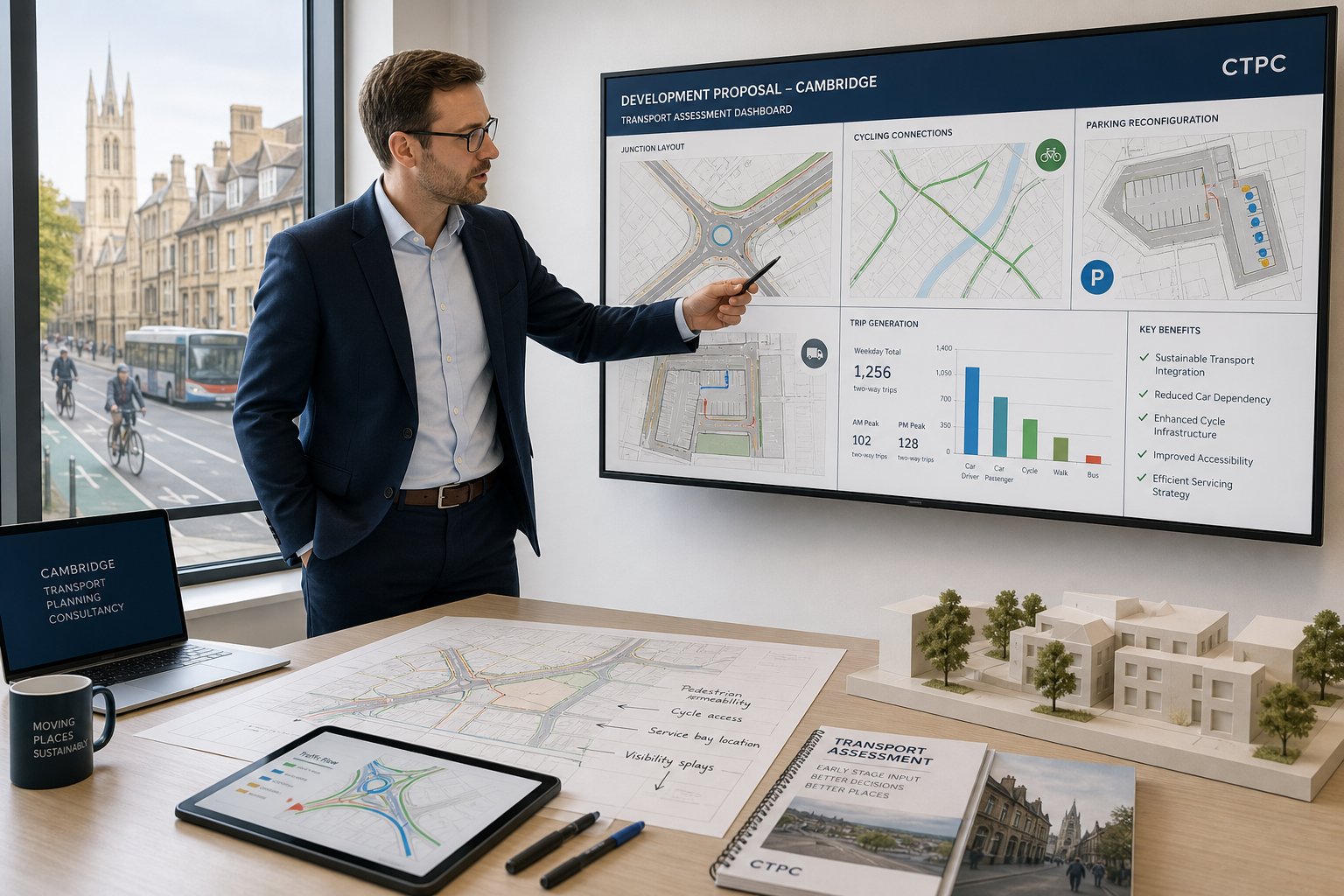
    A Section 278 agreement is the legal mechanism that allows a developer to fund and carry out works to the existing public highway. The design element is the technical package behind that agreement: drawings, geometry, levels, drainage, signs, lining, visibility, safety checks and supporting evidence that show the proposed highway works can be delivered properly and safely.

    That matters because planning permission often says, in effect, “this development is acceptable provided certain off-site highway improvements are delivered.” The transport assessment or transport statement may identify the mitigation in broad terms, but the highway authority still needs a buildable, standards-compliant design before those works can be approved.

    So, in the planning and highway approval process, Section 278 design usually sits between planning strategy and physical delivery. It translates policy and mitigation into something the highway authority can technically approve. No technical approval, no signed agreement. No signed agreement, no lawful highway works.

    In practical terms, the authority will review whether the design complies with the relevant standards, whether all road users are considered, whether drainage and lighting are resolved, whether safety audits have been completed, and whether the proposal can be maintained and adopted. Different authorities have different pro formas and review stages, but the principle is consistent.

    For project teams, the key point is this: section 278 design is not just “the road drawing.” It is the approval pathway for development-related highway works, and it needs to be treated as a live part of the planning programme from the start.

    When A Section 278 Agreement Is Required For A Development

    Development site connecting to a public road with required highway alterations.

    A Section 278 agreement is typically required whenever a development needs permanent alterations to the adopted highway outside the site boundary. If the scheme affects the existing road network and those works will be delivered on publicly maintained highway land, Section 278 is usually the route.

    Common triggers include a new site access onto an existing road, changes to a priority junction, a ghost island right-turn lane, a mini-roundabout, traffic signal amendments, a pedestrian crossing, kerb realignment, footway widening, cycle connections or traffic calming linked to the development. Even works that seem minor can still need a formal agreement if they sit within the highway boundary.

    This is also why legal and planning teams need to be alert early. It is not lawful to simply appoint a contractor and start altering the public highway because planning permission has been granted. The highway authority must consent to the works, approve the design and enter into the Section 278 agreement.

    In many planning permissions, the need for the agreement is baked into conditions or linked to obligations. A development may be prohibited from commencing above a certain phase, from occupying units, or from opening for trade until the off-site works are completed or substantially completed.

    The practical test is straightforward: if development mitigation requires works to the existing adopted highway, assume Section 278 may be needed and confirm that position with the local highway authority as early as possible. Waiting until after consent is one of the easiest ways to lose time.

    The Main Highway Works Typically Covered By Section 278 Design

    Line drawing of a redesigned UK road junction with crossing and cycle lane.

    Section 278 design is used for a wide range of off-site highway interventions, from relatively simple frontage works to complex junction remodelling. The unifying theme is that the works happen on the adopted highway and are needed to make the development acceptable in traffic, access or safety terms.

    For most schemes, the required works are identified first through access strategy, junction capacity work, road safety considerations, active travel requirements or planning negotiation. The Section 278 process then turns those mitigation measures into a deliverable package.

    Below are the types of works we most often see included.

    Junction Alterations, Access Improvements, And Traffic Signal Changes

    Junction works are probably the most recognisable part of Section 278 design. A development may need a new priority access, a modified bellmouth, a right-turn lane, a roundabout upgrade or a fully signalised junction to handle forecast traffic safely.

    In these cases, the design has to prove more than basic geometry. The authority will want confidence that turning movements work, queuing can be managed, pedestrians are protected, visibility is adequate and the layout ties into the existing network without creating new hazards. Signal changes can be especially involved, because detector loops, controller changes, staging, ducting and electrical design all come into play.

    Access improvements can also extend beyond the site entrance itself. We often see requirements for verge adjustments, central islands, lane widening, relocation of bus stops, amendments to waiting restrictions or new splitter islands to channel movements correctly.

    This is where early coordination pays off. What looks efficient on a concept plan can unravel once utilities, retaining features, mature trees or nearby private accesses are mapped properly. Good Section 278 design anticipates that before the authority does.

    Footways, Crossings, Cycle Facilities, And Public Realm Works

    Not every Section 278 package is vehicle-led. Many are driven by walkability, accessibility and local placemaking requirements. New and widened footways, tactile paving, dropped kerbs, uncontrolled crossing points, signalised pedestrian crossings, shared-use links, cycle tracks and public realm upgrades commonly sit within the scope.

    These features often look simple, but they are where authorities tend to be exacting. Widths, gradients, crossfalls, tactile arrangements, drainage, street furniture clearances, lighting, guardrailing, surfacing and inclusive access all need to be right. If a route is intended to connect the development to schools, bus stops, town centres or rail stations, the authority will usually examine continuity and usability rather than just whether a strip of paving exists.

    Public realm works may also include kerb realignment, tree pits, seating, bollards, planters, resurfacing and drainage changes. That can bring a wider set of consultees into the process, especially on town centre schemes.

    In other words, Section 278 design is not only about cars getting in and out. It is often about making the highway work better for everyone who uses it.

    The Core Stages Of A Section 278 Design Project

    Most Section 278 projects follow a recognisable sequence, even though each authority has its own forms, review periods and technical preferences.

    First comes the planning stage. The transport assessment or statement identifies the access strategy and any off-site mitigation likely to be required. Sometimes the principle is agreed at application stage: sometimes the detail is deferred by condition.

    Next, we move into early discussions with the highway authority and concept design development. This is where the obvious conflicts should be surfaced: land ownership, highway extents, existing constraints, potential departures from standards, drainage outfalls, utility diversions and whether the authority is likely to support the broad approach.

    After that, the formal Section 278 application or authority-specific submission is made, usually with the relevant fee. Detailed design then progresses to Technical Approval. That package can include general arrangement drawings, construction details, levels, drainage design, signs and lines, vehicle tracking, visibility checks, road safety audit input and utility information.

    Running alongside or just behind the technical review is the legal agreement itself. That typically covers the works description, bond, fees, commuted sums where applicable, programme obligations and responsibilities during construction and maintenance.

    Once approved and signed, the project moves into permitting, construction, inspection and a maintenance period before final adoption or release. And yes, this is the stage people forget to programme. On many schemes, the maintenance period alone can run for 12 to 24 months.

    Key Design Standards, Safety Checks, And Technical Requirements

    Section 278 design sits inside a technical framework, not a blank sheet. Depending on the road type and authority, the design may need to align with the Design Manual for Roads and Bridges, Manual for Streets, local highway design guides, adoption standards, accessibility requirements and authority-specific details.

    The review is usually broad. Highway engineers will check carriageway geometry, junction radii, lane widths, levels, drainage strategy, materials, kerb details, tactile paving, signs, road markings, lighting, visibility, non-motorised user provision and tie-ins to the existing network. If the authority considers the package incomplete, it can stall quickly.

    That is why a compliant Section 278 submission is less about one clever drawing and more about technical completeness. The strongest packages are coordinated from the start, with surveys, utility intelligence, safety input and planning assumptions all lined up before detailed design races ahead.

    Topographical Surveys, Utilities, And Existing Site Constraints

    A surprising number of avoidable design problems start with poor baseline information. Without a reliable topographical survey of the highway frontage and tie-in areas, levels can be wrong, drainage assumptions can fail, visibility can be misstated and construction extents can drift outside available land.

    For Section 278 design, we generally need accurate survey coverage not just at the access point, but across all affected highway features: kerbs, channels, covers, gullies, signs, columns, trees, boundary treatments, retaining structures, bus stops and crossing points. If the scheme touches a junction, the survey area usually needs to be wider than the first issue plan suggests.

    Utilities are the other major constraint. Statutory undertakers’ apparatus can radically change cost, programme and even design feasibility. A seemingly modest kerb line adjustment becomes far less modest if it conflicts with fibre, gas, water or high-voltage assets. Diversions, protections and trial holes may be needed, and associated costs are often captured in the overall delivery and bond planning.

    Then there are the real-world constraints: tree roots, third-party land, narrow verges, private accesses, visibility obstructions and uncertain highway boundaries. Good teams identify these early, because the authority definitely will.

    Road Safety Audit, Swept Path Analysis, And Visibility Requirements

    Road Safety Audit is a normal part of the Section 278 process and, for many authorities, not optional. Depending on project stage, audits may be required from Stage 1 through to Stage 4. Their purpose is not to redesign the scheme for you, but to identify collision risks and safety concerns for all users, including pedestrians, cyclists and motorcyclists.

    A well-managed audit process helps schemes move faster because risks are addressed early, not after technical positions have hardened. But it only works if the design team responds properly. Ignoring an audit issue without evidence or rationale is a reliable route to delay.

    Swept path analysis is another recurring requirement, particularly where large vehicles need to turn through constrained geometry. Junctions, accesses, servicing routes and internal-external transitions all need to demonstrate that design vehicles can manoeuvre without overrun into unsafe areas.

    Visibility is equally fundamental. Junction visibility splays, stopping sight distance and intervisibility at crossings must meet the relevant standards and reflect actual site conditions, not optimistic assumptions. Walls, planting, vertical alignment and parked vehicles can all become sticking points.

    Put simply, these are not box-ticking exercises. They are some of the first things authorities use to judge whether a scheme is genuinely ready.

    Common Reasons Section 278 Designs Are Delayed Or Rejected

    Most delayed Section 278 schemes are not delayed by one dramatic flaw. They are delayed by accumulation: incomplete drawings, unresolved utilities, unclear land ownership, weak visibility evidence, a missing audit response, drainage left for later, or a concept that never really aligned with local standards.

    One common issue is failure to engage with the authority’s preferences early enough. Designers sometimes work up a detailed layout based on general guidance, only to discover that the local authority expects a different approach to radii, crossing placement, active travel provision, materials or technical submission format.

    Another recurring problem is under-scoped evidence. A design may look acceptable visually but still be rejected because there is no robust swept path analysis, no proper topographical basis, no utility assessment, or no Road Safety Audit at the required stage. Authorities need evidence, not just confidence.

    Legal and land issues also cause major slippage. If works extend beyond land that can be dedicated or lawfully altered, the technical design may be fine but undeliverable. Bond values, commuted sums, drafting delays and unclear obligations between developer, landowner and contractor can hold up signature long after the drawings are “done”.

    In our experience, the fastest route is not speed for its own sake. It is coordination. A technically complete package, aligned with planning assumptions and local authority expectations, almost always outperforms a rushed one.

    How Section 278 Design Fits With Transport Assessments And Planning Support

    Section 278 design should never be treated as a detached engineering afterthought. It sits directly downstream of the transport assessment or transport statement and, ideally, is anticipated while planning strategy is still being shaped.

    The transport assessment identifies the impact of the development and the mitigation needed to make it acceptable. That may include a new access arrangement, junction mitigation, pedestrian links, crossing upgrades, cycle improvements or network management measures. Section 278 design is then the detailed implementation of those measures on the public highway.

    That link matters because inconsistency creates risk. If the planning drawings, capacity modelling and technical highway design point in slightly different directions, the authority will notice. Conditions may become harder to discharge, reserved matters can be complicated, and legal wording may need revisiting.

    For that reason, we usually see the best outcomes where transport planners and highway designers work closely rather than in sequence. The planning case informs the engineering, and the engineering reality tests the planning assumptions. On complex sites, that joined-up approach can also help legal teams by clarifying trigger points, delivery responsibilities and whether works need to be completed before occupation, phased occupation or a later milestone.

    For firms like ours at ML Traffic, this is where experience adds practical value: concise reporting is useful, but the real benefit is making sure the planning evidence and the eventual Section 278 package are telling the same story.

    Choosing The Right Technical Team And Preparing For Delivery

    Section 278 projects move fastest when the team has done them before. That sounds obvious, but it is amazing how often highway works are left with a general design team that understands planning drawings but not adoptable highway detail, technical approval culture, audit coordination or permit sequencing.

    The right team usually includes transport planners, highway designers, Road Safety Audit coordinators, drainage input where needed, utility specialists for more constrained schemes, and legal support that understands bonds, commuted sums and agreement drafting. Not every project needs a huge consultant line-up, but every project needs the right experience.

    Early preparation makes a disproportionate difference. Obtain the topographical survey promptly. Confirm highway boundaries. Commission utility searches. Engage with the authority before fixing the layout. Check whether a Stage 1 RSA is needed at concept stage. Understand local review times. And build a programme that includes technical revisions, legal drafting, permit lead-in, construction windows, inspections and the maintenance period.

    This is also the moment to be realistic with clients and stakeholders. Section 278 delivery is rarely “just a condition discharge.” It is a mini infrastructure project attached to the development. If everybody understands that from the outset, decision-making gets sharper and approvals usually come through with fewer surprises.

    Conclusion

    Section 278 design is the mechanism that turns development-related highway mitigation into approved, deliverable works on the existing public highway. It sits at the junction of planning, transport evidence, technical design, legal agreement and construction delivery.

    For developers and their advisers, the lesson is simple: start earlier than you think you need to. The schemes that move well are usually the ones that treat Section 278 as part of the planning strategy from day one, not a post-consent add-on. They secure good surveys, test constraints early, align the transport assessment with the engineering reality, and engage a team that knows how Technical Approval actually works.

    In 2026, with authorities under pressure and approval pathways rarely getting simpler, that preparation matters even more. If the required off-site works are known, the quickest route is a coordinated one: clear mitigation, robust technical evidence, realistic programming and a Section 278 design package the authority can approve with confidence.

    Section 278 Design Frequently Asked Questions

    What is Section 278 design in the context of highway works?

    Section 278 design refers to the detailed engineering process enabling developers to obtain approval for permanent alterations to the existing public highway under a Section 278 agreement, as required by planning permission and governed by the Highways Act 1980.

    When is a Section 278 agreement required for a development?

    A Section 278 agreement is needed whenever a development requires permanent changes to an existing publicly maintained highway, such as new access points, junction alterations, crossings, or traffic mitigation, and it is illegal to carry out such works without this agreement.

    What types of highway works are typically covered by Section 278 design?

    Typical works include junction and access modifications, pedestrian crossings, footway widening, cycle tracks, traffic calming measures, street lighting, drainage, and other related public realm improvements necessary to support the development safely and accessibly.

    How does Section 278 design relate to transport assessments and planning permissions?

    Transport assessments identify necessary off-site highway mitigation measures for a development, and Section 278 design converts these into detailed, standards-compliant engineering plans that the highway authority can approve and implement in line with planning conditions.

    What are common reasons Section 278 designs face delays or rejections?

    Delays often result from incomplete drawings, inadequate evidence like missing Road Safety Audits or swept path analyses, failure to comply with local design standards, unresolved utility conflicts, unclear land ownership, or improper engagement with highway authorities early in the process.

    What key steps and standards must be followed in the Section 278 design process?

    The process includes pre-application discussions, detailed design with technical approval submission, Road Safety Audits at stages 1 to 4, compliance with standards like the Design Manual for Roads and Bridges, and completion of legal agreements, followed by construction permits, inspection, and a maintenance period before final adoption.

  • Low Traffic Neighbourhood Design In 2026: Principles, Process And Planning Considerations That Matter

    Low Traffic Neighbourhood Design In 2026: Principles, Process And Planning Considerations That Matter

    A low traffic neighbourhood design can look deceptively simple from the outside: a planter here, a camera restriction there, perhaps a short section of road no longer available for through-movements. But anyone involved in planning, transport, architecture or development knows the reality is much more technical. The difference between a scheme that works and one that causes avoidable objections usually comes down to how well the wider network has been understood.

    In 2026, LTNs are no longer a fringe idea or a one-size-fits-all intervention. They sit within broader conversations about active travel, placemaking, road safety, servicing, emergency response and planning policy compliance. For developers and consultants, that means low traffic neighbourhood design is less about isolated traffic calming measures and more about proving that movement, access and network performance have been considered together.

    We see this regularly in planning work. Local planning authorities want clear evidence that through-traffic is being managed without undermining access for residents, deliveries, refuse collection or blue-light services. They also want reassurance that problems are not simply being pushed onto the next street.

    This guide sets out what low traffic neighbourhood design means in practice, the principles that shape a successful scheme, and the planning considerations that matter when preparing transport evidence. It is written for professionals who need robust, usable answers rather than slogans.

    What Low Traffic Neighbourhood Design Means In Practice

    Street-grid infographic showing low traffic neighbourhood access and through-traffic prevention.

    In practice, low traffic neighbourhood design is an area-wide movement strategy rather than a single road closure. The aim is to stop general motor traffic from using residential streets as short cuts while preserving access to homes, workplaces, schools, deliveries and emergency services.

    That distinction matters. If we only close one street, traffic often diverts to the nearest alternative residential route. A proper LTN design treats the neighbourhood as a connected network and uses filters, turn restrictions, one-way arrangements or camera-controlled access so that drivers can still enter the area, but cannot drive through it end to end unless they have a legitimate reason and a permitted route.

    A well-designed LTN remains permeable for walking and cycling. In many schemes, that is the whole point: journeys on foot or by cycle become shorter, safer and more direct than motor vehicle movements. Boundary or distributor roads continue to carry the strategic flow of traffic, while internal streets become calmer and more local in character.

    From a planning perspective, this means the design case cannot rely on intent alone. We need to show how the street pattern works, where displaced trips are likely to go, how access is maintained, and whether the change supports the intended land use and policy objectives.

    Why LTNs Are Being Used In New And Existing Developments

    Comparison infographic of LTNs in existing streets and new UK developments.

    LTNs are being used because many neighbourhoods were never designed to absorb modern levels of through-traffic. Sat-nav routing, rat-running between congested junctions and rising delivery traffic have all increased pressure on streets that primarily serve housing, local services and community facilities.

    For existing neighbourhoods, the motivation is usually to reduce cut-through traffic, lower vehicle speeds, improve safety and create a more liveable public realm. Quieter streets tend to support walking, cycling and informal social use more effectively than streets dominated by non-local traffic.

    In new developments, LTNs are often embedded earlier as part of the movement framework. That allows masterplanners and transport consultants to shape block structure, access points and route hierarchy from the outset. Rather than retrofitting restrictions later, the neighbourhood can be designed so that strategic traffic naturally stays on appropriate roads.

    There is also a policy and commercial driver. Councils increasingly expect schemes to align with active travel, climate and placemaking objectives. Developers want layouts that are policy-compliant, attractive to buyers and less vulnerable to highways objections. In that context, low traffic neighbourhood design becomes a practical tool for achieving both transport and planning outcomes, provided the supporting evidence is sound.

    Core Design Principles For A Successful Low Traffic Neighbourhood

    Infographic showing street hierarchy and traffic filtering in a UK low traffic neighbourhood.

    Successful LTNs share a small number of principles, even when the street pattern, scale and policy context differ.

    Street Hierarchy, Movement And Access Strategy

    The starting point is a clear street hierarchy. Boundary roads and distributor routes should accommodate through-movement, busier traffic flows and wider network connections. Internal residential streets should primarily serve access, local circulation and short local trips. If those roles are blurred, filtering becomes difficult to justify and even harder to operate cleanly.

    We hence need a movement strategy that distinguishes between strategic traffic, local vehicle access, servicing and active travel. That usually means mapping desire lines, identifying rat-run patterns, understanding junction constraints and checking whether nearby roads can realistically absorb reassigned traffic.

    A robust hierarchy also helps with planning narratives. It shows that the design is not anti-car in a simplistic sense: it is about putting the right traffic on the right streets.

    Filtering Through-Traffic Without Blocking Essential Access

    The second principle is straightforward but often mishandled: remove through-traffic, not access. Residents, visitors, carers, deliveries, refuse vehicles and emergency services must still be able to reach properties safely and reliably.

    This is where modal filters, exemptions, lockable bollards, camera enforcement and carefully chosen turning arrangements come in. The exact solution depends on geometry, frontage, servicing needs and operational requirements. A filter in the wrong place can add unnecessary mileage, create awkward reversing movements or compromise response times.

    So we test more than one option. The best low traffic neighbourhood design usually finds a balance where everyday through-movements are filtered out, but essential access remains legible and workable.

    Street Layout, Modal Filters And Public Realm Elements

    Street layout does much of the heavy lifting in an LTN. Filters are important, but they only work well when the wider network geometry supports them. A permeable grid may need multiple interventions to stop through-routing, whereas a layout with natural cells or short blocks may need very little.

    Modal filters can take several forms: bollards, planters, kerb build-outs, bus gates, rising bollards or camera-enforced restrictions. The choice is rarely aesthetic alone. We look at turning heads, refuse tracking, cycle permeability, maintenance, drainage, visibility and the risk of non-compliance.

    Physical design also shapes perception. If the street still reads like a traffic corridor, drivers will continue trying to use it as one. That is why many successful schemes combine filters with tightened junction radii, raised tables, planting, seating, cycle parking and better crossing points. These public realm elements signal that the street’s primary function has changed.

    But restraint matters. An LTN should not become cluttered with street furniture or overdesigned features that complicate maintenance and access. In planning and delivery terms, the strongest approach is usually simple, legible and easy to enforce: clear routes for vehicles with legitimate reasons to be there, and generous permeability for everyone else.

    Designing For Walking, Cycling, Servicing And Emergency Access

    One of the quickest ways to weaken an LTN proposal is to consider active travel first and leave servicing or emergency access until later. In reality, these have to be designed together.

    For walking, the priorities are directness, crossing quality, passive surveillance, inclusive footway widths and links to schools, local centres and public transport. For cycling, permeability is key. Cyclists should be able to travel through the area more directly than general traffic, without confusing dismount points or awkward chicanes.

    Servicing requires a different layer of detail. We need to understand loading patterns, vehicle sizes, turning requirements, delivery frequency and whether larger vehicles can still enter, stop and exit without conflict. The same applies to refuse collection and maintenance access.

    Emergency access is often the point that determines filter design. Fire and rescue services, ambulance trusts and police operators may require lockable bollards, overrun strips, removable sections or alternative entry paths. The answer varies by authority and site context, so early consultation matters.

    When these demands are coordinated from the start, low traffic neighbourhood design becomes much easier to defend. The scheme reads as a functioning access network rather than an aspirational sketch with operational problems still hidden in the margins.

    How Traffic Data And Transport Assessments Inform LTN Design

    Good LTN design is evidence-led. Before recommending filters or restrictions, we need to understand existing traffic conditions, trip patterns and likely reassignment effects. That typically starts with traffic counts, turning counts, speed data, collision records, parking stress observations and site audits.

    Origin-destination information is especially useful where cut-through traffic is suspected but disputed. It helps distinguish local access trips from non-local movements using residential streets for convenience. Depending on scale, we may also review journey time data, school travel patterns, bus routing and pedestrian and cycle desire lines.

    Transport assessments then translate this evidence into design decisions. They test whether traffic is likely to divert to suitable roads, whether junctions on the boundary network can cope, and whether access arrangements remain practical for the proposed land use. For planning applications, they also explain the rationale in a form local authorities can review against policy and development management thresholds.

    At ML Traffic, this is where concise and accurate reporting matters. Councils rarely want theoretical overkill: they want clear analysis tied to local circumstances and planning triggers. A credible assessment should show not just what the LTN is trying to achieve, but how the network is expected to behave once the scheme is in place.

    Planning Policy, Local Authority Expectations And Approval Risks

    Planning policy support for LTNs is usually indirect but strong. Schemes often align with local plan objectives on sustainable transport, healthy streets, safer neighbourhoods, air quality and placemaking. Nationally, active travel and well-designed places remain important themes, even though implementation approaches vary from one authority to another.

    The catch is that policy support does not guarantee approval. Local authorities typically want evidence on three points: network impact, access continuity and deliverability. If any of those are weak, risk rises quickly.

    Approval problems often arise where proposals rely on vague future controls, where boundary-road impacts have not been tested, or where emergency and servicing arrangements remain unresolved. Another common issue is mismatch between the planning red line and the transport effects. If a development depends on off-site filtering to function acceptably, the application needs to explain how that will be secured.

    Councils also increasingly expect engagement. Local support is not the only test, but ignoring likely user concerns is rarely wise. Objections around displacement, school access, parking pressure or business servicing can become material if the evidence base is thin.

    So the safest route is a coordinated package: policy fit, traffic evidence, access strategy, and a realistic delivery mechanism. That combination gives decision-makers confidence that the proposal is practical, not merely aspirational.

    Common Low Traffic Neighbourhood Design Mistakes To Avoid

    The most common mistake is treating an LTN as a single intervention rather than an area strategy. One filter on one street may solve a local complaint, but it can just as easily push traffic onto the next residential road and create a fresh problem.

    A second mistake is weak boundary-road thinking. If the surrounding network is already constrained, traffic reassignment needs careful modelling and honest explanation. Pretending there will be no effect is not credible and usually invites challenge.

    Third, teams sometimes design for idealised travel behaviour and forget operational reality. Delivery vans still need somewhere to stop. Refuse vehicles still need turning space. Emergency services still need robust and agreed access arrangements. If those basics are not integrated, objections are justified.

    Another recurring issue is poor legibility. Drivers, cyclists and visitors need to understand how the network works. Confusing restrictions, inconsistent signing or awkward one-way arrangements can generate non-compliance and frustration.

    And finally, some schemes are advanced without enough monitoring or flexibility built in. Even strong designs may need adjustment after implementation. The authorities that manage LTNs best are usually the ones that accept from day one that refinement is part of delivery, not evidence of failure.

    Monitoring, Adjustment And Long-Term Network Performance

    An LTN should never be treated as finished on the day the filters go in. Travel behaviour changes over time, nearby development comes forward, schools expand, junctions are altered and delivery demand shifts. Monitoring is what tells us whether the original assumptions are still holding.

    Typical monitoring covers traffic volumes within the neighbourhood, flows on boundary roads, speeds, collisions, walking and cycling activity, parking conditions and, where relevant, journey times for key services. Qualitative feedback also matters. Residents, businesses, bus operators and emergency services often spot friction points that raw counts do not immediately reveal.

    Adjustment mechanisms should hence be designed in from the outset. That might mean trial filters before permanent works, phased implementation, or a review framework tied to measured outcomes. Sometimes the right response is minor: moving a planter, changing signage, refining an exemption. Sometimes it is more strategic, especially if adjacent streets begin taking displaced traffic unexpectedly.

    Long-term network performance is the real test. A successful low traffic neighbourhood design should continue to support access, safety and placemaking without creating hidden costs elsewhere. If monitoring is rigorous, councils and project teams can make informed changes rather than relying on anecdote or political noise alone.

    Applying Low Traffic Neighbourhood Design To Planning Applications

    For planning applications, low traffic neighbourhood design needs to be translated into a clear and defensible evidence package. Decision-makers are not only asking whether the concept is attractive: they are asking whether it works on the network, whether access is maintained, and whether any required controls can realistically be delivered.

    In practice, that means the transport submission should do several things well:

    • define the existing and proposed street hierarchy:
    • explain the access strategy for residents, visitors, servicing and emergency response:
    • identify where through-traffic is expected to be filtered and how active travel remains permeable:
    • assess traffic reassignment and boundary-road effects:
    • align the proposal with local policy, parking strategy and placemaking objectives.

    Where LTNs support a wider development, the narrative should be tied directly to the scheme’s layout, trip generation and land-use assumptions. Plans, swept paths, traffic data and concise commentary need to tell one consistent story.

    This is often where specialist reporting adds value. On sites where planning thresholds, local authority expectations and off-site highway impacts are tightly scrutinised, clear transport evidence can make the difference between a manageable consultation process and a stalled application. The design itself matters, obviously. But in development terms, the quality of the supporting case matters just as much.

    Conclusion

    Low traffic neighbourhood design works best when we stop thinking about it as a quick street closure exercise and start treating it as a network, access and placemaking discipline. The strongest schemes are area-wide, evidence-led and realistic about how people, vehicles and services actually move.

    For architects, planners, developers and councils, that means focusing on the fundamentals: a clear street hierarchy, careful filter placement, maintained essential access, robust traffic analysis and a planning strategy that matches local authority expectations. Get those pieces right and an LTN can support quieter streets, safer movement and stronger development outcomes. Get them wrong and the scheme can unravel under perfectly foreseeable objections.

    In 2026, the bar is higher than it was a few years ago. Authorities expect better evidence, clearer access strategies and more credible monitoring plans. That is not a problem: it is an opportunity to produce schemes that work in practice as well as on paper.

    Low Traffic Neighbourhood Design FAQs

    What is a low traffic neighbourhood (LTN) design?

    An LTN design creates an area-wide strategy that restricts through-traffic on residential streets using filters and access controls, while maintaining safe, reliable access for residents, deliveries, and emergency services, promoting active travel and calmer streets.

    How does low traffic neighbourhood design improve road safety and active travel?

    By removing non-local through-traffic and reducing vehicle speeds, LTNs make streets quieter and safer, encouraging walking and cycling through improved permeability and shorter, more direct routes for pedestrians and cyclists.

    Why is it important to treat LTNs as area-wide schemes rather than single road closures?

    Filtering only one street can simply divert traffic to nearby residential roads, creating new problems. An area-wide design uses a connected network approach to effectively manage traffic flow and prevent displacement onto adjacent streets.

    How do LTNs balance filtering through-traffic while maintaining essential access?

    LTNs use physical filters like bollards or camera-controlled restrictions that stop through-traffic but allow residents, visitors, servicing vehicles, and emergency responders to access properties safely and conveniently.

    What role does traffic data and transport assessment play in designing LTNs?

    Traffic counts, origin-destination data, and transport assessments help identify rat-running patterns, test traffic reassignment effects, and ensure boundary roads can absorb diverted traffic without causing new congestion or safety issues.

    Can LTNs be adjusted after implementation, and why is monitoring important?

    Yes, monitoring traffic volumes, speeds, collisions, and user feedback allows authorities to fine-tune LTNs over time, addressing unforeseen issues and ensuring the scheme continues to support safety, access, and placemaking goals effectively.

  • Development Access Design In 2026: How To Create Safe, Compliant Access For Planning Approval

    Development Access Design In 2026: How To Create Safe, Compliant Access For Planning Approval

    Planning applications rarely fail because of one dramatic flaw. More often, they stall because a seemingly ordinary access arrangement hasn’t been thought through well enough. A junction is too close to another junction. Visibility is tight. Refuse vehicles can’t turn. Walking routes are awkward. Or the access strategy described in the planning documents simply doesn’t match what’s shown on the drawings.

    That is why development access design matters so much. It sits at the point where planning policy, highway engineering, site constraints and real-world movement all meet. For architects, planners, developers, lawyers and local authorities, getting access right is not just a technical exercise: it is often the difference between a smooth consent process and months of avoidable delay.

    In 2026, expectations are only getting sharper. Highway authorities want clear evidence. Local planning authorities expect policy alignment, inclusive design and credible transport reporting. And applicants need access proposals that are safe, buildable and proportionate to the development they support.

    In this guide, we set out what development access design means in practice, the standards and policy framework to review first, how site context affects the right solution, and the design mistakes that most often trigger objections. We also explain how transport statements, transport assessments and travel plans need to align with the proposed access strategy, because in planning, consistency wins trust.

    What Development Access Design Means In The Planning Process

    Site entrance design showing safe access for cars, cyclists, and pedestrians.

    Development access design is the planning and engineering of how people, vehicles and service movements enter, leave and move within a site. In planning terms, that sounds simple. In practice, it is one of the most scrutinised parts of a proposal because it connects the development to the public highway, to neighbouring land uses and to the wider transport network.

    Usually, access design is presented across several documents rather than one. We see it in the site layout, highway drawings, the Design and Access Statement, and the supporting Transport Statement or Transport Assessment. For larger or more sensitive schemes, it may also appear in swept-path drawings, visibility plans, stage 1 road safety audits, travel plans and construction logistics material.

    The purpose is broader than proving that cars can get in and out. A sound access strategy shows that the proposal responds to site context, respects the road hierarchy, accommodates emergency and servicing needs, and provides safe routes for walking, wheeling and cycling. It should also demonstrate inclusive access, which is not an optional extra tucked on at the end.

    From a planning perspective, access design helps answer a basic but decisive question: can this development function safely and appropriately in this location? If the answer is unclear, consent is vulnerable. If the answer is robust, well-evidenced and policy-aligned, the rest of the application tends to stand on firmer ground.

    Why Access Design Matters For Safety, Capacity And Planning Consent

    safe site access design with car, cyclist, and pedestrian crossing on UK road

    Access design matters because it goes straight to the issues highway authorities care about most: safety, operational performance and impact on other road users. A poorly designed access can increase turning conflicts, reduce inter-visibility, obstruct traffic flow and create avoidable risk for pedestrians and cyclists. Even a modest scheme can attract objection if those basics are not convincingly addressed.

    Safety is usually the first test. Authorities will want confidence that vehicles can enter and exit without dangerous manoeuvres, that sightlines are adequate for the speed environment, and that vulnerable users are protected. They will also look at whether the design creates hidden problems, such as reversing refuse vehicles onto the highway or crossing points placed in the wrong location.

    Capacity comes next. Not every application needs complex modelling, but every application does need a believable explanation of how the access will operate. If forecast traffic, turning movements or nearby junction interactions have been ignored, the access strategy can quickly unravel.

    And then there is consent. In many cases, the practical route to planning permission runs through a highway authority “no objection”. Access design is rarely the only issue in a planning application, but it is often the issue that carries disproportionate weight. Get it right and the scheme looks thought through. Get it wrong and confidence in the entire proposal drops.

    The Core Standards, Guidance And Policy Framework To Check First

    Planner reviewing road access standards on a site design drawing.

    Before any geometry is fixed, we need to know which standards and policy documents govern the site. In England, the starting point is usually the National Planning Policy Framework and the relevant National Planning Practice Guidance. These establish the broad planning tests around sustainable transport, safe access and severe cumulative impacts.

    From there, the technical framework depends on the road context. For many local streets and urban environments, Manual for Streets and Manual for Streets 2 remain central reference points, particularly on speed, place function and visibility. Where the development affects the strategic road network or trunk roads, the DMRB becomes more relevant. Local highway design guides can be just as important, especially where councils have their own adopted visibility, parking, cycling or junction standards.

    We also need to review Local Plan transport and design policies, supplementary planning documents, parking standards and cycling guidance. Those local documents often decide what is acceptable in practice.

    Inclusive access requirements should be checked at the outset as well, including duties under the Equality Act and the principles reflected in Building Regulations Part M. If step-free routes, dropped kerbs, gradients or crossing details are left until late design stages, redesign is almost inevitable.

    This is one reason specialist input matters. At ML Traffic, for example, the value is not just in producing transport reports quickly: it is in tailoring the access evidence to local authority thresholds, policy wording and likely review points.

    How Site Context Shapes The Right Access Strategy

    There is no universally correct access arrangement. The right strategy depends on where the site sits, what surrounds it, how the adjoining highway operates and what the development is trying to achieve. A suburban infill scheme on a low-speed residential street is a different proposition from a roadside employment site on a fast A-road, even if the red line area looks similar on paper.

    Context starts with the basics: settlement type, frontage conditions, topography, existing accesses, nearby junctions, boundary vegetation, public rights of way and whether there are heritage or environmental constraints. A conservation area, listed wall, steep embankment or mature tree belt can all materially affect access location and geometry.

    Public transport and active travel links matter too. If a site has strong bus connections and direct walking and cycling routes, that may support a different access emphasis than a site where car dependency is higher. Equally, if a proposal relies on sustainable travel in principle, the access design has to make those journeys practical in reality.

    A strong planning submission shows that the access strategy emerged from the site, rather than being dropped onto it. Highway officers can usually tell the difference within a few minutes.

    Existing Highway Conditions And Road Hierarchy

    The first practical question is what kind of road the site connects to. Road hierarchy influences almost everything: expected speeds, traffic composition, acceptable junction form, visibility requirements and the degree of priority the site access can reasonably demand.

    A new access onto a quiet local street may work as a simple priority arrangement with modest radii and pedestrian-friendly geometry. The same layout on a busier distributor road may be entirely unsuitable. On higher-speed routes, design must respond to stopping sight distance, turning demand, lane discipline and the consequences of right-turn movements across traffic.

    We also need to look beyond classification labels. An unclassified road outside a settlement can function like a fast rural link: a B-road in a town centre may operate more like a place-led street. Traffic flows, observed speeds, collision history, on-street parking, frontage activity and nearby schools or shops all help describe the real operating environment.

    This is where weak applications often slip. They cite the speed limit but ignore actual conditions. Or they note traffic levels without considering how queueing at adjacent junctions affects the proposed access. A credible design takes the road’s function seriously and aligns the access with that function, rather than forcing a preferred layout onto the wrong network context.

    Land Use, Scale Of Development And Expected Vehicle Types

    Access design also has to reflect what the development will generate. Residential, retail, industrial, logistics, mixed-use and care uses all produce different travel patterns, peaks and vehicle types. That affects not just the size of the access, but the form it should take and the evidence needed to support it.

    For housing, the key questions may centre on peak-hour car trips, visitor parking pressure, refuse collection and whether pedestrians can move safely between the site and local facilities. For employment or warehousing, the proportion of vans and HGVs becomes critical. For roadside retail or drive-through uses, turning volumes and short-stay circulation can dominate the design challenge.

    Scale changes things again. A small scheme may be acceptable with a straightforward priority junction if geometry and visibility are sound. Larger developments often require more robust arrangements, internal stacking capacity, dedicated turning lanes or phased mitigation.

    Vehicle type is where many layouts reveal whether they have been genuinely tested. Can a fire tender enter and leave in forward gear? Can a refuse vehicle turn without overrunning footways? Can a 16.5 metre articulated HGV, if relevant, reach loading areas without conflict? If the likely design vehicles have not informed the layout from the start, amendments are usually unavoidable.

    Key Design Elements Of A Safe And Effective Site Access

    A safe and effective site access is made up of a handful of design components that must work together, not as isolated checks on a list. Location, visibility, junction geometry, pedestrian provision, drainage, surfacing, lighting and operational clarity all matter. If one element is materially weak, the whole arrangement can become difficult to defend.

    The chosen access point should minimise conflict with existing junctions, crossings, bus stops, parking activity and frontage uses. It should be legible to drivers and comfortable for those walking or cycling past the site. Gradients need to be controlled so vehicles can stop and emerge safely, while surface water must not drain onto the highway.

    Width is another balancing act. Too narrow, and larger vehicles mount kerbs or block movement. Too wide, and crossing distances for pedestrians increase while driver speeds at the access can creep up. Kerb radii need the same judgement: enough to accommodate the intended vehicle, but not so generous that the junction behaves like a slip road.

    Design quality here is rarely about one dramatic flourish. It is about coordination. The most successful access layouts are usually the ones where every small decision supports the same outcome: safe movement, policy compliance and a proposal that feels proportionate to its context.

    Visibility Splays, Geometry, Junction Spacing And Tracking

    Visibility splays are often treated as a box-ticking exercise. They are not. They are a direct expression of whether drivers and riders can see, react and manoeuvre safely in the actual speed environment. The required splay will depend on the applicable guidance and the road context, often drawing on Manual for Streets principles in lower-speed places and more stringent standards where speeds or road functions demand it.

    But visibility is only one part of the picture. Junction geometry needs to support the intended turning movements without causing excessive entry speeds or encroachment into opposing lanes. Carriageway width, kerb radii, approach angles and gradients all affect how safely the access operates.

    Junction spacing matters too. If a proposed access sits too close to another junction, roundabout arm, private drive or crossing point, manoeuvres can overlap in ways that create instability and capacity problems. Authorities are understandably cautious where cumulative conflict is obvious from the plan.

    And then there is tracking. Swept-path analysis should test realistic worst-case design vehicles, not just a convenient one. Depending on the scheme, that may include refuse vehicles, fire appliances, delivery vans or articulated HGVs. Tracking should prove not only that a vehicle can technically make the turn, but that it can do so without unreasonable overrun, repeated shunting or conflict with pedestrian routes.

    Walking, Cycling, Servicing And Refuse Access Requirements

    A modern access strategy cannot be vehicle-only. Local planning authorities and highway authorities increasingly expect a coherent explanation of how people will walk, wheel, cycle, receive deliveries and store waste safely and conveniently.

    For pedestrians, that means direct and step-free routes, suitable footway widths, dropped kerbs where needed, logical crossing points and gradients that work for all users rather than just the able-bodied. Inclusive design should be embedded early. If wheelchair users, people with pushchairs or those with impaired vision are forced into awkward detours or shared conflict points, the scheme will attract justified criticism.

    Cycle access needs similar attention. Connections should be continuous, obvious and safe, with parking located where people will actually use it. A cycle store hidden behind service yards may tick a policy box but still fail in practice.

    Servicing and refuse are the classic afterthoughts that delay applications. Loading bays, turning heads, headroom, route widths and bin collection points all need operational logic. In some schemes, especially flatted development or commercial sites, waste collection strategy can shape the access almost as much as general traffic does. If refuse vehicles need to reverse long distances, stop on the public highway or block pedestrian movement, officers will usually push back, and rightly so.

    When A Priority Junction, Ghost Island Or Other Access Form Is Appropriate

    The correct access form depends on demand, speed, hierarchy and safety performance. A simple priority junction is often suitable where flows are low to moderate, the site road is clearly subordinate, and the adjoining highway environment is relatively forgiving. For many residential and small mixed-use schemes, this remains the most proportionate solution.

    A ghost island right-turn lane may be more appropriate where right-turn demand into the site is material, through traffic speeds are higher, or there is a need to reduce the risk of rear-end shunt collisions caused by waiting right-turners. It can improve operation, but it also introduces land, visibility and road-width implications, so it should never be specified casually.

    Other forms have their place. Roundabouts can help where turning volumes are significant and speed reduction is beneficial. Signal control may be justified where capacity, pedestrian crossing demand or network management requires it. Left-in/left-out arrangements can work on busy corridors, though they often shift turning patterns elsewhere and need careful network consideration.

    What matters is evidence. The chosen form should reflect forecast traffic, likely turning proportions, safety audit findings and the broader function of the road. If the proposed junction type feels either underpowered or over-engineered for the site, reviewers will spot that quickly.

    How Access Design Links To Transport Statements, Transport Assessments And Travel Plans

    Access design should never sit in a separate silo from the transport documents. The Transport Statement or Transport Assessment establishes how many trips the development is likely to generate, when those trips occur, where they are likely to travel and whether nearby junctions can cope. The access arrangement must then be consistent with that evidence.

    If a Transport Assessment predicts significant right-turn demand but the access has no protected provision, there is a mismatch. If the site layout assumes refuse vehicles can turn internally but the swept-path evidence says otherwise, there is a mismatch. And if a Travel Plan seeks to reduce car dependence while the site entrance neglects walking and cycling connections, the strategy lacks credibility.

    Done well, these documents reinforce each other. The transport assessment justifies the junction form and any off-site mitigation. The access drawings show that the physical layout can accommodate those assumptions. The travel plan supports mode shift by making active and shared travel practical from day one.

    For applicants, consistency is more valuable than volume. A concise, accurate suite of documents usually performs better than a large submission with internal contradictions. That is one reason specialist reporting can make such a difference: experienced transport engineers know how to tie access drawings, trip evidence and planning narratives into one coherent case.

    Common Design Mistakes That Delay Planning Applications

    Most access-related delays are not caused by obscure technical debates. They come from avoidable mistakes that suggest the proposal has not been fully interrogated.

    One common problem is underestimating trip generation or choosing assumptions that are hard to defend locally. Another is ignoring the operational needs of larger vehicles, especially refuse, delivery and emergency access. A layout can look tidy on a concept plan and still fail the moment tracking is applied.

    Substandard visibility is another frequent issue, particularly where boundary treatments, vegetation or level changes are not properly accounted for. We also see access points positioned too close to nearby junctions, crossings or bus stops, creating conflict that should have been identified at feasibility stage.

    Pedestrians and cyclists are often the weak link. An application may show a compliant vehicular bellmouth but provide poor footway continuity, awkward crossing movements or no clear step-free route. That can trigger objections not only on highway grounds but also on inclusive design and placemaking grounds.

    Finally, document mismatch causes endless frustration. The Design and Access Statement says one thing, the planning drawings show another, and the transport note uses different assumptions again. Reviewers do not need perfection, but they do expect internal consistency. When evidence, policy and drawings line up, applications move more smoothly.

    What Local Planning Authorities And Highway Authorities Typically Expect

    In most cases, authorities are looking for the same underlying thing: confidence. They want confidence that the proposed access is safe, proportionate, policy-compliant and based on evidence rather than optimism.

    That usually means a clear Design and Access Statement, coherent transport reporting and drawings that actually correspond with the written justification. They will expect the proposal to reference the relevant national and local standards, explain any departures sensibly and show how the development responds to the specific site context. A generic standard detail with a generic paragraph rarely goes very far.

    Where appropriate, authorities may also expect road safety audits, speed survey evidence, visibility plans, swept-path analysis and junction modelling. For larger or more sensitive schemes, they will want to see how the access works not just on opening day but over time, with realistic traffic growth and operational patterns.

    Inclusive design is now central, not peripheral. So is future resilience. Authorities increasingly ask whether the access supports sustainable travel, changing servicing patterns and a safer public realm overall.

    Our experience is that early, well-targeted evidence saves time. When access strategy, planning policy and transport analysis are aligned from the outset, consultation is more focused, objections are fewer and the route to consent becomes much clearer.

    A good access design does not merely get a red line site onto the highway. It helps prove that the development belongs there.

    Frequently Asked Questions about Development Access Design

    What does development access design involve in the planning process?

    Development access design involves planning and engineering how people and vehicles enter, leave, and move within a site. It is explained through a Design and Access Statement and transport reports, showing how a proposal responds to site context, policy, and inclusive access requirements.

    Why is development access design critical for safety and planning consent?

    It ensures that site access is safe for vehicles and vulnerable users, respects highway capacity, and complies with planning policy. A robust access design supports highway authority approval, which is often essential for gaining planning permission.

    Which standards and policies should be checked first for development access design?

    In England, key references include the National Planning Policy Framework (NPPF), National Planning Practice Guidance, Manual for Streets and MfS2, Design Manual for Roads and Bridges (DMRB) for trunk roads, local highway design guides, and inclusive design rules from the Equality Act and Building Regulations Part M.

    How does site context influence the right access strategy?

    Site context such as settlement type, road speed, frontage conditions, environmental constraints, and availability of public transport and active travel routes shapes the appropriate access design. Each location requires an approach tailored to its specific surroundings and transport networks.

    What are the main design elements of a safe and effective site access?

    Key elements include appropriate location away from conflicting junctions, adequate visibility splays, suitable junction geometry with correct radii and widths, safe pedestrian and cycling routes, proper drainage, lighting, surfacing, and clear operational signage.

    How should development access design link with transport assessments and travel plans?

    Access design must align with trip generation and distribution forecasts from Transport Statements or Assessments. It should support the transport mitigation measures and make active travel feasible, ensuring consistency between physical layout, traffic modelling, and travel plan objectives.

  • Transport Planning In Portsmouth: What Developers Need To Know For Smoother Planning Approval In 2026

    Transport Planning In Portsmouth: What Developers Need To Know For Smoother Planning Approval In 2026

    Portsmouth can be a tricky place to get transport right. It’s a dense island city, the road network is heavily constrained, parking pressure is real, and air quality remains a live planning issue. So when a development proposal lands on a case officer’s desk, transport planning is rarely a box-ticking exercise. It often becomes one of the main factors in whether an application moves forward smoothly or gets bogged down in questions, revisions and delay.

    That’s exactly why Transport Planning in Portsmouth needs a locally informed approach. The city’s planning decisions are shaped by Portsmouth City Council’s transport priorities, especially the direction set by Local Transport Plan 4, which pushes hard towards walking, cycling and public transport while managing congestion and supporting growth. In practice, that means developers need more than a generic report. They need evidence that is proportionate, defensible and tailored to Portsmouth’s streets, junctions and policy context.

    In this guide, we set out what architects, planners, surveyors, solicitors, developers and local authorities need to know for 2026. We cover when a Transport Statement, Transport Assessment or Travel Plan is likely to be needed, the highways issues usually scrutinised by the council, and the common mistakes that slow applications down. We also explain what a robust transport planning package looks like in Portsmouth, the sort of practical, concise evidence base that helps schemes stand up to review and progress with fewer surprises.

    Why Transport Planning Matters In Portsmouth

    Infographic showing Portsmouth transport constraints, planning risks, and sustainable travel priorities.

    Portsmouth is not a city where highway impacts can be treated lightly. Its geography does most of the explaining: a compact island setting, limited routes in and out, constrained junctions, intense competition for street space, and neighbourhoods where walking, cycling, buses, servicing, resident parking and through traffic all collide.

    That creates a planning environment in which transport evidence carries real weight. A scheme that might appear modest in another authority area can still attract scrutiny in Portsmouth if it adds turning movements at a sensitive junction, increases parking stress on surrounding streets, or fails to support sustainable travel choices.

    Portsmouth City Council’s wider transport strategy is also important here. Through Local Transport Plan 4, the city is aiming to improve connectivity, reduce car dependency, tackle poor air quality and support healthier travel behaviour. Those goals feed directly into development management. In other words, the council is not just asking whether vehicles can technically get in and out of a site. It is asking whether the proposal supports the city’s long-term transport direction.

    For developers, that means transport planning is often central to planning risk. A well-prepared submission can demonstrate that access is safe, impacts are acceptable and mitigation is credible. A weak one can trigger objections, additional modelling requests, delayed validation or awkward negotiation late in the process.

    Portsmouth’s Local Transport Context And Planning Constraints

    Infographic of Portsmouth transport constraints, policy direction, and sustainable travel priorities.

    To understand transport planning in Portsmouth, we first need to understand the city itself. Portsmouth is unusually constrained physically. There is very limited room for major highway expansion, many routes already operate under pressure, and several locations experience recurring congestion at peak times. Add in high urban density, strong pedestrian activity, a major university presence, tourism, port-related movement and district shopping centres, and the network becomes finely balanced.

    Policy reflects that reality. Portsmouth City Council’s Local Transport Plan 4 sets a clear direction to 2038: more trips by walking, cycling and public transport, better connectivity, improved health outcomes and reduced environmental harm. That is not a side note. It shapes expectations for site layout, parking restraint, cycle provision, access design and Travel Plan measures.

    There are practical constraints too. Some streets have narrow frontages, restricted visibility, extensive on-street parking or frequent bus movements. In central and more urban areas, a development may be expected to function with lower car reliance than it would elsewhere. Air Quality Management concerns can also influence how trip impacts and mitigation are considered.

    So context matters. A transport strategy that ignores Portsmouth’s compact urban form or assumes abundant highway capacity is unlikely to persuade. The strongest submissions respond directly to local conditions, not generic national assumptions.

    How Development Type And Scale Affect Transport Requirements

    Infographic showing how development size and type affect transport assessment needs.

    Not every proposal needs the same depth of transport evidence. In Portsmouth, the likely level of scrutiny depends heavily on both what is being proposed and how large or intensive it will be.

    A small infill housing scheme, a modest office fit-out or a low-key change of use may only create limited additional trips. In those cases, a concise assessment may be enough, provided access, parking and servicing are straightforward. But once a scheme begins to generate more activity, more arrivals, departures, deliveries, refuse collection, pick-up and drop-off, or peak-time pressure, transport requirements usually become more detailed.

    Some land uses tend to attract particular attention. Food retail, drive-thrus, student accommodation, HMOs, larger residential developments, schools, employment sites and leisure or stadium-related uses can all produce trip patterns that are more intense, more concentrated at specific times, or more operationally complex. A site near already-stressed junctions may also need fuller analysis even if the floor area looks relatively modest on paper.

    Scale is only part of it. The pattern of movement matters just as much. A scheme with few daily trips but awkward servicing, poor visibility or high on-street parking demand can raise more concern than a slightly larger development with excellent sustainable links and clean internal layout.

    That’s why we usually advise developers to assess likely transport effects early, before design assumptions harden. It’s much easier to solve a transport problem at concept stage than after submission.

    When A Transport Statement, Transport Assessment, Or Travel Plan Is Needed

    The key question is proportionality. Planning authorities generally expect transport submissions to match the likely scale and significance of impact.

    A Transport Statement is typically used for smaller schemes where transport effects are expected to be limited. That might include minor residential development, a smaller change of use or redevelopment where trip increases are modest and there is no strong evidence of severe network consequences. A good Transport Statement still needs to be evidence-based: “small scheme” does not mean “light on justification”.

    A Transport Assessment is usually needed for major development or proposals that could materially affect traffic patterns, junction performance, safety, servicing or sustainable access. If a scheme is likely to alter queuing, increase turning movements at constrained junctions, intensify use of a difficult access, or create meaningful cumulative impact, a fuller TA is often the right route.

    A Travel Plan is commonly required where there is a realistic opportunity, and policy expectation, to influence how people travel. Schools, larger workplaces, student accommodation, higher-density residential schemes and other trip-generating uses often fall into this category. The purpose is not just to say sustainable travel is desirable: it is to set out measures, targets and monitoring that make mode shift credible.

    In Portsmouth, these judgments are best discussed early with the council. Local thresholds, site sensitivities and surrounding network conditions can all affect whether a TS, TA or Travel Plan is considered necessary.

    Typical Highways And Access Issues Reviewed By The Council

    Portsmouth City Council will usually review whether a development offers safe and suitable access for all users, whether its highway effects are acceptable, and whether its design supports the city’s wider sustainable transport objectives. That broad test then breaks down into some very practical questions.

    Is the access geometry appropriate? Will vehicles be able to enter and leave safely? Does the proposal create conflict with pedestrians or cyclists? Is there enough operational space on site for deliveries, refuse and emergency access? Will overspill parking worsen conditions on nearby streets? Are nearby junctions already under stress? And does the layout genuinely support non-car travel, or simply mention it?

    This is where transport planning becomes very site-specific. The council will often look beyond headline numbers and focus on how the scheme actually functions day to day. A development can fail not because traffic generation is extraordinary, but because one awkward crossover, one blocked servicing arrangement or one badly located bin collection point causes repeated conflict on the public highway.

    The most robust submissions anticipate those concerns rather than waiting for them to be raised in consultation.

    Vehicle Access, Visibility, And Servicing Considerations

    Access design is often the first transport issue people think about, and for good reason. If vehicles cannot safely and efficiently reach the site, the rest of the planning case becomes harder to defend.

    In Portsmouth, councils and highway officers will usually expect access arrangements to align with the principles in Manual for Streets and other relevant Department for Transport guidance. That means suitable visibility splays, sensible junction geometry, safe spacing from nearby accesses or junctions, and layouts that reflect actual street conditions rather than idealised drawings.

    Servicing is just as important. Delivery vans, refuse vehicles and, in some cases, larger rigid vehicles need a workable strategy. Can they stop without obstructing traffic? Is there enough turning space? Do vehicles need to reverse onto the highway? Can emergency access be maintained? These are not minor technical points. They often sit right at the heart of planning negotiations.

    Swept-path analysis is frequently needed to prove that the proposed layout works in practice. And if forward gear entry or exit is expected, the design needs to show it clearly. In dense urban locations, even a small weakness in servicing logic can draw challenge because the surrounding street network has very little spare tolerance for bad manoeuvres.

    Walking, Cycling, Public Transport, And Sustainable Travel Expectations

    Portsmouth’s policy direction is clear: development should support a stronger sustainable mode share, not reinforce avoidable car dependence. That means the council is likely to look closely at how a site connects to walking routes, cycle infrastructure and public transport services.

    For pedestrians, the basics matter. Are routes direct, legible, well lit and overlooked? Do they connect naturally to the surrounding network? Are crossings safe and convenient? For cycling, secure and usable parking is only part of the picture: access to and from the highway has to feel practical for everyday use.

    Public transport accessibility also matters, particularly for higher-density residential, student and employment uses. Reasonable walking distances to bus stops, safe footway links and a decent waiting environment can all strengthen the case that car reliance will be lower. In some locations, developers may also need to consider travel information packs, car club provision, low-car or car-free arrangements, EV charging and incentives that encourage residents or staff to choose alternatives.

    And here’s the key point: sustainable travel measures need to be designed in, not bolted on. A scheme that offers token cycle spaces but poor site permeability or awkward pedestrian access will not feel convincing.

    Parking, Cycle Storage, And Operational Layout Expectations

    Parking is often one of the most sensitive transport topics in Portsmouth. The city has areas of acute on-street pressure, but it also has strong policy reasons for avoiding excessive car provision, especially in accessible urban locations. So the right answer is rarely “more spaces by default”. It is usually a carefully evidenced balance.

    Developments should align with local parking expectations while recognising the council’s broader air quality and modal shift objectives. In central or well-connected areas, restrained parking provision may be appropriate, but only if the wider transport strategy genuinely supports it. If reduced car parking is proposed, the submission should explain why that is realistic and how impacts will be managed.

    Cycle storage is no longer an afterthought. The expectation is usually for secure, covered, convenient and step-free cycle parking that people will actually use. Resident, staff and visitor needs may all need to be addressed separately.

    Operational layout matters too. Internal circulation should be clear. Loading, servicing, refuse collection and emergency access should work without conflict. Parking courts should not dominate the public face of the site if better design options exist. In short, the site should function cleanly from arrival to departure, not just look compliant on a plan.

    The Role Of Traffic Surveys, Trip Generation, And Junction Capacity Testing

    Transport evidence is only persuasive if the baseline is sound. That is why traffic surveys, trip generation and junction modelling remain central to many Portsmouth planning applications.

    Surveys establish what is happening on the network now. Depending on the scheme, that may include weekday AM and PM peak turning counts, queue observations, automatic traffic counts, parking beat surveys, pedestrian and cycle counts, or weekend surveys where retail or leisure uses are involved. Timing matters: outdated or unrepresentative data can quickly weaken a submission.

    Trip generation then estimates how many movements the development is likely to create. In most cases, that will involve TRICS evidence, carefully selected and sensibly adjusted where local context justifies it. The crucial thing is transparency. If assumptions are optimistic, unexplained or detached from Portsmouth conditions, they are likely to be challenged.

    Where a scheme affects key junctions, capacity testing may be needed using tools such as PICADY, ARCADY or LINSIG. The aim is not just to model the development in isolation, but to test operation with and without development, and often with relevant committed schemes included. Done properly, this helps answer the question decision-makers actually care about: will the local network continue to operate acceptably, or are mitigation measures required?

    How Transport Evidence Supports Planning Applications

    Good transport evidence does far more than satisfy a validation requirement. It helps build the planning case.

    At national level, the familiar test is whether there would be safe and suitable access for all users, and whether the residual cumulative impacts on the road network would be severe. Local transport reporting is what allows a planning authority to make that judgment with confidence.

    A clear, proportionate TS or TA can demonstrate that a site is accessible, that expected trip effects have been properly assessed, that junction impacts are understood, and that mitigation is either unnecessary or deliverable. A robust Travel Plan can show how mode shift will be supported in practice. Technical drawings can prove that servicing, refuse collection, turning and cycle provision actually work on the ground.

    This evidence also gives shape to planning conditions and obligations. Travel Plan monitoring, access works, construction traffic management measures, off-site highway changes and legal agreements under Section 106 or Section 278 often flow directly from transport analysis.

    Just as importantly, good reporting reduces ambiguity. If officers and consultees can see the logic, assumptions and conclusions clearly, there is less room for avoidable dispute. That tends to mean fewer late queries, more focused negotiation and, quite often, a smoother route to determination.

    Common Reasons Transport Submissions Are Delayed Or Challenged

    Most transport delays are not caused by one dramatic flaw. They usually arise from a cluster of smaller weaknesses that undermine confidence in the submission.

    A very common issue is poor scoping. If the applicant has not agreed the likely study area, survey requirements, assessment years or reporting approach with the council early on, officers may later ask for more work. That can add weeks, sometimes months.

    Another frequent problem is weak evidence. Surveys may be outdated, collected at the wrong time of year, too limited in scope or missing key junctions. Trip rate assumptions can be insufficiently justified. Parking demand may be asserted rather than demonstrated. Travel Plans are sometimes especially vulnerable here: broad intentions are set out, but there are no measurable targets, no implementation structure and no monitoring framework.

    Design coordination is another stumbling block. The transport report may say one thing while the site plan shows another. Tracking diagrams, access widths, cycle numbers, bin collection arrangements and swept paths need to match the architectural package.

    We also see delays where submissions fail to engage properly with Portsmouth’s policy context, particularly around sustainable travel, air quality and restrained parking in accessible locations. If the report feels generic, consultees tend to ask harder questions.

    Best Practice For Preparing A Robust Transport Planning Package In Portsmouth

    The strongest applications tend to follow the same pattern: early engagement, realistic evidence, policy alignment and clear presentation.

    First, speak to the council early. Pre-application discussion with Portsmouth’s highways or transport officers can help pin down whether a Transport Statement, Transport Assessment or Travel Plan is likely to be needed, along with survey scope, key junctions, assessment scenarios and likely concerns. That early clarity is incredibly valuable.

    Second, tailor the work to Portsmouth. Local Transport Plan 4 priorities should be visible in the proposal, not mentioned as an afterthought. If a scheme claims to support walking, cycling and public transport, the layout, access arrangements, parking strategy and Travel Plan should all point in the same direction.

    Third, keep the evidence concise but complete. A robust package often includes the main TS or TA, a Travel Plan where required, swept-path drawings, parking and cycle schedules, visibility and access drawings, and any relevant capacity modelling. The goal is not to produce a bloated report. It is to answer the likely questions before they are asked.

    Finally, make sure the technical team is coordinated. At ML Traffic, that’s often where we can add most value: producing concise, accurate transport reports quickly, shaped around local authority thresholds and real development management issues rather than generic templates. In Portsmouth especially, that practical, locally aware approach can make the difference between repeated revisions and a smoother planning path.

    Conclusion

    Effective Transport Planning in Portsmouth comes down to one simple principle: evidence must reflect the city you are actually building in. Portsmouth’s constrained network, air quality pressures and strong sustainable transport agenda mean generic reporting rarely goes far enough.

    For developers and their teams, the route to smoother planning approval in 2026 is usually clear. Scope early. Test assumptions properly. Design access, parking, cycle provision and servicing as part of the scheme, not as late technical fixes. And make sure the final submission shows how the proposal aligns with Portsmouth City Council’s transport priorities as well as national policy tests.

    When that happens, Transport Statements, Transport Assessments and Travel Plans become much more than supporting documents. They become part of a coherent planning case, one that demonstrates safe access, acceptable network impact and a credible contribution to a better-connected, healthier city.

    That is what officers, consultees and decision-makers are eventually looking for. And, usually, it is what gets applications moving.

    Frequently Asked Questions about Transport Planning in Portsmouth

    What makes transport planning in Portsmouth particularly challenging?

    Portsmouth’s compact island geography, limited road capacity, constrained junctions, high parking pressure, and air quality concerns make transport planning complex, requiring tailored, locally informed strategies rather than generic approaches.

    When is a Transport Assessment required for a development in Portsmouth?

    A Transport Assessment is usually needed for major developments or proposals materially affecting traffic patterns, junction performance, safety, or servicing, especially those causing increased queuing or impacting constrained junctions.

    How does Portsmouth’s Local Transport Plan 4 influence development proposals?

    LTP4 prioritises walking, cycling, and public transport to reduce car dependency and improve air quality, so developments must support these sustainable modes through design, access, parking strategies, and Travel Plans aligned with these goals.

    What are common reasons transport submissions get delayed or challenged in Portsmouth?

    Delays often arise from poor early scoping with the council, outdated or insufficient surveys, unsupported trip assumptions, inadequate assessment of key junctions, non-compliance with parking or access standards, and weak Travel Plans lacking clear targets.

    How should parking and cycle storage be addressed in Portsmouth transport planning?

    Parking provision should balance local standards with air quality and modal shift objectives, often limiting spaces in central areas, while cycle storage must be secure, covered, convenient, and step-free for residents, staff, and visitors.

    What practical steps should developers take to prepare a robust transport planning package in Portsmouth?

    Developers should engage early with Portsmouth City Council to agree survey scope and transport assessment needs, integrate LTP4 sustainable transport priorities into the design, provide clear, concise evidence with coordinated technical drawings, and ensure the Transport Statement or Assessment and Travel Plan address local conditions thoroughly.

  • Transport Planning In York: What Developers And Planning Teams Need To Know In 2026

    Transport Planning In York: What Developers And Planning Teams Need To Know In 2026

    York can be a deceptively difficult place to plan for. On paper, a site may sit close to shops, bus routes, schools or the rail station. In practice, the city’s medieval street pattern, constrained junctions, heritage sensitivities and strong policy push toward sustainable travel mean even modest development proposals can attract close transport scrutiny.

    That is why Transport Planning in York needs to be handled with care from the outset. For developers, architects, planners, lawyers and local authorities, the transport case is rarely just about forecasting car trips. We also need to show how a proposal fits the city’s wider direction of travel: less car dependency, better walking and cycling connections, stronger public transport integration, and development that does not undermine the character or function of the historic centre.

    In 2026, that conversation is shaped by City of York Council’s Local Transport Strategy 2024–2040 and the emerging regional transport framework under the York & North Yorkshire Combined Authority. Together, they raise the bar for planning submissions. A scheme that ignores local context, or relies on generic national wording, is far more likely to stall.

    In this guide, we set out what planning teams need to know: how York’s network affects strategy, when a Transport Assessment or Travel Plan is likely to be needed, what a strong submission should include, and how to improve the chances of a smooth planning process.

    Why Transport Planning Matters For Development In York

    Professionals reviewing transport plans for development in York.

    Transport planning plays an unusually prominent role in York because the city does not have much spare network capacity to absorb poor decisions. Many development locations connect into radial routes, constrained urban corridors or junctions that already experience pressure at peak times. Add heritage controls, sensitive residential streets and a policy emphasis on sustainable movement, and transport quickly becomes central to planning risk.

    For that reason, we should treat transport evidence as part of site strategy, not as a late compliance exercise. A well-scoped submission can help answer several planning questions at once: whether access is safe, whether impacts are severe, whether parking is appropriate, whether sustainable modes are realistic, and whether mitigation is proportionate.

    In York, those questions are tied closely to policy. The city’s transport direction is clear: encourage walking, cycling and bus use: protect the compact historic core from unnecessary traffic growth: and support development that reduces reliance on the private car. That means proposals are judged not only on highway operation, but on how they support modal shift.

    This is particularly important for residential-led growth, education uses, healthcare schemes, employment sites and mixed-use regeneration. If a development sits near the inner ring road, a park & ride corridor, or a sensitive city-centre approach, transport planning often becomes one of the main determinants of programme, cost and consentability. Get it right early, and the rest of the planning process tends to move more smoothly.

    How York’s Historic Street Network Shapes Transport Strategy

    Transport planners assessing York’s historic street layout with buses, cyclists and pedestrians.

    York’s transport strategy cannot be separated from its physical form. The city centre and many surrounding neighbourhoods were not laid out for modern traffic volumes, large service vehicles or generous highway geometry. Narrow carriageways, tight corner radii, limited forward visibility and busy pedestrian environments all affect what can realistically be delivered.

    That has two practical consequences. First, development proposals often need to work with constraints rather than try to engineer their way out of them. Second, policy support is generally stronger for measures that reduce car demand than for measures seeking major increases in highway capacity.

    In central areas and around the historic core, a transport strategy usually needs to answer some very local questions. Can servicing happen without blocking movement? Will larger vehicles overrun footways or create conflict with cyclists? Does a proposed access sit comfortably in a street with high pedestrian activity? Can parking be restrained because the site is genuinely accessible by non-car modes?

    The historic street network also affects distribution assumptions. Traffic does not spread evenly in York. Certain radial corridors and junctions carry disproportionate pressure, and relatively small trip increases can matter where queues, bus reliability or pedestrian crossing conditions are already sensitive.

    So, in Transport Planning in York, context is everything. A generic access note or standard suburban parking approach rarely survives detailed review. We need a site-specific strategy that respects the city’s street pattern, heritage setting and wider push toward active and public transport.

    Key Planning Policies And Local Transport Considerations In York

    Transport planners reviewing sustainable travel plans for a development in York.

    A credible transport submission in York starts with policy alignment. We should expect officers to look beyond national guidance and test whether the proposal fits local transport objectives in a meaningful way.

    The current direction of travel is shaped by City of York Council’s Local Transport Strategy 2024–2040 and associated implementation priorities, alongside the emerging transport framework being prepared by the York & North Yorkshire Combined Authority in its role as Local Transport Authority. Those documents matter because they influence development management judgements on access, parking restraint, sustainable travel provision and mitigation.

    At a practical level, several themes come up repeatedly:

    • Reducing car dependency rather than accommodating unlimited traffic growth.
    • Prioritising walking, cycling and buses, especially where sites are in or near urban areas with realistic alternatives to private car use.
    • Protecting the city centre and historic streets from traffic impacts that would harm amenity, safety or heritage character.
    • Supporting strategic growth with transport measures that are proportionate, deliverable and policy-led.

    We also need to read site-specific planning context carefully. Local plan allocations, conservation area constraints, parking controls, nearby schools, residents’ parking zones, freight patterns and existing collision records can all change the transport story.

    This is where an experienced local authority-facing approach makes a difference. At ML Traffic, for example, the value is often in tailoring reports to local thresholds and decision-making habits rather than relying on off-the-shelf text. In York, that local fit matters. Policy compliance is not just a chapter in the report: it is often the thread that holds the whole case together.

    When A Transport Assessment, Transport Statement, Or Travel Plan Is Needed

    The question is rarely just whether transport evidence is required. More often, the real issue is what level of evidence is proportionate and what scope the local authority will accept.

    In broad terms, a Transport Statement (TS) is usually suitable for smaller schemes with limited transport effects. It should still be evidence-based, but the analysis is generally more concise and focused on access, parking, local sustainability and any obvious operational issues.

    A Transport Assessment (TA) is normally required where a proposal is larger, generates materially more trips, affects sensitive junctions or corridors, or raises broader network concerns. In York, that can include schemes near the inner ring road, park & ride corridors, city-centre approaches or constrained urban junctions where existing performance is already under pressure.

    A Travel Plan is commonly expected for major residential, education and employment development, and often for other schemes where modal shift is a key policy objective. In York, Travel Plans matter because they show how the development will actively support the city’s sustainable transport agenda rather than simply claim a good location.

    There is no universal local threshold that works in every case. National guidance provides a framework, but local judgement is crucial. That is why pre-application discussion is so important. We should agree early whether the submission should be a TS or TA, whether a Travel Plan is needed, what junctions require testing, and what baseline years and assumptions are likely to be accepted.

    Typical Development Types That Trigger Transport Evidence In York

    Some development categories predictably trigger transport evidence in York, even before formal scoping starts.

    Major housing schemes and urban extensions are obvious examples. They generate multi-directional peak-hour travel, can affect school-run patterns, and often need a full package of walking, cycling, bus and highway analysis. The same is true of larger mixed-use allocations and garden village-style proposals, where transport planning is effectively part of the masterplanning process.

    Retail and leisure uses can also require detailed work, particularly where linked trips, weekend peaks, servicing demand or town-centre effects are relevant. Employment parks, logistics-related sites, education campuses and healthcare development frequently trigger TAs and Travel Plans because trip characteristics are more complex than simple daily totals suggest.

    And then there are the location-led triggers. Even relatively modest schemes may need stronger evidence if they sit on a constrained street, near a controlled parking zone, close to a park & ride corridor, or on routes feeding sensitive junctions. York is one of those places where the context can elevate the transport requirement. A small scheme in the wrong place can raise more concern than a larger one in a genuinely accessible, well-connected location.

    That is why we never advise relying on size alone. In York, use type, local network sensitivity and policy context usually tell us far more about likely evidence requirements than gross floorspace or unit count by themselves.

    Core Elements Of A Strong Transport Planning Submission

    A strong submission in York is clear, proportionate and locally grounded. It does not throw every possible appendix at the problem. Instead, it demonstrates that the development team understands the site, the policy framework and the transport risks that actually matter.

    Most robust submissions include a concise policy review, baseline description, multi-modal accessibility analysis, traffic and movement forecasts, parking and servicing strategy, and a reasoned set of mitigation measures where required. The better ones also explain why the chosen methodology is proportionate. That matters because officers are often looking for confidence as much as content.

    Baseline evidence should usually include observed traffic conditions, local highway characteristics, sustainable travel opportunities, collision history where relevant, and nearby constraints such as schools, crossings, parking controls or bus reliability issues. In York, we should be especially careful not to describe a route as “suitable” in broad terms without testing the detail. A walk route that looks short on a map may feel poor if crossings are awkward or footways are narrow.

    The submission should also connect technical results back to planning outcomes. If parking is restrained, explain why that is realistic. If active travel is central to the strategy, show the links and identify any missing pieces. If junction impacts are limited, set out the assumptions transparently. In short: strong evidence, but also strong judgement.

    Trip Generation, Junction Capacity, And Parking Analysis

    Trip generation is often where scrutiny begins. We should use recognised data sources such as TRICS, but local sense-checking is just as important in York. Car ownership, mode share, proximity to the rail station, city-centre accessibility, nearby bus services and local parking restraint can all justify carefully reasoned adjustments.

    Distribution and assignment also deserve attention. Traffic effects in York are highly corridor-specific, so broad-brush assumptions can quickly unravel. If a site is likely to load onto a constrained radial route or a sensitive inner ring road junction, that needs to be reflected in the study area and testing approach.

    For capacity analysis, the emphasis should be on the junctions that genuinely influence decision-making. There is little value in modelling every arm of the network if only a handful of nodes are critical. But where those nodes are already under pressure, the analysis needs to be robust and transparent.

    Parking can be even more contentious than traffic generation. In central and historic areas, oversupply may conflict with policy just as much as overspill concerns do. We need to justify the parking strategy against accessibility, local controls, likely demand and sustainable travel measures. Cycle parking should be convenient and secure, not hidden as an afterthought, and EV charging expectations should be addressed clearly. In York, a good parking chapter is never just a table of spaces: it is a planning argument.

    Walking, Cycling, Public Transport, And Accessibility Review

    This is the part of the report that often separates a merely competent submission from a persuasive one. York’s policy framework places real weight on sustainable travel, so the accessibility review should be more than a map with circles around bus stops.

    We need to examine whether walking routes are direct, legible and safe: whether crossings are convenient: whether local centres, schools, health facilities and open space are realistically reachable on foot: and whether the route quality supports the mode share assumptions being advanced.

    The same applies to cycling. It is not enough to note that a route exists somewhere nearby. We should assess how people would actually leave the site, join the network and reach common destinations. Are there protected links? Quiet streets? Gaps at key crossings? Difficult junctions that may deter less confident riders? Those details matter, especially in York, where cycling has a significant role in transport policy and everyday travel.

    For public transport, proximity is only the starting point. Service frequency, hours of operation, route coverage and reliability all affect whether bus use is likely to be attractive. On larger schemes, there may be a need to consider bus stop improvements, pedestrian links, financial support for services, or bus-priority-friendly layouts.

    A credible accessibility review should hence read like a real-world movement assessment, not a template exercise. If it is persuasive, it strengthens almost every other part of the transport case.

    Common Transport Planning Issues On York Development Sites

    Certain issues recur across York projects, regardless of use class. Recognising them early saves time.

    One common problem is assuming a site can function like a standard urban plot when the surrounding street network plainly says otherwise. Narrow accesses, on-street parking pressure, frequent pedestrian crossing activity, nearby schools, bus movement constraints and limited turning space all change what is feasible.

    Another is underestimating the planning weight given to sustainable movement. A scheme may appear acceptable in pure highway-capacity terms, yet still face challenge if it provides weak walking links, token cycle facilities or a parking-heavy strategy that conflicts with local objectives.

    Parking displacement is another familiar flashpoint, particularly near residents’ parking zones, controlled parking areas and mixed-use neighbourhoods. Even where traffic generation is modest, local concern about overspill can shape consultation responses and committee debate.

    Then there is servicing. In York, this can become a bigger issue than general traffic, especially on constrained streets or near heritage assets. Refuse collection, deliveries, moving vans and emergency access all need practical testing.

    The best way to handle these issues is to identify them before the application is fixed. That means site visits, realistic vehicle tracking, early policy review and open discussion with the design team. By the time objections arrive, it is usually too late to discover the layout was never workable.

    City Centre Constraints, Heritage Sensitivity, And Network Capacity

    The closer a development sits to York’s centre, the more exacting the transport conversation tends to become. That is partly about traffic, but not only traffic. It is also about character, streetscape, servicing practicality and the cumulative effect of small changes in a tightly constrained environment.

    Within and around the historic core, increased vehicle activity can raise concerns about pedestrian comfort, bus reliability, air quality, noise, safety and the setting of heritage assets. Even relatively minor alterations to access arrangements, kerb lines, signs or street furniture may require careful justification where they affect conservation interests.

    Network capacity is also a live issue. York’s approach to transport improvement does not generally revolve around building major new road capacity in central areas. The policy direction instead favours bus priority, active travel improvements, demand management and smarter use of limited road space. That means mitigation proposals focused solely on accommodating more cars may receive a cool reception.

    For development teams, the implication is clear: in city-centre locations, we need to frame transport strategy around minimising impact and maximising sustainable access. Sometimes that means tighter parking restraint. Sometimes it means off-site walking improvements, delivery management, or a stronger Travel Plan. And sometimes it simply means being honest that the design must adapt to the street, not the other way round.

    Servicing, Refuse Collection, And Safe Site Access Design

    Servicing is one of the easiest issues to overlook and one of the fastest ways to trigger objections. In York, where many streets are narrow and pedestrian activity is high, a theoretically acceptable service arrangement can fail in practice if it blocks movement, creates reversing conflict or depends on unrealistic driver behaviour.

    We should demonstrate swept paths for the vehicles that will actually use the site, not just the ones that are convenient to draw. That typically includes refuse vehicles, delivery vans, occasional larger service vehicles and, where relevant, emergency access requirements. The questions are practical: Can the vehicle enter and leave safely? Does it overrun footways? Does it force pedestrians or cyclists into conflict? Is waiting space available without obstructing the highway?

    For some central or heritage-sensitive sites, time-restricted deliveries or off-street service yards may be the only sensible answer. In other cases, the right solution is to reduce vehicle size expectations or redesign the layout before the application is submitted.

    Safe access design also needs attention to visibility, gradients, pedestrian priority and cycle safety. A technically compliant access is not always a good access if it sits in a place with heavy footfall or poor driver intervisibility. In short, access and servicing design should be tested against real street conditions, because in York, those conditions are often the whole story.

    How To Improve The Chances Of A Smooth Planning Process

    If we want a smoother route through planning, the single best step is to start transport work early enough to influence the scheme. That sounds obvious, but many projects still bring in transport input after the layout, parking numbers and servicing assumptions are effectively fixed.

    Early engagement with City of York Council and, where relevant, Combined Authority transport officers can make a real difference. Pre-application discussion helps us agree the form of submission, likely study area, junctions to assess, suitable trip-rate approaches, parking expectations and whether a Travel Plan or specific mitigation package will be needed.

    It also helps to align the narrative of the scheme with York’s policy priorities from day one. If the proposal is presented as supporting reduced car dependency, stronger bus use and better walking and cycling links, the design needs to back that up visibly. That may mean better cycle parking, stronger pedestrian connections, fewer parking spaces, clearer servicing controls or funded off-site measures.

    The quality of the report itself matters too. Decision-makers respond better to submissions that are concise, evidence-led and specific to the site. Generic wording, borrowed diagrams and unexplained assumptions create friction. A proportionate, locally tailored report tends to build trust.

    That is the real goal: not just technical compliance, but confidence that the development team understands York and has planned accordingly.

    Conclusion

    Successful Transport Planning in York is rarely about one document in isolation. It is the combined effect of good scoping, realistic technical analysis, policy alignment and design decisions that respect a compact, historic and capacity-constrained city.

    For developers and planning teams in 2026, the message is fairly simple. We need to show more than safe access and tolerable traffic impact. We need to demonstrate that a scheme supports York’s wider transport direction: walking, cycling, public transport, parking restraint where appropriate, and careful management of servicing and street-level conflict.

    The strongest applications usually do three things well. They engage early, they test the real local issues rather than generic ones, and they present a transport strategy that feels credible in York rather than merely acceptable on paper.

    That approach reduces planning risk. More importantly, it produces development that fits the city better. And in York, that is often what turns a difficult application into a consentable one.

    Transport Planning in York: Frequently Asked Questions

    Why is transport planning particularly important for development projects in York?

    Transport planning in York is crucial because the city’s historic street layout and limited network capacity mean poor transport decisions can cause severe impacts. Developments must support sustainable travel modes and protect the historic centre, making transport a key planning consideration beyond just car trip forecasts.

    When is a Transport Assessment or Travel Plan typically required for developments in York?

    A Transport Assessment is usually needed for larger developments generating significant trips or affecting sensitive junctions, while a Transport Statement suits smaller schemes with limited traffic impact. Travel Plans are expected for major residential, education, and employment schemes to support modal shift, with thresholds agreed at pre-application stage.

    How does York’s medieval street pattern influence transport planning strategies?

    York’s historic, narrow streets and constrained junctions limit road capacity, vehicle size, and servicing options. This leads to policies prioritising walking, cycling, bus use, and traffic restraint, requiring development proposals to work within these physical constraints rather than seeking major highway expansions.

    What elements should a strong transport planning submission for York include?

    A robust submission combines a local policy review, baseline traffic and travel data, trip generation and junction capacity analysis, parking and servicing strategy, and a thorough accessibility audit covering walking, cycling, and public transport. It often includes a Travel Plan with measurable targets and monitoring.

    How can developers improve the chances of a smooth planning process for transport in York?

    Early engagement with City of York Council and Combined Authority transport officers is vital to agree scope, trip rates, study areas, and mitigation. Proposals should clearly support York’s Local Transport Strategy priorities, providing credible sustainable travel measures and proportionate, site-specific evidence rather than generic reports.

    What challenges do servicing and refuse collection present in York’s historic areas?

    Narrow streets and high pedestrian activity require careful swept path analysis for servicing vehicles to avoid blocking movement or causing conflicts. Time-restricted deliveries or off-street yards may be necessary, especially near heritage assets, ensuring safe access design that addresses visibility and vulnerable road user protection.

  • Transport Planning In Colchester: A Practical Guide To Planning Applications And Local Highway Requirements In 2026

    Transport Planning In Colchester: A Practical Guide To Planning Applications And Local Highway Requirements In 2026

    Colchester is growing, and that growth puts pressure on every part of the transport network: historic streets in the centre, strategic routes such as the A12 and A120, local junctions, bus corridors, walking links, cycle routes, and access to major development areas. For developers, architects, planners and legal teams, that means transport planning in Colchester is no longer a box-ticking exercise. It often sits right at the centre of whether an application moves smoothly through the system or stalls in consultation.

    In practice, local decisions are shaped by a mix of national planning policy, Essex County Council’s highway role, Colchester’s own growth ambitions, and a clear policy push toward active travel and public transport. The result is fairly consistent: proposals need to show not just that vehicles can get in and out, but that sites are genuinely accessible, safe, and aligned with the area’s long-term transport strategy.

    In this guide, we set out what usually matters most in transport planning in Colchester in 2026: when a Transport Assessment or Transport Statement may be required, how local context affects technical expectations, what evidence tends to strengthen an application, and where schemes commonly run into trouble. We also explain how the process typically works from scoping through to decision, so project teams can plan ahead rather than react late. That early clarity usually saves time, cost and a fair bit of frustration.

    Why Transport Planning Matters For Development In Colchester

    Infographic showing how transport planning shapes development decisions in Colchester.

    Colchester’s development context makes transport a material planning issue on almost every sizeable site. It is a major employment, retail, leisure and residential centre, but it is also a place with obvious constraints: a historic core, established neighbourhoods, pressure on key corridors, and growth planned at the edge of the urban area. When those elements collide, transport evidence becomes one of the main ways an applicant shows that development can be accommodated responsibly.

    The direction of travel is clear in the Colchester Future Transport Strategy: active and safe sustainable travel is meant to sit at the heart of how the network evolves. That matters because transport planning is no longer judged purely on junction capacity or parking numbers. Decision-makers increasingly expect us to explain how a proposal supports walking, cycling, bus use, accessibility and safer street design alongside the more traditional traffic questions.

    For planning applications, that has two practical consequences. First, transport reports need to be proportionate but genuinely policy-led. Secondly, mitigation packages often need to do more than tweak an access bellmouth or refresh white lining. In Colchester, a robust submission may need to show better pedestrian links, cycle parking, bus stop improvements, Travel Plan measures, servicing controls, or carefully designed construction routing.

    From our perspective, early transport planning reduces risk because it identifies whether a site is constrained by local streets, strategic roads, sustainable access gaps, or all three. If those issues are left until submission stage, they tend to become objections, holding responses or expensive redesigns.

    When A Transport Assessment, Transport Statement, Or Travel Plan May Be Needed

    Decision infographic showing when TA, TS, or Travel Plan may be needed.

    Whether a development needs a Transport Assessment (TA), Transport Statement (TS) or Travel Plan depends on scale, use, location and likely trip generation. There is no sensible one-size-fits-all answer. In Colchester, Essex County Council, acting as Highway Authority, will usually expect the scope to be agreed through pre-application discussions, especially where impacts may affect sensitive junctions, town-centre streets, school travel patterns, or the strategic road network.

    As a rule, a Transport Assessment is used for developments expected to generate significant movement. It is the fuller document, typically covering baseline conditions, multi-modal accessibility, trip generation, distribution and assignment, junction impact, parking, safety, and mitigation. A Transport Statement is the lighter-touch version, used where impacts are limited and a proportionate assessment is enough.

    A Travel Plan is often requested for larger or more trip-intensive schemes, particularly employment, education, healthcare, mixed-use and major residential development. For phased or strategic sites, that is often a Framework Travel Plan rather than a final site-operator document at application stage.

    The most important point is this: thresholds are not just about floor area or unit numbers on paper. Context matters. A relatively modest scheme on a constrained urban street, close to a school, or in an area with known parking stress can attract more scrutiny than a larger scheme in a less sensitive location. We usually advise clients not to guess. Scoping the requirement early with Essex Highways is far cheaper than arguing later about why evidence is missing.

    How Colchester’s Local Context Shapes Transport Planning Decisions

    Infographic showing how different Colchester locations shape transport planning decisions.

    Transport planning in Colchester is strongly shaped by place rather than formula. The same development quantum can be viewed very differently depending on whether it sits in the city centre, an urban extension, a village edge location, or near a strategic road junction. Local policy and highway advice are hence highly context-driven.

    That approach reflects the way Colchester functions. The city centre has heritage value, constrained streets and competing demands for movement and place. Wider urban areas include established residential districts and local centres where mode shift is possible but not automatic. Edge and rural locations raise different questions about car dependency, bus viability and safe walking and cycling connections. Then there are the strategic links, where impacts on the A12, A120 and associated junctions can quickly become central to the planning debate.

    For applicants, this means the local story cannot be generic. Reports need to explain how a proposal responds to the character of its immediate surroundings and the role of the site within the wider network. That might involve public realm sensitivities, freight routing, school travel patterns, access for disabled users, or cumulative impact from nearby allocations.

    A good submission shows that we understand not only traffic impact, but also how local transport policy is meant to shape future travel behaviour in Colchester.

    Town Centre, Growth Areas, And Strategic Road Considerations

    The city centre is usually the most sensitive transport planning environment in Colchester. Capacity is limited, streets can be narrow, pedestrian activity is high, and policy generally leans toward reducing unnecessary car use while improving the experience for shoppers, visitors and residents. So, for town-centre proposals, the question is rarely just “can cars access the site?” It is often “does the scheme support a better balance between movement and place?”

    By contrast, the main growth areas bring a different set of issues. Strategic allocations, including the Tendring Colchester Borders Garden Community and related large-scale development areas, are supported by their own evidence base, masterplanning and infrastructure expectations. Since the Garden Community Development Plan Document was adopted in 2025, proposals in and around that geography are expected to respond to a more structured transport framework, not simply standalone junction fixes.

    Then there is the strategic road network. Sites with reliance on the A12, A120 or key distributor routes often trigger closer scrutiny of trip assignment, peak-hour impact and cumulative development traffic. Depending on the location, National Highways may need to be consulted alongside Essex Highways. That can affect programmes significantly.

    In practical terms, we usually see three recurring priorities here:

    • realistic assessment of town-centre and corridor constraints:
    • clear alignment with strategic growth and infrastructure planning:
    • early engagement where trunk road or major junction impacts may arise.

    Miss one of those, and even an otherwise well-designed application can slow down.

    Walking, Cycling, Public Transport, And Accessibility Expectations

    One of the biggest shifts in recent years is that sustainable access is no longer treated as a soft add-on. In Colchester, it is central. The local transport strategy places clear emphasis on walking, cycling, bus connectivity and inclusive access, and that expectation filters directly into planning responses.

    So a robust submission needs to test more than highway capacity. We should usually demonstrate how people can reach the site on foot, by cycle and by public transport, and whether those options are realistic for day-to-day use. That includes route quality, crossing opportunities, gradients, lighting, surveillance, bus frequency, stop quality, step-free access, and links to schools, employment areas, services and the centre.

    Accessibility for disabled people also needs to be embedded from the outset. That means thinking about dropped kerbs, tactile paving, crossing design, pavement widths, accessible parking, gradients, mobility scooter use, bus stop access and legible routes, not just nominal compliance on a plan.

    Where sites are weakly connected, we need to confront that honestly. Sometimes the answer is a package of off-site improvements, cycle storage, showers and lockers, bus contribution measures, car club provision, or stronger Travel Plan commitments. Sometimes it means the site is simply more car-dependent than the applicant hoped, and the evidence needs to deal with that openly.

    In Colchester, sustainable transport claims that are unsupported by on-the-ground reality tend not to survive detailed review. The better approach is specific, measurable and local.

    Key Transport Planning Documents Used To Support Applications

    Most planning applications with meaningful transport implications in Colchester are supported by a suite of documents rather than a single report. The exact mix depends on the scheme, but the principle is straightforward: the evidence should be proportionate, technically sound and matched to the authority’s concerns.

    For smaller proposals, that might mean a concise Transport Statement with access drawings and a parking review. For larger or phased schemes, the package can expand quickly to include a Transport Assessment, Framework Travel Plan, Delivery and Servicing Plan, Construction Logistics Plan, swept path drawings, junction modelling outputs, road safety review material and supporting correspondence from pre-application discussions.

    The strongest submissions usually tell one coherent story across all of those documents. If the TA says sustainable travel is realistic, the Travel Plan should contain measures that make that credible. If servicing is sensitive, the delivery strategy should align with the access drawings and site management arrangements. If construction traffic is a concern, the logistics plan should clearly route vehicles away from the most constrained streets where possible.

    This is also where local knowledge matters. At ML Traffic, for example, we tailor reports to authority-specific expectations rather than relying on generic templates. That sounds obvious, but in practice it is often the difference between a smooth consultation and several rounds of avoidable clarification.

    Transport Assessment And Transport Statement

    A Transport Assessment and a Transport Statement do similar jobs, but at different levels of depth.

    A Transport Assessment is the fuller technical document. For Colchester schemes, it will commonly include:

    • a planning and policy review:
    • existing site and highway conditions:
    • walking, cycling and public transport accessibility:
    • traffic count data and baseline analysis:
    • trip generation using appropriate databases and local sensitivity:
    • trip distribution and assignment:
    • junction capacity modelling where required:
    • parking, servicing and road safety review:
    • mitigation and residual impact assessment.

    A Transport Statement is more proportionate. It is suited to development with limited transport effects, where a detailed modelling exercise may not be justified. But “shorter” should not mean thin. A good TS still needs a reasoned explanation of access, parking, likely trip impact and sustainable travel opportunities.

    The choice between the two matters because under-scoping can damage credibility. If a scheme plainly has wider network implications, a brief statement often just delays matters until the authority asks for a TA anyway. Over-scoping, on the other hand, can waste budget and time.

    We generally approach this by asking a simple question early: what are the likely transport concerns of Essex Highways, the local planning authority and, if relevant, National Highways? The document should answer those concerns directly rather than merely satisfy a label.

    Framework Travel Plans, Delivery And Servicing, And Construction Logistics

    For larger sites, especially phased or multi-occupier development, a Framework Travel Plan is often essential. It sets the strategy for reducing single-occupancy car trips over time, usually through targets, management arrangements, monitoring and a menu of measures that future occupiers or phases can refine. In Colchester, that may include cycle parking, end-of-trip facilities, personalised travel information, bus incentives, welcome packs, car sharing tools and appointment of a Travel Plan coordinator.

    Delivery and Servicing Plans are increasingly important where freight activity could affect congestion, residential amenity or safety. Town-centre and constrained urban locations are the obvious examples, but employment schemes, care uses, schools and mixed-use sites can all benefit from a clear servicing strategy. Authorities want to know when deliveries will happen, what vehicles are expected, where they will wait, whether they can turn safely, and how conflict with pedestrians and cyclists will be minimised.

    Construction Logistics Plans serve a similar purpose during the build phase. They manage contractor traffic, routing, hours, wheel washing, staff parking, material delivery timing and vulnerable road user safety. On constrained streets, this document can become a major part of the acceptability case.

    These supporting documents are sometimes treated as afterthoughts. That is a mistake. When prepared properly, they often resolve the practical concerns that sit behind highway objections, even where the main TA or TS already shows acceptable network impact.

    The Core Evidence Needed For A Robust Colchester Submission

    A strong transport submission in Colchester usually combines policy alignment, reliable baseline evidence, clear forecasting and a mitigation package that feels realistic rather than aspirational.

    At minimum, we would expect the core evidence to cover five areas.

    1. Policy and guidance review. The report should reference relevant national policy, Essex transport and highway guidance, and local strategy, including the Colchester Future Transport Strategy where applicable.

    2. Baseline conditions. That means up-to-date traffic counts where necessary, site observations, collision data, parking stress if relevant, and an honest appraisal of walking, cycling and public transport accessibility. Old counts or desk-based assumptions can weaken the whole document.

    3. Trip generation and impact testing. Forecasts should be based on suitable comparators, local context and transparent assumptions. Where junctions are sensitive, capacity modelling may be needed. For some sites, cumulative development traffic also matters.

    4. Access, servicing and safety. Drawings should show that the access works, large vehicles can manoeuvre safely, visibility is acceptable, and the design responds to all users rather than motorists alone.

    5. Mitigation and management. If there is impact, the solution should be specific: junction changes, crossing upgrades, pedestrian links, cycle facilities, bus support, Travel Plan measures, servicing restrictions, construction controls, or contributions secured through planning obligations.

    In short, robust evidence is not about producing a longer report. It is about giving consultees confidence that we have understood the site, the network and the likely real-world effects of the proposal.

    Common Transport Issues That Delay Or Weaken Planning Applications

    The same transport problems come up again and again in Colchester applications, and most are preventable.

    The first is missing or inadequate scoping. If the authority expected a TA and only receives a TS, or if the study area omits a junction everyone knows is sensitive, progress slows immediately. The second is poor baseline evidence: outdated counts, no parking survey where overspill is likely, weak accessibility review, or unsupported statements about bus and cycle use.

    Another common issue is underestimating trip generation. Applicants are sometimes tempted to present the lowest plausible case, but if the numbers feel optimistic, consultees tend to interrogate everything else more closely. Credibility matters.

    We also regularly see over-reliance on car access with too little thought given to walking, cycling and bus connectivity. In Colchester, especially near the centre or on strategic growth sites, that can be a serious weakness because it cuts across local policy direction.

    Then there is insufficient engagement with highway stakeholders. Essex Highways may be the key highway consultee, but some sites also need dialogue with National Highways or bus operators. Leaving that until after submission can create entirely avoidable delays.

    Finally, mitigation is often too vague. Phrases like “encourage sustainable travel” or “deliver improvements if required” do not carry much weight. Authorities usually want defined measures, delivery mechanisms and, where relevant, monitoring.

    Most delays are not caused by transport complexity alone. They happen because the evidence package does not answer the obvious questions early enough.

    How The Transport Planning Process Typically Works From Scoping To Decision

    Although every site differs, the transport planning process in Colchester usually follows a recognisable sequence.

    1. Pre-application and scoping. We begin by identifying likely transport issues and seeking agreement on the study scope with Colchester City Council and Essex Highways. For strategic-road sites, National Highways may also need to be involved. This stage often covers survey requirements, study area, modelling expectations and whether a TA, TS or Travel Plan is needed.

    2. Evidence collection and analysis. That can include traffic counts, queue observations, parking stress surveys, accessibility audits, collision review and site visits. We then prepare trip generation, distribution and any required modelling or capacity checks.

    3. Drafting the technical package. The TA or TS is prepared alongside access drawings and supporting documents such as Framework Travel Plans, Delivery and Servicing Plans or Construction Logistics Plans. If the design team is still evolving the layout, this stage usually involves some iteration.

    4. Submission and consultation. Once submitted, the local planning authority consults the relevant transport bodies. Questions often focus on methodology, mitigation, sustainable access and deliverability. A clear, well-structured report tends to shorten this stage.

    5. Negotiation and resolution. If impacts need mitigation, we may agree highway works, planning conditions, Section 106 contributions, Travel Plan monitoring or phasing triggers. Sometimes revisions are minor: sometimes they require meaningful redesign.

    6. Decision and post-permission discharge. Even after permission, transport work often continues through condition discharge, detailed design approvals, Travel Plan monitoring and construction management.

    The key lesson is simple: successful transport planning starts early. The later transport is considered, the more expensive and adversarial it usually becomes.

    Conclusion

    Transport planning in Colchester sits at the intersection of growth, heritage, network constraint and a clear policy push toward sustainable travel. That combination means planning applications need more than a standard traffic note. They need evidence that is proportionate, locally aware and aligned with how Colchester wants development to work in practice.

    For project teams, the essentials are fairly consistent: scope early, understand whether a TA, TS or Travel Plan is likely to be needed, test the real accessibility of the site, and engage properly with Essex Highways and any other relevant consultees. Then build a mitigation package that is specific enough to be trusted.

    Done well, transport planning in Colchester helps unlock development rather than delay it. And done early, it usually saves everyone time. If a scheme needs concise, authority-focused reporting, our experience at ML Traffic is that clear local scoping and robust technical evidence remain the fastest route to a defensible planning submission in 2026.

    Frequently Asked Questions about Transport Planning in Colchester

    What is the importance of transport planning for development in Colchester?

    Transport planning in Colchester is crucial due to growth pressures and historic constraints. It manages congestion, protects the city centre, and ensures developments support sustainable travel, aligning with the Colchester Future Transport Strategy’s focus on active and safe travel modes.

    When is a Transport Assessment or Transport Statement required in Colchester?

    A Transport Assessment (TA) is needed for developments generating significant travel movements, providing detailed analysis. A Transport Statement (TS) suits smaller proposals with limited impact. Essex County Council guides the scope through pre-application discussions based on location, scale, and trip generation.

    How does Colchester’s local context influence transport planning decisions?

    Transport planning varies by zone: city centre, urban areas, rural edges, and strategic roads. Historic street patterns and environmental limits increase emphasis on walking, cycling, public transport, and sensitive design tailored to each location’s unique transport challenges.

    What sustainable transport considerations are key in Colchester’s development proposals?

    Developments must demonstrate realistic access by walking, cycling, and public transport, including route quality, accessibility for disabled users, and integration with bus services. Supporting infrastructure like cycle parking and bus stop improvements are often required to align with local sustainable travel goals.

    What documents support a transport planning application in Colchester?

    Common documents include Transport Assessments or Statements, Framework Travel Plans for larger sites, Delivery and Servicing Plans, Construction Logistics Plans, and technical drawings. These should be coherent, proportionate, and reference local policies such as the Colchester Future Transport Strategy.

    How can early transport planning benefit a development application in Colchester?

    Early engagement with Essex Highways and pre-application scoping helps tailor studies to local concerns, reduces objections, and identifies constraints. This proactive approach saves time, costs, and prevents delays caused by missing evidence or misaligned mitigation measures, facilitating smoother application approval.

  • Transport Planning In Chelmsford: What Developers Need For Faster Planning Approval In 2026

    Transport Planning In Chelmsford: What Developers Need For Faster Planning Approval In 2026

    Chelmsford is not a place where transport can be treated as a late-stage planning add-on. For many schemes, it is one of the first things that determines whether an application moves smoothly through validation and consultation, or gets bogged down in requests for more information, revised drawings, and extra modelling. That is especially true in 2026, with continued pressure from housing delivery, employment growth, city centre intensification, and strategic infrastructure ambitions tied to the Chelmsford Local Plan and the Future Transport Network strategy.

    In practice, transport planning in Chelmsford sits at the junction of policy, engineering, and planning judgement. Essex County Council, as highway authority, will want to see that access is safe, traffic effects are understood, sustainable travel has been properly considered, and any mitigation is realistic. Chelmsford City Council will also expect transport evidence to align with the wider growth strategy rather than simply showing vehicles can enter and leave a site.

    We see this regularly when supporting architects, planners, developers, and legal teams: the strongest submissions are not always the biggest reports, but the ones scoped correctly from the start, grounded in local policy, and written in a way that answers the authority’s real concerns. In this guide, we set out what developers need to know about transport planning in Chelmsford, when a Transport Assessment or Travel Plan is likely to be required, what a good report includes, and how to avoid the delays that commonly hold schemes back.

    Why Transport Planning Matters For Development In Chelmsford

    Infographic showing how transport planning supports development in Chelmsford.

    Chelmsford’s planning landscape is shaped by growth, but growth on its own is never enough. A scheme also has to show that the surrounding network can cope, that people can reach it safely, and that it supports the area’s wider transport objectives. That is why transport planning matters so much here.

    The policy backdrop is clear. Nationally, the National Planning Policy Framework asks whether a development’s residual cumulative impacts on the road network would be severe. Locally, the Chelmsford Local Plan, Essex transport policy, and the Chelmsford Future Transport Network strategy all push in the same direction: accommodate growth while reducing unnecessary car dependence and improving conditions for walking, cycling, bus, and rail use.

    For developers, that has practical consequences. A residential site on the edge of the city cannot rely solely on a simple vehicular access drawing. A retail or employment proposal cannot just count parking spaces and move on. The planning authority and highway authority will want evidence on trip generation, routing, junction performance, pedestrian links, bus accessibility, cycle parking, servicing, and safety.

    And there is a wider point. Good transport planning is not only defensive. Done well, it helps unlock sites. It can shape a layout before it hardens into a problem, support sensible mitigation discussions, and reduce the risk of late objections. At ML Traffic, that is often where we add the most value: producing concise, accurate reports that are tailored to local thresholds and the planning realities of Chelmsford rather than relying on generic boilerplate.

    How Chelmsford’s Growth, Road Network, And Travel Patterns Shape Planning Decisions

    Chelmsford transport planning infographic showing growth corridors, congestion points, rail links, and sustainable travel.

    Transport planning in Chelmsford is heavily influenced by how the city actually functions day to day. It is a strong commuter location with important rail connections to London, but it also experiences familiar radial congestion on key approaches and around major junctions. Anyone preparing a planning application needs to understand that local decision-making is tied to these real movement patterns, not just site-specific access geometry.

    The Future Transport Network strategy to 2036 is particularly important because it looks beyond isolated developments and considers how the city’s transport corridors and zones should evolve. In simple terms, it is not just asking whether one junction works today. It is asking how new development fits into a broader pattern of movement and whether it helps or hinders the shift to more sustainable travel.

    That affects schemes on corridors influenced by roads such as the A1060, A1114, A130 and other busy city approaches. It also affects developments near rail stations, bus corridors, schools, and local centres, where the opportunity for modal shift may be stronger and hence more heavily scrutinised. New communities and strategic sites are expected to connect into interchanges, bus priority measures, and cycle routes rather than defaulting to private car dependency.

    So when we prepare evidence for Chelmsford, we do not treat traffic forecasting as a standalone exercise. We tie it back to local growth areas, network pressure points, committed development, and sustainable access opportunities. That gives the report more credibility and usually makes planning discussions more productive.

    When A Transport Assessment, Transport Statement, Or Travel Plan Is Needed

    Decision tree showing when transport reports are needed for Chelmsford developments.

    One of the most common early questions is simple: what level of transport document is actually required? In Chelmsford, the answer depends on the scale, type, and location of the development, along with its likely transport impact.

    A Transport Assessment is generally needed for larger or more traffic-intensive schemes where the effect on the local network could be material. That often includes major housing, substantial employment proposals, retail development, education uses, and mixed-use schemes that generate notable person trips or servicing activity.
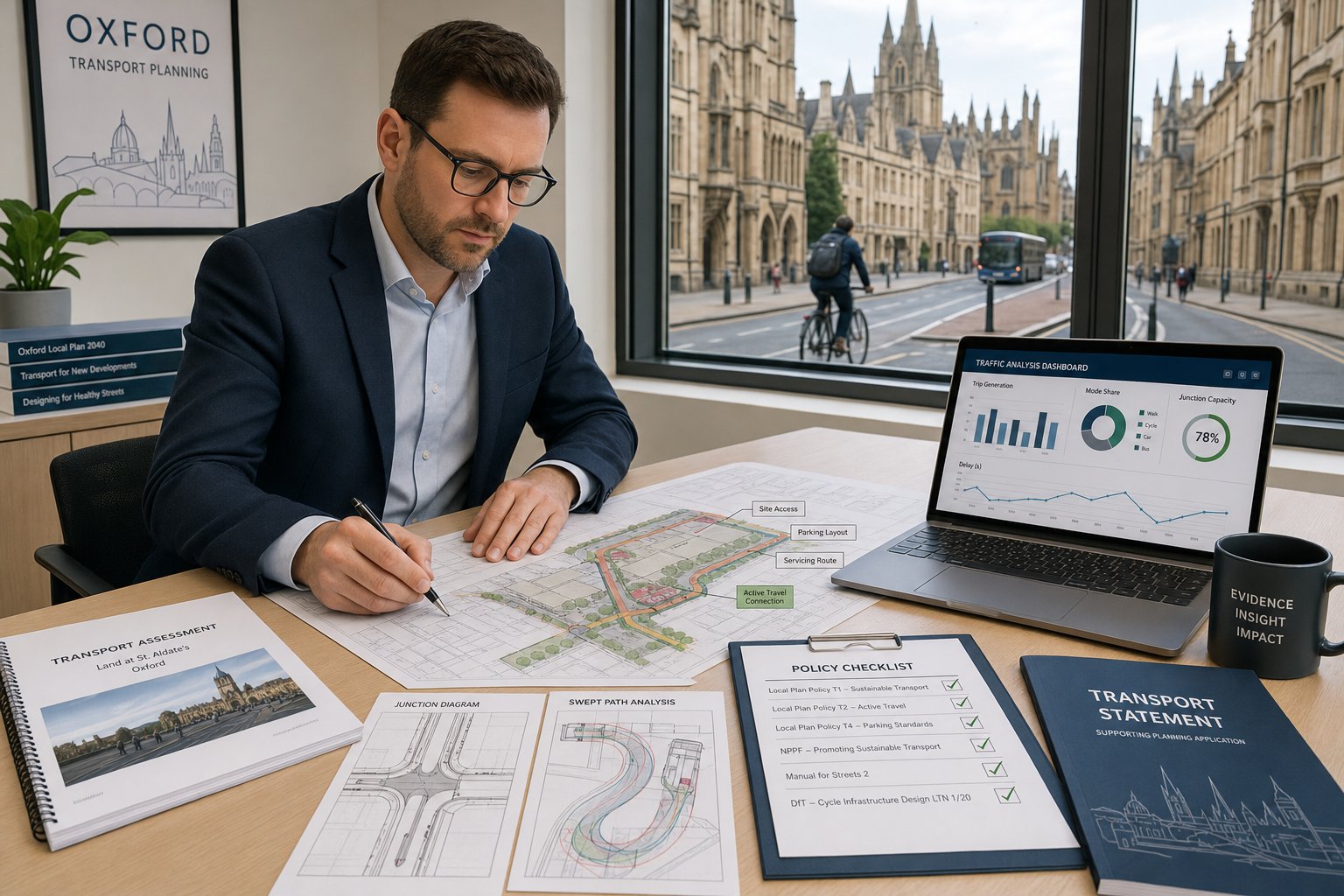
    A Transport Statement is usually more proportionate for smaller developments where transport effects are present but not expected to be significant. It still needs to be robust. “Smaller” does not mean “light-touch” if the site sits on a constrained road, near a sensitive junction, or in an area with parking and safety concerns.

    A Travel Plan is commonly required where a development will generate meaningful numbers of person trips and where there is a realistic opportunity to influence mode choice. Residential, office, education, healthcare, and strategic mixed-use development frequently fall into this category. In Chelmsford, that means setting out practical measures, targets, and monitoring arrangements rather than treating the Travel Plan as a token appendix.

    Thresholds are shaped by Department for Transport guidance, local validation requirements, and Essex County Council expectations. We always advise checking the current position at the start of a project because local validation lists and authority preferences do change, and a missed requirement can slow validation immediately.

    Key Planning Triggers And Local Validation Expectations

    Some triggers come up again and again. Major applications, including 10 or more dwellings or 1,000 square metres or more of non-residential floorspace, are the obvious starting point. But that is not the whole picture.

    Transport documents are also likely to be needed where a proposal affects A-roads, key junctions, city centre streets, or locations with known congestion or collision concerns. Schools, foodstores, drive-thrus, logistics uses, leisure schemes, and healthcare facilities can attract scrutiny because of their travel demand profile, peak hour effects, and servicing needs.

    Local validation in Chelmsford will often expect more than the headline report. Depending on the scheme, supporting material may include access drawings, visibility splays, parking schedules, cycle parking details, swept path analysis, delivery and refuse tracking, and road safety audit information. For larger or more contentious applications, formal scoping with Essex County Council can be the difference between a streamlined review and a long list of follow-up questions.

    The key lesson is this: do not guess. A narrowly scoped report that omits the wrong junction, ignores active travel links, or skips Travel Plan detail can create more delay than producing the right package at the outset.

    What A Chelmsford Transport Planning Report Typically Includes

    A good transport report for Chelmsford should read like a structured piece of planning evidence, not a bundle of disconnected technical outputs. The strongest reports move logically from policy context to baseline conditions, forecast impacts, and mitigation.

    Typically, we would expect to see a review of the relevant planning and transport policy framework, including the NPPF, local transport policy, the Chelmsford Local Plan, parking standards, and the Future Transport Network strategy. Then comes the baseline: the site context, surrounding road hierarchy, walking and cycling links, nearby bus and rail services, local amenities, parking controls, and where relevant, personal injury collision history.

    From there, the report should explain the proposed development in transport terms. That includes access arrangements, expected demand, parking provision, servicing, and refuse strategy. Forecasting needs to be transparent and proportionate, with assumptions that can be followed and tested by the authority.

    A Chelmsford-focused report also needs to show that sustainable travel has been properly considered. That means more than a list of bus stops. It means looking at permeability, quality of pedestrian connections, cycle infrastructure, likely travel behaviour, and whether the design gives people realistic alternatives to driving.

    Where mitigation is needed, it should be specific. Vague references to “encouraging sustainable travel” rarely carry weight. Authorities want to know what is being delivered, when, by whom, and how it will be secured.

    Trip Generation, Distribution, And Junction Capacity Analysis

    This is often the technical core of the submission. Trip generation is usually informed by TRICS, but local judgement matters. Selecting inappropriate sites, using weak filters, or ignoring local land-use context is one of the easiest ways to undermine an otherwise decent assessment.

    Once trip rates are established, the next step is distribution and assignment. In Chelmsford, that should reflect real network conditions and the attractiveness of routes to the strategic road network, city centre, rail stations, and nearby settlements. Census data, observed turning counts, and local traffic patterns often help justify the agreed routing assumptions.

    Junction capacity analysis may then be required on an agreed set of priority junctions, roundabouts, or signals. Depending on the layout, this can involve PICADY, ARCADY, or LINSIG modelling. The important thing is not the software itself: it is whether the modelling has been scoped properly, uses suitable baseline flows, reflects committed development where necessary, and presents results clearly.

    Authorities are rarely persuaded by unexplained tables. We find it far more effective to combine the numbers with a concise narrative: where the network is stressed, what the development adds, whether the impact is material, and what mitigation, if any, is necessary to keep conditions acceptable.

    Parking, Servicing, And Highway Safety Considerations

    Parking can derail an application surprisingly quickly, especially in urban locations or schemes with constrained layouts. Chelmsford proposals should be checked against relevant Essex and local standards for car parking, cycle parking, disabled spaces, electric vehicle provision, and where relevant, motorcycle parking. But compliance alone is not always enough. The authority will also look at usability, allocation, management, and likely overspill risk.

    Servicing is another frequent pressure point. Can delivery vehicles enter and leave in forward gear where required? Is refuse collection workable? Will emergency access be maintained? Swept path analysis often answers these questions, but the drawings need to align with the actual design, not a theoretical version that disappears at reserved matters stage.

    Highway safety should be addressed with care. A review of available collision data, typically informed by STATS19 records, can help identify existing issues on the local network. If there is a pattern, the report should engage with it honestly and explain whether the proposal would worsen conditions or whether mitigation is needed.

    For schemes involving new or altered accesses, road safety audit input may also be necessary. Again, the best submissions are direct. They show safe visibility, workable geometry, clear pedestrian routes, and a realistic understanding of how the site will operate once occupied.

    Common Development Types That Require Transport Input In Chelmsford

    In Chelmsford, some development types almost always need transport input, even where the scale seems modest on paper.

    Residential development is the obvious one. That includes larger housing sites, apartment schemes, care-led housing, and town centre redevelopment. The transport issues can range from access design and parking stress to school-run traffic, walking links, and impact on nearby junctions.

    Employment uses also attract detailed review, especially industrial, warehouse, and logistics proposals. These schemes may generate fewer staff trips than some office developments, but they often raise bigger questions around HGV routing, servicing hours, yard operation, and junction impacts.

    Retail and leisure uses can be particularly sensitive because demand peaks may not align neatly with standard commuter assumptions. Foodstores, drive-thrus, gyms, restaurants, and roadside formats often need careful analysis of turning movements, parking accumulation, and interaction with existing congestion.

    Education, healthcare, and community facilities frequently require transport evidence too. A school or medical centre can generate concentrated person trips and short-stay parking demand in a way that puts immediate pressure on nearby streets. These uses also tend to raise strong local concern, so clear evidence matters.

    Even smaller developments can trigger transport work if they sit on constrained plots, affect classified roads, or involve awkward servicing. In other words, use class alone does not decide the issue. In Chelmsford, location, access conditions, and travel characteristics are just as important as floorspace or unit count.

    How Transport Planning Supports Planning Applications And Appeals

    Transport planning does more than satisfy a validation checklist. It creates the technical case for why a scheme should be approved.

    At application stage, a well-prepared transport submission helps officers and consultees understand the likely effects of the proposal, the credibility of the forecasts, and whether mitigation is sufficient. If done properly, it can reduce ambiguity around access, parking, servicing, active travel, and traffic impact. That matters because uncertainty often leads to holding objections rather than early support.

    It also plays a central role in negotiations. Contributions and off-site works linked to section 106 or section 278 agreements usually depend on a clear evidence base. If the transport case is weak, discussions around bus stop upgrades, crossing improvements, junction works, or Travel Plan measures become harder and more expensive.

    On appeal, the value of solid transport planning becomes even more obvious. Inspectors want coherent evidence that links policy, analysis, and professional judgement. A report that clearly addresses whether impacts are severe, whether sustainable travel has been prioritised, and whether mitigation is deliverable can be highly persuasive.

    In Chelmsford, appeals are not decided in a vacuum. Local Plan strategy, Essex highway concerns, and the city’s longer-term transport direction all matter. That is why the most resilient evidence does not simply argue that traffic increases are “small”. It explains how the development fits within the local transport framework and why any impacts should be considered acceptable in planning terms.

    Frequent Reasons Transport Reports Are Delayed Or Challenged

    Most transport report delays are avoidable. They tend to stem from scope, data, policy alignment, or presentation rather than from any deep technical flaw.

    One of the biggest problems is poor early scoping. If the wrong study area is chosen, the wrong peak hours are assessed, or an obviously relevant junction is left out, Essex County Council is likely to ask for revisions. That can knock weeks off a programme, sometimes more if fresh survey work is needed.

    Another common issue is out-of-date or weak traffic survey data. Survey dates, school holiday effects, network disruption, or incomplete turning counts can all undermine confidence in the assessment. Authorities want representative information, not numbers that look convenient.

    We also see reports challenged because they underplay sustainable travel. In Chelmsford, the Future Transport Network strategy and wider planning policy make it risky to focus almost entirely on vehicular access. If a submission ignores pedestrian permeability, cycle connectivity, bus links, or realistic Travel Plan measures, it can appear disconnected from local policy.
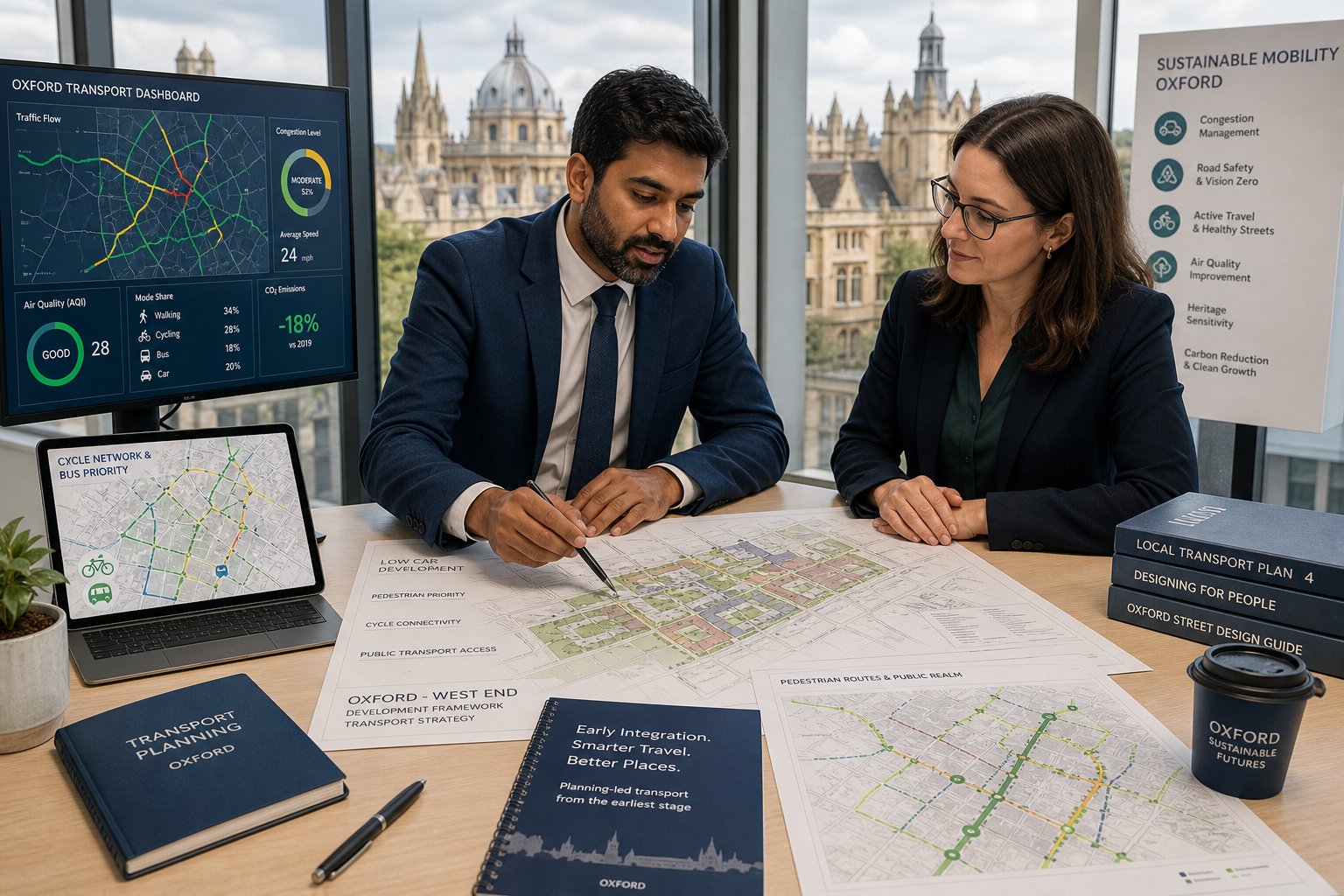
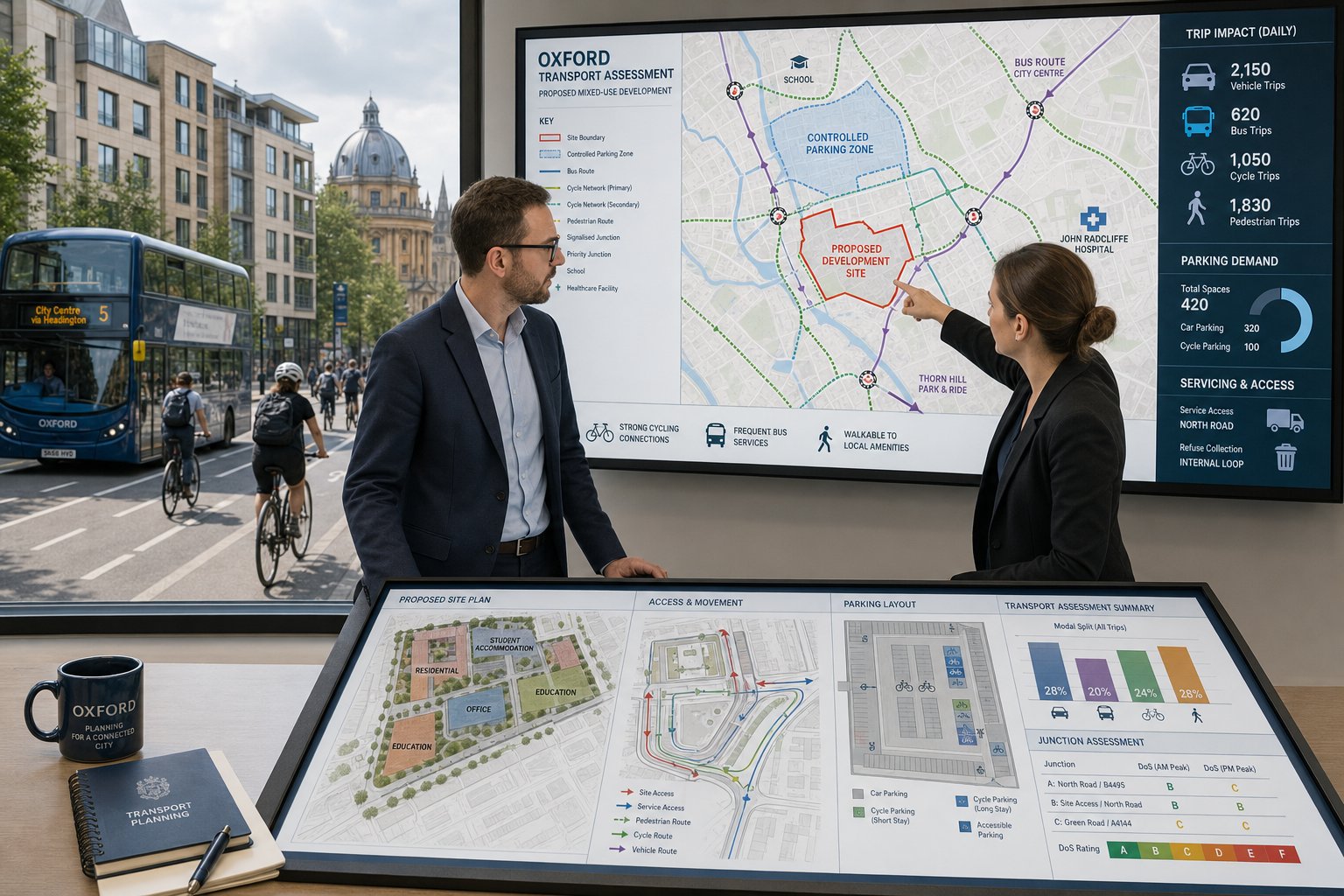
    Then there is Travel Plan quality itself. A short generic statement with no targets, no coordinator role, no welcome packs, no monitoring period, and no review mechanism is unlikely to satisfy a highway authority for a trip-intensive scheme.

    Finally, some reports simply fail on communication. Dense appendices without a clear narrative, inconsistent drawings, unexplained assumptions, and conflicting numbers between chapters all create doubt. Technical work can be perfectly competent and still run into trouble if it is not presented in a way that planners and consultees can follow.

    How To Prepare A Strong Transport Submission From The Start

    The strongest transport submissions usually start before the planning application is drafted. Early coordination saves time later, and in Chelmsford that is especially true where local policy and highway expectations are quite specific.

    First, we recommend early pre-application engagement with both Chelmsford City Council and Essex County Council where the scale or sensitivity of the site warrants it. A short written scoping agreement on survey extents, assessment years, junctions, committed development, and document type can remove a huge amount of uncertainty.

    Second, the site layout and transport strategy should be developed together. Too many schemes still treat transport as a compliance exercise after the architecture is largely fixed. But walkability, cycle permeability, bus access, bin collection, servicing, parking arrangement, and emergency access all need to work as one package.

    Third, use the current policy framework and standards. That means checking the latest local validation requirements, Essex parking guidance, relevant transport policy, and the Chelmsford growth context. We should never assume that an approach accepted on a previous project will automatically be accepted on the next one.

    Fourth, make the submission evidence-led but readable. Clear plans, well-labelled figures, realistic modelling assumptions, and a concise explanation of impacts go a long way. So does being candid about constraints. Authorities are generally more receptive to a report that identifies a problem and proposes a sensible solution than one that tries too hard to insist everything is negligible.

    And finally, if a Travel Plan is needed, make it monitorable. Include meaningful targets, practical measures, responsibilities, and a realistic review structure. That is what turns a transport document from a paper exercise into a planning tool that can genuinely help a scheme through the system.

    Conclusion

    Transport planning in Chelmsford is becoming more exacting, not less. The direction of travel is clear: development must support growth, but it must also respond to congestion, safety, sustainable movement, and the city’s longer-term transport strategy to 2036.

    For developers, that means the quickest route to planning approval is rarely the lightest-touch report. It is the right report, scoped properly, grounded in local policy, and backed by clear evidence on trip generation, junction performance, parking, servicing, safety, and Travel Planning.

    When those pieces are dealt with early, applications tend to move more smoothly, negotiations are more focused, and appeals are easier to defend if they arise. When they are left vague or incomplete, delays are almost built in.

    In our experience, successful transport planning in Chelmsford comes down to one thing: treating transport as part of the development strategy from day one, not as a technical appendix added at the end.

    Frequently Asked Questions about Transport Planning in Chelmsford

    Why is transport planning so important for developments in Chelmsford?

    Transport planning ensures developments support Chelmsford’s growth while managing road network capacity, safety, and sustainable travel priorities. It aligns with local and national policies to prevent severe highway impacts and promote walking, cycling, bus, and rail use.

    When is a Transport Assessment or Travel Plan required in Chelmsford planning applications?

    A Transport Assessment is needed for larger or traffic-intensive developments like major housing or retail schemes. Smaller developments may require a Transport Statement. A Travel Plan is required where significant person-trip generation occurs, offering practical, monitored measures to encourage sustainable travel.

    How do Chelmsford’s travel patterns influence transport planning decisions?

    Transport planning reflects real travel patterns, including strong rail commuting and congestion on key roads like the A1060, A1114, and A130. The Future Transport Network strategy guides how new developments integrate with sustainable corridors, bus priority, cycle routes, and interchanges to reduce car dependency.

    What are common reasons for delays in transport report approvals in Chelmsford?

    Delays often arise from poor scoping, outdated traffic data, ignoring sustainable travel policies, insufficient Travel Plan detail, or unclear report communication. Early engagement with authorities and alignment with local policy can prevent these issues and speed up validation.

    How should developers prepare a strong transport planning submission in Chelmsford?

    Start with early pre-application discussions with local councils to agree scope and surveys. Integrate transport strategy with site layout focusing on walking, cycling, and bus access. Use current Local Plan and Essex standards, provide clear evidence, and include a robust, monitorable Travel Plan.

    What transport considerations are critical for residential and employment developments in Chelmsford?

    Developments must demonstrate safe access, appropriate car and cycle parking, servicing arrangements, and support for sustainable travel modes. For employment sites, HGV routing and servicing hours are key, while residential schemes must address local traffic, school-run impacts, and nearby junction capacity.