Category: High Frequency Posts

  • Commercial Traffic Engineering In 2026: What Developers And Planning Teams Need To Get Right

    Commercial Traffic Engineering In 2026: What Developers And Planning Teams Need To Get Right

    Planning risk rarely starts on site. More often, it starts in a report that was scoped too late, supported by weak survey data, or written without a clear view of what the highway authority is actually worried about. That is why commercial traffic engineering matters so much in 2026.

    For architects, planners, developers, lawyers and local authorities, transport evidence is no longer a box-ticking exercise. It shapes whether a scheme is considered safe, deliverable and policy-compliant. It influences access design, parking strategy, servicing, sustainable travel measures and, eventually, whether a planning application moves forward smoothly or gets dragged into rounds of objections and revisions.

    We see this every week. A commercial scheme may look straightforward on the drawing set, yet the moment questions arise around peak-hour impact, visibility, refuse tracking, or cumulative traffic growth, the planning programme starts to wobble. Good transport input steadies it. Better still, early transport input often prevents the wobble altogether.

    In this guide, we explain what commercial traffic engineering covers, when a Transport Statement or Transport Assessment is needed, what surveys typically support an application, and how forecasting, junction testing and operational planning are put together in practice. The aim is simple: to help planning teams understand what robust transport evidence looks like, and what tends to go wrong when it is rushed.
    What Commercial Traffic Engineering Covers In The Planning Process

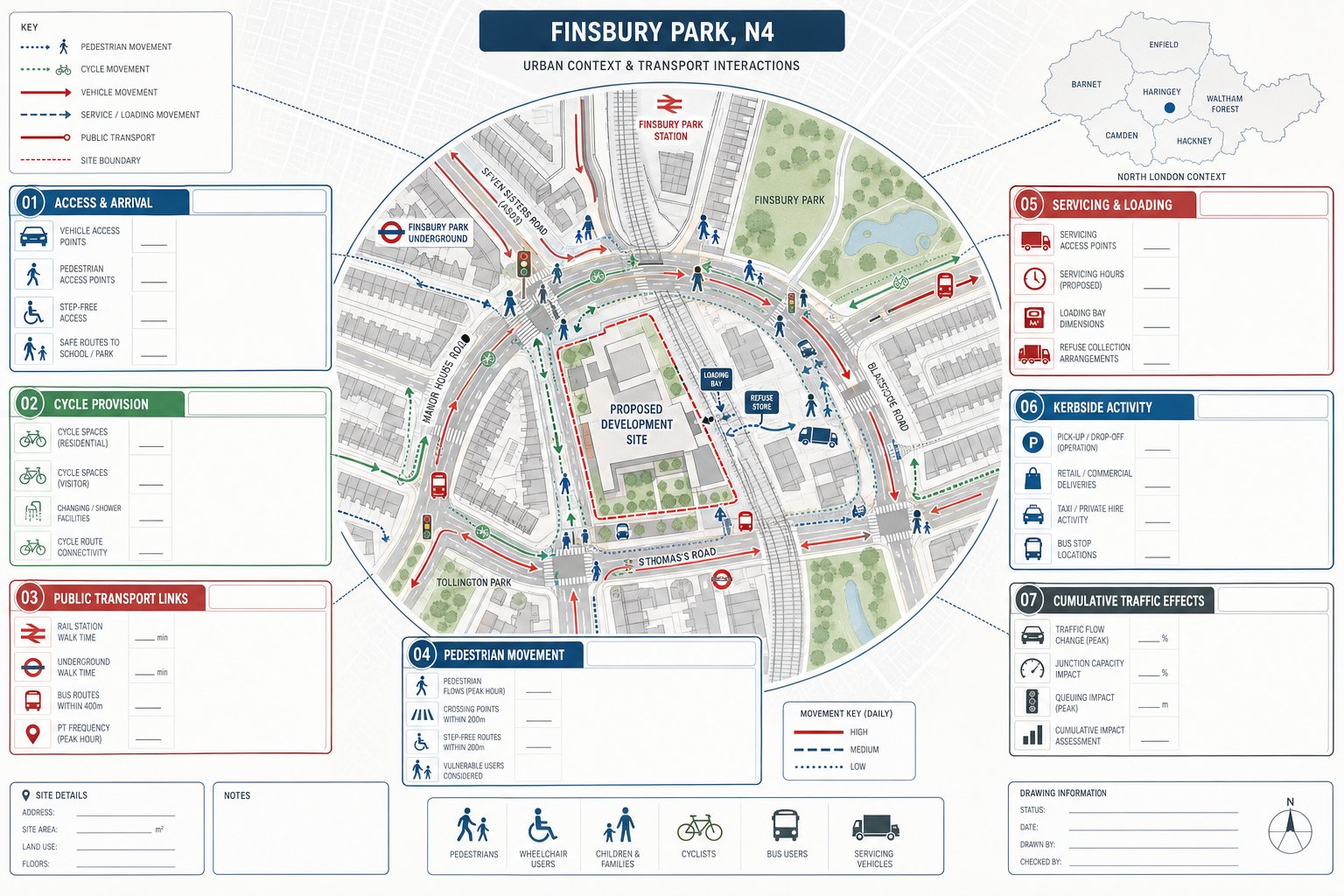
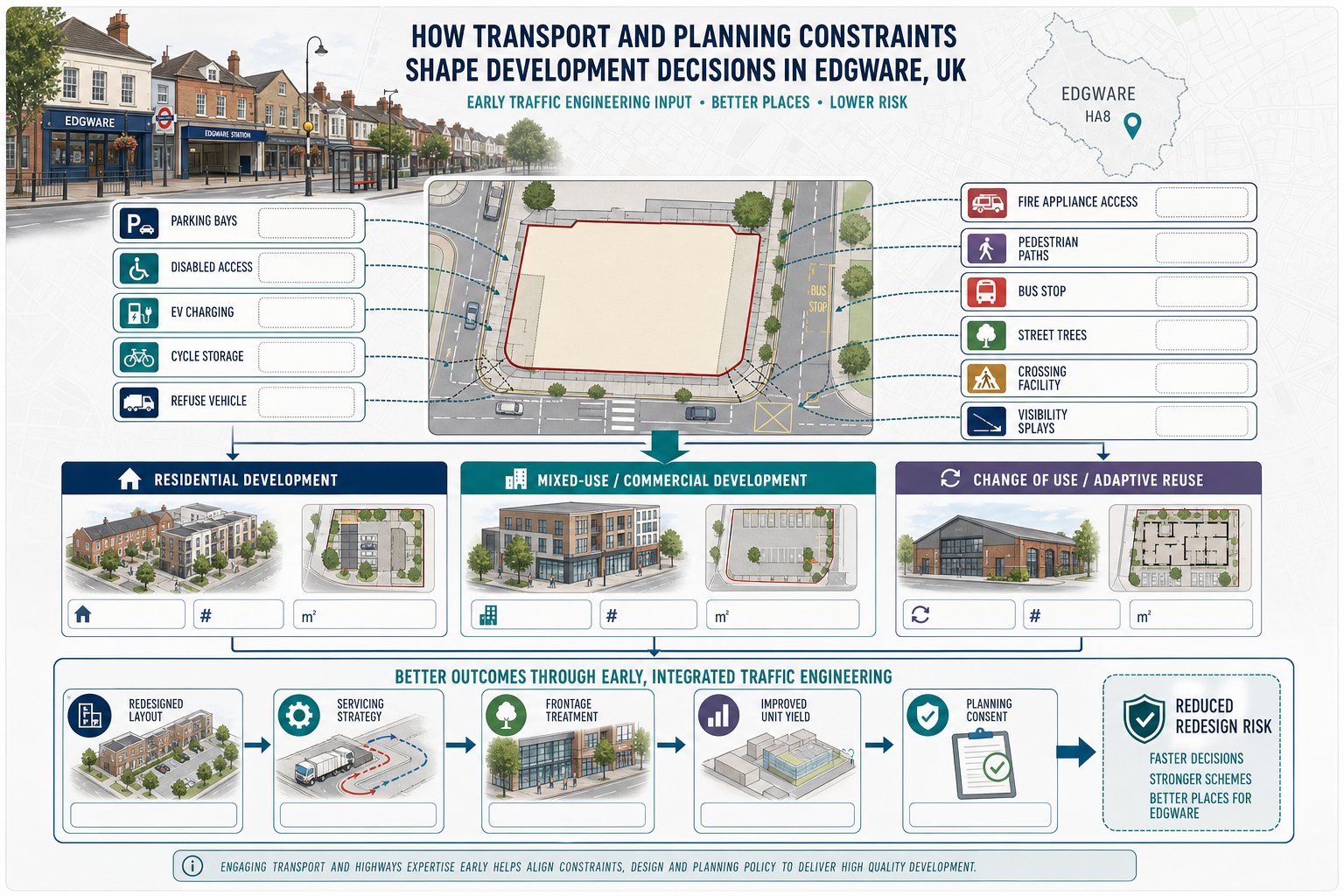
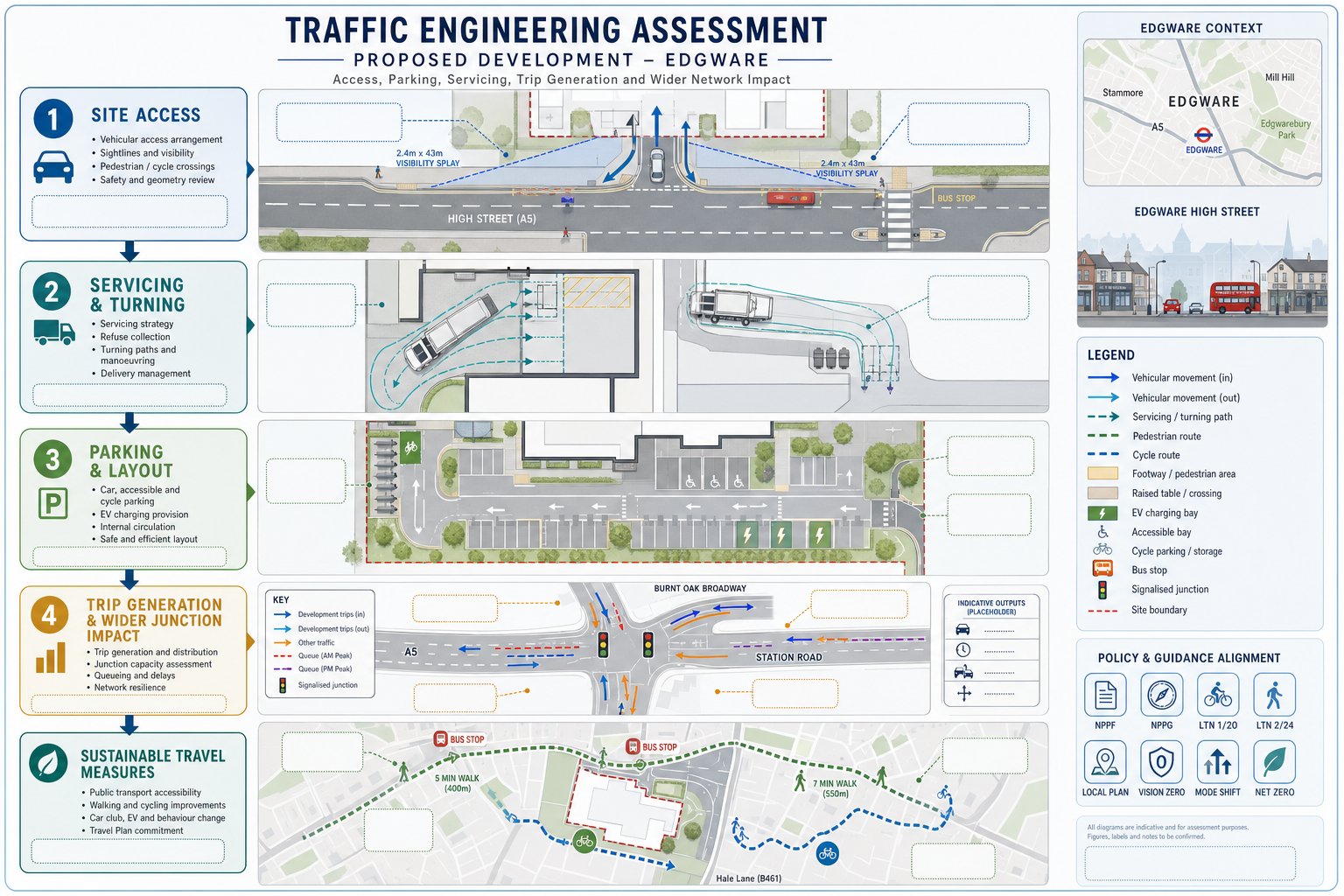
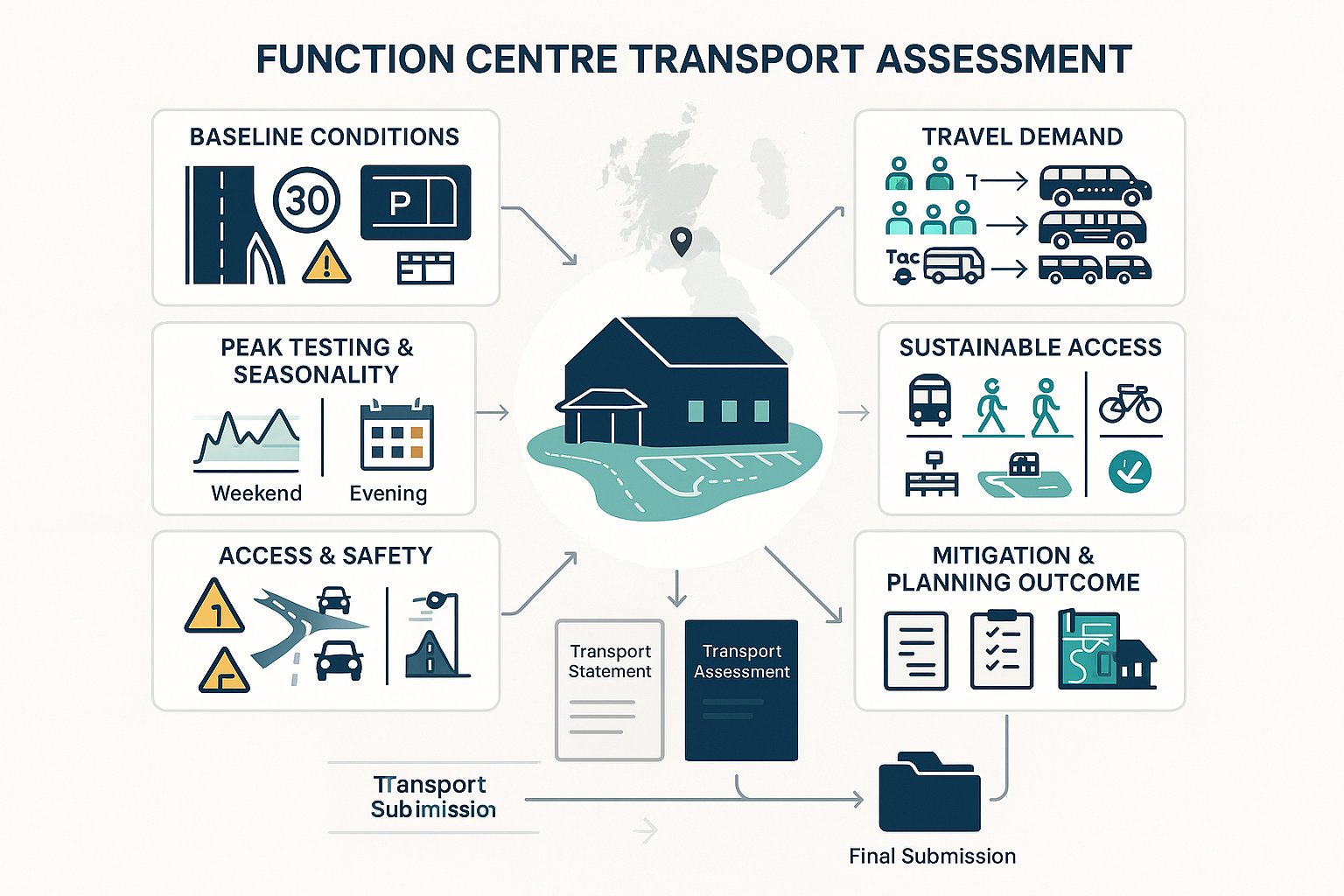
    Infographic of commercial traffic engineering factors and transport evidence for planning in the UK.

    Commercial traffic engineering sits at the point where site design, transport policy and highway operation meet. In practical terms, it covers how a development will be accessed, how people and vehicles will move around it, and what effect that movement will have on the surrounding network.

    For commercial schemes, that usually means more than a single access drawing. We need to look at junction arrangement, internal circulation, delivery and refuse movements, pedestrian links, cycle provision, parking layout, visibility splays, gradients and interaction with nearby roads. On many sites, those pieces evolve alongside the architecture, not after it.

    It also includes the evidence base used to show that a proposal can function safely and efficiently. That may involve traffic surveys, accident analysis, trip generation, junction capacity modelling and review against local and national policy. In other words, transport work is both technical and strategic.

    For planning teams, the key point is this: highway and transport matters are rarely confined to the red line boundary. A well-run process considers off-site effects, neighbouring junctions, sustainable travel opportunities and whether mitigation is needed. That broader approach is a big part of why commercial traffic engineering has become central to planning submissions for employment, retail, logistics, mixed-use and institutional development.

    How Transport Evidence Supports Planning Applications

    Transport evidence gives decision-makers something more reliable than assumption. A Transport Statement or Transport Assessment explains what the proposal will generate, where those movements are likely to go, whether the network can accommodate them, and what mitigation is proposed if pressure points appear.

    That evidence supports judgments on matters such as parking supply, access safety, active travel links, servicing practicality and highway agreements. It also helps tie the proposal back to policy. The National Planning Policy Framework in England still places weight on sustainable transport and on whether any residual cumulative impacts on the road network would be severe. Local plans and validation checklists then add more detailed expectations.

    Strong evidence also reduces ambiguity. Highway officers are much more likely to engage constructively when the baseline is clear, assumptions are transparent and drawings align with the narrative. That is one reason many teams now bring in Traffic Engineering and Transportation input early, before layouts become fixed in the wrong form.

    When A Development Needs A Traffic Assessment Or Transport Statement

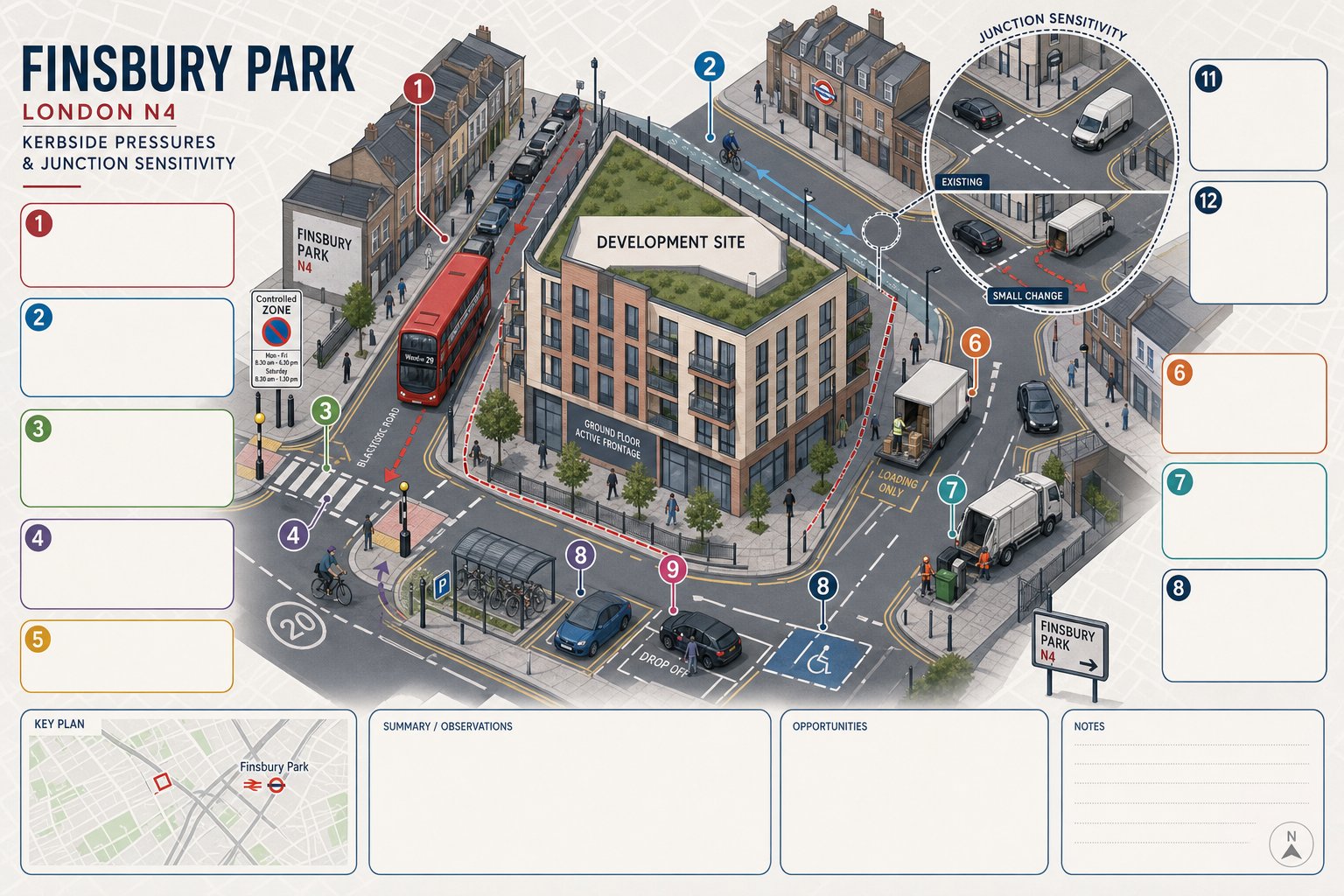
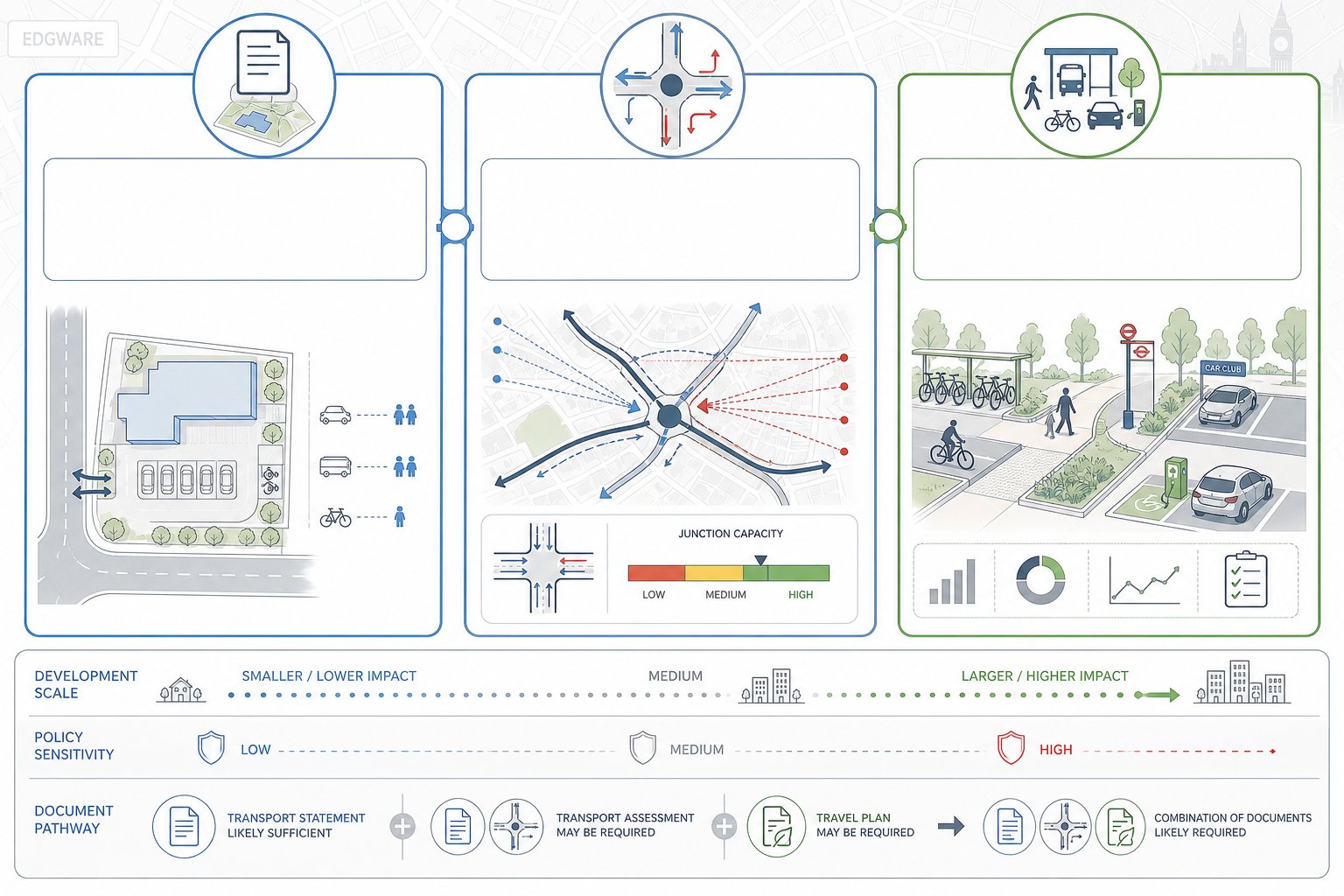
    Decision infographic showing when commercial development needs a transport statement or assessment.

    Not every development needs a full Transport Assessment, but many more schemes need transport evidence than applicants first expect. The broad test is whether the proposal is likely to create significant movement or materially affect access, safety or operation on the local highway network.

    A smaller commercial scheme with modest trip generation may only need a concise Transport Statement. That usually covers the site context, existing transport conditions, expected trip rates at a proportionate level, parking, accessibility and any limited highway effects. A larger or more sensitive proposal typically requires a full Transport Assessment, with detailed surveys, modelling, future-year forecasts and mitigation testing.

    The distinction matters because under-scoping is one of the most common causes of delay. If an authority believes a Statement has been submitted where an Assessment was needed, validation can stall or consultation comments can become much harder to resolve. That is especially true for schemes on congested corridors, near schools, on classified roads, or where HGV servicing is a prominent feature.

    From our side, we usually advise teams to ask a simple question early: will this development change how the surrounding network operates, even if only at one key junction or access point? If the answer might be yes, a more robust assessment route is often the safer planning choice.
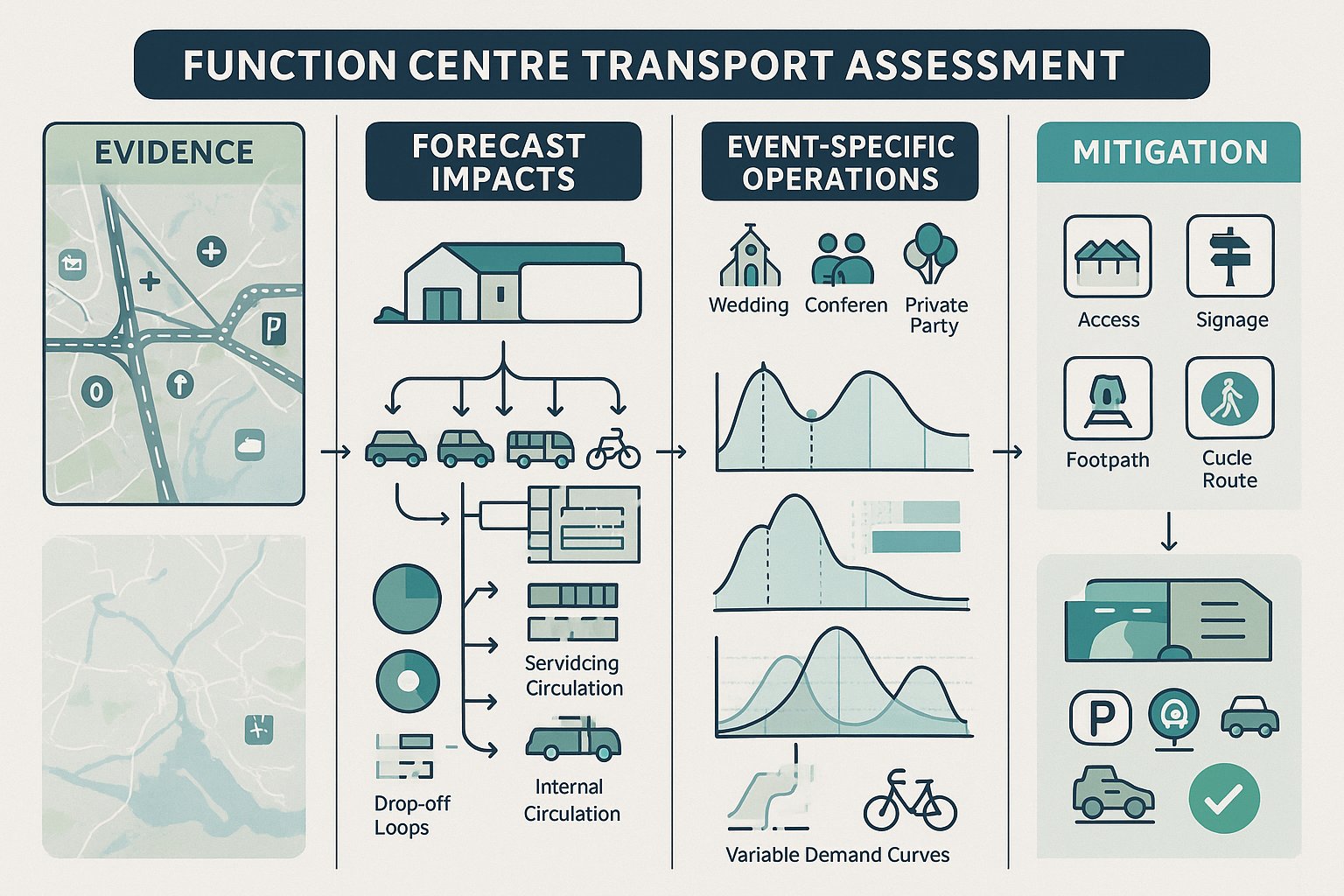
    Typical Local Authority Thresholds And Triggers

    There is no single national trigger table that every council follows in exactly the same way. Local highway authorities typically set expectations through validation checklists, local guidance notes and pre-application responses. That means thresholds vary by authority, by land use and sometimes by site context.

    Common triggers include gross floor area for offices, retail or industrial uses: dwelling numbers on mixed schemes: creation or material alteration of an access: development on A-roads or other strategic corridors: and proposals in locations with known congestion or road safety concerns. Sites close to schools, hospitals, town centres or air quality management areas often attract greater scrutiny as well.

    And context can outweigh scale. A small roadside redevelopment with awkward visibility or constrained servicing may need more assessment than a slightly larger scheme in a well-connected employment area. That is why pre-app discussions matter. A short scoping note agreed with the authority can save weeks later on.
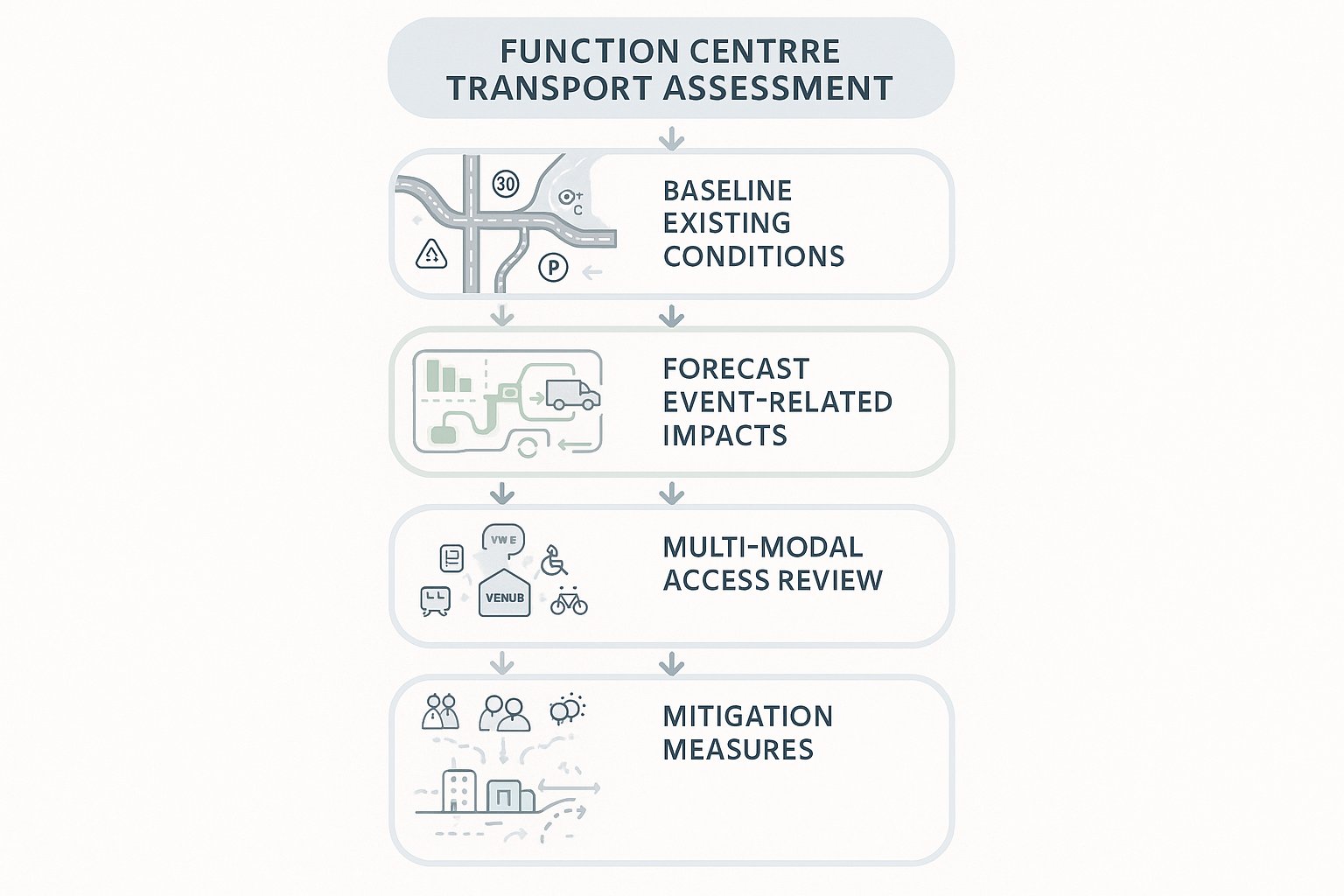
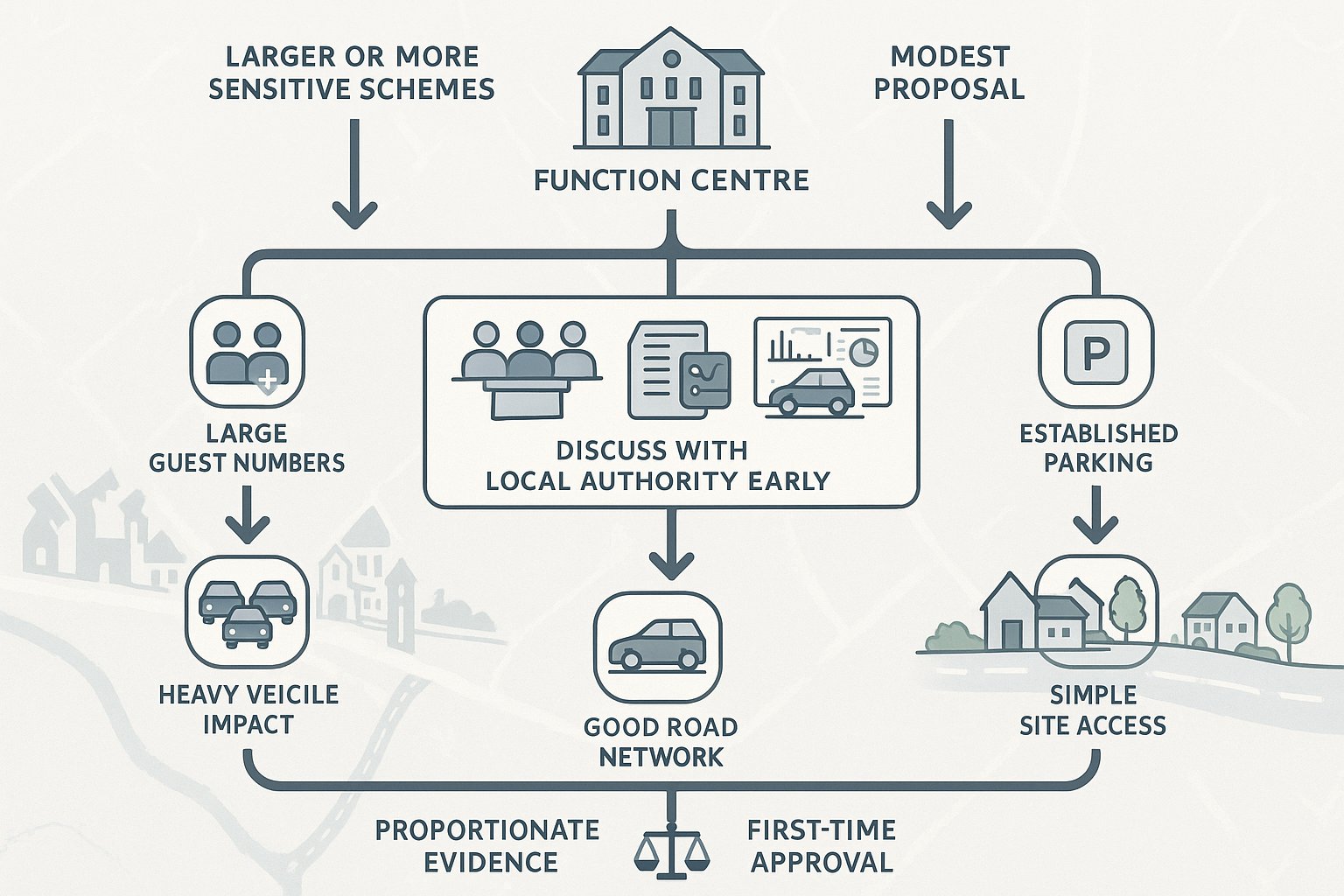
    Where local expectations are unclear, experienced Traffic Engineering Consultants: can usually read the likely position from comparable decisions, validation lists and the physical characteristics of the site.

    The Main Surveys, Data, And Site Evidence Required

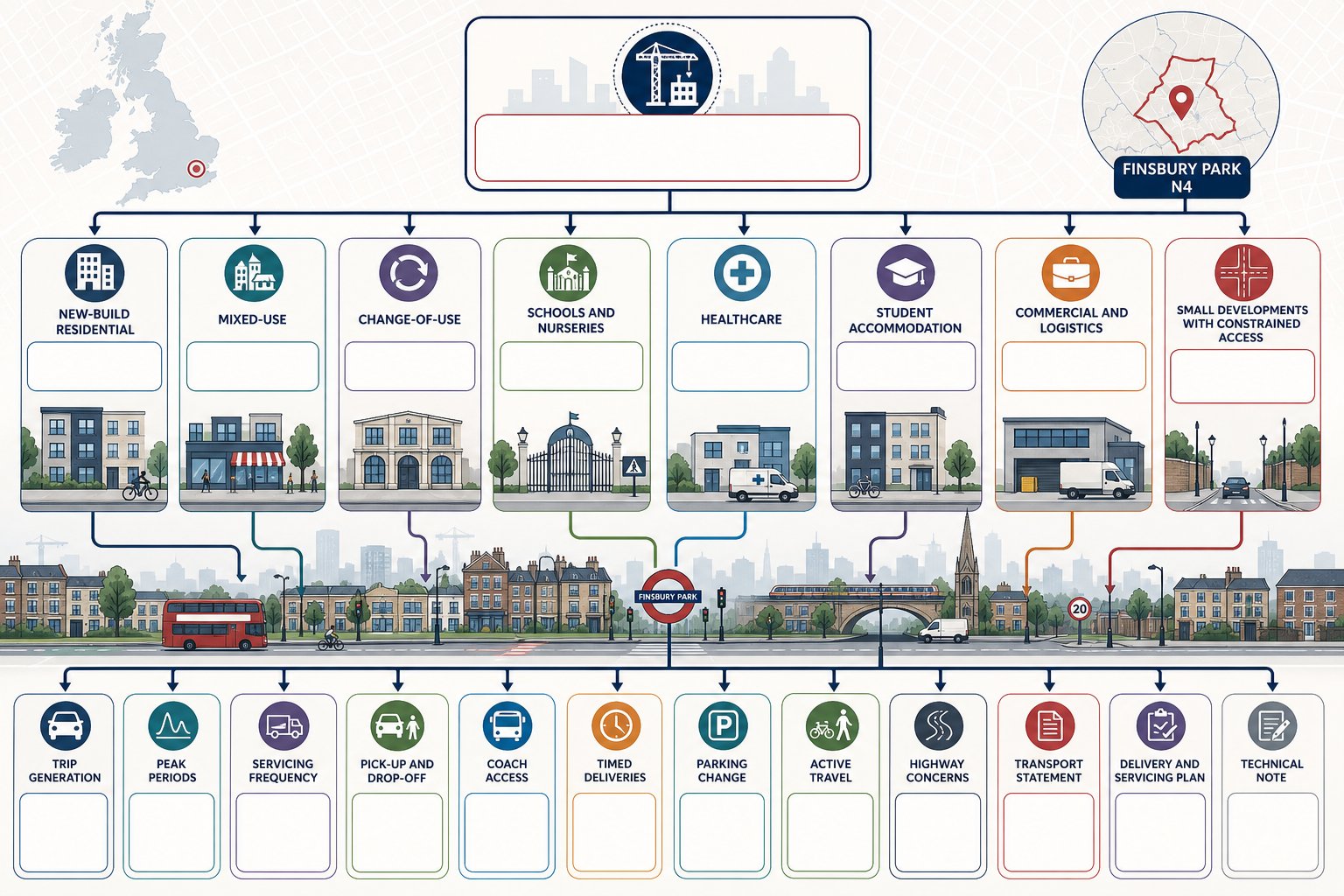
    Infographic showing junction counts, speed surveys, and parking reviews for a UK commercial site.

    Transport submissions are only as reliable as the evidence underneath them. For most commercial planning applications, that evidence begins with observed conditions on the ground rather than broad assumptions from desktop mapping.

    Typical survey work includes classified traffic counts on surrounding roads, turning counts at nearby junctions, queue length observations, journey time checks where congestion is an issue, parking beat surveys, accessibility review and site measurements for access design. We also review collision records, traffic regulation orders, local walking and cycling connections, bus services and, where relevant, servicing activity around neighbouring premises.

    The exact package depends on the scheme. A trade counter unit may need careful analysis of van activity and short-stay parking. A logistics or industrial site may need stronger emphasis on HGV routing, gate operation and swept paths. A town-centre commercial scheme may rely more heavily on accessibility, parking stress and loading restrictions.

    What matters most is proportion. Highway officers do not expect every survey on every scheme, but they do expect the evidence to answer the right questions. Missing baseline data creates a vacuum, and that vacuum nearly always gets filled by caution.

    Junction Counts, Speed Surveys, And Parking Reviews

    Junction counts are the backbone of many assessments because they tell us how the network actually behaves in the busiest periods. Typically, we use AM and PM peak turning counts, sometimes with Saturday surveys for retail or leisure uses. Those flows feed the base models used to test future impact.

    Speed surveys matter where access visibility is an issue. The 85th percentile speed is normally used to derive stopping sight distance and to judge whether a proposed access geometry is appropriate. Designers ignore this at their peril. A beautiful entrance detail on a plan can unravel fast if the measured traffic speed is higher than assumed.

    Parking reviews are equally important, particularly on constrained commercial sites. On-street occupancy, duration, beat patterns and nearby private parking conditions can show whether a proposal’s parking provision is realistic or likely to displace vehicles into surrounding streets. In urban areas, they also help justify management measures, disabled spaces, cycle parking and loading arrangements.

    For schemes where evidence needs to move quickly but still stand up under scrutiny, focused work such as traffic impact assessment support can often keep the survey scope tight without making it thin.

    How Trip Generation And Traffic Forecasting Are Calculated

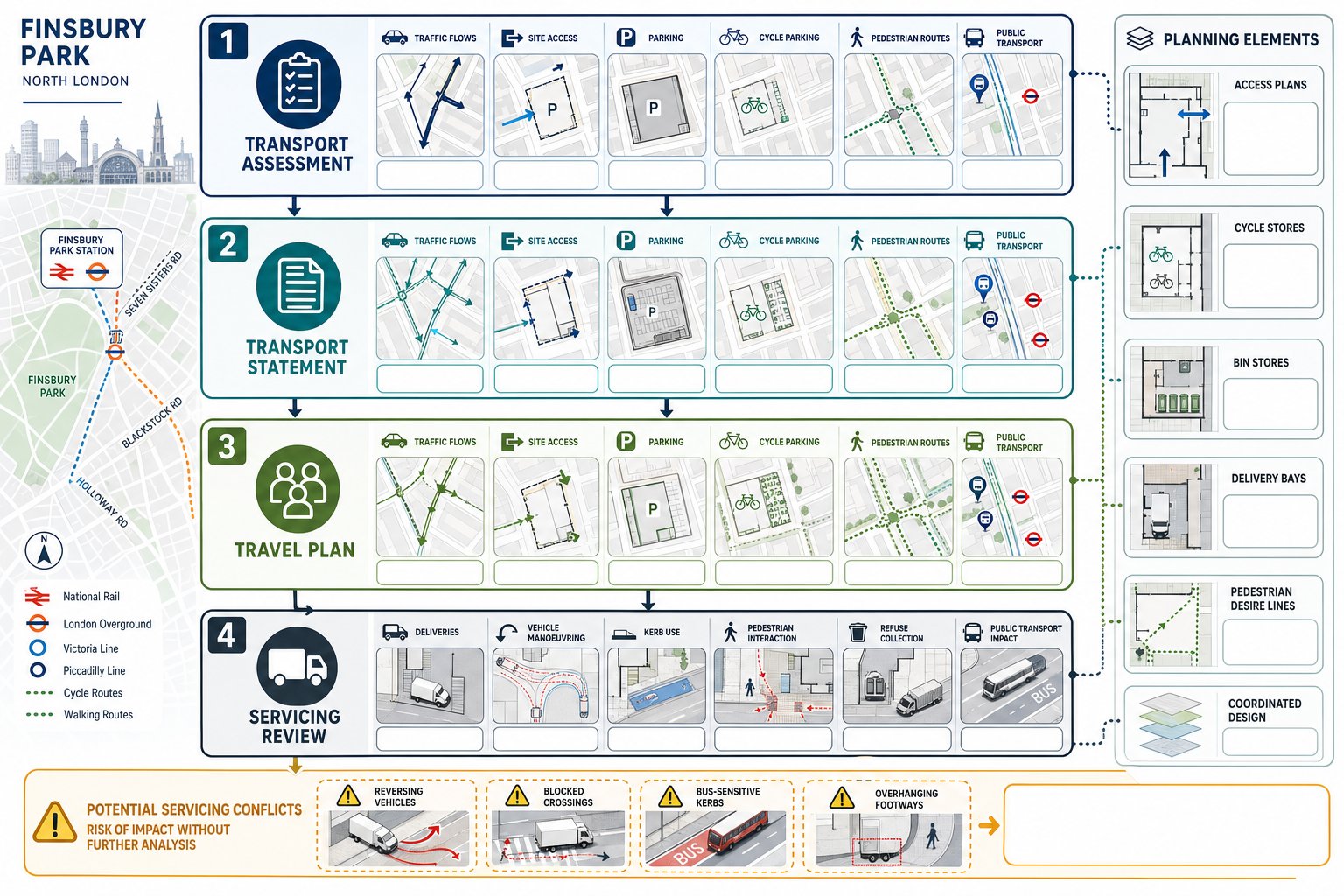
    infographic of UK commercial trip generation and traffic forecasting steps

    Trip generation is where many planning debates start, because once we estimate how many vehicles, pedestrians and cyclists a site will produce, the rest of the assessment begins to take shape. For commercial development, that exercise needs care. Different land uses can produce very different patterns even where floor area looks similar.

    In UK practice, TRICS remains the usual starting point for deriving trip rates. We select comparable sites by land use, scale, location type and operational character, then sense-check the data rather than lifting an average uncritically. A discount foodstore, a trade park, a hotel and a distribution unit all behave differently: selecting the wrong comparison set distorts everything downstream.

    From there, we apply rates to the proposed development quantum and consider pass-by, linked and diverted trips where justified. Existing lawful use is also important. Redevelopment rarely starts from zero, and planning authorities expect the net transport effect to be explained properly.

    Forecasting then carries those trips into the relevant future assessment years. We typically combine observed baseline flows with committed development where appropriate and apply growth factors from recognised sources. Distribution and assignment can be based on gravity-style patterns, existing turning movements, census and journey data, or site-specific evidence such as customer draw and delivery routing.

    The best forecasting is transparent rather than theatrical. Authorities are not looking for a model with the most decimal places: they want assumptions that are reasonable, documented and tested sensibly under sensitivity scenarios. That practical mindset underpins good Traffic Engineering: Your Complete analysis across both straightforward and more contentious commercial schemes.

    Assessing Junction Capacity, Access Design, And Highway Impact

    Infographic of junction capacity, site access, and highway impact assessment in the UK.

    Once trip generation is established, the next question is whether the surrounding network can cope. Junction capacity assessment translates forecast traffic into operational terms: queues, delays, reserve capacity and practical performance under stress.

    The software and methodology depend on junction type. Priority junctions, roundabouts and signalised junctions each use different modelling tools and output measures, but the principle is the same. We compare base and future conditions, then test the development scenario with and without mitigation. Officers usually focus on indicators such as RFC, degree of saturation, queue growth and whether conditions become materially worse in the peak periods.

    But capacity is only part of highway impact. Access design must also be tested against geometry, visibility, gradient, tracking, pedestrian crossing opportunity and relationship to nearby junctions or accesses. A site may show acceptable junction operation and still run into trouble if the entrance arrangement is unsafe or impractical.

    In commercial traffic engineering, we hence assess impact through three linked lenses: operation, safety and resilience. Operation asks whether the network can function. Safety asks whether conflict risk is acceptable and standards are met. Resilience asks what happens when real life intrudes, deliveries arrive together, a queue backs through an access, or peak conditions spill into the next movement cycle.

    That is where integrated design pays off. A modest adjustment to access width, parking aisle arrangement, servicing sequence or pedestrian route can remove a problem that no amount of modelling prose will hide. On larger or regionally sensitive schemes, a Traffic Flow Management perspective can also help frame mitigation around network performance, not just one site gate.

    Sustainable Travel, Servicing, And Operational Movement Planning

    Planning authorities are increasingly clear on this point: transport evidence cannot focus only on cars. Commercial schemes need to show how walking, cycling, public transport, servicing and day-to-day site operation have been considered from the outset.

    That usually means a Travel Plan or at least Travel Plan measures proportionate to the development. For offices, mixed-use schemes, education, healthcare and larger employment sites, this may include mode-share targets, cycle facilities, shower provision, car-sharing measures, public transport information, personalised travel support and monitoring commitments. The detail varies, but the principle is consistent: if a site is expected to generate movement, it should also promote realistic alternatives to single-occupancy car trips.

    Servicing is just as critical. Commercial developments often succeed or fail in planning terms on the practicalities of deliveries, refuse collection and emergency access. Swept-path analysis is used to confirm that the design vehicle can enter, turn, load if necessary and exit safely. Time-window controls, loading bay location, gate operation and conflict with customer parking or pedestrian desire lines all need thought.

    Operational movement planning also bridges the gap between planning drawings and lived reality. We look at who arrives when, in what vehicle type, with what dwell time and by which route. On a constrained urban infill site, that can be the difference between a workable layout and one that produces daily friction. In cities and complex local contexts, teams often benefit from input similar to a Traffic Engineer In Manchester: approach, where local authority expectations and street conditions shape the transport solution early.

    Common Issues That Delay Planning Decisions

    Most transport-related delays are not caused by one dramatic flaw. They come from smaller weaknesses that accumulate until the authority loses confidence in the submission.

    The first is inadequate survey data. Counts outside agreed dates, missing peak periods, poor weather conditions, school holiday anomalies or inconsistent turning movements can all trigger requests for re-survey. The second is underestimating trips or relying on weak comparables, which then undermines every capacity result that follows.

    A third common issue is mismatch between report and drawing package. We still see submissions where the Transport Statement assumes one access arrangement, while the latest planning drawing shows another. The same happens with parking numbers, cycle provision, loading areas or visibility splays. Once documents diverge, review slows down because no one is sure which version to assess.

    Safety concerns also cause delay quickly: substandard visibility, awkward junction spacing, reversing refuse vehicles, servicing across pedestrian routes, or access gradients that do not work in practice. Add in thin sustainable travel measures or vague parking justification, and objections become more likely.

    Then there is timing. Revised layouts submitted late, after consultee comments have landed, often force another loop of review. That can be costly in programme terms.

    We have found that the smoothest applications are not necessarily the biggest or simplest: they are the ones where transport, architecture and planning teams coordinate early, disclose assumptions clearly and fix issues before submission rather than after it.

    How To Prepare A Strong, Policy-Compliant Transport Submission

    A strong submission starts before the report is written. We recommend agreeing scope with the local highway authority at pre-application stage wherever possible, especially for commercial proposals involving new access arrangements, strategic roads, servicing complexity or known congestion issues. Even a short scoping exchange can clarify whether the authority expects a Statement, a full Assessment, specific junction models, a Travel Plan or additional road safety evidence.

    The second step is to build the evidence on current, defensible data. Surveys should be recent, quality-checked and representative. Analysis should use recognised tools and methods, whether that means TRICS for trip generation, standard junction software for capacity testing, or measured speed data for visibility assessment. If assumptions are unusual, they should be explained openly rather than tucked into an appendix and hoped for the best.

    Just as important, the submission needs a clear planning narrative. We should show how the proposal aligns with national policy, local transport policy and site-specific constraints. Where impacts arise, mitigation should be tangible: junction improvement, access amendment, parking management, Travel Plan measures, delivery controls or phasing commitments. Officers are far more comfortable with a scheme that acknowledges issues and solves them than one that claims there are none.

    Sensitivity testing often strengthens the case too. If there is legitimate uncertainty around committed development, trip rates or background growth, testing a reasonable worst case can demonstrate robustness. That helps support the crucial planning conclusion: that residual cumulative impacts would not be severe and that safe, sustainable access can be achieved.

    For applicants working across different authority areas, local nuance matters. What is accepted readily in one district may be challenged in another, which is why regionally informed input, whether akin to a Traffic Engineer In city-based service or broader national experience, can make a noticeable difference to programme certainty.

    Conclusion

    Commercial traffic engineering is eventually about confidence. Confidence that a scheme can be accessed safely, that its trips have been assessed honestly, that servicing will work on a Tuesday morning rather than only on a drawing, and that the planning submission answers the questions a highway authority is actually going to ask.

    In 2026, that means proportionate but robust evidence: the right surveys, sensible forecasting, clear policy alignment, realistic mitigation and close coordination between design and transport teams. When those elements are in place early, planning applications tend to move faster and with fewer surprises.

    For developers, planners, architects and councils, the lesson is simple enough. Treat transport as part of scheme design, not as a late-stage report-writing exercise. The result is usually a stronger application, a more deliverable development and a much better conversation with the decision-makers reviewing it.

    Frequently Asked Questions about Commercial Traffic Engineering

    What is commercial traffic engineering in the context of planning applications?

    Commercial traffic engineering involves the planning and design of how vehicles, pedestrians, and servicing movements will safely and efficiently access and circulate within a development, while assessing impacts on surrounding junctions and highways to ensure policy compliance.

    When is a Transport Assessment required instead of a Transport Statement?

    A full Transport Assessment is usually required for larger or sensitive developments likely to generate significant traffic or materially affect local highways, while smaller schemes with modest trip generation often only need a concise Transport Statement.

    What types of surveys support commercial traffic engineering submissions?

    Typical surveys include classified traffic and turning counts during peak hours, speed surveys for visibility checks, parking occupancy and duration reviews, queue length observations, and collision data to provide robust, representative evidence.

    How do trip generation and traffic forecasting work in commercial traffic engineering?

    Trip generation uses databases like TRICS to estimate trips based on land use and scale, while forecasting applies growth factors and traffic distribution models to predict future impacts on the network, ensuring realistic and tested assumptions.

    Why is early transport input important in commercial development planning?

    Early transport input helps prevent delays by ensuring access designs, junction impacts, and sustainable travel measures are considered upfront, aligning transport evidence with site layouts and local authority expectations for smoother approvals.

    How do sustainable travel plans fit into commercial traffic engineering?

    Sustainable travel plans promote walking, cycling, public transport, and reduced car use through measures like cycle facilities, travel information, and mode-share targets, integrated from the start to support policy compliance and reduce traffic impact.

  • Parking Strategy In Traffic Engineering: A Practical Guide For Planning, Capacity, And Compliance In 2026

    Parking Strategy In Traffic Engineering: A Practical Guide For Planning, Capacity, And Compliance In 2026

    A parking strategy can make or break a planning application long before anyone debates façade treatments or landscape details. When parking is undercooked, the same objections tend to surface fast: overspill onto nearby streets, congestion at the site access, servicing conflicts, poor pedestrian safety, and claims that the proposal simply does not reflect how people actually travel. In traffic engineering, that is not a minor detail. It sits right at the centre of how a development functions day to day.

    For architects, planners, developers, surveyors and local authorities, the challenge in 2026 is sharper than it used to be. Standards are more nuanced, town centre and edge-of-centre sites are under pressure to use land efficiently, and councils increasingly expect evidence rather than assumptions. A good parking strategy hence needs to do more than count spaces. It has to show why the provision is appropriate, how it will operate, and how it supports wider transport and land-use objectives.

    In this guide, we set out a practical view of parking strategy traffic engineering: what it means, why it matters in planning and development control, how demand should be assessed, and what design and management measures strengthen the final case. The aim is simple: help teams produce strategies that are credible, policy-aware, and much harder to pick apart at application stage.

    What Parking Strategy Means In Traffic Engineering

    Infographic showing how parking strategy connects design, demand, access, and policy.

    In traffic engineering, a parking strategy is the structured, evidence-led approach to deciding how much parking is needed, where it should sit, how it should work, and how it should be managed over time. That includes private car parking, accessible bays, visitor spaces, cycle parking, servicing areas, drop-off activity, and sometimes on-street controls beyond the red line boundary. It is not just a layout exercise done at the end of design.

    A strong strategy connects four things that are often treated separately: supply, user demand, operational design, and policy compliance. In practice, that means asking whether parking numbers fit the land use, whether vehicles can enter and leave safely, whether spaces are usable in real conditions, and whether the proposal supports sustainable travel rather than undermining it.

    That broader view matters because parking affects trip distribution, internal circulation, access design, and even street character. On mixed or constrained sites, it can also determine whether refuse collection works properly, whether emergency access is maintained, and whether pedestrians are forced into conflict with turning vehicles.

    We usually treat parking strategy as part of the wider transport evidence package rather than a stand-alone afterthought. On more complex schemes, it sits alongside transport statements, travel planning and junction reviews. That is why parking decisions often overlap with wider Traffic Engineering: Your principles and with the movement assumptions tested in Traffic Engineering and Transportation work. The result should be a joined-up argument: enough parking to function, not so much that it wastes land or generates avoidable traffic.

    Why Parking Strategy Matters In Planning Applications And Development Control

    UK planning infographic showing parking strategy impacts on development decisions.

    Planning officers, highway officers and local members rarely look at parking in isolation. They read it as a signal of whether the development team understands the site, the local network and likely user behaviour. If parking provision appears arbitrary, confidence in the rest of the transport case tends to fall with it.

    That is why parking strategy matters so much in planning applications and development control. It helps demonstrate compliance with local plan policies, parking standards and accessibility expectations. It also addresses practical questions that can trigger objections: Will cars overspill into nearby streets? Will delivery activity block the access? Will visitors circulate around the site looking for spaces? Are disabled users being properly accommodated? Those are not academic concerns: they go straight to amenity, safety and network impact.

    For developers, a robust strategy also protects deliverability. An under-supported parking schedule can lead to lengthy queries, redesign, additional surveys or awkward planning conditions. In some cases, a weak approach spills into the wider transport package, especially where parking assumptions influence trip rates, queueing or servicing assessments. That link is obvious on employment and retail schemes, where parking demand can shape the whole traffic impact assessment narrative.

    Equally, councils are not always looking for the highest possible number of spaces. They want the right level of provision, backed by evidence, and aligned with place-making, mode share and local constraints. Good parking strategy traffic engineering gives decision-makers a clear reason to support that judgement.

    Core Principles That Shape An Effective Parking Strategy

    Five-part parking strategy infographic with policy, demand, safety, access, and management.

    The best parking strategies are rarely complicated on paper. But they are disciplined. We generally build them around a handful of principles that keep the assessment grounded.

    First, policy alignment. The strategy has to start with the adopted local plan, supplementary guidance, and any area-specific standards or restraint policies. Some authorities set maximums, some minimums, some allow reductions for highly accessible sites, and many expect bespoke justification on constrained urban plots.

    Second, real demand rather than guesswork. Parking should reflect likely users, operating hours, dwelling mix, employment type, and local travel conditions. Standard ratios can be useful, but they are only a starting point. Actual survey evidence often tells a more persuasive story.

    Third, safe and efficient operation. A space that exists on a drawing but cannot be reached comfortably, reversed into safely, or used without blocking another movement is not real capacity. Usability matters as much as raw numbers.

    Fourth, accessibility and inclusion. Blue Badge provision, pedestrian routes, cycle parking, and step-free connections are not side issues: they are central to whether the scheme works fairly.

    Finally, management before overprovision. On many sites, permits, allocation, time controls, shared use or travel plan measures solve problems more effectively than simply paving over more land. That is especially true where land value, drainage and urban design are already under pressure.

    A practical Parking Strategy For approach usually succeeds because it combines all five, rather than leaning on one and hoping it carries the rest.

    Assessing Parking Demand And User Behaviour

    Infographic of parking demand patterns, user types and peak time pressures.

    Parking demand assessment is where many strategies either become convincing or unravel. The key is to understand not just how many vehicles may arrive, but who they belong to, when they appear, how long they stay, and what alternatives exist. A supermarket, a care facility, a suburban housing scheme and a town-centre office can all have similar headline parking numbers while behaving completely differently on the ground.

    In practice, we draw from several sources: local surveys, occupancy counts, turnover studies, census and car ownership data, public transport accessibility, and published demand references where appropriate. For planning purposes, local evidence usually carries the most weight because it reflects the authority area, the site context and actual observed behaviour rather than abstract averages.

    Good assessment also recognises that demand is dynamic. There may be spare spaces at 11am and acute pressure at 7pm. Visitor demand can be negligible on weekdays and awkward at weekends. Servicing may only occur briefly, but if it conflicts with access geometry, that short period can create a disproportionate problem.

    This is where parking strategy traffic engineering becomes less about arithmetic and more about pattern recognition. We are not simply asking, “How many spaces?” We are asking, “How will this place operate over a normal day, a busy day, and an awkward day?” If that operational story is weak, decision-makers tend to assume the risk will fall onto surrounding roads.

    Residential, Visitor, Staff, And Operational Parking Needs

    Breaking demand into user groups is one of the simplest ways to improve a parking strategy.

    Residential parking is usually the most stable but not always the easiest to predict. Overnight demand is influenced by dwelling size, tenure, local car ownership, charging opportunities and whether residents can realistically rely on walking, cycling or public transport. Flats close to rail stations may justify lower provision than family housing on the edge of a market town.

    Visitor parking is more elastic. It often peaks in short windows, and poor visitor provision can quickly lead to informal parking on bends, verges or access roads. That tends to generate neighbour complaints even when resident parking is technically adequate.

    Staff parking is shaped by shift patterns, availability of public transport, permit allocation and workplace policy. For employment uses, not all staff arrive at the same time or stay all day, so a blanket assumption can misstate demand either way.

    Operational parking is frequently overlooked. Loading bays, courier stopping, carers, maintenance vehicles, refuse collection and emergency access all need room to function. If operational activity spills into standard parking aisles, the whole layout starts to fail.

    On larger schemes, those categories should be tested against the broader assumptions used in Commercial Traffic Engineering or a residential traffic impact review, so parking is consistent with the rest of the transport evidence.

    Peak Periods, Turnover, Dwell Time, And Seasonal Variation

    A strategy that only reports daily demand can hide the very pressures that cause objections. Peak accumulation matters because parking stress is usually localised in time. Residential demand may crest overnight. Retail and leisure uses often spike mid-afternoon or early evening. School-related activity can produce short but intense pressure that feels far worse than the average daily figure suggests.

    Turnover and dwell time are just as important. A small number of spaces can work well if vehicles stay briefly and bays are easy to access. The same number can fail if dwell times are long, bays are blocked by poor circulation, or users are unwilling to park in remote corners of the site. This is why short-stay visitor parking often needs different positioning and management from long-stay resident or staff parking.

    Seasonal variation can also alter the picture. Coastal towns, tourist locations, university areas and event-led destinations do not behave like neutral annual averages. Even weather can influence cycling rates and hence car demand at the margin.

    When we assess these patterns, we normally combine occupancy profiles with local observation and conservative judgement. Published references such as the ITE Parking Generation Manual can help frame expectations, but UK planning decisions are usually stronger when local evidence leads. The point is not to chase false precision. It is to show that the strategy has anticipated busy periods, user churn and non-standard operating conditions rather than hoping they never occur.

    How Local Policy, Standards, And Site Context Influence Parking Provision

    No parking strategy sits outside policy context. Even a beautifully designed car park can run into trouble if the supporting case ignores local standards or the wider aims of the development plan.

    Across the UK, authorities vary a lot. Some councils still rely on relatively simple zone-based standards. Others apply nuanced maximums and reductions linked to accessibility, town-centre location, housing mix, car club membership, or low-car development models. In London and other highly accessible urban areas, restraint is often a policy objective in its own right. In suburban or rural locations, officers may expect more on-site parking because alternatives are weaker and overspill effects can be harder to absorb.

    Site context matters just as much as the written standard. A site next to a station, frequent bus corridor and active high street may support lower provision if the walking environment is good and local parking controls are credible. A poorly connected edge-of-settlement site usually cannot rely on the same argument. Likewise, constrained infill sites may justify different arrangements from large greenfield schemes, but only if the operational impacts are properly managed.

    Mixed-use projects need special care because parking can often be shared across complementary peaks. Done well, that reduces land take without creating conflict. Done badly, it just moves stress from one user group to another. On larger allocations, mixed use masterplan work often provides the framework for those trade-offs.

    The practical rule is simple: quote the standard, explain the context, and justify any departure clearly. Policy compliance is rarely about copying a table and stopping there.

    Designing Parking Layouts For Safety, Access, And Efficient Circulation

    Numbers alone do not make a parking strategy credible. The physical layout has to prove that vehicles, people and servicing activity can coexist without friction becoming a daily problem.

    That begins with fundamentals: bay dimensions, aisle widths, gradients, visibility, turning space, headroom where relevant, and clear route hierarchy. A layout may technically fit the required count while remaining awkward to use in real conditions, especially on tight or sloping sites. Drivers avoid difficult bays. Visitors stop informally near entrances. Delivery vehicles mount kerbs. Once that happens, the operational capacity shown on the drawing starts to shrink.

    Entry and exit design deserves close attention too. A poorly positioned access can push queueing back onto the public highway or create uncertain priority at the threshold. Internal circulation should be legible, with obvious direction of travel and minimal reversing across main pedestrian routes.

    For planning teams, the strongest layouts show they have been tested, not merely sketched. That usually means vehicle tracking, visibility review, parking allocation logic and sensible treatment of pinch points. On more involved schemes, input from Traffic Engineering Consultants: can help tie the parking design back to access, servicing and planning evidence.

    Good layout design is often invisible when it works. People enter, park, walk and leave without thinking much about it. That is exactly the point.

    Access Geometry, Swept Paths, And Servicing Conflicts

    This is one of the most common weak spots in parking submissions. A layout may accommodate cars reasonably well but fail once refuse vehicles, vans, emergency access or occasional larger deliveries are introduced.

    Access geometry needs to reflect the actual design vehicles expected on site, not an optimistic assumption. That means checking entry radii, gate positions, aisle widths, ramp transitions and turning heads. Swept path analysis is especially important where larger vehicles must enter, turn, load or exit in forward gear. If those movements rely on overrunning pedestrian space or parked bays, officers will notice.

    Servicing conflicts are another frequent problem. Delivery areas placed across the main car park route, bin stores requiring awkward reversing, or drop-off activity close to the access can all create periods of localised congestion and safety risk. These issues often appear minor on plan but become obvious when tested operationally.

    We usually advise teams to identify the highest-risk interaction points early: where a refuse vehicle crosses a pedestrian desire line, where a van blocks visibility, where a turning movement narrows the aisle enough to trap opposing cars. Then either redesign the geometry or manage the activity through timing and control. A strategy becomes stronger the moment it acknowledges these pinch points frankly instead of pretending every movement will occur in ideal conditions.

    Walking Routes, Accessibility, And Cycle Integration

    Parking design is not just about vehicles. It is also about what happens after people get out of them.

    Pedestrian routes from parking areas to entrances should be direct, readable, well lit and, where possible, naturally overlooked. If users have to cut behind reversing vehicles, cross servicing space or detour through blank corners of a site, they usually create their own desire lines. That can undo otherwise sound traffic design.

    Accessible parking needs more than compliant bay markings. Blue Badge spaces should be close to entrances, served by step-free routes, and located where dropped kerbs, gradients and surface quality support independent movement. The same principle applies to parent-and-child areas and any short-stay bays intended for users with limited mobility.

    Cycle integration is increasingly important in planning discussions because parking provision is now judged alongside mode shift potential. Secure, convenient cycle parking near entrances can reduce short local car trips and help justify a more balanced parking offer overall. But it has to be genuinely usable: covered where appropriate, easy to reach, and not hidden behind plant areas or awkward doors.

    In practice, the best schemes treat parking, walking and cycling as one movement system rather than three separate drawings. That joined-up thinking is central to modern parking strategy traffic engineering, especially where authorities are trying to support lower car dependency without compromising access for those who still need to drive.

    Parking Management Measures That Reduce Traffic Impacts

    Not every parking issue should be solved with more tarmac. In many cases, management measures are cheaper, faster and more defensible in planning terms than increasing supply.

    The most common tools are permits, allocation by user group, time limits, pricing, validation systems, controlled visitor parking, shared parking between uses with different peaks, and clear enforcement. For larger or more dynamic sites, real-time information and booking systems can also reduce circulation within the site and cut the familiar problem of drivers cruising for a space.

    Management matters because parking impacts are often operational rather than structural. A development might have enough spaces overall, but the wrong users occupy the wrong bays at the wrong times. Staff use visitor spaces. Residents store vehicles in short-stay areas. Deliveries arrive during peak arrival periods. These are management failures more than capacity failures.

    Planning authorities usually respond well when a strategy includes practical controls, trigger points and monitoring rather than vague assurances. For example, if overspill becomes evident after occupation, what happens next? Are permit rules tightened, visitor allocation reviewed, or travel plan measures escalated?

    This is also where wider transport strategy comes in. Better walking links, cycle facilities, public transport incentives and travel planning can reduce parking demand at source. In that sense, parking management is not separate from transport planning: it is one of the tools that makes it work.

    Common Risks, Objections, And How To Strengthen A Parking Strategy

    Most objections to parking strategies are predictable. Overspill onto nearby streets is probably the most common, followed by claims of under-provision, unsafe access, blocked servicing, poor disabled access, and visual concerns where parking dominates the frontage. Sometimes the objection is technical: sometimes it is really about trust. Residents may simply not believe the scheme has accounted for real-world behaviour.

    The best response is evidence, presented clearly. Start with local policy and standards, then explain demand using surveys, observed occupancy, user segmentation and realistic peak analysis. If the proposal departs from standard provision, say so openly and justify it through site accessibility, management controls, shared use or comparable evidence.

    Drawings matter too. A strategy is much easier to defend when the layout demonstrates usable bays, safe walking routes, servicing logic and swept paths for relevant vehicles. Vague linework invites scepticism. Tested drawings reduce it.

    It also helps to commit to monitoring and review. Councils are often more comfortable with a strategy that includes occupation-stage checks and a mechanism for adjustment if conditions differ from forecasts.

    For applicants, speed and clarity count. At ML Traffic, we find that concise, authority-aware reporting often avoids avoidable rounds of questions because the thresholds, local expectations and transport evidence are addressed early. In other words, a strong parking strategy is not only about being right. It is about being convincingly, visibly right to the people determining the application.

    Conclusion

    A robust parking strategy in traffic engineering does four things well: it measures likely demand honestly, aligns with local policy, proves the layout will function safely, and shows how parking will be managed after occupation. When those pieces work together, parking stops being a weak point in the planning submission and becomes part of the scheme’s credibility.

    For architects, planners, developers and councils, that is the real value. The strategy should not just justify a number of spaces on a drawing. It should explain how the site will operate in practice, how risks have been anticipated, and why the proposal supports both movement and place.

    In 2026, parking strategy traffic engineering is less about default standards and more about evidence-based judgement. And that is a good thing. Better analysis leads to better schemes, fewer avoidable objections, and transport reports that stand up when scrutiny becomes detailed.

    Frequently Asked Questions About Parking Strategy Traffic Engineering

    What is a parking strategy in traffic engineering?

    A parking strategy in traffic engineering is an evidence-based plan that determines how much parking is needed, where spaces should be located, and how parking operations and management can support safe, efficient movement and sustainable travel objectives.

    Why is a robust parking strategy important for planning applications?

    A robust parking strategy demonstrates compliance with local parking policies, addresses concerns like overspill and congestion, supports accessibility, and assures planners that the development meets practical transport and land-use requirements, enhancing application success.

    How do parking demand and user behaviour influence parking strategy design?

    Effective parking strategies assess demand by user groups—residents, visitors, staff, and operational vehicles—and consider peak times, turnover, and local context to ensure accurate parking provision and prevent issues like overcrowding or unsafe conditions.

    What management measures can reduce traffic impacts related to parking?

    Traffic impacts can be mitigated by implementing parking controls such as permits, time restrictions, pricing, shared parking arrangements, and real-time information, which help regulate demand and minimise cruising and congestion without necessarily increasing parking supply.

    How do local policies and site context affect parking provision?

    Local policies set minimum or maximum parking standards that vary by site accessibility and land use. Urban sites might emphasise parking restraint and sharing, while suburban or rural sites generally require more on-site provision to accommodate less sustainable travel options.

    What role do pedestrian routes and cycle parking play in parking strategy traffic engineering?

    Safe, direct pedestrian routes and convenient, secure cycle parking are essential for integrating parking with sustainable travel modes, improving accessibility, and supporting mode shift goals in modern parking strategies.

  • Access Design In Highway Engineering: A Practical Guide For Planning Applications In 2026

    Access Design In Highway Engineering: A Practical Guide For Planning Applications In 2026

    Access design in highway engineering tends to look simple on a planning drawing right up until it becomes the reason an application stalls. A new bell-mouth, a relocated gate, a widened crossover, a side road serving twenty homes, on paper, these can appear minor. In practice, they sit at the point where private development meets the public highway, which means they attract close scrutiny from highway officers, planning case teams, lawyers, designers and, sometimes, objectors.

    That scrutiny is justified. Poorly designed access can increase collision risk, interrupt pedestrian movement, create drainage problems, slow the main road and leave a scheme with a technically awkward layout that is expensive to build. Good access design does the opposite: it helps demonstrate that a development can operate safely, fit local policy, and win planning approval without unpleasant surprises later in detailed design.

    In this guide, we explain what access design in highway engineering actually covers, which standards usually shape it in the UK, and why vehicle tracking, visibility, gradients, drainage, inclusive movement and nearby junction performance all matter. We are writing with planning applications in mind, so the focus is practical: what local authorities typically look for, what commonly delays approval, and what transport evidence usually needs to be submitted. For architects, planners, developers and councils, getting this right early usually saves both time and argument.

    What Access Design Means In Highway Engineering

    site access joining a public road with space for cars, walkers and cyclists

    Access design in highway engineering is the process of planning how vehicles, pedestrians and cyclists enter and leave a site from the public highway while keeping the surrounding network safe and functional. That sounds broad because it is. It can involve a single dwelling crossover, a farm access, a shared private drive, a commercial yard entrance or an entirely new side road serving a wider development parcel.

    At its core, access design is about the interface between land use and road function. Not every road should accept the same form or frequency of access. Motorways permit no direct frontage access. Strategic routes are tightly controlled. Local streets, by contrast, usually tolerate a greater number of driveways and minor junctions. So the first design question is not only “can we get in and out?” but “is this road an appropriate place to do so?”

    The answer then shapes the layout: location, number of access points, junction type, geometry, visibility, gradients, surface treatment and accommodation for non-motorised users. On larger schemes, it also influences whether access is designed as a simple priority arrangement or as a more formal junction.

    For planning work, the exercise is rarely isolated. It sits alongside broader Access Strategy Transport thinking, land constraints, rights over third-party frontage, and the operational expectations of the highway authority. In other words, access design is not just a kerbline detail. It is one of the earliest technical tests of whether a development is realistically deliverable.

    Why Access Design Matters For Planning Approval, Safety And Operation

    UK road access junction with vehicles, cyclist, and pedestrian movements.

    Planning authorities generally want evidence that a development will not create an unacceptable impact on highway safety or cause severe operational harm to the road network. Access design is where those questions often become tangible. If the point of access is flawed, the rest of the transport case can quickly unravel.

    From a planning approval perspective, a well-designed access shows that development traffic can enter and leave the site in a controlled way, that the junction form suits the forecast demand, and that the proposal aligns with local standards. It also helps demonstrate buildability. Officers are often wary of “illustrative” access drawings that ignore retaining walls, levels, visibility obstructions or land ownership.

    Safety is the second major reason it matters. Every access creates conflict points: turning vehicles crossing traffic, pedestrians moving over side road mouths, cyclists continuing along the frontage, and drivers making judgements on gap acceptance. Better access management typically reduces those conflict points and the severity of resulting collisions. Spacing, speed environment, turning provision and sight lines all play a part.

    Operationally, access can affect far more than the site boundary. An awkward right-turn movement on a busy road may increase delay. A poorly spaced access can interfere with a nearby roundabout. A commercial entrance without adequate internal holding space may push queues back into the carriageway. That is why Junction And Access Design is so often considered alongside the wider corridor rather than as a stand-alone feature.

    And yes, sometimes a technically acceptable access still fails the planning smell test if it feels at odds with the street, the frontage or the movement patterns around it.

    Core Design Standards And Guidance That Shape Access Layouts

    UK access layout drawing with guidance documents and visibility splays.

    In the UK, access design is usually shaped by a combination of national guidance, local highway authority standards and site-specific judgement. The exact hierarchy depends on the road type and who will adopt or maintain the infrastructure.

    For trunk roads and the strategic road network, the Design Manual for Roads and Bridges, or DMRB, is normally the starting point. Its standards are stricter because the roads carry higher speeds, higher flows and more strategic movement. Direct access onto such routes is often resisted unless there is a compelling operational and safety case.

    For local roads, Manual for Streets and Manual for Streets 2 remain influential, especially where development fronts onto lower-speed urban streets. Their approach is broader than geometry alone. They consider context, place function, pedestrian movement and the quality of the street environment, which matters when designing accesses in built-up areas.

    Local design guides then add another layer. County councils, unitary authorities and London boroughs commonly publish standards on visibility splays, gradients, crossover widths, refuse access, parking aisle dimensions and accessibility requirements. These documents can differ in useful but awkward ways. One authority may accept a tighter domestic access gradient than another. One may insist on a particular setback for gates. Another may be especially strict on access spacing from junctions.

    That is why our approach is usually to align national guidance with local interpretation from the start. On more complex sites, Highway Design Consultants: experience helps avoid the classic problem of designing to a generic standard that the determining authority simply does not use in practice.

    How Vehicle Type, Traffic Demand And Land Use Influence Access Design

    UK road access design with car, lorry, bus, and site use icons.

    No access should be designed in a vacuum. The right form depends heavily on who is using it, how often they are using it and what the site is actually for.

    Vehicle type matters first. A residential access serving cars only is a very different proposition from an industrial entrance expected to accommodate articulated HGVs, buses, or regular refuse collection. The design vehicle influences entry width, corner radii, internal turning space, tracking over kerbs and whether occasional overrun can be tolerated. If the largest vehicle cannot enter and leave in a safe, practical way, the access is not really designed at all.

    Traffic demand comes next. Low-flow accesses can often operate satisfactorily as simple priority arrangements. As demand rises, especially with a strong right-turn component or a busy main road, the case for ghost islands, separate turn lanes, signals or a roundabout becomes stronger. It is not only about average daily traffic. Peak-hour turning volumes, queue interaction and nearby junction patterns often drive the design response.

    Land use is the third factor, and sometimes the most overlooked. Residential schemes typically create spread peaks and a high pedestrian expectation at the frontage. Retail can generate intensive short-stay turning movements. Industrial and logistics uses create larger vehicles, early starts, and sensitivity to swept path and gate operation. Schools are a category of their own, with sharp peaks and safeguarding concerns.

    This is where Commercial Development Highway work differs from small housing access design: the tolerance for informal manoeuvring is lower, and the operational consequences of getting the layout wrong are usually much higher.

    Key Geometric Design Principles For A Safe And Efficient Access

    Road access junction with visibility splays, turning vehicle, pedestrian and cyclist.

    Good geometry is less about drawing a neat bell-mouth and more about matching layout to road function, speed environment, user mix and the design vehicle. The basic principles are straightforward enough: drivers should be able to see, slow, turn and emerge predictably: pedestrians and cyclists should not be forced into hostile crossing conditions: and the access should not introduce avoidable conflict into the main carriageway.

    Horizontal and vertical alignment matter early. Hidden accesses on bends or crests raise obvious safety concerns because they shorten reaction time. Equally, an access with steep levels close to the carriageway can lead to vehicles grounding, dragging mud, or rolling slowly into the road while drivers hunt for visibility.

    There is also the issue of consistency. A narrow urban frontage street can support a tighter, lower-speed design language than a fast rural road. Trying to import the geometry of one context into the other rarely ends well. On constrained sites, we often need to balance ideal standards with practical mitigation, but that only works if the departures are explicit and evidence-led.

    For planning applications, the key is usually demonstrating that the geometry is not just technically possible but appropriate for day-one operation and future maintenance.

    Visibility Requirements And How Splays Are Assessed

    Visibility splays are one of the first things a highway officer will test because they directly affect driver decision-making. In simple terms, the splay is measured from a driver’s eye position set back from the edge of carriageway at the access, looking along the main road to a distance linked to stopping sight distance and the relevant design speed.

    That last point matters. Posted speed is not always the same as observed speed. On some roads, authorities may look at actual 85th percentile speeds, local conditions or their own adopted visibility tables rather than the sign alone. Obstructions within the splay, walls, fences, planting, parked vehicles, embankments, can render an otherwise sensible access unacceptable.

    Control is just as important as geometry. If the splay passes over third-party land and there is no legal means to keep it clear, planners may be reluctant to rely on it. We have seen technically sound access proposals delayed simply because the applicant could not demonstrate long-term control of frontage vegetation.

    Visibility also has to work in three dimensions. Vertical curvature, hedge growth, street furniture and boundary returns can all interrupt sight lines in ways a flat site plan hides rather well.

    Junction Form, Radii, Widths And Tracking For Different Users

    Once visibility is acceptable, the next question is whether the access form suits the turning task. Low-use residential accesses may need little more than a modest dropped kerb arrangement or simple priority junction. But where flows rise, or where larger vehicles need to turn without crossing opposing lanes awkwardly, entry widths and radii become critical.

    Swept-path analysis is usually the decisive tool here. It tests whether the chosen vehicle can enter, exit and circulate without mounting footways excessively, striking boundary features or blocking opposing traffic. Refuse vehicles and articulated lorries are common governing vehicles because they reveal problems quickly.

    The geometry should also account for the users not in cars. Large radii can encourage high-speed turning, which is poor news for pedestrians crossing the side road mouth. Sometimes the better answer is a tighter pedestrian-friendly corner with local widening, overrun strips or internal tracking space rather than a wide, highway-dominant bell-mouth.

    Where schemes are more demanding, Junction Design Consultants: input can help reconcile competing needs: HGV access, pedestrian safety, frontage constraints and adoption expectations, all on one drawing, somehow.

    Pedestrian, Cycle And Inclusive Access Considerations

    A highway access is not just for drivers, even when the development itself is vehicle-led. The frontage often sits within an existing walking and cycling route, and planning authorities are now far less willing to approve layouts that treat those movements as an afterthought.

    For pedestrians, continuity matters. Footways should remain legible and as level as possible across private accesses. Dropped kerbs, tactile paving and crossing design need to reflect likely pedestrian desire lines, not merely minimum drafting conventions. Fast, sweeping turning paths can make even a low-flow access feel uncomfortable, particularly for children, older people and mobility-impaired users.

    Cyclists raise a similar issue. On streets with cycle routes, designers need to consider whether vehicles turning into the site will cut across rider priority, whether visibility between drivers and cyclists is adequate, and whether the access width or radius encourages speed. In some contexts, protected crossings or priority treatments will be the right response.

    Inclusive design is not a decorative add-on. Gradients, crossfalls, kerb upstands, waiting areas and route widths should support real-world use by wheelchair users, people with visual impairment and those moving with prams or assistance devices. Equality considerations sit behind that, but so does basic street usability.

    For larger or more delivery-intensive schemes, Onsite Delivery Transport planning often needs to align gate locations, servicing movements and pedestrian access so that one does not undermine the other. If the only way a bin lorry enters is by dominating the footway every Tuesday morning, the design still needs work.

    Drainage, Levels, Surfacing And Boundary Constraints

    Some of the most frustrating access problems are not about capacity at all. They are about water, topography and edges. An access that works beautifully on a swept-path plan can still fail if surface water runs onto the public highway, if levels create unsafe gradients, or if the boundary treatment needed for security wipes out the visibility splay.

    Drainage is a classic planning condition issue. Authorities generally want confidence that runoff will not discharge uncontrolled onto the carriageway and that ponding will not form at the channel or crossing point. That usually means careful falls, local collection features and a realistic understanding of how the access ties into the site-wide drainage strategy.

    Levels matter both operationally and structurally. Too steep near the highway and vehicles may scrape, hesitate or lose control in poor weather. Too flat, and drainage becomes difficult. Heavy vehicle access also requires adequate pavement construction, otherwise rutting and edge failure can appear surprisingly quickly.

    Surfacing choice has a practical effect too. Bound gravel near the carriageway is one thing: loose material migrating into the highway is another. Permeable options can help, but only where the sub-base, contamination constraints and maintenance plan support them.

    Then there are boundary constraints: retaining walls, utility apparatus, trees, hedges, easements and neighbouring ownership. These are the details that often turn a theoretical layout into a negotiated one. In broader highway infrastructure design, these edge conditions are often what determine whether an access is merely acceptable or genuinely deliverable.

    When A Simple Access Becomes A Junction Design Issue

    There is a point at which a “simple access” stops being simple. Usually, that happens when traffic volumes, turning patterns, speed environment or safety history indicate that a basic priority arrangement would no longer operate or perform adequately.

    The triggers vary. A residential site of a few dwellings may function perfectly well with a straightforward minor arm. Increase the scale to dozens of units on a busier road, and the authority may expect a ghost island right-turn lane or a compact roundabout. On commercial sites, concentrated peaks, delivery activity and right-turn demand can escalate the issue even faster.

    Context matters just as much as flow. If the access sits close to another junction, opposite an existing side road, near a school crossing, or on a route with a poor collision record, a seemingly minor proposal may need to be tested as part of a wider junction system. In urban areas, multiple direct accesses may be resisted in favour of a single consolidated side road under access management principles.

    This is where modelling and option appraisal become useful rather than bureaucratic. We may need to compare a simple priority layout against a channelised form, signals or a roundabout, not because every scheme needs a major junction, but because planning decisions are easier to defend when alternatives have been examined properly.

    That wider perspective sits at the heart of access design highway engineering: the access is judged not only by its kerbs, but by how it changes the behaviour and performance of the road around it.

    Common Planning And Technical Issues That Delay Access Approval

    Most delayed access approvals are not caused by exotic engineering problems. They usually come from ordinary issues identified too late.

    Inadequate visibility is probably the most common. Either the measured splay does not meet the authority’s requirement, or the applicant cannot prove it will remain clear because part of it lies outside their control. The drawing may be correct, but if the hedge is on somebody else’s land, the objection writes itself.

    Trip generation is another regular weak spot. When forecast traffic is understated, the chosen junction form can look artificially comfortable. Once the authority tests assumptions against TRICS data, local surveys or committed development, queueing and turn lane needs may reappear very quickly.

    Spacing and standards also catch people out. An access too close to a roundabout, bus stop, crossing, bend or another junction may conflict with local guidance even if the geometry itself is tidy. Gradients, gate setbacks, refuse tracking and pedestrian continuity are similarly common points of challenge.

    Drainage and buildability come later but can be just as damaging. If the levels do not work, or if utilities, trees or retaining requirements have been ignored, officers may doubt whether the approved drawing can ever be delivered on site.

    In our experience, early coordination between architects, civil engineers and Highway Engineering Consultants prevents a lot of this. Not all of it, admittedly. But enough to save months rather than days.

    What A Transport Consultant Will Usually Assess And Submit

    For a planning application, a transport consultant’s role is usually to turn a proposed point of access into an evidence-backed package the authority can review with confidence. The exact scope depends on development scale, road type and local validation requirements, but the core submissions are fairly consistent.

    First comes the access strategy itself: where the access should be, how many access points are justified, and what junction form is likely to be acceptable. That may include an option appraisal if more than one layout is plausible.

    Traffic evidence then follows. Depending on the scheme, this can include traffic counts, speed surveys, trip generation, modal assumptions, distribution and assignment, and an assessment of likely turning movements. If network effects may be material, capacity modelling and queue analysis for the proposed access and nearby junctions are commonly required.

    Design submissions typically include general arrangement drawings, visibility splay plans, longitudinal sections showing gradients, and swept-path analysis for the design vehicle. Supporting civil input may cover drainage principles, levels and construction assumptions. On sensitive schemes, Stage 1 Road Safety Audit input is often expected, whether formally submitted or discussed during design development.

    The reporting package usually sits within a Transport Statement or Transport Assessment, with coordinated wording in the Design and Access Statement. On more complex applications, Highway Engineering Consultants For planning work are often as valuable for resolving authority queries and refining the design as they are for preparing the first set of drawings.

    Conclusion

    Access design in highway engineering is where planning ambition meets highway reality. A credible proposal has to do more than fit a red line boundary: it must respect road function, provide suitable visibility, accommodate the right vehicles, support walking and cycling, manage drainage and levels, and avoid creating operational problems beyond the site frontage.

    For planning applications in 2026, that means the strongest access strategies are usually the ones developed early, tested properly and aligned with both national guidance and local authority expectations. Small details matter because they are often what determine whether a layout is simply attractive on paper or genuinely capable of approval and delivery.

    When we approach access design well, we reduce risk in three directions at once: planning risk, safety risk and delivery risk. And that is exactly why it remains one of the most important pieces of transport engineering input on any development scheme.

    Frequently Asked Questions about Access Design in Highway Engineering

    What is access design in highway engineering?

    Access design in highway engineering involves planning how vehicles, pedestrians, and cyclists safely enter and exit a site from the public highway while maintaining road function and safety. It addresses access points such as driveways, junctions, and private roads in line with the road hierarchy.

    Why does good access design matter for planning approval?

    Good access design demonstrates that development traffic can enter and leave safely without causing unacceptable impacts on highway safety or operational capacity. It helps secure planning approval by aligning with local policies and reducing risks related to collisions and traffic disruption.

    How do vehicle type and traffic demand influence access design?

    The design vehicle size and type, such as cars, refuse vehicles, or articulated lorries, determine entry widths, radii, and internal turning requirements. Traffic demand and turning movements drive the need for features like right-turn lanes, signals, or roundabouts to maintain safe and efficient operation.

    What are the key geometric principles for safe highway access?

    Safe access design ensures drivers have adequate visibility, predictability in slowing and turning, and alignment consistent with road speed and function. This includes appropriate horizontal and vertical alignment, clear sight lines, and avoiding hidden or steep accesses to reduce conflict and collisions.

    How is visibility assessed in access design and why is it important?

    Visibility splays are measured from a driver’s eye position to a stopping sight distance along the main road, considering actual speeds. Clear visibility is critical for safe vehicle manoeuvres, and obstructions or lack of control over vegetation in the splays can delay or prevent planning approval.

    When does a simple access become a junction design issue?

    A simple access escalates to a junction design when traffic volumes, turning patterns, or safety concerns require channelised lanes, signals, or roundabouts. Also, consolidation of multiple accesses into one or proximity to other junctions may necessitate more complex junction design solutions.

  • Swept Path Analysis For Traffic: A Practical Planning Guide For 2026 Applications

    Swept Path Analysis For Traffic: A Practical Planning Guide For 2026 Applications

    A planning layout can look perfectly tidy on paper and still fail the moment a refuse lorry tries to turn in. That gap between a neat drawing and a workable site is exactly where swept path analysis traffic becomes indispensable.

    In practical terms, swept path analysis is the manoeuvring check that tells us whether a vehicle can actually enter, turn, load, circulate and leave a site without mounting kerbs, clipping walls, overrunning footways or forcing awkward reversing movements. For architects, planners, developers, solicitors and local authorities, it often becomes one of those documents that quietly decides whether a scheme moves forward smoothly or gets stalled by highways comments.

    We see this regularly in planning work. A development might satisfy land use, scale and parking numbers, yet still attract objections because the access geometry is too tight for servicing, emergency access or refuse collection. And once highways officers raise concerns, a small design issue can quickly become a delay in validation, an amendment request, or a costly redesign.

    That is why this guide focuses on the real-world use of swept path analysis in traffic and highway planning for 2026 applications: what it is, when it is needed, which vehicles are usually tested, how tracking is carried out, what affects accuracy, and what a robust report should contain.

    What Swept Path Analysis Is And Why It Matters In Traffic Planning

    articulated lorry turning through a junction with swept path tracking lines

    Swept path analysis is a technical assessment used to test whether a particular vehicle can move safely through a proposed or existing layout. It maps the route of the wheels and the outer body of the vehicle during a manoeuvre, showing where the front overhang, rear overhang and tail swing travel as the vehicle turns.

    That matters because vehicles do not follow a single tidy line. The rear wheels track inside the front wheels, long vehicles swing wide, and even modest vans need more room than many early-stage layouts allow. A junction, internal estate road, service yard or car park aisle that looks generous at concept stage can prove too tight once an actual design vehicle is applied.

    In traffic planning, this assessment helps us answer straightforward but critical questions:

    • Can a refuse vehicle enter and leave in forward gear?
    • Can an HGV reach the loading area without crossing into opposing traffic?
    • Will a fire appliance clear the access bend?
    • Do parked cars, kerbs or street furniture create conflicts?

    The value is not just technical: it is strategic. A well-prepared vehicle tracking exercise can support road widths, bend radii, servicing arrangements and planning drawings before an application is submitted. It gives highways officers and case teams visual evidence that a layout is workable in practice, not just attractive in CAD.

    That is one reason many applicants now treat swept path analysis traffic as a core part of a transport package rather than an afterthought added once objections arrive.

    When A Swept Path Assessment Is Needed For A Planning Application

    Refuse lorry turning through a tight site access with tracked path lines.

    A swept path assessment is usually required whenever the safe movement of larger or less manoeuvrable vehicles is material to the acceptability of a scheme. In planning terms, that covers far more than industrial estates.

    Common triggers include:

    • new residential developments where refuse vehicles must enter the site:
    • commercial schemes with delivery or servicing arrangements:
    • care homes, schools or mixed-use sites with coach or minibus access:
    • car parks with constrained circulation:
    • new or altered site accesses onto the public highway:
    • developments where emergency vehicle access is a condition or design issue.

    We also find it useful where a local authority has concerns about turning heads, basement ramps, gated accesses, shared surfaces or internal corners. In those cases, the question is not whether a vehicle can theoretically fit, but whether it can manoeuvre safely and repeatably under normal operating conditions.

    Planning officers and highway authorities often ask for swept path work where drawings alone leave room for doubt. And if a site is tight, irregular, listed, urban, or surrounded by existing buildings, the need becomes even stronger. A small geometry change can make the difference between a workable arrangement and one that relies on drivers performing unrealistic movements.

    For applicants, the timing matters. If vehicle tracking is done early, it can inform the layout before problems are baked in. If left late, it tends to expose conflicts after the design team has already committed to parking numbers, landscaping or building footprints. In practice, that is why a concise Swept Path And Vehicle review often saves time during pre-app or submission-stage coordination.

    Vehicles Commonly Tested In Swept Path Analysis

    Swept path plan with HGV and other common tested site vehicles.

    The right design vehicle depends on the land use, local authority expectations and the actual operation of the site. There is no universal template, and that is where some weak submissions go wrong: they test a vehicle that is convenient rather than realistic.

    The most commonly assessed vehicles include:

    • Cars for parking aisles, ramps and tight internal circulation
    • Light vans for smaller service visits and residential access checks
    • Refuse vehicles for housing schemes and mixed-use developments
    • Rigid HGVs for servicing yards and medium-scale deliveries
    • Articulated HGVs where larger logistics movements are expected
    • Buses or coaches for education, leisure and public transport interfaces
    • Emergency vehicles where fire access or operational access is relevant

    Many authorities and design teams pay particular attention to refuse vehicles, often around 11.2 metres, and articulated HGVs around 18.55 metres where freight access is relevant. But vehicle selection should never be guesswork. The correct approach is to confirm the likely operator type, collection method, servicing pattern and any authority-specific standards.

    A suburban housing site, for example, may be driven mainly by refuse and fire access. A town-centre hotel might require coach set-down, delivery vans and emergency access checks. A trade counter or industrial unit may need rigid or articulated vehicle tracking at the gate, yard and loading bays.

    In short, the chosen vehicle should reflect the site’s real use. If the wrong vehicle is tested, the analysis may look polished but still fail under scrutiny.

    How Vehicle Tracking Works In Practice

    Lorry tracking curves over a site plan showing turning clearances.

    In practice, vehicle tracking starts with a base drawing that is accurate enough to rely on. Engineers import the site layout into specialist software, select a design vehicle library entry or create a custom vehicle, and then simulate the manoeuvre through the proposed geometry.

    The software calculates:

    • wheel paths:
    • body envelope:
    • front and rear overhang:
    • tail swing:
    • clearance to kerbs, walls, bays, islands and street furniture.

    That sounds straightforward, but good tracking is not just clicking a route through a plan. The operator has to apply sensible assumptions about steering behaviour, lane position, entry angles and repeatability. A “successful” movement that only works with a perfect one-off steering input is not much use in the real world.

    We typically review whether the vehicle can complete the movement naturally, whether it stays within acceptable bounds, and whether any part of the route creates conflict with pedestrians, parked vehicles or opposing traffic. In constrained schemes, several iterations may be needed before the layout is workable.

    Outputs are usually shown as plotted tracking curves over the site plan, often with separate colours for body and wheel paths. These drawings become part of the planning evidence base, helping all parties understand the practical implications of the design.

    Where that evidence is presented clearly, it reduces ambiguity. Instead of debating whether a lorry “should probably fit”, the team can assess a visible, measurable manoeuvre.

    Key Inputs That Affect The Accuracy Of A Swept Path Assessment

    Engineer reviewing site plan and vehicle turning path inputs.

    The reliability of a swept path assessment depends on the inputs. If the drawing is inaccurate, the vehicle is wrong, or the assumptions are unrealistic, the output may be technically neat but practically misleading. This is why highways reviewers often look past the coloured tracking lines and ask a harder question: were the inputs robust enough to trust?

    A strong assessment is usually built on recent topographical information, coordinated architectural drawings and a clearly justified design vehicle. It also needs enough detail to capture the real constraints of the site rather than an idealised version of it.

    Site Layout Geometry

    Site geometry is the backbone of the exercise. Kerb lines, carriageway widths, radii, gate positions, parking bay depths, boundary walls, building corners, bins stores, islands, ramps and footways all affect the manoeuvre.

    Even small discrepancies matter. A corner shown 300 mm differently on the drawing can alter whether a refuse truck clears a wall. A parking bay that projects slightly into an aisle may turn a comfortable movement into a repeated overrun. Street furniture, bollards, trees and visibility splays can also become critical pinch points.

    This is especially important on constrained brownfield sites, town-centre infill schemes and retrofit developments where space is already spoken for. In those settings, we often find that a design appears compliant at a broad level but becomes awkward once every physical feature is mapped properly.

    Good site geometry means using coordinated plans and checking that all disciplines are drawing the same thing. There is little value in a tracking plan prepared from an earlier revision if the architect has since shifted a wall, enlarged landscaping beds or altered parking.

    Put simply: accurate geometry produces useful conclusions: approximate geometry produces arguments.

    Vehicle Dimensions And Manoeuvring Assumptions

    The other major variable is the vehicle itself, together with the assumptions used to drive it through the layout. Vehicle length matters, of course, but so do wheelbase, axle spacing, steering lock, body overhang and articulation characteristics.

    A generic HGV may not represent the actual servicing vehicle likely to visit the site. Likewise, a refuse vehicle used by one authority or contractor may differ from another. Where local standards or operator details are available, those should guide the model.

    Then come the manoeuvring assumptions. Was the vehicle allowed to use the full carriageway width? Was there opposing traffic? Were parked cars present? Is a reversing movement realistic in daily operation, or merely possible in an empty yard at low speed with no pressure?

    This is where professional judgement really shows. A tracking result can be made to “work” by giving the driver ideal approach positions and unlimited road space, but highways officers will often challenge that if it does not reflect actual conditions.

    For that reason, we prefer assumptions that are defendable, legible and proportionate. If a layout only succeeds under perfect circumstances, it probably needs redesign rather than a more optimistic drawing. A robust Swept Path And exercise should demonstrate practical operation, not just theoretical clearance.

    Typical Manoeuvres Assessed On Development Sites

    Most planning-related vehicle tracking focuses on a fairly consistent set of manoeuvres, though the exact combination depends on the development type. The aim is to test the key operational moments where geometry and vehicle movement collide.

    On a residential site, that may centre on refuse collection and turning. On a commercial scheme, servicing and loading access may dominate. On larger mixed-use sites, we may need to consider access, circulation, set-down, emergency routes and service yard operations together.

    The important point is that swept path analysis is rarely about movement in the abstract. It is about the manoeuvres that matter operationally and that planning officers are most likely to scrutinise.

    Access And Egress

    Access and egress checks test whether vehicles can enter from and leave to the public highway safely, without excessive overrun, awkward positioning or conflict with oncoming traffic and pedestrians.

    This often involves more than simply proving that a vehicle can physically get through the gate. We need to understand approach angles, kerb radii, visibility, lane discipline and whether the driver has enough room to align naturally. A wide vehicle entering a narrow access may swing into the opposing lane. A vehicle exiting may have to edge out in a way that compromises footway safety or blocks the carriageway.

    On constrained plots, the first few metres inside the site are often the hardest part. Gates, walls, level changes and immediate internal turns can create a sequence of movements that is technically possible but operationally poor.

    For highways review, these are often among the most sensitive drawings because they affect not just the site user but everyone on the adjoining road network. If the access only works by taking excessive road width or mounting kerbs, the issue quickly becomes one of highway safety as well as layout design.

    Turning, Servicing And Refuse Collection

    Internal turning and servicing assessments look at what happens after a vehicle enters the site. Can it reach the loading point? Can it turn without repeated shunting? Can refuse collection take place in the expected manner? Can the vehicle leave in forward gear if that is the authority’s preference or requirement?

    Refuse collection is a frequent pressure point on housing schemes. Bin store locations, parking courts and narrow internal roads can combine to leave too little room for a realistic collection movement. The result is often one of three problems: the vehicle cannot enter at all, it can enter but cannot turn, or it can turn only by overrunning kerbs and using areas not intended for vehicle movement.

    Servicing yards have their own traps. Dock positions may be acceptable individually but fail once circulation is considered. Turning heads can look adequate until a parked van or a security island is included. And reversing routes need particular care: some are normal operational practice, others are exactly what a review should help eliminate.

    These checks are often the difference between a layout that is merely drawable and one that can function day after day without ad hoc workarounds.

    Common Design Problems Revealed By Swept Path Analysis

    The biggest value of swept path analysis is often diagnostic. It reveals design issues early, while they are still fixable in a drawing package rather than on site.

    Typical problems include:

    • corners that are too tight for the selected vehicle:
    • carriageways that are too narrow for turning movements:
    • parking spaces that obstruct manoeuvring envelopes:
    • loading bays that cannot be reached cleanly:
    • gate positions that force excessive swing into the highway:
    • layouts that require unsafe or impractical reversing:
    • obstacles such as bollards, walls, trees or cabinets inside the tracking envelope.

    Some of these problems are obvious once plotted. Others are subtler. A vehicle may clear a wall with millimetres to spare but do so only by taking the full width of a shared surface or clipping into pedestrian space. That may still be unacceptable.

    Another recurring issue is overconfidence in nominal dimensions. Teams sometimes assume a standard width or radius will be enough because it has worked elsewhere. But site-specific constraints change everything: gradient, angle of approach, nearby parking, or a shifted boundary can all alter the outcome.

    Done well, vehicle tracking does not merely identify failure. It points to solutions: adjust a kerb line, move a bay, widen a throat, relocate a store, or revise the servicing strategy. That is why it is so useful during design development, not just submission.

    How Swept Path Analysis Supports Planning, Highways And Legal Teams

    A swept path drawing is not just an engineering output. In planning and development work, it often becomes shared evidence across several disciplines.

    For planning consultants and architects, it supports the credibility of the layout. It helps explain why road widths, corner radii, servicing areas and access positions have been chosen. For highway officers, it provides a visual, measurable basis for review rather than relying on assumptions from a general arrangement plan.

    For legal teams, the value is slightly different. A robust manoeuvring assessment can help clarify whether a scheme is reasonably capable of operating as described, whether obligations tied to servicing or access are realistic, and whether technical concerns raised by third parties have objective foundation. On contentious schemes, that matters.

    It also supports clearer communication. A planning case officer may not want a long technical note on turning geometry, but a clean tracking drawing can make the issue instantly understandable. Equally, where amendments are needed, the analysis shows exactly what changed and why.

    At our end of the industry, speed matters too. Applicants often need concise, authority-aware reporting that aligns with local thresholds and planning expectations. That is where experienced transport input tends to make a real difference: not by adding complexity, but by producing evidence that is clear enough to withstand scrutiny and practical enough to keep the application moving.

    What To Include In A Swept Path Analysis Report

    A good swept path analysis report should be concise, clear and complete enough for a planning officer or highway reviewer to understand what was tested, why it was tested, and what the result means.

    At minimum, we would expect it to include:

    • the site address and development description:
    • the purpose of the assessment:
    • the base drawings and revision references used:
    • the selected design vehicle or vehicles:
    • a note on software methodology and assumptions:
    • plotted tracking drawings for the relevant manoeuvres:
    • commentary on clearance, overruns, reversing and operational practicality:
    • any constraints identified:
    • any design amendments made or recommended.

    It also helps to explain the context. Why was that refuse vehicle selected? Is forward entry and exit required by policy or simply preferred? Were parking spaces assumed occupied? Was the access tested against realistic road conditions?

    The best reports are not overloaded with jargon. They are visual, specific and defensible. If the manoeuvre works, the report should show that plainly. If it does not, it should identify the issue and the practical fix. That kind of clarity is what planners, developers and councils actually need.

    Eventually, swept path analysis traffic is most useful when it answers the real planning question: can the site operate safely and credibly with the vehicles it is expected to serve? When a report does that well, it becomes far more than a technical appendix: it becomes part of the case for approval.

    In 2026, that remains the standard worth aiming for, especially on sites where a single turning movement can decide whether a layout survives scrutiny.

    Frequently Asked Questions about Swept Path Analysis Traffic

    What is swept path analysis and why is it important in traffic planning?

    Swept path analysis is a vehicle manoeuvring check used to confirm if a proposed site layout can safely accommodate designated vehicles without conflicts or overruns, ensuring road widths, bend radii and access geometry are practical for real-world use.

    When is swept path analysis typically required for planning applications?

    It is commonly needed when larger or specialised vehicles must access or circulate within a site, including for new residential developments needing refuse collection, commercial servicing, emergency access, or constrained car parks.

    Which vehicles are most commonly assessed in swept path analysis traffic?

    Typical design vehicles tested include cars, light vans, refuse collection trucks (around 11.2m), rigid and articulated HGVs (up to 18.55m), buses, coaches, and emergency vehicles depending on the site’s usage and local authority standards.

    How does vehicle tracking software simulate vehicle manoeuvres for swept path analysis?

    Engineers input accurate site plans and select design vehicles in specialist software that calculates wheel paths, body envelopes, front and rear overhangs, and tail swing to visualise the vehicle’s route through the layout, highlighting any conflicts or spatial issues.

    What common design problems can swept path analysis reveal on development sites?

    It often identifies tight corners, insufficient carriageway widths, obstructive parking bays, unreachable loading areas, gate positions causing excessive road encroachment, unsafe reversing routes, and conflicts with kerbs or street furniture.

    How does swept path analysis support planning and highway teams during application reviews?

    By providing clear, visual evidence of vehicle manoeuvring capability, it helps planning consultants, highway officers and legal teams verify that layouts are operationally sound, guiding design revisions and supporting approvals with measurable technical data.

  • Traffic Mitigation Measures For Planning Applications: Practical Strategies That Help Schemes Win Approval In 2026

    Traffic Mitigation Measures For Planning Applications: Practical Strategies That Help Schemes Win Approval In 2026

    A planning application can look perfectly sound on paper and still run into trouble once transport impacts come under scrutiny. We see it often: a scheme is commercially viable, policy-aligned in broad terms, and even well designed architecturally, yet progress slows because the likely effect on junctions, road safety, parking stress, or sustainable travel has not been worked through in enough detail.

    That is where mitigation measures traffic issues become decisive. In planning terms, mitigation is not a box-ticking exercise or a late-stage drawing note. It is the practical package of interventions that makes a development acceptable in transport terms. If the residual cumulative impact on the road network would otherwise be severe, or if a proposal would undermine local policy objectives around safety, walking, cycling, or public transport, local authorities will expect robust evidence and proportionate solutions.

    For architects, planners, lawyers, surveyors, developers and councils, the challenge is usually not whether mitigation exists, but whether it is properly evidenced, policy-led, deliverable, and capable of being secured through conditions or legal agreements. In this guide, we set out what traffic mitigation measures mean in a planning context, when they are typically required, and which strategies are most likely to help schemes move from objection to approval in 2026.

    What Traffic Mitigation Measures Mean In A Planning Context

    UK planning infographic showing traffic mitigation measures, evidence, interventions, and transport outcomes.

    In planning, traffic mitigation measures are the interventions used to reduce or offset the transport impacts of development so that a proposal can operate safely and acceptably within the surrounding network. That can include physical highway works, changes to access arrangements, pedestrian and cycle improvements, bus-related measures, parking controls, or travel planning initiatives aimed at reducing car trips at source.

    The key point is proportionality. Mitigation should respond to impacts that are identified through evidence, usually a Transport Assessment or Transport Statement, and it should do enough to address those impacts without drifting into unrelated infrastructure wish-lists. Local planning authorities and highway authorities are usually asking a fairly direct question: once this development is built and occupied, will the remaining transport effects still be acceptable?

    In practice, good mitigation usually does three jobs at once:

    • protects capacity where pressure is expected
    • improves safety for all users
    • supports policy goals around sustainable travel and decarbonisation

    That matters because planning decisions are rarely based on congestion alone. A set of works that slightly improves queue lengths but does nothing for walking routes, crossing points, bus access or cycle storage may still feel incomplete. The strongest packages are balanced. They treat vehicle movement as one part of a wider transport system, not the whole story.

    When Mitigation Is Required For A Development Proposal

    Infographic showing when development traffic impacts require mitigation in the UK.

    Mitigation is normally required when the forecast trips from a proposal would otherwise create unacceptable effects on the local or strategic network. Those effects may include longer queues at junctions, delayed right-turn movements, rat-running risk, unsafe access geometry, overspill parking, conflict with vulnerable road users, or a clear mismatch with adopted transport policy.

    The trigger is not always the scale of a site on its own. Sometimes a modest scheme in a constrained location creates more planning concern than a larger site with excellent multimodal access. A few flats on a narrow road near a school entrance can generate sharper objections than a bigger mixed-use proposal next to a town-centre bus corridor. Context matters.

    We also need to think cumulatively. Highway authorities will often review not just the trips from one site, but how those trips interact with committed development nearby. Underestimating this is a common weakness. Where a proposal sits in an area already experiencing pressure, even relatively modest extra demand can tip junction performance or parking conditions into something the authority considers unacceptable.

    As a rule, mitigation becomes central when the evidence shows that without intervention the development would:

    • worsen safety or visibility conditions
    • materially increase delay or queueing
    • undermine sustainable transport objectives
    • create servicing, access or parking stress
    • conflict with local plan or design policy requirements

    At that point, mitigation stops being optional and becomes part of the planning case itself.

    How Transport Assessments And Travel Plans Shape Mitigation

    Transport assessment and travel plan paths combining into traffic mitigation strategy.

    A Transport Assessment tells us what the development is likely to do to the network. A Travel Plan tells us how we can influence that outcome. Together, they shape the mitigation strategy.

    The assessment side is the technical backbone. It usually covers trip generation, trip distribution, assignment, baseline traffic conditions, junction modelling, sustainable accessibility, accident records, servicing, parking demand and cumulative effects. If the analysis is robust, it gives us a realistic picture of where pressure will arise, when it will happen, and whether the impact is severe in policy terms. For many schemes, that is the point at which mitigation moves from broad discussion to tested options.

    For residential and mixed-use sites, the quality of baseline assumptions matters hugely. Weak trip rates or generic assumptions can distort the whole package. That is why a properly scoped residential traffic impact study often makes the difference between a defensible strategy and a fragile one.

    Travel Plans work differently. They target behaviour rather than geometry. Measures can include cycle facilities, welcome packs, public transport information, car-share promotion, subsidised bus travel, shower provision, freight management, delivery booking systems, and monitoring targets. On some sites, especially those with decent public transport or walkable catchments, these softer measures can materially reduce peak vehicle demand.

    The best mitigation packages use both tools well: technical evidence to identify the problem, and targeted travel planning to reduce the need for engineering fixes alone.

    Junction And Highway Capacity Improvements

    UK road corridor infographic showing junction improvements, signal changes, and access design measures.

    Junction and highway capacity improvements are often the most visible form of mitigation because they appear directly on plans and can be modelled with before-and-after outputs. Typical measures include added or lengthened turning lanes, revised flare lengths, new ghost islands, compact roundabouts, signalisation, carriageway widening, or selective reallocation of road space.

    But capacity works should not be treated as the default answer. Extra width can improve one movement while worsening pedestrian crossing distance, increasing vehicle speeds, or creating downstream queue transfer. We have all seen schemes where one junction is “fixed” only for the bottleneck to move 150 metres along the corridor.

    That is why the design objective should be corridor performance and network balance, not simply maximum throughput. In some locations, modest geometric changes combined with sustainable mode measures produce a better planning outcome than major widening works. In others, especially where there is a clear operational pinch point, physical junction improvement is unavoidable.

    Authorities will usually expect evidence on:

    • existing and forecast queue lengths
    • reserve capacity and delay
    • practical land availability
    • stage-by-stage construction feasibility
    • effects on active travel and frontage access

    Where works extend beyond the red line, deliverability becomes just as important as technical benefit. A brilliant mitigation drawing that depends on third-party land, utility diversions and a two-year legal process is not, in truth, robust mitigation.

    Signal Timing, Lane Allocation, And Access Design

    Signal optimisation can be remarkably effective where spare green time exists or coordination between nearby junctions is poor. Revised staging, MOVA-style optimisation, queue-detection, bus priority, and better intergreens can all reduce delay without major civil works. Sometimes that is the smartest option because it is faster to deliver and less disruptive.

    Lane allocation matters too. Reassigning approach lanes, extending storage, or tightening turn restrictions can improve operation where poor lane discipline is the real issue. Access design is equally important. A development access with weak visibility, awkward spacing from an existing junction, or unrestricted turning movements can undermine an otherwise acceptable proposal.

    Good access design normally addresses spacing, radii, tracking, pedestrian priority, visibility splays, refuse and servicing movements, and whether all-turn access is actually necessary. In constrained urban settings, a left-in/left-out arrangement or a simpler priority access can sometimes work better than an overengineered solution.

    Walking And Cycling Measures That Reduce Vehicle Demand

    Infographic of walking and cycling measures reducing car trips in the UK.

    Some of the most effective traffic mitigation measures do not add road capacity at all. They reduce the number of vehicle trips that reach the junction in the first place.

    Walking and cycling interventions are especially powerful where a site sits within realistic reach of schools, shops, employment, bus stops or rail stations. If people can leave the site comfortably on foot or by cycle, car dependence falls. Not dramatically overnight, perhaps, but enough to matter in peak periods.

    The details are what count. Useful measures include:

    • widened and continuous footways
    • raised tables at side roads
    • reduced corner radii to slow turning traffic
    • pedestrian refuges on busier links
    • protected cycle tracks or stepped facilities
    • secure, convenient cycle parking near entrances
    • filtered permeability through larger sites

    We should be honest here: painting a few cycle symbols on a carriageway rarely changes behaviour. People respond to safety, directness and convenience. If the route to the local centre involves poor crossings, hostile turning traffic and awkward severance, mode shift forecasts will look optimistic.

    That is one reason sustainable access analysis should be done early. A sound mitigation measures traffic strategy often starts with how people enter and leave on foot or by cycle, not with how many cars can be stacked at a junction. Authorities are increasingly alert to this, particularly where local plans and LCWIP-style priorities place active travel high on the agenda.

    Public Transport Enhancements And Connectivity Measures

    Public transport mitigation is sometimes overlooked because it can sit outside the highway engineer’s immediate focus. Yet for many schemes, especially larger residential, education, employment or mixed-use proposals, bus accessibility is central to whether car trip forecasts are credible.

    Enhancements can range from relatively modest stop upgrades to more substantial interventions such as relocated stops, raised kerbs, shelters, real-time information, improved walking links to stops, bus gate access, queue-jump lanes, signal priority, or financial support for service improvements in the early years of occupation.

    The planning question is simple enough: does the development make public transport a realistic everyday choice, or just mention it in the documents?

    That depends on frequency, reliability, legibility and journey time. A stop within walking distance is not much use if crossing routes are poor or if buses get trapped in the same congestion the development is creating. This is where targeted bus priority can be more valuable than raw junction widening.

    We also need to think about connectivity, not merely proximity. Can residents or staff reach key destinations without awkward interchange? Is there a safe and direct route to the station? Are timetable and occupation triggers tied together sensibly? Authorities will be far more receptive where enhancements are linked to measurable demand and secured clearly through conditions or obligations, rather than left as a vague aspiration.

    Parking, Servicing, And On-Site Layout Changes

    A surprising number of off-site traffic problems are generated by poor on-site planning. Parking stress, delivery conflicts, blocked aisles, awkward refuse movements and informal turning all spill onto the highway quickly.

    That is why mitigation often starts inside the site boundary. Parking provision should reflect local standards, accessibility, likely car ownership, and the proposed tenure or land use mix. Too much parking can encourage vehicle demand: too little, in the wrong location, can push overspill into surrounding streets and trigger immediate neighbour objections. The right answer is usually more nuanced than either extreme.

    Servicing deserves the same attention. If delivery vehicles cannot enter, turn, wait and leave safely, they will stop where they can. And where they can is often the worst possible place. Swept-path analysis, loading bay design, refuse collection arrangements, gate control, and internal routing all matter.

    On larger sites, internal layout can also support mode shift by making walking and cycling the easiest choice. Direct pedestrian desire lines, overlooked routes, cycle hubs near entrances, and limited vehicle dominance around front doors all influence travel behaviour.

    For planning teams preparing evidence, a focused residential traffic impact review often reveals that layout, parking management and servicing refinements can remove objections before more expensive off-site works are even discussed.

    Construction Traffic And Temporary Mitigation Measures

    Permanent mitigation is only half the story. A development can be acceptable in operation and still cause major short-term problems during demolition, enabling works and construction. Local authorities know this, and neighbours definitely know it.

    Construction traffic mitigation is usually secured through a Construction Management Plan or Construction Logistics Plan. The aim is to control temporary effects on capacity, safety, amenity and road condition. Typical measures include approved HGV routes, delivery timing restrictions, marshalled access, temporary signage, wheel washing, contractor parking controls, holding areas, booking systems, and temporary traffic management around the site frontage.

    Good plans are specific. They identify likely vehicle numbers, abnormal loads if relevant, school peak constraints, nearby sensitive receptors, banksman arrangements, and communication protocols with the highway authority. They also deal with the awkward practical questions that often spark complaints: where do vehicles wait, what happens if they arrive early, and how do pedestrians pass safely when the gate is busy?

    For complex urban sites, temporary mitigation may need phased road orders, footway diversions, bus stop relocation or signal amendments during works. If so, those dependencies should be acknowledged early. A neat sentence saying “details to follow” rarely reassures a planning officer when the route is already congested and politically sensitive.

    Road Safety, Visibility, And Speed Management Measures

    Safety-led mitigation is often where transport objections become most serious. If a proposal introduces intensified use of a substandard access, worsens turning conflict, or places more vulnerable users into an already hostile environment, planning risk rises quickly.

    The response may involve visibility improvements, access realignment, localised widening, removal of roadside obstructions, improved street lighting, formal crossing points, gateway features, speed cushions, tables, chicanes, lane narrowing, or signed and lined changes that clarify priority. In village and edge-of-settlement locations, speed management is often central because posted limits do not always reflect actual driver behaviour.

    A useful principle here is that safety mitigation should match the mechanism of risk. If collisions are linked to speed, tackle speed. If they are linked to poor crossing opportunity, improve crossing provision. If they arise from confusing access arrangements, simplify the geometry. Throwing generic traffic calming at the issue can create fresh problems if the evidence base is thin.

    Authorities will often review recent collision data, site visibility, recorded speeds, pedestrian desire lines, school routes and audit findings. A road safety audit does not replace planning judgement, but it can expose details the broader assessment misses. And sometimes it is the small things that determine acceptability: a tighter radius, a refuge in the right place, or a few metres of unobstructed visibility.

    How Local Authorities Assess Whether Mitigation Is Acceptable

    Local authorities do not assess mitigation on a single metric. They weigh a package against policy, evidence, engineering practicality and legal certainty.

    First, they look at performance. Does the proposal, with mitigation in place, keep queues, delay and network effects within an acceptable range? The answer is not always a perfect number. Planning is more rounded than that. But if residual impacts remain clearly severe, approval becomes difficult.

    Second, they look at safety. Access visibility, pedestrian movement, cycling conditions, servicing conflict and speed environment all feed into the judgement. A mitigation package that improves capacity but worsens active travel conditions may struggle, especially under current policy emphasis on sustainable and inclusive movement.

    Third, they look at compliance and deliverability. Is the package aligned with local transport policy, climate objectives, design guidance and place-making aims? Can it be funded, designed and built when needed? Is land control in place? Are trigger points sensible? Can outcomes be monitored?

    This is where experienced reporting helps. At ML Traffic, our approach is to match mitigation to local authority thresholds and planning context rather than dropping in generic wording. That tends to produce shorter negotiations, because officers can trace the line from evidence to impact to intervention to securing mechanism.

    In practical terms, acceptable mitigation is usually mitigation that is:

    • evidence-based
    • proportionate to impact
    • feasible to deliver
    • properly secured
    • monitored where behaviour change is relied upon

    Common Mistakes That Weaken A Mitigation Strategy

    The most common mistake is relying on capacity increases alone. Extra lane space can be necessary, but if the site has poor walking links, weak cycle access and no credible public transport strategy, the package can look one-dimensional and policy-light.

    Another frequent problem is optimistic forecasting. If trip rates are understated, distribution assumptions are convenient rather than realistic, or cumulative development is brushed aside, every mitigation conclusion built on that base becomes vulnerable. Highway authorities spot this quickly.

    We also see strategies that are technically sound but procedurally weak. Works are described, but not secured. Funding is implied, but not identified. Triggers are too vague. Off-site land is needed, but control is uncertain. Travel Plan measures are ambitious, yet monitoring and remedial mechanisms are missing. In planning terms, that is often fatal.

    Other weak points include:

    • poor integration between transport and site layout teams
    • non-car measures added too late to be effective
    • generic Travel Plans with no local tailoring
    • ignoring servicing and refuse operations
    • failing to test temporary construction effects
    • presenting mitigation as fixed before officer feedback is considered

    The stronger approach is iterative. We should test, refine, discuss with the authority, and make sure the final package is both technically credible and realistically deliverable. That sounds obvious, but in live planning programmes it is exactly where schemes can wobble.

    Conclusion

    Traffic mitigation is rarely about one drawing or one junction fix. For planning applications in 2026, the schemes that stand up best are the ones that combine network efficiency, road safety and sustainable travel in a single, evidence-led package.

    That means starting early, scoping properly, and using the Transport Assessment and Travel Plan as genuine decision-making tools rather than supporting paperwork. It also means being realistic: some impacts need physical works, some need demand management, and many need both.

    When mitigation is proportionate, policy-aware, deliverable and properly secured, it does more than answer consultee comments. It helps turn a development into something the authority can support with confidence. And in a tighter planning environment, that can be the difference between delay and permission.

    Traffic Mitigation Measures FAQs

    What are traffic mitigation measures in planning and why are they important?

    Traffic mitigation measures are interventions designed to reduce or offset the transport impacts of a development, ensuring safe operation within the existing network. They protect capacity, improve safety, and support sustainable travel policies, helping developments gain planning approval.

    When are traffic mitigation measures typically required for a development proposal?

    Such measures are needed when a development’s forecast trips would cause unacceptable congestion, safety issues, parking problems, or conflict with local transport policies, as demonstrated by a detailed Transport Assessment or Transport Statement.

    How do Transport Assessments and Travel Plans influence traffic mitigation strategies?

    Transport Assessments quantify trip generation and network impacts, identifying where mitigation is needed. Travel Plans aim to reduce car trips through behaviour change measures like promoting cycling or public transport, helping shape balanced and effective mitigation packages.

    What types of walking and cycling measures can reduce vehicle demand around a development?

    Effective measures include widened footways, raised crossings, pedestrian refuges, protected cycle tracks, and secure cycle parking. These improve safety and convenience, encouraging mode shift away from car use and reducing congestion and parking pressures.

    How do local authorities judge the acceptability of traffic mitigation measures?

    Authorities assess if the mitigation keeps network performance and safety within acceptable levels, aligns with policies on sustainable travel and climate, is feasible, proportionate, properly secured, and monitored to ensure it delivers intended outcomes.

    What common mistakes weaken a traffic mitigation strategy?

    Common errors include relying solely on capacity improvements, underestimating trips or cumulative effects, neglecting non-car modes, failing to secure or fund measures properly, and presenting mitigation without iterative engagement with authorities.

  • Highway Engineering Feasibility Studies: What They Must Cover for Planning Success in 2026

    Highway Engineering Feasibility Studies: What They Must Cover for Planning Success in 2026

    A good planning strategy can unravel surprisingly quickly when the highway position has been guessed rather than tested. We’ve seen it happen: a site looks promising on a red-line plan, the development brief stacks up commercially, and then an awkward access geometry, poor visibility, third-party land strip or overstretched junction turns into the issue that slows everything down.

    That is exactly where a feasibility study highway engineering process earns its keep. At the earliest stage, it helps us work out whether a development or road proposal can be served safely, practically and in a way that a highway authority is likely to accept. Not in theory. In the messy real-world conditions of boundaries, levels, traffic, frontage activity, legal constraints and local policy.

    For architects, planners, surveyors, lawyers, developers and councils, that early clarity matters. It can influence land deals, masterplanning, application strategy, site value and programme risk long before a full Transport Assessment is commissioned. It also helps teams avoid spending months refining layouts that were never realistically deliverable.

    In this text, we set out what a highway engineering feasibility study should cover in 2026, how it differs from a full transport assessment, and where the most common planning and delivery risks usually sit. The focus throughout is practical: what decision-makers actually need to know to move a scheme forward with confidence.

    What A Highway Engineering Feasibility Study Is And When It Is Needed

    UK highway feasibility study infographic showing checks, planning triggers, and TA comparison.

    A highway engineering feasibility study is an early-stage appraisal of whether access and highway arrangements for a proposed development are capable of working in planning, engineering and delivery terms. Its job is not to polish a final design. Its job is to test realism.

    In practice, we use it to answer a handful of critical questions early: can vehicles, pedestrians and cyclists get in and out safely: is the surrounding network likely to cope: are there obvious standards, land or legal barriers: and what level of mitigation may be needed before a scheme becomes acceptable? That is why it is commonly commissioned at pre-application stage, during land acquisition due diligence, for Local Plan promotion, or when an emerging layout still has options on the table.

    For most project teams, the real value is speed and direction. A concise early review can prevent expensive redesign later, especially where sites sit on classified roads, near schools or hospitals, or rely on constrained frontage access. For developers and consultants weighing up scope, the role of Highway Engineering Consultants is often to identify that risk envelope before a planning application strategy hardens.

    On complex sites, feasibility work also frames what comes next: whether a full TA, Road Safety Audit input, junction modelling or more detailed highway infrastructure design will be needed to support planning and delivery.

    How Feasibility Differs From A Full Transport Assessment

    A feasibility study is options-led and proportionate. It usually relies on indicative site layouts, broad development assumptions, observed site constraints and an outline view of likely traffic effects. It is there to test whether a concept is viable, not to present a complete evidential case for determination.

    A full Transport Assessment is more formal, more data-heavy and more application-focused. It typically includes agreed scope, survey evidence, detailed trip generation, traffic distribution, assessment years, committed development review, capacity modelling and a fuller package of mitigation. It is the document used to support planning decisions against policy and authority requirements.

    That distinction matters. If we ask a feasibility study to do the job of a TA, we usually waste time and money. If we ask a TA to rescue a weak concept that was never feasible, we create avoidable programme risk.

    Typical Planning Triggers For A Feasibility Review

    Certain triggers almost always justify a feasibility review. The obvious ones are major residential, employment, retail and mixed-use schemes, especially where access sits on a busy road or close to an existing junction. But smaller sites can need one too if the frontage is tight, visibility is compromised, gradients are awkward, or the surrounding street pattern is sensitive.

    We also see early feasibility work commissioned where a site is being promoted through plan-making, where land value depends on proving a realistic access solution, or where local authority officers have already hinted that transport will be a sticking point. Trunk road interfaces, school-frontage activity, hospital access routes, collision history and protected routes for walking and cycling are all common triggers.

    At that point, proportionate early input from Highway Design Consultants: How can de-risk the planning route by clarifying whether the issue is manageable, costly or fundamentally fatal.

    Defining The Development Brief, Constraints, And Study Area

    Highway feasibility infographic showing brief, constraints mapping, and study area definition.

    The quality of a feasibility study depends heavily on how well the brief is defined at the start. We need to know what is actually being tested: land use, scale, likely quantum, parking approach, servicing assumptions, phasing and intended access strategy. If those inputs are vague, the conclusions will be vague too.

    We usually start by aligning the transport question with the development objective. A 20-unit residential scheme, a roadside trade counter and a logistics yard may sit on the same parcel of land, but they pose completely different demands in terms of trip profile, vehicle size, peak periods and junction form. Getting that right early prevents the team chasing the wrong solution.

    The next step is constraints mapping. That means reviewing highway boundary, topography, structures, drainage features, retaining walls, trees, utilities, lighting columns, crossings, bus stops, rights of way, environmental designations and any need for third-party land. On many sites, the apparently simple access point is constrained by something mundane but decisive: a level difference, a telecom chamber, an adopted verge, or a visibility line that runs across someone else’s hedge.

    The study area then needs to be sensible and proportionate. We define it around the likely zone of influence, key access points and junctions that may experience noticeable effects. Too narrow, and we miss the real constraint. Too wide, and the exercise turns into premature TA work. The aim is a defendable area that reflects the scale and likely transport consequences of the proposal.

    Site Access, Visibility, And Junction Appraisal

    Highway feasibility infographic showing access options, junction design, vehicle tracking, and visibility checks.

    This is usually where feasibility work becomes very concrete. But attractive a site looks on paper, planning success often turns on whether a safe, policy-compliant and practical access arrangement can be achieved.

    We start by identifying possible access locations for vehicles, pedestrians and cyclists, then testing how each one interacts with frontage activity, nearby junctions, crossings, bus stops, parking pressure and the wider street environment. The right access is not always the most obvious one. Sometimes a small shift in location avoids a tree, unlocks visibility, reduces conflict with a side road and removes the need for major utility diversions.

    Junction form matters too. A simple priority access may work for one development quantum but not for another. In other cases, a ghost-island right-turn lane, compact roundabout or signalised solution becomes necessary. Early review of access design highway issues helps us check whether the land available, traffic environment and likely authority expectations line up with the proposed access strategy.

    Where a scheme depends on a more involved node, input from Junction Design Consultants: How can be especially valuable in narrowing realistic options before the layout is fixed.

    Access Geometry And Vehicle Tracking Requirements

    An access that works for a car but fails for a refuse vehicle or fire appliance is not a workable access. So geometry comes first: carriageway width, kerb radii, swept paths, footway continuity, gradients, stopping areas, passing provision and internal turning space.

    Vehicle tracking is one of the quickest ways to expose whether a concept is sound. We test representative vehicles for the actual use proposed: refuse wagons for housing, articulated deliveries for commercial schemes, emergency vehicles where required, and often vans because they are the everyday reality. This is especially important on tight urban frontage sites where walls, parking bays or street furniture squeeze the entry path.

    A common mistake is assuming later detailed design can somehow solve inadequate width or turning. It usually cannot. If the geometry does not work at feasibility stage, the development quantum, access point or internal layout may need to change.

    Visibility Splays, Speed Data, And Safety Considerations

    Visibility is frequently the make-or-break issue. We review whether the required sightlines can be achieved in both directions, based on the character of the road, measured or reliable speed data and the applicable design approach. In 2026, authorities still expect a clear, evidence-led explanation where departures from standard assumptions are proposed.

    That means looking beyond a drawing line. We consider vertical alignment, bends, vegetation, boundary walls, parked vehicles, street furniture and whether splays cross land outside the applicant’s control. Measured 85th percentile speeds are often essential, particularly where posted limits do not reflect real driver behaviour.

    Safety review should also include collision history, proximity to schools or other vulnerable uses, pedestrian desire lines and the operational complexity of the frontage. A technically achievable access can still be a poor planning prospect if it introduces obvious conflict or depends on visibility that is difficult to maintain over time.

    Traffic Conditions, Network Performance, And Future Demand

    Infographic showing UK traffic impact assessment steps for a highway feasibility study.

    A feasibility study does not usually require the full analytical depth of a Transport Assessment, but it does need a credible view of traffic impact. Otherwise, the team is effectively making planning decisions blind.

    We normally begin with high-level trip generation using an appropriate evidence base, then assign likely movements across the network to identify the junctions and links most likely to matter. The objective is not perfect forecasting at this stage: it is to understand whether the proposal is unlikely to create material issues, likely to need mitigation, or likely to face a significant objection.

    Current conditions matter just as much as future demand. If a site access emerges onto a road already suffering from long peak queues, unreliable right turns or blocked junctions, even modest development traffic can become contentious. Equally, some apparently busy corridors continue to operate acceptably because flows are directional, junctions recover quickly or nearby alternatives exist.

    We also need to account for committed development, local growth assumptions and any nearby highway changes already in the pipeline. For residential-led schemes, an early residential traffic impact review is often useful in judging whether the likely scale of off-site assessment will remain proportionate.

    The key here is honesty. If a scheme is likely to require capacity improvements, signal staging changes, ghost-island provision, lane widening or demand management, a good feasibility study should say so clearly. Not because that kills projects, but because it allows land, cost and programme decisions to be made with open eyes.

    Sustainable Travel, Active Travel, And Public Transport Connections

    Infographic of sustainable travel links in a UK highway feasibility study.

    Highway feasibility in 2026 is not just about cars getting in and out. Planning success increasingly depends on whether a site can support sustainable travel patterns and connect well to surrounding places on foot, by cycle and by public transport.

    So we audit existing walking routes, crossing points, footway widths, dropped kerbs, cycle facilities, bus stops, service frequency and the quality of links to everyday destinations such as schools, shops, centres and employment areas. A site may have a technically workable vehicular access yet still struggle in planning if active travel links are poor and no realistic improvements are identified.

    This part of the review is often where better placemaking ideas emerge. A modest footway extension, a safer crossing location, a bus stop upgrade or a better cycle connection can materially improve a planning case and reduce pressure on highway objections. On public-facing schemes, that wider perspective also aligns with the more place-led expectations now seen across many authorities and in Public Sector Highway Engineering.

    For commercial or mixed-use development, sustainable access is not a soft extra. It can influence parking levels, servicing strategy, mode share assumptions and eventually the acceptability of the whole proposal. A sound feasibility review should hence identify both current shortcomings and practical enhancements that could be delivered proportionately.

    Land, Legal, And Deliverability Constraints That Affect Highway Options

    Some highway options fail not because they are poor engineering, but because they are not deliverable in land or legal terms. This is where feasibility work earns its keep with lawyers, land teams and planning strategists.

    We test whether the preferred access or junction arrangement sits wholly within adopted highway or land under the applicant’s control. If it does not, we need to understand exactly what third-party land is required, whether rights can realistically be secured, and what fallback options exist if they cannot. A sliver of verge, embankment or frontage garden can become a major issue if it is essential to visibility, widening or drainage.

    Legal and procedural constraints also matter. Depending on the scheme, there may be implications for Section 278 or Section 38 agreements, stopping-up, rights of way diversion, highway dedication, private street works, adoption standards or, on larger infrastructure-led proposals, more formal order-making powers. These are not details to leave until after committee.

    Deliverability also includes cost and buildability. Retaining structures, utility diversions, abnormal drainage works, bridge interfaces or extensive frontage reconstruction can make an option technically possible but commercially weak. For employment-led or roadside schemes, the difference between a neat in-boundary solution and one needing significant off-site works can be substantial, which is why early testing is especially important in Commercial Development Highway planning.

    Drawing Up Feasible Highway Options And Comparing Them

    A robust feasibility study should rarely stop at a single sketch. Where genuine choices exist, we need to draw up options and compare them in a structured way.

    Usually that means preparing outline access or junction arrangements, defining likely highway works extents, and then testing each option against a consistent set of criteria: safety, capacity, active travel performance, land take, environmental effect, policy alignment, cost and deliverability. Sometimes one option is clearly better. More often, there is a trade-off. The safest junction may require the most land. The cheapest access may offer the weakest pedestrian environment. The option with the least engineering may create the greatest planning friction.

    This comparative process helps project teams make decisions before they become expensive. It also gives planning officers and highway authorities confidence that alternatives have been considered rather than brushed aside. Where needed, we can then move from an option appraisal into more detailed design development with the right evidence base in place.

    Importantly, comparison should be transparent. If an option is rejected because it depends on third-party land, fails swept-path testing, creates poor visibility or introduces severe network effects, that should be recorded plainly. Good feasibility work does not try to make every option look plausible: it narrows the field to what can actually be delivered.

    Common Risks, Approval Issues, And How To Strengthen A Planning Submission

    Most planning delays in highway matters are predictable. The same themes return again and again: inadequate visibility, over-optimistic access geometry, unresolved land requirements, weak traffic evidence, underplayed safety concerns and mitigation that appears late or feels disconnected from policy.

    Another common problem is proportion. Some submissions overreach with a mountain of technical material before the basic feasibility questions are settled. Others undercook the issue, assuming a simple plan extract will be enough where the site is obviously constrained. Neither approach helps.

    To strengthen a planning submission, we usually focus on five things. First, engage early with the highway authority on the real points of risk. Second, base the work on reliable surveys and site observations rather than assumptions. Third, present a clear option appraisal that shows why the chosen solution is the most credible. Fourth, align the proposal with local and national policy on safety, sustainability and placemaking. Fifth, be realistic about mitigation, including phasing if appropriate.

    When projects move from feasibility to application support, a joined-up approach between planning, design and transport often matters more than producing a longer report. That is one reason experienced teams offering feasibility study highway engineering support tend to focus on concise evidence, local authority thresholds and deliverable recommendations rather than generic technical padding.

    The strongest submissions make the authority’s job easier. They identify the issue, test it properly, explain the trade-offs and show a route to implementation.

    Conclusion

    A highway engineering feasibility study is most valuable when it is commissioned early enough to influence decisions, not just justify them. Done properly, it tells us whether a site can be accessed safely, whether the surrounding network and policy context are likely to support development, and where land, legal or design constraints may change the direction of the project.

    For architects, planners, surveyors, developers and councils, that early clarity can save far more than report cost. It can protect programme, support land negotiations, shape a stronger masterplan and reduce the risk of planning objections appearing late in the process.

    In 2026, the best feasibility work is balanced: technically sound, proportionate, policy-aware and realistic about delivery. If those ingredients are in place, the study becomes more than an early transport note. It becomes a decision tool that helps the whole team move forward with confidence.

    Frequently Asked Questions About Feasibility Study Highway Engineering

    What is a feasibility study in highway engineering and why is it important?

    A feasibility study in highway engineering is an early-stage assessment that tests whether proposed access and highway arrangements for a development are safe, practical and likely acceptable to highway authorities. It helps identify risks early, avoiding costly redesign and delays later in planning.

    How does a feasibility study differ from a full Transport Assessment?

    A feasibility study is an options-led, high-level review using indicative layouts and outline traffic data to test concept viability. In contrast, a full Transport Assessment includes detailed surveys, modelling, and mitigation designs to support planning decisions formally.

    When should a highway engineering feasibility study be commissioned?

    Feasibility studies are typically needed during pre-application, land acquisition, Local Plan promotion, or when access arrangements are uncertain. They are crucial for major residential, retail, employment, or mixed-use schemes, especially if access is constrained or near sensitive sites like schools or hospitals.

    What factors are considered for site access and visibility in a feasibility study?

    Studies evaluate potential vehicle, pedestrian and cycle access points, access geometry, junction forms, visibility splays using measured speeds, obstructions, and safety concerns. This ensures the proposed access works comply with policy and are deliverable within site constraints.

    Why is sustainable and active travel assessment part of highway feasibility studies in 2026?

    Modern feasibility studies assess walking, cycling and public transport connections to support sustainable travel patterns. Improving active travel links can enhance planning outcomes, reduce highway objections, and align with public sector highway engineering expectations.

    How do land and legal constraints impact highway feasibility options?

    Delivery depends not only on engineering but also on control of necessary land, rights of way, and compliance with legal processes like Section 278/38 agreements. Identifying third-party land needs and procedural hurdles early helps avoid costly delays and unfeasible access solutions.

  • Masterplan Traffic Strategy: How To Plan Movement, Access And Growth For A Stronger Planning Application In 2026

    Masterplan Traffic Strategy: How To Plan Movement, Access And Growth For A Stronger Planning Application In 2026

    Big sites rarely fail on ambition alone. More often, they stall because movement was treated as a technical afterthought rather than a design driver. A well-prepared masterplan traffic strategy fixes that early. It sets out, in practical terms, how people, vehicles, servicing and public transport will reach a site, move through it and connect to the wider area as a scheme grows.

    For architects, planners, lawyers, surveyors, developers and local authorities, this matters because transport evidence increasingly shapes whether a proposal feels credible, policy-aligned and deliverable. If access is unsafe, junctions are over capacity, bus links are weak, or active travel routes are vague, those issues tend to surface quickly in pre-app discussions and planning responses.

    In our experience, the strongest strategies do more than forecast traffic. They connect land use, layout, phasing, placemaking and infrastructure into one coherent transport story. That is especially important in 2026, when planning applications are expected to demonstrate not just acceptable highway impact, but a realistic path to sustainable travel and long-term network resilience.

    In this text, we break down what a masterplan traffic strategy is, when it is needed, what it should contain, and how site context should shape the right response. The aim is simple: help project teams build stronger applications with transport thinking embedded from the outset, not patched in at the end.

    What A Masterplan Traffic Strategy Is And Why It Matters

    Infographic of a site traffic strategy linking access, travel modes, policy, and delivery.

    A masterplan traffic strategy is the transport framework that supports a wider development masterplan. It explains how access will work, how movement will be organised within the site, how different travel modes will be prioritised, and how the scheme will interact with the surrounding highway and transport network over time.

    That sounds straightforward, but the practical role is bigger than many teams first assume. It influences access points, junction form, internal street hierarchy, parking approach, servicing, bus penetration, walking and cycling routes, and often the sequencing of infrastructure across phases. In other words, it is not just a highways note. It is one of the documents that helps turn a concept plan into something planning officers, highway authorities and delivery teams can test with confidence.

    This is why a strategy prepared early tends to add value. It helps avoid the classic late-stage clash where an otherwise strong masterplan needs redesign because a junction will not operate, a refuse vehicle cannot turn, or the pedestrian network feels secondary. The best outcomes happen when transport principles sit alongside urban design, viability and planning policy from the start. That broader thinking is reflected in related work on Masterplan Transport Inputs: which shows how early evidence often strengthens both layout and application quality.

    Why does it matter in policy terms? Because planning decisions now look well beyond private car access. A robust strategy should demonstrate accessibility by walking, cycling and public transport, align with local plan policies, and show that environmental and operational impacts have been understood. Where proposals are substantial, authorities often expect clear evidence that growth can be accommodated without severe residual cumulative impacts.

    And there is a commercial angle too. A good strategy reduces uncertainty. It helps developers understand likely mitigation needs, infrastructure triggers, land take implications and programme risk before those issues become expensive surprises.

    When A Traffic Strategy Is Needed In The Masterplanning Process

    Flowchart showing when a masterplan traffic strategy is needed in UK developments.

    Not every planning proposal needs a full masterplan-level transport strategy. But once a scheme moves into the territory of major development, urban extension, strategic allocation, campus expansion, logistics park, mixed-use regeneration or new settlement, it usually becomes essential.

    The trigger is rarely just size on paper. What really drives the need is whether transport and access are central to deliverability. If a site relies on new junctions, altered highway priorities, internal distributor roads, phased public transport provision or a substantial shift towards active travel, a structured strategy is needed to tie those strands together.

    Timing matters. We would normally want transport thinking involved before the layout hardens. Too often, teams wait until an application is nearly assembled and then ask whether the access can be made to work. By that point, options are narrower. Front-loading the transport response allows the masterplan to evolve around movement patterns rather than resisting them. That principle is reflected in an Access Strategy Transport approach, where access and layout are tested as part of design development rather than at the end.

    A strategy is also needed where risk sits outside the red line. For example, a site may have acceptable internal geometry but still affect nearby roundabouts, signalised junctions, bus reliability or school pick-up patterns. In those cases, the planning authority will want evidence on wider network operation and likely mitigation.

    There is another reason to prepare one early: stakeholder alignment. Developers, architects, planning consultants, highway engineers and local councils often have slightly different assumptions about how a place should move. A transport strategy creates a common reference point. It gives the team something testable and shareable in pre-application discussions, committee reporting and reserved matters progression.

    In short, if transport could influence land use quantum, layout, phasing, policy compliance or planning risk, a masterplan traffic strategy is not an optional extra. It is part of the core planning case.

    Core Objectives A Masterplan Traffic Strategy Should Address

    Infographic showing four core objectives of a UK masterplan traffic strategy.

    A robust strategy should be built around a small number of clear objectives rather than a long list of disconnected technical tasks. At masterplan level, we usually want the document to show four things: that access is safe, that the network can function, that sustainable travel is realistic, and that transport supports the wider development vision.

    That last point is often overlooked. Transport should not simply react to land use: it should help shape it. If a scheme aims to create a walkable mixed-use quarter, the movement framework should reinforce that. If it proposes employment floorspace with significant servicing demand, freight and routeing need to be designed in properly. If it is phased over a decade or more, infrastructure triggers should be credible and proportionate.

    A good strategy should also speak to both technical and non-technical readers. Highway officers will examine capacity, geometry and safety. Planning officers and members will want to understand how the movement plan supports place quality, accessibility and policy compliance. Developers will focus on cost, programme and deliverability. The document needs to work for all three audiences.

    In practice, two technical objectives usually sit at the centre of the exercise: safe and efficient access for all modes, and acceptable network operation with mitigation where required. Those deserve explicit treatment.

    Safe And Efficient Access For All Modes

    Infographic of a UK site access plan prioritising walking, cycling and buses.

    A site that works only for drivers is unlikely to be considered a successful modern masterplan. Current planning and transport policy in the UK places real emphasis on a movement hierarchy that gives proper weight to walking, cycling and public transport before defaulting to private car dominance.

    So the first objective is not just “get vehicles in and out”. It is to create access arrangements that are safe, legible and practical for everyone: residents, workers, visitors, delivery drivers, emergency services, bus operators, pedestrians and cyclists, including people with impaired mobility.

    That means asking basic but important questions early. Where should primary access be located? Can pedestrians reach nearby services directly, or are they forced onto long, indirect routes? Is there a bus corridor worth connecting to? Are cycle links continuous or do they stop awkwardly at the site boundary? What happens to servicing movements in places intended to feel civic or residential?

    Design speed, visibility, junction type, crossing provision and route priority all matter here. But so does the character of the place. In a successful masterplan, movement is structured rather than accidental. Streets have roles. Crossings sit where people will actually walk. Bus stops are reachable without detours. Service yards do not cut across school routes.

    For mixed and more complex schemes, this often overlaps with mixed use masterplan decisions, where retail, residential, employment and community uses create different patterns of demand through the day. The strategy should turn those patterns into a coherent access hierarchy instead of hoping they will sort themselves out.

    Network Capacity, Operation And Impact

    UK traffic strategy infographic showing network assessment, mitigation options, and operational outcomes.

    The second core objective is making sure the surrounding network can continue to operate acceptably once the development is in place. That usually requires an evidence-led review of existing conditions, forecast demand, peak periods, junction performance and corridor effects.

    At this stage, the conversation moves beyond site access drawings. We need to understand where trips are likely to come from, when they will occur, which junctions are sensitive, whether queues already spill back, and what cumulative growth is committed nearby. Depending on the scale of the proposal, that may involve junction modelling, multi-modal trip rate analysis, link assessments, accident review and public transport capacity considerations.

    But the objective is not to produce technical output for its own sake. It is to answer the planning question: will the development create unacceptable impacts, and if there are pressures, what is the proportionate response?

    Sometimes the response is physical mitigation, such as signal optimisation, a new ghost island right-turn lane, a roundabout improvement or a bus priority measure. Sometimes it is demand management: reducing car dependence through mode share assumptions, parking restraint, travel planning and phased infrastructure delivery. Often it is a combination. The logic behind those interventions should be explicit, not tacked on. A useful parallel sits in mitigation measures traffic: where mitigation is treated as part of strategy, not just a defensive appendix.

    Crucially, network impact should be judged in context. A busy urban site may never produce free-flowing conditions, and that is not the benchmark. The issue is whether the network remains safe, functional and policy-compliant, with impacts understood and managed.

    How Site Context Shapes The Right Transport Approach

    There is no universal template for a masterplan traffic strategy because site context changes almost everything. A dense urban infill site next to a rail station should not be approached in the same way as an edge-of-town employment allocation, and neither should be assessed like a rural strategic extension dependent on new spine roads.

    Context starts with location in the settlement. Is the site central, peripheral or isolated? Does it sit on a corridor already served by frequent buses? Can people reasonably walk to schools, shops and jobs? Are there barriers such as dual carriageways, rivers, rail lines or steep gradients? Those questions affect mode share assumptions, infrastructure priorities and what the planning authority will expect.

    Context also includes the role the development is meant to play. Some sites are intended to be low-car neighbourhoods. Others need to accommodate significant goods movement or school-run peaks. Some are simple enough to hinge on one access. Others depend on a network of connections delivered in phases over years. The strategy has to reflect that complexity honestly.

    This is where local knowledge matters. Thresholds, evidence preferences and policy emphasis vary between authorities. A technically sound strategy still needs to be tuned to local plan wording, supplementary guidance and the practical stance of the highway authority. That local calibration is often the difference between a report that merely exists and one that genuinely supports a planning application.

    Existing Highway Conditions, Constraints And Opportunities

    The baseline review is more than a site visit and a few traffic counts. We need a rounded picture of how the area currently functions, because constraints and opportunities often sit in the details.

    Existing highway conditions usually cover road hierarchy, junction form, traffic flow patterns, observed congestion, speed environment, collision history, parking stress, servicing activity, bus routes, stop quality, footway continuity, crossing points and cycle infrastructure. Each of those influences what is realistic. A site may have spare junction capacity but poor pedestrian permeability. Or excellent bus accessibility but a constrained bridge that limits HGV routing.

    Physical constraints can be stubborn: protected trees, listed walls, narrow frontages, watercourses, level changes, utilities, rights of way, school frontages, environmental designations. These are not side notes. They shape whether an access can be widened, whether a crossing can be signalised, or whether active travel links can be made direct enough to be attractive.

    Yet context is not only about problems. Opportunities matter just as much. There may be dormant desire lines worth formalising, road space that could be reallocated, nearby development funding to pool, a bus service open to diversion, or a junction whose renewal cycle aligns with the application programme. In some cases, a thoughtful traffic impact assessment helps reveal which constraints are genuinely material and which can be managed through design.

    The best strategies are candid at this stage. They do not pretend every issue disappears. They show that the team understands the network as it is, and knows where intervention will have the most value.

    Land Use, Phasing And Future Demand

    Transport strategy and land-use strategy should be developed together. If they are separated, the masterplan often becomes internally inconsistent: density ends up remote from public transport, employment plots generate routing conflicts, and early phases come forward before the infrastructure needed to support them.

    Land-use mix directly affects trip patterns. Residential uses create morning and evening commuter peaks, but also school, leisure and shopping movement. Employment and logistics uses may bring concentrated peak arrivals, servicing and larger vehicle requirements. Retail and leisure can flatten demand across the day but increase weekend pressure. Community uses add their own pulse. The strategy should translate that mix into realistic assumptions about mode choice, timing and route distribution.

    Density matters too. Higher-density development near strong public transport corridors and local services usually has a better chance of achieving lower car dependence. Lower-density peripheral development often requires stronger intervention to avoid car-led outcomes. The point is not ideology: it is matching the spatial plan to the accessibility profile.

    Phasing then turns the strategy from concept to delivery plan. Which access is needed first? At what occupation threshold is a secondary junction triggered? When should bus service enhancements start? Can active travel routes be provided from phase one rather than promised for later? Parking supply, too, may need to evolve, which is why a linked Parking Strategy For developments approach is often useful on larger schemes.

    Future demand should be assessed with enough realism to withstand scrutiny. That means accounting for committed development, background growth where appropriate, behavioural assumptions, and how the site may mature over time rather than only at day-one occupation.

    The Key Technical Elements Within A Robust Strategy

    A strong masterplan traffic strategy needs structure. Decision-makers should be able to move from principles to evidence to design response without guessing how one relates to another.

    In practical terms, the technical content normally covers baseline conditions, policy context, development proposals, movement hierarchy, access principles, internal street framework, active travel strategy, public transport integration, servicing, parking, trip generation, distribution, network assessment, mitigation and phasing. Depending on the scale of the site, it may also include framework drawings, swept path testing, parameter plans, preliminary junction layouts and delivery triggers.

    The exact package should be proportionate. A strategic urban extension will need more than a modest redevelopment. But proportionality does not mean vagueness. Authorities are rarely persuaded by broad statements that access “can be accommodated” without enough supporting logic.

    Two areas usually deserve particular attention because they connect design, operation and deliverability most directly: first, access and internal movement: second, sustainable travel measures that make lower-car patterns plausible rather than aspirational.

    Access, Junctions, Internal Layout And Servicing

    Access strategy starts with the external interface. How many access points are needed, what function each serves, and how they protect both safety and network resilience. A single all-purpose access may be efficient on paper, but on a large site it can undermine legibility, resilience and emergency response. Conversely, too many connections can create conflict and weaken place quality.

    Junction design must respond to expected flows, speed environment, road status, land take and user priority. Priority junctions, roundabouts, signals and compact urban forms all have different implications. The right answer is not always the one with the highest nominal capacity. Sometimes a lower-speed, more integrated junction aligns better with urban design and active travel goals while still performing adequately.

    Inside the site, the street network should reflect a clear movement hierarchy. Primary streets carry strategic movement and, often, public transport. Secondary streets distribute traffic within neighbourhood parcels. Tertiary streets are more local and place-led. That hierarchy then informs carriageway width, crossing strategy, parking location, street trees, frontage treatment and design speed.

    Servicing is where many masterplans wobble. Refuse vehicles, delivery vans, HGVs and maintenance access all need to function without dominating the public realm. Routes should minimise conflict with pedestrians and cyclists, especially near schools, centres and squares. Tracking, loading locations and management assumptions should be tested early. Where parking is a sensitive issue, parking strategy traffic decisions also feed directly into street operation, visibility and servicing efficiency.

    None of this is glamorous, but it is exactly the level of detail that often determines whether a scheme feels credible at application stage.

    Walking, Cycling, Public Transport And Sustainable Travel Measures

    If a masterplan claims to support sustainable travel, the evidence needs to show how. That starts with direct, continuous and safe walking routes linking homes, workplaces and community uses to each other and to off-site destinations. The same principle applies to cycling: routes should connect, not dissolve at awkward edges or force riders into hostile traffic conditions.

    Public transport should be integrated spatially and operationally. Stops need sensible spacing, accessible routes, good waiting environments and, where justified, priority measures to protect reliability. On larger sites, bus penetration and turning arrangements must be resolved early enough that they influence street layout rather than compromise it later.

    Travel plans and demand management measures then give the strategy behavioural depth. These may include parking restraint, car clubs, cycle parking, e-bike charging, personalised travel planning, real-time information, freight consolidation, delivery management and support for ultra-low emission vehicles. Done properly, these are not cosmetic additions. They help explain why forecast mode shares are credible.

    For applications moving toward formal assessment, related evidence in Traffic Impact Assessments often helps tie sustainable measures back to network outcomes and policy compliance.

    There is also a broader planning point here. Sustainable transport is not just about reducing traffic counts. It affects health, inclusion, air quality, carbon and the everyday usability of the place. A parent deciding whether to walk a child to school is not thinking about paragraph numbers in policy. They are judging whether the route feels obvious and safe. Good strategy design understands that human test.

    When these measures are embedded early, the masterplan becomes easier to defend. It shows growth can happen in a way that is accessible, deliverable and better aligned with how planning decisions are increasingly made in 2026.

    Conclusion

    A masterplan traffic strategy is not a box-ticking transport chapter. It is one of the main tools for proving that a development can function in the real world: safely, efficiently and in line with modern planning policy.

    When prepared properly, it connects access, land use, phasing, mitigation and sustainable travel into a single narrative that planners, highway authorities and development teams can rely on. That is especially important on major schemes, where transport issues can quietly decide whether an application moves forward smoothly or gets dragged into redesign, delay and dispute.

    Our view is simple. The strongest planning applications treat transport as part of place-making from day one. When movement strategy is built into the masterplan early, growth becomes easier to explain, easier to assess and far more likely to be deliverable.

    Masterplan Traffic Strategy FAQs

    What is a masterplan traffic strategy and why is it important?

    A masterplan traffic strategy is the framework for how people and vehicles access and move within a development site, integrating with the wider transport network. It ensures safe, efficient access for all modes and supports sustainable travel, helping to make large developments deliverable and policy-compliant.

    When is it necessary to prepare a masterplan traffic strategy?

    A masterplan traffic strategy is needed for major developments, urban extensions, or significant regeneration projects where transport and access shape deliverability. It is essential when new junctions, phased public transport, or a shift to sustainable travel modes are required to support growth.

    How does a masterplan traffic strategy address sustainable travel?

    The strategy prioritises walking, cycling, and public transport through safe, continuous routes and integration with services. It includes demand management like travel plans and parking restraint, making lower car dependence realistic rather than aspirational, aligning with modern planning policy.

    What role does site context play in shaping a masterplan traffic strategy?

    Site context—such as urban or rural location, existing infrastructure, and role in the settlement—influences mode share assumptions, access design, and infrastructure priorities. Tailoring the strategy to local conditions and policies ensures it supports site-specific needs and network connectivity.

    How does transport evidence influence the planning application process?

    Transport evidence from a masterplan traffic strategy demonstrates safe access, acceptable network impacts, and sustainable modal shift. Robust evidence helps planning officers and highway authorities assess credibility and ensures compliance with local policy, reducing risk of redesign or delays.

    What key technical elements are included in a masterplan traffic strategy?

    Key elements include baseline highway conditions, access and junction design, internal street hierarchy, pedestrian and cycling networks, public transport integration, servicing arrangements, parking strategy, trip generation, network impact assessment, mitigation measures, and phasing aligned with development.

  • Regeneration Highway Design In 2026: How To Plan Streets That Unlock Development And Win Approval

    Regeneration Highway Design In 2026: How To Plan Streets That Unlock Development And Win Approval

    Urban regeneration rarely succeeds on architecture alone. A scheme can look excellent on the drawing board, promise new homes, jobs and public realm, and still stall because the street network doesn’t work for the place it is meant to serve. That is where regeneration highway design becomes critical.

    In planning terms, we’re not simply arranging kerbs, lanes and signs. We’re shaping how a development connects to its surroundings, how people arrive, move and linger, and whether a highway authority is persuaded that the proposal is safe, deliverable and aligned with policy. For architects, planners, developers, surveyors and councils, that means streets have to do more than carry traffic. They have to support growth, improve accessibility, respect existing constraints and stand up to technical scrutiny.

    In 2026, the expectation is clearer than ever: highway design must contribute to place-making as well as movement. That applies whether we’re dealing with a town-centre redevelopment, a mixed-use urban block, estate renewal, or a commercial site needing reconfigured access and servicing.

    In this guide, we set out what regeneration highway design means in a planning context, when it becomes a formal requirement, which standards matter, and how to move from early concept to planning consent with fewer surprises. The aim is practical: help project teams design streets that unlock development, satisfy local authority expectations and remain deliverable on the ground.

    What Regeneration Highway Design Means In A Planning Context

    infographic of highway design balancing traffic movement, place, and regeneration goals in the UK

    Regeneration highway design is the planning and design of streets, junctions and access arrangements so they actively support renewal, not merely traffic flow. In other words, the highway becomes part of the development strategy. It helps unlock land, improve movement, support economic activity and create a better urban environment.

    That distinction matters in planning. Traditional highway thinking often focused heavily on vehicle capacity and standards compliance. Regeneration schemes still need safe and efficient operation, of course, but they are usually judged against a wider set of objectives: housing delivery, town centre vitality, public realm quality, sustainable transport, inclusive access and long-term place value.

    So when we talk about regeneration highway design, we’re usually talking about a context-sensitive approach. The right answer in a constrained town centre will not look the same as the right answer on an edge-of-settlement allocation. Highway geometry, crossing points, servicing strategy, parking layout and frontage treatment all need to respond to the physical, economic and social setting.

    This is also why early technical input matters. A highway proposal that is technically compliant but tone-deaf to the place often struggles in planning. A better route is to align transport strategy with urban design from the outset, using evidence and policy to show how movement and place can work together. On complex schemes, that often starts with a robust feasibility study highway review before fixed layouts harden into assumptions.

    How Highway Design Supports Regeneration Objectives

    Infographic of a redesigned UK street balancing access, safety, place and capacity.

    Good highway design can make the difference between a scheme that technically functions and one that genuinely changes an area for the better. In regeneration projects, streets are often the framework that ties land uses together. They influence development value, occupier confidence, pedestrian activity and the quality of everyday experience.

    At a practical level, highway design supports regeneration by improving connectivity to and through a site. That might mean opening up a previously isolated parcel, reducing severance around a town centre edge, rationalising awkward servicing movements, or making public transport access more attractive. In many cases, it also means rebalancing road space so walking and cycling are realistic, not token gestures.

    Highway interventions can also support viability. Better access can increase developable area, improve frontage quality, and make phased delivery easier. Where schemes include retail, leisure or mixed-use components, the design of the street often affects dwell time, visibility and footfall just as much as the building layout does.

    For planning purposes, the strongest regeneration highway design schemes are the ones that clearly link technical decisions to policy outcomes. If a crossing is moved, there should be a reason tied to desire lines and inclusivity. If carriageway space is reallocated, there should be a reason tied to place quality, safety or modal shift. That clear chain of logic is what helps authorities, design teams and stakeholders stay aligned.

    Place Quality, Accessibility, Safety, And Capacity

    These four themes sit at the centre of almost every regeneration highway discussion, and they need balancing rather than treating in isolation.

    Place quality is about more than appearance. It includes frontage activity, comfort, enclosure, tree planting, materials, crossing simplicity and whether the street feels like part of the neighbourhood rather than a transport corridor cutting through it.

    Accessibility means access for everyone: pedestrians, wheelchair users, cyclists, bus passengers, delivery vehicles and drivers. Inclusive design is not optional. Crossing gradients, tactile paving, footway widths, turning requirements and dropped kerbs all matter, especially in older urban areas where existing conditions are awkward.

    Safety remains fundamental. That includes collision risk, visibility, speed environment, pedestrian conflict points, cycle safety and the legibility of layouts. Regeneration sites often attract more varied users than conventional highway schemes, so the design must be forgiving and intuitive.

    Capacity still matters, but it should be considered in context. The objective is rarely maximum vehicle throughput at any cost. More often, we need an acceptable level of network performance that does not undermine the place-making aims of the development. That is why our highway infrastructure design approach on urban schemes tends to test movement and placemaking together rather than as separate workstreams.

    When A Regeneration Scheme Triggers Highway Design Requirements

    Flowchart of regeneration schemes triggering highway design checks in the UK.

    Not every regeneration proposal requires major off-site works, but many do trigger formal highway design requirements. The trigger is usually one of four things: the scheme generates material new trips, requires a new or altered access, changes the operation of nearby junctions, or affects the way public highway space functions.

    In planning terms, that can arise on relatively modest schemes as well as large masterplans. A town-centre conversion may trigger servicing, parking and pedestrian access issues. A mixed-use redevelopment may require junction upgrades, bus stop changes and cycle connections. Estate renewal can involve reconfigured streets, stopping-up, emergency access checks and changes to adoption responsibilities.

    The highway authority will typically want to know whether the development can be accessed safely, whether surrounding roads can accommodate additional demand, and whether the scheme aligns with local policy on active travel, public realm and sustainable movement. If the answer is uncertain, further design and technical evidence quickly become necessary.

    A common mistake is assuming highway work begins only once the architectural layout is settled. In reality, access, swept paths, vehicle tracking, refuse strategy, loading arrangements and crossing locations often influence the layout from day one. That is especially true where constrained frontages, visibility limitations or competing land uses are in play.

    Where development depends on a new or amended access arrangement, early access design highway input can save a lot of redesign later. It helps establish whether the principle is workable before the scheme becomes politically or financially committed to a layout that the authority may not support.

    Key Planning, Design, And Adoption Standards To Consider

    UK infographic showing planning, design, and highway adoption layers for regeneration schemes.

    Regeneration highway schemes sit at the junction of planning policy, technical design guidance and highway authority practice. That sounds obvious, but many delays happen because teams focus on only one of those layers.

    The planning layer asks whether the proposal supports policy objectives: sustainable transport, good design, healthy streets, town centre renewal, accessibility and deliverability. The technical layer deals with geometry, visibility, tracking, drainage, structures, signs, materials, road safety and operational performance. The adoption layer asks a different question again: if works are to become maintainable public highway, are the authority’s standards and processes actually being met?

    On urban regeneration projects, flexibility is often available, but it has to be justified. Authorities may accept departures from standard dimensions or layouts where context demands it, particularly in historic or constrained areas. But they will still expect a defensible rationale, evidence that risks are understood, and confidence that maintenance and safety issues are addressed.

    This is where project teams benefit from bringing planning and technical reporting together rather than treating them as separate silos. We’ve found that concise, authority-aware reporting tends to work best, especially where local thresholds, committee sensitivities and adoption concerns differ from one borough or county to another.

    National Policy, Local Standards, And Highway Authority Expectations

    National policy increasingly encourages transport design that supports sustainable development and responds to local character rather than imposing a one-size-fits-all highway template. That gives room for intelligent design, but not for vague design.

    Local plans, area action plans and supplementary guidance often add another layer, setting expectations around street hierarchy, public realm, parking restraint, servicing hours, cycle provision and town centre movement priorities. In regeneration areas, these local documents can be more influential than generic standards because they reflect the political and spatial priorities of the place.

    Then there is the highway authority itself. Its development management, adoption and technical approval teams will usually have specific expectations on swept paths, refuse access, tracking, construction details, drainage strategy, visibility, commuted sums and future maintenance liability. If a scheme ignores those expectations until late in the process, approval can drift.

    On larger or more commercially sensitive sites, specialist input from Highway Design Consultants: helps bridge those layers. And where proposals hinge on node performance or signal changes, engaging Junction Design Consultants: early can make the difference between a concept that looks plausible and one that stands up under review.

    Core Design Elements In Regeneration Highway Schemes

    Infographic of interconnected street design elements in a UK regeneration scheme.

    The physical components of regeneration highway design are familiar enough: junctions, crossings, footways, cycle facilities, parking, loading, servicing, drainage and street materials. What changes on regeneration projects is the level of interdependence between them.

    A widened footway may reduce loading space. A new tree line may affect visibility or utility corridors. A relocated bus stop may alter crossing desire lines. A compact junction might improve urban character but introduce tracking constraints for servicing vehicles. Good design works through these interactions rather than treating each item as a separate drawing package.

    In most regeneration schemes, the street also has to perform several roles at once. It may be a movement corridor, a social space, a frontage for active ground-floor uses, an emergency route, a servicing zone and a route for drainage and utilities. That complexity is exactly why early option testing matters.

    There is rarely a single textbook solution. The right arrangement depends on land use intensity, frontage activity, traffic composition, local policy, adoption intentions and the existing urban grain. On employment-led projects, Commercial Development Highway issues often dominate, while residential-led schemes may focus more heavily on frontage, crossings and liveability.

    Junctions, Crossings, Footways, Cycling Links, Parking, And Servicing

    Junctions are often the most scrutinised feature because they affect capacity, safety and first impressions of the scheme. In regeneration areas, compact forms, signal optimisation or revised priorities can be preferable to highway-heavy layouts that consume valuable frontage.

    Crossings should follow desire lines, not just leftover space. Signal-controlled crossings, zebras and side-road entry treatments all have a role, but the best option depends on speeds, flows, user profiles and surrounding land uses.

    Footways need continuity, comfort and width. In practice, that means dealing carefully with dropped crossings, private accesses, street furniture and loading pinch points.

    Cycling links should be coherent and direct. A short painted fragment that disappears at the difficult bit is not a regeneration strategy. Authorities increasingly expect legible, safe connections to surrounding routes.

    Parking should support the land use without overwhelming the public realm. That includes disabled provision, short-stay demand, cycle parking and the management of kerbside space.

    Servicing can make or break urban schemes. If loading happens in the wrong place or at the wrong time, pedestrian comfort and cycle safety quickly suffer. These details often look minor in planning packs but they are exactly the details officers and authorities probe.

    The Role Of Transport Assessments And Supporting Technical Evidence

    A well-designed street concept is not enough on its own. Planning decisions on regeneration projects usually depend on the supporting evidence that explains what the scheme will do to the network, how people will travel, and what mitigation is needed.

    For larger schemes, that normally means a Transport Assessment, often accompanied by a Travel Plan. The TA should quantify trip generation, mode split assumptions, distribution and assignment, junction effects, parking demand and mitigation. But on regeneration sites, the better TAs do something more useful than that: they explain how transport impacts and place outcomes have been weighed together.

    Supporting evidence may include junction modelling, road safety audits, walking and cycling audits, delivery and servicing plans, construction logistics information, parking surveys and tracking analysis. The exact package depends on scale and local thresholds, but the principle is consistent: the authority needs confidence that the proposal is evidence-led rather than aspirational.

    This is where speed and accuracy matter. Authorities can usually spot generic reporting very quickly. They respond better to concise technical work that reflects their local policy framework, network sensitivities and validation expectations. That is one reason firms with long experience in authority-specific planning submissions, including teams like ours at ML Traffic, tend to focus on proportionate evidence rather than inflated reporting.

    Where the highway strategy is still evolving, a staged approach can work well: initial scoping, concept testing, then fuller assessment once the preferred scheme has matured. That avoids overcommitting to assumptions too early while still giving planners and designers a solid technical base.

    Designing For Existing Constraints In Urban Regeneration Areas

    Urban regeneration rarely starts on a clean slate. More often, we inherit narrow corridors, irregular plots, legacy accesses, buried services, retaining structures, level differences, listed frontages, awkward bus movements and local political sensitivities. The challenge is not removing all constraints. It is designing intelligently through them.

    In these settings, the temptation is to force a standard layout into a non-standard context. That usually produces strained geometry, poor public realm and difficult conversations with the authority. A better approach is to understand which standards are essential, which are flexible, and where the real operational risks sit.

    Existing constraints also affect deliverability. A layout that looks neat in plan may fail once utility diversion costs, access rights, retaining requirements or frontage servicing realities are properly understood. So the design process needs to test buildability as well as planning acceptability.

    This is especially important in dense urban centres, where one small geometric change can affect basement access, disabled parking, refuse collection, café spill-out space and drainage strategy all at once. Teams that treat highway design as part of the wider regeneration system tend to handle these trade-offs better than teams working in sequence.

    Utilities, Frontage Access, Public Realm, Levels, And Construction Phasing

    Utilities are a classic programme risk. Existing apparatus can limit tree pits, signal equipment, drainage runs, kerb lines and crossing foundations. Early C2 enquiries help, but real coordination often needs deeper investigation.

    Frontage access has to work for occupiers and residents, not just on a tracking drawing. Short-stay drop-off, servicing windows, emergency access and threshold protection all matter in lived operation.

    Public realm should not be the leftover strip after vehicle design is done. Materials, clutter reduction, seating, planting and lighting all influence whether regeneration feels genuine or cosmetic.

    Levels can be surprisingly tricky. Thresholds to existing buildings, basement ramps, drainage falls and accessible gradients often compete. In retrofit streets, they need very careful resolution.

    Construction phasing is the final test of realism. If the scheme cannot maintain safe access, servicing and reasonable network function during works, delay is almost built in. On complex sites, input from highway design consultants Birmingham: or similarly local teams can be particularly valuable where authority practice and town-centre conditions are very place-specific.

    Common Risks That Delay Approval Or Delivery

    Most delayed regeneration schemes are not undone by one dramatic flaw. They drift because several smaller issues were left unresolved until they became planning objections, technical queries or procurement problems.

    One common risk is over-prioritising vehicle capacity at the expense of place quality and active travel. A layout may model adequately and still face resistance because it undermines the wider regeneration case. Another is the reverse: a very attractive concept with weak evidence on operation, servicing or safety.

    Late engagement with the highway authority is another regular problem. If adoption, visibility, junction form, drainage or commuted sums are only discussed once the application is ready to submit, programme pressure rises immediately. The same applies where local design guidance has been skimmed rather than properly absorbed.

    Technical evidence can also cause delay when it is incomplete, generic or inconsistent across documents. We often see planning statements, transport assessments, delivery plans and engineering drawings describing slightly different schemes. Authorities notice that.

    Then there are physical constraints: utility diversions that are more extensive than expected, third-party land needs, visibility splays crossing land outside control, and maintenance burdens that no authority wants to inherit.

    The practical answer is not endless reporting. It is disciplined coordination: one coherent highway strategy, tested early, explained clearly and updated consistently as the scheme evolves. That usually saves far more time than trying to repair contradictions after submission.

    A Practical Process For Taking A Scheme From Concept To Consent

    The cleanest way to approach regeneration highway design is through a staged process that reflects both planning risk and engineering reality.

    First, define the problem and the vision. We need to be clear what the scheme is trying to achieve: unlock housing, improve a town centre edge, support employment floorspace, remove severance, upgrade public realm, or all of the above. That vision should be tied to local policy from the start.

    Second, establish the baseline and constraints. This means traffic conditions, user movements, collision history, nearby developments, utilities, levels, frontage activity, servicing patterns, land ownership and heritage or townscape sensitivities. If this step is rushed, later design choices become guesswork.

    Third, develop options. Different street typologies, access points, junction forms, crossing arrangements and parking strategies should be explored before the team settles on a preferred layout. Optioneering is where context-sensitive flexibility earns its keep.

    Fourth, appraise and select. The chosen option should be defensible against movement, place, safety, environmental and viability criteria. Not perfect in every respect, but clearly the best-balanced solution.

    Fifth, prepare detailed technical material. That may include a TA, Travel Plan, modelling, tracking, road safety audit input, drainage coordination and adoption discussions. This is where regeneration highway design moves from concept language to consent-ready evidence.

    Sixth, agree the route to delivery. Conditions, Section 278 or 38 mechanisms, commuted sums, phasing, temporary traffic management and construction logistics all need clarity before consent turns into implementation.

    Get that sequence right and approval becomes far more predictable. Not effortless, never that, but grounded in a scheme that makes sense on paper and on site.

    The strongest regeneration projects are the ones where highways are treated neither as an afterthought nor as a purely technical hurdle. They are designed as part of the place itself. When we do that well, streets stop being the thing that delays regeneration and start becoming one of the main reasons it succeeds.

    Frequently Asked Questions about Regeneration Highway Design

    What is regeneration highway design in a planning context?

    Regeneration highway design involves planning streets and highways to actively support urban renewal by enhancing place quality, accessibility, safety, and economic vitality, rather than solely focusing on vehicle movement.

    How does regeneration highway design support urban regeneration objectives?

    It improves connectivity and access for all transport modes, balances road capacity with liveability and safety, enhances streetscapes and public realm, and facilitates development viability and economic activity.

    When does a regeneration scheme require formal highway design input?

    Formal highway design is needed when a scheme generates new trips, alters access points, affects junction operations, or changes public highway functions such as parking or servicing arrangements.

    Which core elements are involved in regeneration highway schemes?

    Key elements include junctions designed for safety and capacity, pedestrian crossings aligned with desire lines, continuous footways, coherent cycling links, managed parking, and integrated servicing to support mixed-use activity.

    Why is early engagement with highway authorities important in regeneration highway design?

    Early engagement helps align designs with local policies and technical standards, identifies constraints, reduces redesign risks, and ensures deliverability and approval for planning consent.

    What common challenges can delay regeneration highway design approval?

    Delays often stem from ignoring local place-making policies, overemphasising vehicle capacity, incomplete or inconsistent technical evidence, late authority engagement, unresolved utilities, or maintenance liabilities.

  • Cycling And Walking Infrastructure In 2026: What Good Design Looks Like For Planning And Development

    Cycling And Walking Infrastructure In 2026: What Good Design Looks Like For Planning And Development

    Planning applications in 2026 are being judged far more closely on how people will walk and cycle to, from and through a site. That shift isn’t cosmetic. Cycling and walking infrastructure now sits at the centre of transport strategy, placemaking, public health and carbon reduction across the UK. For architects, planners, developers and local authorities, it can influence everything from trip generation assumptions to scheme viability, committee risk and planning conditions.

    We’re seeing the same pattern across applications of very different sizes: proposals that treat active travel as a bolt-on tend to run into trouble, while schemes that design it in from the start are easier to justify and often easier to move through the planning process. National policy wants walking and cycling to become the natural choice for shorter journeys. Local plans, LCWIPs, highway authority expectations and Active Travel England’s growing influence are all pushing in the same direction.

    That means the old approach, a narrow footway here, a shared path there, maybe a token cycle store in the corner, usually isn’t enough. Decision-makers increasingly want evidence that routes are safe, direct, coherent and inclusive, and that they actually connect to where people need to go.

    In this guide, we’ll look at what good cycling and walking infrastructure really means in planning and development terms, how to assess a site properly, and where applications most often go wrong.

    Why Cycling And Walking Infrastructure Matters In Planning Applications

    Infographic showing how walking and cycling links improve planning and access.

    In planning terms, active travel is no longer a nice extra. It is a core test of whether a development is accessible, sustainable and aligned with policy. If a site can only work comfortably by car, that weakness tends to surface quickly in transport reviews, consultee responses and committee discussions.

    Good cycling and walking infrastructure matters because it helps reduce car dependency from day one. That has a knock-on effect on congestion, emissions, parking pressure and even the scale of highway mitigation a scheme may need. It also affects how trip generation is understood. Where a development has safe, legible and attractive walking and cycling connections to schools, shops, bus stops, employment areas and local centres, a stronger case can usually be made for lower car mode share.

    There is also a social and economic dimension. Safe active travel routes improve access for people who do not drive, cannot drive, or simply do not want to drive for every short trip. That includes children, older people, disabled people, lower-income households and commuters making linked journeys by foot, cycle and public transport. In other words, the quality of access is often a question of inclusion, not just transport.

    From a planning application perspective, this all translates into risk. Weak proposals attract objections because they can appear contrary to national guidance, local policy and adopted network strategies. Strong proposals, by contrast, show that the site has been planned around realistic movement patterns. That is exactly the sort of evidence we aim to set out in concise transport reports at ML Traffic, especially where local authority thresholds and expectations need careful handling.

    The Policy And Regulatory Context Shaping Active Travel Schemes

    Infographic showing UK active travel policy shaping connected walking and cycling schemes.

    The policy backdrop has become much more demanding and much clearer. Across England, transport and planning policy increasingly expects walking and cycling to be integral to scheme design rather than treated as residual uses of leftover highway space.

    At national level, the direction of travel is straightforward: make walking and cycling the natural choice for short journeys, support healthier communities, and reduce the environmental impact of transport. The Cycling and Walking Investment Strategy continues to shape funding priorities and local delivery expectations. At the same time, Active Travel England has changed the practical planning landscape by scrutinising certain schemes and linking design quality to both support and funding.

    For applicants, that means the policy case cannot stop at broad statements about sustainability. We need to show how a proposal responds to actual standards, local priorities and likely authority concerns. A development may have excellent internal routes, but if those routes do not tie into the surrounding network or fail to address a known severance issue, officers may still see a policy gap.

    This is why active travel should be tested early, at site appraisal and concept design stage, not patched in later once layouts are fixed. By then, the most important opportunities, direct connections, generous frontages, safer crossings, reduced vehicle dominance at key points, are often harder and more expensive to deliver.

    National Guidance, Local Plan Policies, And Highway Authority Expectations

    Three-layer UK infographic on walking and cycling policy, plans, and authority review.

    National guidance sets the broad design direction, but planning decisions are usually won or lost in the detail of local application. That means we have to read three layers together: national standards and guidance, development plan policy, and the practical expectations of the relevant highway authority.

    Nationally, UK guidance increasingly emphasises routes that are safe, coherent, direct, comfortable and attractive for people of different ages and abilities. In practical terms, that affects width, segregation, crossing design, gradients, visibility, junction geometry and surface quality. It also pushes designers away from poor compromises such as awkward shared use beside fast traffic or indirect crossings that make walking and cycling the slowest option.

    Locally, plans and supplementary guidance often go further. Many authorities now rely on Local Cycling and Walking Infrastructure Plans (LCWIPs) to identify priority corridors, strategic links, town centre improvements and future network gaps. If a site sits close to one of those corridors, the application should respond directly to it. Ignoring an LCWIP can look like ignoring adopted evidence.

    Then there is the highway authority’s own review culture. Some authorities focus heavily on crossing safety, some on permeability through large sites, some on school access, and others on junction performance for cycles. We find that successful applications anticipate those priorities rather than waiting for consultation comments to reveal them.

    What Counts As Effective Cycling And Walking Infrastructure

    Infographic of safe, direct, connected cycling and walking routes in the UK.

    Effective cycling and walking infrastructure is not just infrastructure that exists. It is infrastructure that people will actually use because it feels safe, obvious and worthwhile.

    That sounds simple, but poor schemes usually fail on one of those three tests. A route may be technically provided yet feel unsafe because it runs too close to fast traffic. It may be safe enough but so indirect that most people ignore it and walk along carriageways desire-line style. Or it may be direct but confusing, with inconsistent materials, missing signs, ambiguous priority and awkward crossing points.

    In planning and development, effectiveness depends on how the whole journey works. Can someone leave a front door, employment building or retail unit and reach nearby destinations without needless detours? Can a parent walk with a pushchair comfortably? Can an older child cycle to school without mixing with heavy traffic at the worst junction? Can a wheelchair user pass without dropped kerbs that pool water or force repeated level changes? Those are the real-world questions officers, inspectors and consultees increasingly expect us to answer.

    A strong scheme hence connects internal streets and paths to external routes, public transport stops, local facilities and wider strategic networks. It avoids isolated fragments. And it treats walking and cycling as normal everyday modes, not recreational afterthoughts. That distinction matters more than ever.

    Core Design Principles For Safe, Direct, And Inclusive Routes

    Infographic showing five principles for safe and inclusive cycling and walking routes.

    Good design principles are well established, but they need disciplined application.

    Safety comes first. Where traffic speeds or volumes are high, separation is often necessary. That may mean protected cycle tracks, better side-road treatments, tighter junction geometry or lower-speed street design. Simply painting a lane beside fast-moving traffic rarely creates a comfortable environment for most users.

    Directness is equally important. People usually choose the route that is quickest and easiest to understand. If cars get a straight line while pedestrians and cyclists are sent through dog-legs, staggered barriers or multi-stage crossings, the design is already telling us whose journey matters. Planning officers notice that.

    Inclusivity means more than meeting a minimum width. Routes should account for mobility aids, non-standard cycles, child trailers, pushchairs, rest points, surfacing quality and manageable gradients. Crossing times and refuge widths matter too. So does lighting where routes are expected to serve regular daily trips.

    Coherence and legibility tie the network together. Users should be able to follow a route naturally, with clear priority and consistent treatment. Sudden disappearances of cycle provision at junctions are a classic weak point.

    And then there’s comfort. Smooth surfaces, reduced conflict, low delay and pleasant surroundings all influence whether active travel feels practical. Infrastructure does not need to be flashy, but it does need to work in ordinary weather, at ordinary times, for ordinary people.

    Key Infrastructure Types Used In New Developments And Street Improvements

    Most schemes use a mix of infrastructure types, and the right combination depends on context rather than fashion. Residential extensions, town centre upgrades, roadside redevelopment and employment sites all have different movement patterns and constraints.

    The central point is that each element should support a complete route. A high-quality cycle track that ends at a hostile roundabout is only half a solution. A new footway that stops at the site boundary without a safe onward crossing leaves a gap exactly where objections tend to land.

    For developments, internal street design is often just as important as off-site works. Low-speed, permeable layouts can enable walking and cycling naturally, reducing the need for more formal segregation in some areas. But on busier frontages and distributor roads, stronger protection and more deliberate crossing design are usually needed.

    Specification also matters. Widths, kerb details, tactile paving, drainage, visibility, signing, turning radii, servicing arrangements and maintenance access can all affect whether infrastructure performs as intended. In our experience, planning submissions are stronger when drawings and transport evidence tell the same story: the proposed infrastructure is not only policy-compliant in principle, but workable in technical detail.

    Footways, Shared Routes, Cycle Tracks, Crossings, And Junction Treatments

    Footways remain fundamental. They should be continuous, appropriately wide, accessible and protected from obstruction. Narrow pavements squeezed beside carriageways or interrupted by excessive vehicle crossovers create exactly the sort of hostile environment that undermines a sustainability narrative.

    Shared routes can work, but only in the right conditions: lower pedestrian and cycle flows, lower conflict potential, good visibility and clear space. They are often overused where separate provision would be better. If a shared path is proposed simply because there is not enough room for proper segregation, that usually deserves closer scrutiny.

    Cycle tracks are increasingly expected on streets with higher traffic volumes or speeds. One-way or two-way arrangements can both be suitable, provided they connect logically and resolve priority clearly at side roads and access points. Kerb protection often improves comfort and uptake.

    Crossings are where many schemes succeed or fail. Zebra, parallel and signal-controlled crossings all have a role, but the choice should follow route function and user need. Side-road entry treatments and continuous footway or cycleway treatments can dramatically improve priority and legibility if designed properly.

    At junctions, protection matters. Protected junction layouts, cycle-friendly roundabouts, reduced corner radii and priority crossings can make the difference between theoretical access and realistic access. A route is only as good as its most stressful point.

    How To Assess Existing Conditions Around A Site

    A robust active travel assessment starts with honest observation. We need to understand how the area works today, where it fails, and what opportunities a development can realistically unlock.

    That means going beyond desktop mapping. Site visits matter. So do audits at the times people actually travel: school drop-off, commuter peaks, evening periods, wet weather if possible. A route that looks adequate on a plan can feel entirely different when bins narrow the footway, parking overruns dropped kerbs or traffic speeds make an on-carriageway cycle connection feel unrealistic.

    For pedestrians, we should review continuity, effective width, surfacing, lighting, gradients, crossing availability and personal security. For cycling, the key questions include traffic speed and volume, lane widths, existing cycle provision, pinch points, junction stress, parking conflict and whether less confident riders would reasonably use the route.

    We also need to identify attractors: schools, local centres, healthcare, bus stops, rail stations, employment areas, parks and community facilities. If those destinations sit within realistic walking and cycling distance, the application should show how they can be reached safely and directly.

    This assessment work often shapes the entire transport strategy. It informs trip assumptions, mitigation, off-site works, travel plan measures and the credibility of any claim that the development supports sustainable travel.

    Connectivity, Accessibility, Desire Lines, And Network Gaps

    Connectivity is about more than whether a line exists on a map. A connected network allows people to travel continuously between real origins and destinations without awkward breaks, unsafe crossings or confusing transitions.

    We normally begin by mapping likely desire lines. Where will residents walk to buy milk? Which route will staff use to reach the nearest bus stop? Where are pupils likely to cycle? People do not move according to neat red lines on planning diagrams: they follow the simplest sensible route. Good design responds to that human instinct rather than trying to fight it.

    Accessibility then tests whether those routes are usable by a broad range of people. Are gradients reasonable? Are dropped kerbs aligned? Is there enough width for side-by-side movement or passing? Can a non-standard cycle navigate barriers and corners? The answer must be practical, not theoretical.

    Finally, we identify network gaps. These may be short but critical: a missing dropped kerb, no crossing near a desire line, a narrow bridge, an intimidating roundabout, a severed footway, a dead-end path. LCWIPs and local plans are useful here because they often highlight strategic deficiencies already recognised by the authority. If a development can help plug one of those gaps, the planning case becomes much stronger.

    Sometimes the most valuable intervention is not inside the red line at all, but just beyond it.

    Integrating Active Travel Into Transport Assessments And Travel Plans

    If active travel is important to the design, it should also be visible throughout the evidence base. Too many transport assessments mention walking and cycling positively in the opening chapters, then quietly revert to a car-focused analysis everywhere else.

    A better approach is to thread active travel through the whole submission. Existing conditions should include route audits and network mapping. Accessibility should be demonstrated to key destinations by walking and cycling time, not just by drive-time. Trip generation and mode share assumptions should reflect local and national policy aspirations where justified by site context and infrastructure quality. Proposed mitigation should explain how internal layout and off-site works support safer, more attractive active trips.

    Travel plans are equally important. Secure and convenient cycle parking, changing facilities where relevant, wayfinding, welcome packs, personalised travel information, cycle training links, public transport integration, monitoring and review mechanisms all help turn infrastructure into actual behaviour change. But they only work if the underlying routes are credible.

    For planning teams, this joined-up approach is often what gives an application resilience. It shows that active travel has been considered from first principles rather than inserted to satisfy a checklist. That is a big difference. And in practice, concise, locally tuned reporting can make that difference clearer for officers and consultees reviewing multiple complex documents under time pressure.

    Common Design And Planning Mistakes That Lead To Objections

    Some objections are highly site-specific. Others are painfully predictable.

    One common mistake is providing short, disconnected pieces of infrastructure that look positive on a plan but fail as a usable route. Another is forcing pedestrians and cyclists into indirect, delayed movements while preserving vehicle priority at every key junction. If walking and cycling are supposedly encouraged, the geometry should show it.

    Sub-standard widths also cause problems, particularly where designers rely on nominal dimensions without considering walls, columns, overhang, street furniture, drainage features or passing space. The same goes for poor surfacing, steep ramps, awkward tactile layouts and routes vulnerable to obstruction from parking, loading or refuse storage.

    Shared use is another regular weak point. It is often proposed as an easy compromise, yet in constrained or busy settings it can simply transfer conflict from vehicles to vulnerable users. Authorities are increasingly alert to that.

    Perhaps the biggest strategic error is ignoring the wider network. Applications that fail to engage with LCWIPs, local plan priorities or known severance issues can appear detached from adopted policy evidence. That is avoidable.

    In our experience, objections are less likely when the submission explains not only what is proposed, but why it is the right response to the site, the surrounding network and the authority’s policy framework. That extra layer of reasoning matters.

    Conclusion

    In 2026, good cycling and walking infrastructure is not a fringe design issue. It is a planning issue, a transport issue and, increasingly, a viability issue. The strongest schemes are the ones that start with movement patterns people will actually follow and then design safe, direct and inclusive routes around them.

    For developers, consultants and local authorities, the message is fairly plain: active travel needs to be embedded early, tested honestly and evidenced clearly. That means understanding local policy, LCWIPs and highway authority expectations: auditing existing conditions properly: and making sure transport assessments and travel plans support the same story as the drawings.

    Done well, this is not just about avoiding objections. It helps create places that are easier to access, healthier to live in and more resilient in policy terms. And when applications need concise, technically robust transport input shaped around those realities, that is exactly the kind of work we focus on at ML Traffic.

    Cycling and Walking Infrastructure FAQs

    Why is cycling and walking infrastructure crucial in planning applications?

    Cycling and walking infrastructure reduces car dependency, lowers congestion and emissions, and supports inclusive access to jobs, education, and services. It is a core planning test ensuring developments are accessible, sustainable, and aligned with national and local policies.

    How do national policy and local plans influence active travel infrastructure requirements?

    National policies aim to make walking and cycling the natural choice for short journeys, guided by the Cycling and Walking Investment Strategy and Active Travel England standards. Local plans and LCWIPs identify priority routes and expect developments to provide safe, direct, and connected active travel infrastructure.

    What are the key design principles for effective cycling and walking infrastructure?

    Effective infrastructure prioritises safety through separation from fast traffic, direct and legible routes following desire lines, inclusivity with accessible gradients and widths, minimal junction delay, coherence, and comfort with smooth surfaces and pleasant surroundings suitable for all ages and abilities.

    What types of infrastructure are typically used to support active travel in new developments?

    Common infrastructure includes continuous footways separated from roads, shared routes where appropriate, protected cycle tracks (one-way or two-way), safe crossings (zebra, signal-controlled), and junction treatments like cycle-friendly roundabouts and protected side-road crossings, all integrated into connected networks.

    How can planning applicants ensure their transport assessments and travel plans support active travel goals?

    Applicants should demonstrate walking and cycling connectivity to key destinations, align trip generation and mode share with policy aspirations, include infrastructure details, and complement with travel plans offering secure cycle parking, wayfinding, personalised travel info, and monitoring to encourage mode shift to active travel.

    What are common mistakes in cycling and walking infrastructure design that lead to planning objections?

    Frequent issues include disconnected or short routes, indirect crossings favouring cars, sub-standard widths, poor surface quality, routes blocked by parking or servicing, overuse of shared paths in unsuitable locations, and failure to connect with adopted local networks or LCWIPs, all weakening policy compliance and user safety.

  • Cycling And Walking Infrastructure In 2026: What Good Design Looks Like For Planning And Development

    Cycling And Walking Infrastructure In 2026: What Good Design Looks Like For Planning And Development

    Planning applications in 2026 are being judged far more closely on how people will walk and cycle to, from and through a site. That shift isn’t cosmetic. Cycling and walking infrastructure now sits at the centre of transport strategy, placemaking, public health and carbon reduction across the UK. For architects, planners, developers and local authorities, it can influence everything from trip generation assumptions to scheme viability, committee risk and planning conditions.

    We’re seeing the same pattern across applications of very different sizes: proposals that treat active travel as a bolt-on tend to run into trouble, while schemes that design it in from the start are easier to justify and often easier to move through the planning process. National policy wants walking and cycling to become the natural choice for shorter journeys. Local plans, LCWIPs, highway authority expectations and Active Travel England’s growing influence are all pushing in the same direction.

    That means the old approach, a narrow footway here, a shared path there, maybe a token cycle store in the corner, usually isn’t enough. Decision-makers increasingly want evidence that routes are safe, direct, coherent and inclusive, and that they actually connect to where people need to go.

    In this guide, we’ll look at what good cycling and walking infrastructure really means in planning and development terms, how to assess a site properly, and where applications most often go wrong.

    Why Cycling And Walking Infrastructure Matters In Planning Applications

    Infographic showing how walking and cycling links improve planning and access.

    In planning terms, active travel is no longer a nice extra. It is a core test of whether a development is accessible, sustainable and aligned with policy. If a site can only work comfortably by car, that weakness tends to surface quickly in transport reviews, consultee responses and committee discussions.

    Good cycling and walking infrastructure matters because it helps reduce car dependency from day one. That has a knock-on effect on congestion, emissions, parking pressure and even the scale of highway mitigation a scheme may need. It also affects how trip generation is understood. Where a development has safe, legible and attractive walking and cycling connections to schools, shops, bus stops, employment areas and local centres, a stronger case can usually be made for lower car mode share.

    There is also a social and economic dimension. Safe active travel routes improve access for people who do not drive, cannot drive, or simply do not want to drive for every short trip. That includes children, older people, disabled people, lower-income households and commuters making linked journeys by foot, cycle and public transport. In other words, the quality of access is often a question of inclusion, not just transport.

    From a planning application perspective, this all translates into risk. Weak proposals attract objections because they can appear contrary to national guidance, local policy and adopted network strategies. Strong proposals, by contrast, show that the site has been planned around realistic movement patterns. That is exactly the sort of evidence we aim to set out in concise transport reports at ML Traffic, especially where local authority thresholds and expectations need careful handling.

    The Policy And Regulatory Context Shaping Active Travel Schemes

    Infographic showing UK active travel policy shaping connected walking and cycling schemes.

    The policy backdrop has become much more demanding and much clearer. Across England, transport and planning policy increasingly expects walking and cycling to be integral to scheme design rather than treated as residual uses of leftover highway space.

    At national level, the direction of travel is straightforward: make walking and cycling the natural choice for short journeys, support healthier communities, and reduce the environmental impact of transport. The Cycling and Walking Investment Strategy continues to shape funding priorities and local delivery expectations. At the same time, Active Travel England has changed the practical planning landscape by scrutinising certain schemes and linking design quality to both support and funding.

    For applicants, that means the policy case cannot stop at broad statements about sustainability. We need to show how a proposal responds to actual standards, local priorities and likely authority concerns. A development may have excellent internal routes, but if those routes do not tie into the surrounding network or fail to address a known severance issue, officers may still see a policy gap.

    This is why active travel should be tested early, at site appraisal and concept design stage, not patched in later once layouts are fixed. By then, the most important opportunities, direct connections, generous frontages, safer crossings, reduced vehicle dominance at key points, are often harder and more expensive to deliver.

    National Guidance, Local Plan Policies, And Highway Authority Expectations

    Three-layer UK infographic on walking and cycling policy, plans, and authority review.

    National guidance sets the broad design direction, but planning decisions are usually won or lost in the detail of local application. That means we have to read three layers together: national standards and guidance, development plan policy, and the practical expectations of the relevant highway authority.

    Nationally, UK guidance increasingly emphasises routes that are safe, coherent, direct, comfortable and attractive for people of different ages and abilities. In practical terms, that affects width, segregation, crossing design, gradients, visibility, junction geometry and surface quality. It also pushes designers away from poor compromises such as awkward shared use beside fast traffic or indirect crossings that make walking and cycling the slowest option.

    Locally, plans and supplementary guidance often go further. Many authorities now rely on Local Cycling and Walking Infrastructure Plans (LCWIPs) to identify priority corridors, strategic links, town centre improvements and future network gaps. If a site sits close to one of those corridors, the application should respond directly to it. Ignoring an LCWIP can look like ignoring adopted evidence.

    Then there is the highway authority’s own review culture. Some authorities focus heavily on crossing safety, some on permeability through large sites, some on school access, and others on junction performance for cycles. We find that successful applications anticipate those priorities rather than waiting for consultation comments to reveal them.

    What Counts As Effective Cycling And Walking Infrastructure

    Infographic of safe, direct, connected cycling and walking routes in the UK.

    Effective cycling and walking infrastructure is not just infrastructure that exists. It is infrastructure that people will actually use because it feels safe, obvious and worthwhile.

    That sounds simple, but poor schemes usually fail on one of those three tests. A route may be technically provided yet feel unsafe because it runs too close to fast traffic. It may be safe enough but so indirect that most people ignore it and walk along carriageways desire-line style. Or it may be direct but confusing, with inconsistent materials, missing signs, ambiguous priority and awkward crossing points.

    In planning and development, effectiveness depends on how the whole journey works. Can someone leave a front door, employment building or retail unit and reach nearby destinations without needless detours? Can a parent walk with a pushchair comfortably? Can an older child cycle to school without mixing with heavy traffic at the worst junction? Can a wheelchair user pass without dropped kerbs that pool water or force repeated level changes? Those are the real-world questions officers, inspectors and consultees increasingly expect us to answer.

    A strong scheme hence connects internal streets and paths to external routes, public transport stops, local facilities and wider strategic networks. It avoids isolated fragments. And it treats walking and cycling as normal everyday modes, not recreational afterthoughts. That distinction matters more than ever.

    Core Design Principles For Safe, Direct, And Inclusive Routes

    Infographic showing five principles for safe and inclusive cycling and walking routes.

    Good design principles are well established, but they need disciplined application.

    Safety comes first. Where traffic speeds or volumes are high, separation is often necessary. That may mean protected cycle tracks, better side-road treatments, tighter junction geometry or lower-speed street design. Simply painting a lane beside fast-moving traffic rarely creates a comfortable environment for most users.

    Directness is equally important. People usually choose the route that is quickest and easiest to understand. If cars get a straight line while pedestrians and cyclists are sent through dog-legs, staggered barriers or multi-stage crossings, the design is already telling us whose journey matters. Planning officers notice that.

    Inclusivity means more than meeting a minimum width. Routes should account for mobility aids, non-standard cycles, child trailers, pushchairs, rest points, surfacing quality and manageable gradients. Crossing times and refuge widths matter too. So does lighting where routes are expected to serve regular daily trips.

    Coherence and legibility tie the network together. Users should be able to follow a route naturally, with clear priority and consistent treatment. Sudden disappearances of cycle provision at junctions are a classic weak point.

    And then there’s comfort. Smooth surfaces, reduced conflict, low delay and pleasant surroundings all influence whether active travel feels practical. Infrastructure does not need to be flashy, but it does need to work in ordinary weather, at ordinary times, for ordinary people.

    Key Infrastructure Types Used In New Developments And Street Improvements

    Most schemes use a mix of infrastructure types, and the right combination depends on context rather than fashion. Residential extensions, town centre upgrades, roadside redevelopment and employment sites all have different movement patterns and constraints.

    The central point is that each element should support a complete route. A high-quality cycle track that ends at a hostile roundabout is only half a solution. A new footway that stops at the site boundary without a safe onward crossing leaves a gap exactly where objections tend to land.

    For developments, internal street design is often just as important as off-site works. Low-speed, permeable layouts can enable walking and cycling naturally, reducing the need for more formal segregation in some areas. But on busier frontages and distributor roads, stronger protection and more deliberate crossing design are usually needed.

    Specification also matters. Widths, kerb details, tactile paving, drainage, visibility, signing, turning radii, servicing arrangements and maintenance access can all affect whether infrastructure performs as intended. In our experience, planning submissions are stronger when drawings and transport evidence tell the same story: the proposed infrastructure is not only policy-compliant in principle, but workable in technical detail.

    Footways, Shared Routes, Cycle Tracks, Crossings, And Junction Treatments

    Footways remain fundamental. They should be continuous, appropriately wide, accessible and protected from obstruction. Narrow pavements squeezed beside carriageways or interrupted by excessive vehicle crossovers create exactly the sort of hostile environment that undermines a sustainability narrative.

    Shared routes can work, but only in the right conditions: lower pedestrian and cycle flows, lower conflict potential, good visibility and clear space. They are often overused where separate provision would be better. If a shared path is proposed simply because there is not enough room for proper segregation, that usually deserves closer scrutiny.

    Cycle tracks are increasingly expected on streets with higher traffic volumes or speeds. One-way or two-way arrangements can both be suitable, provided they connect logically and resolve priority clearly at side roads and access points. Kerb protection often improves comfort and uptake.

    Crossings are where many schemes succeed or fail. Zebra, parallel and signal-controlled crossings all have a role, but the choice should follow route function and user need. Side-road entry treatments and continuous footway or cycleway treatments can dramatically improve priority and legibility if designed properly.

    At junctions, protection matters. Protected junction layouts, cycle-friendly roundabouts, reduced corner radii and priority crossings can make the difference between theoretical access and realistic access. A route is only as good as its most stressful point.

    How To Assess Existing Conditions Around A Site

    A robust active travel assessment starts with honest observation. We need to understand how the area works today, where it fails, and what opportunities a development can realistically unlock.

    That means going beyond desktop mapping. Site visits matter. So do audits at the times people actually travel: school drop-off, commuter peaks, evening periods, wet weather if possible. A route that looks adequate on a plan can feel entirely different when bins narrow the footway, parking overruns dropped kerbs or traffic speeds make an on-carriageway cycle connection feel unrealistic.

    For pedestrians, we should review continuity, effective width, surfacing, lighting, gradients, crossing availability and personal security. For cycling, the key questions include traffic speed and volume, lane widths, existing cycle provision, pinch points, junction stress, parking conflict and whether less confident riders would reasonably use the route.

    We also need to identify attractors: schools, local centres, healthcare, bus stops, rail stations, employment areas, parks and community facilities. If those destinations sit within realistic walking and cycling distance, the application should show how they can be reached safely and directly.

    This assessment work often shapes the entire transport strategy. It informs trip assumptions, mitigation, off-site works, travel plan measures and the credibility of any claim that the development supports sustainable travel.

    Connectivity, Accessibility, Desire Lines, And Network Gaps

    Connectivity is about more than whether a line exists on a map. A connected network allows people to travel continuously between real origins and destinations without awkward breaks, unsafe crossings or confusing transitions.

    We normally begin by mapping likely desire lines. Where will residents walk to buy milk? Which route will staff use to reach the nearest bus stop? Where are pupils likely to cycle? People do not move according to neat red lines on planning diagrams: they follow the simplest sensible route. Good design responds to that human instinct rather than trying to fight it.

    Accessibility then tests whether those routes are usable by a broad range of people. Are gradients reasonable? Are dropped kerbs aligned? Is there enough width for side-by-side movement or passing? Can a non-standard cycle navigate barriers and corners? The answer must be practical, not theoretical.

    Finally, we identify network gaps. These may be short but critical: a missing dropped kerb, no crossing near a desire line, a narrow bridge, an intimidating roundabout, a severed footway, a dead-end path. LCWIPs and local plans are useful here because they often highlight strategic deficiencies already recognised by the authority. If a development can help plug one of those gaps, the planning case becomes much stronger.

    Sometimes the most valuable intervention is not inside the red line at all, but just beyond it.

    Integrating Active Travel Into Transport Assessments And Travel Plans

    If active travel is important to the design, it should also be visible throughout the evidence base. Too many transport assessments mention walking and cycling positively in the opening chapters, then quietly revert to a car-focused analysis everywhere else.

    A better approach is to thread active travel through the whole submission. Existing conditions should include route audits and network mapping. Accessibility should be demonstrated to key destinations by walking and cycling time, not just by drive-time. Trip generation and mode share assumptions should reflect local and national policy aspirations where justified by site context and infrastructure quality. Proposed mitigation should explain how internal layout and off-site works support safer, more attractive active trips.

    Travel plans are equally important. Secure and convenient cycle parking, changing facilities where relevant, wayfinding, welcome packs, personalised travel information, cycle training links, public transport integration, monitoring and review mechanisms all help turn infrastructure into actual behaviour change. But they only work if the underlying routes are credible.

    For planning teams, this joined-up approach is often what gives an application resilience. It shows that active travel has been considered from first principles rather than inserted to satisfy a checklist. That is a big difference. And in practice, concise, locally tuned reporting can make that difference clearer for officers and consultees reviewing multiple complex documents under time pressure.

    Common Design And Planning Mistakes That Lead To Objections

    Some objections are highly site-specific. Others are painfully predictable.

    One common mistake is providing short, disconnected pieces of infrastructure that look positive on a plan but fail as a usable route. Another is forcing pedestrians and cyclists into indirect, delayed movements while preserving vehicle priority at every key junction. If walking and cycling are supposedly encouraged, the geometry should show it.

    Sub-standard widths also cause problems, particularly where designers rely on nominal dimensions without considering walls, columns, overhang, street furniture, drainage features or passing space. The same goes for poor surfacing, steep ramps, awkward tactile layouts and routes vulnerable to obstruction from parking, loading or refuse storage.

    Shared use is another regular weak point. It is often proposed as an easy compromise, yet in constrained or busy settings it can simply transfer conflict from vehicles to vulnerable users. Authorities are increasingly alert to that.

    Perhaps the biggest strategic error is ignoring the wider network. Applications that fail to engage with LCWIPs, local plan priorities or known severance issues can appear detached from adopted policy evidence. That is avoidable.

    In our experience, objections are less likely when the submission explains not only what is proposed, but why it is the right response to the site, the surrounding network and the authority’s policy framework. That extra layer of reasoning matters.

    Conclusion

    In 2026, good cycling and walking infrastructure is not a fringe design issue. It is a planning issue, a transport issue and, increasingly, a viability issue. The strongest schemes are the ones that start with movement patterns people will actually follow and then design safe, direct and inclusive routes around them.

    For developers, consultants and local authorities, the message is fairly plain: active travel needs to be embedded early, tested honestly and evidenced clearly. That means understanding local policy, LCWIPs and highway authority expectations: auditing existing conditions properly: and making sure transport assessments and travel plans support the same story as the drawings.

    Done well, this is not just about avoiding objections. It helps create places that are easier to access, healthier to live in and more resilient in policy terms. And when applications need concise, technically robust transport input shaped around those realities, that is exactly the kind of work we focus on at ML Traffic.

    Cycling and Walking Infrastructure FAQs

    Why is cycling and walking infrastructure crucial in planning applications?

    Cycling and walking infrastructure reduces car dependency, lowers congestion and emissions, and supports inclusive access to jobs, education, and services. It is a core planning test ensuring developments are accessible, sustainable, and aligned with national and local policies.

    How do national policy and local plans influence active travel infrastructure requirements?

    National policies aim to make walking and cycling the natural choice for short journeys, guided by the Cycling and Walking Investment Strategy and Active Travel England standards. Local plans and LCWIPs identify priority routes and expect developments to provide safe, direct, and connected active travel infrastructure.

    What are the key design principles for effective cycling and walking infrastructure?

    Effective infrastructure prioritises safety through separation from fast traffic, direct and legible routes following desire lines, inclusivity with accessible gradients and widths, minimal junction delay, coherence, and comfort with smooth surfaces and pleasant surroundings suitable for all ages and abilities.

    What types of infrastructure are typically used to support active travel in new developments?

    Common infrastructure includes continuous footways separated from roads, shared routes where appropriate, protected cycle tracks (one-way or two-way), safe crossings (zebra, signal-controlled), and junction treatments like cycle-friendly roundabouts and protected side-road crossings, all integrated into connected networks.

    How can planning applicants ensure their transport assessments and travel plans support active travel goals?

    Applicants should demonstrate walking and cycling connectivity to key destinations, align trip generation and mode share with policy aspirations, include infrastructure details, and complement with travel plans offering secure cycle parking, wayfinding, personalised travel info, and monitoring to encourage mode shift to active travel.

    What are common mistakes in cycling and walking infrastructure design that lead to planning objections?

    Frequent issues include disconnected or short routes, indirect crossings favouring cars, sub-standard widths, poor surface quality, routes blocked by parking or servicing, overuse of shared paths in unsuitable locations, and failure to connect with adopted local networks or LCWIPs, all weakening policy compliance and user safety.